Abandoned uranium mines pose health risk to New Mexicans
Abandoned uranium mines pose health risk to New Mexicans Study: The New Mexico Independent Increased likelihood of kidney disease and diabetes among people who live close to mines by Marjorie Childress 5 May 09
ALBUQUERQUE — New Mexico legislators are in Washington D.C. this week to press the federal government to help clean up hundreds of abandoned uranium mines that dot the state’s landscape.
The trip comes on the heels of an appropriation of $150,000 included in this year’s state budget to help complete the painstaking work of assessing the extent of the problem………………
…………The abandoned mines are found literally all over the state. But the overwhelming concentration is in the “Grants uranium belt” in western New Mexico. Uranium mining began in earnest on Navajo land in the 1950s and lasted until the late 1980s. This was the “Grants uranium boom,”……………………………
Data on the health impacts of uranium mining on communities is hard to come by. While studies have been done on miners themselves, studies looking at the effects on entire communities have been limited in scope.
Dr. Johnnye Lewis, director of the Community Environmental Health Department in the College of Pharmacy at UNM’s Health Sciences Center, is currently heading up an effort to assess the health impact of uranium mines in 20 chapters of the Eastern Agency of the Navajo Nation…………………….
Lewis’s team has only finished the first stage of the study, but initial findings show an increase in likelihood of kidney disease and diabetes among people who live close to mines, she said.
The findings have to take into account a higher prevalence of these health problems among Navajo and Hispanic populations in general, she said. However, a longterm medical monitoring program conducted in Fernald, Ohio has also shown an increase in kidney disease among people living near and drinking water contaminated by uranium. The initial findings in New Mexico support those results, she added…………………………….
The Mount Taylor Uranium Mine also faces a lot of scrutiny from the Navajo Nation, the Hopi Tribe, and the pueblos of Zuni, Acoma, and Laguna, which consider Mount Taylor a sacred site and pushed for its designation by the state last year as a traditional cultural property, as a direct result of the increased interest in uranium mining.
New Mexico Independent » Abandoned uranium mines pose health risk to New Mexicans
International dialogue on nuclear waste management held in Stockholm
International dialogue on nuclear waste management held in Stockholm People’s Daily Online By Xuefei Chen People’s Daily Online correspondent in Stockholm.
7 May 09 “……………………. Panelists from 8 countries including those from China, the US, Germany and France came to attend the discussions…………………..According to SKB, there is currently 120 thousand tones of high-level nuclear waste in the world. This quantity is increasing at a rate of 7200 tons per year. The largest amounts are in the US: around 50 thousand tons. Europe has about 35 thousand tons while Asia has an equal amount……………………..So far no country has a complete system in place yet for the final disposal of spent nuclear fuel or other high-level waste..
Another contentious issue, another phony nuclear consultation
Issues: Another contentious issue, another phony consultation Nuclear Consultations VUE WEEKLY Ricardo Acuña Why bother? Does anyone in Alberta really believe that “consultations” and “expert panel” reports generated by the provincial government are ever anything more than attempts to whitewash contentious issues and unpopular policies? Yet the government continues to spend millions of dollars on these public relations exercises, and continues to try pass them off as genuine and objective consultations.
The latest supposed information gathering and public consultation effort launched by the government is no different. When Albertans responded loudly and angrily to a proposal from Ontario’s Bruce Power to build up to four nuclear reactors in northern Alberta, the government sought to quell the outcry by assuring us that they would not take a position on nuclear power without first studying the pros and cons in depth and fully consulting the public.
As always, the first step in this process was the appointment of an “expert panel” to produce a “comprehensive and balanced” research report, which would look at the environmental, safety and myriad other issues related to nuclear power generation.Unfortunately, the panel itself was neither comprehensive nor balanced. The panel is chaired by Harvie Andre, a former Conservative MP who remains closely allied with pro-nuclear Conservatives, including Stephen Harper. Also on the panel is John Luxat, who is a past president of the Canadian Nuclear Society, and a current board member of Atomic Energy of Canada Limited (AECL). Rounding out the panel are Joseph Doucet, an energy policy professor from the University of Alberta, and Harrie Vredenburg, a prof from the University of Calgary who has done work in the past for energy companies holding a direct stake in Bruce Power.
Missing from the panel were any environmental researchers, any health professionals and generally anyone who might be critical or provide a different perspective to that being presented by the nuclear industry. In fact, when Dr. Helen Caldicott, one of the world’s leading researchers on the health impacts of nuclear energy, was in Alberta recently she offered to meet with Harvie Andre and the entire panel, but her offer was refused by panel chair Andre…………….
The panel’s report heavily downplayed the environmental and health impacts of nuclear energy, focusing instead on nuclear energy as a low-carbon-emission source of electricity. To achieve that claim, the report ignores the full life-cycle emissions of nuclear power, which includes mining and transportation.
There was no mention in the report of peer-reviewed studies from Germany citing higher cancer rates in children living near nuclear plants, nor was there mention of the issue of radioactive emissions from reactors, including tritium. The risk assessment in the report was based on a small 800 megawatt reactor, despite the fact that what is being proposed in Alberta is up to 4000 megawatts of generation. The costs of nuclear generation were also downplayed, focusing only on the direct costs of generation and not including the full life-cycle costs of plants, including construction and decommissioning. These are the costs that have Ontario citizens still paying a premium on their monthly electricity bills to subsidize their nuclear power plants, which have never actually run at anywhere near 100 per cent of capacity…………..
………………… In short, the panel’s research report reads like a public relations document for nuclear power that would make Mr. Burns of The Simpsons proud. The government is now using this report as the foundation for its public consultation exercise…………………
……..Nuclear energy is an issue that demands public discussion, input and dialogue. It is an issue that requires an understanding of all the risks and implications. To tackle this issue by way of a glorified public relations campaign and consultations with predetermined results is an insult to Albertans, and does significant damage to the public interest
Radiation Authority Sees Serious Safety Problems at Olkiluoto,Nuclear Building Site
Radiation Authority Sees Serious Safety Problems at Nuclear Building Site Uutiset 7 May 09
The Finnish Nuclear and Radiation Safety Authority STUK says that the construction of the commercial nuclear reactor in Olkiluoto, which is to be the world’s largest, has not proceeded according to official requirements.
STUK has demanded that the builder of the installation, the French company Areva, correct faults with the automation that guides the reactor……………….. According to STUK, the design of the automation does not meet the basic principles required for nuclear safety, and on this basis STUK does not see any possibilities to approve the automation for installation at Olkiluoto.
State Sues Over Nuclear Waste
State Sues Over Nuclear Waste
3WCASX-TV NEWS Montpelier, Vermont – May 5, 2009
The state of Vermont is suing the federal government over nuclear waste at Vermont Yankee.
Highly-radioactive spent fuel from the reactor is stored at the nuclear plant in Vernon. The safety of spent fuel is governed by the Nuclear Regulatory Commission, but it is not one of the factors the NRC will review as it considers whether to grant Vermont Yankee a license extension. The state wants to change that and is joining a federal lawsuit to force the NRC to consider spent fuel safety in the relicensing process.
State Sues Over Nuclear Waste – WCAX.COM Local Vermont News, Weather and Sports-
Nuclear solution comes with a huge price tag
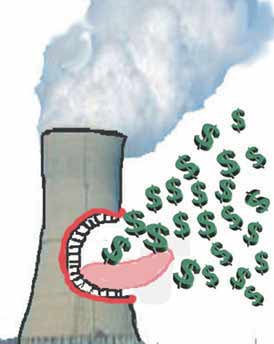 Nuclear solution comes with a huge price tag
North County Times By MARK WILLIAMS – AP Energy Writer | Saturday, May 2, 2009
COLUMBUS, Ohio —- A ghost from the nuclear industry’s early years has reappeared.
It is not public apprehension about safety or disposal issues this time, but the staggering cost of building nuclear reactors.
A wave of new reactors now in the works is intended to solve at least part of the nation’s energy problems as it attempts to shift away from fossil fuels. But cost is likely to plague every upcoming nuclear project.
This month in Missouri, the first of the next-generation reactors was put on hold because of the $6 billion price tag.
Whether or not AmerenUE’s Missouri reactor was a casualty of the current economic climate, the legal fight in several states shows how big the cost hurdle will be.
Some states have altered laws so that consumers begin footing the bill now, even before construction begins. Missouri did not.
“A large plant would be difficult to finance under the best of conditions, but in today’s credit-constrained markets, without supportive state energy policies, we believe getting financial backing for these projects is impossible,” said Thomas Voss, AmerenUE’s president and chief executive.
Reactors were expensive even 40 years ago at around $1 billion. The cost of AmerenUE’s Missouri project dwarfed even the market value of its parent company………………….. “It is so phenomenally costly that it crowds out capital needed for energy-efficiency and renewable energy,” said Mark Haim of Missourians for Safe Energy, a group that has been fighting Ameren’s plans.
Yet Republican lawmakers in Washington want more government funding for nuclear power…………….
http://www.nctimes.com/articles/2009/05/02/business/z6edbd99928ffa519882575a6006f16a6.txt
Project to move 15 million tons of radioactive waste begins
http://www.nctimes.com/articles/2009/05/02/business/z6edbd99928ffa519882575a6006f16a6.txt
Project to move 15 million tons of radioactive waste begins KSLTV 4 May 09 “…………………..They’re finally moving 16 million tons of radioactive dirt away from the town of Moab.
The radioactive dirt is going into big boxes, the boxes onto rail cars: a project that will cost about $1 billion. “You cannot put a price on the image and reputation of the state,” said Gov. Jon Huntsman. “The fact that 50 years ago, during the height of the Cold War, the decision was to make this dump 3 miles out of town, nobody would have thought twice about it. And today, it seems absolutely ludicrous that ever would have been done.”
Moab has been trying to get rid of it almost ever since the uranium mill that produced it shut down 25 years ago. “It’s sitting in the flood plain of the Colorado River and draining into the river,” explained Bill Hedden, executive director of Grand County Trust.
Nuclear power foes not stilled in N.E.
Nuclear power foes not stilled in N.E.
Boston.com 4 May 09 “………………….A march in Montpelier last week was only the latest reminder of ongoing opposition to Vermont Yankee’s bid to extend its operating license 20 more years.
The Vermont Public Interest Research Group wants the Vermont Yankee plant shut down, and assurances that its owner, Entergy Corp., will pay the full cost of decommissioning it. “There are millions of people that live within a dangerous distance of this facility,” said James Moore, clean energy advocate for the group, known as VPIRG…………………… A cadre of activists who oppose Vermont Yankee have built a statewide coalition to oppose the 20-year renewal of the plant’s current license, which expires in 2012. The issue will be subject to a vote by the Vermont Legislature in the coming year.
At last week’s demonstration, activists marched from Montpelier’s City Hall to the State House to urge lawmakers to back development of clean sources of energy such as wind and solar. The marchers also announced they had gathered 12,000 signatures in support of closing Vermont Yankee……………………. Environmentalists and others remain concerned that there is no national plan for long-term storage of nuclear waste.
Safety issues revealed at nuclear facility
Safety issues revealed at nuclear facility
Contractors used substandard materials
The State 3 May 09 By James Rosen WASHINGTON — Contractors at the Savannah River Site — one of the country’s major nuclear-weapons complexes — repeatedly procured dangerous construction materials and components that failed to meet federal safety standards, according to a recently completed internal government probe.
One of the substandard materials revealed at the Savannah River Site on the South Carolina-Georgia border “could have resulted in a spill of up to 15,000 gallons of high-level radioactive waste,” the inspector general of the U.S. Energy Department found.
The five-month investigation also disclosed the purchase of 9,500 tons of substandard reinforcing steel at the SRS site near Aiken……………………. Many employees are engaged in a huge environmental cleanup effort to mediate decades of toxic nuclear waste production……………………. Some environmentalists and other critics cast the NRC as a weak regulator plagued by cozy relationships with the power utilities that own and operate the civilian nuclear reactors it is charged with licensing and overseeing.
Heads of the Energy Department’s Office of Environmental Management, in charge of waste cleanup at SRS and other nuclear complexes, didn’t dispute the inspector general’s findings. http://www.thestate.com/local/story/772791.html
Russia To Ring The Arctic With Floating Nuclear Power Stations
GIZMODO
Jack Loftus (information from The Guardian) May 4, 2009
Mr. Polar Bear and his brethren will be sharing real estate with a ring of floating, self-sustained nuclear power stations. It’s all part of Russia’s—and the world’s—ongoing thirst for energy.Environmentalists are understandably outraged over the impact said stations could have on an already endangered area of the globe, and if polar bears could talk, I imagine they’d be outraged too.
Said a rep from Bellona, a Scandinavian environmental watchdog group, “[The plan] is highly risky. The risk of a nuclear accident on a floating power plant is increased. The plants’ potential impact on the fragile Arctic environment through emissions of radioactivity and heat remains a major concern. If there is an accident, it would be impossible to handle.
“Oh, and there’s this fear that Russia will simply dump the radioactive waste into the Arctic Sea anyway, which they’ve done before on several occasions. To date at least 12 nuclear reactors from decommissioned Russian submarines have been dumped, along with more than 5,000 containers of solid and liquid waste.Pretty soon the ocean will be like a 24/7 aurora borealis up there. A wonderful, cancer-causing aurora borealis.
Russia To Ring The Arctic With Floating Nuclear Power Stations – Gizmodo Australia
Olympic Dam EIS: Impact of the world’s biggest mine
Incomparable and unimaginable are not synonymous, but Olympic Dam is both. It will be the world’s biggest hole-in-the-ground, the largest copper and uranium quarry on the planet, the highest artificial mountain range on Earth and the richest mine since King Solomon………………….
The company will ultimately dig a hole 7.5 kilometres long, five kilometres wide and more than a kilometre deep.
Stacked up, the 44 billion tonnes or so of overburden would effectively create a new mountain range. Depending on its shape, it might be 20 kilometres wide in each direction and almost as high as Mt Lofty’s 720 metres………………………BHP has said it will not comment on the EIS after the weekend even though reporters can’t possibly read all the documents in the time available………..
………….The Independent Weekly understands that the Federal Government is planning much tougher safeguards relating to uranium sales to China, even if it’s gift-wrapped in copper concentrate. BHP does not yet have export permits for that uranium. In May next year nuclear non-proliferation nations, Australia included, will meet in New York. Australia may want a new international treaty to make sure Olympic Dam uranium does not end up in Chinese bombs………….
…………….here’s a prediction. Tomorrow’s EIS will say the project can go ahead on environmental grounds. The company will start moving to begin expansion and hope for a global economic recovery to coincide with increased production. BHP will pass the break-even point on its multi-billion investment within the first two decades, and after that it’s money in the bank all the way down to the year 2100.
But first, there’ll be new legislation presented in State Parliament to legalise the process. It will be a new form of the 1982 Roxby Downs Indenture Ratification Act. It will, once again, over-ride every other Act of Parliament passed up to now and into the future. The first that South Australians see of that legislation will be after the state election.
And BHP Billiton’s Olympic Dam will have an economic and environmental impact that is synonymous with mining on this scale: incomparable and unimaginable.
A cautionary history of the nuclear age | Cautionary tales
The nuclear age Cautionary tales
Apr 30th 2009 The Economist …………….The expectation of electricity “too cheap to meter” brought hopes in some quarters of an end to world poverty. Yet nuclear power proved costly and far from risk-free. Some presumed that by the turn of the 20th century there could be more than 500 fast-breeder reactors, fuelled by expanding stockpiles of plutonium.
By the millennium’s end not a single fast-breeder was in commercial operation (the necessary experimental forerunners produce plutonium in quantities useful for bomb-making). The Bush administration’s Global Nuclear Energy Partnership sought to revive the breeder idea (renaming it a fast-burner), but plans had to be shrunk due to cost, technological complexity and the danger of proliferation.
Whatever the nuclear technology used, the by-products thus far have been accidents (Three Mile Island and Chernobyl were among the worst but there have been plenty of others), pollution and piles of nuclear waste. Meanwhile technologies and materials acquired to keep the lights on can be misused in weapons.
Spread around generously in the 1950s and 1960s, “atoms for peace” helped get Argentina, Brazil, India, Israel, Pakistan, South Africa, South Korea, Taiwan and others started in the bomb business. (Other secretive programmes—in Iran, Libya, North Korea—thrived mostly on black-market connections.)
Now, once again, nuclear suppliers are signing up governments with nuclear ambitions, arguing that co-operation will help ensure the technology is put to proper use. But history suggests that no one can be sure where all this will lead.
A cautionary history of the nuclear age | Cautionary tales | The Economist
Ukraine Honors the Memory of the Victims of Chernobyl
Ukraine Honors the Memory of the Victims of Chernobyl
Epoch Times By Ekaterina Popova 29 April 09 23 years after the incident with the nuclear plant, the concrete slabs which buried 25 000 Ukrainians are crannied and radiation again threatens lives –
“………………On April 27, 1986, workers in Sweden in the nuclear plant Forsmark—about 680 miles from Chernobyl—were found to have radioactive particles on their clothes. Swedish authorities began investigating the case and established that there was no leakage or emissions from their reactor. Then it became clear that there was a serious problem in the western part of the Soviet Union. At that time, Finland had reported an increase in the level of radiation in the atmosphere.
Soviet authorities and the leaders of most countries in Eastern Europe continued to hide the truth from the public until the situation became out of control………….
……….According to scientific research, Belarus has absorbed 60 percent of the pollution. The radioactive cloud reached Bulgaria on May 1, coinciding with the celebration of Labor Day, with thousands of people out in the open.
Twenty-five thousand Ukrainians, known as “liquidators,” died in the early days while trying to keep the situation under control, trying to construct a concrete slab over the remains of the reactor.
In Ukraine alone, 2.3 million people are officially registered as victims of the tragedy. Immediately after the incident over 4,000 Ukrainians—children and adults—were operated on for cancer of the thyroid gland, the most common consequence of radiation exposure.
The nuclear plant was finally closed in 2000. Until then one of the reactors continued to produce electricity.
The facility continues to be dangerous, as the concrete cover, which was laid over 200 tons of radioactive fuel, has started to crack. To prevent further problems, a steel sarcophagus is planned to be built, which will cover the concrete.
Epoch Times – Ukraine Honors the Memory of the Victims of Chernobyl
Study examines radiation dose estimates for pregnant women undergoing therapeutic ERCP
Study examines radiation dose estimates for pregnant women undergoing therapeutic ERCP
Eureka Alert Anne Brownsey 29 April 09 – ” …………………. – Pregnant women with gallstone disease may require immediate endoscopic intervention because of potentially life-threatening cholangitis (infection in the bile ducts) or gallstone pancreatitis (inflammation of the pancreas).
The radiation exposure in endoscopic retrograde cholangiopancreatography (ERCP), which is used to treat these conditions, is a concern because fetal tissues are more susceptible to radiation injury.
Researchers from Greece found that the radiation risks associated with ERCP procedures are not trivial and that accurate fetal dose estimation is now available regardless of patient body size, operating parameters, equipment used and gestational stage.
The study appears in the April issue of GIE: Gastrointestinal Endoscopy, the monthly peer-reviewed scientific journal of the American Society for Gastrointestinal Endoscopy (ASGE).
Study examines radiation dose estimates for pregnant women undergoing therapeutic ERCP
Cabinet to charge for creation and storage of radioactive waste
Cabinet to charge for creation and storage of radioactive waste Kyiv Post 30 April 09 Interfax
-Ukraine National Nuclear Energy Generating Company Energoatom is to pay charges for creating and storing radioactive waste, according to a new cabinet resolution.
The company is obliged to pay UAH 0.0063 per 1 kWh of produced energy plus extra fees depending on the storage costs and the amount of waste material.
The Cabinet of Ministers on April 24 approved the respective resolution, No. 391, which comes into force on May 1 this year.
According to the document, other companies in the sector are to calculate the sum of charges depending on the level of radiation of the materials, and pay 10% of the value of an ionizing irradiation source every month.
The document stipulates that these fees will not be charged if the waste is returned to the company that produced the initial nuclear material abroad.
1 This Month





PLEASE OPPOSE HR 8255 AND S.3639 – bills would accelerate satellite deployment, with no environmental review or safeguards – https://ncstd5li.quorum.us/campaign/169331/
To see nuclear-related stories in greater depth and intensity – go to https://nuclearinformation.wordpress.com
-
Archives
- October 2026 (58)
- September 2026 (339)
- August 2026 (330)
- July 2026 (355)
- June 2026 (287)
- May 2026 (306)
- April 2026 (356)
- March 2026 (251)
- February 2026 (267)
- January 2026 (308)
- December 2025 (358)
- November 2025 (359)
-
Categories
- 1
- 1 NUCLEAR ISSUES
- business and costs
- climate change
- culture and arts
- ENERGY
- environment
- health
- history
- indigenous issues
- Legal
- marketing of nuclear
- media
- opposition to nuclear
- PERSONAL STORIES
- politics
- politics international
- Religion and ethics
- safety
- secrets,lies and civil liberties
- spinbuster
- technology
- Uranium
- wastes
- weapons and war
- Women
- 2 WORLD
- ACTION
- AFRICA
- Atrocities
- AUSTRALIA
- Christina's notes
- Christina's themes
- culture and arts
- Events
- Fuk 2022
- Fuk 2023
- Fukushima 2017
- Fukushima 2018
- fukushima 2019
- Fukushima 2020
- Fukushima 2021
- general
- global warming
- Humour (God we need it)
- Nuclear
- RARE EARTHS
- Reference
- resources – print
- Resources -audiovicual
- Weekly Newsletter
- World
- World Nuclear
- YouTube
-
RSS
Entries RSS
Comments RSS

