The Problem With Nuclear Power
Early on man realized that fossil fuels would soon run out, and so nuclear power was born. It was glorified as the cleaner alternative to oil and coal power stations, promising lower emissions and environmental safety. But has it really lived up to our expectations? And is it the ideal energy solution for the future? We think not…………………
Nuclear power cannot solve global warming:
Once seen as the solution to global climate change, nuclear power is far from it. Everywhere along the nuclear chain – from the mining of uranium to its transportation to the construction of the power plant – greenhouse gases are emitted.
Furthermore, their construction takes too long to solve global warming. In fact, investing in nuclear power deprives other efforts – such as energy efficiency, conservation and renewable energy – of further funding and development.
Nuclear plants release radiation:
The levels of radiation released in the air, water and soil are considered “safe”. However, this standard is based on how it impacts healthy, white males and does not take consideration for children that are sensitive to cancer-causing radiation.
They create harmful radioactive waste:
From mining to milling, processing to enrichment, fuel fabrication to fuel irradiation in reactors, large amounts of harmful, long-lasting radioactive waste is produced. In addition to 20-30 tons of high-level radioactive waste per reactor per year, this includes so-called “low” level radioactive waste.
The current solution for the “disposal” or “storage” of this waste is unacceptable. There is no scientifically safe place to dump this waste, and new reactors would exacerbate the problem. Additional “low” level radioactive waste would have to be dumped in landfills or incinerated, polluting the water and air.
Nuclear plants are too costly:
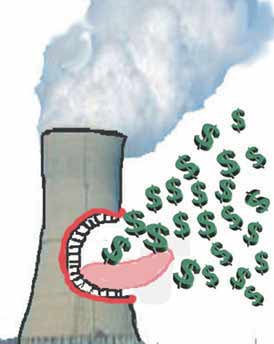
At $6 to $12 billion each, nuclear reactors are not a cheap solution. Nuclear power has already been subsidized hundreds of billions of dollars. Why should we, the taxpayers, subsidize the electric utility companies’ investments any longer?
Development of nuclear technology brings war and terrorism:…………………..Any accident will be catastrophic:
welcome to my space » Blog Archive » The Problem With Nuclear Power
Cost Overruns at Finland Reactor Hold Lessons
In Finland, Nuclear Renaissance Runs Into Trouble
OLKILUOTO, Finland — As the Obama administration tries to steer America toward cleaner sources of energy, it would do well to consider the cautionary tale of this new-generation nuclear reactor site.
The massive power plant under construction on muddy terrain on this Finnish island was supposed to be the showpiece of a nuclear renaissance. The most powerful reactor ever built, its modular design was supposed to make it faster and cheaper to build. And it was supposed to be safer, too.
But things have not gone as planned.
After four years of construction and thousands of defects and deficiencies, the reactor’s 3 billion euro price tag, about $4.2 billion, has climbed at least 50 percent. And while the reactor was originally meant to be completed this summer, Areva, the French company building it, and the utility that ordered it, are no longer willing to make certain predictions on when it will go online…………………………Most of the new construction is underway in countries like China and Russia, where strong central governments have made nuclear energy a national priority…………………………….resistance is mounting. In April, Missouri legislators balked at a preconstruction rate increase, prompting the state’s largest electric utility, Ameren UE, to suspend plans for a $6 billion copy of Areva’s Finnish reactor…………………………Areva has acknowledged that the cost of a new reactor today would be as much as 6 billion euros, or $8 billion, double the price offered to the Finns.
Climate crisis will not be solved by nuclear power
Guest column: Climate crisis will not be solved by nuclear power greenbay pressgazette.com Bill Christofferson • May 27, 2009 Concern about climate change has sparked a campaign by the nuclear power industry to try to sell itself as a “clean” energy solution, with Wisconsin a key target……….the campaign to persuade the Legislature and governor to open the door to more reactors in Wisconsin, which has not built one since 1974……..
……….Nuclear power makes no more sense today than it did when the law was passed in 1983. Wisconsin must address the climate crisis, but renewable energy and energy efficiency technologies are faster, cheaper, safer and cleaner strategies for reducing greenhouse emissions than nuclear power………………
French nuclear utility deep in debt
EDF confronts $34.2 billion debt pile
Troubled French utility, Electricite de France, which acquired half of U.S. utility, Constellation Energy, in December, has already offloaded part of its ownership of British Energy, which it also acquired last year. EDF is staggering under a $34.2 billion debt pile and has sold 20% of British Energy – the British nuclear operator – to Centrica. EDF will also try to raise $1.4 billion through retail bonds. For more on EDF’s financial struggles, read here and here. Furthermore, new nuclear build in the UK may be in jeopardy as EDF is demanding government subsidies there to go forward. Read more here.
Is the Nuclear Renaissance Fizzling?
May 29, 2009, Is the Nuclear Renaissance Fizzling?
The New York Times By James Kanter
“……………. long-standing problems with the technology still could lead to canceled orders and renewed public opposition. One problem is what to do with the highly dangerous waste produced by reactors. Currently waste is stored above ground in pools of water or in vast dry casks, but neither of those methods is regarded as adequate over the long term……………..…………..Another recurring problem is the high up-front price tag of nuclear technology compared with other sources of energy. Utilities were already canceling nuclear power plants before the accidents at Three Mile Island and Chernobyl. The reason? Huge cost overruns………..
…….nuclear’s difficult history with financing could be repeating itself, as the first two reactors that were meant to lead a comeback have been delayed and are running over-budget.
And even if stars do align for nuclear, it still could take some time for it to play a significant role in lowering greenhouse gas levels,
Is the Nuclear Renaissance Fizzling? – Green Inc. Blog – NYTimes.com
Kazakhstan unrest dims Uranium One shares 40%
Kazakhstan unrest dims Uranium One shares 40%’Misunderstanding’ swirls about stake in Kazakh mine: CEOPeter Koven, Financial Post May 28, 2009
A political flare-up in Kazakhstan’s uranium sector has prompted new investor concerns about an authoritarian country that the world is relying on to provide much of its nuclear fuel in the future.
Yesterday, the government accused Mukhtar Dzhakishev, the former head of state-owned uranium miner Kazatomprom, of illegally selling stakes in uranium deposits to foreign companies……………………………..
The broader issue is that the arrest and the accusations, which came out of nowhere, reinforce the fact the political risk in Kazakhstan remains enormous for mining companies.
Uranium deposits are usually considered strategic by host countries, which makes it difficult for uranium miners such as Cameco Corp. to access most markets. As a result, they have flocked to Kazakhstan, which has emerged as a huge uranium hotbed in the past decade.
Another Top Kazakh Uranium Company Official Arrested –
Another Top Kazakh Uranium Company Official Arrested Radio Free Europe
May 27, 2009ASTANA — Baurzhan Ibraev, the vice president of the Kazakh state uranium company Kazatomprom, has been arrested, RFE/RL’s Kazakh Service reports.
Ibraev’s arrest on May 25 comes after company President Mukhtar Dzhakishev and his deputies — Dmitry Parfenov, Askar Kasabekov, and Malkhaz Tsotsoria — were arrested last week and charged with theft……………….Of the seven top managers at Kazatomprom, only two are not in jail, including former National Security Committee chief Nartai Dutbaev.
Another Top Kazakh Uranium Company Official Arrested – Radio Free Europe / Radio Liberty © 2009
Push is on for full cleanup of NY nuclear site
Push is on for full cleanup of NY nuclear site
newsday.com By CAROLYN THOMPSON | Associated Press Writer May 29, 2009 BUFFALO, N.Y. – With a little more than a week left to be heard in the decades-old debate over how to clean up a western New York nuclear site, supporters of complete decontamination say anything less would jeopardize the health of the Great Lakes and its vital freshwater.State and federal energy officials in November recommended a two-phase plan that would have them spend $1 billion to remove contaminated buildings and soil from the West Valley site over the next several years, while deferring for up to 30 years the larger question of whether to leave some radioactive waste forever buried…………..………Environmentalists and others say removing all traces of high- and low-level waste is the only way, given the erosion-prone geology, to ensure that it will not eventually seep into nearby creeks, make its way into Lakes Erie and Ontario and contaminate drinking water supplies.
“Common sense dictates we make a decision now to protect the Great Lakes and protect the water,” Diane D’Arrigo of the Nuclear Information & Resource Service said Friday…………………….
………U.S. Reps. Brian Higgins and Eric Massa, both New York Democrats, support a full cleanup and said they would ask Energy Secretary Steven Chu for a 90-day extension of the public comment period that began in November.
Among others weighing in to support a full cleanup have been the Presbytery of Western New York, which passed a resolution citing its “Christian commitment to caring for creation,” Catholic Charities and the Western New York Council on Occupational Safety & Health.
Push is on for full cleanup of NY nuclear site — Newsday.com
Uranium intrigue
Uranium intrigue
Market Blog May 28, 2009 The Globe and Mail Uranium One Inc. (UUU-T2.20-0.21-8.71%) was whacked on Wednesday after the head of Kazakhstan’s state-owned uranium mining company was reportedly arrested and accused of illegally selling uranium concessions to foreign companies – a potentially big problem, given that Uranium One operates in Kazakhstan.
New Coal and Nuclear Plants May Not Be Needed, U.S. Energy Official Says
New Coal and Nuclear PlantsMay Not Be Needed, U.S. Energy Official Says
e360 digest23 Apr 2009:
Renewable energy technologies have come far enough that the U.S. may not need to build any new coal or nuclear plants, the chairman of the Federal Energy Regulatory Commission said. “We may not need any, ever,” Jon Wellinghoff said at a forum of the U.S. Energy Association. The development of smart grid technologies that better store capacity from wind, solar and biomass sources, he said, will eventually meet the nation’s energy demands — and make coal-fired and nuclear plants unnecessary……………………..Wellinghoff insists the existing concept of baseload capacity will be an “anachronism” as the technology develops to store power capacity, such as a system for concentrated solar plants that currently allows 15 hours of storage.
Yale Environment 360: New Coal and Nuclear Plants
May Not Be Needed, U.S. Energy Official Says
Kyrgyzstan: Radioactive Legacy Vexes Bishkek
Friday, May 29, 2009EURASIANET.org KYRGYZSTAN: RADIOACTIVE LEGACY VEXES BISHKEK David Trilling 5/27/09 – “…………………..In March 2008, officials from Kyrgyzstan’s Emergencies Ministry began moving radioactive uranium waste from Soviet-era dumps — located in poorly fortified ravines and along riverbeds downstream — into the hills just above his home. “It gives us headaches; our eyes itch,” Toko says as he gestures across the road. Now he grows his fruits and vegetables in water potentially contaminated by the radioactive materials.
A few kilometers downstream from Toko’s house there are even more lethal radioactive deposits — known as tailings. They line the river and surround the former industrial town of Mailuu Suu, now home to acres of derelict factory buildings. Not too long ago, the area was a desirable place to live. ………………………….as much as 10,000 tons of yellowcake (U3O8), a refined form of uranium that can be used either to produce nuclear energy or atomic weapons, was produced in Mailuu Suu for Soviet weapons programs. The first Soviet atomic weapon was made from uranium mined at Mailuu Suu, say officials at Kyrgyzstan’s National Academy of Science. Communist central planners tended to care about results, not the potential consequences of their decisions. Thus little thought was given to the disposal of radioactive waste. Approximately 2 million cubic meters of uranium tailings were buried in the area, according to Kyrgyz government statistics. It is the largest such site in the country. In addition to the 23 tailings dumps, workers sprinkled almost a million cubic meters of uranium waste rock atop 13 dumps nearby, on land still exposed to the rain and annual mudslides.
Many of the tailing sites and waste rock dumps are now poorly marked. Sheep graze on them. Water drains through the radioactive material and downstream into Uzbekistan and the Syr Darya, which winds its way through Central Asia’s most densely populated areas.
Mailuu Suu residents complain of goiter, anemia, cancer and early death. Radiation in some areas is 30 times normal levels. Former Mailuu Suu mayor Bumairam Mamaseitova, currently an MP in Bishkek with the opposition Communist Party, says rates of cancer in Mailuu Suu are the highest in Kyrgyzstan. “All of the diseases are related to those uranium tailings in the area.” For her, it is a personal issue. “This issue of uranium tailings worries me a lot because my father died when he was only 52 years old. He used to work in the uranium mines. I was born and have lived in Mailuu Suu. Most of my relatives died in their 50s.”
Dumps there are thought to be the most dangerous in Kyrgyzstan, due to the valley’s higher-than-avera
EurasiaNet Civil Society – Kyrgyzstan: Radioactive Legacy Vexes Bishkek
Gorleben nuclear storage site developed illegally
Gorleben nuclear storage site developed illegally The Local 29 May 09lThe salt dome at the Gorleben nuclear waste depot was developed illegally to be permanent storage facility, according to an internal assessment by the Federal Office for Radiation Protection (BfS) attained by daily Frankfurter Rundschau on Thursday. Since work began on the underground facility in the 1980s, only permission for “exploration” has been granted. But even without an official authorisation, the paper said that costs for assessing the salt dome for its suitability had been high because “the construction of the permanent storage depot was begun parallel to the investigation.”
The Federal Office for Radiation Protection did not want to confirm the existence of the document, but did admit that costs had been higher than necessary.
Some €1.5 billion has been invested in the site.
Work at Gorleben has been suspended since 2000, when the government decided to wait until 2010 to resume the controversial project.
The appearance of the documents has confirmed the doubts of nuclear energy opponents, who believed that Gorleben had been earmarked as a permanent storage depot before the safety of the salt dome had been adequately investigated.
Nuclear energy is deeply unpopular in Germany
Gorleben nuclear storage site developed illegally – The Local
Nuclear power? Great! Nuclear waste? Wait! | Canada | News | Toronto Sun
Nuclear power? Great! Nuclear waste? Wait! By JONATHAN JENKINS, QUEEN’S PARK BUREAUL Toronto Sun : 26th May 2009,
Cabinet minister Rick Bartolucci is 100% for his government’s plans to build new nuclear reactors and 100% against storing their waste in his constituency.
“I don’t see a conflict in regard to my government’s direction at all,” Bartolucci, the minister for community safety and corrections, said yesterday.
Nuclear power? Great! Nuclear waste? Wait! | Canada | News | Toronto Sun
Canada to Seek Buyers for Atomic Energy of Canada, Globe Says – Bloomberg.com
Canada to Seek Buyers for Atomic Energy of Canada, Globe Says
By Greg Quinn
May 28 (Bloomberg) — Canada will seek buyers for part of Atomic Energy of Canada Ltd., seeking to boost sales of its Candu reactors, and is looking for new managers of a damaged reactor that makes medical isotopes, the Globe and Mail newspaper said.
The state-owned company would be split into a Candu division and a division for the isotope-producing reactor, the newspaper said, citing people it didn’t name who are familiar with the plans.
The isotope reactor will remain shut down for at least three months to make emergency repairs, and about C$7 billion ($6.3 billion) is needed for waste clean up at the site, the newspaper said.
Canada to Seek Buyers for Atomic Energy of Canada, Globe Says – Bloomberg.com
Forget reprocessing nuclear waste
Forget reprocessing nuclear waste New Times SLO Paso Robles Klaus Schumann May 27th, 2009, i “………..
………….. the Ford and Carter administrations scrapped the U.S. reprocessing program in the late ’70s precisely because of the abundance of problems associated with it. It was deemed too expensive and too polluting in terms of further radioactive co
tamination. Worst of all, reprocessing doesn’t “recycle” the waste. It creates new radioactive wastes, some which can be directly converted into nuclear weapons, increasing proliferation risks.
Meanwhile, reprocessing plants in Europe, Russia, and Japan are plagued by radiation leaks and other scandalous problems. The Union of Concerned Scientists considers reprocessing as “dangerous, dirty and expensive.” Moreover, especially since 9/11, furth
r concerns have emerged, such as nuclear terrorism or accidents during frequent shipments. Overall, reprocessing was a bad idea then and is an even worse idea now.
New Times SLO | Publishing Local News and Entertainment for over 20 years in San Luis Obispo County
1 This Month





PLEASE OPPOSE HR 8255 AND S.3639 – bills would accelerate satellite deployment, with no environmental review or safeguards – https://ncstd5li.quorum.us/campaign/169331/
To see nuclear-related stories in greater depth and intensity – go to https://nuclearinformation.wordpress.com
-
Archives
- October 2026 (49)
- September 2026 (339)
- August 2026 (330)
- July 2026 (355)
- June 2026 (287)
- May 2026 (306)
- April 2026 (356)
- March 2026 (251)
- February 2026 (267)
- January 2026 (308)
- December 2025 (358)
- November 2025 (359)
-
Categories
- 1
- 1 NUCLEAR ISSUES
- business and costs
- climate change
- culture and arts
- ENERGY
- environment
- health
- history
- indigenous issues
- Legal
- marketing of nuclear
- media
- opposition to nuclear
- PERSONAL STORIES
- politics
- politics international
- Religion and ethics
- safety
- secrets,lies and civil liberties
- spinbuster
- technology
- Uranium
- wastes
- weapons and war
- Women
- 2 WORLD
- ACTION
- AFRICA
- Atrocities
- AUSTRALIA
- Christina's notes
- Christina's themes
- culture and arts
- Events
- Fuk 2022
- Fuk 2023
- Fukushima 2017
- Fukushima 2018
- fukushima 2019
- Fukushima 2020
- Fukushima 2021
- general
- global warming
- Humour (God we need it)
- Nuclear
- RARE EARTHS
- Reference
- resources – print
- Resources -audiovicual
- Weekly Newsletter
- World
- World Nuclear
- YouTube
-
RSS
Entries RSS
Comments RSS

