They are calling fast-track Ukraine EU bid ‘nonsense.’ So why dangle it?
It’s supposed to soften the blow for lost NATO membership. But Kyiv is hardly ready and not all members are enthusiastic.
Ian Proud, Responsible Statecraft, Dec 18, 2025
Trying to accelerate Ukraine’s entry into the European Union makes sense as part of the U.S.-sponsored efforts to end the war with Russia. But there are two big obstacles to this happening by 2027: Ukraine isn’t ready, and Europe can’t afford it.
As part of ongoing talks to end the war in Ukraine, the Trump administration had advanced the idea that Ukraine be admitted into the European Union by 2027. On the surface, this appears a practical compromise, given Ukrainian President Volodymyr Zelensky’s concession that Ukraine will drop its aspiration to join NATO.
However, the idea of accelerated entry for Ukraine has not been met with widespread enthusiasm in Europe itself. Diplomats in Brussels dismissed the notion as “nonsense: There needs to be an appetite for enlargement that isn’t there.”
There are two big problems with Ukraine’s rapid accession, the first being readiness and the second cost.
Firstly, Ukraine is nowhere near ready to meet the EU’s exacting requirements for membership. The process of joining the bloc is long and complex. At the start of November, in presenting its enlargement report, the EU said that it could admit new members as early as 2030, with Montenegro the most advanced in negotiations.
After it was formally granted candidate status in June 2022, Ukraine this year passed screening of its progress against the various chapters of the acquis (regulations) that it needs to pass before accession is granted. However, the EU enlargement report on Ukraine downgraded the country’s status from A+ to B, largely in light of the corruption scandal that first erupted in the summer and that rumbles on today.
The report indicated that Ukraine had made good progress on just 11 of the 33 chapters required for accession. It has made limited progress on 7 of the chapters, including on corruption, public procurement, company law and competition policy. It has yet to finalize negotiations on any of the chapters. And, of course, with war still raging, it is incredibly difficult to both agree and put in place the reforms needed to align itself with EU rules and standards. So, even if the war ended by Christmas, which despite the progress still appears optimistic, it would be unlikely to do all of the necessary work in the space of a year to be ready for accession.
The second, possibly more insurmountable challenge is cost.
In July, German Chancellor Friedrich Merz commented that Ukraine was unlikely to join before 2034. The EU has already formalized its next seven year budget through to that time, coming in at $2.35 trillion.
As I pointed out for Responsible Statecraft last year, Ukrainian membership of the EU would come with an enormous price tag……………………………………………. So the economic cost of delivering Ukrainian membership may not be politically viable any time soon, and certainly not before 2034, as the German premier has indicated.
……………………………………With practically all Russia-Ukraine economic ties severed over the past decade, Russian President Vladimir Putin has dropped his opposition to EU membership for Ukraine. An end to the war would allow Ukraine, finally, to start to reform and rebuild its bankrupt economy, and EU membership could accelerate that process.
That’s why Zelensky’s decision to drop the aspiration to NATO membership is such an important stepping stone. It has been abundantly clear since the start of the war that Russia’s NATO red line will never change. Russia has verbalized its opposition at least since Putin’s Munich Security Conference speech in 2007, when he said that NATO expansion “represents a serious provocation that reduces the level of mutual trust.”
……………………………………..https://responsiblestatecraft.org/ukraine-european-union/
Memory as Resistance: Why Hibakusha Testimonies Matter for Nuclear Justice Today
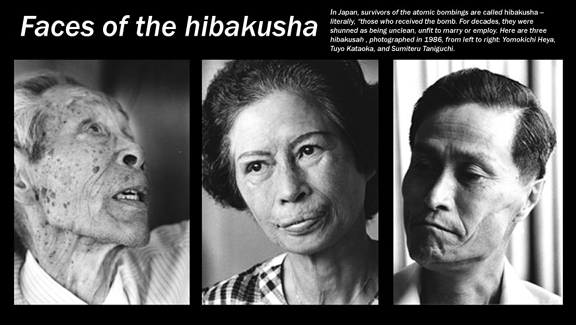
By Monalisa Hazarika
ICAN Australia and Monalisa Hazarika, Dec 19, 2025, https://icanaustralia.substack.com/p/memory-as-resistance-why-hibakusha?utm_source=post-email-title&publication_id=6291617&post_id=181742900&utm_campaign=email-post-title&isFreemail=true&r=1ise1&triedRedirect=true&utm_medium=email
How do we live with memories of discrimination when they are woven into our earliest or most defining experiences? How do we find the strength to speak about encounters we would rather protect our loved ones from? And how do we ensure that the injustices we faced are never repeated? For hibakusha, these questions are not rhetorical; their testimonies turn memory into resistance—insisting that lived experience remains central to struggles for nuclear justice today.
The Story of Lee Jong Keun
The following tells the story of Lee Jong Keun, a non-Japanese hibakusha, as shared by his legacy successor, Mozume Megumi—who has been entrusted to convey his testimony. Mr. Lee, born in 1928, was a Zainichi (residing in Japan) Korean with the Japanese name Egawa Masaichi. He, like many other Koreans at that time, was forced to adopt Japanese-style family names as part of Soshi Kaimei—a Japanese colonial policy aimed at broader assimilation efforts. As a Zainichi, he experienced persistent discrimination from childhood, including being targeted for something as simple as bringing Korean food in his lunchbox. He noted that in school, he was routinely singled out and blamed for wrongdoing, reflecting the broader social prejudice faced by Korean minorities in Japan.
At sixteen, Mr. Lee was a mechanic living in the suburbs of Hiroshima, taking the train each day to his workshop. But on the morning of August 6, 1945, he missed his usual stop and boarded a tram instead—a small change that, as he later said, ended up saving his life. He recalled seeing a sudden pika (a blinding flash), thinking it was a flare bomb, and instinctively covered his eyes, nose, and ears, and crouched on the ground. When he opened his eyes again, the previously sunny morning had turned into pitch-black darkness. People were running for shelter, others trapped under rubble were crying for help. The city was unrecognisable. He described seeing people with peeling skin, charred bodies, and desperate cries for assistance; images that left him feeling helpless, confused, and overwhelmed by fear and pain.
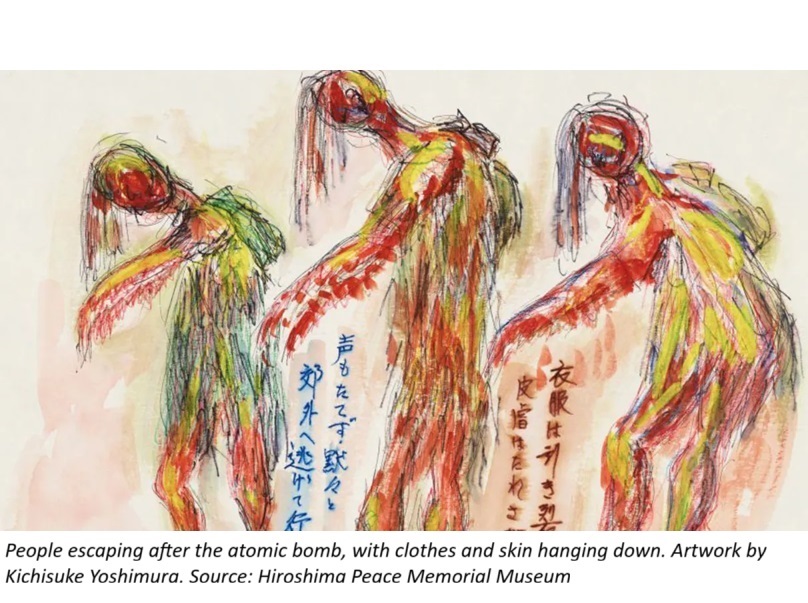
As a railroad worker, he received the limited medical care available, mostly Mercurochrome—a red antiseptic containing mercury—which his family used to treat his burns. He remembered his mother quietly crying as she cleaned the wounds each day, removing maggot eggs and tending to the foul-smelling injuries on his back. Her whispered fear that death might have been kinder than such suffering stayed with him. Yet amid the devastation, he also remembered the kindness of his neighbours. One family, despite having very little themselves, shared a small jar of vegetable oil each week to soothe his burns—an act of generosity that stood in stark contrast to the stigma and isolation survivors faced during that time.
Hibakusha and Non-Japanese Hibakusha
Hibakusha—atomic bomb survivors—faced profound social, economic, and psychological discrimination rooted in widespread misconceptions about radiation sickness. In post-war Japan, many believed that radiation-related conditions were contagious or hereditary, resulting in exclusion from employment, healthcare, marriage prospects, and community life. For non-Japanese hibakusha such as Mr. Lee, this marginalisation was compounded by ethnic discrimination. They endured both the trauma of the bombings and the persistent stigma of being perceived as “outsiders,” leading some, including Mr. Lee, to conceal their survivor status from even close family members for decades. They faced social stigma linked to radiation’s visible effects and persistent institutional neglect tied to their nationality and residency status
Beyond social prejudice, non-Japanese hibakusha have continued to confront bureaucratic obstacles, limited political recognition, and inconsistent access to state support. Restrictions on eligibility for medical subsidies, complex residency verification processes, and legal battles over compensation have left many without adequate care. Their exclusion from formal policymaking spaces has further limited their ability to advocate for their rights. Despite incremental progress, these survivors remain on the margins of disarmament and public health policy, underscoring the need for sustained diplomatic attention, inclusive historical acknowledgment, and equitable survivor support frameworks.
Stories like Mr. Lee’s are not alone and stand as stark reminders of the human cost of misguided policies pursued in the name of national or global security. Across Japan and around the world, thousands of hibakusha, their descendants, and dedicated activists continue to shoulder the burden of history while working tirelessly to ensure its lessons are not forgotten with a collective message: never again!
Hibakusha testimonies are not only records of past violence—they are acts of resistance. By insisting on truth, dignity, and accountability, they challenge systems that normalise nuclear harm and demand justice in the present.
Under Article 6 of the United Nations Treaty on the Prohibition of Nuclear Weapons (TPNW), states must provide age and gender sensitive assistance to victims of nuclear weapons use or testing. This must be enacted without discrimination, including medical care, rehabilitation, and psychological support, and provide for their social and economic inclusion. Countries must be obligated to assist survivors, many of whom share a similar story to Mr Lee, and ensure that nuclear weapons use and testing are prohibited in the future, possible through the advocacy of the TPNW.
About the Author
Monalisa Hazarika is the Strategic Communication and Partnership Officer at the SCRAP Weapons Project. She is one of the UN Youth Champions for Disarmament under the United Nations Office for Disarmament Affairs’ #Youth4Disarmament programme. She is an emerging voice in conventional arms control and meaningful youth engagement, featuring most recently at a UNGA-ECOSOC Joint Meeting. Her areas of expertise and research focus include small arms and light weapons, especially non-industrial weapons and their trends in illicit manufacture and trade, transnational organised crime, and the proliferation of 3D-printed weapons.
Book -Secretary Of Perpetual War

by Caitlin Johnstone (Author), Timothy P Foley (Author)
Part of: JOHNSTONE (28 books) https://www.amazon.com/dp/1923372157?utm_source=substack&utm_medium=email
As the US murder machine ramps up for yet another war of aggression against yet another oil-rich nation in Venezuela, Secretary of War Pete Hegseth has been trying to meme his way out of a major scandal after he was exposed as having authorized the “double-tap” murder of men who survived a US missile strike on a boat in the Caribbean.
In mockery of the uproar over the news, Hegseth posted a meme on Twitter featuring an AI-generated image of the children’s book character Franklin the Turtle with the caption “Franklin Targets Narco Terrorists”. The phrase “narco terrorists” is the slogan the Trump administration has come up with to justify its extrajudicial executions of alleged drug traffickers which it has been using as a pretense to amass a major military presence in the waters near Venezuela.
I personally am glad the US has swapped out the name Department of Defense for the far more honest name Department of War. When was the last time the American military was used to defend the United States? It never happens. Call it what it is. Only thing more honest would be to call it the Department of Perpetual War.
India’s Parliament approves bill to open civil nuclear power sector to private firms
DailyMail, By ASSOCIATED PRESS, 19 December 2025
NEW DELHI (AP) – India´s Parliament approved new legislation Thursday that enables opening the tightly controlled civil nuclear power sector to private companies.
The government termed it a major policy shift to speed up [?] clean energy expansion while the opposition political parties argued that it dilutes safety and liability safeguards.
The lower house of parliament passed the legislation Wednesday and the upper house on Thursday. It now needs the assent from the Indian president, which is a formality, to come into force.
………….. critics say it opens the door to risks, mainly health hazards, that could have long term consequences…………..
some are skeptical about India´s ambitions as the country´s nuclear sector is still very small, and negative public perceptions about the industry remain.
Opposition parties flagged concerns related to several provisions of the bill and urged the government to refer it to a parliamentary panel for examination. The government didn´t adhere to the request.
“The bill doesn´t have sufficient safeguards when it comes to mitigating the bad health of those impacted by living in areas closer to nuclear plants,” Ashok Mittal, a lawmaker from the opposition Aam Admi Party, told The Associated Press.
G. Sundarrajan, an anti-nuclear energy activist, called the bill a “disastrous law,” saying it takes away essential safeguards that are needed to make sure companies invest in safety and reduce the chances of a major disaster that can impact millions from occurring.
“It also provides little recourse for any Indian citizen to claim damages from nuclear companies even if they are affected by radiation leaks or suffer from any other health impact as a result of a nuclear plant in their region,” he said. https://www.dailymail.co.uk/wires/ap/article-15396015/Indias-Parliament-approves-bill-open-civil-nuclear-power-sector-private-firms.html
Over the Moon and Down to Earth
15 December 2025, https://www.banng.info/news/regional-life/over-the-moon-and-down-to-earth/
Varrie Blowers writes for the December 2025 issue of Regional Life magazine
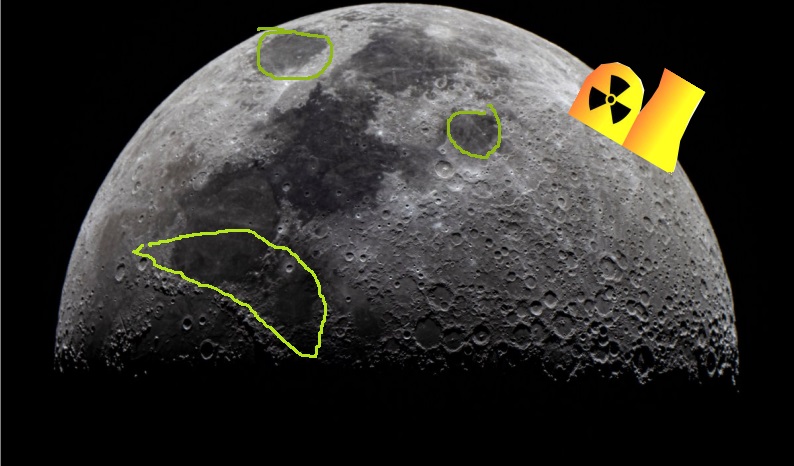
If Bradwell is an unsuitable site for nuclear development……what about the Moon? Although it can be seen shining over the Blackwater and appear quite close, the Moon is actually almost 239,000 miles away. But Sean Duffy, the Acting Administrator of NASA, is over the Moon at the idea of such development.
A new space race is starting between the USA and Russia in collaboration with China planning to build nuclear reactors on the Moon, in 2030 and 2035 respectively, to power bases. No doubt other members of the space club will wish to follow where they lead. Is this a case of the unbelievable becoming believable?
A key problem for building nuclear reactors on the Moon is getting them up there in the first place – in the hope that the transporting rockets do not explode (not unknown!) and shower radioactive particles on populated areas below.
Another is that a stable power supply would be required to sustain the astronauts who would have to get the reactors up and running. This would seem to be impossible; the location for the proposed bases is the Moon’s dark South Pole, where solar power could not provide a consistent supply.
Among other serious problems are:
the Moon’s very environment with its extreme thermal cycles, abrasive dust, reduced gravity, cosmic radiation, the lack of atmosphere;- astronauts in space suits, it seems, would be unable to maintain the reactors regularly meaning that electronic components that could last for a very long time without being replaced would be needed;
- the vast expense and need for sustained funding with cost and time overruns
So why would any nation wish to attempt to undertake a project that appears to be a non-starter? To undertake space exploration…… or space exploitation?
The motive behind the bases is the desire to exploit what are regarded as the Moon’s vast resources of minerals, including rare earths, metals and helium.
All of this prompts the question of ‘Who owns the Moon?’. The answer according to the UN Outer Space Treaty of 1967 is that space, including the Moon, belongs to us all and should be used peacefully for the benefit of all nations. It is, however, unlikely that any nation with a base would regard the resources as ‘belonging to us all’.
History should warn us that in this grab for the Moon’s riches, likely clashes between nations would arise, perhaps even leading to military conflict in space.
We are in danger of transporting our problems to the Moon. Back down to Earth, we have enough problems to cope with.
Less Than 50 Days Before New START Treaty Expires

Concerned Citizens for Nuclear Safety, 19 Dec 25
The New Strategic Arms Reduction Treaty, or the New START Agreement, is set to expire on Thursday, February 5th, 2026 – in less than 50 days. The New START Agreement is the last remaining nuclear arms control treaty between the United States and the Russian Federation.
It was signed in 2010. It limits the number of strategic long-term nuclear warheads and launchers that the United States and Russia can deploy.
And, without any New START Agreement, there would be no limits on United States and Russian nuclear weapons stockpiles.
In September, President Putin offered a one-year extension; President Trump, unfortunately, has not responded in an official manner. https://nuclearactive.org/putin-proposed-to-extend-new-start-treaty-for-one-year-trump-has-not-formerly-responded/
73 Organizations Send Joint Letter Calling on the Federal Government to Improve Nuclear Waste Oversight

73 organizations representing a broad segment of Canadian society have sent a joint letter to the federal government urging more oversight of the nuclear industry and of nuclear waste projects.
In the letter, the groups urged the Prime Minister and the Ministers of Environment and Climate Change and of Energy and Natural Resources to exercise oversight of the Nuclear Waste Management Organization’s “Adaptive Phased Management Project” to transport, process, bury and eventually abandon all of Canada’s nuclear fuel waste at the NWMO’s selected site in the heart of Treaty 3 Territory in northwestern Ontario and its upcoming impact assessment process.
The groups expressed an overarching concern about the lack of federal oversight of this project since its inception in 2002.
More recently, the NWMO has made it known that they are seeking to have transportation of the radioactive wastes excluded from the project’s impact assessment process. But for 20 years the NWMO has been describing transportation as part of their project, and the Impact Assessment Act requires activities that are integral to – or, in the language of the Act “incidental” to – the project be included in the assessment.
The joint letter requests that the federal government provide immediate oversight and direction in four areas:
73 organizations representing a broad segment of Canadian society have sent a joint letter to the federal government urging more oversight of the nuclear industry and of nuclear waste projects.
In the letter, the groups urged the Prime Minister and the Ministers of Environment and Climate Change and of Energy and Natural Resources to exercise oversight of the Nuclear Waste Management Organization’s “Adaptive Phased Management Project” to transport, process, bury and eventually abandon all of Canada’s nuclear fuel waste at the NWMO’s selected site in the heart of Treaty 3 Territory in northwestern Ontario and its upcoming impact assessment process.
The groups expressed an overarching concern about the lack of federal oversight of this project since its inception in 2002.
More recently, the NWMO has made it known that they are seeking to have transportation of the radioactive wastes excluded from the project’s impact assessment process. But for 20 years the NWMO has been describing transportation as part of their project, and the Impact Assessment Act requires activities that are integral to – or, in the language of the Act “incidental” to – the project be included in the assessment.
The joint letter requests that the federal government provide immediate oversight and direction in four areas:
Cancer risk may increase with proximity to nuclear power plants.

By Maya Brownstein, December 18, 2025, https://hsph.harvard.edu/news/cancer-risk-may-increase-with-proximity-to-nuclear-power-plants/
In Massachusetts, residential proximity to a nuclear power plant (NPP) was associated with significantly increased cancer incidence, with risk declining by distance, according to a new study led by Harvard T.H. Chan School of Public Health.
The study was published Dec. 17 in Environmental Health. It was conducted by researchers in the Department of Environmental Health, including corresponding author Yazan Alwadi, PhD student, and senior author Petros Koutrakis, professor of environmental sciences.
Despite widespread—and potentially expanding—reliance on nuclear power in the U.S., epidemiologic research investigating the health impacts of NPPs remains limited. Meanwhile, the results of studies conducted internationally vary significantly. To broaden the evidence base, the researchers assessed proximity of Massachusetts zip codes to nuclear power plants and 2000-2018 cancer incidence data collected by the Massachusetts Cancer Registry. They controlled for confounders such as air pollution and sociodemographic factors.
The researchers estimated that about 20,600 cancer cases in the state—roughly 3.3% of all the cases included in the study—were attributable to living near an NPP, with risk declining sharply beyond roughly 30 kilometers from a facility. The risk of developing cancer attributable to living near an NPP generally increased with age.
According to the researchers, the findings highlight the importance of acknowledging and addressing nuclear energy’s health impacts, particularly at a time when its expansion is being promoted as a solution to climate change.
Read the study:
Residential proximity to nuclear power plants and cancer incidence in Massachusetts, USA (2000–2018)
Israeli Ministers Wear Noose Pins to Symbolize Support for Killing Palestinians

The pins resemble the hostage pins that Israeli leaders have worn throughout the Gaza genocide.
By Sharon Zhang , Truthout, December 8, 2025, https://truthout.org/articles/israeli-ministers-wear-noose-pins-to-symbolize-support-for-killing-palestinians/
Ultranationalist Israeli politicians, including National Security Minister Itamar Ben-Gvir, wore golden noose-shaped lapel pins to a meeting on Monday in order to show their “commitment” to advancing a widely condemned bill to mandate the death penalty for “terrorists” who kill Israelis.
The pins resemble the yellow ribbon pins that Israeli leaders have worn throughout their genocide to to acknowledge the Israeli captives held in Gaza.
Ben-Gvir boasted about the pins, worn by members of his Otzma Yehudit party, saying that they show the politicians’ “commitment to the demand for the death penalty for terrorists.”
The politicians were attending a hearing on a bill advancing through the Israeli Knesset that would ensure that those who kill Israelis “with the aim of harming the State of Israel” would be given the death penalty. Critics have noted that the bill is worded in such a way that it would effectively exclusively target Palestinians, in the latest instance of Israeli politicians advancing policies to further entrench Israel’s apartheid.
Ben-Gvir boasted that the nooses are “one of the options by which the law will enforce a death penalty for terrorists.” He seemed to relish in the idea of the death penalty, saying, “of course, there is the option of the gallows, the electric chair, and there is also the option of lethal injection,” Israeli media reported.
The bill, which passed a first reading last month, has been roundly condemned by human rights experts.
“Knesset members should be working to abolish the death penalty, not broadening its application. The death penalty is the ultimate cruel, inhuman, and degrading punishment, and an irreversible denial of the right to life. It should not be imposed in any circumstances, let alone weaponized as a blatantly discriminatory tool of state-sanctioned killing, domination and oppression,” said Erika Guevara Rosas, Amnesty International’s Research, Advocacy, Policy and Campaigns director.
The bill comes amid “a drastic increase in the number of unlawful killings of Palestinians, including acts that amount to extrajudicial executions” since October 2023 and “a climate of incitement to violence against Palestinians as evidenced by the surge in state-backed settler attacks in the occupied West Bank,” Guevara Rosas said.
Indeed, Ben-Gvir also boasted about the deaths of Palestinians in Israeli custody under his watch. According to Israeli media, 110 Palestinians have died under his prison policies in the past two and a half years — a “record high,” Israeli outlet Walla reported. This is compared to 187 Palestinian detainees recorded killed in Israeli prisons between 1967 and 2007. The true toll may be far higher, as Israel obscures statistics on Palestinian prisoners and captives.
“This morning, I saw that it was published that under Itamar Ben-Gvir, 110 terrorists have died. They said there has never been anything like this since the state’s founding,” Ben Gvir boasted, while also denying that his policies were related to the killings.
Last month, the Israeli Medical Association said that its doctors would not participate in the executions, as that would force them to go back on their oath as doctors. “Our knowledge must not be used for purposes that do not promote health and welfare,” a representative of the group said.
Ben-Gvir claimed on Monday, however, that since that statement, “I have received a hundred calls from doctors saying, ‘Itamar, just tell me when.’”
Trump’s rush to build nuclear reactors across the U.S. raises safety worries
NPR, December 17, 2025
In May, President Trump sat in the Oval Office flanked by executives from America’s nuclear power industry.
“It’s a hot industry. It’s a brilliant industry,” the president said from behind the Resolute desk.
It’s also an industry that’s having a moment. Billions of dollars in capital are currently flowing into dozens of companies chasing new kinds of nuclear technologies. These are small modular designs that can potentially be mass produced in the hundreds or even thousands. Their proponents say these advanced designs promise to deliver megawatts of power safely and cheaply.
But there’s a problem, Joseph Dominguez, the CEO of Constellation Energy, told the president.
New nuclear plants keep getting caught up in safety regulations.
“Mr. President, you know this because you’re the best at building things,” Dominguez, whose company runs about a quarter of America’s existing nuclear reactors, said. “Delay in regulations and permitting will absolutely kill you. Because if you can’t get the plant on, you can’t get the revenue.”
Now, a new Trump administration program is sidestepping the regulatory system that’s overseen the nuclear industry for half a century. The program will fast-track construction of new and untested reactor designs built by private firms, with an explicit goal of having at least three nuclear test reactors up and running by the United States’ 250th birthday, July 4, 2026.
If that goal is met, it will be without the direct oversight of America’s primary nuclear regulator. Since the 1970s, safety for commercial reactors has been the purview of the Nuclear Regulatory Commission. But the NRC is only consulting on the new Reactor Pilot Program, which is being run by the Department of Energy’s Office of Nuclear Energy……………………………………………………………………………………………………
Sites across the country will host new reactor designs
The new pilot program may be an unproven regulatory path run by an agency with limited experience in the commercial sector, but supporters say it’s energizing an industry that’s been moribund for decades.
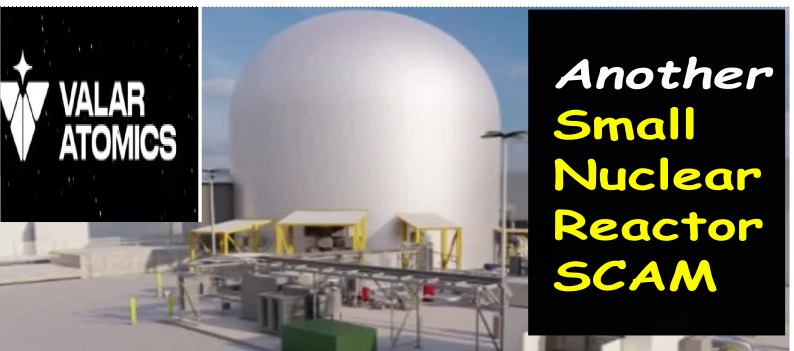
“This is exactly what we need to do,” said Isaiah Taylor, founder and CEO of Valar Atomics, a small nuclear startup headquartered in Hawthorne, Calif. “We need to make nuclear great again.”
Valar and other companies plan to build smaller reactors than those currently used in the nuclear industry, and that makes a Chernobyl or Fukushima-type accident impossible, noted Nick Touran, an independent nuclear consultant. “The overall worst-case scenario is definitely less when you’re a smaller reactor,” he said.
Critics, however, worry that the tight July 4 deadline, political pressure and a lack of transparency are all compromising safety. Even a “small” release of radioactive material could cause damage to people and the environment around the test sites.
“This is not normal, and this is not OK, and this is not going to lead to success,” warned Allison Macfarlane, a professor at the University of British Columbia who served as chairman of the NRC under President Barack Obama. “This is how to have an accident.”
AI’s need for speed
……………………………………………………………………………………………………………. Right from the start it was clear that, unlike the slow and deliberate safety culture that has dominated nuclear power for decades, this new program would be all about speed.
…………officials responsible for overseeing safety would do “whatever we need to ensure that the government is not stopping you from reaching [nuclear] criticality on or before July 4, 2026.”
A new regulator
Before the executive order, the Energy Department did not regulate the safety of commercial nuclear reactors. That job fell to another body: the Nuclear Regulatory Commission.
The commission was set up in 1975 by Congress as an independent safety watchdog, said Allison Macfarlane, the former NRC chair. Part of the reason the NRC was formed was because the predecessor to the DOE, known as the Atomic Energy Commission, oversaw both safety and promotion of nuclear power at the same time.
“This was a very strong conflict of interest,” Macfarlane said.
But in recent years, companies, particularly those trying to build new kinds of reactors, had become frustrated with the NRC, Macfarlane said. “The promoters of these small modular reactors were becoming very vociferous about the NRC being the problem,” she said.

In 2022, the NRC rejected a combined license application for Oklo, a new nuclear startup. Oklo had submitted an application to build and operate its small reactor, called the Aurora powerhouse. But the NRC denied the application because it contained “significant information gaps in its description of Aurora’s potential accidents as well as its classification of safety systems and components.”
Oklo was told it could resubmit its application to the NRC, but it never did.
Then at the May signing of the executive order, Oklo’s CEO Jacob DeWitte appeared behind President Trump applauding the new reactor program at DOE.
“Changing the permitting dynamics is going to help things move faster,” DeWitte said to the president. “It’s never been more exciting.”
Oklo had another connection to the Energy Department — the secretary of energy, Chris Wright, was a member of Oklo’s board of directors until he took the helm at the DOE. Wright stepped down following his confirmation in February.
In August, a little over a month after that initial meeting between industry executives and the DOE, the Office of Nuclear Energy announced the 11 advanced reactor projects had been selected for the Reactor Pilot Program. Three of Oklo’s reactors were part of the new pilot program, including a test version of the reactor design rejected by the NRC…………………………………………………………………………………………………………
Valar’s design looks far different from the reactors that are running today. It will use a special type of fuel together with a high-temperature gas to generate heat and electricity. Taylor said gathering real data will speed development and increase safety over the long-term….
(Valar is also party to a lawsuit against the NRC arguing the commission does not have the authority to regulate small reactors. In his interview, Taylor told NPR the company intends to file for an NRC license “when we’re ready.”)
………………………………………………….. critics question whether the pilot program will really produce safe nuclear reactors.
The July 4, 2026, deadline puts enormous pressure on the program, said Heidy Khlaaf, the chief AI scientist at the AI Now Institute, which recently published a report warning that AI development could undermine nuclear safety.
“I think these manufactured timelines are actually incredibly concerning,” Khlaaf said. “There’s no timeline for assessing a new design and making sure it’s safe, especially something we haven’t seen before.”
Then there’s the question of public transparency. The NRC makes many of the documents around its decisions available publicly. It also frequently allows the public to comment as well, added Edwin Lyman, director of nuclear power safety at the nonprofit Union of Concerned Scientists. The new pilot program is far more opaque and “is really an attempt to subvert the laws and regulations that go around commercial nuclear power,” he said.
While many of the test reactors are small and tout themselves as inherently safer than existing nuclear power plants, they are still capable of leaking radiation in an accident, Lyman noted. “If they are located closer to populated areas, if there aren’t any provisions for offsite radiological emergency planning … then you are potentially putting the public at greater risk, even if the reactors are small,” he said.
Perhaps most worrying, said former NRC Chair Macfarlane, is how the DOE’s safety assessment might be used to build more small reactors across the country, once the pilot reactors are built.
………………………………………..Macfarlane is unconvinced. She said relying on the hasty DOE analysis for the construction of potentially dozens or even hundreds of small reactors around the U.S. is the real risk.
“They can look at what the DOE did, they can take it as a piece of input, but they have to do their own separate analysis,” she warned. “Otherwise, none of us are safe.” https://www.npr.org/2025/12/17/nx-s1-5608371/trump-executive-order-new-nuclear-reactors-safety-concerns
Julian Assange: Sweden Broke Own Laws With Nobel Prize to Venezuela’s Machado

The same dynamic is at play in the Caribbean once again, according to Assange, as the Nobel Committee crowns a Venezuelan politician best known for her unhinged appeals for foreign military intervention and her dedication of her Nobel victory to US President Donald Trump.
Max Blumenthal and Wyatt Reed, The Grayzone, December 17, 2025
By awarding its peace prize to Trump’s favorite Venezuelan opposition figure, pro-war coup plotter Maria Corina Machado, the Nobel Committee contravened the principles enshrined in its founding documents, as well as Swedish law, Julian Assange alleged in an explosive brief reviewed by The Grayzone.
The Swedish government violated its own laws by awarding the Nobel Peace Prize to Venezuelan opposition figure Maria Corina Machado, according to an explosive legal brief filed by Julian Assange, the Wikileaks co-founder and former political prisoner who was hounded across the globe, confined in harsh conditions, and subjected to physical and psychological torment over the course of a decade by the US and its allies.
The Nobel committee’s decision to award Machado the Peace Prize — and the 11 million Swedish Kroner ($1.18 million USD) reward which accompanies it — means that “there is a real risk that funds derived from Nobel’s endowment have been or will be… diverted from their charitable purpose to facilitate aggression, crimes against humanity, and war crimes,” Assange stated.
The Wikileaks founder pointed to the “ample public statements… showing that the U.S. government and María Corina Machado have exploited the authority of the prize to provide them with a casus moralis for war,” adding that the explicitly stated purpose of the war sought by Machado and her wealthy Latin American backers would be “installing her by force in order to plunder $1.7 trillion in Venezuelan oil and other resources.”
The Nobel Foundation stands accused of a number of violations of Swedish criminal law, including breach of trust, misappropriation and gross misappropriation, conspiracy, crimes against international law, as well as financing of aggression, facilitation of war crimes and crimes against humanity, and breaching Sweden’s stated obligations under the Rome Statute, to which Stockholm says it is “deeply committed.”
Under Swedish law, “Alfred Nobel’s endowment for peace cannot be spent on the promotion of war,” Assange noted. “Nor can it be used as a tool in foreign military intervention. Venezuela, whatever the status of its political system, is no exception.”
By granting Nobel funds to Machado, Assange argues that the Committee is effectively financing “a conspiracy to murder civilians, to violate national sovereignty using military force…” By refusing to end payments, “they flagrantly violate Nobel’s will and clearly cross the threshold into criminality,” he alleged. The Wikileaks co-founder seeks the “immediate freezing of all remaining funds and a full criminal investigation” into Committee members who awarded the prize.
The Nobel Prizes were established in 1901 according to Swedish inventor Alfred Nobel’s last will and testament, which was later incorporated into the Swedish and Norwegian legal systems. The Peace Prize, which is meant to be bestowed on the figure who has contributed most to “fraternity between nations,” the “abolition or reduction of standing armies,” and “the holding and promotion of peace congresses,” has served as a cornerstone of Scandinavian soft power ever since.
Since its inception, however, the prize was marred by controversy due to the violent legacy of its recipients, and the political ambitions of its Norwegian sponsors. In the case of one of the Prize’s first winners, US President Theodore Roosevelt, the Norwegian Nobel Committee was criticized at the time for overlooking the American statesman’s naked warmongering in Latin America in order to curry favor with the nascent US empire. The New York Times sardonically observed that “a broad smile illuminated the face of the globe when the prize was awarded … to the most warlike citizen of these United States.”
The same dynamic is at play in the Caribbean once again, according to Assange, as the Nobel Committee crowns a Venezuelan politician best known for her unhinged appeals for foreign military intervention and her dedication of her Nobel victory to US President Donald Trump.
As Assange explained, Trump’s massive buildup of US military forces off the coast of Venezuela “has already committed undeniable war crimes, including the lethal targeting of civilian boats and survivors at sea, which has killed at least 95 people.”
“The Office of the United Nations High Commissioner for Human Rights labeled these U.S. coastal strikes against civilian boats “extrajudicial executions,” the Wikileaks co-founder wrote. And the “principal architect of this aggression” was none other than Trump’s Secretary of State Marco Rubio, who “nominated María Corina Machado for the peace prize.”
Norwegian Nobel judges tied to influential Venezuelan regime change lobbyist
The awarding of the Nobel Peace Prize to a figure as clearly unqualified as Machado – and in apparent violation of Swedish law – raised questions about whether the Committee had been influenced by powerful outside interests. Machado’s nomination for the prize by the US Secretary of State had an undeniable impact on the decision, as the Nobel ceremony serves as a central channel of Norwegian soft power. But inside Oslo, a political powerbroker determined to return to power in his family’s native Venezuela may have also played a role in swinging votes for Machado. ………………………………………………………………………………………………………………………………..
The odds of Machado winning surged from 3.75% to 72.8% just hours before the Nobel Committee officially informed Machado of her victory. One unusually prescient bettor won $65,000 gambling on the Venezuelan opposition figure. “It seems we have been prey to a criminal actor who wants to earn money on our information,” said Kristian Berg Harpviken, the head of the Nobel Institute.
Months later, The Nobel committee still has yet to conclude its investigation into the corruption scandal. As of publication, the committee did not respond to a request for comment by The Grayzone.
For what promotes itself as the world’s premiere peacemaking institution, it may be too late to undo the damage wrought by giving the Nobel Prize to an avowed champion of violent regime change.
“Using her elevated position as the recipient of the Nobel Peace Prize, Machado may well have” already “tipped the balance in favor of war,” Assange concluded. https://thegrayzone.com/2025/12/17/julian-assange-sweden-nobel-venezuelas-machado/
Nuclear power plant is threat to our future.

Western Morning News, Jo Smoldon Bridgwater, Somerset18 Dec 2025,
https://www.pressreader.com/uk/western-morning-news/20251218/281835765040539
YES, of course the Stop Hinkley event you publicised (Letters, December 13) was Christmas humour, but it does concern us that significant facts are being ignored about the outdated Hinkley Point C new (old) nuclear power plant being built on our precious Severn estuary when climate change predictions suggest that the Hinkley coastline will be inundated and flooding will occur across Somerset.
How will this be safe when HPC radioactive waste will be too hot to move and will have to reside on the fragile coastline for over 200 years?
It seems that there are not enough skilled workers to complete the HPC job which has had design problems, despite supposedly learning from the mistakes at Olkiluoto, in Finland, Flammanville, in France, and Taishan, in China.
The original workforce of 8,000 has now had to increase to 15,000, and still the start-up date is up in the clouds. The costs have escalated from £18 billion to current predicted costs of £46 billion and rising.
How is the country going to pay for this and all the other pie in the sky so-called new nuclear builds that roll off the tongues of the fast turnover of politicians that have been involved?
So far it has taken 10 Prime Ministers, starting with Thatcher, to partially build HPC. Their legacy is a big mistake that nobody has the courage to say we shouldn’t have started this, it’s a runaway train on which nobody has figured out how to apply the brakes.
HPC is finished. HPC will never be needed, I believe, other than for a building site training programme.
Not one of those Prime Ministers will be accountable for the toxic high level radioactive waste that will be lurking on the Severn estuary coastline far into the future for our children’s children to pay for and deal with.
The level of radioactivity of the waste will be in total around 80% of the radioactivity level currently of Sellafield. This fact alone will mean that Hinkley will be the Sellafield of the South.
Hinkley’s design is currently in the news due to its intention of destroying more of our precious Severn estuary fish and marine life in its massive cooling water intakes, which will suck in an Olympic-sized swimming pool of water every 20 seconds.
EDF is faltering over its requirement to protect the fish with an acoustic fish deterrent. Even so, this technology may save some of the fish, but the eggs and fry will pass into the cooling system and be destroyed by the heat and chemicals, which will then be pumped back out into the estuary.
The technology of nuclear power belongs to the last century and is wasteful of energy. The steam process results in two thirds of the heat energy being pumped out into the estuary warming the sea.
Stop Hinkley continues to hold EDF to account, and we will be watching, and we will be back for the next predicted finish date of 2027 with our HPC Christmas turkey to cook.
Arctic endured year of record heat as climate scientists warn of ‘winter being redefined’

Oliver Milman, Guardian 16th Dec 2025
Region known as ‘world’s refrigerator’ is heating up as much as four times as quickly as global average, Noaa experts say
The Arctic endured a year of record heat and shrunken sea ice as the world’s northern latitudes continue a rapid shift to becoming rainier and less ice-bound due to the climate crisis, scientists have reported.
From October 2024 to September 2025, temperatures across the entire Arctic region were the hottest in 125 years of modern record keeping, the US National Oceanic and Atmospheric Administration (Noaa) said, with the last 10 years being the 10 warmest on record in the Arctic.
The Arctic is heating up as much as four times as quickly as the global average, due to the burning of fossil fuels, and this extra heat is warping the world’s refrigerator – a region that acts as a key climate regulator for the rest of the planet……………………………………………………………………….. https://www.theguardian.com/world/2025/dec/16/artic-record-heat-shrunken-sea-ice-report
Subject: Rushing to Deregulation – the report of the Nuclear Regulatory Taskforce

NFLA 18th Dec 2025
Introduction:
‘Nuclear plants should be built closer to urban areas and should be allowed to harm the local environment’ so concluded The Times, 24 November 2025 on reporting on the findings of the Nuclear Regulatory Taskforce in its final report to the UK Government. This recommendation made to Ministers
flew in the face of accepted policy, the Semi-Urban Population Density Criteria. that building new nuclear plants near towns and cities should be banned because of the risk posed to large numbers of people in the event of an accident involving radioactive materials.
Many of the other 46 recommendations made by the NRTs were equally disquieting, representing a
manifesto of deregulation – a ‘radical reset’ – in the vain hope that this will spark a renaissance in the nuclear industry, with new nuclear plants thrown up more quickly and more cheaply.
The outcome of the inquiry was effectively predetermined in line with a press release from the Office of the Prime Minister issued 6 February 2025. This appeared to mirror the front pages of vituperative pro-nuclear newspapers, with Prime Minister Starmer speaking of his determination to ‘slash red tape to get Britain building [new nuclear power stations] – as part of his Plan for Change ‘with the government ‘ripping up archaic rules and saying no to the NIMBYS to prioritise growth’.
The press release announced that the Prime Minister was establishing a Nuclear Regulatory Taskforce charged
with making this vision a reality which will ‘report directly to the PM’.
i
Although supposedly independent, three of the five taskforce members had clear links to the nuclear industry (Andrew Sherry is former chief scientist at the National Nuclear Laboratory, Dame Sue Ion has held various posts in UK nuclear industry bodies, and Mark Bassett is a member of the InternationalNuclear Safety Advisory Group), handy for a body charged with identifying the means to sideline Britain’s ‘overly bureaucratic’ nuclear regulations.
Cynics – like this author – might postulate that the findings were largely pre-written at the outset and that the real purpose of the taskforce was to seek to justify them.
In working upon this justification, the taskforce, reinforced by intermittent but consistent statements from Government Ministers, nuclear trades unions, and industry lobbyists, has sought to trash regulators as overzealous, and their regulations as disproportionate, and campaigners and members of the public who oppose nuclear development as NIMBYS and BLOCKERS, with their recourse to legal remedies seen as irksome……………………………………………………………………………………………………………………………………………………https://www.nuclearpolicy.info/wp/wp-content/uploads/2025/12/A445-NB331-Rushing-to-Deregulation-Dec-2025.pdf
Elon Musk Slams Nuclear Energy As ‘Super Dumb’, Declares Solar Power The Real Future.
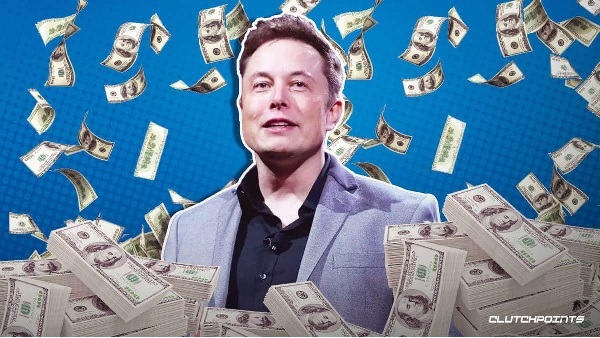
Elon Musk’s solar business, anchored by the 2016 Tesla-SolarCity merger, now operates under Tesla Energy, offering solar panels, Solar Roof systems, and battery storage to promote renewable home energy solutions.
NDTV, Edited by: Nikhil Pandey, Offbeat, Dec 16, 2025
After recently making headlines for his comments on womanhood, Elon Musk has once again stirred the internet, this time with a blunt take on the future of clean energy. The Tesla and SpaceX CEO has taken a jab at nuclear power, calling it inefficient compared to solar energy.
In a viral post on X, Musk dismissed the global obsession with building nuclear fusion reactors on Earth, calling the idea “super dumb.” He argued that instead of chasing complex nuclear solutions, humanity should focus on harnessing solar energy, the very source that powers our entire planet naturally.
He argued that humanity is ignoring the most powerful fusion reactor already available, the Sun.
“The Sun is an enormous, free fusion reactor in the sky. It’s super dumb to make tiny fusion reactors on Earth,” Musk wrote on X. He added, “Even if you burned four Jupiters, the Sun would still account for nearly 100% of all power ever produced in the solar system. Stop wasting money on puny little reactors – unless you’re openly admitting they’re just science experiments.”
At the heart of Musk’s argument is the idea that solar power is vastly underused. He views it as the most abundant, clean, and logical alternative to fossil fuels. His blunt remarks, telling governments and companies to quit investing in miniature fusion projects unless they’re labelled as experimental, quickly gained massive attention online, sparking fresh discussions on the direction of global energy policy…………….
Another user argued that if sunlight were a weapon, humanity would have harnessed solar power centuries ago, noting that just 1/10,000th of the solar energy hitting Earth could meet all global energy need…………………………. https://www.ndtv.com/offbeat/elon-musk-slams-nuclear-energy-as-super-dumb-declares-solar-power-the-real-future-9824354
1 This Month



Tell the Ukrainian Government to Drop Prosecution of Peace Activist Yurii Sheliazhenko

Petition to revoke the licensing of the Near Surface Nuclear Disposal Facility (NSDF) at Chalk River. https://www.ourcommons.ca/petitions/en/Petition/Details?Petition=e-7247


of the week – STOP SMALL MODULAR REACTORS IN CANADA
To see nuclear-related stories in greater depth and intensity – go to https://nuclearinformation.wordpress.com
-
Archives
- March 2026 (222)
- February 2026 (268)
- January 2026 (308)
- December 2025 (358)
- November 2025 (359)
- October 2025 (376)
- September 2025 (258)
- August 2025 (319)
- July 2025 (230)
- June 2025 (348)
- May 2025 (261)
- April 2025 (305)
-
Categories
- 1
- 1 NUCLEAR ISSUES
- business and costs
- climate change
- culture and arts
- ENERGY
- environment
- health
- history
- indigenous issues
- Legal
- marketing of nuclear
- media
- opposition to nuclear
- PERSONAL STORIES
- politics
- politics international
- Religion and ethics
- safety
- secrets,lies and civil liberties
- spinbuster
- technology
- Uranium
- wastes
- weapons and war
- Women
- 2 WORLD
- ACTION
- AFRICA
- Atrocities
- AUSTRALIA
- Christina's notes
- Christina's themes
- culture and arts
- Events
- Fuk 2022
- Fuk 2023
- Fukushima 2017
- Fukushima 2018
- fukushima 2019
- Fukushima 2020
- Fukushima 2021
- general
- global warming
- Humour (God we need it)
- Nuclear
- RARE EARTHS
- Reference
- resources – print
- Resources -audiovicual
- Weekly Newsletter
- World
- World Nuclear
- YouTube
-
RSS
Entries RSS
Comments RSS
 nuclear-news