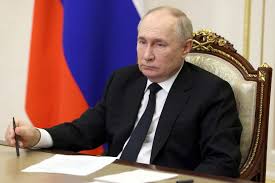
Russian President Vladimir Putin said Thursday that if the United States and the United Kingdom allow Ukraine to strike deep inside Russia with Western missiles, “it will mean nothing less than the direct involvement of NATO countries.”
“This is not a question of allowing the Ukrainian regime to strike Russia with these weapons or not. It is a question of deciding whether or not NATO countries are directly involved in a military conflict,” Putin told Russian state TV. “This will be their direct participation, and this, of course, will significantly change the very essence, the very nature of the conflict.”
Putin’s remarks came amid reports that U.S. President Joe Biden appears poised to let Ukraine use long-range missiles against Russia, signaling a perilous new phase in a deadly war that has dragged on for two and a half years since Russia’s invasion in February 2022.
According toThe New York Times, “President Biden appears on the verge of clearing the way for Ukraine to launch long-range Western weapons deep inside Russian territory, as long as it doesn’t use arms provided by the United States.”
Russian President Vladimir Putin said Thursday that if the United States and the United Kingdom allow Ukraine to strike deep inside Russia with Western missiles, “it will mean nothing less than the direct involvement of NATO countries.”
“This is not a question of allowing the Ukrainian regime to strike Russia with these weapons or not. It is a question of deciding whether or not NATO countries are directly involved in a military conflict,” Putin told Russian state TV. “This will be their direct participation, and this, of course, will significantly change the very essence, the very nature of the conflict.”
Putin’s remarks came amid reports that U.S. President Joe Biden appears poised to let Ukraine use long-range missiles against Russia, signaling a perilous new phase in a deadly war that has dragged on for two and a half years since Russia’s invasion in February 2022.
According toThe New York Times, “President Biden appears on the verge of clearing the way for Ukraine to launch long-range Western weapons deep inside Russian territory, as long as it doesn’t use arms provided by the United States.”
“The issue, which has long been debated in the administration, is coming to a head on Friday with the first official visit to the White House by Britain’s new prime minister, Keir Starmer,” the Times reported Thursday. “Britain has already signaled to the United States that it is eager to let Ukraine use its ‘Storm Shadow’ long-range missiles to strike at Russian military targets far from the Ukrainian border. But it wants explicit permission from Mr. Biden in order to demonstrate a coordinated strategy with the United States and France, which makes a similar missile.”
Ahead of the decision, the Pentagon pointed to Iran’s alleged transfer of ballistic missiles to Russia as further reason to bolster Ukraine’s military capabilities. A spokesperson for Iran’s foreign ministry said in response that “the publication of false and misleading reports about the transfer of Iranian weapons to some countries is simply ugly propaganda to conceal the large illegal arms support of the United States and some Western countries for the genocide in Gaza.”
Ukraine, which has received roughly $55.7 billion in military assistance from the U.S. since February 2022, has already launched repeated drone attacks deep inside Russia, but Western permission for Kyiv to use long-range missiles could be a dire escalation.
As Politiconoted, Moscow could retaliate against a long-range missile strike on Russia by hitting “a target inside NATO, such as the critical weapons supply hub in the Polish city of Rzeszów.” Such an exchange could result in direct conflict between the nuclear-armed powers.
“Military experts argue any guidelines agreed for the British weapons at the two-hour summit in Washington could also then pave the way for the Ukrainians to fire U.S.-supplied ATACMS—a tactical ballistic missile system—at airfields and army bases deep inside Russia,” the outlet observed.
The potential intensification and spread of the war comes as the prospect of a diplomatic resolution appears nonexistent, at least in the near term.
Aída Chávez, communications director and policy adviser at Just Foreign Policy, wrote for The Intercept earlier this week that members of the U.S. Congressional Progressive Caucus were “pilloried” over an October 2022 letter urging Biden to “make vigorous diplomatic efforts in support of a negotiated settlement and ceasefire, engage in direct talks with Russia, explore prospects for a new European security arrangement acceptable to all parties that will allow for a sovereign and independent Ukraine, and, in coordination with our Ukrainian partners, seek a rapid end to the conflict and reiterate this goal as America’s chief priority.”
Today, Chávez wrote, the progressives who signed the letter—which was ultimately withdrawn by the CPC leadership—”look more prescient than ever.”
“Since the ill-fated letter, the war has ground on—with devastating results for the people of Ukraine,” Chávez continued. “Ukraine is not in a position to win the war, nor does it have a stronger bargaining position in talks than it did in late 2022 when the CPC letter came out.”
Tell the Biden administration to call off NATO-backed strikes inside Russia, stop arming Ukraine and support a ceasefire before a world war breaks out between nuclear powers.
We understand the United States and United Kingdom are ready to announce that they will be lifting restrictions on Ukraine’s use of NATO weapons, allowing them to be used to strike deep inside Russia, according to the Guardian and Politico. This news follows former State Department official Victoria Nuland’s admission the US torpedoed a peace deal between Ukraine and Russia a month after Russia invaded Ukraine.
We demand the Biden administration reverse course: call off NATO-backed strikes inside Russia, stop arming Ukraine and support a ceasefire before another world war breaks out.
The Guardian reports, “British government sources indicated that a decision had already been made to allow Ukraine to use Storm Shadow cruise missiles on targets inside Russia.” The missiles will be launched from Ukraine but targeted and guided by NATO technicians. In response, Putin says long-range arms for Ukraine will mean “NATO countries are at war with Russia.”
We demand the Biden administration pursue a diplomatic resolution to the war in Ukraine, call off NATO-supplied missiles striking inside Russia and avert World War III between nuclear powers.
We want Vice President Kamala Harris to know that we do not support her bellicose pledges to continue the war in Ukraine, nor her warmongering words at the DNC when she promised to ensure America always has the “strongest, most lethal fighting force in the world.” The world has suffered enough at the hands of US lies and violence.
In the words of Anatoly Antonov, the Russian Ambassador to the US, Washington “continues to test the limits of our tolerance for hostile steps” and is “paving the way to World War III.”
STOP. Seek a diplomatic resolution now–before it’s too late.
John O’Groat Journal By Iain Grant, 13 September 2024
An action plan has been drawn up by operators NRS to address the issues which include ageing, deteriorating plant, radioactive leaks and the storage of chemicals.
Among the problem areas is the condition of buildings in the prototype fast reactor being used to store drums of radioactive sodium.
An inspection by the Office for Nuclear Regulation (ONR), in April made grim reading for site management. It found significant corrosion and metal loss of structural steelwork in the turbine hall.
It concluded “It was judged that the steam generator hall and generator transformer house are not adequate, as the licensee has failed to safely protect the drums against uncontrolled degradation via air and moisture ingress.
“It is also judged that the licensee is not recognising when there is degradation in these areas.”
The issue first came to light following a probe into a minute leak of radioactive tritium from a sodium drum in the turbine hall in November 2022. Its exposure to rainwater through a leaky roof was blamed for causing the corrosion.
The inspection was one of a number carried out at Dounreay in the spring and summer to receive an amber rating by ONS. Others revealed some elderly electrical plant in a “degraded” state while Dounreay was found to have breached the Control of Major Accident Hazards (CoMAH) regulations by its stockpile of chemicals being over its set limit. A fire safety inspection was generally positive but flagged up a “significant shortfall” in assessment and control of sources of dangerous substances.
The inspector said: “It is my judgement that Dounreay do not currently understand the totality of risk presented by dangerous substances on site and therefore cannot provide adequate assurance as to the safety of personnel on site.”
The top US diplomat has repeated Washington’s talking points while visiting Kiev
Washington wants to see Kiev win the conflict against Moscow and join NATO, US Secretary of State Antony Blinken has said.
Blinken is visiting Kiev with his British counterpart, David Lammy, to reiterate Anglo-American support for Vladimir Zelensky’s government.
“At the July summit, we declared that Ukraine’s path to NATO membership is irreversible,” Blinken said on Wednesday, reminding his hosts that the US-led bloc has “established a command dedicated to support Ukraine’s membership.”
Blinken has made the case for Kiev’s membership in NATO before. However, the bloc has officially declared, both in Washington this summer and last year in Lithuania, that this could only happen “when allies agree and conditions are met.”
Hungary and Slovakia have already said they will not agree under any circumstances, as bringing Ukraine into NATO would mean war with Russia.
During the same speech in Kiev, Blinken painted a rosy picture of Ukraine’s military industry, claiming it had expanded six-fold over the last year.
“In the coming years, that’s going to give Ukraine one of the most advanced defense industries in the world, and it will be able to take that to the global market and take global market share away from other countries like Russia, and also supply NATO allies,” he added.
Kiev is presently entirely dependent on the West for weapons, equipment, ammunition and even cash infusions to keep its government going. Ukraine is also facing widespread electricity shortages, as Russian missile strikes have degraded power production capacity. Blinken himself announced on Wednesday that the US will send $325 million to help repair the Ukrainian power grid and provide emergency backup generators for critical infrastructure.
Another $290 million has been earmarked for “food, water, shelter, health care and education programs for Ukrainians” both in the country and abroad, with the remaining $102 million designated for landmine removal.
“The bottom line is this: We want Ukraine to win,” Blinken declared at another point during his visit, according to AP.
This, too, was stated by Western officials before, as a prerequisite for Kiev’s membership in NATO. This effectively means that Ukraine will never join the bloc, Russian Deputy Foreign Minister Sergey Ryabkov said in June.
NATO’s 2008 announcement about Ukraine’s possible membership “became the trigger for much of the entire crisis that we are observing today,” Ryabkov said at the time. “If NATO members are ready to fall into the same trap again and history teaches them nothing, then they will get hit again and their bruises will get worse,” he added.
In the last few hours, both Russian President Vladimir Putin and Russia’s Ambassador to the United Nations have declared that any attack on Russia by Ukraine with Western long-range missiles will be considered by Moscow to be the direct participation of the country from which the weapon has been supplied and will be met with “corresponding measures with all the ensuing consequences” for that particular state. Putin, in particular noted that such an act will “change the very essence, nature if the war” (http://kremlin.ru/events/president/news/75092).
The recent general strike in Israel is not just a demonstration against the rhetoric that we shouldn’t negotiate with terrorists and that the IDF will release the hostages held in Gaza. It marks the beginning of a realization that Prime Minister Benyamin Netanyahu is not defending Jews. While Jewish Israelis are not yet aware of the ethnic cleansing in Gaza, they are becoming aware of the anti-Arab pogroms in the West Bank. Gradually, they are beginning to admit that their enemies are not their neighbours, but are among them. These are the revisionist Zionists.
Voltaire Network | Paris (France) | 12 September 2024
Israeli public opinion is changing. After having turned away from Prime Minister Benyamin Netanyahu, ineffective during the October 7 attack, some Israelis rallied behind him again after the Iranian retaliation on April 11. About a third of them now support him. They are both settlers, illegally implanted in the West Bank, and citizens who perceive Arabs, Turks and Persians as enemies.
The remaining two-thirds are slowly opening their eyes. The execution of six hostages by Hamas on August 31, just as the “Defense Forces” (IDF) were about to free them, showed them that, far from allowing their release, the presence of soldiers in Gaza condemns them to death. They now see the Prime Minister’s obstinacy in invading not only Gaza, but also the West Bank, to the detriment of the hostages’ lives, as proof that he serves the interests of the settlers alone, and not those of all Israeli Jews. Yet they fail to see the suffering of Israeli Arabs, the pogroms in the West Bank and the ethnic cleansing in Gaza.
It was against this backdrop that Israel’s historic trade union, the Histadrut, which was the main Yichuv organization between the wars, called a general strike. ……………………………………………………the strike was well attended. It inscribed in the minds of Israelis that Benyamin Netanyahu did not defend Jews, that he had never defended them.
At the same time, one of the government’s 32 members, Defense Minister General Yoav Gallant, declared in cabinet that the Prime Minister’s new objective of occupying the Philadelphia Corridor (i.e., the small Egyptian-Gazawi border strip) violates the Camp David Accords without bringing the slightest strategic advantage. When the cabinet discussion turned to invective, General Gallant took the matter public……………………………………………………………………………..
At the time, no one understood the connection between the unionists and the general. However, we later learned that he had been dismissed for having exploded in the Council of Ministers and demanded an explanation for the Prime Minister’s lack of reaction to reports from the Shin Bet (counter-intelligence) and the IDF. Four months before the October 7 attack, all Israeli intelligence services were drafting report after report announcing the “Perfect Storm” (code name for the October 7 “Al-Aqsa Flood” operation) that the Palestinian Resistance was preparing. The Prime Minister refused to listen. He remained deaf to General Gallant’s outburst. He did not defend his country during the October 7 attack, but used it to ethnically cleanse Gaza and allowed anti-Arab pogroms to multiply in the West Bank.
As a result, the question we’ve been asking since mid-November [1] is also starting to resonate with Israelis: what if Benyamin Netanyahu wasn’t incompetent, but an accomplice in the attack?
This question is on the minds of many Israelis, who have called for a state commission of inquiry into all aspects of the October 7 attack, its preparation and response. Israel’s Attorney General, Gali Baharav Miara, who considers the issue relevant, has also called for this. However, Benjamin Netanyahu and his accomplices opposed it.
This question has been on everyone’s lips ever since the Israeli press revealed that the counter-espionage Shin Bet/Shabak had warned the Prime Minister of the imminent attack 10 weeks earlier [2]. This time, we’re no longer talking about foreign sources, but about one of Israel’s security agencies.
Gradually, the story of the current coalition government resurfaces. Jewish supremacists (the Kahanists) are not just another Jewish sect. Certainly, they militate for the destruction of the Al-Aqsa mosque and the rebuilding in its place of Solomon’s temple, whereas the Haredi rabbis, both Ashkenazi and Sephardic, in addition to the leading Israeli rabbis, consider such acts impure and forbid all Jews to enter the courtyards of the Al-Aqsa mosque. They thus seem to distinguish themselves from the revisionist Zionists of Volodymyr Jabotinski and Benzion Netanhayou, who campaigned for a Jewish state from the Nile to the Euphrates. In reality, Rabbi Meïr Kahane was an agent of Yitzhak Shamir (Jabotinky’s successor) in the United States, who financed him through Mossad, of which he was then one of the leaders. In fact, during his first term as Prime Minister, in 1996, Benjamin Netanyahu had a tunnel dug under the Al-Aqsa mosque.
No one in Israel would fail to recall that Volodymyr Jabotinsky and Benzion Netanhayou (the Prime Minister’s father) were allies of Benito Mussolini, who hosted their militia, the Betar, in Rome [3]. A fortiori, no Israeli dares question the links between these historic fascists and Nazism. It’s true that Jabotinsky died at the start of the war, on August 4, 1940, in New York, without having to comment on the latter’s racial ideology. But during the inter-war period, as a director of the (World) Zionist Organization, he had allied himself with the Ukrainian integral nationalists of Symon Petlioura and Dmytro Dontsov against the Soviets. Their men massacred Jews without eliciting the slightest reaction from him. When the Zionist Organization demanded an explanation, he resigned without reply.
David Ben Gurion, Israel’s first Allied Prime Minister, said that Jabotinsky was surely a fascist and possibly a Nazi, which is why he opposed the transfer of his ashes to Jerusalem.
The question arises for two reasons: firstly, revisionist Zionists conducted negotiations with the Nazis throughout the Second World War against the Allies. It was the Germans who refused to go any further in their collaboration, whereas the Jewish followers of Jabotinsky were for continuing……………………. more https://www.voltairenet.org/article221242.html
Contrary to the view of Beltway pundits regarding the sunny side or various alleged successes of Ukraine’s Kursk incursion (https://nationalinterest.org/blog/buzz/kursk-offensive-and-future-russia-ukraine-war-%C2%A0-212669), the Ukrainian President Volodomyr Zelenskiy’s newest simulacra attack – substituting a fake reality for the real one – has led to yet another predictable catastrophe in the real world of war and politics.
Zelenskiy’s gambit had no military logic behind it. Its essence was made up of a propagandistic/PR component and perhaps a terrorist element. It was a reckless, desperate last roll of the dice to overturn the playing board which never had a hope of succeeding. Not one of the goals stated by Ukrainian officials was achieved, nor was the unstated, potential goal of seizng the Kursk Nuclear Power Plant achieved. What was ‘achieved’ was a decimation of some of Ukraine’s best remaining men and materiel`.
Ukrainian officials publicly stated several goals of the operation: (1) to force Moscow to redeploy troops away from Russian forces’ increasingly rapid advance on Pokrovsk and across the Donetsk front; (2) to seize Russian territory to encourage Moscow to negotiate and to trade for the return of Ukrainian lands in peace talks with Moscow; (3) to capture Russian prisoners of war to exchange for Ukrainian prisoners; (4) to create angst in Russia among the elite and population in order to weaken support for the war and/or Putin’s hold on power; and (5) to make Russia feel the pain of death and destruction that Ukraine has been feeling (Zelenskiy alone said this). None of these goals was achieved.
Regarding the first goal, Ukrainian Armed Forces Commander Gen. Oleksandr Syrskii has acknowledged that the Russian forces did not redeploy from Donetsk to Kursk. The strategy was misconceived from the get-go. The Ukrainians tried to get the Russians to make an obvious mistake: divert forces need for their offensives in Donetsk to the Ukrainians’ mini-salient in Kursk and thereby weaken their offensive force. Ironically, in order to get the Russians to make the mistake of diverting valuable resources from Donetsk to Kursk the Ukrainians had done the same. This led to an acceleration of the Russian advance towards Pokrovsk – a key hub and perhaps the last best barrier hindering the Russian army’s march to the Dnieper.
Regarding the second and third, before the incursion Putin and other Russian officials had repeated their willingness to negotiate, but Kiev refused or ignored each statement. After the incursion, the Russians announced that there will be no talks while Ukrainian forces remain in Kursk and other Russian territories, according to Moscow’s definition (https://ctrana.news/news/471809-v-rf-snova-zajavili-chto-ne-budut-vesti-perehovory-s-ukrainoj.html).
Moreover, as one exiled Ukrainian newspaper Ctrana.news, notes, no Russian is going to give back 18 percent of Ukrainian territory held by Russia in return for 5 percent of Kursk region’s territory. The same paper notes that even prominent Russian liberals, editor-in-chief of the banned Ekh Moskvy Aleksei Venediktov and Yabloko Party leader Grigorii Yavlinskii (who met with Putin weeks back to discuss peace talks), thought negotiations might have begun by year’s end until the Kursk incursion spoiled the mood in the Kremlin (https://uiamp.org/kurskiy-tormoz-kakie-seychas-perspektivy-peregovorov-ukrainy-i-rossii). No talks means there will be no trading for land or prisoners, contrary to Kiev’s goals.
Regarding the fourth goal, there has been no discernible elite or popular demand for a change in Putin’s ‘special operation policy’ (SMO). To the contrary, prominent hardliners and others intensified their clamor for untying the Russian military’s hands and undertaking a full-scale war on Ukraine, and this may explain an escalation in Russian missile attacks. In terms of the population, public opinion surveys demonstrate both continuing popular support for Putin and the mirror opposite effect on its views than that intended by Kiev. Ukrainian forces began their incursion on August 6th, crossing the Ukrainian-Russian border between Sumy, Ukraine and Kursk, Russia. In the Levada Center’s polling in July Putin’s approval rating was 87 percent. In August it fell a mere 2 points to 85 percent (within the margin of error) ((www.levada.ru/2024/08/29/rejtingi-avgusta2024-goda-otsenki-polozheniya-del-v-strane-nastroeniya-respondentov-odobrenie-organov-vlasti-doverie-politikam-i-partiyam/?utm_source=mailpoet&utm_medium=email&utm_source_platform=mailpoet&utm_campaign=newsletter-post-title_81).
Levada’s polling also shows that after a short period of shock regarding the Kursk incursion, Russian public opinion adapted and is taking in stride. It ranks fifth in the populace’s mind among the most important events since the SMO’s start in February 2022. Concern was largely localized to regions around Kursk, and discontent with performance was directed at the military, border troops, and intelligence services, not the political leadership, no less Putin personally. Levada’s monthly polling on the public mood showed a barely significant jump just above the margin of error. Whereas in July negative feeling was registered among 18 percent, in August it rose to 24 percent.
Regarding the Ukrainians’ goal of making Russians feel their pain, as noted above the pain has been limited and adjusted to by Russians. Moreover, if there was pain it was in response to Ukrainian brutality broadcast on Russian media and it has led, as noted above, to greater support for continuing the SMO or upgrading it to full-scale war, which so far Putin has resisted. Thus, among those in the already noted Levada opinion survey who expressed concern about Ukraine’s Kursk invasion, the second-most frequently expressed concern (25 percent) was outrage over the cruelty of the Ukrainian troops in relation to Russian civilians as conveyed by Russian media (www.levada.ru/2024/09/03/privychnaya-trevoga-chto-dumayut-rossiyane-o-nastuplenii-vsu-v-kurskoj-oblasti/). This, as noted in Levada surveys noted above, and the fact of the incursion itself apparently provoked outrage that only increased the desire among Russians to continue the war and decreased the number of those preferring to start peace talks.
In regard to the Kursk gambit’s unstated and likely real goal of seizing the Kursk NPP and or nuclear weapons storage site in the hope of holding the local population and the Putin government hostage to a possible terrorist attack and/or trading control of the Kursk object(s) for control over the Zaporozhe NPP, now held by the Russians and badly needed to help Ukraine get throught the upcoming winter, given the diminution of the country’s electricity system as a result of Russia’s repeated attacks. So just like the attempts to destroy the Crimean Bridge and the drone attacks on Moscow and St. Petersburg, the effect of this newest Kievan-Western move has been the precise opposite of what was supposedly intended. Moscow and all Russia are even more committed to ‘Putin’s unprovoked war of aggression’ and any ‘unprovoked responses’ the Kremlin may mount.
Worst of all for the bright lights who conjured up this operation in Langley or elsewhere, the war is getting closer to ‘the last Ukrainian.’ The Kursk gambit has led to the destruction of much of Kiev’s best fighters and equipment, and it is likely many of those Ukrainian and other troops who made the incursion will be encircled in short time. At the same time, the Kursk gambit made Russian advances greater along much of the front but especially on the Donetsk and southern Donetsk fronts, which will lead to the more rapid fall of Pokrovsk, Vugledar, and the entire Ukrainian defense effort east of the Dnieper River. And do the Second Ruin of Ukraine continues with Western crocodile tears and calls to keep up the fight in defense of NATO expansion for as long as ‘it’ takes.
An explanation for a lot of the reason for nuclear power’s high costs can be found in the so-called ‘Baumol effect’. This is named after a US economist who discussed how it is that some sectors of the economy do not improve their productivity, yet sell their services at increasing cost. This includes nuclear power because, as an industry that is, essentially, an exercise in large-scale construction, it does not improve its productivity. In fact, it has been dragged by the need to make it safer away from increases in productivity towards the opposite direction. It became more focused on achieving safety standards rather than improving production efficiency. There’s little potential for production efficiency anyway since it is based on steam generation technology which has long ago achieved all it can. All attempts to build nuclear power plant in the West this century, in the USA, France, Finland and now, it seems in the UK, have involved massive delays and cost overruns. But then large-scale construction projects of all types in the West often suffer the same fate.
Economist Andrew Sissons describes the Baumol effect (see HERE) thus:
‘when productivity rises in one part of the economy — often the manufacturing sector — wages rise in all parts of the economy, even in industries where productivity does not grow. This helps to explain why musicians, hairdressers, economists have seen their wages rise dramatically even if they produce no more output than they did 100 years ago’. He also lists construction as one of the areas where productivity has not risen.
In my book ‘Energy Revolutions’ (see HERE: Pluto Press, page 30), I talk about reasons why nuclear power is so expensive:
‘Among the problems facing efforts to develop new nuclear power plants, there are four big issues. First is the fact that nuclear power plant designers have incorporated safety features designed to minimise the consequences of nuclear accidents, but in doing so the plants have become much more complicated and difficult to build without great expense. A second reason is that large construction projects of whatever type, at least in the West, tend to greatly overrun their budgets.40 In the West, improvements in health and safety regulations to protect construction workers have no doubt played a part in this. A third factor is that, in the West at least, the cheap industrialised labour force that dominated the industrial economies of the past and which could be used to develop nuclear programmes (in the way that France did in the 1980s) has ceased to exist. A fourth factor is simply that renewable energy technologies, especially wind and solar power, can be largely manufactured offsite in a modular fashion and their costs have rapidly fallen, leaving nuclear power increasingly uncompetitive.’
The point, with respect to nuclear power, is that as other parts of the economy improve their productivity, the (massively) construction-based nuclear power becomes more and more expensive. Meanwhile, those energy technologies that have the benefit of improvements through manufacturing and a rapidly expanding market – such as solar pv and batteries – become relatively cheaper. Supporters of nuclear power will always claim that the next plant will be cheaper, but the reverse will happen – it becomes ever more expensive, a consequence of its stagnating productivity. It is claimed that nuclear plant outside the West are being delivered more cheaply. To the extent that might be true it is a simple reflection of the relatively lower wage levels, apart from anything else, in these countries. The cost will go upwards in these countries as wage levels rise.
Advocates of ‘small modular reactors’ get the benefit of wishful thinking that there will be an advance in productivity based on mass manufacturing. But there will be no mass manufacturing. Probably hardly any apart from, if they are lucky, single, demonstration plant heavily underwritten by the state.
The logic of the Baumol effect is indeed that nuclear power is on a path to oblivion through ever-rising costs.
“a consistent bias against Palestinians.” Those highly influential news outlets “disproportionately emphasized Israeli deaths in the conflict” and “used emotive language to describe the killings of Israelis, but not Palestinians.”
As the Gaza war enters its 12th month with no end in sight, the ongoing horrors continue to be normalized in U.S. media and politics. The process has become so routine that we might not recognize how omission and distortion have constantly shaped views of events since the war began in October.
During the first five months of the war, the New York Times, Wall Street Journal, and Washington Post applied the word “brutal” or its variants far more often to actions by Palestinians (77 percent) than to Israelis (23 percent). The findings, in a study by Fairness and Accuracy In Reporting (FAIR), pointed to an imbalance that occurred “even though Israeli violence was responsible for more than 20 times as much loss of life.” News articles and opinion pieces were remarkably in the same groove; “the lopsided rate at which ‘brutal’ was used in op-eds to characterize Palestinians over Israelis was exactly the same as the supposedly straight news stories.”
Despite exceptional coverage at times, what was most profoundly important about the war in Gaza—what it was like to be terrorized, massacred, maimed, and traumatized—remained almost entirely out of view. Gradually, surface accounts reaching the American public came to seem repetitious and normal. As death numbers kept rising and months went by, the Gaza war diminished as a news topic, while most interview shows seldom discussed it.
Gaps widened between the standard reporting in media terms and the situation worsening in human terms. “Gazans now make up 80 percent of all people facing famine or catastrophic hunger worldwide, marking an unparalleled humanitarian crisis in the Gaza Strip amid Israel’s continued bombardment and siege,” the United Nations reported in mid-January 2024. The UN statement quoted experts who said: “Currently every single person in Gaza is hungry, a quarter of the population are starving and struggling to find food and drinkable water, and famine is imminent.”
President Biden dramatized the disconnect between the Gaza war zone and the U.S. political zone in late February when he spoke to reporters about prospects for a “ceasefire” (which did not take place) while holding a vanilla ice-cream cone in his right hand. “My national security adviser tells me that we’re close, we’re close, we’re not done yet,”……………………………………………………… more https://www.eurasiareview.com/10092024-how-corporate-news-has-tried-to-numb-americans-to-the-horrors-in-gaza-oped/
The Gaza war received a vast amount of U.S. media attention, but how much the media actually communicated about the human realities was a whole other matter. Easy assumptions held that the news enabled media consumers to see what was really going on. But the words and images reaching listeners, readers, and viewers were a far cry from experiences of being in the war zone. The belief or unconscious notion that news media were conveying of the war’s realities ended up obscuring those realities all the more. And journalism’s inherent limitations were compounded by media biases.
In-depth content analysis by the Intercept found that coverage of the war’s first six weeks by the New York Times, Washington Post, and Los Angeles Times “showed a consistent bias against Palestinians.” Those highly influential news outlets “disproportionately emphasized Israeli deaths in the conflict” and “used emotive language to describe the killings of Israelis, but not Palestinians.” For example: “The term ‘slaughter’ was used by editors and reporters to describe the killing of Israelis versus Palestinians 60 to 1, and ‘massacre’ was used to describe the killing of Israelis versus Palestinians 125 to 2. ‘Horrific’ was used to describe the killing of Israelis versus Palestinians 36 to 4.”
“With the legal persecution of Julian Assange finally over, the FBI must come clean to the American people,” Chip Gibbons, policy director for Defending Rights & Dissent.
The civil liberties organization Defending Rights and Dissent sued the FBI and United States Justice Department for withholding records on WikiLeaks and its founder Julian Assange.
“For nearly a decade and a half, we’ve been trying to get at the truth about the U.S. government’s war on WikiLeaks,” declared Chip Gibbons, the policy director for Defending Rights and Dissent.
Gibbons added, “With the legal persecution of Julian Assange finally over, the FBI must come clean to the American people.”
On June 25, 2024, U.S. government attorneys submitted a plea agreement [PDF] in the U.S. District Court for the Northern Mariana Islands after Assange agreed to plead guilty to one conspiracy charge under the U.S. Espionage Act.
Assange was released on bail from London’s Belmarsh prison, where he had been jailed for over five years while fighting a U.S. extradition request. He flew on a charter flight to the Northern Mariana Islands, a U.S. territory where a plea hearing was held.
The plea agreement marked the end of a U.S. campaign to target and suppress Assange and WikiLeaks that spanned 14 years and first intensified after WikiLeaks published documents from U.S. Army whistleblower Chelsea Manning that exposed crimes committed in U.S. wars in Iraq and Afghanistan as well as U.S. complicity in human rights abuses in dozens of countries around the world.
“As soon as we began publishing newsworthy stories about US war crimes in 2010, we know the US government responded to what was one of most consequential journalistic revelations of the 21st century by spying on and trying to criminalize First Amendment-protected journalism,” stated WikiLeaks editor-in-chief Kristinn Hrafnsson.
Hrafnsson continued, “While WikiLeaks has fought for transparency, the U.S. government has cloaked its war on journalism in secrecy. That’s why Defending Rights & Dissent’s lawsuit is so important, as it will help unmask the FBI’s efforts to criminalize journalism.”
On June 27, Defending Rights and Dissent requested [PDF] “all records created, maintained, or in the custody of the FBI that mention or reference: WikiLeaks; Julian Assange.”
The FBI separated the request into two requests—one for files mentioning “WikiLeaks,” one for files mentioning Julian Assange. And by August 19, the organization was informed by the FBI that it would take around five and a half years (2,010 days) to “complete action.”
Previously, on June 22, 2021, Defending Rights and Dissent submitted a nearly identical request. It took the FBI two years to respond and notify the organization that the documents could not be provided because there was a “law enforcement” proceeding that was pending against Assange.
The FBI became involved in pursuing an investigation against Assange and WikiLeaks in December 2010.
In 2011, FBI agents and prosecutors flew to Iceland to investigate what they claimed was a cyber attack against Iceland’s government systems. But as Iceland Interior Minister Ögmundur Jónasson told the Associated Press in 2013, it became clear that the FBI agents and prosecutors came to Iceland to “frame” Assange and WikiLeaks.
The FBI was interested in interviewing Sigurdur Thordarson, a serial liar and sociopath who embezzled funds from the WikiLeaks store and sexually preyed on underage boys. As I recount in my book “Guilty of Journalism: The Political Case Against Julian Assange,” Thordarson subsequently became an FBI informant or cooperating witness.
“When I learned about it, I demanded that Icelandic police cease all cooperation and made it clear that people interviewed or interrogated in Iceland should be interrogated by Icelandic police,” Jónasson added.
A little more than a year before the U.S. government’s prosecution against Assange collapsed, the FBI approached three journalists who had worked with Assange but had a falling-out with him. Each refused to help U.S. prosecutors further their attack on journalism.
“The decision to respond to reporting on U.S. war crimes with foreign counterintelligence investigations, criminal prosecutions, and dirty tricks continues to cast a dark shadow over our First Amendment right to press freedom,” Gibbons said.
Gibbons concluded, “We will work tirelessly to see that all files documenting how the FBI criminalized and investigated journalism are made available to the public.”
Walt Zlotow, West Suburban Peace Coalition, Glen Ellyn IL, 14 Sept 24
Kamala Harris has a lot more to be concerned about than possibly losing to Donald Trump November 5…her boss President Biden escalating the Ukraine war beyond control.
As early as this weekend President Biden may approve Ukrainian long range missile strikes into Russia, even reaching Moscow, using US and UK missiles. That would represent a huge US escalation that further overturns Biden’s initial comments on the Russian invasion that he would not foolishly escalate US involvement, least it provoke nuclear war.
But during the 31 months of war largely destroying Ukraine as a functioning nation, Biden has taken increasingly provocative actions risking wider war. Blowing up a Ukraine Russia peace agreement early on to win a zero sum game, check. F-16’s, check. Abrams tanks, Check. Providing long range missiles with strings attached, check.
But removing those strings may be a missile to far for Russian President Putin. He shot back at Biden’s deranged likely escalation charging “This would in a significant way, change the very nature of the conflict. It would mean that NATO countries, the US, European countries, are at war with Russia. If that’s the case, then taking into account the change of nature of the conflict, we will take the appropriate decisions based on the threats that we will face. Supporting long-range Ukrainian strikes inside Russian territory is a decision on whether NATO countries are directly involved in the military conflict or not.”
President Biden keeps double and tripling down on his refusal to concede it has turned Ukraine into the Humpty Dumpty of Europe. But unlike the poor soul of the nursery rhyme, Ukraine didn’t fall of the wall of functioning nations. President Biden pushed it with his lust to bring Ukraine into NATO and weaponize Ukraine’s civil war against Russian leaning Ukrainians in Donbas Ukraine.
It’s possible Harris understands Biden’s reckless folly and will pivot from bombs and missiles to diplomacy to end it should she become president.
But don’t count on it. Harris has been an unbridled proponent of US exceptionalism and world dominance her entire political career. She is unlikely to buck the US security establishment which has and will exert virtually total control over her if elected.
Let’s all push a President Harris to pivot to peace to prevent her blowing up the world. We don’t want her to be America’s last president….that is unless Joe Biden, with his reckless war escalations in Ukraine, beats her to it.
My read is that they are desperately scrounging for some symbolic targets to allow Ukraine to hit, which can be approved with a secret backdoor handshake between Russia, where all parties can be satisfied. US and Russia will agree to not escalate, and US may even make some secret small concession in order to allow Ukraine their slight indulgence. But we’ll see what happens.
It seems every news cycle there is now some major new development surrounding Ukraine, which threatens to plunge the war into some elevated state of risk and threat. This is by design because Zelensky and his curators need to constantly drum up a sense of advancement in the narrative, otherwise the increasingly dire situation on the front threatens to swallow the entire war effort whole.
Today that “shiny new object” meant to give UA supporters some small glint of hope is the information package surrounding permission for deep strikes into Russia.
First let’s clear up the nuances to this report. Some believe the decision has already been made and the media is merely trotting out its regular theater to warm up the public. But the other missed detail is two-fold:
First the US apparently wants Ukraine to demonstrate a tangible plan for how it would utilize these ‘deep strikes’ to actually achieve victory, rather than merely some vague psychological effect.
And for this precise reason, Zelensky is traveling to the US to present his plan, which some sources have claimed has three points, which I outlined last time, but as reminder:
1. Zelensky wants the US to allow long-range strikes into Russia with foreign missiles to destroy all military bases, airfields, ammunition and fuel depots within the European part of Russia.
2. The West (US/NATO) must protect Western Ukraine with Polish and Romanian air defense systems from Russian retaliation strikes so Ukraine could transfer own air defense systems closer to the battlefield.
3.The West must guarantee to be prepared to get more involved by sending ground troops to certain parts of Ukraine to free up Ukraine’s manpower which could be sent to the front lines. Zelensky believes after this campaign Russia would be forced to retreat, at some point Putin’s leadership would be destabilized and replaced, with the new leadership signing a peace deal.
Another report:
Zelensky and Biden will meet in Washington in two days, US Secretary of State Blinken said.
Zelensky said that in two days he will present Joe Biden with a “plan for victory over Russia.” The latecomer said the plan would be, in particular, psychological and political in nature, as well as “weapons of various kinds,” which, according to Zelensky, should encourage Russia to end the war.
This is not corroborated officially as yet, so take it with a grain of salt. However, we already have some sand to throw on the above via another breaking story, which is that infamous Russian pranksters Vovan & Lexus had just caught Polish Foreign Minister Radoslaw Sikorski in their net. Sikorski directly addresses two of the points above, totally dispelling them. He was under the impression he was speaking to Ukraine’s Petro Poroshenko as part of the gag.
Here he plainly states that right now there is no chance for Poland, and likely the rest of NATO, in shooting down any Russian assets or joining the war: [Video on original]
…………………………………………… affirmation that NATO membership is a carrot-on-a-stick being used by the West against Ukraine, and that Ukraine has no real chance of joining the alliance: [Again – Video on original]
This is particularly timely because Blinken has just released a new statement claiming Ukraine will definitely join NATO.
The relief, of course, is that Sikorski confirms: “There is no willingness in Europe to have a war with Russia, this is an absolute red line.”
This is good news, as it shows behind the scenes Europe has a few saner and cooler heads than we sometimes imagine, and Sikorski even goes on to admit that much of his posturing is for the public’s sake to make Putin “wonder”—i.e. part of the infamous “strategic ambiguity” that Europe has banked on out of desperation.
But let’s continue on.
So: we know that the US wants to see concrete plans for why Ukraine needs to strike Russian territory in order to “win”. The only plausible scenario that Zelensky can sell them is that he intends to “hurt” Russia in some way, by striking sensitive sites, as to force it into a peace settlement. That would be the ostensibly public “plan”, whereas the real plan would be to force Russia and NATO into a confrontation—but Zelensky can’t say this part out loud. The former plan would lead to Zelensky’s political demise, as peace would see him removed from power; the latter plan would allow a continuation of his criminal regime’s rule.
One of the problems is: major transnational conglomerates like BlackRock and the Soros Empire have all signed deals with Zelensky’s regime—and it’s in their great interest to keep those contracts active. Should Zelensky be removed, they know a new leader could annul their deals, causing trillions in future losses…..
Now, the second part of the ongoing developments is that even should the US give Ukraine some new discretion to strike Russia, it appears to be a limited one:
As you can see in the above, the US will likely attempt to “sit on both chairs” by acceding to Ukraine’s demands to give them some more leeway in strikes, but still hoping to not provoke Russia into an uncontrollable or runaway escalatory spiral. This would logically entail Ukraine given conditional permission to strike certain conventional targets, but not anything even remotely sensitive, with a long list of red-line “no-gos” which would of course include things like nuclear plants, but even likely governmental or institutional structures, for instance—at the extreme end of the case—striking the Kremlin.
This may sound absurd at face value, but Zelensky literally stated: “It’s a pity we can’t strike the Kremlin” in an interview days ago—citing the poor range of his weapons—and Ukraine would love the ability to “humiliate” Russia and boost its morale by doing something like that.
Now comes the final element. Ukraine is begging to strike Russian territory with long range weapons, but are there really that many remaining?
There have been reports that Ukraine has already used almost “all” of its supplied ATACMS. This was stated explicitly by CNN in their new article:………………………………………………..
People are underestimating just how expensive the ATACMS is. At upwards of $1.5 to $1.7 million each, the total complement of ~300 would have cost around $500,000,000 dollars. The problem with this is that the US has very little military aid left to Ukraine, and its recent “packages” have been only a couple hundred million each, and that is needed to pay for a vast array of different types of ammunition for all systems—you know, the systems actually fighting the real battle on the frontline, like artillery, not systems meant to be used for fancifully pointless PR attacks deep inside Russia.
Not only does the US not have many ATACMS left for itself in case of war, supplying another several hundred of them to Ukraine is prohibitively costly—do people just think these high-level prestige systems grow on trees? From the same CNN piece:
These $1.5+ million dollar missiles, by the way, are being shot down by Russian interceptors costing $100-200k or less. The math simply does not work from any perspective.
The second issue is that, as CNN noted above, “several hundred” of these ATACMS, which potentially represents upwards of 20-40% of the entire US stockpile, have already been expended—and to what effect? If a major portion of the entire US stockpile has had negligible effect in degrading Russia’s warfighting ability, don’t you think that might be a kind of bellwether of things?
Even some of Ukraine’s top ‘experts’ admit the fallacy:
Of course, now there’s talk of JASSM missiles, and the above is merely the underscoring of the point I had made several articles ago where I stated that JASSMs do not represent some “new” wunderwaffe ability but rather the desperate measure of carrying over Ukrainian strike capability from the depleted ATACMS. The JASSMs are much cheaper, at reportedly $700k or so, and on top of that, the US has far more of them in stock—supposedly in the several thousands.
Finally, we get to the most important part. Putin released his new statement regarding the recent developments about potentially greenlighting these deep strikes into Russia. He makes an extremely significant point that most people have missed, which explains why, specifically, Russia considers this as a direct involvement by NATO in the war.
Listen carefully:
Most people simply assumed that Russia fears having some important rear areas being destroyed. But what Putin points out is the distinction between Ukraine’s own paltry drone strikes deep into Russia, which can be carried out by Ukraine acting independently, with the long range strikes of these advanced weapons systems which require direct Western integration, support, and ultimately, participation in the strikes. That’s because many of these systems, like the Storm Shadows, as it was explained to us long ago, require the originating country’s direct involvement in programming the coordinates into them, not to mention the initial satellite surveillance necessary for obtaining the targeting itself.
This was why, you may recall, Germany expressly forbid sending Taurus missiles, as it was declared that German technicians would need to be on the ground directly programming the targeting solutions into the missiles, which would mean their explicit involvement in the war as combatants. You can hear the leaked German Army call discussing precisely this, here.
For those that still don’t understand, let me explain a little more clearly: when Ukraine sends its cardboard drones to Moscow, it can get the coordinates on google maps or whatever other open source database, and does not really need Western involvement. But advanced missiles and weapons systems are often run by proprietary software that requires special keys, programs, equipment, etc., to input the coordinates into them which cannot be done by the Ukrainians themselves, because giving them such digital ‘keys’ could compromise the entire system even in the home NATO countries in case of future conflict.
Thus, Putin is saying that for these systems to strike deep into Russia would necessarily mean NATO would be directly involved as a combatant in striking Russian territory in a more express way than ever before. The most obvious immediate Russian response would likely be to arm the Houthis with advanced anti-ship missiles which would straightaway endanger the entire US fleet.
The ramifications of this are far greater than most can imagine, given the cascading effect it would have. The US fleet is there to deter Iran and Hezbollah in protecting Israel. Should the Houthis possess an ability to completely cripple the US fleet, the falling chips would be: Israel’s defeat, which would mean the entire Empire’s defeat in the Middle East as Iran would reign supreme. This catastrophic sequence of events would result in the entire eventual collapse of the Western order. As such, the US obviously would not like to risk this scenario.
In classified briefings, American intelligence officials have expressed deeper concerns about direct, visible American participation in Ukraine’s move to seize and hold positions near Kursk. There are indications, they have warned, that Russia could provide technological help that would allow Iran and its proxy forces to attack American forces in the Middle East.
For those interested here is Putin’s full statement transcribed, which clarifies my thesis:
Putin:The FULL Statement on the “permission” by US and UK for long range Western missiles attacking the territory of the Russian Federation:
“There is an attempt to substitute concepts. Because we are not talking about allowing or prohibiting the Kiev regime to strike at Russian territory. It is already striking with the help of unmanned aerial vehicles and other means. But when it comes to using high–precision long-range Western-made weapons, it’s a completely different story. The fact is that, as I have already said, and any experts will confirm this (both here and in the West), the Ukrainian army is not able to strike with modern high-precision long-range systems of Western production. It can’t do that. This is possible only with the use of satellite data, which Ukraine does not have — this is data only from satellites of either the European Union or the United States, in general, from NATO satellites. This is the first one. The second, and very important, perhaps key, is that flight missions to these missile systems can, in fact, only be carried out by military personnel of NATO countries.Ukrainian servicemen cannot do this. And therefore, it is not a question of allowing the Ukrainian regime to strike Russia with these weapons or not to allow it. It’s about deciding whether NATO countries are directly involved in a military conflict or not. If this decision is made, it will mean nothing more than the direct participation of NATO countries, the United States, and European countries in the war in Ukraine. This is their direct involvement. And this, of course, significantly changes the very essence, the very nature of the conflict. This will mean that NATO countries, the United States, and European countries are at war with Russia. And if this is the case, then, bearing in mind the change in the very essence of this conflict, we will make appropriate decisions based on the threats that will be created to us.”
Lastly, let me state that despite the hubbub surrounding this, with many outlets reporting with near ‘certainty’ that permission is about to be, or has already been, granted, it seems to me like the opposite is the case, and Biden’s fear-stricken administration is flip-flopping as ever. The official statements today still resoundingly said “no policy change” is expected. My read is that they are desperately scrounging for some symbolic targets to allow Ukraine to hit, which can be approved with a secret backdoor handshake between Russia, where all parties can be satisfied. US and Russia will agree to not escalate, and US may even make some secret small concession in order to allow Ukraine their slight indulgence. But we’ll see what happens.
In light of the above, there have been some odd new reports claiming that drones flying from either Norway or Finland have been attacking Murmansk, with radar maps showing various NATO aircraft surveilling Russia’s borders at the time of the attack:……………………………………………………………………………………………………………………………………………..
Now let’s complete the overview of Sikorski’s very interesting compromised interview with the Russian prankster……………………………………………………………………………………………..
Important one about nuclear weapons: Sikorski says Poland absolutely does not want American nuclear weapons on its territory. ……………….. the clearest admission yet that Ukraine did not own its nukes in the ‘90s, which belonged to Russia:
Previously he stated that Ukraine joining NATO is just a carrot-on-a-stick, while here he states that Ukraine joining the EU is a pipedream that will take over a decade to realize…………………………………………………………………………………………………………………………………………………………
In light of Blinken’s visit and the Sikorski revelations above, here’s Polish MEP Grzegorz Braun sending a strong message:
According to The Guardian, US Secretary of State Antony Blinken “gave the strongest hint yet” about permitting Ukraine to use long-range ATACMS missiles against Russia during his visit to Kiev on Wednesday. The decision is “understood to have already been made in private,” the British outlet claimed.
The Western media is manufacturing public consent for the move, according to a Russian senator
Washington and London may have already decided to let Kiev use long-range missiles for strikes deep inside Russia and are now seeding the narrative through the media, Russian Senator Aleksey Pushkov has said.
Britain has already given the green light for the use of Storm Shadow missiles, The Guardian reported on Wednesday, citing anonymous government sources. London, however, is not expected to announce the move publicly, the sources claimed.
“The decision to strike Russian territory is clearly being prepared,” Pushkov wrote on Telegram on Wednesday. “There are too many conversations and hints about it for it to be reversed. Even if it has not been made yet, it looks like it will be a matter of days. The leak via The Guardian is not accidental. Public opinion is being prepared.”
Limitations on the use of Western-supplied weapons were originally put in place to allow the US and its allies to claim they were not directly involved in the conflict with Russia, while arming Ukraine to the tune of $200 billion. Kiev has been clamoring for the restrictions to be lifted since May, however.
According to The Guardian, US Secretary of State Antony Blinken “gave the strongest hint yet” about permitting Ukraine to use long-range ATACMS missiles against Russia during his visit to Kiev on Wednesday. The decision is “understood to have already been made in private,” the British outlet claimed.
Blinken “signaled” the potential shift from Washington on Tuesday, according to Bloomberg, by bringing up Iran’s alleged delivery of missiles to Moscow.
UK Foreign Secretary David Lammy, who tagged along with Blinken to Kiev, has said the Iranian missile delivery was a “significant and dangerous escalation” that influenced the thinking in London and Washington.
The escalator here is [Russian President Vladimir] Putin. Putin has escalated with the shipment of missiles from Iran. We see a new axis of Russia, Iran and North Korea,” The Guardian quoted Lammy as saying.
Iran has denied sending any missiles to Russia, calling the accusations “psychological warfare” and particularly rich coming from countries heavily involved in arming Ukraine.
An open letter from 27 US congressmen and senators sent to President Joe Biden on Wednesday did not mention Iranian missiles at all. Instead, it claimed that Ukraine’s incursion into Russia’s Kursk Region “changed the very nature of the war” and argued that “Ukraine is not intimidated by Putin’s tyranny, and in the defense of liberty, we should not be either.”
The US “continues to test the limits of our tolerance for hostile steps,” and is “paving the way to World War III,” the Russian ambassador to the US, Anatoly Antonov, told reporters on Wednesday.
“It is impossible to negotiate with terrorists. They must be destroyed,” Antonov added. “As in the years of the Great Patriotic War, fascism must be eradicated. And the goals and objectives of the special military operation must be fully achieved. No one should doubt that it will be so.”
Putin has previously warned NATO members to be aware of “what they are playing with” when discussing plans to allow Kiev to strike deep inside Russian territory using weapons provided by the West. The Russian military is “taking appropriate countermeasures,” according to Kremlin spokesman Dmitry Peskov, while Russian Foreign Minister Sergey Lavrov called the use of Storm Shadow missiles inside Russian territory “playing with fire.”
Grzegorz Braun’s fiery remarks highlight growing divisions within Poland over its involvement in the Ukraine conflict. As tensions escalate, Poland finds itself caught between supporting Western allies and safeguarding its security against potential Russian retaliation. Watch an exclusive on India Today Global.
Grzegorz Braun, a Polish member of the European Parliament, recently made a strong statement opposing Poland’s alignment with the United States in the ongoing war in Ukraine. He expressed his dissatisfaction with the U.S. Secretary of State’s involvement, stating,
“Blinken, go home as soon as possible. Get lost! We don’t want you here. We don’t want Polish people paying and dying for your wars.”