Swedish state to take stake in nuclear development firm

WNN, Tuesday, 14 April 2026
The Swedish government said it plans to take a majority stake in nuclear project development company Videberg Kraft AB and to take a role in financing the future system for the disposal of radioactive waste and used nuclear fuel.
In May last year, Sweden’s parliament – the Riksdag – approved the government’s proposals for providing state aid to companies that want to invest in new nuclear reactors in the country. The loans – aimed at lowering the cost of financing new nuclear – will be limited to the equivalent of four large-scale reactors (about 5000 MWe of capacity). The government noted that support may only be granted if the new reactors are sited at the same location and have a total installed output of at least 300 MWe. Two-way Contracts for Difference may be entered into once a new reactor has become operational and has been licensed to produce electricity at full capacity. The new act on state aid entered into force on 1 August, since when interested companies have been able to apply for the aid.
The Swedish government received an application for state aid in December to support proposals for either five GE Vernova Hitachi BWRX-300 reactors or three Rolls-Royce SMRs to provide about 1,500 MW capacity at the Ringhals site on the Värö Peninsula. The application came from Videberg Kraft AB, a project company owned by Vattenfall AB (80%) and backed by a series of industrial firms via the Industrikraft i Sverige AB consortium (20%).
The government has now said it is seeking authorisation from the Riksdag to acquire shares in Videberg Kraft in 2026 and 2027, giving the state a voting and ownership share of 60%, and to decide on an initial capital injection to the company of a total of no more than SEK1.8 billion (USD190 million). The government intends to enter into an agreement to acquire shares in Videberg Kraft in 2026. The formal transfer of the shares is expected to take place in the second half of 2027.
The government said it believes that there should be the possibility of increasing or decreasing the state’s voting and ownership share in the company, and is therefore requesting authorisation to adjust the ownership in the range of 51–65% until the reactors are completed and put into operation. Authorisation is also requested to be able to contribute capital to the company of a maximum of SEK34.3 billion during the construction period, provided that other owners also contribute their share of the capital. Funds for future capital contributions are estimated from 2030 onwards Both of these authorisations shall be valid until the reactors are put into routine operation, but not until 2045 at the latest.
The government also said that clarity was also needed regarding financing the disposal of used nuclear fuel and radioactive waste from new nuclear power reactors in a new nuclear waste programme for actors who want to build new reactors. It is seeking authorisation to enter into agreements with Videberg Kraft in 2026 and 2027 regarding the proportion of fixed costs and increases in fixed costs in a new nuclear waste programme that the company and the state will be responsible for. The expected fixed costs for a new nuclear waste programme are estimated to total about SEK122 billion at 2026 prices. In order for Videberg Kraft, as the first actor to enter a new nuclear waste programme, not to have to risk bearing the entire fixed cost and being solely responsible for the new programme, the government believes that a state commitment is justified.
………………………………………………….. In February, the government announced several proposed measures to make it easier to establish new nuclear power in Sweden. These include a new approval law, more possible locations for nuclear power on the coast, and increased government support for municipalities’ feasibility studies. https://www.world-nuclear-news.org/articles/swedish-state-to-take-stake-in-nuclear-development-firm
“‘This war is the result of a coup.’”

The Israeli regime’s deep penetration into the U.S. government is not a new story, if this is not to state the obvious. Via the Zionist lobbies in Washington, Israel more or less owns both houses of Congress. The same is emphatically true of the Trump administration itself: Israel and its Zionist supporters in the United States have groomed Trump since he began his rise in national politics 11 years ago. Wealthy American Jews acting in Israel’s behalf donated $90 million to Donald Trump’s first campaign for the presidency, in 2016, and at least $100 million to his second. Israel owns Donald Trump.
The long, steady Zionist takeover in Washington is now complete. There is no longer any flinching from this.
15 APRIL—We were as stunned as many others to read the closely reported account of how, minute-by-minute, Bibi Netanyahu led the Trump regime into war with Iran when it appeared in The New York Times a little more than a week ago. The two correspondents who produced this work chose the most powerful device available to journalists: The reporting evokes compelling visual images. Images are immediate and force recognitions. They do not bear interpretation as language does. There is no turning away from them.
And there is no turning away from what the Times piece shows us: That the leader of a racist, collectively crazed terror state, a man who is self-evidently psychotic in our view, has taken control of the Executive Branch of the U.S. government.
What follows is a piece that appeared Tuesday in Global Bridge, the independent Swiss journal. There have since been further revelations that, to us, could not be more sobering for the gravity of their implications. During his failed negotiations with the Iranians in Pakistan last weekend, J.D. Vance consulted not only with President Trump—11 telephone calls in the 21 hours of talks—but reportedly also with Netanyahu in Jerusalem. In a videoed appearance subsequently broadcast on Israeli television, the Israeli leader boasted—this in Hebrew—that Vance called him while en route back to Washington to give a full account of what transpired in Islamabad and noted that he, Vance, and other members of the Trump regime, “report to me daily.”
The Iran war faces Americans with many new realities. The limits of U.S. power is one of them, and we will address this in weeks to come. The more immediate truth is the abject surrender of American sovereignty by the hand of a president more beholden to the Zionist state than any other in history. As Americans are able fully to see this for the first time, they are also confronted now with realities from which, with media’s complicity, they have for decades averted their eyes, or shrugged off, or pretended were not of consequence, or to which they have otherwise acquiesced. It is in this that what The Times just forced Americans to look at is of a magnitude it is hard to overstate.
AIPAC’s systematic corruption of Congress and many elections to it: This is a very old story. So is the Zionists’ insidious corruption of mainstream media and, by equally subtle means, public discourse altogether. Lately we witness Zionist takeovers of many American media, attacks on free speech and association in the name of combatting a phantom wave of anti–Semitism, the criminalization of criticism of Israel by way of a preposterous definition of “anti–Semitism.” And on and on.
With the Zionists’ assertion of control over the White House, Americans must now recognize—must if they are to save their crumbling republic, we mean to say—that all of this amounts to a long, systematic attack on their sovereignty. It is obvious now, if it has not been to date, that Zionist ideology is inimical to America’s democratic ideals—representative government, civil liberties, the separation of powers and of church and state. Ridding the government of Zionist control and influence—top-to-bottom, at federal, state and municipal levels—must be the beginning of any restoration project worthy of the term.
Two cases in point to bring these thoughts home. One, all those acting in the Zionist state’s behalf—the Israel lobbies, the Adelsons and others with dual citizenship—should be registered as foreign agents and monitored accordingly. Two, media ownership should be similarly regulated.
The creep of Zionist influence into so many aspects of American life has been a calculated operation conducted over many years. This is the bitter truth that now confronts us. The same is true of Trump we now know (if we didn’t already): The Israelis, by much evidence, determined as soon as he entered national politics that he was sufficiently pliable, sufficiently susceptible to flattery and persuasion, altogether sufficiently stupid to serve their interests—the ultimate among the “useful idiots.” This is the purpose he has just served in following Israel into “Bibi’s war.”
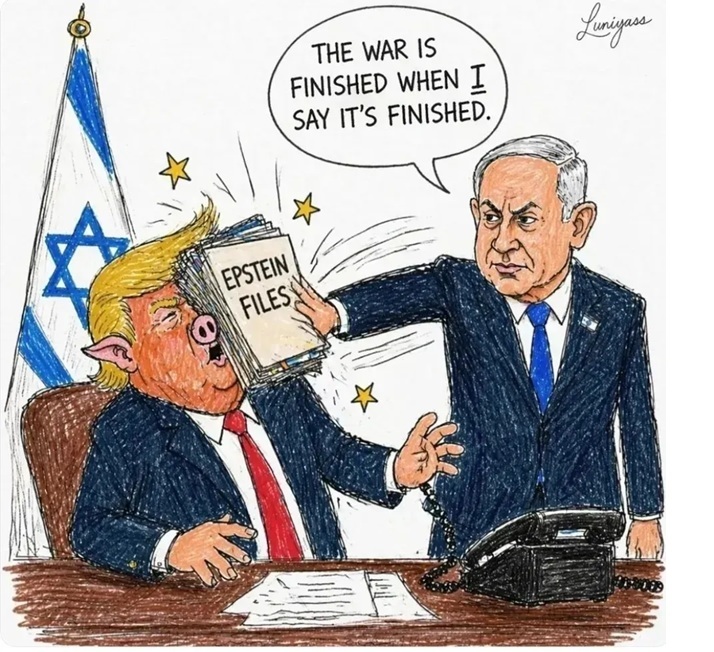
Why has he, Trump, acted so diametrically against his own interests as well as America’s and, indeed, the world’s? This is not clear and may never be. But the thought that the Mossad has a file on Trump that locates him well inside the Epstein mess grows more plausible the deeper Trump digs himself and his country into his hole. Study the photograph atop this piece: To us it is highly suggestive that a cynical exercise in blackmail may be at work between these two men—one victimizer turning another into a victim.
We have chosen to publish the piece that follows as it appeared yesterday but for minor editing adjustments.
—The Editors.
Patrick Lawrence.
13 April—The Israeli regime’s deep penetration into the U.S. government is not a new story, if this is not to state the obvious. Via the Zionist lobbies in Washington, Israel more or less owns both houses of Congress. The same is emphatically true of the Trump administration itself: Israel and its Zionist supporters in the United States have groomed Trump since he began his rise in national politics 11 years ago. Wealthy American Jews acting in Israel’s behalf donated $90 million to Donald Trump’s first campaign for the presidency, in 2016, and at least $100 million to his second. Israel owns Donald Trump.
These are known facts. But one must look very hard to find reference to them in mainstream media or in America’s public discourse altogether. No, Israel’s corruption of American politics and power is part of what I call the Great American Unsayable—a collection of truths too bitter to be acknowledged publicly other than rarely.
Continue readingFresh off Artemis, America is now turning its attention to creating nuclear power in space.
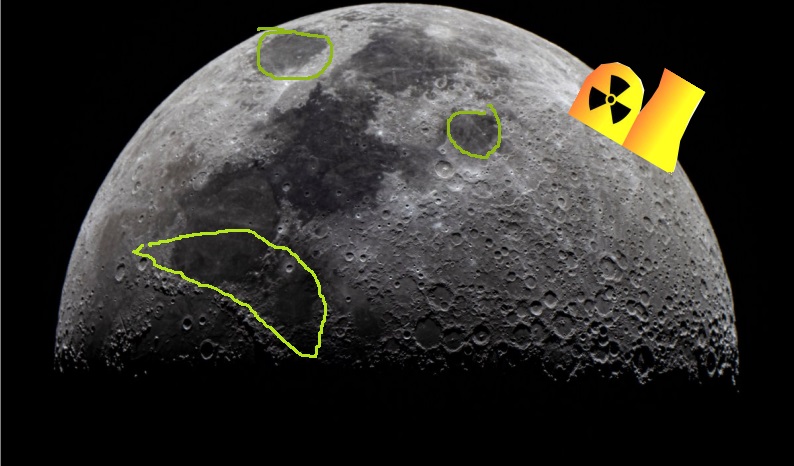
The administration wants to launch the reactors to the moon within the next four years – a timeline that critics say could be a problem
Indeoendent, Julia Musto in New York, Tuesday 14 April 2026
The Trump administration is renewing its focus on creating nuclear power in space, releasing updated guidance for federal agencies following the historic Artemis II lunar mission.
The action is aimed at ensuring the U.S. stays ahead of China in the new space race, which will determine which political power creates the rules there in the future, as humans establish a permanent moon base and work toward getting to Mars in a nuclear-powered spacecraft.
Nuclear energy will be necessary to live and work on the moon because there is not unlimited access to solar power and lunar nights are 14.5 Earth days long. Nuclear reactors can be placed in permanently shadowed areas and can generate power continuously, according to NASA.
The administration’s guidance, issued Tuesday, instructs the Departments of Energy and Defense, the White House Office of Science and Technology Policy and NASA to start taking steps toward safely deploying nuclear reactors in orbit as early as 2028 and launching them to the moon by 2030, in line with a December executive order from President Donald Trump.
“The time has come for America to get underway on nuclear power in space,” NASA Administrator Jared Isaacman, a former SpaceX astronaut, wrote in a post sharing the news on the social media platform X
………………………………. By the next 60 days, it calls for a Department of Energy assessment on the readiness of the nuclear industry to produce “up to four space reactors within five years, including reactor design, delivery of long lead-time components, and fuel allocation or production, along with recommendations for addressing any gaps.”
And the guidance also instructs the OSTP to develop a roadmap that identifies obstacles to achieving these objectives within the next 90 days.
“DOW will, pending availability of funding, pursue deployment of a mission-enabling mid-power in-space reactor by 2031,” the guidance said.
…………………..But some experts say that recent goals for reactors are just not feasible within the allotted timeline – although not everyone agrees.
“The whole proposal is cock-eyed and runs against the sound management of a space program that is now being starved of money,” national security analyst, nuclear expert and author Joseph Cirincione told The Independent last August.
He believes a nuclear reactor on the moon could take up to 20 years to become a reality. https://www.independent.co.uk/space/us-nasa-space-nuclear-power-b2957498.html
There’s a Glaring Safety Problem With Nuclear Energy Startups
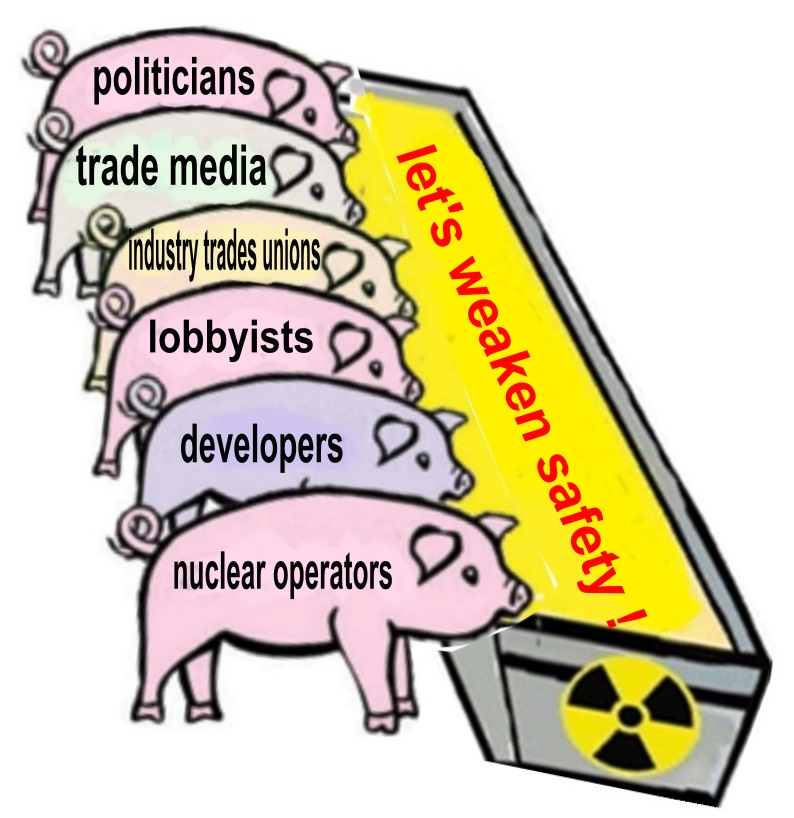
The reason comes down to profit, essentially: why listen to a bunch of bureaucrats telling you to slow down and play it safe when you could just fire up the uranium?
Move fast, break isotopes.,
By Joe Wilkins, Apr 12, 2026, https://futurism.com/science-energy/nuclear-startups-safety
The United States approach to nuclear energy is interesting, to say the least. Of all the countries harnessing the power of the atom, the United States is perhaps the most privatized nuclear energy system in the world. Most countries treat nuclear fission as a government affair — China runs its reactors through state-owned enterprises, and France went so far as to fully renationalize its main nuclear company in 2023. The States, meanwhile, leave their reactors almost entirely in the hands of the private sector.
Disciples of the free market will tell you this is exactly how things should be. If you don’t have a financial stake in the nuclear race, however, you might notice this arrangement comes with side effects like chronic understaffing and public subsidies of private profit. It also raises serious safety questions as a rising number of nuclear startups jostle for a piece of the atomic pie.
Case in point, new reporting by Politico‘s energy publication E&E News found that several baby nuclear companies are avoiding requests to join one of the industry’s main safety organizations. The regulatory body, called the Institute of Nuclear Power Operations (INPO), was formed in the fallout of the partial meltdown at Three Mile Island in 1979. While not a government body, the INPO is a nonprofit nuclear watchdog, responsible for conducting plant inspections, sharing operational guidance between nuclear companies, and helping companies train nuclear personnel.
For a nuclear energy company, joining the INPO is completely voluntary, though every operator has — until now. Of the nine nuclear startups which have sprouted up off the back of the tech industry’s data center boom, only one has signed up to join the INPO, E&E reported. These include companies like the “mass-manufactured nuclear” startup Aalo Atomics, and the “microreactor” company Antares Nuclear.
The reason comes down to profit, essentially: why listen to a bunch of bureaucrats telling you to slow down and play it safe when you could just fire up the uranium?
“These entities are businesses, and they’re trying to make money,” Scott Morris, a nuclear consultant and former US Nuclear Regulatory Commission (NRC) official, told E&E. “Any infrastructure that you put around that entity that is not directly contributing to its bottom line, it’s going to be questioned.”
Their decision to sidestep the INPO is even more concerning in the wake of Donald Trump’s regulatory cutbacks, which put the industry-led INPO in charge of regulations previously handled by the NRC. In effect, these moves have made certain operational regulations completely optional for nuclear energy companies.
“In fact, the NRC has delegated some of its regulatory authority, so to speak, to [the] INPO, specifically in the realm of operations and maintenance training programs,” Morris said. “The NRC and INPO are not duplicative; they’re complimentary.”
New Nuclear Is Too Late and Too Costly for the Climate Crisis

14 April 2026, Paul Dorfman, https://bennettinstitutesussex.org/stories/nuclear-is-too-late-and-too-costly-for-the-climate-crisis/
Dr Paul Dorfman, Bennett Scholar, makes a clear and evidence based case: new nuclear power cannot play a meaningful role in addressing the climate or energy crises. It is not simply expensive, it is structurally misaligned with the speed, scale and affordability required for effective climate action.
In the report, ‘Debt, Delays, Dependencies. Why Public Banks
Should Not Support Nuclear Power‘, Dr Dorfman’s contribution makes clear that new nuclear power represents a policy dead end, diverting scarce resources away from climate‑effective solutions. The opportunity cost is enormous: every pound invested in nuclear is a pound not invested in renewables, energy efficiency, storage or grid resilience. New nuclear is already too late. The renewable transition is happening now – and smart policy must move with it.
Key Findings
Dr Dorfman shows that time is the critical constraint. New nuclear projects consistently take 15–20 years from planning to operation, with average construction overruns of more than 60%. In contrast, wind and solar projects move from planning to generation in months to a few years, making them vastly more effective in the decisive decade for emissions reduction. The Intergovernmental Panel on Climate Change (IPCC) has concluded that renewables are now up to ten times more effective at cutting emissions than new nuclear, underscoring the urgency of choosing technologies that can deliver now rather than decades from now.
Cost compounds the problem. Dr Dorfman highlights that new nuclear is the most expensive form of electricity generation. Nuclear projects routinely double their initial cost estimates, while renewable technologies continue to fall rapidly in price due to economies of scale, innovation and fast global deployment.
The chapter also challenges the notion that nuclear complements renewables. Evidence shows that large, inflexible nuclear plants crowd out investment in grids, storage and flexibility – exactly the systems needed to integrate high shares of renewable energy. Meanwhile, renewables already deliver the bulk of new global power capacity, with wind and solar generating significantly more electricity than nuclear worldwide, and expanding at a far faster rate.
Finally, Dr Dorfman highlights a growing but under‑discussed risk: climate change itself threatens nuclear infrastructure. Rising sea levels, heatwaves, floods and water scarcity increasingly disrupt reactor operation, driving up costs and safety risks. Rather than being a climate solution, nuclear power is becoming more vulnerable because of climate impacts, further undermining its viability.
Why this matters for policy and innovation
Dr Dorfman’s chapter, ‘New nuclear: Too late and too costly for the climate and energy crises‘ has a central insight that aligns squarely with the Bennett Institute’s mission to accelerate effective, evidence‑based policy innovation. The persistence of nuclear in policy debates is not driven by outcomes, but by legacy thinking, political inertia and vested interests. Dr Dorfman’s analysis shows that innovation is not about new reactor designs, but about deploying solutions that already work, quickly, affordably and at scale. This research reinforces a core Bennett Institute principle: policy decisions must be grounded in real‑world delivery.
When “exterminate the world” isn’t a headline
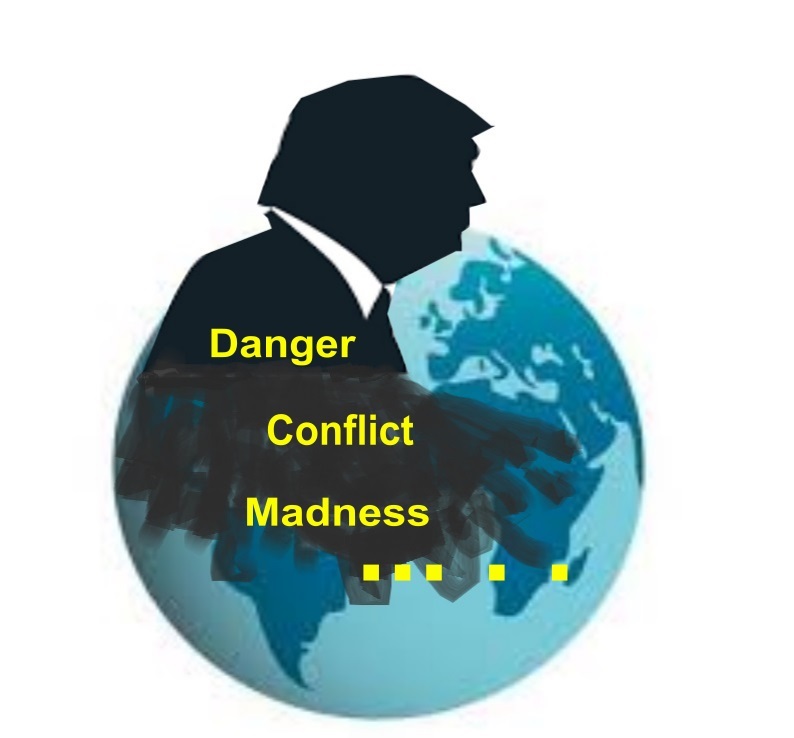
15 April 2026 Michael Taylor, https://theaimn.net/when-exterminate-the-world-isnt-a-headline/
A sitting president speaks of world extermination – and the world barely looks up.
There was a time – not so long ago – when a statement from a sitting president that another nation wants to “exterminate the world” would have detonated across the political landscape. It would have triggered emergency debates, wall-to-wall coverage, and grave discussions about judgment, stability, and the terrifying weight of nuclear rhetoric.
Now, it barely lingers for a news cycle.
When Donald Trump warns of apocalyptic destruction in the context of Iran, the words land with a dull thud rather than a sharp crack. Not because they are any less dangerous – but because the world has been conditioned to expect them. Shock, it turns out, has a shelf life. And we have exceeded it.
This is how democratic norms erode – not always through dramatic rupture, but through repetition. The outrageous becomes familiar. The familiar becomes background noise. And eventually, the unthinkable becomes just another line in a transcript.
There is, of course, always an explanation ready at hand. Analysts speak of strategy, of calculated unpredictability, of the so-called “madman theory” dressed up as geopolitical chess. Perhaps. But even if one accepts that premise, it raises a more unsettling question: what happens when the performance of madness is indistinguishable from the real thing?
The danger is no longer just in the words themselves, but in our diminished reaction to them. A public that no longer flinches at the language of annihilation is a public that has, in some quiet and reluctant way, adapted to it. And a media environment that treats such rhetoric as routine risks becoming an accomplice to that adaptation – not through malice, but through fatigue.
This is the deeper story. Not what was said, but what wasn’t felt in response.
Because when the most extreme language available to a leader of a nuclear-armed state fails to shock, it is not the words that have changed.
It is us.
Trump’s Will Be Done

SCHEERPOST, April 14, 2026 Joshua Scheer Intro
At a moment when political power is increasingly wrapped in spectacle, symbolism, and something closer to religious devotion than democratic accountability, this piece from ScheerPost cuts straight through the illusion. In “Trump’s Will Be Done,” Kenneth A. Carlson examines the dangerous fusion of faith and politics that has helped elevate Donald Trump beyond the realm of politician and into something far more untouchable in the eyes of his followers.
Republishing this now feels especially urgent. As imagery, rhetoric, and power continue to blur into something resembling mythology, Carlson’s question lingers with uncomfortable clarity: not just what would Jesus do—but what happens when political loyalty begins to replace it.
As the war abroad spirals and the stakes grow more dangerous by the day, the spectacle at home has taken on an almost surreal edge. President Donald Trump briefly posted—and then deleted—an AI-generated image depicting himself in Christ-like form, hands glowing as he “healed” the sick, wrapped in flags, fighter jets, and divine symbolism. When pressed, Trump dismissed the backlash, claiming it was merely an image of him as a doctor, not a messianic figure.
But the moment lands differently in a political climate already saturated with religious imagery, blind allegiance, and the merging of power with mythology. It’s not just a post—it’s a signal—one that fits neatly into a broader pattern where politics becomes performance, leadership becomes spectacle, and belief begins to blur into something far more dangerous.
Which brings us to the reality this piece explores: what happens when illusion collides with consequence.
By Kenneth A. Carlson ScheerPost
Trump’s Will Be Done
…………………………………………………………………………………………………………………………………………………………………………………………………………………………………………….. Today, Donald Trump, the former reality TV star, and those around him, understand how to do this all too well. They took their skillset to a new level as they somehow succeeded in fashioning him, and/or he fashioned himself, into a new role as a modern-day messiah — the Chosen One, the Second Coming, the Son of God. And I truly believe he sees himself this way. Remember, this is the same man who once bragged, “I could stand in the middle of Fifth Avenue and shoot somebody, and I wouldn’t lose any voters, OK?” The shocking thing about that statement? It’s likely to be 100% true.
And why? I believe it’s due to some extent to the unfortunate fact that critical thinking in our society is on life-support. People don’t question. They don’t dive deeply and independently into issues. They let others feed it to them in their own private echo chambers. The thirst for knowledge has been replaced by blind allegiance, paving the way for the rise of Donald “The Music Man” Trump — a master showman selling a reckless and dangerous illusion. ……………………………………………………………………
……………………………………. what Donald Trump has tapped into. He positions himself as a godlike figure, offering his followers a false sense of security — a “Daddy’s Home” mentality (yes, there are actual T-shirts for sale on Amazon).
Trump has lulled his base into a dangerous complacency, even as they watch stock markets tumble, inflation soar, entire agencies dismantled, jobs slashed, tariff wars escalated, and unemployment climb. Yet the news they consume assures them it’s all part of his grand plan, and so they wait — idly, expectantly — for a miracle. I never thought my livelihood would be at risk when I voted for him, they say, as if the consequences were unforeseeable.
But critical thinking has been shoved to the backseat, while blind faith handed Trump the wheel. Many have stopped questioning, stopped discerning, stopped seeking truth — because they believe the Almighty Donald Trump will ultimately take care of business.
Nothing could be further from the truth — and the sheer number of his businesses that have filed for bankruptcy should be proof enough. Six of his companies (that we know of) have sought Chapter 11 bankruptcy protection, allowing them to continue operating while erasing massive debts. But behind that legal maneuvering lies a harsh reality: hundreds, perhaps thousands, of workers, vendors, and small businesses left unpaid for their goods and services, are bearing the cost of his failures.
But none of that seems to matter to his unwavering base — the citizens of this so-called God-fearing nation. As a collective, today’s Evangelical and Charismatic Christians appear all too willing to believe a man who promises to end the wars in Ukraine and the Middle East within hours, slash grocery prices, “end inflation,” and miraculously lower the cost of eggs. He also assures us the economy will be “the best ever” — thanks, in large part, to tariffs imposed on both allies and adversaries alike. Few reputable economists would dispute the fact that American consumers will ultimately bear the cost of these tariffs — better known as taxes.
And yet, just over two months into his second term, none of these campaign promises have materialized — not even close. In fact, some might argue the exact opposite has happened.
So why do people still believe him? Why do they worship him with such fervent devotion? Why do they trust him with blind, unquestioning enthusiasm? I believe it’s because he has transcended the role of a mere politician. He has fashioned himself into something greater — a deity of sorts — untouchable, unquestionable, and, to many, infallible.
Trump’s will be done.
So when I ask myself today, ”What would Jesus do?,” the answer seems clear: seek truth, think critically, care for “the other” and break free from the echo chambers that breed blind allegiance. Because if we don’t, our Constitution could erode, our democracy could falter, and Donald Trump could seize the power to declare himself president for an unconstitutional third term — or worse, for life.
Not a Ceasefire—A Reset: The Quiet Expansion of Palestinian Incarceration
April 14, 2026, ScheerPost Staff, https://scheerpost.com/2026/04/14/not-a-ceasefire-a-reset-the-quiet-expansion-of-palestinian-incarceration/
While global attention drifts, the machinery of occupation does not slow—it tightens. Arrests replace releases. Silence replaces scrutiny. And behind it all, a system of incarceration continues to expand, largely out of view.
In this episode of Rattling the Bars, host Mansa Musa sits down with scholar-activist Dr. Rabab Abdulhadi to expose what they describe as a revolving door of detention shaping daily life for Palestinians. What emerges is not simply a prison system—but an architecture of control that extends far beyond prison walls, touching every aspect of Palestinian existence.
More than 9,000 Palestinians are currently held in Israeli custody—a number that continues to climb even after high-profile prisoner releases.
Despite the release of nearly 2,000 Palestinian prisoners during what was labeled a ceasefire in October 2025, a new wave of arrests has already erased that moment. Today, more than 9,000 Palestinians are again held in Israeli custody, according to Dr. Rabab Abdulhadi, with the total constantly shifting as new detentions replace those released.
“It’s a revolving door,” she explains. “You release prisoners—and then you arrest more.”
At the center of that system is administrative detention—imprisonment without charge, without trial, and often without end. Detainees may never be told what they’re accused of, while access to lawyers, family, and even basic information is severely restricted.
Two legal systems operate side by side: one for Israeli settlers, another for Palestinians. Even children are caught in it—Palestinian minors can be prosecuted as adults under military law, stripped of protections others receive.
Inside prisons, conditions continue to deteriorate: reduced food, denied medical care, and near-total isolation since October 2023.
But the system doesn’t end at the prison gates.
Night raids, arbitrary arrests, and movement restrictions turn daily life into an extension of confinement—what Abdulhadi describes as a reality where prison becomes a condition, not just a place.
Children grow up inside it. Families are fractured by it. Entire communities are shaped around it.
And still, the cycle continues.
“The people will resist because they want to live,” Abdulhadi says. This is not a story of what has happened—but of what is still happening, in front of our very eyes.
About children who can identify military aircraft before they can read. Children who grow up navigating checkpoints, raids, and the constant threat of arrest.
“They should not be scared every night,” Abdulhadi says. “They should not have nightmares.”
CND opposes new contract to build nuclear reactors on Anglesey.
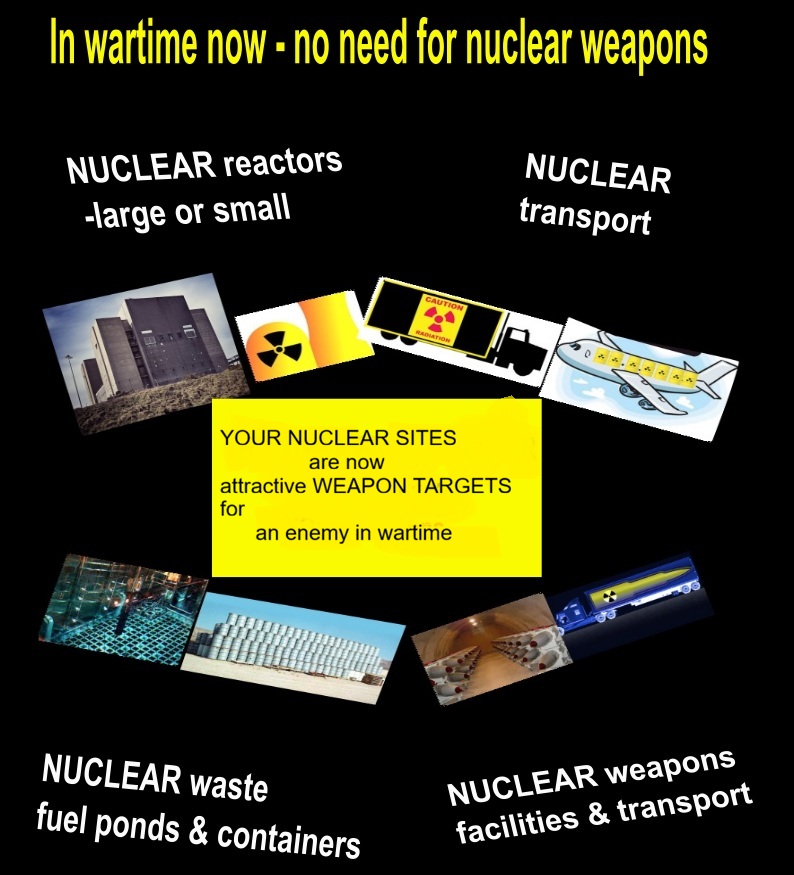
COMMENT Just by the way, in this new Trumpian era, our nuclear sites become a useful weapon for an enemy – an appealing target to be attacked
Anti-nuclear campaigners have condemned plans to build small modular
reactors (SMRs) at Wylfa on Anglesey, dismissing claims that they will
bring energy independence as a “fantasy” today.
CND Cymru commented
after contracts to construct Britain’s first SMRs in north Wales were
signed. Anglesey was selected last year to become the site of the SMR
programme by the Labour government at Westminster.
CND Cymru national
secretary Dylan Lewis-Rowlands said: “Nuclear power does not deliver
energy independence. Wales doesn’t mine fissile material, lacks the
ability to enrich it and convert it into fuel, and has no storage capacity.
“We need to end the corporate nuclear fantasy and focus on the
deliverable solutions that can be done quicker, cheaper and placed in the
hands of communities — that is how we truly make Wales energy
independent.”
Morning Star 13th April 2026, https://morningstaronline.co.uk/article/cnd-opposes-new-contract-build-nuclear-reactors-anglesey
US Aims at Heavy Staff & Budgetary Cuts for United Nations, Seeks to Launch Cost-Saving Artificial Intelligence at UN meetings

By Thalif Deen, UNITED NATIONS, Apr 6 2026 (IPS) –
The US has spelled out in detail its own concept of what a restructured United Nations should look like: after drastic reductions in staff, cutting down its budget, avoiding duplication in mandates, slashing peacekeeping operations worldwide and deploying artificial intelligence (AI) for translations and interpretations in six languages.
As the biggest single contributor to the UN budget—and despite nearly $4.0 billion in unpaid dues—it is using its perceived financial clout to help radically change the world body.
The US says it wants to “make UN great again (MUNGA)”—a variation of President Trump’s oft-repeated slogan “Make America Great Again (MAGA).” ”.
But will it work? And is it feasible?
Ambassador Mike Waltz, U.S. Representative to the United Nations, addressing a Congressional Field Hearing on UN Reform, said last week, “As I stated in my confirmation hearing, the UN truly does need to get what we’re calling back to basics and back to its original mission, from its founding, back to maintaining international peace and security.
“As I’ve mentioned in my hearing then, the UN’s budget in the last 25 years has quadrupled. We have not seen, arguably, a quadrupling of peace and security around the world commensurate with those hard-earned dollars, he said.
“So, we are pressing it. We’re pressing it to streamline its bureaucracy, to eliminate duplication. We’ve made it clear that we will cease participation in some UN agencies that undermine our sovereignty and cannot be reformed.”
Earlier this year, he pointed out, President Trump announced “our withdrawal from 66 international organizations. That review is ongoing. And from my perspective, let me be clear, the U.S. will not fund organizations that act contrary to our interests.”
“On UN compensation and personnel,” he said, “We’re leading reforms to what are often exorbitant compensation and benefit standards that the over 100,000 UN staff receive. The UN pays 17% more than US equivalent civil servants, even though many of them are right here in New York.
“They also have additional generous benefits packages far exceeding what our great civil servants, both here and abroad, receive. And staff costs alone are 70% of their regular budget for these things we’re trying to bring back in line.
“So, we need to, and we are working to bring those compensation and benefits packages back in line with common-sense standards. Part of that will be the pension. There’s over $100 billion in management in the UN pension with 16%—I don’t know of an employer or a government out there that contributes 16% to their pension.”
And there are other reforms, he said.
For example, the number of interpreters and translators—times six for the six UN languages here—technology can be used, AI can be used, and remote translation can be used that will save a lot of the travel and the conference costs, said Waltz.
Stephen Zunes, Professor of Politics at the University of San Francisco and director of Middle Eastern Studies, who has written extensively on the politics of the United Nations, told Inter Press Service (IPS) this is not about cost-cutting or fiscal responsibility.
“Like cutbacks to important U.S. government agencies and domestic programs, the Trump administration appears determined to dismantle the system itself.”
This should be understood in the context of pulling out of international organizations and treaties, the establishment of the so-called “Board of Peace,” the Iran War, and the recently announced dramatic increases in military spending—it is about undermining international legal institutions and replacing them with an imperial order backed by raw military force, said Zunes.
Richard Gowan, Program Director, Global Issues and Institutions, at the Brussels-based International Crisis Group, told IPS in the first half of 2025, U.S. policy towards the UN was pretty chaotic, and diplomats from other countries really had no idea what Washington wanted from the world organization.
Like it or not, he said, Mike Waltz and his team have brought some message discipline and are clarifying their goals for the UN pretty sharply.
“Most diplomats say that Waltz can be reasonable in private and that ultimately, he and his team want to reshape the UN rather than just wreck it. There are times when Waltz goes out of his way to bash the UN and individual UN officials on social media, but I think that is partly him playing to the Republican base.”
Waltz is clear that he wants a slimmed-down UN, Gowan pointed out, and it is worth admitting that this is a popular message among many UN member states. The U.S. is not alone in thinking that the organization’s bureaucracy has grown too big and needs a tough financial diet.
“Trump, Rubio and Waltz are pretty consistent in arguing that the UN should focus on peace and security issues. But I think the administration has not really convinced most other UN members that it has a plan to make the UN deliver on conflict prevention and diplomacy again.”
Instead, he said, the U.S. appears to have a very selective and instrumentalist approach to when and how it uses the UN as a security partner. It wants the UN to help in Haiti but to get out of the way in Lebanon. I do not think there is really a coherent vision at work here. It is a very ad hoc, case-by-case approach.
“Trump’s boosting of the Board of Peace as a potential alternative to the UN has complicated Waltz’s position too. The fact that Trump is willing to flirt with the Board, even if it is not a very serious institution, makes it harder to believe that Washington really wants the UN to regain credibility on peace and security,” declared Gowan.
Meanwhile, excerpts from Ambassador Waltz’s testimony include the following:
- “On budget and staffing cuts, the UN should be doing less and doing it better. Let’s get it more focused and actually achieve more results. The 2026 UN regular budget was estimated at $3.45 billion. The U.S. funds roughly a fifth of that at $820 million in 2025 alone.
- Again, I think we need to reduce the UN’s size and assure every taxpayer dollar is spent responsibly, and thanks to the strong efforts by the United States, led by Ambassador Bartos here and his team in what we call the UN’s Fifth Committee, which approves its budget, we are working towards a leaner and better prioritized 2026 budget going forward.
- In December, we led Member States to adopt a historic 15% cut. $570 million out of the UN’s regular budget. That will eliminate nearly 3000 headquarters positions. And for our contribution, it will reduce our assessment by $126 million. So just in the six months that we’ve been here, we will see going forward, $126 million savings to the U.S. taxpayer.
- We’ve also pushed for a 25% reduction in peacekeeping troops, and I’ll talk a bit about other peacekeeping reforms in a moment that will also save us tens, if not hundreds of millions of dollars while enabling what we call here the repatriation, the sending home of poorly performing peacekeeping troops.
- From an oversight perspective, beyond the salaries and benefits, oversight is essential. We’re leading efforts to empower oversight bodies to root out waste, fraud, abuse, and misconduct.
- On peacekeeping reform, he said, the administration has been clear about focusing on the core mandate of peace and security, and we’re leading efforts to wind down some of these ineffective and costly peacekeeping missions.
………………………………………………………………………………………………………………………….. “We will have a new Secretary-General elected this year, and we’re having those conversations now with the candidates about what they seek to keep and continue or what new things they seek to put in place, but reform is at the top of our list as we meet with some of these candidates.
“So, this is a critical moment with senior leadership transitions approaching here over this next year. We need to have a clear message. We will prioritize qualified Americans. Representative DeLauro, along the lines of what you sought to do so many years ago, of having qualified Americans in UN leadership positions, not just here, but across the ecosystem in Geneva, in Vienna, and Nairobi and other places where you have UN agencies.
“And I’ll just conclude with echoing President Trump’s own words.
“As he said most recently at the General Assembly, the UN has tremendous potential. My charge from him is to help it realize that potential. We are dedicated to making the UN live up to that promise, to making the UN great again—if I can say so, our new acronym is MUNGA…………. https://www.ipsnews.net/2026/04/us-aims-at-heavy-staff-budgetary-cuts-seeks-to-launch-cost-saving-artificial-intelligence-at-un-meetings/?utm_source=email_marketing&utm_admin=146128&utm_medium=email&utm_campaign=US_Pushes_Sweeping_UN_Cuts_Including_Staff_Reductions_and_Budget_Slashes_Inequalities_in_Human_Morta
Ceasefire Exemptions and Quarries of Death: Israel’s War on Lebanon
11 April 2026 Dr Binoy Kampmark, https://theaimn.net/ceasefire-exemptions-and-quarries-of-death-israels-war-on-lebanon/
In the Devil’s Dictionary, Ambrose Bierce defines peace as a period of cheating between two periods of fighting. The Israeli version of a ceasefire might be defined as a moment of war deceptively halted to enable conflict to continue. War as cosplay and camouflage. Under such fragile conditions, military objectives can still be pursued with a ruthlessness offensive to international law, custom and common sense.
Seeing as Israel was a central, if not the central power in pushing the crime of aggression on February 28 against Iran, wooing with seductive voice and lurid promise a deranged egoist in the White House (glory and oil awaits thee, Mr President), not to mention the dedicated thorn in any Middle East peace process that threatens sabotage to any enduring arrangements, the continued attacks on Lebanon seemed quotidian. With a war crimes habit well and truly formed, Israel had already issued displacement orders for some 14% of Lebanon, including areas south of the Zahrani River, a majority chunk of Beirut’s southern suburbs and cuts of the Beqaa region.
With their campaign hitting its strides, the Israeli Defense Forces showed no intention of ceasing operations, despite a Pakistan mediated ceasefire that had paused hostilities between Tehran and Washington. While the parties wrangled over what conditions the Strait of Hormuz would be opened under and what a more lasting peace agreement might look like, Israel exempted itself. While not striking Iran, it would continue its onslaught in Lebanon, despite statements from Pakistan Prime Minister Shehbaz Sharif that the ceasefire would also apply to Lebanon. In the words of Israeli Prime Minister Benjamin Netanyahu, “Israel supports President Trump’s decision to suspend strikes against Iran for two weeks subject to Iran immediately opening the straits and stopping all attacks on the US, Israel and countries in the region.” However, the “ceasefire does not include Lebanon.”
Even homicidal routines can shock with spikes of freakish, callous intensity. These included the 100 strikes within 10 minutes on April 8 that resulted in the deaths of at least 303 people, with 1,150 injured. The Israeli authorities claimed that the majority of those killed were members of Hezbollah, though even a two-third fraction takes it into less than principled territory. The targets lay in the southern suburbs of Beirut, southern Lebanon and the eastern Bekaa Valley. In justifying the slaughter, the IDF expressed the usual pride akin to tribes seeking scalps: the raids had “eliminated Ali Yusuf Harshi, the personal secretary and nephew of Hezbollah Secretary-General Naim Qassem.” Another official dead, only for another to take his place in due course.
The usual, casual destruction of infrastructure that would rankle most justice departments was also celebrated, with the IDF striking “two key crossings used by Hezbollah terrorists and commanders for movement from north to south of the Litani River in Lebanon to transfer thousands of weapons, rockets, and launchers.” Use of such crossings by civilians was of no interest, though the United Nations Office for the Coordination of Humanitarian Affairs (OCHA) did state on March 23 that the destruction of crucial bridges had “significantly [disrupted] movement and humanitarian access,” with certain strikes severing the link between Tyre and Nabatieh, while also limiting “movement between south Lebanon and West Bekaa, including Marjayoun and Hasbaya.”
The previous night, Israeli forces struck a building in front of Hiram Hospital in Al-Aabbassiye, near Tyre. This damaged the hospital and cost the lives of four people. Another strike on the Islamic Health Authority in Qlaileh hit an ambulance, resulting in three deaths. When it comes to targeting and the IDF, categories are highly mutable.
The scale of such killings astonished the United Nations Human Rights Chief Volker Türk. “The scale of the killing and destruction in Lebanon today is nothing short of horrific,” stated the High Commissioner on April 8. “Such carnage, within hours of agreeing to a ceasefire with Iran, defies belief. It places enormous pressure one a fragile peace, which is so desperately needed by civilians.” In truth, they need far more than a fragile peace, and certainly not the targeting pedantry that appears in IDF briefings and justifications, the sort that see corpses as more useful and living civilians. Even in war, Türk states in firm reminder, “Each and every attack must comply with international humanitarian law fundamental principles of distinction, proportionality and precautions to protect civilians.”
The UN official must surely know by now that Israel operates in a vacuum all who have committed crimes in international law inhabit, the quarry of the necropolis, the architectural vision of the Grim Reaper. Even the names for Israel’s military operations are drawn increasingly from the dark – literally. “Operation Eternal Darkness was a very powerful blow to Hezbollah, leaving it stunned and confused by the depth of the penetration and the scale of the track,” glowed Israeli Defence Minister Israel Katz in his video statement. “More than 200 terrorists were eliminated yesterday, bringing the number of those eliminated in this campaign to 1,400.” This was “more than double the number in the Second Lebanon War.” It’s all about thanatotic accounting.
This butchery has taken place in conjunction with the establishment of a four-line security zone in Lebanon. The first is the unimaginative and common destruction of Lebanese villages that might serve as launching posts for Hezbollah attacks and briefing notes for prosecutors of international criminal law; the second constitutes a “defensive line” in Lebanon, currently made up of five forward army posts, and set to bulk to 15. The third comprises the “anti-tank” line and the fourth the Litani River, a goal of security so cherished as to be fetishised in Israeli military objectives. There, according to Katz, the IDF will “prevent further infiltration of terrorists and the return of residents southbound.”
A stunning volte face in these arrangements would be the acceptance of a ceasefire and a genuine affirmation that peace is preferable to war. But the Israeli military-political complex seems to relish the view of US President Theodore Roosevelt, who proudly thundered that the benefits of a prosperous peace would never eclipse or exceed those of war, especially waged with a righteous temper. But budgets for killing and conquest thin over time, as do the support of powers who, for all their abundant hypocrisy, may finally relinquish their backing. The momentum is against Israel, however slow the turning.
A Case for War? Iran’s Non-Existent Nuclear Weapons Program

ByWilliam O. Beeman, Apr 14, 2026, https://americancommunitymedia.org/oped/a-case-for-war-irans-non-existent-nuclear-weapons-program/
The United States’ repeated attacks on Iran over more than 40 years are based on a lie: that Iran has a nuclear weapons program.
Vice-President J.D. Vance, who led the U.S. delegation in cease-fire talks with Iran on April 10-11, once again repeated this lie in his demand that Iran declare that it “will not seek a nuclear weapon, and they will not seek the tools that would enable them to quickly achieve a nuclear weapon.”
The current Iranian regime has done much that has disturbed the world community since the Islamic Revolution of 1978-1979. They have supported Hezbollah in Lebanon, the Houthis in Yemen, the Assad Regime in Syria, and militant groups throughout the Middle East. They have repressed dissent in their own country, including incarceration and execution of many thousands of Iranian citizens, with little justification. For these actions the regime deserves severe condemnation.
However, what Iran has not done and has never done is to develop nuclear weapons.
Iran’s critics hide behind the phrase “Iran’s nuclear ambitions” as if that vague phrase constitutes proof that a nuclear weapons program exists. It does not exist and has never existed. So why does this unsubstantiated accusation remain a live issue?
The answer is surprisingly simple. When Iran was an ally of the United States during the reign of Shah Mohammad Reza Pahlavi, who was re-installed from exile in a CIA-led coup in 1953, the United States fervently encouraged Iran to develop nuclear technology. After the Iranian Revolution of 1978-79, when Iran was seen as opposed to the United States, its nuclear program was suddenly seen as suspect and dangerous.
Iranian nuclear development started during the Eisenhower administration as part of the “Atoms for Peace” program. In 1957, the United States signed a Civil Nuclear Cooperation Agreement with Iran stipulating that the United States would provide Iran with technical assistance, nuclear fuel, and a small research reactor. This resulted in the establishment of the Tehran Nuclear Research Center in 1959. In 1967, under the Johnson administration, the United States delivered a five-megawatt research reactor to Iran along with weapons-grade highly enriched uranium to fuel it.
In 1968, Iran and the United States were founding signatories to the Nuclear Non-Proliferation Treaty (NPT) which was eventually signed by virtually every nation on earth except for Israel, India, and Pakistan. (North Korea initially signed and then withdrew. South Sudan, founded in 2011, never signed the treaty).
The NPT prohibits nations that did not have a nuclear weapons program at the time of signing from ever developing nuclear weapons. At the same time, the NPT guarantees the right of all countries to pursue non-nuclear-weapons programs to develop nuclear technology for peaceful purposes. The treaty also requires nations that already had nuclear weapons to protect the rights of other nations to develop their own nuclear technology, including the right to enrich uranium for peaceful purposes. (Aside from Iran, Germany, Netherlands, Japan, Brazil, and Argentina all have active nuclear enrichment programs today).
From this point on, until the 1978-79 Revolution, the United States encouraged nuclear development in Iran, urging companies like Westinghouse and General Electric to sell nuclear power reactors to the Shah’s government. At one point 23 nuclear power plants were envisioned.
But following the Iranian Revolution and the 444-day hostage crisis when U.S. officials were held at the U.S. Embassy in Tehran, Iran became suspect in the eyes of the United States. The nuclear program that had once been so fervently encouraged became a point of attack against the Islamic Republic.
The idea that Iran was developing a nuclear weapon stems from a 1984 United Press International article entitled “Ayatollah’s Bomb in Production for Iran.” On April 26, 1984, the U.S State Department under the Reagan administration — with no evidence that Iran had the equipment or the capability to produce a bomb — nevertheless urged a world-wide ban on providing nuclear materials to the country.
The eight-year Iran-Iraq war was then underway, and the Reagan administration feared that Iran could develop a weapon to use against Iraq. Another press article from The Washington Post in 1987 entitled “Atomic Ayatollahs” continued the alarm.
Even though Western intelligence agencies repeatedly insisted that Iran did not have a nuclear weapons program, U.S. officials — buoyed by negative public opinion of the Iranian regime — continued the accusation. The first U.S. imposed economic sanctions levied on Iran in relation to its nuclear program were imposed by President Bill Clinton in 1995.
In 2003 the George W. Bush administration, under urging from neo-conservatives bent on effecting regime change throughout the Middle East, again accused Iran of having a nuclear weapons program.
From this point on, the specter of Iran’s “nuclear ambitions” became a mantra in Washington, despite Iranian Supreme Leader Ayatollah Ali Khamenei having issued a religious edict prohibiting nuclear weapons development that same year. President Bush imposed further U.S. economic sanctions, increasing tensions between the two nations.
After more than 10 years, the Obama administration was able to create the Joint Comprehensive Plan of Action (JCPOA). As part of the agreement, Iran agreed to curtail its uranium enrichment program as a “confidence building” measure to assure that it would not violate the provisions of the longstanding NPT.
After President Trump canceled the JCOPA during his first presidential term in 2017, the idea that Iran still had “nuclear ambitions” became the baseline excuse for continued U.S. sanctions. No matter Iran’s transgressions, this one accusation remains the principal reason for continued hostilities culminating in the current war between the two nations.
The base fact is that Iran has never been shown to have had a nuclear weapons program. All intelligence organizations involved with nuclear containment agree on this fact. Nevertheless, as was seen in the failure of the Islamabad talks, Iran’s “nuclear ambitions” continue to be the pretext for U.S. attacks.
Will Trump nuke Iran?
Never has humankind seen so much power concentrated in the hands of one so capricious. Whether the ceasefire will hold, for how long, and in what ways is for the days ahead to tell. No one—not even Donald Trump—knows the end game. But the constant is the man whose finger can push the nuclear button. A man used to quick, vacuous victories through bullying and unbridled force is rancorous, thwarted, and vengeful.
What once seemed preposterous is now a palpable possibility.
When Trump, echoing Gen. Curtis LeMay’s 1965 threat toward North Vietnam, threatened to “obliterate” Iran and bomb it “back into the Stone Age”—rhetoric repeated by Defense Secretary Pete Hegseth—he wasn’t just posturing. In fact he was signaling that in an administration which respects no norms, mushroom clouds may be acceptable.
By Pervez Hoodbhoy | Opinion | April 10, 2026, https://thebulletin.org/2026/04/will-trump-nuke-iran/?utm_source=ActiveCampaign&utm_medium=email&utm_content=Will%20Trump%20nuke%20Iran%3F&utm_campaign=20260413%20Monday%20Newsletter
No one—not even Donald Trump—knows the end game as the six-week old US-Israeli war on Iran enters a temporary ceasefire. Just look at the head-spinning time-line:
Sunday, April 5 (infrastructure destruction-I): “Tuesday will be Power Plant Day, and Bridge Day, all wrapped up in one, in Iran. There will be nothing like it!!! Open the fucking strait, you crazy bastards, or you’ll be living in Hell — JUST WATCH! Praise be to Allah.”
Monday, April 6: (infrastructure destruction-II): “Their infrastructure could be taken out in one night. I’m telling you, no bridges, no power plants. I’m considering blowing everything up and taking over the oil.”
Tuesday, April 7 (morning) (threat to commit genocide): “A whole civilization will die tonight, never to be brought back again. I don’t want that to happen, but it probably will. However, now that we have Complete and Total Regime Change… maybe something revolutionarily wonderful can happen, WHO KNOWS?”
Tuesday, April 7 (evening): Announcement of two-week Pakistan-mediated ceasefire.
Never has humankind seen so much power concentrated in the hands of one so capricious. Whether the ceasefire will hold, for how long, and in what ways is for the days ahead to tell. No one—not even Donald Trump—knows the end game. But the constant is the man whose finger can push the nuclear button. A man used to quick, vacuous victories through bullying and unbridled force is rancorous, thwarted, and vengeful. He has been stymied by a recalcitrant theocratic state that has taken blow after blow, withstood the killing of its venerated leader, the bombing of its cities, the destruction of vital infrastructure, and the systematic targeting of its schools and universities.
Weeks later, when it should rightly be on its knees, Iran still controls the Strait of Hormuz and refuses to negotiate while it is being bombed. Instead, it continues to cause mayhem among America’s allies and take potshots at Israel. Imagine Trump’s frustration, especially after his bloodless victory in Venezuela.
But a so-far-unbroken taboo, inviolate since the nuclear ash settled over Hiroshima and Nagasaki, may crack. What once seemed preposterous is now a palpable possibility. When Trump, echoing Gen. Curtis LeMay’s 1965 threat toward North Vietnam, threatened to “obliterate” Iran and bomb it “back into the Stone Age”—rhetoric repeated by Defense Secretary Pete Hegseth—he wasn’t just posturing. In fact he was signaling that in an administration which respects no norms, mushroom clouds may be acceptable.
The “how” and “when” remain open questions, but if the ceasefire ceases to hold the crosshairs are likely fixed on the Fordow Fuel Enrichment Plant or, just as probably, Isfahan, where Iran’s fissile material was allegedly transferred before the June 2025 attack. Buried deep beneath a mountain of solid rock, Fordow is the nuclear facility that Trump had earlier claimed to have “obliterated.”
The math of escalation is inexorable: Iran reportedly holds roughly 450 kilograms of 60 percent enriched uranium. While a rudimentary gun-type nuclear weapon would be assembled using 80-100 kilograms of this material, a sophisticated implosion-type bomb needs 20-25 kilograms of uranium enriched to contain 90 percent of the uranium 235 isotope, a process requiring only some weeks. If Iran has mastered the complex engineering required for the latter, its current reserves represent a potential arsenal of eight to 10 nuclear warheads.
The game hinges on the upgrade. Iran can push its stockpile to weapons-grade in a matter of weeks. Conventional “bunker busters” like the GBU-57 have already failed; 14 were dropped on Fordow and Natanz in 2025, yet the heart of the program kept beating. To achieve absolute destruction, the hammer would have to be nuclear.
If the United States chooses to go nuclear in Iran, the Pentagon’s solution would likely be an earth-penetrating warhead like the B61-11 or the newly deployed B61-12. Washington would frame such a strike not as a Hiroshima-style apocalypse but as a “clinical necessity”—a tactical operation designed to kill hundreds rather than tens of thousands.
But Iran will not surrender quietly and would retaliate with everything it has. A lucky strike from a sophisticated missile could sink an American aircraft carrier; a coordinated swarm of drones and missiles could turn major Arab oil terminals into pillars of fire. At that point, the “clinical” experiment could end, and the apocalypse might begin as the United States reaches for its next nuclear target.
Even for a man who finds gratification in the suffering of others—who celebrated the recent destruction of Iran’s biggest bridge followed by cars plummeting down—Trump’s nuclear ambitions are constrained by American electoral politics and the upcoming November elections, a potentially hostile public reaction, and a somewhat reluctant military.
For now, America and Israel are operating in lockstep. They reportedly executed coordinated strikes on Iran’s Bushehr nuclear power plant—which has nothing to do with bomb-making—on March 18 and April 4. These were presumably “signaling strikes” since they destroyed only an auxiliary building and killed a single guard. Their intent was clear—even if the endgame is not. The message has been received: In coordination with the Israeli Defence Forces, over 200 high-level Russian technicians have already evacuated Bushehr, leaving behind only a skeleton crew to manage a potential emergency shutdown.
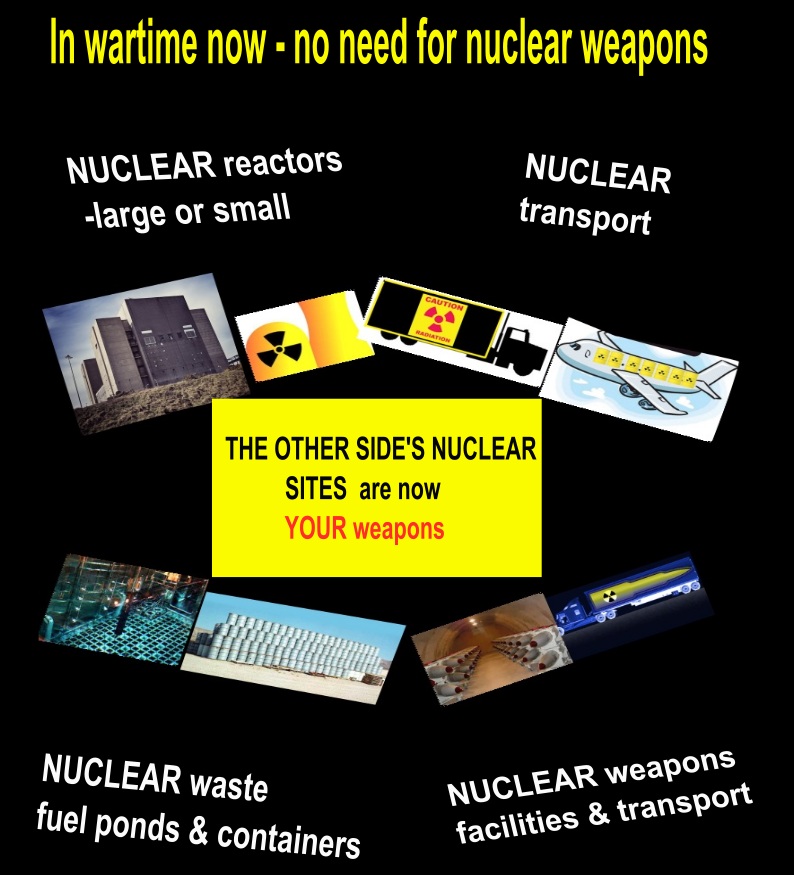
But “signaling” near a live reactor is a high-stakes gamble with an unclear ultimate purpose. While the plant continues to feed the grid, a direct hit on its containment dome would trigger a radiological catastrophe far exceeding that of Chernobyl or Fukushima. With 70-80 tons of uranium dioxide in its core and a massive inventory of spent fuel lying in nearby cooling ponds, a breach would shroud the Persian Gulf with a lethal miasma of radioiodine and cesium-137. This wouldn’t just be a strike against a regime; it would be a death sentence for the region’s environment and its people.
Israel—which pulverized Gaza to rubble and seeks a similar outcome in South Lebanon—may have fewer inhibitions than the United States. Where Washington might hesitate, Israel may well aim for the dome. For America’s Gulf allies—the UAE, Kuwait, Bahrain, Qatar, Saudi Arabia, and Oman—the fallout would range from the devastating to the permanent, the outcome depending on wind direction and speed.
With an undeclared arsenal of over 150 warheads and reliable means to deliver them to any corner of Iran, Israeli nuclear strikes on Iranian population centers are no longer a fringe theory; they would become a live strategic option in Jerusalem if somehow Iran manages to breach the Israel’s Iron Dome missile defenses more regularly and with greater effectiveness.
Operation Epic Fury is now entering its sixth week. As yet there are no direct negotiations, just a temporary ceasefire. With optimism in short supply, the world is watching a grim lesson unfold. The takeaway for every middle power and so-called rogue state is becoming undeniable: If you have the bomb, you don’t get bombed. The race is on to get it while they still can.
Trump is trying to distract us from Pope Leo’s calls for peace. Don’t take the bait.
Not only does Pope Leo not think Iran should have nuclear weapons, he does not think any country should have them, including the United States.)
American Magazine, by Sam Sawyer, S.J.April 13, 2026
If you are outraged—which would be both understandable and justifiable—by President Donald Trump’s social media attack last night on Pope Leo, take a moment to step back and follow the pope’s example rather than taking the president’s bait.
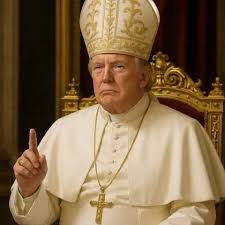
You may remember that at the beginning of May, during the preparation for the conclave that elected Pope Leo XIV, the president posted an A.I.-generated image of himself as pope dressed in a white cassock and miter, his hand raised in blessing. The White House’s official X account later reposted the image, which remains up on the account.
As the America team in Rome and back at home discussed how much to cover that story, I reminded my colleagues that to the degree that the Trump-as-pope meme meant anything, it meant that Mr. Trump was unable to tolerate anyone other than himself commanding the world’s attention.
As the America team in Rome and back at home discussed how much to cover that story, I reminded my colleagues that to the degree that the Trump-as-pope meme meant anything, it meant that Mr. Trump was unable to tolerate anyone other than himself commanding the world’s attention.
Mr. Trump posted a screed against Pope Leo late on the evening of Sunday, April 12. It was, as my colleague James Martin, S.J., posted last night, “unhinged, uncharitable and un-Christian.” It was immeasurably beneath the dignity of the office of the president. (Not satisfied with merely attacking the Vicar of Christ, Mr. Trump posted another A.I.-generated image, this one seeming to depict himself as Jesus.)
Mr. Trump’s post also makes little sense. It achieves the almost impressive feat of becoming less coherent the longer you think about it.
It slams Pope Leo as “WEAK on crime,” probably Trumpian code for Leo’s opposition to the administration’s immigration policy. It then veers into a tirade about priests and ministers being arrested for holding services during the pandemic, followed by Mr. Trump’s praise for the pope’s brother Louis as “all MAGA.” Finally, turning to the foreign policy disagreements that probably triggered the post, it accuses Leo of thinking “it’s OK for Iran to have a Nuclear Weapon.” (Not only does Pope Leo not think Iran should have nuclear weapons, he does not think any country should have them, including the United States.)
In the most muddled part of the attack, Mr. Trump says he is the reason that Leo got elected as pope and that the cardinals in conclave thought that was “the best way to deal with President Donald J. Trump.” This manages to be wrong both coming and going. It is farcical as an account of the motives of the cardinals and, as I will explain below, it misunderstands the purpose of Leo’s own witness entirely.
Far more telling than anything in the president’s post was the timing of it. During a weekend full of bad news for Mr. Trump, his post followed a lack of progress in negotiations with Iran and the resounding electoral loss of his favorite European leader, Viktor Orban, in Hungary. Relative to the Catholic world, his post came the day after Pope Leo XIV led a prayer vigil for peace in St. Peter’s and was joined in prayer all around the world. It came within hours of a “60 Minutes” broadcast of an unprecedented joint interview by three U.S. cardinals, in which they clearly laid out the church’s moral objection to both the Iran war and the administration’s mass deportation agenda.
Mr. Trump, however, was not responding to any of those events in kind. Mr. Trump’s outburst is not trying to convince anyone of his claims but rather to make people angry. In that sense, its incoherence is more a feature than a bug.
The way his attack on the pope functions best for Mr. Trump, like so much of the ragebait with which he pollutes our collective consciousness, is by pulling attention back to him so that we talk about him within terms that he has set. If we are doing that, Mr. Trump does not much care, I suspect, whether we agree with him or oppose him, because at least we are back in orbit around him.
Perhaps the way in which Pope Leo presents the greatest challenge to President Trump is in his consistent demonstration of what it looks like to remain morally centered on the Gospel instead of acting for or against Mr. Trump’s interests. In general, even when offering critiques that respond to American foreign policy moves, as in his description of Mr. Trump’s threat to destroy Iranian civilization as “truly unacceptable,” Pope Leo does not mention the president by name. In part, this follows well-established Vatican diplomatic practice, but it is also meant to remind us that the pope is speaking more from principle than he is in response to persons, even the most powerful person on earth. When Leo is speaking more explicitly about persons, it is to call our attention back to people who are suffering: the poor and the victims of war or violence.
Leo has also encouraged U.S. bishops to speak up more forcefully and more frequently. As can be seen in recent days, both from the “60 Minutes” interview by Cardinals Cupich, McElroy and Tobin and the swift response by Archbishop Paul Coakley, the president of the national bishops’ conference, to Mr. Trump’s threat against Iranian civilization, the pope has been strikingly successful in encouraging the bishops to exercise such leadership……………………………………………………………………………………………………………….. https://www.americamagazine.org/many-things/2026/04/13/trump-pope-leo-truth-social/?utm_source=ActiveCampaign&utm_medium=email&utm_content=Trump%20is%20trying%20to%20distract%20us%20from%20Pope%20Leo%20s%20calls%20for%20peace%20%20Don%20t%20take%20the%20bait&utm_campaign=Daily%204%2013%2026
Sea-level rise is a health crisis and we must hold polluters accountable
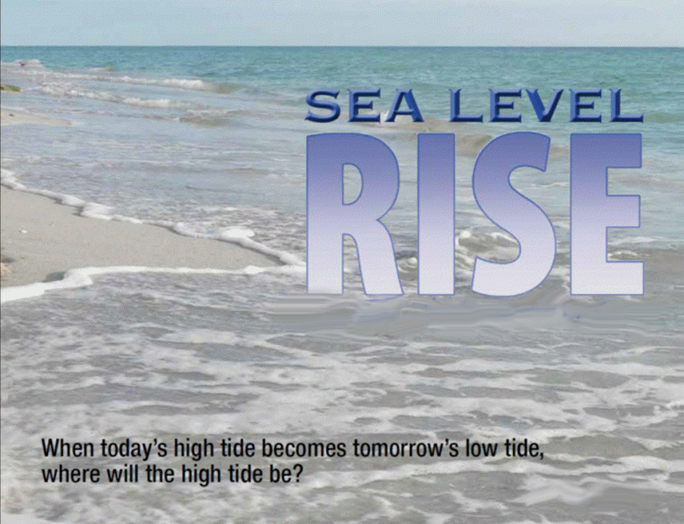
There are moments in history when a crisis long treated as distant reveals
itself to be intimate, immediate and profoundly human. Sea-level rise is
one of those moments.
For years it has been discussed in the abstract
language of centimetres, coastal infrastructure and future projections.
This can make it seem like a technical challenge – something for
engineers and planners to grapple with.
But rising seas are already
damaging bodies, minds, livelihoods and cultures. Sea-level rise is a
present-day health crisis. When saltwater intrudes into freshwater
supplies, health suffers. When floods overwhelm sanitation systems,
diseases spread. When farmland is inundated by king tides, nutrition
deteriorates. And when people are forced to contemplate leaving the land of
their ancestors, they face a painful mix of physical, financial, emotional,
cultural and spiritual harm. The effect of sea-level rise on property lines
and insurance procurement is clear.
But what is being lost goes far deeper
– it’s safety, dignity, continuity and belonging. Across low-lying
coastal regions and small island states, including throughout the Pacific,
communities are living with this reality today. For Indigenous peoples
especially, land is identity, memory, law, kinship, sustenance today and
connection to a shared future.
Guardian 7th April 2026,
https://www.theguardian.com/commentisfree/2026/apr/07/sea-level-rise-health-crisis-christiana-figueres
1 This Month

of the week- – THE ONENESS of HUMANITY
We the Nuclear Free North
1st July – Webinar Waste of Space: The Environmental Harm of Military and Civil Space Activity st July, 7 pm

Report Launch Online: We are seeing an increasing exploitation of space for military and commercial purposes. This must change.

Protect Sazan Island from the Trump family! https://secure.avaaz.org/campaign/en/protect_sazan_island_from_the_trump_family_loc/?bqFCVab&v=174511&cl=22707147157&_checksum=5e9dde668860e8231c33699735e16a1fbf22ab2cb01da50c999fe8732b9775ef&utm_source=email&utm_medium=blast_email&utm_campaign=174511


Cuba Is Not a Failed State – It Is a Besieged State
PETITION: “Global Appeal to Endorse Palestinian Right of Return of Refugees”
To see nuclear-related stories in greater depth and intensity – go to https://nuclearinformation.wordpress.com
-
Archives
- June 2026 (258)
- May 2026 (306)
- April 2026 (356)
- March 2026 (251)
- February 2026 (268)
- January 2026 (308)
- December 2025 (358)
- November 2025 (359)
- October 2025 (376)
- September 2025 (257)
- August 2025 (319)
- July 2025 (230)
-
Categories
- 1
- 1 NUCLEAR ISSUES
- business and costs
- climate change
- culture and arts
- ENERGY
- environment
- health
- history
- indigenous issues
- Legal
- marketing of nuclear
- media
- opposition to nuclear
- PERSONAL STORIES
- politics
- politics international
- Religion and ethics
- safety
- secrets,lies and civil liberties
- spinbuster
- technology
- Uranium
- wastes
- weapons and war
- Women
- 2 WORLD
- ACTION
- AFRICA
- Atrocities
- AUSTRALIA
- Christina's notes
- Christina's themes
- culture and arts
- Events
- Fuk 2022
- Fuk 2023
- Fukushima 2017
- Fukushima 2018
- fukushima 2019
- Fukushima 2020
- Fukushima 2021
- general
- global warming
- Humour (God we need it)
- Nuclear
- RARE EARTHS
- Reference
- resources – print
- Resources -audiovicual
- Weekly Newsletter
- World
- World Nuclear
- YouTube
-
RSS
Entries RSS
Comments RSS
 nuclear-news