Latest leak accident in Fukushima ‘once again exposes management chaos of TEPCO’

By Liu Xin Aug 14, 2024 https://www.globaltimes.cn/page/202408/1318029.shtml
The recent report of 25 tons of radioactive water leaking from Tokyo Electric Power Company (TEPCO)’s troubled Fukushima Daiichi Nuclear Power Plant once again exposes TEPCO’s internal management chaos. It also highlights the unreliability and risks associated with Japan’s moves to dump nuclear-contaminated wastewater into the sea, analysts said.
Approximately 25 tons of water containing radioactive materials leaked into the spent fuel cooling pool of Reactor Unit 2 in the Fukushima plant. TEPCO has stopped water injection into the pool and is investigating the cause of the leak. To ascertain the precise location of the leak and its underlying cause, TEPCO plans to deploy robotic equipment for an inspection scheduled for this week, Japanese media NHK reported on Tuesday.
Although TEPCO claims that there has been no discharge into the outside environment, the report raises concerns about Japan’s current practice of dumping nuclear-contaminated wastewater into the sea given TEPCO’s notorious history of cover-ups related to the Fukushima disaster, analysts said.
This incident exposes TEPCO’s internal management chaos and disorganization. Lü Chao, a research fellow at the Liaoning Academy of Social Sciences said that both TEPCO and the Japanese government bear major responsibility for handling the Fukushima nuclear-contaminated wastewater and should be transparent about any incident that has occurred in Fukushima.
Despite using the International Atomic Energy Agency (IAEA)’s report as a shield, Japan continues to dump nuclear-contaminated wastewater into the ocean, disregarding objections from neighboring countries and calls for international oversight. If this attitude continues, it could lead to further catastrophic incidents, causing severe and irreversible damage to the ocean and the environment, Lü told the Global Times on Wednesday.
As of press time on Wednesday, IAEA has not responded to Global Times’ inquiries on the incident.
This is not the first time this has happened in the Fukushima plant. In February, approximately 5.5 tons of wastewater, which may contain 22 billion becquerels of radioactive materials such as cesium and strontium have leaked from equipment at the nuclear power plant. Also, in October, 2023, five workers were accidentally splashed with liquid containing radioactive materials while cleaning at the Fukushima No. 1 nuclear power plant, according to Japanese media.
On August 7, despite persistent opposition at home and abroad, Japan started its eighth round of dumping of nuclear-contaminated wastewater into the Pacific Ocean. In response, the spokesperson for the Chinese Embassy in Japan said in a statement that Japan is irresponsibly shifting potential pollution risks onto the entire world. It is continuously discharging nuclear-contaminated wastewater into the ocean without addressing international concerns about the safety of the discharge, the long-term reliability of the purification equipment and the effectiveness of monitoring arrangements.
The spokesperson urged Japan to fully cooperate in establishing a comprehensive, independent and effective long-term international monitoring arrangement involving relevant stakeholders, including neighboring countries.
Peace Is Not On The USA Ballot In November
Caitlin Johnstone, Aug 15, 2024, https://www.caitlinjohnst.one/p/peace-is-not-on-the-ballot-in-november?utm_source=post-email-title&publication_id=82124&post_id=147730515&utm_campaign=email-post-title&isFreemail=true&r=1ise1&triedRedirect=true&utm_medium=email
I keep seeing liberal commentators like George Takei trying to frame Kamala Harris as the best candidate to bring peace to the middle east, despite her coming directly out of the administration which has been lighting the region on fire with its insane warmongering.
So let’s be clear here: Peace is not on the ballot in November. Americans are voting for Red War or Blue War. That’s it. Those are the choices.
I repeat: Peace. Is. Not. On. The. Ballot. Nobody who stands an actual chance at winning is going to bring about peace, because the US president is a manager of the US empire, and the US empire depends on constant warmongering.
Any debates over whether Trump or Harris are the one to bring about peace are nonsensical, because neither of them are. It’s like arguing over which car salesman might start handing out free cars — that’s not the job. It’s not what the people who have that job do.
Americans don’t get to vote on changes to US foreign policy; that can only come by way of mass-scale direct action. These elections are here to give Americans the illusion of democratic control and to let them feel okay about their political systems so they don’t start thinking about revolution. It’s all about feelings, so if you want to vote then vote in whatever way makes your feelings feel nice. That’s all this performative spectacle is ever about.
All this murderousness will only come to an end when enough people use the power of their numbers to force it to end, and people will only use the power of their numbers to force it to end when enough of them have awakened from their propaganda-induced coma to get a real revolutionary movement happening.
So that’s where the focus needs to be. Not on which empire manager you should vote for, but on sowing the seeds of revolution by showing as many people as you can that everything they’ve been trained to believe about their nation, their government and their world is a lie. Showing them how depraved their rulers are and how badly they’re being screwed over by exploitative status quo systems, and letting them know that a better world is possible.
There’s always something you can do every day to help accomplish this. Attending demonstrations. Participating in activist organizations. Distributing literature, online and offline. Making videos. Making memes. Having conversations. Today I saw a video of a young woman on a train giving a short speech about the genocide in Gaza and distributing flyers. Anything you can do to spread awareness of what’s really going on and how the media and politicians are lying about it all.
So the bad news is that not until a critical mass of people have reached a sufficient level of awareness will there be a real chance at meaningful change. But the good news is that you absolutely have the power to work towards expanding that awareness.
NATO Countries Think Ukraine Won’t Be Able To Hold Territory in Russia’s Kursk
Biden called Ukraine’s ground invasion in Kursk a ‘real dilemma’ for Putin
by Dave DeCamp August 13, 2024 https://news.antiwar.com/2024/08/13/nato-countries-think-ukraine-wont-be-able-to-hold-territory-in-russias-kursk/
NATO countries think it’s unlikely Ukraine will be able to hold territory in Russia’s Kursk Oblast even if it takes weeks for Russian forces to drive the Ukrainians out, Bloomberg reported Tuesday, citing a Western intelligence official.
Despite that assessment, the report said NATO doesn’t “harbor reservations” about Ukraine’s invasion of Russian territory, which the US and NATO claim they were unaware of until the attack started. Another NATO official told Bloomberg that the incursion shows Ukraine can challenge Russia.
Heavy fighting has been raging in Kursk since over 1,000 Ukrainian soldiers and dozens of armored vehicles, including many provided by the US, entered Russian territory last Tuesday. While Ukrainian forces have captured dozens of villages, they are also taking heavy losses.
The Russian Defense Ministry said Tuesday that in the past day, Ukraine lost 420 soldiers and said it had lost over 2,000 since the invasion started, although the numbers are not confirmed since Kyiv doesn’t release information on its casualties.
The invasion is seen as an attempt by Ukraine to gain leverage in future negotiations. Ukrainian Foreign Ministry spokesman Georgiy Tykhy said Tuesday that Ukraine was not interested in “taking over” Russian territory. “The sooner Russia agrees to restore a just peace… the sooner the raids by the Ukrainian defenses forces into Russia will stop,” he said.
While the US claims it was unaware of Ukraine’s plans to invade Kursk, it is also strongly backing the invasion by allowing Ukrainian forces to use US weapons. President Biden was asked about the offensive on Tuesday and said it was a “real dilemma” for Russian president Vladimir Putin.
The US-backed operation, which is the largest invasion of Russia since World War II, marks a significant escalation of the proxy war and risks a major Russian response. Putin has said he views the incursion as the West using Ukrainians to attack Russia.
Half a billion children live in areas with twice as many very hot days as in 1960s

Unicef analysis also finds children in eight countries spend more than half the year in temperatures above 35C
Almost half a billion children are growing up in parts of the world where
there are at least twice the number of extremely hot days every year
compared with six decades ago, analysis by Unicef has found. The analysis
by the UN’s children’s agency examined for the first time data on
changes in children’s exposure to extreme heat over the past 60 years. As
the planet continues to warm, people worldwide are facing more frequent and
severe climate threats such as extreme heat and heatwaves. Children are
more vulnerable to such hazards.
Guardian 14th Aug 2024
NFLA’s send ‘very best of luck’ to Peace Museum on reopening in historic Salts Mill

13th August 2024
https://www.nuclearpolicy.info/news/nflas-send-very-best-of-luck-to-peace-museum-on-reopening-in-historic-salts-mill/
Saltaire is a village in West Yorkshire that has much to commend it to visitors. It is a World Heritage Site, four miles north of Bradford, which was built by enlightened industrialist Sir Titus Salt in the 19th century. Now the village has one more attraction for the curious to experience – the UK’s only dedicated Peace Museum.
NFLA and Mayors for Peace Secretary Richard Outram was quick to send a note to the trustees, staff, and volunteers to wish them ‘the very best of luck for your reopening today (10 August) and for a successful future in your new premises…The Peace Museum does an incredible job in educating the public about the history of the peace movement and in raising their awareness of the importance of peace in their lives, in their communities, and between nations. That importance has become even more self-evident in recent days with race riots in many of our major towns and cities.’
The Peace Museum is unique in the UK in covering peace history, non-violence, and conflict resolution.
After a four year gap, the Peace Museum has moved from central Bradford to the third floor of the historic Salts Mill, eponymously named after the village’s employer and benefactor. The new home of the Peace Museum is fully-accessible and it can be reached by regular trains which stop at Saltaire Railway Station.
The renovated space will include a newly developed permanent exhibition which explores the often-untold stories of peace, peacemakers, social reform and peace movements. Visitors will be able to see objects from the Museum’s unique collection of 16,000 items, including banners that were originally used at Greenham Common Peace Camp and the Campaign for Nuclear Disarmament’s original drawings of the now well recognized peace symbol. It will also share personal stories of people’s motivations to campaign for peace and the impacts of conflict.
The new Museum will also have temporary exhibitions, an education space, research facilities and a shop.
This development, move, and re-opening have been made possible through the support of various funders, grants, and donations from supporters. The National Lottery Heritage Fund has enabled the creation of a new engaging and accessible exhibition and educational programmes. Generous capital funding has been received from Bradford 2025 and Bradford City Council, and other financial backers include the Key Fund, Art Fund, Association of Independent Museums, Pilgrim Trust, Museum Development North and Arts Council England.
The Peace Museum has a presence on Facebook – peacemuseum.org.uk – where it is possible to subscribe for a regular newsletter.
The Peace Museum is open Wednesday to Sunday, 10am to 4pm. Entry is free, but donations are gratefully received and encouraged.
Nuclear Free Local Authorities (NFLA) welcome developments to move forward to an early poll in Theddlethorpe
NFLA 13th Aug 2024
The NFLAs have welcomed recent developments to move towards an early Test of Public Support of the proposal to bring a Geological Disposal Facility to Theddlethorpe in East Lincolnshire.
Nuclear Waste Services, a division of the taxpayer-funded Nuclear Decommissioning Authority, is seeking to identify a potential site for the GDF in West Cumbria or in Lincolnshire. The GDF would be the final repository for Britain’s legacy and future high-level radioactive waste. Most of this is currently in storage at Sellafield. Any final decision on the location of the nuclear waste dump would be based on two key factors – the suitability of the geology and the willingness of the community to accept it.
In Theddlethorpe, the shock revelation that the former Conoco gas terminal was being considered as a surface site generated an immediate public response. An opposition group, the Guardians of the East Coast, was soon formed and members now work with supportive elected Councillors to oppose the plan.
Amongst the Labour, Green and independent members elected in May 2023 on a platform of opposing the GDF, Theddlethorpe Councillor Travis Hesketh and Sutton on Sea Councillor Robert Watson have been active in championing the need for an early ballot to determine public support for the plan. The two Leaders of East Lindsey District Council and Lincolnshire County Council have already agreed to hold a poll in 2025, but at the last meeting of East Lindsey District Council, the two Councillors brought a further motion to commit the authority to back a local ballot within twelve months or otherwise withdraw from the process.
Under the government’s established procedures for determining public support for a GDF, Lincolnshire County Council and East Lindsey District Council are deemed to be ‘Relevant Principal Local Authorities’ with the right to decide when a ‘Test of Public Support’ should be held. However, the Community Partnership, which provides limited oversight to the process, determines the boundaries of the ‘Potential Host Community’, the geographic area within which the residents are eligible to participate in any test, and determines the nature of the ‘Test of Public Support’, which does not have to be a public referendum.
At the East Lindsey District Council meeting, the motion was carried, but with an amendment proposed by the Council Leader. Councillor Colin Leyland said he had now come round to supporting an earlier poll in principle, but with certain caveats; namely that the boundary of the ‘Potential Host Community’ be first defined and subject to Nuclear Waste Services being given an additional twelve months to provide more information to residents impacted by the proposal. Councillor Leyland indicated that, if after a year, no poll had been held and NWS engagement efforts remained unsatisfactory, he would recommend to his Executive that Council withdraw from the process. This would be subject to a review by the Council’s Overview Board.
After this amended motion was carried, the NFLA Secretary wrote to David Fannin, the newly elected Chair of the Theddlethorpe GDF Community Partnership, urging him to consider as his ‘urgent workstreams’ defining the Potential Host Community and preparing to hold a local referendum as a Test of Public Support.
The NFLAs have now received Mr Fannin’s response; in it the Community Partnership Chair said: ‘The Community Partnership will continue to press NWS (Nuclear Waste Services) to make this (open and transparent dialogue) a priority and produce information for the local community and supports the local authorities’ ambition for an early Test of Public Support. I can assure you that activities that lead to determining the Potential Host Community and preparing for the Test of Public Support are the top priority for the Community Partnership
In a second interesting development, newly elected Louth and Horncastle MP, Victoria Atkins, has invited her constituents to complete an online survey in which they are asked whether and when they would like to see a referendum on the GDF and who they would like to see invited to participate in such a ballot. Ms Atkins circulated a letter just before the General Election in which she made a welcome affirmation that she had ‘always argued for a swift conclusion to this and will support local residents in their quest for a prompt referendum’. In the preamble to her survey, Ms Atkins stated that ‘I will back the call for a public vote within the next 12 months if this is the will of the majority of constituents in Theddlethorpe’.
The NFLAs hope that as many Theddlethorpe residents will participate in the survey. We look forward to hearing the result and hope that it will reflect a local desire to hold a referendum within twelve months and limit participation to those local residents who are directly affected.
A letter was sent by the NFLA Secretary to Ms Atkins the day after the general election is which the MP was asked ‘to use (her) influence as the local MP to speak with your Conservative colleagues, the Leaders of East Lindsey District Council and Lincolnshire County Council, to urge the Leader of East Lindsey District Council to throw his support, and that of his Conservative Group, behind (the recent) motion and for the Leader of Lincolnshire County Council to indicate his support for its aspirations, either to hold a poll by 2025 or withdraw from the process’. The letter remains unanswered.
Ends://… For more information, contact NFLA Secretary Richard Outram by email at richard.outram@manchester.gov.uk or by telephone on 07583 097793
Hinkley Point B: What happens after a nuclear power station stops making electricity?
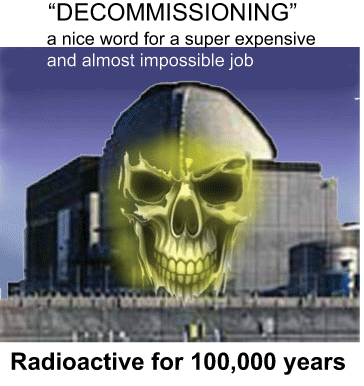
After shutting down in 2022, the job now is to carefully
remove tonnes of nuclear waste to be transported for storage at Sellafield
in Cumbria. The team is halfway through that task with one reactor empty
and one more to go.
I was given exclusive access to the power station,
getting the chance to travel deep within the bowels of the building and see
something few people outside EDF Energy get to – the cooling ponds, where
spent fuel is cooled down before being sealed for transport and storage.
there will be another couple of years to finish defuelling operations, then
EDF hands this place over to the Nuclear Decommissioning Authority as the
painstaking job of decommissioning will continue for many years.
ITV 13th Aug 2024
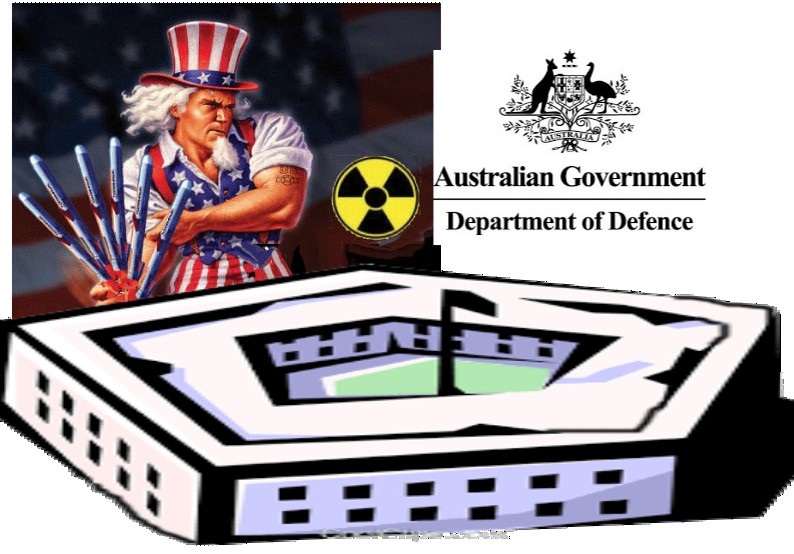
Forced Posture: has Australia already ceded military control to the US?
by Michelle Fahy and Elizabeth Minter | Aug 13, 2024, https://michaelwest.com.au/forced-posture-has-australia-already-ceded-military-control-to-the-us/?utm_source=newsletter&utm_medium=email&utm_term=2024-08-15&utm_campaign=Michael+West+Media+Weekly+Update
The war of words between Defence Minister Richard Marles and Paul Keating belies how the US bid for military control of Australia has been underway for over a decade, supported by both the Coalition and Labor. Michelle Fahy and Elizabeth Minter explain the Force Posture Agreement.
The Albanese government has not explained the full picture in its rejection of Paul Keating’s concerns about Australia’s defence policy. The former Labor prime minister said on ABC’s 7:30 last Thursday that AUKUS was likely to turn Australia into the 51st state of the United States: “AUKUS is really about, in American terms, the military control of Australia.”
The next morning deputy prime minister Richard Marles claimed Keating’s remarks were “not a fair characterisation” and that Keating’s remarks were not news.
Unmentioned by either Keating or Marles was that America’s bid for military control of Australia has been under way for more than a decade, with the enthusiastic support of both Coalition and Labor governments. As we write this, the US is spending $630 million as part of an extensive militarisation of the Australian Top End to suit its purposes.
Furthermore, five days ago, after the annual Ausmin (Australia-US Ministerial Consultations) talks, it was announced that the US was planning more frequent deployments to Australia of long-range B-52 bombers, which can carry nuclear weapons.

When asked last year whether Australia would allow US aircraft operating out of Tindal air base in the Northern Territory to carry nuclear weapons, the response of Foreign Minister Penny Wong was simply: “We understand and respect the longstanding US policy of neither confirming or denying.”
Compare that stance with that of Malcolm Fraser’s government. As John Menadue explained in a recent podcast “The Americanisation of our public policy, media and national interest”, then prime minister Fraser stood up in Parliament and insisted that no US aircraft or ships carrying nuclear weapons could access Australian ports or operate over Australia without the permission of the Australian government.
As Menadue said: “This is our territory, this is our sovereignty, [yet today] we won’t even ask the Americans operating out of Tindal whether they’re carrying nuclear weapons.”
Unimpeded access for the US
A critical piece of evidence regarding Australia’s sellout is the little-known Force Posture Agreement (FPA) with the United States, which the Abbott Coalition government signed in 2014, building on agreements made with the US by the Gillard Labor government. Her government allowed up to 2,500 US marines to be stationed on a permanent rotation in Darwin, and increased the number of military aircraft that could fly in and out of the Top End and use Australia’s outback bombing ranges.
The FPA provides the legal basis for the extensive militarisation of Australia by the US. In short, it permits the US to prepare for, launch and control its own military operations from Australian territory: “United States Forces and United States Contractors shall have unimpeded access to and use of Agreed Facilities and Areas for activities undertaken in connection with this Agreement.”
Defence Minister Marles has been effusive in his support for the force posture agreement and the control the US has been given over Australian soil.
Just last week, he announced that: “American force posture now in Australia involves every domain: land, sea, air, cyber and space.” Yet the longstanding Outer Space Treaty, which each AUKUS ally has ratified, reserves outer space for purely peaceful purposes.
Two months after Labor won office in May 2022, Marles was in Washington DC announcing that Labor would “continue the ambitious trajectory of its force posture cooperation” with the US.
He added that Australia’s military engagement with the US military would “move beyond interoperability to interchangeability” and Australia would “ensure we have all the enablers in place to operate seamlessly together, at speed”.
While the FPA strongly supports America’s ability to wage war against China, politicians have not explained its significance to the Australian public. Moreover, public consultation on the FPA was virtually non-existent. The Northern Territory government was consulted, while other state and territory governments merely received advice about it.
Defence Minister Marles speaks of the “appreciation for the contribution that America is making to the stability and the peace of the Indo-Pacific region by its presence in Australia”, but numerous critics, including Sam Roggeveen, the director of the Lowy Institute’s international security program and a former Australian intelligence analyst, warn of the risks of bringing “US combat forces, and its military strategy to fight China, on to our shores”.
The FPA allows the following and much more:
- unimpeded access to our airfields and airport facilities for US combat aircraft and bombers;
- unimpeded access to our seaports for US naval vessels, including US nuclear submarines at HMAS Stirling in Western Australia;
- the construction of a US Air Force mission planning, intelligence and operations centre in Darwin as part of $630 million in American spending across the Top End over the next two years;
- the establishment, under US military control, of several storage facilities for aircraft fuel, spare parts and munitions, including 11 giant jet fuel storage tanks near Darwin’s main port, which “will allow the US to run large-scale exercises and operations from Northern Australia”.
AUKUS, in conjunction with the FPA, ensures that Australia’s navy, in particular, will be tightly integrated with the US navy for the purpose of fighting China, and that the two navies can operate as one from Australian ports and waters.
Handcuffed to the US
Australia’s high-tech major weapons systems also make us more reliant than ever on the United States. As respected veteran journalist Brian Toohey reported in 2020, “The US … denies Australia access to the computer source code essential to operate key electronic components in its ships, planes, missiles, sensors and so on.”
This includes the F-35 fighter jets, which both Foreign Minister Penny Wong and Defence Minister Marles have noted this year form the largest proportion of the Australian Air Force’s fast jet capacity.
The significant erosion of Australian sovereignty did not start with AUKUS. Australians were warned as far back as 2001 of the high costs of our dependence on the US by a Parliamentary Library research paper that stated: “It is almost literally true that Australia cannot go to war without the consent and support of the US.”
The paper also noted that the Australian Defence Force is critically dependent on US supply and support for the conduct of all its operations except those at the lowest level and of the shortest duration.
It is more than dependency though? Deputy Prime Minister Richard Marles boasts that “American force posture now in Australia involves every domain: land, sea, air, cyber and space” yet the Albanese government denies that Australia is turning into the 51st state of America.
Nato fighter jets intercept Russian nuclear bombers
msn by Gergana Krasteva, 14 Aug 24
Vladimir Putin deployed two Tu-95MS strategic nuclear missile carriers over Nato waters after accusing Britain of coordinating the incursion into Russia with Ukraine, it has been reported.
MiG-31 combat warplanes belonging to the Alliance escorted the Kremlin’s jets, which buzzed over the Norwegian Sea.
Separately, two Tu-22M3 long-range bombers flew over the neutral waters of the Baltic Sea.
Both the Tu-95MS and Tu-22M3 bombers – key parts of Russia’s nuclear arsenal – were escorted by Nato planes during their ‘scheduled’ flights.
This is the latest of the Kremlin’s reconnaissance flights as part of its ongoing attempts to taunt the bloc.
It comes after it accused the UK of involvement in Ukraine’s attack on the border region – now in its second week and forcing Putin to move reserves on a massive scale to Kursk.
Assault troops have pushed about a mile farther into Russia on Wednesday, the commander of the Ukrainian military, General Oleksandr Syrskyi, said in a video posted on president Volodymyr Zelensky’s Telegram channel.
In addition, more than 100 Russian soldiers have been taken prisoner, Syrskyi added…………………………………………………….
Russian authorities have evacuated about 132,000 people from the Kursk and Belgorod regions and have plans to evacuate another 59,000 [could this be related to fears about Kursk’s nuclear power plant?] …….. https://www.msn.com/en-au/news/other/nato-fighter-jets-intercept-russian-nuclear-bombers/ar-AA1oNL0R?ocid=hpmsn—
Sweden Considers Borrowing $28.5 Billion to Finance Nuclear

By Lars Paulsson and Niclas Rolander, August 12, 2024
(Bloomberg) — Sweden could borrow 300 billion Swedish kronor ($28.5 billion) to help finance a new fleet of nuclear reactors in the coming decades.
A government study released Monday in Stockholm highlighted several features of its preferred model in order provide certainty for investors. Funding instruments include government borrowing to support construction, and 40 years of guaranteed revenues through a so-called contract-for-difference or CfD. ……….
Financing is one of the biggest hurdles for nuclear energy, with reactors costing multiple billions of dollars and taking years to build — often compounding the price. The model presented on Monday is focused on financing a program of as much as 6,000 megawatts, or four large-scale reactors, and has taken inspiration from the Czech Republic’s plans for financing new units at the Dukovany complex. ……..
The proposals will be sent for consultation to various institutions, companies and government agencies before they may be adopted by the government.
One feature is the CfD model, used for both Electricite de France SA’s Hinkley Point C in the UK and Dukovany. Under this mechanism, developers and the government agree a fixed price for electricity for a certain period of time, providing certainty of future revenue. If market prices fall too low, the generator receives a top-up from the state. On the flip side, the plant operator must pay back the difference if the market rate is higher.
In contrast with the financing scheme for Hinkley Point, which has a total cost estimate of about £47.9 billion ($61.2 billion) in today’s prices, the suggested model for Sweden also involves public borrowing to finance construction. According to the proposal, the government would borrow as much as 75% of investment costs, which Dillen expects could increase public debt by some 300 billion Swedish kronor ($28.5 billion).
Swedish state-owned Vattenfall AB and Finland’s Fortum are among the utilities studying new reactors……
In a comment on its website, Vattenfall said it agreed with a lot of the points made by Dillen, but that it was unclear how the state will ensure that the first wave of new reactors actually will be built.
Sweden has had a love-hate relationship with atomic energy since the first commercial reactor began operations in 1972. Mounting grassroots opposition in subsequent years culminated in a 1980 referendum calling for the dismantling of all reactors — an effort that ultimately failed. The winning center-right coalition in the 2022 election made a nuclear renaissance a pillar of its election campaign. ………. https://www.bnnbloomberg.ca/investing/2024/08/12/sweden-leans-toward-czech-style-funding-for-new-nuclear-reactors/
The Fajr massacre: Every 70 kg bag of human remains is considered a martyr
The bodies of Palestinians killed in the latest Israeli massacre in Gaza were destroyed so far beyond recognition that doctors have only been able to give grieving families an anonymous bag of human remains to bury.
Mondoweiss, By Tareq S. Hajjaj August 11, 2024
Zainab al-Jaabari, 79, sits a few dozen meters in front of the scene of the massacre. She is waiting for her family members to return from checking for her seven sons and grandchildren, who were in the prayer hall praying Fajr at the time it took place.
Her family members arrived to see the reality of the massacre with their own eyes: more than a hundred people were killed, and their bodies were now scattered and mixed in the prayer hall in the Daraj neighborhood in Gaza City. It is possible their delay in returning now is due to their horror at what they found, or perhaps because they can’t imagine how to tell Zainab that her seven sons and grandchildren have been killed.
At dawn on Saturday, August 10, the Israeli army bombed a mosque while dozens of displaced people were praying the Fajr prayer, the daily Islamic prayer offered in the early morning. The bombing killed more than a hundred people, most of whom were dismembered or destroyed beyond recognition. For this reason the identification of the bodies has so far been incomplete……………………………………………………………………………………………………….
Every 70 kilograms of remains is considered a martyr
In the mosque, people stand in a row close to each other as they pray, and after the bombing, the worshipers remained intermingled as well, as remains and corpses. Large numbers of martyrs were not able to be identified, and entire families were wiped out.
Survivors of this massacre are describing a new and horrifying experience they are being forced to endure in aftermath of Israeli bombing in the Gaza Strip: they cannot even identify the remains of their loved ones.
Because the rescue teams couldn’t identify many of the human remains collected due to the intensity of the bombing, the doctors at Baptist Hospital were not able to identify each martyr individually. Instead, the doctors have started collecting body parts in plastic bags and giving 70 kilos of remains to the family of a martyr who has gone missing.
Hassan Ahmad told Mondoweiss that he searched extensively for the body of his 6-year-old son Ali, and after hours of searching, he did not find a trace of him. He then went to the Baptist Hospital to ask about his son, or to find any part of his body so I could identify him and bury him. After a long search that did not yield any results, the doctors at the Baptist Hospital gave him a plastic bag containing 18 kilograms of human remains and told him, “This is your son; go and bury him.”………………………………………………………..
I saw my father’s carnage
Muhammad Hamida, 12, recounted to Mondoweiss how he found his father, who had been torn apart in the Israeli attack. He says that he went with his older brother to the prayer hall after the bombing to rescue their father, who was praying at the time.
When we arrived, we couldn’t enter because of the intensity of the fire, blood, and body parts, but we wanted to check on my father. Moments later, we could enter the prayer hall but we couldn’t bear the scene.”
“People were cut up, there was a lot of blood on the ground, and body parts and small pieces of worshipers’ bodies were scattered everywhere. We found my father lying on the ground there. We recognized him, and our relatives helped us drag him out of the prayer hall. We found a human head stuck between his feet when we took him out. I was stunned with fear. I have never seen scenes like this in my life. I hope I never see them again.”
“They will kill us all; we are here alone; no one cares about us. They killed my father, and a month ago, they killed my two uncles, and they will kill everyone who remains in Gaza.”
Fatima Hassona conducted the interviews for this report from Gaza. https://mondoweiss.net/2024/08/the-fajr-massacre-every-70-kg-bag-of-human-remains-is-considered-a-martyr/?ml_recipient=129461487750088454&ml_link=129461453864305971&utm_source=newsletter&utm_medium=email&utm_term=2024-08-12&utm_campaign=Daily+Headlines+RSS+Automation
How NATO Went Rogue
By Tomasz Pierscionek, Morning Star, August 9, 2024, https://worldbeyondwar.org/how-nato-went-rogue/
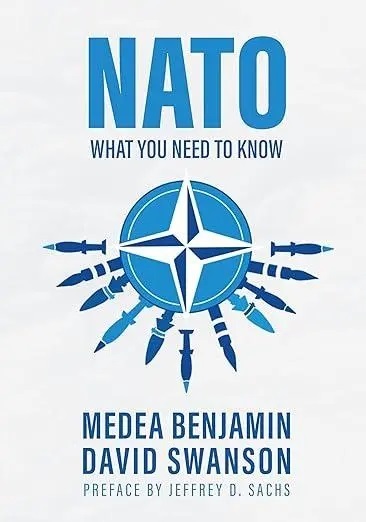
NATO: What You Need to Know by Medea Benjamin and David Swanson, OR books, £12.99
To mark the 75th anniversary of Nato’s creation, veteran anti-war activists Medea Benjamin and David Swanson have published a book that explores the alliance’s origins and critiques its role in global affairs over the past several decades.
The authors produce a much needed antidote to the pervasive propaganda that claims Nato makes the world a safer place.
Benjamin and Swanson duly set the record straight and offer a powerful riposte to the arguments upon which Nato’s proponents rely in order to justify the military collective’s long overdue existence.
Nato’s first secretary-general allegedly declared that the organisation, originally comprising 12 members when founded in 1949, aimed “to keep the Soviet Union out, the Americans in, and the Germans down.” Notwithstanding this comment’s facetiousness, the words hold a darker meaning and provide an insight into what Nato would become.
Taking Nato’s founding document (the Washington Treaty) at face value, its original members sought collectively to preserve stability within the north Atlantic region while adhering to the principles of the United Nations Charter, desiring to live in peace with all nations, and seeking to resolve any disputes peacefully.
We learn that in the ensuing decades Nato would expand its influence far beyond the north Atlantic area, incorporate countries which were dictatorships at the time (such as Greece and Turkey), support colonialism in Africa, seek to thwart democracy by stifling popular communist and left-wing movements across Europe, and support numerous unsavoury groups such as Kosovan criminals and Islamic terrorists.
Benjamin and Swanson thus show how Nato’s future actions would violate the intentions expressed in its founding document.
We learn too how the USSR, fearful of West German rearmament and having recently lost 27 million of its people, asked to join Nato in the mid-1950s with the intention of being part of the post-war security architecture in Europe. The request was rebuffed, leading to the USSR forming its own defensive Warsaw Pact the following year.
The reader is left to ponder how different history could have been and which future conflicts may have been avoided had Nato’s founders accepted this offer of detente during the cold war’s early years. Perhaps it is not coincidental that Nato’s first military operation only occurred after the USSR’s collapse, when it became engaged in shooting down Serbian planes during the Bosnian war of the mid-1990s.
Subsequent chapters reveal how Nato became a vehicle for the US to pursue its dreams of global dominance without the shackles of international treaties or the constitution. For example, whereas the president of the United States requires Congressional approval to undertake military action, this constraint is not required for the US-led Nato alliance to go to war.
Benjamin and Swanson discuss the role Nato has played in the Yugoslav, Afghan, Iraq and Libyan conflicts to demonstrate how the military bloc leaves a trail of destruction and chaos in its wake, a far cry from the stability and democracy it claims to uphold.
The alliance has also morphed into an excuse to oblige member nations as well as non-member countries (the latter referred to as Nato’s “global partners”) to purchase US-made weapons under the guise of promoting “inter-operability.”
Voicing the opinion that Ukraine joining Nato is a ludicrous idea that will provoke an aggressive response from Russia may nowadays get you demonised as promoting pro-Kremlin propaganda. Yet Benjamin and Swanson tell us that such a view was considered sensible in the upper echelons of US politics not too long ago.
For example, former US ambassador to Moscow William Burns reportedly once sent a communique back home explaining that Ukraine joining Nato would be “the brightest of all red lines for the Russian elite (not just Putin),” adding that this was a view shared by President Putin’s harshest critics and that “I have yet to find anyone who views Ukraine in Nato as anything other than a direct challenge to Russian interests.”
Ironically, as the authors describe, Russia’s invasion of Ukraine gave Nato a new lease of life at a time when some politicians were beginning to question the organisation’s purpose. While rightly condemning the invasion, Benjamin and Swanson explain how relentless expansion and provocation from a US-led Nato over the preceding two decades set the scene for a war that could have been avoided.
I was left wondering how Western nations would have reacted to Russian encroachment after the cold war had roles been reversed. Relabelling the acronym Nato as Not A Tenable Option, Benjamin and Swanson finish by describing alternatives to the alliance that could de-escalate tensions around the globe while providing countries with a sense of security.
The authors present their case in a clear and straightforward manner that makes their analysis easy to comprehend. Despite being less than 150 pages long, Nato: What You Need to Know contains a plethora of vital wisdom for readers across the political spectrum.
Its publication comes at a time when many, including some on the left or those once considered as anti-war, have been seduced into swallowing militarist propaganda that advocates arming Ukraine to fight Russia regardless of what consequences may transpire.
The world is closer to witnessing a conflict between nuclear-armed powers than it has been for decades. Now is the time to change direction before it is too late.
Iran planning to resume testing nuclear bomb detonators
Wednesday, 08/14/2024 Mojtaba Pourmohsen, Journalist at Iran International
Iran is intensifying efforts on its secretive nuclear weapons program, bringing the country closer than ever to developing a nuclear bomb—a threat that has loomed for over two decades, according to exclusive information obtained by Iran International.
According to three independent sources in Iran, who have chosen to remain anonymous due to the sensitive nature of the topic, the Islamic Republic is advancing its secret nuclear weapons program by restructuring the Organization of Defensive Innovation and Research (SPND), retaining Mohammad Eslami as the head of the Atomic Energy Organization of Iran, and resuming tests to produce nuclear bomb detonators.
For years, US intelligence agencies consistently stated in their annual reports that Iran “isn’t currently undertaking the key nuclear weapons development activities necessary to produce a testable nuclear device”. However, in the Director of National Intelligence’s 2024 report, released in July, that phrase was omitted. Instead, the report stated that Iran has “undertaken activities that better position it to produce a nuclear device, if it chooses to do so.”
The newly obtained information shows the Islamic Republic has intensified its efforts to complete the nuclear weapons production cycle, including high-level uranium enrichment, the production of nuclear detonation devices, and the development of missiles capable of carrying nuclear warheads.
Restructuring SPND.
Less than a month before Ebrahim Raisi’s death, the Iranian Parliament passed a bill to formalize the Organization of Defensive Innovation and Research (SPND) as an independent entity. Originally established in 2010 as a subsidiary of the Ministry of Defense, SPND was restructured under this new legislation, enacted just a week before Raisi’s passing.
Mohsen Fakhrizadeh, a prominent figure in Iran’s military nuclear program, previously led SPND.
Fakhrizadeh was assassinated in November 2020 near Tehran, an act attributed to Mossad. The new law has granted SPND financial independence, exempting it from the oversight of the National Audit Office, essentially allowing it to operate without accountability for its budget.
The law also states that SPND will be governed according to a statute issued by Supreme Leader Ali Khamenei. This restructuring of SPND is significant as it provides the organization with unique autonomy, allowing it to continue the legacy of Fakhrizadeh’s work, particularly in producing nuclear detonation devices
SPND’s role in Iran’s nuclear program……………………………………………………………………………………………………………………………………………………….
Shifting to nuclear weapons for deterrence
A Western diplomat told Iran International that Iran’s suspicious nuclear activities have raised concerns among the United States, Israel, and European countries. Following the assassination of Hamas leader Ismail Haniyeh, the head of Hamas’ political bureau in Tehran said the Islamic Republic’s deterrence policy, which relied heavily on proxy forces, has lost its effectiveness, something Khamenei and other government officials are fully aware of.
This reality might have driven the Islamic Republic to consider pursuing another form of deterrence. On the day Pezeshkian presented his ministerial picks to the Parliament, Iranian lawmaker Mohammad-Reza Sabbaghian told the open session, “What logic or law dictates that arrogant powers should have nuclear weapons, but Iran should not?”
He added, “We call on the Supreme National Security Council to review the new circumstances and recommend to the Supreme Leader that, considering dynamic Islamic jurisprudence, the path be cleared for the development of nuclear weapons.”
This could be the final, and perhaps most dangerous, arrow in Khamenei’s quiver. https://www.iranintl.com/en/202408148823
Iran to Israel: Ceasefire in Gaza war, or retaliation for Haniyh murder will proceed
SOTT, Parisa Hafezi and Laila Bassam, Reuters, Tue, 13 Aug 2024
Only a ceasefire deal in Gaza stemming from hoped-for talks this week would hold Iran back from direct retaliation against Israel for the assassination of Hamas leader Ismail Haniyeh on its soil, three senior Iranian officials said.
Iran has vowed a severe response to Haniyeh’s killing, which took place as he visited Tehran late last month and which it blamed on Israel. Israel has neither confirmed or denied its involvement. The U.S. Navy has deployed warships and a submarine to the Middle East to bolster Israeli defenses.
One of the sources, a senior Iranian security official, said Iran, along with allies such as Hezbollah, would launch a direct attack if the Gaza talks fail or it perceives Israel is dragging out negotiations. The sources did not say how long Iran would allow for talks to progress before responding.
With an increased risk of a broader Middle East war after the killings of Haniyeh and Hezbollah commander Fuad Shukr, Iran has been involved in intense dialogue with Western countries and the United States in recent days on ways to calibrate retaliation, said the sources, who all spoke on condition of anonymity due to the sensitivity of the matter.
In comments published on Tuesday, the U.S. ambassador to Turkey confirmed Washington was asking allies to help convince Iran to de-escalate tensions. Three regional government sources described conversations with Tehran to avoid escalation ahead of the Gaza ceasefire talks, due to begin on Thursday in either Egypt or Qatar.
“We hope our response will be timed and executed in a way that does not harm a potential ceasefire,” Iran’s mission to the U.N. said on Friday in a statement. Iran’s foreign ministry on Tuesday said calls to exercise restraint “contradict principles of international law.”
Iran’s foreign ministry and its Revolutionary Guards Corps did not immediately respond to questions for this story. The Israeli Prime Minister’s Office and the U.S. State Department did not respond to questions.
“Something could happen as soon as this week by Iran and its proxies… That is a U.S. assessment as well as an Israel assessment,” White House spokesperson John Kirby told reporters on Monday.
“If something does happen this week, the timing of it could certainly well have an impact on these talks we want to do on Thursday,” he added.
At the weekend, Hamas cast doubt on whether talks would go ahead. Israel and Hamas have held several rounds of talks in recent months without agreeing a final ceasefire.
In Israel, many observers believe a response is imminent after Supreme Leader Ayatollah Ali Khamenei said Iran would “harshly punish” Israel for the strike in Tehran……………………………………….. more https://www.sott.net/article/493939-Iran-to-Israel-Ceasefire-in-Gaza-war-or-retaliation-for-Haniyh-murder-will-proceed
Fire sparks Georgia nuclear plant alert, but officials say no safety threat as reactors unaffected
Georgia’s largest nuclear plant declared an emergency alert Tuesday
after an electrical transformer caught fire. The fire, described as small
by Georgia Power Co. spokesperson John Kraft, broke out about noon and
could have threatened the electrical supply to the heating and cooling
system for the control room of one of the complex’s two older nuclear
reactors, Vogtle Unit 2.
AP News 13th Aug 2024
1 This Month

22 June – Virtual Event –Climate Change: New Data, New Debate
Monday, June 22, 2026 2:30 p.m. – 3:15 p.m. CT
YouTube. Register here
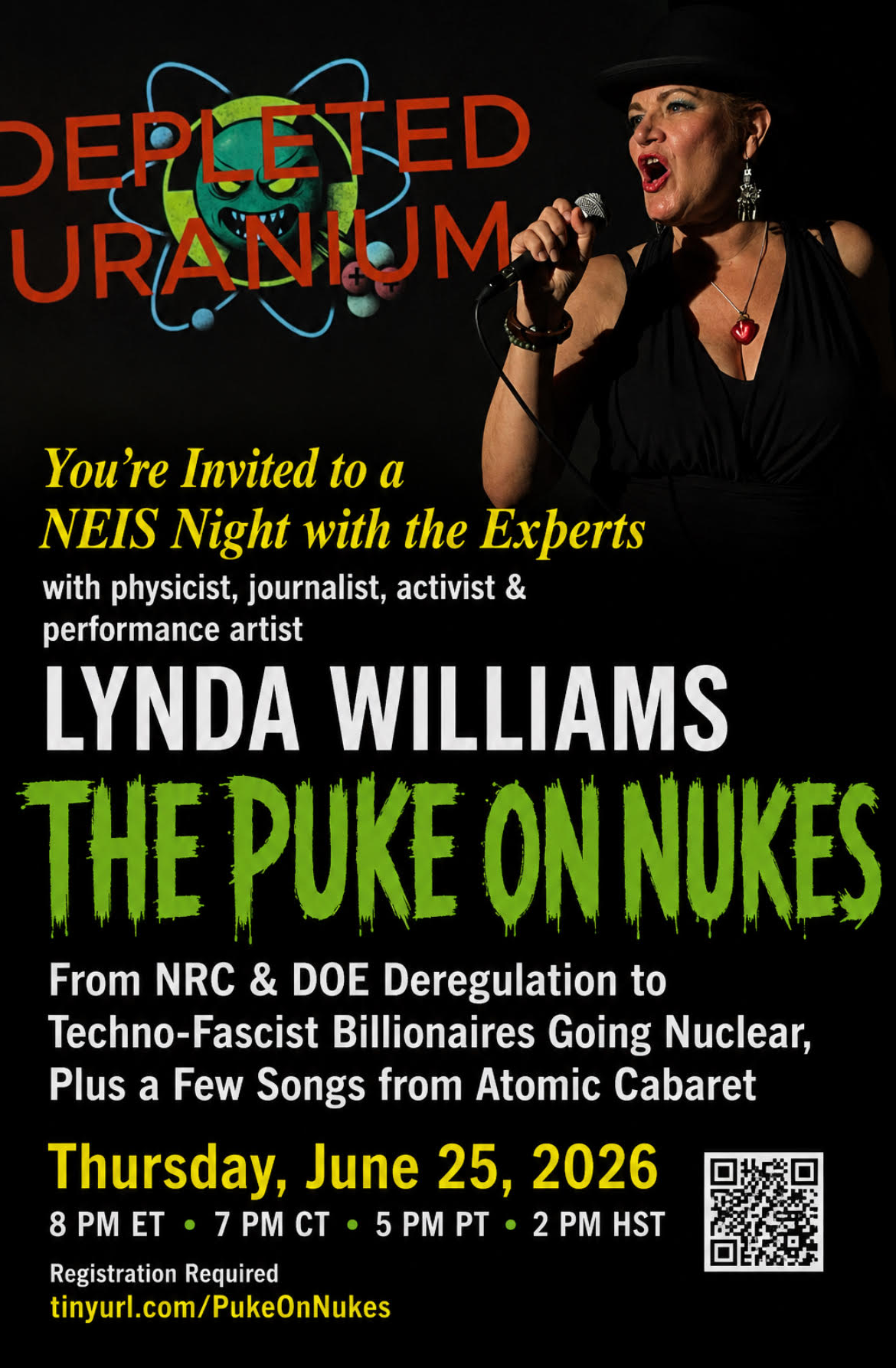
25 June- THE PUKE ON NUKES
Thursday, June 25, 2026
7pm Central Time (8pm ET, 6pm MT, 5pm PT) UTC – 5
From NRC & DOE Deregulation to Techno-Fascist Billionaires Going Nuclear, Plus a Few Songs from Atomic Cabaret REGISTER
26 June – Radiation Trainwreck at the NRC / Join the Protect Better Campaign – https://us02web.zoom.us/meeting/register/4ZlZ5_qLSHGiLSCg8FF6Bg#/registration
1st July – Webinar Waste of Space: The Environmental Harm of Military and Civil Space Activity st July, 7 pm

Report Launch Online: We are seeing an increasing exploitation of space for military and commercial purposes. This must change.

Protect Sazan Island from the Trump family! https://secure.avaaz.org/campaign/en/protect_sazan_island_from_the_trump_family_loc/?bqFCVab&v=174511&cl=22707147157&_checksum=5e9dde668860e8231c33699735e16a1fbf22ab2cb01da50c999fe8732b9775ef&utm_source=email&utm_medium=blast_email&utm_campaign=174511


Cuba Is Not a Failed State – It Is a Besieged State
PETITION: “Global Appeal to Endorse Palestinian Right of Return of Refugees”
To see nuclear-related stories in greater depth and intensity – go to https://nuclearinformation.wordpress.com
-
Archives
- June 2026 (221)
- May 2026 (306)
- April 2026 (356)
- March 2026 (251)
- February 2026 (268)
- January 2026 (308)
- December 2025 (358)
- November 2025 (359)
- October 2025 (376)
- September 2025 (257)
- August 2025 (319)
- July 2025 (230)
-
Categories
- 1
- 1 NUCLEAR ISSUES
- business and costs
- climate change
- culture and arts
- ENERGY
- environment
- health
- history
- indigenous issues
- Legal
- marketing of nuclear
- media
- opposition to nuclear
- PERSONAL STORIES
- politics
- politics international
- Religion and ethics
- safety
- secrets,lies and civil liberties
- spinbuster
- technology
- Uranium
- wastes
- weapons and war
- Women
- 2 WORLD
- ACTION
- AFRICA
- Atrocities
- AUSTRALIA
- Christina's notes
- Christina's themes
- culture and arts
- Events
- Fuk 2022
- Fuk 2023
- Fukushima 2017
- Fukushima 2018
- fukushima 2019
- Fukushima 2020
- Fukushima 2021
- general
- global warming
- Humour (God we need it)
- Nuclear
- RARE EARTHS
- Reference
- resources – print
- Resources -audiovicual
- Weekly Newsletter
- World
- World Nuclear
- YouTube
-
RSS
Entries RSS
Comments RSS
 nuclear-news