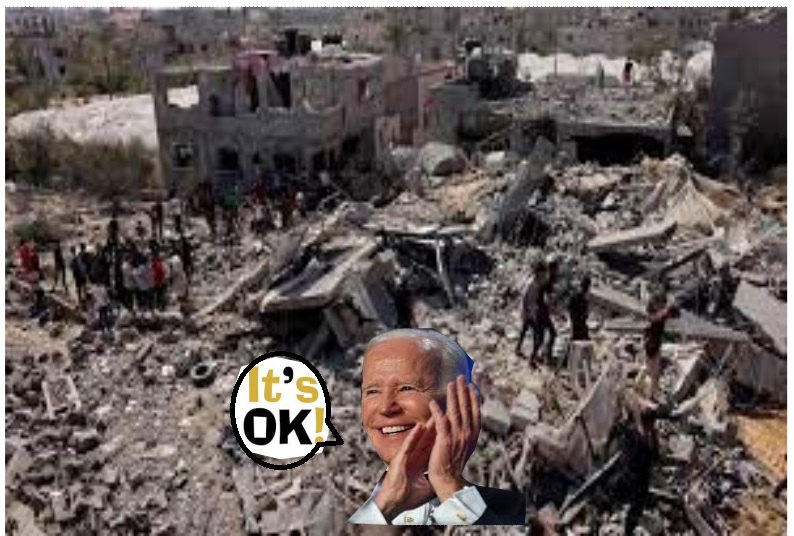
Are Blinken and Biden’s Gaza genocide denials any different than Nazi WWII genocide denials?
Walt Zlotow, West Suburban Peace Coalition, Glen Ellyn IL , 12 Jan 25.
Secretary of State Antony Blinken told the NY Times he’s not worried about history judging him as a genocide enabler.
When asked he replied, “No. It’s not (genocide), first of all. Second, as to how the world sees it, I can’t fully answer to that.”
Blinken will deny to his death his $22 billion in weapons that Israel has used to utterly destroy sustainable life for 2,300,000 Palestinians in Gaza’s 139 square miles is genocide. But the entire world aside from the Biden administration is correct in viewing it as genocide
It isn’t that Blinken “Can’t answer to that” (the world viewing it as genocide). He simply won’t answer to what is the most monstrous crime a national leader can commit. From Day 1 in the genocide Israel embarked upon in response to the October 7, 2023 Hamas attacks, Blinken and his boss Biden have been calling the genocide their weapons enable ‘self-defense.’
Denying genocide is what the Nazi war criminals did to a man at the Nuremberg War Crime Trials after WWII.
There will be no war crime trials for Blinken and Biden for the genocide that could not take place their tens of billions in weapons, vetoes of ceasefire resolutions in the US Security Council, public support and their endless ‘self-defense’ refrain.
In a bitter irony for humanity, it was the US which helped establish the International Criminal Court (ICC) in 1998 to ferret out and prosecute war criminals. But with criminal US wars devastating Afghanistan and Iraq, the US has turned on the ICC in fear of becoming ICC war crime targets. The US has abstained from membership and has blasted the ICC indicting Israeli Prime Minister Benjamin Netanyahu for his Gaza genocide. President Biden called the indictment “outrageous” and declared “We will always stand with Israel.”
Is that any different from denying, even condoning WWII Nazi genocide?
Blinken and Biden, barreling toward historical infamy with their blank check enabling Israeli genocide in Gaza.
2024 confirmed as first year to pass 1.5C threshold

Scientists warn efforts to limit the long-term temperature rise to 1.5°C will fail as data confirms 2024 was the hottest year in human history
New Scientist, By James Dinneen and Madeleine Cuff, 10 January 2025
Hopes of keeping global warming below 1.5°C above pre-industrial levels have been all but extinguished after new data confirmed 2024 was the first calendar year to see average temperatures breach that critical threshold.
Last year was the hottest ever recorded in human history, the World Meteorological Organization (WMO) declared on 10 January, in the latest stark warning that humanity is pushing Earth’s climate into uncharted territory.
The average global temperature for the year exceeded 1.5°C above the pre-industrial baseline for the first time, the agency also confirmed, temporarily breaching the threshold set by the Paris Agreement.
The WMO’s assessment is calculated using the average global temperature across six datasets, with the period of 1850 to 1900 used to provide a pre-industrial baseline. Temperature datasets collected by various agencies and institutions around the world vary slightly, mainly due to differences in how ocean temperatures have been measured and analysed over the decades. Some of those datasets come in just below the 1.5°C mark, but others are well above.
The UK’s Met Office weather service puts 2024’s average temperature at 1.53°C above pre-industrial levels, with a margin of error of 0.08°C. That is 0.07°C above 2023, the previous warmest year on record. Meanwhile, the European Union’s climate change service Copernicus has 2024 temperatures at 1.6°C above pre-industrial levels, 0.12°C above 2023’s record.
Berkeley Earth, a climate research group in California, finds a rise of 1.62°C, the second time in its dataset the rise in global average temperatures has breached 1.5°C, after 2023. Temperature data from NASA puts the rise in temperature a bit lower at 1.47°C above pre-industrial levels, and the US National Oceanic and Atmospheric Administration finds a 1.46°C rise above pre-industrial levels. The WMO finds an average rise of 1.55°C across the six datasets, with a margin of error of 0.13°C.
Scientists agree that the surge in temperature was caused mostly by the continuation of human-caused climate change and an El Niño weather pattern, which tends to push up global temperatures. But the scale and persistence of the heat has shocked many experts, who expected temperatures to subside once El Niño ended in May 2024. Instead, they remained at record levels throughout the rest of the year.
The world’s oceans have been most affected, with sea surface temperatures staying at record levels for most of 2024, playing havoc with marine ecosystems. The year also brought no shortage of extreme weather on land, with fierce heatwaves, sharp declines in polar ice, deadly flooding and uncontrollable wildfires. “This was a year when the impacts of climate change are right across the planet,” says David King, former chief scientific adviser to the UK government and founder of the Climate Crisis Advisory Group.
Technically, the Paris Agreement target of limiting warming to below 1.5°C is calculated using a 20-year average, so a single year above the threshold doesn’t signal a formal breach of the target. But given the pace of warming in recent years, many scientists say the long-term Paris goal is now out of reach………………………………………..
https://www.newscientist.com/article/2463480-2024-confirmed-as-first-year-to-breach-1-5c-warming-limit/
Lawsuit challenges NRC on SMR regulation

Friday, 10 January 2025, https://www.world-nuclear-news.org/articles/lawsuit-challenges-nrc-on-smr-regulation
The States of Texas and Utah and microreactor developer Last Energy Inc are challenging the US regulator over its application of a rule it adopted in 1956 to small modular reactors and research and test reactors.
Under the US Nuclear Regulatory Commission (NRC) Utilization Facility Rule, all US reactors are required to obtain NRC construction and operating licences regardless of their size, the amount of nuclear material they use or the risks associated with their operation. The plaintiffs say this imposes “complicated, costly, and time-intensive requirements that even the smallest and safest SMRs and microreactors – down to those not strong enough to power an LED lightbulb” must satisfy to secure the necessary licences. This does not only affect microreactors: existing research and test reactors such as those at the universities in both Texas and Utah face “significant costs” to maintain their NRC operating licences, the plaintiffs say.
In the filing, Last Energy – developer of the PWR-20 microreactor – says it has invested “tens of millions of dollars” in developing small nuclear reactor technology, including USD2 million on manufacturing efforts in Texas alone, and has agreements to develop more than 50 nuclear reactor facilities across Europe. But although it has a “preference” to build in the USA, “Last Energy nonetheless has concluded it is only feasible to develop its projects abroad in order to access alternative regulatory frameworks that incorporate a de minimis standard for nuclear power permitting”.
Noting that only three new commercial reactors have been built in the USA over the past 28 years, the plaintiffs say building a new commercial reactor of any size in the country has become “virtually impossible” due to the rule, which it says is a “misreading” of the NRC’s own scope of authority.
They are asking the court to set aside the rule, “at least as applied to certain small, non-hazardous reactors”, and exempt their research reactors and Last Energy’s small modular reactors (SMRs) from the commission’s licensing requirements.
Houston, Texas-based law firm King & Spalding said the lawsuit, if it is successful, would “mark a turning point” in the US nuclear regulatory framework – but warns that it could also create greater uncertainty as advanced nuclear technologies get closer to commercial readiness.
“Regardless the outcome, the Plaintiffs’ lawsuit highlights the challenges in applying the Utilization Facility Rule to the advanced nuclear reactors now under development in the US,” the company said in in analysis released on 9 January.
But the NRC is already addressing the issue: in 2023, it began the rulemaking process to establish an optional technology-inclusive regulatory framework for new commercial advanced nuclear reactors, which would include risk-informed and performance-based methods “flexible and practicable for application to a variety of advanced reactor technologies”. SECY-23-0021: Proposed Rule: Risk-Informed, Technology-Inclusive Regulatory Framework for Advanced Reactors is currently open for public comment until 28 February, and the NRC has said it expects to issue a final rule “no later than the end of 2027”.
The lawsuit has been filed with the US District Court in the Eastern District of Texas.
Trident nuclear submarines leave UK reliant on the US, in lockstep with the US.
By Lynn Jamieson and Samuel Rafanell-Williams
The special relationship has meant that UK leaders typically fall in lockstep with US superpower logic, most catastrophically in Iraq, no matter how devastating the consequences.
An important and easily overlooked reason why Westminster is so willing to
do Washington’s bidding is the reliance of our supposedly
“independent” nuclear weapons capability on US military infrastructure
and technology.
The nuclear weapons based on the west coast of Scotland,
are arguably more of a US technology than British. The submarines, whilst
built in Barrow-in-Furness in England, are assembled according to US
blueprints and with US components. The Trident missiles fired by the
submarines are built, supplied and maintained in the US.
The National 10th Jan 2025,
https://www.thenational.scot/politics/24846637.trident-nuclear-submarines-leave-uk-reliant-us/
There is no such thing as good nuclear proliferation
it’s not just Trump — America’s actions have been running counter to Washington’s nonproliferation interests for longer than that.
In a world less constrained by international norms and rules, and increasingly governed by sheer power, the strictures that long constrained nuclear proliferation are in danger of loosening — if not untangling altogether.
ReutersFrom Across the Pond, January 8, 2025 , By Ivo Daalder
Ivo Daalder, former U.S. ambassador to NATO, is CEO of the Chicago Council on Global Affairs and host of the weekly podcast “World Review with Ivo Daalder.” He writes POLITICO’s Across the Pond column.
While attending a virtual transatlantic seminar on burden sharing recently, I heard two Americans arguing that Washington needed to prioritize military engagement in Asia over continued engagement in Europe — a view closely aligned with the incoming administration.
But my ears perked up when one of them said the U.S. “would maintain its extended nuclear deterrent,” even though Europe would need to defend itself against Russia’s military threat. This was reassuring, for America’s nuclear arsenal has been the cornerstone of NATO’s nuclear security for decades.
However, I have my doubts. NATO’s nuclear history consists of one long effort to reassure nonnuclear European allies that the U.S. would risk the destruction of New York or Washington to defend Berlin or Warsaw. One way it has done so is by deploying nuclear weapons in Europe and offering some European allies to fly their own aircraft carrying U.S. nuclear weapons.
The more important reassurance, however, has always involved the deployment of U.S. troops on the front line, which guarantees America will be involved in any war from the very first shot. It is those troops that make America’s security commitment, including its nuclear deterrent, very real — both for Russia and for NATO allies.
When I pointed this out, though, the presenter suggested that European countries may want to consider getting nuclear deterrents of their own then. After all, they argued, Washington had supported “good proliferation” before — just look at France and the U.K. But while this view isn’t all that far removed from what President-elect Donald Trump has been saying, it’s also a very slippery slope.
Indeed, back in 2016, then-candidate Trump argued that Korea and Japan might want to get nuclear weapons to deal with North Korea’s arsenal. He then offered them little reassurance that the U.S. had their backs. And later, as president, he was more concerned with getting allies to “pay up” than defending them in the event of an attack.
Of course, worries about nuclear proliferation are nothing new. In 1963, then-U.S. President John F. Kennedy warned of a “world in which 15 or 20 or 25 nations may have these weapons.” But while Washington did help some allies with their nuclear programs, its longer-term effort was to stem the desire for acquiring nuclear weapons through a combination of arms control and alliance building.
Together with the Soviet Union, the U.S. negotiated the Treaty on the Non-Proliferation of Nuclear Weapons (NPT), which committed nonnuclear states to remain so, and nuclear states to work toward nuclear disarmament. Washington also bolstered its nuclear commitments to allies in Europe and Asia, sharing nuclear information and inviting some allies to participate in nuclear missions.
These efforts have been extraordinarily successful. Since the NPT was signed in 1968, only five other countries developed nuclear weapons — and one of those, South Africa, dismantled its small arsenal in the 1990s. Over the past few decades, arms control agreements— as well as stronger alliances — reduced nuclear inventories by nearly 90 percent.
But now, this strategy is under severe stress. New START, the last remaining U.S.-Russia strategic arms control agreement, will expire in little over a year. Moscow has already made clear it doesn’t seek another extension, and Washington is now concerned that Beijing’s rapidly expanding nuclear arsenal means future negotiations will mean trying to pull off a more complicated and difficult tripartite agreement……………………………………………………………………….
it’s not just Trump — America’s actions have been running counter to Washington’s nonproliferation interests for longer than that…………………………………………………………
As a nuclear power, Russia deters the U.S. and its allies from directly defending Ukraine, but as a nonnuclear power, Iran can do little to prevent the U.S. and its allies from directly defending Israel. No surprise, then, that the International Atomic Energy Agency recently announced Tehran had “dramatically” accelerated its uranium enrichment efforts.
In a world less constrained by international norms and rules, and increasingly governed by sheer power, the strictures that long constrained nuclear proliferation are now in danger of loosening — if not untangling altogether. And in such a world, even “good” proliferation can soon lead to very bad results. https://www.reuters.com/business/energy/us-study-proliferation-risk-haleu-nuclear-fuel-after-warning-by-scientists-2025-01-08/
When Carter met Kim – and stopped a nuclear war

Tessa Wong, Asia Digital Reporter, BBC News, 11 Jan 25 https://www.bbc.com/news/articles/cpee202y907o—
Three decades ago, the world was on the brink of a nuclear showdown – until Jimmy Carter showed up in North Korea.
In June 1994, the former US president arrived for talks in Pyongyang with then leader Kim Il-sung. It was unprecedented, marking the first time a former or sitting US president had visited.
But it was also an extraordinary act of personal intervention, one which many believe narrowly averted a war between the US and North Korea that could have cost millions of lives. And it led to a period of greater engagement between Pyongyang and the West.
All this may not have happened if not for a set of diplomatic chess moves by Carter, who died aged 100 on 29 December.
“Kim Il-sung and Bill Clinton were stumbling into a conflict, and Carter leapt into the breach, successfully finding a path for negotiated resolution of the standoff,” North Korean expert John Delury, of Yonsei University, told the BBC.
In early 1994, tensions were running high between Washington and Pyongyang, as officials tried to negotiate an end to North Korea’s nuclear programme.
US intelligence agencies suspected that despite ongoing talks, North Korea may have secretly developed nuclear weapons.
Then, in a startling announcement, North Korea said it had begun withdrawing thousands of fuel rods from its Yongbyon nuclear reactor for reprocessing. This violated an earlier agreement with the US under which such a move required the presence of inspectors from the International Atomic Energy Agency (IAEA) nuclear watchdog.
North Korea also announced it would withdraw from the IAEA.
American suspicion spiked as Washington believed Pyongyang was preparing a weapon, and US officials broke off negotiations. Washington began preparing several retaliatory measures, including initiating UN sanctions and reinforcing troops in South Korea.
In subsequent interviews, US officials revealed they also contemplated dropping a bomb or shooting a missile at Yongbyon – a move which they knew would have likely resulted in war on the Korean peninsula and the destruction of the South’s capital, Seoul.
It was in this febrile atmosphere that Carter made his move.
For years, he had been quietly wooed by Kim Il-sung, who had sent him personal entreaties to visit Pyongyang. In June 1994, upon hearing Washington’s military plans, and following discussions with his contacts in the US government and China – North Korea’s main ally – Carter decided to finally accept Kim’s invitation.
“I think we were on the verge of war,” he told the US public broadcaster PBS years later. “It might very well have been a second Korean War, within which a million people or so could have been killed, and a continuation of the production of nuclear fissile material… if we hadn’t had a war.”
Carter’s visit was marked by skillful diplomatic footwork – and brinkmanship.
First, Carter had to test Kim’s sincerity. He made a series of requests, all of which were agreed to, except the last: Carter wanted to travel to Pyongyang from Seoul across the demilitarised zone (DMZ), a strip of land that acts as a buffer between the two Koreas.
“Their immediate response was that no-one had ever done this for the last 43 years, that even the United Nations secretary-general had to go to Pyongyang through Beijing. And I said, ‘Well, I’m not going, then’,” he said.
A week later, Kim caved.
The next step for Carter was harder – convincing his own government to let him go. Robert Gallucci, the chief US negotiator with North Korea at the time, later said there was “discomfort in almost all quarters” about the US essentially “subcontracting its foreign policy” to a former president.
Carter first sought permission from the State Department, who blanked him. Unfazed, he decided to simply inform then-US president Bill Clinton that he was going, no matter what.
He had an ally in vice-president Al Gore, who intercepted Carter’s communication to Clinton. “[Al Gore] called me on the phone and told me if I would change the wording from “I’ve decided to go” to “I’m strongly inclined to go” that he would try to get permission directly from Clinton… he called me back the next morning and said that I had permission to go.”
The trip was on.
‘Very serious doubts’
On 15 June 1994, Carter crossed over to North Korea, accompanied by his wife Rosalyn, a small group of aides and a TV crew.
Meeting Kim was a moral dilemma for Carter.
“I had despised Kim Il-sung for 50 years. I was in a submarine in the Pacific during the Korean War, and many of my fellow servicemen were killed in that war, which I thought was precipitated unnecessarily by him,” he told PBS.
“And so I had very serious doubts about him. When I arrived, though, he treated me with great deference. He was obviously very grateful that I had come.”
Over several days, the Carters had meetings with Kim, were taken on a sightseeing tour of Pyongyang and went on a cruise on a luxury yacht owned by Kim’s son, Kim Jong-il.
Carter discovered his hunch was right: North Korea not only feared a US military strike on Yongbyon, but was also ready to mobilise.
“I asked [Kim’s advisers] specifically if they had been making plans to go to war. And they responded very specifically, ‘Yes, we were’,” he said.
“North Korea couldn’t accept the condemnation of their country and the embarrassment of their leader and that they would respond.
“And I think this small and self-sacrificial country and the deep religious commitments that you had, in effect, to their revered leader, their Great Leader as they called him, meant that they were willing to make any sacrifice of massive deaths in North Korea in order to preserve their integrity and their honour, which would have been a horrible debacle in my opinion.”
Carter presented a list of demands from Washington as well as his own suggestions. They included resuming negotiations with the US, starting direct peace talks with South Korea, a mutual withdrawal of military forces, and helping the US find remains of US soldiers buried in North Korean territory.
“He agreed to all of them. And so, I found him to be very accommodating,” Carter said. “So far as I know then and now, he was completely truthful with me.”
Crucially, Carter came up with a deal where North Korea would stop its nuclear activity, allow IAEA inspectors back into its reactors, and eventually dismantle Yongbyon’s facilities. In return, the US and its allies would build light-water reactors in North Korea, which could generate nuclear energy but not produce material for weapons.
While enthusiastically embraced by Pyongyang, the deal was met with reluctance from US officials when Carter suggested it in a phone call. He then told them he was going on CNN to announce details of the deal – leaving the Clinton administration little choice but to agree.
Carter would later justify forcing his own government’s hand by saying he had to “consummate a resolution of what I considered to be a very serious crisis”. But it did not go down well back home – officials were unhappy at Carter’s “freelancing” and attempt to “box in” Clinton, according to Mr Gallucci.
Near the end of the trip, they told him to convey a statement to the North Koreans, reiterating Clinton’s public position that the US was continuing to press for UN sanctions. Carter disagreed, according to reports at that time.
Hours later, he got on the boat with Kim, and promptly went off-script. As TV cameras rolled, he told Kim the US had stopped work on drafting UN sanctions – directly contradicting Clinton.
An annoyed White House swiftly disowned Carter. Some openly expressed frustration, painting a picture of a former president going rogue. “Carter is hearing what he wants to hear… he is creating his own reality,” a senior official complained at the time to The Washington Post.
Many in Washington also criticised him for the deal itself, saying the North Koreans had used him.
But Carter’s savvy use of the news media to pressure the Clinton administration worked. By broadcasting his negotiations almost instantaneously, he gave the US government little time to react, and immediately after his trip “it was possible to see an almost hour-by-hour evolution in US policy towards North Korea” where they ratcheted down their tone, wrote CNN reporter Mike Chinoy who covered Carter’s trip.
Though Carter later claimed he had misspoken on the sanctions issue, he also responded with typical stubbornness to the blowback.
“When I got back to Seoul, I was amazed and distressed at the negative reaction that I had from the White House. They urged me not to come to Washington to give a briefing, urged me to go directly to… my home,” he said.
But he went against their wishes.
“I decided that what I had to offer was too important to ignore.”
A final dramatic coda to the episode happened a month later.
On 9 July 1994, on the same day as US and North Korean officials sat down in Geneva to talk, state media flashed a stunning announcement: Kim Il-sung had died of a heart attack.
Carter’s deal was immediately plunged into uncertainty. But negotiators ploughed through, and weeks later hammered out a formal plan known as the Agreed Framework.
Though the agreement broke down in 2003, it was notable for freezing Pyongyang’s nuclear programme for nearly a decade.
‘Carter had guts’
Robert Carlin, a former CIA and US state department official who led delegations in negotiations with North Korea, noted that Carter’s real achievement was in getting the US government to co-operate.
“Carter was, more or less, pushing on an open door in North Korea. It was Washington that was the bigger challenge… if anything, Carter’s intervention helped stop the freight train of US decision-making that was hurtling toward a cliff,” he told the BBC.
Carter’s visit was also significant for opening a path for rapprochement, which led to several trips later, including one in 2009 when he travelled with Clinton to bring home captured US journalists.
He is also credited with paving the way for Donald Trump’s summit with Kim Jong Un – Kim Il-sung’s grandson – in 2018, as “Carter made it imaginable” that a sitting US president could meet with a North Korean leader, Dr Delury said.
That summit failed, and of course, in the long run Carter’s trip did not succeed in removing the spectre of nuclear war, which has only grown – these days North Korea has missiles regarded as capable of hitting the US mainland.
But Carter was lauded for his political gamble. It was in sharp contrast to his time in office, when he was criticised for being too passive on foreign policy, particularly with his handling of the Iran hostage crisis.
His North Korea trip “was a remarkable example of constructive diplomatic intervention by a former leader,” Dr Delury said.
His legacy is not without controversy, given the criticism that he took matters in his own hands. His detractors believe he played a risky and complicated game by, as CNN’s Mike Chinoy put it, “seeking to circumvent what he viewed as a mistaken and dangerous US policy by pulling the elements of a nuclear deal together himself”.
But others believe Carter was the right man for the job at the time.
He had “a very strong will power”, but was also “a man of peace inside and out,” said Han S Park, one of several people who helped Carter broker the 1994 trip.
Though his stubbornness also meant that he “did not get along with a lot of people”, ultimately this combination of attributes meant he was the best person “to prevent another occurrence of a Korean War”, Prof Park said.
More than anything, Carter was convinced he was doing the right thing.
“He didn’t let US government clucking and handwringing stop him,” says Robert Carlin. “Carter had guts.”
Ireland formally joins ICJ genocide case against Israel

Ireland is the latest country to join South Africa in attempting to hold Israel accountable at the International Court of Justice in the Hague
News Desk, JAN 7, 2025, https://thecradle.co/articles/ireland-formally-joins-icj-genocide-case-against-israel
Ireland has submitted a declaration to join South Africa’s case at the International Court of Justice (ICJ) accusing Israel of genocide.
“Ireland, invoking Article 63 of the Statute of the Court, filed in the Registry of the Court a declaration of intervention in the case concerning Application of the Convention on the Prevention and Punishment of the Crime of Genocide in the Gaza Strip,” or South Africa versus Israel, the ICJ said in a statement on 7 January.
Under Article 63, any state party to a convention that is under judicial consideration has the right to intervene, making the ICJ’s interpretation of that convention binding on them as well.
Irish Foreign Minister Micheal Martin announced in December his government would join the ICJ case.
Israel closed its embassy in Dublin in response, while the Israeli Foreign Minister, Gideon Saar, described Ireland’s Prime Minister, Simon Harris, as antisemitic.
Harris responded by saying, “You know what I think is reprehensible? Killing children, I think that’s reprehensible. You know what I think is reprehensible? Seeing the scale of civilian deaths that we’ve seen in Gaza. You know what I think is reprehensible? People are being left to starve, and humanitarian aid is not flowing.”
US-Palestinian entrepreneur and art curator Faisal Saleh said he has begun efforts to lease the closed Israeli embassy building and convert it into a Palestinian museum.
“This will be a very powerful symbolic move where Palestinian art replaces the genocidal entity representation in Ireland,” Saleh told Anadolu Ajansi on 3 January.
Israel began its war on Gaza in October 2023, placing the strip under total siege and unleashing a horrific bombing campaign targeting Palestinian civilians and Hamas fighters alike.
In December of that year, South Africa filed an application instituting proceedings against Israel, claiming its actions in Gaza were in violation of the Genocide Convention.
Several countries have since joined the case, including Nicaragua, Colombia, Libya, Mexico, Palestine, Spain, and Turkiye.
In fifteen months of war, Israeli forces have killed over 46,000 Palestinians in Gaza, mostly women and children, while injuring over 105,000.
The campaign has laid waste to much of the enclave, including homes, mosques, schools, hospitals, universities, agricultural land, and water infrastructure, making Gaza largely unlivable.
Israeli soldiers and politicians have declared it their goal to forcibly expel all 2.3 million Palestinians from Gaza and to build Jewish settlements on the ruins of the destroyed Palestinian cities and refugee camps.
Together Against Sizewell C letter to National Audit Office SZC Value for Money concerns 06.01.25

Assessment of the true costs of the project could lead to Sizewell C failing the value for money assessment
TASC 6th Jan 2025
Dear Mr Davies,
SIZEWELL C
Whilst acknowledging your previous comments regarding TASC’s concerns for the UK taxpayer in relation to the Sizewell C project, TASC wishes to make further representations regarding more recent developments which highlight a risky project proceeding by stealth with no transparency regarding Value for Money (VfM). The Sizewell C DCO was approved based on an estimated capital cost of £20 billion, but with announcements that the sister project at Hinkley Point C is estimated to cost (at current prices) £46 billion and in the knowledge that the Sizewell site is a more difficult site to develop, it is not credible to suggest, as one of the developer’s joint managing directors did in 2024[1], the cost to build Sizewell C remains at £20 billion.
With reference to your letter of 17th June, TASC fully appreciates that it is a government decision whether to proceed with Sizewell C and we advise that we are not expecting the NAO, at the current time, to pre-judge the final decision or to review the current negotiations with potential investors. However, what is clear from recent developments is that the growing and already substantial government financial support for the project has been split into two separate funding streams, the first being for the period leading to the potential Final Investment Decision (FID), and the other being part of the FID should it be agreed. TASC has considerable concerns about the decision-making at this pre-FID stage of the project due to the risk to public finances and the lack of transparency regarding the VfM assessment which is being used to justify the current funding.
On 30th August 2024, DESNZ published details of the Sizewell C Development Expenditure
(Devex) Subsidy Scheme no. SC11179 (the ‘Devex’ scheme) which authorises a total subsidy of £5.5 billion, up to the date of a potential FID, the first tranche of which, amounting to £1.2 billion, was allocated without any transparency or announcement on 20th September 2024 (details of this payment were first disclosed to the public on the subsidy scheme website on 5th
December)[2]. Combined with the £2.5 billion granted through the ‘SZC Investment Funding Scheme (SC10655)’, this will take total taxpayer exposure to £8 billion. If we then add the £2.7 billion allocated to the project in the recent budget which, if not part of the Devex scheme, the exposure of public funds would extend to £10.7 billion – for a project that is not guaranteed to go ahead should there be no FID or satisfactory resolution of the many other key matters relating to the project. The Devex scheme states that allocations will be supported by VfM assessments.
In your letter of 15th May 2024, you advised that you were anticipating that FID would occur during the period of the previous Parliament. According to the Devex scheme, FID may not happen till June 2026. It is worth recalling that when EDF first proposed Sizewell C, they budgeted the costs to get to FID to be £458 million. With a £2.5 billion spend by the previous Tory government, £5.5 billion authorised by this government under the Devex Scheme and an estimated £700 million invested by EDF, the cost of getting to FID is approximately 1,900% of the original budget. Even by EDF’s previous underbudgeting history, this uplift is quite staggering, yet there has been no explanation as to why these costs are so astronomically higher than the original estimate, how such increases have been justified and how much more public funding is likely to be assigned to what many observers are calling ‘Labour’s HS2’.
TASC call on the NAO to carry out a review of the Value for Money assessment supporting the government decision to use up to £10.7 billion of public funding without any guarantee that the project will go ahead. There are many facets to the Sizewell C project that will have an impact on its viability and TASC take this opportunity to remind you of some of the risks why the project may not proceed:-
- Insufficient external funding, perhaps due to the many cost uncertainties raised in our letter of 29th April 2024, meaning that a final investment decision cannot be made.
2. Assessment of the true costs of the project could lead to Sizewell C failing the value for money assessment, particularly as the government has advised that by 2030, the UK will be a net exporter of electricity[3] meaning that if and when Sizewell C ever becomes operational in the late 2030’s, it is likely to be surplus to the UK’s needs: even though Sizewell C’s DCO approval was justified on the grounds of ‘Imperative Reasons of Overriding Public Interest’.
3. Sizewell C is proposed to be sited on one of Europe’s fastest eroding coastlines, yet there is still no final design of the sea defences required to keep it safe from the effects of climate change, so there is no guarantee that the Office for Nuclear Regulation (ONR) will be satisfied that the site can be kept safe for its full lifetime i.e. until the late 2100s. The future need for a final design of the sea defences, including the flood risk implications of the 20-year extension to the site lifetime (to that approved in the DCO) and the need to justify the proposed nuclear platform height, was recognised by the ONR when they issued a Nuclear Site Licence to Sizewell C in May 2024. If the ONR are not satisfied with the outstanding proposals, they will not licence Sizewell C’s operations.
4. The project’s safety case currently being assessed by the ONR is materially different from the project that was approved in the DCO i.e. in respect of the commitment Sizewell C Ltd have made to install ‘Overland Flood Barriers’ and the 20-year extension to the site’s lifetime, meaning that the Secretary of State should review the updated project before opining whether the changes are acceptable.
5. Sizewell C Ltd have still not completed investigations into the ground conditions beneath the nuclear site, much of which was originally marshland, to determine how and if the cut-off wall – essential to enable the dewatering of the whole nuclear site – can be constructed. Without the cut-off wall, Sizewell C cannot be built. TASC are not aware that ground testing has even started for the area that will be covered by the hard coast sea defences.
6. Despite being located in the UK’s driest region, there is still no guaranteed sustainable source or agreement for the provision of the 2.2 million litres of potable water per day essential for Sizewell C’s sixty years of operation, meaning that the nuclear plant could be built but unable to operate.
TASC draw your attention to the evidence given by GBN’s interim CEO, Simon Bowen, at the 20th November 2024 meeting of the ESNZ Parliamentary committee[4], at which he indicated that one of the reasons for the delay in Sizewell C achieving a FID is, quote, “technical issues in getting the design to the stage where you can take it to final investment decision” and following a discussion about nuclear projects achieving value for money and how projects can be de-risked he said, quote, “How do you de-risk in the way that you do across all infrastructure projects? Well, you do not dig a hole until you have completed the design. It is as basic as that.” He then went on to say “If we can get to that stage, first, it makes it more investable for the private sector…”
In the light of Simon Bowen’s evidence and in recognition that the Sizewell C project is already digging a significant number of large holes throughout East Suffolk building or preparing projects which without Sizewell C would not be justified and are totally unnecessary. Such potentially redundant projects include:-………………………………………………………………………..
Why Greenland Is Of Growing Strategic Significance
Donald Trump seems more insistent than ever on controlling Greenland, but regardless of his controversial intentions, the island is of real strategic importance
Thomas Newdick, THE WARZONE, 9 Jan 25
Donald Trump wouldn’t categorically rule out using the U.S. military to take control of Greenland, saying that America needs it — as well as the Panama Canal — for “economic security.” Amid intense kickback from Denmark — a NATO ally of which Greenland is an autonomous territory — and other countries, it’s worth looking in more detail at the significance of the island, which is one of the world’s largest, in economic, geostrategic, and, above all, military terms…………………………………….. more https://www.twz.com/news-features/why-greenland-is-of-growing-strategic-significance
Germany deploys 16.2 GW of solar in 2024

Germany installed 16.2 GW of solar in 2024, bringing total PV capacity to
99.3 GW by the end of December 2024, according to the Federal Network
Agency (Bundesnetzagentur).
PV Magazine 8th Jan 2025
https://www.pv-magazine.com/2025/01/08/germany-deploys-16-2-gw-of-solar-in-2024/
US to study proliferation risk of HALEU nuclear fuel, after warning by scientists

By Timothy Gardner January 10, 2025
WASHINGTON, Jan 8 (Reuters) – The U.S. agency in charge of nuclear security is commissioning a study on the proliferation risks of a more-enriched uranium fuel that nuclear power developers want to fuel new high-tech reactors, the head of the agency said this week.
Jill Hruby, administrator of the National Nuclear Security Administration, said in a statement published in the journal Science that it is important to address proliferation concerns of so-called high assay, low-enriched uranium fuel, or HALEU.
“NNSA recognizes that reactor type, fuel enrichment level, fuel quantity, and fuel form are important factors in evaluating proliferation risks and believes that risk-informed and adaptive approaches to the proliferation challenges inherent in nuclear energy are warranted,” Hruby said.
Planned new nuclear plants, known as small modular reactors, or advanced reactors, must set high standards for safety and security, “especially considering Russia’s takeover of Ukraine’s largest nuclear power plant,” she said.
Russia in 2022 took the Zaporizhzhia plant, the largest nuclear plant in Europe, by force after it invaded Ukraine.
Hruby’s statement was in response to an article published last year in which scientists said HALEU poses a security risk because it can be used without further enrichment as fissile material in a crude nuclear weapon.
HALEU is uranium fuel enriched up to 20% instead of the 5% level of uranium fuel used in today’s commercial reactors.
Several companies are hoping to develop a wave of reactors that would use HALEU, including the Bill Gates-backed TerraPower, which wants to build a $4 billion plant in Wyoming by 2030. Nuclear has gotten attention from technology companies seeking new ways to power data centers and as U.S. power demand is growing for the first time in decades. None of the plants have yet to be built.
TerraPower did not immediately respond to a request for comment.
In October, the U.S. Energy Department rolled out initial contracts to four companies hoping to produce HALEU domestically. Currently, commercial amounts of HALEU are only produced in Russia. The U.S. contracts will last up to 10 years and each awardee received a minimum of $2 million, with up to $2.7 billion available subject to congressional appropriations.
Hruby said NNSA has regularly collected data and evaluated HALEU risks, and is finalizing plans to commission a National Academies report. The reports are largely classified, she said. But the information will be used to inform programs, develop actions, and make recommendations to stakeholders.
Edwin Lyman, a physicist at the Union of Concerned Scientists and an author of last year’s report, said he appreciated that Hruby is asking for the independent review of HALEU by the National Academies. “We are hopeful that this effort will lead to tighter security controls on HALEU to prevent its misuse by proliferators and terrorists.”
The authors had written that if HALEU enrichment is limited to 10% to 12%, the supply chain would be far safer with only modest costs.
China Is Not Our Enemy
So I coordinate our CODEPINK’s China is our enemy campaign, and the campaign was created in response to this rise in recent years of anti-China sentiments and the actions that our government has been taking to accelerate the new Cold War offensive against Beijing, and that includes spending billions of dollars militarizing Asia Pacific region, utilizing military economic coercion to push US interests outright labeling China an enemy, demonizing essentially anything China does, and all of which has led to a rise in Asian American hate around the country.
So the campaign seeks to do two things. The first is to educate the public how their minds are being shaped for war. And we do this by teaching our audience about China, dismantling the lies being told by the media, by politicians, and then also informing on all the tax dollars being spent preparing for war with China. And the second thing that we try to do is redirect all that energy into a push for peace. And that’s why we emphasize the need for friendship and cooperation with China for working together on climate justice, nuclear disarmament and other extremely important issues today.
SCHEERPOST, 10 Jan 25, Robert Scheer interviews Megan Russell, a writer, academic and CODEPINK’s China is Not Our Enemy Campaign Coordinator.
…………………………………………………………………………………………………………………………………. in the past 50 or so years, you know, China has accomplished an incredible amount of progress, something they don’t talk about enough, in my opinion, is how China managed to eradicate extreme poverty. And that’s not just a minimum income level. It also means access to food, to clothes, health care, clean housing, free education, you know, means infrastructure, means functioning systems and and through the past half a century, you know, through market reforms, rural collectivization and other poverty alleviation programs, China was ultimately successful in its in its mission. And by 2021, I believe the last 100 million people were taken out of extreme poverty, which was nearly 900 million people total. And many UN officials call it the greatest anti-poverty achievement in history, which it is. That’s 1.4 billion people without extreme poverty. That’s about the entire continent of Africa or the US and Europe combined.
…………………………………………….This turn toward China, and this new narrative that China is some sort of existential threat to us, even though China has never threatened war or even invaded or intervened in a nation for 50 years, which is a sharp contrast to US history, which is very heavily involved in overseas conflicts. But, you know, China’s been focused on its internal growth and accomplishing its own goals. And non interventionism, of course, is one of its foundational policy pillars.
The American saber-rattling against China has been increasing almost as fast as China’s own development in the past few years. China’s economic prosperity and international influence is undeniable yet American politicians continue to treat their rise as a threat to their global hegemony. Joining host Robert Scheer on this episode of Scheer Intelligence is Megan Russell, a writer, academic and CODEPINK’s China is Not Our Enemy Campaign Coordinator.
Scheer is quick to point out the intergenerational dynamic between his own work on China as a fellow in the Center for Chinese Studies at the University of California, Berkeley in the 1960s and Russell’s recent experience living in China and studying in Shanghai. Both witnessed and experienced the American perspective of China and how it has continued to undermine it. Scheer and Russell focus on her latest article, which calls out New York Times columnist Thomas Friedman for his portrayal of China and how his deficient op-ed mirrors the broader perception of China in the United States. While many may think that China is an authoritarian country with people living under the heel of Xi Jinping, the actual material conditions of its population are often left out.
“Something [people] don’t talk about enough, in my opinion, is how China managed to eradicate extreme poverty. And that’s not just a minimum income level, it also means access to food, to clothes, healthcare, clean housing, free education. It means infrastructure, means functioning systems,” Russell says.
People also point to working conditions and the outsourcing of American jobs to China as a means of attacking them. To this, Russell explains, “All China has done is use the system in place to develop and try to provide opportunities to its incredibly vast population, while still maintaining its proto-socialist policies. It’s us that has exported the production of all our goods to make a few more dollars.”
In the end, the US stands to lose, not only in a trade war, but also in the climate aspect, since China has also made great strides towards combatting the climate crisis. Russell cites their plan of reaching carbon neutrality by 2060 and tells Scheer, “China has really undergone this internal green energy revolution, doing far more than any other country to combat climate change.”
………………………………………………………………………………………………………………………………………….. Megan Russell
…………………………………………………………………………………..Megan Russell
Yeah, you know, a lot of times the first thing people ask me when they hear that I lived in China was that was “Was it scary?” Did I feel threatened and watched? Someone actually just asked me that yesterday, and it’s very real to them, though it always sounds a little silly to me, because I actually felt very safe in China more than I felt in most other countries, I would say, maybe all of them. And that’s, you know, my honest answer. You know, crime rates are very low in China. I never had any safety issues. I lived there a year. I traveled extensively by myself to many provinces on all sides of the country. I never felt unsafe. I never worried about pickpockets. I never worried about being robbed. I never felt the discomfort of being a woman alone. You know, everyone has a different experience, but this was my experience,
……………………………………………………………………………………………………… the success of China is, you know, very triggering to this idea of Western exceptionalism. You know that any form of socialism could actually improve the lives of the people, could actually obtain any measure of success. And this exceptional exceptionalism is based on ideals, right on this imagined perfection of free markets and democracy, yes, but also on colonial racist doctrines. And that’s really, you know, at the root of it, a lot of this negativity as well. Unfortunately, though, it’s, you know, often disguised or dressed up like something else. It’s at the root of it, a dehumanization of China and Chinese people that they are worth less, that they aren’t deserving of of jobs or opportunities or of success. And I think this manifests itself very easily into a global system that is, you know, inherently based on a division of humanity that we have been forced to accept as normal and and that doesn’t just go for China, of course, but the entire Global South……………………………………………………………………………..
Robert Scheer…………………………………………………………………… you know, we need to manufacture consent for militarization, for war, because it’s far easier with public support, and it helps maintain internal stability here as well. And this is why you’ve seen, you know, this steady rise of anti-China messaging and and fear mongering. You know, just last fall, the House passed a bill to fund $1.6 billion to anti-China propaganda around the world. You know, that’s $1.6 billion of going to information warfare. Because, you know, in order to pursue this agenda, you need to convince the rest of the world that, or at least the United States, that China is a threat and and many people aren’t, you know, convinced enough. And also, along with that, you know, there was a whole China week where they passed 25 anti China bills, including the propaganda Bill, you know, all with the end goal of countering the influence of the Communist Party of China………………………………………………………………………………………………………………………………………………………………… more https://scheerpost.com/2025/01/10/china-is-not-our-enemy/
TODAY. The California wildfires and the unmentioned threat of nuclear radiation

Australian Independent Media, https://theaimn.net/the-california-wildfires-and-the-unmentioned-threat-of-nuclear-radiation/ 12 January 2025
So far, the corporate media is not mentioning the potential threat of the Los Angeles horror fires to the Santa Susana Field Nuclear Laboratory.
The Santa Susana Field Laboratory (SSFL) is located approximately 18 miles (29 km) northwest of Hollywood and approximately 30 miles (48 km) northwest of Downtown Los Angeles. The Field Lab was the site of a nuclear meltdown in 1959, and its area is radioactively contaminated. Many locals and doctors condemn inadequate cleanup efforts, and link them to high cancer rates which are 60% higher for those people living within a 2 mile radius of the SSFL.
In 2018 the Woolsey Fire, devastating swathes of Ventura and northwestern Los Angeles Counties, started at the SSFL. The fire burned 96,949 acres (39,234 hectares) of land, destroyed 1,643 structures, and caused the evacuation of over 295,000 people.
California’s Department of Toxic Substances Control said sampling by multiple agencies found no off-site radiation or other hazardous material attributable to the fire. But another study, using hundreds of samples collected by volunteers, found radioactive microparticles in ash just outside of the lab boundary and at three sites farther away that researchers say were from the fire. Here was a case of a wildfire that started at a nuclear facility, with the danger of ionising radiation affecting surrounding areas.
The Woolsey fire started in a nuclear laboratory, but what about wildfires that start elsewhere and spread to nuclear facilities?
In Texas in February 2024, the largest wildfire in Texas history came within 3 miles (5 kilometers) of the Pantex Plant, the nation’s primary nuclear weapons facility. A 2000 wildfire burned to within a half mile (0.8 kilometers) of a radioactive waste site. the 40-square-mile Los Alamos National Laboratory in New Mexico. Also in 2000, a wildfire burned one-third of the 580-square-mile (1,502-square-kilometer) of the plutonium-contaminated Hanford nuclear site in Washington
Across the United States there are 94 operating nuclear power reactors, 54 nuclear power plants operating, 42 permanently shut-down ones, and 31 operating research reactors. Also there are nuclear military facilities, including government-owned sites, military bases, and laboratories.
So far, the corporate media is not mentioning the potential threat to the Santa Susana Field Laboratory, so here’s hoping that SSFL is not going to be impacted by the current wildfires raging in the Los Angeles area, – with the danger of widespread radioactive fallout.
But how long can the authorities and the media pretend that wildfires, that climate change, are not a huge danger to nuclear sites? For how long is the public supposed to believe the fairy tale that nuclear power is the solution to climate change?

The Los Angeles wildfire is a frightening and dramatic example of the new type of fire – an idea that people have not come to grips with. Our former view of wildfires, bushfires, was that they happen in forests. We’re not used to big grassfires. We’re not used to huge fires that travel at a much greater speed than before, that fling embers for great distances, that themselves create greater wind strength.
California has, over the past few years, experiencing drought, and big wildfires, In 2024 a total of 8,024 wildfires burned a cumulative 1,050,012 acres (424,925 ha). While many structures were destroyed, the current fire is a new development- with the shocking revelation that now, not only grassy areas, but cities can be wiped out.
For Australia -what a warning! It could all happen here. Much of Australia’s southeast coast has similarities with coastal California.
Meanwhile, Australia’s Opposition leader, Peter Dutton, is opening his electoral campaign, with the Liberal Coalition’s plan for a nuclear Australia. And the Labor government in concert with the Opposition, is all for the AUKUS nuclear submarine project, with its nuclear problems of terrorism risks, and waste disposal. Neither political party seems aware of Australia’s great opportunity to be the almost completely nuclear-free continent, avoiding the dangers that global heating brings to nuclear sites.
Drone Warfare Has Exploded the Myth of Nuclear Reactor Safety

There are eight atomic power plants in the Russo-Ukrainian war zone: six at Zaporizhzhia, two at Kursk. A wide range of hostile acts and basic incompetence continually threaten their security.
If severely damaged, or deprived of cooling water, or cut off from back-up power supplies, any one of them could melt or explode. Each could blanket large swaths of the Earth and many of Europe and Asia’s largest cities with deadly radiation, inflicting enormous human and permanent ecological devastation.
by Harvey “Sluggo” Wasserman, January 8, 2025, https://freepress.org/article/age-drone-warfare-reactor-safety-myth
Terrifying reports from the Ukraine-Russia front underscore an inescapable new nuclear reality: In the age of drone warfare, the myth of atomic reactor safety has been exploded.
No matter how thick the containment domes, or how vehement the industry denials, a quantum leap in the killing power of weaponized drones has completely blown past official atomic safety assurances.
The unwelcome new reality has been brought home by two recent features in the New York Times.
A devastating, Pulitzer-level dispatch from C.J. Chivers in the Times Magazinecovering the Ukrainian killing fields seems to announce a total transformation in trench warfare. https://www.nytimes.com/2024/12/31/magazine/drones-weapons-ukraine-war.htm
In excruciating detail, Chivers documents the new-found ability of remote drone operators to overcome with lethal force virtually any defensive barrier or evasive maneuver.
From safe bunkers sometimes miles away, Ukrainian operators now send small un-manned devices worth as little as $400 to destroy tanks and heavy artillery pieces worth multi-millions. They’re also killing terrified Russian soldiers in open fields or dense underbrush even as they desperately try to escape. The Ukrainians are even flying their drones deep into buried bunkers, obliterating whoever’s in there.
Amidst a campaign to deploy a million drones per year, the vastly outnumbered Ukrainians have been able to overcome with astonishing ease highly complex, sophisticated defensive barriers as well as frenzied, desperate attempts at evasion.
Many of the operators are young and lightly trained. Their weapons are essentially cheap household toys.
The Russian adversaries they target often know the drones are coming. Yet the Ukrainians inflict brutal, lethal, hugely expensive damage with shocking ease.
There are eight atomic power plants in the Russo-Ukrainian war zone: six at Zaporizhzhia, two at Kursk. A wide range of hostile acts and basic incompetence continually threaten their security.
If severely damaged, or deprived of cooling water, or cut off from back-up power supplies, any one of them could melt or explode. Each could blanket large swaths of the Earth and many of Europe and Asia’s largest cities with deadly radiation, inflicting enormous human and permanent ecological devastation.
Such a horror could far exceed what followed the 1986 explosion at Chernobyl Unit Four, which contained significantly less core radiation than at Kursk and Zaporizhzhia, which have operated far longer.
Reactor containment domes are often constructed with thick, reinforced concrete. But they’re very far from invulnerable. The routes to major catastrophe are far too numerous to delineate or discount. They plague in various forms all the 400+ nuclear power plants licensed worldwide, including the 90+ in the United States.
A second Times piece warns that weaponized drones have become part of a “hybrid” global conflict operating in an amorphous “Gray Zone. The ability to wreck lethal, unimaginably costly havoc is virtually unlimited. https://www.nytimes.com/2025/01/04/world/europe/nato-attacks-drones-exploding-parcels-hybrid.html
With easily deployed drones like those now ravaging Eastern Europe… hostile nations, rogue armies, tiny terror groups or even a lone psychopath could handily turn any number of commercial reactors into lethal engines of a radioactive apocalypse.
Atomic technology has been in civilian use since the 1957 opening of Pennsylvania’s Shippingport reactor. The US Congress at the time promised the public that the “Peaceful Atom” would have comprehensive liability insurance within fifteen years.
But nearly seven decades later, no commercial US atomic power plant has blanket private accident insurance against a major catastrophe. Homeowners policies nationwide specifically exempt a nuclear disaster. When push comes to shove, you will pay for your own irradiation.
All atomic power plants emit radioactive Carbon 14, expand global CO2 levels in the mining and fuel fabrication process, burn at 540+ degrees Fahrenheit, bathe their neighborhoods in “low level” radiation, create unmanageable wastes, cost far more than renewables by factors of 2-400% and more while producing inflexible “baseload” power that clogs the grid.
They have always been vulnerable to explosion due to natural disasters (as at Fukushima), mismanagement (Chernobyl) or military/terror attacks.
The advent of drone warfare has taken all that to a terrifying, uninsurable new level. ,
Yet in servitude to a new generation of nukes, Congress has approved a 40-year extension of the original Federal insurance exemption. Thus by the 2060s the industry could have operated an entire century while unable to obtain the basic private insurance necessary to protect the public from a major radiation release.
A whole new level of terror is now being inflicted in the Ukraine-Russian war zone by drones barely beyond neighborhood toys.
The nuke industry’s insistence that we have nothing to fear from military or terror attacks on its un-insured fleet has lost any residual credibility.
Given the horrific new reality of drone warfare, generating hyper-expensive radioactive power and waste from hot, dirty, decrepit reactors is more insane than ever.
Harvey Wasserman co-hosts the Green Grassroots Emergency Election Protection zoom (www.grassrootsep.org) most Mondays at 5pm Eastern Time. His 20 books include The People’s Spiral of US History, & The Last Energy War.
U.S. politicians want transparency about the radiation risks of the fire afflicted Santa Susana nuclear site.

 Public Risks from the Woolsey Fire and the Santa Susana Field Laboratory: A Letter to DTSC https://www.indybay.org/newsitems/2018/11/20/18819268.php, by Bradley Allen Nov 20th, 2018
-
Archives
- October 2026 (120)
- September 2026 (339)
- August 2026 (330)
- July 2026 (355)
- June 2026 (287)
- May 2026 (306)
- April 2026 (356)
- March 2026 (251)
- February 2026 (267)
- January 2026 (308)
- December 2025 (358)
- November 2025 (359)
-
Categories
- 1
- 1 NUCLEAR ISSUES
- business and costs
- climate change
- culture and arts
- ENERGY
- environment
- health
- history
- indigenous issues
- Legal
- marketing of nuclear
- media
- opposition to nuclear
- PERSONAL STORIES
- politics
- politics international
- Religion and ethics
- safety
- secrets,lies and civil liberties
- spinbuster
- technology
- Uranium
- wastes
- weapons and war
- Women
- 2 WORLD
- ACTION
- AFRICA
- Atrocities
- AUSTRALIA
- Christina's notes
- Christina's themes
- culture and arts
- Events
- Fuk 2022
- Fuk 2023
- Fukushima 2017
- Fukushima 2018
- fukushima 2019
- Fukushima 2020
- Fukushima 2021
- general
- global warming
- Humour (God we need it)
- Nuclear
- RARE EARTHS
- Reference
- resources – print
- Resources -audiovicual
- Weekly Newsletter
- World
- World Nuclear
- YouTube
-
RSS
Entries RSS
Comments RSS

