Iran ready for nuclear talks at UN ‘if other parties willing’, foreign minister says

By Reuters, September 23, 2024,
Reporting by Dubai Newsroom; editing by Alex Richardson, Christina Fincher and Mark Heinrich https://www.reuters.com/world/iran-ready-nuclear-talks-new-york-if-other-parties-are-willing-foreign-minister-2024-09-23/
DUBAI, Sept 23 (Reuters) – Iran is ready to start nuclear negotiations on the sidelines of the U.N. General Assembly in New York if “other parties are willing”, Foreign Minister Abbas Araqchi said on Monday in a video published on his Telegram channel.
The U.S., under then-President Donald Trump, withdrew in 2018 from a nuclear accord signed in 2015 by Iran and six world powers under which Tehran curbed its disputed nuclear programme in return for a lifting of international sanctions.
Indirect talks between Washington and Tehran to revive the deal have stalled. Iran is still formally part of the deal but has scaled back commitments to honour it due to U.S. sanctions reimposed on the Islamic Republic.
“I will stay in New York for a few more days than the [Iranian] president and will have more meetings with various foreign ministers. We will focus our efforts on starting a new round of talks regarding the nuclear pact,” Araqchi said.
He added that messages have been exchanged via Switzerland and a “general declaration of readiness” issued, but cautioned that “current international conditions make the resumption of talks more complicated and difficult than before”.
Araqchi said he would not meet with U.S. Secretary of State Antony Blinken: “I do not believe it would be expedient to hold such a dialogue. There were such meetings before but there is currently no suitable ground for that. We are still a long way from holding direct talks.”

Since the renewal of U.S. sanctions during the Trump administration, Tehran has refused to directly negotiate with Washington and worked mainly through European or Arab intermediaries.
Iranian leaders want to see an easing of U.S. sanctions that have significantly harmed its economy. But Iran’s relations with the West have worsened since the Iranian-backed Palestinian Hamas militant group attacked southern Israel on Oct. 7, and as Tehran has increased its support for Russia’s war in Ukraine.
U.S. President Joe Biden’s administration has said the United States is not ready to resume nuclear talks with Iran.
Microsoft’s Three Mile Island deal: How big tech is snatching up nuclear power
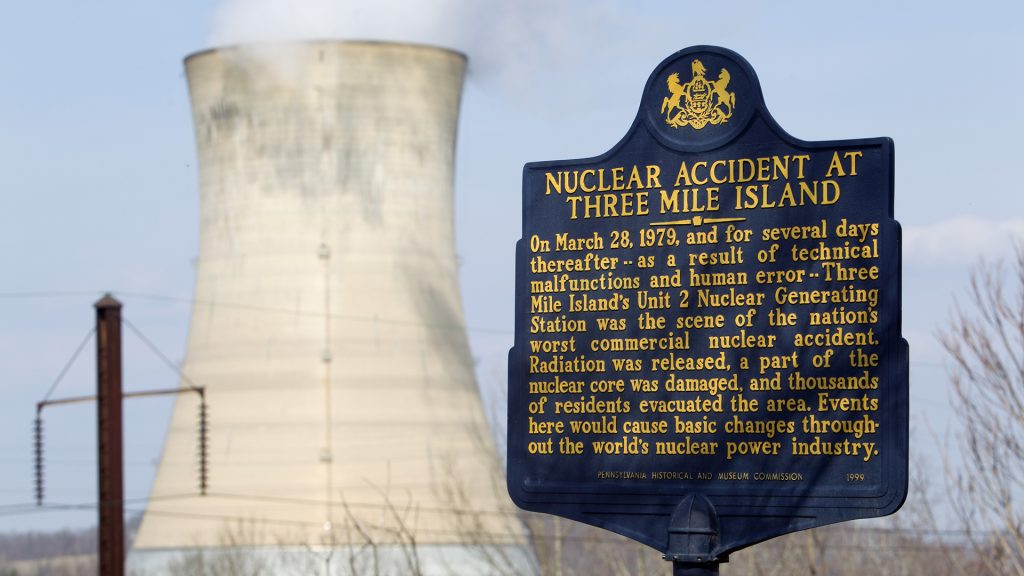
The company paid for access to all the power made by the previously defunct nuclear plant
By Theara Coleman, The Week US, 24 September 2024
With artificial intelligence putting a damper on its clean energy goals, Microsoft is turning to nuclear power in a first-of-its-kind exclusive deal with a nuclear plant. The massive amount of energy needed to power artificial intelligence has contributed to a resurgence of interest in nuclear power, a turn for an industry on its way out over the last decade. But with Big Tech closing in on nuclear plants, some wonder what will be left for everyone else.
The symbolism of the deal
Three Mile Island, the dormant Pennsylvania nuclear plant at the center of the Microsoft deal, became “shorthand for the risks posed by nuclear energy after one of the plant’s two reactors partly melted down in 1979,” said The New York Times. The other reactor operated safely for years before ultimately closing down for economic reasons five years ago. With the Microsoft deal, a “revival is at hand.” Because of artificial intelligence, the tech giant needs massive amounts of electricity for its growing number of data centers, and the company has agreed to use as much power as possible from the plant over the next 20 years. The plant’s owner, Constellation Energy, promises to spend $1.6 billion refurbishing the reactor, hoping to restart it by 2028 with regulatory approval. The deal marks the first time “Microsoft has secured a dedicated, 100% nuclear facility for its use,” the Times said.
“The symbolism is enormous,” Joseph Dominguez, the chief executive of Constellation, said to the Times. Even though Three Mile Island “was the site of the industry’s greatest failure,” it can now be a “place of rebirth.”…………………………………………………………….
Unfortunately, tech’s bullish approach to securing nuclear power has some experts worried there will not be enough to go around. The owners of nearly a third of the country’s nuclear power plants were in talks with tech companies to meet the demands of the AI boom, The Wall Street Journal said. These deliberations could potentially “remove stable power generation from the grid while reliability concerns are rising across much of the U.S,” and the electricity demand is driven up by new tech like AI, the outlet said. Instead of helping to add new green energy solutions to meet their “soaring power needs,” tech companies would be “effectively diverting existing electricity resources.” That could raise prices for other customers and “hold back emission-cutting goals,” said the Journal.
Amazon Web Services closed a similar deal earlier this year, acquiring a data center campus connected to Talen Energy Corp.’s nuclear power plant on the Susquehanna River in Pennsylvania for $650 million. The arrangement raised concerns among clean energy advocates and regulators, specifically the the state’s consumer advocate, Patrick Cicero, who said he was worried about cost and reliability if big companies snatch up all the plants. “Never before could anyone say to a nuclear-power plant, we’ll take all the energy you can give us,” Cicero said to the Journal.
https://theweek.com/tech/microsoft-three-mile-island-nuclear-power-big-tech
Losing The Narrative War: Israel Illegally Raids and Shuts Down Al Jazeera’s West Bank Bureau

The Dissenter, Kevin Gosztola, Sep 23, 2024
Israel attacks Al Jazeera and its journalists because their reporting consistently shows the truth of Israel’s war and undermines its military occupation against Palestinians.
As the Israeli government struggles to maintain its preferred narrative in the global news media around the country’s brutal assault on Gaza, the Israeli military illegally raided Al Jazeera’s West Bank bureau in Ramallah on September 22 and said the news network would be shut down for 45 days.
Israel’s latest act of lawfare against Al Jazeera occurred several months after the Israeli military raided Al Jazeera’s office in East Jerusalem in May. In that raid, soldiers seized the network’s media equipment after Prime Minister Benjamin Netanyahu and the Knesset banned Al Jazeera from operating in the country.
“The Network vehemently condemns and denounces this criminal act by the Israeli occupation forces. Al Jazeera reject the draconian actions, and the unfounded allegations presented by Israeli authorities to justify these illegal raids,” Al Jazeera stated. “Al Jazeera reaffirms its unwavering commitment to continue reporting on the war on Gaza and the ongoing occupation of the Palestinian territories and the regional escalation.”
Israeli communications minister Shlomo Karhi said the raid was launched to stop “the mouthpiece of Hamas and Hezbollah.” He added, “We will continue to fight the enemy’s channels and ensure the safety of our heroic fighters.”
Al Jazeera’s media license in the West Bank does not come from the Israeli government but rather the Palestinian National Authority, which released a statement denouncing the illegal raid.
According to reporting from Al Jazeera English, masked and “heavily armed” Israeli soldiers entered the Al Jazeera office in the early morning. A document reflecting a decision by an Israeli military general was shown to Al Jazeera media personnel. Every person in the office was given 10 minutes to grab their personal belongings and cameras and leave.
Israeli soldiers tore down a poster of Shireen Abu Akleh, the Palestinian American correspondent for Al Jazeera who was effectively assassinated in May 2022 by Israeli military forces while reporting on a military raid in the Jenin refugee camp in the West Bank.
Soldiers took the microphone from Walid Al-Omari, who is the West Bank bureau chief, as he tried to provide a live report on the raid. They confiscated media equipment and documents that had information potentially from confidential media sources. And the soldiers also welded shut the doors to the office.
Carlos Martínez de la Serna, who is a program director for the Committee to Protect Journalists, condemned the raid and said, “Israel’s efforts to censor Al Jazeera severely undermine the public’s right to information on a war that has upended so many lives in the region. Al Jazeera’s journalists must be allowed to report at this critical time, and always.”
“The policy of this Israeli government is to prevent any voice that might contradict its official line. They have destroyed all the media in Gaza, targeted and killed journalists because they were doing their job, and now they want to wipe out the media in the occupied West Bank,” declared Anthony Bellanger, the secretary general for the International Federation of Journalists (IFJ).
The National Union of Journalists in the United Kingdom called the shut down of Al Jazeera in the West Bank a “dangerous act clearly intended to silence truths and prevent journalists from carrying out their crucial work. The seizure of confidential documents is particularly alarming, as we know protecting sources will be of utmost priority to all journalists impacted by the raid.”……………………………………………………………………………
As of September 20, there were more than 170 deaths of journalists in Gaza and the occupied Palestinian Territories. The Israeli military has detained nearly 100 Palestinian journalists—with 52 journalist still “languishing in Israeli jails.”
Paired with the censorship regime that the Israeli government has imposed on international correspondents, the crackdown on Al Jazeera increases the Israeli government’s ability to commit atrocities without the world seeing them in real time. In fact, in the past month, Israel has significantly ramped up its acts of aggression against Palestinians in the West Bank.
“Israel’s ongoing suppression of the free press is blatantly aimed at concealing its actions in the Gaza Strip and the occupied West Bank, in contravention of international and humanitarian law. Israel’s direct targeting and killing of journalists, along with arrests, intimidation, and threats, will not deter Al Jazeera from its commitment to coverage,” declared the Al Jazeera news network.
Basravi recorded a video message in anticipation of the raid. “Where we are now in the occupied West Bank is the core of newsgathering hub from where Al Jazeera has carried out uninterrupted storytelling spanning three decades.”
“In that time, our journalists have worked to bring our viewers stories about the Palestinian experience—everything from home demolitions to airstrikes, raids, and assassinations, the construction of separation barriers and the absurdity of occupation in the 21st century, the expansion of illegal settlements and the terror of settler violence, the humiliation and economic burdens of checkpoints, the suffering of thousands of incarcerated Palestinians and the impact on their families, the pain and anger of a people that [United Nations] officials have described as living under apartheid.”
Basravi concluded, “Our teams regularly faced threats to their safety, and too many have made the ultimate sacrifice for telling stories about people fighting for their freedom,” and, “Al Jazeera has been accused of harming Israeli security, of inciting against Israeli soldiers.”
“But to quote our bureau chief here, all we’ve been doing is reporting on what the Israeli military has been doing to people in the Occupied Palestinian Territories. And if they stop doing it, we can stop reporting it.” https://thedissenter.org/losing-the-narrative-war-israel-raids-and-shuts-down-al-jazeeras-west-bank-bureau-2/
Cold War II: US Congress passes 25 anti-China laws in 1 week, funds propaganda campaign
By Ben Norton
https://geopoliticaleconomy.com/2024/09/22/us-congress-25-anti-china-laws-week-fund-propaganda/
In what it called “China Week”, the US House of Representatives approved 25 anti-Chinese laws over a few days, in bipartisan votes. Cold War Two fervor is reaching fever pitch in Washington.
The US House of Representatives approved 25 anti-China laws in just one week in September: a clear sign that Washington’s new cold war is quickly heating up.
The hawkish House Select Committee on the Chinese Communist Party proudly described these days as “China Week”, boasting that much of the legislation had “overwhelming bipartisan” support.
NBC News noted that “many of the measures passed with bipartisan support at a time when viewing [China] primarily as a geopolitical rival is one of the few issues both Republicans and Democrats can agree on”.
Cold War Two fervor is reaching fever pitch in the United States. CIA Director William Burns has referred to China as the “bigge[st] long-term threat”. The last two US secretaries of state, Democrat Antony Blinken and Republican Mike Pompeo, gave speeches specifically dedicated to demonizing China.
In an article in the Financial Times in 2023, centrist British columnist Gideon Rachman recalled that, “Visiting Washington last week, it was striking how commonplace talk of war between the US and China has become”.
“Many influential people seem to think that a US-China war is not only possible but probable”, Rachman wrote, adding that “US officials are now looking at the cold war — not as a warning, but as a potential model”.
Among the bills passed during September 2024’s “China Week” was the “Countering the PRC Malign Influence Fund Authorization Act”, which would give $1.63 billion to the State Department and USAID over five years ($325 million each year from 2023 through 2027) in order to fund organizations that spread anti-China propaganda around the world.
Anti-interventionist think tank the Quincy Institute for Responsible Statecraft noted that this massive funding for anti-China propaganda would amount to roughly twice the annual operating expenses of CNN.
Other bills approved in “China Week” include legislation that threatens the Hong Kong Economic and Trade Office, targets Chinese officials and their family members over Taiwan, seeks to strengthen US influence in the Pacific region, deepens ties to Japan and South Korea, expands blacklists of Chinese companies, and hopes to weaken the renminbi.
Many of the bills would facilitate the imposition of further unilateral US sanctions on entities not only from China, but also from Russia, Iran, the DPRK (North Korea), Cuba, and Venezuela. (The United States has already imposed sanctions on one-third of all countries on Earth, including 60% of poor nations.)
The so-called “End Chinese Dominance of Electric Vehicles in America Act” portrays Chinese EVs as a supposed threat, and would restrict them. However, it fails to mention that, as the New York Times put it, “few Chinese electric cars are sold in U.S.” An April 2024 report by the US International Trade Commission found that Chinese vehicles made up a mere 2% of EV imports into the US from 2018 to 2023. Despite this, just a month later, President Joe Biden announced 100% tariffs on Chinese EVs.
Other bills passed during “China Week” target Chinese drones, batteries, biotechnology, routers and modems, telecommunications infrastructure, and media outlets.
Approved legislation would also block scientific cooperation with China, while banning the sale of US farmland to nationals of China, Russia, Iran, and the DPRK (North Korea).
An especially redundant bill adopted by the House would withhold funding to US universities that host Confucius Institutes – organizations that teach foreign students about Chinese languages and culture. This measure went through despite the fact that, as was reported in 2023 by the US Government Accountability Office (GAO), “In 2018, Congress restricted federal funding to schools with institutes; nearly all of the institutes have since closed”.
All of this legislation passed during “China Week” must subsequently be approved by the Senate and signed by the president before it officially becomes law.
Nuclear War in Ukraine Is a Distinct Possibility
September 22, 2024, By C.J. Polychroniou / Common Dreams, https://scheerpost.com/2024/09/22/a-nuclear-war-in-ukraine-is-a-distinct-possibility/
The war in Ukraine has been going on for 2.5 years with no end on sight. Not only that, but we are now close to a nuclear war, according to the Norwegian scholar Glenn Diesen who predicted in November 2021 that “war was becoming increasingly unavoidable” as NATO was escalating tensions with Russia by strengthening its ties with Ukraine. Indeed, as Diesen argues in the interview that follows, NATO provoked Russia and sabotaged all peace negotiations, using Ukraine as a proxy to a geopolitical chessboard. Diesen is professor of political science at the University of South-Eastern Norway and author of scores of academic articles and books, including, most recently, The Ukraine War & the Eurasian World Order(2024).
C. J. Polychroniou: On February 22, 2022, in a move that few had anticipated, Russia invaded Ukraine by launching a simultaneous ground and air attack on several fronts. The war hasn’t gone at all as Moscow had intended and it rages on as neither side is seriously considering an end to the fighting. Yet, the invasion is in many ways a continuation of a territorial conflict between Russia and Ukraine that goes back to 2014. What lies behind the Russia-Ukraine conflict? How did we arrive at this dangerous juncture that is now dragging NATO into the conflict?
Glenn Diesen: I predicted the war in an article in November 2021, in which I argued war was becoming “unavoidable” as NATO continued to escalate while rejecting any peaceful settlement. This should have been evident to everyone if we had an honest discussion about what had been happening.
NATO was always part of this conflict, and it did not start as a territorial conflict. The conflict began with the Western-backed coup in Ukraine in February 2014, which was seen as a precursor to NATO expansion and the eventual eviction of Russia from its Black Sea fleet in Sevastopol. As the New York Times has confirmed, on the first day after the coup, the new Ukrainian government hand-picked by Washington established a partnership with the CIA and MI6 for a covert war against Russia. It is important to remember that Russia had not laid any claims to Crimea before seizing it in the referendum in March 2014. This is not a commentary on legality or legitimacy, merely the fact that Russia’s actions were a reaction to the coup.
A proxy war broke out in which NATO backed the government it installed in Kiev and Russia backed the Donbas rebels who refused to recognize the legitimacy of the coup and resisted the de-russification and purge of the language, political opposition, culture, and the church. The Minsk-2 peace agreement of 2015 laid the foundation for resolving the conflict, but this was merely treated as a deception to buy time and build a large Ukrainian army as confirmed by the Germans, French and authorities in Kiev. After 7 years of Ukraine refusing to implement the Minsk agreement and NATO’s refusing to give Russia any security guarantees for NATO’s military infrastructure that moved into Ukraine—Russia invaded in February 2022.
It is correct that the war has not gone as Moscow expected. Russia thought it could impose a peace but was taken by surprise when the U.S. and U.K. preferred war. When Russia sent in its military, the small size and conduct of the invading forces indicated that the purpose was merely to pressure Ukraine to accept a peace agreement on Russian terms. Ukraine and Russia were close to an agreement in Istanbul, although it was sabotaged by the U.S. and U.K. as they saw an opportunity to fight Russia with Ukrainians.
The nature of the war changed fundamentally as it became a war of attrition. Russia withdrew to more defensible front lines, began mobilizing its troops and sourcing the required weapons for a long-term war to defeat the NATO-built army in Ukraine. After 2.5 years of war, this has become a territorial conflict that makes it impossible to resolve in a manner that would be acceptable to all sides. As NATO refuses to accept losing its decade-long proxy war in Ukraine, it must continue to escalate and thus get more directly involved in the war. We are now at the brink of a direct NATO-Russia War.
Did NATO provoke Russia’s invasion of Ukraine? Even if so, didn’t Moscow have any other options other than to resort to the use of military force?
NATO provoked the invasion and sabotaged all paths to peace. The NATO countries affirmed on several occasions that the UN-approved Minsk agreement was the only path to a peaceful resolution of the conflict in Ukraine, yet then admitted that it was merely a ruse to militarize Ukraine. This convinced the Russians that NATO was pursuing a military solution to the conflict in Ukraine that would also involve an invasion of Crimea. As argued by a top advisor to former French president Sarkozy, the U.S.-Ukrainian strategic agreement of November 2021 convinced Russia it had to attack or be attacked.
Russia considered NATO in Ukraine to be an existential threat, and NATO refused to give Russia any security guarantees to mitigate these security concerns. The former U.S. ambassador to NATO, Kurt Volker, argued during the Biden-Putin discussions that no agreements should be made with Russia as “success is confrontation.” This war is a great tragedy as it has resulted in the deaths of hundreds of thousands of young Ukrainians and Russians, made Europe weaker and more dependent, and taken the world to the brink of nuclear war. By failing to admit NATO’s central role in provoking this war, we also prevent ourselves from recognizing possible political solutions.
Russia and Ukraine were close to war-ending agreements in April of 2022, but apparently certain western leaders convinced Ukrainian president Zelensky to back down from such a deal. Is Ukraine a US pawn on a geo-political chessboard?
Zelensky confirmed on the first day after the Russian invasion that Moscow had contacted Kiev to discuss a peace agreement based on restoring Ukraine’s neutrality. On the third day after the invasion, Russia and Ukraine agreed to start negotiations. Yet, the American spokesperson suggested the US could not support such negotiations. When the negotiations nonetheless began, Boris Johnson was sent to Kiev to sabotage them. Johnson later wrote an op-ed warning against a bad peace. The Ukrainian negotiators and the Israeli and Turkish mediators all confirmed that Russia was willing to pull back its troops and compromise on almost everything if Ukraine would restore its neutrality to end NATO expansionism. The mediators also confirmed that the US and UK saw an opportunity to bleed Russia and thus weaken a strategic rival by fighting with Ukrainians. The US and UK told Ukraine they would not support a peace agreement based on neutrality, but NATO would supply all the weapons Ukraine would need if Ukraine pulled out of the negotiations and chose war instead. Interviews with American and British leaders made it clear that the only acceptable outcome for the war was regime change in Moscow, while other political leaders began to speak about breaking up Russia into many smaller countries.
Yes, I believe that Ukraine is a pawn on the geopolitical chessboard. Why do we not listen to all the American political and military leaders who describe this as a good war and an opportunity to weaken Russia without using American soldiers?
What does Russia want from Ukraine?
Russia demands peace based on the Istanbul+ formula. The Istanbul agreement of early 2022 involved Russia retreating from the territory it seized since February 2022 in return for Ukraine restoring its neutrality. However, after 2.5 years of fighting, the war has also evolved into a territorial conflict. Russia therefore demands that Ukraine also recognizes Russian sovereignty over the territories it annexed.
Russia will not accept a ceasefire that merely freezes the front lines, because this could become another Minsk agreement that merely buys time for NATO to re-arm Ukraine to fight Russia another day. Moscow therefore demands a political settlement to the conflict based on neutrality and territorial concessions. In the absence of such an agreement and continued threats by NATO to expand after the war is over, Russia will likely also annex Kharkov, Dnipro, Nikolaev, and Odessa to prevent these historical Russian regions from falling under the control of NATO.
Ukraine has become increasingly a de facto NATO member. What are the chances that Russia might introduce tactical nuclear weapons in the battlefield to achieve its aims?
Russia permits the use of nuclear weapons in response to a nuclear attack or if its existence is threatened. NATO becoming directly involved in the war is considered an existential threat by Russia, and Russia has warned that NATO would become directly involved by supplying long-range precision missiles. Such missiles will need to be operated by American and British soldiers and navigated by their satellites, thus this represents a NATO attack on Russia. We are very close to a nuclear war, and we are deluding ourselves by suggesting we are merely helping Ukraine defend itself.
Can you briefly discuss the implications for world order if the West defeats Russia? And what would the international system look like if Russia wins the war in Ukraine?
The West would like to defeat Russia to restore a unipolar order. As many military and political leaders in the US argue, once Russia has been defeated then the US can focus its resources on defeating China. It is worth remarking that few Western political leaders have clearly defined what “victory” over the world’s largest nuclear power would look like. Russia considers this war to be an existential threat to its survival, and I am therefore convinced that Russia would launch a nuclear attack long before NATO troops get to march through Crimea.
A Russian victory will leave Ukraine a dysfunctional state with much less territory, while NATO will have lost much of its credibility as this was bet on a victory. The war has intensified a transition to a multipolar world, and this likely increase at a much higher pace if NATO loses the war in Ukraine.
NATO expansion that cancelled inclusive pan-European security agreements with Russia was the main manifestation of America’s hegemonic ambitions after the Cold War, thus the entire world order will be greatly influenced by the outcome of this war. This also explains why NATO will be prepared to attack Russia with long-range precision missiles and risk a nuclear exchange.
Israel’s Tally of War Crimes in Lebanon Increases in Wake of Exploding Pagers
The Israeli bombing of a residential neighborhood in Beirut is also a war crime.
By Marjorie Cohn , Truthout, September 23, 2024
Israel escalated attacks against Lebanon on September 23, marking the deadliest day of Israeli bombings in that country since 2006. Israel’s strikes in southern and eastern Lebanon, as well as the capital city of Beirut, left a death toll of at least 274, including women, children and paramedics. The Israeli military targeted “medical centres, ambulances and cars of people trying to flee,” according to Al Jazeera, which cited Lebanon’s Health Minister Firass Abiad as the source for the information. Israel also targeted civilian homes, which it claimed were housing Hezbollah weapons.
This latest targeting of Lebanese civilians comes on the heels of Israel’s detonation of hand-held electronic devices in civilian areas of Lebanon on September 17 and 18, when Israeli forces remotely triggered multiple explosions of electronic pagers and walkie-talkies that killed at least 37 people, including a 9-year-old girl and an 11-year-old boy, and maimed or injured 3,250 people, 200 critically. About 500 people suffered severe eye wounds and others received grave injuries to their hands, faces and bodies. The blasts occurred in residential buildings, barber shops, grocery stores, cars and at funerals. Many civilians, including government and hospital workers, were killed.
Elias Warrak, an ophthalmologist at Mount Lebanon University Hospital in Beirut, treated several of those injured by the blasts. He told the BBC that between 60 percent and 70 percent of the patients he attended had to have at least one eye removed. “Some of the patients, we had to remove both eyes. It kills me. In my past 25 years in practice, I’ve never removed as many eyes as I did yesterday [September 17].”
Israel’s weaponization of 3,000 to 4,000 pagers and walkie-talkies programmed to explode simultaneously constituted “terrifying” violations of international law, according to 22 independent United Nations experts, including 13 special rapporteurs.
The radios and pagers were reportedly distributed to people associated with Hezbollah, which includes both military and civilian individuals. “At the time of the attacks there was no way of knowing who possessed each device and who was nearby,” the experts noted. “Simultaneous attacks by thousands of devices would inevitably violate humanitarian law, by failing to verify each target, and distinguish between protected civilians and those who could potentially be attacked for taking a direct part in hostilities.”
A booby-trap is defined as something designed to kill or injure unexpectedly when a person performs an apparently safe act like answering a pager. International humanitarian law prohibits the use of booby-traps that are disguised as harmless objects when they are constructed and designed with explosives. They breach the principles of distinction, proportionality and precautions.
War Crimes of Murder, Attacking Civilians, Indiscriminate Attacks, Violence to Spread Terror
“These attacks violate the human right to life, absent any indication that the victims posed an imminent lethal threat to anyone else at the time,” the U.N. experts wrote. “Such attacks could constitute war crimes of murder, attacking civilians, and launching indiscriminate attacks.”
The U.N. experts declared, “It is also a war crime to commit violence intended to spread terror among civilians, including to intimidate or deter them from supporting an adversary,” adding, “A climate of fear now pervades everyday life in Lebanon.”
Amal Saad, an expert on Hezbollah, told Drop Site News, “Everyone’s scared to send text messages, to make calls, and they’re afraid to open laptops. It’s definitely led to some level of complete disorientation, fear, confusion, paranoia. It has huge psychological effects.” Saad noted that the purpose behind the explosions “was to terrorize and paralyze and demoralize.”………………………………………………………………………………………………..more https://truthout.org/articles/israels-tally-of-war-crimes-in-lebanon-increases-in-wake-of-exploding-pagers/?utm_source=feedotter&utm_medium=email&utm_campaign=FO-09-23-2024&utm_content=httpstruthoutorgarticlesisraelstallyofwarcrimesinlebanonincreasesinwakeofexplodingpagers&utm_source=Truthout&utm_campaign=097274f518-EMAIL_CAMPAIGN_2024_09_23_08_53&utm_medium=email&utm_term=0_bbb541a1db-097274f518-%5BLIST_EMAIL_ID%5D
Record solar boom

The world is on track to install a record-breaking 593 gigawatts (GW) of
new solar capacity in 2024, according to analysis by thinktank Ember. This
would be up 29% on 2023 levels and nearly six times the amount added just
five years ago. In addition to established leaders, such as China, Europe
and the US, Ember said there was strong growth in new markets, such as
Pakistan and Saudi Arabia, in 2024. It added that solar growth continues to
outpace many forecasts for the industry, “put[ting] ambitious climate
pledges within reach”.
Carbon Brief 20th Sept 2024
Fears of ‘Imminent Catastrophe’ Mount as Hezbollah Hits Back Amid Israeli Airstrikes
“It cannot be overstated enough: There is NO military solution that will make either side safer,” said one U.N. official.
Brett Wilkins, Sep 22, 2024, https://www.commondreams.org/news/israel-lebanon-escalation-rockets
Fears of an all-out Middle East war mounted Sunday as Hezbollah fired more than 100 rockets into Israel, whose military continued bombing targets in southern Lebanon while moving troops, tanks, and other equipment toward the northern border.
During a Sunday funeral speech for three members killed in Israeli airstrikes, Hezbollah Deputy Secretary-General Naim Qassem declared an “open-ended battle” with Israel was underway. Hezbollah is reeling from last week’s unprecedented surprise attack on communication devices that killed dozens of people and wounded thousands more, as well as Israeli airstrikes on Beirut suburbs that have slain dozens of Lebanese including women and children and injured scores more.
The dead include senior Hezbollah commander Ibrahim Aqil.
“We admit that we are pained. We are humans. But as we are pained, you will also be pained,” Qassem told mourners at Aqil’s funeral, directing his remarks to Israel.
In Israel, air raid warning sirens blared warnings of incoming Hezbollah rocket fire that penetrated further south in Israel than at any time in nearly two decades, sending residents scrambling for shelters. Israeli media reported 13 people injured—one of them seriously—and heavy damage to homes and cars.
As officials closed schools, limited gatherings, and ordered hospitals to move patients in the north, the Israel Defense Forces moved troops, tanks, and other equipment toward the border with Lebanon. Numerous social media posts said Israeli reservists had received emergency call-up orders, known as Tzav 8s.
Israeli Prime Minister Benjamin Netanyahu said Sunday that his far-right government would “take whatever action is necessary to restore security” in the northern part of Israel.
“No country can accept the wanton rocketing of its cities,” he said. “We can’t accept it either.”
Hezbollah said it would not stop fighting until Israel stops its assault on Gaza, for which it is on trial for genocide at the International Court of Justice.
Jeanine Hennis-Plasschaert, the United Nations envoy for Lebanon, said on X, formerly known as Twitter, that “with the region on the brink of an imminent catastrophe, it cannot be overstated enough: There is NO military solution that will make either side safer.”
Fears of an all-out Middle East war mounted Sunday as Hezbollah fired more than 100 rockets into Israel, whose military continued bombing targets in southern Lebanon while moving troops, tanks, and other equipment toward the northern border.
During a Sunday funeral speech for three members killed in Israeli airstrikes, Hezbollah Deputy Secretary-General Naim Qassem declared an “open-ended battle” with Israel was underway. Hezbollah is reeling from last week’s unprecedented surprise attack on communication devices that killed dozens of people and wounded thousands more, as well as Israeli airstrikes on Beirut suburbs that have slain dozens of Lebanese including women and children and injured scores more.
The dead include senior Hezbollah commander Ibrahim Aqil.
“We admit that we are pained. We are humans. But as we are pained, you will also be pained,” Qassem told mourners at Aqil’s funeral, directing his remarks to Israel.
In Israel, air raid warning sirens blared warnings of incoming Hezbollah rocket fire that penetrated further south in Israel than at any time in nearly two decades, sending residents scrambling for shelters. Israeli media reported 13 people injured—one of them seriously—and heavy damage to homes and cars.
As officials closed schools, limited gatherings, and ordered hospitals to move patients in the north, the Israel Defense Forces moved troops, tanks, and other equipment toward the border with Lebanon. Numerous social media posts said Israeli reservists had received emergency call-up orders, known as Tzav 8s.
Israeli Prime Minister Benjamin Netanyahu said Sunday that his far-right government would “take whatever action is necessary to restore security” in the northern part of Israel.
“No country can accept the wanton rocketing of its cities,” he said. “We can’t accept it either.”
Hezbollah said it would not stop fighting until Israel stops its assault on Gaza, for which it is on trial for genocide at the International Court of Justice.
Jeanine Hennis-Plasschaert, the United Nations envoy for Lebanon, said on X, formerly known as Twitter, that “with the region on the brink of an imminent catastrophe, it cannot be overstated enough: There is NO military solution that will make either side safer.”
European Union foreign policy chief and European Commission Vice President Josep Borrell said on social media Sunday that “the E.U. is extremely concerned by the escalation in Lebanon, following Friday’s attacks in Beirut and the increasing cross-border violence between Israel and Hezbollah.”
“Civilians on both sides are paying an enormous price,” Borrell added. “An immediate ceasefire is needed.”
In the United States, White House national security spokesman John Kirby toldABC‘s “This Week” on Sunday that the Biden administration—which supplies Israel with billions of dollars in arms and diplomatic cover—is “involved in extensive and quite assertive diplomacy.”
“We want to make sure that we can continue to do everything we can to try to prevent this from becoming an all-out war there with Hezbollah across that Lebanese border,” he added. “We still believe that there can be time and space for a diplomatic solution here.”
World’s biggest banks pledge support for nuclear power

Names including Bank of America, Morgan Stanley and Goldman Sachs boost COP28 goal of
tripling capacity by 2050. Fourteen of the world’s biggest banks and
financial institutions are pledging to increase their support for nuclear
energy, a move that governments and the industry hope will unlock finance.
FT 23rd Sept 2024, https://www.ft.com/content/96aa8d1a-bbf1-4b35-8680-d1fef36ef067
Negotiate with Moscow to end the Ukraine war and prevent nuclear devastation.
The Hill, by Robert F. Kennedy Jr. and Donald Trump Jr., opinion contributors – 09/17/24
The New York Times reported Thursday that the Biden administration is considering allowing Ukraine to use NATO-provided long-range precision weapons against targets deep inside Russia. Such a decision would put the world at greater risk of nuclear conflagration than at any time since the Cuban missile crisis.
At a time when American leaders should be focused on finding a diplomatic off-ramp to a war that should never have been allowed to take place, the Biden-Harris administration is instead pursuing a policy that Russia says it will interpret as an act of war. In the words of Vladimir Putin, long-range strikes in Russia “will mean that NATO countries — the United States and European countries — are at war with Russia.”
Some American analysts believe Putin is bluffing, and favor calling his bluff………………………
These analysts are mistaking restraint for weakness. In essence, they are advocating a strategy of brinksmanship. Each escalation — from HIMARS to cluster munitions to Abrams tanks to F-16s to ATACMS — draws the world closer to the brink of Armageddon. Their logic seems to be that if you goad a bear five times and it doesn’t respond, it is safe to goad him even harder a sixth time.
Such a strategy might be reasonable if the bear had no teeth. The hawks in the Biden administration seem to have forgotten that Russia is a nuclear power. They have forgotten the wisdom of John F. Kennedy, who said in 1963, “Nuclear powers must avert those confrontations which bring an adversary to a choice of either a humiliating retreat or a nuclear war.”………………………………………………………………………… more https://thehill.com/opinion/international/4882868-negotiate-with-moscow-to-end-the-ukraine-war-and-prevent-nuclear-devastation/
Nuclear danger is growing. Physicists of the world, unite!

Bulletin, By Curtis T. Asplund, Zia Mian, Stewart Prager, Frank von Hippel | July 1, 2024
Physicists have been central to imagining, developing, constructing and advancing nuclear weapons ever since the idea of a nuclear chain reaction came to Leo Szilard in 1933. Over the subsequent 90 years, physicists have also been an important force in global efforts aimed at confronting the nuclear threat they created, through the promotion of nuclear arms control and disarmament. Since the end of the Cold War, however, the physics community has been relatively absent as analysts, activists, and advocates contesting nuclear weapons policies. Meanwhile, the Cold War-era nuclear arms control regime has mostly collapsed, a nuclear arms race led by the United States, Russia, and China is underway, and all nine nuclear-armed states are recommitting to nuclear deterrence for the foreseeable future.
In response, in October 2023, a group of 50 physicists from 20 nations gathered for a three-day workshop at the International Centre for Theoretical Physics (ICTP) in Trieste, Italy—“The Increasing Danger of Nuclear Weapons: How Physicists Can Help Reduce the Threat.” The objective of this workshop was to brainstorm on how to mobilize the international physics community to engage in advocacy for nuclear threat reduction. This discussion resulted in the formation of an international working group to help foster this mobilization.
As recently described in the Bulletin and depicted in the movie Oppenheimer, prominent physicists tried to think through the challenges posed by what were then new weapons and be a voice of reason and restraint informing nuclear weapons policy debates during the Manhattan Project and beyond. The early debate and introspection at Los Alamos and elsewhere on the implications of nuclear weapons were not just among Americans, however. The debate was international, involving physicists from many countries within the Manhattan Project, including refugees from Europe escaping fascism. All these efforts were private and aimed at US policymakers, not the larger scientific community or the public.
After the bombings of Hiroshima and Nagasaki and the beginning of the US-Soviet nuclear arms race, the debate about nuclear weapons became more deliberately public and more international. In Princeton in 1946, Albert Einstein announced the Emergency Committee of Atomic Scientists to educate and mobilize scientists and the public on the dangers of nuclear weapons.
The clearest international expression of scientist activism started in 1957 with the Pugwash Conferences on Science and World Affairs. Historian Matthew Evangelista gives Pugwash “considerable credit for substantial breakthroughs in US-Soviet arms control in the late 1960s and early 1970s.” This determined decades-long effort eventually earned the Pugwash Conferences and their key leader, physicist Joseph Rotblat, a shared Nobel Peace Prize in 1995 “for their efforts to diminish the part played by nuclear arms in international politics and, in the longer run, to eliminate such arms.”…………………………………………………….
Today, new efforts by the international physics community against the threats posed by nuclear weapons are very much needed………………………………………………………….
A strong consensus emerged from the Trieste workshop on the importance of catalyzing international advocacy by physicists for nuclear arms control and reduction. Early-career scientists, especially, found engagement with like-minded physicists from various countries to be strongly affirming of their concerns regarding the dangers of nuclear weapons and their desire to engage in policy activism.
As a next step, the ICTP meeting participants agreed to form an international working group to promote engagement and advocacy across and within nations among physicists and colleagues in the engineering sciences. This initiative can complement the efforts underway by the Scientific Advisory Group of the UN Treaty on the Prohibition of Nuclear Weapons to establish a broad network of scientific and technical institutions and experts to support that treaty’s goals.
“Today, the arms race is draining humanity of enormous resources; material, moral and intellectual. Unfortunately, science and scientists have contributed to this dangerous state of affairs. As scientists, as citizens of the world, we have the duty both to recognize this and to use our skill to explore ways out of the present situation.” This is from the call to the 1986 Hamburg meeting. Now, in 2024, physicists must step up again and exercise that responsibility.
Editor’s note: This article is a product of a workshop at the International Centre for Theoretical Physics (ICTP), organized by a committee consisting of the authors as well as Jürgen Altmann and Götz Neuneck. This workshop received support from the ICTP; the Physicists Coalition for Nuclear Threat Reduction; the German Physical Society; the American Physical Society’s Forum on Physics and Society; the Research Association for Science, Disarmament and International Security (Germany); and Princeton University‘s Program on Science and Global Security. https://thebulletin.org/2024/07/nuclear-danger-is-growing-physicists-of-the-world-unite/
New Book Explores the Intersection of God and Nuclear Weapons
By Global Security Institute, , https://gsinstitute.org/new-book-explores-the-intersection-of-god-and-nuclear-weapons/
Bishop William E. Swing, founder of the United Religions Initiative, has released a thought-provoking new book titled “God and Nuclear Weapons: Meditations at the End of the Atomic Age.”
This timely and relevant book delves into the complex relationship between belief in a life-creating God and the reality of a life-denying nuclear arsenal. While life teeters on the edge of extinction, this book offers the full biblical scope of hope in the face of extinction.
Bishop Swing’s book is organized around an on-going conversation with his friend, the former Secretary of State, George Shultz, who initially asked, “Bill, what do you think?” regarding nuclear weapons. This book is a posthumous answer. The author goes on at the end of each chapter to pass along the same question to the reader: “What do you think?”
One Amazon reviewer describes the book as “a must-read for anyone grappling with the reality of nuclear weapons in our world today.” The book has received high praise for its thought-provoking and insightful approach to a complex and vital issue. Bishop Swing’s unique perspective as a religious leader and nuclear weapons abolitionist adds a valuable perspective to the ongoing conversation about nuclear weapons.
As the number of nuclear armed nations grows and the weapons are modernized with ever greater lethal strength, Bishop Swing asserts that this is the moment for “end-time thinking.” “God and Nuclear Weapons: Meditations at the End of the Atomic Age” is available now on Amazon and other major book retailers. For more information, please visit Voices for a World Free of Nuclear Weapons.
Bishop Swing’s book is about a property dispute between God and nuclear armed nations over nothing less than life on planet Earth. And where hope abides in the end! “God and Nuclear Weapons” is sure to spark thoughtful reflections which lead to actions. The book is available at Amazon.
The Global Security Institute is dedicated to strengthening international peace and security based on co-operation, diplomacy, shared interests, the rule of law and universal values. Our efforts are guided by the skills and commitment of our team of former heads of state, distinguished diplomats and politicians, celebrities, religious leaders, Nobel Peace Laureates, disarmament and legal experts, and concerned informed citizens. Our focus is on controlling and eliminating humanity’s greatest threat – nuclear weapons.
This week – exposing and counteracting nuclear-military-industrial spin.

Some bits of good news. World leaders gathered in the UN headquarters in New York and adopted the Pact for the Future, cementing the shift away from fossil fuels as the fundamental norm for climate action.
After a two-year project by UNICEF and the German government, Torit, a city in South Sudan, is now efficiently providing clean water to over 80% of its population.
TOP STORIES. Selling War: How Raytheon and Boeing Fund the Push for NATO’s Nuclear Expansion.
Global status report highlights parlous state of nuclear power sector.Opening Pandora’s Electronic Box.Welcome to Planet Vogtle! The Lessons of Georgia’s Nuclear Boondoggle.
Tritium into the air?
Sizewell C now: from farce to drama.
Labour backs nuclear – but at what cost? – ALSO AT https://nuclear-news.net/2024/09/22/1-a-labour-backs-nuclear-but-at-what-cost/
The 2024 World Nuclear Industry Status Report now released.
Climate. Online Misinformation Harming Climate Change Effort: UN Chief.
Hunger. When Will It Be Enough? Humanitarian organizations call for urgent action from World Leaders as the people of Sudan face unprecedented starvation and violence [EN/AR]
Noel’s notes. Nuclear socialism in its glory – in The West?
************************
AUSTRALIA. Peter Dutton refuses to divulge costs of going nuclear at anticipated ‘could it work’ speech. Peter Dutton and the pursuit of fame . The UK’s nuclear waste problem. Nuclear debate stalls as detail goes missing in action. “Catastrophic:” Coalition plan to stop renewables and push nuclear will result in massive supply gaps.
AUKUS boss insists project remains on track despite frustrations and staff upheaval within submarine agency.
South Australia joins Denmark in elite club of two, “pushing the boundaries” of renewable energy integration. More Australian nuclear news headlines at https://antinuclear.net/2024/09/21/australian-nuclear-news-headlines-16-23-september/
NUCLEAR ITEMS
ARTS and CULTURE. Nuclear Free Local Authorities want to lament, not ‘celebrate’ nuclear legacy.
ATROCITIES.
22,500 Palestinians Now Have Life-Changing Injuries Due to Israel’s Genocide.
CLIMATE. Data center emissions probably 662% higher than big tech claims. Can it keep up the ruse?
ECONOMICS.
Call for banks to back nuclear energy projects. World’s biggest banks pledge support for nuclear power/
Western, Russian nuclear industries still intertwined, report says.
Nuclear in Australia would increase household power bills.
Hinkley Point C: Building Britain’s first nuclear reactor in 30 years.
Serbia picks EDF, Egis for study on introduction of nuclear energy.
New logo for Geological Disposal Facility (GDF) represents a costly conversation.
MIT Coalition for Palestine Announces Major Divestment Win.
EDUCATION. ‘The Genocide Gentry’: Weapon Execs Sit on Boards of Universities, Institutions
ENERGY.
- As Biden deliberates, Ukraine’s nuclear plants are increasingly at risk – Stuck in the crosshairs are key substations.
- Three Mile Island nuclear reactor to restart to power Microsoft AI operations.
- Global Solar Installations on Track for Another Record Year. Record solar boom.
- Is the new UK government prepared to rise to the challenge of investing in energy efficiency measures and reducing the country’s energy use?
ENVIRONMENT. Hinkley Point C must deploy mandated protections for fish. A Suffolk wildlife and conservation charity has called for “greater transparency” from Sizewell C in relation to its wildlife compensation schemes.
ETHICS and RELIGION. Jewish Council disappointed at Australia’s UN abstention, calls for strong international action to prevent Israeli war crimes.
New Book Explores the Intersection of God and Nuclear Weapons.
HEALTH.
Radiation. Radiation levels mysteriously spike along Norway’s border with Russia – as it’s claimed activity has been seen at test site for Putin’s ‘Flying Chernobyl’ nuclear missile
LEGAL. Nuke waste confusion continues with D.C. Circuit ruling.
MEDIA. ‘Genocide Can and Should Never Be Just a Normal Story’ CounterSpin interview with Gregory Shupak on Palestinian genocide.
Australian film-maker refused entry into India.
Nuclear horror still haunts us Threads tapped into our fear of apocalypse.
POLITICS. Patrick Lawrence: The ‘War Party’ Makes Its Plans. Biden, Harris sacrificing endless thousands of Ukrainians to retain presidency November 5. The experts comment: Key nuclear questions that the US presidential candidates should answer.
‘Obvious Conflict of Interest’: Report Reveals 50+ US Lawmakers Hold Military Stocks.
One big factor could decide if one of Wales’ biggest (nuclear) projects can happen.
POLITICS INTERNATIONAL and DIPLOMACY.
- With US $billions and diplomatic support, Ukraine and Israel are destroying themselves. Negotiate with Moscow to end the Ukraine war and prevent nuclear devastation.
- Israel’s Collapse Is Imminent Amid Escalation In Lebanon. World demands end to Israel’s illegal occupation of Palestine, in landslide UN vote. The World’s Chance To Confront US-Israeli Genocide.
- Miliband urged by US nuclear giant to abandon large reactors in favour of mini-nukes.
- The World Would Be Better off Without NATO, Revisited. Biden’s Grand Alliance against Russia in Ukraine beginning to recognize the N word…Negotiations.
- US Military Policy Is Stoking the Risk of Nuclear War on Korean Peninsula.
SAFETY. Safety level at Scotland’s largest nuclear site raised to ‘enhanced’ after leaks found. Scottish nuclear base staff using pagers adds to Trident fears.
New iodine tablets for communes near French nuclear power sites.
SPINBUSTER. More nuclear reactors? Denying the risks, IAEA’s Grossi promotes unrealistic nuclear power plans.
The UK government deserves an award for the biggest load of nuclear propaganda BS yet!. Nuclear waste group spends £4,600 on logo to show it IS listening toTheddlethorpe views.
TECHNOLOGY. UK Government designates data centres as Critical National Infrastructure (Whaa-aa-t!).
Microsoft deal propels Three Mile Island restart, with key permits still needed.
Unrealistic expectations for So-Called Novel Nuclear Reactor Concepts.
URANIUM. Surge in Russian uranium sent to China.
WASTES.
- TEPCO again halts work to collect melted nuclear fuel.
- The challenge of long-lived alpha emitters in the Chalk River legacy wastes.
- Dounreay nuclear wastes : new snake like robot to access off limits areas.
- Germany’s dirty secret: Its leaking nuclear waste dump.
- Decommissioning: Hinkley Nuclear plant’s decommissioning could take 95 years.
WAR and CONFLICT
- Are the World’s Ongoing Conflicts in Danger of Going Nuclear? Nuclear War in Ukraine Is a Distinct Possibility. Why Putin’s nuclear saber-rattling on Ukraine sounds different this time. Putin ally warns West of nuclear war over Ukraine. Ukraine hits Russia with “massive drone attack” on military depot in Toropets, causing huge explosion.
- Ukrainian Tipping Points – UPDATE 4: US Blocks Long-Range Missile Attacks Until After Elections? The NATO/Ukraine Defeat in Kursk (and Beyond). French officials fear WWIII – Le Monde.
- Israel Unleashes Hell On South Lebanon With Giant Mystery Bomb As War Escalates. Failed Machismo: Israel’s Pager Killings. Israel Admits It Probably Killed Israeli Hostages in Gaza Airstrike in November. ‘An Act of Terror’: Israel Behind Pager Explosions That Killed 11, Wounded Thousands.
- US Navy chief unveils plan to be ready for possible war with China by 2027.
- Nuclear danger is growing- Physicists of the world, unite!
WEAPONS and WEAPONS SALES. North Korea inadvertently gives away location of nuclear weapons facility, with pictures of Kim Jong-un visit.
Germany will not lift restrictions on long-range weapons for Kiev.
Turkey needs to acquire nuclear arms to stop Israel, urges Erdogan’s chief fatwa giver.
UN overwhelmingly votes to sanction Israel, impose arms embargo.
More nuclear reactors? Denying the risks, IAEA’s Grossi promotes unrealistic nuclear power plans
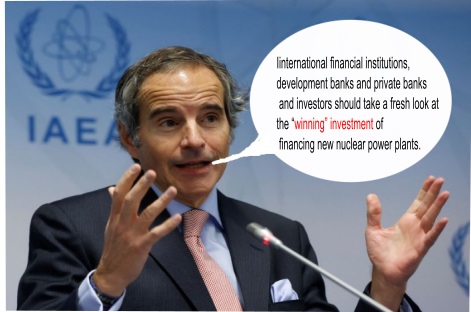
Beyond Nuclear, By M.V. Ramana and Jixiang Wang, 22 Sept 24
Rafael Grossi, the International Atomic Energy Agency’s Director General, has been busy over the last few years. The media has often reported on his efforts to highlight “the risk of a major nuclear accident” at the Zaporizhzhia nuclear plant. Grossi has also met with Russian President Vladimir Putin twice to discuss the situation at Zaporizhzhia, arguing that a “severe nuclear accident…would recognize no borders” and “we must do everything possible to prevent” such an accident.
But Grossi has also simultaneously been increasing the risk of accidents, albeit inadvertently, by calling for building more nuclear reactors. This advocacy takes many forms. He has written op-eds in prominent outlets like Foreign Affairs. He has been trying to canvas countries to start nuclear power programs. For example, in March 2024. he went to Baghdad and committed to working with Iraq to help build a nuclear reactor “for peaceful purposes”. And as a way to deal with the unaffordable costs of nuclear reactors, he has pushed the World Bank and Asian Development Bank to provide funding for building nuclear plants.
None of this make sense. When viewed as investment advice to banks, Grossi’s promotion of nuclear power does not meet the laugh threshold. According to Grossi, the banks’ lack of funding for nuclear energy is “out of date, out of step with what is happening”. But it is Grossi’s advocacy that is out of step with happening to nuclear energy in the real world.
When nuclear energy is evaluated through how much it contributes to the world’s electricity production, the technology has been declining continuously for over 25 years, from 17.5 percent in 1996 down to 9.2 percent in 2022. For reasons discussed later, this trend will likely continue. In other words, the importance of nuclear energy is diminishing. Investing more money into a technology that some scholars argue is “destined for decline” makes little sense.
When analyzing Grossi’s advice to these development banks, one should remember what these institutions are supposed to do. The World Bank’s mission is “to end extreme poverty and boost prosperity on a livable planet”. And the Asian Development Bank has a similar mission, with a regional focus on Asia and the Pacific. The World Bank’s mission, in particular, mentions the multiple, intertwined crises we are confronting and emphasizes both the need for “affordable energy” and how quickly these crises should be addressed, stating “time is of the essence”. Nuclear energy fails on both counts.
Expensive and Slow
Electricity from nuclear reactors is costly and does not provide affordable energy, especially when compared to other low-carbon, renewable sources of energy. During the same period mentioned earlier, the share of all electricity generated by modern renewables has risen from just over 1 percent of in 1996 to 15.9 percent in 2023. Today, it is utility-scale solar photovoltaic power that provides the least costly option for generating electricity plants in many countries. This is why, in 2020, the International Energy Agency dubbed solar “the new king of the world’s electricity markets”. Money spent on nuclear reactors by banks would only divert funds away from investing in renewables and associated technologies and infrastructures.
Nuclear reactors have also almost never been on time. An astonishing 89 percent of all reactors that were connected to the grid between 2020 and 2022 were delayed………………………………..
That is not all. Around the world, 92 nuclear projects have been cancelled or suspended, usually after hundreds of millions, if not billions, have been spent. In the United States, the latest such cancellation was a project involving a small modular reactor from NuScale that the company advertised as “smaller, safer, and cheaper”
Necessary Conditions for Nuclear Power
It is not as though development banks have not considered nuclear energy. Back in 1959, the World Bank did invest in a nuclear project in Italy, based on a set of conditions, most importantly the unavailability of other cost-competitive alternatives. That project was not a success. More important for the present discussion is that with the reduced cost and increasing availability of solar and wind power, nuclear power no longer meets these conditions to be cost-effective.
The Asian Development Bank (ADB), too, undertook an analysis of various technologies and published an Energy Policy paper in 2009 that highlighted a number of barriers confronting nuclear power development, including “public concerns related to nuclear proliferation, waste management, safety issues, high investment costs, long lead times, and commercial acceptability of new technologies”. Thanks to these concerns, the paper declared that “ADB will maintain its current policy of non-involvement in the financing of nuclear power generation”. None of these barriers have disappeared.
………………………………………Fukushima served as a reminder that the nature of nuclear technology ensures “the inevitability of accidents”.
The Unlearned Lessons of Zaporizhzhia
A different route to a severe nuclear accident is on display at the Zaporizhzhia power plant—and Grossi has been eloquent about how such an accident will “have ripples and reverberations all over the world”. But instead of considering Zaporizhzhia as a wake-up call to reflect on whether the world should continue to build more nuclear power plants, Grossi has taken recourse to advocating for five principles of nuclear safety and security. Unfortunately for him these rules are unlikely to be widely accepted—as evidenced by the many attacks on the Zaporizhzhia plant.
…………………………………………………………………………………………………………………………………………….. Grossi’s silence about this risk should be troubling at the best of times. But it is particularly inexcusable when he is, in parallel, emphasizing the risks of suffer a major accident at the Zaporizhzhia power plant. When he went to Iraq recently, he actively downplayed the legitimate concerns in that country thanks to its nuclear reactors being bombed by Israel and the United States. Grossi’s prescription is to simply call for “turning the page on this complex past”. Can he genuinely and credibly assure Iraq that such an attack will not happen again?
The deeper problem is a conflict of interest. As the head of the International Atomic Energy, Rafael Grossi, like his predecessors, tasked with two separate objectives: “to accelerate and enlarge the contribution of atomic energy to peace, health and prosperity throughout the world” and to “ensure, so far as it is able, that assistance provided by it or at its request or under its supervision or control is not used in such a way as to further any military purpose”. The case for promoting nuclear energy was never very strong and has completely collapsed in recent years. It is past time to simply abandon the first objective and focus on the second. https://beyondnuclearinternational.org/2024/09/22/more-nuclear-reactors/
Nuclear horror still haunts us Threads tapped into our fear of apocalypse
Unherd 23rd Sept 2024 Paul Heron, September 23, 2024
On 13 September, Vladimir Putin issued a sobering threat. If Ukraine used Nato-supplied missiles against targets deep inside Russia, the president warned, the alliance would be “directly participating in the conflict” — and the US and its allies would be “fighting with Russia”. Putin’s comments echoed another threat, two years ago, when he drew several ”red lines” for Nato, adding that he was prepared to use nuclear weapons if they were crossed.
Here, then, we have the one of the least welcome developments of the 2020s: the return, after decades of absence, of the terrible spectre of nuclear war. And for those old enough to remember what it was like the first time round — or for their children who’ve watched the clips on YouTube — surely the most disturbing example of what atomic catastrophe might actually look like was first broadcast 40 years ago today. Shown by BBC Two on 23 September 1984, Threads is more horrifying and urgent than ever.
The scenario imagined in Threads is troublingly familiar. After an American-backed coup in a strategically important nation — in this case Iran — the Soviets invade. The US then moves to deploy troops. In unemployment-hit Sheffield, meanwhile, ordinary life goes on. A young couple prepares to become parents. The husband’s middle-aged father has been laid off; his redundancy money will go toward the renovation of the family’s home. Elsewhere, the local council is quietly making preparations in the event of war. Sheffield’s size, and the proximity of RAF Finningley, make the South Yorkshire town a prime target.
It is, by common consent, one of the darkest films ever made. There’s a disturbing sense of logical inevitability about the way the world moves step-by-step toward the precipice. The attack, when it comes, is unflinching, unsentimental and horrifyingly believable.
Writer Barry Hines — best-known for his novel A Kestrel for a Knave — sketches his native milieu with deft assurance. Hines, who died in 2016, was from the mining village of Hoyland, just outside Sheffield. In his career, he often focused on Northern England’s working class, and Threads is no different. As the Iran crisis escalates, for instance, we see protesters taking to the streets in a Campaign for Nuclear Disarmament march (most of the film’s actors were in fact CND members). Days later, there’s a moment of black humour when a speaker at a much more fraught protest calls for a general strike, as if that could have any effect whatsoever. It’s tempting to read the scene as a subtle comment on the eclipse of traditional Left politics in the age of Thatcherism.
Indeed, the whole film takes on added depth when viewed within that context: I think the film’s darkness has its roots not simply in the terrifying subject matter, but also in the broader political context of the Eighties. ………………………………………………………………………………..
Yet more than its narrator, it’s surely the denouement of Threads that makes it so enduring. When, after ratcheting up the tension, we’re finally shown the actual bombing, it is genuinely frightening. There are no heroics, only suffering and death, either instantaneous or slow. Later, the nuclear exchange having run its course, a stark computer readout informs us that 3,000 megatons have been exploded globally, with 210 falling on Britain. Needless to say, the film’s second half isn’t easy to watch. Threads explores severals aspects of desperate postwar life: the hazards of radiation; the search for loved ones in the ruins; shortages of food and water; the collapse of law and order; the shooting of looters; the impossibility of treating the multitudes of sick and injured; the coming of nuclear winter. Just as powerful is the film’s final minutes, which shows the world years after the bombs have fallen. Almost everyone seems to be under eighteen, the clear implication being that no one lives very long anymore. Technology is at near-medieval levels.
This wretched narrative is hammered home by an utter lack of sentimentality. Threads has no heroes and major characters die abruptly. What viewers get instead are wordless montages, and blunt facts delivered in cyan text on a black screen. As in Brecht’s theatre, interpreting what is put before us in our usual clichéd, complacent way is made impossible…………………………………………
Docudramas as accomplished as Threads, so full of dark passion and righteous anger, are rare today. The gravity and urgency of the political situation in the mid-Eighties inspired a superb example of British cinematic modernism. The defenders of social democracy knew their world was disappearing, but faced an infinitely worse possibility: the destruction of the world, tout court. It’s clear this threat has in some way returned — thanks to Putin’s threats, but also events in the Middle East and Asia-Pacific — though I have my doubts whether our governing or creative classes fully grasp what that means.
Today there is a lack of vision. Perhaps the Cold War is distant enough that its lessons are being forgotten. Watch Threads and you’ll recall them soon enough. https://unherd.com/2024/09/nuclear-horror-still-haunt-us/
1 This Month

of the week- – THE ONENESS of HUMANITY
We the Nuclear Free North

1st July – Webinar Waste of Space: The Environmental Harm of Military and Civil Space Activity st July, 7 pm

Report Launch Online: We are seeing an increasing exploitation of space for military and commercial purposes. This must change.

Protect Sazan Island from the Trump family! https://secure.avaaz.org/campaign/en/protect_sazan_island_from_the_trump_family_loc/?bqFCVab&v=174511&cl=22707147157&_checksum=5e9dde668860e8231c33699735e16a1fbf22ab2cb01da50c999fe8732b9775ef&utm_source=email&utm_medium=blast_email&utm_campaign=174511


Cuba Is Not a Failed State – It Is a Besieged State
PETITION: “Global Appeal to Endorse Palestinian Right of Return of Refugees”
To see nuclear-related stories in greater depth and intensity – go to https://nuclearinformation.wordpress.com
-
Archives
- June 2026 (251)
- May 2026 (306)
- April 2026 (356)
- March 2026 (251)
- February 2026 (268)
- January 2026 (308)
- December 2025 (358)
- November 2025 (359)
- October 2025 (376)
- September 2025 (257)
- August 2025 (319)
- July 2025 (230)
-
Categories
- 1
- 1 NUCLEAR ISSUES
- business and costs
- climate change
- culture and arts
- ENERGY
- environment
- health
- history
- indigenous issues
- Legal
- marketing of nuclear
- media
- opposition to nuclear
- PERSONAL STORIES
- politics
- politics international
- Religion and ethics
- safety
- secrets,lies and civil liberties
- spinbuster
- technology
- Uranium
- wastes
- weapons and war
- Women
- 2 WORLD
- ACTION
- AFRICA
- Atrocities
- AUSTRALIA
- Christina's notes
- Christina's themes
- culture and arts
- Events
- Fuk 2022
- Fuk 2023
- Fukushima 2017
- Fukushima 2018
- fukushima 2019
- Fukushima 2020
- Fukushima 2021
- general
- global warming
- Humour (God we need it)
- Nuclear
- RARE EARTHS
- Reference
- resources – print
- Resources -audiovicual
- Weekly Newsletter
- World
- World Nuclear
- YouTube
-
RSS
Entries RSS
Comments RSS
 nuclear-news