Record solar boom

The world is on track to install a record-breaking 593 gigawatts (GW) of
new solar capacity in 2024, according to analysis by thinktank Ember. This
would be up 29% on 2023 levels and nearly six times the amount added just
five years ago. In addition to established leaders, such as China, Europe
and the US, Ember said there was strong growth in new markets, such as
Pakistan and Saudi Arabia, in 2024. It added that solar growth continues to
outpace many forecasts for the industry, “put[ting] ambitious climate
pledges within reach”.
Carbon Brief 20th Sept 2024
Fears of ‘Imminent Catastrophe’ Mount as Hezbollah Hits Back Amid Israeli Airstrikes
“It cannot be overstated enough: There is NO military solution that will make either side safer,” said one U.N. official.
Brett Wilkins, Sep 22, 2024, https://www.commondreams.org/news/israel-lebanon-escalation-rockets
Fears of an all-out Middle East war mounted Sunday as Hezbollah fired more than 100 rockets into Israel, whose military continued bombing targets in southern Lebanon while moving troops, tanks, and other equipment toward the northern border.
During a Sunday funeral speech for three members killed in Israeli airstrikes, Hezbollah Deputy Secretary-General Naim Qassem declared an “open-ended battle” with Israel was underway. Hezbollah is reeling from last week’s unprecedented surprise attack on communication devices that killed dozens of people and wounded thousands more, as well as Israeli airstrikes on Beirut suburbs that have slain dozens of Lebanese including women and children and injured scores more.
The dead include senior Hezbollah commander Ibrahim Aqil.
“We admit that we are pained. We are humans. But as we are pained, you will also be pained,” Qassem told mourners at Aqil’s funeral, directing his remarks to Israel.
In Israel, air raid warning sirens blared warnings of incoming Hezbollah rocket fire that penetrated further south in Israel than at any time in nearly two decades, sending residents scrambling for shelters. Israeli media reported 13 people injured—one of them seriously—and heavy damage to homes and cars.
As officials closed schools, limited gatherings, and ordered hospitals to move patients in the north, the Israel Defense Forces moved troops, tanks, and other equipment toward the border with Lebanon. Numerous social media posts said Israeli reservists had received emergency call-up orders, known as Tzav 8s.
Israeli Prime Minister Benjamin Netanyahu said Sunday that his far-right government would “take whatever action is necessary to restore security” in the northern part of Israel.
“No country can accept the wanton rocketing of its cities,” he said. “We can’t accept it either.”
Hezbollah said it would not stop fighting until Israel stops its assault on Gaza, for which it is on trial for genocide at the International Court of Justice.
Jeanine Hennis-Plasschaert, the United Nations envoy for Lebanon, said on X, formerly known as Twitter, that “with the region on the brink of an imminent catastrophe, it cannot be overstated enough: There is NO military solution that will make either side safer.”
Fears of an all-out Middle East war mounted Sunday as Hezbollah fired more than 100 rockets into Israel, whose military continued bombing targets in southern Lebanon while moving troops, tanks, and other equipment toward the northern border.
During a Sunday funeral speech for three members killed in Israeli airstrikes, Hezbollah Deputy Secretary-General Naim Qassem declared an “open-ended battle” with Israel was underway. Hezbollah is reeling from last week’s unprecedented surprise attack on communication devices that killed dozens of people and wounded thousands more, as well as Israeli airstrikes on Beirut suburbs that have slain dozens of Lebanese including women and children and injured scores more.
The dead include senior Hezbollah commander Ibrahim Aqil.
“We admit that we are pained. We are humans. But as we are pained, you will also be pained,” Qassem told mourners at Aqil’s funeral, directing his remarks to Israel.
In Israel, air raid warning sirens blared warnings of incoming Hezbollah rocket fire that penetrated further south in Israel than at any time in nearly two decades, sending residents scrambling for shelters. Israeli media reported 13 people injured—one of them seriously—and heavy damage to homes and cars.
As officials closed schools, limited gatherings, and ordered hospitals to move patients in the north, the Israel Defense Forces moved troops, tanks, and other equipment toward the border with Lebanon. Numerous social media posts said Israeli reservists had received emergency call-up orders, known as Tzav 8s.
Israeli Prime Minister Benjamin Netanyahu said Sunday that his far-right government would “take whatever action is necessary to restore security” in the northern part of Israel.
“No country can accept the wanton rocketing of its cities,” he said. “We can’t accept it either.”
Hezbollah said it would not stop fighting until Israel stops its assault on Gaza, for which it is on trial for genocide at the International Court of Justice.
Jeanine Hennis-Plasschaert, the United Nations envoy for Lebanon, said on X, formerly known as Twitter, that “with the region on the brink of an imminent catastrophe, it cannot be overstated enough: There is NO military solution that will make either side safer.”
European Union foreign policy chief and European Commission Vice President Josep Borrell said on social media Sunday that “the E.U. is extremely concerned by the escalation in Lebanon, following Friday’s attacks in Beirut and the increasing cross-border violence between Israel and Hezbollah.”
“Civilians on both sides are paying an enormous price,” Borrell added. “An immediate ceasefire is needed.”
In the United States, White House national security spokesman John Kirby toldABC‘s “This Week” on Sunday that the Biden administration—which supplies Israel with billions of dollars in arms and diplomatic cover—is “involved in extensive and quite assertive diplomacy.”
“We want to make sure that we can continue to do everything we can to try to prevent this from becoming an all-out war there with Hezbollah across that Lebanese border,” he added. “We still believe that there can be time and space for a diplomatic solution here.”
World’s biggest banks pledge support for nuclear power

Names including Bank of America, Morgan Stanley and Goldman Sachs boost COP28 goal of
tripling capacity by 2050. Fourteen of the world’s biggest banks and
financial institutions are pledging to increase their support for nuclear
energy, a move that governments and the industry hope will unlock finance.
FT 23rd Sept 2024, https://www.ft.com/content/96aa8d1a-bbf1-4b35-8680-d1fef36ef067
Negotiate with Moscow to end the Ukraine war and prevent nuclear devastation.
The Hill, by Robert F. Kennedy Jr. and Donald Trump Jr., opinion contributors – 09/17/24
The New York Times reported Thursday that the Biden administration is considering allowing Ukraine to use NATO-provided long-range precision weapons against targets deep inside Russia. Such a decision would put the world at greater risk of nuclear conflagration than at any time since the Cuban missile crisis.
At a time when American leaders should be focused on finding a diplomatic off-ramp to a war that should never have been allowed to take place, the Biden-Harris administration is instead pursuing a policy that Russia says it will interpret as an act of war. In the words of Vladimir Putin, long-range strikes in Russia “will mean that NATO countries — the United States and European countries — are at war with Russia.”
Some American analysts believe Putin is bluffing, and favor calling his bluff………………………
These analysts are mistaking restraint for weakness. In essence, they are advocating a strategy of brinksmanship. Each escalation — from HIMARS to cluster munitions to Abrams tanks to F-16s to ATACMS — draws the world closer to the brink of Armageddon. Their logic seems to be that if you goad a bear five times and it doesn’t respond, it is safe to goad him even harder a sixth time.
Such a strategy might be reasonable if the bear had no teeth. The hawks in the Biden administration seem to have forgotten that Russia is a nuclear power. They have forgotten the wisdom of John F. Kennedy, who said in 1963, “Nuclear powers must avert those confrontations which bring an adversary to a choice of either a humiliating retreat or a nuclear war.”………………………………………………………………………… more https://thehill.com/opinion/international/4882868-negotiate-with-moscow-to-end-the-ukraine-war-and-prevent-nuclear-devastation/
Nuclear danger is growing. Physicists of the world, unite!

Bulletin, By Curtis T. Asplund, Zia Mian, Stewart Prager, Frank von Hippel | July 1, 2024
Physicists have been central to imagining, developing, constructing and advancing nuclear weapons ever since the idea of a nuclear chain reaction came to Leo Szilard in 1933. Over the subsequent 90 years, physicists have also been an important force in global efforts aimed at confronting the nuclear threat they created, through the promotion of nuclear arms control and disarmament. Since the end of the Cold War, however, the physics community has been relatively absent as analysts, activists, and advocates contesting nuclear weapons policies. Meanwhile, the Cold War-era nuclear arms control regime has mostly collapsed, a nuclear arms race led by the United States, Russia, and China is underway, and all nine nuclear-armed states are recommitting to nuclear deterrence for the foreseeable future.
In response, in October 2023, a group of 50 physicists from 20 nations gathered for a three-day workshop at the International Centre for Theoretical Physics (ICTP) in Trieste, Italy—“The Increasing Danger of Nuclear Weapons: How Physicists Can Help Reduce the Threat.” The objective of this workshop was to brainstorm on how to mobilize the international physics community to engage in advocacy for nuclear threat reduction. This discussion resulted in the formation of an international working group to help foster this mobilization.
As recently described in the Bulletin and depicted in the movie Oppenheimer, prominent physicists tried to think through the challenges posed by what were then new weapons and be a voice of reason and restraint informing nuclear weapons policy debates during the Manhattan Project and beyond. The early debate and introspection at Los Alamos and elsewhere on the implications of nuclear weapons were not just among Americans, however. The debate was international, involving physicists from many countries within the Manhattan Project, including refugees from Europe escaping fascism. All these efforts were private and aimed at US policymakers, not the larger scientific community or the public.
After the bombings of Hiroshima and Nagasaki and the beginning of the US-Soviet nuclear arms race, the debate about nuclear weapons became more deliberately public and more international. In Princeton in 1946, Albert Einstein announced the Emergency Committee of Atomic Scientists to educate and mobilize scientists and the public on the dangers of nuclear weapons.
The clearest international expression of scientist activism started in 1957 with the Pugwash Conferences on Science and World Affairs. Historian Matthew Evangelista gives Pugwash “considerable credit for substantial breakthroughs in US-Soviet arms control in the late 1960s and early 1970s.” This determined decades-long effort eventually earned the Pugwash Conferences and their key leader, physicist Joseph Rotblat, a shared Nobel Peace Prize in 1995 “for their efforts to diminish the part played by nuclear arms in international politics and, in the longer run, to eliminate such arms.”…………………………………………………….
Today, new efforts by the international physics community against the threats posed by nuclear weapons are very much needed………………………………………………………….
A strong consensus emerged from the Trieste workshop on the importance of catalyzing international advocacy by physicists for nuclear arms control and reduction. Early-career scientists, especially, found engagement with like-minded physicists from various countries to be strongly affirming of their concerns regarding the dangers of nuclear weapons and their desire to engage in policy activism.
As a next step, the ICTP meeting participants agreed to form an international working group to promote engagement and advocacy across and within nations among physicists and colleagues in the engineering sciences. This initiative can complement the efforts underway by the Scientific Advisory Group of the UN Treaty on the Prohibition of Nuclear Weapons to establish a broad network of scientific and technical institutions and experts to support that treaty’s goals.
“Today, the arms race is draining humanity of enormous resources; material, moral and intellectual. Unfortunately, science and scientists have contributed to this dangerous state of affairs. As scientists, as citizens of the world, we have the duty both to recognize this and to use our skill to explore ways out of the present situation.” This is from the call to the 1986 Hamburg meeting. Now, in 2024, physicists must step up again and exercise that responsibility.
Editor’s note: This article is a product of a workshop at the International Centre for Theoretical Physics (ICTP), organized by a committee consisting of the authors as well as Jürgen Altmann and Götz Neuneck. This workshop received support from the ICTP; the Physicists Coalition for Nuclear Threat Reduction; the German Physical Society; the American Physical Society’s Forum on Physics and Society; the Research Association for Science, Disarmament and International Security (Germany); and Princeton University‘s Program on Science and Global Security. https://thebulletin.org/2024/07/nuclear-danger-is-growing-physicists-of-the-world-unite/
New Book Explores the Intersection of God and Nuclear Weapons
By Global Security Institute, , https://gsinstitute.org/new-book-explores-the-intersection-of-god-and-nuclear-weapons/
Bishop William E. Swing, founder of the United Religions Initiative, has released a thought-provoking new book titled “God and Nuclear Weapons: Meditations at the End of the Atomic Age.”
This timely and relevant book delves into the complex relationship between belief in a life-creating God and the reality of a life-denying nuclear arsenal. While life teeters on the edge of extinction, this book offers the full biblical scope of hope in the face of extinction.
Bishop Swing’s book is organized around an on-going conversation with his friend, the former Secretary of State, George Shultz, who initially asked, “Bill, what do you think?” regarding nuclear weapons. This book is a posthumous answer. The author goes on at the end of each chapter to pass along the same question to the reader: “What do you think?”
One Amazon reviewer describes the book as “a must-read for anyone grappling with the reality of nuclear weapons in our world today.” The book has received high praise for its thought-provoking and insightful approach to a complex and vital issue. Bishop Swing’s unique perspective as a religious leader and nuclear weapons abolitionist adds a valuable perspective to the ongoing conversation about nuclear weapons.
As the number of nuclear armed nations grows and the weapons are modernized with ever greater lethal strength, Bishop Swing asserts that this is the moment for “end-time thinking.” “God and Nuclear Weapons: Meditations at the End of the Atomic Age” is available now on Amazon and other major book retailers. For more information, please visit Voices for a World Free of Nuclear Weapons.
Bishop Swing’s book is about a property dispute between God and nuclear armed nations over nothing less than life on planet Earth. And where hope abides in the end! “God and Nuclear Weapons” is sure to spark thoughtful reflections which lead to actions. The book is available at Amazon.
The Global Security Institute is dedicated to strengthening international peace and security based on co-operation, diplomacy, shared interests, the rule of law and universal values. Our efforts are guided by the skills and commitment of our team of former heads of state, distinguished diplomats and politicians, celebrities, religious leaders, Nobel Peace Laureates, disarmament and legal experts, and concerned informed citizens. Our focus is on controlling and eliminating humanity’s greatest threat – nuclear weapons.
This week – exposing and counteracting nuclear-military-industrial spin.

Some bits of good news. World leaders gathered in the UN headquarters in New York and adopted the Pact for the Future, cementing the shift away from fossil fuels as the fundamental norm for climate action.
After a two-year project by UNICEF and the German government, Torit, a city in South Sudan, is now efficiently providing clean water to over 80% of its population.
TOP STORIES. Selling War: How Raytheon and Boeing Fund the Push for NATO’s Nuclear Expansion.
Global status report highlights parlous state of nuclear power sector.Opening Pandora’s Electronic Box.Welcome to Planet Vogtle! The Lessons of Georgia’s Nuclear Boondoggle.
Tritium into the air?
Sizewell C now: from farce to drama.
Labour backs nuclear – but at what cost? – ALSO AT https://nuclear-news.net/2024/09/22/1-a-labour-backs-nuclear-but-at-what-cost/
The 2024 World Nuclear Industry Status Report now released.
Climate. Online Misinformation Harming Climate Change Effort: UN Chief.
Hunger. When Will It Be Enough? Humanitarian organizations call for urgent action from World Leaders as the people of Sudan face unprecedented starvation and violence [EN/AR]
Noel’s notes. Nuclear socialism in its glory – in The West?
************************
AUSTRALIA. Peter Dutton refuses to divulge costs of going nuclear at anticipated ‘could it work’ speech. Peter Dutton and the pursuit of fame . The UK’s nuclear waste problem. Nuclear debate stalls as detail goes missing in action. “Catastrophic:” Coalition plan to stop renewables and push nuclear will result in massive supply gaps.
AUKUS boss insists project remains on track despite frustrations and staff upheaval within submarine agency.
South Australia joins Denmark in elite club of two, “pushing the boundaries” of renewable energy integration. More Australian nuclear news headlines at https://antinuclear.net/2024/09/21/australian-nuclear-news-headlines-16-23-september/
NUCLEAR ITEMS
ARTS and CULTURE. Nuclear Free Local Authorities want to lament, not ‘celebrate’ nuclear legacy.
ATROCITIES.
22,500 Palestinians Now Have Life-Changing Injuries Due to Israel’s Genocide.
CLIMATE. Data center emissions probably 662% higher than big tech claims. Can it keep up the ruse?
ECONOMICS.
Call for banks to back nuclear energy projects. World’s biggest banks pledge support for nuclear power/
Western, Russian nuclear industries still intertwined, report says.
Nuclear in Australia would increase household power bills.
Hinkley Point C: Building Britain’s first nuclear reactor in 30 years.
Serbia picks EDF, Egis for study on introduction of nuclear energy.
New logo for Geological Disposal Facility (GDF) represents a costly conversation.
MIT Coalition for Palestine Announces Major Divestment Win.
EDUCATION. ‘The Genocide Gentry’: Weapon Execs Sit on Boards of Universities, Institutions
ENERGY.
- As Biden deliberates, Ukraine’s nuclear plants are increasingly at risk – Stuck in the crosshairs are key substations.
- Three Mile Island nuclear reactor to restart to power Microsoft AI operations.
- Global Solar Installations on Track for Another Record Year. Record solar boom.
- Is the new UK government prepared to rise to the challenge of investing in energy efficiency measures and reducing the country’s energy use?
ENVIRONMENT. Hinkley Point C must deploy mandated protections for fish. A Suffolk wildlife and conservation charity has called for “greater transparency” from Sizewell C in relation to its wildlife compensation schemes.
ETHICS and RELIGION. Jewish Council disappointed at Australia’s UN abstention, calls for strong international action to prevent Israeli war crimes.
New Book Explores the Intersection of God and Nuclear Weapons.
HEALTH.
Radiation. Radiation levels mysteriously spike along Norway’s border with Russia – as it’s claimed activity has been seen at test site for Putin’s ‘Flying Chernobyl’ nuclear missile
LEGAL. Nuke waste confusion continues with D.C. Circuit ruling.
MEDIA. ‘Genocide Can and Should Never Be Just a Normal Story’ CounterSpin interview with Gregory Shupak on Palestinian genocide.
Australian film-maker refused entry into India.
Nuclear horror still haunts us Threads tapped into our fear of apocalypse.
POLITICS. Patrick Lawrence: The ‘War Party’ Makes Its Plans. Biden, Harris sacrificing endless thousands of Ukrainians to retain presidency November 5. The experts comment: Key nuclear questions that the US presidential candidates should answer.
‘Obvious Conflict of Interest’: Report Reveals 50+ US Lawmakers Hold Military Stocks.
One big factor could decide if one of Wales’ biggest (nuclear) projects can happen.
POLITICS INTERNATIONAL and DIPLOMACY.
- With US $billions and diplomatic support, Ukraine and Israel are destroying themselves. Negotiate with Moscow to end the Ukraine war and prevent nuclear devastation.
- Israel’s Collapse Is Imminent Amid Escalation In Lebanon. World demands end to Israel’s illegal occupation of Palestine, in landslide UN vote. The World’s Chance To Confront US-Israeli Genocide.
- Miliband urged by US nuclear giant to abandon large reactors in favour of mini-nukes.
- The World Would Be Better off Without NATO, Revisited. Biden’s Grand Alliance against Russia in Ukraine beginning to recognize the N word…Negotiations.
- US Military Policy Is Stoking the Risk of Nuclear War on Korean Peninsula.
SAFETY. Safety level at Scotland’s largest nuclear site raised to ‘enhanced’ after leaks found. Scottish nuclear base staff using pagers adds to Trident fears.
New iodine tablets for communes near French nuclear power sites.
SPINBUSTER. More nuclear reactors? Denying the risks, IAEA’s Grossi promotes unrealistic nuclear power plans.
The UK government deserves an award for the biggest load of nuclear propaganda BS yet!. Nuclear waste group spends £4,600 on logo to show it IS listening toTheddlethorpe views.
TECHNOLOGY. UK Government designates data centres as Critical National Infrastructure (Whaa-aa-t!).
Microsoft deal propels Three Mile Island restart, with key permits still needed.
Unrealistic expectations for So-Called Novel Nuclear Reactor Concepts.
URANIUM. Surge in Russian uranium sent to China.
WASTES.
- TEPCO again halts work to collect melted nuclear fuel.
- The challenge of long-lived alpha emitters in the Chalk River legacy wastes.
- Dounreay nuclear wastes : new snake like robot to access off limits areas.
- Germany’s dirty secret: Its leaking nuclear waste dump.
- Decommissioning: Hinkley Nuclear plant’s decommissioning could take 95 years.
WAR and CONFLICT
- Are the World’s Ongoing Conflicts in Danger of Going Nuclear? Nuclear War in Ukraine Is a Distinct Possibility. Why Putin’s nuclear saber-rattling on Ukraine sounds different this time. Putin ally warns West of nuclear war over Ukraine. Ukraine hits Russia with “massive drone attack” on military depot in Toropets, causing huge explosion.
- Ukrainian Tipping Points – UPDATE 4: US Blocks Long-Range Missile Attacks Until After Elections? The NATO/Ukraine Defeat in Kursk (and Beyond). French officials fear WWIII – Le Monde.
- Israel Unleashes Hell On South Lebanon With Giant Mystery Bomb As War Escalates. Failed Machismo: Israel’s Pager Killings. Israel Admits It Probably Killed Israeli Hostages in Gaza Airstrike in November. ‘An Act of Terror’: Israel Behind Pager Explosions That Killed 11, Wounded Thousands.
- US Navy chief unveils plan to be ready for possible war with China by 2027.
- Nuclear danger is growing- Physicists of the world, unite!
WEAPONS and WEAPONS SALES. North Korea inadvertently gives away location of nuclear weapons facility, with pictures of Kim Jong-un visit.
Germany will not lift restrictions on long-range weapons for Kiev.
Turkey needs to acquire nuclear arms to stop Israel, urges Erdogan’s chief fatwa giver.
UN overwhelmingly votes to sanction Israel, impose arms embargo.
More nuclear reactors? Denying the risks, IAEA’s Grossi promotes unrealistic nuclear power plans
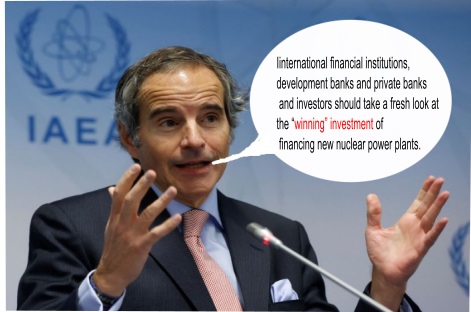
Beyond Nuclear, By M.V. Ramana and Jixiang Wang, 22 Sept 24
Rafael Grossi, the International Atomic Energy Agency’s Director General, has been busy over the last few years. The media has often reported on his efforts to highlight “the risk of a major nuclear accident” at the Zaporizhzhia nuclear plant. Grossi has also met with Russian President Vladimir Putin twice to discuss the situation at Zaporizhzhia, arguing that a “severe nuclear accident…would recognize no borders” and “we must do everything possible to prevent” such an accident.
But Grossi has also simultaneously been increasing the risk of accidents, albeit inadvertently, by calling for building more nuclear reactors. This advocacy takes many forms. He has written op-eds in prominent outlets like Foreign Affairs. He has been trying to canvas countries to start nuclear power programs. For example, in March 2024. he went to Baghdad and committed to working with Iraq to help build a nuclear reactor “for peaceful purposes”. And as a way to deal with the unaffordable costs of nuclear reactors, he has pushed the World Bank and Asian Development Bank to provide funding for building nuclear plants.
None of this make sense. When viewed as investment advice to banks, Grossi’s promotion of nuclear power does not meet the laugh threshold. According to Grossi, the banks’ lack of funding for nuclear energy is “out of date, out of step with what is happening”. But it is Grossi’s advocacy that is out of step with happening to nuclear energy in the real world.
When nuclear energy is evaluated through how much it contributes to the world’s electricity production, the technology has been declining continuously for over 25 years, from 17.5 percent in 1996 down to 9.2 percent in 2022. For reasons discussed later, this trend will likely continue. In other words, the importance of nuclear energy is diminishing. Investing more money into a technology that some scholars argue is “destined for decline” makes little sense.
When analyzing Grossi’s advice to these development banks, one should remember what these institutions are supposed to do. The World Bank’s mission is “to end extreme poverty and boost prosperity on a livable planet”. And the Asian Development Bank has a similar mission, with a regional focus on Asia and the Pacific. The World Bank’s mission, in particular, mentions the multiple, intertwined crises we are confronting and emphasizes both the need for “affordable energy” and how quickly these crises should be addressed, stating “time is of the essence”. Nuclear energy fails on both counts.
Expensive and Slow
Electricity from nuclear reactors is costly and does not provide affordable energy, especially when compared to other low-carbon, renewable sources of energy. During the same period mentioned earlier, the share of all electricity generated by modern renewables has risen from just over 1 percent of in 1996 to 15.9 percent in 2023. Today, it is utility-scale solar photovoltaic power that provides the least costly option for generating electricity plants in many countries. This is why, in 2020, the International Energy Agency dubbed solar “the new king of the world’s electricity markets”. Money spent on nuclear reactors by banks would only divert funds away from investing in renewables and associated technologies and infrastructures.
Nuclear reactors have also almost never been on time. An astonishing 89 percent of all reactors that were connected to the grid between 2020 and 2022 were delayed………………………………..
That is not all. Around the world, 92 nuclear projects have been cancelled or suspended, usually after hundreds of millions, if not billions, have been spent. In the United States, the latest such cancellation was a project involving a small modular reactor from NuScale that the company advertised as “smaller, safer, and cheaper”
Necessary Conditions for Nuclear Power
It is not as though development banks have not considered nuclear energy. Back in 1959, the World Bank did invest in a nuclear project in Italy, based on a set of conditions, most importantly the unavailability of other cost-competitive alternatives. That project was not a success. More important for the present discussion is that with the reduced cost and increasing availability of solar and wind power, nuclear power no longer meets these conditions to be cost-effective.
The Asian Development Bank (ADB), too, undertook an analysis of various technologies and published an Energy Policy paper in 2009 that highlighted a number of barriers confronting nuclear power development, including “public concerns related to nuclear proliferation, waste management, safety issues, high investment costs, long lead times, and commercial acceptability of new technologies”. Thanks to these concerns, the paper declared that “ADB will maintain its current policy of non-involvement in the financing of nuclear power generation”. None of these barriers have disappeared.
………………………………………Fukushima served as a reminder that the nature of nuclear technology ensures “the inevitability of accidents”.
The Unlearned Lessons of Zaporizhzhia
A different route to a severe nuclear accident is on display at the Zaporizhzhia power plant—and Grossi has been eloquent about how such an accident will “have ripples and reverberations all over the world”. But instead of considering Zaporizhzhia as a wake-up call to reflect on whether the world should continue to build more nuclear power plants, Grossi has taken recourse to advocating for five principles of nuclear safety and security. Unfortunately for him these rules are unlikely to be widely accepted—as evidenced by the many attacks on the Zaporizhzhia plant.
…………………………………………………………………………………………………………………………………………….. Grossi’s silence about this risk should be troubling at the best of times. But it is particularly inexcusable when he is, in parallel, emphasizing the risks of suffer a major accident at the Zaporizhzhia power plant. When he went to Iraq recently, he actively downplayed the legitimate concerns in that country thanks to its nuclear reactors being bombed by Israel and the United States. Grossi’s prescription is to simply call for “turning the page on this complex past”. Can he genuinely and credibly assure Iraq that such an attack will not happen again?
The deeper problem is a conflict of interest. As the head of the International Atomic Energy, Rafael Grossi, like his predecessors, tasked with two separate objectives: “to accelerate and enlarge the contribution of atomic energy to peace, health and prosperity throughout the world” and to “ensure, so far as it is able, that assistance provided by it or at its request or under its supervision or control is not used in such a way as to further any military purpose”. The case for promoting nuclear energy was never very strong and has completely collapsed in recent years. It is past time to simply abandon the first objective and focus on the second. https://beyondnuclearinternational.org/2024/09/22/more-nuclear-reactors/
Nuclear horror still haunts us Threads tapped into our fear of apocalypse
Unherd 23rd Sept 2024 Paul Heron, September 23, 2024
On 13 September, Vladimir Putin issued a sobering threat. If Ukraine used Nato-supplied missiles against targets deep inside Russia, the president warned, the alliance would be “directly participating in the conflict” — and the US and its allies would be “fighting with Russia”. Putin’s comments echoed another threat, two years ago, when he drew several ”red lines” for Nato, adding that he was prepared to use nuclear weapons if they were crossed.
Here, then, we have the one of the least welcome developments of the 2020s: the return, after decades of absence, of the terrible spectre of nuclear war. And for those old enough to remember what it was like the first time round — or for their children who’ve watched the clips on YouTube — surely the most disturbing example of what atomic catastrophe might actually look like was first broadcast 40 years ago today. Shown by BBC Two on 23 September 1984, Threads is more horrifying and urgent than ever.
The scenario imagined in Threads is troublingly familiar. After an American-backed coup in a strategically important nation — in this case Iran — the Soviets invade. The US then moves to deploy troops. In unemployment-hit Sheffield, meanwhile, ordinary life goes on. A young couple prepares to become parents. The husband’s middle-aged father has been laid off; his redundancy money will go toward the renovation of the family’s home. Elsewhere, the local council is quietly making preparations in the event of war. Sheffield’s size, and the proximity of RAF Finningley, make the South Yorkshire town a prime target.
It is, by common consent, one of the darkest films ever made. There’s a disturbing sense of logical inevitability about the way the world moves step-by-step toward the precipice. The attack, when it comes, is unflinching, unsentimental and horrifyingly believable.
Writer Barry Hines — best-known for his novel A Kestrel for a Knave — sketches his native milieu with deft assurance. Hines, who died in 2016, was from the mining village of Hoyland, just outside Sheffield. In his career, he often focused on Northern England’s working class, and Threads is no different. As the Iran crisis escalates, for instance, we see protesters taking to the streets in a Campaign for Nuclear Disarmament march (most of the film’s actors were in fact CND members). Days later, there’s a moment of black humour when a speaker at a much more fraught protest calls for a general strike, as if that could have any effect whatsoever. It’s tempting to read the scene as a subtle comment on the eclipse of traditional Left politics in the age of Thatcherism.
Indeed, the whole film takes on added depth when viewed within that context: I think the film’s darkness has its roots not simply in the terrifying subject matter, but also in the broader political context of the Eighties. ………………………………………………………………………………..
Yet more than its narrator, it’s surely the denouement of Threads that makes it so enduring. When, after ratcheting up the tension, we’re finally shown the actual bombing, it is genuinely frightening. There are no heroics, only suffering and death, either instantaneous or slow. Later, the nuclear exchange having run its course, a stark computer readout informs us that 3,000 megatons have been exploded globally, with 210 falling on Britain. Needless to say, the film’s second half isn’t easy to watch. Threads explores severals aspects of desperate postwar life: the hazards of radiation; the search for loved ones in the ruins; shortages of food and water; the collapse of law and order; the shooting of looters; the impossibility of treating the multitudes of sick and injured; the coming of nuclear winter. Just as powerful is the film’s final minutes, which shows the world years after the bombs have fallen. Almost everyone seems to be under eighteen, the clear implication being that no one lives very long anymore. Technology is at near-medieval levels.
This wretched narrative is hammered home by an utter lack of sentimentality. Threads has no heroes and major characters die abruptly. What viewers get instead are wordless montages, and blunt facts delivered in cyan text on a black screen. As in Brecht’s theatre, interpreting what is put before us in our usual clichéd, complacent way is made impossible…………………………………………
Docudramas as accomplished as Threads, so full of dark passion and righteous anger, are rare today. The gravity and urgency of the political situation in the mid-Eighties inspired a superb example of British cinematic modernism. The defenders of social democracy knew their world was disappearing, but faced an infinitely worse possibility: the destruction of the world, tout court. It’s clear this threat has in some way returned — thanks to Putin’s threats, but also events in the Middle East and Asia-Pacific — though I have my doubts whether our governing or creative classes fully grasp what that means.
Today there is a lack of vision. Perhaps the Cold War is distant enough that its lessons are being forgotten. Watch Threads and you’ll recall them soon enough. https://unherd.com/2024/09/nuclear-horror-still-haunt-us/
Israel Unleashes Hell On South Lebanon With Giant Mystery Bomb As War Escalates
Zero Hedge, by Tyler Durden, Sep 22, 2024
Massive escalation along the southern Lebanese border is very clear at this point, as Israeli jets have pounded Hezbollah positions through much of Saturday.
Al Jazeera correspondents have confirmed that “Israel’s military launched 400 attacks on Lebanon on Saturday and Hezbollah fired rockets at the Ramat David base near the city of Haifa, in their largest exchange of fire since the war on Gaza began.”
Another indicator of the escalation is that Israel is apparently beginning use much bigger bombs compared to much of the past nearly year of internecine fighting. The below widely circulating footage shows a large flash and skyscraper-size fireball, resulting in some viewers speculating it was likely a heavy bunker-buster bomb, or possibly even a tactical nuke of some sort. Whatever it was, there’s never been anything like it used on Lebanon (that we know about).
……………. Since Thursday and the deadly chaos of the two-day pager explosion attack, southern Lebanon has seen the most intense exchange of fire between Hezbollah and Israel since the conflict began after Oct.7.
On Saturday the expanded pace of fire has continued, with Hezbollah having launched at least 90 rockets on northern Israel, and the IDF saying it has mounted at least 80 raids on weapons installations belonging to Hezbollah…………………………………..
The death toll from Friday’s Israeli airstrike which killed Hezbollah special forces commander Ibrahim Aqil has risen to 37, after a day-long rescue operation and workers picking through rubble of a residential building, according to the country’s Health Ministry. Reports say that a meeting of Hezbollah leaders was taking place in either a garage, or a tunnel underneath the building in south Beirut.
“According to source, the meeting was being held in a tunnel under a residential building, a location that was being used for the first time, which has raised Hezbollah’s concerns about the extent Israel has infiltrated its ranks,” Middle East Eye reports. Hezbollah has since confirmed that 16 of its members were killed in the attack.
Lebanon’s government says three children and seven women were among the victims. Over 60 others were injured. The White House has still called the Israeli strike “a good outcome”.
White House National Security Adviser Jake Sullivan described Aqil as having “American blood on his hands and has a rewards for justice price on his head.”
He has long been sought by the US for his alleged role in the 1983 bombing of the US Embassy in Beirut, and well as kidnapping of Westerners in the the later 1980s. He had a $7 million bounty on his head issued by the Justice Department.
“He is somebody who the United States promised long ago we would do everything we could to see brought to justice,” Sullivan said. “You know, 1983 seems like a long time ago,” he added. “But for a lot of families and a lot of people, they’re still living with it every day.”
Some Middle East pundits and commentators expressed “shock” at the celebratory statements by the Biden administration, given the Israeli operation resulted in a high civilian death toll. https://www.zerohedge.com/geopolitical/idf-says-180-targets-eliminated-southern-lebanon-us-lauds-good-outcome-beirut-strike
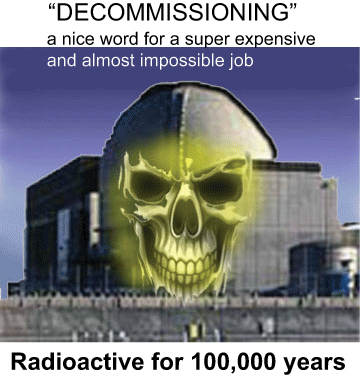
Nuclear plant’s decommissioning could take 95 years
Daniel Mumby, Local Democracy Reporting Service, 19 Sept 24, https://www.bbc.com/news/articles/c8699v4dvexo
Residents are being asked for their views on how a former nuclear power station should be safely decommissioned.
The Hinkley Point B facility, which lies on the Somerset coast north of Stogursey, ceased operations in August 2022, after cracks developed in the plant’s graphite cores, creating potential safety concerns.
EDF Energy, which owns the facility, has applied to the Office for Nuclear Regulation (ONR) for formal permission to decommission the site, which could take about 95 years.
Somerset residents now have three months to voice their views.
Under the proposals, Hinkley Point B, which opened in 1976, could be decommissioned in three phases.
The first phase, which will last until 2038, includes the dismantling of all buildings and plant materials except for the site’s safestore structure. This facility will be used to store and manage the residential nuclear waste from the power station.
The second phase will see “a period of relative inactivity” of up to 70 years from 2039, to allow for the radioactive materials within the safestore to safely decay, according to the Local Democracy Reporting Service.
While physical activity within the site will be minimal during this phase, the former power station will remain under close surveillance with “periodic maintenance interventions” to prevent any risk to health or national security.
The third and final phase will see the former reactor and debris vaults being dismantled and removed and any final landscaping work being completed – with EDF estimating that this will be finished by 2118.
The consultation is running until 9 December, with the ONR expected to publish its formal response in early 2025.
Hinkley Point C
EDF is currently building Hinkley Point C, which has a target completion date of June 2027.
Costing about £46bn, it is expected to generate enough electricity to supply some six million homes for the next 60 years.
Is the new UK government prepared to rise to the challenge of investing in energy efficiency measures and reducing the country’s energy use?

Internationally, more recent UN assessments are placing much greater emphasis on changing demand for fuel, broadly supporting the CREDS’ analysis of the scale of the potential. The International Energy Agency consistently refers to energy efficiency as ‘the first fuel’, and the European Commission actively promotes ‘Energy Efficiency First’.
Is the new government prepared to rise to the challenge of investing in energy efficiency measures and reducing the country’s energy use? asks Andrew Warren.
The UK has a new government. It arrives determined to deliver the potential that greater investment in energy efficiency offers, and these are acknowledged to be ‘wins all round’ in economic, social and environmental terms. Every plausible scenario for delivering climate targets depends critically on delivering these improvements.
The key question remains – how best to deliver this potential? Fortunately, for the past six years, there has been a major project, funded by UK Research & Innovation, that has been exploring precisely these answers.
The Centre for Research into Energy Demand Solutions (CREDS) has been run by an Oxford University professor, Nick Eyre – a man with a very practical background in the subject. Prior to becoming an academic, he worked at a senior level for the Energy Saving Trust. An active County Councillor, he was a key figure seconded to the Cabinet Office, helping create the first energy White Paper for 30 years, launched by Tony Blair in 2003, which elucidated the entire case for an energy efficiency/renewables-based future.
And way back in 1989, he helped prepare the energy efficiency case for Margaret Thatcher’s government on the ‘greenhouse effect’. This included the identification of potential emission reductions of 477 Mt CO₂ within 30 years. These were deemed grossly over ambitious by the energy establishment at the time, but they have nonetheless been achieved. Practically half these savings have come from improvements in energy efficiency, which have been spread across the three major categories of energy use: electricity (32%, 123 Mt CO₂) heating (34%, 68 Mt CO₂) and transport (17%, 33 Mt CO₂).
Energy demand matters
A full analysis of what has actually been achieved to date can be found on the Centre’s website (www.creds.ac.uk/creds-research-findings/). In addition, there are approaching 500 other publications drawn from academics based throughout the UK involved in this initiative, the vast majority of these fully peer-reviewed. On the website, these have been grouped under nine different ‘themes’. The overall findings of the six-year project can be found in 15 one-page topic summaries, each of which provides links to the underlying evidence base.
The CREDS consortium has a wide range of perspectives. For a collection of academics this is inevitable, and healthy. But there are some insights that are commonly shared.
The first is that energy demand management matters. Use of energy is fundamental to a modern society, but it is currently the main cause of greenhouse gas emissions. The analysis confirms it has to be reduced, made more flexible and switched to decarbonised fuels. Reducing the amount of energy that needs to be decarbonised reduces the cost of the transition.
The work reasserts the importance of energy efficiency improvements, and importantly identifies the huge boost to its potential offered by electrification. But also established is that some of the broader benefits of demand reduction (e.g. for health, energy security and green employment) also require more fundamental change in the systems that drive energy use, in particular shifts to a circular economy.
Reducing consumption
Going forward, CREDS’ analyses show clearly that current UK energy consumption can be halved by 2050 – and, critically, the policy measures that need to be introduced, and enforced, to achieve this. The research has consistently found that fairness matters – not just because it is normatively important, but also because perceptions of fairness, or otherwise, affect public support for change.
All this means that managing demand for energy is central to the shift to sustainable energy within a zero emissions concept. Conceptualising changing energy demand purely in terms of ‘individual responsibility’, ‘greener choices’ or ‘behaviour change’ simply misses the point.
Just like changing energy supply, changing demand requires changes in infrastructure, technology and business models.
For many people, this may well be CREDS’ most surprising insight. It certainly also means that existing institutions and policies will not be adequate. Previous UK governments have failed to address this key conclusion. All significant change takes time and effort. Particularly in democracies, a ‘long march through the institutions’ is needed. And there are positive signs that these insights are beginning to have traction.
Efficiency first
Internationally, more recent UN assessments are placing much greater emphasis on changing demand for fuel, broadly supporting the CREDS’ analysis of the scale of the potential. The International Energy Agency consistently refers to energy efficiency as ‘the first fuel’, and the European Commission actively promotes ‘Energy Efficiency First’.
In the UK, some similar shifts can be seen in reports from the Climate Change Committee, the National Infrastructure Commission and the Government Office of Science. And there are positive signs in the Scottish and Welsh governments and many local authorities, as well as forward-thinking businesses and civil society organisations.
For research funders, the CREDS initiative has a clear message – inter-disciplinary approaches are still needed. They can be hard work, but the challenges of changing demand require multiple perspectives. As importantly, ‘changing energy demand’ is not a single topic; the challenges are diverse and require in-depth knowledge of specific sectors, technologies and energy services. Expertise matters and should be supported.
One of the biggest long term benefit of CREDS will be from the skills and commitment of the people its existence has brought together. They are part of the generation that will help government map the pathways through to complete decarbonisation.
As his professorship becomes ‘emeritus’, wise leaders in the new UK administration should be expressing considerable gratitude to Nick Eyre, for the very remarkable groundwork his foresight in creating the insightful CREDS initiative has provided for them.
Western, Russian nuclear industries still intertwined, report says

By Reuters, September 19, 2024, https://www.reuters.com/business/energy/western-russian-nuclear-industries-still-intertwined-report-says-2024-09-19/
VIENNA, – The Russian and Western nuclear industries remain dependent on each other, a situation that has shielded Russia from European sanctions, an industry report said on Thursday.
Cutting the West’s dependence would likely drive up costs, the annual World Nuclear Industry Status Report said.
Since Russia’s 2022 full-scale invasion of Ukraine, some of the five European Union countries with Russia-designed VVER reactors, which use Russian fuel, have sought alternative fuel sources, particularly U.S. company Westinghouse Electric.
Several of those countries, however, stockpiled Russian fuel last year, driving up imports.
Some Western companies rely heavily on Russian state company Rosatom’s construction of new reactors abroad to sell their parts, the report said.
“Interdependence between Russia and its Western partners remains significant,” the report said.
“With Rosatom implementing all 13 nuclear-power reactor construction sites started outside China over the past five years, providers of parts, e.g. France’s Arabelle turbines, do not have any other foreign customer besides Rosatom,” it said, referring to a unit of French state power utility EDF.
Global Solar Installations on Track for Another Record Year

Solar capacity around the world will be installed at a record pace in 2024,
as bargain panel prices help countries’ efforts to deploy cleaner energy.
Global additions are set to hit 593 gigawatts this year, a jump of about
29% from last year, London-based energy research firm Ember said in a new
report. The increase comes on top of a near doubling of new installations
in 2023, and largely matches a forecast from BloombergNEF.
Bloomberg 19th Sept 2024 https://www.bloomberg.com/news/articles/2024-09-18/global-solar-installations-on-track-for-another-record-year
Call for banks to back nuclear energy projects

The global nuclear industry
is asking major banks to fund nuclear projects to [?] meet net zero goals and
improve energy security. Nuclear energy is increasingly being discussed as
a key component in global efforts to improve energy security. At the
“Roadmaps to New Nuclear” conference in Paris, nuclear industry
associations from various countries, including the US, UK, Canada and
France, urged international financial institutions to support new nuclear
projects.
The call was directed at organisations such as the World Bank,
asking them to include nuclear energy in their funding portfolios to help
nations meet their low carbon energy goals. This push aims to expand
nuclear energy capacity alongside renewable energy by 2050,
Industry groups also highlighted the potential to decrease reliance on
Russian nuclear technology.
Energy Live News 20th Sept 2024
1 This Month

25 June- THE PUKE ON NUKES
Thursday, June 25, 2026
7pm Central Time (8pm ET, 6pm MT, 5pm PT) UTC – 5
From NRC & DOE Deregulation to Techno-Fascist Billionaires Going Nuclear, Plus a Few Songs from Atomic Cabaret REGISTER
26 June – Radiation Trainwreck at the NRC / Join the Protect Better Campaign – https://us02web.zoom.us/meeting/register/4ZlZ5_qLSHGiLSCg8FF6Bg#/registration

1st July – Webinar Waste of Space: The Environmental Harm of Military and Civil Space Activity st July, 7 pm

Report Launch Online: We are seeing an increasing exploitation of space for military and commercial purposes. This must change.

Protect Sazan Island from the Trump family! https://secure.avaaz.org/campaign/en/protect_sazan_island_from_the_trump_family_loc/?bqFCVab&v=174511&cl=22707147157&_checksum=5e9dde668860e8231c33699735e16a1fbf22ab2cb01da50c999fe8732b9775ef&utm_source=email&utm_medium=blast_email&utm_campaign=174511


Cuba Is Not a Failed State – It Is a Besieged State
PETITION: “Global Appeal to Endorse Palestinian Right of Return of Refugees”
To see nuclear-related stories in greater depth and intensity – go to https://nuclearinformation.wordpress.com
-
Archives
- June 2026 (230)
- May 2026 (306)
- April 2026 (356)
- March 2026 (251)
- February 2026 (268)
- January 2026 (308)
- December 2025 (358)
- November 2025 (359)
- October 2025 (376)
- September 2025 (257)
- August 2025 (319)
- July 2025 (230)
-
Categories
- 1
- 1 NUCLEAR ISSUES
- business and costs
- climate change
- culture and arts
- ENERGY
- environment
- health
- history
- indigenous issues
- Legal
- marketing of nuclear
- media
- opposition to nuclear
- PERSONAL STORIES
- politics
- politics international
- Religion and ethics
- safety
- secrets,lies and civil liberties
- spinbuster
- technology
- Uranium
- wastes
- weapons and war
- Women
- 2 WORLD
- ACTION
- AFRICA
- Atrocities
- AUSTRALIA
- Christina's notes
- Christina's themes
- culture and arts
- Events
- Fuk 2022
- Fuk 2023
- Fukushima 2017
- Fukushima 2018
- fukushima 2019
- Fukushima 2020
- Fukushima 2021
- general
- global warming
- Humour (God we need it)
- Nuclear
- RARE EARTHS
- Reference
- resources – print
- Resources -audiovicual
- Weekly Newsletter
- World
- World Nuclear
- YouTube
-
RSS
Entries RSS
Comments RSS
 nuclear-news

