The great trek for justice
Linda Pentz Gunter, beyondnuclearinternational, https://beyondnuclearinternational.org/2025/03/30/the-great-trek-for-justice/?fbclid=IwY2xjawJYPUJleHRuA2FlbQIxMQABHbTmI9Rmb5knuObbif5AyBi6QtzDPUk738EQVWKFyLjhSy0BzHZEkr0Jxg_aem_N7hMr5F6Wk2F3eIhm-2GeA
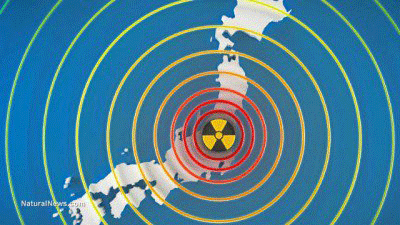
Won-Young Lee has walked from his homeland in South Korea to Tokyo. Now he’s on the march in the US, writes Linda Pentz Gunter
How far would you walk for a cause? In the case of South Korean anti-nuclear activist, Won-Young Lee, that distance has no limit.
Lee, 67, and the director of the Korea Land Future Research Institute and the Public Reporting Center for the Dangers of Nuclear Power Plants (PRCDN), will arrive in Washington, DC on April 8, having walked there from the United Nations in New York City, a journey he began on March 19. The distance is about 260 miles.
His cause this time is to draw attention to the continued dumping of highly radioactive waste water from the stricken Fukushima Daiichi nuclear power plant in Japan into the Pacific Ocean. This is not Mr. Lee’s first walk, but he chose the dates deliberately to span the time between the 2011 Fukushima nuclear disaster that began on March 11 and the April 26, 1986 Chornobyl reactor explosion in Ukraine.
This latest walk falls under the umbrella of what Lee has titled the “New Silk Road for Life and No-Nukes. Walking Planet Earth With Joy.” Together, the walks constitute a marathon that have taken Lee and other walkers through vast areas of the Asian continent, including Vietnam, Laos, Thailand, Malaysia, India and Nepal and on through Uzbekistan, Azerbaijan, and Georgia and through numerous countries in Europe. Lee himself has traversed 6,125 miles on foot.
He has been inspired, he says, by Gandhi’s ‘Salt March’ “that led to India’s independence,” and was also started, Lee says, “by a small number of people,” that grew into ever greater numbers.
That will of the people manifested again in 2023, during a trek of almost 1,000 miles undertaken by South Korean and Japanese citizens from Seoul, South Korea to Tokyo, Japan with stops that included one in Hiroshima.
Currently, as Lee marches resolutely from Manhattan to DC, he has encountered others who are equally inspired, often from Japan. Yoko Akashi, who marched with him in New Jersey, wrote that “even though we’re only two walking highways and shopping streets, people waved, honked cars and wanted to know more because they’re concerned.”
All of this is done with unbounded optimism. The purpose of the current walk is not only to engage with populations along the route but to try, once it reaches its destination in the nation’s capital, to convince members of Congress and even the White House, that the water dumping at Fukushima needs to stop.
By marching, we can gain the support of citizens, get citizens to join the march, and as the procession gets longer, citizens can pressure politicians,” asserts Lee.
We have published numerous articles on our news site — Beyond Nuclear International — arguing against the dumping of at least 1.3 million tons of radioactive water from Fukushima into the Pacific, a procedure that will go on for years, even decades.
One of the more recent ones, by Tilman Ruff, sums up many of the arguments. Another earlier one from GENSUIKIN, also lays out the specific risks.
Lee’s organization has turned to the cartoon format to produce a booklet telling the story. It’s entitled STOP! Fukushima Nuclear Wastewater Dumping and can be downloaded from the PRCDN website in English here.
I met with Lee and a group of Korean activists on Capitol Hill in February, during a press conference led by Congressman Brad Sherman (CA-32), a senior member of the House Foreign Affairs Committee, to urge for the passage of his bipartisan legislation, the Peace on the Korean Peninsula Act.
The bill calls for swift and substantial diplomatic engagement in order to achieve a formal end to the Korean War – America’s longest war.
During the event, Lee expressed his hopes for a political change of policy over the dumping (I am afraid I did not share his optimism.) In a statement before his New York to Washington march began, Lee expressed the view that stopping the dumping was in the hands of the US president. “He is the only person to whom the Japanese prime minister bows his head,” Lee wrote. “If the US president asks the Japanese prime minister to stop, the dumping can be stopped.”
At the heart of the matter for Lee is the devastating and continued destruction of the ecosystems on which all of us — human and animals — depend. The Fukushima radioactive water dump is just one of the most recent examples.
“Humanity has a responsibility to respect the survival of all living things in the ecosystem as well as its own future generations,” said a declaration put out before the latest walk launched. And yet, “the Japanese government is intentionally dumping potentially fatal nuclear contaminants into the sea.”
Both the International Atomic Energy Agency (IAEA) and the United Nations come in for deservedly harsh criticism as well. In the cartoon booklet, the IAEA is referred to as “Japan’s Brazen Enabler”. The UN, says the declaration, is “ignoring the spirit of the World Charter of Nature (1982), drawn up by themselves and the Earth Charter (2000), made by agreement at the Rio Environmental Conference, and are simply watching the destruction of our ecosystem.” Striking an uncharacteristically pessimistic note, it adds: “All of these things show that our international community is completely broken. At this rate, there is no hope for humanity.”
In conclusion, the march declaration offers the following:
The Japanese government, which has intentionally put humanity and the Earth’s ecosystem at great risk, must immediately stop dumping nuclear contaminated water and apologize to all living things on Earth.
The U.S. government and the IAEA, which support Japan’s ocean dumping of nuclear contaminated water, should immediately withdraw their support and seek safe measures for all living things on Earth.
The UN and the International Community must acknowledge and reflect on dereliction of their duty to stop Japan from dumping nuclear contaminated water into the ocean.
Global citizens, keep in mind that if we turn a blind eye to these errors, we are committing a crime to our descendants, and let us actively punish any country or power that intentionally commits such crimes.
Global citizens, let us be aware of our responsibility to protect the dignity of all life in the global village, and set the right guideposts.
Linda Pentz Gunter is the international specialist at Beyond Nuclear and writes for and edits Beyond Nuclear International. Her forthcoming book, Hot Stories. Reflections from a Radioactive World, will be published later this year.
Pearl Harbor update brings nuclear risk
Star Advertiser March 30, 2025, Lynda Williams
Kevin Knodell’s recent article highlights the significance of Dry Dock 5 at Pearl Harbor, but omits a critical detail: this facility is set to host the U.S. Navy’s most lethal nuclear-powered and nuclear-armed submarines (“‘An emphasis on lethality,’” Star-Advertiser, March 23).
This will likely transform Hawaii’s role in the U.S. nuclear arsenal by accommodating Ohio-class and, eventually, Columbia-class ballistic missile submarines, each capable of carrying Trident missiles with multiple nuclear warheads.
The detonation of even a single modern warhead could result in millions of deaths and potentially trigger a nuclear winter, devastating the global biosphere.
An accident on such a submarine near Pearl Harbor would be catastrophic and could cause widespread contamination across Hawaii. Hawaii’s residents were not consulted about housing nuclear-armed submarines in Honolulu. Please do not whitewash or sugarcoat the dangers associated with housing these submarines in our community……………………………………….. https://lyndalovon.blogspot.com/2025/03/my-op-ed-in-honolulu-star-advertiser.html?m=1&fbclid=IwY2xjawJYOxdleHRuA2FlbQIxMQABHXmnePII2HU6StRh1n7LgFionyc9TcmHIMLXETxISQeaZWtElxJvUl_axg_aem_RhuD_LZZLNNZDjuYWl-yGg
Swarms of satellites are harming astronomy. Here’s how researchers are fighting back

SpaceX and other companies plan to launch tens of thousands of satellites, which could mar astronomical observations and pollute the atmosphere.
Nature, By Alexandra Witze, 18 Mar 25
In the next few months, from its perch atop a mountain in Chile, the Vera C. Rubin Observatory will begin surveying the cosmos with the largest camera ever built. Every three nights, it will produce a map of the entire southern sky filled with stars, galaxies, asteroids and supernovae — and swarms of bright satellites ruining some of the view.
Astronomers didn’t worry much about satellites photobombing Rubin’s images when they started drawing up plans for the observatory more than two decades ago. But as the space around Earth becomes increasingly congested, researchers are having to find fresh ways to cope — or else lose precious data from Rubin and hundreds of other observatories.
The number of working satellites has soared in the past five years to around 11,000, mostly because of constellations of orbiters that provide Internet connectivity around the globe (see ‘Satellite surge’). Just one company, SpaceX in Hawthorne, California, has more than 7,000 operational Starlink satellites, all launched since 2019; OneWeb, a space communications company in London, has more than 630 satellites in its constellation. On paper, tens to hundreds of thousands more are planned from a variety of companies and nations, although probably not all of these will be launched1.
Satellites play a crucial part in connecting people, including bringing Internet to remote communities and emergency responders. But the rising number can be a problem for scientists because the satellites interfere with ground-based astronomical observations, by creating bright streaks on images and electromagnetic interference with radio telescopes. The satellite boom also poses other threats, including adding pollution to the atmosphere.
When the first Starlinks launched, some astronomers warned of existential threats to their discipline. Now, researchers in astronomy and other fields are working with satellite companies to help quantify and mitigate the impacts on science — and society. “There is growing interest in collaborating and finding solutions together,” says Giuliana Rotola, a space-policy researcher at the Sant’Anna School of Advanced Studies in Pisa, Italy.
Timing things right………………………………………..https://www.nature.com/articles/d41586-025-00792-y?fbclid=IwY2xjawJYMe9leHRuA2FlbQIxMAABHZglIwLgXdf2zs39ZTJIEmAP2QcvsWbVMRrzGsBT3jO8rtlyneCYBjefSA_aem_YRQybLlF5vTcwKEIIuQ0ZA
Biden Lied About Everything, Including Nuclear Risk, During Ukraine Operation
Sourced to tone-deaf “U.S. officials,” a massive New York Times exposé reveals an unprecedented betrayal of American voters, but also Ukraine
Racket News, Matt Taibbi, Apr 01, 2025
From “The Secret History of the War in Ukraine” in the New York Times:
At a hastily arranged meeting on the Polish border, General Zaluzhny admitted to Generals Cavoli and Aguto that the Ukrainians had in fact decided to mount assaults in three directions at once.
“That’s not the plan!” General Cavoli cried…
Fifteen months into the war, it had all come to this tipping point.
“We should have walked away,” said a senior American official.
But they would not.
When Ukrainian President Volodymyr Zelensky visited the White House nearly a month ago, the New York Times packed its pages with stories denouncing Donald Trump and J.D. Vance for abandoning Ukraine, and the impolitic “dressing down” of a friendly foreign leader. The Times like most Western news outlets for years suggested that anything short of a full-throated expression of support for war was a betrayal of the “democratic world order” that would lead to instant battlefield deaths.
Now that the war appears lost, and newspapers abroad (conspicuously, not here) are full of news about an apparent bombing of Vladimir Putin’s motorcade, and the future of NATO hangs by a thread, the Times has run a 13,000-word “Secret History” that shows the same U.S. officials who denounced Trump and American voters for saying it out loud long ago concluded that they, too, should probably “walk away.”
The piece is also an extraordinarily comprehensive betrayal of Zelensky and Ukraine, exponentially worse than the “dressing down” by Trump. Authored by longtime veteran of controversial intel pieces Adam Entous, it’s sourced to 300 American and European officials who seem to be responding to their apparent sidelining via a shameless tantrum, exhibiting behavior that in the field would get military men shot. Not only do they play kiss and tell with a trove of operational secrets, they use the Times to deflect blame from their own failures onto erstwhile Slavic partners, cast as ignorant savages who snatched defeat from the jaws of America-designed victory. It’s as morally abhorrent a piece of ass-covering ever as I’ve seen in print, and that somehow is not its worst quality.
The people who quarterbacked the NATO side of the Ukraine war are so pleased with themselves, they can’t keep from boasting about things that will make the average American want to pitchfork the lot of them. Entous describes a tale told “through a secret keyhole” that reveals how America was “woven into the war far more intimately and broadly than previously understood.” (Translation: it was hidden from us.) Sources not only make it clear that the public was lied to on a continuous basis from the outset of the conflict, they describe how we were lied to, apparently thinking the methods clever. Some are small semantic gambits the idiots wrongly believe exculpated their actions, but the main revelation involves one gigantic, inexcusable deception. From Joe Biden down, they all lied about the risk of World War III.
They risked our lives and our children’s lives, knowingly, repeatedly, and for the worst possible reason: politics. Afraid to admit a mistake, they planned individual excuses while letting bureaucratic inertia expand the conflict. Worse, as was guessed at on this site late last year, the Biden administration after last November’s election increased the risk of global conflict by “expanding the ops box to allow ATACMS and British Storm Shadow strikes into Russia,” in order to “shore up his Ukraine project.” If you and check this “secret history” against contemporaneous statements of American and European leaders, you’ll find the scale of the lies beyond comprehension. Heads need to roll for this:………………………………….. https://www.racket.news/p/biden-lied-about-everything-including?utm_source=post-email-title&publication_id=1042&post_id=160259839&utm_campaign=email-post-title&isFreemail=true&r=1ise1&triedRedirect=true&utm_medium=email
Iran rejects direct talks with the US over its nuclear programme
IRAN will not hold direct negotiations with the United States over its
nuclear programme, President Masoud Pezeshkian said today. Commenting on a
letter sent by US President Donald Trump to Iranian Supreme Leader Ali
Khamenei, Mr Pezeshkian said Iran’s response, delivered via Oman, left
open the possibility of indirect negotiations with Washington.
However, such talks have made no progress since Mr Trump, during his first term in
the White House, unilaterally withdrew the US from Tehran’s nuclear deal
with world powers in 2018. The Iranian president told a cabinet meeting:
“We don’t avoid talks; it’s the breach of promises that has caused
issues for us so far. “They must prove that they can build trust.”
Morning Star 30th March 2025, https://morningstaronline.co.uk/article/iran-rejects-direct-talks-us-over-its-nuclear-programme
Why Ontario won’t consider the nuclear option in its fight over Trump’s tariffs
Although Ontario Premier Doug Ford vowed that his
government would “not back down,” “apply maximum pressure” and
“keep up the fight” in the Canada-U.S. trade war, one nuclear option is
off the table: cancelling contracts to build American power reactors.
The province’s utility, Ontario Power Generation, is on the cusp of starting
construction of the first of four BWRX-300 small modular reactors, or SMRs,
at Darlington Nuclear Generating Station in Clarington. They’re designed
by Wilmington, N.C.-based GE-Hitachi Nuclear Energy, a stalwart of the
U.S.‘s nuclear industry. While the cost hasn’t been disclosed yet, the
first reactor is likely to cost several billion dollars.
Globe & Mail 30th March 2025,
https://www.theglobeandmail.com/business/article-why-ontario-wont-consider-the-nuclear-option-in-its-fight-over-trumps/
Nuclear news this week – not industry handouts

Some bits of good news – Being kind and believing others are kind – makes you happier than wealth: Happiness Report ranks 150 countries.
Conservation efforts are bringing species back from the brink, even as overall biodiversity falls.
Analysis showed climate action is a win for the global economy.
TOP STORIES. Trump threatens bombs if Iran doesn’t make nuclear deal. Netanyahu’s nuclear gamble: The risks of escalation with Iran.
The US hypocrisy about Israel’s nuclear weapons must stop.
EDF reduces stake in Sizewell C Nuclear as boss sacked.
Nuclear experts pour cold water on US idea to restore and run Ukrainian power plant.
European Court of Human Rights (ECHR) Finds Ukraine Responsible for Odessa Massacre.
From the archives– Poison in the Heart – The Nuclear Wasting of South Australia,
Climate. Quakers condemn police raid on Westminster Meeting House.
Noel’s notes. Australia’s MUMS FOR NUCLEAR – propaganda wheels within wheels.
AUSTRALIA.
- The Australian Electoral Commission is having words with Nuclear for Australia as the group spends $100,000s on its campaign.
- Proposed Queensland nuclear power plants risk contaminating water supplies in event of disaster, research finds.
- Avalon Air Show: Arms deals, weapons of destruction and family fun.
- I’m a Liberal and I want Dutton to drop nuclear. Now’s the perfect time to do it.
- Why The US Australia Alliance Needs a Rethink.
- More Australian nuclear news at https://antinuclear.net/2025/03/25/australian-nuclear-news-march-25-31/
NUCLEAR ITEMS
| ATROCITIES. Report: Israel Planning More Aggressive Invasion of Gaza |
| CIVIL LIBERTIES. CODEPINK Responds to US Senate McCarthy-Style Attack. |
| ECONOMICS. Finland’s Fortum says building new nuclear power is too expensive, for now.France delays EPR2 reactors to 2038. UK Government investment continues squeeze on EDF’s share of Sizewell C. It’s time to stop Sizewell C to generate ‘Warm Homes’ jobs instead. Why the nuclear renaissance is far from certain. |
| ENERGY. Finland backs green hydrogen as Fortum pauses nuclear expansion. As Nuke Power Dies, Lithium Must Not Be the New Plutonium. |
| HISTORY. “Born Violent: The Origins of Nuclear Power” by Robert (Bo) Jacobs. Britain’s worst nuclear disaster: the Windscale fire of 1957. |
| INDIGENOUS ISSUES. ‘Protect our future’: Alaskan Indigenous town fights ‘destructive’ uranium mine project |
| OPPOSITION to NUCLEAR . Leona Morgan – Rally and March to Abolish Nuclear Weapons in front of the UN – https://www.youtube.com/watch?v=6XB-TQWWIi4 Redirect Sizewell C funding to the Warm Homes Plan, say campaigners. |
POLITICS. A nuclear Svengali on Capitol Hill?
U.S Dept of Energy Reissues $900M Nuclear SMR Opportunity, Scraps Community Criteria to Focus on Technical Merit.
Will Texas Become ‘the Epicenter of a National Nuclear Renaissance’?- ALSO AT https://nuclear-news.net/2025/03/31/1-b1-will-texas-become-the-epicenter-of-a-national-nuclear-renaissance/
POLITICS INTERNATIONAL and DIPLOMACY.
- The US has the power to switch off the UK’s nuclear subs – a big problem as Donald Trump becomes an unreliable partner. Now that Washington is potentially an unreliable ally, the UK needs to revisit its nuclear strategy.
- France’s UK energy apathy poses nuclear problem for Labour.
- Zaporizhzhia nuclear plant to stay in Russian control, Moscow says. Ukraine will have to make territorial concessions – Waltz.
- Ukraine and Israel are not US allies.
- Iran rejects direct nuclear talks with Trump, open to indirect negotiations. US seeks full dismantling of Iran’s nuclear program. Trump warns of ‘bad, bad things’ for Iran if nuclear deal not reached-Trump’s advisor says.
- I’m Oppenheimer’s grandson: I support Trump’s pursuit of nuclear diplomacy
| SAFETY. Risks posed by hole in protective shell over Chernobyl. Russ How a Cheap Drone Punctured Chernobyl’s 40,000-Ton Shield. Russia rules out transferring control over Zaporizhzhia Nuclear Power Plant to Ukraine. |
| SECRETS and LIES. More lies from British nuclear power advocate Zion Lights.Trump Killed Public War Research: Stargate Will Make It Secret—and Far More Dangerous. |
| SPACE. EXPLORATION, WEAPONS. The rush to war in space only needs a Gulf of Tonkin incident, and then what happens |
| TECHNOLOGY. Behind the hype -“New wave of smaller, cheaper nuclear reactors sends US states racing to attract the industry “. |
| URANIUM. Greenland’s uranium ban likely to continue. |
| WASTES. China calls for strict, long-term international supervision over Fukushima wastewater discharge: spokesman. Second shipment of high level waste departs UK for Germany. Nuclear waste centre delayed. Dounreay more likely to build up than knock down -ALSO AT https://nuclear-news.net/2025/03/31/1-dounreay-more-likely-to-build-up-than-knock-down/ Dounreay learns what its share of £4bn decommissioning cash will be. |
| WAR and CONFLICT. An Extreme Ultimatum for Iran. |
| WEAPONS and WEAPONS SALES. Calls to restart nuclear weapons tests stir dismay and debate among scientists. Militarize Ukraine ‘to the teeth’ – Finnish president. ‘Deeply concerning’: British General’s Israeli weapons job criticised. Is your insurance company funding Israeli war crimes? Trump’s Star Wars Revival: The Golden Dome Antimissile Fantasy. New nuclear arms race looms as US threatens to pull atomic shield. Walt Zlotow: UK to push 250,000 Brits into poverty to increase unneeded defense spending. |
European Court of Human Rights (ECHR) Finds Ukraine Responsible for Odessa Massacre
The ECHR’s appraisal of criminal investigations into perpetrators of the Odessa massacre, and all the officials who failed in their most basic duties on May 2nd 2014, was absolutely scathing, the details pointing to a very clear, deliberate state-level coverup.
internal documents attesting that security measures had in fact been undertaken were found to have been forged.
the lethal incineration of anti-Maidan activists in May 2014 was an intentional and premeditated act of mass murder, conceived and directed by Kiev’s US-installed far-right government. This interpretation is amply reinforced by testimonies from a Ukrainian parliamentary commission, instituted in the massacre’s immediate aftermath.
(While the video above has been censored. This video below is allowed, as it contains a more favoured view of theUkrainian government.
Kit Klarenberg, Mar 30, 2025, https://www.kitklarenberg.com/p/echr-finds-ukraine-responsible-for?utm_source=post-email-title&publication_id=552010&post_id=160179175&utm_campaign=email-post-title&isFreemail=true&r=nxsz&triedRedirect=true&utm_medium=email
On March 13th, a bombshell judgment by the European Court of Human Rights found the Ukrainian government guilty of grave human rights breaches over the May 2nd 2014 Odessa massacre, in which dozens of Russian-speaking anti-Maidan activists were forced into the city’s Trade Unions House and burned alive by violent ultranationalist thugs. The explosive findings unambiguously uncover a concerted conspiracy by Ukrainian authorities to facilitate and exacerbate the grotesque killing, then insulate its perpetrators, and officials and state agencies which helped it happen, from justice.
In all, 42 people were killed and hundreds injured as a result of the blaze, a bloody bookend to the so-called “Maidan revolution” that saw Ukraine’s democratically-elected president Viktor Yanukovych deposed in a Western-orchestrated coup months earlier. Ever since Ukrainian officials and legacy media outlets have consistently framed the deaths as a tragic accident, with some figures even blaming anti-Maidan protesters themselves for starting the blaze. That notion is comprehensively incinerated by the verdict, which was delivered by a team of seven European judges, including a Ukrainian.
“Relevant authorities’ failure to do everything that could reasonably be expected of them to prevent the violence in Odessa…to stop that violence after its outbreak, to ensure timely rescue measures for people trapped in the fire, and to institute and conduct an effective investigation into the events” means Kiev was found guilty of egregious European Convention on Human Rights breaches. Moreover, numerous incendiary passages make clear industrial scale “negligence” by officials on the day, and ever after, “went beyond an error of judgment or carelessness.”
For example, the ECHR found deployment of fire engines to the site was “deliberately delayed for 40 minutes” – the local fire station being just one kilometer away – and police stood by passively as the building and its occupants burned, refusing to “help evacuate people…promptly and safely.” Moreover, Ukrainian authorities made “no efforts whatsoever” or “any meaningful attempt” to prevent or disrupt the skirmishes between pro- and anti-Maidan activists that prefaced the deadly inferno, despite knowing in advance such clashes were impending on the day.
While stopping short of charging that Ukrainian authorities actively wished for the anti-Maidan activists trapped in the burning building to die, this conclusion is ineluctable based on the ECHR’s findings. So too the apparent immunity from prosecution for implicated officials and ultranationalist perpetrators, and Kiev’s failure to act on “extensive photographic and video evidence” indicating precisely who was responsible for “firing shots during the clashes,” setting the building ablaze, and “assaulting the fire victims” who managed to escape.
The case was brought by 25 people who lost family members in the Neo-Nazi arson attack and clashes that preceded it, and three who survived the fire “with various injuries”. The ECHR has demanded Ukraine pay them just 15,000 euros each in damages. In an even greater affront to justice, the damning ruling stops short of exposing the full reality of the Odessa slaughter, indicting the Western-supported Neo-Nazi elements responsible, and their intimate ties to the February 2014 Maidan Square false flag sniper massacre.
‘Explicit Order’
Once the Maidan protests commenced in Ukraine in November 2013, tensions began steadily brewing between Odessa’s sizable Russian-speaking population and Ukrainian nationalists within and without the city. As the ECHR ruling notes, “while violent incidents had overall remained rare…the situation was volatile and implied a constant risk of escalation.” In March 2014, anti-Maidan activists set up a tent camp in Kulykove Pole Square, and began calling for a referendum on the establishment of an “Odessa Autonomous Republic”.
The next month, supporters of Odesa Chornomorets and Kharkiv Metalist football clubs announced a rally “For a United Ukraine” on May 2, before a scheduled match. Shortly thereafter, the ECHR records “anti-Maidan posts began to appear on social media describing the event as a Nazi march and calling for people to prevent it.” While branded Russian “disinformation” in the ruling, hooligans associated with both clubs had overt Neo-Nazi sympathies and associations, and well-established reputations for violence. They later formed the notorious Azov Battalion.
Fearing their tent encampment would be attacked, anti-Maidan activists resolved to disrupt the “pro-unity march” before it reached them. The ECHR reveals Ukraine’s security services and cybercrime unit had substantive intelligence indicating “violence, clashes and disorder” were certain on the day. Yet, authorities “ignored the available intelligence and the relevant warning signs”, and undertook no actions or “proper measures” to “stamp out any provocation”, such as implementing “enhanced security in the relevant areas.”
So it was on the afternoon of May 2nd 2014, “as soon as the march began,” anti-Maidan activists confronted the demonstrators, and violent clashes erupted. At roughly 17:45, in the precise manner of the Maidan Square sniper false flag massacre three months earlier, multiple anti-Maidan activists were fatally shot “by someone standing on a nearby balcony”, using “a hunting gun.” Subsequently, “pro-unity protesters…gained the upper hand in the clashes,” and charged towards Kulykove Pole square.
Anti-Maidan activists duly “took refuge” in Trade Unions House, a five-storey building overlooking the square, while their ultranationalist adversaries “started setting fire to the tents.” Gunfire and Molotov cocktails were “reportedly” exchanged by both sides, and before long, the building was ablaze. “Numerous calls” were made to the local fire brigade, including by police, “to no avail.” Mysteriously, its chief had “instructed his staff not to send any fire engines to Kulykove Pole without his explicit order,” so none were dispatched.
Several people trapped in the building tried to escape by jumping from its upper windows – some survived, but others died. “Video footage shows pro-unity protesters attacking people who had jumped or had fallen,” the ECHR notes. It was not until 20:30 that firefighters finally entered the building and extinguished the blaze. Police then arrested 63 surviving activists “still inside the building or on the roof.” They were released two days later, after a several hundred-strong group of anti-Maidan protesters “stormed the local police station where they were being held.”
‘Serious Defects’
The litany of security failures and industrial scale negligence by authorities on the day was greatly aggravated by “local prosecutors, law enforcement, and military officers” not being “contactable for a large part or all of time [sic],” as they were coincidentally attending a meeting with Ukraine’s Deputy Prosecutor General. The ECHR “found the attitude and passivity of those officials inexplicable,” apparently unwilling to consider the obvious possibility they purposefully made themselves incommunicado to ensure maximum mayhem and bloodshed, while insulating themselves from legal repercussions.
Still, the ECHR ruled “relevant” Ukrainian authorities “had not done everything they reasonably could to prevent the violence” or “what could reasonably be expected of them to save people’s lives,” therefore finding Kiev committed “violations of the substantive aspect of Article 2” of the European Convention on Human Rights. The Court also concluded authorities “failed to institute and conduct an effective investigation into the events in Odessa” – “a violation of the procedural aspect of Article 2”.
The ECHR’s appraisal of criminal investigations into perpetrators of the Odessa massacre, and all the officials who failed in their most basic duties on May 2nd 2014, was absolutely scathing, the details pointing to a very clear, deliberate state-level coverup. For example, no effort was made to seal off “affected areas of the city centre” in the event’s aftermath. Instead, “the first thing” authorities did “was to send cleaning and maintenance services to those areas,” meaning invaluable evidence was almost inevitably eradicated.
Accordingly, when on-site inspections were finally carried out two weeks later, the probes “produced no meaningful results.” Trade Unions House likewise “remained freely accessible to the public for 17 days after the events,” giving malicious actors plentiful time to manipulate, remove, or plant incriminating evidence at the site. Meanwhile, “many of the suspects absconded.” Several criminal investigations into perpetrators were opened, only to go nowhere, left to expire under Ukraine’s statute of limitations. Other cases that reached trial “remained pending for years”, before being dropped.
This was despite “extensive photographic and video evidence regarding both the clashes in the city centre and the fire,” from which culprits’ identities could be easily discerned. . The ECHR had no confidence Ukrainian authorities “made genuine efforts to identify all the perpetrators,” and several forensic reports weren’t released for many years. Elsewhere, the Court noted a criminal investigation of an individual suspected of having shot at anti-Maidan activists was inexplicably discontinued on four separate occasions, on identical grounds.
The ECHR also noted “serious defects” in investigations of officials, “and their role in the events.” Primarily, this took the form of “prohibitive delays” and “significant periods of unexplained inactivity and stagnation” in opening cases. For instance, “although it had never been disputed that the fire service regional head had been responsible for the delayed deployment of fire engines to Kulykove Pole,” no probe into his flagrantly criminal dereliction of duty was launched until almost two years after the massacre.
Similarly, Odessa’s regional police chief not only failed to implement any “contingency plan in the event of mass disorder” according to protocol, but internal documents attesting that security measures had in fact been undertaken were found to have been forged. However, he only became subject to criminal investigation “almost a year later.” Following pre-trial investigation, his case remained pending “for about eight years,” after which he was released from criminal liability, “on the grounds that the charges against him had become time-barred.”
Burn Everything’
Wholly unconsidered by the ECHR was the prospect that, far from a freak twist of fate produced by two effectively warring factions clashing in Odessa, the lethal incineration of anti-Maidan activists in May 2014 was an intentional and premeditated act of mass murder, conceived and directed by Kiev’s US-installed far-right government. This interpretation is amply reinforced by testimonies from a Ukrainian parliamentary commission, instituted in the massacre’s immediate aftermath.
The commission found Ukrainian national and regional officials explicitly planned to use far-right activists drawn from the fascist Maidan Self-Defence to violently suppress Odessa’s would-be separatists, and disperse all those camped by Trade Unions House. Moreover, Maidan Self-Defence chief Andriy Parubiy and 500 of his armed and dangerous members were dispatched to the city from Kiev on the eve of the massacre. From 1998 – 2004, Parubiy served as founder and leader of Neo-Nazi paramilitary faction Patriot of Ukraine.
He also headed Kiev’s National Security and Defence Council at the time of the Odessa massacre. Ukraine’s State Bureau of Investigations immediately began scrutinising Parubiy’s role in the May 2014 events after he was replaced as lead parliamentary speaker, following the country’s 2019 general election. This probe has seemingly come to nothing since. Nonetheless, a year prior a Georgian militant told Israeli documentarians that he engaged in “provocations” in the Odessa massacre under Parubiy’s command, who told him to attack anti-Maidan activists and “burn everything.”
He is one of several Georgian fighters who has openly alleged they were personally responsible for the February 2014 Maidan Square false flag sniper massacre, under the command of Parubiy, other ultranationalist Ukrainian figures, and Mikhael Saakashvili, founder of infamous mercenary brigade Georgian Legion. That slaughter brought about the end of Viktor Yanukovych’s government, and sent Ukraine hurtling towards war with Russia. The Odessa massacre was another key chapter in that morbid saga – and the West’s foremost human rights court has now firmly laid responsibility for the horror at Kiev’s feet.
Finland backs green hydrogen as Fortum pauses nuclear expansion

28 March 2025, Helsinki Times
Finnish utility Fortum has ruled out new investments in nuclear power in the near term, citing low electricity prices in the Nordic market and high construction costs. The announcement came as Finland inaugurated its first industrial-scale green hydrogen plant, marking a shift in focus toward alternative energy technologies.
Fortum concluded a two-year study into the feasibility of building new nuclear reactors and determined that such investments are not commercially viable under current market conditions.
New nuclear could provide new supply to the Nordics earliest in the second half of the 2030s, if market and regulatory conditions are right,” said Markus Rauramo, CEO of Fortum.
The company will instead focus on expanding renewable power generation, increasing storage capacity, and extending the life of existing nuclear facilities, including the Loviisa nuclear plant.
The company’s Vice President for New Nuclear, Laurent Leveugle, said a risk-sharing model would be required to make future nuclear investments possible.
“We are not saying that the state has to pay for it, but that the risk must be shared with the different parties: technology providers, investors, utilities, and also the state,” Leveugle told Reuters…………………….
While Fortum has paused new nuclear plans, Finland is pressing ahead with new green energy initiatives. On 26 March 2025, P2X Solutions inaugurated the country’s first industrial-scale green hydrogen production plant in Harjavalta. The event was attended by Alexander Stubb, President of the Republic of Finland.
“Finland has everything it takes to become a clean energy superpower,” Stubb said during his speech at the inauguration……………………………………………………………………………
As Fortum turns to renewables and lifetime extensions for existing nuclear facilities, and P2X accelerates hydrogen development, Finland’s energy policy is shifting toward flexible and decentralised solutions.
The Nordic power market has experienced prolonged periods of low electricity prices, driven by increased renewable capacity and lower demand growth. Fortum has warned that these conditions are not sufficient to support capital-intensive projects like nuclear reactors without regulatory reforms or direct financial support……………………………………………..
Finland’s approach to energy diversification comes amid broader European efforts to reduce reliance on fossil fuels and improve energy security. Green hydrogen and advanced storage systems are seen as essential components of this transition.
Fortum’s position reflects growing caution among European utilities over the costs and risks associated with new nuclear builds. The company has yet to release any cost estimates for new reactors, but industry analysts say capital requirements often exceed €10 billion per unit and construction timelines stretch over a decade.
By contrast, modular hydrogen projects like those developed by P2X Solutions involve lower upfront costs and shorter lead times. They also benefit from growing political and financial support across the EU…………………….https://www.helsinkitimes.fi/business/26416-finland-backs-green-hydrogen-as-fortum-pauses-nuclear-expansion.html
Risks posed by hole in protective shell over Chernobyl
Lilia Rzheutska, DW, March 29, 2025,
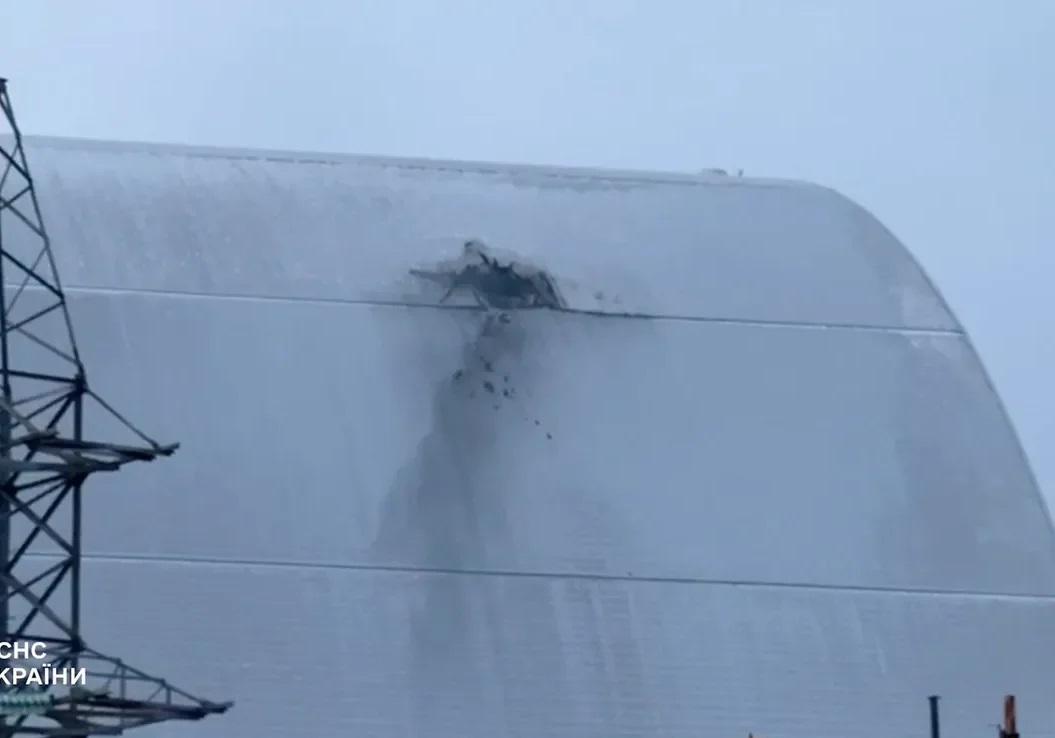
When it was erected in 2019, the giant shell over the damaged nuclear reactor in Chernobyl was one of the biggest structures ever moved by humans. In February a Russian drone put a hole in it.
For weeks, the Ukrainian authorities have been looking for ways to repair a large hole in the protective shell that covers the fourth reactor of the decommissioned Chernobyl nuclear plant. On February 14, a Russian drone hit the structure, which is called the New Safe Confinement, or NSC, because it is meant to “confine” the reactor’s radioactive remains. The drone started a fire that caused considerable damage and was only extinguished three weeks later on March 7.
“The main mission is to close the hole, which is about 15 square meters [around 162 square feet] in size, but also the more than 200 small holes that the State Emergency Service of Ukraine drilled into the shell during firefighting operations,” said Hryhoriy Ishchenko, the head of the State Agency of Ukraine on Exclusion Zone Management, which is responsible for the area around the Chernobyl power plant.
He told DW that experts would soon be arriving on site to examine the structure and that “preliminary recommendations on the repair work should be available within a month.”
A €1.5 billion megaproject
The NSC was erected over a pre-existing protective shell called the sarcophagus, which is there to prevent the release of radioactive contaminants from the reactor, which exploded in 1986. The NSC was built after 45 donor countries came together and gathered around €1.5 billion for the project. Eventually 10,000 people from 40 countries would play a part in the shell, which took 12 years, from the signing of contracts to the moment the NSC was ready in 2019. …………………………
Although experts say the drop in pressure in the NSC does not pose any immediate threat, there are other dangers. Dmytro Humeniuk, a safety analysis expert at Ukraine’s State Scientific and Technical Center for Nuclear and Radiation Safety said it was currently impossible to dismantle the old sarcophagus. The NSC was built in part to replace the old shell but inside the old shell, there are still 18 unstable beams. Three of the main beams could reportedly collapse at any time. If this were to happen under the new-but-now-damaged protective structure, radioactive dust could be stirred up and radioactivity released, Humeniuk said. “The protective shell is currently not fulfilling its function, which is to contain the nuclear fission products beneath it.”………………………….
For Jan Vande Putte, a nuclear expert at Greenpeace Ukraine, there are very few options. “Due to the high radiation levels above the sarcophagus, the entire Chernobyl protective shell will probably have to be moved back to the place where it was built on rails before the expensive repairs can be carried out,” he said adding that the costs of doing this were completely unknown.
Representatives of the European Bank for Reconstruction and Development visited Chernobyl on March 18 and spoke with the power plant’s directors, according to a report on the power plant’s website. They also inspected the technical units of the NSC and the area under the protective shell.
After the meeting, €400,000 from the International Chernobyl Cooperation Account, which the European Bank manages, was approved for a specialist-led damage assessment. https://www.dw.com/en/risks-posed-by-hole-in-protective-shell-over-chernobyl/a-72078360?fbclid=IwY2xjawJV0VZleHRuA2FlbQIxMQABHfhIgvFmxHhPebzUFjc8wxY4HEGBSRbgMxQdAOL2rCSoRY-S4A1j5U8wvw_aem_qeZu8AA
EUROPE’S DESPERATE GAMBIT
Russian and Eurasian Politic,sby Gordonhahn, March 31, 2025, https://gordonhahn.com/2025/03/31/europes-desperate-gambit/
Ukraine’s battlefronts and army continue to slowly crumble under the pressure of the Russian army’s advance east. The Maidan regime is beginning to eat itself. Yuliya Tymoshenko is being courted by Kiev’s former key backer, Donald Trump’s new America. Former president and Zelenskiy-indicted opposition leader Petro Poroshenko calls Zelenskiy “a dictator.” Kiev’s Mayor Vitaliy Klichko and Zelenskiy’s former aide Oleksiy Arestovich have done much the same, and the latter has announced his intent to run for president. And well-armed neofascist army units, some at the corps level, await their moment to ‘finish Ukraine’s nationalist revolution, which the oligarch-dominated Maidan regime, they say, only began.
On this catastrophic background, Europe is radically opposed to Trump’s new détente with Vladimir Putin’s Russia and rather than pursuing an end to the NATO-Russia Ukrainian War is planning what will prove to be an only partially realizable rearmament campaign to restock its own weapons stores and refill those of Ukraine’s deteriorating army. By supplying military and financial aid to Kiev, Europe can block any ceasefire and prolong Ukraine’s agony. At the same time, Britain and France are spearheading a reckless plan to deploy ‘peacekeeping troops’ from a ‘coalition of the willing’ recruited from among the EU’s member-states.
Moscow has repeatedly warned that any troops from NATO member-states will be regarded as legal military targets. This European ‘maximum plan’ would not only undermine U.S. President Donald Trump’s ceasefire and peace treaty efforts but would create a ‘trip wire’ that Paris and London hope Moscow will touch so the U.S. will be compelled to intervene militarily in direct rather than by proxy fashion as hitherto. Thus, Europe hopes to continue a policy orientation that has helped to destroy Ukraine, pushed the West towards authoritarianism, and weakened many of its own ruling parties and governments.
However, this policy orientation of NATO expansion, Ukrainian victory at seemingly all costs, and subjugation of Russia has begun to split not just the Trans-Atalantic core of NATO and the Western community. It is driving a wedge into Europe, forcing a schism, generally speaking, between Western, Central, and Northern Europe, on the one hand, and Eastern and Southern Europe, on the other hand.
In the north and west, Great Britain, France, Portugal, Germany, Poland, the Baltic states, and Scandinavia prefer to continue the Ukrainian war for years in the hope that Putin wil leave the scene, an upheaval will occur in Moscow, and a new Russian administration or even regime will be weaker on the battlefield or more amenable to compromises.
Countries in Eastern and Southern Europe such as Hungary, Serbia, Slovakia, and Croatia support an end to the war outright and Trump’s general effort to achieve it. Romania’s population has moved in this direction, but the election of anti-war Calin Giorgescu has been blocked by the government and, apparently, the EU itself.
Italy (Germany too) has balked at Anglo-Franco plans to organize European peacekeeping contingents for deployment to Ukraine, even as Washington rejects the idea and Russia has given to understand in no uncertaine terms that any such troops will be treated as legitimate, legal military targets by Russia’s armed forces. Italy, Portugal, Spain, and even France are opposing the EU proposal to provide up to 40 billion euros ($43.67 billion) in military aid for Ukraine this year, which would be a doubling of its support ion 2024 (https://t.me/stranaua/189942).
Yet France is leading the effort to deploy ‘peacekeepers’ in Ukraine. While Denmark, Estonia, and Lithuania are leaders in backing Ukraine, having devoted more than 2 percent of their GDPs to the war since February 2022, support has been limited from Italy, Slovenia, Spain, Portugal, Greece and Cyprus, each of which has provided less than 0.5% of their GDPs (www.reuters.com/world/europe/italy-spain-not-ready-back-eu-plan-boost-ukraine-military-aid-2025-03-17/).
EU member states will be tested as Trump follows through on his threat to level high tarriffs against European states for any continuation of their support for Kiev or at least for their resistance to Trump’s peace efforts.
What Europe should be doing is joining the Trump administration in attempting to put an end to the bloodshed in and ruin of Ukraine. More generally, as Trump seems to understand, a more benign Western policy vis-à-vis Russia’s national security, NATO expansion, and a new security architecture that will serve all from Vladivostok to Vancouver, inlcuding Kiev.
A general peace formula in Eastern Europe must be based on two fundamental principles:
(1) States on Russia’s borders should seek modus vivendi with great power neighbor and
(2) other great powers refrain from drawing adjacent neighbors out of Moscow’s orbit, which is impossible without putting the local neighbors’ national security at risk.
Some might counter: But at the end of the Cold War the West succeeded in removing from Moscow’s orbit numerous East European states without provoking Moscow to war. This was an anomaly in world history in which a declining power prioritized good relations with a former foe over maintenance of its external empire, which was crumbling from within in as Moscow’s USSR was.
Russia is not crumbling from within, despite the West’s best efforts; rather, it is strengthening on the basis of effective leadership and robust relations, including profitable foreign trade with the Rest or non-Western world. The USSR had little economically effective trade relations with the outside world and squandered its finances and economic growth in the attempt to support ‘color’ revolutions by comunist and national liberation movements in the ‘Third World’, today’s Rest. Under such a scheme Kiev, Kishinev, Tbilisi, Baku, Yerevan, and, yes, Riga, Tallinn, Vilnius, and Warsaw should follow the Cold War Finnish model and profit therefrom. NATO is a troublemaker in the region, and the trouble it incites will rain down on the Eastern European states first and foremost.
Western and Eastern Europeans. Their arrogant leaders, deluded by visions of granduer and a Woke dystopia, are drunk on their own generously spiked Cool Aid: a mixture of Western superiority and rights to remake the world as the West sees proper (and profitable) at any minute in time and a perverse, historical russophobia that clouds the mind, inuring it of all realism and simple common sense.
Britain sent over 500 spy flights to Gaza
Exclusive: New study reveals the scale of British intelligence gathering above Gaza, raising fears of complicity in Israeli war crimes
DECLASSIFIED UK, IAIN OVERTON, 27 March 2025
- Flights have continued even after Israel broke the ceasefire
The Royal Air Force (RAF) has conducted at least 518 surveillance flights around Gaza since December 2023, an investigation by Action on Armed Violence (AOAV) for Declassified UK has found.
The flights, carried out by 14 Squadron’s Shadow R1 aircraft from RAF Akrotiri in Cyprus, have been shrouded in secrecy, raising concerns about whether British intelligence has played a role in Israeli military operations that have resulted in mass civilian casualties in Gaza.
These revelations come as Israel faces allegations of genocide at the International Court of Justice (ICJ) and war crimes at the International Criminal Court (ICC), with warrants issued for Israeli prime minister Benjamin Netanyahu and former defence minister Yoav Gallant.
The UK government insists that the flights are purely for hostage recovery, but the lack of transparency has done little to allay suspicions that the intelligence gathered may be facilitating Israeli attacks.
Surveillance sorties continued during and after the ceasefire, despite Israel’s renewed bombing of Gaza killing hundreds of children.
Over 500 missions in 15 months
AOAV’s analysis of flight-tracking data shows that between 3 December 2023 and 27 March 2025, the RAF carried out at least 518 Intelligence, Surveillance, and Reconnaissance (ISR) flights over or close to Gaza’s airspace.
Both Labour and Conservative governments have enacted the policy, with at least 215 flights taking place during Keir Starmer’s tenure as prime minister and 303 under Rishi Sunak’s administration.
The frequency of flights remained high throughout 2024, with some months seeing as many as 49 sorties. The missions have typically lasted up to six hours, with the longest flight recorded at seven hours and four minutes.
While the Ministry of Defence (MoD) claims these flights are solely for locating Israeli hostages held by Hamas, AOAV found that the RAF conducted 24 flights in the two weeks leading up to and including the day of Israel’s deadly attack on the Nuseirat refugee camp on 8 June 2024, which reportedly killed 274 Palestinians and injured over 700.
Four Israeli hostages were rescued in the operation; it remains unclear whether British intelligence directly contributed to the attack or was solely used to locate hostages…………………………………
Parliamentary stonewalling
Parliamentary efforts to probe the true purpose of these flights have been repeatedly stonewalled by the UK government. ………………………………
This lack of transparency raises serious questions about whether the UK is complicit in violations of international law. If intelligence gathered by the RAF was used to facilitate war crimes, the UK could itself be liable under the Rome Statute of the ICC.
The ICJ’s genocide case against Israel, brought by South Africa, highlights mass civilian deaths, deliberate destruction of infrastructure, and obstruction of humanitarian aid as key components of the allegations.
The UK, as a signatory to the Arms Trade Treaty and the Geneva Conventions, is legally obligated to ensure its military intelligence is not used to facilitate war crimes. However, the UK government has admitted in court that “Israel is not committed to upholding international humanitarian law” – yet surveillance flights continue…………………………………………….
Calls for a public inquiry
Pressure is growing for a full public inquiry into the UK’s role in Israel’s bombardment of Gaza. This month, Independent MP Jeremy Corbyn called for a ‘Chilcot-style’ investigation into the UK’s military collaboration with Israel, warning that “parliament has been kept in the dark”.
Human rights groups, including Amnesty International and Human Rights Watch, have also demanded full transparency regarding UK surveillance flights and their potential role in Israeli operations.
Nuvpreet Kalra from campaign group CODEPINK told Declassified that when a bomb “massacres Palestinians sheltering in tents or a drone shoots dead a journalist, we have to ask where the intelligence to target these attacks come from…Britain must immediately stop the spy flights and shut down their colonial military bases on Cyprus.”……………………….
If UK intelligence has been used in any Israeli strikes that resulted in civilian deaths, the British government could be found complicit in war crimes. https://www.declassifieduk.org/britain-sent-over-500-spy-flights-to-gaza/?utm_source=Email&utm_medium=Button&utm_campaign=ICYMI&utm_content=Button
Trump Threatens Iran With ‘Bombing’ If Nuclear Deal Is Not Reached

no evidence Iran is trying to build a nuclear weapon or that Iranian Supreme Leader Ayatollah Ali Khamenei has reversed his 2003 fatwah that banned the production of weapons of mass destruction.
The threat comes after US intelligence agencies reaffirmed that Iran is not building a nuclear weapon
by Dave DeCamp March 30, 2025, https://news.antiwar.com/2025/03/30/trump-threatens-iran-with-bombing-if-no-nuclear-deal-is-reached/
President Trump on Sunday threatened to bomb Iran if a deal isn’t reached on the country’s civilian nuclear program.
“If they don’t make a deal, there will be bombing. It will be bombing the likes of which they have never seen before,” Trump told NBC News in a phone interview.
The president has made similar threats toward Iran, but Sunday’s marked the most explicit one yet, and it comes as the US is sending more bombers to the region and pounding Yemen with daily airstrikes. Trump also said the US could hit Iran with “secondary tariffs” if a deal isn’t reached.
Trump’s threat comes after US intelligence agencies said in their annual threat assessment that there’s no evidence Iran is trying to build a nuclear weapon or that Iranian Supreme Leader Ayatollah Ali Khamenei has reversed his 2003 fatwah that banned the production of weapons of mass destruction.
Iran recently responded to a letter Trump sent to Khamenei proposing nuclear talks and giving Tehran a two-month deadline to reach a deal. A US official told Axios that the deployment of US B-2 bombers to Diego Garcia was “not disconnected” from that deadline.
Iranian officials have repeatedly rejected the idea of direct talks with the US in the face of Trump’s so-called “maximum pressure campaign” but have left the door open to indirect negotiations.
Iranian President Masoud Pezeshkian said Sunday that Iran’s response to Trump’s letter made indirect talks possible but that the US’s behavior would determine how things would move forward.
“While Iran’s response rules out the possibility of direct talks between the two sides, it states that the path for indirect negotiations remains open,” Pezeshkian said. Iranian officials have been noting the fact that Trump was the one who tore up the 2015 nuclear deal by reimposing sanctions on Iran.
“As we have stated before, Iran has never closed the channels of indirect communication. In its response, Iran reaffirmed that it has never shied away from engaging in negotiations, but rather, it has just been the United States’ repeated violations of agreements and commitments that have created problems on this path,” Pezeshkian said.
“It’s the behavior of the Americans that will determine whether the negotiations can move forward,” the Iranian leader added. In his interview with NBC, Trump said that US and Iranian officials were talking but didn’t elaborate further.
Resistance to nuke dump grows in South Copeland

NFLA 31st March 2025
Kirksanton and Bankhead residents in the South Copeland GDF Search Area will be heartened by the support of Millom Town Councillors who approved a motion at their 26 March meeting to ‘reject the area of focus as being beneficial to Bank Head’.
In January, Nuclear Waste Services announced that a site surrounding the prison West of Haverigg was its ‘Area of Focus’, the preferred inland site for a Geological Disposal Facility, a deep repository for Britain’s legacy and future high-level radioactive waste. This site borders the village of Kirksanton and the Bank Head housing estate.
The Council also agreed to a request that a public meeting be held to examine the ‘positives and negatives’ of bringing the GDF to the area. In September 2023, a Community Forum attended by the public and organised by the South Copeland GDF Community Partnership drew up an initial list. In response to this NWS promised to commission an ‘impacts report’ from an independent consultant, but this has never materialised.
Councillors also agreed to send a letter of complaint to NWS about the size of the Area of Focus and how the announcement has impacted house sales and affected residents of the area. At the meeting, the Chair conceded that, after speaking to estate agents, he believed the area to be ‘blighted’. Since the announcement, one house sale in nearby Silecroft has fallen through and a house owner in Bank Head has been forced to significantly reduce their asking price in make a sale.
Jan Bridget, who co-founded Millom and District against the GDF in 2022, was delighted at the level of attendance from the public and at the outcome:
“Well, what can I say, we have won a battle but not the war. And I am thrilled that around 40 people turned up at the Millom Town Council meeting, demonstrating that Bank Head and Kirksanton are not willing communities”.
Millom and District Against the Nuclear Dump organised a meeting of Bank Head residents to meet their local councillors from Cumberland and Millom Town Councils in February. Thirty-nine people attended the meeting, most from the Bank Head estate. Residents asked the councillors for their help after sharing their very moving concerns.
We reported on this meeting:…………………………………..
https://www.nuclearpolicy.info/news/resistance-to-nuke-dump-grows-in-south-copeland/
-
Archives
- October 2026 (92)
- September 2026 (339)
- August 2026 (330)
- July 2026 (355)
- June 2026 (287)
- May 2026 (306)
- April 2026 (356)
- March 2026 (251)
- February 2026 (267)
- January 2026 (308)
- December 2025 (358)
- November 2025 (359)
-
Categories
- 1
- 1 NUCLEAR ISSUES
- business and costs
- climate change
- culture and arts
- ENERGY
- environment
- health
- history
- indigenous issues
- Legal
- marketing of nuclear
- media
- opposition to nuclear
- PERSONAL STORIES
- politics
- politics international
- Religion and ethics
- safety
- secrets,lies and civil liberties
- spinbuster
- technology
- Uranium
- wastes
- weapons and war
- Women
- 2 WORLD
- ACTION
- AFRICA
- Atrocities
- AUSTRALIA
- Christina's notes
- Christina's themes
- culture and arts
- Events
- Fuk 2022
- Fuk 2023
- Fukushima 2017
- Fukushima 2018
- fukushima 2019
- Fukushima 2020
- Fukushima 2021
- general
- global warming
- Humour (God we need it)
- Nuclear
- RARE EARTHS
- Reference
- resources – print
- Resources -audiovicual
- Weekly Newsletter
- World
- World Nuclear
- YouTube
-
RSS
Entries RSS
Comments RSS

