Hunterston B decommissioning approved
The UK Office for Nuclear Regulation (ONR) has granted consent to EDF
Energy’s application to start decommissioning the Hunterston B nuclear
power station. This follows a public consultation and a detailed assessment
by ONR specialist inspectors of EDF’s environmental statement.
The
statement included a detailed environmental impact assessment (EIA) for the
proposed decommissioning project at the North Ayrshire site in Scotland,
along with mitigation measures designed to prevent or reduce any
significant adverse environmental impacts.
The EIA identified two
significant impacts during decommissioning: temporary adverse visual impact
of dismantling activities of the power station for local residents and the
socioeconomic effects on the regional employment market and workers at
Hunterston B released from their roles during phases of the project. ONR
said it is satisfied that the environmental statement proposes adequate
mitigation measures to address these factors and considers the statement to
be complete, of the right quality, and in line with relevant good
practices.
Nuclear Engineering International 19th Nov 2024 https://www.neimagazine.com/news/hunterston-b-decommissioning-approved/
Households receive chilling leaflet urging them to prepare for war and grim nuclear attack
Households have all received a booklet on how to properly prepare for war
– as tensions escalate with Russia. Sweden has issued advice to citizens on
what to do if there is a World War Three, with all the grim and scary
details about what a nuclear bomb attack would bring, as well as how best
to protect yourself from any type of attack.
Mirror 21st Nov 2024
https://www.mirror.co.uk/news/households-receive-chilling-leaflet-urging-34158320
On Way Out, Reckless Biden Allows Deep Russia Strikes

Biden staked his legacy on Ukraine. He was involved in the 2014 coup, in allegedly shady practices there with his son and then in provoking Russia to invade in 2022. He foolishly believed he would prevail in bringing down Putin with an economic, information and proxy ground war. [See: Biden Confirms Why the US Needed This War]
All three are now decisively lost as the U.S. — still under Biden — prepares for the end game. Biden’s only face saver is for Ukraine to get back some of its lost territory by trading for it with Russian territory it seized in Kursk this summer.
November 17, 2024 By Joe Lauria, Consortium News, https://consortiumnews.com/2024/11/17/on-way-out-reckless-biden-allows-deep-russia-strikes/
With his party decisively beat at the polls, the rejected president is gambling with regional security to preserve his ‘legacy’ and to saddle the incoming president, who wants to end the war, with a major new crisis, writes Joe Lauria.
As a parting shot to incoming U.S. President Donald Trump and Russian President Vladimir Putin, the defeated Joe Biden has defied the Pentagon by risking European and U.S. security with his decision announced Sunday to allow Ukraine to fire U.S. long-range missiles into Russian territory.
Just two months ago, in September, Biden had bowed to the realists in the Pentagon to oppose allowing long-range British Storm Shadow missiles from being fired by Ukraine deep into Russia out of fear it would lead to a direct NATO-Russia military confrontation with all that that entails.
Putin warned at the time in that British soldiers on the ground in Ukraine launching the British missiles into Russia with U.S. geostrategic support “will mean that NATO countries — the United States and European countries — are at war with Russia. And if this is the case, then, bearing in mind the change in the essence of the conflict, we will make appropriate decisions in response to the threats that will be posed to us.”
That was a clear warning that British and U.S. targets could be hit. Biden thus wisely backed off.
It was the second time that Biden had sided with the Pentagon against the neocons in his administration when it came to avoiding direct war with Russia.
The first time was in March 2022 when his neocon Secretary of State Antony Blinken stepped out of line to announce that the U.S. would give NATO-member Poland a “green light” to send Mig-29 fighter jets to Ukraine to enforce a no-fly zone against Russian aircraft.
Members of Congress and the media then piled the pressure on Biden to approve it until cooler heads at the U.S. Defense Department, the greatest purveyor of violence in history, stepped in to stop it.
Biden ultimately sided with the Pentagon, and he couldn’t be more explicit why. He opposed a NATO no-fly zone over Ukraine fighting Russian aircraft, he said, because “that’s called World War III, okay? Let’s get it straight here, guys. We will not fight the third world war in Ukraine.”
U.S. Defense Secretary Lloyd Austin at the time backed him up, saying:
“President Biden’s been clear that U.S. troops won’t fight Russia in Ukraine, and if you establish a no-fly zone, certainly in order to enforce that no-fly zone, you’ll have to engage Russian aircraft. And again, that would put us at war with Russia.”
But now Biden has reversed himself on his sensible positions and is defying the Pentagon to roll the dice that Russia’s warnings, repeated on Monday by Putin’s spokesman, won’t lead to nuclear conflict.
While he previously would not even authorize British long-range missile attacks into Russia in September, let alone U.S. ATACMS, on Sunday he authorized the ATACMS, risking Russia taking direct action against U.S. targets.
So what changed Biden’s addled mind?
An Undemocratic Democratic System
First, the undemocratic U.S. electoral system gave Biden the opportunity. His party was voted out of office on Nov. 5, but though the demos rejected Democrats in the White House they get to hang on in power for another 11 weeks, enough time to do considerable mischief to tie up the incoming administration that the people chose. (In a parliamentary system the new prime minister takes office on the next day and names the new cabinet well in advance of the election).
After one-term president George H.W. Bush lost to Bill Clinton in the 1992 election, Bush used those 11 weeks to invade Somalia, saddling Clinton with a foreign policy crisis that would bog him down and distract him from his agenda.
What’s happening now is something similar. Biden wants to undermine Trump’s effort to end the Ukraine war. The incoming vice president has floated the idea of Russia holding on to territory it has won in exchange for peace.
Biden staked his legacy on Ukraine. He was involved in the 2014 coup, in allegedly shady practices there with his son and then in provoking Russia to invade in 2022. He foolishly believed he would prevail in bringing down Putin with an economic, information and proxy ground war. [See: Biden Confirms Why the US Needed This War]
All three are now decisively lost as the U.S. — still under Biden — prepares for the end game. Biden’s only face saver is for Ukraine to get back some of its lost territory by trading for it with Russian territory it seized in Kursk this summer.
So he is authorizing U.S. soldiers to operate ATACMS missiles from Ukraine to beat back a 50,000-man Russian force seeking to take back all of that Russian territory. Part of that force, according to the Pentagon spokesman, is a contingent of at least 10,000 North Korean troops invited by Moscow, thus operating legally on pre-war Russian territory.
Yet the presence of these North Koreans has sent the Biden administration and its allied media into paroxysms of near insanity. The New York Times reported on Sunday:
“Officials said Mr. Biden was persuaded to make the change in part by the sheer audacity of Russia’s decision to throw North Korean troops at Ukrainian lines. He was also swayed, they said, by concerns that the Russian assault force would be able to overwhelm Ukrainian troops in Kursk if they were not allowed to defend themselves with long-range weapons.”
It is not like Biden doesn’t know the potentially grave consequences he is recklessly unleashing. He was already warned about the no-fly zone and said “that’s called World War III, okay?” He was then warned by the Pentagon against allowing the British missiles and acted like a responsible statesman.
But now, when it comes to his precious legacy, he doesn’t appear to give a damn about anything else. He was deprived of a second term (by traitors within his own party he no doubt thinks) and he will risk a NATO-Russia war to avoid the taint of utter defeat in Ukraine.
This is what he’s ignoring, according to the Times:
“Some of Mr. Biden’s advisers had seized on a recent U.S. intelligence assessment that warned that Mr. Putin could respond to the use of long-range ATACMS on Russian soil by directing the Russian military or its spy agencies to retaliate, potentially with lethal force, against the United States and its European allies.
The assessment warned of several possible Russian responses that included stepped-up acts of arson and sabotage targeting facilities in Europe, as well as potentially lethal attacks on U.S. and European military bases.”
Where it goes from there, nobody knows. Thanks, Joe.
NY Times killed investigation of Israeli hooligans, internal email reveals
Asa Winstanley Media Watch 18 November 2024, https://electronicintifada.net/blogs/asa-winstanley/ny-times-killed-investigation-israeli-hooligans-internal-email-reveals
The New York Times has killed an investigation by one of its own reporters into Israeli mob violence in Amsterdam earlier this month.
In an internal Times email inadvertently shared with The Electronic Intifada, Dutch reporter Christiaan Triebert explained to a manager that he had pitched “a visual investigation I was conducting into the events of [6-8 November] in Amsterdam.”
“Unfortunately, that story was killed,” he wrote. “I regret that the planned moment-by-moment visual investigation was not further pursued.”
“This has been very frustrating, to say the least,” Triebert wrote.
The email was addressed to senior Times manager Charlie Stadtlander – a former senior press officer for the US National Security Agency and for the US army.
Triebert appeared interested in carrying out reporting that would set the record straight, remediating the false narrative insistently advanced by his own newspaper – that the Israeli fans were victims of mob violence motivated by anti-Jewish hatred.
The correspondence between Triebert and Stadtlander on Friday was triggered by The Electronic Intifada’s requests for comment to The Times regarding the paper’s highly misleading reporting of Israeli mob violence in Amsterdam.
As this reporter explained on The Electronic Intifada livestream on Wednesday, the paper actually inverted reality
You can watch the full livestream segment in the video above, where we break down the evidence in detail.
There is still precisely zero evidence that even one anti-Semitic attack took place in Amsterdam – let alone the “pogrom” that Israeli government officials immediately claimed had happened.
The Times has come under fire for using a video of Israeli football hooligan violence in Amsterdam last week to claim the exact opposite of what the video actually showed.
The Times claimed footage shot by a Dutch photojournalist showed “anti-Semitic attacks” on Israelis – even though it actually showed Israeli mob violence against a Dutch citizen.
For several days, the footage was attached to the top of the paper’s 8 November report about events in Amsterdam the night before.
But on Tuesday the paper was forced to issue a correction, after the video’s creator – Dutch photojournalist Annet de Graaf – publicly condemned international media for mislabeling her video as evidence of “anti-Semitic attacks” against Israeli football supporters.
In fact, the video shows a mob of dozens of Israeli hooligans attacking someone, after their team Maccabi Tel Aviv lost an away game 5-0 to Dutch club Ajax on 7 November.
Times manager Stadtlander claimed to The Electronic Intifada in a statement on Friday that after the correction, the newspaper had “removed the video at the creator’s request.”
But de Graaf insisted that was untrue. “I haven’t said that at all,” she told The Electronic Intifada by phone on Friday. “It’s not true what the chief editor [Stadtlander] is saying to you in the email. Not true.”
Asked to comment, Stadtlander declined to respond to that, writing only that “my statement to you last night constitutes our comment on the matter.”
Downplaying genocidal Israeli violence
None of the four authors of the article – John Yoon, Christopher F. Schuetze, Jin Yu Young and Claire Moses – responded to requests for comment from The Electronic Intifada.
Stadtlander denied playing any role in the commissioning or editing of the article.
After The Electronic Intifada received Triebert’s “inadvertently copied” email, Stadtlander sent a follow-up email in what appears to have been an attempt at damage control.
He claimed that “the valuable work Christiaan [Triebert] and others on his team were doing did not become a standalone piece” because “much of the material was incorporated” into another article the Times had published.
But the piece that Stadtlander linked to is yet another whitewash of the Israeli mob violence in Amsterdam – one of a number published by the Times.
It obfuscates or outright reverses cause and effect and downplays the Israeli attacks on Dutch citizens while relying almost entirely on the Israeli hooligans’ claims.
It also downplays a video of Maccabi hooligans returning from Amsterdam to Tel Aviv airport chanting an openly genocidal slogan gloating that there are “no children left” in Gaza as merely “incendiary chants against Arabs and Gazans.”
Anti-Palestinian agenda
That the Times newsroom had a pro-Israel agenda from the outset of its coverage of the incident is apparent from reading the earliest version of the piece still available in online archives.
That version did not include the video by Annet de Graaf, and contained no evidence – or even allegation – of anti-Semitism, aside from the baseless claims of Israeli government officials.
One of the main sources quoted in that version was Itamar Ben-Gvir, Israel’s far-right police minister, who wants to expel all Palestinians. “Fans who went to see a football game encountered anti-Semitism and were attacked with unimaginable cruelty just because of their Jewishness,” the article quoted Ben-Gvir as saying.
However, all references to Ben-Gvir were removed from the article, within less than two hours.
To date, The New York Times has published more than a dozen articles substantially focused on the violence in Amsterdam.
This is an astonishingly high number compared, say, to how the newspaper has ignored or consistently downplayed grave crimes perpetrated by Israelis in Palestine, including systematic and well-documented sexual assaults and rapes of Palestinian prisoners by Israeli forces.
The Times coverage not only includes numerous news articles baselessly spinning the Amsterdam violence as “anti-Semitic,” but opinion columns with inflammatory headlines such as “Amsterdam Is About Jew Hatred – and Gaza,” “A Worldwide ‘Jew Hunt’” and “The Age of the Pogrom Returns.”
The willingness of the Times to falsely portray Israel and Israelis as victims in this case is reminiscent of how it has insistently advanced the debunked narrative of “mass rapes” by Palestinian fighters on 7 October 2023, including false reporting by its star correspondent Jeffrey Gettleman.
Such atrocity propaganda masquerading as journalism has been used to justify Israel’s genocide in Gaza.
A new front in Israel’s genocidal war?
In his internal Times email to Stadtlander, reporter Christiaan Triebert explained that, after a conversation with de Graaf, “I reached out to the authors of the article to address the factual inaccuracies it contained.”
Triebert wrote that he had been unsure “what the rationale was for deleting the video rather than including the detail in the article. I think it would have been helpful to have the video in there with the context that it showed Israeli fans attacking a man.”
De Graaf has repeatedly clarified as much herself, as even the Times’ correction admits.
“What I explained to several media channels is that the Maccabi supporters deliberately started the riot in front of central station returning from the game,” de Graaf wrote on X, also known as Twitter.
And footage of the same incident shared on an Israeli Telegram channel shows the Maccabi hooligans’ attack from a different angle, apparently shot by one of the hooligans themselves.
The channel falsely claimed in Hebrew that the video showed Maccabi Tel Aviv fans being “violently attacked in the last hour by dozens of Palestinian rioters.”
A full video report of the Israeli hooligans’ rampage by popular Dutch YouTuber Bender also shows footage of the same incident.
Israeli football hooliganism in Europe seems to have become Israel’s latest global front in its genocidal war in Gaza.
On Thursday night, Israeli football hooligans attacked supporters of France at a European Nations League match in Paris between the two sides.
British journalist Peter Allen reported witnessing “horrendous violence” by the Israelis. He said he “spoke to three off-duty soldiers who were over from Tel Aviv, while one openly wore” an Israeli army T-shirt.
Based in Paris for many years, Allen is a contributor of reporting to many international media outlets, including occasionally to The Electronic Intifada.
Despite the attendance of French President Emmanuel Macron, the match was heavily boycotted, with Reuters reporting that the Stade de France was barely one-fifth full and protests taking place in Paris against the event.
It was the lowest attendance for any home match in the history of France’s national team.
Biden’s Missile Crisis
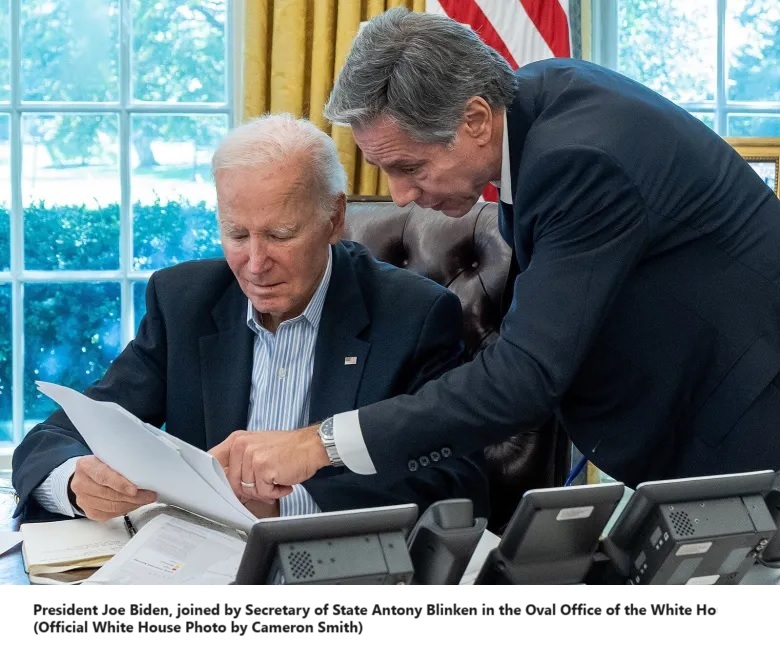
The American people voted for Trump to end the wars. Biden apparently wants to end the world.
Dennis Kucinich, Nov 20, 2024, https://denniskucinich.substack.com/p/bidens-missile-crisis
When President Biden approved the use of supersonic Army Tactical Missile Systems (ATACMS) to strike Russia, he placed in jeopardy the national security of the United States, the safety of our troops abroad and violated the U.S. Constitution, Article I, Section 8, which provides that only Congress can declare war.
Biden has made a decision to insert the U.S. into an unambiguous, escalatory phase, using the territory of Ukraine to attack Russia directly with missiles which can reach 190 miles deep. This is an illegal act by the President which puts our nation on a path to war with Russia.
The American people voted for Trump to end the wars. Biden apparently wants to end the world. Trump is listening to the American people. Biden is listening to NATO’s malignant agenda.
Trump has put America’s interests for peace and prosperity first.
No President has the right to use unilateral executive authority to permit a U.S. missile strike against another nation. It invites a retaliatory attack. It is an impeachable offense.
Congress, as a co-equal branch of government, must act now:
Any Member of Congress can, under privileges of the House, ask for immediate consideration of a joint resolution which invokes Article I, Section 8, and then cuts off all funding for personnel, coordination, technical advisers, materiel, equipment and deployment of ATACMS and emplacement of any other offensive missile systems in Ukraine.
The specter of WWIII has loomed before, in October of 1962, when the Soviet Union used the territory of Cuba to place offensive missiles just 90 miles away from the American mainland.
Absent the wisdom of President Kennedy and the forbearance of Nikita Krushchev, the world was on a path to nuclear annihilation.
If Krushchev had “permitted” Russian missiles to be launched at the U.S. from Cuba, you would not be reading this.
It is magical thinking that U.S. missiles can be used to attack Russia without consequences. Now it is Putin who must exercise forbearance.
North Korea has reportedly sent a detachment to assist Russia. Once the North Koreans learn the Russian language and vice versa, military cooperation will be instructive. That some in the Biden Administration use this occurrence as a bogus excuse to aim U.S. missiles at Russia, shows the neocon/neolieral addiction to war has become a tragicomic death wish.
Western vainglorious cynicism, together with hundreds of billions of dollars for weapons, shoved Ukraine into an unwinnable conflict. Russia is not NATO’s footstool, but its undoing.
The Putin-as-Hitler narrative projected in the media accelerated fear, induced acquiescence and rallied Western support for what was essentially a long-standing war scam by the military-industrial-intelligence complex. The alchemy which turned man into monster turned blood into cash.
Kiev has already paid a horrible price for being a US/NATO proxy: the loss of the flower of its youth, the destruction of its beautiful cities, the spoilation of its fertile farmland, and the sacrifice of its sovereignty.
Now, as U.S. missiles rain down on Russia, a counterstrike will occur, spreading ever wider the misery which has enveloped Ukraine.
The Biden Administration, in the face of the Afghanistan withdrawal debacle, rejected a Ukrainian-Russian diplomatic settlement more than two years ago, and continued financing the war for domestic political reasons, giving Americans a false hope for victory over Russia.
Two weeks ago, the people of the United States voted to stop the endless wars and elected Donald Trump.
Two months to go before the January 20, 2025 Inauguration and Joe Biden has handed Donald Trump a poisoned presidential chalice. Trump knows better than to drink from it.
What would Iran do: A race to the bomb or a deal with Trump?
A proposed censure of Iran for its lack of cooperation with the UN nuclear watchdog
raises important questions at a critical time after Donald Trump’s
reelection when Tehran faces regional weakness, economic pressure and
Israel.
The planned censure is likely going through despite Tehran offering
to cap its highly enriched uranium stock. France, Britain, Germany, and the
United States will introduce the resolution at Wednesday’s meeting of the
International Atomic Energy Agency (IAEA) Board of Governors despite, Iran
International has learned.
Iran and nuclear experts agree on one thing:
Trump’s return to the White House will have an impact on the Islamic
Republic, but whether and how the incoming administration and the Islamic
Republic may engage on the nuclear issue is up for debate.
Iran International 20th Nov 2024,
https://www.iranintl.com/en/202411203852
Iran has offered to keep uranium below purity levels for a bomb, IAEA confirms
Patrick Wintour Diplomatic editor, mhttps://www.theguardian.com/world/2024/nov/20/iran-has-offered-to-keep-uranium-below-purity-levels-for-a-bomb-iaea-confirms
UN inspectorate chief calls Tehran’s move a ‘concrete step in the right direction’, amid threat of restored sanctions.
Iran has offered to keep its stock of uranium enriched up to 60% – below the purity levels required to make a nuclear bomb – the head of the UN nuclear inspectorate, Rafael Grossi, has confirmed amid the threat of restored European sanctions over Tehran’s nuclear activities.
“I think this is … a concrete step in the right direction. We have a fact which has been verified by us. It is the first time Iran has agreed to take a different path,” Grossi said in Vienna on Tuesday.
The move negotiated by Grossi with Iranian officials, including the president, Masoud Pezeshkian, on a visit to Tehran last week is designed to head off a move at the IAEA board this week by European diplomats to request a comprehensive report on Iranian compliance that could lead to the snapback of UN sanctions. The agreement covering Iran’s nuclear activities formally expires in September, 10 years after it was negotiated in 2015.
A snapback would involve the reimposition of security council sanctions from earlier resolutions on Iran in the event of “significant non-performance” of Iran’s commitments under the nuclear deal.
“I went last week and I got something, and by moving step by step and getting concrete results the trajectory may be less confrontational,” Grossi said.
Iran’s foreign minister, Abbas Araghchi, has however hinted that the Iranian offer of a cap on enrichment might be withdrawn if the European powers – France, Germany and the UK – insist on commissioning the report. Grossi said he had spoken to Araghchi on Tuesday night but there had been no Iranian threat or warning during the conversation.
Araghchi said in a statement: “If the other parties ignore Iran’s goodwill and interactive approach and put non-constructive measures on the agenda at the meeting of the governing council through the issuance of a resolution, Iran will respond appropriately and proportionately.”
He said the offer to freeze the stockpile was a sign of goodwill, but the European powers are likely to regard the Iranian offer to cap the 60% stockpile as less groundbreaking than either Grossi or the Iranians do. Grossi clearly believes it is a sign of constructive progress after nearly two years of impasse.
He added that four new, experienced nuclear inspectors were being allowed into Iran.
European powers are worried both by Iran’s continued refusal to give IAEA inspectors access to its nuclear sites, and also by the steady increase in its stockpile of nearly weapons-grade uranium. The strikes and counter-strikes between Israel and Iran this year has led to a growing debate inside Iran whether it should drop the fatwa on producing a nuclear weapon, with some Iranian officials claiming they had already mastered most of the techniques necessary to do so. Iran has always claimed that its nuclear work is solely for peaceful civilian purposes.
Israel and the US have both said they will not allow Iran to acquire a nuclear weapon, but the incoming Trump administration has so far put the emphasis on tightening economic sanctions against Iran rather than a military attack on Iran’s nuclear sites.
In its latest report to the IAEA board, the IAEA said Iran’s stockpile of 60% enriched uranium had increased by 17.6kg to 182.3kg (402lbs). Assuming no change, that means Trump would enter office in January with Iran having enough nuclear fuel for four atomic bombs. It would take Iran just a few days to convert the 60% material into weapons-grade material.
Australian government gives firm ‘no’ to joining UK-US agreement to advance nuclear technology

The Conversation, November 19, 2024, Michelle Grattan, Professorial Fellow, University of Canberra
The Albanese government has been put on the spot by a new agreement – which it has declined to join – signed by the United Kingdom and the United States to speed up the deployment of “cutting edge” nuclear technology.
The original version of the British government’s press release announcing the agreement said Australia, among a number of other countries, was expected to sign it.
But the reference was removed from the statement.
The UK Energy Secretary Ed Miliband and the US deputy Secretary of Energy David Turk signed the agreement in Baku during COP29…….
A spokesperson for Energy Minister Chris Bowen, who is at the COP meeting, said: “Australia is not signing this agreement as we do not have a nuclear energy industry.
“We recognise that some countries may choose to use nuclear energy, depending on national circumstances.
“Our international partners understand that Australia’s abundance of renewable energy resources makes nuclear power, including nuclear power through small modular reactors, an unviable option for inclusion in our energy mix for decarbonisation efforts.”
Australia would remain as observers to the agreement to continue to support its scientists in other nuclear research fields, the spokesperson said………
In parliament, acting Prime Minister Richard Marles said for Australia to pursue a path of nuclear energy would add $1200 to the bills of each household in this country.
………………………Update: UK government seeks to clear things up
Later The Guardian reportred: “The UK government has conceded it made a mistake in including Australia in a list of countries that has signed up to a US-UK civil nuclear deal”. https://theconversation.com/albanese-government-gives-firm-no-to-joining-uk-us-agreement-to-advance-nuclear-technology-244041
Somerset church would ‘become’ island if ‘ham-fisted’ Hinkley saltmarsh plans go-ahead
Sunday 17th November
Somerset church would ‘become’ island if ‘ham-fisted’ Hinkley saltmarsh
plans go-ahead. Steve Bridger (Yatton, Independent), a local councillor for
the village on North Somerset Council, told a full meeting of the council
on November 12 that the plan was “ham-fisted.”
He said: “Landowners
who would be directly impacted by the proposals were sent letters in
September, completely out of the blue, with a rather threatening tone
talking about compulsory purchase of their land.” When Somerset’s new
nuclear power station was granted planning permission, it was told to
install speakers to scare off fish from getting sucked into its cooling
systems.
But EDF now says this would be “dangerous to install,” and
wants to compensate for the 44 tonnes of fish expected to die each year by
creating 340 hectares of saltmarsh along the Severn. Peter Burden
(Portishead South, Conservative) told the council chamber: “It is crazy,
chairman, to destroy habitat to mitigate for killing fish.”
West Somerset Free Press 17th Nov 2024, https://www.wsfp.co.uk/news/somerset-church-would-become-island-if-ham-fisted-hinkley-saltmarsh-plans-go-ahead-739509
Great British Nuclear to put £1.8bn worth of mini-nuke contracts up for grabs

Successful bidders will work with winners of delayed SMR design
competition. Nearly £2bn worth of construction contracts for Britain’s
first mini-nuclear power plants will be up for grabs next year as officials
prepare sites for the pioneering energy projects.
Great British Nuclear(GBN), the government body tasked with spearheading the development of small modular reactors (SMRs), expects to put the work out for tender
between February and July 2025, according to official documents.
The biggest jobs available will be at least two £800m “delivery partner”
contracts to manage the construction of the SMRs over a period of 10 years.
Smaller contracts for an “owner’s engineer”, “foundation project
management” and “foundation engineering” will also be open to
bidding.
They will work with technology companies designing the reactors
which will be selected in GBN’s ongoing SMR design competition, which has
been delayed multiple times.
Telegraph 18th Nov 2024 https://www.telegraph.co.uk/business/2024/11/18/great-british-nuclear-to-put-18bn-worth-mini-nuke-contracts/
Nuclear reactor cooling systems threatened by global heating.

Believing that waterways used as cooling sources for nuclear power plants
could get warmer due to climate change, climate scientists and nuclear
engineering specialists at the US Department of Energy’s Argonne National
Laboratory are joining forces to develop a plan B for nuclear power in
Richland, Washington.
The plan is to use Gateway for Accelerated Innovation
in Nuclear (GAIN) funding from DOE to work with Energy Northwest to inform
the design and selection of future nuclear reactor cooling systems and
assess their impacts on electricity cost.
NS Energy 20th Nov 2024, https://www.nsenergybusiness.com/analysis/determining-optimal-configurations-for-nuclear-plants-and-advanced-reactors-in-local-climates/
The 1.5C Climate Goal Is Dead. Why Is COP29 Still Talking About It?

The battle to keep global warming within 1.5 degrees Celsius has been a
rallying cry for climate action for nearly a decade. Now, with the planet
almost certain to blow past the target, diplomats and campaigners at the
COP29 summit have found themselves awkwardly clinging to a goal that no
longer makes sense.
The evidence has become harder and harder to ignore.
This year will once again be the hottest on record as greenhouse gas
emissions continue to soar and Earth will likely register an average
reading of 1.5C above pre-industrial levels for the first time.
A study released this month using a new technique for measuring the rise in
temperatures suggests the world was already 1.49C hotter at the end of
2023.
“1.5C has been deader than a doornail” for a while now, said Zeke
Hausfather, a climate scientist at Berkeley Earth. Many of his peers agree.
The United Nations has concluded that the world is on track to warm roughly
3.1C before the end of the century if nothing changes. That report was
released just before representatives from nearly 200 countries gathered in
Baku, Azerbaijan for the UN’s annual global climate conference, where
they have been mired in bitter negotiations over how to raise money to help
developing nations combat global warming.
Bloomberg 18th Nov 2024, https://www.bloomberg.com/news/features/2024-11-18/cop29-what-does-1-5c-s-failure-mean-for-climate-negotiations
Beyond one million years: The intrinsic radiation hazard of high-level nuclear wastes

This paper highlights the absence of quantitative estimates
regarding the intrinsic radiation hazard of high-level nuclear wastes,
namely, spent fuel (SF) and vitrified high-level wastes (VHLW), for periods
exceeding one million years.
Using available data, conducting scoping
calculations of radiation doses, and comparing the results to radiation
protection guidelines and natural background radiation, this paper shows
that high-level wastes cannot be safely handled or left unprotected
essentially indefinitely.
By quantitatively evaluating the dose rates of
unshielded SF and VHLW, this study identifies critical new insights, such
as the roles of the Np-237 decay chain; the eventual, long-term dominance
of the U-238 decay chain; and the interplay of three actinide decay chains,
including the significant role of Bi-214.
These findings fill a gap in the literature and emphasize the need for more detailed investigations in this as-yet-unexplored research area, which has a direct bearing on technical and societal decision-making for both waste disposal safety and the choice
of the back end of the nuclear fuel cycle.
Nukleonik 24th Sept 2024 http://www.nukleonika.pl/www/back/full/vol69_2024/v69n4p215f.pdf
High-Precision, Long-Range NATO Missiles Against Russia: Why Now?

Joe Quinn, Sott.net, Wed, 20 Nov 2024, https://www.sott.net/article/496207-High-Precision-Long-Range-NATO-Missiles-Against-Russia-Why-Now
Russia announced a change to its nuclear doctrine several months ago, where it can now respond with nuclear weapons to a non-nuclear attack on Russia by an enemy, either directly from enemy territory or from the territory of a third party. A notable caveat however is that such a response would only occur in the event that the attack “threatened the very existence of the Russian state”.
The changes were officially signed into law yesterday with the wording relevant to the conflict in Ukraine being “where the aggression creates a critical threat for the sovereignty and/or territorial integrity [of Belarus or the Russian Federation].
In this context, the Russians have also said that the use of nuclear weapons would also be permissible if an enemy attacked Russian forces in the context of the SMO in a way that definitively threatened the achievement of the objectives of the SMO.
In Sept. Putin said that NATO’s plan to allow Ukraine to use longer range Western precision weapons against Russian targets inside Russia would be evidence of direct NATO involvement in a war against Russia. And that Russia would respond appropriately.
Three days ago, “Biden” approved the use of longer range Western precision weapons against Russian targets inside Russia.
Two days ago, Ukraine fired 5 US-made longer range Western precision weapons (supersonic ATACMS ballistic missiles) at a military base 130kms into Southern Russia. According to the Russians, all 5 missiles were shot down, with one falling on the periphery of the missile base, starting a fire but doing no material or personnel damage.
While many have interpreted this attack as fulfilling the requirements for a Russian nuclear response, that is obviously not the case, for four reasons:
1) The attack did not, in any way, threaten the very existence of the Russian state
2) The attack did not, in any way, threaten the achievement of the objectives of the SMO.
3) The Biden admin has less than 2 months left in power.
4) Trump and his incoming team have made no secret of their intention to negotiate a near-future settlement to end the war in Ukraine.
What then, at this late stage, was the point in the ‘Biden’ admin authorizing the use of long range precision weapons against Russia and why do EU leaders continue to make repeated reference to EU citizens needing to prepare for a potential “war with Russia” and sending EU/NATO military forces to Ukraine, if there’s a reasonable chance of a peaceful settlement of the conflict under the Trump admin?
The problem is how any ‘settlement’ would play out.
First (see map) Russia will not settle for anything less than the four regions it has already incorporated into its territory (including the “demilitarization and denazification of Ukraine”). In addition, a demilitarized buffer zone (of some distance) would be necessary extending out from these regions and away from the Russian and Belarusian borders to the North.
NATO and EU nations would, undoubtedly, insist on militarily occupying (“peacekeepers”) the rest of Ukraine beyond these zones, but such a presence would create an uneasy, and potentially dangerous, peace for some time to come. Hence the talk of sending their military forces to Ukraine and possible/eventual ‘war with Russia’.
Of note in this respect is yesterday’s announcement that the ‘Biden’ admin will begin sending anti-personnel landmines to Ukraine to “blunt the advancement of Russian troops”. Interestingly, the mines are said to be “nonpersistent” design, meaning they become inactive within weeks of deployment. Why now? Russian troops have been advancing, in one form or another, for most of the war. Why would NATO/Ukraine want to deploy anti-personnel mines that last for only a few weeks?
Much like the use of precision long-range weapons, the use of “non-persistent” anti-personnel mines now is more likely to be part of a strategy for a negotiation settlement, than to effect any significant change on the current battlefield.
The point of authorizing (and using) both NATO long range precision weapons against Russia and anti-personnel mines now is in preparation for expected negotiations after Jan 6th.
By using these weapons and calling Russia’s ‘nuclear bluff’, (while also being careful not to push too far) NATO expects that Russia will be forced to accept them as a de facto (rather than theoretical) part of Ukraine/NATO’s arsenal against Russia, and thereby provide NATO with a more favorable basis for negotiations.
Seeds of Resistance – Reviving the Peace Movement in the Age of Trump
William Hartung, 17 Nov 24, https://tomdispatch.com/seeds-of-resistance/
—
When the election results came in on November 5th, I felt a pain in the pit of my stomach, similar to what I experienced when Ronald Reagan rode to power in 1980, or with George W. Bush’s tainted victory over Al Gore in 2000. After some grieving, the first question that came to my mind was: What will a Trump presidency mean for the movements for peace and social justice? I offer what follows as just one person’s view, knowing that a genuine strategy for coping in this new era will have to be a distinctly collective process.
As a start, history offers some inspiration. On issues of war and peace, the trajectory of the Reagan administration suggests how surprising hope can prove to be. The man who joked that “we begin bombing [Russia] in five minutes,” and hired a Pentagon official who told journalist Robert Scheer that America would survive a nuclear war if it had “enough shovels” to build makeshift shelters, ended up claiming that “a nuclear war cannot be won and must never be fought.” He even came tantalizingly close to an agreement with Soviet leader Mikhail Gorbachev to abolish nuclear weapons altogether.
To his credit, Reagan developed a visceral opposition to such weaponry, while his wife, Nancy, urged him to reduce nuclear weapons as a way to burnish his legacy. A Washington Post account of her role noted that “[s]he made no secret of her dream that a man once branded as a cowboy and a jingoist might even win the Nobel Peace Prize.” Such personal factors did come into play, but the primary driver of Reagan’s change of heart was the same thing that undergirds so many significant changes in public policy — dedicated organizing and public pressure.
Reagan’s presidency coincided with the rise of the largest, most mainstream anti-nuclear movement in American history, the nuclear freeze campaign.
Along the way, in June 1982, one million people rallied for disarmament in New York’s Central Park. And that movement had an impact. As Reagan National Security Advisor Robert MacFarlane pointed out at the time, “We took it [the freeze campaign] as a serious movement that could undermine congressional support for the [nuclear] modernization program, and potentially… a serious partisan political threat that could affect the election in `84.”
Reagan’s response was twofold. He proposed a technical solution, pledging to build an impenetrable shield against incoming missiles called the Strategic Defense Initiative (more popularly known as the Star Wars program). That impenetrable shield never came to be, but the quest to develop it deposited tens of billions of dollars in the coffers of major weapons contractors like Lockheed and Raytheon.
The second prong of Reagan’s response was a series of nuclear arms control proposals, welcomed by reformist Soviet leader Mikhail Gorbachev, including a discussion of the possibility of eliminating the two sides’ nuclear arsenals altogether. The idea of abolishing nuclear weapons didn’t come to fruition, but the Reagan administration and its successor, that of George H.W. Bush, did at least end up implementing substantial cuts to the American nuclear arsenal.
So, in a few short years, Reagan, the nuclear hawk, was transformed into Reagan, the arms-control-supporter, largely due to concerted public pressure. All of which goes to show that organizing does matter and that, given enough political will and public engagement, dark times can be turned around.
Trump at Peace (and War)
Donald Trump is nothing if not a top-flight marketeer — a walking, talking brand. And his brand is as a tough guy and a deal maker, even if the only time he’s truly lived up to that image was as an imaginary businessman on television.
But because Trump, lacking a fixed ideology — unless you count narcissism — is largely transactional, his positions on war and peace remain remarkably unpredictable. His first run for office was marked by his relentless criticism of the 2003 invasion of Iraq, a rhetorical weapon he deployed with great skill against both Jeb Bush and Hillary Clinton. That he failed to oppose the war when it mattered — during the conflict — didn’t change the fact that many of his supporters thought of him as the anti-interventionist candidate.
To his credit, Trump didn’t add any major boots-on-the-ground conflicts to the conflicts he inherited. But he did serious damage as an arms dealer, staunchly supporting Saudi Arabia’s brutal war in Yemen, even after that regime murdered U.S.-resident and Saudi journalist Jamal Khashoggi. In a statement after the murder, Trump bluntly said that he didn’t want to cut off arms to the Saudi regime because it would take business away from “Boeing, Lockheed Martin, Raytheon, and many other great U.S. defense contractors.”
Trump also did great damage to the architecture of international arms control by withdrawing from a treaty with Russia on intermediate-range nuclear forces and the Iran nuclear deal, known formally as the Joint Comprehensive Plan of Action. If those agreements were still in place, the risks posed by the current conflicts in Ukraine and the Middle East would be lower, and they might have served as building blocks in efforts to step back from such conflicts and return to a world of greater cooperation.
But there is another side to Trump, too. There’s the figure who periodically trashes the big weapons makers and their allies as greedy predators trying to line their own pockets at taxpayer expense. For example, in a September speech in Wisconsin, after a long rant about how he was being unfairly treated by the legal system, Trump announced that “I will expel warmongers. We have these people, they want to go to war all the time. You know why? Missiles are $2 million apiece. That’s why. They love to drop missiles all over the place.” And then he added, referring to his previous presidency, “I had no wars.” If past practice is any indication, Trump will not follow through on such a pledge. But the fact that he felt compelled to say it is at least instructive. There is clearly a portion of Trump’s base that’s tired of endless wars and skeptical of the machinations of the nation’s major defense contractors.
Trump has also said that he will end the war in Ukraine on day one. If so, it may be the peace of the graveyard, in the sense that he’ll cut off all U.S. support for Ukraine and let Russia roll over them. But his support for peace in Ukraine, if one can call it that, is not replicated in his other strategic views, which include a confrontational stance towards China, a pledge to further militarize the U.S.-Mexican border, and a call for Benjamin Netanyahu to “finish the job” in Gaza.
The last thing to consider in assessing what Trump’s military policies might look like is his administration’s close association with the most unhinged representatives of Silicon Valley’s military tech surge. For instance, Peter Thiel, founder of the emerging military tech firm Palantir, gave J.D. Vance, Trump’s vice president, a job at one of his companies and later donated large sums to his successful run for the Senate from Ohio. The new-age militarists of Silicon Valley loudly applauded the choice of Vance, whom they see as their man in the White House.
All of this adds up to what might be thought of as the Trump conundrum when it comes to war and peace and, to deal with it, a peace movement is truly needed.
Peace Resistance
For any peace movement, figuring out how to approach Trump will be like shadow boxing — trying to imagine what position he’s likely to take next.
The biggest problem in working for peace under a Trump presidency may involve whether groups are even allowed to organize without facing systematic government repression. After all, in the past, Trump has labeled his opponents with the Hitlerian-style insult “vermin” and threatened to jail any number of those he’s designated as his enemies.
Of course, the first job of any future peace movement (which would have applied as well had the Democrats taken the White House) will simply be to grow into a viable political force in such a difficult political climate.
The best way forward would undoubtedly be to knit together a coalition of organizations already opposing some aspect of American militarism — from the Gaza ceasefire movement and antinuclear groups to unions seeking to reduce the roles their members play in arms production, progressive veterans, big-tent organizations like the Poor People’s Campaign, groups opposed to the militarization of the Mexican border, organizations against the further militarization of the police, and climate activists concerned with the Pentagon’s striking role in pouring greenhouse gasses into our atmosphere. A coordinated effort by such movements could generate real political clout, even if it didn’t involve forming a new mega-organization. Rather, it could be a flexible, resilient network capable of focusing its power on issues of mutual concern at key moments. Such a network would, however, require a deeper kind of relationship-building among individuals and organizations than currently exists, based on truly listening to one another’s perspectives and respecting differences on what end state we’re ultimately aiming for.
Even as peace and justice organizations paint a picture of what a better world might look like, they may be able to win some short-term reforms, including some that could even garner bipartisan mainstream support. One thing that the American roles in the ongoing wars in Ukraine and Gaza and plans to arm up for a potential conflict with China have demonstrated is that the American system for developing and purchasing weapons is, at the very least, broken. The weapons are far too costly, take too long to produce, are too complex to maintain, and are often so loaded with unnecessary bells and whistles that they never work as advertised.
A revival of something along the lines of the bipartisan military reform caucus of the 1980s, a group that included powerful Republicans like former Georgia representative Newt Gingrich, is in order. The goal would be to produce cheaper, simpler weapons that can be turned out quickly and maintained effectively. Add to that the kinds of measures for curbing price gouging, holding contractors responsible for cost overruns, and preventing arms makers from bidding up their own stock prices (as advocated relentlessly by Senator Elizabeth Warren), and a left-right coalition might be conceivable even in today’s bitterly divided Congress and the Trump era.
After all, the most hawkish of hawks shouldn’t be in favor of wasting increasingly scarce tax dollars on weapons of little value to troops in the field. And even the Pentagon has tired of the practice of letting the military services submit “wish lists” to Congress for items that didn’t make it into the department’s official budget submission. Such measures, of course, would hardly end war in our time, but they could start a necessary process of reducing the increasingly unchecked power of the Lockheed Martins and Raytheons of our world.
There are also issues that impact all progressive movements like voter suppression, money in politics, political corruption, crackdowns on free speech and the right of political assembly, and so much more that will have to be addressed for groups to work on virtually any issue of importance. So, an all-hands-on-deck approach to the coming world of Donald Trump and crew is distinctly in order.
An invigorated network for peace, justice, and human rights writ large will also need a new approach to leadership. Old-guard, largely white leaders (like me) need to make room for and elevate voices that have either been vilified or ignored in mainstream discourse all these years. Groups fighting on the front lines against oppression have already faced and survived the kinds of crackdowns that some of us fear but have yet to experience ourselves. Their knowledge will be crucial going forward. In addition, in keeping with the old adage that one should work locally but think globally, it will be important to honor and support local organizing. Groups like the Poor People’s Campaign and the progressive feminist outfit Madre have been working along such lines and can offer crucial lessons in how to link strategies of basic survival with demands for fundamental change.
Last, but not least, while such organizing activities will undoubtedly involve real risks, there must be joy in the struggle, too. I’m reminded of civil rights activists singing freedom songs in jail. My favorite of that era isn’t “We Shall Overcome” — although overcome we must — but “Ain’t Gonna Let Nobody Turn Me Round,” which includes the lyric “gonna keep on walkin’, keep on talkin’, gonna build a brand-new world.” That may seem like a distant dream in the wake of the recent elections, but it’s all the more necessary because of that.
Victory is by no means assured, but what alternative do we have other than to continue to fight for a better, more just world? To do so will call for a broad-based, courageous, creative, and committed movement of the kind that has achieved other great transformations in American history, from securing the end of slavery to a woman’s right to vote to beginning the process of giving LGBTQ people full citizenship rights.
Time is short, when it comes to the state of this planet and war, but success is still possible if we act with what Martin Luther King, Jr., once called “the fierce urgency of now.”
1 This Month
22 June – Virtual Event –Climate Change: New Data, New Debate
Monday, June 22, 2026 2:30 p.m. – 3:15 p.m. CT
YouTube. Register here

Protect Sazan Island from the Trump family! https://secure.avaaz.org/campaign/en/protect_sazan_island_from_the_trump_family_loc/?bqFCVab&v=174511&cl=22707147157&_checksum=5e9dde668860e8231c33699735e16a1fbf22ab2cb01da50c999fe8732b9775ef&utm_source=email&utm_medium=blast_email&utm_campaign=174511
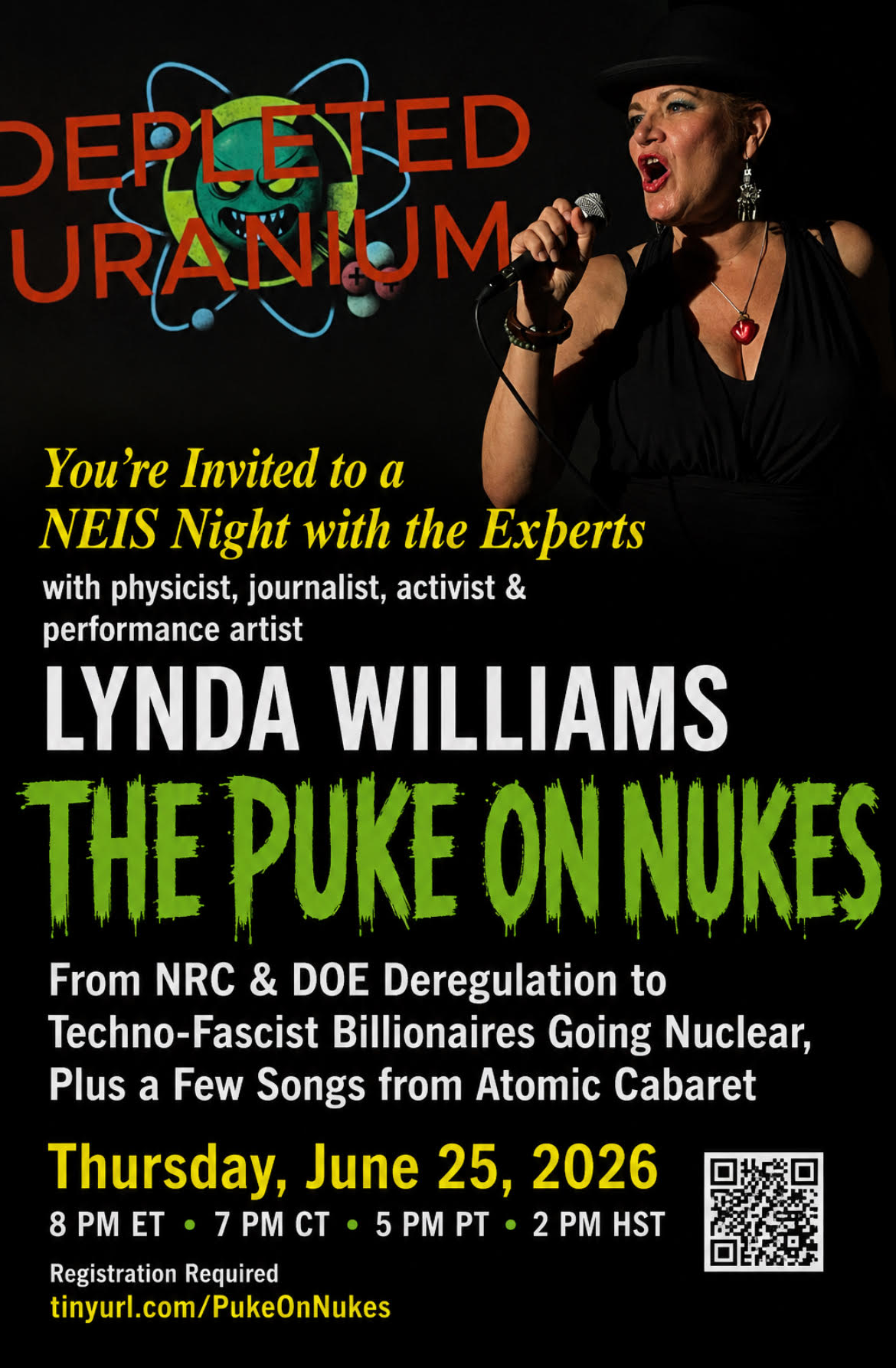
25 June- THE PUKE ON NUKES
Thursday, June 25, 2026
7pm Central Time (8pm ET, 6pm MT, 5pm PT) UTC – 5
From NRC & DOE Deregulation to Techno-Fascist Billionaires Going Nuclear, Plus a Few Songs from Atomic Cabaret REGISTER
26 June – Radiation Trainwreck at the NRC / Join the Protect Better Campaign – https://us02web.zoom.us/meeting/register/4ZlZ5_qLSHGiLSCg8FF6Bg#/registration


Cuba Is Not a Failed State – It Is a Besieged State
PETITION: “Global Appeal to Endorse Palestinian Right of Return of Refugees”
To see nuclear-related stories in greater depth and intensity – go to https://nuclearinformation.wordpress.com
-
Archives
- June 2026 (193)
- May 2026 (306)
- April 2026 (356)
- March 2026 (251)
- February 2026 (268)
- January 2026 (308)
- December 2025 (358)
- November 2025 (359)
- October 2025 (376)
- September 2025 (257)
- August 2025 (319)
- July 2025 (230)
-
Categories
- 1
- 1 NUCLEAR ISSUES
- business and costs
- climate change
- culture and arts
- ENERGY
- environment
- health
- history
- indigenous issues
- Legal
- marketing of nuclear
- media
- opposition to nuclear
- PERSONAL STORIES
- politics
- politics international
- Religion and ethics
- safety
- secrets,lies and civil liberties
- spinbuster
- technology
- Uranium
- wastes
- weapons and war
- Women
- 2 WORLD
- ACTION
- AFRICA
- Atrocities
- AUSTRALIA
- Christina's notes
- Christina's themes
- culture and arts
- Events
- Fuk 2022
- Fuk 2023
- Fukushima 2017
- Fukushima 2018
- fukushima 2019
- Fukushima 2020
- Fukushima 2021
- general
- global warming
- Humour (God we need it)
- Nuclear
- RARE EARTHS
- Reference
- resources – print
- Resources -audiovicual
- Weekly Newsletter
- World
- World Nuclear
- YouTube
-
RSS
Entries RSS
Comments RSS
 nuclear-news