Small nuclear reactors are no fix for California’s energy needs

I know all too well that the hype is built on quicksand …….. many of those “building support for small modular reactors” are putting forward “rhetorical visions imbued with elements of fantasy.”
SMRs are just one of several wildly overhyped false promises on which the world is poised to spend hundreds of billions of dollars by 2040
Joseph Romm, April 18, 2025 , https://www.latimes.com/opinion/story/2025-04-18/small-modular-reactors-cost-california
It might seem like everyone from venture capitalists to the news media to the U.S. secretary of Energy has been hyping small modular reactors as the key to unlocking a nuclear renaissance and solving both climate change and modern data centers’ ravenous need for power.
On Monday, the Natural Resources Committee of the California Assembly will consider a bill to repeal a longstanding moratorium on nuclear plants in the state, which was meant to be in place until there is a sustainable plan for what to do with radioactive waste. Defeated multiple times in the past, this bill would carve out an exception for small modular reactors, or SMRs, the current pipe dream of nuclear advocates.
SMRs are typically under 300 megawatts, compared with the combined 2.2 gigawatts from Diablo Canyon’s two operating reactors near San Luis Obispo. These smaller nukes have received so much attention in recent years mainly because modern reactors are so costly that the U.S. and Europe have all but stopped building any.

The sad truth is that small reactors make even less sense than big ones. And Trump’s tariffs only make the math more discouraging.
I’ve been analyzing nuclear power since 1993, when I started a five-year stint at the Department of Energy as a special assistant to the deputy secretary. I helped him oversee both the nuclear energy program and the energy efficiency and renewable energy program, which I ran in 1997.
So I know all too well that the hype is built on quicksand — specifically, a seven-decade history of failure. As a 2015 analysis put it, “Economics killed small nuclear power plants in the past — and probably will keep doing so.” A 2014 journal article concluded many of those “building support for small modular reactors” are putting forward “rhetorical visions imbued with elements of fantasy.”
But isn’t there a nuclear renaissance going on? Nope. Georgia’s Vogtle plant is the only new nuclear plant the U.S. has successfully built and started in recent decades. The total cost was $35 billion, or about $16 million per megawatt of generating capacity — far more than methane (natural gas) or solar and wind with battery storage.
As such, Vogtle is “the most expensive power plant ever built on Earth,” with an “astoundingly high” estimated electricity cost, noted Power magazine. Georgia ratepayers each paid $1,000 to support this plant before they even got any power, and now their bills are rising more than $200 annually.
The high cost of construction and the resulting high energy bills explain why nuclear’s share of global power peaked at 17% in the mid-1990s but was down to 9.1% in 2024.
For decades, economies of scale drove reactors to grow beyond 1,000 megawatts. The idea that abandoning this logic would lead to a lower cost per megawatt is magical thinking, defying technical plausibility, historical reality and common sense.
Even a September report from the federal Department of Energy — which funds SMR development — modeled a cost per megawatt more than 50% higher than for large reactors. That’s why there are only three operating SMRs: one in China, with a 300% cost overrun, and two in Russia, with a 400% overrun. In March, a Financial Times analysis labeled such small reactors “the most expensive energy source.”

Indeed, the first SMR the U.S. tried to build — by NuScale — was canceled in 2023 after its cost soared past $20 million per megawatt, higher than Vogtle. In 2024, Bill Gates told CBS the full cost of his 375-megawatt Natrium reactor would be “close to $10 billion,” making its cost nearly $30 million per megawatt — almost twice Vogtle’s.
All of this has played out against a backdrop of historically cheap natural gas and a rapid expansion of renewable energy sources for electricity generation. All that competition against nuclear power matters: A 2023 Columbia University report concluded that “if the costs of new nuclear end up being much higher” than $6.2 million per megawatt, “new nuclear appears unlikely to play much of a role, if any, in the U.S. power sector.” R.I.P.
SMRs are just one of several wildly overhyped false promises on which the world is poised to spend hundreds of billions of dollars by 2040, including hydrogen energy and direct air carbon capture.
But nuclear power is the original overhyped energy technology. When he was chairman of the Atomic Energy Commission, Lewis Strauss — the Robert Downey Jr. character in “Oppenheimer” — predicted in 1954 that our children would enjoy nuclear power “too cheap to meter.”
Yet by the time I joined the Department of Energy in 1993, nuclear power costs had grown steadily for decades. Since then, prices for new reactors have kept rising, and they are now the most expensive power source. But solar, wind and battery prices have kept dropping, becoming the cheapest. Indeed, those three technologies constitute a remarkable 93% of planned U.S. utility-scale electric-generating capacity additions in 2025. The rest is natural gas.
China is the only country building many new nuclear plants over the next five years — about 35 gigawatts. Less than 1% of this projected capacity would be from small reactors — while more than 95% will be from reactors over 1,100 megawatts. Now compare all that to the 350 gigawatts of solar and wind China built — just in 2024.
For the U.S., President Trump’s erratic tariffs make small modular reactors an even riskier bet. If the U.S. economy shrinks, so does demand for new electric power plants. And the twin threats of inflation and higher interest rates increase the risk of even worse construction cost overruns.
Also, China, Canada and other trading partners provide critical supply chain elements needed to mass-produce SMRs — and mass production is key to the sales pitch claiming this technology could become affordable. That logic would apply only if virtually all of the current SMR ventures fail and only one or two end up pursuing mass production.
So, can we please stop talking about small modular reactors as a solution to our power needs and get back to building the real solutions — wind, solar and batteries? They’re cheaper and cleaner — and actually modular.
Joseph Romm is a former acting assistant secretary of Energy and the author of “The Hype About Hydrogen: False Promises and Real Solutions in the Race to Save the Climate.”
Murder in Broad Daylight :REPORTING FROM THE CLIMATE WAR ZONE

April 16, 2025, by Radio Ecoshock [ includes audio]
Killer summer heat in Spring? Don’t worry. Donald Trump shoots the messengers. Closing down climate in NASA and NOAA, the news from Paul Voosen at the American Academy. The voice of Canadian weather and science David Phillips helps process the news. Plus a quick replay from Arjit Varki: denial as a basic function in the human mind.
Summer is two months early in Central Asia. The first 11 days in Turkmenistan, Uzbekistan, and Kazakhstan were all above 30 degrees C or 86 Fahrenheit. Just listen to the harsh heat wave hitting India’s capital Delhi and it’s 33 million people. Delhi has been over 40 degrees C (104 F) three days this month. The summer heat is yet to come!
Still don’t care? How about the first 100 degree day in Phoenix, already – a month earlier than usual. That’s a Spring heat wave over the whole U.S. Southwest.
No matter what weather you experienced, according to the Copernicus Climate Change Service and US NOAA, the world had the warmest January ever recorded. It was 1.75 degrees C above the pre-industrial level. Eighteen of the last nineteen months were over the alleged 1.5 degree safety line for climate change. We get the hottest months ever recorded on this planet, despite the La Nina conditions which normally cool things down. This is over-the-limit super heat.
Donald Trump got elected promising cheap gas at the pumps. He would turn the USA into an energy super-power. Off with protections and National Parks. Drill by the beaches, frack by the schools, do whatever you want. Because they are firing the regulators, scientists and the prosecutors who enforce anything related to pollution, the protection of nature, or climate change.
The Artificial Intelligence bro’s are scanning all government data to find anything related to climate change. They want to delete all that and fire the scientists who generate data on climate. Or just fire scientists generally. Who needs those egg-heads?
We need funeral music. The end of climate science in America is nigh. That’s not a fringe worry anymore, it is happening in real time.
REPORTING FROM THE CLIMATE WAR ZONE
Paul Voosen
Paul Voosen holds a master’s in science journalism from Columbia University. On April 11th, he filed this story at science.org, the publication of the American Association for the Advancement of Science. The title is: “Trump seeks to end climate research at premier U.S. climate agency – White House aims to end NOAA’s research office; NASA also targeted.”
I’m just going to pass this on, quoting from Voosen’s article:
“President Donald Trump’s administration is seeking to end nearly all of the climate research conducted by the U.S. National Oceanic and Atmospheric Agency (NOAA), one of the country’s premier climate science agencies, according to an internal budget document seen by Science. The document indicates the White House is ready to ask Congress to eliminate NOAA’s climate research centers and cut hundreds of federal and academic climate scientists who track and study human-driven global warming.
The administration is also preparing to ask for deep cuts to NASA’s science programs, according to media reports today.
The administration’s plan would “eliminate all funding for climate, weather, and ocean laboratories and cooperative institutes,” says the document, which reflects discussions between NOAA and the White House Office of Management and Budget (OMB) about the agency’s 2026 budget request. Currently, NOAA operates 10 research labs around the country. They include influential ocean research centers in Florida and Washington state; five atmospheric science labs in Boulder, Colorado, and Maryland; and a severe storm lab in Oklahoma. It also operates the Geophysical Fluid Dynamics Laboratory in New Jersey, the birthplace of weather and climate modeling, as well as a lab in Michigan devoted to the Great Lakes. The agency further funds cooperative institutes, which support a large collection of academic scientists who work closely with the NOAA labs.
The proposal would cut NOAA’s competitive climate research grants program, which awards roughly $70 million a year to academic scientists. It would end support for collecting regional climate data and information, often used by farmers and other industries. And it would terminate the agency’s National Oceanographic Partnership Program and college and aquaculture sea grant programs, which support a host of research efforts.
NOAA officials still have time to persuade OMB to alter the request, but NOAA sources said it is unlikely to substantially change. But this proposal is only the first stage of the budget process; Congress will have the final word in setting NOAA’s spending.
At NASA, science programs also face severe cuts, according to details first reported by Ars Technica. The White House is considering requesting a nearly 50% cut to NASA science’s office, down to an overall budget of $3.9 billion. According to Ars Technica, the plan calls for: “a two-thirds cut to astrophysics, down to $487 million; a greater than two-thirds cut to heliophysics, down to $455 million; a greater than 50 percent cut to Earth science, down to $1.033 billion; and a 30 percent cut to Planetary science, down to $1.929 billion.”
Such NASA cuts would require ending the operations of a huge host of earth science satellites. They could also result in the closure of NASA’s Goddard Space Flight Center in Maryland, which has thousands of employees and is one of the agency’s premier centers for earth science research. The cuts would also end plans for Mars Sample Return, the DAVINCI mission to Venus, and the Nancy Grace Roman Space Telescope, which is almost fully assembled.“
That is from Paul Voosen at science.org, with work from Eric Berger’s report April 11 at arstechnica.com on the NASA cuts.
Close the Goddard Space Flight Center? Forget new earth science satellites? Fire the biggest and possibly best climate science teams in the world? All this is deeply wrong.
IS IT THE FALL OF EMPIRE?
In the year 410, the Christian Father Saint Augustine kept a diary of his times. The German tribes known as “the Vandals” were storming across North Africa. They surrounded his ancient city of Carthage. Then he received impossible news: Rome itself was sacked. Augustine forsaw the ancient institutions of learning, government, and the arts crumbling away, leading to a long period now called “The Dark Ages”.
Are we there yet? I don’t think so. But we can smell burning institutions in America, once a light of Democracy for the world. Big name universities like Harvard, Princeton and Columbia are being defunded and told what to teach. Until now, the brightest students, scientists and scholars came to those universities to learn and spread their brilliance. They have all been sent home, abruptly, with no warning. They find an email announcing an immediate cut to funding, and told to self-deport.
One scientist I follow on Bluesky was fired in February, rehired a week ago, and then fired again. Others have watched five or ten years of research suddenly wiped out, along with their paychecks that paid the mortgage. Big black holes of data are opening up in America, formerly the largest depository of weather data and climate science.
In recent weeks I asked guests from Europe and Australia whether climate science can be maintained and go forward without NASA or NOAA. In today’s feature interview with the grand old man of Canadian weather and climate – I ask again. Twice. Because nobody, none of our guests, could take that seriously. After working this beat for decades, I see NASA and NOAA science in almost everything. The new deniers plan to kill that off.
On April 8th, Trump stands in front of some burly men who might be coal miners, looking strangely out of place in the Oval Office. He signed an Executive Order to boost the American coal industry. Trump wants a rash of new coal plants to fuel data farms for Artificial Intelligence. He’s dumping any incentives to buy electric cars, and removing any legislation requiring phasing out gas vehicles. The electric revolution is over along with all that other green crap, he says. The new Environmental Destruction Agency fired any investigators and dumped the pollution rules, so just go for it.
The new Orwellian Great Leader says: “There is no climate change – that was all a scam!” Don’t believe your lying eyes. Never mind the heat, and all those bodies overseas. But the disasters will come again, and again.
David Gelles writes about “Climate: Economic Disaster Warnings” for the New York Times, April 10. He notes a Morgan Stanley report expects the world to heat by 3 degrees Celsius. A U.N. Gap report also found the world likely to warm to 3.1 degrees C over preindustrial by the end of this century. That means flooding of cities like Rio, Shanghai and Miami, just to name a few. A February report from First Street, found the U.S. would lose $1.47 trillion in lost real estate values by 2055, just 30 years from now. 80,000 homes would be lost to floods in the next 15 years in New York City according to reporters Zaveri and Howard.
Günther Thallinger is a member of the supervisory board of Allianz SE, the giant Swiss insurer. He told the times:
“The math breaks down: the premiums required exceed what people or companies can pay,” he said. “This is already happening. Entire regions are becoming uninsurable.”
But the risks extend well beyond the insurance business, Thallinger said.
“This is not a one-off market adjustment,” he wrote in his post. “This is a systemic risk that threatens the very foundation of the financial sector. If insurance is no longer available, other financial services become unavailable too. A house that cannot be insured cannot be mortgaged. No bank will issue loans for uninsurable property. Credit markets freeze. This is a climate-induced credit crunch.”
- David Gelles in the New York Times April 10th.
You think the stock market is melting down now. Wait until the real world melts down too. You won’t have to wait long.
So let’s get to our feature guest with Canada’s take.
==================================
THE VOICE OF WEATHER & ENVIRONMENT
DAVID PHILLIPS…………………………………………………………………………………. https://www.ecoshock.org/2025/04/murder-in-broad-daylight.html
The core of the Flamanville EPR reactor will be completely rebuilt

To prevent potential fuel rod leakage problems, EDF has decided to completely
rebuild the core of the Flamanville EPR reactor (Manche). This decision is
based on feedback from the Taishan reactor in China, which experienced
similar problems during the second production cycle.
As the Flamanville EPR
prepares to be reconnected to the electricity grid on Monday, April 21,
2025 , after more than two months of shutdown, EDF has also announced the
future change of part of the fuel. As a precaution, the Flamanville EPR
reactor core will be recomposed with reinforced fuel after its first unit
outage, in late 2026 or early 2027. “This is a precautionary measure,” EDF
emphasizes. ” To date, there have been no leak-tightness issues. We are
simply taking into account international feedback.”
Ouest France 18th April 2025 https://www.ouest-france.fr/environnement/nucleaire/le-cur-du-reacteur-de-lepr-de-flamanville-sera-entierement-recompose-5262993e-1b70-11f0-a759-74724e64dd56
Awash in AI propaganda
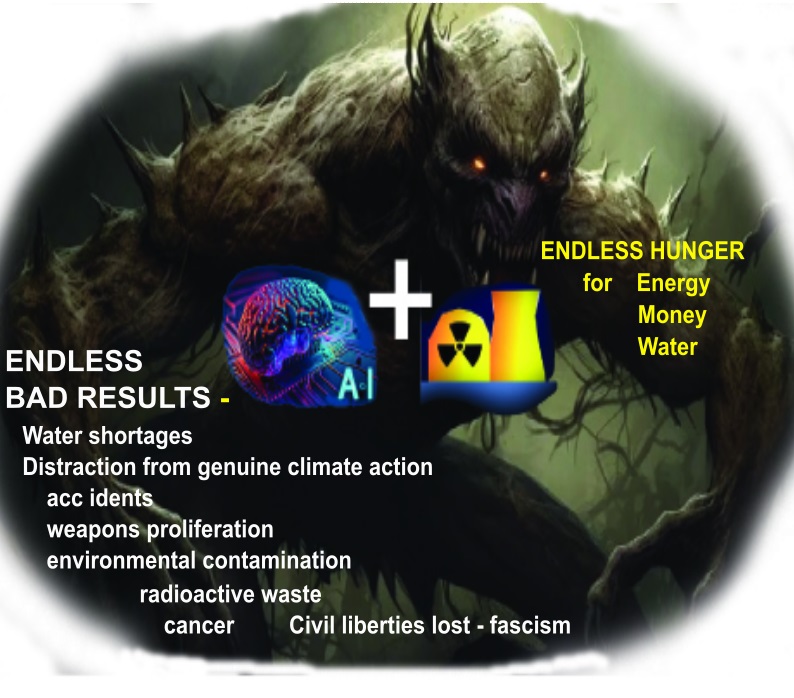
we have been here before. Consider, for example, the arguments made for building the V. C. Summer nuclear project in South Carolina.
“our technocrats are so committed to the worship of the sacred cow of technology that they say in effect: Let the machine prevail, though the earth be poisoned, the air be polluted, the food and water be contaminated, and mankind itself be condemned to a dreary and useless life, on a planet no more fit to support life than the sterile surface of the moon”.
by beyondnuclearinternational, https://beyondnuclearinternational.org/2025/04/21/awash-in-ai-propaganda/
The hype about massive data centers delivered by nuclear companies eager to power them, is probably just that, writes M.V. Ramana
One bright spot amidst all the terrible news the last couple of months was the market’s reaction to DeepSeek, with BigTech firms like Nvidia and Microsoft and Google taking major hits in their capitalizations. Billionaires Nvidia’s Jensen Huang and Oracle’s Larry Ellison—who had, just a few days back, been part of Donald Trump’s first news conference—lost a combined 48 billion dollars in paper money. As a good friend of mine, who shall go unnamed because of their use of an expletive, said “I hate all AI, but it’s hard to not feel joy that these asshats are losing a lot of money.”
Another set of companies lost large fractions of their stock valuations: U.S. power, utility and natural gas companies. Electric utilities like Constellation, Vistra and Talen had gained stock value on the basis of the argument that there would be a major increase in demand for energy due to data centers and AI, allowing them to invest in new power plants and expensive nuclear projects (such as small modular reactors), and profit from this process. [The other source of revenue, at least in the case of Constellation, was government largesse.] The much lower energy demand from DeepSeek, at least as reported, renders these plans questionable at best.
Remembering Past Fanfare
But we have been here before. Consider, for example, the arguments made for building the V. C. Summer nuclear project in South Carolina. That project came out of the hype cycle during the first decade of this century, during one of the many so-called nuclear renaissances that have been regularly announced since the 1980s. [In 1985, for example, Oak Ridge National Laboratory Director Alvin Weinberg predicted such a renaissance and a second nuclear era—that is yet to materialize.] During the hype cycle in the first decade of this century, utility companies proposed constructing more than 30 reactors, of which only four proceeded to construction. Two of these reactors were in South Carolina.
As with most nuclear projects, public funding was critical. The funding came through the 2005 Energy Policy Act, the main legislative outcome from President George W. Bush’s push for nuclear power, which offered several incentives, including production tax credits that were valued at approximately $2.2 billion for the South Carolina nuclear plant project at V. C. Summer.
The justification offered by the CEO of the South Carolina Electric & Gas Company to the state’s Public Service Commission was the expectation that the company’s energy sales would increase by 22 percent between 2006 and 2016, and by nearly 30 percent by 2019.
In fact, South Carolina Electric & Gas Company’s energy sales declined by 3 percent by the time 2016 rolled in. [Such mistakes are standard in the history of nuclear power. In the 1970s, the U.S. Atomic Energy Commission and utility companies were projecting that “about one thousand large nuclear power reactors” would be built “by the year 2000 and about two thousand, mostly breeder reactors, by 2010” on the basis of the grossly exaggerated estimates of how rapidly electricity production would grow during the same period. It turned out that “utilities were projecting four to nine times more electric power would be produced in the United States by nuclear power in 2000 than actually happened”.] In the case of South Carolina, the wrong projection about energy sales was the basis of the $9 billion plus spent on the abandoned V. C. Summer project.
The Racket Continues
With no sense of shame for that failure, one of the two companies involved in that fiasco recently expressed an interest in selling this project. On January 22, Santee Cooper’s President and CEO wrote, “We are seeing renewed interest in nuclear energy, fueled by advanced manufacturing investments, AI-driven data center demand, and the tech industry’s zero-carbon targets…Considering the long timelines required to bring new nuclear units online, Santee Cooper has a unique opportunity to explore options for Summer Units 2 and 3 and their related assets that could allow someone to generate reliable, carbon emissions-free electricity on a meaningfully shortened timeline”.
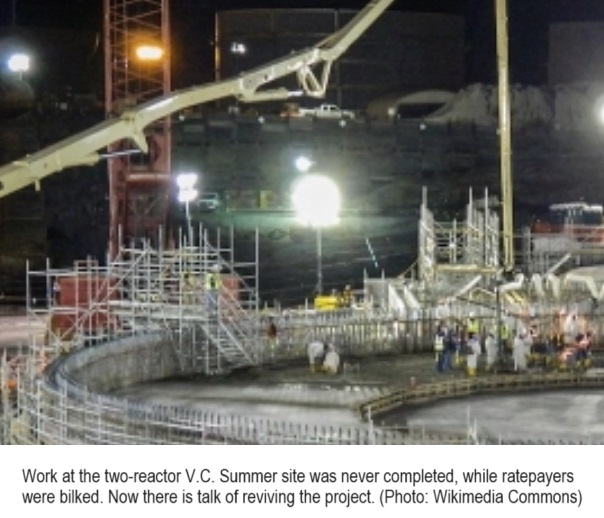
A couple of numbers to put those claims about timelines in perspective: the average nuclear reactor takes about 10 years to go from the beginning of construction—usually marked by when concrete is poured into the ground—to when it starts generating electricity. But one cannot go from deciding to build a reactor to pouring concrete in the ground overnight. About five to ten years are needed before the physical activities involved in building a reactor to obtain the environmental permits, and the safety evaluations, carry out public hearings (at least where they are held), and, most importantly, raise the tens of billions of dollars needed. Thus, even the “meaningfully shortened timeline” will mean upwards of a decade.
Going by the aftermath of the Deepseek announcement, the AI and data center driven energy demand bubble seems to have crashed on a timeline far shorter than even that supposedly “meaningfully shortened timeline”. There is good reason to expect that this AI bubble wasn’t going to last, for there was no real business case to allow for the investment of billions. What DeepSeek did was to also show that the billions weren’t needed. As Emily Bender, a computer scientist who co-authored the famous paper about large language models that coined the term stochastic parrots, put it: “The emperor still has no clothes, but it’s very distressing to the emperor that their non-clothes can be made so much more cheaply.”
But utility companies are not giving up. At a recent meeting organized by the Nuclear Energy Institute, the lobbying organization for the nuclear industry, the Chief Financial Officer of Constellation Energy, the company owning the most nuclear reactors in the United States, admitted that the DeepSeek announcement “wasn’t a fun day” but maintained that it does not “change the demand outlook for power from the data economy. It’s going to come.” Likewise, during an “earnings call” earlier in February, Duke Energy President Harry Sideris maintained that data center hyperscalers are “full speed ahead”.
Looking Deeper
Such repetition, even in the face of profound questions about whether such a growth will occur, is to be expected, for it is key to the stock price evaluations and market capitalizations of these companies. The constant reiteration of the need for more and more electricity and other resources also adopts other narrative devices shown to be effective in a wide variety of settings, for example, pointing to the possibility that China would take the lead in some technological field or other, and explicitly or implicitly arguing how utterly unacceptable that state of affairs would be, while never asking whether it even matters who wins this race for AI. These tropes and assertions about running out of power contribute to creating the economic equivalent of what Stuart Hall termed “moral panic”, thus allowing possible opposition to be overruled.
One effect of this slew of propaganda has been the near silence on the question of whether such growth of data centers or AI is desirable, even though there is ample evidence of the enormous environmental impacts of developing AI and building hyperscale data centers. Or for that matter the desirability of nuclear power.
As Lewis Mumford once despaired: “our technocrats are so committed to the worship of the sacred cow of technology that they say in effect: Let the machine prevail, though the earth be poisoned, the air be polluted, the food and water be contaminated, and mankind itself be condemned to a dreary and useless life, on a planet no more fit to support life than the sterile surface of the moon”.
But, of course, we live in a time of monsters, a time when the levers of power are wielded by a megalomaniac who would like to colonize Mars, and despoil its already sterile environment.
M. V. Ramana is the Simons Chair in Disarmament, Global and Human Security at the School of Public Policy and Global Affairs, University of British Columbia and the author of The Power of Promise: Examining Nuclear Energy in India.
Sellafield Construction of new “Box Encapsulation Plant” Requires Dumping Nearly 1 Million Litres of Contaminated Water into the River Calder Every Day For An Unknown Length of Time

And they already use the River Calder as a sewer for radioactive crapola, there is sacrifice and then there is sacrifice.
Marianne Birkby, Apr 21, 2025, Radiation Free Lakeland
If anyone can make sense of this document received from the Environment Agency then please do get in touch – the deadline for comments to the EA is 23rd April.
From what I can see the plan is to dig a tunnel and drive multiple piles into the alluvium sandstone below Sellafield for a “Box Encapsulation Plant Product Store 2 (BEPPS2)”. This new build would be just 700 metres from the coast and would facilitate transfer of the Magnox wastes including from the silos that have been leaking at a rate of knots for decades into the groundwater.
This is the information below, no-one begrudges the nuclear industry repackaging the wastes – we are relying on them to repackage the wastes again and again into eternity but we should absolutely begrudge them the label of “clean energy.” An industry that produces wastes that should be isolated from the biosphere and has polluted an existing major aquifer (and more) as they admit in this document is not “clean.” The tone of this Sellafield application to the Environment Agency is one of: “we have you over a barrel so you need to allow us to do this no matter the cost to the River Calder or the major aquifer that we have already polluted.” Any help on our response to the Environment Agency about this application would be really welcome. People can contact me here: wastwater@protonmail.com
The application by Sellafield to the Environment Agency is for a full licence to abstract water from the Alluvium Sandstone Deposit at Sellafield, Cumbria, within the area marked by National Grid References NY 03193 03004, NY 03240 02991, NY 03175 02939 and NY 03223 02927. [Map here on original]
The application is to abstract water as follows:
· 40 cubic metres an hour
· 960 cubic metres a day
· 350,400 cubic metres a year
· between 1 April and 31 March inclusive in each year.
“The water will be used for the purpose of dewatering to aid construction.
The Box Encapsulation Plant Product Store 2 (BEPPS2) facility is one in a series of Intermediate Level Waste (ILW) stores required to provide future storage and enable operational continuity for High Hazard Risk Reduction work at Sellafield. BEPPS2 construction excavations will generate construction waters – rainfall, infiltration through soil, and groundwater due to digging and piling required for construction. This will initially require an Abstraction Licence to dewater excavations and transfer the collected water for discharge.” Environment Agency
Documents and tables …………………………………………………………………………………………………………………………….. https://radiationfreelakeland.substack.com/p/sellafield-construction-of-new-box?utm_source=post-email-title&publication_id=2706406&post_id=161731523&utm_campaign=email-post-title&isFreemail=true&r=ln98x&triedRedirect=true&utm_medium=email
Why Is The BBC Middle East Desk Run By A Mossad Collaborator?
Dorset Eye, 14th April 2025
A senior figure at the BBC’s Middle East desk, Raffi Berg, has been exposed as a former employee of a CIA propaganda division and a collaborator with Israel’s intelligence agency Mossad, according to a detailed investigation by MintPress News.
Berg, who currently heads the BBC’s Middle East coverage, is facing growing internal criticism. At least thirteen BBC journalists have reportedly accused him of holding an overt bias in favour of Israel. Staff allege that Berg’s influence is so extensive that his role essentially revolves around “watering down” any reporting that might be overly critical of Israel. One source described him as wielding a “wild” degree of power within the newsroom.
A separate investigation published by Drop Site News in December disclosed that an atmosphere of “extreme fear” prevails at the BBC when it comes to covering stories critical of Israel, with Berg allegedly playing a central role in steering the network’s output towards what has been described as “systematic Israeli propaganda”.
Links to U.S. Intelligence
Before joining the BBC in 2001 as a writer and producer on the world news desk, Berg worked for the U.S. State Department’s Foreign Broadcast Information Service (FBIS), according to MintPress News, which cited his LinkedIn profile and other corroborating sources.
The FBIS was part of the CIA’s Directorate of Science and Technology, tasked with monitoring, translating, and distributing open-source international news and information for U.S. government consumption. According to its publicly available profile, the FBIS played a key role in U.S. intelligence gathering.
Berg himself confirmed his association with the CIA during a 2020 interview with The Jewish Telegraph. Recounting his time at the FBIS, he revealed, “One day, I was taken to one side and told, ‘You may or may not know that we are part of the CIA, but don’t go telling people.’” I was absolutely thrilled. It wasn’t too much of a surprise because the application process was enormous — it took 10 months. They scrutinised my character and background meticulously, even asking whether I had visited communist countries and, if so, whether I had formed any relationships there.”
Mossad Collaboration
The revelations do not stop with Berg’s past ties to the CIA. The MintPress News investigation uncovered a significant professional entanglement between Berg and Mossad, Israel’s intelligence service. This relationship emerged during his work on Red Sea Spies: The True Story of Mossad’s Fake Diving Resort — a book recounting Mossad’s covert mission to smuggle Ethiopian Jews into Israel.
Berg openly acknowledged that the book was written “in collaboration” with Mossad commander Dani Limor…………………..
A Pattern of Pro-Israel Editorial Bias
According to MintPress News, Berg has consistently demonstrated overt sympathies towards Israel since the beginning of his tenure at the BBC. He was elevated to head of the Middle East desk shortly after instructing colleagues during Israel’s 2012 “Operation Cast Lead” to avoid language that could place “undue emphasis” on Israel’s role in the violence.
Operation Cast Lead saw Israel accused of widespread human rights violations, including indiscriminate attacks on civilians, the use of Palestinians as human shields, and the deployment of prohibited munitions such as white phosphorus.
Leaked emails revealed that Berg encouraged reporters to present the military assault as a response to rocket fire from Gaza, thus framing Hamas as the primary aggressor. MintPress noted this editorial slant as a clear effort to deflect blame from Israel.
More recently, during Israel’s ongoing military offensive in Gaza — described by critics as a genocidal campaign — Berg is said to have transformed the BBC’s coverage into “systematic Israeli propaganda”, according to a journalist cited by the Drop Site investigation.
“Almost every correspondent you know has an issue with him,” one journalist revealed. “He has been named in multiple meetings, but [management] just ignore it.”
Berg has also been accused of making extensive editorial changes to reporters’ work before publication, frequently reframing narratives to downplay Israel’s culpability. A stark example involved the killing of Mohammed Bhar, a Palestinian man with Down’s syndrome who was fatally attacked by Israeli military dogs and denied medical assistance as he bled to death.
Under Berg’s direction, the BBC originally ran the headline: “The Lonely Death of Gaza Man with Down’s Syndrome”. Only after significant international backlash did the broadcaster amend the headline to acknowledge the circumstances of Bhar’s death.
Despite repeated internal grievances highlighting Berg’s bias and unprofessional conduct, the BBC has “offered unequivocal support for him and his work,” according to the MintPress report.
Media Whitewashing of Israeli Atrocities
The controversy surrounding Berg comes amid broader criticism of Western media outlets for whitewashing or downplaying Israeli war crimes in Gaza. The BBC is not alone in facing scrutiny; other networks have been accused of propagating misleading narratives supplied by Israeli officials.
An investigation by Al Jazeera in October last year revealed that CNN broadcast false claims that Hamas fighters had hidden captives inside Gaza’s al-Rantisi Children’s Hospital — claims that were based on documents presented by the Israeli military. In reality, the documents turned out to be an ordinary calendar showing the days of the week in Arabic, a fact that CNN’s own Palestinian producer had flagged internally.
Nevertheless, CNN aired the footage, with correspondent Nic Robertson uncritically accepting the Israeli army’s account.
For more info: Raffi Berg: BBC Middle East Editor Exposed as CIA, Mossad Collaborator https://dorseteye.com/why-is-the-bbc-middle-east-desk-run-by-a-mossad-collaborator/
Israel’s escalating West Bank assault is part of a larger plan to split the territory in two
Israel is expanding its “Iron Wall” offensive in the West Bank as it approves plans to separate the northern West Bank from the south. The plan is an accelerated prelude to Israel’s expected annexation of the West Bank.
Mondoweiss, By Qassam Muaddi April 14, 2025
Israeli forces escalated their offensive in the occupied West Bank last week across Palestinian cities and refugee camps, killing three Palestinians. The escalation came amid renewed Israeli plans to expedite annexation plans to solidify the expansion of key new settlement projects in the central West Bank, including connecting one of the largest Israeli settlements, Maale Adumim, to Jerusalem.
Last Monday, April 7, Israeli forces opened fire at three children in the town of Turmusayya, northeast of Ramallah, killing 14-year-old Palestinian-American citizen Omar Saadeh. On Tuesday, April 8, Israeli forces shot and killed a Palestinian woman, Aminah Yaaqoub, 30, at an Israeli checkpoint near Salfit in the northern West Bank.
These killings raised the number of Palestinians killed by Israeli forces or settlers since October 2023 to more than 800, as the Israeli army increased its use of lethal force as part of an ongoing military crackdown on the West Bank’s cities and refugee camps………………………………………………………………………………………………………………………………..
The plan to bifurcate the West Bank
The launching of the “Iron Wall” offensive has been described by the families of Israeli captives held in Gaza as compensation offered to Smotrich in exchange for accepting the signing of the ceasefire and refraining from quitting Netanyahu’s right-wing governing coalition.
In reality, Smotrich’s agenda of crushing Palestinian refugee camps is part of the Israeli government’s broader stated agenda for annexing the West Bank. The escalation of Israel’s military campaign against Palestinian cities came as an echo to developments in Gaza, as Israel announced the expansion of its ground invasion in the strip last week, especially in Rafah. This West Bank escalation was also coupled with the expansion of new settlement projects.
On March 30, the Israeli cabinet approved a new settlement roads project east of Jerusalem. The project includes a road that circumvents the center of the West Bank between Jerusalem and the Jordan Valley, allegedly allowing Palestinians to drive directly from Bethlehem to Jericho and isolating both areas definitively from Jerusalem. The current highway, one of the few Israeli highways on parts of which Palestinians are allowed to drive, will be exclusively reserved for Israelis, connecting Jerusalem with Israeli settlements that expand from the east of Jerusalem to the Jordan Valley. Most central to this annexation project is the second-largest Israeli settlement, Maaale Adumim, which houses 40,000 Israelis.
Linking Jerusalem with settlements to the east would separate the south and the north of the West Bank and create a geographical continuity between Israel’s 1948 boundaries, Jerusalem, and Israeli settlements. Most crucially, the West Bank would be bifurcated. It’s a plan that Israel has had in the works for years but has now gained official approval……………………………………………………………………………….
Both Katz and Smotrich belong to the Israeli far right, whose voting base comes largely from the settler movement. Smotrich has been leading calls to annex the West Bank since 2015 and has labeled his plan “the definitive solution.” This plan, according to Smotrich, would “end the conflict” by imposing Israeli control over the West Bank and annexing it to Israel’s 1948 boundaries, killing any chances for establishing a Palestinian state. This vision aligns with Israeli Prime Minister Benjamin Netanyahu’s longtime effort to undermine a two-state solution and prevent the establishment of a Palestinian state…………………………………
Settler violence in the West Bank has displaced no less than 20 Bedouin communities in the West Bank since October 2023, while the Israeli army and settler attacks have killed more than 800 Palestinians in the same time period. According to UNRWA, Israel’s “Iron Wall” offensive has so far displaced well over 40,000 Palestinians and completely depopulated the Jenin and Tulkarem refugee camps, with Israel’s Defense Minister saying that its residents would not be allowed to return for at least a year. https://mondoweiss.net/2025/04/israels-escalating-west-bank-assault-is-part-of-a-larger-plan-to-split-the-territory-in-two/
Ministry of Defence awards £2.6m contract for nuclear apprentice training

The Ministry of Defence has awarded a contract worth nearly £2.6 million
to Bridgwater & Taunton College for the provision of nuclear degree
apprentice training, according to a contract award notice published on 15
April 2025. The contract supports the enrolment of up to 30 students per
year, over three annual cohorts, into the ST0289 Nuclear Scientist and
Nuclear Engineer integrated degree programme—an apprenticeship standard
recognised by the Institute for Apprenticeships and Technical Education
(IfATE).
UK Defence Journal 19th April 2025,
https://ukdefencejournal.org.uk/mod-awards-2-6m-contract-for-nuclear-apprentice-training/
Lots of nuclear news this week – not industry handouts

Some bits of good news – The Eastern Tropical Pacific Marine Corridor is now bigger and better, thanks to international cooperation. Heartening’ reduction in Australian ocean plastic.
TOP STORIES.Murder in Broad Daylight :REPORTING FROM THE CLIMATE WAR ZONE.
The Conservative Argument Against Nuclear Power in Japan.
AI’s Energy Demands and Nuclear’s Uncertain Future.
How climate change could disrupt the construction and operations of US nuclear submarines -ALSO AT https://nuclear-news.net/2025/04/19/1-a-israel-still-eyeing-a-limited-attack-on-irans-nuclear-facilities/
Climate. Eco anxiety – environment doom- ALSO AT https://nuclear-news.net/2025/04/16/2-b1-eco-anxiety-environment-doom/
The climate crisis has tripled the length of ocean heatwaves. Flood warnings as Europe named as the fastest-warming continent in the world.
Noel’s notes. Is Elon Musk a halfwit ? Donald Trump flounders about on the Ukraine situation.
AUSTRALIA.
- “The System” needs to change: War crimes whistleblower David McBride.
- Dotty and Cretinous: Reviewing AUKUS.
- Dutton’s nuclear revival smells rotten to Gens Y and Z. 10 reasons why nuclear energy is a bad idea for Australia.
- Tim Wilson, secretive money and “think” tanks. Australia’s democracy is at stake.
- Forget nuclear, Australia is on fast lane to 100pc renewables. The Coalition Nuclear Policy is a Fake. More Australian nuclear news at…….. https://antinuclear.net/2025/04/17/australian-nuclear-news-14-21st-april/
NUCLEAR ITEMS
| ART and CULTURE. Elon Musk and the dangerous myth of omnigenius. |
| ATROCITIES. ‘Only Hellfire’: Israel Says Lifesaving Aid, Troop Withdrawal Off the Table for Gaza. |
| CLIMATE. Nuclear Energy Means Climate Action Delay: O’Donnell and Winfield. |
ECONOMICS. UPENN REPORT: TARIFFS LIKELY NAIL IN COFFIN OF U.S. SMALL NUCLEAR REACTORS. – ALSO AT https://nuclear-news.net/2025/04/18/2-b1-upenn-report-tariffs-likely-nail-in-coffin-of-u-s-small-nuclear-reactors/
Chinese firm ‘will not bid’ to run Essex nuclear plant- ALSO AT https://nuclear-news.net/2025/04/17/1-b1-chinese-firm-will-not-bid-to-run-essex-nuclear-plant/
Third tender submitted in UK Small Nuclear Reactor selection process.
Framatome and Sizewell C sign contract for EPR reactor instrumentation.
CND Cymru has highlighted the continued lack of investment in communities and people, while billions are to be spent subsidising the nuclear industry.
‘Risk of insolvency’ at parent company of N.B. nuclear developer. A nuclear play in New Brunswick is facing a fragile outlook.
| EDUCATION. Westinghouse and McMaster University deepen eVinci microreactor collaboration. Ministry of Defence awards £2.6m contract for nuclear apprentice training. |
| EMPLOYMENT. Navy’s nuclear submarine hiring crisis as sailors forced to spend record 204 days underwater. |
| ENERGY. TIDES, NUKES AND BIRDS. |
ENVIRONMENT. Uranium Hot Particles Detected in Soil Samples from Site of Israel Bomb in Beirut– https://www.youtube.com/watch?v=Esd2e-UcFe4
Trump’s Latest Executive Order is Blatant Attack on States’ Rightful Action to Protect Communities and the Climate.
Sellafield Construction of new “Box Encapsulation Plant” Requires Dumping Nearly 1 Million Litres of Contaminated Water into the River Calder Every Day For An Unknown Length of Time.
| ETHICS and RELIGION. What Would Jesus Do?Saying It’s Antisemitic To Oppose Genocide Is Like Saying It’s Anti-Catholic To Oppose Pedophilia – https://www.youtube.com/watch?v=gWgBxGWxqLM |
| EVENTS. Campaign for Nuclear Disarmament (CND), to blockade RAF Lakenheath after US exemption to British nuclear safety rules revealed – 26 April. Second Annual WIPP Plutonium Trail Caravan on Saturday, April 26th. |
| HEALTH. Almost 7 months underwater pushes UK nuclear submariners to the limit – ALSO AT https://nuclear-news.net/2025/04/21/1-b1-almost-7-months-underwater-pushes-uk-nuclear-submariners-to-the-limit/No such thing as ‘clean’ nuclear energy.Uranium’s hazardous effects on humans and recent developments in treatment.Doncaster prisoners could sue government over exposure to radon gas. |
| LEGAL. GOP states sue NRC to deregulate SMR licensing. Lawsuit on Nuclear Regulation. |
| MEDIA. Documentary – “Atomic Secrets“. A picture paints a thousand words: Shocking aerial images of Sizewell C devastation. Why Is The BBC Middle East Desk Run By A Mossad Collaborator? |
| OPPOSITION to NUCLEAR . Germany’s New federal government wants nuclear fusion instead of nuclear power plants – no word on nuclear energy in the coalition agreement- ALSO AT https://nuclear-news.net/2025/04/16/2-b-1-germanys-new-federal-government-wants-nuclear-fusion-instead-of-nuclear-power-plants-no-word-on-nuclear-energy-in-the-coalition-agreement/ Protester for life. Peace camp protestors hand in letter to US airbase commanders at Lakenheath. CND Cymru condemns billions for nuclear industry. |
PERSONAL STORIES. “I Want A Death That The World Will Hear” — Journalist Assassinated By Israel For Telling The Truth
– https://www.youtube.com/watch?v=fNG5dyZXpZ8
| POLITICS. Ukrainian-born US lawmaker says Ukraine should cede land to Russia, demand Zelensky’s resignation. Ukraine’s Extension Of Martial Law Exposes Zelensky’s Fear Of Losing Re-Election. DOGE’s staff firing fiasco at the nuclear weapon agency means everything but efficiency. During Canada’s leaders’ debate, Carney praised a nuclear firm he bought while at Brookfield. Canada’s Liberal energy plan: more corporate, less climate? The removal of Trident must remain a core SNP policy. |
| POLITICS INTERNATIONAL and DIPLOMACY. Germany: One exit and back? The role of nuclear power in the Merz coalition. Trump playing Dr. Jekyll Mr. Hyde. Saudi Arabia, US on ‘pathway’ to civil nuclear agreement. Iranian minister says nuclear deal possible if US does not make ‘unrealistic demands’. US Energy Secretary says. Hopes for Iran nuclear talks tempered by threats and mixed messages. Trump envoy demands Iran eliminate nuclear programme in apparent U-turn. |
| SAFETY. Kyiv working to repair Chornobyl nuclear site damaged by drone attack |
| SECRETS and LIES. CIA: Undermining and Nazifying Ukraine Since 1953. |
| SPACE. EXPLORATION, WEAPONS. Gender Stunts in Space: Blue Origin’s Female Celebrity Envoys. |
| TECHNOLOGY. California Nuclear Plant Integrates AI for Efficiency.Bill Gates enters race to build mini-nuclear reactors in Britain.Aerial photos show state of Sizewell C preparatory works. |
| WASTES. DOE report: Cost to finish cleaning up Hanford site could exceed $589 billion.Robot starts 2nd mission to retrieve debris at Fukushima nuclear plant. |
| WAR and CONFLICT. Israel’s escalating West Bank assault is part of a larger plan to split the territory in two.UK deeply involved in Ukraine conflict – The Times. |
| WEAPONS and WEAPONS SALES.Unprecedented number of B-2 bombers amassed for Iran strike.Zelensky started the war then begged for missiles – Trump.U.S. advances microreactor program for military sites. https://dorseteye.com/why-is-the-bbc-middle-east-desk-run-by-a-mossad-collaborator/ |
WOMEN. I’ve got a rocket for these space cadets and their pantomime of feminism.
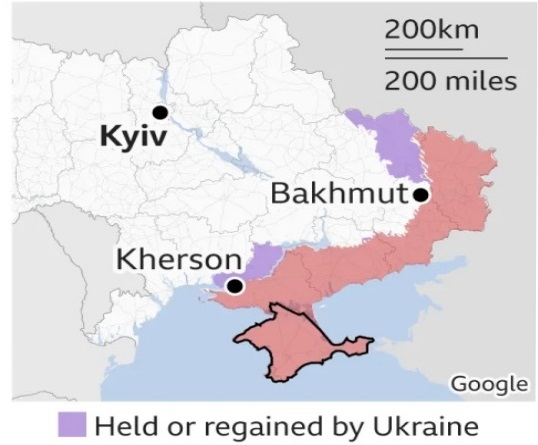
US proposes leaving former Ukrainian territories under Russian control – Bloomberg
18 Apr,25 – https://www.rt.com/news/615961-russia-ukraine-peace-us/
Washington’s offer also reportedly envisions easing sanctions on Moscow and ending Kiev’s NATO aspirations.
The US has presented its allies with details of its peace plan to bring the conflict between Russia and Ukraine to an end, Bloomberg reported on Friday, citing European officials familiar with the matter.
The proposal, outlined during a meeting in Paris on Thursday, reportedly includes easing sanctions on Russia, as well as terminating Ukraine’s aspirations to join NATO. The roadmap would effectively freeze the conflict and leave former Ukrainian territories that are part of Russia under Moscow’s control, the sources suggested.
One of the officials told Bloomberg that the proposal still had to be discussed with Kiev, adding that the plan would not actually amount to a definitive conflict settlement. Kiev’s European backers would not recognize the territories as Russian, the source suggested.
The US delegation at the Paris meetings, which involved senior officials from several countries, was led by Secretary of State Marco Rubio and White House special envoy Steve Witkoff. They met with French President Emmanuel Macron and also held discussions with top officials from France, Germany, the UK, and Ukraine.
Earlier on Friday, Rubio signaled Washington was ready to “move on” if a way to end the hostilities between Moscow and Kiev could not be found “within days.”
“We need to figure out here now, within a matter of days, whether this is doable in the short term. Because if it’s not, then I think we’re just going to move on,” Rubio told reporters before departing from France.
Moscow has signaled a full ceasefire with Ukraine was highly unlikely, citing Kiev’s violations of previous deals. Speaking to reporters at the UN headquarters on Thursday, Russian envoy Vassily Nebenzia said there are “big issues with the comprehensive ceasefire,” recalling the fate of the now-defunct Minsk agreements, which were “misused and abused to prepare Ukraine for the confrontation.”
The diplomat also cited repeated Ukrainian violations of a US-brokered 30-day moratorium on energy infrastructure strikes, implemented on March 18.
“How close we are to the ceasefire is a big question to me personally, because, as I said, we had an attempt at a limited ceasefire on energy infrastructure, which was not observed by the Ukrainian side. So, in these circumstances, to speak about a ceasefire is simply unrealistic at this stage,” Nebenzia said.
I’ve got a rocket for these space cadets and their pantomime of feminism

They do not operate the spaceship. They dress sexy for the spaceship flight.
pseudo-feminism.. which wrinkles its nose if you look grey, ugly or old
The Age, Jacqueline Maley, April 20, 2025
“……………………………………………………………….. We didn’t want to look but we found we couldn’t look away when, on Wednesday, Jeff Bezos’ Blue Origin – a space technology company – launched an all-female, B- and C-list celebrity crew of six into space, wearing skintight designer spacesuits and heavy make-up. It was the first fully-lady-mission since Russian astronaut Valentina Tereshkova’s solo space flight in 1963.
The team consisted of the billionaire Bezos’ fiancée, the television journalist and children’s book author Lauren Sanchez; pop star Katy Perry; television host and Oprah-bestie Gayle King; former NASA rocket scientist Aisha Bowe; activist, sexual assault survivor and scientist Amanda Nguyen; and film producer Kerianne Flynn.
“I was like, ‘What am I going to wear?’” Perry told Elle of her initial reaction to the invitation. “But seriously, I have wanted to go to space for almost 20 years.”
In terms of publicity for space tourism for the rich and (dubiously) famous, it was a bonanza. But the heavily girlified nature of the rhetoric around the mission (if we can call it that – the trip lasted for 11 minutes), and its explicit branding as an exercise in empowering girls to aspire to careers in space exploration, well, that made it a very dark day for feminism.
The whole exercise was emblazoned with such drippy femininity and lame girlboss-ery that all womankind was implicated. It was a test of the implicit feminist pact to Support Women. I suspect I failed it.
It’s not something that Virginia Woolf or Betty Friedan ever prepared us for – an all-woman space crew which served quotes like: “I think it’s so important for people to see … this dichotomy of engineer and scientist, and then beauty and fashion. We contain multitudes. Women are multitudes. I’m going to be wearing lipstick.”
Despite not having any direct link to the Trump administration, it all felt so very Trumpy – a symbol of the dark end-days of American democracy; the great American project of aspiration and exploration reduced to a commercialised stunt, obscenely wasteful and vulgar beyond words. …………..
… the moral emptiness of the mission was underscored by leaked documents showing the Trump administration plans to gut key science programs funded by the federal government.
Under the leaked plans, NASA’s science budget for the fiscal year 2026 would be nearly halved. As Nature reported: “At risk is research that would develop next-generation climate models, track the planet’s changing oceans and explore the Solar System.”
Separately, NASA’s Diversity, Equity and Inclusion chief Neela Rajendra was sacked, in compliance with Trump’s executive order to “terminate” all people employed under “DEI” programs.
Business Standard reported Rajendra “played a key role in national initiatives like the Space Workforce 2030 pledge, aimed at increasing representation of women and minorities in STEM fields”.
Sure, but did she put the glam into space? The girlstronauts represent a pantomime of feminism found everywhere across Trump-land.
It’s in the robotically doll-like women who sit behind the men of the administration, nodding and smiling as they announce powerful new assaults on the rule of law.
It’s in the milquetoast “Be Best” initiatives of first lady Melania Trump.
It’s in the administration’s persecution of trans people in the name of “women’s rights”, and in its rollback of abortion rights…………
But at least the women are on stage, right? Women can be treated as a special category as long as they uplift and adorn – that seems to be the message the girl crew have absorbed and then promoted. But there is little point in them being on view if they are not looking “glam”.
Such women equate a certain kind of physical presentation with self-respect, and they defend it as their “right”. They fail to realise, or are too rich to care, that the companies which sell them their version of beauty are exploiting them. They do not operate the spaceship. They dress sexy for the spaceship flight.
It is a nihilistic form of pseudo-feminism that insists on women’s right to “take up space” (as the astronaut women chanted when they reached the zero-gravity part of their adventure), but which wrinkles its nose if you look grey, ugly or old while doing so.
It is a way of reducing women to the status of a pretty distraction, while insisting, straight-faced, that at least that means we are being “seen”. https://www.theage.com.au/politics/federal/i-ve-got-a-rocket-for-these-space-cadets-and-their-pantomime-of-feminism-20250417-p5lslv.html
Iranian minister says nuclear deal possible if US does not make ‘unrealistic demands’
Guardian, 19 Apr 25
Iran’s foreign minister, Abbas Araqchi, and US Middle East envoy Steve Witkoff will resume talks in Rome on Saturday
Iran’s top negotiator believes reaching an agreement on its nuclear programme with the US is possible as long as Washington is realistic, as the two sides prepare to resume talks in Rome on Saturday.
Iran’s foreign minister, Abbas Araqchi, and the US Middle East envoy, Steve Witkoff, will begin indirect negotiations through mediators from Oman, after their first round in Muscat, which both sides described as constructive.
“If they demonstrate seriousness of intent and do not make unrealistic demands, reaching agreements is possible,” Araqchi told a news conference in Moscow on Friday after talks with Russia’s foreign minister, Sergei Lavrov.
Tehran has, however, sought to tamp down expectations of a quick deal. The supreme leader, Ayatollah Ali Khamenei, said this week he was “neither overly optimistic nor pessimistic”.
The talks take place under the shadow of Donald Trump’s threat to attack Iran if it does not reach a deal with the US over its nuclear programme.
The US president told reporters on Friday: “I’m for stopping Iran, very simply, from having a nuclear weapon. They can’t have a nuclear weapon. I want Iran to be great and prosperous and terrific.”
Trump, who ditched a 2015 nuclear pact between Iran and six powers during his first term in 2018 and reimposed crippling sanctions on Tehran, has revived his “maximum pressure” campaign on Iran since returning to the White House in January.
Washington wants Iran to halt production of highly enriched uranium, which it believes is aimed at building an atomic bomb.
Tehran, which has always said its nuclear programme is peaceful, says it is willing to negotiate some curbs in return for the lifting of sanctions, but wants watertight guarantees that Washington will not renege again as Trump did in 2018.
Araghchi said Iran’s right to enrich uranium was “non-negotiable”, after Witkoff called for its complete halt…………………………..https://www.theguardian.com/world/2025/apr/19/irans-minister-says-nuclear-deal-possible-if-us-does-not-make-unrealistic-demands
What Would Jesus Do?

George D. O’Neill. The American Conservative, Sat, 19 Apr 2025
And is there anything particularly Christian about Christian Zionism?
When did Jesus say it was acceptable to starve the poor, slaughter women and children while turning a blind eye to the suffering of the weak? The answer, of course, is never. Yet for years, a vocal strain of American Christian Zionist leaders have supported policies that do precisely that — enabling the starvation and slaughter of Palestinians while underwriting broader wars that have decimated ancient Christian communities across the Middle East. How did we arrive at a place where those who claim to follow the Prince of Peace justify such unchristian horrors.
The Biblical call for compassion is clear: Leviticus 23:22 commands, “When you harvest the crops of your land, do not harvest the grain along the edges of your fields, and do not pick up what the harvesters drop. Leave it for the poor and the foreigners living among you.” This is a divine directive to care for the vulnerable, not an optional gesture. James, the brother of Jesus, is yet more emphatic: “Pure and genuine religion in the sight of God the Father means caring for orphans and widows in their distress and refusing to let the world corrupt you” (James 1:27). What kind of religious leaders cheer the bombing of Gaza’s widows and orphans, left destitute by policies supported by American and Israeli leaders? Decades of war propaganda have numbed many Americans to the atrocities committed in their name. Yet a growing awareness is stirring both here and abroad.
American Christian Zionist leaders often frame their support for Israel as a divine mandate, dismissing Palestinian suffering as collateral damage in a prophetic plan. Pastor Robert Jeffress declares, “The Bible says this land belongs to the Jewish people — period… God has pronounced judgment after judgment in the Old Testament to those who would ‘divide the land,’ and hand it over to non-Jews.” Likewise, Pastor John Hagee insists, “You’re either for the Jewish people or you’re not.” But where in the Gospels do we find Jesus exalting land rights or ethnic loyalty over human lives? Why did Jesus tell his fellow Jews to be like the Good Samaritan if not to call all people out of their tribalism? The only time He spoke of snakes was to call the Pharisees a “brood of vipers” (Matthew 23:33), condemning their ethnonationalism that blinded them to His message of nonviolence and forgiveness of enemies. He urged, “I desire mercy, not sacrifice” (Matthew 9:13), a rebuke to those who prized vengeance and power over compassion. Did He not say, “Blessed are the peacemakers,” and instruct us to “turn the other cheek”? How do religious leaders who celebrate military might over mercy square with the Messiah who dined with sinners and healed the outcast?
The fruits of this ideology are death and destruction. For decades, some American Christian Zionist leaders have backed Israel’s destructive actions, often at the expense of the very people Jesus called us to protect. They support the decades-long blockade of Gaza, where malnutrition haunts the population, and the wider wars in Iraq and Syria, which have all but erased Christian communities dating back millennia. In Syria, America’s decade-long support for “moderate insurgents” — coupled with the theft of Syrian oil, much of it shipped to Israel — helped topple the government. Now, Al Qaeda affiliates hold sway in parts of that land. Who benefited? Not the Syrian Christians and other religious minorities who are being killed, displaced, and fleeing for their lives.
And then there’s the inconvenient truth about Hamas. For years, Israel’s Prime Minister Benjamin Netanyahu facilitated funding to Hamas through channels like Qatar, a policy aimed at keeping Palestinians divided and weakening the Palestinian Authority. The State of Israel, with American Christian Zionist leaders’ applause and U.S. support, has trained, equipped, and empowered Hamas to serve its own strategic ends. Decades of this cynical game have propped up a terrorist group that Israel and its allies now use as a pretext to justify slaughtering Gazan children by the thousands. How can Christians reconcile killing innocents for the actions of a monster they helped enable? Worse still, many believe Netanyahu’s government may have had foreknowledge of Hamas’s October 7 attack plan yet allowed it to proceed, amplifying the tragedy to justify further escalation of the abuse of Gazans.
God made a covenant with Abraham, promising his descendants a legacy (Genesis 12:2-3). But the Apostle Paul clarifies this promise in Galatians 3:16: the covenant finds its fulfillment in Jesus. Many well-meaning Christians, however, were misled into believing otherwise by the questionable biblical interpretations of Cyrus Scofield. In certain circles, his 1917 edition of the Scofield Reference Bible was very influential.
What would Jesus do if asked to condone the terrorist actions involved in Israel’s founding? The 1946 bombing of the King David Hotel by the Irgun, killing 91 people under the guise of a “liberation” struggle, or the 1948 Deir Yassin massacre, where Zionist militias slaughtered over 100 Palestinian villagers to terrorize others into flight — would He bless such bloodshed? And what of the Nakba, the catastrophic expulsion of over 700,000 Palestinians from their homes that same year, leaving them refugees in their own land? Israel’s first prime minister David Ben-Gurion himself acknowledged in 1918, “We have no reason to assume that the inhabitants of the country who remained after the destruction of the Second Temple were uprooted. On the contrary, the Jewish farmer, like his neighbors, clung to the soil and continued to live in the land, eventually adopting Christianity and later Islam.” If even Israel’s founding father recognized the deep roots of Palestine’s people, how can Christians justify their dispossession? Jesus, who wept over Jerusalem and called for mercy, would surely mourn the dispossessed, not celebrate their displacement.
With countless lives lost and trillions of dollars spent since, can anyone claim this is a policy God has blessed? America’s veterans from our Christian Zionist-supported Middle East wars face high suicide rates, their families shattered by the toll of endless conflict. Our witness to the region lies in ruins, as America plays Israel’s enforcer — destroying Israel’s enemies while partnering with Al Qaeda in Syria and enabling ISIS in Libya and Iraq. Would God bless us and Israel for intentionally putting radicals like Hamas in power over Gaza, sidelining moderate voices from other Palestinian groups? How does any of this reflect faithfulness to Christ? As we approach Easter 2025 — the celebration of Christ’s sacrifice and triumph over death — shouldn’t we reflect on whether our actions honor the One who died for all, not just a favored few?
Jesus Himself opposed violent religious zeal for Israel’s sake. When the Zealots pressed for rebellion, He chose nonviolence. Even Peter, His disciple, was rebuked for cutting off Malchus’ ear in the Garden of Gethsemane. “Put your sword back in its place,” Jesus told him, “for all who live by the sword will die by the sword” (Matthew 26:52). Where is that spirit being promoted by leading Christian Zionists?
The American political class enables this madness, funneling billions in aid to Israel each year — more than to any other nation — often bypassing Congress entirely. Much of the non-Israel foreign aid is used to bribe neighboring countries into compliance or to destabilize regimes deemed insufficiently pro-Israel. You know them by their fruits, and these fruits are war and suffering.
What would Jesus do? He would likely overturn the tables of this unholy alliance, as He did the money-changers in the temple. He would call us back to the edges of the field, where the poor and the foreigner await the compassion we’ve withheld. He would remind us that true faith is measured not in bombs dropped or wars waged, but in the love we show to the least of these. So I ask: If caring for orphans and widows is the mark of pure religion, what does it say of Christian leaders who justify their death and destruction?
About the author
George D. O’Neill, Jr., is a member of the board of directors of the American Ideas Institute, which publishes The American Conservative, and an artist who lives in rural Florida.
Navy’s nuclear submarine hiring crisis as sailors forced to spend record 204 days underwater

By MARY O’CONNOR, 20 April 2025
Naval experts have sounded the alarm over a recruitment crisis plaguing
Britain’s submarine fleet. The Royal Navy is struggling to hire and hold on
to sailors manning the Trident nuclear deterrent, resulting in shortages of
engineers and other critical roles. Sailors are quitting amid a raft of
challenges, including maintaining ageing boats. There are increasingly long
patrols underwater, with sailors cut off from contact with loved ones for
months.
Daily Mail 19th April 2025,
https://www.dailymail.co.uk/news/article-14628517/sailors-forced-spend-record-days-underwater.html
1 This Month





PLEASE OPPOSE HR 8255 AND S.3639 – bills would accelerate satellite deployment, with no environmental review or safeguards – https://ncstd5li.quorum.us/campaign/169331/
To see nuclear-related stories in greater depth and intensity – go to https://nuclearinformation.wordpress.com
-
Archives
- October 2026 (91)
- September 2026 (339)
- August 2026 (330)
- July 2026 (355)
- June 2026 (287)
- May 2026 (306)
- April 2026 (356)
- March 2026 (251)
- February 2026 (267)
- January 2026 (308)
- December 2025 (358)
- November 2025 (359)
-
Categories
- 1
- 1 NUCLEAR ISSUES
- business and costs
- climate change
- culture and arts
- ENERGY
- environment
- health
- history
- indigenous issues
- Legal
- marketing of nuclear
- media
- opposition to nuclear
- PERSONAL STORIES
- politics
- politics international
- Religion and ethics
- safety
- secrets,lies and civil liberties
- spinbuster
- technology
- Uranium
- wastes
- weapons and war
- Women
- 2 WORLD
- ACTION
- AFRICA
- Atrocities
- AUSTRALIA
- Christina's notes
- Christina's themes
- culture and arts
- Events
- Fuk 2022
- Fuk 2023
- Fukushima 2017
- Fukushima 2018
- fukushima 2019
- Fukushima 2020
- Fukushima 2021
- general
- global warming
- Humour (God we need it)
- Nuclear
- RARE EARTHS
- Reference
- resources – print
- Resources -audiovicual
- Weekly Newsletter
- World
- World Nuclear
- YouTube
-
RSS
Entries RSS
Comments RSS

