World’s first AI-powered nuclear power plant Diablo Canyon worries experts after Trump plan

AI technology being used to aid the running of a nuclear power plant has experts worried as Trump scraps AI regulation labelling them it ‘as barriers to American AI innovation’.
Daily Star 21st April 2025
Fears AI technology powering nuclear power plants could lead to catastrophe have been sparked experts caution the emergence of AI in the nuclear energy industry.
These fears come after Trump scraps AI regulation labelling it “as barriers to American AI innovation” as experts have begun to deploy AI to help run a once dead nuclear power plant.
Boffs at the Diablo Canyon, California’s sole remaining nuclear power plant, has begun exploring the frontier of AI to help aid them running the powerplant. In a venture with artificial intelligence start-up Atomic Canyon, a brand-new artificial intelligence tool designed for the nuclear energy industry.
Pacific Gas and Electricity who runs Diablo Canyon have announced a deal with the artificial intelligence start-up declaring the development of “the first on-site generative AI deployment at a U.S. nuclear power plant”.
Currently the artificial intelligence tool, dubbed Neutron Enterprise, is meant to help workers navigate extensive technical reports and regulations. Due to Neutron Enterprise’s use at the Diablo Canyon, both lawmakers and AI experts are requesting strong guardrails…………………..
Tamara Kneese, the director of tech policy non-profit Data & Society’s Climate, Technology, and Justice program commented on the use of AI in the field. “AI can be helpful in terms of efficiency,” the director said, praising the initial implementation.
“The idea that you could just use generative AI for one specific kind of task at the nuclear power plant and then call it a day, I don’t really trust that it would stop there. And trusting PG&E to safely use generative AI in a nuclear setting is something that is deserving of more scrutiny,” Kneese added…………………… https://www.dailystar.co.uk/news/world-news/worlds-first-ai-powered-nuclear-35093367
Nuclear Free Local Authorities sign letter asking leading banks to back our planet not the bomb!

The UK/Ireland Nuclear Free Local Authorities have endorsed an Open Letter
calling on five major banks to divest from nuclear weapons. The letter was
drafted by activists at Medact as the next action in their Don’t Bank on
the Bomb UK campaign. Barclays, HSBC, Lloyds, NatWest and Standard
Chartered have provided $30.5 billion to the nuclear weapons industry. For
the survival of humanity and the planet, the elimination of nuclear weapons
and prevention of their use is an urgent priority. This letter calls on the
five banks to stop choosing profit over people and end financing nuclear
weapons.
NFLA 22nd April 2025, https://www.nuclearpolicy.info/news/nflas-sign-letter-asking-leading-banks-to-back-our-planet-not-the-bomb/
China, Russia may build nuclear plant on moon to power lunar station, official says
China is considering building a nuclear plant on the moon to power the
International Lunar Research Station (ILRS) it is planning with Russia, a
presentation by a senior official showed on Wednesday. China aims to become
a major space power and land astronauts on the moon by 2030, and its
planned Chang’e-8 mission for 2028 would lay the groundwork for
constructing a permanent, manned lunar base.
Reuters 23rd April 2025, https://www.reuters.com/business/energy/china-led-lunar-base-include-nuclear-power-plant-moons-surface-space-official-2025-04-23/
Iran opens door to restoring nuclear surveillance, UN watchdog says

Iran has agreed to allow a technical team from the International Atomic
Energy Agency (IAEA) to discuss restoring camera surveillance in Iranian
nuclear facilities, the head of the UN nuclear watchdog said on Wednesday.
IAEA Director General Rafael Grossi confirmed the agency would send a
technical team to Iran following his visit to Tehran this month. Grossi
said his impression is that the Islamic Republic’s leaders are “seriously
engaged in discussions… with a sense of trying to get to an agreement.”
The UN body would be the party responsible for verifying Iran’s compliance
with a deal, Grossi said. “This will have to be verified by the IAEA.”
Iran International 23rd April 2025 https://www.iranintl.com/en/202504237179
Miliband explores cut-price clean-up of Britain’s deadliest nuclear waste.

The UK’s massive nuclear waste stockpile includes 110,000 tonnes of uranium, 6,000 tonnes of spent nuclear fuels and about 120 tonnes of plutonium – mostly stored at the Sellafield nuclear site in Cumbria in decaying containers and ageing buildings.
Space equivalent to eight Royal Albert Halls is required to dispose of highly toxic substances.
Ed Miliband is backing a cut-price clean-up of
the UK’s growing nuclear waste mountain. The Energy Secretary’s plans
involve highly radioactive used fuel rods being dropped into holes drilled
deep into the Earth’s crust.
The experimental approach, pioneered by Deep
Isolation, an American company, is being funded by the Department for
Energy Security and Net Zero (Desnz), which is helping develop the
toughened canisters needed to contain the deadly waste. If it works, the
method could offer a faster and cheaper way of dealing with the hundreds of
tonnes of high-level radioactive waste accumulated by the UK over the last
seven decades and the new waste generated by future reactors like Hinkley
Point C, under construction in Somerset.
The solution will see used fuel
rods from nuclear reactors placed into steel cylinders designed to fit into
boreholes drilled thousands of feet into deep rock formations. The UK’s
massive nuclear waste stockpile includes 110,000 tonnes of uranium, 6,000
tonnes of spent nuclear fuels and about 120 tonnes of plutonium – mostly
stored at the Sellafield nuclear site in Cumbria in decaying containers and
ageing buildings. UK Government Investments warned in its annual report
that the cost of “nuclear decommissioning threatens the Government’s
finances due to its inherent uncertainty.” The Office for Budget
Responsibility has issued similar warnings. A key problem for the UK is
that, despite decades of trying, it still has no way of permanently storing
nuclear waste. The current plan is to excavate a network of caverns under
the sea, filling them with nuclear waste and then sealing them with cement.
However, work is not expected to start till at least 2050 and will take
decades to complete. Deep boreholes could offer a faster and cheaper
solution for at least some of the waste. Under the Deep Isolation scheme,
boreholes would be drilled into rock using technology first developed by
the oil and gas industry for “fracking”.
Telegraph 21st April 2025,
https://www.telegraph.co.uk/business/2025/04/21/miliband-cut-price-clean-up-deadliest-nuclear-waste/
Unmonitored radiation hazard at the Darlington Waste Facility
Dr. F. R. Greening, Hamilton, ON. 23 Apr 25
On March 26, 2025, CNSC staff made a presentation at Commission Hearing CMD 25-H2.A in which it discussed OPG’s Public Information and Disclosure Program, (PIDP), with regard to the performance of Darlington NGS and its licence renewal application. The CNSC concluded that Darlington was in compliance with the requirements of CNSC REGDOC-3.2.1. by virtue of its provision to the public of all information related to facility operations, health and safety.
Nevertheless, I was recently made aware that the presence of unexpected neutron emissions emanating from radioactive waste containers (RWCs) for removed pressure tubes and calandria tubes was discovered in June 2024 at the Darlington Waste Facility during a routine IAEA safeguards inspection. I believe that this incident is described in Darlington Waste Management Facility Event Report No: N-2024-09119, but has not been made public, as required by OPG’s Public Information and Disclosure Program.
I am therefore requesting that OPG confirm that this unmonitored radiation hazard was indeed discovered as described above and I am asking that the CNSC ensures that all relevant information pertaining to this incident be made public as soon as possible.
Framatome awarded backup power and remote sensing Sizewell C contract

Framatome has been awarded a contract to provide conventional field
instrumentation (CFI) and emergency backup power generation capacity to
Sizewell C. The company is 80.5% owned by EDF – a French state-owned
company, which is the minority owner of Sizewell C. The remaining 19.5% of
Framatome is owned by Mitsubishi Heavy Industries. The UK Government is
currently the majority owner of Sizewell C, which has sunk £6.4bn of
taxpayer cash into the project. Sizewell C has not yet achieved a final
investment decision (FID), which is a requirement before main construction
can take place. Framatome will be supplying “ultimate diesel
generators” which will be “controlled by Framatome’s digital control
systems”, according to a statement from the company. Ultimate diesel
generators provide emergency backup power capacity to nuclear power
stations in the event that grid power becomes unavailable.
New Civil Engineer 22nd April 2025
https://www.newcivilengineer.com/latest/framatome-awarded-backup-power-and-remote-sensing-sizewell-c-contract-22-04-2025/
The world’s biggest companies have caused $28 trillion in climate damage, a new study estimates
The study is part of an effort to make it easier for people and governments to hold major polluters financially accountable, like the tobacco giants were.

A Dartmouth College research
team came up with the estimated pollution caused by 111 companies, with
more than half of the total dollar figure coming from 10 fossil fuel
providers: Saudi Aramco, Gazprom, Chevron, ExxonMobil, BP, Shell, National
Iranian Oil Co., Pemex, Coal India and the British Coal Corporation. For
comparison, $28 trillion is a shade less than the sum of all goods and
services produced in the United States last year.
Boston Herald 23rd April 2025, https://www.bostonherald.com/2025/04/23/climate-corporate-damages/
Be wary of Google Search, especially on nuclear matters.

24 Apr 25 https://theaimn.net/be-wary-of-google-search-especially-on-nuclear-matters/
I’ve been meaning for a long time, to write about Google’s very pro-nuclear stance.
Then today, I found something that was both amusing and a wake-up call.
I have, for the past 16 years, run an anti-nuclear website – nuclear-news.net. Today, I typed into Google Search:
“who owns nuclear-news.net?”
And here is Google’s answer:
The online news service at nuclear-news.net, also known as World Nuclear News (WNN), is supported by the World Nuclear Association. WNN is based within the Association’s London Secretariat. The Association is an international industry organization with a global mandate to communicate about nuclear energy.
Well fancy that! I had no idea that WNN promoted the nuclear-free cause. Well of course, it doesn’t. Interestingly one does not “own” a website name, -one licenses it from a domain names company. Even if you make up the name yourself, as I did. And I still have the license. So – poo to the WNN.
And to Google. What a sad decline in morality! They started out with that noble motto: “Don’t Be Evil”
Back in 2008, if you typed “nuclear news” into Google Search – my website would come up at or very near the top. Google’s system then prioritised its list according to two considerations:
- That the website title accurately indicated its content.
- The number of viewings the website receives.
That system’s gone long ago, and Google has at least had the grace to abandon its former motto. Its now motto is “Do the right thing”.
Now isn’t that an interesting motto? Sounds similar to “Don’t Be Evil” – and yet, and yet ……. it’s not really the same. You see “the right thing” depends on who decides between right and wrong.
For a start, in today’s zeitgeist – the culture of economic growth – the right thing is what makes the most money. Therefore, Google correctly prioritises the websites that pay Google the most in sponsorship.
But that priority leads on to other considerations. For a company like Google, well, it’s essential to keep the most powerful economic interests onside. So, the weapons companies, Western militarism, the nuclear industry, and the other polluting industries get priority. And the Gazans and other impoverished communities don’t matter much.
Anyway, as I don’t pay Google any sponsorship money, my website comes up at something like page 154 on Google search , when looking for “nuclear news”.
I’m not writing this to get you to go to my website. And quite a healthy number of viewers do go there each day.
The thing is – be aware of Google’s priorities. They are not interested in the facts. We all knows that economic progress is more important than the truth, don’t we?
And at the same time, you might fairly accuse me of hypocrisy. I use Google Search all the time. It is tremendously useful . One just needs to be aware of the sources of information, and of Google keeping its nose clean by not too much offending the powerful and wealthy.
As more countries enter space, the boundary between civilian and military enterprise is blurring. Dangerously.
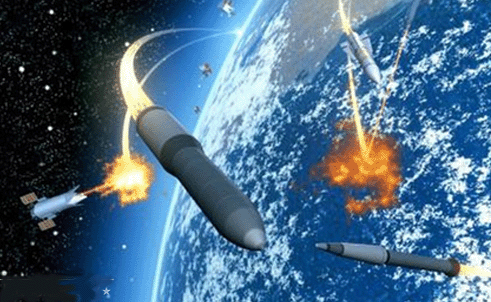
By Zohaib Altaf | April 9, 2025, https://thebulletin.org/2025/04/as-more-countries-enter-space-the-boundary-between-civilian-and-military-enterprise-is-blurring-dangerously/#post-heading
Outer space is no longer just for global superpowers and large multinational corporations. Developing countries, start-ups, universities, and even high schools can now gain access to space. The democratization of space has led to significant technological advancements, economic growth, and international collaboration.
In 2024, a record 2,849 objects were launched into space. The commercial satellite industry saw global revenue rise to $285 billion in 2023, driven largely by the growth of SpaceX’s Starlink constellation. Private space companies such as SpaceX have played crucial roles in making space more accessible globally.
Developing countries have also made strides. Since 2018, nations like Bangladesh, Ghana, Nepal, Rwanda, and Sri Lanka have launched their first satellites. The African space scene has grown, with 43 satellites launched since 2016, totaling 63 in 2025. Ethiopia, despite being one of the world’s poorest countries, has made significant progress in space activities. Similarly, Rwanda, with a substantial portion of its population living in poverty, has embarked on its space journey. These advances show that barriers to space entry are declining.
While the democratization of space is a positive development, it has introduced complex challenges, particularly an ethical quandary that I call the “double dual-use dilemma.” The double dual-use dilemma refers to how private space companies themselves—not just their technologies—can become militarized and integrated into national security while operating commercially
Unlike the traditional military-industrial complex, space companies fluidly shift between civilian and military roles. Their expertise in launch systems, satellites, and surveillance infrastructure allows them to serve both markets, often without clear regulatory oversight. Companies like Walchandnagar Industries in India, SpaceX in the United States, and the private Chinese firms that operate under a national strategy of the Chinese Communist Party called Military-Civil Fusion exemplify this trend, maintaining commercial identities while actively supporting defense programs. This blurring of roles, including the possibility that private space companies may develop their own weapons, raises concerns over unchecked militarization and calls for stronger oversight to preserve space as a neutral domain.
Dual use of space companies. Countries like the United States and China have already shown a willingness to use commercial space entities for military purposes. China encourages private entities to participate in space activities as part of its Military-Civilian Integration Strategy. Similarly, the 2021 United States Space Priorities Framework outlines how new commercial space capabilities and services can be leveraged to meet national security needs. In a 2021 interview, the then-head of the US Space Force discussed the importance of using the space industry for national security.
Researchers and security analysts are increasingly concerned that the dual use of private space companies is not limited to their space technologies, such as the satellites they launch. In some cases, a company may appear to be a civilian space entity while actually maintaining close links with defense sectors.
For instance, take the example of India, which has seen phenomenal growth in its space sector in recent years. The leading companies of the Indian Space Association have worked closely with the Indian Ministry of Defence on various contracts.
Furthermore, the association’s leadership maintains a close connection with the Indian army and defense organizations. For example, the first chairman, Jayant Patil, was also the senior vice president for defense business at Larsen and Toubro, an Indian company involved in the space industry. The company has collaborated with India’s Defence Research and Development Organisation since the mid-1980s.
The usefulness of space companies goes beyond their existing technologies. Military organizations can use expertise gained through civilian cooperation programs to develop other critical technologies. India’s intercontinental ballistic missile program, based on the SLV-3 vehicle, was initially developed under civilian space cooperation with NASA. India’s Agni-V ICBM, which is capable of carrying multiple warheads and has a range exceeding 5,000 kilometers, has also benefited from technological cooperation with NASA.
Indian private space companies such as Walchandnagar Industries are also defense contractors producing aerospace, defense, missile, and nuclear power technologies. These companies collaborate with India’s Defence Ministry and the Defence Research and Development Organisation to produce strategic articles, tactical missiles, and critical platform-based equipment. The expertise gained from private space launches and technological developments can be leveraged to improve missile technology.
There is a serious risk that civilian companies in India and elsewhere, having gained expertise through cooperation with the military, might start developing their own weapons. The table below shows how specific types of space expertise can be used to develop missiles, drones, precision missiles, hypersonic missiles, and other loitering munitions.
Dual use of space technology. India’s rapidly growing space sector and expanding military-commercial partnerships make it a key case study of the double dual-use dilemma. Unlike the United States and China, which have structured policies—the US Space Force and National Space Policy formally integrate private firms into defense, while China’s Military-Civil Fusion strategy mandates commercial space support for China’s army—India’s private space sector is expanding, but its dual-use regulatory framework is still developing. India’s Space Policy 2023, while not explicitly mentioning the military, hints at defense applications by emphasizing space capabilities for “national security.”
This lack of clear regulatory boundaries allows technologies initially developed for civilian use to be repurposed for defense applications, as seen in the case of Synthetic Aperture Radar. Originally acquired through civilian cooperation with NASA, this radar imaging technique is now being adapted for military reconnaissance and targeting. Although not a weapon, the technique’s dual-use nature enables high-resolution surveillance, missile guidance, and intelligence operations.
The commercialization of space by private companies poses significant security challenges. For instance, ostensibly civilian satellites can be repurposed for military uses such as surveillance and espionage. Commercial satellites with high-resolution imaging capabilities, like those from companies such as Planet Labs, can be used for intelligence gathering, providing detailed information on adversaries’ activities and installations. The dual-use dilemma affects governments as well as private companies, but poses greater risks with private entities due to weaker oversight and profit-driven priorities. Governments operate under strict security frameworks and treaties like the Outer Space Treaty, ensuring accountability in the use of dual-use technologies. In contrast, private companies may prioritize commercial interests, potentially selling technologies to less accountable actors, increasing proliferation risks. While satellite launches are regulated, post-launch activities—like selling high-resolution imagery or repurposing technology—are harder to monitor.
Furthermore, companies like the American company Capella Space have developed synthetic aperture radar satellites for civilian purposes such as disaster management and environmental monitoring. However, the high-resolution images provided by these satellites can also be used for military applications, including counterforce strikes and espionage. These satellites can monitor adversaries and plan strategic military operations.
Moreover, American companies like SpaceX and Blue Origin, which focus on developing rockets and spacecraft for civilian space missions, also have the potential to contribute to military logistics and defense operations. For instance, SpaceX’s Starlink constellation, designed for global internet coverage, could be used in military scenarios to support drone operations by enabling real-time communication and coordination, as seen during the Russia-Ukraine conflict.
Repurposing commercial technologies for military use introduces potential risks. Civilian systems could become high-value targets, vulnerable to cyberattacks and physical strikes, potentially disrupting operations and escalating conflicts into space. The reliance on privately owned infrastructure also poses challenges, as it reduces government oversight and increases the risk of misuse or proliferation. For example, reusable rockets developed for commercial launches could be adapted for missile programs, enabling military advancements to be concealed within civilian initiatives. These dual-use capabilities have the potential to blur the boundaries between civilian and military applications, increasing the risks of conflict escalation and complicating efforts to maintain global stability in a democratized space domain.
Need for robust regulatory framework. The challenges posed by the double dual-use dilemma necessitate robust regulatory frameworks and international cooperation to ensure that the commercialization of space does not compromise global security. For example, commercial satellite launch services could be used to deploy space-based weapons or reconnaissance systems under the guise of civilian activities, making it harder to enforce arms control agreements. Effective space governance must address the potential for commercial space entities to be co-opted for military purposes. One practical step is the establishment of international agreements that mandate transparency in satellite launches and operations.
The Outer Space Treaty, which forms the basis of international space law, should be expanded to include specific provisions for the dual use of space technologies. For example, countries could be required to declare the intended uses of their satellites, with periodic inspections to ensure compliance. International space governance must ensure that expertise gained through civil cooperation does not translate into new weapons programs.
Furthermore, partnerships between governments and private corporations should be regulated to prevent the misuse of commercial space capabilities. The European Union’s Space Surveillance and Tracking network is an example of regional cooperation to monitor space activities and ensure that space assets are used for their declared purposes. This type of cooperation should be extended globally to include major space-faring nations and emerging space players.
In the United States, the Space Force has already begun leveraging commercial space capabilities for national security purposes. For instance, the National Reconnaissance Office has contracted with commercial satellite companies to provide imagery for intelligence purposes. Such partnerships highlight the need for clear guidelines to differentiate civilian and military applications and to ensure that commercial space activities do not escalate geopolitical tensions.
The international community must develop comprehensive strategies to manage the complexities introduced by the double dual-use dilemma. It is no longer a distant challenge—it is actively reshaping the balance of power in space. As private space firms blur the lines between commercial innovation and military assets, the risk of an unregulated arms race beyond Earth’s atmosphere grows.
Without clear governance, space could follow the path of cyberspace—a once-neutral domain now deeply entrenched in geopolitical rivalry. The question is no longer if commercial space activities will fuel strategic competition, but how soon nations will act to prevent the militarization of the final frontier.
Russia’s Rosatom says will proceed with Myanmar nuclear plant despite quake.
Myanmar lies on the boundary between two tectonic plates and is one of the world’s most seismically active countries.
Reuters, By Panu Wongcha-um, April 22, 2025
Summary
Myanmar is one of the world’s most seismically active countries
Myanmar and Russia agreed in early March to build small-scale nuclear facility
Construction timeline and location have not been announced
Thousands were killed in March 28 earthquake
BANGKOK, April 22 (Reuters) – A plan to build a nuclear power plant will continue in Myanmar, a war-torn Southeast Asian country partly devastated by a massive earthquake in March, the Russian state-owned firm leading the project told Reuters.
Myanmar’s junta chief Min Aung Hlaing and Russian President Vladimir Putin last month signed an agreement for a small-scale nuclear facility, three weeks before the 7.7 magnitude quake flattened communities and left more than 3,700 people dead – the country’s deadliest natural disaster in decades.
The agreement involves cooperation to build a Small Modular Reactor (SMR) in Myanmar with an initial 110 MW capacity, consisting of two 55 MW reactors manufactured by Russia’s state nuclear corporation Rosatom.
“The recent earthquake has not affected Rosatom’s plans in Myanmar,” the company’s press office said in an email.
“Rosatom adheres to the highest international safety and reliability standards, including strict seismic resistance requirements.”
The company’s intention to go ahead with the nuclear plan despite the quake, which crippled critical infrastructure, has not been previously reported.
Rosatom declined to provide any construction timeline or details of the location of the proposed nuclear facility that will be powered by RITM-200N reactors, which were made by the company for use initially on icebreaker ships.
A Myanmar junta spokesman did not respond to calls from Reuters seeking comment.
The push for nuclear power in Myanmar comes amid an expanding civil war triggered by a 2021 military coup that removed the elected government of Nobel laureate Aung San Suu Kyi.
Facing a collection of established ethnic armies and new armed groups set up in the wake of the coup, the ruling junta has lost ground across large parts of the country and increasing leaned on its few foreign allies, including Russia.
The conflict, which stretches from the border with China to the coast along the Bay of Bengal, has displaced more than 3.5 million people and left Myanmar’s mainly agrarian economy is tatters.
Myanmar is currently evaluating options for financing the Russia-backed nuclear power project. “This may involve both own and borrowed funds,” Rosatom said. In places such as Bangladesh and Egypt, Russia has funded conventional nuclear power projects through low interest loans.
Authorities in neighbouring Thailand, which is closely monitoring Myanmar’s nuclear developments, assess that a plant could be built in Naypyitaw, a fortified purpose-built capital that was heavily damaged by the earthquake, according to a security source briefed on the matter.
Two other potential sites include a location in the central Bago region and the Dawei special economic zone in southern Myanmar, where the junta and Russia have announced plans to build a port and an oil refinery, according to the Thai assessment.
Myanmar lies on the boundary between two tectonic plates and is one of the world’s most seismically active countries.
MONEY AND MANPOWER
Southeast Asia’s first nuclear facility – the 621 MW Bataan Nuclear Power Plant in the Philippines – was finished in 1984 with a price tag of $2.3 billion but mothballed in the wake of the Chornobyl disaster, opens new tab in the then Soviet Union two years later.
The Philippines and other regional countries have since mounted repeated efforts to explore nuclear energy but made limited progress.
Vietnam is, however, renewing a bet on nuclear power after it suspended its programme in 2016.
Russia and Myanmar have been collaborating in the sector for years, with Burmese students studying nuclear energy and related subjects in Russian universities under government quotas since 2019, according to Rosatom…………………
With the Myanmar junta prioritising exports of natural gas, which could be used to fuel cheaper domestic power generation, to earn foreign exchange, the nuclear plan makes no economic sense for a cash-strapped administration, said Richard Horsey, senior Myanmar adviser at International Crisis Group.
“Nuclear power is very expensive, and Myanmar simply can’t afford it,” he said.
Reporting by Panu Wongcha-um; Editing by Devjyot Ghoshal and Kate Mayberry, https://www.reuters.com/business/energy/russias-rosatom-says-will-proceed-with-myanmar-nuclear-plant-despite-quake-2025-04-22/
Drawing inspiration from Vaclav Havel..

https://www.artistespourlapaix.org/3-ans-de-souffrances-ukrainiennes/
Par Pierre Jasmin, Artiste pour la Paix, 21 février 2025


1 Vaclav Havel and the Art of Compromise
Unfortunately, I never knew Vaclav Havel personally, even though I gave masterclasses (except for one in Piešťany, Slovakia), concertos, and recitals in the Czech Republic for fourteen summers between 1991 and 2005. I therefore had the privilege of experiencing the miracle of the Velvet Revolution in a country as Eastern European as Ukraine. The ruling communist party, allied with the Soviet army that had bloodily halted Dubcek's revolution, sought out a humanist playwright from prison in 1989 and installed him in the presidential seat. The new Havel government accepted the separation of Czecho-Slovakia less than three years later, without a drop of bloodshed.

Five years after the first Minsk Treaty (UN), mistreated by our Minister Baird, an accomplice of the fascist Poroshenko, a similar hope arose in Ukraine with the election of the comedian Zelensky in May 2019. This unprecedented electoral moment unfolded in the first round with the defeat of the comfortable Russian gas option (to prevent the elderly from dying in their poorly insulated homes) represented by the succession of the corrupt President Yanukovych, deposed by the Maidan revolution in 2014, and then, in the second round, of the outgoing head of state, Poroshenko.

But unlike Havel, Zelensky, with 73.2% of the vote, surrounded himself with nationalist Bandera supporters who threatened his life to force him to bomb Donbass and join his country to the militaristic NATO, thus provoking the Russian invasion of his country. In a context of devastating war, he avoided running for re-election.

Our government, Radio-Canada, and professors like Dominique Arel, the only ones authorized to speak (Artists for Peace are censored), are imposing the obstinacy of unconditional Canadian support for this Zelensky, corrupted by Biden's weapons and money, against the imposition of a peace desired by the sacrificed young people in the trenches of Donbass, those who survived, and by the improbable Putin-Trump duo. Other arguments can be read in ().
This point 1 was an “opinion” sent to Le Devoir on Wednesday, which did not publish it. On February 20, Arel was among six university colleagues who cowardly avoided contradicting his pro-Zelensky propaganda, except for Frédérik Gagnon of UQAM: see point 7.
Lviv and its troubled history
Putin is blamed for having wanted to invade the whole of Ukraine as early as the end of February 2022 with his advance near Kyiv, which aimed to bomb the arms factories and munitions located in the capital and in Lviv. Why this former capital of Galicia, which also bore the Austrian name of Lwow, the German name of Lemberg, and the Polish name of Lvov? The answer lies in the murky history revealed in two books I read by Philippe Sands, “Return to Lemberg” and “The Line.” With a complacent ambiguity that delighted his far-right readers at Albin Michel, the Franco-British lawyer recounts the romanticized saga of Charlotte, the Nazi wife of Otto von Wächter. A member of the Nazi Party since 1923, the latter became, after the outbreak of the Second World War, governor of Krakow in Poland, then governor of the district of Galicia, two territories that were noted for the mass extermination of Jews whom he saw as allies of the Bolshevik Soviet Union. “Handsome Otto” praised Lemberg, a place far more welcoming to his family than Berlin and Krakow, as it fully shared Nazi ideology. He evaded justice until 1949, notably due to complicity in the Vatican.
Before his two questionable books, Sands had worked on the horrors of the Rwandan genocide, the Bosnian-Serb massacres, Guantanamo, and the invasion of Iraq by Blair and Bush, but not Jean Chrétien, following our mass demonstrations in Montreal motivated by the UN’s refusal to endorse the war, given the conclusions of the Swede Hans Blix exonerating Saddam Hussein of possessing weapons of mass destruction. We should also read Sands’s 2006 book, prophetic of the recent marginalization of the UN by Biden, Trump, Macron, etc., Lawless World, subtitled Torture Made in the USA (Music And Entertainment Books, 2009), in which he denounced the use of music at Abu Ghraib by CIA agents and the American army, sentenced last November to pay millions of dollars to compensate three victims (who were better defended than the thousands of others).
February 21: A Ukrainian historian exposes the “real” Zelensky
Hosted by Clark University (Atlanta), historian Marta Havryshko, a graduate and professor at the University of Lviv (!), received death threats for criticizing the Ukrainian far right, to which she retorted:
“Every day, we lose parts of our territory. Every day, we lose people. Every day, our children suffer from missile and drone attacks. And we don’t know the consequences.”
She commented for Aaron Maté on the destruction of her homeland by a proxy war waged between Russia and the United States, with Zelensky’s complicity:
“Those who want to continue this disaster, this hell,” she said, addressing the foreign warriors and those who criticized her for seeking peace, “ARE THEY READY TO SACRIFICE THEIR LIVES, and those of their brothers, sons, and other beloved family members, FOR THE ABSURD IDEA OF ACHIEVING VICTORY? “Russia is bigger, resourceful, with powerful friends. I cannot conceive that anyone who is not mentally disturbed can truly believe that Ukraine can change the situation on the front and reconquer the lost territories.”
Marta observed family members forced to fight and die in this proxy war. She showed Aaron Maté newsreels showing the army Ukrainian forces hunting and kidnapping men to force them to become conscripts to replace soldiers who are dying (or being sent to hospitals).
“Who will recapture these territories? Several of my friends, several of my relatives, are conscripted now. They suffer from suicidal thoughts, they suffer from despair or intense frustration. No one can replace them because of the problems with forced mobilization, and because we simply lack manpower.“
And she explains that everyone (except the neo-Nazis) blames Zelensky:
“His popularity has plummeted (even though television channels are censored). Ukraine under Zelensky is no longer a democracy.“
American Caitlin Johnstone adds that anyone who doesn’t support a ceasefire is a monster (of ignorance, I might add, to soften her attack).
4 abi Yar
Western censorship of Russian music, even that of a genius like Dmitri Shostakovich, is applied, for example, to the excellent Italian film The Rape. Fortunately, in 2019, the Montreal Symphony Orchestra and Nagano programmed his thirteenth symphony with the choir featuring the composer David Sela. Through a long poem by the Ukrainian Yevtuchenko (whose ex-wife, the poet Bella Achmadulina, I met in Moscow in 1978 and 1987), the Babi Yar symphony, his masterpiece, denounces the worst pogrom of all time, perpetrated by Ukrainian einsatzgruppen: 33,771 Jews murdered on the night of September 29-30, 1941. Why don’t pro-Netanyahu activists say a word about this humanist work? Because NATO supports Israel?
5 – Chrystia Freeland vs. Glenn Michalchuk
We won’t dwell on the nefarious role played since 2015 by the granddaughter of a Ukrainian Nazi, up until the horrific House of Commons ceremony that gave a standing ovation to Zelensky and the old Nazi soldier Hunka, much to the dismay of our dear friend Glenn Michalchuk, National President of the Association of United Ukrainian Canadians and a peace activist in Winnipeg, who spoke with the Artists for Peace on November 24 at the Pan-Canadian Justice and Peace Network Counter-Summit ().
6 – Colleague David Mandel
and Sachs, Guterres, Swanson, Rabkin, Philpot, Saul, Seymour, Maté, Lorincz, Stone, etc.
A full professor of political science at UQAM, David, who is Jewish, had a devastating experience following Ukraine’s breach of the UN treaty signed in Minsk in 2014: he spent his summers with trade unionists in the Ukrainian Donbass who were being bombed by the Azov Battalion; here’s a photo that triggers warnings from the Royal Canadian Mounted Police on my computer every time I share it, even though my intention is not to claim that the Nazification of Ukraine was a major phenomenon in the population.
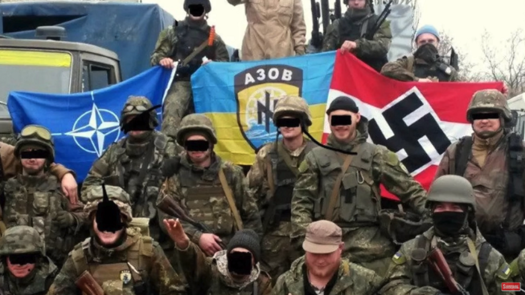
(on the original of this photo, the man on the left is making a NAZI salute)
But here as elsewhere, for example in Germany on this election day where the AfD is increasing its support through a fierce campaign against immigrants and the illusion that more money for the army will solve the problems, the vociferous extreme right is taking an exaggerated position.
Supported by Professor Jeffrey Sachs of Columbia University, also an advisor to Antonio Guterres, David Swanson of World Beyond War writes: “NATO is not what its defenders imagine it to be. NATO is neither legal nor legalistic. It is a violation of the UN Charter for a group of nations to swear to join each other’s wars, and it does not legalize, authorize, legitimize, or sanctify a war.” Amen to the British-American wars in Iraq, Syria, and Afghanistan, at the cost of hundreds of thousands of deaths. A warning to journalists who still lie about the obvious.
7 – UQAM and the Raoul Dandurand Chair – Forum on February 20 at 12:30
Seven guests, including six university professors, spoke, repeating media nonsense. Third, then first in line to ask questions, the organizers (who know me) interrupted the presentation four minutes before the scheduled start time of 2:00 p.m. PAIX’s opinion is not welcome among intellectuals, who find it too simplistic…and, above all, anti-government.
The APLP really don’t like dictators Putin and Trump, but if they stop the war, on this point alone, we will congratulate them. The same goes for Elon Musk, if he succeeds in cutting the American military budget in half as he says he intends to do. Are the left-wing ideologues disowning us? We reassure them that as soon as these two objectives are achieved (?), we will collaborate in the fight for equality, fraternity and liberty…
8. Good news in Berlin with the award of a special prize on February 18th to the following film, which we loved for its objectivity on Hamas and the fate of civilians in the Gaza Strip following the Israeli bombings that decimated the family of this great humanist
ANNE LINDSEY DENOUNCES MARK CARNEY’S NUCLEAR TEMPTATIONS.

Article published on April 16 in the Winnipeg Free Press. https://www.artistespourlapaix.org/anne-lindsey-denonce-tentations-nucleaires-carney/
IN this “flag-waving” moment, where the U.S. government is threatening our sovereignty and economic well-being, it now appears the federal election is the Liberals’ to lose.
Amid the hype and adulation for Liberal Leader Mark Carney, however, the Liberals are promoting ideas that merit a closer look. Not least their plan to “make Canada the world’s leading energy superpower” announced in Calgary on April 9.
On the surface, it looks like the perfect recipe for self-reliance in energy and building a stronger Canada. It’s an industrial development strategy meant to exploit our natural mineral resources, build needed infrastructure and create jobs.
But what kind of energy and infrastructure? The plan includes many welcome and essential commitments to reducing emissions: investment in zero-emission vehicles, developing battery and smart grid technologies, reducing methane, and references to our “clean energy advantage.”
But there is also this nagging notion of “dominating the market in conventional energy” and building out pipelines… neither of which square with the looming climate emergency, regardless of (and exacerbated by) the external pressures from the south.
The “clean energy advantage” is not well defined. Conventional wisdom suggests it includes hydropower, renewables like solar, wind, and geothermal energy, along with energy efficiency. However, although Carney mentioned “more nuclear, both large scale and small modular” in his Calgary announcement, the word “nuclear” is absent from the written plan.
Why? Nuclear is a controversial energy technology, for good reason. It seems inevitable that nuclear power will play a starring role in Canada’s energy future but not one the Liberals want to highlight.
Nuclear’s proponents might be winning the semantic battle branding it as “clean,” despite its routine operations releasing a cocktail of radioactive substances, its waste products containing among the most dangerous elements on the planet, and its inextricable link to the manufacture and proliferation of nuclear weapons.
Federal Liberals (and for that matter, Conservatives) have always been pro-nuclear, even though no nuclear plants have been built in Canada for decades. The annual federal expenditure on Crown corporation Atomic Energy of Canada Limited is more than $1 billion, due in no small part to the massive liabilities of managing nuclear waste. Tax credits for nuclear companies already abound.
Just this year, in the month of March alone, the current Liberal government committed another nearly half a billion dollars to a variety of nuclear projects across the country. The plan may not talk, but money does.
Mark Carney himself, a former UN special envoy on climate change and finance, has said there is “no path to net zero without nuclear.” In 2022, he joined Brookfield Asset Management, a firm holding both renewable energy and nuclear portfolios that, together with uranium giant Cameco, purchased bankrupt reactor company Westinghouse, under his watch. No question that Carney has a strong pro-nuclear bent.
More nuclear energy is an inappropriate climate action response, for at least two reasons. First, reactors take decades to be licensed, constructed and connected to the grid. And that’s a luxury we can’t afford.
Business as usual while waiting for nuclear power to get online means we surpass the tipping points of global warming, a scenario we must avoid.
Second, nuclear is the costliest way to generate electricity. Studies by organizations from the Ontario Clean Air Alliance to Lazard show that nuclear is not competitive with renewable alternatives which continue to drop in price. As governments fund nuclear, there is a massive lost opportunity cost for developing cheaper and readily available renewable energy.
Nuclear is too slow and too expensive to address climate change. The IPCC shows nuclear to be inefficient in reducing emissions. This is not an ideological perspective. It is fact.
Besides, “new generation” reactors being touted in Canada (such as GE Hitachi’s BWRX300) carry a massive political liability, given current world events: most are American designs and all require enriched uranium fuel fabricated outside Canada.
Hardly a prescription for self-sufficiency. It’s a bit mysterious why “nuclear” does not appear in Liberal election plans while getting so much government (Liberal and Conservative) attention and money — unless we recognize the essential role of civilian nuclear infrastructure in maintaining weapons of mass destruction. Canada was instrumental in building the first atomic bombs and remains central to today’s U.S. defence/weapons supply chains for critical minerals, including uranium. Let’s keep that in mind as leaders negotiate trade and tariffs.
Canada should define itself not by becoming an “energy superpower” in the conventional and nuclear sense, but by disengaging from the defence industrial complex. We should use our critical minerals, ingenuity and workforce to pursue a decentralized, affordable, locally based renewable energy infrastructure leaning heavily into building and transportation efficiencies. We need to work together with Indigenous and remote communities, fully understand environmental and social impacts of developments and create smart grid interconnections that allow for maximum flexibility in energy sharing within Canada.
Anne Lindsey volunteers with the No Nukes MB campaign of the Manitoba Energy Justice Coalition and has been monitoring nuclear waste since the 1980s.
Pope Francis’ Obituaries Omit Focus on Palestine
rather than criticizing Francis’ attention to Gaza, the lengthy obituaries in the most prominent US newspapers ignored his advocacy for Palestinian rights entirely.
By relegating Francis’ compassion for Palestine to sidebars, as though it were only of transient interest, US outlets eliminated a central aspect of his papacy from that record.
Fair, Ari Paul, April 23, 2025
The obituaries for Pope Francis in the leading US newspapers ignored the late pontiff’s commitment to the Palestinian people and the acute suffering in Gaza in the last years of his life. Many of them ran separate pieces that highlighted Francis’ concern for Gaza and the response of Palestinians to his death, but they failed to mention these aspects of his papacy in the lengthy obituaries that summed up his life.
……………………………………………..regarding his outspoken concern for Gaza, the Times found room for not a word.
Obituaries at other major US newspapers also failed to include Francis’ Palestine focus.
……………………… Toward the end of Francis’ life, the head of the Catholic Church focused his attention on ongoing genocide in Gaza. “He used to call us at 7 p.m. every night. No matter how busy he was, no matter where he was, he always called,” George Anton, spokesperson for the Church of the Holy Family in Gaza, told NPR (4/22/25). Reuters (4/22/25) ran the headline, “Gaza’s Christians ‘Heartbroken’ for Pope Who Phoned Them Nightly.” AP (4/21/25) called these communications his “frequent evening ritual,” noting that this “small act of compassion made a big impression on Gaza’s tiny Christian community.”
Francis was generally sympathetic to addressing political and human rights for Palestinians, and under his watch the Vatican recognized the state of Palestine (BBC, 5/13/15). He “suggested the global community should study whether Israel’s military campaign in Gaza constitutes a genocide of the Palestinian people” (Reuters, 11/17/24). In his final Easter message, issued the day before his death, he called for a ceasefire in Gaza to end a conflict that “continues to cause death and destruction, and to create a dramatic and deplorable humanitarian situation” (Truthout, 4/21/25).
‘Privileged a politicized version’
Not everyone in the press approved of this act of compassion when recalling his life and church leadership. In an editorial, the New York Post (4/21/25) criticized the “leftist” positions of the “deservedly beloved figure,” complaining that Francis “even went so far as to call for an investigation of Israel over its nonexistent genocide in Gaza.”
When it came to Francis’ support for Middle East peace generally, the Jerusalem Post (4/22/25) said in an editorial, “Time and again, Israel expressed dismay at the Vatican’s tendency to elevate Palestinian narratives while brushing aside Israeli concerns.” It complained that “the Vatican’s posture under Francis consistently privileged a politicized version of the Palestinian story over the complex reality on the ground.”
But rather than criticizing Francis’ attention to Gaza, the lengthy obituaries in the most prominent US newspapers ignored his advocacy for Palestinian rights entirely…………………………………………………………………..
regarding his outspoken concern for Gaza, the Times found room for not a word.
Obituaries at other major US newspapers also failed to include Francis’ Palestine focus.
………………………………………………The Wall Street Journal’s obituary (4/21/25) didn’t say anything about the topic either, though it said that Francis
made a priority of improving ties with the Islamic world, washing the feet of Muslims on Holy Thursday, visiting nine Muslim-majority countries and insisting that Islam was, like Christianity, a religion of peace.
The same is true with AP‘s obituary (4/21/25), which likewise commented instead that he “charted new relations with the Muslim world by visiting the Arabian Peninsula and Iraq.” USA Today’s obituary (4/21/25) said Francis “sometimes took progressive or controversial stances on pressing issues, such as same-sex couples and climate change,” but it didn’t bring up Gaza.
By contrast, it was not hard to find references to Gaza in Francis’ obituaries in major non-US English-language outlets. The British Guardian (4/21/25) noted, “During his recent period in hospital, he kept up his telephone calls to the Holy Family church in Gaza, a nightly routine since 9 October 2023.” The Toronto-based Globe and Mail (4/21/25) included Palestine in a list of war-ravaged places Francis prayed for, and devoted most of a paragraph to his nightly Gaza calls. Reuters (4/21/25), headquartered in London and owned by Canada’s Thomson family, noted that Francis’ last Easter Sunday message “reiterated his call for an immediate ceasefire in Gaza—a conflict he had long railed against.”
Though the major US obituaries all ignored Gaza, the same outlets published separate articles on Francis and Gaza. USA Today (4/21/25) ran “Pope Francis Used Final Easter Address to Call for Gaza Ceasefire.” The Wall Street Journal (4/23/25) had “Pope Francis Kept Up Routine of Calling Gaza Until the End.” For the New York Times (4/22/25), it was “Even in Sickness, Pope Francis Reached Out to Gaza’s Christians.” AP (4/21/25) offered “Pope’s Frequent Calls to a Catholic Church Made Him a Revered Figure in War-Battered Gaza,” an article that appeared on the Washington Post‘s website (4/21/25).
These stand-alone pieces are welcome, and spotlight the importance of the Gaza crisis to Francis. But the official obituaries in these major outlets are meant to stand as a permanent record of Francis’ life and career. By relegating Francis’ compassion for Palestine to sidebars, as though it were only of transient interest, US outlets eliminated a central aspect of his papacy from that record.
Reuters not only had a stand-alone story (4/22/25) about Palestinians’ response to Francis’ death, but included his advocacy for Gaza in its main obituary (4/21/25) https://fair.org/home/pope-francis-obits-omit-focus-on-palestine/
Nuclear Free Local Authorities express support for Democracy Day at USAF Lakenheath

The NFLAs have sent a message of solidarity and support to the organisers
of the Peace Camp at RAF / USAF Lakenheath for Democracy Day being hosted
today. The Lakenheath Alliance for Peace has kept up a 24/7 vigil at the
gates of the airbase since 14th April. LAP consists of 59 organisations,
including the NFLAs, who are opposed to the siting of US nuclear weapons at
the base and campaign in favour of nuclear disarmament. Although notionally
an RAF station, Lakenheath is really the largest US airbase in the UK
hosting the 48th ‘Liberty’ Fighter Wing of around 6,000 personnel and
F-15C/D Eagle, F-15E Strike Eagle, and F-35A Lightning II fighter bomber
aircraft. From 1954 until 2008, the station held nuclear weapons in its
inventory. Now there are plans to reintroduce them.
NFLA 22nd April 2025, https://www.nuclearpolicy.info/news/nflas-express-support-for-democracy-day-at-usaf-lakenheath/
1 This Month





PLEASE OPPOSE HR 8255 AND S.3639 – bills would accelerate satellite deployment, with no environmental review or safeguards – https://ncstd5li.quorum.us/campaign/169331/
To see nuclear-related stories in greater depth and intensity – go to https://nuclearinformation.wordpress.com
-
Archives
- October 2026 (91)
- September 2026 (339)
- August 2026 (330)
- July 2026 (355)
- June 2026 (287)
- May 2026 (306)
- April 2026 (356)
- March 2026 (251)
- February 2026 (267)
- January 2026 (308)
- December 2025 (358)
- November 2025 (359)
-
Categories
- 1
- 1 NUCLEAR ISSUES
- business and costs
- climate change
- culture and arts
- ENERGY
- environment
- health
- history
- indigenous issues
- Legal
- marketing of nuclear
- media
- opposition to nuclear
- PERSONAL STORIES
- politics
- politics international
- Religion and ethics
- safety
- secrets,lies and civil liberties
- spinbuster
- technology
- Uranium
- wastes
- weapons and war
- Women
- 2 WORLD
- ACTION
- AFRICA
- Atrocities
- AUSTRALIA
- Christina's notes
- Christina's themes
- culture and arts
- Events
- Fuk 2022
- Fuk 2023
- Fukushima 2017
- Fukushima 2018
- fukushima 2019
- Fukushima 2020
- Fukushima 2021
- general
- global warming
- Humour (God we need it)
- Nuclear
- RARE EARTHS
- Reference
- resources – print
- Resources -audiovicual
- Weekly Newsletter
- World
- World Nuclear
- YouTube
-
RSS
Entries RSS
Comments RSS

