Danger of an India-Pakistan war and Canada’s Reactors
Normand Lester, Journal de Montréal, 27 avril 2025, https://www.journaldemontreal.com/2025/04/27/danger-de-guerre-indo-pakistanaise-et-nos-candu
An individual with dual Canadian and Pakistani citizenship has just been arrested in the USA for attempting to acquire technology for Pakistan’s nuclear weapons program and smuggle it through Canada.
The case comes to light as tension mounts between India and Pakistan following the massacre of 26 Indian tourists in the disputed region of Kashmir. New Delhi accuses Pakistan of being responsible. The latter denies being behind the attack. India has annexed Muslim-majority Kashmir, which is claimed by Pakistan. China is a major ally of Pakistan, while India has close defense ties with the United States.
Clashes between the two armies increased, raising fears of a large-scale military conflict. Peace has never really been restored since 1947, when the British Indian Empire was violently partitioned into two independent states: Muslim-majority Pakistan and Hindu-majority India. The war of religious partition is thought to have claimed between one and two million lives, and led to the massive displacement of between 12 and 20 million people.
A-bomb: thanks to Canada
India and Pakistan have already fought two major wars, in 1965 and 1971, before acquiring nuclear weapons… with the help of Canada. Any war between them could therefore turn into a nuclear exchange.
Since then, India and Pakistan have experienced a major border skirmish in 1999, which left at least 1,000 people dead.
After donating one nuclear reactor to India in 1956, Ottawa heavily subsidized the purchase of another by India in 1963. As part of this purchase, Canada trained 271 Indian scientists, engineers and technicians, who went on to develop New Delhi’s atomic bomb.
In 1971, Canada built a 137-megawatt CANDU nuclear reactor in Karachi, Pakistan. The contract also included a heavy water production facility. Three years later, in 1974, India detonated its first nuclear device, dubbed the “Smiling Buddha”, using plutonium from the reactor donated by Ottawa in 1956.
According to experts, Canadian reactors are ideal for producing weapons-grade plutonium, and Ottawa hasn’t even asked India to comply with the safeguards required by the International Atomic Energy Agency (IAEA).
Canada sneaks away
U.S. Secretary of State Henry Kissinger then roundly criticized Canada, telling the media that the Indian nuclear explosion had been carried out using material diverted from a Canadian reactor lacking the appropriate safeguards.
With its guilt exposed, Canada quietly withdrew from the Indian CANDU project. It also stopped supplying uranium to Karachi, and withdrew from the Pakistani project. This did not prevent it from carrying out its first nuclear test in 1998.
If India and Pakistan ever wage nuclear war on each other, Canada will have to assume – in part – the moral responsibility.
Why is No. 1 US bombing No. 137 Yemen?
Walt Zlotow, West Suburban Peace Coalition, Glen Ellyn IL,
Is there a bigger bully in the world than President Trump?
Trump’s current effort is bullying the hapless innocents in Yemen. Trump will never war against anyone his own size. His No. 1 $30.5 trillion economy singled out for destruction No. 137, the $17.4 billion economy of Yemen.
Trump has launched 750 airstrikes against Yemen since March 15, killing and injuring over thousand innocents. His latest strike on Yemen’s Ras Isa fuel port in Hodeidah Province killed 95 and injured 192. Defense Secretary Pete Hegseth, in a nod to America’s all time premier warmonger Teddy Roosevelt, has dubbed the bombing campaign Operation Rough Rider. Ouch.
As with every US bombing campaign against innocents in weak countries, Congress simply rolls over allowing these grisly, unconstitutional wars to proceed without an iota of pushback.
Why is Trump bullying pitifully poor Yemen? Because Yemen is interfering in the ongoing Israeli/US genocide in Gaza. Yemen has largely shut down vital (tho not to US) Red Sea shipping with drone attacks to degrade Israel’s Gaza genocide campaign. Trump’s futile bombing campaign, which will never stop the Yemeni Houthis from opposing genocide, has no connection to US national security interests whatsoever.
That is unless our national security interests include enabling Israel to complete their genocidal ethnic cleansing of Gaza so Trump can kick off his dream real estate development, creating Trump Gaza Mediterranean to expand Greater Israel.
Robotic arm struggles to take fuel sample from Fukushima plant

By KEITARO FUKUCHI/ Staff Writer, April 28, 2025, https://www.asahi.com/ajw/articles/15704793
A narrow, attic-like space lies directly below the No. 5 reactor at the Fukushima No. 1 nuclear power plant, showing the difficult route a robotic arm must take to collect samples of melted fuel debris in a sister reactor.
The robotic arm is 22 meters long, weighs 4.6 tons and has 18 articulatable joints.
It has been developed to retrieve samples from the No. 2 reactor of Tokyo Electric Power Co.’s Fukushima No. 1 plant—which was crippled when the 2011 Great East Japan Earthquake and tsunami triggered a nuclear disaster at the facility.
To this day, an estimated 880 tons of melted fuel debris remain in the No. 1 through No. 3 reactors, and recovering this material is considered the most challenging phase in the long decommissioning process.
After more than six years of development using taxpayer money and undergoing numerous setbacks, the robotic arm may go on its first real debris retrieval mission later this fiscal year—or face being scrapped.
“The latest attempt may prove a failure since numerous trials have produced no successful outcomes so far,” said a nuclear industry insider. “The robot arm might be left to gather dust without ever being used.”
News reporters were given a tour in January of the crippled power plant’s No. 5 reactor, which is the same model and reportedly has the same dimensions as the No. 2 reactor, to see the route the arm must take if it is to succeed.
THE MISSION
To reach the debris, the arm will have to be navigated—by remote control—through the same narrow route at the No. 2 reactor that the reporters traversed at its twin.
The first step will be to carefully insert the arm, which is 40 centimeters tall, through an opening with an inner diameter of just 55 cm.
Once inside the 1.5-meter-tall space directly under the reactor, the approximately 4-meter-long tip of the arm will be slowly rotated and lowered to reach the fuel debris at the bottom of the containment vessel.
“Adjusting the joints’ angles is particularly difficult,” said a TEPCO public relations representative. “Even a single error can cause the device to hit its surroundings.”
TRIAL AND ERROR
The robotic arm has been under development since fall 2018 by Mitsubishi Heavy Industries Ltd. and a British company from the nuclear power industry. As much as 7.8 billion yen ($53.1 million) in taxpayers’ money has been invested in the arm and related projects.
However, the project has faced numerous setbacks.
The government and TEPCO initially planned to debut the arm in a debris retrieval test in 2021, but the device was unable to move with the necessary precision, causing delays.
When the first retrieval test was finally undertaken in November 2024, a simpler device with a solid track record in past applications was used instead. The same device was used in the second retrieval test earlier this month—while revisions on the robotic arm continued.
Because the arm’s weight is supported at its base, the device tends to bend and move unsteadily when extended.
“They are working hard to carry out this difficult procedure under particularly challenging conditions,” said Hajimu Yamana, president of the Nuclear Damage Compensation and Decommissioning Facilitation Corp. (NDF), which serves as an adviser on the decommissioning work.
As the arm’s development dragged on for more than half a decade, new problems arose in and after August 2024.
Disconnection of motor cables that had deteriorated over time was detected, as was a failure in the arm’s obstacle removal mechanism.
In December that year, the robotic arm came into contact with a model of the containment vessel during a test. However, it later safely passed through the opening without encountering any obstructions after its operators fine-tuned the insertion point.
“New issues arise each time a test is conducted,” lamented Yusuke Nakagawa, a TEPCO group manager involved in the project. “We just have to address them one by one again and again.”
TEPCO began dismantling part of the robotic arm in February to examine the deteriorated cable. The inspection is expected to take three to four months, and the arm will likely undergo additional operational tests after that.
THE FUTURE
For now, TEPCO plans to put the robotic arm to practical use at the site in the latter half of fiscal 2025.
“The final decision (on whether to actually use the arm on site) will be made after taking into account the results of the envisioned operational tests,” said Akira Ono, president of TEPCO’s Fukushima Daiichi Decontamination and Decommissioning Engineering Co.
The future of the robotic arm is still unclear given that its official introduction has already been delayed four times.
Officials involved are expressing a growing sense of alarm.
Toyoshi Fuketa, an ex-chairman of the Nuclear Regulation Authority, calls for reviewing the current plan.
“Never changing a plan once it has been decided upon, even if it does not work properly, is a bad habit of Japan,” he noted. “People should have the courage to back down at times (by giving up on the robotic arm).”
Victory for Greenpeace Luxembourg against EDF in court transparency ruling

Thomas Toussaint – Adapted by RTL Today, Update: 28.04.2025 ,
https://today.rtl.lu/news/luxembourg/a/2297912.html
In a landmark decision for nuclear transparency, the Strasbourg administrative court has ordered energy giant EDF to disclose information previously kept under wraps about the Cattenom nuclear power station, marking a major victory for Greenpeace Luxembourg.
Greenpeace went to court to challenge EDF’s refusal to provide information on “the possible use within the Cattenom nuclear centre of parts manufactured by the Italian company Tectubi, their destination and their conformity.”
The parts had previously been inspected by Italy’s Nuclear Safety Authority, which identified shortcomings in their production process.
The suspect parts were alleged to have been used to address the well-known issue of stress corrosion, detected in several nuclear power plants, including Cattenom. Greenpeace therefore requested to be informed of the possible use of these parts at the Moselle power station.
In response, the plant’s management refused, citing trade secrecy under the Code of Public Administration Relations. This left Greenpeace with no alternative but to turn to the administrative court in July 2023.
In a ruling on 24 April 2025, the Strasbourg court confirmed that the documents requested by Greenpeace Luxembourg were not subject to secrecy and ordered the director of Cattenom to provide the information within two months. EDF has also been ordered to pay €1,500 to Greenpeace Luxembourg.
“The decision by the administrative court is an important victory for transparency and nuclear safety,” said Roger Spautz, nuclear campaigner at Greenpeace Luxembourg. “EDF cannot continue to conceal crucial information regarding reactor safety, especially when issues such as stress corrosion and cracking are concerned.”
Pope Francis Refused to Be Silent on Gaza. Will His Successor Follow Suit?
Even from his hospital bed, Pope Francis continued his near-daily video calls in solidarity with Palestinians in Gaza
By Seraj Assi , Truthout, April 27, 2025
Pope Francis, who died on April 21, was a rare beacon of hope for many Palestinians in the long months of the Gaza genocide. The pope refused to be silent on Gaza. For 18 months, he made nearly daily video calls in solidarity with Palestinians in Gaza, including recent calls he made from his hospital bed. He rang the Holy Family Church in Gaza City every night, speaking with church leaders and displaced Palestinians sheltering there, usually for about 15 minutes.
Pope Francis began one of his most memorable calls to parishioners in Gaza earlier this year by saying “As-salaam Alaikum” (“Peace be upon you”). The video of that call showed his intimate relationship with the small Palestinian Christian community that remains in Gaza, many of whom he came to know by name. His final call to the Gaza Strip, made two days before his death, lasted 30 seconds.
For many in Gaza, those phone calls were a ray of light that shone through the horrors of Israeli genocide, which has killed over 51,000 Palestinians, most of them women and children. “His Holiness the pope was not an ordinary person,” Musa Antone, a Christian resident of Gaza, told CNN. “He was a man of faith who inquired about both Christians and Muslims.”
The surviving Christian community in Gaza now mourns Francis’s loss. “We felt like ‘Oh my God, we’re like orphans now,’” lamented George Anton, a local Catholic, and the emergency coordinator in the Holy Family church. “He was a real father to us. Pope Francis was like a shield for the Christians in the enclave. He was the fighter. He was fighting for our rights and for our protection.”
Kamal Anton, a 72-year-old who had taken shelter at the church amid the genocide, said: “During his call, he prayed for peace and resilience for us in Gaza. He never forgot the word ‘peace’ in any of his calls with us throughout the war. His support included all of us — Christians and Muslims alike. He prayed daily for our safety.”……………………………………………
In a tribute to the late pope, Palestinian theologian Munther Isaac wrote Monday: “He conveyed true compassion to Palestinians, most notably to those in Gaza during this genocide. The pope left our world today, and the occupation and the wall remained. Even worse, he left our world while a genocide continues to unfold.”
Pope Francis’s last public appearance was a plea to end the war in Gaza. In an Easter message one day before his death, the pope, visibly very sick, renewed his call for a ceasefire
The appeal culminated Francis’s months-long antiwar legacy in Gaza. In 2024, the pope wrote that, “what is happening in Gaza has the characteristics of a genocide,” while calling for an international investigation. He called Israel’s genocide in Gaza “shameful,” “deplorable” and a “useless slaughter” of civilians. He also labeled Israel’s massacres of civilians in Gaza “terrorism.” In December, after an Israeli strike in Gaza killed Palestinian children, he said: “Children have been bombed. This is cruelty. This is not war. I wanted to say this because it touches the heart.”…………………………………
Last Christmas, in a bold symbolic gesture against genocide, Francis unveiled a Nativity scene portraying baby Jesus in a crib lined with a Palestinian Keffiyeh, which was likely inspired by Palestinian Rev. Munther Isaac’s iconic “Christ in the Rubble” Christmas sermon in Bethlehem………
Pope Francis’s support for the Palestinian people was not merely humanitarian; he also unequivocally recognized Palestinian independence and freedom. Ten years ago, when he visited Bethlehem, widely recognized as the birthplace of Jesus, he referred to the land as “the State of Palestine.” Shortly after, the Vatican signed a treaty recognizing the State of Palestine. “Yes, it’s a recognition that the state exists,” affirmed Rev. Federico Lombardi, the Vatican spokesman.
Pope Francis’s unwavering solidarity with Gaza stood in sharp contrast with the shameful complicity of the Western political class. “This campaign has made Pope Francis arguably the most consistent high-profile defender of the humanity of the Palestinian people during a period when the Israeli assault on Gaza has been pursued with relentless violence,” wrote John Nichols ………………………………………..
In a move that has caused some controversy within Israel, according to the Israeli news site Ynet, the foreign ministry in Israel sought to prevent its ambassadors from expressing condolences following the pope’s passing. Middle East Eye reports: “Without providing an explanation, the ministry instructed its missions and diplomats to delete any social media posts mourning the former pope, according to Yedioth Ahronoth” (a major Israeli newspaper). Meanwhile, Israeli Prime Minister Benjamin Netanyahu waited more than three days after Pope Francis’s death before finally offering his own condolences on Thursday, following backlash over the foreign ministry’s deletion of condolence tweets.
Certainly, Francis’s broad antiwar vision, which made him a champion of nuclear disarmament who opposed and denounced nuclear weapons as “immoral,” did not endear him to warmongers………………………………..
Amid urgent concerns about the ongoing genocide in Gaza and rising attacks on the LGBTQ community in the U.S. and beyond, Palestinians and progressive supporters of the church are nervously awaiting news about who the pope’s successor will be.
One notable candidate to replace Pope Francis is the Latin Patriarch of Jerusalem, Cardinal Pierbattista Pizzaballa, a longtime advocate for the Christian minority in the Holy Land.
Cardinal Pizzaballa has praised the late pope’s moral clarity on Gaza, saying:
War is not just weapons. War is sometimes words. Pope Francis recently, especially in the last year, has been very outspoken about the situation of the Holy Land, calling for the liberation of the hostages, but also condemning the dramatic situation, the ongoing war in Gaza and the situation for Palestinians.
Cardinal Pizzaballa, an Italian Franciscan prelate, is the top Catholic in the Middle East with an archdiocese encompassing Israel, Palestine, Jordan and Cyprus. He has appealed for peace from both sides, and led a Christmas mass both in Gaza and Jerusalem. The cardinal, who visited Gaza in May 2024 after months of ceasefire negotiations, nearly one year after he offered to be exchanged for Gaza hostages, would be expected to continue some aspects of Francis’s leadership of the church……………………………………………………………
Cardinal Sarah, who has branded himself as a “parallel authority” to Pope Francis, has defended clerical celibacy, denounced “gender ideology,” and refused any “theological dialogue” with Islam –– a stark departure from the late pontiff’s legacy, who made notable progress in interfaith relations, particularly with Muslims. As Katherine Kelaidis writes at Vox, it’s important to note that “millions of dollars have been spent pushing a conservative social agenda in Africa” — a dynamic at play in the rise of socially conservative church leaders like Cardinal Sarah…………………………………………………………..
Another more progressive candidate is Luis Antonio Gokim Tagle, who hails from the Philippines. Described by some commentators as “Asian Francis,” the Filipino prelate has been praised for his commitment to social justice and equality, particularly for marginalized groups like LGBTQ people and the poor, though he simultaneously maintains a hardline anti-abortion stance.
……………………………………………. like most of the candidates, Cardinal Tagle’s views on the Gaza genocide remain to be seen.
Meanwhile, Raymond Burke, the Wisconsin-born cardinal, and Trump’s favorite candidate — a rabid Islamophobe who is highly conservative and clashed with Pope Francis on issues ranging from LGBTQ rights and the role of women in the church, to immigration — is perfectly positioned to become Trump’s papal puppet in the Vatican if he is chosen.
Pope Francis’s bold political stance on Palestine will put to the test the apolitical and eerie silence among his progressive successors, few of whom have expressed substantial views on Palestine. One of the few who have done so is Matteo Zuppi, the cardinal from Bologna, who was Francis’s peace envoy between Russia and Ukraine, and has worked extensively to broker peace there. He been outspoken in the wake of October 7, calling for peace, urging the need to understand the “root causes” of the conflict. He also called Hamas “the worst enemy of the Palestinian people.” He visited Bethlehem, called for a ceasefire, and highlighted the suffering of Palestinian children.
The other candidate who has publicly expressed a view on Palestine is Pietro Parolin,the first person Francis made a cardinal, in 2014. As secretary of state, he was involved in the George W. Bush administration’s attempts to revive the Israeli-Palestinian peace talks. He argued against deportation of Palestinians in Gaza in a rebuke to Trump’s plan, urged for lasting peace in Gaza and called for respect for humanitarian law. But he is hardly a liberal………………………
Most of the other candidates have hardly ever addressed Palestine, save for general allusions to peace. The issues of Palestine, social justice and immigration are inexorably linked, and many Palestine solidarity activists are hoping that the next pope will not fail to see that justice should be whole and not selective or partial.
Pope Francis, the first Latin American pontiff, brought a limited yet desperately needed progressive spirit to the Catholic Church. For all his reluctance to bring about church reforms on social issues, he will still go down as a symbol of a more compassionate and tolerant Christianity; a steadfast voice of peace and opponent of genocide; and a defender of the oppressed in Gaza, immigrants and the poor. Judging from the list of potential candidates, a move rightward seems likely………………………………………………….
Seraj Assi is a Palestinian writer living in Washington, D.C. and the author, most recently, of My Life as an Alien (Tartarus Press).
The Great British nuclear expansion is a project bound to fail.
With the government committed to a huge expansion of nuclear power to meet
our energy needs, Andrew Blowers and Stephen Thomas contend that this is an
uneconomic, unachievable and undesirable solution that is doomed to fail.
In 2022, the then Conservative government set a target of having 24GW
(gigawatts) of new nuclear capacity up and running by 2050, despite the
dismal history of cost and time over-runs experienced in developing the
existing plans. If achieved, this would be the equivalent of having eight
more Hinkley Point Cs.
The succeeding Labour government reaffirmed its
commitment to nuclear power in its manifesto, proclaiming that a scale
expansion ‘will play an important role in helping the UK achieve energy
security and clean power’ Neither government was prepared to recognise that
the Great British nuclear expansion is a project bound to fail.
TCPA (accessed) 28th April 2025,
https://www.tcpa.org.uk/sample-journal-content/
Scrapping Britain’s nuclear power plans would lead to lower energy bills
Letters, John French, and Dr David Lowry 29 Apr 25, https://www.theguardian.com/money/2025/apr/28/scrapping-britains-nuclear-power-plans-would-lead-to-lower-energy-bills
You report that experts have warned that adding levies to electricity bills to support low-carbon projects will make it more difficult for people to reduce their reliance on fossil fuels (Why the UK’s electricity costs are so high – and what can be done about it, 20 April).
One way to reduce those levies dramatically would be to scrap all planned nuclear power stations. These include the crazily expensive Sizewell C, which has already received nearly 2.5bn in subsidies before it has even started construction and which will cost the bill payer dear, even without the inevitable huge cost overruns that the French-state-owned EDF always incurs (think Flamanville and Hinkley C); and the four, possibly six, new reactors to be built on a flood plain on the River Severn at Oldbury in Gloucestershire.
Scrapping Britain’s nuclear power plans would lead to lower energy bills
New nuclear power stations will cost billions to build and run, and cost taxpayers and energy customers dear, says John French. Plus a letter from Dr David LowryTue 29 Apr 2025 01.52 AESTShare
You report that experts have warned that adding levies to electricity bills to support low-carbon projects will make it more difficult for people to reduce their reliance on fossil fuels (Why the UK’s electricity costs are so high – and what can be done about it, 20 April).
One way to reduce those levies dramatically would be to scrap all planned nuclear power stations. These include the crazily expensive Sizewell C, which has already received nearly 2.5bn in subsidies before it has even started construction and which will cost the bill payer dear, even without the inevitable huge cost overruns that the French-state-owned EDF always incurs (think Flamanville and Hinkley C); and the four, possibly six, new reactors to be built on a flood plain on the River Severn at Oldbury in Gloucestershire.
These latter reactors are still at an early design stage, will have to go through years of safety approval before construction can start, and, being of an uncertain and novel design, will end up costing the bill payer a fortune in subsidies. And then there’s the unquantifiable cost of decommissioning and trying to deal with the highly radioactive waste.
The energy minister, Ed Miliband, has publicly expressed doubts in the past about the wisdom of subsidising nuclear power at the expense of renewables. Now is the time for him to scrap all plans for this unaffordable and dangerous way to boil water, and invest in renewables, including tidal power.
John French
Stand (Severnside Together Against Nuclear Development)
Your report says that “by generating more electricity from renewable energy and nuclear reactors, electricity costs would begin to fall”. All reliable recent studies demonstrate this is so for renewables, but not so for nuclear, if the full costs of uranium mining, milling, enrichment, fuel fabrication, radioactive waste management and nuclear facility decommissioning are taken into account.
To illustrate this, a very recent report from the US Department of Energy projects to final clean-up costs of Hanford, the US equivalent of Sellafield, but bigger, is an extraordinary $589bn. These huge sums need to be factored into nuclear power’s costs to give the real price of power from splitting the atom.
Dr David Lowry
Co-author, The International Politics of Nuclear Waste
Situation unstable: IAEA says shots were heard at Zaporizhzhia power plant

Artur Kryzhnyi — Friday, 25 April 2025,
IAEA experts at the Zaporizhzhia Nuclear Power Plant heard loud gunshots on 23 April near the main administrative building where their office is located.
Source: IAEA press service
Details: In addition, the IAEA team has heard explosions and gunshots at different distances from the plant almost every day over the past week.
“What once seemed almost unthinkable – evidence of hostilities near a large nuclear facility – has become an almost daily occurrence and a familiar part of life at Europe’s largest nuclear power plant. From a nuclear safety point of view, this is certainly an unstable situation,” said IAEA Director General Rafael Grossi.
Despite the regular sounds of fighting, IAEA experts continue to conduct inspections at the plant to monitor and assess the state of nuclear safety and security…………….
Ukrainian President Volodymyr Zelenskyy said that the proposal for US control over the Zaporizhzhia Nuclear Power Plant raises many questions that are difficult to resolve.
Ukrainska Pravda 25th April 2025
https://www.pravda.com.ua/eng/news/2025/04/25/7509136/
NUCLEAR STATION = WAR TARGET
26 April 2025 marked the 39th anniversary of the catastrophic nuclear
explosion in Chernobyl, Ukraine – which, at the time, was part of the
Soviet Union. It’s worth reminding people of the effects of that horrific
event.
Tens of thousands of children and adolescents developed thyroid
cancer in Ukraine, Belarus and Russia. Genetic problems have been observed
in the wildlife of the area. The area around the nuclear plant is still
uninhabited. Moreover, the rain that fell in Wales following the explosion
caused radioactive pollution, even though we were 1,600 miles away.
As a result, there has been a serious impact on the agricultural industry, with
upland lamb being banned from entering the food chain until tests show that
the level of Caesium-137 radiation has been adequately reduced. Bans were
issued on 9,800 farms, most of them in Wales and Cumbria. The final bans
were not lifted until 2012 – 26 years after the explosion.
Why mention this now?
Because Chernobyl is in a country that is in the middle of war; a
country that contains other nuclear reactors such as Zaporizhzhia, the
largest nuclear complex in Europe.
Because a shell built over the reactor
at Chernobyl in order to prevent radiation from escaping was hit by a
Russian drone on the 14th of February this year.
Because it is the first war that is being fought on the land of a country where there are active
nuclear reactors.
And because this nightmare could happen to us.
NUCLEAR STATION = WAR TARGET. With all the talk of preparing for war by political
parties in Westminster, the British State’s obsession with nuclear energy
and nuclear weapons is extremely dangerous. Consider that Starmer wants to
see nuclear plants all over the State! All would be a target in war. And
all need to be protected by special police.
All of this is another reason for opposing nuclear, though there are enough already – the radioactive waste without a long-term solution; the fact that waste would be on site
for over a century; the dangers of fire; the fact that it will not be
possible to build enough nuclear to have an impact on climate change; the
diversion of funds and resources from renewable energy; the environmental
mess associated with uranium mining; the threat to the Welsh language by
thousands of workers for a large station; the likelihood that relatively
few workers would be needed for a Modular Reactor (SMR); the extreme cost.
PAWB 25th April 2025
Not the industry handouts – nuclear news this week.

SOME BITS OF GOOD NEWS – From Drought to Hope: Advancing Water, Sanitation and Hygiene in Turkana County. Ancient Himalayan Water Temples Are Meeting Modern Needs.
Women Plumbers in Jordan Are Breaking Taboos.
TOP STORIES . The Ever-Expanding War Machine.
Security fears over mini nuclear plant network with ‘1,000s more police needed’ – ALSO AT
https://nuclear-news.net/2025/04/23/3-a-security-fears-over-mini-nuclear-plant-network-with-1000s-more-police-needed/Scottish nuclear plant emptied of fuel as UK winds down ageing gas-cooled reactors – ALSO AT
https://nuclear-news.net/2025/04/26/1-a-scottish-nuclear-plant-emptied-of-fuel-as-uk-winds-down-ageing-gas-cooled-reactors/
On Neo-Nazi Influence in Ukraine.
Plutonium’s Hidden Legacy at Piketon.
On Chernobyl Disaster Anniversary, Repairing Damaged Shield Poses ‘Enormous Challenge’
Climate. Activate climate’s ‘silent majority’ to supercharge action, experts say.
‘Spiral of silence’: climate action is very popular, so why don’t people realise it?. The world’s biggest companies have caused $28 trillion in climate damage, a new study estimates.
Noel’s notes. The Australian Labor Party is No Friend of the Nuclear-Free Cause
AUSTRALIA. Australian civil society groups unite against nuclear as pre-polling begins.
New report: Coalition’s nuclear folly would cost Australian economy at least $4.3 trillion by 2050
Dark Money: Labor and Liberal join forces in attacks on Teals and Greens.
Labor, Liberal and National Parties all caught up in American militarism, and enriching American weapons companies.
Fireys pour water on Peter Dutton’s “potentially catastrophic” nuclear power plan.
Toxic threat: New Greenpeace report outlines unacceptable risk of nuclear waste in Australia.
More Australian nuclear news at https://antinuclear.net/2025/04/23/australian-nuclear-news-21-28-april/
NUCLEAR ITEMS
| ATROCITIES. Call it what it clearly is: Genocide. UN: Gaza Is Facing Worst Humanitarian Situation Yet Due to Israeli Blockade. Aid workers describe Gaza as “stuff of nightmares” as Israel’s mass forced displacements cause carnage and despair. |
| ECONOMICS.EDF’s new UK plants should be negotiated as one, French energy minister says – ALSO AT https://nuclear-news.net/2025/04/27/2-b1-edfs-new-uk-plants-should-be-negotiated-as-one-french-energy-minister-says/Framatome awarded backup power and remote sensing Sizewell C contract. Nuclear Free Local Authorities sign letter asking leading banks to back our planet not the bomb! DOE Releases More Funding to Reopen Palisades Nuclear Plant. Sam Altman steps down as chair of nuclear power supplier Oklo to avoid conflict of interest – ALSO AT https://nuclear-news.net/2025/04/24/1-b-1-sam-altman-steps-down-as-chair-of-nuclear-power-supplier-oklo-to-avoid-conflict-of-interest/ British nuclear fusion pioneer plunges after ditching reactor plans. |
| ENERGY. Nuclear Free Local Authorities call for more NGO cash and solar panels on Sellafield nuke plant. |
| ENVIRONMENT. Water. Tankers travel from Alton Water to Sizewell C every day |
| ETHICS and RELIGION. The Pope Has Died, And The Palestinian People Have Lost An Important Advocate. |
| EVENTS. You are invited to join the 7 June ‘Outrage’ Rally against Sizewell C.CND shines spotlight on nuclear cover-up of US bombs in Britain with blockade of RAF Lakenheath, 26 April |
| HEALTH. They didn’t know their backyard creek carried nuclear waste – Now, they’re dying of cancer.. |
| LEGAL. What’s Legally Allowed in War – Gaza a dress rehearsal for U.S. war on China. 7 arrested during blockade of RAF Lakenheath, 26 April 2025 https://www.youtube.com/watch?v=xdy-fAGyT7wVictory for Greenpeace Luxembourg against EDF in court transparency ruling. |
| MEDIA. Pope Francis’ Obituaries Omit Focus on Palestine. As Israel Openly Declares Starvation as a Weapon, Media Still Hesitate to Blame It for Famine. Have some fun with Steve Coogan’s theatrical new Dr Strangelove – https://www.youtube.com/watch?v=ALXh9rOvzfs |
SAFETY.
- Russia’s Rosatom says will proceed with Myanmar nuclear plant despite quake.
- The core of the Flamanville EPR reactor EPR reactor will be completely rebuilt – ALSO AT https://nuclear-news.net/2025/04/22/3-b-1-the-core-of-the-flamanville-epr-reactor-will-be-completely-rebuilt/
- ‘I guarded Britain’s nuclear sites – our security can’t cope with new mini reactors’. INSIDER THREAT SECURITY CONSIDERATIONSFOR ADVANCED AND SMALL MODULAR REACTORS-SUMMARY AT https://nuclear-news.net/2025/04/23/3-b1-insider-threat-security-considerationsfor-advanced-and-small-modular-reactors/ Terrifying report warns UK’s nuclear facilities face rising military threat . Locals call for transparency after nuclear drill.
- World’s first AI-powered nuclear power plant Diablo Canyon worries experts after Trump plan.
- Tripling nuclear brings challenges for nuclear transport.
| SECRETS and LIES. Bribery at Hinkley Point. |
| SPACE. EXPLORATION, WEAPONS. As more countries enter space, the boundary between civilian and military enterprise is blurring. Dangerously.China, Russia may build nuclear plant on moon to power lunar station, official says. |
| SPINBUSTER. Awash in AI propaganda. |
| TECHNOLOGY. US nuclear giant Westinghouse pulls out of race to build Britain’s first mini-nukes. |
| WASTES. Miliband explores cut-price clean-up of Britain’s deadliest nuclear waste -ALSO AT https://nuclear-news.net/2025/04/25/2-b1-miliband-explores-cut-price-clean-up-of-britains-deadliest-nuclear-wast Weatherwatch: sage advice 50-odd years ago on UK nuclear power still relevant. Before the Elephant’s Foot: True Story of Chernobyl’s Reactor Explorers | Chornobyl Uncharted Ep 22 – https://www.youtube.com/watch?v=a8WGdMzR7v4 |
| WAR AND CONFLICT. UK to scrap plans for Ukraine troop deployment – The Times.Kursk Region fully liberated from Ukrainians – Putin. |
| WEAPONS and WEAPONS SALES. 80 years after atomic bombs devastated Japan, Donald Trump’s actions risk nuclear proliferation.Spain terminates multimillion deal with Israeli weapons maker.US prepares $100bn arms deal with Saudi Arabia ahead of Trump visit. |
Tripling nuclear brings challenges for nuclear transport

the back-end of the fuel cycle as an “intractable” issue that could hinder nuclear expansion plans: “In the US, one of the big challenges is that no matter what solution you have – interim storage or repository – you’re gonna have to transport hundreds of thousands of tonnes of spent fuel from somewhere to somewhere else
Monday, 14 April 2025, https://www.world-nuclear-news.org/articles/tripling-nuclear-brings-challenges-for-nuclear-transport
Issues such as tariffs, taxes and regulation facing the transport sector as it prepares for the coming growth in nuclear capacity worldwide were highlighted by a panel at the World Nuclear Fuel Cycle 2025 conference.
Transport has always faced challenges with too few ports and carriers willing to accept Class 7 radioactive materials, said panel moderator and Energy Resources International President Eileen Supko, who is also the World Nuclear Transport Institute’s principal representative for North America. (Radioactive materials are Class 7 materials under UN regulations on the transport of dangerous goods).
Panelist George Kargopolov, transportation and special projects director of Montreal-based CIS Navigation agreed. The company operates a fleet of six ships transporting radioactive and nuclear materials including radioisotopes such as cobalt-60 and natural uranium, and has provided nuclear material transport services for almost three decades.
With more and more nuclear power plants around the world, the demand for nuclear transport is growing, but there are not many carriers that are willing to accept nuclear materials for transportation and there are few ports, especially in the USA, that are capable and willing to handle nuclear materials, he said: “The industry is expanding, but the shipping capacity is not.”
He identified four key challenges for nuclear sea transportation: nuclear liability concerns; stowage limitations; port acceptance issues; and political and regulatory challenges, specifically proposals by the USA to levy charges on Chinese-built or linked ships for each port call they make in the USA (known as USTR Section 301). “Nuclear materials carriers are niche carriers, and they will be definitely affected if the [proposed] flat fee of USD1.5 million [per port call] will be applied,” he said.
Kurtis Hinz, president and CEO of Canadian headquartered transporter TAM International, said USTR Section 301 tariffs could lead to a further restrictions and limitations on carriers of Class 7 materials and result in “rate volatility” for the transport of such materials.
For every Chinese-built vessel in its fleet, the shipping line will be charged up to USD1.5 million per port call, Hinz said. “So let’s say the vessel calls into the west coast of the US. That’s USD1.5 million in LA, USD1.5 million in Oakland, USD1.5 million in Seattle tagged on to that vessel,” he said.
“If you’re a big carrier that has 15,000 containers on it, you can spread that cost out. If you’re chartering for small amounts of uranium ore, EUP (enriched uranium product) or things like that, that number hits pretty hard,” he said.
“At the end of the day, we are the last in line on those liner services to try and move material. We have to make alliances … but they will restrict their capacities to make sure they’re running as efficiently into the places they work.”
Transporters of Class 7 materials are facing growing risks of delays and denial of shipments…………………………………………..
Lynch pin
Michael McMahon is vice president of Transportation and Strategic Projects at NAC International, part of the Kanadevia Corporation (formerly Hitachi Zosen Corporation), with more than 30 years’ experience in nuclear materials transportation services, especially in the back-end of the fuel cycle.
“I would say without transportation, there’s no nuclear because the materials have to get from where they are to where they need to be. And that’s not the same place. Without that lynch pin, you really don’t have an industry,” he said.
He also highlighted HALEU fuels as a challenge for the transport sector. Current volumes of HALEU requiring transport are low but this is set to change and become an area of concern over the coming years, he said. The packages that exist today for shipping HALEU are geared towards smaller quantities and are not going to be economically efficient for larger demand in future.
It still takes time and money to get a new package designed now that is going to economically address this market,” he said.
Back-end transport issues should not be forgotten, he added, describing the back-end of the fuel cycle as an “intractable” issue that could hinder nuclear expansion plans: “In the US, one of the big challenges is that no matter what solution you have – interim storage or repository – you’re gonna have to transport hundreds of thousands of tonnes of spent fuel from somewhere to somewhere else … we’re gonna need to address that.
Statistics show that “transportation is absolutely the safest thing we do in nuclear right now”, McMahon said, but a gap between public perception of risks versus the reality of the thousands of nuclear fuel transports completed safely every year present a potential barrier to new nuclear plans. “I think this is going to be a big challenge for us,” he said, calling for a demonstration of the safety of these future transports. “That would be a key aspect for us.”
World Nuclear Fuel Cycle 2025, co-organised by the Nuclear Energy Institute and World Nuclear Association, took place in Montreal, Canada on 9-10 April.
Terrifying report warns UK’s nuclear facilities face rising military threat
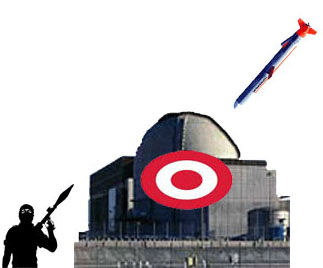
RUSI also points to the likelihood of increased targeting as more countries adopt nuclear power.
The use of military force near or against nuclear facilities represents an under-addressed threat to international peace and civilian safety, the report warns.
By Ciaran McGrath, Senior News Reporter,
https://www.express.co.uk/news/uk/2046553/terrifying-report-warns-uks-nuclear
Britain’s nuclear infrastructure is increasingly vulnerable to military attack as global tensions rise, a worrying new report has warned. The Royal United Services Institute (RUSI) study, published on Friday, highlights the growing risk of nuclear power plants being targeted deliberately or incidentally during armed conflict.
While the threat is not new, Russia’s occupation of Ukraine’s Zaporizhzhia Nuclear Power Plant (ZNPP) has shown how such facilities can become strategic objectives in modern warfare, with devastating consequences for civilian populations. Written by RUSI research fellow Darya Dolzikova, the report examines the “strategic and operational logic” behind targeting nuclear installations and urges military and political leaders to prepare for scenarios in which nuclear infrastructure comes under direct threat. It further warns that the use of military force near or against nuclear facilities represents an under-addressed threat to international peace and civilian safety.
Key motivations for attacks include disrupting an enemy’s energy supply, generating public fear, denying access to contested territory through radioactive contamination and halting nuclear weapons programmes.
In each case, the consequences for civilian safety, the environment and regional stability are severe.
RUSI also points to the likelihood of increased targeting as more countries adopt nuclear power.
Ms Dolzikova explains: “The expected growth of nuclear power in the global energy mix may increase the likelihood that future armed conflict will see greater targeting of nuclear energy infrastructure.”
The report outlines several recent examples of nuclear facilities being exposed to military activity, with Zaporizhzhia cited as the most significant.
It warns that even where nuclear plants are not the primary objective, they may lie on key axes of advance and become flashpoints by default.
In response, the think tank calls for urgent measures to improve such sites’ physical protection and operational resilience.
Recommendations include reinforcing legal prohibitions on attacks, integrating counter-CBRN (chemical, biological, radiological and nuclear) and air defence capabilities, and decentralising energy systems through smaller, modular reactors.
Crucially, the report highlights the psychological impact of nuclear threats.
t points out: “Such threats may be used as a ‘half-step’ between conventional and nuclear weapons – despite key differences in their normative and operational significance.”
The UK operates several nuclear power stations, including Sizewell B and Hinkley Point B, with new projects under development.
While no specific intelligence suggests they are under imminent threat, the report stresses the need for military planners to take the risks seriously and integrate safeguards into all aspects of defence strategy.
RUSI also urges governments to engage the public, building trust and preparing communities for possible emergencies without causing panic.
The report concludes: “Efforts must prioritise the establishment of trust between the population and authorities, and offer clear information and instructions.”
UK in talks to buy back nuclear sites from French firm EDF
Politico 25th April 2025
“Discussions are continuing” between the two governments on the U.K. acquiring three sites, an official told POLITICO.
LONDON — The U.K. government is in talks with its French counterparts about purchasing back three nuclear sites from state-owned energy giant EDF, as Whitehall looks to take control of the upcoming expansion of nuclear power.
U.K. ministers are discussing buying up Bradwell B, Heysham and Hartlepool, a French government official confirmed to POLITICO.
“There have been discussions. For the moment, no decision has been taken and discussions are continuing,” the official said.
Two senior industry figures based in the U.K., familiar with government planning and granted anonymity to discuss sensitive plans, also said negotiations over the purchase of the three sites were ongoing.
Energy Secretary Ed Miliband and French Minister for Industry and Energy Marc Ferracci discussed the negotiations on the margins of the International Energy Agency Summit in London earlier this week, the official added.
The account was disputed by the British government, with a post-publication statement from the Department for Energy Security and Net Zero saying: “We categorically do not recognise these claims.”
The next key moment could come in July as part of a proposed French-U.K. summit.
Any move to bring the sites into state ownership would come as the U.K. mulls the most ambitious revival of nuclear power in a generation.
At a conference last December, Miliband insisted nuclear was essential for an an “all of the above approach” to energy security and low-carbon power, and told investors “my door is open” for future nuclear projects, as the U.K. bids to hit its legally-binding target of net zero carbon emissions by 2050.
………………..The ‘obvious’ sites
All three sites are owned by French firm EDF, a company in which the French state is the sole shareholder, handed over in a deal struck in 2023.
An EDF spokesperson declined to comment on any discussions but said: “EDF would welcome developments that enable ongoing employment opportunities at our sites, once existing stations close.
…………….. The U.K. has not built a new nuclear power plant since Sizewell B was opened in 1995. The much-delayed Hinkley Point C is at risk of not being completed until 2031, and the government is still weighing up a final investment decision for sister plant Sizewell C.
Meanwhile Great British Nuclear (GBN), the arms-length body set up under the last Conservative government, is overseeing the final stages of the late-running competition to build mini-nukes in the U.K., known as small modular reactors (SMRs).
GBN owns two sites — Oldbury and Wylfa — which were brought into state ownership by former Chancellor Jeremy Hunt last year.
A decision on awarding SMR contracts is now expected this summer. If the government goes ahead with its plans to boost nuclear capacity and award SMR contracts to multiple bidding companies, it will need more than two sites to host the work.
“If the government are going to expand gigawatts [capacity] as well as SMRs, they’ll need more sites, and those [three sites] are the obvious ones left over from EN-6 [the U.K.’s shortlist for projects],” a third industry figure said.
Heysham and Hartlepool both include operating nuclear power plants, which are set for decommissioning in stages across 2027 and 2030 respectively.
By contrast, Bradwell B, once earmarked for new nuclear, is a now vacant plot of land. The site is still owned by EDF but is currently being leased by China General Nuclear (CGN) Power, which stopped advancing their mooted project in 2022.
This means any takeover of the site could include a payout to the Chinese state-backed company, in line with £100 million-plus buyout of CGN’s stake in Sizewell C in 2022.
The developments could also pave the way for Wylfa to be reserved for a third gigawatt scale power plant, alongside Hinkley Point C and Sizewell C.
https://www.politico.eu/article/uk-nuclear-sites-edf-energy-bradwell-b-heysham-hartlepool/
British nuclear fusion pioneer plunges after ditching reactor plans
Oxford’s First Light blames lack of funding after abandoning prototype power plant.
Matthew Field, Senior Technology Reporter
A UK nuclear fusion company has suffered a massive write-down in its value
after ditching plans to build its first reactor. First Light Fusion, based
in Oxford, has seen 60pc wiped off the price of shares after one of its key
backers, IP Group, slashed the company’s price tag from £236m a year ago
to £100m.
It comes after the nuclear group abandoned plans for a prototype
power plant based on its “projectile fusion” technology because of a
lack of funding. The technology involves a 5p-sized projectile being fired
at a fuel cell at extreme speeds using electromagnets to generate a
powerful reaction and simulate collisions at extremely high speeds, such as
those in space.
Instead of building its own plant, First Light plans to
supply other nuclear power companies with one of its inventions, called an
“amplifier”, which houses a nuclear fuel capsule and boosts the power
of fusion reactions. The group has burned through tens of millions of
pounds trying to bring its technology to fruition.
Telegraph 27th April 2025, https://www.telegraph.co.uk/business/2025/04/27/first-light-fusion-nuclear-fusion-pioneer-abandon-reactor/
You are invited to join the 7 June ‘Outrage’ Rally against Sizewell C

With Prime Minister Keir Starmer having recently indicated that the announcement of a Financial Investment Decision about Sizewell C might be made in the days immediately prior to the Spending Review being made public on 11 June, campaigners opposed to the nightmare nuclear power plant project in Suffolk will be holding an important protest action on the preceding weekend.
On Saturday 7 June Stop Sizewell C and Together Against Sizewell C are co-organising an ‘Outrage’ Rally on Sizewell Beach. The Rally will run from 11am to 12.15/30pm, after which participants who are able will be invited to walk up the beach to the Sizewell C site.
There will be speakers, including Jonathon Porritt and from Greenpeace UK, interspersed with some music from Peter Kirtley and Gary Morley.
Organisers say that outrage was a defining characteristic of legendary campaigner and former TASC Chair Pete Wilkinson, who died in January. Speakers will pay tribute to Pete in whose memory the gathering is in part being held, but marchers do not need to have known Pete to attend.
28th April 2025
You are invited to join the 7 June ‘Outrage’ Rally against Sizewell C
With Prime Minister Keir Starmer having recently indicated that the announcement of a Financial Investment Decision about Sizewell C might be made in the days immediately prior to the Spending Review being made public on 11 June, campaigners opposed to the nightmare nuclear power plant project in Suffolk will be holding an important protest action on the preceding weekend.
On Saturday 7 June Stop Sizewell C and Together Against Sizewell C are co-organising an ‘Outrage’ Rally on Sizewell Beach. The Rally will run from 11am to 12.15/30pm, after which participants who are able will be invited to walk up the beach to the Sizewell C site.
There will be speakers, including Jonathon Porritt and from Greenpeace UK, interspersed with some music from Peter Kirtley and Gary Morley.
Organisers say that outrage was a defining characteristic of legendary campaigner and former TASC Chair Pete Wilkinson, who died in January. Speakers will pay tribute to Pete in whose memory the gathering is in part being held, but marchers do not need to have known Pete to attend.
Everyone opposed to the outrage that is Sizewell C is encouraged to attend, and to bring with them friends and family to swell the crowd. Marchers are also encouraged to create their own banners with suitable slogans. Organisers also wish to reassure marchers that they are working with the police to ensure a safe event for all.
More details can also be found at www.stopsizewellc.org/outrage, but these are also reproduced in the appendix accompanying this media release………………………………………………………………………………. https://www.nuclearpolicy.info/news/you-are-invited-to-join-the-7-june-outrage-rally-against-sizewell-c/
1 This Month





PLEASE OPPOSE HR 8255 AND S.3639 – bills would accelerate satellite deployment, with no environmental review or safeguards – https://ncstd5li.quorum.us/campaign/169331/
To see nuclear-related stories in greater depth and intensity – go to https://nuclearinformation.wordpress.com
-
Archives
- October 2026 (81)
- September 2026 (339)
- August 2026 (330)
- July 2026 (355)
- June 2026 (287)
- May 2026 (306)
- April 2026 (356)
- March 2026 (251)
- February 2026 (267)
- January 2026 (308)
- December 2025 (358)
- November 2025 (359)
-
Categories
- 1
- 1 NUCLEAR ISSUES
- business and costs
- climate change
- culture and arts
- ENERGY
- environment
- health
- history
- indigenous issues
- Legal
- marketing of nuclear
- media
- opposition to nuclear
- PERSONAL STORIES
- politics
- politics international
- Religion and ethics
- safety
- secrets,lies and civil liberties
- spinbuster
- technology
- Uranium
- wastes
- weapons and war
- Women
- 2 WORLD
- ACTION
- AFRICA
- Atrocities
- AUSTRALIA
- Christina's notes
- Christina's themes
- culture and arts
- Events
- Fuk 2022
- Fuk 2023
- Fukushima 2017
- Fukushima 2018
- fukushima 2019
- Fukushima 2020
- Fukushima 2021
- general
- global warming
- Humour (God we need it)
- Nuclear
- RARE EARTHS
- Reference
- resources – print
- Resources -audiovicual
- Weekly Newsletter
- World
- World Nuclear
- YouTube
-
RSS
Entries RSS
Comments RSS

