The Australian election as a game of cricket: cost of living is the issue, but does Nature bat last?

December 26, 2024 , By Noel Wauchope, https://theaimn.net/the-australian-election-as-a-game-of-cricket-cost-of-living-is-the-issue-but-does-nature-bat-last/
It is not nice to talk about politics at this happy festive time. But you can talk about cricket. Indeed, in Melbourne, it is your patriotic duty. So, I will – sort of.
A prestigious political analyst, Paul Bongiorno, writes in The Saturday Paper about the focus of campaigning for the 2025 Australian federal election. He sees both political parties emphasising the economy, and the “cost of living”. But Bongiorno warns that climate change could suddenly become once more the big factor in the political game, if summer does bring bushfires and floods.
Bongiorno argues that Dutton and the Liberal Coalition are out to stop renewable energy development:
“If the Dutton-led Coalition manages to take the treasury benches, the brakes will be dramatically applied to climate action. The energy transition would be stalled and billions of dollars of new-energy investment put in jeopardy.A key Labor strategist says… it would take only another summer of catastrophic bushfires or floods to significantly jolt public opinion.”
Bongiorno goes on to argue that “The portents here are not favourable for Dutton.” And he cites powerful arguments about “deep flaws” in Dutton’s energy plan’s economic modelling. Bongiorno draws the conclusion that if climate change extremes hit Australia, voters will recognise the value of renewable energy, and vote for the present Labor government’s policies on climate action.
If only that would be the effect of weather disasters – Australian voters embracing action on climate change – the development of renewable energy and energy conservation!
Paul Bongiorno is a much-admired and well-informed analyst. And I am presumptuous to doubt his opinion. But I do doubt it. Look what happened in 2023, with the Australian public first supporting the concept of an Aboriginal Voice to Parliament, but finally voting a resounding “No” to that plan.
How did it happen?
We are in a different era of media and opinion. We are in extraordinary times. When it comes to national elections, people still do vote according to what they see as “their best interest”. It’s just that now, due largely to the power and influence of “social” media, information about “one’s best interest” has become very confusing.
We thought that the Internet would give everyone a voice. And it did. But very soon the new information platforms found money and power could be bought by corporate interests, and indeed, that they themselves could become ultra-lucrative corporations. The media has become a smorgasbord of conflicting information, with so much of it not fact- checked. The “old” media still checks its facts (though I’m not sure about Sky News), but the old media has always been beholden to corporate influence. Even the ABC is circumspect in what it covers, and what it omits – and still makes sure to provide “balance”, even when one side is plainly unreasonable.
Anyway, for the old media to compete – the news has to be preferably exciting, dramatic, even violent. Except for sport and feel-good stuff.
In the new zeitgeist of 24 hour information barrage from so many different outlets, political news can be, and indeed is, swamped by cleverly designed brief messages, from forces like the Atlas Network, from the dominant global fossil fuel corporations. That swamping propelled many Australians to vote against the Aboriginal Voice.
In political news, media emphasis has shifted dramatically away from facts to personalities. In the USA, Donald Trump was seen as a strong, confident, interesting man, as against weak, indecisive, (and female) Kamala Harris. In Australia, there’s an obvious contrast between careful, measured, Anthony Albanese, and strong, outspoken Peter Dutton. In the USA, it didn’t matter that Trump offered few positive policies, so in Australia, the Liberal Coalition does the same.
In the USA, with a population of 334.9 million, approximately 161.42 million people were registered to vote. But only about 64% of these actually did vote in the 2024 general election. in the 2024 general election. So, the majority of Americans don’t vote anyway. Trump was elected by a minority. The rest either didn’t care, or weren’t able to vote.
The Australian election system is so different. With compulsory voting, preferential voting, and the nationwide and highly reliable Australian Electoral Commission (AEC), most Australians do vote. You’d think that with factual news being provided by mainstream media, climate change information would become so important to voters, in the event of summer weather disasters. Paul Bongiorno thinks so.
I think so, too, But the advantage for Peter Dutton in the current national mood might be twofold.
First, Dutton is still that “tough, decisive person” with a tough plan, too – nuclear power instead of renewables. Secondly, the Dutton plan can so easily be marketed as the only real solution to global heating – nuclear power portrayed as “emissions free”, and “cheaper” than solar and wind power.
Never mind that there are substantial greenhouse gas emissions from the total nuclear fuel cycle. Never mind the astronomic cost. Never mind problems of radioactive wastes, safety, and weapons proliferation. The very telling point is that nuclear reactors cannot be up and running in time to have the needed effect on cutting greenhouse emissions. The time for effective action is now, not decades later.
Action on climate change is critical for Australia – and now!
But for the global nuclear lobby, getting Australia as the new poster boy for nuclear power – is critical – now!
Nuclear power should be a dying industry. There is ample evidence of this: reactors shutting down much faster than new ones are built, and of the mind-boggling cost of decommissioning and waste disposal. However, “peaceful” nuclear power is essential to the nuclear weapons industry – with the arms industry burgeoning in tandem with the increasing risk of nuclear war. It seems that the world cannot afford to weaken this war economy.
And the cost and trouble of shutting down the nuclear industry with its tentacles in so many inter-connected industries, and in the media, and in politics, is unimaginable.
The old poster boy, France, has blotted its nuclear copybook recently with its state energy company EDF deep in debt, and things rather crook with its latest nuclear station. But hey! What about Australia, a whole continent, with a national government perhaps ready to institute nuclear power as its prime energy source, and all funded by the tax-payer!
The long-promised nuclear renaissance might really come about – led by Australia, the energetic new nation, with its AUKUS nuclear submarines, with brand-new nuclear waste facilities, and kicking off this exciting new enterprise – nuclear power. This is the opportunity for a global nuclear spin machine to gear up for an onslaught on Australia. They really need the Liberal-National Coalition to win this election.
Dutton will be fed with the right phrases to regurgitate. It’ll be all about a “balanced” economy – nuclear in partnership with renewables and so on, if people have any worries about that. All the same, there are those problems of pesky independent politicians like Monique Ryan and David Pocock, and there’s still the ABC, Channel 9 TV and its print publications.
First, I’m hoping that Australia does avoid bushfires and floods this summer. And second, I’m hoping that in the event of climate disasters, Australians will choose the Labor Party with its real plan for action against climate change, and reject the Coalition with its nuclear power dream. There is a good chance of this result.
I’m hoping that Paul Bongiorno is right, if climate change does bat last in the election game, and that I am wrong about the power of personality politics + slick lies.
Did Israel explode a small nuclear bomb in Syria? Spike in radiation report says…

Story by support@india.com (India.com News Desk), 25 Dec 24, https://www.msn.com/en-in/news/world/did-israel-explode-a-small-nuclear-bomb-in-syria-spike-in-radiation-report-says/ar-AA1wqXyT
In a step that has shocked the whole world, the Israeli Defense Forces (IDF) carried out an airstrike on the weapons depot in Tartus, Syria on 16 December 2024. Through the massive strike, Israel reportedly destroyed the Scud missile facility. However, reports are speculating that the damage caused by the strike was much more and a small nuclear weapon might have been used. Here are the details you need to note about the Israeli strike on Syria.
As a result of the attack, an earthquake of magnitude 3 also occurred along with the massive explosion. The earthquake was so huge that it was felt up to Iznik in Turkey, 820 km away. Moreover, Russian media organization Sputnik had then said that Israel had targeted it with a new missile from a warship. However, some reports also claim that the B61 nuclear bomb developed by America was used here.
Reports have also added that the European Union’s Radioactive Environmental Monitoring surprisingly found that the amount of radiation increased in Turkey and Cyprus 20 hours after the intense blast, pointing towards a small nuclear attack.
Israeli army in the Golan Heights after UN extends peacekeeping mission between Syria, Israel
Israeli forces continued to operate along the Syria-Israel ceasefire line in the Golan Heights on Sunday (December 22) after the United Nations Security Council on Friday (December 20) extended a long-running peacekeeping mission between the two countries.
The UN mission was extended for six months and the security council expressed concern that military activities in the area could escalate tensions.
Ouster of Syrian President Bashar al-Assad
Since a lightning rebel offensive ousted Syrian President Bashar al-Assad earlier this month, Israeli troops have moved into the demilitarized zone – created after the 1973 Arab-Israeli war – that is patrolled by the UN Disengagement Observer Force (UNDOF).
Israeli officials have described the move as a limited and temporary measure to ensure the security of Israel’s borders but have given no indication of when the troops might be withdrawn. Armed forces from Israel and Syria are not allowed in the demilitarized zone – a 400-square-km (155-square-mile) “Area of Separation” – under the ceasefire arrangement.
(With inputs from agencies)
AI bigwigs want to go all-in on nuclear. They also happen to be behind nuclear companies

By Clare Duffy, CNN, December 24, 2024
Sam Altman is the chairman of a company that promises a brighter future for humankind.
No, it’s not OpenAI, the artificial intelligence company he co-founded and now runs as CEO.
It’s a company called Oklo, and it’s developing the kind of nuclear power technology that many tech leaders — including Altman himself — say they will need to fuel future artificial intelligence advancements.
The proliferation of electricity-hungry data centers to power our digital lives – and increasingly, the AI technology that tech giants say is the future – now means that energy demand could soon outstrip supply. And that would be a problem for tech companies who are angling for their AI technology to revolutionize almost everything about the way we live and work.
But while tech leaders have pointed to nuclear energy as essential to a climate friendly future, some industry experts wonder how much their investments will truly benefit the wider public, rather than just protecting their own businesses’ ability to operate.
“I think the tech companies are looking out for their own interests, and whether those nuclear vendors are able to sell additional nuclear power plants for the public is another question,” said Sharon Squassoni, a research professor at George Washington University who’s studied nuclear energy and policy.
t’s clear that more energy will need to come from somewhere. Electricity demand from US data centers has grown 50% since 2020 and now accounts for 4% of the country’s energy consumption; that figure could grow to 9% by 2030, UBS analysts said in a research note earlier this month. And overall power demand in the United States is expected to grow 13% to 15% a year until 2030, potentially turning electricity “into a much scarcer resource,” according to JPMorgan analysts.
The electricity needs of data centers have also threatened to upend tech giants’ sustainability promises.
Tech giants have pointed to the benefit of nuclear energy’s reliability versus other renewable energy sources, such as solar or wind. Microsoft in September secured a deal to reopen a reactor on Three Mile Island, the site of a 1979 partial meltdown in Pennsylvania, aiming to revive a different reactor by 2028 to power its AI ambitions. Amazon and Meta have also begun working to lock in deals to secure future nuclear power for their data centers.
“Data centers operate 24/7 and they need a stable supply of electricity. They can’t shut down because the wind is not blowing or the sun is down,” said Anna Erickson, a professor at Georgia Tech who studies nuclear engineering.
Oklo isn’t Altman’s only nuclear energy investment. The OpenAI CEO has also invested in Helion Energy, a nuclear startup that’s using a different kind of technology from Oklo. Facebook co-founder and now Asana CEO Dustin Moskovitz, LinkedIn co-founder Reid Hoffman and billionaire tech investor Peter Thiel’s venture capital firm, Mithril, have also invested in Helion Energy.
And Altman isn’t the only tech leader trying to cash in on the push toward nuclear.
Separately, TerraPower, which is backed and chaired by Microsoft founder Bill Gates, is in the early phases of building a new nuclear reactor in Wyoming. Google joined a $250 million funding round for nuclear startup TAE Technologies in 2022, and Amazon anchored a $500 million financing round for nuclear startup X-energy in October. Amazon founder Jeff Bezos has also invested in Canadian nuclear startup General Fusion.
As of August, Peter Thiel’s venture capital firm, Mithril, owned 5.3% of Oklo’s shares, and the billionaire tech investor has reportedly backed other nuclear startups. Tech investor Cathie Wood’s Ark Invest also invested in Oklo earlier this year. (President-elect Donald Trump’s pick for energy secretary, Chris Wright, chief executive of the fracking company Liberty Energy, also serves on Oklo’s board.)
The push for nuclear
Already, lawmakers are lining up to support expanding nuclear power. President Joe Biden in July signed into law the Advance Act, a bill designed to make it easier, cheaper and faster to permit and build new nuclear reactors that received bipartisan support. And during this year’s COP28 climate talks, the United States joined more than 20 other countries in pledging to triple global nuclear energy capacity by 2050.
Some experts see the tech industry’s investment as crucial for pushing forward an expensive but clean energy source that could help combat climate change.
“Let’s face it, these guys who are doing AI right now, they’re the ones with the money, right?” Erickson said.
Megan Wilson, chief strategy officer at General Fusion, told CNN that “as we look at the interest by tech companies… in nuclear power, what we’re seeing is really a symptom of the broad recognition that we need clean, baseload power that is free of both carbon dioxide and methane emissions, that’s reliable and affordable.”
Although General Fusion is still in the process of proving its technology works, Wilson added that fusion is expected to be an even safer option than fission, because it is combining atoms rather than separating them, and therefore is “very hard to start and very easy to stop.”
In the future, the company expects its power plants “will have a radiation profile very similar to that of a hospital that uses medical isotopes or has a cancer treatment ward,” Wilson said.
But some experts have raised concerns about heavy investments in nuclear by the leaders of an industry known for pushing back against regulations that could slow it down, even when it is intended to improve safety.
“The problem here is that you have these Silicon Valley giants who have the clout, who have the power, to get a lot of what they want … and the industry’s attitude, first and foremost, is fight any regulation that would interfere with their plans,” said Edwin Lyman, director of nuclear power safety at the Union of Concerned Scientists.
“I am very concerned that the safety and security rules that are really essential for protecting the public could take a real beating,” Lyman said.
Oklo and TerraPower did not respond to requests for comment………………………………………………………….. more https://edition.cnn.com/2024/12/24/tech/nuclear-energy-ai-leaders/index.html
US Military Supported Syrian Rebel Offensive That Toppled Assad Government
Geopolitical Economy, By Ben Norton, 12 Dec 24
Syrian rebel commanders have boasted that the US military helped them overthrow the government of Bashar al-Assad.
They acknowledged this in a report published by major British newspaper The Telegraph, titled “US ‘prepared Syrian rebel group to help topple Bashar al-Assad’”.
The article revealed that a rebel group armed, trained, and funded by the United States, based in the south of Syria, collaborated with rebranded al-Qaeda in the north to jointly topple the Syrian government.
According to the report, the US military helped to create a Syrian militia called the Revolutionary Commando Army (RCA). The US and UK armed and trained the RCA. The Pentagon paid its fighters a salary of $400 per month, which The Telegraph noted was “nearly 12 times what the soldiers in the now defunct Syrian army were paid”. (This was because illegal unilateral Western sanctions on Syria had crushed the country’s economy, causing high rates of inflation that decimated local purchasing power.)
The US military knew that an offensive was being planned to topple Assad, The Telegraph reported. The Pentagon pressured disparate rebel groups and mercenaries in southern Syria to unify behind the US-funded RCA.
In the lead-up to the assault, which was launched in November 2024, US military officers met with Syrian rebel commanders in the Al-Tanf base that the US had built on the border with Iraq………………………………………………………………………………………………………………………………… more https://geopoliticaleconomy.com/2024/12/23/us-military-syria-rebels-assad/
Northwestern Ontario nuclear waste site selection raises concerns
The Hill Times: Canada’s Politics and Government News Source, BY ERIKA SIMPSON | December 12, 2024, https://www-hilltimes-com.proxy1.lib.uwo.ca/story/2024/12/12/northwestern-ontario-nuclear-waste-site-selection-raises-concerns/444838/
The selection process has overlooked the broader impact on local and Indigenous populations near highways that could be used to transport nuclear waste north.
Opinion | BY ERIKA SIMPSON | December 12, 2024
The Nuclear Waste Management Organization selection of two northwestern Ontario communities—Wabigoon Lake Ojibway Nation and Ignace—as host communities for Canada’s proposed Deep Geological Repository raises concerns and controversy. Located approximately 1,500 km from Toronto, the distance highlights the geographical separation between the selected communities and Toronto, home to the Darlington and Pickering nuclear power plants that will eventually be decommissioned.
On Nov. 28—the same day of Nuclear Waste Management Organization’s (NWMO) announcement—the Municipality of South Bruce took many by surprise by announcing it was exiting the site selection process for the proposed Deep Geological Repository (DGR). Despite South Bruce’s proximity—just 46 km from the Bruce reactor, the world’s largest-operating nuclear facility on Lake Huron’s shores—the NWMO decided to pursue the Ignace location.
This raises questions about why the NWMO chose to bypass South Bruce, which, due to its location, appeared to be a more logical choice for Canada’s first DGR.
Despite being presented as a “community-driven, consent-based” process, the selection process launched in 2010 sought to narrow 22 potential sites down to just one willing community. The process has thus far overlooked the broader impact on local and Indigenous populations near highways that could be used to transport nuclear waste northward.
Media outlets like The Globe and Mail and The Hill Times report that the NWMO’s DGR plan involves transporting nuclear waste by truck for over four decades, from all Canada’s reactor sites to the nuclear facility, where the waste could be stored underground. More than 90 per cent of the waste is currently at Pickering, Darlington, and Bruce nuclear stations in Ontario, with the rest located in Point Lepreau, N.B., Quebec, Manitoba, and Ottawa.
With the NWMO selecting the Ignace site and an all-road transportation method, the trucks are expected to travel a total of 84 million km on Canadian roads. There is always the risk that radioactive material will leak while in transit or short-term storage, something that has happened in Germany and New Mexico over the past two decades.
The NWMO’s claims of a rigorous and independent process are undermined by a lack of public dialogue and transparency. Few have been aware of the proposal to build a national underground nuclear waste site. Northwatch and We The Nuclear Free North raised concerns about the NWMO’s decision involving Wabigoon Lake Ojibway Nation (WLON) in the project.
WLON’s Nov. 28 statement clarifies that the First Nation has not approved the project but has agreed to proceed with the next phase of site characterization and regulatory processes. Their “yes” vote reflects a commitment to assess the project’s feasibility through environmental and technical evaluations, not an endorsement of the DGR itself.
South Bruce, the other potential willing community, held a referendum on Oct. 28, which revealed deep divisions. The final tally was 1,604 votes in favor (51.2 per cent) and 1,526 against (48.8 per cent), with a total of 3,130 votes cast. A margin of just 78 votes decided a by-election with far-reaching implications for millions of people across multiple generations.
The decision to allow a local municipality to oversee the referendum on the nuclear waste disposal site has been met with significant controversy. Critics argue that the arrangement posed a conflict of interest, as municipal staff—partially funded by the NWMO—actively promoted the project, casting doubt on their impartiality and raising concerns about financial influence on the referendum’s outcome. The council’s firm opposition to allowing a paper ballot raised further suspicions. Why reject a voting method that could be physically verified?
Located about 19 km southeast of Dryden, WLON faces similar concerns regarding the fairness of the online voting process and voter eligibility. These issues could erode public confidence in municipal referendum processes, and the handling of decisions by councils.
The nuclear waste storage site selection marks an early shift to the regulatory phase, raising concerns about whether the process is premature. Over the coming year, the effectiveness of the Canadian Nuclear Safety Commission and its regulation of all steps in the management of radioactive waste will come under scrutiny, particularly as Ontario’s new energy minister, Stephen Lecce, emphasizes the need to invest in energy infrastructure to meet rising electricity demand over the next 25 years.
Critics argue that despite evaluations with long-term implications, ethical and environmental concerns surrounding nuclear waste disposal remain long unaddressed. Ontario Power Generation’s initial 2005 proposal to the safety commission for a DGR near the Bruce reactor was rejected in 2020 following a Saugeen Ojibway Nation vote.
While many acknowledge the potential benefits of nuclear energy and DGR technology, the NWMO’s approach to the project over the past two decades has drawn significant scrutiny. Questions centre on the decision to place untested DGR technology in populated farmland near the Great Lakes, the world’s largest source of freshwater. The risks of radiation leakage into Hudson’s Bay and the Arctic over thousands of years are particularly troubling, especially as the technology remains unproven in such a critical and sensitive location.
Despite objections, the NWMO pressed forward, with its process viewed as federally approved bribery through financial incentives. South Bruce has already received millions and will receive $4-million more for its involvement, with another $4-million due in 2025. Mayor Mark Goetz has announced plans for alternative development, but critics like W.J. Noll from Protect Our Waterways question why such options weren’t considered earlier, given the risks to farmland, water sources, and the divisions left in the local farming community.
The growing influence of the nuclear industry on international and local governance has left many feeling powerless, fearing that war-torn regions, Indigenous lands, and rural communities are being sacrificed, threatening ecosystems from Ukraine and Russia to the Great Lakes and Arctic rivers.
If no Canadian community agrees to host a permanent nuclear waste depository, it may be necessary to reconsider nuclear energy expansion, halt new plant construction, and scale back capacity at existing reactors. In the interim, managing waste at above-ground sites could offer a safer alternative until technology ensures long-term environmental protection.
Erika Simpson is an associate professor of international politics at Western University, the author of Nuclear Waste Burial in Canada? The Political Controversy over the Proposal to Construct a Deep Geologic Repository, and Nuclear waste: Solution or problem? and NATO and the Bomb. She is also the president of the Canadian Peace Research Association.
The Hill Times
Ontario First Nation challenging selection of underground nuclear waste site in court
Eagle Lake First Nation is seeking a judicial review of the Nuclear Waste Management Organization’s decision to select the Township of Ignace and Wabigoon Lake Ojibway Nation area as the repository site.
Toronto Star, Dec. 24, 2024 , By Sonja Puzic The Canadian Press
A First Nation in northern Ontario is challenging the selection of a nearby region as the site of an underground repository that will hold Canada’s nuclear waste, arguing in a court filing that it should have had a say in the matter as the site falls “squarely” within its territory.
Eagle Lake First Nation has filed an application in Federal Court seeking a judicial review of the Nuclear Waste Management Organization’s decision to build the deep geological repository in the Township of Ignace and Wabigoon Lake Ojibway Nation area.
The decision was announced in November after Ignace’s town council and Wabigoon Lake Ojibway Nation both agreed to move forward, but Eagle Lake First Nation says it was “unjustifiably” rejected as a host community and denied its own right to consent to the project.
“NWMO rejected ELFN as a host community and not for any fair, justifiable or defensible reasons,” but because members of the First Nation had raised concerns about the nuclear waste site, court documents filed last Friday allege.
The court filing, which also names the federal minister of natural resources among the respondents, accuses the NWMO of acting in “bad faith” and seeks to have its decisions quashed.
The NWMO, a non-profit body funded by the corporations that generate nuclear power and waste, said it is reviewing the legal challenge…………………………….
The $26-billion project to bury millions of used nuclear fuel bundles underground will include a lengthy regulatory and construction process, with operations not set to begin until the 2040s. ………………………………………………………. more https://www.thestar.com/news/canada/ontario-first-nation-challenging-selection-of-underground-nuclear-waste-site-in-court/article_375e4d88-c0bd-53e5-ba7a-03a2c2f8e4e1.html?utm_campaign=Nuclear+Free+North++e-news+%7C+Eagle+Lake+First+Nation+is+seeking+a+judicial+review+of+the+NWMO+Site+Selection&utm_medium=email&utm_source=newsletter
FRANCE’S NUCLEAR ENERGY POLICY: A CHRONICLE OF FAILURE – FLAMANVILLE 3.
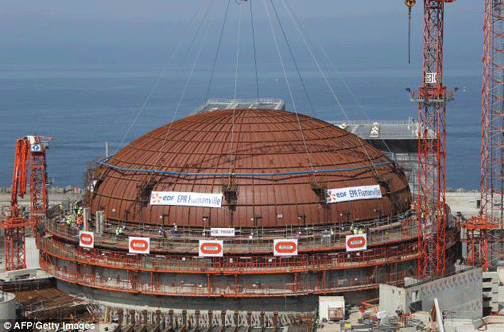
FRANCE’S NUCLEAR ENERGY POLICY: A CHRONICLE OF FAILURE – FLAMANVILLE 3
25 December 2025
France’s ambitious nuclear energy policy, once hailed as a cornerstone of its energy independence, has faced a long series of missteps, delays, and spiralling costs. The Flamanville 3 reactor, emblematic of these challenges, has taken over two decades from decision to anticipated commercial operation, showcasing the systemic failures in planning, execution, and financial management. This timeline highlights the stark realities behind France’s nuclear endeavours.
TIMELINE: 2002 FRENCH NUCLEAR RENAISSANCE
2002: POLITICAL DISCUSSIONS BEGIN
Discussions around a nuclear renaissance gain traction in France. Policymakers and EDF propose new reactor designs to bolster energy independence and address climate goals.
DECISION: 2004
The decision to build the Flamanville 3 reactor marked the beginning of a new chapter for France’s nuclear ambitions. With an estimated cost of €3.3 billion and a planned construction timeline of 56 months, this European Pressurised Reactor (EPR) was touted as a symbol of technological advancement. However, the project’s initial promise soon gave way to setbacks.
INITIAL WORKS: 2006
Preliminary works commenced in 2006, with optimism running high. The EPR design, developed to enhance safety and efficiency, was heralded as the future of nuclear energy. Yet, from the outset, the complexity of the design began to reveal challenges that would compound over time.
REACTOR CONCRETE: 2007
In 2007, construction on the reactor’s concrete base began, symbolising tangible progress. Simultaneously, the cost estimate was revised to €3.3 billion, as technical adjustments and initial delays started to emerge. Early warnings about budget overruns and scheduling issues were largely ignored.
GRID CONNECTION: 2024
After 17 years of setbacks, the reactor was finally connected to the grid. By this point, the budget had ballooned to €13.2 billion, a nearly fourfold increase from the original estimate. The delays and cost overruns underscored critical deficiencies in project management and regulatory compliance, as over 7,000 design changes required significant material additions.
COMMERCIAL OPERATION: 2025 Q1 The reactor is expected to achieve commercial operation in early 2025, over a decade behind schedule. The protracted timeline—more than 20 years from decision to operation—illustrates the systemic inefficiencies plaguing France’s nuclear energy strategy.
COST OVERRUNS AND FINANCIAL STRAIN
The financial fallout from Flamanville 3 is emblematic of broader challenges in the nuclear industry. Initially budgeted at €3.3 billion, the project’s costs had soared to €19.1 billion by 2020, with further increases likely. These overruns mirror similar issues faced by EDF’s international projects, such as Hinkley Point C in the United Kingdom and Olkiluoto 3 in Finland. Hinkley’s budget has nearly doubled to an estimated £46 billion, with completion now pushed to 2029–31.
EDF’S MOUNTING DEBTS AND CHALLENGES
EDF, the state-owned utility tasked with leading France’s nuclear initiatives, has been burdened by mounting debts. With a €65 billion debt load and a near €18 billion loss in 2022, EDF’s financial woes have raised questions about its capacity to handle multiple large-scale projects. Efforts to stabilise its finances through state support and electricity price adjustments have provided temporary relief but have not addressed structural issues.
BROADER IMPLICATIONS
The delays and cost overruns at Flamanville and other EPR projects have cast doubt on the viability of France’s nuclear renaissance. President Macron’s commitment to building six to 14 new reactors appears increasingly untenable given EDF’s financial and operational struggles. Moreover, these challenges have weakened France’s position as a global leader in nuclear technology, with international competitors advancing at a faster pace.
A FAILED STRATEGY
The failure of France’s nuclear energy policy is evident in its inability to deliver projects on time and within budget. The Flamanville 3 reactor, once a beacon of innovation, has become a cautionary tale of mismanagement and overreach. As France doubles down on nuclear energy, it must confront the hard truths of its flawed approach and consider whether a pivot to more agile and cost-effective renewable energy solutions is necessary to ensure its energy security and economic stability.
France connected its first nuclear reactor to the grid this century. Construction was to take 56 months.
2002 TIMELINE STARTS THE
FRENCH NUCLEAR RENAISSANCE
Initial works: construction was to take 56 months.
Timeline:
• decision: 2004
• initial works: 2006
• reactor concrete: 2007
• grid connection: 2024
• commercial operation: 2025 Q1
22 December 2024 Reports
We don’t know the final cost of France’s new #nuclear reactor at Flamanville, but guestimates it’ll be a few hundred $million higher than the 2020 figure:
• 2007 cost estimate: €3.3bn
• 2020 cost estimate: €19.1bn
Workers Seek Shelter As Hanford Nuclear Complex Issues Leak Alert

Oil Price, By Alex Kimani – Dec 23, 2024
Workers at the Hanford nuclear site were ordered to take cover on Friday after a large holding tank with ammonia vapor was discovered to be leaking near the vitrification plant in the 200 East Area. Workers in that area were told to shelter in place with doors, windows and ventilation closed while other workers were told to avoid the 200 East Area. The Hanford Site is a decommissioned nuclear production complex operated by the United States federal government on the Columbia River in Benton County in the U.S. state of Washington
The 200 East Area has a vitrification plant, built and commissioned to treat the tank waste for disposal. The waste was left from the past production of plutonium from World War II through the Cold War for America’s nuclear weapons program. Today, there are 177 underground storage tanks on the Hanford Site, holding about 56 million gallons of highly radioactive and chemically hazardous waste.
The Hanford incident highlights the ongoing challenges of dealing with nuclear waste. Currently, there are thousands of metric tons of used solid fuel from nuclear power plants worldwide and millions of liters of radioactive liquid waste from weapons production sitting in temporary storage containers, some of which have begun leaking their toxic contents. Nuclear waste is notorious for the fact that it can remain dangerously radioactive for many thousands of years. ……………..https://oilprice.com/Latest-Energy-News/World-News/Workers-Seek-Shelter-As-Hanford-Nuclear-Complex-Issues-Leak-Alert.html
Israel to Annex the West Bank – Why Now? And What are the Likely Scenarios?
By Ramzy Baroud / CounterPunch, December 23, 2024
Israel is getting ready to annex the occupied Palestinian West Bank. The annexation will be a major step backward on the road to Palestinian freedom and will likely serve as a catalyst for a new Palestinian uprising.
Though annexation has been on the Israeli agenda for years, this time around a ‘great opportunity’ – in the words of extremist Israeli Finance Minister Bezalel Smotrich – has presented itself and, from an Israeli point of view, cannot be missed.
“I hope we’ll have a great opportunity with the new US administration to create full normalization (of the Israeli occupation),” the minister was quoted as saying by Israeli media.
This is not the first time that Smotrich, among other Israeli extremists, has made the connection between Trump’s advent to the White House and the illegal expansion of Israel’s borders.
Two reasons make Israel’s far-right optimistic about Trump’s arrival: One, the Israeli experience during Trump’s first term in office, where the US president allowed Israel to claim sovereignty over illegal settlements, the Syrian Golan Heights, and occupied East Jerusalem; and, two, Trump’s more recent statement in the run-up to the elections.
Israel is “so tiny” on the map, Trump said while addressing the pro-Israeli group ‘Stop Antisemitism’ at an event last August, wondering: “Is there any way of getting more?” The statement, absurd by any definition, caused joy among Israeli politicians, who understood it to be a green right for further annexations.
Israel’s aims for colonial expansion also received a boost in recent days. Following the fall of Bashar al-Assad’s rule in Syria, Israel immediately began invading large swathes of the country, reaching as far as the Quneitra governorate, less than 20 kilometers away from the capital, Damascus.
What is taking place in Syria serves as a model of what to expect in the West Bank in coming months…………………………………………………………………………………………………
While such annexation will not change the legal status of the West Bank, it will have dire consequences for the millions of Palestinians living there, as annexation is likely to be followed by a violent campaign of ethnic cleansing, if not from the whole of the West Bank, certainly from large parts of it.
Annexation will also render the Palestinian Authority legally irrelevant – as it was created following the Oslo Accords to administer parts of the West Bank in anticipation of a future sovereignty, which never actualized. Will the PA agree to remain functional as part of the Israeli military administration of a newly annexed West Bank?
Palestinians will certainly resist, as they always do. The nature of the resistance will prove critical in the success or failure of the Israeli scheme. A popular Intifada, for example, will overstretch the Israeli military, which will likely use an unprecedented degree of violence to suppress Palestinians but will unlikely succeed.
Annexing the West Bank at a time that Palestine, in fact, the whole region is in turmoil, is a recipe for perpetual war, which, from the viewpoint of Smotrich and his ilk is the actual ‘great opportunity’, as it will secure their political survival for years to come.
Ramzy Baroud is a journalist and the Editor of The Palestine Chronicle. He is the author of five books. His latest is “These Chains Will Be Broken: Palestinian Stories of Struggle and Defiance in Israeli Prisons” (Clarity Press, Atlanta). Dr. Baroud is a Non-resident Senior Research Fellow at the Center for Islam and Global Affairs (CIGA), Istanbul Zaim University (IZU). His website is www.ramzybaroud.net https://www.counterpunch.org/2024/12/23/israel-to-annex-the-west-bank-why-now-and-what-are-the-likely-scenarios/
British energy supplier Centrica is prepared to “walk away” from a planned investment in the Sizewell C nuclear plant
British energy supplier Centrica is prepared to “walk away” from a
planned investment in the Sizewell C nuclear plant, according to its chief
executive. In an exclusive interview with Energy Voice, Centrica chief
executive Chris O’Shea said “there are a number of criteria we have to
consider to invest in the project”. “We’ve said that we are part of the
Sizewell C process but there are a number of criteria we have to consider
to invest in the project,” O’Shea said. “If these are not met, the
right thing to do would be to walk away to protect the business.”
The UK-based supplier owns a 20% stake in the nuclear power stations, amounting
to a 9 terawatt-hour capacity out of a total of 45 TWh. “When the
conditions are right, we’ve seen how good investing in nuclear can be for
Centrica,” said O’Shea. He added that access to that nuclear power
capacity “will be very valuable to the company and to the UK’s energy
system”. “New nuclear will play a crucial role in the future energy
system, however we will only invest if the risks-and-rewards balance is
right for us,” he said. “If it is not right for us, we will not
invest.”
Energy Voice 23rd Dec 2024 https://www.energyvoice.com/renewables-energy-transition/nuclear/564808/centrica-prepared-to-walk-away-from-sizewell-c/
References to ‘inducing a North Korean attack’ found in ex-military official’s notes
2024-12-24 , By Lee Ji-hye, staff reporter, HANKYOREH,
A notebook found at the home of Roh Sang-won, the former Defense Intelligence Command, included jottings about shooting people to death and “concentration and handling” of those who were to be arrested.
A memo written by Roh Sang-won, the former head of the Defense Intelligence Command identified as the secret mastermind of the Dec. 3 insurrection attempt, contained the phrases “inducing a North Korean attack around the Northern Limit Line (NLL),” and “trash balloons.” With evidence pointing to attempts to stoke conflict with North Korea surfacing, police have stated that they are investigating President Yoon Suk-yeol, his former defense chief Kim Yong-hyun, and others on suspicions of treason.
Roh’s notebook also mentioned the “means of concentration and handling” of those who were to be arrested, even going so far as to suggest “execution by shooting.” Such drastic phrases suggest those plotting to punish so-called “anti-state forces” may not have been satisfied with simply detaining these figures.
The special unit investigating the martial law declaration under the Korean National Police Agency’s National Office of Investigation announced on Monday that Roh’s notebook contained the phrase “inducing a North Korean attack around the Northern Limit Line (NLL).”
When asked by Democratic Party lawmaker Youn Kun-young whether “trash balloons” also appeared in Roh’s notebook during a plenary session of the parliamentary Public Administration and Security Committee on the same day, Woo Jong-soo, the head of the National Office of Investigation, confirmed that the phrase was spotted in the notebook.
This is the first time that a plot to provoke North Korea has been confirmed in the investigation into the Dec. 3 insurrection attempt……………………………………………………………………………..more https://english.hani.co.kr/arti/english_edition/e_national/1174701.html
Pentagon Admits It’s Been Lying About the Number of Troops in Both Iraq and Syria
December 25, 2024, By Dave DeCamp / Antiwar.com, https://news.antiwar.com/2024/12/23/pentagon-admits-its-been-lying-about-the-number-of-troops-in-both-iraq-and-syria/
The Pentagon said on Monday that the US has more troops deployed in Iraq than it has been disclosing, an admission that comes after it revealed there are significantly more US troops in Syria than the US has said.
For years, the Pentagon has said there are 900 troops in Syria and 2,500 in Iraq. Last week, Pentagon spokesman Maj. Gen. Pat Ryder revealed the US was lying about the number of troops in Syria, saying the real number is 2,000.
In a statement meant to clarify the situation that was released on Monday, Ryder also said there were more than 2,500 US troops in Iraq but refused to say how many. “However, due to operations security and diplomatic considerations, we do not have any more specifics to provide,” Ryder said.
Ryder’s statement revealed that the number of US troops in Syria has been higher than publicly disclosed since 2020. “In addition to the approximately 900 baseline troops, there are also approximately 1,100 US military personnel in Syria that deploy for shorter durations as temporary enablers in support of force protection, transportation, maintenance, or other emerging operational requirements,” Ryder said.
“The numbers of these additional temporary forces have fluctuated over the past several years based on mission needs but in general have increased over time as the threat has increased to baseline forces,” he added.
Lying about the actual number of US troops in Syria goes back to at least the Trump administration. In 2020, James Jeffrey, the outgoing US envoy for Syria at the time, admitted his team was “always playing shell games to not make clear to our leadership how many troops we had there.” In 2019, after reversing an order to withdraw all troops from Syria, Trump agreed to keep 200 in the country. But Jeffrey said there was “a lot more” than that deployed.
In his statement on Monday, Ryder also said that “some additional temporary enablers” had been deployed alongside the 2,500 US troops in Iraq.
Sources told CNN that the US had been lying about the number of US troops in Syria because it didn’t want to anger neighboring countries, particularly Iraq, where the presence of US troops is strongly opposed by many political factions.
The sources said the US was worried if Iraqi officials found out the US had more troops in Syria than it was disclosing, officials would fear the same is happening in Iraq. Ryder’s statement that there are more than 2,500 US troops in Iraq will likely cause trouble for Iraqi Prime Minister Mohammed Shia al-Sudani, who has been under significant pressure to get the US to leave.
Earlier this year, after a series of US airstrikes on Iraq, al-Sudani called for US troops to leave, and his government entered negotiations with the US. The two sides reached a deal that was announced in September, but it will only formally end the mission of the US-led anti-ISIS coalition and says US troops will remain in the country under a “bilateral security partnership.”
No more research for genocide at MIT !

Every human on this planet, especially those of us at MIT, is morally obligated to use their voice, body, and labor to make an immediate material impact toward ending the ongoing genocide.
By MIT Coalition For Palestine, Mondoweiss, December 22, 2024,
https://popularresistance.org/no-more-research-for-genocide-at-mit/
Despite Censorship And Intimidation We Continue To Make This Demand.
An MIT lab is collaborating with the Israeli military to develop AI surveillance algorithms and the university censored a campus publication that tried to expose it. We refuse to be intimidated and continue to demand: No More Research for Genocide.
On November 7th, we published an op-ed titled “Daniela Rus, The People Demand: No More Research for Genocide” in the MIT Tech. Our piece detailed how Prof. Daniela Rus, director of MIT’s Computer Science and Artificial Intelligence Laboratory, uses Israeli Ministry of Defense money to develop algorithms with applications in “multirobot security defense and surveillance.” Rather than engage with these publicly verifiable facts, the Tech’s editorial board (under the guidance of Prof. Rus) retracted our op-ed.
MIT sent several of us “no contact” and “no harassment” orders for Prof. Rus, disciplining one student for simply writing our Op-Ed’s title on a public chalkboard! As if this naked intimidation wasn’t enough, the Tech indefinitely halted all Op-Eds after retracting our piece. This comes directly after the suspension and effective expulsion of MIT PhD student Prahlad Iyengar, in part due to an email he sent Professor Rus’ students “offering support” and a “safe space” to discuss her research.
We refuse to be intimidated by MIT. Professor Rus takes money from a genocidal army to do research with military applications (stated in her own papers here, here and here). Retractions and suspensions cannot change these simple facts. Here, we republish our article in full:
Daniela Rus, The People Demand: No More Research For Genocide
Today, MIT’s Computer Science and Artificial Intelligence Laboratory (CSAIL) conducts research funded by the Israeli Ministry of Defense (IMoD), with direct applications to the ongoing genocide in Gaza. We, the MIT Coalition for Palestine, whose tuition and labor support CSAIL, call on CSAIL Director Daniela Rus to lead by example and end her IMoD-sponsored research.
Rus currently leads the project “Coreset Compression Algorithms,” which has received $425,000 in direct sponsorship from the IMoD since 2021, according to MIT’s 2024 Brown Books. This project develops AI algorithms for applications like “city-scale observation systems” and “surveillance and vigilance”. Many of these lightweight algorithms are ideal for teaching small unmanned vehicles, including drones, to track and pursue targets with increased autonomy. Notably, navigating human environments is central: “a human may provide the global path… and the robots will adapt their configuration automatically”.
Many of us have friends and family surveilled and killed by the Israel Defense Forces (IDF) drones streamlined by Rus’s research. These quadrotor drones are used extensively to monitor, injure, and kill Palestinian civilians at close range. Last Wednesday, October 30, 2024, Palestinian poet Mosab Abu Toha shared videos showing Israeli bombs destroying his home, including footage of a quadrotor drone with a mounted machine gun just meters away. He described how Israel’s relentless indiscriminate bombardment in Gaza has wiped out entire families he knew. Stories like his have become the norm for families in Gaza.
As we write this piece, Jabalia has been under constant siege for a month. The Israeli military is targeting hospitals and burning patients alive. The government blocks access to life-saving humanitarian supplies, worsening Gaza’s already severe health crisis, all while threatening, targeting, and killing journalists attempting to report on these war crimes. At this time, it is our moral responsibility to do everything in our power to disrupt and dismantle all which enable the continuing of this genocide.
There has been a long-standing demand for Rus’s IMoD-sponsored projects to end.
The MIT Coalition for Palestine (C4P) is a group of MIT students, staff, faculty, community members, and campus organizations who refuse to devote their labor to companies complicit in Israeli apartheid, occupation, and the violation of Palestinian human rights. Daniela Rus was first contacted by the C4P on March 8th, 2024 by email where she was informed of how her IMoD-sponsored projects made her complicit in the ongoing genocide in Gaza.
Without response, we then emailed out to the graduate students in her lab informing them of these ties and of potential alternative funding arrangements. In April, we launched the Scientists Against Genocide Encampment, where we consistently highlighted her lab’s IMoD ties to the school and community.
Over a year of accelerating genocide has now since passed, seven months since we first contacted Rus, and she continues her research, violating MIT’s own rules for research sponsorship. On Tuesday October 22, 2024, the Coalition Against Apartheid, a member organization of C4P, delivered a second letter in-person to her CSAIL office, chanting and flyering in the process.
We are committed to engaging in continuing action because it works. For instance, The U.S. arm of Israeli defense contractor Elbit Systems recently ended its lease of office space in Cambridge after months of demonstrations by pro-Palestinian protestors. This win reinforces our resolve, and reminds us of a crucial lesson: the only way to make material disruptions for these inhumane systems is to continuously raise the cost for conducting research for genocide.
MIT’s police and disciplinary response against peaceful demonstrators was swift and unjust.
Within fifteen minutes, MIT escalated the situation with police force by violently arresting student protestors and detaining others for merely chanting and passing out flyers. At one point, there were four to six cops pinning down one person. Even those who were simply filming the arrests were detained, pushed around, and groped. There was no warning or attempt by faculty or administrators to engage with the students in order to understand their actions. Three days after the protest, eight students received interim sanction letters from the MIT Committee on Discipline (COD).
This interim letter did not indicate what charges students were being prosecuted for. Rather, they prohibited the students from entering common student spaces in CSAIL, where some of these students work. They also issued three no-contact orders to students: one for Rus, one for her collaborator on IMoD-funded projects Eytan Modiano, and one for Jack Costanza, a CSAIL employee who physically assaulted students in an attempt to unlawfully aid police in their arrests. None of the students were given the chance to review or respond to the charges. Once again, the COD demonstrates it operates primarily on the premise of treating political dissidents as “guilty until proven innocent.”
One week later, students received their alleged charges from the COD. All eight of them, whether they were chanting, putting a flyer up on a wall with painter’s tape, or simply video-taping the protest, received the same charges: assault, disorderly conduct, harassment, and threats/intimidation. COD Chair Tamar Schapiro later verbally admitted to one student in a meeting that she was aware none of the protestors assaulted anyone. Yet she still sent the letters accusing all eight of the students of assault. The COD systematically criminalizes the Coalition for Palestine as a community for protesting genocide. By indiscriminately instating a blanket no-contact order against all individuals who received a discipline letter, the COD draws a direct parallel between the acts of collective punishment MIT inflicts on pro-Palestinian advocates on its campus, and the collective punishment that Israel has long been inflicting on Palestinians themselves.
Discipline against pro-Palestinian students reinforces systemic racism at MIT.
Over the past year, MIT’s administration’s response to protests against genocide continues to be reflective of MIT’s longstanding racist and xenophobic systems. Students have attempted time and time again to address these issues, as described in this article by the Black Graduate Students Association. Despite the manufactured facade of an MIT community that is safe for students of minoritized backgrounds, racism at MIT has persisted over the last year at an institutional level.
At an institutional level, the MIT administration has been emboldened to continue to weaponize the police and inconsistent “academic” disciplinary proceedings in order to disproportionately target Black and Brown students. In the past year, 87% of the people MIT has disciplined, relating broadly to protest activity, have been people of color. Just consider MIT’s response to the letter delivery protest of Rus’ lab: people of color made up 8 out 13 student protestors present, yet 7 out of 8 people who received letters from the CoD were people of color. In addition to the disciplinary discrimination we face, many of us on campus feel incredibly unsafe, as the Institute of Discrimination Harassment and Reporting (IDHR) has failed to follow up on at least thirty reports of harassment against us. Simultaneously, IDHR selectively applies sanctions against us without evidence. To MIT, we are solely perceived as threats, never as victims. When Tamar Schapiro was asked to clarify the discipline, she told one female student that as a woman, she should understand that Daniela Rus felt unsafe by the demonstration, even though she was not even present in the lab at the time. What about the women in Gaza who fear being killed by the very technology Daniela Rus’s work contributes to? What about the women of color on campus who fear being unjustly brutalized by the frequent displays of disproportionate police violence? Tamar Schapiro, and MIT as a whole, fail to acknowledge the tangible fears of marginalized women, yet prioritize the theoretical fears of white women. This twisted, victim-blaming, racist logic matches the insinuation of Provost Barnhart in the previous Spring semester, wherein she justified the interim suspensions and eviction threats of 27 people by suggesting that MIT apply the same disciplinary measures previously reserved for when individuals are immediately at risk of sexual assault. As long as we have a broken reporting system, rapists and sexual offenders continue to freely walk on campus while students of color are treated as criminals for protesting a genocide.
To Daniela Rus and the world: no more labor for apartheid and genocide!
At the end of the day, MIT’s racism and racist discipline cannot counteract one fact: Daniela Rus is complicit in doing research for genocide. She has been complicit since 2012 when the sponsorship was first established through her then-postdoc, Dan Feldman, who currently works at University of Haifa in occupied Palestine. Professor Rus continues to deny her evident, present-day connections to the IMoD while flaunting her other morally dubious connections, such as her recent public statement of admiration, at her October book talk, for Marvin Minsky, alleged co-perpetrator of notorious pedophile Jeffrey Epstein.
As students of conscience, we cannot stand for this. The time to take action is now. We therefore call on Daniela Rus to immediately terminate all IMOD-funded projects and for MIT to provide transitional funding to all affected graduate students, in line with how MIT terminated financial ties with the Skoltech Institute in Russia the day after the Russian invasion of Ukraine.
Why are we here at MIT? What purpose is there to any of the science and research being done on this campus when we know that ultimately our work will be used for mass murder and exploitation? It is the current leadership at MIT that is ensuring that the great potential of this community is being abused to oppress individuals globally. Therefore, it will take all people of conscience at this institution to change the course we are currently on to force MIT to embody the values it claims to have. We cannot rest until MIT completely cuts ties and divests from all entities that support genocide and colonialism.
Every human on this planet, especially those of us at MIT, is morally obligated to use their voice, body, and labor to make an immediate material impact toward ending the ongoing genocide.
Poland threatens to arrest Netanyahu at Auschwitz

https://www.rt.com/news/609773-israel-arrest-pm-poland/ 24 Dec 24
Warsaw has to comply with the International Criminal Court’s decisions, the deputy foreign minister has said
Israeli Prime Minister Benjamin Netanyahu would be arrested if he attends next month’s ceremonies marking the 80th anniversary of the liberation of Auschwitz in Poland, the EU country’s deputy foreign minister, Wladyslaw Bartoszewski, told newspaper Rzeczpospolita on Friday.
Warsaw’s top diplomat stated that Poland, as a signatory of the Rome Statute, is obligated to comply with the directives of the International Criminal Court (ICC). In November, ICC issued warrants for the arrests of Netanyahu and former Israeli defense minister Yoav Gallant, citing alleged war crimes related to the ongoing conflict in Gaza.
The court accused Netanyahu and Gallant of using starvation as a method of warfare, alleging they deliberately deprived civilians in Gaza of food, water, and medicine. There was “no obvious military necessity” for such actions, which amount to violations of international law, according to prosecutors.
Israel’s Education Minister Yoav Kisch is expected to be the only government representative at the Auschwitz commemoration, Jerusalem Post reports. The participation of President Isaac Herzog “seems unlikely.”
While all 27 European Union member states are parties to the Rome Statute and thus required to enforce ICC arrest warrants, responses to the court’s decision have varied. Hungarian Prime Minister Viktor Orban has openly invited Netanyahu to visit, assuring him that Hungary would not enforce the arrest warrant.
Conversely, countries like Spain, the Netherlands, Belgium, Ireland, Lithuania, and Slovenia have indicated their intent to comply with the ICC’s directives, regardless of diplomatic immunity.
France initially expressed its intention to adhere to the arrest warrant but later cited diplomatic immunity protections for Netanyahu.
The ICC’s actions have elicited strong reactions from Israeli officials. Prime Minister Netanyahu has likened the arrest warrants to a “modern-day Dreyfus affair,” asserting that they are politically motivated.
Auschwitz was a Nazi concentration and extermination camp in occupied Poland during World War II. Over 1.1 million Jews were murdered there, alongside tens of thousands of others, including Poles and Soviet prisoners of war.
There’s a Major Problem With the Nuclear War Bunkers The Rich Are Buying

“Bunkers are, in fact, not a tool to survive a nuclear war.
https://futurism.com/the-byte/nuclear-war-bunkers-problem 24 Dec 24
Truth Bomb
As more and more rich people rush to buy and build bomb shelters, experts suggest they’re little more than a psychological defense mechanism for wealthy people who want to feel a shred of control in an unpredictable world.
As the Associated Press reports, the bunker business was worth $137 million last year and is slated to grow to $175 million by the end of the decade, per analysis from BlueWeave Consulting.
According to experts who spoke to the outlet, however, these shelters do more to address atomic anxieties than nuclear realities. After all, you’re eventually going to need to crawl out of your bunker and face the horrific situation back on the surface.
“Bunkers are, in fact, not a tool to survive a nuclear war, but a tool to allow a population to psychologically endure the possibility of a nuclear war,” explained Alicia Sanders-Zakre of the International Campaign to Abolish Nuclear Weapons.
Radiation after a nuclear bomb detonation, as Sanders Zakre described it, is a “uniquely horrific aspect of nuclear weapons.” Even those who survive the fallout, which involves radioactive particles raining down on the area surrounding the blast, will be unable to escape its long-lasting, intergenerational health effects like those seen in Chernobyl after its reactor meltdown nearly 40 years ago. And that’s without getting into starvation, thirst, and the breakdown of social order.
“Ultimately,” she said, “the only solution to protect populations from nuclear war is to eliminate nuclear weapons.”
Shelter Skelter
Despite the promises made by companies catering to so-called “doomsday preppers,” nonproliferation expert Sam Lair told the AP that such efforts are likely futile.
“Even if a nuclear exchange is perhaps more survivable than many people think, I think the aftermath will be uglier than many people think as well,” Lair, a researcher at the James Martin Center for Nonproliferation Studies, said. “The fundamental wrenching that it would do to our way of life would be profound.”
As Lair pointed out, politicians used to urge the citizenry to build their own bomb shelters half a century ago. Now, the “political costs incurred by causing people to think about shelters again is not worth it” — though that sort of concern clearly doesn’t extend to the big business of bunkers.
While doomsday prepping is now as American as apple pie, the revival of bunker culture isn’t limited to our shores: over in Switzerland, where each resident is guaranteed a spot in a bomb shelter in the case of nuclear war, the government is investing hundreds of millions of dollars to update its vast array of Cold War-era bunkers.
1 This Month

Protect Sazan Island from the Trump family! https://secure.avaaz.org/campaign/en/protect_sazan_island_from_the_trump_family_loc/?bqFCVab&v=174511&cl=22707147157&_checksum=5e9dde668860e8231c33699735e16a1fbf22ab2cb01da50c999fe8732b9775ef&utm_source=email&utm_medium=blast_email&utm_campaign=174511

25 June- THE PUKE ON NUKES
Thursday, June 25, 2026
7pm Central Time (8pm ET, 6pm MT, 5pm PT) UTC – 5
From NRC & DOE Deregulation to Techno-Fascist Billionaires Going Nuclear, Plus a Few Songs from Atomic Cabaret REGISTER
26 June – Radiation Trainwreck at the NRC / Join the Protect Better Campaign – https://us02web.zoom.us/meeting/register/4ZlZ5_qLSHGiLSCg8FF6Bg#/registration


Cuba Is Not a Failed State – It Is a Besieged State
PETITION: “Global Appeal to Endorse Palestinian Right of Return of Refugees”
To see nuclear-related stories in greater depth and intensity – go to https://nuclearinformation.wordpress.com
-
Archives
- June 2026 (138)
- May 2026 (306)
- April 2026 (356)
- March 2026 (251)
- February 2026 (268)
- January 2026 (308)
- December 2025 (358)
- November 2025 (359)
- October 2025 (376)
- September 2025 (257)
- August 2025 (319)
- July 2025 (230)
-
Categories
- 1
- 1 NUCLEAR ISSUES
- business and costs
- climate change
- culture and arts
- ENERGY
- environment
- health
- history
- indigenous issues
- Legal
- marketing of nuclear
- media
- opposition to nuclear
- PERSONAL STORIES
- politics
- politics international
- Religion and ethics
- safety
- secrets,lies and civil liberties
- spinbuster
- technology
- Uranium
- wastes
- weapons and war
- Women
- 2 WORLD
- ACTION
- AFRICA
- Atrocities
- AUSTRALIA
- Christina's notes
- Christina's themes
- culture and arts
- Events
- Fuk 2022
- Fuk 2023
- Fukushima 2017
- Fukushima 2018
- fukushima 2019
- Fukushima 2020
- Fukushima 2021
- general
- global warming
- Humour (God we need it)
- Nuclear
- RARE EARTHS
- Reference
- resources – print
- Resources -audiovicual
- Weekly Newsletter
- World
- World Nuclear
- YouTube
-
RSS
Entries RSS
Comments RSS
 nuclear-news