A new nuclear arms race

With this in mind, the official representatives of most of the world’s nations, gathering in 2017 under UN auspices, met and crafted the Treaty on the Prohibition of Nuclear Weapons. Endorsed by a vote of 122 to 1 (with 1 abstention), it banned the use, threatened use, development, manufacture, acquisition, possession, stockpiling, stationing, and installation of nuclear weapons. The treaty entered into force in January 2021, and has been signed, thus far, by 94 nations. Opinion polls and declarations by hundreds of cities in a variety of nations indicate that it has substantial public support.
by beyondnuclearinternational. https://beyondnuclearinternational.org/2025/07/13/a-new-nuclear-arms-race/
Are we headed towards one, or already in it, asks Lawrence Wittner
Amid growing international chaos, it should come as no surprise that nuclear dangers are increasing.
The latest indication is a rising interest among U.S. allies in enhancing their nuclear weapons capability. For many decades, remarkably few of them had been willing to build nuclear weapons―a result of popular opposition to nuclear weapons and nuclear war, progress on nuclear arms control and disarmament, and a belief that they remained secure under the U.S. nuclear umbrella. But, as revealed by a recent article in London’s Financial Times, Donald Trump’s public scorn for NATO allies and embrace of Vladimir Putin have raised fears of U.S. unreliability, thereby tipping the balance toward developing an expanded nuclear weapons capability.
This growing interest in nuclear weapons is especially noticeable in Europe, where Trump’s berating of NATO and Putin’s threats of nuclear attack are particularly unsettling. Although Friedrich Merz, Germany’s chancellor, dismissed any notion of Germany developing its own nuclear weapons, he has stated that it must explore “whether nuclear sharing, or at least nuclear security from the UK and France, could also apply to us.” Furthermore, several German think tank experts have floated the idea of building the infrastructure that, if necessary, could produce German nuclear weapons.
In Poland, too, a nuclear weapons capacity has become increasingly appealing. Prime Minister Donald Tusk recently raised the idea of pursuing nuclear weapons or, at least, seeking an agreement for sharing France’s nuclear arsenal. A board director of PGZ, Poland’s state-controlled military manufacturer, remarked: “There are suddenly a lot of words and different opinions about what to do, but they all show Poland believes in stronger nuclear deterrence against Russia.”
In South Korea, North Korea’s nuclear weapons program and its growing military relationship with Russia, combined with Trump’s unreliability, have contributed to growing support for the nation’s acquiring its own nuclear weapons. Although neither of the two major parties has announced this policy, Cho Tae-yul, the foreign minister, informed parliament that acquiring nuclear weapons was “not off the table,” for “we must prepare for all scenarios.”
Similarly, the idea of developing nuclear weapons is drawing increasing scrutiny in Japan. Sharing South Korea’s fear of a North Korean attack and Trump’s unreliability, Japanese leaders also worry about China’s growing assertiveness. If a North Korean or Chinese nuclear strike occurred, Japan would have only 5 minutes of warning time. Moreover, thanks to its nuclear power plants, Japan already holds enough plutonium to build several thousand nuclear bombs.
In addition, of course, a nuclear arms race is well underway among the nuclear weapons-producing nations: the United States, Russia, China, Britain, France, Israel, India, Pakistan, and North Korea. All of them are either expanding their nuclear arsenals, building a new generation of nuclear weapons, or both. Most of the nuclear arms control and disarmament agreements of the past have been abandoned, while the remaining agreements are on life support. The New Start Treaty between Russia and the United States, the two nations possessing almost 90 percent of the world’s 12,331 nuclear weapons, is scheduled to expire in February 2026, and there are no negotiations underway to replace it. Meanwhile, in recent years, the top officials of three nuclear-armed nations―Vladimir Putin, Donald Trump, and Kim Jong Un―have issued numerous statements threatening nuclear war.
Against this backdrop, this January the editors of the Bulletin of the Atomic Scientists reset their “Doomsday Clock,” established in 1946, at 89 seconds to midnight, the closest ever to human extinction. The following month, UN Secretary-General António Guterres, deploring the unraveling of international security arrangements, warned that nuclear weapons provided a “one-way road to annihilation.”
These escalating nuclear dangers suggest that, if nuclear weapons, whether possessed by an alliance or by individual nations, are unable to safeguard humanity from total destruction, then a different approach to survival in the nuclear age is needed: one grounded in international security.
With this in mind, the official representatives of most of the world’s nations, gathering in 2017 under UN auspices, met and crafted the Treaty on the Prohibition of Nuclear Weapons. Endorsed by a vote of 122 to 1 (with 1 abstention), it banned the use, threatened use, development, manufacture, acquisition, possession, stockpiling, stationing, and installation of nuclear weapons. The treaty entered into force in January 2021, and has been signed, thus far, by 94 nations. Opinion polls and declarations by hundreds of cities in a variety of nations indicate that it has substantial public support.
Although the Treaty on the Prohibition of Nuclear Weapons provides a useful framework for creating a nuclear weapons-free world, it has not, as yet, rolled back the nuclear menace. The reason is that its provisions are only binding on the nations that have signed it. And the nine nuclear weapons-producing nations, joined by the nations under their nuclear umbrella, refuse to do so―at least so far. Convinced that, in a world of independent and often hostile nations, their security rests upon possession of nuclear weapons, they remain unwilling to abolish them.
Even so, their resistance to the treaty might be overcome by a further step toward international security: the strengthening of international organizations. At present, the United Nations lacks the power to effectively enforce its primary mission of maintaining international peace and security. But that power could be expanded by providing the global organization with an independent source of income, restricting the role of the veto in the Security Council, and expanding the role of the General Assembly. International security would also be enhanced by increasing the jurisdiction of the International Court of Justice and of the International Criminal Court.
Strengthening international security might seem impractical at this time of overheated nationalist claims and the global chaos they produce. Even so, times of crisis sometimes produce historic breakthroughs, and the prospect of nuclear annihilation might have that effect.
Lawrence S. Wittner is Professor of History Emeritus at SUNY/Albany and the author of Confronting the Bomb (Stanford University Press).
Trump to Ukraine: ‘Squander another half million casualties to prevent defeat on my watch’

Walt Zlotow, West Suburban Peace Coalition, Glen Ellyn IL. 13 July25
Most esteemed observers put Ukraine’s dead and wounded at north of a half million in their lost war with Russia. Several million young Ukrainian men have fled conscription while stragglers are rounded up like stray dogs to be thrown into the meat grinder of warfare they’re totally unprepared to fight.
But the war is much more than Ukraine defending itself from a Russian invasion. It’s America’s proxy war to weaken, Russia from Western European political economy. Its origins go back 17 years when the US pitched NATO membership to Ukraine to achieve that senseless goal. It virtually guaranteed war after the US engineered the 2014 coup against Russian friendly Ukrainian President Victor Yanukovych. It ignited a civil war between the Kyiv government and the Russian cultured Ukrainians in the Donbas on Russia’s border. Russia tried diplomacy for 8 years to no avail before invading both to keep Ukraine out of NATO and end protect the beleaguered Donbas Ukrainians. Just before the invasion the US stupidly told Russia that NATO membership for Ukraine and Russia’s security concerns were not subject to diplomacy.
America’s best laid plans to prevail failed spectacularly. Now Ukraine will never join NATO but Donbas Ukrainians are largely safe and thrilled to be under Russian protection from the terrors imposed by Kyiv. Ukraine’s fate was sealed once Biden announced he’d only waste US treasure for weapons but not one drop of US blood for Ukraine’s defense. Three and a half years and over $200 billion in US/NATO weapons have simply put Ukraine on US/NATO life support.
Biden was able to keep Ukraine in the fight for nearly 3 years, squandering a half million of its finest, so he could pass the war on to successor Trump. After being eviscerated by the US national security class for his admitting defeat and withdrawing from the 20 year Afghan war, Biden was loathe to incur another defeat on his watch. So he loaded up Ukraine with tons of weapons in his last months to ensure Ukraine would not collapse before his leaving.
Even before retaking office, clueless Trump bragged he’d end the war in one day. He tried to browbeat Ukraine President Zelensky to negotiate war’s end, even humiliating him before the world in the Oval Office. One hundred seventy-five days in Trump is facing his own Afghanistan style defeat as Ukraine nears collapse.
To stave off impending defeat he reversed the Pentagon’s withdrawal of new weapons based on US stockpiles running low. But all he could sputter was that he’s releasing “defensive weapons” only which will do no good with Ukraine running out of cannon fodder to fire them.
For Trump that’s A-OK. ‘Fight on Ukraine…I’ve only got three and a half years to keep this going till I can pull a Biden and pass it on the next clueless idiot trying to defeat an undefeatable Russia.’ The real issue is not whether Trump will succeed. He can’t. The ominous issue facing the US, indeed peoplekind, is whether Trump’s plan to avert defeat will lead to nuclear war that has been a possibility every day in Ukraine for the past three and a half years.
Atomic bomb survivors in Japan fear nuclear weapons could be used again: poll
Newly released survey shows close to 70 percent of survivors fear a resurgence in nuclear risks as Japan readies for the 80th anniversary of Hiroshima and Nagasaki.
14 July 25 https://trt.global/world/article/0c8b4e3aec45
Nearly 70 percent of atomic bomb survivors in Japan believe nuclear weapons could be used again, citing growing global tensions, including Russia’s war in Ukraine and North Korea’s weapons development, a survey by Kyodo News Agency revealed on Sunday, ahead of the 80th anniversary of the US atomic bombings.
Around 1,500 survivors took part in the survey, with 68.6 percent saying the risk of nuclear weapons being used again is increasing.
Some 45.7 percent of respondents said they “cannot forgive” the US for the bombings, while 24.3 percent said they have “no special feelings” and 16.9 percent said they “did not know.”
This year marks 80 years since the US dropped atomic bombs on Hiroshima and Nagasaki in western Japan near the end of World War II.
On August 6, 1945, the US dropped an atomic bomb on Hiroshima, killing an estimated 140,000 people.
A second bomb was dropped on Nagasaki three days later, resulting in about 70,000 additional deaths.
Japan surrendered on August 15, 1945, officially marking the end of World War II.
Nuclear waste to nuclear reactor: The case of Russia in Kazakhstan
Ayushi Saini, 11 Jul 2025 https://www.lowyinstitute.org/the-interpreter/nuclear-waste-nuclear-reactor-case-russia-kazakhstan
Facing energy deficits, Kazakhstan turns to Russia’s Rosatom for nuclear
power despite a history of environmental and dependency concerns.
After shutting down its last Soviet-era reactor in 1999, Kazakhstan is now on the cusp of returning to nuclear energy. Long reliant on non-renewables and electricity imports, the country faces rising energy demands and an urgent need to diversify its energy sources.
In October 2024, a national referendum strongly backed the construction of a nuclear power plant, with Russia’s Rosatom ultimately selected to lead the project. The decision marks a major shift in the country’s energy strategy and reaffirms Russia’s enduring influence in Central Asia’s high-stakes infrastructure sector.
However, the decision raises several concerns, including environmental risks, increased energy dependence on Russia, and the revival of unsettling memories of Soviet-era nuclear contamination in Kazakhstan. Understanding why Kazakhstan is turning back to nuclear power and why it chose Russia for its first Nuclear Power Plant (NPP)merits a closer look at the strategic and geopolitical factors behind this move.
Nuclear past, nuclear future
Kazakhstan’s journey with nuclear technology is fraught and painful. As a Soviet republic, it served as a major testing ground, most notably at the Semipalatinsk Test Site, where more than 450 atmospheric and underground nuclear detonations took place. This placed a heavy toll on the environment of Kazakhstan, without the nuclear waste having been taken care of by the Soviet Union.
From 1979 to 1999, Kazakhstan hosted a high-neutron Soviet nuclear power plant. After independence in 1991, Kazakhstan dismantled its arsenal and embraced nuclear non-proliferation with the Semipalatinsk test site closing in the same year.
Now, facing power deficits, it is returning to nuclear power for civilian use. The new plant will be built near the village of Ulken by Lake Balkhash – a site chosen for its geographical viability, including proximity to water access. However, environmental concerns persist. Kazakhstan lacks the domestic capacity to manage nuclear waste and must rely on external actors. Despite its past role in Kazakhstan’s nuclear contamination, Russia has reemerged as a key partner in the country’s nuclear revival.
Illusion of a consortium
Astana designated Rosatom to lead the construction of its first NPPafter a competitive bidding process involving China’s China National Nuclear Commission (CNNC), France’s Electricité de France (EDF), and Korea Hydro & Nuclear Power. While authorities claim the formation of an international consortium, Rosatom remains the undisputed leader, reflecting both its technological edge and Moscow’s strategic weight in Astana. Kazakhstan claims that it is the exclusive owner, operator, and supplier of uranium fuel, with complete control over the technological processes of its upcoming nuclear power plant.
Meanwhile, China has been selected to lead the second nuclear power plant, with feasibility studies underway. Kazakhstani officials argue that China is best suited to cooperate with Russia, given their regional rapport. Though framed as multinational, the consortium appears largely symbolic, aimed at balancing ties with major powers. Rosatom’s financing offer further tightens Russia’s grip on Kazakhstan’s energy future.
Why Russia?
Kazakhstan’s decision to shift to nuclear power comes amid a growing electricity production deficit. The country faces a projected shortfall of over 6 GW by 2030, making energy security urgent. The selection of Rosatom to carry out the construction is officially justified by Kazakhstani authorities, given Russia’s global leadership in nuclear technology and its advanced VVER 3+ generation reactors, which are already in operation across several domestic and international sites. Rosatom was deemed to have submitted “the most optimal and advantageous proposal.”
This outcome is not surprising. Talks between Kazakhstan and Russia on nuclear cooperation began in 2011, leading to a feasibility study and a series of agreements. In 2014, an MoU was signed for constructing a VVER-based plant with a capacity of up to 1200 MWe. Kazakhstan also holds a 25% stake in parts of Russia’s nuclear energy sector, and Rosatom’s subsidiary, Uranium One, is already active in Kazakhstan’s uranium mining. Additionally, Russia was Kazakhstan’s top electricity supplier in 2024, exporting 4.6 billion kWh.
Kazakhstan’s alignment with Russia reflects shared Soviet-era technical standards, institutional continuity, and a workforce fluent in the Russian system. Rosatom’s reactors are cost-effective, geographically proximate, and supported by uranium supply and tech transfer offers. Russian remains a common language among elites, and Rosatom’s regional presence, including in Uzbekistan, adds further appeal.
As Kazakhstan’s oil and gas sector is dominated by Western companies (such as ENI, Shell and Chevron, and Russian Lukoil only having 13% stakes in Kashagan Oil Field), choosing Russia for nuclear energy helps Astana maintain a strategic balance and avoid overdependence on any one bloc, without triggering Western sanctions, as Rosatom remains unsanctioned.
Balancing act
Kazakhstan’s decision to pursue nuclear power under Rosatom’s leadership marks a turning point in both its energy strategy and ties with Russia. While the project aims to ease electricity shortages and boost Kazakhstan’s global energy profile, it also deepens reliance on Russia, whose regional influence had waned after the Ukraine crisis.
Although Kazakhstan seeks diverse partnerships – “middle power” diplomacy being a recent fous – geographic and historical ties continue to draw it toward Moscow. The inclusion of other countries in the proposed consortium reflects Astana’s multi-vector foreign policy, an attempt to maintain geopolitical flexibility while meeting infrastructure needs. As the consortium’s lead, Rosatom reinforces its influence over the region’s energy and political landscape. Yet, Kazakhstan’s visible effort to balance Russia and China suggests it won’t sideline either in its strategically vital energy sector.
Iran says cooperation with UN nuclear watchdog will take ‘new form’
Iran said Saturday its cooperation with the International Atomic Energy
Agency “will take on a new form”, expressing a desire for a diplomatic
solution to resolve concerns over its nuclear programme.
Iran’s 12-day war
with Israel last month, sparked by an Israeli bombing campaign that hit
military and nuclear sites as well as residential areas, rattled its
already shaky relationship with the UN nuclear watchdog.
The attacks began
days before a planned meeting between Tehran and Washington aimed at
reviving nuclear negotiations, which have since stalled. Iran has blamed
the IAEA in part for the June attacks on its nuclear facilities, which
Israel says it launched to prevent Iran from developing a nuclear weapon —
an ambition Tehran has repeatedly denied. Araghchi said requests to monitor
nuclear sites “will be reviewed on a case-by-case basis… taking into
account safety and security issues”, and be managed by Iran’s Supreme
National Security Council.
Daily Mail 12th July 2025,
https://www.iranintl.com/en/202507120964
Aid as ambush: The horrifying new face of Israel’s Gaza war.
The IDF has shut out the UN, installing its own group to hand out food to the starving Palestinians… except it distributes death instead
By Eva Bartlett, a Canadian independent journalist. She has spent years on the ground covering conflict zones in the Middle East, especially in Syria and Palestine (where she lived for nearly four years). 30 Jun, 2025 , https://www.rt.com/news/620793-israel-palestine-aid-trap/
For nearly 630 days, the world has watched the Israeli slaughter of Palestinians in Gaza, primarily by bombing, sniping, and starvation. Off-camera, we’ve read about the rape and torture of Palestinian hostages, including the torturing to death of three doctors from the enclave.
For the last 100 days, Israel has reinforced a full blockade on Gaza, depriving starving Palestinians of food, drinking water, medicines, and fuel – meaning ambulances cannot function. . This is following prior blockades last year, and the overall blockade of the strip, which has lasted over 17 years.
Since late May, we’ve been seeing horrific video footage of skeletal Palestinians lined up hoping for food aid being gunned down by US mercenaries and Israeli soldiers.
Israel has endlessly bombed Palestinians, destroyed hospitals and abducted doctors and patients. It has bombed churches, schools, UN centres and tents housing displaced Palestinians – in supposed “safe zones” where they were ordered by the Israeli army to flee to. It has killed over 200 journalists and deliberately targeted medics. To those only paying attention recently, these crimes go back decades, and extend to the Israeli army and illegal colonists’ crimes against Palestinian civilians, including children, in the West Bank. Add to this the Israeli bombardment of civilian areas of Lebanon and Syria over the years, and now Israel’s recent unprovoked bombings of Iran.
Suffice it to say that when Israel came under the barrage of Iranian retaliatory missiles, reports of some 30 Israeli civilians suffering panic attacks garnered little sympathy.
Again, those who have been paying attention for longer than two years would also recall previous Israeli wars on Gaza, like in 2014, when Israelis gathered with drinks and snacks on hillsides to rejoice in the bombing of the enclave, or the 2009 t-shirts celebrating snipers killing pregnant women with the phrase “one shot, two kills”.
In 2010, when writing about a traumatized 10 year old I’d met who could no longer walk normally nor speak after the terror of having Israeli tanks shelling his home, I cited a study by the Gaza Community Mental Health Programme which stated that “91.4 percent of children in Gaza displayed symptoms of moderate to very severe PTSD.”That was fifteen years and numerous Israeli wars on Gaza ago.
The US-Israeli “humanitarian” death traps
The killing of Palestinians in Gaza didn’t stop when Israel attacked Iran. The most insidious new invention is the recently-created US-Israeli “aid” group, the Gaza Humanitarian Foundation (GHF). The Israeli authorities accuse Hamas of stealing aid, and based on this unproven accusation, have deemed that long-established UN aid agencies could no longer operate in Gaza, insisting instead that a group staffed with armed combat veterans (mercenaries is a better word) is better equipped to ensure that food reaches famished Palestinians.
It is outrageous that in spite of some media coverage, Israel has been allowed to for months (over a year, really) block the entrance of thousands of aid trucks amassed outside of Gaza, only to then dictate that hired gunmen would be in charge of “distributing aid.”
The massive irony and duplicity is that even Israeli and Western media have reported on the actual thieves of aid in Gaza: not Hamas, but an ISIS-linked group under the protection of the Israeli army.
As the independent media outlet The Cradle reported, the group’s leader, Yasser Abu Shabab, “is a known leader of armed gangs linked to ISIS and involved in looting aid under Israeli protection… Multiple reports, including from Haaretz and The Washington Post, confirm that these gangs have been seen looting in full view of Israeli forces, who neither intervene nor prevent the theft.”
In a subsequent post, The Cradle cited the Israeli Army Radio as reporting: “Israel has transferred weapons to members of the militia…The militia operates mainly in the Rafah area, which the Israeli army has occupied and cleared. The militia’s tasks include preventing humanitarian aid from entering Gaza and fighting Hamas.”
What is apparently happening is that starved Palestinians, after walking many kilometres to the distribution sites, are then corralled into tight enclosures and fired upon by the “aid” mercenaries.
Jonathan Whittall, the Head of the UN Office for the Coordination of Humanitarian Affairs in the Occupied Palestinian Territory (OCHA) described the situation as “conditions created to kill, carnage, weaponized hunger, a death sentence for people just trying to survive.”
In a clip posted on June 23, Whittall said, “Israeli authorities are preventing us from distributing through these systems that we’ve established and that we know work. We could reach every family in Gaza, as we have in the past, but we’re prevented from doing so at every turn.”
More recently, UN Secretary-General Antonio Guterres echoed Whittall, saying: “Any operation that channels desperate civilians into militarized zones is inherently unsafe. It is killing people.. People are being killed simply trying to feed themselves and their families. The search for food must never be a death sentence.” The UN’s own humanitarian efforts are being “strangled” by Israel, he said, and even the aid workers themselves are starving.
The aid-seeking civilians are reportedly being shot in the head and chest, in what looks more like execution than “warning shots” or “crowd control”.
The victims include an 18-month old girl whose X-ray shows a bullet lodged in her chest. According to Ramy Abdu, Chairman of the non-profit Euro-Med Human Rights Monitor, the girl was shot while in her mother’s arms on the way to a GHF aid point.
As far back as last July, an article in The Lancet warning that the total number of Palestinian civilian deaths caused directly and indirectly by Israeli attacks since October 2023 could reach “up to 186,000 or even more.”Other estimates were even more grim, include that of Norwegian Dr. Mads Gilbert, who has worked extensively from Gaza over the years, who said the number of those dead or soon to die could be over 500,000.
Fast forward to a recent report by Yaakov Garb of Ben-Gurion University, published via the Harvard Dataverse. It describes the false aid distribution design as, “all adjacent to Israeli military installations… manned by armed combat veterans backed by Israeli soldiers. The design creates a ‘chokepoint’ or ‘fatal funnel’ – a predictable movement path from a single entry to a single exit with no cover or concealment.”
It is the graphic on page five which caught people’s attention. From a population of 2.2 million before the genocide, the graph only accounts for 1.85 million, leaving many asking, where are the remaining 350,000 people? This makes the concerns voiced a year ago more valid.
In his report, Yaakov Garb wrote, “The Israeli military has an obligation, as the occupying power in Gaza, to supply the population with humanitarian relief… If an attacker cannot adequately and neutrally feed a starving population in the wake of a disaster it is ongoingly creating, it is obligated to allow other humanitarian agencies to do so.”
But instead, every day we see new horrors of emaciated Palestinian civilians desperately braving death in hopes of securing food for their families… and being gunned down by the Israeli army and the mercenaries it backs.
It seems, at least, that these actions are finally catching up with Israel, meaning a lack of support for or trust in the state or its representatives, and a global demand for justice for Palestinians.
To cite Craig Mokhiber, a human rights lawyer and former senior UN Human Rights official, who posted recently on X:
“The (Israeli) regime is on trial for genocide. Its leaders are indicted for crimes against humanity. Israel is isolated. The regime is now almost universally despised, just as the Nazi and apartheid regimes were despised. People across the world stand overwhelmingly with Palestine. You don’t come back from apartheid & genocide.”
Hoping for nuclear to boost the economy -will not end well.

Samuel Rafanell-Williams, Scottish CND:
MANY readers will be conscious of
the emerging PR operation to promote nuclear power and admonish the
Scottish Government over its long-standing opposition to new nuclear
projects in Scotland.
This comes at a time when The Ferret reported 585
cracks in the reactor of the Torness nuclear plant in East Lothian,
prompting fears about radioactive risks (Hunterston B power station was
closed in 2022 following the discovery of 586 reactor cracks).
The industrial messes of the Hinkley and Sizewell nuclear projects in England,
both running billions over budget, also don’t sweeten the case for
starting similar projects in Scotland.
Transparently, this media drive is
an attempt to manufacture consent for new potential nuclear plants in
Scotland in the wake of the UK Government’s recent proud announcement of
“Nuclear Britain”.
These PR efforts in Scotland are being led by
lobbyists like Britain Remade, a group composed of former Tory party
officials firmly committed to lifting Scotland’s ban on nuclear power, as
recently reported by Bella Caledonia.
Make no mistake, the UK
Government’s promotion of nuclear power is integral to its vision of a
war economy: massive investment, including exorbitant public expenditure,
into so-called “civilian” nuclear power (£40 billion-plus for Hinkley,
£40bn-plus for Sizewell) is a precondition for shoring up the nuclear
weapons industry. As Scottish CND have frequently argued, much of the same
technical expertise, personnel and fissile materials are required in both
fission and the production of warheads and propulsion reactors for naval
vessels. All nuclear states know building their omnicide weapons relies on
a nuclear power programme.
The National 11th July 2025, https://www.thenational.scot/politics/25305651.hoping-nuclear-boost-economy-will-not-end-well/
US Army Building New Air Bases, Ammunition Depots For Israel
By News Desk, The Cradle.July 9, 2025, https://popularresistance.org/us-army-building-new-air-bases-ammunition-depots-for-israel/
Part of tens of billions in US aid to Israel, the projects include multi-year tenders for hangars, fuel stations, and ammunition sites.
The US Army Corps of Engineers is constructing new military infrastructure for Israel across several bases, including airfields, hangars, and ammunition depots, according to public records reported by Haaretz on 8 July.
The current projects total more than $250 million, with future ones expected to exceed $1 billion, based on a call for interested contractors originally scheduled for June but postponed due to Israel’s war against Iran.
The Israeli news site Haaretz reported on the public documents on Monday.
The US Army Corps of Engineers is using contractors to build ammunition depots, refuelling stations, and concrete structures for Israeli military bases. The documents also show that the US is seeking contractors for building maintenance and repairs, including work on airfields.
One project for hangars, maintenance rooms, and storage facilities for new Boeing KC-46 tankers that Israel is expected to receive in the coming years is projected to cost over $100 million. Another facility to house CH-53K helicopters is expected to cost up to $250 million.
The US is also soliciting bids for ammunition storage buildings, estimated at up to $100 million. A separate seven-year tender, capped at $900 million, covers maintenance, repairs, construction, demolition, and infrastructure upgrades at unspecified sites for the Israeli Ministry of Defence.
These projects are funded through foreign military financing. Israel receives $3.8 billion annually in military aid, under a system that allows the US and Israel to determine how to spend the funds, which are routed to US defense contractors.
Since the Hamas-led 7 October 2023 Operation Al-Aqsa Flood, Washington has also provided supplemental military aid totalling around $18 billion.
The US has previously used military aid for Israeli infrastructure. In 2012, public tender documents showed large-scale US-funded works at Nevatim air base. At the time, the Washington Post reported that the US had constructed a secret facility there, known as site “911.”
The construction projects detailed on Monday were planned before the June 2025 Israeli attack on Iran. On 2 July, Reuters cited an Israeli official confirming that Iranian ballistic missiles struck several Israeli military sites during the 12-day exchange.
Earlier in June, Washington approved a $510 million arms deal for Israel, adding over 7,000 JDAM kits and support services to the growing list of weapons transfers in 2025.
That package formed part of a broader escalation in US military support, which by mid-year had surpassed $9 billion. Tel Aviv reported receiving more than 90,000 tons of US weapons in 600 days – deliveries Netanyahu credited to Trump as “the greatest friend that Israel has ever had in the White House.”
Around the same time, the Pentagon halted multiple arms shipments to Ukraine, despite internal reviews showing no critical shortage.
The decision followed concerns over stockpile depletion after the US assisted Israel in intercepting Iranian missiles. Senior officials have since pushed for a shift in US military focus toward the Pacific.
Australia obstructed probe into deadly ‘Rainbow Warrior’ bombing
David Robie, July 10, 2025 , https://johnmenadue.com/post/2025/07/australia-obstructed-probe-into-deadly-rainbow-warrior-bombing/
France’s ‘Operation Satanique’ bombing of the Greenpeace ship Rainbow Warrior, 40 years ago this month, was state-sponsored terrorism – and Australia had a part in helping French secret agents to escape.
A DECLASSIFIED AUSTRALIA SPECIAL REPORT
The French Government terror bombing of Greenpeace ship, Rainbow Warrior, 40 years ago in Auckland harbour backfired on the French disastrously. It added to mounting Pacific and global pressure to force France 11 years later to abandon nuclear testing on its Pacific island colonies.
Australia’s obstruction of the New Zealand police investigation of the French secret agents who conducted the terror bombing still rankles, 40 years on.
David Robie, the only journalist on board the ship in the weeks leading up to the bombing, looks back on the event and on the legacy of this sordid act of state terrorism in a New Zealand port.
Was dubbed “Blunderwatergate”. This was an apt epithet for the Jacques Tati-like farce marking the bombing of the Rainbow Warrior by French secret agents on 10 July 1985.
And the bungled attempts to cover up the murky trail leading back to the highest levels of government, the military and intelligence in Paris.
It was tragic too. The killing of Greenpeace’s photojournalist Portuguese-born Fernando Pereira that night at Auckland’s Marsden Wharf was a shock to the crew – and to me as a journalist who had been on board documenting the ship’s voyage for 10 weeks.
But we had no illusions about French involvement. The Greenpeace ship had just arrived in Auckland and was preparing for a protest voyage to Moruroa Atoll, in the French Pacific territory of Tahiti, to highlight the French nuclear testing.
A combination of a swift investigation by New Zealand police, and curious bystanders, led to the arrest and charging with murder of two French secret agents from France’s secret service, the Directorate-General for External Security (DGSE). The arrested agents had been posing as Swiss honeymooners in the days that followed the bombing.
A lack of co-operation and actual obstruction by Australian authorities stymied an attempt to arrest four more French DGSE agents who had fled to Australian territory of Norfolk Island.
French terror in Opération Satanique
In a sense it was lucky that the death toll on board the Rainbow Warrior that night wasn’t a lot higher. Fernando had gone below deck after the first blast looking for a missing crew member and to rescue his camera gear.
In their appropriately titled “Opération Satanique”, the French spies used a deadly double detonation to bomb the ship twice, precisely seven minutes apart. This technique has similarities to the now-familiar “double tap” bombing that often results in first responders and rescuers being targeted, and has been described as a war crime as it violates the Geneva Convention by targeting civilians and the wounded.
Fernando died when the second bomb exploded, rapidly flooding the ship further and crippling the propellor shaft just behind his cabin – and next to my own.
Ten other crew members on board scrambled off, some thrown into the water. More people could have died, as several had been asleep after the lively 29th birthday party for campaign co-ordinator Steve Sawyer earlier in the evening.
Some were still chatting in the mess when the first French Naval limpet mine went off, blasting a massive hole the size of a garage door in the hull at the engine room, at 10 minutes to midnight.
There had been no warning from the French to the crew or others on board in this worst case of state terrorism ever to happen in New Zealand. And no warning of the second blast to come.
The final voyage
The man killed in the blast, Fernando Pereira, aged 36 and the father of two young children, was on the Rainbow Warrior’s Pacific voyage almost by chance.
At the beginning of the voyage, co-ordinator Steve Sawyer had been seeking a wirephoto machine for transmitting photographs to the world of the campaign voyage to the Marshall Islands.
He phoned Fiona Davies, then heading the Greenpeace photo office in Paris. But he wanted the machine and a photographer separately.
“No, no – I’ll get you a wire machine,” replied Davies. “But you’ll have to take my photographer with it.”
So Fernando Pereira joined the Rainbow Warrior in Hawai’i and he covered the voyage to Rongelap Atoll in the Marshall Islands The islanders there wanted help to leave their contaminated ancestral home, and in May 1985, Greenpeace’s ship, the Rainbow Warrior, set out to help them.
They suffered serious health problems because of radioactive fallout that had dusted their island home from at least five “dirty” US nuclear bomb tests in the 1950s. Marshall Islands, 3500kms north-east of Australia, had been occupied by US forces since WW2, and in 1979 voted to exercise sovereignty in a Compact in Free Association with the United States.
The 15-megaton “Bravo” test on 1 March 1954, a thousand times more powerful than the US atomic bomb that devastated Hiroshima, was the most lethal to the islanders. Hundreds of people were living on the downwind atolls of Rongelap, Rongerik and Utirik, barely 150km to the east. They are left with a deadly legacy of thyroid tumours, cancers, still births, and a host of other illnesses.
Neglected by both the US and Marshall Islands authorities, and despite losing their homes and much cultural heritage, the islanders urged the Greenpeace flagship to evacuate them to Mejatto on Kwajalein Atoll, 120km away.
It took four return voyages for the Rainbow Warrior to move about 320 Rongelapese with their dismantled homes and belongings — some hundreds of tonnes — to their new atoll.
Their future and their health remain uncertain four decades after Greenpeace helped them. But the media spotlight on the humanitarian voyage helped pressure the US to partially make amends.
The US did provide US$150 million as part of the agreement for the Compact of Free Association, to establish a Nuclear Claims Tribunal to deal with health claims over the testing. Established in 1988, the Tribunal ran out of funds in 2011 and ceased to function.
It also provided US$45 million to the Rongelap people to “clean up” the atoll – but so far just one of 60 islands has been cleaned up. The islanders are debating a return to their homeland of Rongelap, but many are not convinced that their atoll is safe yet.
Australian involvement in Opération Satanique
One aspect of the police investigation that rankled with New Zealanders was the lack of co-operation verging on obstruction by Australian authorities. This was the pursuit of the DGSE agents posing as the crew of the yacht Ouvéa that had been chartered in New Caledonia and was suspected of smuggling the explosives into New Zealand.
On 15 July, five days after the deadly bombing, a team of eight New Zealand detectives — including two French speakers — and a forensic scientist on the hunt for the fleeing French agents, were flown in a New Zealand Air Force plane to Australia’s Norfolk Island.
They interviewed the three crew on board (they missed the leader Dr Xavier Maniguet, who had earlier managed to fly to Sydney) – DGSE agents Chief Petty Officer Roland Verge, 32; Petty Officer Gerald Andries, 32; and Petty Officer Jean-Michael Barcelo, 33. They all claimed to be “tourists”.
The next day the detectives searched the Ouvéa, took scrapings from the yacht’s bilges to check for explosives, and seized documents. They also found a map of Auckland with a near-harbour Ponsonby address of a Greenpeace member handwritten on it – later shown to be a map sent by the French spy Christine Cabon, who had infiltrated Greenpeace, to the DGSE. She later fled to Israel, but managed to elude a New Zealand detective who tracked her down.
The 11-metre yacht the Ouvéa had been secretly chartered by the “covert action” arm of the DGSE French spy agency, to carry the two limpet bombs, the diving gear, a zodiac dingy, and radios and other gear to Auckland harbour.
The information collected after analysis produced enough evidence to charge the three agents with murder on the same basis as the two DGSE agents already arrested, but the New Zealand police needed time for the analytics, and even the passport checks took five days.
However, the Australian police and immigration officials on Norfolk Island, without doubt operating under instructions from Canberra (where the Bob Hawke Labor Government was in power), would not allow extra time for holding the suspects.
They gave New Zealand police just one day — an impossible deadline of 2pm on 16 July — and after that the yacht crew and their boat were free to depart, unimpeded by Australian authorities.
By the time the New Zealand police had obtained arrest warrants for the arrest of the Ouvéa crew on 26 July on charges of arson and murder, they and their boat had already sailed away from Australian territory.
Australian assistance to the French may have been more than mere obstruction.
A former head of DGSE in his memoir admitted to many covert sabotage and espionage operations against Greenpeace. He described how its “traditional allies” had ”on several occasions” been informed of plans for covert operations and had either lent a hand or “turned a blind eye on such-and-such a day”.
Whether Australia’s intelligence agencies also directly assisted the French with intelligence, surveillance, or preparations for carrying out the bombing, or in the escape of their agents, is unclear.
Tahitian sources said the DGSE agents, after being released by Australian authorities from Norfolk Island, had rendezvoused with the French Navy’s nuclear-powered attack submarine Rubis which was used for Special Forces deployment and surveillance, and had been conveniently deployed to the Coral Sea area.
The Ouvéa yacht was then scuttled. An empty life raft was detected in the area shortly after by a New Zealand Air Force P-3 Orion surveillance plane dispatched to hunt for the yacht and for the French submarine known to be in the area. The DGSE agents were landed ashore from the submarine at the French Pacific territory of Tahiti.
Four other French agents remained undetected in New Zealand. One of the agents nonchalantly flew out unimpeded through Sydney, while the others laid low under cover for two weeks before quietly slipping out of the country.
French state violence against Greenpeace
So why was the Rainbow Warrior bombed? Many in the French military were blinded by an intense paranoia over Greenpeace and other activists working to highlight nuclear testing in the South Pacific and in supporting independence struggles in their Pacific colonies.
The French secret service, the DGSE, was given a free hand by Defence Minister Charles Hernu to “neutralise” the environmental organisation.
The French prime minister at the time, Laurent Fabius, claimed in a TVNZ interview in 2005 that he had been “betrayed” by his defence minister. Hernu died in 1990 – still popular in France over the bombing.
The sabotage attack on the Rainbow Warrior certainly wasn’t out of character with many other brutal actions taken by French authorities against Greenpeace vessels protesting against nuclear testing in the Pacific.
In 1973, for example, French commandos boarded the Greenpeace yacht Vega off Moruroa Atoll and savagely beat two of the crew, including one of the founders of Greenpeace, David McTaggart, who almost lost an eye.
McTaggart filed a civil action against the French Navy, accusing it of piracy. The Paris court found the Navy guilty of having deliberately rammed the Vega.
In 1995, Greenpeace led another flotilla to Moruroa. Ten years after the lethal bombing in Auckland, French commandos boarded the Rainbow Warrior II, smashed equipment, fired tear gas at crew on the ship’s bridge, arrested Greenpeace activists, and seized the ship.
France only returned the vessel to Greenpeace several months later.
And I also had my personal run-ins with French authorities as a journalist covering environmental and independence issues in the 1980s.
In January 1987, a year after the first edition of my book, Eyes of Fire: The Last Voyage of the Rainbow Warrior, was published, I was arrested at gunpoint by French troops in the French Pacific territory of New Caledonia /Kanaky, near the New Caledonian village of Canala.
The arrest followed a week of being tailed by secret agents in the capital, Nouméa. When I was handed over by the military to local gendarmes for interrogation, accusations of my being a “spy” and questions over my book on the _Rainbow Warrior_bombing were made in the same breath.
After about four hours of questioning by the gendarmes, I was released.
Greenpeace, after being awarded $8 million in compensation — but no apology — from France by the International Arbitration Tribunal, finally towed the Rainbow Warrior to Matauri Bay and scuttled her off Motutapere, in the Cavalli Islands in northern New Zealand on 12 December 1987, to create a living reef.
Her namesake, the Rainbow Warrior II, formerly the Grampian Fame, was launched in Hamburg exactly four years after the bombing, to continue the environmental advocacy work
Cutting a deal
The diplomatic pressure from France heaped upon New Zealand to release the DGSE agents was huge. A deal was finally agreed but it sparked almost as much anger in New Zealand as the bombing itself, when France threatened to block trade access to New Zealand’s European markets.
The compensation deal for New Zealand, mediated in 1986 by then UN secretary-general Javier Perez de Cuellar, awarded the government $13 million. The money was used to fund anti-nuclear projects and the Pacific Development and Conservation Trust.
The compensation agreement and an apology by France was in exchange for the deportation of the two jailed DGSE secret agents, Alain Mafart and Dominique Prieur (“the honeymooners”), after they had served less than a year of their 10-year sentences for manslaughter and wilful damage of the bombed ship.
They were transferred to Hao Atoll in French Polynesia to serve three years in exile at a “Club Med”-style nuclear and military base.
But the bombing scandal didn’t end there. The same day as the “burial at sea” of the Rainbow Warrior in 1987, the French government told New Zealand that Mafart had a “serious stomach complaint”.
French authorities repatriated him to France – in defiance of the terms of the UN agreement and protests from David Lange’s Labour Government.
It was later claimed by a Tahitian newspaper, Les Nouvelles, that Mafart was being smuggled out of Tahiti on a false passport hours before New Zealand was even told of his “illness”.
The other French agent, Prieur, was also repatriated to France in May 1988 because she was pregnant. France ignored protests by the New Zealand Government, and the secret agent pair were honoured, decorated and promoted in their homeland.
A supreme irony is that such an act of terrorism should be publicly rewarded, given the past two decades efforts against terrorism in the so-called “war on terror”.
Satanique mea culpa
In May 2005, the French agents’ lawyer, Gerard Currie, tried to block footage of their 1985 guilty pleas in the New Zealand High Court — shown on closed circuit to journalists, including myself, at the time but not seen publicly — from being broadcast in TVNZ’s Sunday program.
Losing the High Court ruling, the DGSE ‘s lawyer appealed against the footage being broadcast. But the two former agents had lost any spurious claim to privacy over the act of terrorism by publishing their own memoirs – Agent Secrete (Prieur, 1995) and Carnets Secrets (Mafart, 1999).
More than three decades after the bombing, in September 2015, the French secret agent who planted the French Naval limpet mines on the hull of the Rainbow Warrior, “outed” himself and apologised to Greenpeace, the Pereira family, and the people of New Zealand, describing the operation as a “big, big failure”.
Retired colonel Jean-Luc Kister (alias Alain Tonel), revealed in simultaneous interviews with TVNZ’s Sunday program reporter John Hudson and French investigative journalist Edwy Plenel, publisher of _Mediapart_, his role in the sabotage.
Colonel Kister revealed that an early French proposal to merely damage the ship’s engine in Auckland Harbour was rejected.
“There was a willingness at a high level to say: ‘This has to end once and for all. We need to take radical measures’.
“We were told we had to sink it,” Kister said in the interview.
“I have the blood of an innocent man on my conscience, and that weighs on me. We are not cold-blooded killers. My conscience led me to apologise and explain myself.”
The legacy of nuclear resistance
Bengt Danielsson, a Swedish anthropologist, and his French wife, Marie-Thérèse, were an inspiration to the nuclear-free and independent Pacific movement, especially in the Cook Islands, New Zealand and Tahiti.
Along with Elaine Shaw of Greenpeace Aotearoa, they played a vital role in raising public awareness of the plight of Tahitians harmed by the years of French atmospheric nuclear tests.
While the Danielssons published several scientific studies and popular books on the islands, including _Moruroa, Mon Amour_ and Poisoned Reign, they constantly campaigned to expose French nuclear colonialism.
They were honoured for their commitment and achievements with Bengt being awarded the Right Livelihood Award, an alternative Nobel Peace Prize-style international recognition, “exposing the tragic results of and advocating an end to French nuclear colonialism”.
However, Bengt Danielsson’s health deteriorated after this honour and he died in July 1997, barely a year after French nuclear testing in the Gambier Islands ended for good. Marie-Thérèse died six years later in 2003.
France agreed to sign the Comprehensive Test Ban Treaty after a swansong package of eight planned nuclear tests to provide data for simulation computer software.
However, such was the strength of international hostility and protests and riots in Pape’ete that Paris ended the nuclear program after just six tests. France officially ratified the CTBT on 10 September 1996.
Elaine Shaw worked for Greenpeace Aotearoa for 16 years and developed it with a core group into the small but lively movement it had become by the time of the bombing.
But she was not comfortable with the changes and rapid growth of the organisation after the bombing. She worked tirelessly for the people of Rongelap as well as “French” Polynesia, the victims of nuclear testing until she died of cancer in 1990.
“I sensed that her interest stemmed from her concern for the people rather than any political ideology,” said Tahitian activist Tea Hirshon. “She went to many islands and saw for herself what people in the Pacific wanted.”
Still other Greenpeace stalwarts have died since the Rainbow Warrior bombing, including Warrior of the Rainbow author and journalist Robert Hunter (2005), founding president of Greenpeace; and David McTaggart (2004), for many years the inspirational chairman of Greenpeace International.
Kawhia-based Owen Wilkes, who had joined a Vega voyage to the Cook Islands in mid-1986, and Fijian nuclear-free and independent Pacific campaigner Amelia Rokotuivuna, both also died in 2005.
The campaign co-ordinator of the fatal voyage, Steve Sawyer, died of pneumonia caused by lung cancer in 2019. One of the crew members on the Rongelap mission, the Rainbow Warrior’s chief engineer Davey Edward, also died of cancer in 2021.
The best possible memorial for Elaine Shaw, Amelia Rokotuivuna, Owen Wilkes, the Danielssons and other Pacific campaigners came in 2004 when Tahitians elected Oscar Temaru as their territorial President.
He had established the first nuclear-free municipality in the Pacific Islands when he was mayor of the Pape’ete suburb of Faa’a.
Since the Temaru coalition came to power, demands increased for a full commission of inquiry to investigate new evidence of radiation exposure from the atmospheric tests in the Gambiers in French Polynesia from 1966-1974.
Altogether France carried out 193 nuclear tests in the South Pacific, 46 of them dumping more than nine megatons of explosive energy into the atmosphere – 42 over Moruroa, and four over Fangataufa atolls.
It was recently revealed that the French Atomic Energy Commission has spent at least €90,000 in a vain campaign to undermine the research by an investigative journalism unit called Disclose and revealed in the book _Toxique,_ published in 2021 and an associated website “The Moruroa Files“.
The investigators trawled some 2000 pages of declassified documents and carried out scores of interviews, concluding that French authorities consistently underestimated the scale of the impact on the environment, geology and the health of the islanders of the French nuclear testing in Polynesia.
The CEA produced its own booklet, “Nuclear tests in French Polynesia: why, how and with what consequences”, printed 5000 copies, and distributed these around Pacific countries.
However, the pressure on France to atone for its actions will continue.
From death springs life
The sordid Rainbow Warrior affair was a diplomatic debacle for the French, and it has taken years for Paris to recover some mana — spiritual power and authority — in the South Pacific region.
Greenpeace and the general environmental movement have grown dramatically and matured over the past four decades. Greenpeace is currently operating Rainbow Warrior III as its campaign flagship.
Campaigns have broadened from the dangers of nuclear power, into issues such as the climate crisis, driftnet fisheries, genetic engineering, glacier retreat, the illegal rainforest timber trade, and now the growing threat of deep sea mining industry.
The original Rainbow Warrior’s last voyage and the death of Fernando Pereira were not in vain. The struggle lives on.
Republished from Declassified Australia , 1 July 2025
SIZEWELL C, RISING SEA LEVELS AND EDF’s SILENCE
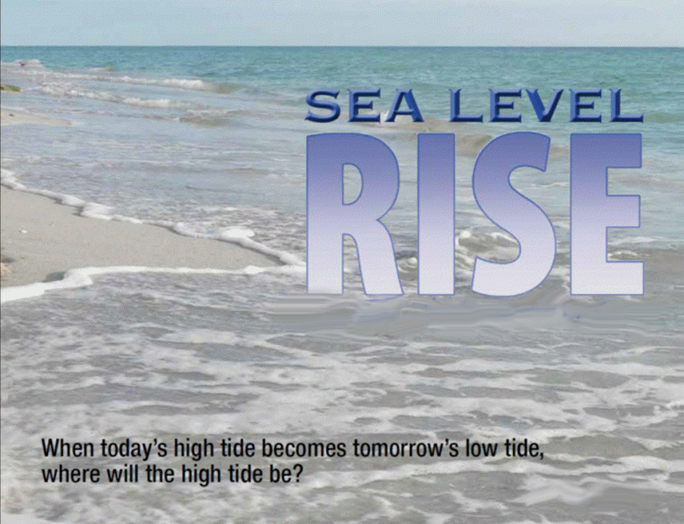
The dust has just about settled since Labour’s ‘golden nuclear
moment’ laid out by Rachel Reeves in her recent Spending Review. Plans
for the monstrous Sizewell C took another step forward, nudged along by the
offer of another £14.2 billion of taxpayers’ money, together with a
further £2.5 billion promised for Small Modular Reactors, and roughly the
same amount for fusion, the nuclear industry’s very own black hole.
So
loud were the fanfares, so overblown the hype, that the real story of that
week got lost. EDF’s deeply ingrained habits of secrecy and deceit were
– yet again – exposed to the harsh light of a Freedom of Information
request from the indefatigable Together Against Sizewell C (TASC). One of
the principal concerns that TASC has doggedly pursued over the last few
years is the vulnerability of Sizewell C being built on one of Europe’s
most rapidly eroding coastlines and its lack of resilience to the impacts
of climate change. The evidence regarding future sea level rise goes from
deeply worrying to totally terrifying – with the very real possibility of
at least a 1 metre rise – and possibly as much as 2 metres – by 2100.
Given that the spent fuel used at Sizewell C throughout its operating life
(around 4,000 tonnes) will need to be stored on site until at least 2160
this is clearly a matter of the greatest concern.
Johnathon Porritt 7th July 2025, https://jonathonporritt.com/sizewell-c-flood-risk-and-edf-silence/
Staff walk out at Hinkley Point C over alleged ‘bullying’
“This bullying has been going on for far too long.”
Staff at Hinkley Point C walked out
on an unofficial strike on Wednesday over alleged bullying. An unconfirmed
number of workers in the MEH group of contractors have downed tools at the
nuclear power station construction site in Somerset yesterday (July 9). A
person involved in the staff walk out told the Local Democracy Reporting
Service it was a response to bullying from senior management. They said:
“This bullying has been going on for far too long.”
Somerset Live 10th July 2025, https://www.somersetlive.co.uk/news/local-news/staff-walk-out-hinkley-point-10333388
We must count the real costs of nuclear power
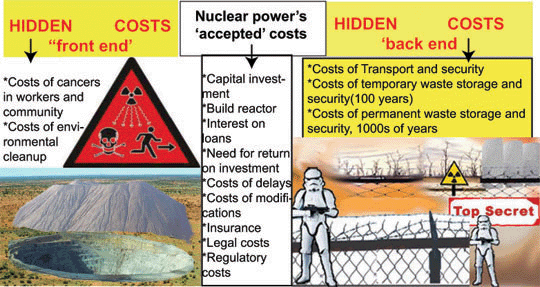
Letter: Your author, in his enthusiasm to highlight the cheaper costs to
build new nuclear plants, failed to include the ever-increasing costs of
decommissioning nuclear plants at the end of their working life. This must
be included in any comparison of costs. He also failed to mention the
problems of vast amounts of highly dangerous radioactive nuclear waste and
accidents, freak weather – such as the tsunamis causing radioactive leaks
in Japan – and potential terrorist attacks. Nuclear may not cause
atmospheric carbon waste but it does create hugely toxic radioactive waste
that remains dangerous for hundreds of thousands of years. A problem that
threatens the health of all life.
Guardian 9th July 2025, https://www.theguardian.com/environment/2025/jul/09/we-must-count-the-real-costs-of-nuclear-power
Why new nuclear power is a bad way to balance solar and wind
As we continue to respond to the coordinated propaganda campaign for new nuclear power in Scotland we hear from David Toke, the author of the book ‘Energy Revolutions – profiteering versus democracy’ (Pluto Press).
In the UK it has almost become an accepted truth in the media that new nuclear power is needed because there is no other practical or cheaper way to balance fluctuating wind and solar power. Yet not only is this demonstrably false, but it actually runs counter to the way that the UK electricity grid is going to be balanced anyway. Essentially the UK’s increasingly wind and solar dominated grid is going to be balanced by gas engines and turbines that are hardly ever used. But you would never guess this from the coverage.
Bella Caledonia 9th July 2025,
https://bellacaledonia.org.uk/2025/07/09/why-new-nuclear-power-is-a-bad-way-to-balance-solar-and-wind/
The Australia-Tuvalu climate migration treaty is a drop in the ocean

Australia has offered a lifeline to the people of Tuvalu, whose island is threatened by rising sea levels. But the deal comes with strings attached – and there will be millions more climate migrants in need of refuge by 2050
By New Scientist, 2 July 2025, https://www.newscientist.com/article/mg26635502-900-the-australia-tuvalu-climate-migration-treaty-is-a-drop-in-the-ocean/
A lifeline has been extended to the people of Tuvalu, a low-lying Pacific nation where rising sea levels are creating ever more problems. Each year, Australia will grant residency to 280 Tuvaluans. The agreement could see everyone currently living in Tuvalu move within just a few decades.
Effectively the world’s first climate migration agreement, the Australia-Tuvalu Falepili Union will also provide adaptation funds to help those who stay behind.
Is this a model for how climate migration can be managed in an orderly way, before disaster strikes? Far from it. To get this deal, Tuvalu must allow Australia a say in future security and defence matters. Few other countries are likely to agree to similar terms.
Tuvalu’s population is also very small. Taking in around 10,000 climate migrants would be inconsequential for a country of 28 million like Australia. Worldwide, it is estimated that between 25 million and 1 billion people might be forced to move by 2050 because of climate change and other environmental factors. Where will they go?
Many argue that the wealthy countries that emitted most of the carbon dioxide that is warming the planet have a moral duty to help people displaced by climate change. But these kinds of discussions have yet to be translated into the necessary legal recognition or acceptance of forced climate migrants. On the contrary, many higher-income nations seem to be becoming more hostile to migrants of any kind.
There has been a little progress in setting up “loss and damage” funds to compensate lower-income countries for the destruction caused by global warming. This could help limit the need for climate migration in the future – but the money promised so far is a fraction of what is required.
The most important thing nations should be doing is limiting future warming by cutting emissions – but globally these are still growing. Sadly, the Falepili Union is a drop in the ocean, not a turning of the tide.
UK Moves Closer to Approving Sizewell C Nuclear Plant Project
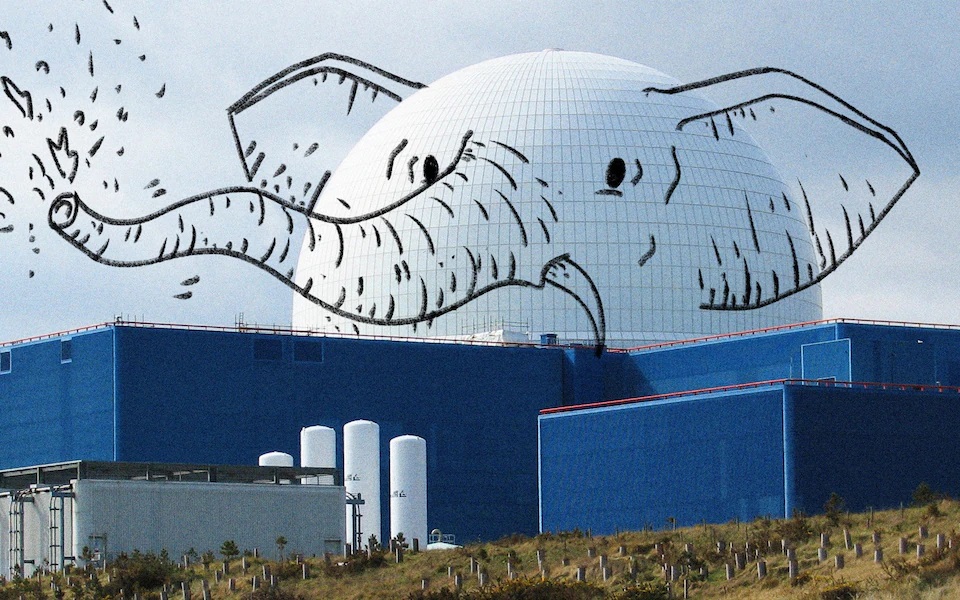
The UK government has reached a deal with French authorities, allowing
Electricite de France SA (EDF) to retain a 12.5% stake in the Sizewell C
nuclear reactor project. The UK government and other investors will hold
the remaining stake, with the UK investing £14.2 billion in the project to
replace aging atomic plants and provide low-carbon electricity. EDF is set
to hold a board meeting to greenlight its participation in Sizewell C,
which will help the UK government make a final investment decision on the
project soon after.
Bloomberg 7th July 2025, https://www.bloomberg.com/news/articles/2025-07-07/uk-moves-closer-to-approving-sizewell-c-nuclear-plant-project
1 This Month





PLEASE OPPOSE HR 8255 AND S.3639 – bills would accelerate satellite deployment, with no environmental review or safeguards – https://ncstd5li.quorum.us/campaign/169331/
To see nuclear-related stories in greater depth and intensity – go to https://nuclearinformation.wordpress.com
-
Archives
- October 2026 (67)
- September 2026 (339)
- August 2026 (330)
- July 2026 (355)
- June 2026 (287)
- May 2026 (306)
- April 2026 (356)
- March 2026 (251)
- February 2026 (267)
- January 2026 (308)
- December 2025 (358)
- November 2025 (359)
-
Categories
- 1
- 1 NUCLEAR ISSUES
- business and costs
- climate change
- culture and arts
- ENERGY
- environment
- health
- history
- indigenous issues
- Legal
- marketing of nuclear
- media
- opposition to nuclear
- PERSONAL STORIES
- politics
- politics international
- Religion and ethics
- safety
- secrets,lies and civil liberties
- spinbuster
- technology
- Uranium
- wastes
- weapons and war
- Women
- 2 WORLD
- ACTION
- AFRICA
- Atrocities
- AUSTRALIA
- Christina's notes
- Christina's themes
- culture and arts
- Events
- Fuk 2022
- Fuk 2023
- Fukushima 2017
- Fukushima 2018
- fukushima 2019
- Fukushima 2020
- Fukushima 2021
- general
- global warming
- Humour (God we need it)
- Nuclear
- RARE EARTHS
- Reference
- resources – print
- Resources -audiovicual
- Weekly Newsletter
- World
- World Nuclear
- YouTube
-
RSS
Entries RSS
Comments RSS

