The Military Connection. For Australian workers and the public, the situation is complicated by and made more urgent as a result of the Australia, UK, USA (AUKUS) agreement regarding the building and stationing of nuclear-powered submarines in Australia. We have already seen the creation of a separate Australian Naval Nuclear Power Standards Regulator (ANNPSR) that will be responsible for all standards in the construction, operation, maintenance, decommissioning, and radioactive waste management from the submarines built or stationed here. We can expect pressure from the USA to have these standards align with those in the USA. As such the ANNPSR could become a back door for pressuring the current standards agency ARPANSA to revise and weaken rather than tighten protection standards across the full range of other occupational and public radiation health risks.
Radiation Protection Standards For most of the past century national and international standards agencies have regulated radiation protection based on three fundamental principles.
1 A ”Linear No Threshold ‘ (LNT) model based on scientific evidence that indicates there is no safe level of exposure. Any dose however small can be the one which can cause cancer – sometimes taking years to develop – or genetic damage affecting future generations.
2 That, therefore, all exposures should be kept ‘As Low As Reasonably Achievable’ – known as the ALARA principle
3 And that exposures to workers and the public should be kept below specified annual limits.
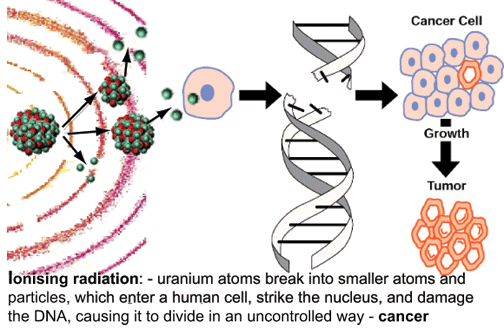
The science behind this protection regime is based on the capacity of ionising radiation to cause damage at the cellular level in the human body. Radiation striking a cell can either cause no damage or it may kill the cell outright – in which case, unless too many cells are killed at once, the body will eliminate the dead cells and function healthily. The problem comes when the cell is merely damaged, and the natural process of repair is imperfect, leaving the cell to replicate in this damaged form – which may in some cases lead to the kind of growth we call a cancer, other long term health or genetic damage. The level of this kind of damage (known as stochastic) is a hit-and-miss affair – a low level of radiation exposure doesn’t determine a health effect but as the level of exposure increases, it increases the probability of the damage.
Current Standards Need Tightening The limits on exposure have been progressively tightened over the years as estimates of the cancer risks, mainly drawn from the Life-Span Studies (LSS) of Japanese survivors of the Hiroshima and Nagasaki atomic bomb blasts in 1945, showed progressively higher rates of this stochastic health damage. Recent evidence from studies of workers in the Nuclear Industries in France the UK and USA (The INWORKS studies) suggest the worker-exposure limits need to again be revised – and significantly tightened. In addition, studies on health of populations living close to nuclear power plants in Europe and the USA show significantly elevated rates of cancer in both children and the elderly directly related to living distance from these facilities.
United States Proposals Would Weaken Current Standards Unfortunately, it appears that the USA is headed in the opposite direction and given the recent behaviour of the current President, may soon pressure other countries to follow suit. In May 2025 US President Donald Trump issued a Directive (EO 14300) Instructing the US Nuclear Regulatory Commission (NRC) to revise all its regulations – in particular, to revise those relating to radiation health and safety. He instructed the NRC to abandon the LNT and ALARA principles and re-set limits on worker and public exposures based on ‘deterministic’ rather than ‘probabilistic’/’stochastic ‘ health outcomes – potentially allowing much higher levels of exposure.
Exactly how the NRC will respond to these directives is unclear. To comply with the president’s orders would put the USA in conflict with national and international agencies such as the International Commission of Radiological Protection (ICRP), the United Nations Scientific Committee on Atomic Radiation (UNSCEAR), the US National Academy of Science’s. Committee on the Biological Effects of Ionising Radiation (the BEIR committee) and other countries’ national agencies including the Australian Radiation Protection and Nuclear Standards Agency (ARPANSA) – all of which have recently reaffirmed commitment to the LN and ARPANSA principles and the current annual limits on worker and public exposure.
TThe draft of the revised NRC regulations on radiation protection is expected on 30 April 2026 with a 30-day period for comments before the final comprehensive revision of all NRC regulations is published in November 2026.
An international Campaign These US proposals have stimulated the beginnings of an international campaign bringing together trade unions, environment and public health groups and communities concerned about current and future exposures from mining, industrial, medical, and nuclear radiation sources. The objectives of this campaign are two-fold:
1 To pressure national and international agencies with responsibility for radiation protection to publicly repudiate any US regulations that align with the Trump Directive and resist any pressures from the US to similarly weaken existing national standards. 2. To build pressure on these national and international agencies to revise and tighten the standards in line with the best available scientific evidence that the health risks are greater than those used to set current standards.
The Military Connection For Australian workers and the public, the situation is complicated by and made more urgent as a result of the Australia, UK, USA (AUKUS) agreement regarding the building and stationing of nuclear-powered submarines in Australia. We have already seen the creation of a separate Australian Naval Nuclear Power Standards Regulator (ANNPSR) that will be responsible for all standards in the construction, operation, maintenance, decommissioning, and radioactive waste management from the submarines built or stationed here. We can expect pressure from the USA to have these standards align with those in the USA. As such the ANNPSR could become a back door for pressuring the current standards agency ARPANSA to revise and weaken rather than tighten protection standards across the full range of other occupational and public radiation health risks.
For further information For references to the scientific evidence and to be kept informed of developments as this campaign evolves contact:
The Lavender case thus exposes the consolidation of a digital necropolitics. Algorithms decide who lives and who dies; corporations provide the infrastructure; intelligence services operate in the shadows; and technocratic language seeks to normalise the unacceptable. Gaza bleeds so that this model may be tested, refined, and then exported.
The revelations by +972 Magazine and Local Call have exposed the darkest core of the contemporary war in Gaza, in which genocide is carried out not only by bombs and missiles, but by data, algorithms and global digital platforms.
The Israeli artificial intelligence system known as Lavender has confirmed what the Palestinian resistance, Lebanon, and Iran have denounced for years: Technology as an organic part of the Zionist war machine, functioning as an instrument of surveillance, target selection, and mass extermination.
The liberal rhetoric of “digital privacy” collapses in the face of the facts. Applications such as WhatsApp insist on the promise of end-to-end encryption, but conceal what is essential, in which metadata are worth more than messages.
“Location, contact networks, patterns of communication, and group affiliations make it possible to map the social life of an entire people. In Gaza, these data have been incorporated into military systems that turn human relationships into algorithmic criteria for death.“
Lavender assessed virtually the entire population of the Gaza Strip, comprising more than 2.3 million people, assigning automated “risk scores”. Merely being in a WhatsApp group, maintaining frequent contact with someone already marked, or displaying digital patterns considered “suspicious” was enough to be placed on execution lists.
Human supervision was deliberately minimal, reduced to seconds, with conscious acceptance of high error rates. Entire families were killed in their homes, treated as “acceptable collateral damage” in an algorithmic equation that normalises massacre.
This is not a technical deviation. It is a policy of extermination. International Humanitarian Law explicitly prohibits indiscriminate attacks and requires distinction between civilians and combatants.
Systems that automate lethal decisions, pre-accepting the death of innocents, constitute crimes against humanity and reinforce the characterisation of genocide as a technologically organised and rationalised process.
The machinery that sustains this model is global. Twenty-first century espionage no longer depends on intercepting messages, but on controlling digital ecosystems.
Private platforms function as permanent sensors of planetary social life, feeding databases accessible to intelligence services such as the Mossad and the CIA, through formal cooperation, legal pressure or the exploitation of vulnerabilities. This represents a structural convergence between big tech companies, the military-industrial complex and the imperial security apparatus.
“Palestine is the laboratory. In an official statement released during the war, Hamas stated on its Telegram channel that “the occupier has turned every modern tool into a weapon against the Palestinian people, using technology to justify the killing of civilians and to conceal genocide behind technical terms”
free translation). The denunciation is clear: Israel is not waging a war against combatants, but against Palestinian existence itself, now mediated by algorithms.
Lebanese Hezbollah has warned that this model forms part of a regional hybrid war, combining digital surveillance, technological sabotage, and selective attacks.
After the attack that occurred in Lebanon in 2024, involving the coordinated explosion of pagers used by its members, Hezbollah declared through institutional channels that “the enemy has turned civilian devices into tools of assassination, proving that its war knows no ethical or human limits” (free translation). The episode revealed a new level in the weaponisation of everyday technology.
This pattern is not isolated. International investigations have already demonstrated the recurring use of military spyware against journalists, activists, and political leaders in various countries, often through smartphones widely available on the global market.
The message is unequivocal: every connected device is a potential instrument of surveillance, control, or death when inserted into the logic of imperial power……………..
The Lavender case thus exposes the consolidation of a digital necropolitics. Algorithms decide who lives and who dies; corporations provide the infrastructure; intelligence services operate in the shadows; and technocratic language seeks to normalise the unacceptable. Gaza bleeds so that this model may be tested, refined, and then exported.
Denouncing this machinery is a historic task. It is not merely a matter of solidarity with the Palestinian people, although that solidarity is urgent and non-negotiable.
Rubio’s speech isn’t just another round of transatlantic posturing. It marks a moment when a top U.S. official openly reframes five centuries of Western expansion — conquest, colonization, and domination — as a civilizational triumph that must be revived.
According to journalist Ben Norton, Rubio’s remarks went beyond simple rhetoric — openly lamenting the end of Western imperial expansion and portraying decolonization movements as destructive forces driven by “godless communist revolutions.”
In a striking address at the Munich Security Conference, U.S. Secretary of State Marco Rubio framed Western history not as a legacy of colonial domination, but as a “great civilization” whose decline must be reversed.
Rubio stated:
“For five centuries before the end of the Second World War, the West had been expanding… its missionaries, its pilgrims, its soldiers, its explorers… building vast empires extending out across the globe. But in 1945… it was contracting.”
He described anti-colonial uprisings as accelerating Western decline and rejected what he called “managed decline,” urging Europe and the United States to renew “the greatest civilization in human history.”
As reported in the Guardian this is something along the lines of “Empire is great. Empire is back. Empire is American.” Adding “The US secretary of state delivered what can only be described as a 22-minute ode to empire. A love letter to conquest and colonialism. A proud defense of the west’s territorial expansion.
Why This Matters
Since the post-World War II wave of decolonization across Africa, Asia, and Latin America, formal empires largely collapsed. Yet Rubio’s framing — praising Western expansion while dismissing colonial crimes as “purported sins” — signals a broader ideological shift.
Norton argues that this speech represents:
A defense of Western imperial legacy
A call for renewed transatlantic unity
A strategic push to restructure global supply chains away from China
An ideological justification for reasserting dominance over the Global South
Context: Competing Global Visions
While Rubio emphasized Western civilizational unity and supply chain control, China’s foreign minister presented an opposing vision centered on multilateralism and sovereign equality at the same conference.
The divide reflects a larger geopolitical struggle between:
A U.S.-led Western alliance seeking strategic dominance
A rising multipolar bloc emphasizing sovereignty and UN-centered governance
For more context on Rubio’s speech and the broader geopolitical stakes, here’s Ben Norton and The Geopolitical Economy Report:
WARNING: DISTRESSING CONTENT Nuclear plant worker Hisashi Ouchi suffered the highest radiation dose in history after 1999 Japan accident, enduring 83 agonising days before death.
Hisashi Ouchi, a 35‑year‑old nuclear plant worker, survived a 1999 criticality accident that delivered the highest recorded radiation dose to a human, enduring 83 days of severe medical complications before dying of multiple organ failure. A government probe later blamed inadequate supervision, safety culture, and training, leading to negligence charges against six plant officials.
Key points:
On September 30, 1999, a criticality accident at a Japanese nuclear fuel processing plant exposed worker Hisashi Ouchi to an estimated 17,000 millisieverts of radiation.
The dose Ouchi received was about 850 times the annual occupational limit for nuclear workers and roughly 140 times higher than the exposure of residents near Chernobyl.
Ouchi was hospitalized at the University of Tokyo Hospital, where he underwent experimental treatments for 83 days, during which his skin sloughed off, his eyelids fell off, and his digestive system collapsed.
Medical staff administered up to ten blood transfusions daily, and painkillers were reported to be ineffective; Ouchi reportedly said, “I can’t take it anymore. I am not a guinea pig.”
He died on December 21, 1999, and the official cause of death was recorded as multiple organ failure
A nuclear facility worker suffered what many consider to be the most agonising death ever recorded after a routine procedure went catastrophically wrong.
Hisashi Ouchi, 35, was exposed to an incomprehensible level of radiation when colleagues accidentally added excessive uranium to a processing vessel, sparking an uncontrolled nuclear chain reaction on September 30, 1999.
The unfortunate Ouchi was positioned nearest to the vessel, consequently subjecting him to 17,000 millisieverts of radiation – equivalent to 200,000 X-rays.
The exposure he received was 850 times the safe yearly limit for nuclear facility workers, 140 times greater than what Chernobyl residents experienced after the 1986 catastrophe, and the most severe dose ever documented in human history.
Within seconds and minutes of his exposure, Ouchi became violently sick. Whilst most individuals subjected to such levels would die within days, Ouchi survived, reports the Mirror.
He was taken to hospital alert but in critical condition, as his white blood cell count had been virtually eliminated, leaving him completely without an immune system.
Medical staff moved him to the University of Tokyo Hospital, where they tried various experimental procedures in a frantic bid to preserve his life.
What ensued was 83 days of torment for the nuclear facility worker.
Radiation had completely obliterated Ouchi’s capacity to heal and regenerate cells, causing his skin to gradually slough away, his blood vessels to fail, and his eyelids to fall off.
Fluids seeped relentlessly from his ravaged flesh and accumulated in his lungs, compelling medics to maintain him on life support.
Making his ordeal even more harrowing, his digestive system collapsed entirely, inflicting excruciating agony and causing litres of fluid to drain from his body daily. Despite numerous skin grafts and stem cell treatments, his body remained unable to recover.
Breathing became impossible without mechanical assistance, and nourishment could only be administered via feeding tube.
The agony became so unbearable that, two months into his treatment, Ouchi’s heart ceased beating, yet medical staff chose to revive him.
His wife reportedly held onto hope that he would survive until at least January 1, 2000, so they could welcome the new millennium together.
During lucid moments, he remained fully aware of his deteriorating condition.
According to accounts, Ouchi eventually reached breaking point and spoke six chilling words to hospital staff: “I can’t take it anymore. I am not a guinea pig.”
Medical professionals were compelled to administer up to ten blood transfusions daily merely to sustain his life. Painkillers appeared utterly ineffective, and at one stage, he reportedly pleaded for the treatment to cease.
Ouchi passed away on December 21, 1999, from multiple organ failure, nearly three months following the incident. Multiple organ failure was recorded as the official cause of death.
Four months afterwards, in April 2000, his colleague Shinohara also died from multiple organ failure at the age of 40.
Supervisor Yokokawa, who had been seated at his workstation when the criticality incident unfolded, managed to survive.
A probe by the Japanese government determined that the accident was due to a lack of regulatory supervision, a deficient safety culture, and insufficient training for employees.
Six officials from the company running the plant were subsequently charged with professional negligence and breaches of nuclear safety laws. In 2003, they received suspended prison sentences for their deadly neglect.
When President Trump unilaterally withdrew the United States from the JCPOA, the US reimposed wide-ranging sanctions in direct contradiction of Resolution 2231 and launched a campaign of economic warfare designed to cripple Iran’s economy that continues to this day.
The US assault on the UN Charter has now escalated once again to the brink of war, with US threats of force and acts of economic warfare proceeding daily.
SCHEERPOST, By Jeffrey Sachs / Common Dreams, February 18, 2026
Distinguished Members of the Security Council,
The President of the United States is issuing grave threats of force against the Islamic Republic of Iran if it does not accede to US demands. His actions risk a major regional war that would be devastating. Asked if he wanted regime change, he responded that it “seems like that would be the best thing that could happen.” When asked why a second US aircraft carrier has been sent to the region, President Trump answered “in case we don’t make a deal, we’ll need it … if we need it, we’ll have it ready.”
These threats are in violation of Article 2(4) of the UN Charter, which declares that “All Members shall refrain in their international relations from the threat or use of force against the territorial integrity or political independence of any state, or in any other manner inconsistent with the Purposes of the United Nations.”
These threats come in the context of Iran’s repeated calls for negotiations. Moreover, on February 7, Iran’s Foreign Minister delivered a speech in Doha proposing comprehensive negotiations for regional peace, following a round of talks in Oman supported by the diplomacy of the Arab states and Türkiye. Even as a second round of negotiations has been announced, the US is resorting to escalating threats of force.
The issue facing the UN Security Council in these perilous days is whether any member state, by force or threat of force, may place itself above the United Nations Charter that governs us all. At stake is the integrity of the UN-based international system.
One of the crucial roles of the Security Council is to call on member states to settle disputes by peaceful means such as negotiation, mediation, arbitration, or judicial settlement, without the threat of force or resort to force. Today, the world is in urgent need of a renewed commitment to diplomacy.
The current threat of an attack by the US did not begin with any failure by Iran to negotiate. On the contrary, it began with the United States’ repudiation of negotiations that had already succeeded.
On July 14, 2015, after years of extensive diplomacy, Iran and the P5 countries plus Germany concluded the Joint Comprehensive Plan of Action (JCPOA) to ensure that Iran’s nuclear program would remain exclusively peaceful. In return, economic sanctions on Iran were to be lifted. The JCPOA placed Iran’s nuclear activities under strict and continuous scrutiny by the International Atomic Energy Agency and thereby ended the risk of a nuclear-arms breakout by Iran, a risk that Iran had consistently denied.
On July 20, 2015, the UNSC unanimously adopted Resolution 2231. That resolution “endorses the JCPOA” and calls upon all states to take the steps “necessary to support the implementation.” It terminated previous sanctions resolutions and incorporated the JCPOA into international law. The Security Council explicitly recognized Iran’s “right to develop nuclear energy for peaceful purposes” under the Non-Proliferation Treaty and established a robust verification regime.
Yet on May 8, 2018, three years after the successful UNSC Resolution, the United States unilaterally withdrew from the JCPOA. This withdrawal was actively lobbied for by the Israeli government. Since the late 1990s, Israel’s leadership has repeatedly, falsely, and hypocritically claimed that Iran was on the verge of obtaining a nuclear weapon, even as Israel itself had secretly acquired nuclear weapons outside the Treaty on the Non-Proliferation of Nuclear Weapons and has until today refused to join the treaty and subject itself to its controls.
When President Trump unilaterally withdrew the United States from the JCPOA, the US reimposed wide-ranging sanctions in direct contradiction of Resolution 2231 and launched a campaign of economic warfare designed to cripple Iran’s economy that continues to this day.
The current threats by the US are therefore part of a long-standing pattern of feigning interest in negotiations while in fact pursuing economic warfare and military force. In June 2025, following the renewal of negotiations earlier that year, the United States and Iran entered a sixth round of talks. The US had characterized the negotiations as constructive and positive. The sixth round was set for June 15, 2025. Yet on June 13, 2025, the US supported Israel’s bombing of Iran. A week after that, the US attacked Iran under Operation Midnight Hammer.
If you have stopped paying attention to global warming, you may soon be in for a nasty surprise. A paper by Columbia University predicts that we will have our first taste of a 1.7C world as soon as next year – a shock big enough to intrude on everybody’s consciousness. One cause is the reversion from the current cooling weather pattern of La Niña in the South Pacific to the opposite El Niño pattern of cyclical warmth. A less understood cause is that aerosol pollution has masked the latent heat effect of past CO2 emissions by around 0.5C and possibly more. Carbon lingers in the atmosphere for several hundred years. This aerosol effect is going into rapid reverse as the world cuts toxic particulates from coal plants, industry, cars and shipping. The Columbia estimate of 1.7C above 1880-1920 levels is at the high end of the scientific spectrum but the Met Office, Europe’s Copernicus service and others also expect a record-shattering year in 2027.
Instead of pumping oil out, the nuclear startup wants to bury a small modular reactor a mile underground. Last week, the company scored $80 million in new financing to help turn the long-discussed concept in the nuclear energy world into reality. And, yes, it’s yet another play at powering those energy-starved data centers.
Notes From the Underground
There are two key reasons to bury SMRs deep beneath the earth’s surface. The first is that, obviously, nuclear fission carries the risk of releasing radiation into the surrounding area, which makes a mile’s worth of earth, dirt and rocks the perfect natural containment system. The second reason is related to the first: It’s a lot cheaper to dig a (very deep) hole and drop an SMR down it than it is to build a whole nuclear facility around a surface-dwelling SMR.
That means Deep Fission’s SMRs might not just be safe, but also more rapidly deployed than their above-ground competitors. And it’s why big names have lined up to back the company in two massive financing rounds just months apart:
Last week’s $80 million funding round featured participation from major backers, including Montrose Capital and EE Holdings, and is built around “a new strategic relationship” with Blue Owl Capital’s Real Assets platform, the company said in a statement.
The cash infusion comes after the company secured a $30 million funding round in a go-public reverse merger (read: SPAC move) with Surfside Acquisition Inc., with plans to eventually list public shares on the OTCQB Venture Market, the lesser-known exchange for, fittingly, riskier investments. The merger occurred shortly after Deep Fission won a spot in the Department of Energy’s Nuclear Reactor Pilot Program to expedite the commercialization of nuclear energy in the US.
The Hole Truth: Most importantly, the fresh $80 million will be used to continue operations at the company’s pilot site in Parsons, Kansas, where it officially broke ground in December — and then, presumably, kept digging and digging and digging.
Why do Malcolm Parkin (Letters, February 12) and many others keep going on about the need for small nuclear reactors because the wind does not blow all the time, as if there were no other highly successful ways to produce energy
Have they never heard of the numerous other means of production? What about pumped storage? Nearly 50 years ago, I visited the Cruachan pumped storage site and learned how that could, when demand is high, release the water to produce electricity to fill any shortfall, and pump it back up to store for the next use. There are already places in Scotland where small, local, pumped storage systems are in operation and numerous larger ones are in construction, or operational, such as Foyers on Loch Ness. These systems could power millions of homes, wind or no wind.
Mr Parkin and others seem unaware that there are wave-powered and tidal systems already operating in Scotland and being further developed, for example around Orkney and the Pentland Firth. These have the advantage that there are two tides a day and constant waves all round our coasts, which would never stop providing energy. Such projects could have been much further advanced had Westminster not, years ago, withdrawn the funding for a major one of these schemes, thus retarding progress. Nevertheless, Scotland is a world leader in these technologies, providing 50% of the world’s such energy.
What need is there to consider any form of nuclear reactor? Whilst nuclear power produced may be clean, the building process and materials have an exorbitant cost, take years, and are highly carbon-producing. Storage of waste presents an insurmountable problem, with severe risks for centuries. Witness the ongoing occasional discovery of radioactive particles contaminating the beaches around Dounreay, years after the plant closed.
Small nuclear reactors are not yet fully developed, and our taxes are currently contributing to the “UK-wide” project, Hinckley Point reactor in South-east England, already 10 years late, nearly three times the original cost and still not completed. Moreover, we are now to share the cost of Sizewell C, of the same outdated design in the same area, final cost and operation date still unknown.
Meantime, Scottish renewables producers pay an exorbitant sum to connect to the Grid, whence 40% of their product goes to England, while our consumers pay the highest costs in Europe, and perhaps the world. Rather than moaning about wind energy and supporting nuclear, Mr Parkin and friends might ask why the Scottish Government does not receive payment for this export – an income which could help speed up our transition and make wind turbine eventually obsolete..
Channel 4’s documentary last night on Palestine Action’s proscription as a terrorist organisation was a game of two halves. The first half, which built the government’s case for proscription, was presumably the “balance” needed to avoid a pile-on by the rest of the establishment media. The second half then proceeded to tear down the government’s case brick by brick.
Here are the five main takeaways from the second half:
1. The film reminded us that the government’s proscription of Palestine Action as a terrorist organisation was done at the behest of Elbit Systems – the Israeli arms firm making killer drones for use in Gaza that Palestine Action was chiefly targeting.
Government officials regularly met with Elbit. A 2023 internal Home Office email, two years before proscription, states: “Reassure Elbit Systems UK and the wider sector affected by Palestine Action that the government cares about the harm the group is causing the private sector [arms industries].”
2. A senior Home Office official told the film-makers that there was a widespread belief among staff that the government was “wrong” to proscribe Palestine Action, and there was “disquiet” that the government was using Palestine Action as a way to curtail rights to protest and speech more generally.
3. Lord Hain, a former Labour government minister, explained that, when MPs and Lords were presented with an amendment to the Terrorism Act in 2020 under which Palestine Action has now been proscribed, the government had made explicit reassurances that criminal damage to property – Palestine Action’s modus operandi – would not qualify as terrorism.
He also reminded viewers that, had earlier governments adopted the same approach as Sir Keir Starmer’s government, the Suffragette and anti-apartheid movements would also have been declared terrorist organisations……………………………………………………………………………………………………………………………………………………………………………………………. https://www.jonathan-cook.net/blog/2026-02-10/ban-palestine-action-arms-industry/
Scotiabank’s subsidiary firm, 1832 Asset Management, has sold its remaining shares in Israeli arms manufacturer Elbit Systems Ltd., according to regulatory filings reported on 16 February.
The latest disclosure to the US Securities and Exchange Commission no longer lists Elbit among 1832’s holdings, ending an investment that once made the Canadian bank the company’s largest foreign shareholder.
In a press release on Monday, No Arms in the Arts, a Canada-based arts coalition opposing institutional ties to the arms trade and Israel’s actions in Palestine, and Just Peace Advocates, a Canadian human rights organization, said the sale followed “more than two years of sustained organizing that made the bank’s investment a liability.”
“Scotiabank’s divestment from Elbit Systems signals that investment in companies complicit in Israeli war crimes has become too risky to sustain,” Karen Rodman of Just Peace Advocates said.
“Yet 2025 data showed the ‘Big Five’ Canadian banks holding over $182 billion in companies operating in the occupied Palestinian territory – a clear contradiction of Canada’s stated opposition to illegal settlements that demands immediate government action to align policy with practice,” Rodman added.
Jody Chan of No Arms in the Arts said, “This news comes after years of sustained pressure across the country, with thousands protesting at Scotiabank branches, hundreds of artists refusing to let their work whitewash the bank’s complicity, and many more closing their accounts.”
Chan added, “Against our government’s attempts to use the façade of a ceasefire to normalize Israel’s siege on Gaza, this demonstrates our collective power to define what we find morally unacceptable and force real change.”
The investment drew sustained protests across Canada, including demonstrations at Scotiabank branches and the disruption of the bank-sponsored Giller Prize broadcast in November 2023.
In November 2025, filings showed approximately 165,000 shares worth around $84 million.
By August 2024, 1832 had cut its stake to roughly 700,000 shares, valued at about $315 million at the time. At the end of 2021, the asset manager held more than 2.2 million shares in the company.
As of mid-February 2026, the position stands at zero.
During the period of divestment, Elbit’s share price rose sharply, climbing from below $175 in 2021 to above $400 last year, before spiking past $700 in January 2026.
Scotiabank had previously said it did “not directly hold the shares” and that it could not interfere in the independent investment decisions of its subsidiary’s portfolio managers.
Elbit Systems is Israel’s largest weapons manufacturer and supplies military equipment used in the Israeli genocide of Palestinians in Gaza.
The company reported record profits during that period, openly marketing weapons used in Gaza as “battle-tested” to demand higher premiums in international contracts,
Mexico’s president, Claudia Sheinbaum, reaffirmed this week her long-standing position with Gaza and Palestine as she declined an invitation from US President Donald Trump to join his newly established Board of Peace, while reinforcing Mexico’s economic strategy with Canada and its commitment to key trade agreements.
Speaking at her regular morning press conference, Sheinbaum confirmed that Mexico would not become a member of the Board of Peace, an initiative launched by Trump to oversee reconstruction and stabilisation efforts in Gaza. She explained that Mexico’s decision is rooted in its longstanding recognition of Palestine as a state. In her view, any credible peace effort in the Middle East must include representation from both Israel and Palestine.
Mexico will instead attend the inaugural session as an observer through its ambassador to the United Nations, signaling that it is not withdrawing from dialogue but insisting on inclusive diplomatic frameworks.
“The participation of both states, Israel and Palestine, is important. But that is not how it is being set out in the meeting,” Sheinbaum said.
“It’s being proposed that we go [to the meeting] as observers. So, our ambassador to the United Nations will probably go as an observer,” she added.
“The White House’s initiative, and Mexico’s decision to stay out of it, come at a time of already heightened tensions between Mexico City and Washington over trade, security cooperation and broader regional policy differences.“
The move also coincides with speculation surrounding the upcoming trilateral review of the United States-Mexico-Canada Agreement (USMCA), after a reporter noted concerns that the United States could potentially withdraw from the agreement and suggested that Mexico may be exploring a “plan B” with Canada.
“More than a plan B, we’re strengthening our relationship with Canada,” She said.
Sheinbaum shifted focus to economic priorities, stressing that Mexico is strengthening ties with Canada ahead of the USMCA review rather than preparing a fallback plan. Officials from both countries are advancing efforts to expand trade, boost bilateral investment and reinforce supply chains.
The overcapacity in electricity production in France for the past two years has forced EDF to modulate the output of its nuclear, hydroelectric, and thermal power plants twice as much. A partial estimate (based solely on the nuclear fleet) puts the annual additional cost at 50 million euros.
L’Usine Nouvelle 17th Feb 2026
EDF’s nuclear power plants are designed for this very purpose. When electricity production significantly exceeds consumption, the 57 reactors are capable of reducing their output by 80% in half an hour, then increasing it again. This is called modulation. This feature is used by the grid operator for frequency balancing, but also by EDF to optimize its production based on market prices, or to conserve fuel. The problem is that this modulation, when too frequent, impacts the equipment in the secondary circuit and its maintenance.
The terrifying story of Japan’s Fukushima nuclear accident of 2011, caused by a cataclysmic earthquake and tsunami, is retold by British film-maker James Jones and Japanese co-director Megumi Inman. The natural disaster left 20,000 dead, and 164,000 people were displaced from the area around the nuclear plant, some with no prospect of return. The earthquake damaged the cooling systems that prevent meltdowns and caused three near-apocalyptic explosions, bringing the nation close to a catastrophe that would have threatened its very existence. Incredibly, the ultimate calamity was finally staved off by nothing more hi-tech than a committed fire brigade spraying thousands of tons of water on the exposed fuel rods.
The film plunges us into the awful story moment-by-moment, accompanied by interviews with the chief players of the time – prominently nuclear plant employee Ikuo Izawa, a shift supervisor and de facto leader of the “Fukushima 50” (actually 69 people) who became legendary in Japan and beyond for their self-sacrificial courage, staying in a nightmarish reactor when everyone else had been evacuated.
Perhaps we could have been given more context and less immediate drama, particularly more background about the plant’s dismal corporate owners, the Tokyo Electric Power Company, or Tepco, which had closed a nuclear plant in 2007 after an earthquake, with a resulting loss of profits. But to skimp on the drama might be obtuse, given the pure hair-raising shock of events. The archive footage of the tsunami spreading across the fields and farmland of Japan is deeply disturbing; “nightmare” is a word casually used, but appropriate here.
The Japanese soul had been uniquely traumatised by the nuclear issue in 1945 and Fukushima was the opening of an old wound; Barack Obama’s offers to help were received warily and the film hints that some of a certain age might have even suspected a kind of opportunistic emergency takeover, like the Douglas MacArthur rule that followed the war. There is something chillingly military in the company’s need for volunteers for a so-called “suicide squad” to vent the reactors to forestall a pressure buildup.
And as far as comparisons with the Chornobyl disaster go, that involved a single reactor; Fukushima had six ready to blow. Before I watched this film, I assumed that Japan’s modern democracy would at least have meant more transparency than the sclerotic and malign Soviet apparatchiks. But maybe not. Tepco has still not released a full history of exactly what went wrong and what discussions took place at the time. And in any case, politicians were themselves dismally eager to cover themselves by tentatively blaming Tepco.
The most robust witness here is the New York Times’s Tokyo bureau chief Martin Fackler, who gives us a crisp account of the official chaos and bungling – and the fact that Tepco had already received a report indicating the Fukushima plant was vulnerable to an earthquake and did nothing. He is interesting on corporate obeisance to the “safety myth”, an industry article of faith which does not result in vigilant and innovative efforts to improve safety, but rather icy disapproval of anyone who questions existing safety provisions. Doing so was disloyalty to the industry and could damage your career.
Perhaps inevitably, the larger questions are left open. Fossil fuels cause slow-motion catastrophe to the planet – in fact, not so slow – while nuclear fuel does not cause climate change, but could cause instant calamity. So is the answer simply what the industry says it is? More and better safety? Or can other renewables fill the gap? Either way, this is a gripping film.
Fukushima is out in the UK and US from 20 February.
This article was amended on 19 February 2026 to clarify that the death toll relates to the natural disaster alone.
Israel’s systematic use of internationally prohibited thermal and thermobaric weapons, often referred to as vacuum or aerosol bombs, capable of generating temperatures exceeding 3,500 degrees Celsius [6,332 degrees Fahrenheit].
“This is a global genocide, not just an Israeli one,”
Al Jazeera investigation reveals how US-supplied thermal and thermobaric munitions burning at 3,500C have left no trace of nearly 3,000 Palestinians.
At dawn on August 10, 2024, Yasmin Mahani walked through the smoking ruins of al-Tabin school in Gaza City, searching for her son, Saad. She found her husband screaming, but of Saad, there was no trace.
“I went into the mosque and found myself stepping on flesh and blood,” Mahani told Al Jazeera Arabic for an investigation that aired on Monday. She searched hospitals and morgues for days. “We found nothing of Saad. Not even a body to bury. That was the hardest part.”
Mahani is one of thousands of Palestinians whose loved ones have simply vanished during Israel’s genocidal war on Gaza, which has killed more than 72,000 people.
According to the Al Jazeera Arabic investigation, The Rest of the Story, Civil Defence teams in Gaza have documented 2,842 Palestinians who have “evaporated” since the war began in October 2023, leaving behind no remains other than blood spray or small fragments of flesh.
Experts and witnesses attributed this phenomenon to Israel’s systematic use of internationally prohibited thermal and thermobaric weapons, often referred to as vacuum or aerosol bombs, capable of generating temperatures exceeding 3,500 degrees Celsius [6,332 degrees Fahrenheit].
Grim forensic accounting
The figure of 2,842 is not an estimate, but the result of grim forensic accounting by Gaza’s Civil Defence.
Spokesperson Mahmoud Basal explained to Al Jazeera that teams use a “method of elimination” at strike sites. “We enter a targeted home and cross-reference the known number of occupants with the bodies recovered,” Basal said.
“If a family tells us there were five people inside, and we only recover three intact bodies, we treat the remaining two as ‘evaporated’ only after an exhaustive search yields nothing but biological traces—blood spray on walls or small fragments like scalps,” he added.
The chemistry of erasure
The investigation detailed how specific chemical compositions in Israeli munitions turn human bodies into ash in seconds.
Vasily Fatigarov, a Russian military expert, explained that thermobaric weapons do not just kill; they obliterate matter. Unlike conventional explosives, these weapons disperse a cloud of fuel that ignites to create an enormous fireball and a vacuum effect.
“To prolong the burning time, powders of aluminium, magnesium and titanium are added to the chemical mixture,” Fatigarov said. “This raises the temperature of the explosion to between 2,500 and 3,000 degrees Celsius [4,532F to 5,432F].”
According to the investigation, the intense heat is often generated by tritonal, a mixture of TNT and aluminium powder used in United States-made bombs like the MK-84.
Dr Munir al-Bursh, director general of the Palestinian Ministry of Health in Gaza, explained the biological impact of such extreme heat on the human body, which is composed of roughly 80 percent water.
“The boiling point of water is 100 degrees Celsius [212F],” al-Bursh said. “When a body is exposed to energy exceeding 3,000 degrees combined with massive pressure and oxidation, the fluids boil instantly. The tissues vaporise and turn to ash. It is chemically inevitable.”
Anatomy of the bombs
The investigation identified specific US-manufactured munitions used in Gaza that are linked to these disappearances:
MK-84 ‘Hammer’: This 900kg [2,000lb] unguided bomb packed with tritonal generates heat up to 3,500C [6,332F].
BLU-109 bunker buster: Used in an attack on al-Mawasi, an area Israel had declared a “safe zone” for forcibly displaced Palestinians in September 2024, this bomb evaporated 22 people. It has a steel casing and a delayed fuse, burying itself before detonating a PBXN-109 explosive mix. This creates a large fireball inside enclosed spaces, incinerating everything within reach.
GBU-39: This precision glide bomb was used in the al-Tabin school attack. It uses the AFX-757 explosive. “The GBU-39 is designed to keep the building structure relatively intact while destroying everything inside,” Fatigarov noted. “It kills via a pressure wave that ruptures lungs and a thermal wave that incinerates soft tissue.”
Basal of the Civil Defence confirmed finding fragments of GBU-39 wings at sites where bodies had vanished.
A ‘global genocide, not just an Israeli one’
Legal experts said the use of these indiscriminate weapons implicates not just Israel but also its Western suppliers.
“This is a global genocide, not just an Israeli one,” said lawyer Diana Buttu, a lecturer at Georgetown University in Qatar.
Speaking at the Al Jazeera Forum in Doha, Buttu argued that the supply chain is evidence of complicity. “We see a continuous flow of these weapons from the United States and Europe. They know these weapons do not distinguish between a fighter and a child, yet they continue to send them.”
Buttu emphasised that under international law, the use of weapons that cannot distinguish between combatants and noncombatants constitutes a war crime.
“The world knows Israel possesses and uses these prohibited weapons,” Buttu said. “The question is why are they allowed to remain outside the system of accountability.”
Collapse of international justice
Despite the International Court of Justice issuing provisional measures against Israel in January 2024, ordering it to prevent acts of genocide, and an arrest warrant from the International Criminal Court issued against Israeli Prime Minister Benjamin Netanyahu in November 2024, the killing intensified.
Tariq Shandab, a professor of international law, argued that the international justice system has “failed the test of Gaza”.
“Since the ceasefire agreement [in October], more than 600 Palestinians have been killed,” Shandab said. He highlighted that the war has continued through siege, starvation and strikes. “The blockade on medicine and food is itself a crime against humanity.”
Shandab pointed to the “impunity” granted to Israel by the US veto power at the UN Security Council. However, he noted that universal jurisdiction courts in countries like Germany and France could offer an alternative path to justice, provided there is political will.
For Rafiq Badran, who lost four children in the Bureij refugee camp during the war, these technical definitions mean little. He was only able to recover small parts of his children’s bodies to bury.
“Four of my children just evaporated,” Badran said, holding back tears. “I looked for them a million times. Not a piece was left. Where did they go?”
If an Epstein document had revealed that Trump advanced Israeli interests as a political favor to the world’s richest Israeli in exchange for campaign funding, it would’ve been the biggest story in the world. But because he came right out and said it, it barely caused a blip.
One under-discussed ticking time bomb is the way Israel keeps saying it’s going to resume incinerating Gaza if Hamas doesn’t disarm while Hamas keeps saying it won’t disarm. Netanyahu’s office is saying that Hamas will soon be given a 60-day deadline to give up its arms, after which the full-scale bombing of the enclave will resume if these demands aren’t met.
A lot of people don’t understand that Hamas has never at any point agreed to give up its weapons. To give up its weapons would be to surrender, which is a very different thing from agreeing to a ceasefire. Israel’s demands and Hamas’ refusal are two diametrically opposed positions which put things on a collision course toward reigniting the Gaza holocaust at full scale.
Israel and its allies have no legitimate basis upon which to demand that Hamas surrender. All they can legitimately do is stop murdering and abusing the Palestinians. If Israel does resume the full-scale incineration of Gaza it will try to justify its actions, but those actions will be completely unjustifiable.
After a year of dishonest concern trolling about imaginary nuclear weapons in Iran, the so-called “President of Peace” Donald Trump has let the last remaining nuclear arms treaty between the US and Russia go the way of the dinosaur. The New START treaty has been allowed to fully collapse by the Trump administration, and has been replaced by nothing. This is infinitely more dangerous for our world than anything Iran has ever been accused of doing.
❖
Someone on Twitter tried to cite Cuba’s floundering economy as evidence that socialism doesn’t work. I told him, “Believing capitalism is better than communism because the US was able to strangle the Cuban economy is like believing you’re a better person than your neighbor because you beat the shit out of him in his driveway.”
There’s an infuriating video going around showing an AI program whose entire function is to monitor baristas using facial recognition software and make sure they’re maintaining maximum efficiency at the coffee shop.
We could have a utopia where robots do most of the labor. Instead we’ve got a dystopia where AI programs push human employees to work like robots.
If an Epstein document had revealed that Trump advanced Israeli interests as a political favor to the world’s richest Israeli in exchange for campaign funding, it would’ve been the biggest story in the world. But because he came right out and said it, it barely caused a blip.
Every news outlet, pundit and analyst who tries to tell you that Jeffrey Epstein was a Russian intelligence operative instead of an Israeli one is just telling you they’re a propagandist. View it as a big flashing sign that says “Never trust anything from this source ever again.”
❖
Israel supporters were overjoyed when the Bondi shooting happened, because they knew it would cause authoritarian laws to be passed. They were happier than the worst Nazis in Australia. They were flooding my replies excitedly telling me I’m going to prison for criticizing Israel.
❖
Every time those in power move to silence Israel’s critics, we must triple our criticism of Israel.
Every time they try to shut down pro-Palestine protests, we must triple our participation in the protests.
We need to make sure their efforts to silence us guarantees them MORE of the thing they’re trying to get rid of, not less.
Impose direct costs on their tyrannical behavior and show them with our actions that every effort to silence us only makes things worse for them.
And that’s as it should be. They’re coming after our rights now. If you attack the civil rights of the citizenry, the citizenry are going to fight you right back.
You don’t get to push without getting pushback. You don’t get to try to take away my rights and then just coast along like it’s no big deal. You get back what you give, thrice over.
The only governments who’ve been able to resist US imperial domination are the ones like China and Iran who forcefully control what goes on in their country, because that’s the only way to shut down US infiltration and subversion effectively. So now the US spends its time going “All our enemies are authoritarian dictatorships! We must be the Good Guys!”
Really they’re the ones who set the conditions which made it so that the only states which maintain their sovereignty are the ones who tightly restrict things like western media propaganda, National Endowment for Democracy influence operations, and other regime change ops. If the US wasn’t constantly trying to topple governments which don’t kiss the imperial boot, those nations could be a lot less restrictive in their laws and policies.
The US empire makes the whole world more tyrannical.







 nuclear-news