Iran warns ‘no point’ in deal with US if Israel remains unrestrained
Another top Iranian official said Washington’s ‘rabid dog’ must be ‘controlled’ following Israel’s latest strike on Beirut
The Cradle,, JUN 14, 2026
Iran’s Parliament Speaker Mohammad Bagher Ghalibaf warned in a statement on 14 June that there is “no point” in continuing efforts to reach a deal with Washington if Tel Aviv remains unrestrained, a few hours after a new Israeli attack on Lebanon’s capital.
“The Zionists’ aggression against the southern suburb [of Beirut] once again demonstrated that the US either lacks the will to uphold its commitments or lacks the ability to do so,” Ghalibaf said.
“You cannot gain concessions by giving the [Israeli] regime a green light. The ‘good cop, bad cop’ game has grown old. If you lack the will and the ability to fulfill your commitments, then there is no point in speaking about continuing down this path,” the parliament speaker added.
Meanwhile, Brigadier General Mohammad Jafar Asadi, deputy commander and deputy inspector of the Iranian military’s Khatam al-Anbiya Central Headquarters, said Israel’s attack on Beirut’s southern suburb will not go unanswered.
Israelnews updates
“If you seek an agreement or understanding, you must discipline the Zionist regime. If this rabid dog is not controlled, it will bite your leg before the ink is dry on the agreement,” said Ebrahim Rezaei, spokesperson for the Iranian parliament’s Foreign Policy and National Security Committee.
The latest Israeli airstrike on the Lebanese capital took place earlier on Sunday afternoon. The attack hit a building in the southern suburb’s Ghobeiry area. …………………………………………………………………………….. https://thecradle.co/articles/iran-warns-no-point-in-deal-with-us-if-israel-remains-unrestrained
Jeffrey Sachs: Peace at Last—or Just the Next Pause Before War?
SCHEERPOST, June 15, 2026, Joshua Scheer
For weeks, the world stood on the edge of a wider regional war as the United States and Israel launched attacks on Iran, threatening to ignite a conflict that could engulf the Middle East and destabilize the global economy. Now, with Washington announcing that a deal has been reached with Tehran, the question is no longer whether the fighting will continue—but whether this agreement represents genuine peace or merely a temporary pause before the next crisis.
In this conversation with Glenn Diesen, economist and geopolitical analyst Jeffrey Sachs argues that the war achieved none of its stated objectives. Rather than demonstrating American or Israeli strength, Sachs contends the conflict exposed the limits of military power, accelerated the decline of U.S. global dominance, and left all sides weakened. While reports suggest the agreement could reopen the Strait of Hormuz, ease sanctions, and restart negotiations over Iran’s nuclear program, Sachs warns that the deal remains fragile, its details unclear, and its success far from guaranteed—especially with Israel remaining outside the formal framework.
More broadly, Sachs sees the conflict as part of a larger historical turning point. From Ukraine to Iran to China, he argues that Washington is confronting a reality it has long resisted: the unipolar moment is over. The United States can still inflict enormous damage, but it can no longer dictate outcomes across Eurasia through military force alone. Whether this agreement marks the beginning of a more diplomatic era or simply another pause in a cycle of escalation remains an open question. What is clear, Sachs argues, is that the assumptions that guided American foreign policy for the last three decades are increasingly colliding with reality.
Jeffrey Sachs: The Iran War Failed. Now Comes the Real Test.…………………………………………………………………………………………………………………………………………………………………………………………………………………………https://scheerpost.com/2026/06/15/jeffrey-sachs-peace-at-last-or-just-the-next-pause-before-war/
Netanyahu faces a new threat: The collapse of Western support

the Foreign Office announced plans for the UK to bring “together Australia, Canada, France, New Zealand and Norway to deliver coordinated sanctions against networks financing and enabling settler attacks against Palestinians in the West Bank, and firmly advises British businesses against activity in illegal Israeli settlements.”
As Iran and Israel exchange fire once again, it seems that the Israeli PM’s greatest loss may be US public opinion
By Paul Rogers, June 15, 2026, https://www.opendemocracy.net/netanyahu-new-threat-collapse-support-united-states-israel-iran-gaza/
In a further fracturing of the very shaky ceasefire between Iran and the United States, the Iranian Revolutionary Guard Corps (IRGC) this week shot down a US Army Apache attack helicopter near the Strait of Hormuz.
At any other time, the US would have seen this as an unacceptable act of war requiring a very strong reaction. But where Donald Trump’s unpredictable social media output would usually have breathed hellfire and damnation, this time it talked a proportionate response.
It seemed a welcome sign that Trump’s advisers, and maybe even the president himself, are having to accept that this war will not be won by bombs, missiles and drones, and will have to end in compromise.
As domestic support for the war is ebbing away in the US, the mood in Washington is changing. Opposition to the war is growing, while support for Israel and its prime minister, Binyamin Netanyahu, is dwindling.
A week ago, this was all reasonably obvious, but the past few days have given a sharp indication of how difficult it will be to move to negotiated settlements in the double conflicts involving Israel and Lebanon, and the US and Iran.
The recent sequence of events started with a warning from the IRGC leadership in Tehran: Israel’s continued bombing of Lebanese towns and cities, including the widespread targeting of health facilities, violated the temporary ceasefire and must stop. Instead, Netanyahu ordered more attacks, including on the Lebanese port city of Tyre, which has been subject to around 30 direct air raids by the IDF in the past three months.
As well as healthcare facilities, the IDF attacks have also been aimed at critical urban infrastructure, such as power and communications lines, water treatment plants and sewage treatment systems. The New York Times even reports the probable use by the Israelis of white phosphorus, an incendiary substance that spontaneously ignites on contact with air and is exceptionally difficult to extinguish.
The IDF is also continuing its practice of ordering mass evacuations of both urban populations and rural communities.
Yet despite the extent of the force it is using, the IDF has failed to destroy Hezbollah. There is little sign of that changing; consider that the IDF is still unable to control Hamas in Gaza despite having destroyed so many urban areas.
Meanwhile, Netanyahu has made it abundantly clear that Israel is stepping up its plans to annex the great majority of Gaza. Over 50% of the land, including most of the area previously used for intensive horticulture, has been taken over by Israel. That is now increasing to 70% of Gaza, with yet more Palestinians being forced into overcrowded camps.
Taken alongside the increasing number of illegal settlements as well as Jewish settler violence in the Occupied West Bank, and the move to control substantial parts of southern Lebanon, the immediate prospects for a peaceful outcome are minimal.
A remarkable indicator of this is that, as settler violence against Palestinians continues, Amnesty International reports on a “Great Israeli Real Estate Event” scheduled to take place in London this weekend, in which land in illegal settlements will be marketed to the Israeli diaspora in the UK.
Two substantial issues remain. The first has been glaringly obvious for over 30 months: Israel is radicalising many thousands of young Palestinians to resist the IDF, even to the extent of sacrificing their lives. That alone means Netanyahu and his government are engaged in an unwinnable war.
Then there is the second issue: overseas opposition to Israel is growing in some unexpected quarters. Germany is historically reluctant to criticise Israel in public, yet a pro-Palestinian wave of support has been seen in universities across the country.
In Britain, Labour MP Melanie Ward has brought attention to UK charities that she says have given at least £28m illegal Jewish settlements across the occupied West Bank. Foreign secretary Yvette Cooper has responded by announcing that the Charity Commission will investigate the organisations’ links to the settlements and whether they can retain their charity status.
This comes in the week that the Foreign Office announced plans for the UK to bring “together Australia, Canada, France, New Zealand and Norway to deliver coordinated sanctions against networks financing and enabling settler attacks against Palestinians in the West Bank, and firmly advises British businesses against activity in illegal Israeli settlements.”
Despite the Labour government’s antagonism to pro-Palestinian activists, The Guardian reports that some activists believe there is a “sea-change” underway in government circles, aided by the strongly pro-Palestinian stance of leading Green Party politicians, including leader Zac Polanski.
Successive Israeli governments have spent decades cultivating support through well-funded lobbies in these two key European states. That support is fraying, but what is far more significant is the shift in attitudes in the US. A trenchant piece in the influential Wall Street Journal, entitled ‘Netanyahu has lost Middle America’, concludes that whatever happens in the Gaza conflict, the loss of public US support “has been catastrophic and won’t be reversed quickly.”
That conclusion, in that journal, may turn out to be the most significant development in a singularly chaotic week.
Trump hands Iran a major nuclear concession as US and regime get closer to peace deal… while Tehran demands two-part agreement: live updates
By JON MICHAEL RAASCH, WHITE HOUSE CORRESPONDENT and STEPHEN M. LEPORE, US SENIOR REPORTER, 13 June 2026 , https://www.dailymail.com/news/article-15895963/Trump-hands-Iran-major-nuclear-concession-final-deal-text-agreed-sides.html
Donald Trump has agreed to let Iran retain its civilian nuclear program in a major concession as the two sides say they are closer than ever to reaching a peace deal, with Iran wanting it done in two parts.
A senior White House official said: ‘We’re not bothered at all by the idea of civilian power plants in Iran; what we’re bothered by is the type of infrastructure that would allow them to jump from civilian power generation to nuclear weapons development.’
The official pointed to how the United Arab Emirates has a civilian nuclear power program that could not be turned into a bomb-making operation.
Meanwhile, Iranian Foreign Minister Abbas Araghchi confirmed the deal is in its final stages, while laying out what they want out of Washington.
That includes Israel‘s withdrawal from Lebanon and Tehran’s continued control over a reopened Strait of Hormuz and a ‘service fee’ for commercial ships.
Araghchi added that he wants a two-part pact to end the war. Part one would be a memorandum of understanding followed by a lasting peace deal build on the nuclear issue and the lifting of sanctions.
‘The nuclear issue has been left for the second round and a final agreement,’ he said on state television.
The revelation indicates that the Trump administration has given Iran the green light to hold onto its civilian nuclear power plants as long as those sites cannot be used to create a nuclear weapon.
What safeguards would be put in place to prevent Iran from scaling up its nuclear power plants to bomb-making facilities is unclear, but any steps taken by the Islamic Republic to make a nuclear weapon would derail any potential deal.
Trump has long stressed that any end to the war would be predicated on Iran giving up its nuclear capabilities, particularly its uranium enrichment labs that US intelligence claims can make weapons-grade fuel.
The MOU mandates that Iran’s current stockpile of nuclear material be destroyed on-site and then taken out of the country. Trump has said that only the US and China can dig up the deeply buried fissile material.
Pakistani Prime Minister Shehbaz Sharif said on Friday that the ‘final text’ of a peace deal between the US and Iran ‘has been reached.’
‘Peace has never been this close as it is now,’ he added.
The official also said the deal would reopen the Strait of Hormuz and end the current US blockade targeting Iranian vessels.
The US is 80 to 85 percent certain that the deal would be signed, the official said, with reports indicating a ceremony planned for Sunday in Geneva.
Many of the hardliners in the Iranian regime are on board with the proposed MOU, the senior White House official stated.
The Islamic regime will be rewarded economically after the deal, the US official said.
‘They do get reintegrated into the world economy, they’re going to be rewarded for acting like a normal country rather than the largest state sponsor of terrorism,’ the official said. ‘That said, those benefits only accrue if Iran delivers.’
The call to clarify exactly what is in the MOU came after the President fumed at Iranian officials for leaking the terms, saying what they put out is not the official stance of US negotiators.
‘The terms that Iran leaked out to the Fake News have nothing to do with the terms that were agreed to, in writing,’ Trump wrote on Friday morning. ‘What they said, including their weak and pathetic statement on having a deal, bears no relation to the truth.’
Very dishonorable people to deal with. With them, there is no such thing as dealing in good faith.’
The administration has said on countless occasions over the past months that a deal was close at hand.
But this time, there may be more traction as Vice President JD Vance is expected to sign a deal in Europe as soon as this weekend.
Four US Air Force C-17 transport planes flew to Europe on Thursday, carrying equipment for a possible VP trip to Geneva, where a signing ceremony is planned in the coming days, Axios reports.
The MOU between the US and Iran to halt the war could be signed as soon as Sunday, a source told Reuters, the same day as Trump’s birthday.
‘We just made a great settlement of the war with Iran,’ Trump told reporters on Thursday.
‘The documents are in pretty final shape, so we’ll see. It should be done over the next few days. We’ll probably have a signing, maybe in Europe, and it’s a great thing.’
Trump Administration Plans Major NATO Drawdown Of U.S. Jets, Tankers, Bombers And Warships In Europe
The reported reductions provide one of the clearest pictures so far of how far the Trump administration intends to go in scaling back the U.S. role within NATO
by yourNEWS Media Newsroom | Jun 13, 2026
A June document shared with allies reportedly outlines sweeping reductions in U.S. military assets assigned to NATO operations, including fighter jets, surveillance aircraft, tankers, naval forces and bomber units.
By yourNEWS Media Newsroom
The Trump administration is preparing to reduce key U.S. air and naval assets available for NATO missions in Europe, a move that would mark a broad shift in America’s military posture inside the alliance, according to The New York Times.
Two senior European officials familiar with the decision said the reductions were detailed in a document provided to allies in early June. The plan would cut the number of American aircraft and warships assigned to NATO operations and could limit the alliance’s capacity for aerial refueling, surveillance, long-range strikes and maritime monitoring.
Under the proposal described by the officials, U.S. F-16 and F-15E fighter jets available for NATO operations would fall from about 150 to 100. Maritime reconnaissance aircraft would be reduced from 26 to 15, and all eight aerial refueling tankers previously assigned to Europe would be withdrawn.
The drawdown would also involve the reassignment of a missile-launching submarine, an aircraft carrier and several supporting warships. One of the two bomber groups previously designated for Europe’s defense would also be reassigned.
The Pentagon declined to address the specific numbers in the document. It instead referred to a recent statement from U.S. European Command about plans to reduce American commitments in Europe.
The reported reductions provide one of the clearest pictures so far of how far the Trump administration intends to go in scaling back the U.S. role within NATO, the post-World War II alliance created for the collective defense of North America and Europe. European leaders continue to regard NATO as central to deterring Russian aggression, and the proposed shift comes as many governments on the continent remain concerned about Moscow’s military activity near alliance territory.
No public timetable has been announced for carrying out the reductions. However, U.S. officials have signaled that the changes could occur sooner than many European governments had expected.
The impact could be felt across several NATO missions. Fewer aircraft and ships could affect the alliance’s ability to track Russian submarine movements, support long-distance air operations and conduct long-range strike missions.
Giuseppe Spatafora of the European Union Institute for Security Studies said the combined reductions would have consequences beyond any one category of equipment.
“While each of these cuts can be managed individually, together they represent a significant posture change and pose challenges to European deterrence readiness across the spectrum,” Spatafora said.
President Donald Trump has repeatedly argued that European NATO members rely too heavily on U.S. military power and should spend more on their own defense. His administration had already announced smaller adjustments to American troops and forces in Europe, but the June document outlines wider reductions affecting NATO missions across the continent.
The United States would still maintain one of NATO’s largest military footprints in Europe after the planned cuts. At the same time, European governments have increased defense spending and moved to rebuild military capacity amid uncertainty over long-term U.S. support……………………………………………………………………………………………… https://yournews.com/2026/06/13/7053385/trump-administration-plans-major-nato-drawdown-of-u-s-jets-tankers/
The Elon Musk Cult: Drooling in the SpaceX Bubble

Musk had become this unfortunate planet’s first trillionaire due to a tax system that offered a shield for the ultra-wealthy while requiring the toiling workers to “pay taxes on every paycheck.”
Social responsibility tended to be hard to find in the cultic coverage of Musk’s attainments. Here was indulgence and market distortion aplenty, which should bother anyone whose fund managers wish to ride the wave. Musk is not just a threat to such simple notions as civic duty but an arid, unforgivable bore who tries so hard to be, well, liked.
14 June 2026 Dr Binoy Kampmark, https://theaimn.net/the-elon-musk-cult-drooling-in-the-spacex-bubble/#google_vignette
The fourth estate has taken leave of its senses again, not that much is left for the exercise of those frail faculties. But commentary on Elon Musk’s transformation from multibillionaire tech prat into a trillionaire tosser because of magical accounting and the bubble of company valuation was reverenced rather than critiqued. Starry-eyed commentary from financial analysts swooned over the prospect of further investments after SpaceX made its public offering on June 12; the rhetoric of intergalactic travel and extra-terrestrial based data centres was lapped up. (Easy to revel in what is yet to be created.)
Publications such as Forbes “declared” – as if they have such priestly authority to do so – the change of financial status of the cocksure mogul. Better reporting would at least have pointed out that these assessments lie in the world of the fictive, a trillionaire status tied up in stockholdings in Tesla and the monster that is now SpaceX. The stock in SpaceX will be unsellable for at least a year. But let us see how that supposed scrutineer of wealth described it: “Forbes estimates that the IPO has boosted Musk’s fortune to $1.1 trillion, as of Friday morning. His net worth rose by $188 billion to an estimated $982 billion on Thursday evening, when SpaceX priced the IPO at $135 per share.” Matt Durott, Deputy Editor of the Wealth section of Forbes valiantly bored readers with the observation that Musk’s “ascent to a $1 trillion fortune represents a milestone once considered unimaginable, highlighting how rapidly wealth can be created in an increasingly interconnected and technology-driven world.”
Renaissance Capital’s Matthew Kennedy was appropriately banal to observe that such public offerings do tend to involve fluff, bluster and show. “No question that there is a ton of hype about it. Nothing captures the imagination like space.” Such expansive imagination becomes borderless with the realisation that SpaceX is a loss-making exercise, a warning that is being beaten back by the financial tribes. In 2025 and 2026, it lost $9 billion, according to the company’s own financial filings. Much of that bleeding has taken place in the artificial intelligence portfolio, where artificial means what it says. Nancy Tengler of Laffer Tengler Investments, a firm that has put in an order to net SpaceX shares, had to admit that the AI arm of the company was proving to be a “cash incinerator.” Proving to be a gambler, as many in this bubble industry are proving to be, Tengler is focusing on an “investment horizon” lasting anywhere from three to ten years.
Unless you subscribe to Cult Musk, another facet of this monstrous growth of counterfeit wealth lies in its origins, which are very much of a government and administrative making. The tech brat complex has tended to draw a generous share of public monies through government subsidies and research propped by the public sector. Government contracts have sought to fill the coffers of SpaceX, dispelling notions of rugged, self-sufficient innovation.
Even as Musk went about his vigilante task of trimming US federal spending through his DOGE (Department for Government Efficiency) team, it was hard to ignore the looming shadow that his business empire had received, according to an estimate arrived at by the Washington Post, $38 billion in government padding and stretching, be it through contracts, loans, subsidies and tax credits. “Nearly a tenth of government money that has benefited Musk’s companies comes from agencies in eight states, including California. Since 2007, state and local governments have given Musk companies at least $1.5 billion in tax credits, grants and reimbursements, while various government agencies at multiple levels contributed another $2.1 billion, much of it to drive the development of Tesla and the batteries it relies upon
Those sufficiently alert can at least make the obvious point that a risibly generous tax system, which should be described as a system that negates tax for the wealthy, has turned the clownishly well-heeled into caricatures of gilded wealth, a bird species ornamented beyond conscience and saved from any hunting season. Igor Volsky, director of the Tax the Greedy Billionaires Campaign, offered few surprises in expressing the view that Musk had become this unfortunate planet’s first trillionaire due to a tax system that offered a shield for the ultra-wealthy while requiring the toiling workers to “pay taxes on every paycheck.” Volsky then mourns the horse long bolted from the stable. “Unless we plan to cede control and agency over our future to a handful of ultra-wealthy individuals, lawmakers must pursue bold tax policies that actually meet this moment – not just slowing the accumulation of extreme wealth, but reversing it.” Volsky then mourns the horse long bolted from the stable. “Unless we plan to cede control and agency over our future to a handful of ultra-wealthy individuals, lawmakers must pursue bold tax policies that actually meet this moment – not just slowing the accumulation of extreme wealth, but reversing it.”
Social responsibility tended to be hard to find in the cultic coverage of Musk’s attainments. Here was indulgence and market distortion aplenty, which should bother anyone whose fund managers wish to ride the wave. Musk is not just a threat to such simple notions as civic duty but an arid, unforgivable bore who tries so hard to be, well, liked. Were a novelist to ever try to do justice to his repulsive case, not much would present itself. At least Evelyn Waugh, when trying to elevate the nobs he worshipped in Brideshead Revisited, proved lush in his representation of a dying era he should have left to the tombs. No amount of cash, or space, will do it for Musk on that score.
Can Trump Restrain Israel?
Middle East Monitor06/13/2026, by Norliza binti Saleh, https://www.juancole.com/2026/06/trump-restrain-israel.html
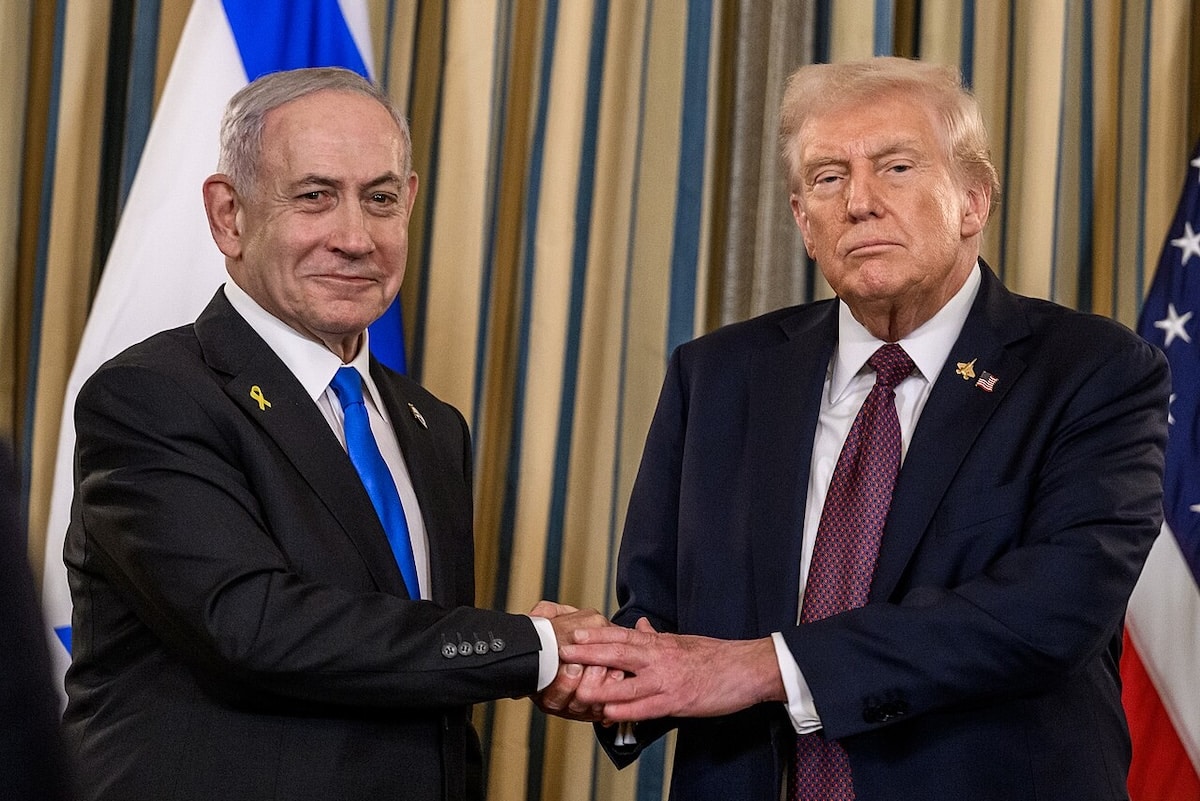
The latest exchange between Iran and Israel raises a fundamental question: Who is really driving events in the Middle East – Washington or Jerusalem?
Following Israeli strikes on targets in Beirut, Lebanon, Iran responded with strikes against northern Israel and military facilities around Haifa. Israel then immediately retaliated by attacking Tehran, Tabriz, Karaj and Isfahan. While the ceasefire between the United States and Iran is technically in place, the broader regional conflict continues to intensify. Throughout the crisis, President Donald Trump has repeatedly expressed support for de-escalation and urged all parties to avoid a wider war.
Yet events on the ground suggest that Washington’s desire for stability may not necessarily translate into restraint by its closest ally. The current crisis is becoming a test not only of regional security but also of American influence itself.
The Trump administration appears reluctant to become involved in another prolonged West Asian conflict. Unlike previous periods of direct American military engagement in the region, Washington’s priorities today are largely domestic and economic.
A wider regional war would almost certainly increase energy prices, disrupt global trade routes, and create uncertainty in international markets. Such instability would undermine economic recovery efforts and place additional pressure on American households.
For Trump, who has consistently portrayed himself as a leader focused on domestic prosperity rather than foreign military adventures, another regional war offers few political benefits.
This explains why Washington continues to advocate restraint and emphasize the importance of maintaining the ceasefire framework currently in place.
Israel, however, views the situation through a different lens.
From the Israeli perspective, Hezbollah and Iran remain immediate security threats that cannot be ignored. Israeli leaders claim that military pressure is necessary to weaken these adversaries, regardless of American concerns about regional escalation.
Yet security alone does not fully explain Israel’s actions.
“The conflict is also intertwined with political and ideological ambitions. The influential factions within the Israeli regime continue to be influenced by a broader vision of expanding Israel’s strategic footprint in the region, often associated with the concept of “Greater Israel”.
In this reading, Lebanon is not merely a battlefield but part of a wider Israeli expansionist project.
This creates an important divergence between American strategic interests and Israeli security calculations. The result is an increasingly visible gap between what the United States wants and what Israel is prepared to do.
Recent developments have also highlighted Iran’s growing strategic importance. Iran occupies a critical geographical position overlooking the Strait of Hormuz, through which a significant portion of the world’s oil and gas supplies passes. Any disruption to this maritime chokepoint would immediately affect global energy markets and international trade.
More importantly, external pressure has strengthened domestic unity within Iran. The groups that previously disagreed with the government have increasingly
rallied around the state in response to external threats. Regionally, Iran has demonstrated both military capability and strategic reach, reinforcing its position as a major regional power whose actions can no longer be ignored. Recent events have witnessed that Iran possesses significant leverage over regional security and global energy stability.
The central issue, therefore, is not whether Trump supports a ceasefire. He clearly does.
The real question is whether Washington possesses sufficient leverage to translate its preference into Israeli behaviour.
“If Israeli military operations continue despite American calls for restraint, observers will inevitably question the extent of US influence over its closest ally. “
This matters because American credibility remains a key pillar of regional stability. If Washington is unable to shape the actions of partners that depend heavily on American diplomatic, financial and military support, its broader influence across West Asia may also come under scrutiny.
Failure to contain the current escalation carries risks far beyond West Asia. A wider Iran-Israel confrontation could threaten critical energy routes, including the Strait of Hormuz and other regional maritime chokepoints. Rising energy prices would affect economies worldwide, including countries geographically distant from the conflict such as Malaysia.
At the same time, continued instability risks expanding the conflict across multiple fronts involving Lebanon, Syria, Iraq and the Red Sea region. The longer the crisis continues, the greater the likelihood of miscalculation by one or more actors.
For this reason, calls for a genuine ceasefire must be matched by meaningful diplomatic efforts and credible pressure on all parties involved.
“The current crisis has become a test of two things: regional stability and American influence. “
President Trump may genuinely prefer de-escalation, but preference alone is insufficient. The true measure of leadership lies in the ability to shape outcomes, not merely express intentions If Washington cannot persuade its closest ally to support a sustainable ceasefire, the risk of a wider regional conflict will continue to grow.
“The key question is therefore not whether Trump wants peace. The key question is whether he still possesses the leverage necessary to make it happen”
Why a single ‘peace deal’ for Ukraine war just won’t work
As Western mainstream media carpet bombs the world with news that Ukraine is turning the tide in the war and could still win, then the calculus may be among Western policy hawks that continuing the war is no bad thing.
The Europeans and Zelensky appear dug in for the long haul.
An agreement within NATO. A peace settlement for Ukraine will only land when its future NATO aspiration is taken decisively off of the table. Anyone who still believes that Russia will give up on this clearest of redlines is dangerously misguided.
The time is ripe for European leaders to set aside the self-licking summits and get in the room with the US, Ukraine, and Russia
Ian Proud, Jun 13, 2026, https://responsiblestatecraft.org/ukraine-russia-europe-talks/
The time is ripe for European leaders to set aside the self-licking summits in European capitals and get in the room with the U.S., Ukraine, and Russia to orchestrate a modern-day Helsinki Conference.
A durable peace for Ukraine will require several interlocking agreements, each of which will be incredibly difficult to negotiate, but all of which will be vital if we are to avoid a general war in Europe.
In a recent post on X, former U.S. diplomat Dan Fried, commenting on the June 7 E3 Leaders’ Statement on peace in Ukraine, said, “If Russia wants to end the war it can, you know, end the war.”
It’s important to pause here and note that Fried was the State Department Coordinator for Sanctions Policy from 2013 until 2017. I know, because I was directly involved at the time, that Fried is the architect of the policy of making Russia sanctions permanent by linking them to the full implementation of the Minsk II agreement, which Russia and Ukraine interpreted in radically different ways. The main aim of sanctions conditionality was therefore to delay any possibility of peaceful settlement, and in that it succeeded.
Eleven years on, Fried’s remark echoes a common line of argument in pro-war Western circles: that Russia could simply end the war without a negotiated settlement. And yet an unconditional about-face by Russia is quite obviously never going to happen, and so the comment serves only to prolong the war.
The E3 statement flowed from the same logic. It offered nothing new or unexpected. Critically, it reiterated the line that roughly $300 billion of Russian assets will remain immobilized until Russia “ceases its war of aggression and compensates Ukraine for the damage caused by the war.”
The current World Bank estimate of the cost of reconstruction and recovery in Ukraine stands at $588 billion. So, the E3 position amounts to confirmation that Russia will never see its money again and moreover will still have $288 billion left to pay.
This, I fear, is another example of Fried’s logic — that peace in Ukraine is indeed possible, but only on terms that Russia would be unable or unwilling to accept. As Western mainstream media carpet bombs the world with news that Ukraine is turning the tide in the war and could still win, then the calculus may be among Western policy hawks that continuing the war is no bad thing.
It’s certainly clear that no one appears in a rush. The E3 statement follows a sixteen-month period of endless and repetitive meetings by European leaders and Zelensky in which everyone violently agrees, but to which the Russians are never invited.
Only in recent months, notably since President Donald Trump’s Alaska Summit with Putin, has the topic of a negotiated end to the Ukraine war slowly bubbled to the surface in Europe. President Alexander Stubb of Finland, President Emmanuel Macron of France, Prime Minister Bart de Wever of Belgium have at various times dipped their toes in the water of suggesting diplomatic talks with Russia.
Last week, Zelensky himself issued an open letter to Putin about a possible meeting.
But, being that the letter contained several pages of personal barbs and insults about Putin, it is hard to see this as anything more than a self-licking stunt, of the type Dan Fried would support. The Europeans and Zelensky appear dug in for the long haul.
A senior Russian contact remarked to me recently that the Europeans spend a lot of time talking about the possibility of talks, but not the substance of what might be on the agenda. In truth, a vast amount of work will be needed in preparatory negotiations to map out the shape of a future peace settlement, requiring a clarity of focus that has hitherto been missing.
A durable peace for Ukraine will require several interlocking deals, possibly negotiated separately with different signatories. Talk of a single ‘peace deal’ for Ukraine is a lazy over-simplification. The latest E3 statement bundles up separate issues in the same basket as does the now dormant US brokered plan. A peace settlement for Ukraine will require, inter alia, the following.
A bilateral peace deal between Russia and Ukraine, brokered by the U.S. and others. The existing U.S.-brokered draft is the right place to start, as that includes the most contentious issue of territory, and in particular the future status of the remaining territory in Donetsk which Russia has not conquered. It would also need to cover sensitive topics such as the size of Ukraine’s army, Ukrainian children who were removed to Russia, and minority languages in Ukraine.
A clear plan and timeline for Ukraine to join the European Union. This can only be negotiated bilaterally by the EU and Ukraine, without U.S. or British involvement. It is arguably as difficult as a bilateral peace agreement between Ukraine and Russia.
Zelensky has said he wants to see Ukrainian accession by 2027, but this is not going to happen, and not only because the war may still be ongoing. The Europeans aren’t over eager about Ukraine joining because Ukraine is nowhere near ready, and Europe can’t afford it. Chancellor Merz has recently resurfaced the idea of “associate membership,” in which Ukraine gets no voting rights or money. Every rational observer should be able to judge that many Ukrainians will want clarity on the glidepath towards EU membership as a condition for ending the war.
An agreement between Russia and Europe, including the United Kingdom, on the future shape of their relationship. The third issue is equally as complex. Should Ukraine eventually join the EU, then it would join existing former Soviet and Warsaw Pact members (the Balts and Poland) who frame Russia as an existential threat. Relations between Europe and Russia are more shuttered today than they were during the Soviet era.
Europe needs cheap energy to stem the tide of self-imposed deindustrialization; Russia would like European investment again and a more open people-to-people relationship. There will need to be a settlement on how sanctions against Russia are eased during a post-war period. Ignoring an EU-Russia deal risks pressing the pause button on a future general war at a time when Europe is rapidly rearming,
An agreement within NATO. A peace settlement for Ukraine will only land when its future NATO aspiration is taken decisively off of the table. Anyone who still believes that Russia will give up on this clearest of redlines is dangerously misguided.
Ukraine needs cast iron security guarantees that should involve a hard commitment to boots on the ground should Russia renege on its commitments.This will require Russia to have confidence that NATO isn’t stoking the fire in the background to reignite tensions as a pretext for intervention. These are incredibly complex issues and will require U.S. leadership to shift the Europeans into line. The NATO-Russia Council could have provided a forum for discussion and deconfliction but was formally disbanded in December 2025. Perhaps a NATO-Ukraine-Russia Council might emerge, to take its place, reopening a vital avenue for military dialogue and deconfliction.
Amid signs that the Trump Administration is tiring of the Ukraine peace process, the time is ripe for a serious push to bring the disastrous war in Ukraine to a close. Rather than the Europeans and Americans tussling over who should be in charge of the negotiations, the truth is that every Western nation will have a role to play, together with Ukraine and Russia, to hammer out the various agreements needed for peace. That may require a grand summit similar in scale to the Helsinki Conference of 1975. On the back of the E3 Statement, however, I am not holding my breath.
An MoU Is Not Peace—It Is Misleading Language That Paves the Way for More War
The reality is that this MoU, if it is signed, is not a peace agreement. It does not end the Iran war
What an MoU means in the context of a war is confusing and misleading. Is the war over when it is signed? Or is it a pause until there is a misunderstanding?
Kathy Gannon Substack, June 14, 2026, https://scheerpost.com/2026/06/14/an-mou-is-not-peace-it-is-misleading-language-that-paves-the-way-for-more-war/
As with so much surrounding the Iran war, which the United States and Israel began in February, truth has been elusive and words have lost much of their meaning.
A cease fire agreement does not cease the firing. A peace agreement is not an agreement. Instead it is a Memorandum of Understanding.
Pakistan’s Prime Minister Shehbaz Sharif and U.S. President Donald Trump have been claiming on social media, of course that there is an agreement on the Iran war and says Sharif “peace has never been this close as it is now.”
What exactly an MoU is in the context of a war is a bit of a mystery. Also an MoU has an inoffensive, business-like sound to it. It’s as if the brutal reality of war, the deaths of innocents, homes destroyed, children killed, is made invisible behind the inoffensive MoU. It is manipulative and it should be more than a little offensive to anyone who values words and reality.
And what does it even mean?
Is the war over when it is signed? Or is it on pause until/if the Memorandum of Understanding is misunderstood? Who decides whether there is a misunderstanding?
Can an MoU be interpreted as a peace agreement? Would breaking an MoU be a declaration of war? If it is, would the U.S. administration this time be required to seek permission to go to war?
The reality is that this MoU, if it is signed, is not a peace agreement. It does not end the Iran war, a war that has killed nearly 4,000 Iranians, destroyed homes, and devastated countless lives. Nothing is over. It is simply a pause in fighting while the warring sides agree to talk about the issues, they have been unable to resolve until now, like the Strait of Hormuz and Iran’s nuclear enriched material.
If one peels away the layers, this MoU, if it is signed, appears to be little more than a 60-day breathing space for President Donald Trump, who is desperate for an off ramp. This MoU allows him to kick the war down the road until he can recover some political ground at home ahead of the November mid-term elections in the United States?
If the MoU opens the Strait of Hormuz to unfettered traffic and gas prices at the pumps in America (which really is all that matters to most Americans), Trump will be able to tell mid-term voters he was right all along: The pain at the pumps was temporary.
This latest “peace has never been this close” moment is not hopeful—it is manipulative, detached from reality, and dangerously effective at normalizing memorandums as a substitute for real peace.
If this is where we are headed, wars may no longer end at all. They will simply be deferred—one evasive compromise, one sanitized memorandum, one future battlefield at a time—while innocents are killed, families are torn apart, and homes are reduced to rubble beneath the deceptively harmless language of an MoU.
NATO collapsing in 2026? Can’t come soon enough – Walt Zlotow.
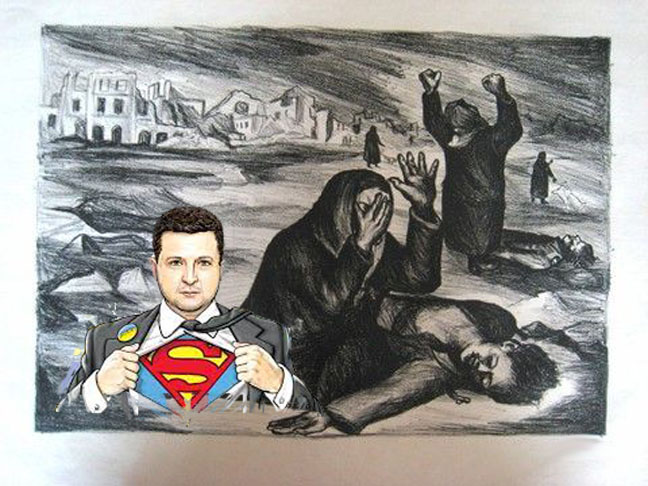
A case can be made for creating the North Atlantic Treaty Organization (NATO) when it was founded April 4, 1949. Originally just 10 Western European countries plus the US and Canada, NATO ensured no further Soviet expansion beyond the block of Soviet satellite nations Stalin established following WWII.
Of course, one can debate whether NATO was necessary at all. A was ravaged Russia, had neither the will not the means to expand anywhere beyond the buffer it had created to protect itself from a third invasion from the West in the 20th century. NATO may had more to do with expanding US imperial power in Europe and enriching the Military Industrial Complex than protecting Western Europe from unlikely Russian invasion.
Regardless, when the Berlin Wall came tumbling down on November 9, 1989 and the Soviet Union followed along December 26, 1991, NATO should have joined both in the dustbin of history. Indeed, the US, under President George H.W. Bush, spent much of 1990 negotiating the reunification of Soviet Eastern Germany into Western Germany, something Soviet Russia would have thought unthinkable. The pro in the quid pro quo was that NATO would never expand one inch eastward toward Mother Russia from its then western membership of 16 nations. Russia could even imagine that NATO, like The Warsaw Pact, would go away.
Big Russian mistake. With the US now the world’s sole superpower, the US abrogated any détente with Russia regarding NATO expansion, much less existence. Russia was to be permanently consigned to second class European status. Beginning under President Clinton in 1999, the NATO added 14 former Soviet aligned nations cementing NATO hegemony in Europe and ensuring an ever weakened Russia.
By betraying the former Soviet Union after its collapse, NATO morphed from a theoretically defensive to an overtly offensive organization. Russia was just one of NATO’s offensive moves. In 1999, NATO bombed Russian ally Serbia for 78 days to kick Serbia out of Kosovo, turning Kosovo into a failed province of the West. In 2011 NATO intervened in the Libyan civil war, bombing the Gaddafi regime and Gaddafi himself into oblivion. Libya remains a failed state 15 years on with much of Africa destabilized in its wake. Even the revered Barack Obama laments NATO intervention in Libya as his biggest presidential mistake.
But nothing compares to NATO perfidy in Ukraine. NATO proposed membership to Ukraine in 2008 to further isolate Russia from Europe. When six years of advancing NATO membership failed due to Ukrainian President Yanukovych partnering with Russia, NATO, led by Obama, simply overthrew him in 2014. Even worse, Ukraine began murdering Russian leaning Ukrainians in Donbas on Russia’s border by the thousands with NATO’s help. Worse Yet, NATO suckered Russia into agreeing to the Minsk I and II agreements that Donbas could achieve autonomy under Ukraine sovereignty to bring peace to Donbas Ukrainians. That was a subterfuge to build up the Ukraine military to finish off the Ukraine separatists in the Donbas. After 8 years of this duplicity Russia had enough, invading in February 2022 to end NATO, Ukraine aggression.
Four and a half years on, Ukraine is on life support, not from the US, which has largely bowed out, but from European NATO, which is still throwing billions of Euros on Ukraine’s lost cause. EU leaders, Especially UK’s Starmer, Frances’s Macron and Germany’s Merz claim Ukraine can win, reclaim all lost territory and save Western Europe from a likely Russian attack as early as 2030.
Long before 2030, Starmer, Macron and Merz will be gone, as well as the Ukraine that existed before the NATO offensive blew it up. NATO may be gone as well and good riddance if it is. Russia has no designs on Western Europe or all of Ukraine. They simply want their sensible security concerns met that have been foolishly rejected by NATO since the Soviet Union went poof in 1991 and NATO, led by the US, used it crush Russian integration in the European political economy.
Had the US and NATO exercised an iota of sensible diplomacy there would have been no war destroying Ukraine. Europe would be enjoying cheap energy and other trade with Russia fostering mutual economic growth. Current NATO leadership would have favorable approval ratings instead of ones worse than President Trump. Right wing European opposition parties would remain on the fringe instead of poised to assume power. European treasure could be spent uplifting the commons instead of destroying Ukraine.
Pivoting away from supporting NATO and the senseless Ukraine war is the one sensible Trump foreign policy. He’s too busy blowing up the world’s economy over Iran to care about NATO. Starmer, Macron, Merz, along with NATO secretary general Mark Rutte, remain in denial that the hopeless war they’re supporting is not only wrecking their careers and their countries; it may spell the end of NATO. It cannot come soon enough.
Europe’s recent peace overtures are war by other means

Zakharova accused the ambassadors of promoting a “dead-end Zelensky formula.”
She said: “The leaders of these countries are pretending, through their statements, to be calling for peace, but in reality they are putting forward unacceptable conditions, increasing the production of long-range weapons for Kiev and generally taking steps towards the militarisation of Ukraine and Europe.”
European overtures for renewing diplomacy with Russia smack of hypocrisy and duplicity.
June 12, 2026, https://strategic-culture.su/news/2026/06/12/europes-recent-peace-overtures-are-war-by-other-means/
After four years of zero diplomacy, multiple rounds of economic sanctions aimed at crushing the Russian state, and hundreds of billions of euros fueling a futile war in Ukraine against Russia, European capitals are lately abuzz with calls for opening peace negotiations with Moscow.
No doubt part of the shifting policy is due to the economic mess that Europe has created for itself by cutting off energy trade with Russia. Escalating energy costs are destroying European industries and imposing crippling financial hardship on millions of its citizens. Realizing the self-inflicted disaster, European capitals are desperate to appear to be normalizing relations with Russia and resume affordable energy supplies.
France and Italy are advocating the appointment of an envoy to engage with Russia to resolve the conflict and the lifting of anti-Russian sanctions.
Last weekend, the leaders of Britain, France, and Germany – the so-called E3 – stated that they would “help mediate” a peace deal between Ukraine and Russia. The Ukrainian puppet president, Vladimir Zelensky, was feted in Downing Street on June 7 by Britain’s Keir Starmer, France’s Macron, and Germany’s Merz. They proposed taking the lead in negotiations from the United States since President Trump seems more preoccupied with ending the war against Iran.
Various names have been suggested as to who could serve as an interlocutor representing Europe. Angela Merkel, the former German Chancellor, and former Italian Prime Minister Mario Draghi are two names that have been put forward. Finnish President Alexander Stubb has also been suggested. It’s unlikely any of them would be acceptable to Moscow, especially Merkel, mainly due to her past role in covertly undermining the 2015 Minsk Accords, thereby sowing the seeds for war that erupted seven years later.
The telling – almost laughable – thing is the paucity of any European figure with credibility as an envoy.
The EU’s top diplomat, Kaja Kallas, has become a laughing stock over her rank incompetence. Her Russophobic ranting has rendered her redundant in conducting foreign policy. So much so that there is a revolt among European diplomats against what they declaim as her “dysfunction”.
This week, Europe sent three ambassadors to Moscow to renew some form of dialogue. Russia’s deputy foreign minister, Mikhail Galuzin, met with representatives from Britain, France, and Germany. The Russian foreign ministry said it was open to hearing what Europe had to say.
However, Galuzin reportedly gave the visitors short shrift, reminding them that Europe cannot pose as mediators when it is a participant in the war against Russia.
Following the meeting on Thursday, Maria Zakharova, the foreign ministry spokeswoman, dismissed the European mission as not serious about addressing the challenge of finding a peace settlement.
Zakharova accused the ambassadors of promoting a “dead-end Zelensky formula.”
She said: “The leaders of these countries are pretending, through their statements, to be calling for peace, but in reality they are putting forward unacceptable conditions, increasing the production of long-range weapons for Kiev and generally taking steps towards the militarisation of Ukraine and Europe.”
If Europe were serious about peace, it would stop arming the Kiev NeoNazi regime and show some meaningful acknowledgment of Russia’s long-held demand to deal with the root causes of the conflict.
Europe’s backing of the Kiev regime’s call for an immediate ceasefire while expanding Ukraine’s ability to carry out deep strikes on Russian territory with European-manufactured drones, killing hundreds of civilians over recent months, is just a cynical ploy to rearm the proxy regime and give it some respite in order to resume the war with more lethal vigour at a later stage.
The duplicity of the European politicians goes back to the treachery of the Minsk Peace Accords in 2015 and the sabotage of the Istanbul peace negotiations in April 2022. That has culminated in the biggest war in Europe since World War Two, with millions of casualties and a real threat of spiralling into open war.
Europe’s governments and its EU and NATO bureaucrats are still wedded to the ideology of inflicting a strategic defeat on Russia. So, too, it seems is Washington, despite Trump’s talk of wanting peace.
Arming the Nazi regime in Kiev at an increasing pace while calling for a superficial ceasefire is proof that the European leaders are not authentic in their belated espousal of seeking diplomacy with Russia.
Former German foreign minister Sigmar Gabriel (2017-2018) recently pointed out a shameful truth when he said that Europe lost its chance for diplomacy in 2021.
Back then, the EU leadership and the American Biden administration both repudiated Russia’s earnest efforts to negotiate a way to avoid war in Ukraine. Moscow had clearly set out its objections to NATO expansion, in particular, the absorption of Ukraine into the military alliance, and it proposed rational solutions for collective security. Russia’s diplomacy was rejected out of hand by Washington and Brussels.
The Europeans and the Americans were bent on provoking Russia into an armed confrontation with their proxy Ukrainian regime that they had installed in the 2014 coup and weaponized. Diplomacy was rejected because the NATO axis calculated that it could defeat Russia with war and economic strangulation, or, as some Western politicians admitted, “total war”.
The European agenda, as reflected in demands for an immediate ceasefire without any cognizance of Russia’s arguments about historic claims and indivisible security, demonstrates that European leaders are not yet ready or willing to engage genuinely and meaningfully.
As 18th-century Prussian strategist Carl von Clausewitz might put it, their recent overtures for political talks are simply war by other means.
New Billionaire Jared Kushner Is Mired in Conflicts of Interest as “Peace Envoy”
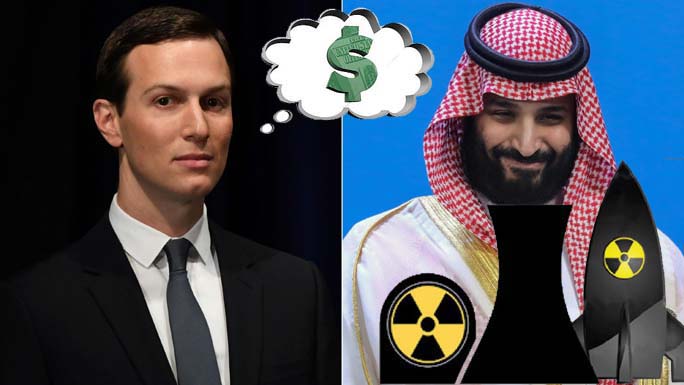
Kushner’s current fundraising efforts with Gulf state regimes, through which he aims to personally profit, raise serious concerns over conflicts between his business interests with regional states and his diplomatic role as a top Trump administration negotiator.
Jared Kushner, like the rest of the Trump family, uses the White House for personal enrichment.
By Derek Seidman , Truthout, June 12, 2026, https://truthout.org/articles/from-peace-envoy-to-billionaire-kushner-makes-a-killing-in-white-house-admin/?utm_source=Truthout&utm_campaign=8d7f421301-EMAIL_CAMPAIGN_2026_06_12_06_45_COPY_01&utm_medium=email&utm_term=0_bbb541a1db-16ee3bf6a0-650192793
Kushner is now a billionaire,” proclaimed Forbes in September 2025 of Donald Trump’s son-in-law Jared Kushner. While just over half of Kushner’s wealth — $560 million — comes from his family’s real estate empire, what’s catapulted Kushner into billionaire status is the growth of his private equity firm, Affinity Partners, formed in 2021.
“[T]hese days,” said Forbes, Kushner is “laser-focused on Affinity.”
Kushner is not an experienced investment manager. His key clients are Gulf state sovereign wealth funds — hugely wealthy state-owned coffers that invest revenue generated by fossil fuel sales — overseen by the same regimes with whom Kushner is now involved diplomatically as a U.S. “special envoy for peace.”
That Kushner personally profits from, and is currently trying to raise billions from, the same actors he’s negotiating with, raises code red-level alarms over potential conflicts of interest. Moreover, two of Trump’s sons, Donald Jr. and Eric, have been tied to a slew of business deals connected to companies that are benefitting handsomely from federal government contracts.
“The degree of shamelessness is unprecedented,” Jeff Hauser, founder and executive director of the Revolving Door Project, a watchdog group monitoring the U.S. executive branch, told Truthout. “The degree of unity among elected Republicans to not speak about the Trump progeny, and their corruption, is the worst conspiracy of silence in American political history.”
Affinity Partners
Jared Kushner founded Affinity Partners in 2021, and he is the firm’s sole owner. Forbes estimates Affinity was worth $215 million as of September 2025, up from $170 million in October 2024. Through Affinity, Kushner recruits wealthy clients and invests their money through funds that acquire stakes in different companies.
Affinity currently has $6.2 billion in assets under management. According to the Israeli financial paper Globes, Kushner earns “a commission of 1.25 percent on investors’ capital.” Forbes says that Affinity’s investors “pay about $60 million per year in fees.”
The New York Times also reports that Affinity has earned an estimated 25 percent rate of return on its investments since 2021. Private equity investment firms often get a double-digit percentage cut on client returns.
Affinity’s biggest clients are Gulf state sovereign wealth funds. According to The New York Times, Saudi Arabia’s Public Investment Fund, which invests the kingdom’s oil profits and is led by Crown Prince Mohammed bin Salman, is “already the largest and earliest investor in Affinity,” having invested $2 billion with the firm after Trump’s first term ended. As part of that investment deal, Saudi Arabia was also given “the first chance to invest during any subsequent attempts by Affinity to raise funds,” said The New York Times.
The sovereign wealth funds of both the United Arab Emirates (UAE) and Qatar were also early investors in Affinity Partners, with the UAE investing over $200 million in Kushner’s firm.
“Most of Affinity’s investors came through connections Kushner made while serving in the White House,” wrote Forbes.
Kushner is currently trying to raise $5 billion or more in new funds for Affinity. As part of this effort, The New York Times reported in March 2026 that Affinity representatives had met with Saudi Arabia’s Public Investment Fund and that the United Arab Emirates and Qatar “are also expected to be asked for more” as the fundraising efforts should “stretch on for the better part of this year,”
“Staggering Conflicts of Interest”
Kushner’s current fundraising efforts with Gulf state regimes, through which he aims to personally profit, raise serious concerns over conflicts between his business interests with regional states and his diplomatic role as a top Trump administration negotiator.
“There’s an enormous conflict of interest when you have somebody who had never been a money manager like this before, and who is all of a sudden building massive funds based off a handful of foreign investors with an interest in buttering up the Trump administration,” said Hauser.
Hauser said it’s “not unprecedented” for well-connected family members or friends of presidents to influence U.S. diplomacy. But, he adds, “it is very susceptible to abuse, and I think it’s being abused here,” and government reforms are needed in the wake of Kushner’s current “diplomatic exploits.”
The potential conflicts of interest have been highlighted by some members of congress. Rep. Jamie Raskin (D-Maryland) has opened an investigation into what he labels Kushner’s “foreign entanglements and staggering conflicts of interest.”
“From the standpoint of the American people, your decision to act in these two roles — one public for the government and one private for personal profit — creates a glaring and incurable conflict of interest,” Raskin wrote in a letter to Kushner.
Kushner’s diplomatic efforts have included helping to design and advance the Abraham Accords, which aims to normalize relations between Israel and key Gulf States; carrying out negotiations with Iran, whose retaliatory strikes have been aimed at nations like Saudi Arabia and the UAE; and working on Donald Trump’s “Board of Peace,” which several Gulf states, including top Affinity clients, have joined.
Kushner’s Portfolio Companies
Read more: New Billionaire Jared Kushner Is Mired in Conflicts of Interest as “Peace Envoy”Affinity Partners’ most significant deal has been its $55 billion acquisition in 2025, in partnership with Saudi Arabia and other investors, of the video game giant Electronic Arts, maker of popular franchises like Madden and Sims. The transaction, which has garnered protests from gamers and developers, would be the largest-ever private buyout of a publicly-traded company. It’s currently in its final stages of approval.
Under the deal’s terms, Saudi Arabia’s sovereign wealth fund — which already had a 10 percent stake in Electronic Arts — will own 93.4 of EA, while Affinity Partners will own 1.1 percent. For Saudi Arabia, the deal advances two separate but intertwined aims: diversifying its economy away from overreliance on oil revenue, and partnering with a member of the Trump family as the deal seeks regulatory approval from the U.S. Committee on Foreign Investment, chaired by Trump’s Treasury Secretary Scott Bessent
Affinity Partners also invests in smaller AI and financial companies, including U.K. digital bank OakNorth, AI infrastructure firm Universal AGI, and the fintech start-up company Revolut. Forbes reports that Kushner recently launched a new San Francisco-based AI start-up with the prominent Israeli-born venture capitalist Elad Gil. The firm, Brain Co., also raised funds from Coinbase’s Brian Armstrong and LinkedIn’s Reid Hoffman.
Raising more potential for conflicts with his diplomatic role, Kushner also has stakes in several Israeli companies, including $1.68 billion in Phoenix Financial, one of Israel’s leading insurance and financial companies. Affinity is Phoenix’s top shareholder and has seen a five-times return on its investment.
Affinity is also invested in the Israeli Shlomo Group, one of Israel’s largest holding groups with big investments in the auto sector.
Kushner, TikTok, and the Trump Web
Jared Kushner is also embedded in a wide web of business figures advancing the Trump agenda — which could be seen in the January 2026 deal that created a U.S. spinoff of TikTok.
Kushner’s Electronic Arts deal is co-led by Silver Lake, a Los Angeles-based private equity firm. As Truthout previously reported, Silver Lake is also a 15 percent stakeholder in the new U.S. TikTok. The firm’s co-CEO Egon Durban sits on the seven-member board of U.S. TikTok.
In 2025, the Wall Street Journal reported that acquiring Electronic Arts was Durban’s “dream deal,” but that “the pieces began to fall into place” for the acquisition only after Durban “began spending time with Jared Kushner.”
Silver Lake also owns Endeavor, whose portfolio includes TKO Group Holdings, the parent company of Ultimate Fighting Championship (UFC), the mixed martial arts corporation that is chummy with Donald Trump.
Durban and Silver Lake are close business partners with Michael Dell, the megabillionaire chairman and CEO of Dell Technologies who is also part of the U.S. TikTok ownership group with Durban. Dell has cast himself as a Trump ally by donating $6.25 billion toward the president’s so-called “Trump Accounts” program, which creates investment accounts for U.S. children.
Billionaire Yuri Milner, another U.S. TikTok investor, previously invested $850,000 in a real estate company started by Kushner in 2015. Jon Winkelried, the billionaire CEO of TPG Global, a private equity firm represented on U.S. TikTok’s board, also previously served as a strategic adviser and partner for Thrive Capital, an investment firm overseen by Jared Kushner’s brother, Josh Kushner.
The Trump Sons
If Kushner, Donald Trump’s son-in-law, may be personally benefiting from his closeness to the president, so too might be two of the president’s own children.
Donald Trump Jr. is a partner with an investment firm called 1789 Capital, which he says is dedicated to “patriotic capitalism,” and which has seen its assets under management boom from $200 million to $3.5 billion over the past year.
1789 Capital has made investments in companies that have gone on to benefit from federal contracts. For example, the Trump administration helped secure a $620 million loan for Vulcan Elements, a rare earths firm, months after 1789 Capital acquired a stake. Other 1789 Capital portfolio companies that benefit from federal contracts include rocket propulsion start-up Firehawk Aerospace, quantum computing company PsiQuantum, and AI group Cerebras Systems, as well as SpaceX and Anduril. Donald Trump Jr. and Eric Trump have also been linked to other drone makers, including Unusual Machines and Powerus, that have secured federal contracts.
Trump Jr. told the Financial Times that he is “very involved in the strategic decisions regarding where to invest” the resources of 1789 Capital.
The Financial Times also reported that Eric Trump accompanied his father on his recent state visit to China at the same “a company linked to him and the US president’s family” — Alt5 Sigma, a Las Vegas-based financial technology company — “explores a deal” with Chinese chipmaker Nano Labs that U.S. lawmakers says is tied to the Chinese Community Party. Eric Trump is an “observer” on the board of Alt5 Sigma, while Zach Witkoff, the son of top Trump aide Steve Witkoff, chairs Alt5’s board.
The Financial Times also reports that a shell company backed by Donald Trump Jr. and Eric Trump is set to merge with a critical minerals group that last year secured up to $1.6 billion in U.S. government backing to mine tungsten in Kazakhstan. Now, that group is asking for $400 million more from the government.
Holding Politicians to Account
While Donald Trump may be struggling in the polls, his family, financially, is doing just fine.
Hauser told Truthout that much of Donald Trump’s “economic interest” is tied to “increasing the wealth of his kids,” including his son-in-law Kushner. “When they are engaged in these types of overseas actions, they are carrying Trump’s interests with them inherently,” said Hauser.
But, Hauser adds, the law treats adult children of presidents as wholly independent from their parents, allowing “relative impunity” for their intermixing of business transactions with diplomatic roles or close familial relations.
“The law is just not written to address this type of situation,” said Hauser.
But Hauser sees hope in past U.S. history, which he says has always experienced vicissitudes of political corruption and revulsion against corruption that propels reform through both legal avenues as well as social ostracization of bad actors.
“Political corruption cycles tend to be cyclical,” he said. “Hopefully this is [the] nadir, and we can all be angry enough and hold our politicians to account such that they start to clean this up, and we can switch from a vicious cycle of ever-increasing corruption to a virtuous cycle of greater integrity.”
Gaza Genocide, Inc.: The Permanent-Conflict Industry
Imran Khalid for Foreign Policy in Focus, 12 June 26 https://scheerpost.com/2026/06/12/gaza-genocide-inc-the-permanent-conflict-industry/
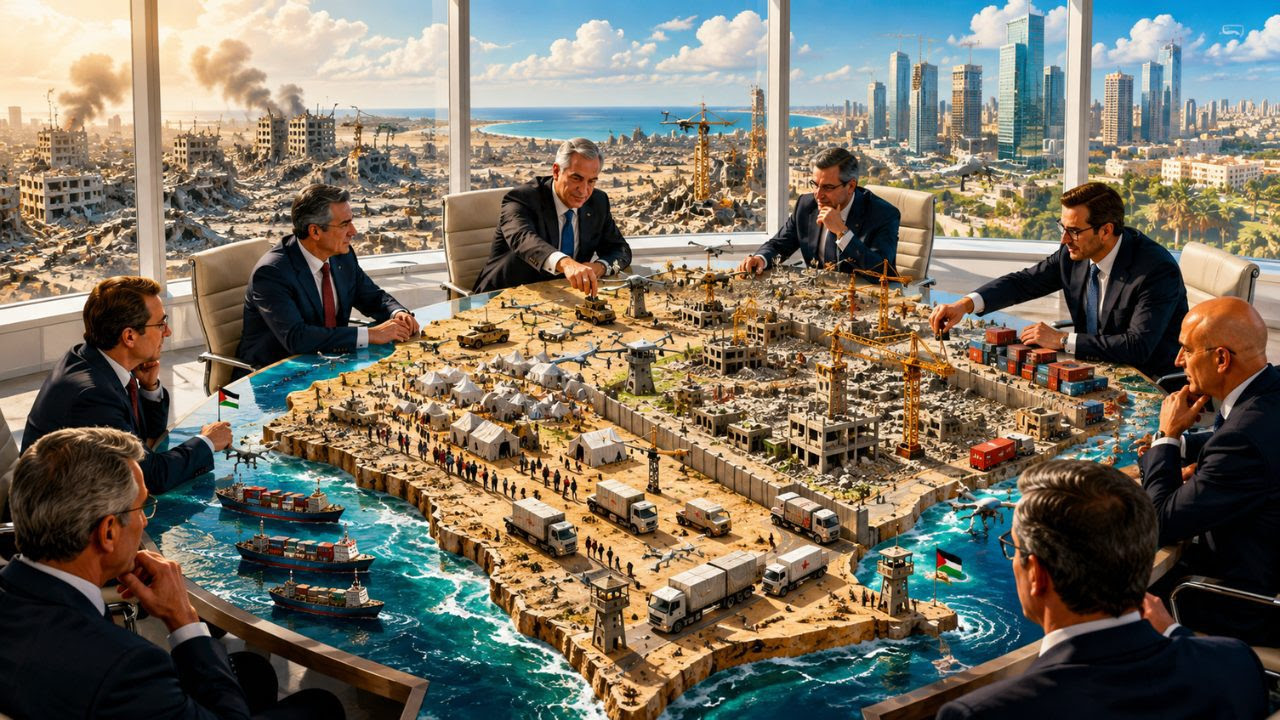
The international community’s approach to conflict resolution has undergone a profound and dangerous structural shift, moving away from the pursuit of political settlements toward the permanent administration of crisis. This transition is vividly apparent in Rafah, where the newly established National Committee for the Administration of Gaza (NCAG) has begun overseeing a reconstruction process stripped of any path toward genuine sovereignty or political renewal. What is being built instead is a sprawling, technocratic bureaucracy designed to manage human suffering indefinitely, transforming a site of active geopolitical dispossession into a permanent administrative holding pattern.
The rollout of Phase Two of the Trump administration’s Comprehensive Gaza Plan—secured with a UN Security Council endorsement—exposes the nakedly corporate logic underpinning modern foreign policy. By placing a “Board of Peace” stacked with billionaire financiers and political hawks like Marco Rubio, Tony Blair, Jared Kushner, Ajay Banga, and Marc Rowan in charge of post-conflict governance, Western hegemony has effectively financialized geopolitical containment. The plan treats Gaza not as a nation deserving of self-determination but as a high-risk economic asset to be secured, stabilized, and folded into regional trade corridors while its population remains permanently disenfranchised.
This containment model carries severe consequences both for the occupied population and the broader global order. For Palestinians, it institutionalizes a bleak daily reality of endless aid lines and checkpoints under an international apparatus that has traded the promise of liberation for technocratic stabilization. Globally, this reveals a deeper systemic reality: the traditional assumption that regional conflicts are temporary shocks awaiting a diplomatic fix has completely collapsed.
For global political and economic elites, perpetual instability is no longer a failure to be corrected but a baseline structural condition around which modern global capitalism is choosing to organize itself.
A Shift in Logic
In the twentieth century, major conflicts were viewed as massive disruptions to globalization. In the twenty-first, globalization is rapidly adapting itself around endless disruption. Entire corporate, financial, and bureaucratic systems now operationalize instability as a baseline condition rather than a temporary shock.
Private-sector logistics firms are securing long-term contracts to manage continuous delivery corridors into high-risk zones. Maritime conglomerates are permanently adjusting pricing models and routing assets around Africa as a structural business reality. Digital and physical infrastructure protection has transitioned from an annual insurance check-box to a core operational expense that drives tech-sector hiring and venture capital investment.
Markets are internalizing this shift. Oil prices no longer spike the way they once did after escalations because commodity investors increasingly price in chronic, localized instability rather than assuming systemic collapse. Capital markets are no longer asking whether a crisis will end but whether it can remain geographically contained. That distinction changes everything for how corporate treasuries allocate capital.
Gaza and Ukraine
Gaza illustrates this vividly. The NCAG’s reconstruction mandate and the Board of Peace’s integration of Gaza into the India–Middle East–Europe Economic Corridor (IMEC) show that crisis management itself has become a growth industry. Reconstruction is not about closure; it is about embedding instability into global supply chains.
This economic adaptation mirrors a deeper systemic fatigue within international governance. The post-Cold War era operated on the logic that major conflicts eventually reached closure, whether Bosnia after Dayton or Northern Ireland after the Good Friday Agreement. Today, that logic is spent.
Instead of diplomacy aimed at structural architecture, modern institutions are becoming highly efficient at administering instability rather than ending it. The UN’s Resolution 2803 did not declare peace; it endorsed a framework for managing crisis indefinitely. The NCAG’s mandate is to restore services under conditions of volatility, not to deliver closure.
Ukraine offers a parallel. Western institutions have become adept at stabilizing financial flows, managing refugee integration, and sustaining military aid—but without a credible path to settlement. Sudan’s humanitarian corridors are similarly managed as permanent relief operations. Gaza’s plan institutionalizes this model: reconstruction without resolution, administration without settlement.
Normalization
The third transformation is occurring inside the human infrastructure of the modern workplace, driven by algorithmic fatigue and the workspace paradox. The digital age has fundamentally altered how societies, consumers, and employees process global trauma.
Previous generations experienced major conflicts sequentially. Today’s professional workforce experiences them simultaneously, continuously, and instantly. In any given hour, a professional’s algorithmic stream displays corporate Slack messages alongside real-time updates from Gaza, Ukraine, Taiwan, and climate disasters.
This continuous exposure has created a dangerous psychological paradox. The global workforce is more emotionally connected to macro-level crises than at any point in history, yet constant exposure is triggering widespread psychological numbness and professional exhaustion. Public and corporate outrage surges rapidly, then stabilizes into fatigue. For leaders, managing a workforce under the weight of this continuous cognitive load is a quiet crisis in itself.
The ultimate danger of the era of permanent crisis is that it becomes intellectually and socially normalized. Once corporate strategies and public expectations internalize the assumption that global disruption never truly ends, ambition contracts. Leaders stop pursuing long-term expansions because planning horizons narrow from years to weeks. Innovation takes a backseat to survival and containment.
History offers a stern warning: the late Roman Empire did not collapse because every frontier failed simultaneously. It declined because permanent emergencies became routine, and tactical crisis management slowly replaced strategic renewal.
The modern international order risks entering a similar phase. Gaza, Ukraine, and shipping vulnerabilities matter immensely for their immediate human and material costs, but they matter even more because they reveal the new template of global operations. Trump’s Gaza plan, with its NCAG, Board of Peace, and IMEC linkage, is not just a reconstruction blueprint. It is a case study in how global institutions now design for permanence of crisis rather than its resolution.
The challenge for the next generation of business leaders is not simply navigating the next disruption but learning how to build sustainable, human-centric enterprises when disruption is the baseline condition. The permanent crisis economy is here: industries are monetizing instability, institutions are administering it, and workforces are absorbing it.
Gaza’s reconstruction framework, endorsed by the UN and operationalized by Trump’s Board of Peace, crystallizes this reality. It shows that the world’s most powerful actors are no longer promising closure. They are promising management.
For commerce, governance, and society, the task is clear: to resist the temptation to normalize crisis as the only horizon. Otherwise, the machinery of global order will become a treadmill of containment, and the ambition for renewal will fade. The permanent crisis economy may be the present reality, but it must not become a permanent destiny.
How Zionist Lobbying Has Reshaped Global Politics

13 June 2026 Dr Andrew Klein, PhD, Australian Independent Media
The Branch That Reaches Across Oceans – How Zionist Lobbying Has Reshaped Global Politics
“The branch is not the tree. The tree is still standing. And the tree – the tree is justice.”
The Branch That Reaches Across Oceans
The “Greater Israel” project is not a secret. It is not a fringe fantasy. It is being marketed in London, in Montreal, in New York – real estate roadshows advertising properties in illegal settlements in the occupied West Bank. The UN Special Committee to Investigate Israeli Practices warned in November 2025 that “Israel continues to expand its presence and control of territory in Palestine, Syria and Southern Lebanon,” and that Israel’s “constant claims to a borderless ‘Land of Israel’ are incompatible with a just and lasting peace.”
This is not merely a Middle Eastern conflict. It is a global project – one that relies not only on military force, but on an extensive apparatus of lobbying, financial influence, and the suppression of dissent in Western capitals.
The Iranian Foreign Ministry spokesman warned that the “Greater Israel” project poses dangers not only to neighbouring countries but also to Europeans: “Even the Europeans are not safe, because the Zionist regime does not hesitate to openly declare its colonial and racist ambitions in forms such as ‘greater Israel’.” Whether one accepts the Iranian framing, the fact that the project is cited by adversaries as a casus belli indicates that it is not a secret.
The scale of political interference is not unique in spirit – it is an extension of historically brutal colonial behaviours, morphed into a new scale in line with modern communication systems. The Roman Empire bribed Germanic chieftains. The British Empire divided and ruled India. But the contemporary Zionist project operates within a rules‑based international order that was supposed to prevent exactly this kind of extraction.
And it operates with the active complicity of Western governments – not because they are powerless, but because their political systems have been captured.
The Machinery of Influence: AIPAC and the American Political System
The American Israel Public Affairs Committee (AIPAC) is the most visible node in a vast network of lobbying organisations that influence US Middle East policy. A 2024 academic study published in the Hasanuddin Journal of Strategic and International Studies found that “the AIPAC lobby is deeply rooted in US policymaking structures, ranging from vice‑president, and higher‑echelon staff, to parliament members.” The study noted that since 2021, AIPAC has expanded its activities to include direct participation in political campaign contributions, effectively buying access to the highest levels of American government.
The study’s conclusion is stark: “Such overly foreign influence on national policymaking has the potential to harm America’s long‑term relationships and interests in the Middle East if the US can’t make the barrier for foreign interference toward its national interests.”
This is not a fringe argument. Ilan Pappé’s comprehensive study, Lobbying for Zionism on Both Sides of the Atlantic, documents how “over a century of aggressive lobbying changed the map of the Middle East.” Pappé details how pro‑Israel lobbies convinced British and American policymakers “to condone Israel’s flagrant breaches of international law, grant Israel unprecedented military aid and deny Palestinians rights.” Anyone who questioned unconditional support for Israel, “even in the mildest terms, became the target of relentless smear campaigns.”
The mechanism is not subtle. It is the same mechanism that has always operated in systems where political survival depends on campaign contributions. The donor class – in this case, a network of Zionist organisations and aligned right‑wing groups – buys influence. Politicians who comply receive funding, electoral support, and protection from primary challenges. Those who dissent are targeted, smeared, and often defeated.
This is not a conspiracy. It is a system.
The Silencing of Dissent: Academic Freedom Under Attack
The suppression of criticism extends beyond electoral politics into the realm of ideas. A 2024 academic paper in the journal Milel ve Nihal examines how “political lobbying, financial influence, and allegations of antisemitism are strategically employed to establish a cultural hegemony that determines what discourse is acceptable” in US universities.
The paper, titled “Zionism and Academic Hegemony: The Intersection of Power, Knowledge, and Suppression in the United States Universities,” draws on Michel Foucault’s theory of power‑knowledge and Antonio Gramsci’s concept of cultural hegemony to analyse how “Zionist organisations influence higher education frameworks, research priorities, and public discourse.” This manipulation, the paper argues, “serves to marginalize, silence, or delegitimize critical perspectives that oppose or challenge Israeli policies and actions, especially those related to the occupation of Palestinian territories and human rights violations.”
The paper provides specific examples, including the rescinded job offer to Professor Steven Salaita at the University of Illinois following his criticism of Israel’s genocide in Gaza on social media. The case is not isolated. The paper documents “additional examples including the suppression of pro‑Palestinian viewpoints and the punishment of students and faculty who advocate for Palestinian rights at various prominent U.S. institutions.”
The paper concludes that “Zionism’s influence is not limited to isolated cases but creates a widespread atmosphere where academic freedom is restricted.” Universities, “meant to be pillars of free thought and critical inquiry, increasingly become arenas where dissent is suppressed and ideological conformity is imposed.”
The weaponisation of antisemitism accusations is central to this strategy. Criticism of Israeli government policy is routinely conflated with hatred of Jews. The effect is to chill debate, to intimidate critics, and to protect the settlement enterprise from scrutiny. As one reviewer of Pappé’s book noted, the strategy involves “cracked down on dissent in the Labour Party, and relentlessly smeared critics.”
The Australian Connection
The pattern is not confined to the United States and the United Kingdom. Australia has its own history of Zionist lobbying and political interference – a history that remains largely unexamined in mainstream discourse.
The Australian example is particularly instructive because it reveals how the machinery of influence operates even in a country geographically distant from the Middle East, with no historical responsibility for the conflict, and no strategic interest that would justify the degree of alignment with Israeli policy.
The mechanisms are similar: campaign donations, community lobbying, and the weaponisation of antisemitism accusations to silence critics. Australian politicians who question Israeli policy face organised opposition from Zionist organisations. The media environment is shaped by the same dynamics of donor pressure and editorial alignment.
The result is a foreign policy that is not in Australia’s national interest – AUKUS, the uncritical support for US Middle East policy, the silence on Israeli atrocities – but is dictated by a donor class whose primary loyalty is not to Australia.
This is not a fringe observation. It is the conclusion of the same structural analysis that applies to the United States and the United Kingdom. The only difference is scale.
The Geographic Safety Nets
The “Greater Israel” project is not merely ideological. It is infrastructural. …………………………………………………………………………………………………………………………………………………………………………………………………… https://theaimn.net/how-zionist-lobbying-has-reshaped-global-politics/
1 This Month
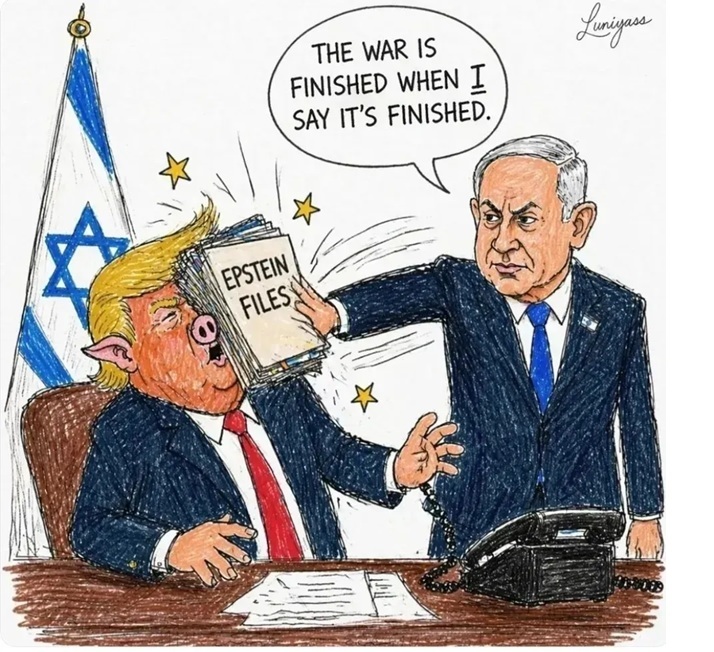
22 June – Virtual Event –Climate Change: New Data, New Debate

Monday, June 22, 2026 2:30 p.m. – 3:15 p.m. CT
YouTube. Register here

Protect Sazan Island from the Trump family! https://secure.avaaz.org/campaign/en/protect_sazan_island_from_the_trump_family_loc/?bqFCVab&v=174511&cl=22707147157&_checksum=5e9dde668860e8231c33699735e16a1fbf22ab2cb01da50c999fe8732b9775ef&utm_source=email&utm_medium=blast_email&utm_campaign=174511

25 June- THE PUKE ON NUKES
Thursday, June 25, 2026
7pm Central Time (8pm ET, 6pm MT, 5pm PT) UTC – 5
From NRC & DOE Deregulation to Techno-Fascist Billionaires Going Nuclear, Plus a Few Songs from Atomic Cabaret REGISTER
26 June – Radiation Trainwreck at the NRC / Join the Protect Better Campaign – https://us02web.zoom.us/meeting/register/4ZlZ5_qLSHGiLSCg8FF6Bg#/registration


Cuba Is Not a Failed State – It Is a Besieged State
PETITION: “Global Appeal to Endorse Palestinian Right of Return of Refugees”
To see nuclear-related stories in greater depth and intensity – go to https://nuclearinformation.wordpress.com
-
Archives
- June 2026 (221)
- May 2026 (306)
- April 2026 (356)
- March 2026 (251)
- February 2026 (268)
- January 2026 (308)
- December 2025 (358)
- November 2025 (359)
- October 2025 (376)
- September 2025 (257)
- August 2025 (319)
- July 2025 (230)
-
Categories
- 1
- 1 NUCLEAR ISSUES
- business and costs
- climate change
- culture and arts
- ENERGY
- environment
- health
- history
- indigenous issues
- Legal
- marketing of nuclear
- media
- opposition to nuclear
- PERSONAL STORIES
- politics
- politics international
- Religion and ethics
- safety
- secrets,lies and civil liberties
- spinbuster
- technology
- Uranium
- wastes
- weapons and war
- Women
- 2 WORLD
- ACTION
- AFRICA
- Atrocities
- AUSTRALIA
- Christina's notes
- Christina's themes
- culture and arts
- Events
- Fuk 2022
- Fuk 2023
- Fukushima 2017
- Fukushima 2018
- fukushima 2019
- Fukushima 2020
- Fukushima 2021
- general
- global warming
- Humour (God we need it)
- Nuclear
- RARE EARTHS
- Reference
- resources – print
- Resources -audiovicual
- Weekly Newsletter
- World
- World Nuclear
- YouTube
-
RSS
Entries RSS
Comments RSS
 nuclear-news