Do heatwaves, wildfires and travel costs signal the end of the holiday abroad?

It was a prediction nobody wanted to hear. On the main stage of the world’s
biggest tourism fair, Stefan Gössling, a leading researcher in sustainable
transport, had just calmly announced the looming death of the holiday
industry. “We have already entered the beginning of the age of
non-tourism,” said Gössling, to an uneasy audience of travel agencies,
car rental companies, cruise operators and hoteliers. That prophecy may
sound fanciful to holidaymakers in Europe and North America who have been
jetting off this summer – as well as to industry executives delighted to
see international tourism return to pre-pandemic highs last year – but
Gössling argues that as carbon pollution stokes heatwaves, fuels wildfires
and ruins harvests, the cost of foreign travel will soar, and fewer people
will be able to afford it. Gössling is not short of examples of
destinations already feeling the squeeze. Warm weather is melting snow that
keeps Alpine ski resorts alive. Coastal erosion is stripping sand from
southern European beaches. Droughts are forcing Spanish hotels to ship in
fresh water as swimming pools lie empty, while wildfires are setting scenic
Greek islands ablaze.
Guardian 23rd Aug 2025, https://www.theguardian.com/business/2025/aug/23/do-heatwaves-wildfires-and-travel-costs-signal-the-end-of-the-holiday-abroad
Iran willing to reduce uranium enrichment to avoid British sanctions.

Reformist government is pushing hardline security figures to curtail nuclear programme.
Telegraph 24th Aug 2025
Iran is prepared to significantly reduce its uranium enrichment to prevent Britain reimposing United Nations sanctions, The Telegraph has been told.
Iranian officials said Tehran was willing to soften its hardline stance to avoid further military strikes from Israel and the United States.
Ali Larijani, the newly appointed secretary of Iran’s supreme national security council, is leading efforts to convince the clerical regime to lower uranium enrichment to 20 per cent purity, down from 60 per cent.
The current enrichment level is approaching the roughly 90 per cent purity required for nuclear weapons development, raising international concerns about Iran’s nuclear ambitions…………………………………………………………………………………………https://www.telegraph.co.uk/world-news/2025/08/24/iran-willing-reduce-uranium-enrichment-uk-sanctions/
Taiwan nuclear plant re-opening vote fails as approval threshold missed

By Ben Blanchard, August 23, 2025
TAIPEI, Aug 23 (Reuters) – A referendum to push for the re-opening of Taiwan’s last nuclear plant failed on Saturday to reach the legal threshold to be valid, though the president said the island could return to the technology in the future if safety standards improve.
The plebiscite, backed by the opposition, asked whether the Maanshan power plant should be re-opened if it was “confirmed” there were no safety issues. The plant was closed in May as the government shifts to renewables and liquefied natural gas.
The small Taiwan People’s Party (TPP) proposed the referendum earlier this year, and with the backing of the much larger Kuomintang (KMT) passed the legislation for the vote, saying Taiwan needs reliable power supplies and not to be so reliant on imports.
Around 4.3 million people voted in favour of the plant’s re-opening in the referendum, a clear majority over the 1.5 million who voted against, figures from the Central Election Commission showed.
But the motion needed the backing of one quarter of all registered electors – around 5 million people – to get through under electoral law, meaning the plant on Taiwan’s southern tip will not re-open.
Taiwan’s government says there are major safety concerns around generating nuclear power in earthquake-prone Taiwan and handling nuclear waste………………………..https://www.reuters.com/business/energy/taiwan-nuclear-plant-re-opening-vote-fails-approval-threshold-missed-2025-08-23/
Trump ‘angry’ about Ukrainian attacks on key Russian pipeline to EU – Budapest
Comment: Trump’s angry, and yet, as we learned from NYT and WaPo reports earlier this year, HIMARS launches rely on American satellites for targeting and delivery to conduct such attacks, it’s possible that this key pipeline delivering oil to one of Trump’s ‘allies’ in eastern Europe… was effectively carried out by the Americans.
Sat, 23 Aug 2025 https://www.sott.net/article/501415-Trump-angry-about-Ukrainian-attacks-on-key-Russian-pipeline-to-EU-Budapest
Kiev has struck the Druzhba conduit supplying oil to Hungary and Slovakia at least three times this month.
US President Donald Trump has expressed outrage over Ukrainian strikes on a key pipeline supplying Hungary and Slovakia with Russian oil, according to a senior official in Budapest.
On Friday, Balazs Orban, political director to Hungarian Prime Minister Viktor Orban (no relation), shared a letter from his boss to Trump raising the issue of the Ukrainian attacks on the Druzhba pipeline. “Hungary supports Ukraine with electricity and petrol, in return they bomb pipeline that supply us. Very unfriendly move!” the Hungarian leader wrote.
On the same letter, Trump reportedly replied in his own hand:
“Viktor – I do not like hearing this. I am very angry about it. Tell Slovakia. You are my great friend,” alongside what appeared to be his signature.
“The Druzhba pipeline is a vital source of Hungary’s crude oil supply, without which our energy security cannot be guaranteed. Hungary will not allow its security to be undermined,” Balazs Orban wrote.
Ukraine has carried out at least three strikes this month on the Druzhba (‘Friendship’) pipeline, which stretches for more than 4,000km from Russia through Belarus and Ukraine to Poland, Germany, Hungary, Slovakia, and the Czech Republic.
The Druzhba controversy has become yet another source of tension in the already strained relations between Budapest and Kiev, which are marred by Hungary’s reluctance to support EU sanctions on Russia and by sharp disagreements over the rights of ethnic Hungarians living in western Ukraine.
In response to the attacks on the Druzhba pipeline, Hungarian Foreign Minister Peter Szijjarto said he and Slovak Foreign Minister Juraj Blanar were pressuring Brussels to force Kiev to stop the raids.
“With these attacks Ukraine is not primarily hurting Russia, but Hungary and Slovakia… Brussels must understand: they are the European Commission, not the Ukrainian Commission.”
Moscow has also denounced the attacks as “outrageous,” portraying them as proof that Kiev sees no bounds when engaging in malignant activities.
Meanwhile, Slovak officials have said the section of the Druzhba pipeline damaged in the latest attack is expected to be repaired by Monday.
Taiwan Must Not Turn Back: A Message of Solidarity for a Post-Nuclear Future
TCAN, Statements of support from international energy scholars for Taiwan’s nuclear phase-out, 2025-08-19 Dr. Sun-Jin Yun | Professor and Dean, Graduate School of Environmental Studies, Seoul National University
Taiwan has made history as the first country in Asia to phase out nuclear power. Even before its formal policy decision, Taiwan had already halted construction of two nearly completed reactors at the Lungmen Nuclear Power Plant. Then, following its bold commitment to denuclearization in 2016, Taiwan laid out a clear roadmap and proceeded to permanently shut down all six of its operating nuclear reactors by 2025. In total, eight reactors were removed from Taiwan’s energy future. This achievement stands as a global milestone—one that not only reflects the wisdom and determination of the Taiwanese people, but also shows what democratic leadership and civic engagement can accomplish in energy policy.
As a Korean educator and researcher who has supported Taiwan’s anti-nuclear movement—traveling across the island to share the experience of Seoul’s “One Less Nuclear Power Plant” initiative—I have seen firsthand the strength of Taiwan’s civil society. I was deeply inspired by how communities organized, informed, and mobilized to ensure that energy decisions would be made not by technocrats or corporations alone, but by the people. Taiwan’s experience became a source of hope and pride for many of us in Asia, proving that an energy transition rooted in justice and public engagement is indeed possible—even in societies with high electricity demand and heavy dependence on imported fossil fuels, where renewables are still being developed.
Taiwan’s nuclear phase-out was not just a policy—it was a people-powered choice for the future. Let’s not turn back. Let Taiwan lead again.
But today, that progress is under threat. Taiwan’s opposition parties have proposed a national referendum to restart the final two reactors that were recently shut down. On August 23, Taiwanese citizens will be asked to vote on whether to undo what they have so carefully and courageously accomplished. That is why I write this statement—not only to express concern, but to offer international solidarity.
While nuclear energy is often framed as a low-carbon tool for addressing climate change, the reality is more paradoxical: the worsening climate crisis itself is undermining the viability of nuclear power. As the crisis worsens, rising ocean temperatures reduce reactor cooling efficiency, while extreme weather events—such as typhoons and wildfires—and jellyfish blooms, fueled by ocean warming, increasingly threaten plant operations. And in a region prone to typhoons and earthquakes, the risk of catastrophe is never far away. Above all, nuclear energy produces radioactive waste for which no nation on Earth has found a safe, long-term solution.
Meanwhile, Taiwan has made remarkable strides in expanding solar and offshore wind. Your country is already charting a path toward a resilient, renewable energy future. To reverse course now would not only be scientifically and economically unwise—it would undermine the very civic spirit that brought you this far. The world is watching. Taiwan has led before, and you can lead again.
Please stay the course. A nuclear-free Taiwan is not only possible—it is already underway. Let us not go backward, but forward together.
https://tcan2050.org.tw/en/nonuke-2/
Mile High City sparks fury over plan for one of America’s busiest airports
Daily Mail, By ALYSSA GUZMAN, US NEWS REPORTER, 24 August 2025
Bosses at one of America’s busiest airports have sparked fury by unveiling controversial plans to explore using nuclear energy.
Leaders at Denver International Airport in Colorado made the announcement earlier this month, sparking an immediate backlash from locals who claim they were never consulted.
The airport has since been forced to pause its plans for a feasibility study following the outcry.
Councilwoman Stacie Gilmore, who represents District 11, said the issue was never discussed with her constituents, who have questions about safety and nuclear waste.
‘It never came up,’ she told Daily Mail. ‘Denver International Airport is trying to put the cart before the horse, and they got called out by the community.’
The airport was planning to pay up to $1.25million for a six to 12-month study to determine if nuclear power is viable for the airport long-term, what are the risks, and how much it would cost, among other things.
But Gilmore said her constituents are unequivocally opposed and highlighted that the proposed nuclear reactor is a relatively new technology which would be located near the two most racially diverse populations in the city and county of Denver.
‘People don’t want something that produces radioactive waste – something that we currently don’t have a way to even store it – in a community of color,’ Gilmore added.
She called Denver Airport CEO Phil Washington’s ‘rushed’ plan ‘half-baked’.
But more than that, she said the airport hasn’t reached out the community to hear their concerns, which include, the heightened risk for cancers, air and noise pollution, and radioactive chemicals being nearby, among others. ……………………………………………………………….
This is brand new technology that nobody really knows long-term issues with,’ she told Daily Mail. ‘That’s irresponsible.’
Denver is the third busiest airport in the US and the sixth worldwide. It handles 80million passengers a year and is estimated to see more than 120million by 2045.
The city is hoping to find a more sustainable way to generate electricity to become ‘energy independent’ and to have the ‘greenest airport in the world,’ a press release stated. ………………………….
small reactors are still in the development stage in the US and it could be up to a decade before operations begin.
Another drawback to nuclear power is that waste is stored on site as the US does not have a national disposal site. …………………… https://www.dailymail.co.uk/news/article-15015601/denver-international-airport-fury-nuclear-power-busy.html
Revealed: The KGB plot to poison loch with radioactive waste… then blame it on American nuclear subs CND peaceniks were campaigning to ban from Britain

Daily Mail, By MARK HOOKHAM, 24 August 2025
The KGB secretly plotted to attack the UK at the height of the Cold War by polluting Scotland’s coastline with radioactive waste, it was revealed this weekend.
Masterminded by a Soviet spy based in London, the plan involved dumping nuclear waste into Holy Loch on the Clyde, which was a crucial base for US nuclear-armed submarines.
The proposed attack was designed to fracture the UK’s ‘special relationship’ with America, by falsely implicating the US military in a devastating radioactive incident, and to stoke Britain’s anti-nuclear movement.
Details of the shocking plot have been unearthed from declassified FBI files by security expert Richard Kerbaj and are revealed in an explosive book about the extraordinary life of Oleg Lyalin, a Soviet agent who defected from the KGB in 1971.
Lyalin claimed to be a ‘knitwear’ specialist with Russia’s trade delegation in London. But in reality he was a spy attached to Department V, a top secret KGB unit tasked with assassinations, kidnappings and sabotage.
A heavy-drinking partygoer engaged in a string of extramarital affairs, Lyalin defected, aged 33, after his wife secretly told his Soviet colleagues that he was a liar and a cheat and that he was dissatisfied with his work for the KGB.
During his debriefing by MI5 he revealed how he had been tasked by Moscow with drawing up plans for a series of attacks to destabilise the UK and spread panic if a war looked imminent.
Lyalin’s bombshell revelations led to the UK’s expulsion of 105 suspected Soviet intelligence officers from Britain – the largest ever such expulsion by a single country and a turning point in MI5’s fight against Soviet spy networks during the Cold War.
The KGB agent’s dramatic defection came at the height of the Cold War, with the West and the Soviet Union locked in an arms race amid fears of nuclear conflict.
Official MI5 files on Lyalin remain under lock and key in Britain. However, information the Security Service passed to the FBI has now been unearthed by Kerbaj after painstaking research.
A file with hundreds of pages of intelligence reports and memos related to Lyalin’s defection gathered dust in an FBI warehouse until it was declassified in 2018.
One three-page FBI report, written in September 1971 and stamped ‘Secret’, revealed how ‘Lyalin revealed that on one occasion a proposal was submitted to headquarters for an operation to contaminate Holy Loch with radioactive material with a view to implicating US Naval forces’.
Holy Loch, a sea loch 25 miles from Glasgow, was used by the US Navy as a ballistic missile submarine base between 1961 and 1992.
Home to up to ten submarines carrying Polaris nuclear missiles, a floating dry dock and a depot ship, it was the epicentre of protests by the Campaign for Nuclear Disarmament (CND).
Crucially, unlike other KGB plans designed to sow chaos after the outbreak of war, the plot to poison Scottish waters would have been launched during peacetime.
The Kremlin had already targeted the base, obtaining a secret submarine manual in 1967, which led to the arrest and jailing of three KGB agents.
In his book, entitled The Defector, Kerbaj writes that the KGB ‘believed they could stoke the ongoing fears held by anti-nuclear protesters, who had been warning for years about the potential release of radioactive debris from the nuclear submarines in the Firth of Clyde’.
CND and other anti-nuclear protesters had established a camp on Holy Loch and tried to intercept US support ships using kayaks.
In May 1961, Michael Foot, one of the founders of the CND who later became Labour Party leader, led 2,000 people in a huge protest against the submarines in nearby Dunoon. Around 350 protesters were arrested later that year during another big demonstration.
The declassified FBI documents reveal how Lyalin’s audacious proposal required approval from the Central Committee of the Communist Party in Moscow…………………………………………………………………………………………………………………………… https://www.dailymail.co.uk/news/article-15027913/KGB-plot-poison-loch-radiation-blame-American-nuclear-subs-CND-peaceniks-campaigning-ban-Britain.html
Albion Stupidities: Palestine Action and Anti-Terrorism Laws
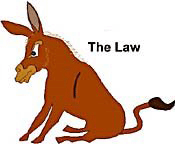
24 August 2025, Dr Binoy Kampmark, https://theaimn.net/albion-stupidities-palestine-action-and-anti-terrorism-laws/
Protest in Britain has become dangerous of late. Shaky lawmakers minding their elected positions, displaying decorative ignorance, have been criminalising protests against the war in Gaza, branding certain groups “terrorist” in inclination. While the laws dealing with criminal damage to property and such are already more than adequate, the government of Sir Keir Starmer thought it wise to enlarge them. There are people dying in large numbers in Gaza, and those protesting that situation have become a nuisance.
The keen obsession of this government – and a majority of the cerebrally softened legislators in the House of Commons – is that a group called Palestine Action is somehow worthy of being bracketed as a terrorist group under the Terrorist Act 2000. On June 20, members of the outfit broke into a Royal Airforce base at Brize Norton, Oxfordshire and spray painted two military aircraft alleged to be aiding US and Israel in refuelling tasks. This seemingly minor display of indignation by the organisation was enough to warrant its proscription by Home Secretary Yvette Cooper three days later under section 3 of the Terrorism Act.
United Nations experts linked to the UN Human Rights Office of the High Commissioner, among them Francesca Albanese, Ben Saul and Irene Khan, issued a press release on July 1 calling the labelling of a protest movement as “terrorist” an unjustified measure. “According to international standards, acts of protest that damage property, but are not intended to kill or injure people, should not be treated as terrorism.” Despite there being no binding definition of terrorism in international law, the experts were of the view that it would be limited to such acts as would cause death, serious personal injury, or involve the taking of hostages “in order to intimidate a population or compel a government or an international organisation to do or to abstain from doing any act.”
Were a national law to criminalise property damage in democracies, it would have to exclude acts of advocacy, protest, dissent or industrial action not causing death or serious injury, an approach approved by the UN Security Council’s Counter-Terrorism Executive Directorate. In the case of banning Palestine Action, individuals would be needlessly “prosecuted for peacefully exercising their rights to freedom of expression and opinion, assembly, association and participation in political life.”
A leaked report by the Joint Terrorism Analysis Centre (JTAC), obtained by human rights activist and former diplomat Craig Murray, further showed the decision to proscribe Palestine Action under the Terrorism Act as one marked by mendacity and panic on the part of the Starmer government. While JTAC is not sympathetic to Palestine Action, it did note that “The majority of the group’s activity would not be classified as terrorism under Section 1 of the Terrorism Act 2000.” While it assesses the group as having “promoted terrorism”, the primary focus of the direct action, according to the sanitised version of the report, is on inflicting property damage. Serious damage to property could bring the group within the legislation, but even then, as the UN experts have noted, that would not meet necessary international standards to warrant the label of terrorism.
According to Murray, had Palestine Action, as claimed or implied by the government, deliberately attacked individuals, received foreign funding from Iran or any hostile power, attacked Jewish-owned businesses based on racism, or planned a “future unspecified appalling terrorist acts”, then JTAC’s report would have made mention of it. “Palestine Action,” insists Murray, “is what it says it is: a non-violent direct action group which targets the Israeli weapons industry and its support and supply line.”
The High Court has granted Palestine Action co-founder Huda Ammori judicial review regarding the proscription of the organisation on two grounds: that it arguably amounts to a disproportionate interference with Article 10 and 11 rights of the claimants, which guarantee free speech and peaceful assembly under the European Convention on Human Rights; and that the proscription was made in breach or natural justice and/or contrary to article 6 the ECHR, which entitles all to a fair and public hearing within a reasonable time by an independent and impartial tribunal established by law. The Home Secretary, it was noted, had failed to even consult PA in making the decision.
The decision by the Starmer government was astonishing and, as with all bad laws, the foundry of astonishingly stupid results. It has made the police imbecilic enforcers; it has turned prosecutions into a dismal circus. Protesters otherwise regarded as very English and very middle class have found themselves facing arrests and charges. Over the course of one weekend this month, section 13 of the Terrorism Act 2000 was used to arrest over 500 people, most of them carrying a placard supporting PA. That provision criminalises the wearing of clothing items or the wearing, carrying or displaying of any article, and the publishing of an image of an item of clothing or any other article “in such way or in such circumstances as to arouse reasonable suspicion that he is a member or supporter of a proscribed organisation.” Sentences range from six-month imprisonment to a fine.
One particularly absurd arrest was that of retired head teacher John Farley, who was carrying a placard making reference to Palestine Action. Farley was eventually released on bail pending charges, which were never pressed. The incident last month did not even involve the proscribed organisation but was connected with another organised protest group.
The protest held in Leeds began as a solemn, silent march. Two police caught sight of Farley holding the placard. They proceeded to drag Harley away, and, typical of those types of recruits, refused to listen to any explanation: that the cartoon on the placard was a replica from the satirical magazine Private Eye, commenting on the banning of Palestine Action. The Private Eye piece, brutal, grim, and apposite, sought to explain what “Palestine Action”entailed: “Unacceptable Palestine Action” involved “spraying military planes with paint”;“Acceptable Palestine Action” entailed “shooting Palestinians queuing for food.”
Private Eye’s editor, Ian Hislop, roundly condemned the arrest as “mind-boggling” and “ludicrous”. The cartoon had been “a very neat and funny little encapsulation about what is and isn’t acceptable, and it’s a joke about – I mean, it’s quite a black joke – but about the hypocrisies of government approach to any sort of action in Gaza.”
A spokesman for West Yorkshire Police expressed some contrition for Farley’s consternation, and went on to express a view in tortured middle management speak. “As this is a new proscribed organisation, West Yorkshire Police is considering any individual or organisational learning from this incident.” That ship would seem to have sailed into the waters of sheer lunacy, leaving the judges to decide in November whether the proscription order for Palestine Action struck a proportionate balance. Till then, this egregious application of the law will continue to make pro-Palestinian protests in Britain a perilous affair.
September 13/14 – Global Network 33rd Annual Space Zoom Conference- “NATO-US prepare for war on China “.
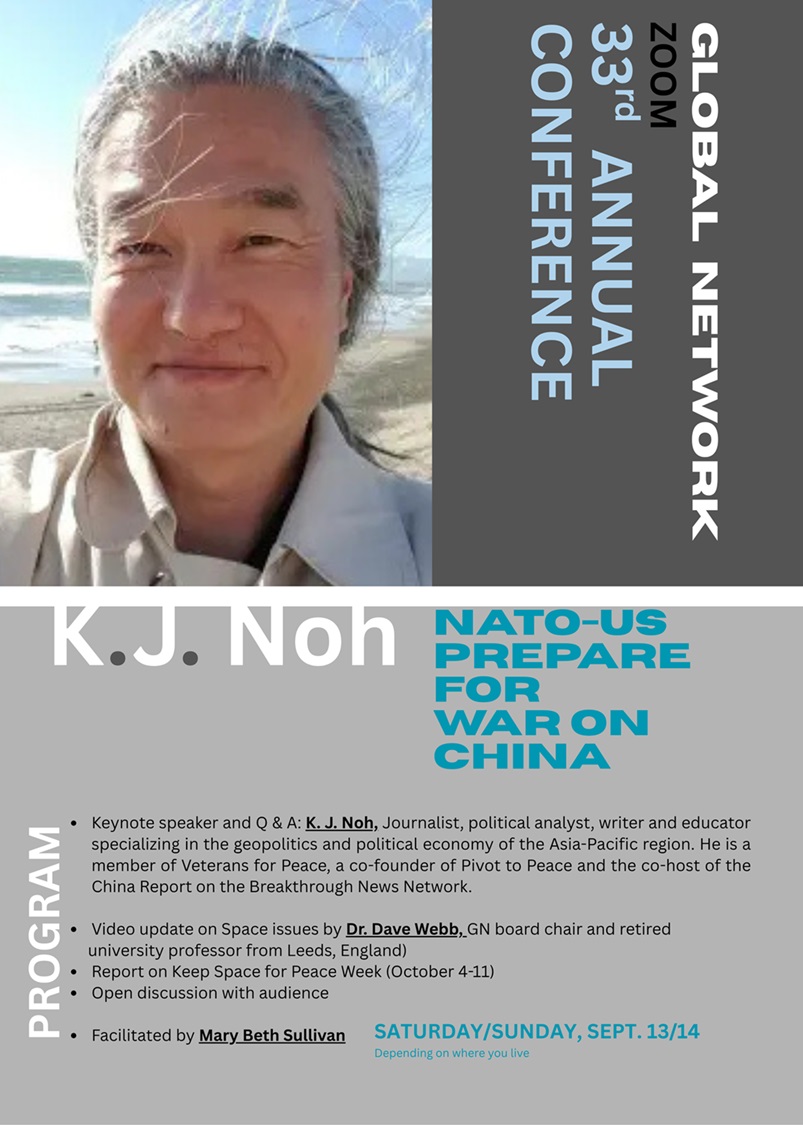
Keynote Speaker K. J. Noh
| Saturday/Sunday September 13/14(Depending on where you live) Registration required |
| Please note the time of the meeting in your part of the world just below. To register just click here Honolulu, HI @ 2:00 pm Sept 13 Los Angeles, CA @ 5:00 pm Sept 13 New York, NY @ 8:00 pm Sept 13 London, United Kingdom @ 1:00 am Sept 14 Stockholm, Sweden @ 2:00 am Sept 14 Delhi, India @ 5:30 am Sept 14 Manila, Philippines @ 8:00 am Sept 14 Seoul, South Korea @ 9:00 am Sept 14 Tokyo, Japan @ 9:00 am Sept 14 Hagåtña, Guam @ 10:00 am Sept 14 Sydney, Australia @ 10:00 am Sept 14 Auckland, New Zealand @ 12:00 noon Sept 14 |
Taiwan votes on recalling opposition lawmakers and reviving nuclear power
Voters in Taiwan are deciding whether to dismiss seven opposition members from the legislature and on a return to nuclear power five months
after the last operating reactor shut down.
Independent 23rd Aug 2025, https://www.independent.co.uk/news/taiwan-taipei-foxconn-nvidia-american-b2812877.html
KHNP And Westinghouse ‘Holding Talks’ Over Nuclear JV For US And Europe
By David Dalton, 22 August 2025, https://www.nucnet.org/news/khnp-and-westinghouse-holding-talks-over-nuclear-jv-for-us-and-europe-8-5-2025
Companies may cooperate on new build as they try to put legal dispute behind them.
Korea Hydro & Nuclear Power (KHNP) and Westinghouse are holding talks to set up a joint venture for US and European projects as they try to move on from a legal settlement that has been criticised by politicians in Seoul, multiple press reports have said.
The UK daily Financial Times (subscription required) reported that KHNP’s chief executive will travel to Washington on Saturday to meet executives from Pennsylvania-based Westinghouse.
The proposed joint venture could pave the way for South Korean groups to expand in the US, where president Donald Trump has pledged to quadruple nuclear energy capacity by 2050.
“The two countries are expected to discuss ways to cooperate on nuclear power, including building nuclear power plants in the US,” a South Korean Democratic Party lawmaker told The Korea Economic
The move comes after KHNP was awarded a 26 trillion won (€16bn, $18.6bn) contract in June to build two nuclear power plants at Dukovany in the Czech Republic, following the resolution in January of a long-running dispute over nuclear technology rights with Westinghouse.
Unconfirmed reports have said KHNP ceded leadership of nuclear projects in Europe to Westinghouse when it settled the dispute in order to secure the Dukovany contract.
As a result, KHNP is said to be barred from entering the nuclear markets of European Union member states – except the Czech Republic – the US, the UK, Japan and Ukraine.
Thi means it is restricted to pursuing projects in Southeast Asia, Central Asia, the United Arab Emirates, Saudi Arabia, South America and Turkey, reports said.
According to press reports, KHNP and its parent company Korea Electric Power Corporation also agreed to pay Westinghouse $825m in goods, services and royalties per exported reactor over the next 50 years.
Westinghouse had accused the South Korean company of infringing on its intellectual property, claiming KHNP’s APR1000 and APR1400 plant designs use its licensed technology.
The January settlement removed a major hurdle for a KHNP-led consortium to sign the final Dukovany contract in June.
KHNP has withdrawn from bidding for nuclear deals in the Netherlands, Slovenia and Sweden in the past year. The company also said this week it had pulled out of a potential Polish project.
Fukushima nuclear plant decommissioning seen overrunning estimate
Fukushima nuclear plant decommissioning seen overrunning estimate. $35bn
already committed, with debris removal price ‘difficult’ to guess. The
amount spent or budgeted so far to decommission the Fukushima Daiichi
nuclear power plant has reached 5.2 trillion yen ($35.4 billion), it was
learned Friday, making it highly likely that the grand total will exceed
the government’s estimate of 8 trillion yen.
Nikkei Asian Review 22nd Aug 2025, https://asia.nikkei.com/business/energy/fukushima-nuclear-plant-decommissioning-seen-overrunning-estimate
Workers who developed cancer while building America’s nuclear weapons struggle to make medical claims after Trump cuts
Unless the Trump administration chooses to renew the compensation program former nuclear weapons employees who are hoping to receive assistance with their medical payments will no longer have the opportunity.
Ariana Baio, New York, Friday 22 August 2025, https://www.independent.co.uk/news/world/americas/us-politics/nuclear-facility-cancer-government-compensation-trump-b2812678.html
Former government employees who contracted cancers while working on America’s nuclear weapons are unable to get the government to review their medical claims in order to obtain compensation after the administration made rollbacks.
The Advisory Board on Radiation and Worker Health, part of the U.S. Centers for Disease Control and Prevention, is composed of doctors, nuclear experts, former nuclear weapon employees, and others, who dedicate their time to understanding if a specific ailment is tied to a worker’s exposure to radiation and advising the Department of Health and Human Services about potential compensation.
Their findings help determine whether former nuclear employees at U.S. facilities qualify for government compensation.
But the board has been effectively shut down because of President Donald Trump’s plan to reduce the size of the federal government and streamline processes.
That means those including Steve Hicks are left in limbo. The 70-year-old, who spent 34 years working as a nuclear mechanist at the Y-12 National Security Complex, which enriched uranium for the atomic bomb dropped on Hiroshima, is battling skin cancer and seeking compensation.
“I made a good living there, but I am not happy that I am this sick,” Hicks told Reuters in an interview published Friday. “And there are people who worked there that are sicker than me.”
Hicks is one of the thousands of former nuclear employees who suffer from cancers associated with radiation exposure.
He previously had kidney cancer, which is one of the 22 cancers the government recognizes, and provides a $150,000 lump-sump payment and medical expense compensation.
But skin cancer is not on that list.
Hicks has spent a lot of time petitioning the government to provide coverage for his skin cancer treatment and for them to add the cancer to the “Special Exposure Cohort” which are cancers the government does compensate.
The “Special Exposure Cohort” was established by a congressional act in 2000, to compensate former nuclear weapons workers who were diagnosed with cancer due to high radiation exposure. To qualify, an employee must have worked at least 250 days, before February 1992, at three gaseous diffusion plants in Kentucky, Ohio, or Tennessee and have one of the 22 cancers.
But to add another cancerto the list is an extremely arduous process and can take years.
When it was first established, Congress had 13 cancers on the list and have added to it over the years through the petition process.
“I’ve contacted politicians and the White House and haven’t heard anything back,” Hicks told Reuters.
But the process has now become virtually impossible because the board has been inactive since the start of the Trump administration.
The Advisory Board on Radiation and Worker Health was in the process of reviewing eight petitions from former nuclear workers when HHS suspended its activities in January.
The board is supposed to meet six times per year, according to law. But its 10 members told Reuters that it has not met since December 2024.
“Meetings of the Advisory Board on Radiation and Worker Health are currently paused due to outstanding administrative requirements, which the program is actively working to resolve,” a CDC spokesperson told Reuters.
The Independent has asked the CDC for comment.
As of last year, the U.S. had given $25 billion in compensation and medical benefits to the more than 100,000 atomic weapons workers who made claims, according to the Department of Energy.
But that could end for good soon because it has a statute expiration of September 2025.
Unless the Trump administration chooses to renew the compensation program those former nuclear weapons employees who are hoping to receive assistance with their medical payments will no longer have the opportunity.
Ukraine’s best security guarantee is the peace NATO sabotaged
As Trump drops his demand that Putin accept a ceasefire, Zelensky and allied proxy warriors cling to a backdoor NATO commitment that could be used to “strike Russia.”
Aaron Maté, Aug 25, 2025
In recent high-profile meetings with Russian, Ukrainian, and European counterparts, the most significant breakthrough on the path to ending the Ukraine war came from President Donald Trump himself. After threatening Vladimir Putin with punishing new sanctions unless he agreed to a ceasefire, Trump dropped that demand and accepted the Kremlin leader’s insistence on negotiating a final settlement.
Trump’s shift reflects the battlefield reality. As Russian forces continue their advance in Ukraine, Putin has no interest in freezing a conflict that his much larger army is winning, albeit at a slow pace. Trump, by contrast, ran on a pledge to end the war, and his administration has continued to promise, as Vice President JD Vance recently put it, that “we’re done with the funding of the Ukraine war business.”
Trump’s stance has created a new quandary for Ukrainian president Volodymyr Zelensky, who was enticed by the US and UK to abandon a peace deal with Russia three years ago in Istanbul with tens of billions of dollars in funding for the Ukraine war business……………………………………………(Subscribers only) https://www.aaronmate.net/p/ukraines-best-security-guarantee?utm_source=post-email-title&publication_id=100118&post_id=171821682&utm_campaign=email-post-title&isFreemail=true&r=ln98x&triedRedirect=true&utm_medium=email
∙
Western Media Manufactured Consent for Israel’s Murder of Palestinian Journalists.

The BBC (8/11/25) wrote, “More than 61,000 people have been killed in Gaza since the Israeli military operation began, according to the territory’s Hamas-run health ministry.” Western media have taken it upon themselves to seemingly rename the Gaza Health Ministry (GHM) in order to cast doubt on the extent of Israel’s atrocities.
Emma Lucia Llano, 22 Aug 25, https://fair.org/home/western-media-manufactured-consent-for-israels-murder-of-palestinian-journalists/
Israel’s targeted assassination of six Palestinian media members in the Gaza Strip on August 10 sent shockwaves through the journalism community. Though the murder of journalists has been a common tool of the Israeli’s government’s suppression of information coming out of Gaza, the loss of Al Jazeera‘s Anas al-Sharif was particularly harrowing.
Many of us had been moved by al-Sharif’s heart-wrenching coverage, from watching him remove his press vest in relief when a ceasefire was announced (1/19/25), to seeing a languid al-Sharif reporting on the famine (7/21/25) as people fainted around him. “Keep going, Anas, don’t stop,” said a voice off-camera. “You are our voice.”
Three of the victims were al-Sharif’s colleagues at Al Jazeera, one of the few media outlets that was able to keep journalists reporting in Gaza despite Israel’s blockade. As millions around the world grieved not just for al-Sharif but for his colleagues Mohammed Qreiqeh, Mohammed Noufal and Ibrahim Zaher, and freelancers Moamen Aliwa and Mohammad al-Khaldi, we were also gravely concerned about the vacuum their murders created of on-the-ground coverage of the genocide.
Establishment media, however, used these courageous journalists’ murders as an opportunity to continue parroting the same Zionist talking points that contributed to manufacturing consent for their killings. FAIR looked at 15 different news outlets’ initial coverage of the murders: the New York Times, Los Angeles Times, Washington Post, Wall Street Journal, Financial Times, ABC, CBS, NBC, CNN, Fox, BBC, Politico, Newsweek, Associated Press and Reuters.
We found that they overwhelmingly centered Israel’s narrative, attempted to delegitimize pro-Palestinian sources, and failed to contextualize the killings within the larger context of the genocide.
Prioritizing Israel’s pretext
All of the articles mentioned Israel’s allegation that al-Sharif was a member of Hamas posing as a journalist, a claim that the Committee to Protect Journalists (CPJ), the Foreign Press Association and the United Nations have all found to be baseless.
Four of the 15 articles (New York Times, 8/10/25; NBC, 8/10/25; Fox, 8/11/25; Wall Street Journal, 8/11/25) mentioned the allegations in either the headline or subhead. “Israel Kills Al Jazeera Journalists in Airstrike, Claiming One Worked for Hamas,” was NBC‘s headline, with Israel’s smear that al-Sharif “posed as a journalist” in the subhead. Fox offered “Israel Says Al Jazeera Journalist Killed in Airstrike Was Head of Hamas ‘Terrorist Cell.’”
Reuters’ original headline (8/11/25) was “Israel Kills Al Jazeera Journalist It Says Was Hamas Leader,” only later changed to “Israel Strike Kills Al Jazeera Journalists in Gaza.”
Al-Sharif had been targeted and smeared by the Israeli Defense Forces for months prior to his murder, and had written a statement in anticipation of his killing. “If these words reach you, know that Israel has succeeded in killing me and silencing my voice,” he wrote. He asked the world to continue fighting for justice in Palestine: “Do not forget Gaza.”
Six of the articles (ABC, 8/11/25; BBC, 8/11/25; New York Times, 8/10/25; NBC, 8/10/25; Fox, 8/11/25; Wall Street Journal, 8/11/25) completely omitted references to or quotes from al-Sharif’s final statement. Of those six articles, the New York Times, BBC, NBC and Fox did include quotes from Israeli government representatives—perplexingly choosing to prioritize the voices of al-Sharif’s killers over his own.
Coverage by the Wall Street Journal and New York Times devoted the most space to advancing Israel’s pretext for the killings. The Journal’s Anat Peled dedicated the first three paragraphs of her article to detailing al-Sharif’s supposed Hamas affiliation. Ephrat Livni of the Times also spent three paragraphs on the bogus allegations, allowing only one paragraph for a rebuttal from Al Jazeera and CPJ.
Every article except the ones from the New York Times (8/10/25) and Fox (8/11/25) cited the historically high number of Palestinian journalists that have been killed since October 7, 2023. The death toll currently stands at 192, according to the CPJ. However, only four articles (ABC, 8/11/25; CNN, 8/10/25; Politico, 8/11/25; Wall Street Journal, 8/11/25) listed Israel as the primary perpetrator of these murders. More typically, the AP (8/11/25) wrote that “at least 192 journalists have been killed since Israel’s war in Gaza began,” leaving the identities of both these journalists and their killers unmentioned.
Six (ABC, 8/11/25; BBC, 8/11/25; Newsweek, 8/10/25; Fox, 8/11/25; CBS, 8/11/25; Wall Street Journal, 8/11/25; LA Times, 8/11/25) of the 15 articles failed to mention Prime Minister Benjamin Netanyahu, and none mentioned the International Criminal Court’s arrest warrant against him for war crimes and crimes against humanity, including murder and intentionally directing attacks against a civilian population.
Critically, only two articles (Wall Street Journal, 8/11/25; Washington Post, 8/11/25) even noted the fact that the other five slain journalists had not been accused of belonging to Hamas. With this omission, the other outlets accepted and transmitted to audiences Israel’s premise that any number of bystanders can legitimately be killed in order to target a supposed Hamas member.
Unnecessary qualifiers
A common practice for Western media has been the use of unnecessary qualifiers to delegitimize information that comes from Palestinian sources. The coverage of al-Sharif’s assassination was no exception.
The BBC (8/11/25) wrote, “More than 61,000 people have been killed in Gaza since the Israeli military operation began, according to the territory’s Hamas-run health ministry.” Western media have taken it upon themselves to seemingly rename the Gaza Health Ministry (GHM) in order to cast doubt on the extent of Israel’s atrocities. They rarely note that a Lancet study (2/8/25) has found that the death toll could be up to 40% higher than what the GHM is reporting. The New York Times (8/10/25) and Reuters (8/11/25) also utilized “Hamas-run” to describe figures from the Gazan government.
These outlets also showed a clear bias as to how they characterize casualties. The New York Times (8/10/25), when reporting on the death toll in Gaza, wrote that the GHM doesn’t “distinguish between civilians and combatants.” Later on, the Times reported on Israeli deaths—and failed to distinguish between Israeli civilian and combatant deaths.
The implication is that some Palestinian deaths might be considered to be of lesser importance, or even justified, based on victims’ potential “combatant” status. Israeli deaths, meanwhile, are to be counted simply as human beings. The Washington Post (8/11/25) exhibited the same double standard in its reporting.
NBC (8/10/25) wrote, “Many of the targets of [the October 7] attacks were civilians, including people attending a music festival.” When reporting Palestinian deaths, NBC made no mention that over half of those killed by Israel have been women, children and the elderly. A more recent investigation found that civilians make up 83% of deaths, according to the IDF’s own data. The report also didn’t describe what Palestinian victims might have been doing when they were killed, such as the almost 1,400 who have been shot while seeking aid.
In addition to the usual rhetoric, eight of the 15 articles cast doubt on Al Jazeera by repeatedly mentioning its ownership by the Qatari government. (Qatar, like Israel, is one of 20 countries worldwide officially designated as a “major non-NATO ally” by the United States.) Three of the articles (New York Times, 8/10/25; Wall Street Journal, 8/11/25; LA Times, 8/11/25) mention the Israeli government’s adversarial relationship with Al Jazeera, with the New York Times and the Journal dedicating several paragraphs to the outlet’s alleged ties to Hamas as the presumed basis for the conflict, rather than Al Jazeera‘s critical coverage of Israeli actions.
False equivalences
Only three of the articles use the word “famine” (Financial Times, 8/10/25; CNN, 8/10/25; Newsweek, 8/10/25), and only the Financial Times mentions the word outside of quotes. Reuters (8/11/25) and the Wall Street Journal (8/11/25) called the situation “a hunger crisis” and “a humanitarian crisis that has pushed many Palestinians toward starvation,” respectively.
Media outlets continue to push the narrative that this so-called conflict began less than two years ago, as when NBC (8/10/25) wrote, “Israel launched the offensive in Gaza, targeting Hamas, after the Hamas-led terror attacks against Israel on October 7, 2023.”
Though the rate of killing greatly escalated after the October 7 operation, Israeli violence against Palestinians goes back to before the founding of the state, as many historians have carefully explained. In the decades immediately prior to the Hamas operation, the Israeli human rights group B’tselem counts more than 10,000 Palestinians killed by Israeli forces between September 2000 and September 2023—most of them noncombatants, over 2,400 of them children under 18. (Over the same period, some 1,300 Israelis—civilians and military—were killed by Palestinians.)
The Financial Times (8/10/25) described the ongoing genocide as “triggered” by the October 7 attacks, as if the al-Aqsa Flood operation were a random act of violence unrelated to the apartheid system that Israel imposes on Palestinians. The BBC (8/11/25) described Israeli violence as a “response to the Hamas-led attack,” completely erasing Israel’s history of occupation and ethnic cleansing of Palestinians that long precedes the existence of Hamas. Obscuring this sort of context is part of the motivation for Israel’s systematic murder of Palestinian journalists, including al-Sharif and his colleagues.
1 This Month





PLEASE OPPOSE HR 8255 AND S.3639 – bills would accelerate satellite deployment, with no environmental review or safeguards – https://ncstd5li.quorum.us/campaign/169331/
To see nuclear-related stories in greater depth and intensity – go to https://nuclearinformation.wordpress.com
-
Archives
- October 2026 (58)
- September 2026 (339)
- August 2026 (330)
- July 2026 (355)
- June 2026 (287)
- May 2026 (306)
- April 2026 (356)
- March 2026 (251)
- February 2026 (267)
- January 2026 (308)
- December 2025 (358)
- November 2025 (359)
-
Categories
- 1
- 1 NUCLEAR ISSUES
- business and costs
- climate change
- culture and arts
- ENERGY
- environment
- health
- history
- indigenous issues
- Legal
- marketing of nuclear
- media
- opposition to nuclear
- PERSONAL STORIES
- politics
- politics international
- Religion and ethics
- safety
- secrets,lies and civil liberties
- spinbuster
- technology
- Uranium
- wastes
- weapons and war
- Women
- 2 WORLD
- ACTION
- AFRICA
- Atrocities
- AUSTRALIA
- Christina's notes
- Christina's themes
- culture and arts
- Events
- Fuk 2022
- Fuk 2023
- Fukushima 2017
- Fukushima 2018
- fukushima 2019
- Fukushima 2020
- Fukushima 2021
- general
- global warming
- Humour (God we need it)
- Nuclear
- RARE EARTHS
- Reference
- resources – print
- Resources -audiovicual
- Weekly Newsletter
- World
- World Nuclear
- YouTube
-
RSS
Entries RSS
Comments RSS

