Renewables blow past nuclear when it comes to cheap datacenter juice.

Study finds microgrids with wind, solar, and batteries can be built years sooner and at lower cost than SMRs
CNZ describes itself as an open research institute, founded by Octopus Energy Group in the UK, and claims to advise the State of California and Europe’s International Energy Agency as well as the British government.
While CNZ’s study applies to the UK sector, where energy costs are among the highest in the industrialized world, it is likely that the overall conclusion would still be valid in other countries as well.
Its analysis shows that renewables can meet 80 percent of the constant demand from a large datacenter over the course of a year. Offshore wind can provide the majority of load requirements, with gas generation backed by battery storage as a stopgap source of power representing the most cost-optimal mix.
Greater capacity in the on-site battery storage system would reduce the reliance on gas power, and this would likely happen over time as the cost of such systems is expected to come down, the report claims.
Fri 26 Sep 2025, Dan Robinson,
https://www.theregister.com/2025/09/26/renewables_vs_smr_datacenter/
UN sanctions on Iran set to return as nuclear diplomacy fades

September 27, 2025, https://www.news.com.au/breaking-news/un-sanctions-on-iran-set-to-return-as-nuclear-diplomacy-fades/news-story/0c414f139787f2be580259e3e8daba7f
Iran was set to come under sweeping UN sanctions late Saturday for the first time in a decade — barring an unexpected last-minute breakthrough — after nuclear talks with the West floundered.
The UN nuclear watchdog on Friday said that inspectors had been allowed to return to Iranian sites, but Western powers did not see enough progress to agree to a delay after a week of top-level diplomacy at the UN General Assembly.
European powers set the clock ticking a month ago for the “snapback” of the UN sanctions, accusing Iran of failing to come clean on its nuclear program — including through countermeasures it took in response to Israeli and US bombing.
Iran on Saturday recalled its envoys in Britain, France and Germany for consultations, after the three European countries triggered the mechanism, Iranian state television said.
The sanctions are set to go into effect at 0000 GMT on Sunday (8:00 pm on Saturday in New York).
They will set up a global ban on working with companies, people and organizations accused of developing Iran’s nuclear program or ballistic missiles.
Iranian President Masoud Pezeshkian said there was no reason to reach a deal when, in his view, Israel and the United States were seeking to use the pressure to topple the Islamic republic.
“If the goal had been to resolve concerns on the nuclear program, we could easily do that,” Pezeshkian told reporters, as he insisted again that Iran will never pursue nuclear weapons.
Pezeshkian, who met during the week with French President Emmanuel Macron, said France had proposed that Iran give up its stockpile of highly enriched uranium in return for a one-month delay in the return of sanctions
“Why would we put ourselves in such a trap and have a noose around our neck each month?” he said.
He accused the United States of pressing the Europeans not to reach a compromise.
Steve Witkoff, Trump’s friend and roving negotiator, had said that the United States does not want to hurt Iran and was open to further talks.
But Pezeshkian charged that Witkoff lacked seriousness, saying he had backtracked on agreements during earlier talks — which abruptly stopped when Israel launched its military campaign.
– No Russia enforcement –
The sanctions are aimed at imposing new economic pain to pressure Iran, but it remains to be seen if all countries will enforce them.
Russian deputy ambassador Dmitry Polyansky said Friday that Moscow, a top partner of Iran, considered the reimposition of sanctions “null and void.”
Russia and China sought at the Security Council Friday to delay the reimposition of sanctions until April but failed to muster enough votes.
The United States already has unilateral sanctions on Iran and has tried to force all other countries to stop buying Iranian oil, although companies from China have defied the pressure.
Trump imposed a “maximum pressure” campaign during his first term when he withdrew from a landmark 2015 nuclear agreement negotiated under former president Barack Obama, which had offered sanctions relief in return for drastic curbs on Iran’s nuclear program.
The new sanctions mark a “snapback” of the UN measures that were suspended under the 2015 deal, which had been strongly supported by Britain, France and Germany after Trump’s withdrawal.
The International Crisis Group, which studies conflict resolution, said in a report that Iran seemed dismissive of the snapback as it had already learned to cope with the US sanctions.
But it noted that the snapback was not easy to reverse as it would require consensus at the Security Council.
“It is also likely to compound the malaise around an economy already struggling with high inflation, currency woes and deepening infrastructure problems,” the report said.
Israeli Prime Minister Benjamin Netanyahu in a defiant UN address Friday urged no delay in the snapback and hinted that Israel was willing to again strike Iran’s nuclear program, after the 12 days of bombing in June that Iranian authorities say killed more than 1,000 people.
Pezeshkian said that Iran would not retaliate against the sanctions by leaving the nuclear Non-Proliferation Treaty, warning that unnamed powers were seeking a “superficial pretext to set the region ablaze.”
Britain remade – with a lot of nuclear?
the land on which renewable techs sit is not all lost to other uses and offshore wind farms use no land. And the nuclear fuel cycle (from uranium mining through to eventual waste disposal) also involves land use.
Renew Extra Weekly September 27, 2025
In a new report, the Britain Remade lobby group pushes nuclear strongly, as part of its ecomodernist growth-based future. It models different nuclear build costs and renewable price scenarios to assess long-term impacts on household energy bills. But although it accepts that ‘renewables may have seen large price-falls over the last 15 years’ it says that ‘at high penetrations costs linked to managing intermittency are high: Britain has added 40 GW since 2010 and 120 GW is forecast by 2030, yet balancing, curtailment, backup, and overbuild still add cost and leave gaps that require firm power’.
It is also not very happy about the local environmental impact of renewables, given their high land use compared with nuclear plants. Well yes, but the land on which renewable techs sit is not all lost to other uses and offshore wind farms use no land. And the nuclear fuel cycle (from uranium mining through to eventual waste disposal) also involves land use.
The new report does admit that Britain is the most expensive place to build nuclear capacity. It notes that ‘Hinkley Point C (HPC) is estimated to cost £46 billion, or £14,100 per kW: when finished, it will be the most expensive nuclear power station ever built. British-built plants cost far more per kW than peers: our per-kW costs are about six times South Korea’s, and France and Finland deliver the same EPR design for less per kW (27% and 53% respectively). Britain has gone backwards on cost: Sizewell B in 1995 cost £6,200 per kW, less than half Sizewell C’s budgeted cost.’………………….
To improve things in the UK (not an easy task you might think, using the same vendors) it wants better regulation and reduced planning barriers. Well we will see how that goes with EDF’s new Sizewell C EPR. But better planning systems and regs might also help renewables ! Overall Britain Remade seems a bit desperate in its promotion of nuclear: ‘If renewable costs rise, nuclear can play an even larger role: government forecasts assume falling solar costs (-27% by 2040) and modest wind cost drops (-6%), but recent data show solar prices flat and wind costs rising. If renewables costs climb 30% above baseline, the most cost-efficient plan would be eight new plants at French prices (saving £7.6 bn) or fifteen at Korean prices (saving £21 bn) over 25 years, with benefits lasting decades’.
Lots of assumptions about costs there, and also about demand and markets, with there being some big uncertainties. …………………………
……………………………………………………………Not everyone in the UK will relish American dominance, even in a collaborative context, if that is what we face in this sector, and maybe in others, like AI. However, for good or ill, the Labour government, like most governments, is wedded to technology-led growth. So, with China now politically bared and the EU somewhat out of bounds, US help is evidently seen as vital. Like the US, the UK is now pushing nuclear hard: 75% of the Department of Energy Security and Net Zero’s £6.7bn spending in 2024-25 was allocated to nuclear.
It is true that renewable are also being pushed in the UK (not now under Trump in the US), but mainly via private sector investment e.g. £1.5bn for last year’s CfDs. Which way might it go in future given the US influence? The new US-UK ‘technology prosperity’ deal pushes nuclear and also AI hard, but ignores renewables. You will find exactly the opposite approach in Electrotech, the new Ember global energy report, with renewables dominating, a view also shared by the latest World Nuclear Industry Status report, which depicts nuclear as mostly declining and as something of a dead end option – see my next post. https://renewextraweekly.blogspot.com/2025/09/britain-remade-but-mostly-with-nuclear.html
Paper reactors and paper tigers
John Quiggin, September 27, 2025, https://johnmenadue.com/post/2025/09/paper-reactors-and-paper-tigers/?utm_source=substack&utm_medium=email
The culmination of Donald Trump’s state visit to the UK was a press conference at which both American and British leaders waved pieces of paper, containing an agreement that US firms would invest billions of dollars in Britain.
The symbolism was appropriate, since a central element of the proposed investment bonanza was the construction of large numbers of nuclear reactors, of a kind which can appropriately be described as “paper reactors”.
The term was coined by US Admiral Hyman Rickover, who directed the original development of nuclear powered submarines.
Hyman described their characteristics as follows:
1. It is simple.
2. It is small.
3. It is cheap
4. It is light.
5. It can be built very quickly.
6. It is very flexible in purpose (“omnibus reactor”)
7. Very little development is required. It will use mostly “off-the-shelf” components.
8. The reactor is in the study phase. It is not being built now.
But these characteristics were needed by Starmer and Trump, whose goal was precisely to have a piece of paper to wave at their meeting.
The actual experience of nuclear power in the US and UK has been an extreme illustration of the difficulties Rickover described with “practical” reactors. These are plants distinguished by the following characteristics:
1. It is being built now.
2. It is behind schedule
3. It requires an immense amount of development on apparently trivial items. Corrosion, in particular, is a problem.
4. It is very expensive.
5. It takes a long time to build because of the engineering development problems.
6. It is large.
7. It is heavy.
8. It is complicated.
The most recent examples of nuclear plants in the US and UK are the Vogtle plant in the US (completed in 2024, seven years behind schedule and way over budget) and the Hinkley C in the UK (still under construction, years after consumers were promised that that they would be using its power to roast their Christmas turkeys in 2017). Before that, the VC Summer project in North Carolina was abandoned, writing off billions of dollars in wasted investment.
The disastrous cost overruns and delays of the Hinkley C project have meant that practical reactor designs have lost their appeal. Future plans for large-scale nuclear in the UK are confined to the proposed Sizewell B project, two 1600 MW reactors that will require massive subsidies if anyone can be found to invest in them at all. In the US, despite bipartisan support for nuclear, no serious proposals for large-scale nuclear plants are currently active. Even suggestions to resume work on the half-finished VC Summer plant have gone nowhere.
Hope has therefore turned to Small Modular Reactors. Despite a proliferation of announcements and proposals, this term is poorly understood.
The first point to observe is that SMRs don’t actually exist. Strictly speaking, the description applies to designs like that of NuScale, a company that proposes to build small reactors with an output less than 100 MW (the modules) in a factory, and ship them to a site where they can be installed in whatever number desired. The hope is that the savings from factory construction and flexibility will offset the loss of size economies inherent in a smaller boiler (all power reactors, like thermal power stations, are essentially heat sources to boil water). Nuscale’s plans to build six such reactors in the US state of Utah were abandoned due to cost overruns, but the company is still pursuing deals in Europe.
Most of the designs being sold as SMRs are not like this at all. Rather, they are cut-down versions of existing reactor designs, typically reduced from 1000MW to 300 MW. They are modular only in the sense that all modern reactors (including traditional large reactors) seek to produce components off-site. It is these components, rather than the reactors, that are modular. For clarity, I’ll call these smallish semi-modular reactors (SSMRs). Because of the loss of size economies, SMRs are inevitably more expensive per MW of power than the large designs on which they are based.
Over the last couple of years, the UK Department of Energy has run a competition to select a design for funding. The short-list consisted of four SSMR designs, three from US firms, and one from Rolls-Royce offering a 470MW output. A couple of months before Trump’s visit, Rolls-Royce was announced as the winner. This leaves the US bidders out in the cold.
So, where will the big US investments in SMRs for the UK come from? There have been a “raft” of announcements promising that US firms will build SMRs on a variety of sites without any requirement for subsidy. The most ambitious is from Amazon-owned X-energy, which is suggesting up to a dozen “pebble bed” reactors. The “pebbles” are mixtures of graphite (which moderates the nuclear reaction) and TRISO particles (uranium-235 coated in silicon carbon), and the reactor is cooled by a gas such as nitrogen.
Pebble-bed reactor designs have a long and discouraging history dating back to the 1940s. The first demonstration reactor was built in Germany in the 1960s and ran for 21 years, but German engineering skills weren’t enough to produce a commercially viable design. South Africa started a project in 1994 and persevered until 2010, when the idea was abandoned..Some of the employees went on to join the fledgling X-energy, founded in 2009. As of 2025, the company is seeking regulatory approval for a couple of demonstrator projects in the US.
Meanwhile, China completed a 10MW prototype in 2003 and a 250MW demonstration reactor, called HTR-PM in 2021. Although HTR-PM100 is connected to the grid, it has been an operational failure with availability rates below 25%. A 600MW version has been announced, but construction has apparently not started.
When this development process started in the early 20th century, China’s solar power industry was non-existent. China now has more than 1000 Gigawatts of solar power installed. New installations are running at about 300 GW a year, with an equal volume being produced for export. In this context, the HTR-PM is a mere curiosity.
This contrast deepens the irony of the pieces of paper waved by Trump and Starmer. Like the supposed special relationship between the US and UK, the paper reactors that have supposedly been agreed on are a relic of the past. In the unlikely event that they are built, they will remain a sideshow in an electricity system dominated by wind, solar and battery storage.
Why President Trump should put off the new nuclear arms race for one more year

Bulletin, By Jon B. Wolfsthal | September 26, 2025
On September 22, Russian President Vladimir Putin stated that Russia would be willing to abide by the limits in the New START nuclear arms control treaty for an additional year if the United States did the same. Both the United States and Russia are parties to the treaty. That agreement commits both countries to deploy no more than 1,550 strategic offensive nuclear weapons.
The agreement was negotiated in 2010 and is set to expire in February of next year.[1] After it expires, there will be no restrictions on the number and types of nuclear weapons that those two countries can build and deploy. The treaty was extended for one five-year term in 2021, but it cannot be legally extended as a formal treaty a second time.
While both sides stopped fully implementing the verification provisions under the treaty during the COVID-19 epidemic, Russia refused to restart them in 2022 after it launched its war against Ukraine. Yet even so, both Washington and Moscow are complying with the treaty’s central numerical limits. Without a new agreement, however, the world’s two largest nuclear weapons states would coexist without any caps on their arsenals for the first time in two generations.
Extending the deal by a year, even informally, would be a security and diplomatic win for the United States. However, as with many things these days, nothing is simple.
Words need action. US President Donald Trump announced at the United Nations on September 23 that he’d like to cease the development of all nuclear weapons (and biological weapons) “once and for all.” Trump has previously said that he would like to negotiate new nuclear agreements with Russia and to find a way to include China in those efforts. But to date, neither his first nor current administration has delivered any results on those fronts.
There are also voices both inside and outside of the Trump administration who maintain that Washington should not agree to any new limits with Moscow, and that the United States needs more nuclear weapons to address the threats posed by Russia and China combined. These voices are rightly concerned about Russia’s aggressive behavior and the rapid growth of China’s nuclear arsenal. They are also increasingly worried about coordination and cooperation between Russia and China, as well as with North Korea and Iran—known increasingly as the “Axis of Upheaval.”
While these concerns are legitimate, the need to respond to them with immediate increases in US nuclear deployments is questionable. Today, China has an estimated total nuclear arsenal of roughly 600 weapons, and is adding about 100 per year. The United States has just over 3,700 nuclear weapons, and Russia is thought to have just over 4,300. At the current rate of increase, it will take China almost 30 years to reach parity with the United States.
There is simply not enough time to realistically address the longer-term concerns about Chinese and Russian nuclear capabilities before New START expires in February. The question, therefore, is whether the United States and its allies would be more secure with having a one-year extension of the New START limits or living in a world in which all countries can build as many nuclear weapons as they want, and the United States has turned down an offer to maintain at least some caps in place.
The US administration should not let the perfect be the enemy of the good here and should agree to a one-year extension of New START as long as it is confident that it can monitor Russia’s compliance with the central limits. As of today, there is every reason to believe that it can, although the increasing politicization of US intelligence agencies is a growing concern.
Better restraint than arms racing. The one-year deal on offer should be pursued for at least two reasons.
First, there is no compelling military rationale for the US to increase the number of warheads above the limit set in New START. No such statement has been made by the president, the Chairman of the Joint Chiefs of Staff, or the Commander of US Strategic Command. Ultimately, a decision to build and deploy military capabilities should be driven by military necessity. In the absence of such a statement or compelling case, the money, time, and effort needed to deploy more weapons over the near term would be better used to enhance US conventional and other military capabilities. This does not mean the United States should stop preparing to possibly increase the number of deployed weapons if needed, but available information suggests that may not be needed any time soon.
The United States advances three reasons to maintain its nuclear weapons: to deter its adversaries and those of US allies, to reassure allies that the United States can and will come to their defense, and to limit the damage that an adversary can do to the United States or its allies should deterrence fail. In the US system, it is the president who determines how many nuclear weapons are needed to achieve these goals.
Deterrence theory makes clear that deterrence can work if one country can hold at risk the things that matter most to its adversary. (Whether the threat of using those forces is credible is another issue.) The United States is very capable of holding key Russian and Chinese leadership and valued targets at risk even within the New START limits. That has been and remains true today.
Another critical role for US nuclear weapons is to reassure US allies. This need is greater than ever, and some support for increasing US nuclear weapons comes from this motive. However, if the US goal is to reassure allies of Washington’s commitment to their security, then there are much greater problems the United States must address—including the egregious use of tariffs against key partners and allies, the abusive detention and deportation of South Korean workers in the United States, and the seemingly random and unpredictable nature of President Trump’s statements and behavior toward US allies overall. Yes, allies are eager for the United States to convincingly recommit to their defense and alliance relationships, but very few of these are built around a wish list that starts with increasing the number of deployed US strategic weapons. Any new deployments of US nuclear weapons are years away, and damage to US alliances is happening now. New weapons will not fix or prevent those rifts from manifesting in real and dangerous ways. And the United States must recognize that it cannot fix a credibility problem with capability alone.
Limiting the damage an enemy can inflict on the United States and its allies, should deterrence fail and a war take place, also remains a long-standing and key US objective. However, the leaders of the United States, Russia, and China have stated that a nuclear war cannot be won and should never be fought. This echoes the historic statement of Ronald Reagan and Mikhail Gorbachev that helped end the Cold War……………………………………………………………. https://thebulletin.org/2025/09/why-president-trump-should-put-off-the-new-nuclear-arms-race-for-one-more-year/
Fighter jets purchase would put UK in breach of nuclear treaty, says CND
Legal opinion for campaign group says deal amounts to reversal of UK’s commitment to nuclear disarmament
Dan Sabbagh, 26 Sept 25, https://www.theguardian.com/world/2025/sep/26/uk-fighter-jets-purchase-nuclear-treaty-cnd
Britain will violate its nuclear disarmament obligations if Labour presses ahead with the £1bn purchase of 12 F-35A fighter jets, according to a specialist legal opinion prepared on behalf of the Campaign for Nuclear Disarmament (CND).
Two international lawyers argue that the government’s plan to reintroduce air-launched nuclear weapons for the RAF will break a key provision of the nuclear non-proliferation treaty (NPT) signed by the UK and 190 other countries.
Prof Christine Chinkin and Dr Louise Arimatsu from the London School of Economics argued that the UK would be in breach of article six of the treaty, and they accused ministers of hypocritical behaviour in broadening the country’s nuclear capabilities.
In a piece published before the start of Labour’s annual conference, the authors wrote: “The decision of the UK to purchase F-35A fighter jets rather than any other model is precisely because the aircraft can ‘deliver both conventional and nuclear weapons’ and thereby enable the RAF to reacquire ‘a nuclear role for the first time since 1998’.
“Reinstating a nuclear role for the RAF represents a reversal of the UK’s long-term commitment to nuclear disarmament, including under the NPT.”
Article six of the non-proliferation treaty commits the signatories “to pursue negotiations in good faith on effective measures relating to cessation of the nuclear arms race at an early date and to nuclear disarmament” as well as to a future treaty “on general and complete disarmament”.
Though the lawyers’ conclusions are not necessarily surprising given they were working on behalf of CND, they highlight a growing contradiction between international treaty commitments and a creeping global nuclear rearmament.
Keir Starmer announced at a Nato summit in June that the UK would buy 12 F-35As with the intention of joining the alliance’s “nuclear mission”. US B61-12 nuclear bombs now stored at RAF Lakenheath in Suffolk would be made available for use by the British jets in the event of a major war.
Four years ago the UK said it would lift the cap on the number of warheads it could stockpile by 40% to 260 for its existing nuclear deterrent, the submarine-launched Trident system. It was the first time the UK had said it would increase its nuclear capability since the end of the cold war.
Sophie Bolt, the CND general secretary, accused the government of “yet another breach of international law” and of “escalating nuclear dangers in the world”. She called on MPs to discuss the UK’s nuclear intentions, arguing that the F-35A purchase plan had been announced “without parliamentary debate or scrutiny”.
The Ministry of Defence said the investment in 12 new F-35A aircraft would improve the UK’s national security. “The UK remains committed to the goal of a world without nuclear weapons and upholds all our obligations under the nuclear non-proliferation treaty,” a spokesperson said.
Other countries are also rearming and redeploying nuclear weapons as tensions rise. The US moved B61-12 bombs to Lakenheath in July, while Russia has said it has moved nuclear missiles to Belarus. China is increasing its arsenal by 100 warheads a year and plans to reach 1,500 by 2035, according to the Stockholm Peace Research Institute.
The nuclear non-proliferation treaty came into force in 1970 with article six a core component and has been signed by the world’s largest nuclear powers – the US, Russia, China and France. A handful of countries with nuclear programmes – Israel, India, Pakistan – never signed up, and North Korea pulled out in 2003.
Lots of nuclear news – NOT from the nuclear-corporate-political-media-military-complex

Some bits of good news – Conservation efforts paying off for Yellow River basin ecology Ocean treaty “a landmark victory” for the high seas. Australia is getting a new national park
TOP STORIES. 50 States One Israel – Wikipedia.
Trump’s visit proved the utter corruption of our political and media class.Nuke Power is Trump/Fascist Power…and an Epic Global Failure.
‘Inevitable’ that nuclear waste facility will go ahead without local consent says former minister.
The horrors I’ve seen of Ukrainian, NATO-backed, shelling of completely civilian areas of the Donbass throughout 2022 (and 2019, 2023…)
Trump’s nuclear ‘renaissance’ rests on risky plan for radioactive waste.
Fukushima recovery plagued with setbacks.
Living with the legacy of France’s nuclear weapons testing.
Climate. Global drying, Gaia & Abrupt Change
AUSTRALIA.Two leaders, two realities: Trump vs Albanese at the UN. Australian Submarine Agency lobbies Fremantle locals amid protest over AUKUS defence hub
.
Illawarra groups want Port Kembla ruled out for AUKUS nuclear submarine base.Global report confirms and details nuclear power’s stagnation: Someone needs to tell the Coalition
Opposition to proposed nuclear submarine base at Port Kembla. Islamophobia in Australia, antisemitism’s ignored cousin.
NUCLEAR ITEMS
| ATROCITIES. The Real Violent Extremists Are The Freaks Who Run The US Empire. |
| CIVIL LIBERTIES. This Ridiculous, Dangerous Antifa Order Is McCarthyism All Over Again—Possibly Worse. |
| ECONOMICS. Nuclear power’s record year masks future sustainability challenges, says report. EDF: Court of Auditors warns of a model running out of steam. While EDF must invest 460 billion euros over 15 years, its economic model is taking on water.- ALSO AThttps://nuclear-news.net/2025/09/25/3-b1-edf-court-of-auditors-warns-of-a-model-running-out-of-steam/ |
| ENERGY. Sorry, Donald Trump and Keir Starmer – Scotland doesn’t need nuclear – ALSO AT https://nuclear-news.net/2025/09/27/2-a-sorry-donald-trump-and-keir-starmer-scotland-doesnt-need-nuclear/ |
| ENVIRONMENT. Sizewell C taking the axe to two century-old trees/ |
| ETHICS and RELIGION. Imagine There Was A Violent Cult Committing Atrocities With Impunity. |
| EVENTS. PETITION. Say No to Nuclear Financing – World Bank and ADB, Why Turn Away from the Right Path? |
| HEALTH. Here’s What Life Is Like Inside One of Gaza’s Last Remaining Hospitals. |
| LEGAL. Federal Judge Strikes Down New York’s “Save the Hudson” Nuclear Discharge Ban.David versus Goliath: the battle of a small indigenous community against a federal radioactive waste dump |
| MEDIA. ‘Near Daily’ Israeli Assaults on Lebanon Have Become Non-News for Western Media.UN Declares Genocide in Gaza While 250 US Lawmakers Are in Israel. The Shift: 50 States, One Israel. Trump Turns Pentagon Into Department of War on First Amendment. ‘Media Really Took at Face Value What Trump Said About This Boat and Its Occupants’: CounterSpin interview with Alex Main on Venezuelan boat assault. |
| OPPOSITION to NUCLEAR . Nuclear Free Local Authorities join global call on World Bank to abandon plans to back new nuclear. Cumberland Council is Looking Like Last Line of Defence Against Lake District Coast Nuclear Dump So Why Won’t They Hold A Full Vote and Full Debate ? Remembering the fight to make Sebastopol a “nuclear-free zone”. |
| SAFETY.Nuclear choices. Quake less alarming than tsunami threat to China’s coastal nuclear power plants. Incident. Safety fears as external power to Zaporizhzhia nuclear plant still out after three days. Zaporizhzhia nuclear plant loses all off-site power, risking safety. UK Minister cites national security and public safety in dismissing 148-home scheme near nuclear weapons facility. Three formal ‘special measures’ notices remain in place amid ongoing safety issues at Dounreay. |
| SECRETS and LIES. Iran says it obtained secret files on Israel’s nuclear program. Iran publishes alleged leak of Israeli nuclear sites, experts and secret files. |
| SPINBUSTER. Cato Institute: Nuclear power’s hamster wheel. |
| TECHNOLOGY. Small Nuclear Reactors Will Not Save The Day.Underground data fortresses: the nuclear bunkers, mines and mountains being transformed to protect our ‘new gold’ from attack.‘Life and death’: Penny Wong’s nuclear AI warning to UN Security Council. |
WASTES. Confusion About a Second Repository for Radioactive Wastes.
| WAR and CONFLICT. Trump Claims Ukraine Can Retake All Territory Captured by Russia, May Be Able to ‘Go Further’ With nuclear pact in peril, Trump embraces prolonged war in Ukraine. Spain and Italy, not US, protecting 22 Americans on Global Sumud Flotilla targeted for destruction by Israel.In move that could Bring in NATO, Spain joins Italy in Sending Rescue Ship for Sumud Gaza Aid Flotilla. Trump to Netanyahu: ‘Here’s another $6 billion to polish off those pesky Palestinians. What’s In a Name? The “Defense” Department Has Always Been About War. Three dead after Ukraine bombs Crimea wellness resort – governor. |
| WEAPONS and WEAPONS SALES. Trump administration plans nearly $6B in arms sales to Israel: Report. Iran’s president vows to never build a nuclear bomb in his UNGA speech. Canada keeps bankrolling Ukraine’s war crimes. North Korea building nuclear weapon stockpile, says Seoul. Fighter jets purchase would put UK in breach of nuclear treaty, says CND. Why President Trump should put off the new nuclear arms race for one more year. |
UN Declares Genocide in Gaza While 250 US Lawmakers Are in Israel.

The visit was previously announced as part of a broader campaign launched last month to host some 400 delegations involving over 5,000 participants by year’s end, “to help spread the Israeli narrative in international media,” according to the ministry.
Tyler Poisson, September 26, 2025 https://fair.org/home/un-declares-genocide-in-gaza-while-250-us-lawmakers-are-in-israel/
The UN Independent International Commission of Inquiry on the Occupied Palestinian Territory published a report on September 16 that charged Israeli authorities and security forces with having committed, and continuing to commit, acts of genocide against Palestinians in the Gaza Strip.
The 72-page report, replete with 495 footnotes, was compiled by senior independent rights investigators appointed by the UN Human Rights Council. Specifically, the report concludes that Israel is responsible for committing four of the five genocidal acts defined by the 1948 Convention on the Prevention and Punishment of the Crime of Genocide, namely:
- (i) killing members of the group;
- (ii) causing serious bodily or mental harm to members of the group;
- (iii) deliberately inflicting on the group conditions of life calculated to bring about its physical destruction in whole or in part; and
- (iv) imposing measures intended to prevent births within the group.
This report brings the UN into line with leading human rights groups, including Human Rights Watch, Genocide Watch, Amnesty International, B’Tselem and Oxfam, all of whom have explicitly labeled Israel’s crimes in Gaza genocidal. The International Association of Genocide Scholars (IAGS) also recently passed a resolution stating that Israel’s policies and actions in Gaza meet the legal definition of genocide.
The corporate press relayed the IAGS resolution to its readers and viewers with varying degrees of emphasis and efficacy. Writing for FAIR (9/4/25), Saurav Sarkar highlighted the fact that the New York Times (9/1/25) “buried the news in the 31st paragraph of a story headlined ‘Israel’s Push for a Permanent Gaza Deal May Mean a Longer War, Experts Say.’”
Corporate coverage of the United Nation’s latest report was also of varying seriousness. The New York Times (9/17/25) decided that it was appropriate to relegate the headline that “Israel Is Committing Genocide in Gaza, UN Inquiry Says” to page A8 of its print edition. Granted, the UN finding that Israel is committing genocide in Gaza was mentioned on the front page, only under the heading “Israeli Ground Forces Push Into Gaza City, Forcing Many to Flee: Assault Deepens a Humanitarian Crisis.”
ABC (9/16/25) similarly treated the UN report as a footnote, referring to it in the final moments of a minute-and-15-second report on the assault on Gaza. Fox News (9/17/25) covered the news in the course of rebuking the UN, going so far as to put the label of “genocide” in quotes. While the Wall Street Journal (9/16/25) included the most recent genocide allegations as a subhead, the only mention we could find on MSNBC‘s website (9/18/25) came in an opinion piece headlined “The New Gaza City Offensive Is a Disaster. Trump Is Shrugging.”
The Washington Post (9/16/25) ran a piece on its website about the UN declaration, but did not find it worth a spot in its print edition.
Some corporate outlets, such as CNN (9/17/25) and Time (9/16/25), have given more appropriate emphasis to the news that the world’s preeminent governing body has officially labeled what is happening in Gaza genocide, offering dedicated articles.
‘Help spread the Israeli narrative’
On the same day the UN released its report, approximately 250 US state legislators, representing all 50 states and both parties, were in Israel for a “50 States, One Israel” conference sponsored by the Israeli government. The Jerusalem Post (9/15/25) characterized it as “the largest-ever delegation of US lawmakers” to Israel.
According to ethics disclosures reported in the Boston Herald (9/14/25), Massachusetts Democratic Rep. Alan Silvia’s trip to Israel for the conference cost $6,500. The Herald said Israel’s Ministry of Foreign Affairs would “reimburse, waive or pay for travel expenses, though it was unclear what portion of the costs the government planned to cover.”
Quoting Rep. Ilana Rubel (D-Idaho), Boise State Public Radio (9/17/25) reported that no Idaho taxpayer funds were used to send any of five Idaho state legislatures to the conference.
The Oregon Capital Insider (9/18/25) reported that Rep. Emily McIntire (R-Ore.) “said in an email from Israel that traveling to the country has always been a dream for her, and the trip has only solidified her support for Israel.”
In this connection, the Times of Israel (9/7/25) was open about the purposes of the conference:
The ministry stresses the [“50 States, One Israel”] delegation’s strategic importance, noting that state legislators often influence anti-Israel bills, such as those supporting the Boycott, Divestment and Sanctions movement. Israel hopes the visitors will help block hostile legislation at the state level and promote initiatives combating antisemitism and strengthening US/Israel ties.
The visit was previously announced as part of a broader campaign launched last month to host some 400 delegations involving over 5,000 participants by year’s end, “to help spread the Israeli narrative in international media,” according to the ministry.
Alert readers may have noticed that this article has only cited local, independent and Israeli sources about the “50 States, One Israel” conference. (See also Columbus Dispatch, 9/17/25; Georgia Public Broadcasting, 9/15/25; Mondoweiss, 9/25/25.)
At the time of this writing, the “50 States, One Israel” conference is conspicuously absent from all existing reporting on Israel in the national US corporate media. Not one major US outlet has covered the largest delegation of US state legislators to Israel. This is a startling act of omission on the part of the corporate media in the United States, and it speaks to the indispensability of local, not-for-profit, independent news.
Given that half of US voters believe that Israel is committing genocide in Gaza (Al Jazeera, 8/25/25), it is surely in the interest of the public to know if, when, why and that their local representatives were in Israel networking with parties to what the UN has labeled a genocide.
Global majority of countries now signed onto the UN nuclear ban treaty
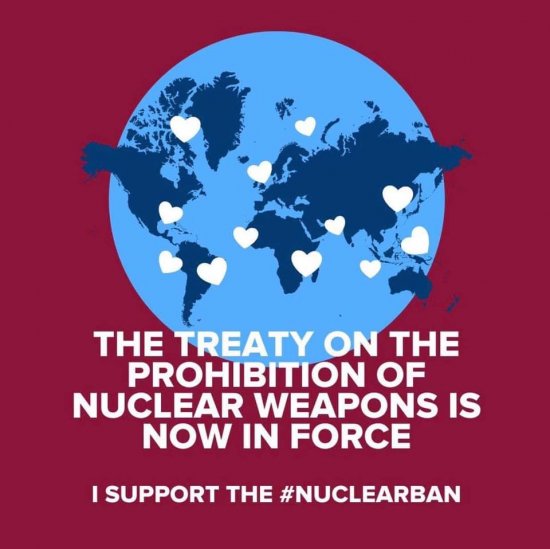
Kyrgyzstan has signed, and Ghana has ratified the Treaty on the Prohibition of Nuclear Weapons (TPNW), bringing the numbers of those who signed, ratified or acceded into the global majority. Kyrgyzstan’s Minister of Foreign Affairs, Zheenbek Kulubaev signed the treaty at the United Nations earlier today while Samuel Okudzeto Ablakwa, Foreign Minister of Ghana, deposited his country’s ratification, bringing the total to 99 out of 197 eligible states that have taken legal action under the treaty.
This is a key milestone for what is still a young treaty which was adopted by the UN just over just 8 years ago and only came into force under 5 years ago.
The TPNW outlaws nuclear weapons and all activities associated with them, including production, possession, testing, threats or use.
The TPNW was inspired by efforts to build the legal bulwark against the catastrophic humanitarian harm that nuclear weapons are known to cause. As we know from the evidence from the United States’ nuclear attacks on Hiroshima and Nagasaki 80 years ago, the effects of nuclear weapons are uniquely cruel and inhumane because of the indiscriminate, lasting, intergenerational harm they cause.
The International Campaign to Abolish Nuclear Weapons won the Nobel Peace Prize in 2017 for its work that led to the adoption of the TPNW. ICAN’s Executive Director, Melissa Parke, welcomed today’s news: “I warmly congratulate Kyrgyzstan and Ghana on their actions today. The TPNW is the best way to ensure real security from the existential threat nuclear weapons pose to the future of humanity, because as long as they exist, nuclear weapons are bound to be used, intentionally or by accident. The treaty is the sane alternative to the misguided and dangerous doctrine of nuclear deterrence and a new nuclear arms race that don’t provide security, but instead threaten it.”
Ms Parke continued: “The nuclear-armed countries and their allies that endorse the use of nuclear weapons are a distinct minority and they have no right to continue to threaten the future of the rest of the world. The TPNW is the pathway under international law to the fair and verifiable elimination of nuclear weapons so these nine countries have no excuse to continue to defy the majority here at the UN”.
The expanding influence of the TPNW has broken the hold nuclear-armed states and their flawed and dangerous doctrine of nuclear deterrence had on the public debate around nuclear weapons. The TPNW states are directly challenging deterrence doctrine as both a threat to all countries and an obstacle to nuclear disarmament – an objective the nuclear-armed states themselves say they share.
Theodora Williams Anti, from ICAN partner Foundation for Security and Development in Africa (FOSDA) said “Ghana’s ratification of the UN Treaty on the Prohibition of Nuclear Weapons is a proud moment for our nation and a powerful statement to Africa and the world. By joining the majority of states in rejecting these weapons of mass destruction, Ghana affirms its unwavering commitment to peace, human security, and the protection of future generations. This milestone reminds us that true strength lies not in the threat of annihilation, but in the courage to choose dialogue, cooperation, and a safer world for all.”
95 states have signed the treaty, which has 74 states parties. Four countries acceded to the treaty without signing beforehand as permitted under its Article 14.
The fact that the global majority of states are now on board the treaty sends a strong signal to the nuclear-armed states and their allies which support the use of nuclear weapons in their defence strategies that they are the minority and increasingly regarded by the international community as irresponsible actors threatening global security.
The TPNW has made nuclear weapons as unacceptable as chemical and biological weapons. The more countries that join the treaty, the more the diplomatic pressure builds on the pro-nuclear states and the more isolated they will become with all the diplomatic and reputational costs involved.
‘Life and death’: Penny Wong’s nuclear AI warning to UN Security Council

Nuclear weapons could be fired by artificial intelligence, Australia’s Foreign Affairs Minister has warned the United Nations.`
Blair Jackson, 26 Sept 25, https://www.news.com.au/technology/innovation/military/life-and-death-penny-wongs-nuclear-ai-warning-to-un-security-council/news-story/8ca47bc22b428922edb720dcfffe5458
Nuclear weapons could be fired by artificial intelligence, Australia’s Foreign Affairs Minister has warned the United Nations.
Speaking to the UN in New York on Thursday US time, Penny Wong issued a stark speech about technological advancements and armed conflict.
“AI’s potential use in nuclear weapons and unmanned systems challenges the future of humanity,” she said.
“Nuclear warfare has so far been constrained by human judgment, by leaders who bear responsibility and by human conscience. AI has no such concern, nor can it be held accountable.
“These weapons threaten to change war itself and they risk escalation without warning.”
Senator Wong has been with Prime Minister Anthony Albanese and Communications Minister Anika Wells at the UN this week, promoting Australia’s world-first under-16 social media ban.
Australia’s representatives have also been pushing to become one of 10 smaller nations to gain a 10-year non-permanent seat on the UN’s Security Council.
Senator Wong delivered the doomsday warning to the Security Council.
“Decisions of life and death must never be delegated to machines, and together we must set the rules and establish the norms,” she said.
“We must establish standards for the use of AI to demand it is safe, secure, responsible and ethical.
“To ensure AI transforms the tools of conflict and diplomacy for the better, the Security Council must lead by example – to strengthen international peace and security and ensure it is not undermined.”
Ukrainian President Volodymyr Zelenskyy delivered a similar warning to the UN’s General Assembly a day prior.
“It’s only a matter of time, not much, before drones are fighting drones, attacking critical infrastructure and targeting people all by themselves, fully autonomous and no human involved, except the few who control AI systems,” he said.
“We are now living through the most destructive arms race in human history because this time it includes artificial intelligence.”
Underground data fortresses: the nuclear bunkers, mines and mountains being transformed to protect our ‘new gold’ from attack
The Conversation , 26 Sept 25 A.R.E. Taylor, Senior Lecturer in Communications, University of Exeter
It’s a sunny June day in southeast England. I’m driving along a quiet, rural road that stretches through the Kent countryside. The sun flashes through breaks in the hedgerow, offering glimpses of verdant crop fields and old farmhouses.
Thick hawthorn and brambles make it difficult to see the 10ft high razor-wire fence that encloses a large grassy mound. You’d never suspect that 100ft beneath the ground, a hi-tech cloud computing facility is whirring away, guarding the most valuable commodity of our age: digital data.
This subterranean data centre is located in a former nuclear bunker that was constructed in the early 1950s as a command-and-control centre for the Royal Air Force’s radar network. You can still see the decaying concrete plinths that the radar dish once sat upon. Personnel stationed in the bunker would have closely watched their screens for signs of nuclear missile-carrying aircraft.
After the end of the cold war, the bunker was purchased by a London-based internet security firm for use as an ultra-secure data centre. Today, the site is operated by the Cyberfort Group, a cybersecurity services provider.
I’m an anthropologist visiting the Cyberfort bunker as part of my ethnographic research exploring practices of “extreme” data storage. My work focuses on anxieties of data loss and the effort we take – or often forget to take – to back-up our data.
As an object of anthropological enquiry, the bunkered data centre continues the ancient human practice of storing precious relics in underground sites, like the tumuli and burial mounds of our ancestors, where tools, silver, gold and other treasures were interred.
The Cyberfort facility is one of many bunkers around the world that have now been repurposed as cloud storage spaces. Former bomb shelters in China, derelict Soviet command-and-control centres in Kyiv and abandoned Department of Defense bunkers across the United States have all been repackaged over the last two decades as “future-proof” data storage sites.
I’ve managed to secure permission to visit some of these high-security sites as part of my fieldwork, including Pionen, a former defence shelter in Stockholm, Sweden, which has attracted considerable media interest over the last two decades because it looks like the hi-tech lair of a James Bond villain.
Many abandoned mines and mountain caverns have also been re-engineered as digital data repositories, such as the Mount10 AG complex, which brands itself as the “Swiss Fort Knox” and has buried its operations within the Swiss Alps. Cold war-era information management company Iron Mountain operates an underground data centre 10 minutes from downtown Kansas City and another in a former limestone mine in Boyers, Pennsylvania.
The National Library of Norway stores its digital databanks in mountain vaults just south of the Arctic Circle, while a Svalbard coal mine was transformed into a data storage site by the data preservation company Piql. Known as the Arctic World Archive (AWA), this subterranean data preservation facility is modelled on the nearby Global Seed Vault.
……………………..Bunkers are architectural reflections of cultural anxieties. If nuclear bunkers once mirrored existential fears about atomic warfare, then today’s data bunkers speak to the emergence of a new existential threat endemic to digital society: the terrifying prospect of data loss.
Data, the new gold?
………………………………………………………………… For governments, corporations and businesses, a severe data loss event – whether through theft, erasure or network failure – can have a significant impact on operations or even result in their collapse. The online services of high-profile companies like Jaguar and Marks & Spencer have recently been impacted by large-scale cyber-attacks that have left them struggling to operate, with systems shutdown and supply chains disrupted. But these companies have been comparatively lucky: a number of organisations had to permanently close down after major data loss events, such as the TravelEx ransomware attack in 2020, and the MediSecure and National Public Data breaches, both in 2024.
With the economic and societal impact of data loss growing, some businesses are turning to bunkers with the hope of avoiding a data loss doomsday scenario.
The concrete cloud
One of the first things visitors to the Cyberfort bunker encounter in the waiting area is a 3ft cylinder of concrete inside a glass display cabinet, showcasing the thickness of the data centre’s walls. The brute materiality of the bunkered data centre stands in stark contrast to the fluffy metaphor of the “cloud”, which is often used to discuss online data storage.
Data centres, sometimes known as “server farms”, are the buildings where cloud data is stored. When we transfer our data into the cloud, we are transferring it on to servers in a data centre (hence the meme “there is no cloud, just someone else’s computer”). Data centres typically take the form of windowless, warehouse-scale buildings containing hundreds of servers (pizza box-shaped computers) stored in cabinets that are arranged in aisles………………………………………………………….
We often think of the internet as an immaterial or ethereal realm that exists in an electronic non-place. Metaphors like the now retro-sounding cyberspace and, more recently, the cloud perpetuate this way of thinking.
But the cloud is a material infrastructure composed of thousands of miles of cables and rows upon rows of computing equipment. It always “touches the ground” somewhere, making it vulnerable to a range of non-cyber threats ………………………………………………………………………………….
Like any computer, servers generate a huge amount of heat when they are running, and must be stored in constantly air-conditioned rooms to ensure they do not overheat………………………………………………………………………
An average data centre consumes an estimated 200-terawatt hours of electricity each year. That’s around 1% of total global electricity demand, which is more than the national energy consumption of some countries. Many of these facilities are powered by non-renewable energy sources, and the data centre industry is expected to emit 2.5 billion tons of carbon dioxide by 2030.
In addition, to meet expectations for “uninterruptible” service levels, data centres rely on an array of fossil fuel-based back-up infrastructure – primarily diesel generators. …………………………
………….Amid hype and speculation about the rise of AI, which is leading to a boom in the construction of energy-hungry data centres, the carbon footprint of the industry is under increasing scrutiny…………………………..
For technology behemoths like Apple and Google, cloud storage is a key strategic avenue for long-term revenue growth. While the phones, laptops and other digital devices they make have limited lifespans, their cloud services offer potentially lifelong data storage. Apple and Google encourage us to perpetually hoard our data rather than delete it, because this locks us into their cloud subscription services, which become increasingly expensive the more storage we need.
Apple’s marketing for its cloud storage service, iCloud, encourages users to “take all the photos you want without worrying about space on your devices”. Google has made “archive” rather than “delete” the default option on Gmail. While this reduces the likelihood of us accidentally deleting an email, it also means we are steadily consuming more of our Gmail capacity, leading some to purchase more Google Drive storage space.
Cloud hoarders
It is also increasingly difficult to operate off-cloud. Internal storage space on our digital devices is dwindling as the cloud becomes the default storage option on the majority of digital products being developed. Users must pay a premium if they want more than the basic local storage on their laptop or smartphone. Ports to enable expandable, local storage – such as CD drives or SD card slots – are also being removed by tech manufacturers.
As our personal digital archives expand, our cloud storage needs will continue to grow over our lifetimes, as will the payments for more and more cloud storage space. And while we often imagine we will one day take the time to prune our accumulations of digital photos, files, and emails, that task is often indefinitely postponed. In the meantime, it is quicker and easier to simply purchase more cloud storage.
Many consumers simply use whichever cloud storage service is already pre-installed on their devices – often these are neither the cheapest nor most secure option. But once we commit to one provider, it is very difficult to move our data to another if we want a cheaper monthly storage rate, or simply want to switch – this requires investing in enough hard drives on which to download the data from one cloud provider and upload it to another. Not everyone is tech-savvy enough to do that…………………………………………. https://theconversation.com/underground-data-fortresses-the-nuclear-bunkers-mines-and-mountains-being-transformed-to-protect-our-new-gold-from-attack-262578
The Shift: 50 States, One Israel

Amid the ongoing genocide, the largest-ever delegation of U.S. lawmakers attended the “50 States, One Israel” conference in Jerusalem last week. It’s clear from the event, and the local reactions it sparked, that Israel’s isolation is only worsening.
It seems clear that this event was organized out of a growing sense of desperation, not a position of strength.
By Michael Arria September 25, 2025 https://mondoweiss.net/2025/09/the-shift-50-states-one-israel/
Multiple installments of this newsletter have covered congressional delegations to Israel, but the “special relationship” goes far beyond Washington and permeates politics at the most local of levels.
Last week, lawmakers from across the U.S. flew to Jerusalem to attend “50 States One Israel,” which was billed as the largest delegation of politicians to ever visit the country.
“I thank you for coming here to stand with Israel. Thank you, Democrats and Republicans alike,” Israeli Prime Minister Benjamin Netanyahu told the attendees. “We value and cherish your support. This is an active effort to counter attempts to besiege Israel – not isolated, not symbolic, but a real effort to push back.”
“It may sound a little bit this afternoon as if I’m almost speaking on behalf of Israel rather than the U.S.,” Ambassador to Israel Mike Huckabee told the group.
“If you came to my house tonight for dinner and you came in and you said, ‘Oh, Mike, we like you,” he continued. “We really think the world of you. We just enjoy being with you. So excited to be here with you and have dinner with you. ‘But your wife, we can’t stand her. We don’t like her a bit. I hope she’s not going to be at the table.’ I would say, ‘Well, she will be. You won’t be. Get out.’ Because if you were to insult my partner, you have insulted me.”
Normal stuff.
There wasn’t much coverage of the event in the mainstream media, but you can find a lot of interesting coverage in local outlets, and see how the battle over Israel is taking shape in multiple states.
Let’s start with the Idaho Capital Sun, where Clark Corbin covered the state’s participants. Idaho sent five lawmakers to Israel, four of whom were Republicans. The only Democrat to attend was House Minority Leader Ilana Rubel (D-Boise).
A group of state Democrats is circulating a letter condemning Rubel for attending and calling for her to step down from her leadership position. The Idaho Young Democrats published a statement criticizing the move as well.
Shiva Rajbhandari, an Idaho human rights advocate, wrote an Op-Ed for the Idaho Statesman, arguing that Rubel and her Republican colleagues “lack the moral courage for public service of any kind.”
Rubel published her own Op-Ed, in which she wonders why we can’t all just get along.
“If you want someone that will indignantly shun the other side, I’m not your person,” writes Rubel. “I prefer useful results.”
It’s unclear what results Rubel’s referring to, but she goes on to dismiss the anti-genocide position as an example of “ideological purity,” giving people “false comfort.”
Next, the Alaska News Source. Wil Courtney reports on four Alaskan lawmakers making the trip.
Courtney says his paper “sent all members of the delegation questions..including questions over the war in Gaza, which were not answered.”
He notes that the World Health Organization estimates over 640,000 people will face “catastrophic levels of food insecurity” in the Gaza Strip.
Alaska’s News Source also reached out to the governor’s office, but did not receive a response.
On Instagram, the daughter of New Mexico State Senator Jay Block (R) posted a video criticizing her dad and other “loser politicians” for attending the conference.
“It seems like he sold his soul to the devil and is now just peddling lies and propaganda,” she declared. “I just genuinely hope this will be the end of my dad’s political career.”
“50 States, One Israel” occurred amid growing international solidarity against the ongoing genocide in Gaza and Israel’s further isolation on the world stage. Lately, Netanyahu has expressed anxiety about the country’s actions impacting its economy.
A recent piece by Mitchell Plitnick, explains why BDS is so crucial at this juncture. “An isolated Israel is a failed Israel, and Netanyahu knows it. So do his business cronies,” he wrote.
Foreign Minister Gideon Sa’ar called on the conference attendees to combat the BDS movement within their communities.
“Instead of boycotting Israel, promote engagement with Israel,” he told the lawmakers. “Instead of divesting from Israel, promote investments in Israel. And instead of sanctioning the only Jewish state, speak out clearly against those who recycle age-old hatred in modern form.”
It seems clear that this event was organized out of a growing sense of desperation, not a position of strength.
Block the Bombs
The Congressional Progressive Caucus (CPC) has voted to endorse the Block the Bombs Act.
The news was first reported by Prem Thakker at Zeteo.
“The Block the Bombs bill is the first step toward oversight and accountability for the murder of children with US-made, taxpayer-funded weapons,” said Rep. Delia Ramirez (D-IL), who leads the bill. “In the face of authoritarian leaders perpetrating a genocidal campaign, Block the Bombs is the minimum action Congress must take.”
The legislation currently has 50 House co-sponsors.
It focuses on bunker buster bombs, 2,000-pound bombs, Joint Direct Attack Munitions (JDAMs), 120mm tank rounds, and 155mm artillery shells.
Many find it difficult to take the merits of this bill seriously.
It does nothing to deter “defensive weapons” like Iron Dome. In fact, it allows Israel to keep receiving all weapons by simply providing “written assurances satisfactory to the President.”
On top of all that, it obviously has no chance of passing.
However, the Progressive Caucus is one of the largest in Congress, and it has traditionally avoided the issue altogether. This is the first time it has endorsed legislation directly related to Palestine.
The fact that it’s backing an effort that’s opposed by groups like AIPAC is certainly notable, as it points to the decline of Israel’s brand among Democratic voters.
In a recent Common Dreams Op-Ed, Peace Action president Kevin Martin puts this bill, and recent related efforts, in a wider context:
The bill is as close as we have to a de facto arms embargo on Israel, as it would ban transfers of seven specific offensive weapons systems, from bunker busting bombs to tank ammunition to white phosphorus artillery munitions. While House Speaker Mike Johnson and the Republican majority will probably not allow the bill to advance, even to consideration by a House committee, building support to Ban the Bombs to Israel can help put pressure on President Trump (who recently blurted out that Israel had lost its “total control” of Congress) to exert leverage on Israeli Prime Minister Netanyahu to end his inhumane slaughter in Gaza.
In addition to further votes on Joint Resolutions of Disapproval on specific weapons transfers to Israel, the Senate could also move privileged measures including a War Powers Resolution to prevent further support for Israel’s actions in Gaza, or an inquiry under section 502(B) of the Foreign Assistance Act for Israel’s clear violations of U.S. law. Or, the Senate could attach language such as that in the House Block the Bombs bill as an amendment to an Appropriations Bill.
None of those actions would be an easy lift, and would not be likely to pass (or override an expected presidential veto) but the reality now is the political tide has turned decisively against Israel.
Perhaps the simplest way to look at this is that advocates for peace and human rights have done their job, and the public has responded, as only 8% of Democrats approve of Israel’s actions in Gaza, with the overall number at only 32%, according to a recent Gallup poll.
Disarmament over destruction: A renewed push for a world without nuclear weapons

United Nations, By Sachin Gaur, 25 September 2025
In the final days of the Second World War, as the idea of the United Nations was beginning to take shape, the atomic bombings of two Japanese cities sent a chilling warning to the world, of the terrifying destructive power of nuclear weapons. Eight decades later, amidst rising geopolitical tensions and ongoing conflicts, the threat from nuclear arms is escalating.
Highest threat level for decades
In his message for the ‘International Day for the Total Elimination of Nuclear Weapons’, observed annually on September 26, UN Secretary-General Antonio Guterres reminds the world that “nuclear weapons deliver no security – only the promise of annihilation.”
Nuclear disarmament has remained a top priority for the UN since its inception. In fact, the very first resolution adopted by the UN General Assembly in 1946 focused on nuclear disarmament.
In the decades that followed, the UN continued to lead diplomatic efforts in this direction. In 1959, the General Assembly formally supported the goal of general and complete disarmament. In 1978, the first Special Session of the General Assembly on Disarmament declared nuclear disarmament to be the highest priority.
Every UN Secretary-General has actively pursued this goal. The current incumbent, António Guterres, has repeatedly warned in recent years that “geopolitical tensions and mistrust have escalated the risk of nuclear warfare to its highest levels in decades.”
“These weapons are growing in power, range, and stealth. An accidental launch is one mistake, one miscalculation, one rash act away,” he told the Security Council last year
What’s at stake
Although nuclear weapons have only been deployed twice, their shadow still hangs over humanity. Over 12,000 nuclear warheads still exist today. Their destructive potential threatens entire cities, millions of lives, the environment, and future generations.
More than 50 per cent of the world’s population lives in countries that either possess nuclear weapons or are part of nuclear alliances. Deep concerns surrounding the possible use of these weapons have intensified due to conflicts, including the war in Ukraine.
Many nuclear-armed countries are also planning to modernise their arsenals. The integration of emerging technologies, such as artificial intelligence, raises the possibility of misjudgements and misunderstandings, making the risks even more complex and unpredictable.
A renewed nuclear arms race?
A range of multilateral treaties and initiatives have been established to curb, regulate, or eliminate nuclear weapons over the decades, helping – to some extent – to put the brakes on proliferation and advanced disarmament.
However, rising global instability and violent conflicts are placing increasing pressure on these mechanisms. The weakening of such frameworks risks sparking a renewed nuclear arms race.
In 2019, the United States announced its withdrawal from the Intermediate-Range Nuclear Forces Treaty, which targeted the elimination of a specific class of nuclear missiles and, in 2022, a major review conference failed to reach consensus on the Nuclear Proliferation Treaty.
The following year, Russia withdrew its ratification of the Comprehensive Nuclear Test-Ban Treaty (CTBT) and suspended its participation in the ‘New START’ Treaty on measures for the reduction and limitation of Strategic Offensive Arms
These developments have led to growing frustration over the slow pace of disarmament and increasing concern about the catastrophic potential of even a single nuclear detonation: since the end of the Cold War, while the number of deployed nuclear weapons has decreased, not a single nuclear warhead has been eliminated as a result of any treaty. Nor are there any active negotiations currently aimed at nuclear disarmament………………………….. https://news.un.org/en/story/2025/09/1165949
UN at 80: Civil Society Must Have a Say in the Struggle for Renewal
Andrew Firmin, https://www.ipsnews.net/2025/09/un-at-80-civil-society-must-have-a-say-in-the-struggle-for-renewal/?utm_source=email_marketing&utm_admin=146128&utm_medium=email&utm_campaign=UN_at_a_Mixed_Legacy_of_Highs_and_Lows_An_Overdose_of_Renewables_New_Energy_Risk_in_Brazil_and_more
LONDON, Sep 26 2025 (IPS) – As the high-level opening week of the UN General Assembly unfolds, with heads of states delivering often self-serving speeches from the UN’s podium, the organisation is undergoing one of its worst set of crises since its founding 80 years ago. This year’s General Assembly – ostensibly focused on development, human rights and peace – comes as wars are raging across multiple continents, climate targets are dangerously being missed and the institution designed to address these global challenges is being hollowed out by funding cuts and political withdrawals.
A UN Commission has just determined that Israel is committing genocide in Gaza, while the Israeli state recently escalated its campaign of violence by bombing Qatar. Meanwhile, Russia’s war on Ukraine threatens to spill over with its recent launch of drones against Poland and incursion into Estonia’s airspace. Conflicts continue in Myanmar, Sudan and many other countries, despite the UN’s foundational hopes of ensuring peace, security and respect for human rights.
The Trump administration has abandoned multilateralism in favour of transactional bilateral dealmaking while spearheading a donor funding withdrawal that is hitting both the UN and civil society hard. The US government has also repudiated the Sustainable Development Goals, the ambitious and progressive targets all states agreed in 2015, but which are now badly off track.
Today’s multiple and growing crises demand an effective and powerful UN – but at the same time they make this less likely to happen.
Cutbacks loom large
As state leaders meet, one of the items on the agenda is the UN80 initiative. Launched in March, this is presented as a reform process to mark the UN’s 80th anniversary. But reflecting the impacts of the funding crisis, it’s first and foremost a cost-cutting drive. The slashing of donor aid – not only by the USA, but also by other established donor states such as France, Germany and the UK, often in favour of military spending – is having a global impact. The UN is being hit both by states failing to pay their mandatory assessed contributions, or delaying them for long spells, and by underfunding of initiatives that rely on additional voluntary support.
When it comes to mandatory contributions, the most powerful states are those that owe the most, with the USA in the lead with a circa US$1.5 billion debt, followed by China on close to US$600 million. Meanwhile voluntary funding shortfalls are particularly hitting human rights work, always the most underfunded part of the UN’s work. In June, UN human rights chief Volker Türk announced that 18 activities mandated by Human Rights Council resolutions wouldn’t be implemented because of resource constraints. In a world riven by sickening conflicts, human rights investigations on Palestine, Sudan and Ukraine aren’t able to operate at anywhere near full capacity.
Funding shortfalls, intensified by the Trump administration pulling out of key UN bodies and agreements, have forced the UN to plan for a 20 per cent budget cut in 2026. That may involve shedding some 7,000 jobs from its 35,000-person workforce, merging some agencies, shutting offices and relocating functions to cheaper locations.
The UN is undoubtedly an unwieldy and over-bureaucratic set of institutions, and it would be surprising if there weren’t some efficiency savings to be made. If staff are relocated from expensive global north hubs to cheaper global south locations, it could help UN bodies and staff better understand global south realities and improve access for civil society groups that struggle to travel to the key locations of Geneva and New York, particularly given the Trump administration’s new travel restrictions – although that wouldn’t be the rationale behind relocation.
But the proposed cuts mean the UN is effectively planning to do less than it has done before, at a time when the problems are bigger than they’ve been in decades. Given this, decisions about UN priorities mustn’t be left to its officials or states alone. Civil society must be enabled to have a say.
Civil society already has far too little access to UN processes. At the high-level week, even civil society organisations normally accredited for UN access are locked out of events. Reform processes such as last year’s Summit of the Future have also fallen far short of the access needed. Civil society’s proposals to improve the situation – starting with the creation of a civil society envoy, a low-cost innovation to help coordinate civil society participation across the UN – haven’t been taken up.
Now even civil society’s limited access could be further curtailed. Already the Human Rights Council is shortening sessions, reducing the opportunities available for civil society. The proposed cuts would impact disproportionately on the UN’s human rights work. In the name of efficiency, the UN could end up becoming less effective, if it grows even more state-centric and less prepared to uphold international human rights law. States that systematically violate human rights can only benefit from the ensuing lower levels of scrutiny.
Civil society is an essential voice in any conversation about what kind of UN the world needs and how to make it fit for purpose. It urgently must be included if the UN is to have any hope of fulfilling its founding promise to serve ‘we the peoples’.
Andrew Firmin is CIVICUS Editor-in-Chief, co-director and writer for CIVICUS Lens and co-author of the State of Civil Society Report.
Two leaders, two realities: Trump vs Albanese at the UN.


26 September 2025 Roswell , https://theaimn.net/two-leaders-two-realities-trump-vs-albanese-at-the-un/
President Trump has spoken at the United Nations, and now Prime Minister Anthony Albanese has too.
The contrast could not have been starker. Trump rambled like a man who’d just been handed the microphone at a small-town karaoke night – except the song was foreign policy and he didn’t know the words. He wandered through half-baked grievances, boasted about imaginary achievements, and at one point seemed to forget which country he was president of.
Albanese, meanwhile, spoke like an actual world leader – calm, confident, and passionate. He talked about climate action, regional security, and cooperation with the kind of clarity that makes you think, “Ah yes, this person knows what he’s talking about.”
And yet, if you relied on Australia’s right-wing media, you’d think you’d just watched two completely different events. To them, Trump was basically Moses parting the Red Sea with one hand while balancing the U.S. economy on the other. Albanese, apparently “reckless,” was a bumbling tourist who accidentally stumbled into the General Assembly and asked for directions to Times Square.
One commentator even claimed Trump was “extraordinary” – which is technically true if you count all the diplomats burying their heads in their hands. Meanwhile, Albanese’s calm and measured speech was branded “utterly humiliating” and dismissed as nothing but “symbolic gestures,” because apparently international diplomacy should be performed like a WWE entrance.
This is the theatre we live with now: policy and substance don’t make headlines, but a man ranting about wind turbines does. If Trump had started selling selfies from the UN podium, they’d have called it “bold economic diplomacy.”
The world saw two very different leaders this week – one looking like he could chair a serious discussion about global challenges, the other looking like he should be gently escorted back to his seat before he accidentally sanctioned Canada.
1 This Month





PLEASE OPPOSE HR 8255 AND S.3639 – bills would accelerate satellite deployment, with no environmental review or safeguards – https://ncstd5li.quorum.us/campaign/169331/
To see nuclear-related stories in greater depth and intensity – go to https://nuclearinformation.wordpress.com
-
Archives
- October 2026 (49)
- September 2026 (339)
- August 2026 (330)
- July 2026 (355)
- June 2026 (287)
- May 2026 (306)
- April 2026 (356)
- March 2026 (251)
- February 2026 (267)
- January 2026 (308)
- December 2025 (358)
- November 2025 (359)
-
Categories
- 1
- 1 NUCLEAR ISSUES
- business and costs
- climate change
- culture and arts
- ENERGY
- environment
- health
- history
- indigenous issues
- Legal
- marketing of nuclear
- media
- opposition to nuclear
- PERSONAL STORIES
- politics
- politics international
- Religion and ethics
- safety
- secrets,lies and civil liberties
- spinbuster
- technology
- Uranium
- wastes
- weapons and war
- Women
- 2 WORLD
- ACTION
- AFRICA
- Atrocities
- AUSTRALIA
- Christina's notes
- Christina's themes
- culture and arts
- Events
- Fuk 2022
- Fuk 2023
- Fukushima 2017
- Fukushima 2018
- fukushima 2019
- Fukushima 2020
- Fukushima 2021
- general
- global warming
- Humour (God we need it)
- Nuclear
- RARE EARTHS
- Reference
- resources – print
- Resources -audiovicual
- Weekly Newsletter
- World
- World Nuclear
- YouTube
-
RSS
Entries RSS
Comments RSS

