Wall Street Warns of Nuclear Tech Bubble

Oil Price, By Haley Zaremba – Oct 03, 2025
- Billions of dollars are being invested in advanced nuclear technologies, driven by increasing energy demand from AI and broad bipartisan support.
- Despite significant investment, some Wall Street analysts are concerned about a potential bubble, citing a disconnect between fundamentals and valuations, leading to downgrades for some startups.
Billions of dollars are flowing into cutting-edge nuclear technologies, from nuclear fusion experiments to small modular reactors and microreactors that backers say will catalyze a global nuclear power renaissance. But after years of buzz and successful funding rounds, these Wall Street darlings have yet to send any of their promised carbon-free energy to the grid.
In 2024, investments in advanced nuclear companies from both private equity and venture capital hit an all time high. According to S&P Global, last year’s investments “surpassed the total deal value of the past 15 years combined.” The push for next-gen nuclear energy has accelerated on the back of growing energy demand projections driven by the proliferation of AI integration…………………………………………..
confidence is being undercut by some Wall Street analysts, who smell a bubble in the making. Semafor reports that “in general, the hysteria around power demand is pushing the valuations of many newly public energy startups beyond what they will realistically be able to deliver.” Dimple Gosai, head of U.S. clean tech equity research at Bank of America, told the news outlet that “the disconnect between fundamentals and valuation is too wide to ignore.”
Oklo, a small modular reactor (SMR) startup backed by AI bigwig Sam Altman, may prove to be such a cautionary tale. While the company’s share values have fared well since its 2024 IPO, the Bank of America downgraded its rating from “buy” to “neutral” just this week. It also downgraded NuScale, another SMR startup, NuScale, from “neutral” to “underperform.”
Axios Pro has also begun to report on investors looking to make a hasty exit from the market via SPAC mergers. SPACs, sometimes referred to as “blank check companies” are shell companies with no existing assets or operations at the time that they go public, making them an ideal “escape hatch” for investors getting cold feet about next-gen nuclear startup companies who want to offload the risk elsewhere. “This is the epitome of dumping on retail investors,” a venture funder told Axios
Pro…………………………………………………………..https://oilprice.com/Alternative-Energy/Nuclear-Power/Wall-Street-Warns-of-Nuclear-Tech-Bubble.html
Nuclear Testing Threats are Returning & Saber Rattling is Getting Louder, warns UN Chief.

by Thalif Deen, https://www.ipsnews.net/2025/09/nuclear-testing-threats-are-returning-saber-rattling-is-getting-louder-warns-un-chief/?utm_source=email_marketing&utm_admin=146128&utm_medium=email&utm_campaign=Climate_Finance_Will_Be_the_First_Casualty_of_Rising_Militarism_Nuclear_Testing_Threats_are_Returnin
UNITED NATIONS, Sep 30 2025 (IPS) – Is the unpredictable Trump administration toying with the idea of resuming nuclear tests?
The New York times reported April 10 that some of Trump’s senior advisers had proposed the resumption of “test denotations for the sake of national security”. The last such US explosion took place in 1992.
But former US Representative Brandon Williams, (Republican-New York), the new administrator of the National Nuclear Security Administration (NNSA), which plays an integral role in the nation’s $1.7 trillion nuclear weapons modernization effort, testified last April before the Senate Armed Services Committee he would not recommend the re-start of nuclear weapons testing.
The last confirmed full-scale nuclear explosive test was conducted by North Korea in September 2017—with perhaps more to come.
Speaking at a meeting, September 26, on “the international day for the total elimination of nuclear weapons,” UN Secretary-General Antonio Guterres warned “nuclear testing threats are returning, while nuclear saber rattling is louder than in past decades.”
Hard-won progress – reductions in arsenals, the cessation of testing – these are being undone before our eyes. We are sleepwalking into a new nuclear arms race, Guterres warned,
“I call on every State to ratify the Comprehensive Nuclear-Test-Ban Treaty, ending once and for all and for all the dark legacy of nuclear tests.
And every State must support the victims of nuclear use and testing – and confront the enduring harm: poisoned lands, chronic illness, and lasting trauma” declared Guterres.
Meanwhile, the devastating after-effects of past nuclear tests from a bygone era are still lingering.
During the British nuclear weapons tests in Australia between 1952 and 1963, Indigenous voices were systematically ignored, resulting in severe health and cultural devastation, according to a published report.
Through decades of relentless campaigning, survivors and their descendants have forced a belated official acknowledgement of the harm caused. However, the fight for full justice continues to this day, with the voices of many still unheard.
For years, both governments dismissed or covered up the health dangers associated with the tests, despite Aboriginal communities reporting severe health issues like rashes, blindness, and cancers. A 1956 letter from an Australian government scientist mocked a patrol officer for prioritizing the safety of a “handful of natives” over the British Commonwealth.
Despite state-sanctioned ignorance, Aboriginal survivors and their advocates refused to be silenced, ensuring their experiences were recognized.
Dr M.V. Ramana, Professor and Simons Chair in Disarmament, Global and Human Security and Director pro-tem, School of Public Policy and Global Affairs at the University of British Columbia, Vancouver, told IPS a resumption of nuclear weapon testing by the United States will most likely lead other countries like Russia, China, India, and North Korea to test their nuclear weapons.
In turn, this will increase the likelihood of an accelerated nuclear arms race, and a greater likelihood of nuclear weapons being used somewhere in the world with catastrophic consequences.
But even without nuclear war, the people who live close to these test sites, which in many cases have included indigenous communities, will suffer from exposure to radioactive contamination and other environmental effects.
The only countervailing force that one can place some hope on under these circumstances is the peace and disarmament movement, that might be able to catalyze public opposition to testing, declared Dr Ramana.
Jackie Cabasso, Executive Director, Western States Legal Foundation, Oakland, California, told IPS: It is somewhat reassuring that the new head of the U.S. National Nuclear Security Administration, Brandon Williams, during his confirmation hearings said he would advise against resuming explosive nuclear tests.
“However, the second Trump regime’s likely nuclear policy is spelled out in a manifesto by Project 2025, which proposes that a second Trump administration prioritize nuclear weapons programs over other security programs, accelerate the development and production of all nuclear weapons programs, increase funding for the development and production of new and modernized nuclear warheads, and prepare to test new nuclear weapons,” she pointed out.
Separately, Robert O’Brien, Trump’s national security advisor during his first term, wrote in Foreign Affairs, that in order to counter China and Russia’s continued investments in their nuclear arsenals, the U.S. should resume nuclear testing.
“And we must keep in mind that Russell Vought, one of the architects and co-authors of Project 2025, is now the Director of the powerful Office of Management and Budget,” said Cabasso.
Since 1945, she said, there have been 2,056 nuclear weapons tests by at least eight countries. Most of these tests have been conducted on the lands of indigenous and colonized people.
The United States conducted 1,030 of those tests in the atmosphere, underwater, and underground, while the USSR carried out 715 nuclear test detonations.
“Not only did these nuclear test explosions fuel the development and spread of nuclear weapons, but hundreds of thousands of people have died and millions more have suffered—and continue to suffer—from illnesses directly related to the radioactive fallout from nuclear detonations in the United States, islands in the Pacific, in Australia, China, Algeria, across Russia, in Kazakhstan, India, Pakistan, North Korea, and elsewhere,” said Cabasso.
According to an AI extract: Some of the major nuclear test sites include:
• Nevada Test Site, USA: A primary location for U.S. atmospheric and underground testing for over 40 years. Fallout from atmospheric tests was carried by wind over vast downwind areas.
• Pacific Proving Grounds: A U.S. site in the Marshall Islands where numerous high-yield tests, including the 1954 Castle Bravo shot, caused extensive radioactive contamination.
• Semipalatinsk Test Site, Kazakhstan: A major Soviet test site where 456 tests exposed as many as one million people to radiation, leading to high rates of cancer and birth defects.
• Novaya Zemlya, Russia: The Soviet Union’s test site for the largest nuclear explosion in history, the Tsar Bomba, in 1961.
• Lop Nor, China: The location for all of China’s nuclear tests.
• Reggane and Ekker, Algeria; Mururoa and Fangataufa atolls, French Polynesia: French nuclear test sites.
• Maralinga, Emu Field, and Montebello, Australia: British test sites.
Armed Conflicts, Editors’ Choice, Featured, Global, Headlines, IPS UN: Inside the Glasshouse, Nuclear Disarmament, Nuclear Energy – Nuclear Weapons, TerraViva United Nations
Nuclear Testing Threats are Returning & Saber Rattling is Getting Louder, warns UN Chief
By Thalif DeenReprint | | Print | Send by email

A nuclear test is carried out on an island in French Polynesia in 1971. Credit: the Comprehensive Nuclear-Test-Ban Treaty Organisation (CTBTO)
UNITED NATIONS, Sep 30 2025 (IPS) – Is the unpredictable Trump administration toying with the idea of resuming nuclear tests?
The New York times reported April 10 that some of Trump’s senior advisers had proposed the resumption of “test denotations for the sake of national security”. The last such US explosion took place in 1992.
But former US Representative Brandon Williams, (Republican-New York), the new administrator of the National Nuclear Security Administration (NNSA), which plays an integral role in the nation’s $1.7 trillion nuclear weapons modernization effort, testified last April before the Senate Armed Services Committee he would not recommend the re-start of nuclear weapons testing.
The last confirmed full-scale nuclear explosive test was conducted by North Korea in September 2017—with perhaps more to come.
Speaking at a meeting, September 26, on “the international day for the total elimination of nuclear weapons,” UN Secretary-General Antonio Guterres warned “nuclear testing threats are returning, while nuclear saber rattling is louder than in past decades.”
Hard-won progress – reductions in arsenals, the cessation of testing – these are being undone before our eyes. We are sleepwalking into a new nuclear arms race, Guterres warned,
“I call on every State to ratify the Comprehensive Nuclear-Test-Ban Treaty, ending once and for all and for all the dark legacy of nuclear tests.
And every State must support the victims of nuclear use and testing – and confront the enduring harm: poisoned lands, chronic illness, and lasting trauma” declared Guterres.
Meanwhile, the devastating after-effects of past nuclear tests from a bygone era are still lingering.
During the British nuclear weapons tests in Australia between 1952 and 1963, Indigenous voices were systematically ignored, resulting in severe health and cultural devastation, according to a published report.
Through decades of relentless campaigning, survivors and their descendants have forced a belated official acknowledgement of the harm caused. However, the fight for full justice continues to this day, with the voices of many still unheard.
For years, both governments dismissed or covered up the health dangers associated with the tests, despite Aboriginal communities reporting severe health issues like rashes, blindness, and cancers. A 1956 letter from an Australian government scientist mocked a patrol officer for prioritizing the safety of a “handful of natives” over the British Commonwealth.
Despite state-sanctioned ignorance, Aboriginal survivors and their advocates refused to be silenced, ensuring their experiences were recognized.
Dr M.V. Ramana, Professor and Simons Chair in Disarmament, Global and Human Security and Director pro-tem, School of Public Policy and Global Affairs at the University of British Columbia, Vancouver, told IPS a resumption of nuclear weapon testing by the United States will most likely lead other countries like Russia, China, India, and North Korea to test their nuclear weapons.
In turn, this will increase the likelihood of an accelerated nuclear arms race, and a greater likelihood of nuclear weapons being used somewhere in the world with catastrophic consequences.
But even without nuclear war, the people who live close to these test sites, which in many cases have included indigenous communities, will suffer from exposure to radioactive contamination and other environmental effects.
The only countervailing force that one can place some hope on under these circumstances is the peace and disarmament movement, that might be able to catalyze public opposition to testing, declared Dr Ramana.
Jackie Cabasso, Executive Director, Western States Legal Foundation, Oakland, California, told IPS: It is somewhat reassuring that the new head of the U.S. National Nuclear Security Administration, Brandon Williams, during his confirmation hearings said he would advise against resuming explosive nuclear tests.
“However, the second Trump regime’s likely nuclear policy is spelled out in a manifesto by Project 2025, which proposes that a second Trump administration prioritize nuclear weapons programs over other security programs, accelerate the development and production of all nuclear weapons programs, increase funding for the development and production of new and modernized nuclear warheads, and prepare to test new nuclear weapons,” she pointed out.
Separately, Robert O’Brien, Trump’s national security advisor during his first term, wrote in Foreign Affairs, that in order to counter China and Russia’s continued investments in their nuclear arsenals, the U.S. should resume nuclear testing.
“And we must keep in mind that Russell Vought, one of the architects and co-authors of Project 2025, is now the Director of the powerful Office of Management and Budget,” said Cabasso.
Since 1945, she said, there have been 2,056 nuclear weapons tests by at least eight countries. Most of these tests have been conducted on the lands of indigenous and colonized people.
The United States conducted 1,030 of those tests in the atmosphere, underwater, and underground, while the USSR carried out 715 nuclear test detonations.
“Not only did these nuclear test explosions fuel the development and spread of nuclear weapons, but hundreds of thousands of people have died and millions more have suffered—and continue to suffer—from illnesses directly related to the radioactive fallout from nuclear detonations in the United States, islands in the Pacific, in Australia, China, Algeria, across Russia, in Kazakhstan, India, Pakistan, North Korea, and elsewhere,” said Cabasso.
According to an AI extract: Some of the major nuclear test sites include:
Environmental and health effects include:
Global radioactive fallout: Atmospheric testing spread radioactive particles, such as iodine-131, cesium-137, and strontium-90, globally. This significantly increased atmospheric radioactivity, which peaked in 1963
Increased cancer rates: Long-term exposure to radioactive fallout has been linked to increased rates of various cancers, including thyroid cancer, leukemia, and other solid tumors. The highest risks are often seen in communities living downwind of test sites and in those exposed during childhood
Acute radiation sickness: Individuals near test sites who were exposed to high levels of radiation suffered from immediate symptoms like nausea, vomiting, and hair loss.
Soil and water contamination: Radioactive particles can contaminate soil, water, and air for decades, entering the food chain and posing long-term risks.
Disruption of ecosystems: Radioactive fallout can cause genetic mutations and death in animal populations, leading to wider ecological disruption.
Psychological impact: Survivors and affected communities have also experienced profound psychological trauma, anxiety, and fear.
Downwinder compensation: In the U.S., the Radiation Exposure Compensation Act (RECA) was established in 1990 to provide compensation to “Downwinders” who contracted specific cancers and diseases from fallout exposure from the Nevada Test Site.
This article is brought to you by IPS NORAM, in collaboration with INPS Japan and Soka Gakkai International, in consultative status with the UN’s Economic and Social Council (ECOSOC). IPS UN Bureau Report
After Bombing Boats, Trump Tells Congress US Is in ‘Armed Conflict’ With Drug Cartels.

“This is not stretching the envelope,” said a retired judge advocate general lawyer. “This is shredding it. This is tearing it apart.”
October 3, 2025, Jessica Corbett, https://www.commondreams.org/news/trump-venezuela
President Donald Trump’s administration claimed that the United States is in an “armed conflict” with drug cartels in a confidential notice to Congress this week intended to justify his deadly bombings of alleged smuggling boats in the Caribbean.
Democrats in Congress and legal officials have been challenging the legality of the three military strikes Trump announced last month. A woman who identified herself as the wife of one of the at least 17 people extrajudicially killed in the US bombings said her husband was a fisher.
“Congress was notified about the designation by Pentagon officials on Wednesday,” according to The Associated Press, one of several outlets that obtained the notice. The New York Times reported that it “was sent to several congressional committees.”
NewsNation‘s Kellie Meyer posted the full memo on social media: https://x.com/KellieMeyerNews/status/1973817299053269376?ref_src=twsrc%5Etfw%7Ctwcamp%5Etweetembed%7Ctwterm%5E1973817299053269376%7Ctwgr%5Eed7e0a4e5fa28e5d3a356b95835b5dd3057f6b22%7Ctwcon%5Es1_&ref_url=https%3A%2F%2Fwww.commondreams.org%2Fnews%2Ftrump-venezuela
After citing a relevant section from the National Defense Authorization Act for fiscal year 2024, the notice describes decades of law enforcement efforts to stem the flow of illicit narcotics into the United States as “unsuccessful,” and says that cartels “illegally and directly cause the deaths of hundreds of thousands of American citizens each year.”
“The president determined these cartels are nonstate armed groups, designated them as terrorist organizations, and determined that their actions constitute an armed attack against the United States,” the document continues. Trump also “determined that the United States is in a non-international armed conflict with these designated terrorist organizations” and directed the US Department of Defense, which he has dubbed the Department of War, “to conduct operations against them.
“The United States has now reached a critical point where we must use force in self-defense and defense of others against the ongoing attacks by these designated terrorist organizations,” adds the memo, which notes the second strike on September 15.
Lawmakers and legal experts again challenged the administration’s claim that, as the notice put it, Trump directed the bombings under “his constitutional authority as commander in chief and chief executive to conduct foreign relations.”
As the Times reported:
Geoffrey S. Corn, a retired judge advocate general lawyer who was formerly the Army’s senior adviser for law-of-war issues, said drug cartels were not engaged in “hostilities”—the standard for when there is an armed conflict for legal purposes—against the United States because selling a dangerous product is different from an armed attack.
Noting that it is illegal for the military to deliberately target civilians who are not directly participating in hostilities—even suspected criminals—Mr. Corn called the president’s move an “abuse” that crossed a major legal line.
“This is not stretching the envelope,” he said. “This is shredding it. This is tearing it apart.”
New York University School of Law professor Ryan Goodman, who served as special counsel to the general counsel of the Defense Department during the Obama administration, said on social media that Corn was “completely right.”
“Drug cartels not = ‘armed conflict,‘” Goodman added, stressing that the “people killed” in such strikes “are civilians.”
Rutgers University law professor Adil Haque similarly pushed back on social media, saying: “The United States is not in a ‘non-international armed conflict’ with drug cartels. Cartels are not organized as armed groups, nor are they engaged in intense hostilities. These are dangerous criminal organizations and should be confronted using law enforcement tools.”
Members of Congress also publicly weighed in, including Senate Armed Services Committee Ranking Member Jack Reed (D-RI), who said that “every American should be alarmed that President Trump has decided he can wage secret wars against anyone he labels an enemy. Drug cartels must be stopped, but declaring war and ordering lethal military force without Congress or public knowledge—nor legal justification—is unacceptable.”
At least two of the strikes have occurred off the coast of Venezuela, elevating fears of an armed conflict with the country.
“Trump’s actions are illegal, unconstitutional, and dangerous,” Sen. Ed Markey (D-Mass.) said in response to the new memo. ”He is leading us willy-nilly into war with Venezuela. I have ‘determined’ that this is a terrible idea.”
Israel Raids Global Sumud Flotilla, Abducts Over 400 Volunteers, Group Says.
“This is an unlawful abduction, in direct violation of international law and basic human rights,” the flotilla said.
By Elizabeth Weill-Greenberg , Truthout, October 2, 2025, https://truthout.org/articles/israel-raids-global-sumud-flotilla-abducts-over-400-volunteers-group-says/
Overnight on Wednesday, Israeli soldiers raided more than a dozen boats carrying humanitarian aid to Gaza, blocked the ships’ communications, and abducted more than 400 volunteers from 47 countries.
During the raid, Israeli forces attacked volunteers with water cannons and doused them with “skunk water,” according to a press release issued by the flotilla. The volunteers were reportedly taken to the large naval vessel, the MSC Johannesburg, but the lawyers representing the volunteers have been given “minimal updates,” as per the press release.
“This is an unlawful abduction, in direct violation of international law and basic human rights,” the group said, adding that “intercepting humanitarian vessels in international waters is a war crime.”
“[D]enying legal counsel and concealing the fate of those seized compounds that crime,” the group continued.
The Global Sumud Flotilla set sail in August, carrying volunteers from more than 40 countries on dozens of civilian boats filled with humanitarian aid for Gaza, including baby formula, medicine, and prosthetic limbs. As a result of Israel’s genocide, Gaza has the largest population of child amputees per capita in the world.
The flotilla posted several prerecorded messages from volunteers stating their name, their country of origin, and that they had been abducted by Israeli forces.
Among the people aboard the flotilla were Nkosi Zwelivelile “Mandla” Mandela, Nelson Mandela’s grandson; European Parliament Member Emma Fourreau; and climate justice activist Greta Thunberg. The raid on the Global Sumud Flotilla occurred on the Jewish holiday of Yom Kippur, the day of atonement. Israel largely shuts down for the holiday, but that did not stop the raid or its attacks on Gaza.
Israel’s raid on the boats sparked demonstrations overnight throughout the world, and Italian unions have called for a general strike on Friday in solidarity with the flotilla. The unions held a general strike just weeks ago in support of the flotilla.
The Council on American-Islamic Relations (CAIR) called Israel’s raid on the Global Sumud Flotilla “an act of piracy meant to sustain its genocide.”
“Every nation that pays lip service to international law should condemn this illegal attack on the Global Sumud Flotilla and take their own steps to forcibly break the siege of Gaza,” CAIR Deputy Executive Director Edward Ahmed Mitchell said in a statement.
Earlier this week, more than a dozen U.S. lawmakers called on the Trump administration to protect the volunteers onboard the flotilla’s ships.
“The law is clear: any attack on the Global Sumud Flotilla or its civilians is a clear and blatant violation of international law,” the lawmakers wrote in a letter to Secretary of State Marco Rubio. “The United States has an obligation to protect its citizens from foreign attack.”
The lawmakers also demanded that the administration “address the issue at root of this voyage: the brutal Israeli blockade and genocide of the Palestinians in Gaza.”
The flotilla said they will not be deterred by Israel’s illegal attacks on the flotilla.
“We have to make it clear: They take one boat, we sail with 40,” the group posted on Instagram. “They try to stop us, we escalate. Take the streets, take the ports, take the seas.”
Money to oversee nuclear weapons safety will start running low after 8 days, Energy secretary says

The National Nuclear Security Administration will need to ramp back its work, which ranges from maintaining the weapons arsenal to international non-proliferation efforts.
Politico, By Kelsey Tamborrino, 10/03/2025
Energy Secretary Chris Wright is warning that the agency within the Energy Department that oversees the safety and reliability of the nation’s nuclear weapons stockpile has only enough funding to operate at full strength for about eight more days because of the ongoing government shutdown.
“Eight more days of funding, and then we have to go into some emergency shutdown procedures, putting our country at risk,” Wright said Thursday evening on Fox News, referring to the National Nuclear Security Administration.
Prior to federal cuts imposed earlier this year, NNSA had more than 65,000 federal workers and contractors across the country responsible for a wide range of activities from maintaining the nuclear arsenal to international non-proliferation work and overseeing the U.S. Navy’s nuclear operations.
In its recent shutdown plan, the Energy Department said it would maintain the NNSA’s weapons-focused staff who operate “critical control operations systems,” as well as employees who work on tasks such as stemming the spread of nuclear weapons, but it did not offer figures on how many people that includes…………………………………………………………….
The shutdown poses the second risk this year to the NNSA, after cuts instituted by Elon Musk’s DOGE removed too many people, forcing DOE to call back some terminated workers at the NNSA. Those DOGE appointees were reportedly unaware of the NNSA’s role in overseeing national security………………………………………………………. https://www.politico.com/news/2025/10/03/nuclear-energy-nnsa-00592883
Under Trump, Criticism Is Now Criminal

Jim Naureckas, FAIR, October 3, 2025
After the killing of right-wing influencer Charlie Kirk, President Donald Trump (9/10/25) escalated his war on free speech, calling for criminalizing criticism of himself:
“It’s a long past time for all Americans and the media to confront the fact that violence and murder are the tragic consequence of demonizing those with whom you disagree day after day, year after year, in the most hateful and despicable way possible. For years, those on the radical left have compared wonderful Americans like Charlie to Nazis and the world’s worst mass murderers and criminals.
This kind of rhetoric is directly responsible for the terrorism that we’re seeing in our country today, and it must stop right now. My administration will find each and every one of those who contributed to this atrocity and to other political violence, including the organizations that fund it and support it, as well as those who go after our judges, law enforcement officials, and everyone else who brings order to our country.“
To spell it out: “Demonizing”—which is to say, criticizing—people with whom you disagree is “directly responsible” for Kirk’s death. Note that this is about criticizing people that you disagree with—”you” presumably being one of “those on the radical left”—as Trump has built a wildly lucrative political career out of demonizing those he disagrees with, and he’s not about to stop now. It’s the “wonderful Americans” like Kirk whom you aren’t supposed to criticize.
Trump promises “this kind of rhetoric”—the “radical left” kind—will “stop,” because the government will “find each and every one who contributed to this atrocity.” This includes all those who used their speech to “go after our judges,” cops and “everyone else who brings order.”
This is, in short, a declaration that the idea of free speech is over—despite Trump going on to list “free speech” first among “the American values for which Charlie Kirk lived and died.” Where once you had the right to criticize those who “bring order,” now such reckless rhetoric is punishable as direct support for “terrorism”—a word that under the US legal system authorizes draconian police powers……………………………………………………………………………………………………………………. https://fair.org/home/under-trump-criticism-is-now-criminal/
Wildfires are getting deadlier and costing more. Experts warn they’re becoming unstoppable.

Guardian 2nd Oct 2025,
Of 200 fires in the past 44 years, half of the fires that cost US$1bn or more were in the last decade
Graham Readfearn Environment and climate correspondentFri 3 Oct 2025 04.00 AESTShare
Wildfires tore through central Chile last year, killing 133 people. In California, 18,000 buildings were destroyed in 2018 causing US$16bn (A$24bn, £12bn) in damage. Portugal, Greece, Algeria and Australia have all felt the grief and the economic pain in recent years.
As the headlines, the death tolls and the billion-dollar losses from wildfires have stacked up around the world, so too have the rising temperatures – fuelled by the climate crisis – that create tinderbox conditions.
For the first time scientists say they have shown unambiguously that the numbers of “societally disastrous” wildfires – the ones that hit economies hard and take lives – have increased around the world as global heating bites.
“We’re witnessing a fundamental shift in how wildfires impact society,” said the Australian scientist Dr Calum Cunningham, who led research published in the journal Science. “Climate change sets the stage for these disasters.”
Looking at the 200 costliest fires between 1980 and 2023 – pulled from a private database maintained by global re-insurer Munich Re – the trends were clear.
Of the 200 most damaging fires since 1980 – that is, the fires with the highest direct costs relative to each nation’s GDP – 43% happened in the last 10 years.
Half of the fires that cost US$1bn or more were also in the last 10 years. Over the 44 years analysed, the frequency of fires causing 10 or more deaths tripled while the population only went up by 1.8 times.
Temperatures and the dryness of the atmosphere and of the vegetation – all factors promoting fires – all got significantly worse between 1980 and 2023.
Half the wildfires happened while local weather conditions were in the worst 0.1% on record for fire danger.
Disturbing regularity
Many studies have found the weather conditions that promote fires around the world are getting worse, and happening more often, because of global heating………………………………………………………………………………………… https://www.theguardian.com/world/2025/oct/02/earths-wildfires-growing-in-number
Can Warriors Stop Endless Wars?
The Role of Veterans in Movements for Peace and Justice
By William D. Hartung. Tom Dispatch, September 30, 2025
Secretary of Defense Pete Hegseth, the former “Fox and Friends” cohost, claims to be obsessed with making the Pentagon and the military services about “the warfighter.” His main approach to doing so is a deeply misguided campaign to reduce “distractions” like commitments to diversity, equity, and inclusion (the dreaded “DEI”). No matter that the purpose of DEI is to combat White supremacist attitudes, misogyny, and anti-gay and anti-trans violence in the ranks.
All such forms of discrimination are, in fact, already present in the U.S. military, and the way to build a cohesive defense force is certainly not by allowing them to run wild and be seen as acceptable or “normal” behavior. The best way to build a stronger, more unified military would, of course, be to make people feel welcome regardless of gender, race, ethnicity, or gender identification. That would, in fact, be the only way to build a military that reflects the nation it’s charged with defending. DEI, after all, is not an irritating slogan. It’s an attempt to right historic wrongs in the service of a more effective military and a more unified populace. And it’s one thing to suggest that current approaches could be made more effective, but quite another to demonize them in the name of forging “better” warfighters.
In short, the Hegseth method is bound to prove destructive. Count on this, in fact: it will only weaken our military, not strengthen it. The result, if Hegseth’s efforts succeed, will indeed be a Whiter, more aggressive armed forces, and quite likely one significantly more loyal to the current occupant of the Oval Office than to the Constitution.
Ex-Warriors for Peace
Thankfully, Hegseth’s vision is not shared by many of the veterans of America’s disastrous post-9/11 wars in Afghanistan, Iraq, and elsewhere. The eye-opening documentary What I Want You to Know presents the views of just such veterans about their service and about the meaning of the conflicts they fought in. Almost to a person (no, not “a man”!), they said the following four things:
– They don’t know why they were sent to the places where they fought
– They did not believe the U.S. could win the war they were sent to fight
– Their government lied to them
– They were forced to do things that will haunt them for the rest of their lives
It took courage for such veterans to go on camera and offer the unvarnished truth about the disastrous wars they helped to fight. They are, of course, far from alone, but as one of the producers of the film told me, many veterans are reluctant to discuss such feelings and insights publicly. Some don’t want to reflect on the idea that the wars they fought in were disastrously misguided and didn’t end in anything resembling an American victory. Others fear political retribution. Still others prefer to keep such conversations among their fellow vets, in large part because they feel that people who haven’t served can’t fully understand what they went through.
It’s little wonder that many vets keep their feelings about their long years in service within a close circle of friends and other veterans. But whether they choose to speak out publicly or not, a striking number of them are now either antiwar or “war skeptical,” questioning whether some of our recent conflicts were faintly worth fighting in the first place.
Don’t misunderstand me on this. There are indeed veterans speaking out against such unnecessary, unjust wars (past or future). Fifteen of them, for instance, contributed chapters to Paths of Dissent, a volume edited by Quincy Institute co-founder Andrew Bacevich and U.S. Army veteran Daniel Sjursen. A description of a 2023 webinar marking the release of the book caught its main theme perfectly:
“[T]hese soldiers vividly describe both their motivations for serving and the disillusionment that made them speak out against the system. Their testimony is crucial for understanding just how the world’s self-proclaimed greatest military power went so badly astray.”
There are also entire organizations, including Veterans for Peace (VFP), Common Defense, and About Face: Veterans Against the War, devoted to ensuring that such endless wars remain over and crafting an American foreign policy grounded in diplomacy and defense rather than in a quest for global military dominance. …………………………………………………………………………………………………………………………………………………………………………………………………………………………..
Isn’t it finally time for a respectful national dialogue about what constitutes an adequate defense and how to balance military preparations with other urgent national needs? Of course, having any such conversation, given the present deep divisions in American society, will be a challenge in its own right. But the alternative is a continuation of some variation of the devastating wars of the post-9/11 period, and such new and perilous conflicts will involve boots on the ground, air strikes, or the endless arming of repressive regimes. https://tomdispatch.com/can-warriors-stop-endless-wars/
Hamas Agrees to Release Hostages, Trump Calls on Israel to Stop Bombing
Trump threatened that “all hell” would be unleashed in Gaza if Hamas did not accept his deal by Sunday
UPDATE by Kyle Anzalone | October 3, 2025
In response to Hamas’s statement agreeing to release the hostages and entering into negotiations, President Donald Trump called on Israel to immediately cease bombing Gaza. “Based on the Statement just issued by Hamas, I believe they are ready for a lasting PEACE. Israel must immediately stop the bombing of Gaza, so that we can get the Hostages out safely and quickly! Right now, it’s far too dangerous to do that. We are already in discussions on details to be worked out,” the President wrote on Truth Social.
Hamas responded to President Donald Trump’s 20-point proposal to end the Israeli genocide in Gaza. Hamas said it is willing to release all Israeli captives, turn administration in Gaza over to an independent Palestinian committee, and enter into negotiations to end the conflict.
In a statement released on Friday, Hamas said it is willing to release the remaining 48 Israeli captives under the framework proposed by Trump. “Out of concern to stop the aggression and the genocide being inflicted upon our steadfast people in the Gaza Strip,” the group explained. “The movement announces its approval to release all prisoners of the occupation according to the exchange formula included in President Trump’s proposal.”
On Monday, Trump met with Israeli Prime Minister Benjamin Netanyahu at the White House and released a 20-point proposal to end the war in Gaza. The deal would involve an immediate ceasefire followed by Hamas releasing all remaining Israeli captives. Once that happens, Israel will release 250 life sentence prisoners plus 1,700 Palestinians thrown in Israeli prisons after October 7th, 2023.
Trump’s proposal includes turning Gaza over to the control of apolitical Palestinians that will be overseen by an international “Board of Peace” that will include Trump as chair and former UK Prime Minister Tony Blair.
Hamas said it is prepared to “immediately enter into negotiations, through the mediators, to discuss the details.”
Control of Gaza following the Israeli withdrawal may be a potential issue in reaching a final agreement. Hamas said, “The movement also reiterates its approval to hand over the administration of the Gaza Strip to a Palestinian body composed of independents (technocrats).”
While Trump said Netanyahu had agreed to his proposal, it’s unclear whether Israel will be willing to implement the deal. The agreement called for a phased Israeli withdrawal from Gaza and the possibility of the Palestinian Authority taking over as the government in the Strip.
Netanyahu has previously rejected the PA having any role in post-war Gaza. Additionally, after Trump announced his proposal, Netanyahu said, “Now the whole world, including the Arab and Muslim world, is pressuring Hamas to accept the terms that we created together with Trump, to bring back all the hostages — the living and the dead — while the IDF stays in the Strip.”
Hamas issued its response to Trump’s proposal after the President gave Hamas until Sunday evening to accept the deal or “all HELL, like no one has ever seen before, will break out against Hamas.”
Kyle Anzalone is the opinion editor of Anitwar.com and news editor of the Libertarian Institute. He hosts The Kyle Anzalone Show and is co-host of Conflicts of Interest with Connor Freeman.
The U.S. is now a fascist state. What Trump’s new order on domestic terrorism really means.
Richard J Murphy, 3 Oct 2025
Fascists mean what they say. Donald Trump has now issued NSPM-7, a presidential order that redefines dissent as terrorism and authorises the state to treat opponents as enemies. From Stalin’s Article 58 to the Nazi Malicious Practices Act, history shows what happens when repression becomes law. We need to face facts: the US is very rapidly sliding into full-blown fascism — and the UK could follow.
And that future is dystopian. Dissent is recast as terrorism in Trump’s world. This order makes that idea law, and terrorists are now to be eliminated by the US military, as he told them in a conference when he assembled 700 or more generals and declared that they would now be fighting terrorism in the cities of the USA.
In effect, Trump is saying that there is a civil war to be waged in the USA now against what he calls the domestic terrorist threat, but which doesn’t exist.
The truth is that the USA is now a fascist authoritarian state, and we need to take seriously what he’s saying because, as Chris Hedges put it, “Fascists mean what they say”.
This memo, this order, signed by Trump, starts with the words ’Heinous assassinations and other acts have dramatically increased’. He lists Charlie Kirk’s murder, an attack on the Supreme Court Judge Brett Kavanaugh in 2022 and recent attacks on ICE, the Customs Enforcement Agency in the USA, that is expelling people from the country.
He claims that these are the basis for the terror that he is talking about. But in a country where, frankly, violence is normalised, and death on the streets is not uncommon, to pretend that this is the case is just wrong. He’s trying to build a highly selective, distorted, and self-serving story about left-wing terror, for which there is almost no evidence whatsoever. But as a consequence, he’s criminalising dissent.
Anti-fascism is now defined as terrorism.
Opposition to expulsions by ICE and opposition to patriarchy, or to his idea of empire, is defined as violent revolution. Anti-capitalism, anti-racism, and campaigns for gender equality – all these are branded as extremist. And truth becomes whatever he, as the arbiter of power, declares it to be.
In this situation, the law is inverted. Instead of being a mechanism that defends our freedoms, the law becomes a weapon of repression. This order dictates that the Department of Justice seek to prosecute people who oppose what Trump is trying to do with maximum charges.
There is an instruction that the Internal Revenue Service of the USA, the equivalent of HM Revenue and Customs in the UK, should strip the tax status of suspected groups, and that would include NGOs of the sort that campaign in the UK with regard to human rights, or even universities that teach courses that suggest that people have the right to dissent.
The agencies of the USA are authorised to interrogate and detain people just because they don’t agree with Trump.
Justice in this world becomes a means of persecution, and we’ve been here before, of course. There are massive historical parallels to what Trump is now doing.
Stalin had Article 58 in his penal code. It was a catchall for counter-revolutionary activity, and literally millions of people died as a result of being prosecuted under Article 58. Any form of dissent basically gave rise to their execution.
The same thing happened in Nazi Germany. There was the Malicious Practices Act of 1933, the very first act right at the beginning of the Nazi era that made it illegal to criticise the Nazi government, its leaders or its policies, and which allowed for punishment by arrest and internment in concentration camps like Dachau, which was in suburban Munich.
Trump’s memo – his order – fits exactly the same pattern. It’s vague and sweeping, and it’s designed to criminalise opposition, but without precisely saying what anybody will have done wrong, except to offer dissent.
This is, in effect, a declaration of preemptive war. What the order says is that a new organisation, the National Joint Terrorism Task Force, or the JTTF for short, must disrupt and dismantle networks of opposition to what Trump is trying to achieve. That’s not based on evidence of crimes, but on the basis of people’s associations or their free speech or their ideas. Financial networks, NGOs and universities are all specifically targeted by this. This is the policing of thought.
And behind all this, there is a very obvious ideology. A Christian nationalist worldview drives this agenda.
Those who support LGBTQ+ rights or who are indeed members of the LGBTQ+ community, people who are secular humanists or immigrants, all of them are labelled as deviants. Science and reason are replaced by biblical dogma, and patriotism is twisted into theocratic authoritarianism.
This has a paranoia behind it. Indeed, there is a paranoia that is gripping the elite in America. Narcissists and conspiracists are imagining that there are enemies everywhere to what Trump is proposing to do and what they wish to happen.
Pseudo-democracy is being created. Pseudo-courts, pseudo-media, pseudo-citizens, people who will, in fact, support the lies that maintain the Trump regime, and I rightly call it a regime and not an administration, and these lies replace facts.
Loyalty is replacing law.
Liberal institutions are being hollowed out.
Rights are being reduced to privileges and are being revoked at will, and hope and silence will ensure that the repression spreads.
And all of this happens whilst we try to look the other way. And that is the big threat of this moment.
Alexander Solzhenitsyn wrote in The Gulag Archipelago, “Universal innocence gives rise to the universal failure to act. Maybe they won’t take you. Maybe it will all blow over”, he said.
But it won’t. This is real. Fascists should lay out in advance what they intend to do, and then they do it, and that is what is happening in the USA.
This will happen. People will disappear. This is not a future danger. It’s here and now, and the decree that puts it into place already exists. The bars to freedom are being literally built before our own eyes at this moment, and democracy can’t survive if the opposition to it is redefined as terrorism.
So, where are we? Let’s face the facts. Fascism cannot be reasoned with. It must be confronted. And hope is most definitely not enough. And silence is complicity.
Solidarity and resistance are essential, even though that does inevitably involve risk. Making this video involves risk. If these measures become the norm in the UK as well, I will, of course, be identified as one of the threats.
But we have to defend civil liberties, truth and institutions now and challenge our government to act to do so, or we will follow the path of the USA and head down the direct route to both fascism and everything that follows from it, including the internment camps, which I am sure will be sprouting up soon in the USA and not just for those who are scheduled for deportation because they come from an ethnic minority.
We have to isolate the USA.
We have to call out what’s happening.
We have to say we object.
Our governments must decide whether they can any longer align with a country which is so openly fascist.
We need to come to the point where we say, “This is not acceptable.”
We need to say, “This is a country now built on lies, peddling myths and untruths and oppressing what is real.”
We need to support independent journalism, which there still is in the USA, but which is under enormous threat.
And we need to support those who will stand up for democracy.
We need to demand accountability.
And we need to stand up for what was put in place after World War II, which was the structure of human rights, which our mainstream political parties in the UK, including the Labour Party and the Conservative Party, both now question, even though this structure was put in place as a result of the influence of Winston Churchill, who wanted to make sure that never again would human rights be threatened by fascists. But they are, and our politicians are letting that happen.
We have to take action before the iron bars of fascism slam the door shut. That’s the risk that we face, and our politicians have to rise to the challenge, or we’re all in very deep trouble. The US is already a fascist state. We could be too. That’s what we’re up against.
What do you think? There’s a poll below. Do you think the US has now moved into fascism? Do you think that the UK could follow in the same way? Are you willing to take a stand? Or will you stand by the wayside? We are at a point where we have to decide.
Please think about what you are going to do.
Israeli Defense Minister says half a million Palestinians in Gaza City will be considered ‘terrorists’ if they don’t evacuate.
One of the most devastating aspects of the ongoing Israeli campaign has been the phenomenon of what locals call the use of remote-controlled “robots” rigged with explosives and sent into dense built-up areas to be detonated, causing widespread destruction………….. each of these explosions equals the explosive force of two heavy air missiles.
With at least half a million people still left in Gaza City, Israeli Defense Minister Israel Katz issued a “final warning” for residents to evacuate, saying those who remain will soon be regarded as “terrorists or terrorist supporters.”
By Qassam Muaddi October 1, 2025, https://mondoweiss.net/2025/10/israeli-defense-minister-says-half-a-million-palestinians-in-gaza-city-will-be-considered-terrorists-if-they-dont-evacuate/
The Israeli army just announced that it won’t allow Palestinians in central and southern Gaza to travel north to Gaza City. Movement will only be allowed to leave the city for the south, the Israeli army said in a statement. Israeli Defense Minister Israel Katz also said that this was the Palestinians’ “last warning” to leave Gaza City, adding that anyone who remains will be considered “terrorists or terrorist supporters.”
An estimated 500,000 Palestinians remain in Gaza City, who are now officially cut off from any provisions coming from the south, including food, water, fuel, and medicine. To the north, Gaza City is completely sealed off from northern Gaza, including the cities of Jabalia, Beit Lahia, and Beit Hanoun, where the Israeli army is operating and has emptied of most of its inhabitants.
The announcement comes two days after the Trump administration announced its new plan for the end of the war on Gaza, amid an intensification of Israel’s campaign in Gaza City ahead of its planned occupation in the coming days or hours. According to the Israeli army, some 700,000 Palestinians have left, leaving at least 500,000 Palestinians still within the city. As of last Monday, September 29, half a million Palestinians remain trapped there, occupying a space of less than 8 square kilometers, UNRWA spokesperson Adnan Abu Hasna said.
The slow pace of evacuations from the city for the central and southern parts of the Strip had forced the Israeli army to delay sending in the third of its three military divisions (the 36th division), finally pushing it into Gaza last week.
Israel’s Channel 12 quoted military sources saying that the occupation would take up to three months, according to a report airing on September 16. The Israeli channel had reported earlier in August of disagreements between the Israeli army and the Israeli cabinet on the timing of the scheduled invasion. The cabinet insists on a faster operation, while the army prefers to conduct operations at a slower pace.
According to the Israeli daily Maariv, the Israeli army is avoiding combat with Palestinian resistance fighters, concentrating on air and artillery strikes to increase pressure on residents before sending in ground troops. Yet armored Israeli vehicles have still reached several areas, including the vital Jalaa street and the vicinity of the al-Shifa Hospital.
Despite the slow advance of ground forces, aerial and artillery bombardment has been relentless, sowing overwhelming destruction. Already, the iconic Shuja’iyya district in eastern Gaza City has been completely flattened, 90% of the Tuffah district has been destroyed, and 300 buildings have been demolished in Gaza’s largest neighborhood, Zeitoun.
In addition to entire residential blocks, Israeli strikes have targeted universities, where thousands of displaced Palestinians have taken shelter.
Remote-controlled ‘robots’ rigged to explode
One of the most devastating aspects of the ongoing Israeli campaign has been the phenomenon of what locals call the use of remote-controlled “robots” rigged with explosives and sent into dense built-up areas to be detonated, causing widespread destruction.
The deadly weapon is essentially an outdated Israeli armored personnel carrier (APC), which is retrofitted with large amounts of explosives and sent into neighborhoods. According to a report by Israeli army radio reporter Doron Kadosh, aired on September 21, each of these explosions equals the explosive force of two heavy air missiles.
The report pointed out that each APC explosion sends fragments across 500 square meters, turning the sky red for several seconds and pulverizing anything — including bodies — in its perimeter. The report confirmed that the Israeli army has been using these weapons “at an industrial scale,” detonating dozens of APCs in Gaza City every day, especially at night.
Meanwhile, Nibal Farsakh, spokesperson for the Palestinian Red Crescent Society (PRCS), told Al-Araby TV on Wednesday that the only two hospitals still operating in Gaza City are the al-Ahli Arab Hospital and the al-Quds Hospital, which is also owned by PRCS. Both hospitals are running without essential medical supplies, and access to al-Quds Hospital has been cut off by Israeli forces for the past nine days, Farsakh said, adding that the hospital can only treat the patients already inside it.
Farsakh said that the hospital is using its last stock of oxygen canisters, which are about to run out at any moment, warning that today’s blockade on the only way into the city puts thousands of patients at risk. Farsakh noted that as large numbers of wounded individuals have continued to require treatment, most essential medicines and medical supplies have run out.
If Gaza City falls
Amid the offensive, Palestinians are practically trapped in the city. Moving south is only possible through vehicles that charge up to 8,000 shekels per trip (about $2,420), with long delays due to the high volume of requests. For thousands of families, the only alternative is to flee on foot, which is impossible for the elderly, the sick, and the wounded. Many of them have already fled Israeli strikes numerous times.
Although most Palestinians from north Gaza have already fled the cities of Jabalia and Beit Lahia, which have been completely destroyed, most of them moved a short distance south to Gaza City.
The majority of them had fled during the Israeli operation between October and December of 2024, dubbed “the Generals’ Plan.” The majority of these displaced Palestinians returned to the destroyed north during the ceasefire between January and March of this year. After Israel broke the ceasefire, most Palestinians remained in the north, exhausted by the displacement they had already experienced since October 2023, especially after Israel bombed places to which they had fled in the south that the army designated as “safe zones.”
The Palestinians who have already fled Gaza City have concentrated in the central Gaza Strip, in and around the cities of Deir Al-Balah, Khan Younis, and the coastal Mawasi area. These areas have been crowded with tent encampments for almost two years.
A Palestinian displaced from Gaza City in Mawasi, who asked not to be named, told Mondoweiss that “there is no place left in Mawasi, not even for a needle.” He noted that “people are expanding the tent encampments into the areas in Khan Younis controlled by the Israeli army, which is putting their lives at risk.”
“They’ve been removing the rubble of other people’s homes with their bare hands for days, just to make some room for another tent,” he said.
Another Palestinian who remains in Gaza City told Mondoweiss that “we had a difficult and long discussion inside my family over moving out or not, and decided to split.”
“My mother and two sisters left to the south, and my father and I remained,” they said. “The moment we said goodbye was the most difficult of my entire life. I hugged my mother for several minutes, and we both wept, as neither of us knew if we were going to see each other again.”
Gaza City is the largest urban center in the Strip, and is 5,000 years old. It has been an economic and cultural hub for a millennia.
Now Palestinians fear that Israel plans on wiping it out entirely, the same way it did with Rafah, which has now been completely leveled. If Gaza City meets the same fate, it would be the end of the Gaza Strip as we know it.
80 years demonizing Russia long enough…time for détente.

In 2019 and 2020 the US withdrew from two critical nuclear treaties with Russia: INF (Intermediate-Range Nuclear Forces) and Open Skies. The third and last, New Start, expires in 4 months with no substantive ongoing negotiations. Why? Because America has abandoned negotiations extending New Start and reinstituting the others during its senseless, failed proxy war to weaken, isolate Russia from the European political economy.
Walt Zlotow, West Suburban Peace Coalition, Glen Ellyn IL , 3 Oct 25,
Last time US and Russia were buddies was 80 years ago at the end of WWII. Russia coughed up over 25 million dead in defeating Nazism in the East. In return for shedding that blood, the US coughed up several billion in military aid that kept the Russian war machine functioning in a Russian economy largely destroyed by Germany.
That friendship was blown up, literally, on August 6, 1945, when the US dropped the first of 2 atomic bombs on Japan. One of several reasons was to inform Russia (than USSR) that as new boss of the world America would brook no interference from a Russia we falsely assumed was bent on expanding communism everywhere on earth.
Had FDR lived there may not have been a Cold War. FDR recognized a prostrate Russia needed a buffer from a third German invasion from the west in the 20th century. He wisely surmised Stalin had no agenda whatsoever to conquer the world. So, he acquiesced in Stalin’s authoritarian control of his neighbors.
Alas, FDR’s death ushered in profoundly inexperienced Harry Truman. Woefully uninformed on foreign affairs, Truman was easy pickings for Russophobes Jimmy Burns, James Forestall, Dean Atchison and others who not only wanted to vanquish communist Russia, but desired a permanent war economy to prevent another Great Depression.
That wasn’t needed as pent-up domestic demand began the fabulous growth of the post WWII middle class. But Truman’s foreign policy handlers convinced him to promulgate the Truman Doctrine in February 1947, opposing communist expansion everywhere on earth even if meant demonizing as ‘communist’ any progressive movement that might make life better for downtrodden peoples.
But Russia never, for a single day between 1945 and the USSR’s implosion 46 years later, represented a serious existential threat to America. That’s because Russia had neither the desire nor the capability to attack America without suffering its utter destruction from an overwhelming American nuclear capability.
Instead, imaginary US obsession with Russia promoting communism in every corner of the earth including America, led to millions of deaths from hot wars such as Korea and Vietnam, and from US support for dictators killing dissidents threatening their regimes in over 20 countries. The million leftists Indonesia’s General Suharto killed with America’s help gave the grisly name to this murderous foreign policy…The Jakarta Method.
So, the Cold War was on till l1991 when the USSR went poof. Time to disband a now obsolete NATO? ‘Ha ha’, said the US national security state. ’We’re just getting started.’ Between 1999 and 2020 NATO expanded from 16 to 30 members, including 2 on Russia’s borders.
Beginning in 2007 Russia, requested, pleaded, begged the US and NATO to cease expansion. A year later the US response was to pledge NATO membership to the one country Russia would never allow in…neighboring and partially Russian cultured Ukraine. It took 14 years for an astonishingly patient Russia to say ‘enough’ and launch its ‘special military operation.’ That will not only prevent Ukraine NATO membership, it will effectively destroy Ukraine as a functioning state. All thanks to deranged anti-Russian US policy.
But America’s clearly lost proxy war against Russia sacrificing Ukraine is not the worst of what should be termed Cold War II. In 2019 and 2020 the US withdrew from two critical nuclear treaties with Russia: INF (Intermediate-Range Nuclear Forces) and Open Skies. The third and last, New Start, expires in 4 months with no substantive ongoing negotiations. Why? Because America has abandoned negotiations extending New Start and reinstituting the others during its senseless, failed proxy war to weaken, isolate Russia from the European political economy. The US has put peoplekind at increased risk of nuclear confrontation due to refusal to negotiate nuclear disarmament.
Eighty years of America’s Russian Derangement Syndrome is 80 years too long. Time to shut down the lost proxy war against Russia by ceasing all aid to Ukraine till they negotiate the war’s end. Time to begin disengagement from European security including NATO. Time to embrace diplomatic relations with Russia to end all sanctions, explore mutually beneficial trade relations, and most importantly, reinstitute and renew nuclear agreements to prevent our collective annihilation rom nuclear war. We can’t wait another 80 years, 80 months, 80 weeks…even another 80 days.
Are We Waking Up Fast Enough to the Dangers of AI Militarism?

As we continue to be force-fed AI, the voting public needs to find a way to push back against this onslaught against both personal autonomy and the democratic process.
Tom Valovic, Common Dreams, 1 Oct 25
AI is everywhere these days. There’s no escape. And as geopolitical events appear to spiral out of control in the Ukraine and Gaza, it seems clear that AI, while theoretically a force for positive change, has become has become a worrisome accelerant to the volatility and destabilization that may lead us to once again thinking the unthinkable—in this case World War III.
The reckless and irresponsible pace of AI development badly needs a measure of moderation and wisdom that seems sorely lacking in both the technology and political spheres. Those who we have relied on to provide this in the past—leading academics, forward-thinking political figures, and various luminaries and thought leaders in popular culture—often seem to be missing in action in terms of loudly sounding the necessary alarms. Lately, however, and offering at least a shred of hope, we’re seeing more coverage in the mainstream press of the dangers of AI’s destructive potential.
To get a feel for perspectives on AI in a military context, it’s useful to start with an article that appeared in Wired magazine a few years ago, “The AI-Powered, Totally Autonomous Future of War Is Here.” This treatment practically gushed with excitement about the prospect of autonomous warfare using AI. It went on to discuss how Big Tech, the military, and the political establishment were increasingly aligning to promote the use of weaponized AI in a mad new AI-nuclear arms race. The article also provided a clear glimpse of the foolish transparency of the all-too-common Big Tech mantra that “it’s really dangerous but let’s do it anyway.”
More recently, we see supposed thought leaders like former Google CEO Eric Schmidt sounding the alarm about AI in warfare after, of course, being heavily instrumental in promoting it……………………
The acceleration of frenzied AI development has now been green-lit by the Trump administration with US Vice President JD Vance’s deep ties to Big Tech becoming more and more apparent. This position is easily parsed—full speed ahead. One of Trump’s first official acts was to announce the Stargate Project, a $500 billion investment in AI infrastructure. Both President Donald Trump and Vance have made their position crystal clear about not attempting in any way to slow down progress by developing AI guardrails and regulation even to the point of attempting to preclude states from enacting their own regulation as part of the so called “Big Beautiful Bill.”
Widening The Public Debate
……………………………………………………………………………………… The role of the military in developing most of the advanced technologies that have worked their way into modern society still remains beneath the threshold of public awareness. But in the current environment characterized by the unholy alliance between corporate and government power, there no longer seems to be an ethical counterweight to unleashing a Pandora’s box of seemingly out-of-control AI technologies for less than noble purposes.
That the AI conundrum has appeared in the midst of a burgeoning world polycrisis seems to point toward a larger-than-life existential crisis for humanity that’s been ominously predicted and portrayed in science fiction movies, literature, and popular culture for decades. Arguably, these were not just films for speculative entertainment but in current circumstances can be viewed as warnings from our collective unconscious that have largely gone unheeded. As we continue to be force-fed AI, the voting public needs to find a way to push back against this onslaught against both personal autonomy and the democratic process.
No one had the opportunity to vote on whether we want to live in a quasi-dystopian technocratic world where human control and agency is constantly being eroded. And now, of course, AI itself is upon us in full force, increasingly weaponized not only against nation-states but also against ordinary citizens. As Albert Einstein warned, “It has become appallingly obvious that our technology has exceeded our humanity.” In a troubling ironic twist, we know that Einstein played a strong role in developing the technology for nuclear weapons. And yet somehow, like J. Robert Oppenheimer, he eventually seemed to understand the deeper implications of what he helped to unleash.
Can we say the same about today’s AI CEOs and other self-appointed experts as they gleefully unleash this powerful force while at the same time casually proclaiming that they don’t really know if AI and AGI might actually spell the end of humanity and Planet Earth itself? https://www.commondreams.org/opinion/ai-militarism-dangers
A breakdown of Tony Blair’s bizarre proposal to run Gaza
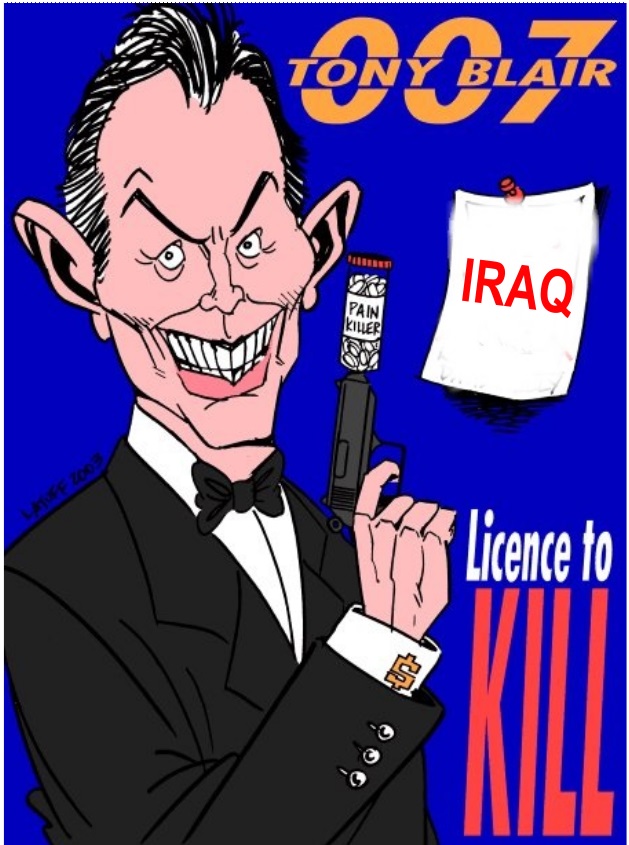
His handling of the Iraq war as premier of the UK, as well as his dealings with a string of autocrats, has left him deeply unpopular across the globe.
Proposed transitional authority will have global billionaires and businesspeople at top and Palestinians at bottom, according to leaked draft
Middle East Eye, By Rayhan Uddin, 29 September 2025
An unlikely answer has been found for who should lead the process of running Gaza after Israel’s genocidal war: Tony Blair.
It was revealed last week that the former British prime minister – a controversial figure in the Middle East, to say the least – was being considered to lead a transitional authority in the enclave.
Haaretz has now published a leaked draft plan of what Gaza would look like under Blair’s initiative.
The plan reveals a hierarchy in which an international board of billionaires and businesspeople sit at the top, while highly vetted “neutral” Palestinian administrators are at the bottom.
It sets out a three-year plan, budgeted at $90m in the first year, $134m in the second and $164m in the third (these are solely management expenses, and don’t include reconstruction or aid).
The administration would work closely with Israel, Egypt and the US, and, according to Israeli sources cited by Haartez, has the backing of the White House.
Middle East Eye breaks down key highlights from the 21-page leaked document.
Board of billionaires
Gaza International Transitional Authority, or Gita, is the name given to the new institution which will administer the Palestinian enclave.
According to the draft, Gita will be run by an international board which has “supreme political and legal authority for Gaza during the transitional period”.
The board will be in charge of all appointments, and supervise every component of the authority.
It will be made up of between seven and 10 members, including a chair.
The board will include a senior UN official, with Sigrid Kaag, the UN’s special coordinator for the Middle East peace process, cited as an example.
It would also include “leading international figures with executive and financial expertise”.
Three names are cited as potential candidates: Marc Rowan, a billionaire who owns one of America’s largest private equity firms, Naguib Sawiris, an Egyptian billionaire in the telecommunications and technology sector, and Aryeh Lightstone, chief executive of the Abraham Accords Peace Institute.
Lightstone was a senior adviser to David Friedman, a staunch defender of Israel’s illegal settlement movement, when he was US ambassador to Israel between 2017 and 2021 under Donald Trump’s first administration.
According to Haaretz, he was also deeply involved in the creation of the highly controversial Gaza Humanitarian Foundation.
Not every single board member will be a billionaire or have links to Israel or America.
There will be “at least one qualified Palestinian representative”, potentially coming from the “business or security sector”. It wasn’t made clear what “qualified” means.
And finally, the document said that the board would have “a strong representation of Muslim members to ensure regional legitimacy and cultural credibility”.
These Muslim figures would ideally have the political support of their countries, but also “long standing business credibility”.
Members of the board would be “nominated by contributing states and confirmed through a process coordinated by the UN”.
The board would report to the UN Security Council, which would ultimately grant it authority to carry out its functions.
The Security Council currently includes non-permanent members that have been highly critical of Israel’s genocide in Gaza, such as Algeria, Pakistan and Slovenia, in addition to permanent members Russia and China.
It would be interesting to see if these countries would approve a transitional government in Gaza run mostly by non-Palestinian billionaires and business figures.
The chairman (probably Blair)
Various media outlets have reported that Blair is being touted to be the chair of the transitional authority, though his name is not mentioned in the draft.
Public-private partnerships to run government projects, one of Blair’s hallmark policies as prime minister of the UK, is mentioned in the document.
According to the draft plan, the chairman will serve as the “senior political executive, principal spokesperson, and strategic coordinator for the entire transitional authority”.
They would be appointed through “international consensus” and endorsement by the UN Security Council. There is no mention of Palestinian consensus in choosing them.
If Blair is indeed the proposed chairman, he may have his work cut out gaining “international consensus” for his appointment.
His handling of the Iraq war as premier of the UK, as well as his dealings with a string of autocrats, has left him deeply unpopular across the globe.
The chair will represent Gita “in all diplomatic, donor and intergovernmental forums”. They will also lead “strategic security diplomacy” with other actors, “including Israel, Egypt and the United States”.
The document notes that initially, Gita’s senior officials won’t be in Gaza. ………………………………………………………………………………………………………………………………………………………………………
Palestinian Executive Authority, with little authority
Despite the name, the Palestinian Executive Authority, at the bottom of the hierarchy, has little to no independent authority.
It is separate from the PA, which administers parts of the occupied West Bank…………………………………………
It’s notable that the language used for all roles throughout the document, like board, chairman and CEO, reflects a business structure rather than a country or territory.
The Palestinian CEO will lead the process of identifying “directors” (not ministers) to head up the various departments like health, education, infrastructure and planning. …..
The international board of billionaires and businesspeople will have the final say on appointments “to safeguard institutional legitimacy and independence”.
“All department heads are subject to performance review and can be dismissed or replaced in accordance with transitional governance procedures,” the document notes.
An Israeli source told Haaretz that the Palestinian Executive Authority would be completely subordinate to the board and have no independent authority.
As such, it would be far weaker than the technocratic administration set out in a joint Arab plan led by Egypt earlier this year.
Below the Palestinian Executive Authority are a number of municipal roles related to the running of local public services and utilities. ………………………………………………………….. https://www.middleeasteye.net/news/breakdown-tony-blairs-bizarre-proposal-run-gaza
Here comes the sun! The solar energy revolution – podcast

Why might authoritarians fear the rise of green energy? With Bill McKibben
Last week Donald Trump let the UN general assembly know exactly what he thought about renewable energy sources. “I’ve been right about everything and I’m telling you that if you don’t get away from this green scam, your country is going to fail,” he said.
Despite this political opposition, in the last 36 months there has been a global revolution in clean energy. The acclaimed environmentalist and writer Bill McKibben explains to Lucy Hough that we have now passed a tipping point when it comes to solar energy, driven by falling prices, widespread innovation and countries’ desire for energy independence.
McKibben outlines how China is becoming the world’s first “electrostate” and argues that while this global shift is too big for the US president to prevent, activism and engagement is still required to reign in the worst excesses of the climate crisis. Finally, McKibben discusses the important role that clean energy may play in loosening the grip of authoritarianism around the world.
Bill McKibben’s new book, Here Comes the Sun, is out now.
1 This Month





PLEASE OPPOSE HR 8255 AND S.3639 – bills would accelerate satellite deployment, with no environmental review or safeguards – https://ncstd5li.quorum.us/campaign/169331/
To see nuclear-related stories in greater depth and intensity – go to https://nuclearinformation.wordpress.com
-
Archives
- October 2026 (49)
- September 2026 (339)
- August 2026 (330)
- July 2026 (355)
- June 2026 (287)
- May 2026 (306)
- April 2026 (356)
- March 2026 (251)
- February 2026 (267)
- January 2026 (308)
- December 2025 (358)
- November 2025 (359)
-
Categories
- 1
- 1 NUCLEAR ISSUES
- business and costs
- climate change
- culture and arts
- ENERGY
- environment
- health
- history
- indigenous issues
- Legal
- marketing of nuclear
- media
- opposition to nuclear
- PERSONAL STORIES
- politics
- politics international
- Religion and ethics
- safety
- secrets,lies and civil liberties
- spinbuster
- technology
- Uranium
- wastes
- weapons and war
- Women
- 2 WORLD
- ACTION
- AFRICA
- Atrocities
- AUSTRALIA
- Christina's notes
- Christina's themes
- culture and arts
- Events
- Fuk 2022
- Fuk 2023
- Fukushima 2017
- Fukushima 2018
- fukushima 2019
- Fukushima 2020
- Fukushima 2021
- general
- global warming
- Humour (God we need it)
- Nuclear
- RARE EARTHS
- Reference
- resources – print
- Resources -audiovicual
- Weekly Newsletter
- World
- World Nuclear
- YouTube
-
RSS
Entries RSS
Comments RSS

