Why Tony Blair governing Gaza would result in more war crimes.

Soldiers who served under his command in Iraq got away with sexually assaulting prisoners, in scenes similar to Israel’s torture of Palestinians.
IRFAN CHOWDHURY, 8 October 2025, https://www.declassifieduk.org/why-tony-blair-governing-gaza-would-result-in-more-war-crimes/
Under US president Donald Trump’s new plan for Gaza, former British prime minister Tony Blair has been touted as having a senior role in governing Gaza, acting as a deputy to Trump himself.
Aside from the obvious neo-colonial implications of this – Western Viceroys ruling over occupied Arabs, as opposed to those occupied Arabs being granted self-determination – Blair’s track record of human rights violations makes him deeply unsuitable for the job.
Blair made the decision in 2003 to join with the US in invading and occupying Iraq. Human Rights Watch has noted that “UK nationals committed abuses in Iraq after 2003 on a significant scale”.
Many of these abuses stemmed from policies that were implemented by Britain’s Ministry of Defence (MoD) under Blair’s leadership, wherein abusive interrogation techniques were authorised from above.
Under Blair’s MoD, ‘harshing’ was authorised – this constitutes a technique of psychological abuse wherein an interrogator screams into a detainee’s face, making implicit threats of violence and engaging in personal insults and vitriol.
‘Uncontrolled fury’
Justice Andrew Collins observed at the High Court in 2013: “There can be no doubt that the practices carried out under the guidelines then in place were unacceptable. The harsh technique included the following elements which could be deployed as the questioner considered necessary.
“The shouting could be as loud as possible. There could be what was described as uncontrolled fury, shouting with cold menace and then developing, the questioner’s voice and actions showing psychotic tendencies, and there could be personal abuse.”
Sir William Gage, who chaired the Baha Mousa Inquiry in 2011, noted: “The teaching of the ‘harsh’ permitted insults not just of the performance of the captured prisoner but personal and abusive insults including racist and homophobic language.
“The ‘harsh’ was designed to show anger on the part of the questioner. It ran the risk of being a form of intimidation to coerce answers from prisoners.
“It involved forms of threats which while in some senses indirect were designed to instil in prisoners a fear of what might happen to them, including physically.”
Footage published by The Guardian in 2010 of Iraqi detainees being harshed by British soldiers makes for harrowing viewing.
Nicholas Mercer, who served as the British Army’s chief legal advisor in Iraq in 2003, has stated that in his view, harshing is a violation of the Geneva Conventions.
Sexually abusing prisoners
In 2005, under Blair’s MoD, training documents at the headquarters of the British Army’s Intelligence Corps in Chicksands encouraged interrogators to sexually humiliate detainees as a form of conditioning and for punitive purposes.
One training aid stated: “Get them naked. Keep them naked if they do not follow commands.”
Another training aid encouraged the use of blindfolds in order to put pressure on detainees; harshing was also encouraged.
During the same period, a training document at Chicksands explicitly stated that “Sexual frustration” was a vulnerability that interrogators were allowed to exploit in detainees.
I have written about how between 2006 and 2007, evidence suggests that interrogators from the Intelligence Corps subjected detained Iraqi men to widespread sexual abuse at the Shaibah Logistics Base in southern Iraq.
Ian Cobain noted in regard to these training documents at Chicksands: “This material was created for the instruction of ‘tactical questioners’, who conduct initial interrogations of prisoners of war, as well as for the instruction of servicemen and women from all three branches of the armed forces who conduct ‘interrogation in depth’.
“The material suggests not only that British military interrogators have employed techniques that may be in breach of the International Criminal Court Act, but that the MoD has spent a considerable amount of time and money training them to do just that.”
‘Misguided zeal’
Blair’s MoD also oversaw a near-total lack of accountability for even the most serious war crimes in Iraq.
After photographs emerged in 2005 showing British soldiers physically abusing Iraqi civilians, stripping them naked, and forcing them to simulate oral and anal sex at Camp Breadbasket in southern Iraq, none of the Iraqi victims were called to give evidence at the subsequent court martial proceedings.
The Army Prosecuting Authority’s excuse for not calling the victims to give evidence is that it could not locate them – this is despite the fact that the Independent on Sunday was able to locate the victims and interview them.
None of the soldiers who were responsible for what the Judge Advocate described as “perhaps the worst of these offences” – namely, forcing detainees to simulate oral and anal sex – were prosecuted.
The images are reminiscent of what Israel has done to Palestinian detainees at its Sde Teiman camp in the Negev desert.
Captain Dan Taylor, who issued the order for the detainees to be “worked hard” at Camp Breadbasket, was exonerated by the British Army before the court martial proceedings even began.
The military determined that while his order was “unlawful”, he had “acted with well-meaning and sincere but misguided zeal”. He was subsequently promoted from the rank of Captain to Major.
‘Unacceptable’
Similarly, in the 2003 case of Ahmed Jabbar Kareem Ali – a 15-year-old Iraqi boy who British soldiers beat and forced to enter a canal, where he drowned – the Royal Military Police’s Special Investigation Branch failed to conduct a proper investigation into the killing.
The MoD also massively delayed the court martial proceedings, which saw all of the soldiers being acquitted.
The court martial of the soldiers did not convene until 28 months after the incident – a delay which Brigadier Robert Aitken, who was commissioned to look into cases of detainee abuse, criticised as “unacceptable”.
These soldiers were all later deemed culpable for Ahmed’s death in a public judicial inquiry that took place in 2016, although some still dispute its findings.
The European Court of Human Rights examined this case, and found that “the Special Investigation Branch was not, during the relevant period, operationally independent from the military chain of command”.
It added: “no explanation has been provided by the Government in respect of the long delay between the death and the court martial.
“It appears that the delay seriously undermined the effectiveness of the investigation, not least because some of the soldiers accused of involvement in the incident were by then untraceable.”
The man who oversaw all these abuses – Tony Blair – should not be appointed to have any role in governing the people of Gaza; a people who have been subjected to a campaign of genocide, who are deeply traumatised, and who deserve to live with dignity and safety.
Most troubling is Trump’s stipulation that the people of Gaza must be “deradicalized” – if this “deradicalization” process is overseen by Blair, and involves a programme of detention and punishment, then it is virtually guaranteed that egregious human rights violations will occur.
This is not to mention that if anyone needs to be “deradicalized” in this conflict, it is the genocidal Israeli leadership and Israeli society who have perpetrated one of the gravest crimes in modern history in Gaza, as well as the likes of Blair himself – who appears to view the lives of Arabs as inferior to his own.
Irfan Chowdhury is a freelance writer and PhD student at the University of Brighton. His PhD is titled: ‘’How systematic were the British Army’s war crimes in Iraq between 2003 and 2009? An investigation into Britain’s abuse of underage Iraqi boys’. He has had articles published in Bella Caledonia, Iraq Now, Mondoweiss, Roar News, Peace News, Hastings In Focus, Interfere Journal, and Norman Finkelstein’s website.
‘You and the Atom Bomb’: how George Orwell’s 1945 essay predicted the Cold War and nuclear proliferation

October 20, 2025, Ibrahim Al-Marashi, Adjunct Professor, IE School of Humanities, IE University; California State University San Marcos, https://theconversation.com/you-and-the-atom-bomb-how-george-orwells-1945-essay-predicted-the-cold-war-and-nuclear-proliferation-267708
August 2025 marked the 80th anniversary of the 1945 atomic bombings of Hiroshima and Nagasaki. Just a month after the attacks, on 19 October 1945, George Orwell published an essay in the London Tribune, entitled “You and the Atom Bomb”. In it, he surmised what if “the great nations make a tacit agreement never to use the atomic bomb against one another?” He wrote that what would emerge is a “peace that is no peace”, and “a permanent state of ‘cold war’”, introducing an enduring metaphor that would define geopolitics for decades.
In the essay, Orwell also predicted nuclear proliferation: “The bomb is fantastically expensive and that its manufacture demands an enormous industrial effort, such as only three or four countries in the world are capable of making.” Indeed, all five permanent members of the Security Council of the United Nations (UN), which was also established 80 years ago, have now obtained “the bomb”, the USSR being the second in 1949.
Since then, its threat has shaped and justified global conflict. Both Iraq and Iran have been accused of seeking the bomb, but instead of diplomatic non-proliferation, the US and Israel have, in both cases, used armed force to prevent these nations from obtaining nuclear weapons.
One of the reasons the UN approved the 1991 Gulf War was the existence of intelligence that Iraq had a nuclear weapons program. In 2003, the US and UK attempted to get the UN to approve a similar war to dismantle Iraq’s alleged nuclear weapons – based on flawed intelligence that had been plagiarised from my very own University of Oxford thesis.
In June 2025, Israel attacked Iran for allegedly seeking a nuclear weapon, also on the basis of “intelligence” reports. The world held its breath during the ensuing 12-day war, which could all too easily have escalated into nuclear conflict.
Today, artificial intelligence (AI) may allow a nation or terrorist group to build an atomic bomb in ways that Orwell’s contemporaries – the likes of Einstein and Oppenheimer – could have never envisioned.
Novels and the Cold War
In 1949, just four years after You and the Atom Bomb, Orwell’s novel 1984 was published. It is a dystopian novel that foreshadows the Cold War he had predicted in 1945, with three fictional geopolitical blocs – Oceania (North America and Britain), Eurasia (USSR and Europe), and Eastasia (China and its neighbours) – forming a series of ever-shifting alliances to control the “Disputed territories.”
The novel was prescient – it written before the North Atlantic Treaty Organization (Nato) and the Warsaw Pact, and before terms such as the “First”, “Second” and “Third World” had taken root.
However, it was his contemporary, WWII British Naval Intelligence officer Ian Fleming, who used the novel to predict a different facet of 21st century power dynamics. In his wildly successful James Bond novels (and their even more popular film adaptations), the greatest threat to global security is not national governments like the USSR, but super-powerful individual actors, such as criminal mastermind Ernst Stavro Blofeld and the scientist Dr No.
In recent decades, Fleming’s vision of concentrated individual power as the nexus of geopolitical threat has materialised time and time again. In 2001, Osama bin Laden ushered in the 20-year Global War on Terror. Media mogul Rupert Murdoch holds inordinate power over international politics, swaying elections and major votes like the 2016 Brexit vote. It was Elon Musk, not NASA, who created a space program and provided internet to Ukraine after the 2022 Russian invasion, giving SpaceX power not seen since the days of the British East India Company.
Atomic AI and dirty bombs
The path to obtaining a nuclear weapon has not changed much since Hiroshima, though AI might make it easier for states that seek atomic bombs. Advances in AI may also make it easier for a terrorist group to produce and detonate a conventional explosive combined with radioactive material, causing psychological and economic disruption, otherwise known as a “dirty bomb”.
Orwell’s writing exposes the hypocrisy of this term, as he forces us to ask whether it means that regular nuclear weapons are, by default, “clean bombs”. Nevertheless, for all the fear of an improvised, terrorist dirty bomb attack, the dirtiest are those covered with depleted uranium (DU), which are widely used by Western military forces.
DU was initially produced 80 years ago as a “waste” by-product of uranium enrichment during the Manhattan Project. Its scientists discovered that it could be used to create armour-piercing weapons.
These were used by the US and UK during both the 1991 Gulf War and 2003 Iraq War. They still contaminate the soil, leading to cancer, birth defects, and other illnesses. Today, Ukraine not only suffers from the continuing fallout of Chernobyl – both it and Russia have been using these weapons since 2022.
Fake news in 1945
While AI has supercharged what we typically think of as Orwellian – surveillance states like those depicted in 1984 – Orwell also wrote about how technology allowed for misinformation. In 1944, he questioned fake reports of non-existent German air raids over Britain which were broadcast on Nazi radio, and highlighted their value as propaganda in the event of a potential German victory.
Today, 80 years on, the same thing is still happening. In June 2025, during the 12-Day War between Israel and Iran, AI-fabricated deepfake videos showed nuclear mushroom clouds detonating over destroyed Iranian atomic facilities.
Some argue today that the Cold War between Washington and Moscow never ended, giving Orwell’s metaphor an enduring legacy. Nevertheless, US writer and political commentator Walter Lippman is generally credited for inventing the term in 1947, proving Orwell’s assertion from the novel 1984: “He who controls the past controls the future; who controls the present controls the past.”
Israel Launches Wave of Heavy Airstrikes Across Gaza, Killing at Least 45
Reports contradict Israel’s claim that its troops came under attack in Rafah on Sunday
by Dave DeCamp | October 19, 2025, https://news.antiwar.com/2025/10/19/israel-launches-wave-of-heavy-airstrikes-across-gaza-killing-at-least-21/
The Israeli military launched heavy airstrikes across Gaza on Sunday, killing at least 45 Palestinians, marking the deadliest day of Israeli attacks in the Strip since the ceasefire went into effect on October 10.
The IDF stepped up its attacks on Gaza after alleging its troops were attacked by Palestinian militants in Rafah, southern Gaza, though some reports indicate an explosion was caused by an Israeli vehicle running over an unexploded bomb.
Hamas denied responsibility for the incident in Rafah on Sunday, saying it hasn’t been in contact with its fighters in the area. “We confirm our full commitment to carrying out everything that was agreed, first and foremost the ceasefire in all areas of the Gaza Strip,” Hamas’s armed wing, the al-Qassam Brigades, said in a statement.
“We have no knowledge of any incidents or clashes taking place in the Rafah area, since these are red zones under occupation control, and contact with what remains of our groups there has been cut off since the war resumed in March of this year. We have no information on whether they have been killed or are still alive since that date,” al-Qassam added.
Israeli officials said later in the day that two IDF soldiers were killed in the attack. According to Haaretz, Israeli military officials said they thought militants fired on Israeli troops after exiting a tunnel, but other reports contradict the claim.
Curt Mills, the Executive Director of The American Conservative, wrote on X that a senior Trump administration official told him: “Hamas did nothing. Israeli tank hit an unexploded IED that has probably been there for months.”
Ryan Grim, a reporter for Drop Site News, reported something similar. “Soon after the explosion in Rafah, I’m told by a source familiar, the White House and Pentagon knew that the incident was caused by an Israeli settler bulldozer running over unexploded ordnance — contradicting Netanyahu’s claim that Hamas had popped up from tunnels,” he wrote on X.
“After Netanyahu said he was blocking all aid from entering Gaza in response, and unleashed a bombing campaign, the administration conveyed to Israel that they know what happened. Netanyahu then announced he would re-open the crossings in a few hours,” Grim added.
Israeli strikes on Sunday mainly targeted southern and central Gaza, and pictures and videos show that children were among the casualties. The latest reported bombing hit a tent sheltering displaced people near the Nuseirat refugee camp in central Gaza, killing at least six.
In a statement on Sunday night, the IDF said that it had “begun the renewed enforcement of the ceasefire,” signaling that its heavy bombardment was over. “The IDF will continue to uphold the ceasefire agreement and will respond firmly to any violation of it,” the IDF said.
Israel has repeatedly violated the truce by killing dozens of Palestinians over the past week. One strike on Friday hit a vehicle and killed 11 members of the same family, including seven young children and three women.
The IDF also warned all Palestinians to remain west of the so-called “yellow line,” the line IDF troops withdrew to when the ceasefire went into effect. Under the current arrangement, the IDF controls more than 50% of the Palestinian territory.
The Great Narco Pretext: Trump Readies for Regime Change in Venezuela.

20 October 2025 Dr Binoy Kampmark, https://theaimn.net/the-great-narco-pretext-trump-readies-for-regime-change-in-venezuela/
Since the start of September, the Trump administration has busied itself with striking boats in international waters stemming from Venezuelan and possibly Colombian waters. Their mortal offence: allegedly carrying narcotics cargo destined for consumers in the United States. A few days following the first strike on September 2, President Donald Trump stated in a War Powers Resolution notification to Congress that the action was one of “self-defense” motivated by “the inability or unwillingness of some states in the region to address the continuing threat to United States persons and interests emanating from their territories.”
In early October, a presidential notice was issued deeming those killed in such strikes on suspicion of drug smuggling “unlawful combatants.” The notice to Congress advanced an anaemic excuse to justify murder instead of arrest, an echo of previous, elastic rationales used by administrations to justify an enlargement of executive war powers: “based on the cumulative effects of these hostile acts against the citizens and interests of the United States and friendly foreign nations, the president determined that the United States is in a non–international armed conflict with these designated terrorist organizations.” The US had “reached a critical point where we must use force in self-defense and defense of others against the ongoing attacks by these designated terrorist organizations.”
The document amounted to an arrogation of extraordinary wartime powers to combat drug cartels, treating the trafficking of illicit narcotics to an armed assault on US citizens. Geoffrey S. Corn, a former judge advocate general lawyer, thought it a most adventurous move, given that drug cartels were not engaged in “hostilities”. “This is not stretching the envelope,” he told The New York Times. “This is shredding it. This is tearing it apart.”
In the kingdom of alternative legal realities, White House spokeswoman Anna Kelly articulated the position in an email: “the president acted in line with the law of armed conflict to protect our country from those trying to bring deadly poison to our shores, and he is delivering on his promise to take on the cartels and eliminate these national security threats from murdering more Americans.”
The number of possible international law violations are far from negligible. Michael Schmitt lists a few in Just Security. Most obvious is the physical violation of a State’s sovereignty, which can take place through interfering with its “inherently governmental functions” comprising such matters as law enforcement. To also authorise kinetic operations in another State’s territory can amount to wrongful intervention in its international affairs. Last, though not least, is that using force in this context may be unlawful, violating Article 2(4) of the United Nations Charter and customary law.
Nothing in this cooked up scheme adds up. If the intention is to curb overdoses on US soil from drug use, flow of fentanyl would be the object of the exercise. But fentanyl hails from Mexico, not South America. The broader agenda is a more traditional one: the assertion of the imperium’s control over countries in the Americas, eliminating regimes deemed unfriendly to Washington’s interests. Narcotics has become the throbbing pretext, with Trump accusing Venezuela’s President Nicolás Maduro of being the leader of the drug trafficking organisation Cartel of the Suns. He is also accused of using the dark offices of the Tren de Aragua prison gang to conduct “irregular warfare” against the United States, despite countering claims by the intelligence community that the gang is not under Maduro’s control. (The reaffirmation of the initial intelligence assessment by the National Intelligence Council led to the sacking of its acting director, Michael Collins.)
In 2020, the first Trump administration offered a reward of up to US$15 million for information leading to the arrest and conviction of Maduro. Two more increases to the bounty followed, the latest on August 7 being US$50 million following the sanctioning of the Cartel of the Suns by the Department of Treasury as a Specially Designated Global Terrorist. “As leader of Cartel of the Suns,” declares the State Department in its notice of reward, “Maduro is the first target in the history of the Narcotics Rewards Program with a reward offer exceeding $25 million.”
Trump, in one of his moments of sharp frankness, concedes that the Central Intelligence Agency (CIA) has been authorised to conduct covert lethal operations on Venezuelan soil and more broadly through the Caribbean in a presidential finding. “We are certainly looking at land now, because we’ve got the sea well under control,” he told reporters hours after the secret authorisation was revealed.
In explaining his shoddy reasons, Trump cited Venezuela’s emptying of its “prisons into the United States of America” and the issue of drugs. “We have a lot of drugs coming in from Venezuela, and a lot of the Venezuelan drugs come in through the sea, so you get to see that, but we’re going to stop them by land also.”
To the finding can be added a bulking military presence in the region: eight surface warships and a submarine in the Caribbean, 10,000 US troops, largely garrisoned at bases in Puerto Rico, with a contingent of Marines equipped with amphibious assault boats. In the meantime, the recent winner of the Nobel Peace Prize, the Venezuelan opposition figure María Corina Machado, salivates at the prospect of regime change with muscular intervention from Washington. The pieces are being moved into place, and the self-proclaimed peace maker in the White House is readying for war.
Trump furious War Chief Hegseth didn’t kill all on Venezuelan boat No. 6 he sent to Davy Jones Locker.
Walt Zlotow, West Suburban Peace Coalition, Glen Ellyn IL . 19 Oct 25
Rule No. 1 about being a mass murderer of hapless souls on unarmed boats off Venezuela is, ‘Leave no survivors.’ War Secretary Pete Hegseth followed that rule to a tee in his murderous strikes on 5 unarmed boats, killing all 27 aboard.
But he screwed up boat No. 6, allowing 2 survivors to be picked up by Hegseth’s death dealing Navy. Since of course there was no evidence of their involvement in drug smuggling, the irrelevant reason for blasting their boat, Trump’s Hit Man quickly whisked them off to drug kingpin Nicholas Maduro’s Venezuela. Oops, their actual countries of Columbia and Ecuador which are not on Trump’s mass murder radar.
Not bashful about trumpeting his Venezuelan boat murder rampage, Trump took to his War Criminal Social platform, touting “It was my great honor to destroy a very large DRUG-CARRYING SUBMARINE that was navigating towards the United States on a well known narcotrafficking transit route. It was loaded up with mostly Fentanyl, and other illegal narcotics and there were four known narcoterrorists on board the vessel”. Trump omitted his horror that 2 survived to refute his insane murder justification scheme.
Come on Attorney General Pam Bondi. You’ve got Trump’s gleeful confession on the web to convince any responsible juror of his guilt in mass premeditated murder. Time to do your job as Attorney General, enforcing the law instead of being Consigliere for Trump’s Murder Incorporated.
Radioactivity and nuclear waste under scrutiny in Peskotomuhkati homeland [video]
by NB Media Co-op, October 20, 2025, https://nbmediacoop.org/2025/10/20/radioactivity-and-nuclear-waste-under-scrutiny-in-peskotomuhkati-homeland-video/
Nuclear energy in New Brunswick was the focus of a recent public meeting in Fredericton, hosted by the NB Media Co-op. It took place at the Social Forum in Wolastokuk, a two-day event that brought together activists from across the province and beyond.
Nuclear energy is a live issue right now in New Brunswick, as NB Power goes forward with its controversial plans to build a Small Modular Nuclear Reactor at Point Lepreau. New Brunswick is the only province outside of Ontario that operates a nuclear power reactor, the aging Point Lepreau station.
At the social forum, Gordon Edwards, president and co-founder of the Canadian Coalition for Nuclear Responsiblity, outlined the history of nuclear energy and spoke about its risks.
Hugh Akagi, chief of the Peskotomuhkati Nation at Skutik, also led a discussion as part of the session. The community has members in New Brunswick and in Maine, and for decades, has pushed for official recognition from the Government of Canada.
The First Nation never consented to the existing reactor at Point Lepreau, opposes more nuclear reactors on their territory, and has expressed grave concerns about radioactive waste.
The full presentation is brought to you by the NB Media Co-op in partnership with the CEDAR Project. This reporting has been made possible in part by the Government of Canada via the Local Journalism Initiative.
Trump Furloughs Top Nuclear Weapons Staff (What Could Go Wrong?)

The workers responsible for protecting the U.S. nuclear arsenal are now being furloughed.
Robert McCoy, October 21, 2025, https://newrepublic.com/post/202015/trump-furloughs-nuclear-weapons-staff-shutdown
The government’s nuclear watchdog agency is poised to be understaffed, as Politico reports the Trump administration has placed about 80 percent of its personnel on furlough amid the ongoing government shutdown.
The National Nuclear Security Administration is a semiautonomous agency within the Department of Energy that maintains the U.S. nuclear stockpile, responds to nuclear emergencies domestically and abroad, and works to prevent nuclear proliferation globally. The NNSA’s staff of fewer than 2,000 workers oversees about 60,000 contractors.
On Monday morning, the administration sent out furlough notices to about 1,400 employees, Politico reports, leaving just 375 staff members on the job for the time being. This is an unprecedented action in the agency’s 25-year history.
Last week, when the then-impending cuts were first reported, Energy Secretary Chris Wright called the workers “critical to modernizing our nuclear arsenal.”
This is just the latest controversial NNSA staffing news to come out of the second Trump administration. The agency previously faced scrutiny for terminating hundreds of workers at the behest of President Trump’s Department of Government Efficiency, before scrambling to rehire some of them as Wright confessed he’d “made mistakes” and moved “a little too quickly.”
Russia to Raise Cold War Nuclear Submarines From Arctic—What’s Hiding on the Seabed?
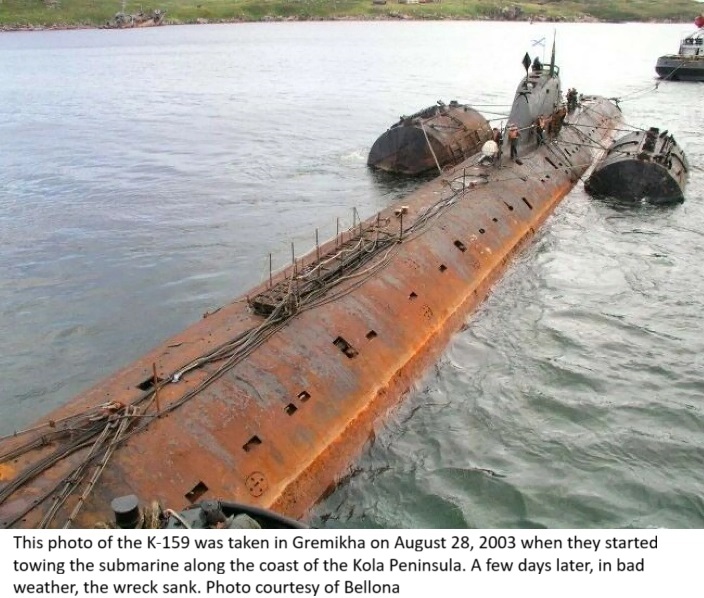
Ivan Khomenko, Oct 20, 2025 , https://united24media.com/latest-news/russia-to-raise-cold-war-nuclear-submarines-from-arctic-whats-hiding-on-the-seabed-12644
Russia plans to begin preparations in 2026 for raising two Soviet-era nuclear submarines that sank in Arctic waters, according to RBC on October 18. The recovery work itself is scheduled to start in 2027.
As RBC reported, the draft federal budget for 2026 and the planned period of 2027–2028 includes allocations for rehabilitating Arctic sea areas contaminated by sunken or submerged radiation-hazardous objects.
These activities are part of Russia’s state program Development of the Atomic Energy and Industrial Complex.
According to the explanatory note cited by RBC, the section titled “Safe Handling of Federal Radioactive Waste and Decommissioning of Nuclear and Radiation-Hazardous Legacy Facilities” earmarks 10.5 billion rubles for 2026, 10.7 billion for 2027, and 10.6 billion for 2028.
The project reportedly focuses on two of the seven sunken Soviet nuclear submarines—K-27 and K-159.
K-27, introduced in 1963, was an experimental submarine equipped with liquid-metal cooled reactors using a lead-bismuth alloy. In 1968, during its third voyage, a reactor accident exposed more than 140 crew members to radiation, killing nine.
The vessel was scuttled in the Kara Sea in 1981 and now lies at a depth of about 75 meters.
K-159 entered service the same year as K-27 and remained operational until 1989. It sank in 2003 in the Barents Sea while being towed for dismantling near Kildin Island, resulting in the deaths of nine crew members. The wreck rests at approximately 250 meters.
Plans to lift these submarines have been discussed for more than a decade but were repeatedly postponed due to the lack of specialized equipment, qualified personnel, and safety concerns. In 2021, Rosatom estimated that raising the vessels would cost around 24.4 billion rubles.
The renewed inclusion of the project in Russia’s 2026 budget marks the first concrete step since 2012 toward removing the radioactive wrecks from the Arctic seabed, though the exact reasons for the timing remain unclear, RBC noted.
Earlier in October, Russia’s Novorossiysk submarine—armed with Kalibr cruise missiles—was forced to abandon its Mediterranean mission and return to Saint Petersburg after a fuel leak disabled its underwater capability.
The incident highlighted Russia’s growing naval limitations following the loss of its Syrian logistics hub in Tartus and Turkey’s blockade of the Bosphorus Strait.
Trump rejects Zelensky on Tomahawks, but Washington’s war lobby refuses to “lose”

By rejecting Tomahawk missiles for Ukraine, Trump once again disappoints Zelensky. To negotiate with Putin, will he also defy the Beltway?
Aaron Maté, Oct 21, 2025
Ukrainian president Volodymyr Zelensky was hoping to leave the White House on Friday with a commitment for long-range US Tomahawk missiles that can strike Russia. Instead, Zelensky once again found himself on the losing end of his strained relationship with President Trump. After musing about providing Tomahawks and even declaring that Ukraine was positioned to recapture all of its territory, Trump rejected Zelensky’s request and urged him to cede the Donbas region to Moscow.
“[Trump] said Putin will destroy you if you don’t agree now,” a source told the Washington Post. “It was pretty much like ‘no, look guys, you can’t possibly win back any territory. … There is nothing we can do to save you. You should try to give diplomacy another chance.’” According to a European official, Trump is now “saying the U.S. needs Tomahawks, and doesn’t want to escalate.”
Trump’s renewed aversion to escalation followed a phone call with Russian President Vladimir Putin, who initiated the conversation to lobby against Zelensky’s request. Putin likely conveyed a stark warning. For Ukraine to fire Tomahawks at Russia, the US military would have to do the job inside Ukrainian territory. And because the Tomahawks are technically nuclear-capable, Russia, by its own military doctrine and the logic of basic deterrence, would have to fire back beyond Ukraine. Given the abundance of US military assets near its borders, Russia would have no shortage of targets……………………………………………………………….(Subscribers only) https://www.aaronmate.net/p/trump-rejects-zelensky-on-tomahawks?utm_source=substack&utm_medium=email
Tireless advocacy delivers victory
A grand coalition and legal support won a hard-fought struggle to stop Holtec’s radioactive waste dump, writes Kevin Kamps
Holtec International and Eddy-Lea Energy Alliance’s (ELEA) joint scheme to construct and operate the world’s largest high-level radioactive waste dump, midway between Hobbs and Carlsbad, has been terminated. This is a hard-won environmental justice (EJ) victory, and brought about by the tireless work of countless Indigenous, as well as grassroots EJ, environmental, and public interest allies for more than a decade.Together they have successfully blocked a dangerous dump scheme and the many thousands of “Mobile Chornobyl” radioactive waste shipments its opening would have launched nationwide.
Beyond Nuclear has fought against this Holtec-ELEA consolidated interim storage facility (CISF) since it was first launched on “Nuclear Fool’s Day” (April 1), 2017, when Holtec’s CEO, Krishna Singh, publicly unveiled the CISF license application just submitted to the U.S. Nuclear Regulatory Commission (NRC), at a Capitol Hill press conference.
In fact, Beyond Nuclear and coalition allies wrote the NRC in October 2016, warning that CISFs — such as Interim Storage Partners’ (ISP) in Texas, some 40-miles east of Holtec’s site — were illegal on their face, and urging the agency to cease and desist from processing such applications. NRC ignored our own warnings and those of others and proceeded with docketing the license applications.
Many years of intense NRC licensing proceedings on both Holtec and ISP’s CISFs, and related environmental reviews, followed. Our coalition engaged at every step, alongside environmental allies in New Mexico, Texas, and across the country. For example, we broke records, in terms of the number (many tens of thousands) of public comments opposing both dumps, at the environmental scoping, as well as the Draft Environmental Impact Statement stages, despite the latter taking place during the Covid-19 pandemic.
The grassroots environmental coalition partners included Don’t Waste Michigan, et al. (Citizens’ Environmental Coalition of New York, Citizens for Alternatives to Chemical Contamination in Michigan, Demanding Nuclear Abolition (formerly Nuclear Issues Study Group) of New Mexico, Nuclear Energy Information Service in Illinois, Public Citizen’s Texas Office, San Luis Obispo Mothers for Peace of California, and Sustainable Energy and Economic Development Coalition in Texas), as well as Sierra Club chapters in New Mexico and Texas. Together, we generated many dozens of contentions in NRC Atomic Safety and Licensing Board proceedings, all of which were rejected, with those rulings rapidly upheld by the NRC Commissioners despite our appeals.
Our coalition, which includes an oil and ranching company, as well as the States of New Mexico and Texas, then appealed to three separate federal courts of appeal across the country. Many years of federal court battles have taken place, all the way up to the U.S. Supreme Court.
Although the Supreme Court ruled last June that Texas and the oil/ranching company lacked standing, the merits of the dump opponents’ cases, including Beyond Nuclear’s, have never had their day in court. Beyond Nuclear is considering further appeals of adverse rulings by the federal courts thus far, in an attempt to address the CISFs’ violation of such laws as the Nuclear Waste Policy Act of 1982, as Amended, as well as the Administrative Procedure Act.
This work could not have been done without yeoman efforts bye our attorneys, Diane Curran of Harmon Curran in Washington, D.C., and Mindy Goldstein, director of the Turner Environmental Law Clinic at Emory University in Atlanta, Georgia. Invaluable legal support also came from Wally Taylor, the Cedar Rapids, Iowa-based attorney who served as legal counsel for Sierra Club, as well as Terry Lodge, the Toledo, Ohio-based attorney who served as legal counsel for Don’t Waste Michigan, et al., in these proceedings.
We benefitted from a number of expert witnesses who served Sierra Club and Don’t Waste Michigan, et al., including: the late Robert Alvarez of Institute for Policy Studies in Washington, D.C.; Dr. James David Ballard, a retired California State University, Northridge professor (see his report, here); Dr. Marvin Resnikoff of Radioactive Waste Management Associates in Vermont; and Dr. Gordon Thompson of Institute for Resource and Security Studies in Massachusetts.
Our fight was significantly enhanced by members and supporters of Beyond Nuclear in New Mexico and Texas — most of them working ranchers and orchardists — who have steadfastly and for many years provided legal standing for our NRC interventions and federal court appeals……………………………………………………………………………………………………………………..
Despite this tremendous environmental justice victory, we must remain vigilant. ELEA has already stated it is seeking a new partner to nuclearize its southeastern New Mexico site, including to do reprocessing. Besides being environmentally ruinous, with large-scale releases of hazardous radioactivity into the air, onto soil, and into surface waters and groundwater, the separation of fissile Plutonium-239 from highly radioactive waste via reprocessing is also a glaring nuclear weapons proliferation risk. Reprocessing is also astronomically expensive, and the public will be left holding the bag.
For its part, Holtec has also stated it will simply carry on seeking “collaborative siting” (formerly called “consent-based siting”) as part of an ongoing DOE initiative. Holtec has recently targeted Arkansas communities. Many times for the past several decades now, low-income and/or Black/Indigenous/People of Color (BIPOC) communities, especially Native American reservations, have been targeted for such schemes by the nuclear industry.
(T-shirt design at left by the late Noel Marquez)
A part of the good news here is that Holtec’s proposed barge shipments of highly radioactive waste on surface waters — such as the Hudson River past New York City; Cape Cod Bay, Massachusetts Bay, and Boston Harbor in Massachusetts; Barnegat Bay and the Jersey Shore into Newark, New Jersey; and Lake Michigan — have been fended off yet again, at least for the time being.
So have the potential road and rail shipments of highly radioactive waste — potential ‘Mobile Chornobyls’ — through most states in the Lower 48. CISFs automatically double transport risks, as irradiated fuel would have to be transferred from interim storage to an eventual permanent disposal site.
Regarding the latter, Holtec and ISP, as well as NRC, outrageously assumed Yucca Mountain, Nevada, on Western Shoshone land, would serve as the permanent repository.
Decades of previous hard work by many hundreds of environmental, EJ, and Indigenous groups across the country fended off the permanent repository at Yucca Mountain, as well as “interim storage” at both Yucca, and the Skull Valley Goshutes Indian Reservation in Utah, another aborted radioactively racist scheme in which Holtec was a partner. Holtec would have provided 4,000 storage/transport containers of dubious structural integrity to PFS on the tiny reservation west of Salt Lake City, had the dump not been stopped. But PFS was blocked, and never broke ground, despite having received an NRC construction and operating license.
As with Private Fuel Storage in Utah, despite NRC’s rubber stamping of the license, we have now also blocked Holtec’s CISF in New Mexico, and hope to do the same at ISP’s CISF in Texas.
For more information about Holtec’s now blocked CISF in New Mexico, and Interim Storage Partners’ CISF in west Texas (just 0.3 miles from the New Mexico state line, and upstream), including our coalition’s resistance to both, see our Centralized Storage website section (2022-present). For earlier posts (2009-2022), see the Centralized Storage section at Beyond Nuclear’s archived website. And see Beyond Nuclear’s educational video, featuring Mustafa Ali (formerly President Obama’s head of EJ at EPA), and grassroots Indigenous and Latinx New Mexican voices, opposing the CISFs, and our series of backgrounders detailing the reasons for our opposition, posted here. https://beyondnuclearinternational.org/2025/10/19/tireless-advocacy-delivers-victory/
AUKUS: Revolving door, spiralling down
Ahead of the launch of a new database on the Australian military-industrial complex, we document the farce that AUKUS has become

Michelle Fahy, Undue Influence, Oct 20, 2025
It is clear to many that AUKUS, in particular its early fulfilment stages, is becoming a debacle. In February, Defence Minister Richard Marles lauded as a ‘very unique’ arrangement Australia’s gift to the United States of $4.7 billion to bolster America’s struggling submarine output, highlighting that such an arrangement hasn’t been seen in other defence pacts globally.
Of course such an arrangement hasn’t been seen elsewhere! Most other countries wouldn’t agree to hand over this massive sum without ensuring there were provisions for a refund should the promised submarines fail to arrive.

In an inept performance in Senate Estimates in June 2024, Vice Admiral Jonathan Mead, head of the Australian Submarine Agency, woodenly refused to answer a straightforward question from Greens’ Senator David Shoebridge about whether the agreement Australia has struck with the US contains a clawback provision should the promised submarines fail to be supplied.
Mead’s performance, as recorded in Hansard, is mordantly comical:

It is thus obvious that Australia has no contractual way of recovering its money should the current or a future US President block the transfer of the submarines, as the US President is entitled to do under US legislation.
Australia is certainly ‘very unique’ in its willingness to part with almost $10 billion (the UK is getting a similar amount) in public funds with no strings attached.
Australia made the first payment of $800 million to the US in February and quietly transferred the second payment, a further $800 million, in July. It has committed to paying a total of US$2 billion ($3 billion) by the end of 2025, with the remainder to be paid over the decade to 2035‒36.
Under the AUKUS deal, both major political parties have committed to spending vast public resources with no consultation and minimal transparency and accountability.
Even though the Australian National Audit Office has exposed, in report after report, serious probity breaches in defence procurement, including unethical conduct between global weapons companies and the Australian government, these transgressions are routinely ignored. The weapons deals continue regardless.
The big winners from AUKUS so far have been nuclear submarine manufacturers in the United States and the United Kingdom. Australia has committed to providing almost $10 billion to boost the output of these companies, helping secure jobs for workers in America and the United Kingdom.
As there are no clawback provisions in either of these agreements, should President Trump ditch AUKUS, or if the submarine manufacturing capacity in the US and UK doesn’t sufficiently increase, Australian taxpayers will be picking up another multibillion-dollar defence tab with nothing to show for it. We’ve already shelled out $3.4 billion for no submarines, following former PM Scott Morrison’s shredding of the pre-AUKUS French submarine contract.
This is far from the only example of waste, misdirection and incompetence in Australia’s dealings with the global arms industry. Take the Albanese government’s engagement with global arms giant Thales. In October last year, the government signed up Thales to a further munitions manufacturing contract and a ‘strategic partnership’ in the new domestic missile-making endeavour, the Guided Weapons and Explosive Ordnance (GWEO) enterprise.
The new deal with Thales was struck despite the fact that Thales is currently being investigated by four countries for widespread criminal activity in three separate corruption probes. …………………….https://undueinfluence.substack.com/p/nothing-to-see-here-says-australia………………………………………… The Thales example illustrates how a key democratic accountability mechanism, the National Audit Office and its reports, is routinely ignored.
…………………………………………………How is it that such imbroglios occur again and again? Australian governments are highly susceptible to the ‘revolving door’ process in which politicians, the military and public servants move effortlessly between government, lobbying and the industry itself.
In what follows, no suggestion is being made of unlawful activity by any person named, nor that any of the appointments noted was unlawful.
The problem for Australia is not one of legality but of the perfectly legal influence of industry insiders within government, the lack of transparency, and the absence of management of the ‘revolving door’.
The revolving door
The ‘revolving door’ describes the movement of public officials into related private roles, and industry executives into related public roles. It is a widespread problem that undermines democracy, yet in Australia it remains unmonitored and unpoliced.
A large number of Australia’s senior government ministers and their staffers, military officers, and defence department officials move through the revolving door into paid roles with the weapons industry. Such moves are not illegal but they require a robust management framework—with rules that are enforced—to mitigate the inherent conflicts of interest. Australia’s feeble attempts at managing the revolving door have been completely ineffective
……………………………………………………………………………………………………………..In the lobby
Numerous former senior politicians are now working as lobbyists for the weapons industry. Examples include: Liberals Christopher Pyne (Pyne and Partners), Joe Hockey (Bondi Partners), Arthur Sinodinos (The Asia Group) and David Johnston (TG Public Affairs); and Labor’s Kim Beazley (TG Public Affairs), Joel Fitzgibbon (CMAX Advisory), Stephen Conroy (TG Public Affairs) and Mark McGowan (Bondi Partners).
There are also plenty of former senior military officers pulling strings on behalf of weapons companies too. Examples are listed below.
The federal register of lobbyists provides some transparency, but does not cover the majority of people who lobby politicians. The register applies only to third-party lobbyists. These people operate as paid professionals, either individually or as an employee of a lobbying firm, on behalf of clients. Third party lobbyists make up just 20% of all lobbyists. The remaining 80% include, amongst others, company CEOs and people employed by corporations as ‘government relations’ advisers. This enables employees of major weapons companies to lobby politicians easily and legally, with zero transparency.
Reverse cycle: private to public
The government’s engagement with UK weapons giant BAE Systems’ local subsidiary best illustrates how this works.
The government gave former senior BAE Systems executives influential behind-the-scenes roles both before and during the tender process for Australia’s largest ever surface warship procurement, the $46 billion Hunter class frigates, a contract BAE went on to win. Few of these roles were publicly acknowledged. https://undueinfluence.substack.com/p/sinking-billions-revolving-doors
BAE Systems was awarded the frigates contract by the Turnbull government in mid-2018. The names of the people appointed to an expert advisory panel to oversee the tender evaluation process were not made public. Here’s why: serious conflicts of interest…………………………………………………………………………………………………..
Lockheed Martin locks on target
Israel’s genocidal war on Gaza has put the issue of the extensive influence on the Australian government of Lockheed Martin—the world’s largest arms manufacturer—under the spotlight…………https://undueinfluence.substack.com/p/buck-passing-inside-the-murky-arms
Lockheed Martin utilises the revolving door heavily in the US. Until recently, it had openly adopted the same strategy in Australia. From October 2013 until the end of 2021, the board of Lockheed Martin Australia boasted multiple former senior Australian public officials: at least two at any one time, more often three, and even four during one 20-month period.
They included a roll call of defence heavies from past decades,………………………………………………………………………………………
The UN Special Rapporteur on the occupied Palestinian territory, Francesca Albanese, released a report in July addressing the ‘economy of genocide’ in which she makes special note of Lockheed Martin’s F-35 program…………………………….
Australia’s refusal to cease the supply of parts and components into Lockheed Martin’s F-35 global supply chain places the nation at risk of being found complicit in Israel’s genocide.
Complicity in the world’s worst international crime is just one of the democracy-undermining consequences of Australia’s deep enmeshment in the US and broader Western military industrial complex.
This feature article started life as a talk to Australia’s Online Quaker Meeting mid-year. I later expanded it for ARENA Quarterly’s Spring 2025 issue, which was delivered to bookshops last week ($20). It is also online at Arena. https://undueinfluence.substack.com/p/aukus-revolving-door-spiralling-down?utm_source=post-email-title&publication_id=297295&post_id=176534719&utm_campaign=email-post-title&isFreemail=true&r=1ise1&triedRedirect=true&utm_medium=email
Moscow puts money on the table to raise nuclear subs from Arctic seabed
Both the K-27 and the K-159 represent ticking radioactive time-bombs for the Arctic marine environment.
The Government’s draft budget for 2026, and the planned budget for 2027-2028, include funding to lift the K-27 and K-159, two wrecked submarines that are resting on the seabed in the Barents Sea and Kara Sea.
Thomas Nilsen, 20 October 2025 –https://www.thebarentsobserver.com/news/moscow-puts-money-on-the-table-to-raise-nuclear-subs-from-arctic-seabed/439056
It is the state nuclear corporation Rosatom that told news outlet RBK about the plans to finally do something about the ticking radioactive time-bombs.
“The draft federal budget for 2026 and the 2027-2028 planning period includes funding for the rehabilitation of Arctic seas from sunken and dumped radiation-hazardous objects, beginning in 2027. Preparations for the planned work will begin in 2026,” the press service of Rosatom said.
An explanatory note to Rosatom’s budget post for disposal of nuclear and radiation-hazardous nuclear legacy sites details how 30 billion rubles for the three-year period are earmarked for planning and lifting of the Cold War era submarines left on the Arctic seabed.
The K-27 and the K-159 are the most urgent to raise and bring to shore for safe scrapping.
While the K-27 was dumped on purpose in 1982 in the Stepovoy Bay on the Kara Sea side of Novaya Zemlya, the sinking of the K-159 in the Barents Sea was an accident.
Lifting a nuclear submarine from the seabed is nothing new. It is difficult, but doable.
In 2002, the Dutch salvage company Mammoet managed to raise the ill-fated Kursk submarine from the Barents Sea. A special barge was built with wires attached underneath. The wreck of the Kursk was safely brought in and placed in a floating dock where the decommissioning took place.
Aleksandr Nikitin, a nuclear safety expert with the Bellona Foundation in Oslo, said to the Barents Observer that it is too early to conclude that the lifting actually will happen, or whether this is a preliminary plan that needs to be developed before concluding.
“As far as I understand, there’s no concrete plan,” Nikitin said.
Before Russia’s full-scale war against Ukraine, Aleksandr Nikitin was member of Rosatom’s Public Chamber, a body that worked with non-governmental organisations to foster transparency and civic engagement on nuclear safety related issues in Russia.
Nikitin believes there still is infrastructure on the Kola Peninsula to deal with the two submarines if they are lifted from the seabed.
“Rosatom is currently trying not to destroy what the French built in Gremikha, hoping to dismantle the K-27 there if it’s raised. This is a special facility where this nuclear submarine with a liquid metal coolant reactor can be dismantled,” he explained.
“As for the K-159, it could be dismantled, for example, at Nerpa.”
Nerpa is a shipyard north of Murmansk that decommissioned several Cold War submarines at the time when Russia maintained cooperation with European partners, including Norway.
Ticking radioactive time-bombs
Both the K-27 and the K-159 represent ticking radioactive time-bombs for the Arctic marine environment.
The K-159 is a November-class submarine that sank in late August 2003 while being towed in bad weather from the closed naval base of Gremikha on the eastern shores of the Kola Peninsula towards the Nerpa shipyard north of Murmansk.
Researchers have since then monitored the wreck, fearing leakages of radioactivity from the two old nuclear reactors onboard could contaminate the important fishing grounds in the Barents Sea. A joint Norwegian-Russian expedition examined the site in 2014 and concluded that no leakage has so far occurred from the reactors to the surrounding marine environment.
However, the bad shape of the hull could eventually lead to radionuclides leaking out.
The two onboard reactors contain about 800 kilograms of spent nuclear fuel, with an estimated 5,3 GBq of radionuclides.
A modelling study by the Norwegian Institute of Marine Research said that a pulse discharge of the entire Cesium-137 inventory from the two reactors could increase concentrations in cod in the eastern part of the Barents Sea up to 100 times current levels for a two-year period after the discharge. While a Cs-137 increase of 100 times in cod sounds dramatic, the levels would still be below international guidelines. But that increase could still make it difficult to market the affected fish.
The K-27, the other submarine that it is urgent to lift, was on purpose dumped in the Kara Sea in 1982. In September 2021, divers from the Centre for Underwater Research of the Russian Geographical Society conducted a survey of the submarine’s hull. Metal pieces were cut free, the thickness of the hull was measured, along with other inspections of the submarine that has been corroding on the seabed for more than 40 years.
In aditionl to the K-27 and K-159, there are also the other dumped reactors in the Kara Sea, including from the K-11, K-19 and K-140, as well as spent nuclear fuel from an older reactor serving the icebreaker Lenin.
In Soviet times, thousands of containers with solid radioactive waste from both the civilian icebreaker fleet and the military Navy were dumped at different locations in the Kara Sea.
Straight from the horses’ mouths: Nuclear is a dead end.

By Ben Kritz, October 2, 2025, https://www.manilatimes.net/2025/10/02/opinion/columns/straight-fromthe-horses-mouths-nuclear-is-a-dead-end/2193114
ONE of the most authoritative and anticipated reports about the nuclear energy sector is the annual World Nuclear Industry Status Report (WNISR), which for close to 20 years has tracked the progress, or lack thereof, of the nuclear industry. It is, at least in my opinion, a better source for detailed information on the nuclear sector than the annual reports of the International Atomic Energy Agency (IAEA), because while the IAEA does provide completely reliable and detailed information, it provides a bit less than does the WNISR, and has an obvious positive bias toward nuclear energy.
The WNISR by contrast is completely neutral; even the bit of commentary that prefaces this year’s 589 pages of data and status updates confines itself to simply acknowledging the current reality of nuclear policy and activity, and leaves it to the audience to draw their own conclusions.
There are a few pieces of good news for nuclear enthusiasts in the 2025 WNISR. Nuclear power generation rose to 2,677 terawatt-hours in 2024, and generation capacity reached 369.4 gigawatts (GW). Those are both record highs, but on the other hand, they are both less than 1 percent higher than the previous records, and so are really not overwhelming evidence of a growing sector. One indication of that is that nuclear’s share of generating capacity declined slightly (by less than 1 percent) year on year, and is now at 9.0 percent. That is only about half its historic peak of 17.5 percent in 1996.
Other factoids that might encourage nuclear proponents are that there are three countries building their first nuclear plants — Bangladesh, Egypt and Turkey — all of which are being constructed and largely financed by Russia’s Rosatom. The number of reactor startups was higher than the number of shutdowns in 2024. Seven plants were brought online — three in China, and one each in France, the United Arab Emirates, the United States and India, while four were closed, two in Canada, and one each in Russia and Taiwan. At the end of 2024, there were 409 reactors operating worldwide (that number has since gone down by one this year), which were the same number as at the end of 2023. The number of operating reactors peaked in 2002 with 438, operated in 32 countries; since then, the sector has slowly declined. There are only 31 countries as of now, and the number of reactor closures across the past 20-odd years has been slightly higher than the number of startups.
For example, the WNISR notes that from 2005 to 2024, there were 104 startups and 101 closures, which might seem like a modest gain. But any nuclear expansion is solely attributable to China; in that time period, there were 51 startups and no closures in China. In the rest of the world, there was a net decline of 48 in the number of operating reactors, with a corresponding decline in generating capacity of 27 GW.
China has big numbers in everything because China is very big; in its broader energy mix, nuclear power is at best an afterthought, and is declining even there. Nuclear’s share in the total energy mix in China fell for the third straight year in 2024, down to 4.5 percent. While nuclear capacity did increase by 3.5 GW from a year earlier, it was overwhelmed by the growth in solar capacity, which increased by 278 GW. In China, since 2010, the output of nuclear has increased by a factor of six. But on the other hand, the output of solar increased by a factor of more than 800, and wind by a factor of 20. Renewables’ share of the energy mix increased from 18.7 percent in 2010 to 33.7 percent in 2024, or in other words, outpaced nuclear by 7.5 times.
Prospects for growth
The simple answer is that there aren’t any; some incremental gains here and there may be possible, but the idea that nuclear is the go-to solution for decarbonization is not at all supported by real-world trends. The first problem is that existing nuclear power is quickly reaching the end of its useful life. The WNISR notes that the average age of the presently operating power reactors has been increasing since 1984 and stands at 32.4 years as of mid-2025. The average age at closure of the 28 reactors permanently shut down between 2020 and 2024 was 43.2 years. The nuclear industry is going to have to expend increasing effort and resources in senior care for its aging plants just to maintain the status quo of stagnation and gradual slow decline.
Investment figures bear that out. Over the past decade, the WNISR notes that nuclear investment has been essentially stagnant, although not nonexistent; in the same time period, investment in renewables has increased by 21 times.
Apart from the three newcomers (Egypt, Bangladesh and Turkey) that are actually building reactors, the WNISR identifies 12 others with prospects for nuclear power sometime in the future, four of which are in Africa. It may come as a discouraging surprise to our own Department of Energy and nuclear cheerleaders here that the Philippines is not even mentioned.
In fact, the name “Philippines” appears exactly once in the 589 pages of the report, on a chart listing countries that have abandoned or suspended reactor constructions since 1970. But to be fair, the recent passage of the Philippine Nuclear Safety Act and its subsequent creation of an actual regulating body are recent developments, so the 2026 WNISR will probably include it.
None of the other countries noted are even close to beginning construction, or even seriously considering it. In fact, the World Nuclear Association, which is definitely an optimistic source of information, in a Sept. 19 report concluded that only one additional country besides those already building reactors — Poland — is likely to join the nuclear energy community within the next 15 years.
The WNISR’s overall conclusion kind of says it all: “2024 has seen an unprecedented boost in solar and battery capacity expansion driven by continuous significant cost decline. As energy markets are rapidly evolving, there are no signs of vigorous nuclear construction and the slow decline of nuclear power’s role in electricity generation continues.”
The Philippines’ nuclear aspirations, and likely those of any other country anywhere else, are clearly swimming against the tide. That does not make nuclear development impossible, but it almost certainly means that any development that is achieved will have much less impact than anticipated. And, nuclear being what it is, that impact will cost more and take longer to achieve than expected.
The broad picture painted by the WNISR brings us back to the conclusion of the Cato Institute assessment I discussed in the first part of this column on Tuesday, and bear in mind this is coming from a deeply conservative source: “The problem is not so much that money will be wasted on large numbers of uneconomic facilities. Rather, it is the opportunity costs of the time and human resources that are consumed by nuclear power and not available to other, quicker, more cost-effective and less financially risky options. We appear now to be facing serious risks from climate change, and there will not be a second chance if we fail to tackle it because too many resources are being consumed by an option — new nuclear — that will not work.”
Trump-Zelensky meeting was ‘bad’ – Axios.

18 Oct, 2025 , https://www.rt.com/news/626650-trump-zelensky-meeting-bad/
The Ukrainian leader left Washington without promises on Tomahawk missiles, the outlet’s sources say
Friday’s White House meeting between US President Donald Trump and Vladimir Zelensky was “tense,” with the Ukrainian leader failing to secure deliveries of long-range Tomahawk missiles, Axios has reported, citing sources.
Trump told Zelensky he does not plan to provide Tomahawks “at least for now,” according to two people briefed on the meeting. The talks lasted around two and a half hours and were described by one source as “not easy,” and by another as “bad.” At times, the discussion “got a bit emotional,” the outlet said.
”Nobody shouted, but Trump was tough,” one source told Axios. The session ended abruptly when Trump reportedly said, “I think we’re done. Let’s see what happens next week,” possibly referring to upcoming Russia-US talks.
Speaking to reporters afterwards, Zelensky declined to answer questions about Tomahawk deliveries, only saying the US “does not want escalation.”
Trump said “it’s not easy” for Washington to provide the missiles because it needs to maintain its own supplies for the nation’s own defense. He also acknowledged that allowing Kiev to conduct strikes deep into Russia could lead to an escalation.
Moscow has warned against supplying the missiles to Ukraine, arguing they would “not change the situation on the battlefield” but would “severely undermine the prospects of a peaceful settlement” and harm Russia-US relations.
Zelensky has sought Tomahawks – which have a maximum range of 2,500km (1,550 miles) – for weeks, insisting that Ukraine would only use them against military targets to increase pressure on Russia and move toward a peace deal. However, the Ukrainian leader has threatened Russia with blackouts in border regions and Moscow. Russian officials also suggested that Kiev is plotting to use the missiles for “terrorist attacks.”
The Trump-Zelensky meeting followed a phone call between Trump and Putin, after which both sides signaled plans for a summit in Budapest, Hungary, in the near future.
Trump: “Thank you so much, Bibi. Excellent work.”

Manlio Dinucci, Voltairenet.org, Sat, 18 Oct 2025, https://www.sott.net/article/502465-Trump-Thank-you-so-much-Bibi-Excellent-work
President Donald Trump,like all his predecessors, has continued the US policy of military support for Israel. But he has broken with the revisionist Zionists. Thus, he lavishly congratulated Benjamin Netanyahu, but forced him to accept his peace plan.
President Trump said in his speech to the Israeli parliament:
“I want to express my gratitude to a man of exceptional courage and patriotism. There is only one, Prime Minister Benjamin Netanyahu. Bibi, please stand. You are a very popular man. You know why? Because you know how to win. Thank you so much, Bibi. Great job. I think, as you said, Bibi, peace is achieved through strength.
“And that’s really the point. The United States has the largest and most powerful military that the history of the world has ever seen. I can tell you, we have weapons that no one could have ever imagined. We produce the best weapons in the world, and we have an awful lot of them. And, frankly, we supplied many of them to Israel. Bibi kept calling me, ‘Can you get me this weapon? This one, and this one?'” Some I’d never heard of, Bibi, and yet I was the one producing them. But we would have gotten them for you. And they’re the best. You used them well. You need someone who knows how to use them, and you obviously used them very well. So well that Israel became strong and powerful, which in the end led to peace.”
Official data confirms that the United States has provided Israel with at least $21.7 billion in military aid since the start of the Gaza war on October 7, 2023. In addition, both the Biden and Trump administrations have agreements to sell Israel weapons and military services worth tens of billions of dollars more in the coming years. Between October 2023 and May 2025, Israel received 940 ships and cargo planes loaded with weapons from the United States, the Israeli Defense Minister said on May 27, 2025.
The Trump administration has accelerated the supply of weapons to Israel, including 2,000-pound bombs (about one ton) that Israel has used to destroy buildings, hospitals, water infrastructure, and other civilian targets in Gaza. In February 2025, the Trump administration’s State Department notified Congress of three arms sales to Israel: 35,529 Mk-84 and BLU 117 2,000-pound bombs and 4,000 I-2000 penetrator warheads for $2 billion; 5,000 1,000-pound bombs and JDAM guidance kits for $675 million; and Caterpillar D9 bulldozers for $295 million.
In March, Secretary of State Marco Rubio announced that since Trump took office on January 20, 2025, his administration has approved nearly $12 billion in major arms sales to Israel. Now, the Trump administration is planning new arms sales to Israel worth $6 billion. These include 30 AH-64 Apache helicopters worth $3.8 billion, nearly doubling Israel’s current fleet of military helicopters, and 3,250 assault vehicles costing $1.9 billion.
In addition, the United States has supplied significant arms to Israel, Germany, and Italy. Germany has provided frigates and catfish, ammunition, and military services. Italy has supplied helicopters and cannons for Israeli warships. Italy, moreover, produces components for the US F-35 fighter jet in Cameri (Piedmont), including for other countries that possess this fighter, including Israel, which also used it to bomb Gaza. Added to this is the fact that the Trapani-Birgi air base in Sicily will soon become the first international training center for US F-35 fighter pilots outside the United States. The new center will train pilots not only from Italy, but also from allied countries that use the F-35 fighter jet, including Israeli ones.
1 This Month





PLEASE OPPOSE HR 8255 AND S.3639 – bills would accelerate satellite deployment, with no environmental review or safeguards – https://ncstd5li.quorum.us/campaign/169331/
To see nuclear-related stories in greater depth and intensity – go to https://nuclearinformation.wordpress.com
-
Archives
- October 2026 (40)
- September 2026 (339)
- August 2026 (330)
- July 2026 (355)
- June 2026 (287)
- May 2026 (306)
- April 2026 (356)
- March 2026 (251)
- February 2026 (267)
- January 2026 (308)
- December 2025 (358)
- November 2025 (359)
-
Categories
- 1
- 1 NUCLEAR ISSUES
- business and costs
- climate change
- culture and arts
- ENERGY
- environment
- health
- history
- indigenous issues
- Legal
- marketing of nuclear
- media
- opposition to nuclear
- PERSONAL STORIES
- politics
- politics international
- Religion and ethics
- safety
- secrets,lies and civil liberties
- spinbuster
- technology
- Uranium
- wastes
- weapons and war
- Women
- 2 WORLD
- ACTION
- AFRICA
- Atrocities
- AUSTRALIA
- Christina's notes
- Christina's themes
- culture and arts
- Events
- Fuk 2022
- Fuk 2023
- Fukushima 2017
- Fukushima 2018
- fukushima 2019
- Fukushima 2020
- Fukushima 2021
- general
- global warming
- Humour (God we need it)
- Nuclear
- RARE EARTHS
- Reference
- resources – print
- Resources -audiovicual
- Weekly Newsletter
- World
- World Nuclear
- YouTube
-
RSS
Entries RSS
Comments RSS

