Fire at Windscale piles
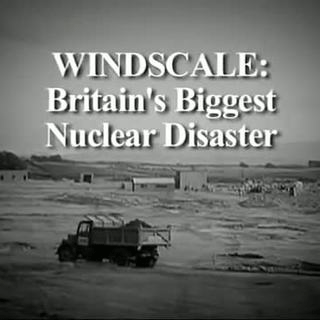
Does Britain Really Ned Nuclear Power? by Ian Fairlea, beyondnuclearinternational
“…………………………………………………………….In 1957, a major fire occurred at Windscale nuclear site (what is now known as Sellafield). The effects of the Windscale fire were hushed up at the time but it is now recognised as one of the world’s worst nuclear accidents. An official statement in 1957 said: ‘There was not a large amount of radiation released. The amount was not hazardous and in fact it was carried out to sea by the wind.’ The truth, kept hidden for over thirty years, was that a large quantity of hazardous radioactivity was blown east and south east, across most of England.
After years of accidents and leaks, several of them serious, and regular cover-up attempts by both the management and government, it was decided to change the plant’s name in 1981 to Sellafield, presumably in the hope that the public would forget about Windscale and the accident.
When, in 1983, Greenpeace divers discovered highly radioactive waste being discharged into the sea through a pipeline at Sellafield and tried to block it, British Nuclear Fuels Ltd (BNFL), who then operated the site, repeatedly took Greenpeace to the High Court to try to stop them and to sequestrate its assets. The first generation of British Magnox nuclear power stations were all secretly designed with the dual purpose of plutonium and electricity production in mind.
Some people think that because plutonium is no longer needed by the UK to make weapons as it already has huge stocks of weapons grade plutonium, there no longer is any connection between nuclear weapons and nuclear energy. This is incorrect: they remain inextricably linked. For example:
- All the processes at the front of the nuclear fuel cycle, i.e. uranium ore mining, uranium ore milling, uranium ore refining, and U-235 enrichment are still used for both power and military purposes.
- The UK factory at Capenhurst that makes nuclear fuel for reactors also makes nuclear fuel for nuclear (Trident and hunter-killer) submarines.
- Nuclear reactors are used to create tritium (the radioactive isotope of hydrogen) necessary for nuclear weapons.
………………………………………………………………………………………………… https://beyondnuclearinternational.org/2025/12/14/does-britain-really-need-nuclear-power/
Trump’s Empire of Hubris and Thuggery

The president’s latest National Security Strategy memorandum treats the freedom to coerce others as the essence of US sovereignty. It is an ominous document that will—if allowed to stand—come back to haunt the United States.
Jeffrey D. Sachs, December 13, 2025, https://www.commondreams.org/opinion/trump-national-security-strategy-memo
The 2025 National Security Strategy (NSS) recently released by President Donald Trump presents itself as a blueprint for renewed American strength. It is dangerously misconceived in four ways.
First, the NSS is anchored in grandiosity: the belief that the United States enjoys unmatched supremacy in every key dimension of power. Second, it is based on a starkly Machiavellian view of the world, treating other nations as instruments to be manipulated for American advantage. Third, it rests on a naïve nationalism that dismisses international law and institutions as encumbrances on US sovereignty rather than as frameworks that enhance US and global security together.
Fourth, it signals a thuggery in Trump’s use of the CIA and military. Within days of the NSS’s publication, the US brazenly seized a tanker carrying Venezuelan oil on the high seas—on the flimsy grounds that the vessel had previously violated US sanctions against Iran.
The seizure was not a defensive measure to avert an imminent threat. Nor is it remotely legal to seize vessels on the high seas because of unilateral US sanctions. Only the UN Security Council has such authority. Instead, the seizure is an illegal act designed to force regime change in Venezuela. It follows Trump’s declaration that he has directed the CIA to carry out covert operations inside Venezuela to destabilize the regime.
American security will not be strengthened by acting like a bully. It will be weakened—structurally, morally, and strategically. A great power that frightens its allies, coerces its neighbors, and disregards international rules ultimately isolates itself.
The NSS, in other words, is not just an exercise in hubris on paper. It is rapidly being translated into brazen practice.
A Glimmer of Realism, Then a Lurch into Hubris
To be fair, the NSS contains moments of long-overdue realism. It implicitly concedes that the United States cannot and should not attempt to dominate the entire world, and it correctly recognizes that some allies have dragged Washington into costly wars of choice that were not in America’s true interests. It also steps back—at least rhetorically—from an all-consuming great-power crusade. The strategy rejects the fantasy that the United States can or should impose a universal political order.
But the modesty is short-lived. The NSS quickly reasserts that America possesses the “world’s single largest and most innovative economy,” “the world’s leading financial system,” and “the world’s most advanced and most profitable technology sector,” all backed by “the world’s most powerful and capable military.” These claims serve not simply as patriotic affirmations, but as a justification for using American dominance to impose terms on others. Smaller countries, it seems, will bear the brunt of this hubris, since the US cannot defeat the other great powers, not least because they are nuclear-armed.
Naked Machiavellianism in Doctrine
The NSS’s grandiosity is welded to a naked Machiavellianism. The question it asks is not how the United States and other countries can cooperate for mutual benefit, but how American leverage—over markets, finance, technology, and security—can be applied to extract maximal concessions from other countries.
This is most pronounced in the NSS discussion of the Western Hemisphere section, which declares a “Trump Corollary” to the Monroe Doctrine. The United States, the NSS declares, will ensure that Latin America “remains free of hostile foreign incursion or ownership of key assets,” and alliances and aid will be conditioned on “winding down adversarial outside influence.” That “influence” clearly refers to Chinese investment, infrastructure, and lending.
The NSS is explicit: US agreements with countries “that depend on us most and therefore over which we have the most leverage” must result in sole-source contracts for American firms. US policy should “make every effort to push out foreign companies” that build infrastructure in the region, and the US should reshape multilateral development institutions, such as the World Bank, so that they “serve American interests.”
Latin American governments, many of whom trade extensively with both the United States and China, are effectively being told: you must deal with us, not China—or face the consequences.
Such a strategy is strategically naive. China is the main trading partner for most of the world, including many countries in the Western hemisphere. The US will be unable to compel Latin American nations to expel Chinese firms, but will gravely damage US diplomacy in the attempt.
Thuggery So Brazen Even Close Allies Are Alarmed
The NSS proclaims a doctrine of “sovereignty and respect,” yet its behavior has already reduced that principle to sovereignty for the US, vulnerability for the rest. What makes the emerging doctrine even more extraordinary is that it is now frightening not only small states in Latin America, but even the United States’ closest allies in Europe.
In a remarkable development, Denmark—one of America’s most loyal NATO partners—has openly declared the United States a potential threat to Danish national security. Danish defense planners have stated publicly that Washington under Trump cannot be assumed to respect the Kingdom of Denmark’s sovereignty over Greenland, and that a coercive US attempt to seize the island is a contingency for which Denmark must now plan.
This is astonishing on several levels. Greenland is already host to the US Thule Air Base and firmly within the Western security system. Denmark is not anti-American, nor is it seeking to provoke Washington. It is simply responding rationally to a world in which the United States has begun to behave unpredictably—even toward its supposed friends.
That Copenhagen feels compelled to contemplate defensive measures against Washington speaks volumes. It suggests that the legitimacy of the US-led security architecture is eroding from within. If even Denmark believes it must hedge against the United States, the problem is no longer one of Latin America’s vulnerability. It is a systemic crisis of confidence among nations that once saw the US as the guarantor of stability but now view it as a possible or likely aggressor.
In short, the NSS seems to channel the energy previously devoted to great-power confrontation into bullying of smaller states. If America seems to be a bit less inclined to launch trillion-dollar wars abroad, it is more inclined to weaponize sanctions, financial coercion, asset seizures, and theft on the high seas.
The Missing Pillar: Law, Reciprocity, and Decency
Perhaps the deepest flaw of the NSS is what it omits: a commitment to international law, reciprocity, and basic decency as foundations of American security.
The NSS regards global governance structures as obstacles to US action. It dismisses climate cooperation as “ideology,” and indeed a “hoax” according to Trump’s recent speech at the UN. It downplays the UN Charter and envisions international institutions primarily as instruments to be bent toward American preferences. Yet it is precisely legal frameworks, treaties, and predictable rules that have historically protected American interests.
The founders of the United States understood this clearly. Following the American War of Independence, thirteen newly sovereign states soon adopted a constitution to pool key powers—over taxation, defense, and diplomacy—not to weaken the states’ sovereignty, but to secure it by creating the US Federal Government. The post-WWII foreign policy of the United States government did the same through the UN, the Bretton Woods institutions, the World Trade Organization, and arms-control agreements.
The Trump NSS now reverses that logic. It treats the freedom to coerce others as the essence of sovereignty. From that perspective, the Venezuelan tanker seizure and Denmark’s anxieties are manifestations of the new policy.
Athens, Melos, and Washington
Such hubris will come back to haunt the United States. The ancient Greek historian Thucydides records that when imperial Athens confronted the small island of Melos in 416 BC, the Athenians declared that “the strong do what they can and the weak suffer what they must.” Yet Athens’ hubris was also its undoing. Twelve years later, in 404 BC, Athens fell to Sparta. Athenian arrogance, overreach, and contempt for smaller states helped galvanize the alliance that ultimately brought it down.
The 2025 NSS speaks in a similar arrogant register. It is a doctrine of power over law, coercion over consent, and dominance over diplomacy. American security will not be strengthened by acting like a bully. It will be weakened—structurally, morally, and strategically. A great power that frightens its allies, coerces its neighbors, and disregards international rules ultimately isolates itself.
America’s national security strategy should be based on wholly different premises: acceptance of a plural world; recognition that sovereignty is strengthened, not diminished, through international law; acknowledgment that global cooperation on climate, health, and technology is indispensable; and understanding that America’s global influence depends more on persuasion than coercion.
More than 200 environmental groups demand halt to new US datacenters.

Congress urged to act against energy-hungry facilities blamed for increasing bills and worsening climate crisis
Oliver Milman, Guardian 8 December 25
A coalition of more than 230 environmental groups has demanded a national moratorium on new datacenters in the US, the latest salvo in a growing backlash to a booming artificial intelligence industry that has been blamed for escalating electricity bills and worsening the climate crisis.
The green groups, including Greenpeace, Friends of the Earth, Food & Water Watch and dozens of local organizations, have urged members of Congress to halt the proliferation of energy-hungry datacenters, accusing them of causing planet-heating emissions, sucking up vast amounts of water and exacerbating electricity bill increases that have hit Americans this year.
“The rapid, largely unregulated rise of datacenters to fuel the AI and crypto frenzy is disrupting communities across the country and threatening Americans’ economic, environmental, climate and water security,” the letter states, adding that approval of new data centers should be paused until new regulations are put in place.
The push comes amid a growing revolt against moves by companies such as Meta, Google and Open AI to plow hundreds of billions of dollars into new datacenters, primarily to meet the huge computing demands of AI. At least 16 datacenter projects, worth a combined $64bn, have been blocked or delayed due to local opposition to rising electricity costs. The facilities’ need for huge amounts of water to cool down equipment has also proved controversial, particularly in drier areas where supplies are scarce.
These seemingly parochial concerns have now multiplied to become a potent political force, helping propel Democrats to a series of emphatic recent electoral successes in governor elections in Virginia and New Jersey as well as a stunning upset win in a special public service commission poll in Georgia, with candidates campaigning on lowering power bill costs and curbing datacenters.
This threatens to be a major headache for Donald Trump, who has aggressively pushed the growth of AI but also called himself the “affordability president” and vowed to cut energy costs in half in his first year………………………………………………………………………………………….
it is the growth of datacenters to service AI – with electricity consumption set to nearly triple over the next decade, equivalent to powering 190m new homes – that is the focus of ire for voters as well as an unlikely sweep of politicians ranging from Bernie Sanders on the left to Marjorie Taylor Greene on the far right…………………………………………………………………………………………….https://www.theguardian.com/us-news/2025/dec/08/us-data-centers
University of Michigan report: History shows advanced nuclear likely to have predictable negative consequences
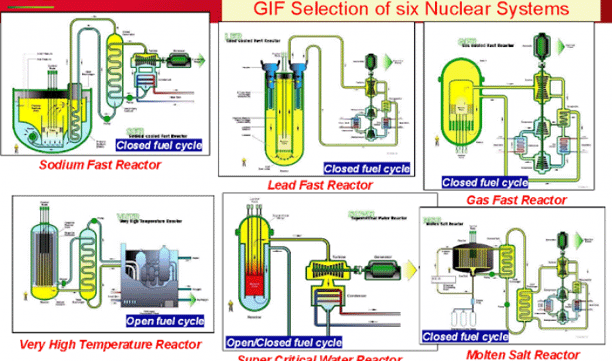
A new University of Michigan report says that despite its promise as a clean, cheap energy source, advanced nuclear technologies could end up fueling—or exacerbating—social and environmental problems.
Michigan Public | By Sarah Cwiek December 14, 2025
The report, titled The Reactor Around the Corner: Understanding Advanced Nuclear Energy Futures, looks at historical examples of what happened when major new technologies touted as game-changers were introduced. It concludes that without “robust governance frameworks” in place, next-generation nuclear is likely to reinforce or even create problems that technology alone can’t fix.
According to the report, advanced nuclear reactors generally use novel fuel types for power generation, higher uranium enrichment levels, and alternative coolants. The most common and increasingly popular form of advanced nuclear reactors are small modular reactors, or SMRs.
SMRs are slightly smaller than conventional nuclear reactors, producing about a third of the electricity output of a conventional reactor. They’re attractive to governments and power providers due to their generally lower upfront construction costs and shorter construction times, and are often seen as a safer alternative to larger traditional nuclear infrastructure. However, the report notes that “the technology is at an early stage, and it is still unclear whether the SMR industry can fulfill its promises.”
Nonetheless, many SMR projects are either planned or about to come online, said Shobita Parthasarathy, a UM professor of public policy specializing in the history of technology, and one of the report’s authors. The planned reactors include two SMRs at the site of West Michigan’s Palisades nuclear plant — the first in the country to be revived after being decommissioned. Governor Gretchen Whitmer announced the project, which is backed by a $400 million investment from the U.S. Department of Energy and additional federal support, earlier this month.
“This historic investment will double Palisades’ capacity, provide more clean energy for Michigan homes and businesses, and protect 900 good-paying Michigan jobs,” Whitmer said in a statement. “(It) will lower energy costs, reaffirm Michigan’s clean energy leadership, and show the world that we are the best place to do business.”
Parthasarathy said looking at historical examples of other technologies touted as game-changers can be instructive. She said one concern the report highlights is that while nuclear energy may itself be considered “clean,” it can be used to power other industries or technologies that are far from it. And in the case of SMRs, she said that some tech companies have proposed building them alongside the massive data centers that fuel energy and water-hungry artificial intelligence.
And as for the promised economic boost, Parthasarathy said some skepticism is in order. “What we have found in our work is that those promises, at best, are very short-lived,” she said. “The jobs don’t last very long often. “
After analyzing historical examples of technologies that have parallels to advanced nuclear, the report found that its expansion likely “introduces — and in some cases reinforces — problems that technological solutions alone will not be able to fix.” And it suggests that the only way to head off those problems is to have “robust governance frameworks in place before the widespread implementation of SMRs.”
Parthasarathy noted that currently, those large scale frameworks don’t exist, nor do they seem likely to anytime soon. And she said that because of SMRs’ size — about that of a city block in some cases — they’re likely to show up in many community landscapes. “They’re going to be right next to us,” she said.
But Parthasarathy said that also presents an opportunity: because SMRs are so much smaller than traditional nuclear plants, it could give local residents a real chance to influence how these technologies are deployed. And her hope is that this report can help them do that.
The report “provides a guide to communities on what they should be thinking about intervening in and maybe mobilizing around,” Parthasarathy said. “[It] can empower citizens to ask detailed, sophisticated questions about the implications of nuclear power for them and their communities.”
The Oldest Nuclear Power Plant In The World Is Facing Public Backlash
By Talia Roepel Dec. 14, 2025, https://www.bgr.com/2047450/oldest-nuclear-power-plant-world-controversy-beznau/
The oldest nuclear power plant in the world that is still operating is Beznau in Switzerland. With both units of the power plant fully operational in 1972, plans are for it to continue to operate until it is completely decommissioned in 2033. Switzerland has no policies in place to stop nuclear power plants after a set amount of time, instead, it is determined based on safety evaluations. However, because of Beznau’s age and its presence in general, it has come under plenty of backlash.
The Beznau nuclear power plant has seen its fair share of incidents. It has had nearly 100 safety incidents across its history, alarming the residents of the surrounding area. It was even temporarily closed for repairs from 2015 to 2018 due to issues with its steam generators, and its reactor was found to have cracks around it that same initial year.
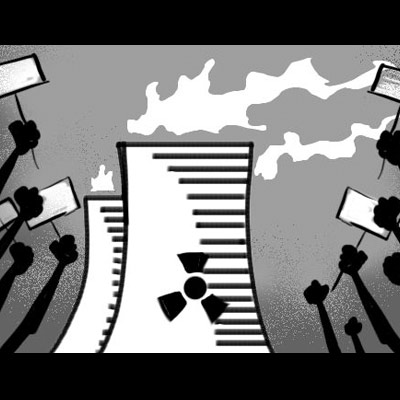
The public isn’t entirely happy about Beznau still being in operation. Nuclear power tends to be controversial because of the danger accidents pose, as well as the fact that nuclear waste doesn’t ever truly go away. There have been gatherings of protestors around Beznau a couple of times in the past, with one protest attracting 20,000 people. Still, it doesn’t look like Beznau has plans to retire early.
Decades of Global Drone War Made Trump’s Caribbean Killing Spree Possible
“Suspicion of smuggling is not an imminent threat. Even if known traffickers were on board, it would not give the military the authority to launch missiles at a civilian vessel”
The Caribbean is not a war zone.
The so-called war on terror laid the foundations for Trump to turn international waters into one-sided battlefields.
By Emran Feroz , Truthout December 13, 2025
In September 2, 2025, a small fishing boat carrying 11 people was targeted by a U.S. Reaper drone off the coast of Venezuela. Hellfire missiles were fired. Two survivors clung to the wreckage. Their identities and motives were unknown. Their behavior showed no hostility. Moments later, the drone operator launched a second strike — the so-called “double tap” — killing the final survivors. This scene is shocking, but it should not be surprising to anyone who has followed the trajectory of the U.S.’s drone wars. This tactic is familiar from Afghanistan, Pakistan, Yemen, and, most recently, Gaza, where the Israeli military has used much worse violence to conduct genocide.
The U.S.’s first drone strike in the Caribbean, and the footage of the incident, reignited a debate about a conflict that Washington refuses to call a war — because it isn’t one. Instead, the Trump administration is using sheer violence to terrorize non-white populations and, as usual, has normalized lethal force far from declared battlefields and without any legal mandate.
U.S. Defense Secretary Pete Hegseth has approved at least 21 additional strikes in the Caribbean and eastern Pacific since September, killing at least 87 people. He has aggressively defended the very first operation, insisting he would have authorized the second strike as well — despite claiming he did not see it. Hegseth even misinterpreted the visible smoke on the video as the “fog of war,” seemingly unaware that the term refers to uncertainty in conflict, not the physical aftermath of a missile strike.
The details matter because they reveal something essential: the senior leadership overseeing these operations does not appear interested in the law, accuracy, or the basic meaning of proportionality. Instead, it has embraced escalation and mass murder as official policy.
Illegal Violence Dressed Up as Counter-Narcotics
Almost all legal experts agree that the U.S. strikes in the Caribbean violate international law. The Trump administration claims that suspected smugglers are “narco-terrorists” and therefore legitimate targets. But as Khalil Dewan, a legal scholar at London’s School of Oriental and African Studies who has studied U.S. and British drone programs for years, told me: “Drug trafficking is a crime, not an armed conflict.”
International law permits lethal force outside war zones only to prevent imminent threats to life. There is no indication that any of the boats the U.S. targeted — including the one in the September 2 video — posed such a threat. Dewan is clear: these are extrajudicial killings taking place on the high seas.
Former Air Force drone technician Lisa Ling, who left the program under the Obama administration due to the civilian casualties she witnessed, shares the same assessment. “Suspicion of smuggling is not an imminent threat. Even if known traffickers were on board, it would not give the military the authority to launch missiles at a civilian vessel,” she told me. Ling emphasizes a point that U.S. officials seem intent on ignoring: The Caribbean is not a war zone.
Ling also raises a question the military prefers not to confront: Who bears responsibility? “We were taught to disobey unlawful orders,” she said. “I’m still waiting to see that principle applied to those who carried out strikes on civilian boats in international waters.”
A Pattern With a Long History
The U.S. drone program did not begin with Trump. Its first lethal strike took place on October 7, 2001, in Kandahar province, targeting Taliban founder Mullah Mohammad Omar. It missed and killed civilians instead. That pattern — high-value targets declared dead, only to reappear alive — became common………………………………………………………………………………………………………………………………………………………….
Trump Escalation and Total Blowback
Trump has not only expanded the use of drone strikes but also removed the few modest oversight mechanisms Obama left behind. Now, under his second administration, the U.S. is openly striking vessels in international waters with almost no pretext.
…………………………….For years, critics of the war on terror have warned that a globalized drone program, paired with militarized domestic security agencies, would eventually produce consequences within the Americas too. That moment is here.
At least one family in Colombia has announced legal action after a fisherman, Alejandro Carranza, disappeared at sea. At the same time, Washington claimed to have killed “three violent drug-smuggling cartel members and narco-terrorists.” Carranza leaves behind a wife and five children.
What happens in the Caribbean today is not an anomaly. It is the outcome of two decades of policy decisions made by presidents of both parties. The world was declared a battlefield long before Trump returned to office. What we are seeing now is the cost of refusing to confront that reality. https://truthout.org/articles/decades-of-global-drone-war-made-trumps-caribbean-killing-spree-possible/?utm_source=Truthout&utm_campaign=f725ba5970-EMAIL_CAMPAIGN_2025_12_13_05_12&utm_medium=email&utm_term=0_bbb541a1db-f725ba5970-650192793
Radioactive fertilizer and the nuclear industry

Gordon Edwards. 14 Dec 25
CORRECTION
I wrote that
“…selling raffinate as fertilizer goes on all the time from the world’s largest uranium refinery owned by Cameco, situated at Blind River on the north shore of Georgian Bay.”
This sentence is incorrect. Raffinate from Blind River is not used as fertilizer. I apologize for the error.
Radioactive fertilizer from the Canadian uranium industry does not come from the Cameco Blind River refinery but from two other sources – the Cameco Key Lake uranium mill in Northern Saskatchewan, and the Cameo uranium dioxide conversion facility at Port Hope Ontario.
Moreover, the material that is being used in radioactive fertilizer is not raffinate (i.e. refinery waste). It is ammonium sulphate that is recovered from the Key Lake uranium processing circuits and sold as fertilizer, together with a liquid by-product of Cameco’s Port Hope uranium dioxide conversion plant – an ammonium nitrate solution – that is sold to a local agricultural supply company for use in fertilizer production.
The use of similar waste solutions from nuclear fuel facilities as fertilizer has been a concern in other jurisdictions as well. So at the present time, it is not raffinate but ammonium compounds that have been used in uranium processing that ends up in fertilizer. I apologize for not checking the facts much more carefully..
About radioactive fertilizer and the nuclear industry.
A lot of the phosphate used for fertilizer comes from Florida where the phosphate ore is mined. That ore is contaminated with uranium and its decay products, especially radium. Radium disintegrates to produce radon gas Radon-222) and this builds up in an enclosed space, without adequate ventiliation, reaching an “equilibrium” in about one month.
That’s why Florida was the first “hot spot” that alerted the US government to the major public health hazard posed by radon, which is estimated to kill about 20-30 thousand Americans every year. Every atom of radon comes from the disintegration of a radium atom, and in turn, every atom of radium started out as an atom of uranium.
Radioactive quilibrium means #becquerels of radium = #becquerels of radon. One becquerel being one disintegration per second. In a simiar way, if pure radon gas is in an enclosed container, it will reach equilibrium with its four short-lived decay products in a couple of hours – so the radioactivity in the container is about five times greater than it was originally, as all the short-lived decay products have attained roughly the same level of radioactivity as the radon.
When this radioactive fertilizer is used on tobacco crops, the radon from the soil and the fertilizer builds up under the thick canopy of tobacco leaves and hangs there for a time (radon being 7-8 times heavier than air). The radon atoms disintegrate to produce four airborne solid short lived decay products – polonium-218, bismuth-214, lead-214, polonium-214, all of which decay into lead-210 and polonium-210. [Note: the last two nuclides never reach equilibrium, unlike the first four.]
These radon decay products stick to the resinous (sticky) hairs on the undersides of the tobacco leaves and when the tobacco is harvested these radioactive materials are harvested along with the tobacco. By the time the tobacco is cured, rolled, and packaged, small quantities of lead-210 (22-year half-life) and its immediate successor polonium-210 are left in the tobacco/cigarettes for the unwitting smoker (or second-hand-smoke inhaler) to encounter.
When the cigarette is lit and the smoker draws on it, the temperature at the tip increases dramatically and it vaporizes the lead-210 and polonium-210 which is inhaled deep into the lungs, where polonium-210 sticks to and attacks the sensitive lung tissue with its very energetic alpha particles.
Polonium-210 is a very damaging radionuclide which Los Alamos Labs reckons is about 250 billion time more toxic than hydrogen cyanide. (It’s what was used to murder Alexander Litvenenko in London at the “request” of Putin who was openly criticized by Litvenenko).
Polonium-210 adds greatly to the cancer-causing characteristic of the tobacco residues lodged in the lung, making cigarettes smoke significantly more carcinogenic than it would otherwise be. (When the smoker is not inhaling, the lead-210/polonium-210 is wafted into the second-hand cigarette smoke as a respirable aerosol to endanger the health of those within sniffing distance,)
Inside the lung, some of the inhaled polonium-210 crosses the blood-air barrier end enters the bloodstream. Being solid, it attaches to pre-existing plaque build-up in the arteries of the smoker, usually near the arterial valves, where the alpha particle bombardment causes fibrosis of the arterial wall and valve, thus exacerbating the plaque build-up and increasing the restriction of blood flow, thereby contributing substantially to the incidence of heart attacks and strokes among smokers because of the alpha emitting polonium-210 in the plaque.
What you may not have heard is that voluminous sand-like radioactive waste from the uranium industry, called “raffinate” (leftovers from uranium refining), is also sold as fertilizer on the open market without any warnings about the radioactive content. The justification for this nefarious practice seems to be, that since “natural” phosphate from Florids is used to make fertilizer, and it is clearly radioactive (due to the radium-radon chain), and since raffinate from a uranium refinery is not much higher in radioactive content, then what the heck, we (the uranium industry) may as well turn this sow’s ear into a silk purse by selling the radioactive raffinate waste as fertilizer.
Extensive radioactive contamination – involving uranium raffinate – of the homes, schools, roadways, ravines, and the public beach in the town of Port Hope (prior to 1985) – has led to a $2.6 billion radioactive environmental cleanup of the town (by the federal government) resulting in over a million cubic metres (about a million tonnes) of radioactibve waste to be stored for 500 years in a gigantic earthen mound just north of the town. The subsequent fate of the still-radioactive waste will be decided at that time.
This practice of selling raddinate as fertilizer goes on all the time from the world’s largest uranium refinery owned by Cameco, situated at Blind River on the north shore of Georgian Bay. The Blind RIver plant turns uranium mill concentrates from Saskatchewan, Australia and South Africa, called “yellowcake” (mostly U3O8), into a product called “uranium trioxide” UO3. At that point the raffinate is the waste product, contaminated with radium. That’s what’s sold for fertilizer.
The trioxide then goes to Port Hope Ontario, where it is chemically converted into UO2 (uranium dioxide) for domestic use, about 15% of the total, and into UF6 (uranium hexafluoride or “hex”) for export to enrichment plants outside of Canada where the concentration of U-235 is increased to the level required by the customer.
At the enrichment plant, the “hex” is turned into a gas at a fairly low temperature so that the heavier U-238 atoms can be separated from the lighter U-235 atoms, resulting in an enriched uranium product that goes out the front door while the voluminous discarded U-238 (called depleted uranium or “DU”) goes out the back door.
For low enrichment in light water nuclear power plants, about 85% of the refined uranium is discarded as depleted uranium. The DU has important military uses, and a few civilian uses, but for the most part DU is part of the radioactive legacy of the nuclear age wth a half-life of 4.5 billion years.
Besides using DU in conventional bullets, shells, missiles, tanks, et cetera, used in the former Yugoslavia and in other conflicts, resulting in a battlefield litters with radioactive waste, the military also uses DU as “target rods” in plutonium production reactors to breed plutonium for nuclear warheads. In addition, the military uses DU metal in almost all nuclear warheads as a way of significantly multiplying the explosive power of the warhead by a sizable factor. These weapons are called “fission-fusion-fission” weapons,
The first fission is from a small ball of plutonium (usually with a tritium “spark-plug” inside) whose sole purpose is to ignite the fusion reaction by raising it to a temperature of about 100 million degrees. When fusion occurs, extremely energetic neutrons are goven off which fission the U-238 that has been used for that exact purpose in the construction of the warhead. That third stage, the fission of U-238, provides the bulk of the explosive power and the lion’s share of the radioactive fallout.
It is a sad story from beginning to end.
And, to add to this tale of woe, Canada currently has about 220 million tonnes of radioactive waste (tailings) stored at or near the surface from uranium milling (the operation that produces yellowcake) along with about 167 million tonnes of radioactive “waste rock”. Yet the Canadian authorities and others routinely and unabashedly declare that nuclear power is a “clean” source of energy and for the most part, Canadian academic scientists and sientific bodies say not a peep to the contrary.
Nuclear power is inherently colonialist and unjust.
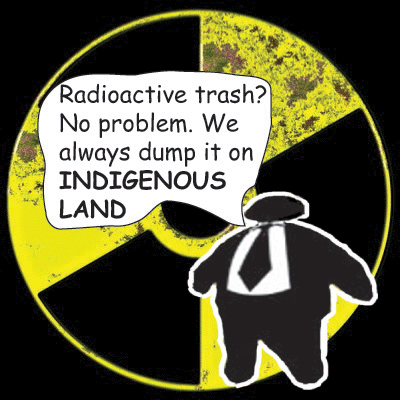
Radioactive waste sites are invariably targeted at indigenous or working-class communities, where dire economic need is preyed upon for easy acquiescence.
The argument for a “significant expansion” of nuclear power will deliver soaring electricity prices that condemn underserved communities to unending hardship and poverty, argues LINDA PENTZ GUNTER
Morning Star 13th Dec 2025, https://morningstaronline.co.uk/article/nuclear-power-inherently-colonialist-and-unjust
MARK JONES is right to argue in his recent article that corporate-driven energy industries should come under public control.
Regrettably, that is unlikely to happen any time soon, whereas long-lasting jobs and a sustainable energy supply are needed today.
However, whether under private or public ownership, nuclear power can deliver neither. Nor will public ownership undo the technology’s fundamental injustices.
The exploitative colonialism and racism inherent in nuclear power renders it incapable of contributing to the “just transition we all want” that Jones and many of us advocate. That’s because nuclear power relies on the victimisation of indigenous and brown populations in foreign lands to provide its fuel — uranium — all of which is imported to Britain.
A just transition cannot simply ignore the perpetual exploitation of Native American, First Nations, Australian Aboriginal and indigenous African uranium miners and millers, living in poverty without running water and electricity and subjected daily to radiation exposure.

Nor does the victimisation end there. In India, a massive mobilisation of thousands of farmers, fishermen and villagers opposed to a six-reactor Russian nuclear power plant in Kudankulam was met with lethal force. Many landed in jail, some went into hiding and at least one died. A democratic process giving voice to the people was nowhere to be seen. The plant went forward, realising their worst nightmares with the natural environment destroyed, incomes lost and small businesses devastated.
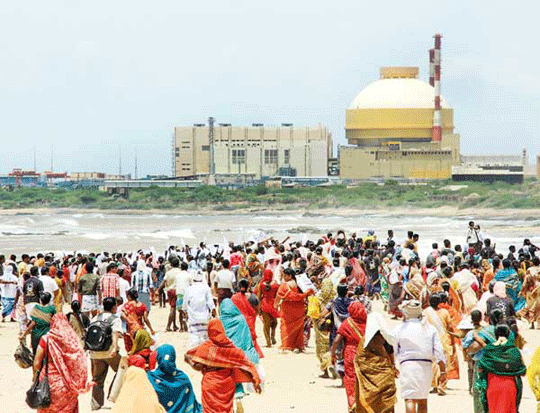
Numerous studies have shown that children living close to operating commercial nuclear power plants have higher rates of leukaemia than those living further away. Radioactive waste sites are invariably targeted at indigenous or working-class communities, where dire economic need is preyed upon for easy acquiescence.
The nuclear industry — even the nationalised version in France — is driven by multinational corporations such as Westinghouse, EDF, Rolls-Royce, Holtec and others, whose only motive is profit.
Britain as an island nation is exceedingly well positioned to deploy renewable rather than nuclear energy on a grand scale. The decision not to maximise expansion of Britain’s abundant offshore wind, wave and tidal power, as well as onshore wind, stream power and solar energy, has been a political, not a technological choice.
Jones’s comment about nuclear waste being “far more straightforward to manage” than the “mountains of unrecyclable turbine blades and solar panels,” is just plain wrong. The waste fuel from nuclear power plants is deadly for tens and, for some of the isotopes it contains, even hundreds of thousands of years.
Whether it fits in a shoebox as Jones writes, or is stacked on a football field — another metaphor used by the industry — is irrelevant given the lethality of the contents. If you opened that box or sat in that stadium, you would be dead from radiation exposure within minutes.
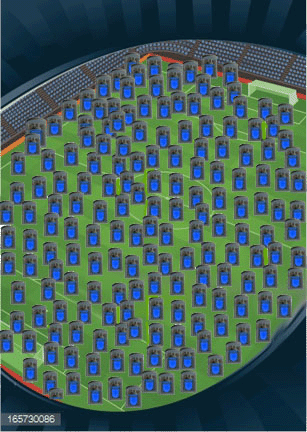
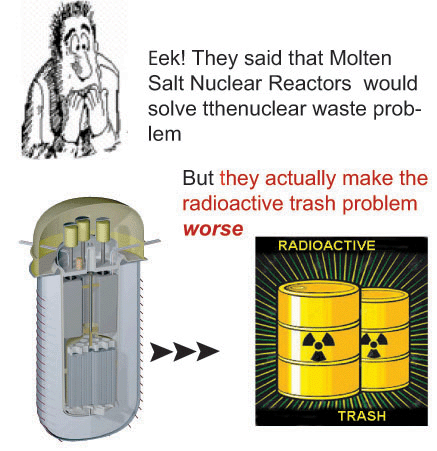
The new proposed small modular reactors, as a Stanford University study has shown, will actually generate greater volumes of radioactive waste than their full-sized predecessors.
Meanwhile, although somewhat complex, wind turbine blades and solar panels are both recyclable and recycled, with advances being made all the time to simplify this process. A similar effort is under way to recycle renewable batteries through the recovery rather than the continued exploitation of metals like lithium, nickel, cobalt and manganese, the major downside of renewables.
To dismiss concerns about major nuclear accidents as “catastrophism” is disingenuous and disrespectful to the hundreds of thousands of people across the former Soviet Union, much of Europe and now Japan, whose lives and livelihoods have been upended, destroyed and even lost altogether as a result of the Chernobyl and Fukushima disasters.
Many of these people were hardworking families indefinitely displaced, unable to resume their former professions.
The prospect of another meltdown is a very real likelihood, given the ageing of current reactors and the major safety uncertainties about the new designs. These latter are unproven, untested, and some use cooling systems such as liquid sodium that have already demonstrated a propensity to catch fire or explode.
A nuclear disaster on a small island like Britain would leave people with nowhere to run to.
The serious concerns around winter warmth, especially for the elderly that Jones rightly calls out, would be better met with a comprehensive energy efficiency progamme combined with renewables that includes insulation and building retrofits. These measures can reduce consumption, obviate the need for new power sources and drive down energy bills.
The huge costs associated with nuclear power will only send electric bills even higher, worsening fuel poverty.
As an example, the British government awarded EDF a guaranteed strike price that was nearly triple what consumers were already paying, to secure Somerset’s Hinkley Point C two reactor deal.
If the reactors are finished by 2027 as EDF presently claims, they will have taken 17 years to get here, 10 years later than expected.
We have seen similar outcomes in the US where Westinghouse — eager for new reactor contracts in Britain — took 15 years to complete two reactors in Georgia at a cost of £27 billion, almost triple the original £10bn estimated cost. That left consumers with the largest electricity rate increase in Georgia history.
Nuclear power falsely advertises itself as reliable, but reactors must shut down under drought and heatwaves if the cooling water sources are too hot or depleted. They must also power or shut down during extreme weather, given the inherent danger of losing the power essential to cool the reactors and the fuel pools, without which the plant can melt down.
Nuclear plants also have to close down routinely for days at a time or longer for refueling or maintenance.
Nuclear power cannot work well with renewable energy because reactors must be on all the time and therefore their power cannot quickly ramp up and down in response to demand as renewables do.
Nuclear power’s inflexibility effectively shuts out grid access to renewables and, as David Toke of 100% Renewable UK points out, “simply pushes wind and solar off the grid.”
Worse still, waiting for slow and far more expensive new nuclear plants while stifling renewables means continued reliance on fossil fuels. This increases pollution and asthma rates while the planet continues to overheat. The result is that a policy of “significant nuclear expansion” actually makes climate change worse.
Renewable energy stimulates employment all along the supply chain, for example in steel and ports, providing jobs not only to energy workers but to those in many other needed sectors. Its “fuel” is the sun, the wind and the waves which, unlike uranium, will never be depleted.
Linda Pentz Gunter is the founder of Beyond Nuclear and the author of No to Nuclear. Why Nuclear Power Destroys Lives, Derails Climate Progress and Provokes War, to be published by Pluto Press in March.
Nuclear power: the courts put a stop to the project for two EPR2 reactors at Bugey

December 10, 2025
“ It’s a dramatic turn of events ” against the project to build two EPR2 reactors in the Ain region. Speaking by phone, Jean-Pierre Collet, from the Sortir du nucléaire ( SDN ) Bugey network, made no secret of his satisfaction. On Wednesday, December 10, 2025, the Lyon Administrative Court
overturned amendments to urban planning documents—
the SCOT ( Regional Planning Scheme ) in February 2023 and
the PLU ( Local Urban Development Plan ) in September 2024—that would have allowed the construction of these two new reactors on the EDF site at Bugey.
This decision follows a hearing on November 18th and sides with the anti-nuclear group Sortir du nucléaire Bugey and several residents. The court ruled that the ecological impact had not been sufficiently considered, particularly the presence of numerous protected species and the proximity of the Natura 2000 site of Isle Crémieux.
This decision comes as the project was already underway, with archaeological excavations already begun, according to Jean-Pierre Collet. A public debate held in early 2025 took place in a heated atmosphere, with the team in charge of organizing the debates lamenting the lack of data on the actual cost of the new facilities.
“
The construction site is suspended for a while,” Jean-Pierre Collet rejoiced.
“This shows that even on large-scale projects, you can’t ignore the rules. There are urban planning regulations, you can’t pretend they don’t exist. For us, this is very good news. ”……………………………………………………………………… https://reporterre.net/Nucleaire-la-justice-met-un-coup-d-arret-au-projet-de-deux-EPR2-au-Bugey
The worrying new detail in UK plans for nuclear-capable jets
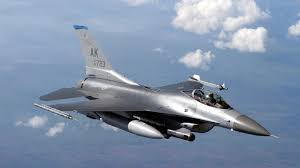
Bill Kidd MSP: Thanks to the publication of a new Nuclear Education Trust report, Stepping Back From The Brink: The Myths Of Tactical Nuclear Weapons And Limited Nuclear War, we have additional detail on how the Ministry of Defence is to spend billions reintroducing tactical nuclear weapons into
the RAF.
We also know that these are weapons the RAF will not own or control. Re-nuclearising the RAF requires much more than the purchase of an additional squadron of F-35A jets at around £1 billion. Creating the logistical and command and control infrastructure will be 10 times the cost of just the aircraft. What additional cuts to our already stretched public
services will that presage?
Going back on his word is, of course, how Starmer was elected. He conned the public with his slogan of change, when he really meant more of the same.
The National 13th Dec 2025, https://www.thenational.scot/politics/25695116.worrying-new-detail-uk-plans-nuclear-capable-jets/
Elon Musk says small nuclear reactors ‘super dumb’
Eamonn Sheridan, 15 Dec 25, https://investinglive.com/news/musk-says-small-nuclear-reactors-super-dumb-20251214/
Musk coming out in favour or solar energy
Musk weighing in on nuclear reactors in a tweet:
- The Sun is an enormous, free fusion reactor in the sky. It is super dumb to make tiny fusion reactors on Earth.
- Even if you burned 4 Jupiters, the Sun would still round up to 100% of all power that will ever be produced in the solar system!!
- Stop wasting money on puny little reactors, unless actively acknowledging that they are just there for your pet science project jfc.
Google, NextEra expand collaboration to develop nuclear-powered gigawatt AI campuses
The initial three campuses under this new accord are now in the active development phase.
Interesting Engineering ByAman Tripathi, Dec 13, 2025
NextEra Energy and Google Cloud announced a significant expansion of their ongoing collaboration, creating a partnership designed to develop multiple gigawatt (GW)-scale data center campuses across the United States………………………………………………………………………………………………..
This collaborative effort focuses on accelerating the deployment of data centers by systematically addressing critical infrastructure hurdles.
These challenges include land acquisition, managing load interconnection, and the simultaneous development of supporting power generation resources needed to sustain large-scale artificial intelligence operations.A central component of this energy strategy involves the revitalization of nuclear power capabilities to support the electrical grid.
“Most recently, the companies announced the restart of the Duane Arnold Energy Center in Iowa followed by two new long-term power purchase agreements to add 600 megawatts of clean energy capacity to Oklahoma’s electricity grid to support Google’s technology infrastructure,” noted a press release.
To facilitate this restart, NextEra Energy has formally requested that the US Federal Energy Regulatory Commission (FERC) restore grid connection rights for the shuttered facility.
This regulatory filing seeks to reclaim interconnection rights that had previously been transferred from the nuclear plant to a planned solar energy project at the same site.
The move follows a licensing change request that NextEra filed with the US Nuclear Regulatory Commission (NRC) in January, marking a distinct shift from solar back to nuclear baseload power to meet steady demand.
Digital transformation of operations
Beyond the construction of physical infrastructure, the partnership will implement a digital transformation of NextEra Energy’s operations using Google Cloud’s artificial intelligence tools. ,…………………………………………………………
NextEra Energy Chairman and CEO John Ketchum characterized the partnership as a reflection of the current moment where the energy and technology sectors are becoming increasingly intertwined. He noted that the joint effort intends to build infrastructure at scale and change how energy companies function.
Similarly, Google Cloud CEO Thomas Kurian stated that combining NextEra’s domain expertise with Google’s AI infrastructure is necessary to support the digital future of energy infrastructure and meet the rising demand for AI technologies. https://interestingengineering.com/energy/nuclear-powered-gigawatt-ai-campuses-google
How nuclear submarines could pave the way for nuclear weapons in South Korea
Bulletin, By Sharon Squassoni | December 12, 2025
Share
The mystique of nuclear-powered submarines has been captured by at least half a dozen popular Hollywood films. Some have centered on the drama of undersea warfare and the risk of global nuclear apocalypse should the nuclear-tipped missiles aboard most of them be launched. Others confront the issues of rogue submarine commanders or the dilemmas of decision-making when out of communication with national leadership. One or two, including Kathryn Bigelow’s K-19 Widowmaker, portray real-world disasters of a reactor meltdown aboard submarines. (Bigelow is also the director of the new film, A House of Dynamite, which depicts the last 20 minutes before a nuclear-armed missile of unknown origin falls on an American city.)
The underlying message of these fictional works is that nuclear submarines—powered by reactors and armed with atomic missiles—are a tightrope act. One misstep could endanger many, many lives.
The United States’ recent nuclear submarine deal with South Korea is a tightrope act for a different reason. Lost in the noise about nuclear submarines, the Trump administration has agreed to let South Korea enrich uranium and reprocess commercial nuclear spent fuel. This step—which could give South Korea a virtual or latent nuclear weapons capability—is needlessly destabilizing.
US nuclear technology exports. In the last five years, the United States has made deals with Australia and South Korea to hasten the day when some countries will deploy nuclear-powered submarines that don’t carry nuclear missiles. Under the 2021 AUKUS deal (a partnership between Australia, the United Kingdom, and the United States), Australia will build nuclear-powered submarines using UK reactors and US highly enriched uranium fuel at the latest estimated cost of $368 billion. And in October, South Korea scored a political coup in convincing US President Donald Trump to allow its pursuit of nuclear-powered submarines.
South Korea has sought nuclear-powered submarines for more than 30 years. Sparked by the first international crisis over North Korea’s nuclear weapons program, Seoul has dabbled in the relevant technologies in an on-again, off-again fashion. Past forays included a 1994 directive to the Korean Atomic Energy Research Institute to design a nuclear-powered submarine (cancelled in 1998) and the so-called “362” covert task force formed in 2003 that reportedly utilized Russian help to design a submarine reactor. This task force was disbanded in 2004 after South Korean officials revealed that scientists had enriched uranium without declaring it to the International Atomic Energy Agency.
More recently, Moon Jae-in campaigned on South Korea acquiring nuclear-powered submarines in 2017, and Korean officials since 2020 have suggested that their next generation of submarines would be nuclear-powered. Speculation persists over whether South Korean efforts to develop small modular reactors fueled with 19.5 percent high-assay low-enriched uranium could be adapted or modified for naval applications.
Many details about South Korea’s nuclear submarines are still unknown— when, where, and how they will be built. Those details will matter a great deal in terms of the proliferation implications. Allowing South Korea to indigenously produce its own nuclear submarines could be riskier than if South Korea were to purchase US subs or the reactors that go into these subs.
Nuclear-powered vs. nuclear-armed. Nuclear-powered submarines make total sense to nuclear weapon states, which weigh the risks and costs of these vehicles against the benefits of stealth, range, and having a platform for assured, nuclear retaliation. (In theory, such submarines can enhance stability because they provide assured destruction in case an opponent seeks advantage by striking first—the so-called delicate balance of terror.) Already engaged in high-cost and high-risk nuclear projects, nuclear-powered submarines are not a huge step up for countries with nuclear weapons.
For countries without nuclear weapons, however, the costs far outweigh the benefits.
Per unit, a single modern diesel-electric attack submarine with air-independent propulsion costs between $500 million and $900 million. A modern nuclear-powered attack submarine will cost between $3 billion and $4 billion each, based on the current cost of Virginia-class nuclear attack submarines in the United States, a country with experience in building such ships. This is on top of the considerable investment in shipbuilding that countries like South Korea and Australia would have to make. For instance, South Korea has vowed to invest $350 billion in the United States, of which half will be spent on US shipbuilding…………………………………………………………………………………………………………………………………………… https://thebulletin.org/2025/12/how-nuclear-submarines-could-pave-the-way-for-nuclear-weapons-in-south-korea/
Elections impossible under Zelensky’s ‘terrorist regime’ – exiled Ukrainian MP

Sat, 13 Dec 2025, https://www.sott.net/article/503481-Elections-impossible-under-Zelenskys-terrorist-regime-exiled-Ukrainian-MP
Presidential elections in Ukraine are impossible under the “terrorist regime” of Vladimir Zelensky and his cohort, exiled Ukrainian lawmaker Artyom Dmitruk has said.
Zelensky, whose presidential term expired over a year ago, has repeatedly refused to hold a new election, citing martial law – which was imposed after the conflict with Russia escalated in 2022 and has been regularly extended by parliament.
Earlier this week, Zelensky said he would hold an election within 90 days if Kiev’s Western backers can guarantee security. The shift came after US President Donald Trump accused the Ukrainian authorities of using the conflict as an excuse to delay elections, insisting that it’s time.
In a series of Telegram posts on Friday, Dmitruk argued that it is “completely pointless” to discuss elections now, calling Zelensky’s remarks “manipulation and hypocrisy” aimed at clinging to power.
“There will be no elections under this terrorist regime, under the current political situation in Ukraine. Under this regime, elections are impossible,” the exiled lawmaker wrote. “The political situation in Ukraine is vile and deceitful. Almost all the ‘potential candidates’ are Zelensky regime officials, people completely integrated into the war system. And at the head of this march – a parade of blood – is Zelensky himself.”
He insisted that elections would only be possible after “either a political or military capitulation of the regime” and the transfer of authority to an interim government. According to Dmitruk, Trump’s call to Zelensky was not really about elections: “It is a form of diplomatic signal… a polite, diplomatic way to show Zelensky the door.”
Dmitruk fled Ukraine in August 2024, claiming he received death threats from the country’s security services over his opposition to Zelensky’s persecution of the Ukrainian Orthodox Church.
Russia maintains that Zelensky is an illegitimate leader. President Vladimir Putin warned that it is “legally impossible” to conclude a peace deal with the current leadership due to Zelensky’s lack of a valid mandate.
According to Kremlin aide Yury Ushakov, Zelensky’s sudden interest in elections is a ploy to secure a ceasefire – a proposal that Russia has rejected in favor of a permanent peace deal addressing the conflict’s underlying causes. Moscow has warned that Kiev would use any pause in the fighting to rearm and regroup.
Comment: There is more pressure on Zelensky to hold elections from various stakeholders while a peace deal is in the works. One way or another Zelensky will have to hold elections soon.
Ottawa medical manufacturer giving up nuclear licence after defying regulator
Canadian Nuclear Safety Commission ordered Best Theratronics to comply over a year ago.

COMMENT.There are questions about lack of financial guarantee in the case where the plant in Kanata is decommissioned, i.e. cost of cleaning up the radioactive materials at the site. Next step is the CNSC is waiting for the decommissioning preliminary plan. The owner is moving the business to the U.S. and India, he says.
Campbell MacDiarmid · CBC News · Dec 14, 2025, https://www.cbc.ca/news/canada/ottawa/ottawa-medical-manufacturer-giving-up-nuclear-licence-after-defying-regulator-9.7014006
A storied Kanata medical manufacturer is in the process of relinquishing its nuclear licence, more than a year after Canada’s nuclear regulator placed it under orders for violating the terms of that certificate.
On Friday, the Canadian Nuclear Safety Commission (CNSC) confirmed that Best Theratronics is in the process of offloading the nuclear material it used to manufacture cancer treatment devices.
“Best Theratronics Limited has obtained an export licence to ship its Cobalt 60 sealed sources, as well as an export licence to ship its Cesium 137 sealed sources,” said Andrew McAllister, director of the CNSC’s nuclear processing facilities division, during a public meeting.
Best Theratronics was once a Crown agency that created the world’s first cancer treatment machine, but it has struggled in recent years under the private ownership of overseas businessman Krishnan Suthanthiran.
Suthanthiran says he has lost millions of dollars since buying the company from MDS Nordion in 2007. More recently, the company faced a protracted labour dispute that saw workers strike for nearly 10 months to demand better pay.
Last November, the CNSC issued orders against Best Theratronics after noticing that its financial guarantee had lapsed. The industry regulator ordered the company to make $1.8 million available to cover any cleanup costs in the event that its site was decommissioned.
But Suthanthiran never complied, telling CBC in October that the CNSC was in the wrong and that he lacked the funds to restore the guarantee.
Instead, Suthanthiran said he would give up his nuclear licence and shift the company toward activities that don’t involve nuclear materials.
CBC asked Suthanthiran whether staff at Best Theratronics would would be out of work as a result of the company surrendering its nuclear licence.
In an email, he wrote that he was being forced “to relocate to the USA and India” and that would result in “the loss of 200 high-tech jobs.” He also cited the high yearly cost of having the nuclear licence.
The CNSC has required Best Theratronics to submit monthly reports relating to its progress in offloading its nuclear material. But the company missed its December deadline, submitting its report several days later, McAllister said.
Manny Subramanian, a representative of Best Theratronics, told the CNSC the delay was due to Suthanthiran’s absence.
“One particular report, you know, we ended up sending about a day late or two days late because Krish, the president of the company, was travelling. We couldn’t get ahold of him,” Subramanian said.
The next deadline facing Best Theratronics comes Tuesday when it’s due to submit a preliminary plan for decommissioning its plant in Kanata.
1 This Month





PLEASE OPPOSE HR 8255 AND S.3639 – bills would accelerate satellite deployment, with no environmental review or safeguards – https://ncstd5li.quorum.us/campaign/169331/
To see nuclear-related stories in greater depth and intensity – go to https://nuclearinformation.wordpress.com
-
Archives
- October 2026 (39)
- September 2026 (339)
- August 2026 (330)
- July 2026 (355)
- June 2026 (287)
- May 2026 (306)
- April 2026 (356)
- March 2026 (251)
- February 2026 (267)
- January 2026 (308)
- December 2025 (358)
- November 2025 (359)
-
Categories
- 1
- 1 NUCLEAR ISSUES
- business and costs
- climate change
- culture and arts
- ENERGY
- environment
- health
- history
- indigenous issues
- Legal
- marketing of nuclear
- media
- opposition to nuclear
- PERSONAL STORIES
- politics
- politics international
- Religion and ethics
- safety
- secrets,lies and civil liberties
- spinbuster
- technology
- Uranium
- wastes
- weapons and war
- Women
- 2 WORLD
- ACTION
- AFRICA
- Atrocities
- AUSTRALIA
- Christina's notes
- Christina's themes
- culture and arts
- Events
- Fuk 2022
- Fuk 2023
- Fukushima 2017
- Fukushima 2018
- fukushima 2019
- Fukushima 2020
- Fukushima 2021
- general
- global warming
- Humour (God we need it)
- Nuclear
- RARE EARTHS
- Reference
- resources – print
- Resources -audiovicual
- Weekly Newsletter
- World
- World Nuclear
- YouTube
-
RSS
Entries RSS
Comments RSS

