The earth has moved under our feet, and our massive security gamble is crumbling, but the government pretends nothing has happened, writes Michael Pascoe.
Tits on a bull, the Joint Standing Committee on Foreign Affairs, Defence and Trade and the Parliamentary Joint Committee on Intelligence and Security, all same same. The former committee is a random mix of odds and sods – even Ralph Babet – as could be assembled, the latter stacked with fans of last century’s security stories, devotees of Pax Americana, fed and watered by the local and American security establishment
“to think no further than their outdated Anglosphere prejudices.“
This was the year the earth moved for Australia’s security, while our timid government kept its head under the pillows, desperately hoping it would not have to face up to the changes and challenges, praying its political strategy of copying coalition policy would help keep it safe at the polls. What’s Labor’s main security concern? How it looks in khaki on election day.
Can the opposition come up with a more pro-American defence spokesman than Richard Marles? No. Labor remains safe on the security right flank that was traditionally Liberal high ground.
With the Albanese/Marles/Wong government devoted to exerting discipline, quashing dissent and going all the way with Donald J, Australia’s national security future goes unexamined while its current blueprint burns.
Strategic failure
We have proven ourselves to be rich in the greatest strategic failure: lacking imagination. Our defence establishment – politicians, spooks, bureaucrats, military, salespeople, foreign agents – could not imagine the change that has been foisted on them, could not conceive any future for Australia other than one embedded in the American military armpit,
can’t grasp that the game has irreversibly changed.
Now, as America changes faster than anyone dared guess, we pursue the path of failure that comes from not believing what is happening. Having explicitly bet our strategic future on America always protecting us, that that is our only hope for survival, it is too painful for the establishment to face up to America withdrawing, to being proven wrong.
Australia Deputy Sheriff
There have been rare and largely ignored voices forecasting what is happening under Trump. A decade ago, Geoff Raby warned of the US eventually withdrawing from Western Pacific domination, leaving Deputy Dawg Australia an orphaned shag on a rock. Hugh White, more recently, has made the case that America is in retreat to its core interests.
That has now been spelt out in the Trump administration’s National Security Statement and by its “Secretary for War” Pete Hegseth. America is to be about the Americas, with Europe left to itself, or Russia, and China’s military rise acknowledged and accepted in Asia.
A new reality
Crikey’s Bernard Keane summarised the new reality ($) while highlighting local mainstream media’s failure to examine it, citing a speech last weekend in which Hegseth said the quiet bits out loud:
“Our interests in the Indo-Pacific are significant, but also scoped and reasonable … this includes the ability for us, along with allies, to be postured strongly enough in the Indo-Pacific to balance China’s growing power.
“President Trump and this administration seek a stable peace, fair trade and respectful relations with China…this involves respecting the historic military buildup they are undertaking.”
Keane concluded Hegseth had said the unthinkable: the US aims merely to be present in the Pacific, not to dominate it. It merely seeks to balance China’s power, not defeat it. And it “respects” China’s military build-up.
“Imagine the absolute uproar from the media — and not just from News Corp — if Anthony Albanese had talked about ‘respecting’ China’s military build-up,” Keane posited.
Like the US blatantly committing war crimes and now piracy off the Venezuelan coast, America’s declared security strategy is an embarrassment Australia doesn’t want to see. This is the America which preferences Russia over Europe.
Not “just a phase”
The optimistic view within the defence establishment clinging to American coattails is that Trump, too, will pass and everything will get back to just the way it was.
It won’t. That’s not the way it happens when the world changes. Much of MAGA will prove sticky even if the Democrats reclaim the White House and Congress.
“Having given ground, it’s very difficult to reclaim it.
Not much of Trump 1.0 was overturned by Biden. The tax cuts and Chinese tariffs remained. The domestic chaos created by Trump will be more than enough for a Democrat administration to wrestle with, if there is a Democrat administration next.
America is set for so many problems by 2028, China’s role in Asia won’t register.
In little ol’ Australia, we’ll watch the cricket and slumber through summer. Prime Minister Albanese’s interview on the final Insiders program for 2025 was typical, being purely domestic. A minister’s expensive airfares was a major issue, American war crimes and the national strategic statement Russia applauded didn’t rate a mention.
And with an iron grip on Labor Party members and an irrelevant opposition, Albanese/Marles/Wong will continue to treat the somnambulant Australian public with contempt, refusing to be open about our AUKUS fantasy,
“refusing to risk a public inquiry,
refusing to tell us what more the US is demanding of its South Pacific vassal.
Oh well, we can concentrate on the cricket, ignore our complicity in piracy and war crimes and just keep handing over the billion-dollar cheque
Michael Pascoe is an independent journalist and commentator with five decades of experience here and abroad in print, broadcast and online journalism. His book, The Summertime of Our Dreams, is published by Ultimo Press.
NESO report says net zero will make energy cheaper within 25 years Energy Live News 11th Dec 2025
Britain could halve its energy spending by 2050 as decarbonisation cuts costs and shields the economy from fossil fuel shocks.
That is the headline finding from NESO’s new analysis of the Future Energy Scenarios 2025 which lays out three illustrative routes to net zero and the price tags attached.
NESO says energy-related costs fall in every pathway dropping from roughly 10% of GDP today to around 5-6% by mid-century even as demand rises due to population growth, economic expansion and power-hungry data centres.
The reason is simple. Spending shifts from imported fossil fuels to homegrown renewables, stronger networks and efficient electric heating which cut operating costs and create local jobs.
Missile defense, as the term implies, is defending against enemy missiles carrying an explosive payload. The origin of these anti-missile systems dates back to the Cold War space race between the U.S. and the Soviet Union, an era when intercontinental ballistic missiles could be deployed in space to launch satellites to orbit or travel thousands of miles carrying nuclear weapons. Missile defense systems were deployed by both superpowers in the 1960s, but proved to be technically infeasible and prohibitively expensive. They were ultimately abandoned.
Feasibility and cost notwithstanding, the U.S. military and weapons contractors succeeded in pursuing these systems during the Ronald Reagan and George W. Bush administrations. Now, Donald Trump has launched the ambitious Golden Dome project, yet another missile defense program based on technologies and space-based interceptors proven to be unworkable.
In this webinar, we will hear three experts discuss the technical and policy aspects of Golden Dome.
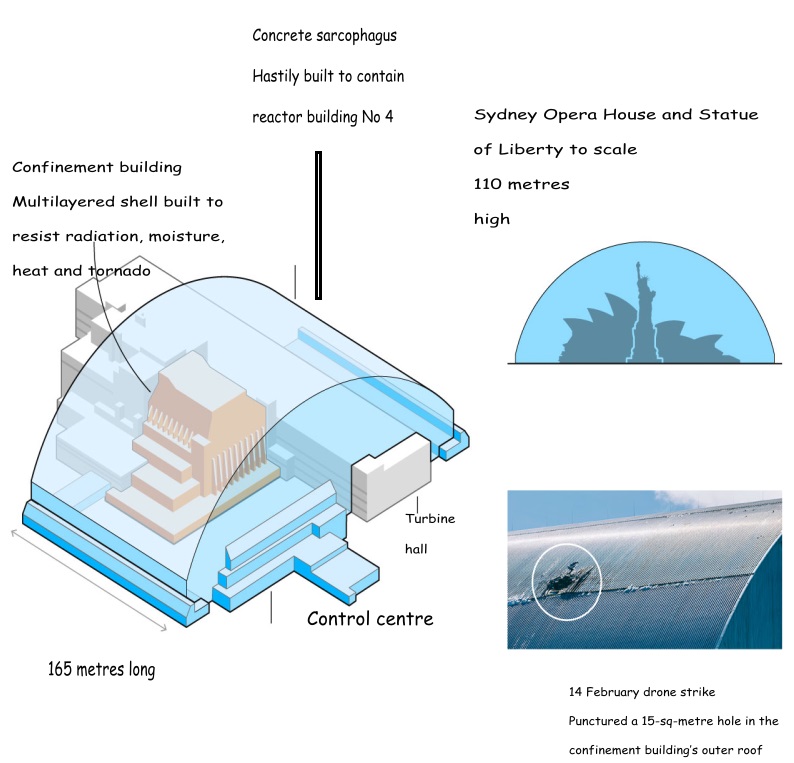
The dome built over the remains of the Chernobyl disaster has been damaged, raising fears it may no longer be able to contain radioactive material.
Officially known as the New Safe Confinement (NSC), the at least $2 billion protective shield was constructed over Reactor 4, which caused the world’s worst nuclear disaster in 1986.
The United Nations‘ International Atomic Energy Agency (IAEA), a nuclear watchdog, revealed this month that the NSC was severely damaged in a Russian drone strike in February.
The IAEA team conducted a safety assessment earlier this month, finding the dome had lost its primary safety functions, including confinement capability.
IAEA director general Rafael Mariano Grossi said: ‘Limited temporary repairs have been carried out on the roof, but timely and comprehensive restoration remains essential to prevent further degradation and ensure long-term nuclear safety.’
The inspection brought some relief, confirming that the dome’s main structure and monitoring systems remain intact.
But beneath the damaged shelter lies massive quantities of radioactive material from the 1986 disaster, making the site a ticking time bomb.
The IAEA has urged urgent repairs and upgrades to Chernobyl’s protective shelter, calling for better humidity control, advanced corrosion monitoring, and a high-tech automatic system to keep the radioactive reactor remains under control.
The damaged dome is the latest of several such expert missions since September last year, when the substations became increasingly affected by the military conflict.
‘These substations are essential for nuclear safety and security. They are absolutely indispensable for providing the electricity all nuclear power plants need for reactor cooling and other safety systems,’ Grossi said
‘They are also needed to distribute the electricity that they produce to households and industry.’
In 2026, with support from the European Bank for Reconstruction and Development (EBRD), the Chornobyl site will undertake additional temporary repairs to support the re-establishment of the NSC’s confinement function, paving the way for full restoration once the conflict ends.
At the UK-France Summit in July 2025, Prime Minister Keir Starmer and President Emmanuel Macron affirmed their commitment to strengthening the UK-France nuclear relationship. They signed the Northwood Declaration, which established the UK-France Nuclear Steering Group in order to provide political direction and coordinate bilateral work across nuclear policy, capability and operations.
On 10 December, the Nuclear Steering Group met for the first time in Paris, jointly chaired by senior officials from the UK Cabinet Office and the Presidency of the French Republic.
They were accompanied by senior military personnel and officials from defence and foreign ministries to discuss Euro-Atlantic security issues and coordination of their respective independent deterrents. They discussed their approach to strengthening deterrence in Europe and confirmed their ambition for bilateral co-operation on nuclear deterrence.
They also observed Operation POKER which was the first time foreign officials were given access to this demonstration of France’s strategic nuclear airborne component.
The golden noose represents a theology of death, a reverence for vengeance that distorts the face of Judaism and deals a severe blow to Israeli society.
If you happened to wander into the meeting of the Knesset committee this week, you might have expected to see MKs engrossed in serious discussions on the myriad and often existential challenges Israel must address. But what would most likely have caught your eye is the golden pin on National Security Minister Itamar Ben-Gvir and his party members’ jackets.
What was troubling about these pins was their shape – a hangman’s noose. Ben-Gvir and his fellow party members explained that the pins symbolize their commitment to executing terrorists. But symbols carry weight beyond their stated purpose, and this one speaks volumes – not about strength but about a dangerous path threatening Israel’s Jewish and democratic character.
Israel’s existential challenges
Two existential challenges confront the State of Israel at this hour: defeating our enemies and taking every possible precaution to ensure that we do not become like them – neither in their savagery, nor in their abandonment of morality. Those who believe meeting the first challenge can be achieved without the second have forgotten what it means to be Jewish.
Time and time again, the prophets and the sages declared a simple truth: Military might without moral purpose is self-defeating. A nation that abandons its ethical foundations does not become stronger. On the contrary, it erodes itself from within.
When voices in Israel call for us to “learn from our enemies,” to match their cruelty, to embrace their methods – they forget a crucial fact: Our enemies are losing. They have always lost. Not because we out-brutalized them but because we built something they could not: a free society, a democracy, a culture that believes in law and conscience. This is not weakness. This is the source of our strength and our resilience.
A distortion of Judaism
The golden noose goes far beyond poor taste. It represents a theology of death, a reverence for vengeance that distorts the face of Judaism and deals a severe blow to Israeli society.
But the golden noose does not represent most religious Israelis who abhor these politicians. This is a community committed to Torah along with democratic values, ethics, and social responsibility – so vastly different from the caricature of religious Zionism that Ben-Gvir and his followers present. They shame the public face of religious Judaism. They do not speak for it.
NATIONAL SECURITY Minister Itamar Ben-Gvir is seen wearing a gold pin of a noose, on December 8, 2025.(photo credit: Itamar Ben-Gvir’s Office)
This distortion of Judaism has implications far beyond Israel’s borders. The bond between Israel and the Diaspora depends on Israel remaining a society worthy of that bond – a society committed not only to Jewish survival but to Jewish values. When Israeli politicians parade symbols of death as badges of honor, they threaten that bond, so dear to all of us. In such a reality, Jews around the world would be hard-pressed to defend and embrace the Jewish state.
We believe in a God who rewards those who pursue justice and righteousness. We believe that moral societies are stronger societies – more cohesive, more resilient, more capable of sustaining alliances with fellow democracies. This is not naive idealism. It is strategic and moral clarity.
Going forward, it is essential for us to succeed in meeting both challenges: victory over those who seek our annihilation, and victory over any impulse to go down the path of destruction, hate, and inhuman behavior. The first challenge cannot be met without the second. A nation that wins its wars but loses its soul has not truly won anything at all.
The writer is the CEO of Kolenu, a Jewish-Democratic voice for Torah, moral leadership, and social responsibility.
Australians everywhere should be made acutely aware that the Australian Israel lobby is now explicitly advocating a ban on criticism of the state of Israel.
Not just hate speech against Jews. Criticism of a foreign state. They’re coming right out and saying it.
During a recent public video conference with the American Jewish Committee on the topic of the Bondi Beach shooting, the Executive Manager of the Australia/Israel & Jewish Affairs Council (AIJAC) explicitly says he wants pro-Palestine protests to be banned by the Australian government, and that addressing the problem of antisemitic hate speech in Australia necessarily means stopping opposition to Israel’s actions.
About 40 minutes into the American Jewish Committee’s YouTube video of the conference, AIJAC Executive Manager Joel Burnie demands that the Australian government take much stronger action to regulate freedom of expression regarding Israel and Zionism in Australia, saying the following:
“They need to act swiftly. They need to go to their own arms and their own institutions: no longer can you refuse service to a Zionist. We are going to prosecute people that spew hate speech against your people, and we’re not going to tip toe around the fact that the central problem here is Israel. I for one as Jewish leader will no long talk about antisemitism in isolation from Israel, because it’s the rhetoric and language on Israel that motivates the people to come and kill us. Those two terrorists were motivated by what was going on in Israel, and that’s what motivated them to come and kill us. So if they had Israel on their minds why are we acting as though it has nothing to do with the vitriolic binary nature of the pro-Palestinian advocacy movement?”
Burnie goes on to say that he wants a complete government ban on protests against Israel’s abuses throughout the nation:
“So overnight what we want immediately if you ask any Jew, what do you want, what do you want? No more protests! No more protests! No more no-go zones for Jews. I can’t, for two years, cannot take my kids to downtown Melbourne for two years on a Sunday, because of the pro-Palestinian marches, because of the violent nature of them. No more! Because that is an acceptance of the connection between the two. And until the prime minister is willing to do that, this is gonna happen again.”
Burnie is lying here, for the record. Anyone who has gone to the pro-Palestine demonstrations in Melbourne as I have will tell you that the protests are not even slightly violent in nature, and that there are Jews among the demonstrators who actively make their presence known. Those demonstrations have never been “no-go zones for Jews”; Joel Burnie doesn’t want to take his kids to downtown Melbourne on a Sunday because he doesn’t want to expose them to ideas and information which reveal the depravity of his Israel-supporting worldview.
Australians would probably benefit from watching the entire hour-long video of the conference, whose contents I first saw spotlighted on Twitter by Information Liberation’s Chris Menahan.
Some other highlights:
At 4:20 Burnie says that part of his role at AIJAC is “to take non-Jewish politicians and journalists and diplomats and other Australian officials to Israel.”
At 14:00 Nick Aronson, who is Chief of Staff to Australia’s so-called “antisemitism envoy” Jillian Segal, regurgitates the bogus propaganda line we’ve been hearing nonstop from Israel apologists throughout the western political/media class, “the words globalise the intifada actually mean globalise the intifada; it means kill Jews wherever they are”. Pro-Israel spinmeisters have been spouting this line with creepy uniformity ever since the Bondi shooting in order to justify government crackdowns on freedom of speech and assembly to protect Israeli information interests.
At 15:00 Burnie says “the gloves are off now” with regard to stomping out free speech in Australia, saying Jews need stop saying “not all pro-Palestinian supporters are antisemitic”, saying “The pro-Palestinian movement, or the things within the pro-Palestinian movement that we all are exposed to in the public, is too binary: you’re pro-Palestinian so you need to be viciously anti-Israel.”
At 16:20 Burnie claims the Bondi shooting “happened because of the protest movements on the streets”, citing no evidence.
At 17:30 Burnie again makes his “no more protests” demand, saying “If I could ask for one thing of the government today: no more protests. If they cannot utilise language that is not inciting violence, that does not marginalise and dehumanise Jews, they have no right to be on the streets.”
At 21:10 Burnie complains that there haven’t been any prosecutions and arrests for antisemitic speech.
At 33:30 Burnie singles out Australian Muslims, saying “there needs to be more monitoring and surveillance of Islamic hate preachers” and an auditing of their education syllabus because of an “antisemitism problem amongst the Australian Muslim community.”
At 36:25 Burnie says Jillian Segal’s notorious speech-suppressing plan for fighting antisemitism in Australia “wasn’t about quashing debate on Israel, it just happens to be that language on Israel invading all of our social spaces in Australia have made this country a very unsafe space and place for Jews.”
At 46:00 Aronson says “there’s absolutely no doubt that people need to go to jail” for antisemitic hate speech in Australia, but says that won’t be enough to fix the problem because “we can always arrest more people, make no mistake, but you can never arrest enough, to be honest.”
At 54:00 Aronson speaks of the need for regulating online speech, complaining that “a number of the online platforms pride themselves on what they call free speech — obviously we would disagree; we would call it hate speech.” At 56:00 he says “we need to continue to put pressure on these platforms to understand the role they have to play in social cohesion, and how far short they are falling of community standards.”
This comes as the Australian government announces plans to ramp up its war on free speech in the wake of the Bondi Beach attack. We can be sure to see more authoritarian measures rolled out in the weeks to come as Israel’s supporters seize on this opportunity to advance the information interests of a genocidal apartheid state.
US President Donald Trump late Tuesday declared a blockade on “all sanctioned oil tankers” approaching and leaving Venezuela, a major escalation in what’s widely seen as an accelerating march to war with the South American country.
The “total and complete blockade,” Trump wrote on his social media platform, will only be lifted when Venezuela returns to the US “all of the Oil, Land, and other Assets that they previously stole from us.”
US President Donald Trump late Tuesday declared a blockade on “all sanctioned oil tankers” approaching and leaving Venezuela, a major escalation in what’s widely seen as an accelerating march to war with the South American country.
The “total and complete blockade,” Trump wrote on his social media platform, will only be lifted when Venezuela returns to the US “all of the Oil, Land, and other Assets that they previously stole from us.”
“Venezuela is completely surrounded by the largest Armada ever assembled in the History of South America,” Trump wrote, referring to the massive US military buildup in the Caribbean. “It will only get bigger, and the shock to them will be like nothing they have ever seen before.”
The government of Venezuelan President Nicolás Maduro, which has mobilized its military in response to the US president’s warmongering, denounced Trump’s comments as a “grotesque threat” aimed at “stealing the riches that belong to our homeland.”
The US-based anti-war group CodePink said in a statement that “Trump’s assertion that Venezuela must ‘return’ oil, land, and other assets to the United States exposes the true objective” of his military campaign.
“Venezuela did not steal anything from the United States. What Trump describes as ‘theft’ is Venezuela’s lawful assertion of sovereignty over its own natural resources and its refusal to allow US corporations to control its economy,” said CodePink. “A blockade, a terrorist designation, and a military buildup are steps toward war. Congress must act immediately to stop this escalation, and the international community must reject this lawless threat.”
US Rep. Joaquin Castro (D-Texas), one of the leaders of a war powers resolution aimed at preventing the Trump administration from launching a war on Venezuela without congressional approval, said Tuesday that “a naval blockade is unquestionably an act of war.”
MOSCOW, Dec 16 (Reuters) – The Russian-controlled Zaporizhzhia nuclear power plant in Ukraine is currently receiving electricity through only one of two external power lines, its Russian management said on Tuesday.
The other line was disconnected due to military activity, the management said, adding that radiation levels remain normal. Repair work will begin as soon as possible.
The nuclear plant, Europe’s largest, has been under Russian control since March 2022, when Russian forces overran much of southeastern Ukraine. It is not currently producing electricity but relies on external power to keep the nuclear material cool and avoid a meltdown.
Each side has regularly accused the other of shelling the facility. It experienced a couple of complete power outages earlier this month but was subsequently reconnected.
In September and October the plant was without external power for 30 days, relying on backup diesel generators, until a damaged line was reconnected during a local ceasefire arranged with the help of the U.N. nuclear agency.
Reporting by Reuters Writing by Maxim Rodionov Editing by Mark Trevelyan
By Tom Dunlop, UK Defence Journal, December 17, 2025
A disagreement over defence innovation and reliance on US technology surfaced in the House of Commons during Defence questions.
SNP MP Dave Doogan argued that what he described as an “America-first posture” is harming UK defence innovation, particularly in relation to the nuclear deterrent. He said the system relies heavily on US technology, citing components including “fusing, firing, arming, neutron initiators, the gas transfer system and the Mark 4 aeroshell.” Doogan also criticised plans to buy additional F-35 aircraft for what he characterised as “US-manufactured gravity-delivered nuclear weapons.”
He questioned why the government appeared aligned with US priorities while, in his view, overlooking European initiatives. “President Trump will put America first, but it is difficult to understand why this Labour Government seem keen to do the same, while spurning the innovation opportunity of the £130 billion SAFE programme in the EU,” Doogan told the House……………https://ukdefencejournal.org.uk/snp-says-uk-nuclear-deterrent-is-america-first/
Could the threat of nuclear war be closer than ever? Amy Hall explores how we got here and the pathways out of the crisis.
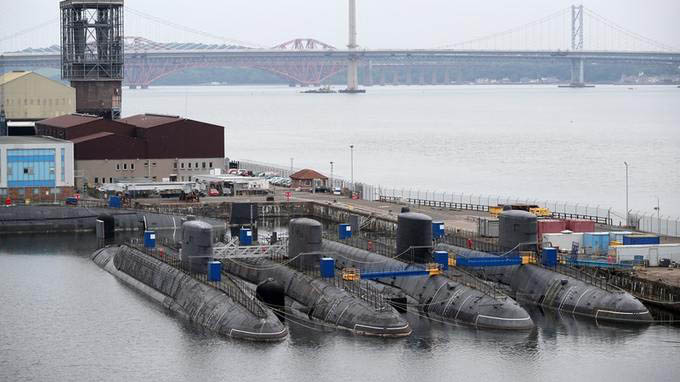
If you want to get a nuclear-powered submarine refitted, repaired or refuelled in Britain, there is only one place to go – Devonport dockyard in Plymouth, the biggest naval base in Western Europe.
Running across more than six kilometres of waterfront, the dockyard has been part of the landscape for generations. It dominates the western edge of the South West England city, encased by high fenced walls, security cameras and warning signs about police dogs and potential arrest for ‘unauthorized activity’.
But Plymouth itself has not seen the same boost. ‘Most of the money generated goes out of the city,’ says local campaigner Tony Staunton, who is also the vice chair of the Campaign For Nuclear Disarmament (CND). Authorities say that Devonport generates around 10 per cent of Plymouth’s income, but neighbourhoods next to the dockyard remain among the poorest five per cent in the country.
Devonport doesn’t just work on operational nuclear submarines, it is also a ‘graveyard’ for retired ones. Twelve out of the 16 decommissioned submarines at Devonport are still carrying their fuel – effectively a stockpile of nuclear waste.
Over the last 30 years, at least 10 serious radioactive leaks have been documented at Devonport, and chemicals like plutonium, americium and tritium have been found on the Plymouth coastline, including at a wildlife reserve close to the dockyard. Staunton says he has met former dockworkers with cancer who are convinced that their illnesses date back to the time they worked at Devonport, but a ‘culture of secrecy’ about any negative impact of the docks pervades over this military city.
Local authorities have taken steps to prepare for a serious radiation leak at the dockyard, which is within a residential area. An investigation by Declassified UK found that in 2018 the Ministry of Defence distributed 60,900 iodine tablets to schools, emergency services and healthcare settings in local areas.
Nuclear-powered submarines are not only able to carry warheads; they are an essential part of the nuclear warfare infrastructure. And, as the British government jumps with both feet into the nuclear arms race, Devonport is key. The facility is set to receive £4.4 billion (just over $5 billion) in government investment over the next 10 years.
As the world becomes more insecure, nuclear-armed states are reaffirming commitments to the most destructive weapons humans have developed. During the first six months of 2025, five nuclear-armed countries were engaged in military hostilities or outright war. And, after decades of decline, the trend of more retired nuclear warheads being dismantled than new ones being deployed looks set to be reversed.
Nearly all of the nine nuclear-armed states (US, Russia, Britain, France, China, Israel, India, Pakistan, North Korea) have been busy modernizing and growing their arsenal. Over the past five years global spending on nuclear weapons increased by just over 32 per cent, with the US and UK’s spending rising by 45 and 43 per cent respectively between 2019 and 2023. One year of global nuclear weapons spending could feed 45 million people in danger of famine for 13 years.
Meanwhile, nuclear-armed states are dialling up confrontational rhetoric. The threat posed by nuclear weapons was one of the factors leading the Bulletin of the Atomic Scientists to reset their ‘Doomsday Clock’ to 89 seconds to midnight in 2025 – the closest it has been in its 78-year history. ‘Continuing on the current path is a form of madness,’ the scientists’ statement said. ‘The United States, China and Russia have the prime responsibility to pull the world back from the brink.’…………………………………………………….New START – the last remaining agreement limiting Russian and US deployed nuclear warheads – expires in 2026 unless renewed………………………………………………………………………………
Experts warn that states are becoming increasingly secretive about their nuclear weapons. Israel is perhaps one of the least transparent, maintaining a policy of nuclear ambiguity despite widely accepted evidence that it began developing nukes shortly after its founding in 1948. Israel has collaborated with several other countries’ nuclear programmes, including that of apartheid South Africa during the 1970s and 1980s, ‘conditioned by a perceived common threat in the rise of post-colonial nationalism that drew the two states together’.
You’ve got a nuclear-armed state that is carrying out a genocide, breaching international law – completely outside of any kind of international norms,’ says Bolt. ‘When you look at what Israel is capable of doing, why would it not use its nuclear weapons? If a country can get away with carrying out a genocide in full view, then what’s the next taboo?’
The myth of deterrent
They’re for our own protection. That’s how nuclear weapons are framed by the governments and arms companies that depend on them. They are said to deter attacks – the threat of annihilation is what will save us. And if a potential political leader refuses to say they will press the ‘nuclear button’ they are considered ‘weak’…………………………
Challenging this is essential. And there is plenty of evidence that the endgame will be catastrophic………………………………………………….
Building the movement
‘Countries that have nuclear weapons still continue to integrate them into their security doctrines,’ explains Sanders-Zakre. They ‘see them as essential tools of security, and that makes it very difficult to go from simply reducing numbers to zero.’……..
Overall, the world has far fewer nuclear weapons today than in the mid-1980s, largely due to the anti-nuclear movement that emerged following World War Two and resurged during the Cold War.
People power has won key treaties and agreements to limit the testing and development of nuclear weapons, from international ones like the 1963 Partial Test Ban Treaty to regional examples like the Treaty of Tlatelolco which established a nuclear-weapon-free Latin America and Caribbean.
While disarmament was not achieved, these mass movements certainly succeeded in slowing the race.
One of the most debated international agreements is the Nuclear Non-Proliferation Treaty (NPT), which came into force in 1970, focused on limiting the spread of nuclear weapons. Five countries – Britain, the US, Russia, China and France – already had nuclear weapons at the time. The NPT is criticised for its focus on non-proliferation over disarmament, entrenching the power of those five states. ‘Though presented as steps to disarmament, their over-riding purpose was to safeguard the interests of the major nuclear possessors,’ wrote activist and disarmament expert Rebecca Johnson in 2016.
Today, as the British government itself admits, ‘the future of strategic arms control … does not look promising’. But civil society has got behind the Treaty on the Prohibition of Nuclear Weapons (TPNW) which makes acquiring, proliferating, deploying, testing, transferring, using and threatening to use nukes illegal.
they’re using a tragic mass shooting as a political cudgel against people who believe Palestinians are human beings. This is just one more cynical manipulation aimed at protecting Israel from criticism so that it can inflict more violence and suffering upon the world.
Looks like some kind of memo went out or something, because pro-Israel outlets and individuals are all loudly amplifying one specific talking point about the Bondi Beach shooting.
“I have a simple question for leftists after the antisemitic shooting in Australia. What do you think ‘globalize the intifada’ means?” ~ US Senator Ted Cruz
“That attack in Sydney is exactly what it means to ‘globalize intifada.’ We saw the actual application of the globalization of intifada in Sydney.” ~ New York City Mayor Eric Adams
“These are the results of the anti-Semitic rampage in the streets of Australia over the past two years, with the anti-Semitic and inciting calls of ‘Globalise the Intifada’ that were realized today.” ~ Gideon Sa’ar, Foreign Minister of Israel
“When you refuse to condemn and only ‘discourage’ use of the term ‘Globalize the Intifada,’ you help facilitate (not cause) the thinking that leads to Bondi Beach.” ~ Former US antisemitism envoy Deborah Lipstadt (addressing New York City Mayor Elect Zohran Mamdani)
“What on earth do you think globalise the intifada means? And can’t people see the link between that kind of rhetoric and attacks on Jewish people as Jewish people? Because that’s what really struck at the heart of Jewish people in our country today — an attack on Jewish people organising around Hannukah, coming together as Jewish people.” ~ UK Health Secretary Wes Streeting
“Why is it still allowed? What is the meaning of globalise the intifada? I’ll tell you the meaning… it’s what happened on Bondi Beach yesterday.” ~ Ephraim Mirvis, Chief Rabbi of the United Kingdom
“Calls to ‘globalise the intifada’ and chants of ‘from the river to the sea’ are not abstract or rhetorical slogans. They are explicit calls for violence, and they carry deadly consequences. What we are witnessing is the inevitable outcome of sustained radicalisation that has been allowed to fester under the guise of protest.” ~ Israeli embassy in the UK
“This is what happens when you ‘globalize the intifada.’” ~ Newsweek editors
“This was not an isolated act of violence — it was the culmination of ‘globalise the intifada’ rhetoric that has been building around the world since October 7.” ~ Yoni Bashan, The Times
“For those who’ve been marching these past few years demanding to ‘globalise the intifada’ this is a barbarous anti-Semitic consequence of their pro-Islamist stupidity.” ~ Former BBC anchor Andrew Neil
“When people call to ‘globalise the intifada’, this is what they are calling for: dead Jews, terrorism and families shattered forever.” ~ Campaign Against Antisemitism spokesperson
“Taking a stand against antisemitism after Bondi Beach should begin with an unequivocal recognition that ‘intifada’ rhetoric is hate speech.” ~ The Bulwark’s Cathy Young
“It would be great if those who have been shouting ‘Global Intifada’ would revisit that phrase right now. It is not a ‘harmless left wing slogan.’ It is a call to blame — and kill — Jews who have nothing, absolutely nothing to do with the actions of the Israeli government.” ~ Spiritual guru and former US presidential candidate Marianne Williamson
Of course, these outlets and individuals do not actually care about the phrase “globalize the intifada”. If pro-Palestine activists had never chanted that slogan, pro-Israel spinmeisters would be focusing on a different line today. They are not trying to stop chants which they perceive as dangerous, they are trying to stomp out criticism of Israel’s genocidal atrocities.
As The Intercept’s Natasha Lennard wrote regarding the aforementioned Bret Stephens piece, “It’s all done in the name of fighting antisemitism by conflating the worst kinds of violent anti-Jewish bigotry, like what we saw in Bondi Beach, with any criticisms of Israel and its actions. To so much as say Palestinians ought to have basic human rights, in this view, becomes a deadly attack on Jewish safety.”
The term “intifada” means to “shake off” and “rise up”, and as Middle East Eye’s Craig Birckhead-Morton and Yasmin Zainab Bergemann explained last year, intifadas have historically included nonviolent resistance. Saying “globalize the intifada” isn’t calling for people to massacre Jewish civilians around the world, it’s advocating resistance to the power structure which incinerated Gaza and continues to inflict abuse upon Palestinians and any other population which doesn’t bow to the interests of the empire.
And the people scaremongering about this phrase know this. They’re fully aware that they’re using a tragic mass shooting as a political cudgel against people who believe Palestinians are human beings. This is just one more cynical manipulation aimed at protecting Israel from criticism so that it can inflict more violence and suffering upon the world.
As Em Hilton wrote for the Israeli outlet +972, “It is obscene how quickly the right has seized on this horror to advance an Islamophobic, anti-Palestinian agenda. And it is disgusting to see Israel’s politicians almost gleeful at the opportunity to distract from their genocidal onslaught in Gaza by using our pain and grief as a political weapon.”
Niger’s state-owned Timersoi National Uranium Company has signed an agreement with Russian company Uranium One Group to cooperate in uranium mining and eventually open new mines. Meanwhile, Global Atomic Corporation remains upbeat about the prospects for securing financing for the Dasa uranium project – although first uranium shipments could now be delayed.
The Memorandum of Cooperation signed on 9 December by the Timersoi National Uranium Company (TNUC) and Uranium One Group – part of the Rosatom State Corporation group of companies – is expected to make a significant contribution to strengthening the Russia-Niger partnership in the energy sector, Uranium One said.
Under the agreement, the two companies plan to “obtain the necessary permits, conduct geological exploration of prospective deposits, and ultimately establish new uranium mining operations at those sites
Niger has produced uranium commercially since 1971, in operations closely linked with French companies. But that changed following the overthrow of the government in a military coup in July 2023, which saw the revoking of mining permits held by French company Orano at Imouraren and Canadian company GoviEx Uranium at Madaouela. However, Toronto-headquartered Global Atomic has continued to develop the high-grade Dasa deposit, apparently with the support of the Niger government………………………………………………………………………………………. https://www.world-nuclear-news.org/articles/niger-builds-relationships-with-overseas-uranium-partners
A council continues to gather evidence to prosecute those responsible for an illegal development near a nuclear weapons site.
Work has been carried out on land opposite the Atomic Weapons Establishment’s (AWE) Aldermaston campus despite a temporary stop notice, West Berkshire Council said.
The authority said the applicant has not submitted additional information to make it a valid application and so it is not being considered.
Neither the council nor the police have legal powers to remove individuals or items from the land and the council says the relevant civil legal processes must be followed to enable this.
“The temporary stop notice remains in force,” a council spokesperson said.
“Any activity that breaches it is a criminal offence, and officers are continuing to gather evidence to support potential prosecution.”
Sizewell C’s Julia Pyke brings expertise in delivering major infrastructure projects and effective community engagement
The Nuclear Industry Association has welcomed the appointment of Julia Pyke, Co-Managing Director of Sizewell C, as one of the UK Government’s eight new Clean Power 2030 Advisory Commissioners – marking the first time somebody with significant nuclear experience has been appointed to the Commission.
The appointment recognises the vital role nuclear power plays in delivering secure, reliable and low-carbon electricity, and ensures nuclear expertise is at the heart of advice shaping the UK’s clean power future.
Tom Greatrex, Chief Executive of the Nuclear Industry Association, said:
“Julia Pyke’s appointment is a hugely positive step and a clear recognition that nuclear must be central to delivering the UK’s clean power mission. The fact that this is the first time a nuclear leader has been appointed to the Commission ensures that decisions on the UK’s energy future are informed by the realities of building and operating clean, reliable power at scale.”