Ontario – Lecce’s nuclear spin –and the $3.3 billion he forgot to mention

| Ontario Clean Air Alliance, 13 Feb 2026 |
Energy Minister Stephen Lecce likes to trumpet how Ontario Power Generation (OPG) finished its Darlington Refurbishment Project on budget and ahead of schedule. It’s a great story. Except it’s not true.
In fact, as OPG has admitted in filings with the Ontario Energy Board (OEB), the project will run at least 25% over budget and take another six years to fully complete.
As our new fact sheet describes, OPG will have to spend at least another $3.3 billion to ensure the safe operation of the Darlington Nuclear Station until 2055.
So the truth is that Ontario has maintained a perfect record on nuclear projects: every single one has been over budget and finished behind schedule.
That’s just a little unsettling given the province’s plans to spend about $400 billion on new nuclear projects, including what it hopes will be the world’s largest nuclear station in Port Hope. You’re already paying more for power every month thanks to rising costs for nuclear power. All the happy talk in the world isn’t going to change the reality of eye watering costs and huge financial risks when it comes to new nuclear.
Instead of betting on costly nuclear, Minister Lecce should direct OPG to work with First Nations to develop offshore wind in the Great Lakes and solar farms at OPG’s generating station sites in Port Hope, Nanticoke and St. Clair Township.
Please tell Energy Minister Stephen Lecce that we need to invest in renewables and energy storage – not new nuclear – to make electricity more affordable for Ontario’s families and businesses.
EDF makes distorted claims about Hinkley C fish deterrent.
Tuesday 10 February 2026, https://www.wildlifetrusts.org/news/edf-makes-distorted-claims-about-hinkley-c-fish-deterrent
The developers of Hinkley C continue to misrepresent the impact that the nuclear plant will have on nature
Today EDF has published a press release which misrepresents the cost of its acoustic fish deterrent and the impact that the Hinkley Point C nuclear plant will have on wildlife.
It comes as England’s leading nature groups and over 60 MPs publish a letter calling on the Secretary of State for Energy Security and Net Zero, Ed Milliband, to reject the three recommendations of the Nuclear Regulatory Review which threaten to undermine protections for nature.
Matt Browne, head of public affairs at The Wildlife Trusts, says:
“The developers of Hinkley C continue to misrepresent the impact that the nuclear plant will have on nature. Today’s press release claims that a number of plant safety measures are fish protection measures. This is highly misleading and allows EDF to pretend that £700 million is being spent to protect nature, when the real figure is closer to £50m. It also misrepresents the number of fish affected by the proposed plant – they spotlight the suggestion that just two salmon will be killed per year when Environment Agency experts warn that 4.6 million fish will die every year – including critically endangered species such as European eel.
“It’s shocking that these claims were accepted without interrogation by the Nuclear Regulatory Review. On the basis of these false claims, the Government is now considering progressing recommendations which will lead to nature protections being severely compromised.
“The leaders of England’s largest nature groups and over 60 MPs have written to the Government today to express concerns about errors in the Review, and the damage its recommendations would cause to wildlife that is already on the brink.”
The Wildlife Trusts recently published ‘Why the Nuclear Regulatory Review is flawed – and how it could turn the nature crisis into a catastrophe’ which exposed the faulty evidence behind recommendations to cut environmental protections made in the Government’s review of nuclear delivery.
It revealed that:
The review claimed that fish protection measures at Hinkley C nuclear power station will cost £700 million. The actual cost of the fish deterrent system is £50 million. This £50 million is in the context of an overall project cost of £46 billion, up from an original £18 billion due to ballooning costs that are nothing to do with the environment.
- The review claimed that that fish protection measures at Hinkley C will protect just 0.08 salmon, 0.02 trout and 6 lamprey per year. The actual numbers from research carried out by Environment Agency suggest that 4.6 million adult fish per year could be killed per year without protection measures, a scale of wildlife destruction which would have significant consequences for ecosystems across the internationally important Severn Estuary. Many of these fish are already rare or endangered.
Natural England wrote yesterday: “The Severn Estuary has the highest recorded number of fish species in the UK and is the nursery ground for many of the young fish that our fishing industry depends on. The estuary also plays a crucial role in the lifecycle of a range of endangered migratory fish species including Atlantic Salmon. It is for these reasons that the estuary and some of its species are protected by law.”
Uncharted Nuclear Territory

Dr Paul Dorfman, Bennett Scholar, explores the question – ‘As a key nuclear weapons treaty falls away, is the world heading towards a new arms race?’
12 February 2026, https://bennettinstitutesussex.org/stories/uncharted-nuclear-territory/
Russia and the US control 87% of the world’s nuclear warheads. The US has 1,419 deployed strategic warheads, Russia has 1,549.
NewSTART (the Measures for the Further Reduction and Limitation of Strategic Offensive Arms Treaty) is built on the START (Strategic Arms Reduction Treaty) plus earlier agreements that drove large reductions in Cold War nuclear arsenals. Decades of negotiation have massively reduced warheads, with neither Russia or the US testing a nuclear bomb in more than 30 years.
Treaty compliance meant that each country received on-site access to each other’s nuclear weapons military sites, committed to not interfere with satellites and other intelligence collection about nuclear forces, regularly traded data, and committed to use a treaty dispute resolution mechanism – the Bilateral Consultative Commission (BCC). The verification measures in the treaty were robust. Each detail was carefully negotiated by experienced diplomats and military service members.[1]
However, on 4 February 2026, this key nuclear arms control agreement between Russia and the US expired. With it, a new nuclear arms race seems set to begin, allowing the two states to significantly increase their deployed warheads within a matter of months. This is because, given their reserves, both have the capacity to increase the number of operational warheads on each of their missiles and bombers.[2] Inexplicably, Trump seems sanguine at the prospect – “if it expires, it expires”.
“It sounds like a good idea to me”
Following the Russian war of aggression in Ukraine, Putin has placed his nuclear weapons on heightened alert, and plans to deploy warheads to Belarus. That said, Russia seems prepared to continue observing NewSTART deployed warhead numerical limits for one more year if the US does the same.[3] Correspondingly, on 11 Feb 2026, Russian Foreign Minister Sergey Lavrov pledged to observe the expired treaty’s nuclear limits if the US also maintains compliance.[4] Unfortunately, at time of writing, besides an aside by Trump – “it sounds like a good idea to me” – the US hasn’t formally responded to the Russian offer. In this context, it’s perplexing to reflect that observers suggest that this worrying state of affairs may owe less to ideology than to the potentially limited capacity of the Trump administration. In other words, with career diplomats side-lined, it could be that remaining staff may not have either the bandwidth or the stamina to negotiate a complex nuclear arms agreement.[5] Meanwhile, China ‘regrets’ the expiration of the Treaty, urging the US to engage in talks with Russia.[6]
All in all, as the UN Secretary General, Antonio Guterres says, it’s a “grave moment for international peace and security. For the first time in more than half a century, we face a world without any binding limits on the strategic nuclear arsenals of … the two states that possess the overwhelming majority of the global stockpile of nuclear weapons. This dissolution of decades of achievement could not come at a worse time – the risk of a nuclear weapon being used is the highest in decades.”[7]
Meanwhile, the disappearance of NewSTART is likely to have knock on effects, with UK and France facing increased pressure to expand their arsenals – so too, Pakistan and India, not forgetting Israel. Likewise, if South Korea begins nuclear weapons development, Japan seems likely to follow. Plus, with tensions continuing to rise in the Middle East and negotiations intensifying over curbing Iran’s nuclear weapons programme,[8] Saudi Arabia has made no secret of its nuclear weapons ambitions, emphasising the proliferation risks associated with new civil nuclear and weapons proliferation – quite literally, beating ploughshares into swords.[9]
Negotiation Spaces
Trump further complicates matters by insisting that negotiations on any future nuclear arms control agreements include China. However, China has, for the time being, rejected this,[10] suggesting that there’s no precedent for trilateral nuclear control or disarmament negotiations. Though substantive and growing (China is estimated to have 600 nuclear warheads) Xi Jinping’s arsenal is still considerably less than those of the US and Russia.
Negotiating a new treaty – whether bilateral or trilateral – would be a major undertaking even in a more stable political environment, requiring complex technical work on definitions, counting rules and verification. It also needs sustained diplomatic engagement and a degree of trust. None of these conditions are in place, and the idea that a workable new treaty could be concluded quickly seems deeply unrealistic.[11]
The unsettling reality is that, along with NewSTART, other key long-standing arms control treaties fall by the way, including: the Open Sky’s Treaty[12] (allowing unarmed reconnaissance over-flights); the Conventional Armed Forces in Europe Treaty[13] (limiting NATO and Russian tank, troop, and artillery deployment numbers in Europe); and the Intermediate Range Nuclear Force Agreement,[14]
Direction of travel
All things considered, we seem to be entering a new strategic nuclear and tactical conventional weapons phase – uncertain and uncharted. A new unconstrained nuclear and conventional arms race with more weapons, no verification, data transfer or dialogue, and an increased risk of miscalculation.
References…………………………………………..
Japan Restarts Nuclear Power at Kashiwazaki Kariwa After 14 Years
By Alex Kimani – Feb 11, 2026,
https://oilprice.com/Latest-Energy-News/World-News/Japan-Restarts-Nuclear-Power-at-Kashiwazaki-Kariwa-After-14-Years-in-the-Dark.html
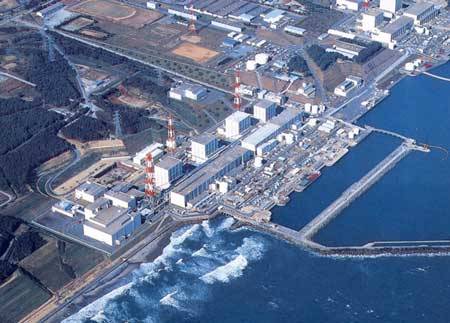
Japan’s Tokyo Electric Power Company (TEPCO) has restarted Unit 6 of the Kashiwazaki-Kariwa nuclear power plant, following a 14-year shutdown following the 2011 Fukushima disaster. The 1,360 MW reactor is the first unit to come online since the nuclear accident that saw Japan halt operations at all its nuclear plants pending regulatory changes.
The accident was caused by the 9.1-magnitude T?hoku earthquake – the third-largest in the world since 1900 – that triggered a tsunami, resulting in electrical grid failure and damage to nearly all of the power plant’s backup energy sources. With a total capacity of roughly 7,965 MW, the Kashiwazaki-Kariwa Nuclear Power Plant is the largest in the world.
TEPCO has implemented extensive, multi-layered safety enhancements at the Kashiwazaki-Kariwa Nuclear Power Plant to prevent accidents, particularly focusing on tsunami, earthquake, and terrorism risks. The company has constructed a 15-meter-high reinforced concrete seawall (extending 1,000 meters) to protect against tsunamis far exceeding the predicted maximum of 7-8 meters; critical buildings, including reactor and turbine buildings, have been fitted with heavy, watertight doors and barriers to prevent water from entering during a flood while essential equipment and emergency diesel generators have been moved to higher ground (up to 35 meters) to remain operational if the site floods.
Similar to many Western nations, Japan is doing a 180 on nuclear power after virtually ditching the power source as it looks to enhance energy security, reduce heavy reliance on expensive imported fossil fuels, meet rising electricity demand (including for AI data centers), and achieve 2050 carbon neutrality goals. Japan imports 60-70% of its electricity resources. In 2024, the country spent nearly $70 billion on liquefied natural gas (LNG) and coal imports, with nuclear power offering a [?] cheaper, [?] home-grown alternative.
Dounreay workers among 200 allowed to leave Nuclear Restoration Services’ UK in early exit scheme
By Iain Grant, John O’Groat Journal 10th Feb 2026
About 30 workers at Dounreay are believed to have been offered early leaving terms in a scheme designed to trim the size of Nuclear Restoration Services’ UK-wide workforce.
Many others at the Caithness site who applied for the mutually agreed voluntary exit (MAVE) initiative were unsuccessful.
The scheme, which has raised the hackles of unions, offers one month of salary per year of service, capped at 21 months of pay or £95,000.
No numbers for Dounreay have been made available but about 500 applied at NRS’s 14 sites throughout the country. Of those, about 200 have been made offers.
It is part of a wider Treasury drive to cut the public sector payroll following its growth during the pandemic.
About 1200 are employed by NRS at Dounreay though that will increase by more than 300 when plans to put NRS in charge of the neighbouring MoD plant at Vulcan come to pass.
Dounreay provide £128k over 3 years for STEM activities for Caithness and Sutherland primary pupils
Read More
The MAVE scheme is opposed by Prospect, which along with GMB and Unite, is running a What a Waste campaign, to highlight the loss of scarce, skilled specialists in the nuclear sector.
They claim the job cuts will cost the government more in the long term as it will put a spoke in the programme to decommission redundant nuclear sites and mean it has to fork out to rebuild the workforce in the future……………………..
In addition to Dounreay, NRS runs nuclear sites at Berkley, Bradwell, Chapelcross, Dungeness, Harwell, Hinkley Point, Hunterston, Oldbury, Sizewell, Trawsfynydd, Winfrith and Wyfla and the Maentwrog hydro-electric plant. https://www.johnogroat-journal.co.uk/news/dounreay-workers-among-200-allowed-to-leave-nrs-in-early-exi-426869/
REVEALED: Labour said Scottish nuclear study could be seen as ‘waste of money’
by Tom Pashby, The Canary 11th Feb 2026
The UK government has admitted that a study into the suitability of Scottish sites for new nuclear power projects could have been “a waste” of money. The government commissioned Great British Energy-Nuclear (GBE-N), a public body, to carry out the study.
The revelation came after Department for Energy Security and Net Zero (DESNZ) secretary of state Ed Miliband told Scottish journalists in October 2025 that:
given the growing interest in nuclear in Scotland, I’m asking GBE-N to assess Scotland’s capability for new nuclear power stations, including at Torness and Hunterston.
This is going to be a very, very big issue in the Scottish election campaign. We are saying yes to new nuclear in Scotland.
Labour hoping to end SNP ban on new nuclear in Scotland
Scotland is due to go to the polls to elect a new Scottish parliament and Scottish government in May 2026. Labour is hoping to wrest back control from the Scottish National Party (SNP).
In an article about the same interview published in October 2025, the Scotsman newspaper reported that a “senior UK government source” had said they were considering submitting planning applications for new nuclear developments at Torness and Hunterston because they expected a Scottish Labour victory at the Holyrood election.
The UK Labour Party and Scottish Labour support nuclear power and nuclear weapons. This position is coming under pressure as the Green Party of England and Wales, which vehemently opposes all nuclear, increasingly challenges Labour in public opinion polls.
Under the Freedom of Information (FOI) Act, the government released documents to the Canary about Miliband’s request to GBE-N. These included a Q&A document prepared by DESNZ officials. It revealed that officials knew there would be concerns about new nuclear proposals in Scotland.
No new nuclear can be built in Scotland because planning policy is a devolved matter, and the ruling SNP opposes nuclear power. The rebuttal in the DESNZ Q&A was that there is “cross-party interest in new nuclear” in Scotland.
Energy department officials contradict each other on responsibility for study
The documents released under FOI also revealed that a DESNZ official, whose name was redacted, had sought to reassure GBE-N colleagues that DESNZ was not “behind the briefing” in an email sent on 22 October 2025 at 4:02pm.
That position was contradicted by an email in a separate earlier conversation where, on 21 October 2025 at 6:46pm, John Staples, DESNZ director for new nuclear strategy and fusion energy, said:
our SpAds [special advisors] want SoS [secretary of state] to be able to say the below to Scottish journalists.
‘Below’ in the email were lines drafted for Miliband which included:
I will ask Great British Energy – Nuclear to begin assessing Scotland’s capability for new nuclear power stations.
The internally prepared Q&A included a question which asked:
Isn’t this study a waste of money?
The DESNZ answer said:
New nuclear projects can deliver millions of pounds of investment and thousands of high-quality jobs to a region – UK ministers want to understand the potential for new projects right across Great Britain.
The Canary approached the Labour Party for comment, which deferred to DESNZ. DESNZ did not respond to a request for comment.
‘Obvious’ that study would be ‘waste of money’ – Scottish CND
A Scottish Campaign for Nuclear Disarmament (CND) spokesperson told the Canary:
It is obvious that an assessment of the viability of new nuclear sites in Scotland would be a waste of money, since the foremost issue is not the viability of sites but Scottish government policy.
Energy policy is devolved to Holyrood and the Scottish government very sensibly opposes new nuclear plants in Scotland.
There are a whole host of reasons why new nuclear plants in Scotland would be a terrible idea, including the absolutely exorbitant cost of nuclear plant construction, the reliance on destructive and unjust international uranium supply chains, and the enormous and cross-generational burden of decommissioning nuclear plants, which in the case of Dounreay is expected to take hundreds of years.
In particular, the notion that Scotland, which is a net energy exporter and has the potential to become an international renewables powerhouse, should pivot to costly nuclear projects at this stage is somewhat absurd.
Investing the same sums invested in nuclear power plants – scores of billions and climbing for Hinkley Point C and Sizewell C – into the grid, home insulation and the renewables sector across Scotland would be an immeasurably better investment.
For Scottish CND, another concerning element of the renewed push for nuclear power is the deep imbrication [overlapping] of the ‘civil’ and military nuclear industries, as openly promoted in the 2025 Industrial Strategy.
From this perspective, investment in new nuclear power plants can be seen as defence spending by stealth and a means of shoring up the UK nuclear weapons industry – something which is of no benefit to Scotland and indeed causes major risks and harms in Scottish communities.
New nuclear would be incredibly expensive – Scottish government minister………………………………………………….
SNP criticises ‘Westminster obsession with nuclear’………………………………………………
‘New nuclear would waste time, money and political attention’ – Scottish Greens……………………………………… https://www.thecanary.co/uk/news/2026/02/11/scottish-nuclear-study/
Over 2,000 Britons served for Israel amid Gaza genocide
More than 2,000 Britons served in the Israel Defence Forces (IDF) during the Gaza genocide, it can be revealed.The information was obtained by Declassified via a Freedom of Information request issued to the IDF by lawyer Elad Man from the NGO Hatzlacha.The data outlines the number of people with dual and multiple nationalities who were IDF service members as of March 2025. |
It shows how 1,686 British-Israelis and a further 383 people with British, Israeli, and another nationality served in the IDF amid the annihilation of Gaza.
They were among over 50,000 IDF soldiers with Israeli and at least one other nationality.
The largest cohorts come from the US, Russia, Ukraine, France, and Germany.
Prior to this, data was only available on the number of Britons without Israeli citizenship serving in the IDF, so-called lone soldiers, a figure that was as low as 54.
The revelation that far more UK passport holders served in the IDF will raise serious legal questions for the British authorities, which have thus far failed to prosecute any citizens returning home after fighting in Gaza.
Paul Heron, a lawyer with the Public Interest Law Centre (PILC), told Declassified: “There must be no impunity where credible evidence links British nationals to grave breaches of international law.
The revelation that far more UK passport holders served in the IDF will raise serious legal questions for the British authorities, which have thus far failed to prosecute any citizens returning home after fighting in Gaza.Paul Heron, a lawyer with the Public Interest Law Centre (PILC), told Declassified: “There must be no impunity where credible evidence links British nationals to grave breaches of international law.“The UK has clear duties to prevent genocide and avoid assisting unlawful military action. “Where dual nationals have served in units implicated in atrocities, the authorities must investigate promptly and, where the evidence meets the threshold, pursue arrest and prosecution like any other serious crime”. |
Declassified contributor Hamza Yusuf previously exposed how Britons were serving in some of Israel’s “craziest” combat units in Gaza where they viewed Palestinian fighters as “rats” and “animals”.
Among the Britons identified by Yusuf was Levi Simon, who was seen “rummaging through the underwear drawers of Palestinian women forced to flee their homes” in Gaza. Another was master sergeant Sam Sank from London, who filmed himself fighting in Gaza between December 2023 and January 2024. |
Sank had told The Times that “based on the number of his friends in the IDF, which includes a Scot in his own small unit, [he] believes there are hundreds, if not thousands, more Britons fighting in Israel.”
Sank had told The Times that “based on the number of his friends in the IDF, which includes a Scot in his own small unit, [he] believes there are hundreds, if not thousands, more Britons fighting in Israel.” His estimates match with the data Hatzlacha has now obtained from Israeli authorities. The UK Foreign Office declined to comment on the new data but confirmed that it does not collect information on the number of Britons in the IDF. You can read the full story here. |
Nuclear Power – A White Elephant in the Energy Debate

By Pete Roche, David Hume Institute 12th Feb 2026,
https://davidhumeinstitute.org/latest-news/2026/2/12/nuclear-power-a-white-elephant-in-the-energy-debate
As Scotland prepares for elections, pro‑nuclear lobbyists are urging the Scottish Government to lift its ban on new nuclear developments.Yet the evidence shows that building new nuclear power stations would be an expensive white elephant — too slow, too costly, and ultimately unnecessary for tackling climate change.
Investing in nuclear now risks diverting resources from cheaper, faster, and safer renewable alternatives that are ready to deploy and without the risk of hazardous waste.
Nuclear makes us more vulnerable
Recent events in Europe underline nuclear’s vulnerabilities in a warming world. In summer 2025, prolonged heatwaves forced several French nuclear plants to reduce output or shut down entirely because the rivers and coastal waters used for cooling became too warm to operate safely. At sites including Golfech and Blayais operators had to curtail production, while the Gravelines plant faced additional disruption when swarms of jellyfish clogged its cooling systems. These incidents show how our changing climate can turn nuclear plants into operational white elephants at precisely the time electricity demand is high as people try to cool homes and buildings.
All energy sources produce carbon emissions over their lifecycle, but nuclear power stations typically emit more CO₂ per kilowatt-hour than wind or solar when construction, uranium mining, and waste management are included. For example, Sizewell C, currently under construction in Suffolk, is not expected to offset the emissions generated during its build phase until the late 2030s — well after the UK should have largely eliminated fossil fuels from electricity generation. Renewables, by contrast, deliver low-carbon power from day one.
Nuclear increases risk
Nuclear also carries long-term environmental and security risks. Coastal and riverside sites face rising sea levels and heatwave-induced water shortages, creating further potential for nuclear plants to become white elephants. They produce long-lived radioactive waste with no permanent disposal solution, are vulnerable to terrorism or armed conflict, and uranium mining causes serious ecological damage.
Advocates argue nuclear is needed for “baseload” power because wind and solar are variable. But baseload is an outdated concept.
Modern grid operators emphasise flexibility — blending renewables, storage, and demand management — rather than relying on inflexible generators. Large nuclear plants cannot easily ramp output to match demand and risk creating the same mismatch that critics cite for renewable variability. Proposed small modular reactors (SMRs) are similarly problematic: only two operate commercially worldwide, they are unproven at scale, and early evidence suggests they may be even more expensive per unit of electricity while producing more toxic waste — another potential white elephant.
Voters need real solutions, not white elephants
Meeting Scotland’s energy needs with renewables is feasible and cost-effective. Analyses suggest a renewable-first strategy could save the UK hundreds of billions compared to nuclear-centric plans, making the most of Scotland’s wind, solar, and engineering expertise. In contrast, costly nuclear projects risk becoming long-term white elephants — expensive, slow, and unsafe — at a time when voters need solutions that work now, not in a far distant future.
US Military Helping Trump to Build Massive Network of ‘Concentration Camps,’ Navy Contract Reveals
The Department of Homeland Security is using a repurposed $55 billion Navy contract to convert warehouses into makeshift jails and plan sprawling tent cities in remote areas.
Stephen Prager, Feb 02, 2026, https://www.commondreams.org/news/military-contract-concentration-camps
In the wake of immigration agents’ killings of three US citizens within a matter of weeks, the Department of Homeland Security is quietly moving forward with a plan to expand its capacity for mass detention by using a military contract to create what Pablo Manríquez, the author of the immigration news site Migrant Insider calls “a nationwide ‘ghost network’ of concentration camps.”
On Sunday, Manríquez reported that “a massive Navy contract vehicle, once valued at $10 billion, has ballooned to a staggering $55 billion ceiling to expedite President Donald Trump’s ‘mass deportation’ agenda.”
It is the expansion of a contract first reported on in October by CNN, which found that DHS was “funneling $10 billion through the Navy to help facilitate the construction of a sprawling network of migrant detention centers across the US in an arrangement aimed at getting the centers built faster, according to sources and federal contracting documents.”
The report describes the money as being allocated for “new detention centers,” which “are likely to be primarily soft-sided tents and may or may not be built on existing Navy installations, according to the sources familiar with the initiative. DHS has often leaned on soft-sided facilities to manage influxes of migrants.”
According to a source familiar with the project, “the goal is for the facilities to house as many as 10,000 people each, and are expected to be built in Louisiana, Georgia, Pennsylvania, Indiana, Utah, and Kansas.”
SUBSCRIBE TO OUR FREE NEWSLETTER
Daily news & progressive opinion—funded by the people, not the corporations—delivered straight to your inbox.
Now Manríquez reports that the project has just gotten much bigger after a Navy grant was repurposed weeks ago. It was authorized through the Worldwide Expeditionary Multiple Award Contract (WEXMAC), a flexible purchasing system that the government uses to quickly move military equipment to dangerous and remote parts of the world.
The contract states that the money is being repurposed for “TITUS,” an abbreviation for “Territorial Integrity of the United States.” While it’s not unusual for Navy contracts to be used for expenditures aimed at protecting the nation, Manríquez warned that such a staggering movement of funds for domestic detention points to something ominous.
“This $45 billion increase, published just weeks ago, converts the US into a ‘geographic region’ for expeditionary military-style detention,” he wrote. “It signals a massive, long-term escalation in the government’s capacity to pay for detention and deportation logistics. In the world of federal contracting, it is the difference between a temporary surge and a permanent infrastructure.”
He says the use of the military funding mechanism is meant to disburse funds quickly, without the typical bidding war among contractors, which would typically create a period of public scrutiny. Using the Navy contract means that new projects can be created with “task orders,” which can be turned around almost immediately, when “specific dates and locations are identified” by DHS.
“It means the infrastructure is currently a ‘ghost’ network that can be materialized anywhere in the US the moment a site is picked,” Manríquez wrote.
Amid its push to deport 1 million people each year, the White House has said it needs to dramatically increase the scale of its detention apparatus to add more beds for those who are arrested. But Manríquez said documents suggest “this isn’t just about bed space; it’s about the rapid deployment of self-contained cities.”
In addition to tent cities capable of housing thousands, contract line items include facilities meant for sustained living—including closed tents likely for medical treatment and industrial-sized grills for food preparation.
They also include expenditures on “Force Protection” equipment, like earth-filled defensive barriers, 8-foot-high CONEX box walls, and “Weather Resistant” guard shacks.
Eric Feigl-Ding, an epidemiologist and health economist, said the contract’s provision of materials meant to deal with medical needs and death was “extra chilling.” According to the report, “services extend to ‘Medical Waste Management,’ with specific protocols for biohazard incinerators.”
The new reporting from Migrant Insider comes on the heels of a report last week from Bloomberg that US Immigration and Customs Enforcement (ICE) has used some of the $45 billion to purchase warehouses in nearly two dozen remote communities, each meant to house thousands of detainees, which it said “could be the largest expansion of such detention capacity in US history.”
The plans have been met with backlash from locals, even in the largely Republican-leaning areas where they are being constructed:
This month, demonstrators protested warehouse conversions in New Hampshire, Utah, Texas and Georgia after the Washington Post published an earlier version of the conversion plan.
In mid-January, a planned tour for contractors of a potential warehouse site in San Antonio was canceled after protesters showed up the same day, according to a person familiar with the scheduled visit.
In Salt Lake City, the Ritchie Group, a local family business that owns the warehouse ICE identified as a future “mega center” jail, said it had “no plans to sell or lease the property in question to the federal government” after protesters showed up at their offices to pressure them.
On January 20, Sen. Chris Van Hollen (D-Md.) joined hundreds of protesters outside a warehouse in Hagerstown, Maryland, that was set to be converted into a facility that will hold 1,500 people.
The senator called the construction of it and other detention facilities “one of the most obscene, one of the most inhumane, one of the most illegal operations being carried out by this Trump administration.”
Reports of a new influx of funding from the Navy come as Democrats in Congress face pressure to block tens of billions in new funding for DHS and ICE during budget negotiations.
“If Congress does nothing, DHS will continue to thrive,” Manríquez said. “With three more years pre-funded, plus a US Navy as a benefactor, Secretary Kristi Noem—or any potential successor—has the legal and financial runway to keep the business of creating ICE concentration camps overnight in American communities running long after any news cycle fades.”
Israel Destroyed Gaza’s Hospitals. Now It’s Banning Doctors Without Borders.

Israel says it will start enforcing its ban on 37 aid groups in Gaza in March, putting more Palestinian lives at risk
.By Eman Abu Zayed , Truthout, February 12, 2026
On January 1, the Israeli occupation revoked the licenses of 37 international and local humanitarian organizations operating in Gaza, and it has now warned they must “must complete the cessation of their activities by March 1, 2026.” These organizations provide essential services to civilians: delivering food aid to the poor, supplying clean drinking water, supporting hospitals with medicines and medical equipment, protecting children and women, and overseeing education and nutrition programs in camps and local communities. The decision to revoke the licenses affects more than just paperwork — it threatens the lives of thousands of civilians who rely on this aid daily to survive one of the most severe humanitarian crises the territory has faced.
The license revocation came at the same time that Donald Trump established the “Board of Peace” tasked with overseeing Gaza’s reconstruction and implementing the second phase of the ceasefire. This international group, which includes no representation of Palestinians themselves, is allegedly responsible for facilitating the delivery of aid and the rebuilding of war-damaged areas. However, the ban on humanitarian organizations creates a significant gap, threatening the continuity of vital relief programs and leaving thousands of Palestinians without real protection amid harsh living conditions.
According to international humanitarian law, all parties in conflict are obliged to allow humanitarian aid to enter and to enable neutral organizations to assist those in need, regardless of political or security considerations. This obligation includes protecting civilians and ensuring the continued delivery of food, medicine, and clean water to affected populations. Under these laws, Israel bears the responsibility to permit these organizations to operate in Gaza and facilitate their activities in a way that does not endanger civilians or staff. Denying access to essential services constitutes a direct violation of international law.
According to testimonies from staff within aid organizations operating in Gaza, such as Oxfam, the restrictions imposed by Israel are seen as a means of pressuring humanitarian organizations to halt the delivery of vital aid. One Oxfam employee based in Gaza, who asked to remain anonymous due to fear of reprisal, explained that these measures are not merely about controlling aid — they aim to criminalize humanitarian work, weaken aid infrastructure, harm civilians, and increase daily suffering.
Staff members from the branch of Médecins Sans Frontières (Doctors Without Borders) based at Al-Aqsa Hospital confirmed to Truthout that the restrictions include detailed demands for employee information and operational locations, as well as strict administrative procedures, making it extremely difficult to continue their work and threatening the stability of food, medicine, and water services relied upon by thousands of civilians daily. In light of these pressures, employees believe that the real objective of these policies is not security, but rather to disrupt humanitarian work and widen the gap in aid delivery……………………………………………..
These restrictions come at a critical moment, as humanitarian workers face real dangers in carrying out their duties. Since the beginning of the Israeli assault in October 2023, at least 543 humanitarian workers have been killed while providing aid in Gaza, including staff from local and international organizations. Over 1,700 health care workers have lost their lives while attempting to deliver medical care to the wounded and other patients. Additionally, around 256 journalists and media personnel, as well as more than 140 civil defense workers, have been killed. These shocking statistics demonstrate how Israel has turned humanitarian work into a dangerous mission, threatening the continuity of essential services………………………………………………………………………………………………………………………….. https://truthout.org/articles/israel-destroyed-gazas-hospitals-now-its-banning-doctors-without-borders/?utm_source=Truthout&utm_campaign=6c4318efa8-EMAIL_CAMPAIGN_2026_02_12_10_34&utm_medium=email&utm_term=0_bbb541a1db-6c4318efa8-650192793
Our Leaders Couldn’t Fix Our Problems If They Wanted To (And They Don’t Want To)
Caitlin Johnstone, Feb 11, 2026, https://www.caitlinjohnst.one/p/our-leaders-couldnt-fix-our-problems?utm_source=post-email-title&publication_id=82124&post_id=187582757&utm_campaign=email-post-title&isFreemail=true&r=1ise1&triedRedirect=true&utm_medium=email
Our leaders are not going to fix the worst problems in our world. They couldn’t if they wanted to. And they don’t want to.
Our leaders are not wise or insightful. They’re not even particularly intelligent. Our society is led by plutocrats who only know how to make more money, by unelected empire managers who only know how to dominate and control, and by elected politicians who only know how to say the right words and make the right bargains in order to get themselves elected.
These people are not capable of curing our civilization of its dysfunction. They don’t have the necessary skills or attributes. Even if they weren’t a bunch of evil sociopaths who are only in the positions they’re in because of their willingness to collaborate with the agendas of oligarchy, war, militarism, imperialism, ecocide, exploitation, oppression and planetary domination, they don’t even have the personal characteristics necessary to do things like end poverty, rescue our biosphere, bring about world peace or give rise to human thriving. They’d have no idea where to star
I say this because as I watch Americans and Australians falling all over themselves to justify the recent police brutality in our respective nations, I am struck by how many people still believe our society is run by leaders who more or less know what they are doing and will guide us to more or less where we need to be. They view their government as a wise and beneficent father who knows what’s best for all of us, and they believe anyone who disagrees with Daddy is being naughty.
That’s really all it is. They’ll make up all sorts of justifications and excuses, but ultimately their police apologia arises from an infantile worldview which believes the authorities are right for no other reason than because they are in authority. They begin with their tongue on the boot of power, and then they make up reasons for why their tongue needs to be there.
That’s the worldview that gets a lot of people through their day. Believing our society is basically just and decent, and that we don’t need to concern ourselves with the world’s problems because we’ve got highly qualified leaders working hard at fixing them.
Believing our society is just and decent allows one to relax under the assumption that they deserve all the comforts they have in life and that the system will never turn against them. If someone is killed by police, or is impoverished or imprisoned or homeless, then it’s because they did something wrong and immoral, and all you need to do to avoid the same fate is follow the rules and make ethical choices. Under a just and decent system, good things happen to good people and bad things happen to bad people, so all you need to do is be good and you’ll be fine, and if things are going badly for you it’s because you deserve it.
Believing we’ve got highly qualified leaders working on our world’s problems allows one to relax under the assumption that everything’s taken care of. There’s no need to concern ourselves with all the information which tells us we’re plunging deeper and deeper into tyrannical dystopia on a collision course with environmental catastrophe under a globe-spanning empire that is fueled by human blood, because Daddy’s got it all taken care of.
Really these are just juvenile fairy tales designed to help us psychologically compartmentalize away from uncomfortable realities; no grown adult has any business believing them. But a lot of people would do anything to avoid internal discomfort. Entire psychological universes are constructed around the unconscious agenda of not feeling unpleasant feelings.
Daddy’s not gonna save us, kiddos. Daddy’s a serial killer with dead bodies in the attic, and many important parts of his brain are missing. Our problems aren’t going to get fixed until we get rid of Daddy. Getting rid of Daddy means forcibly getting rid of the entire system under which we live and replacing it with something that serves the interests of ordinary human beings.
Bootlickers hate revolutionary politics, because it is diametrically opposed to their infantile worldview of paternalistic government deities. But things aren’t going to get better until we find a way to get the steering wheel of our world out of the hands of the people who are currently in charge. Until then, everything’s just going to keep getting worse.
Submissions to the Federal Court of Appeal about UN Declaration on the Rights of Indigenous Peoples (UNDRIP)

Raven Trust, By Levin Chamberlain, February 10, 2026
Gitxaała Nation’s recent decision in the British Columbia Court of Appeal (BCCA) in Gitxaala v. British Columbia (Chief Gold Commissioner), 2025 BCCA 430 that incorporates the United Nations Declaration on the Rights of Indigenous Peoples (UNDRIP) into positive law is getting attention. While media outlets are focused on David Eby’s commitment to amending the Declaration on the Rights of Indigenous Peoples Act (DRIPA) — undermining the rule of law and potentially reversing decades of reconciliation — behind the scenes, there’s a company trying to further undermine Indigenous rights – Canadian Nuclear Laboratories (CNL).
CNL recently filed a submission in Kebaowek First Nation’s case over the proposed nuclear waste facility on their territory, a legal case that RAVEN has supported for almost two years. If built in its current location, the facility would hold over one million cubic metres of nuclear waste just one kilometre from the Kichi Sibi (Ottawa river), which provides millions of people with clean drinking water.
Kebaowek recently went to the Federal Court of Appeal with CNL, who is seeking to overturn the need for the First Nation’s free, prior, and informed consent over the consultation process to build the nuclear waste facility. You can read more about the decision and why Kebaowek cross-appealed here.
With the BCCA decision in Gitxaała’s case being such a powerful precedent that incorporates UNDRIP, the Federal Court judges gave CNL and Kebaowek the opportunity to make new submissions specifically about this decision. Not only does this show how interconnected Indigenous-led litigation is (which RAVEN is integral to in supporting both cases), but it also allows for both sides to share new perspectives.
The Submissions
CNL’s response with a new submission to the courts argues that Gitxaała’s case is “wholly distinguishable” from their case, and that it doesn’t alter the one sole point that CNL is relying on: consultation with Kebaowek was fulfilled. They comb through the specific differences between DRIPA and Canada’s own United Nations Declaration on the Rights of Indigenous Peoples Act (UNDA) in attempts to show how UNDA shouldn’t be taken the same way as DRIPA. CNL also criticizes two aspects of the BCCA’s decision in Gitxaala v. British Columbia as “unsupported statements of law.”
Is that fear we are picking up on in CNL’s submission? Or is it just pure hypocrisy……………………………………..
The Reality
Unfortunately, instead of navigating toward reconciliation between the Crown, industry, and Indigenous Peoples, we are witnessing more conflict and tension than before. UNDRIP and its incorporation into positive law in Canada should be something to celebrate with clear pathways toward long-term economic development and environmental protections while honouring Indigenous rights and their territories. Working in a good way with First Nations, like Kebaowek, is crucial for getting decisions right, especially in a world with a rapidly accelerating climate, sincere threats to democratic processes, and a troubling shift of public support away from reconciliation.
In 2007, Canada and three other nation-states initially opposed the ratification of UNDRIP. They opposed enshrining the human rights of Indigenous Peoples on an international stage. That – and much, much worse – will always be a part of our dark history in Canada. Unless we see a real shift in accountability and action, future generations will view this time period and the responses by industry and the Crown as another era of oppression.
But, even if the decision is overturned and Kebaowek doesn’t have their day at the Supreme Court of Canada; even if David Eby is successful in reducing the legal teeth of UNDRIP for Indigenous Peoples to use in B.C.’s courtrooms; even if something similar happens to UNDA; there will be no end to pursuits for justice. UNDRIP rights are fundamental human rights of Indigenous Peoples that are just now being recognized through colonial doctrines. These rights have existed since time immemorial in their own beautiful and unique ways, and although injustice is present, the people will continue to resist, and justice shall persist. https://raventrust.com/articles/the-law-is-connected-new-submissions-to-the-federal-court-of-appeal-about-undrip/
Whitehaven’s Polluted Harbour is “Riviera of the North” NuSpeak Lives
FEB 10, 2026, Lakes Against Nuclear Dump
This months Cumbria Life has a gushing “People and Places” article “A Day Out in Whitehaven” with the strap line “Cornwall and Cannes eat your heart out- Discover a popular seaside town on the Cumbrian Coast” Words and Photos by Geneve Bartholomew – Brand.
The article makes much of the Sellafield funded Beacon Museum and Edge water sports centre along with the also Sellafield funded new gaming centre called LEVELS “a new digital and gaming hub located at the Grade 11 listed former Whittles building in the heart of the town.” The gaming hub will no doubt be a recruitment source for the next generation of AI robotics operators at Sellafield.
The heart of the town is being bought up by Sellafield with a pithy letter in the 4th February Whitehaven News from former councillor Tim Knowles saying “I was recently concerned that Whitehaven had experienced some kind of emergency. The town seemed full of people wandering around in high visibility clothing but with no apparent purpose. I was later told that this is the latest in Sellafield outfitting…..is the Hi Vis -uniform becoming a rather “in your face” badge of relative wealth around town.” The letter goes on to remark about “the number of sheds and fences painted in the famous “BNFL blue” all around West Cumbria.” (takeaways still happen)
Many £Millions of pounds of taxpayers money are being poured into Whitehaven filtered through the big brother hands of Sellafield. That is not all that is being poured into Whitehaven.
What the “Riviera of the North” article in Cumbria Life fails to mention is the outrageous state of the harbour with water that can no longer be called water in the docks. The ongoing pollution event started in 2022 and has continued ever since with the acid mine pollution from historic mines which includes the sulphur producing Anhydrite Mine at the old Marchon site (now scandalously approved for housing) . The ‘water’ only ran clear for a short time last September when Silt Buster machines were in operation in the rail tunnel which drains to the culvert in Queen’s Dock.
We recently released FOI answers to the authorities and the press. BBC online did cover this albeit not telling the whole story but with much more openness that that previously aired and certainly without the rose tinted specs of the Cumbria Life article. If this ongoing pollution event was happening in Cornwall or Cannes there would be banner headlines worldwide. But here in Whitehaven there are vested interests in keeping schtum about the impacts of deep mining because guess who wants to mine out the biggest void ever on the Lake District coast – yep our generous benefactor Sellafield.
The BBC online article can be read in full here extract below [on original] https://lakesagainstnucleardump.com/2026/02/10/whitehavens-polluted-harbour-is-riviera-of-the-north-nuspeak-lives/?page_id=1772
WANTED: Volunteers to host nuclear waste, forever
By Sarah Mcfarlane, Timothy Gardner and Susanna Twidale, February 6, 2026, https://www.reuters.com/sustainability/land-use-biodiversity/wanted-volunteers-host-nuclear-waste-forever-2026-02-06/
- U.S. wants campuses to host nuclear facilities and data centers
- Asks states to volunteer, permanent waste disposal a must-have
- No deep geological waste facility yet in operation worldwide
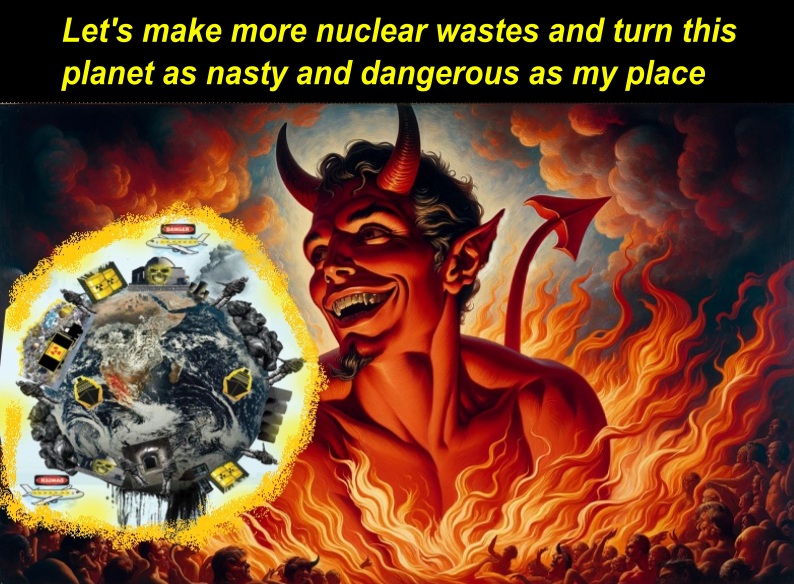
LONDON/WASHINGTON, Feb 6 (Reuters) – The Trump administration’s plan to unleash a wave of small futuristic nuclear reactors to power the AI era is falling back on an age-old strategy to dispose of the highly toxic waste: bury it at the bottom of a very deep hole.
But there’s a problem. There is no very deep hole, and the stockpile of some 100,000 tons of radioactive waste being stored temporarily at nuclear plants and other sites across the United States keeps getting bigger.
To resolve this quandary, the U.S. administration is now dangling a radioactive carrot.
States are being asked to volunteer to host a permanent geological repository for spent fuel as part of a campus of facilities including new nuclear reactors, waste reprocessing, uranium enrichment and data centers, according to a proposal published by the Department of Energy (DOE) last week.
Its request for information (RFI) marks a big shift in policy. The plan to boost nuclear energy is now combined with a requirement to find a permanent home for waste and puts decisions in the hands of local communities – decisions worth tens of billions of dollars in investment and thousands of jobs, according to a spokesperson for the DOE’s Office of Nuclear Energy.
“By combining this all together in a package, it’s a matter of big carrots being placed alongside a waste facility which is less desirable,” said Lake Barrett, a former official at the U.S. Nuclear Regulatory Commission (NRC) and the DOE. States including Utah and Tennessee have already expressed interest in nuclear energy investments, he said.
The nuclear office said the request had generated interest but did not comment on individual states, which have 60 days to respond. Officials in Utah and Tennessee did not respond to requests for comment.
President Donald Trump wants to quadruple U.S. nuclear power capacity, opens new tab to 400 gigawatts by 2050 as electricity demand surges for the first time in decades thanks to the boom in data centers driving artificial intelligence and the electrification of transport.
In 2025, the DOE picked 11 new advanced nuclear test reactor designs for fast-track licensing and aims to have three pilots built by July 4 this year.
However, public acceptance of nuclear energy hinges partly on the promise of burying nuclear waste deep underground, according to studies by the U.S. and British governments as well as the European Commission.
“A complete nuclear strategy must include safe, durable pathways for final disposition, and that remains a required element of the RFI,” the Office of Nuclear Energy spokesperson said.
Previous efforts to find a solution have run into strong local opposition.
The DOE started looking for a permanent waste facility in 1983 and settled on Nevada’s Yucca Mountain in 1987. But former President Barack Obama halted funding in 2010 due to opposition from Nevada lawmakers worried about safety and the effect on casinos and hotels – with nearly $15 billion already spent.
NEW REACTOR DESIGNS
To accelerate the deployment of nuclear power, countries including the United States, Britain, Canada, China and Sweden are championing so-called small modular reactors (SMRs).
The appeal of SMRs lies in the idea they can be mostly prefabricated in factories, making them faster and cheaper to assemble than the larger reactors already in use.
But none of the new SMR designs are expected to solve the waste problem. Experts say designers are not compelled to consider waste at inception, beyond a plan for how it will be managed.
“This rush to create new designs without thinking about the full system bodes really poorly for effective regulatory oversight and having a well-run, safe, and reliable waste management program over the long term,” said Seth Tuler, associate professor at the Worcester Polytechnic Institute and previously on the U.S. Nuclear Waste Technical Review Board.
Most of the new SMRs are expected to produce similar volumes of waste, or even more, per unit of electricity than today’s large reactors, according to a study published in the Proceedings of the National Academy of Sciences in 2022.
SMRs can also be sited in areas lacking the infrastructure needed for larger plants, raising the prospect of many more nuclear sites which could become interim waste dumps too. And in the United States, “interim” can mean more than century after a reactor closes, according to the U.S. nuclear power regulator.
Reuters contacted the nine companies behind the 11 SMR designs backed by the DOE’s fast-track programme. Some said nuclear waste was an issue for the operators of the reactors, and the government.
Others said they hoped technological advances in the coming decades would improve prospects for reprocessing fuel, although they agreed a permanent repository was still needed.
The prospect of a new wave of nuclear reactors, has rekindled interest in reprocessing spent fuel whereby uranium and plutonium are separated out and, in some instances, reused.
“Modern technologies, particularly advanced recycling and reprocessing, can dramatically shrink the volume of nuclear material requiring disposal,” the spokesperson for the nuclear energy office said. “At the same time, reprocessing does not eliminate the requirement for permanent disposal.”
Nuclear security experts, however, questioned whether reprocessing would be included in any of the new campuses.
“Every time it’s been attempted, it’s failed, it creates security and proliferation risks, the costs are enormous, and it complicates waste management,” said former DOE official Ross Matzkin-Bridger. He said the few countries reprocessing fuel were recycling between zero to 2%, far below the 90% promised.
A PERMANENT PROBLEM
For now, most waste in the United States, Canada, Europe, and Britain is stored on site indefinitely, first in spent fuel pools to cool and then in concrete and steel casks. France sends spent fuel to La Hague in Normandy for reprocessing.
The more than 90 nuclear reactors operating in the United States – the world’s biggest nuclear power producer ahead of China and France – add about 2,000 tons of waste a year to existing stockpiles, according to the DOE.
Office of Nuclear Energy data shows that as of the end of 2024, U.S. taxpayers have paid utility companies $11.1 billion to compensate them for storing spent fuel, some of which can remain harmful to humans for hundreds of thousands of years.
Scotland’s Dounreay site, where the last reactor closed in 1994, has repeatedly extended its decommissioning period and budget due to complications handling waste, according to the British government, in an early sign of the issues the industry faces as older plants shut down.
Vast vaults are being stocked with low-level radioactive waste in large metal containers as Dounreay, once at the cutting edge of Britain’s nuclear industry, is dismantled.
Ever since the first commercial nuclear plant went online 70 years ago in England, the consensus has been that burying the most toxic waste deep underground is the safest option but there is still no repository in operation anywhere in the world.
Getting a repository up and running is a slow process. Governments need community buy-in and geological studies are required to determine the flow of groundwater and the stability of the rock up to 1,000 metres (1,090 yards) underground.
Finland has made the most progress and is close to opening the world’s first permanent nuclear repository in Olkiluoto – having also kicked off the process way back in 1983.
Posiva, the Finnish company behind the project, began transferring test canisters more than four hundred meters below ground in 2024. It told Reuters its goal is to start commercial operations this year, though it is waiting for the Finnish Radiation and Nuclear Safety Authority to approve the operating licence, which will be followed by technical checks.
Once up and running, separate underground tunnels will be filled with canisters made of copper and iron housing the waste, and then sealed forever.
Sweden began constructing its permanent repository in January 2025, aiming to have it running by the late 2030s. Canada has agreed a site in Ontario which it aims to be operational by the late 2040s. Switzerland and France have chosen sites too and hope to have their repositories open from about 2050. Britain is shooting for the late 2050s, but has yet to settle on a location.
Pending the construction of a permanent repository somewhere in the country, high-level waste from nuclear sites such as Dounreay is sent for storage at Sellafield in England.
Some decommissioned nuclear sites, including Dounreay, are also being promoted as locations for data centers, as they’re hooked up to the power grid already and won’t need to wait for a connection.
But the clean-up there has a way to go. Irradiated nuclear fuel was flushed into the sea decades ago and a “minor” radioactive fragment was found on a local beach as recently as January.
The last “significant” particle was found in April and fishing is banned within a 2 kilometer (1.25 mile) radius of Dounreay’s outlet pipe because of radioactive particles on the seabed.
Last year, Britain extended the time frame for the Dounreay clean-up from 2033 to the 2070s.
Reporting by Sarah McFarlane and Susanna Twidale in London, Timothy Gardner in Washington; Visual Production by Morgan Coates; Editing by David Clarke
Leading Papers Call for Destroying Iran to Save It

Gregory Shupak, February 10, 2026, https://fair.org/home/leading-papers-call-for-destroying-iran-to-save-it/
The United States has no right to wage war on Iran, or to have a say who governs the country. The opinion pages of the New York Times and Washington Post, however, are offering facile humanitarian arguments for the US to escalate its attacks on Iran. These are based on the nonsensical assumption that the US wants to help brighten Iranians’ futures.
In two editorials addressing the possibility of the US undertaking a bombing and shooting war on Iran, the Washington Post expressed no opposition to such policies and endorsed economic warfare as well.
Crediting Trump with “the wisdom of distinguishing between an authoritarian regime and the people who suffer under its rule,” the first Post editorial (1/2/26) approvingly quoted Trump’s Truth Social promise (1/2/26) to Iranian protesters that the US “will come to their rescue…. We are locked and loaded and ready to go.”
For the Post, the problem was not that Trump was threatening to bomb a sovereign state, but that “airstrikes are, at best, a temporary solution”:
If the administration wants this time to be different, it will need to oversee a patient, sustained campaign of maximum pressure against the government…. The optimal strategy is to economically squeeze the regime as hard as possible at this moment of maximum vulnerability. More stringent enforcement of existing oil sanctions would go a long way…. Western financial controls are actually working quite well.
Thus, the paper offers advice on how to integrate bombing Iran into a broader effort to overthrow the country’s government in a hybrid war. Central to that project are the sanctions with which the Post is so thoroughly impressed. Such measures have “squeeze[d] the regime” by, for example, decimating “the government’s primary source of revenue, oil exports, limiting the state’s ability to provide for millions of impoverished Iranians through social safety nets” (CNN, 10/19/25).
That the US continues to apply the sanctions, knowing that they have these effects, demonstrates that it has no interest in, as the Post put it, “free[ing]” Iranians “from bondage.”
‘Always more room for sanctions’
The second Washington Post editorial (1/23/26) expressed disappointment that, despite “mass killings” and the “most repressive crackdown in decades,” “Trump has ratcheted back his earlier rhetoric.” It emphasized that “the regime is now mocking Trump for backing down.” The paper offered advice for the president:
Airstrikes alone won’t bring down the regime—or make it behave like a normal country. But Israel and the US have shown in recent years that bombing can cause significant tactical setbacks. And there is always more room for sanctions pressure….
The president cannot maintain effective deterrence by turning the other cheek [in response to Iranians who have taunted him]. How he responds is just as important as how quickly he does it.
The implication is that, to deter Iran’s government from killing Iranians, the US needs to kill Iranians. After all, bombing campaigns come with “mass killings” of their own: The US/Israeli aggression against Iran last June killed more than 1,000 Iranians, most of them civilians.
Meanwhile, those sanctions the paper wants to use to deter the Iranian government from “harm[ing] its own people” do quite a bit of damage in their own right, often causing “low-income citizens’ food consumption” to “deteriorate due to sanctions”—a rather novel approach to harm reduction.
Bombing other countries, depriving them of food—is this what it means to “behave like a normal country”?
‘Too depraved’ for reform
Over its own pro–regime change piece, the New York Times editorial board headline (1/14/26) declared: “Iran’s Murderous Regime Is Irredeemable.”
“The Khamenei regime is too depraved to be reformed,” the editors wrote, spending the majority of the piece building its case to that effect before turning to solutions. For the Times, these start “with a unified expression of solidarity with the protesters,” and quickly move to punitive measures against the Iranian government:
The world can also extend the sanctions it has imposed on Iran. The Trump administration this week announced new tariffs on any countries that do business with Iran, and other democracies should impose their own economic penalties.
For the authors, “deprav[ity]” needs to be resisted by Washington and its partners, who have demonstrated their moral superiority with their presumably depravity-free sanctions. These have, as Germany’s DW (11/23/25) reported, “caused medical shortages that hit [Iran’s] most vulnerable citizens hardest,” preventing the country from being able “to purchase special medicines—like those required by cancer patients.”
The Times also supported US military violence against Iran—if with somewhat more restraint than the Post, asking Trump to “move much more judiciously than he typically does.” The Times wants him to seek “approval from Congress before any military operation,” and make “clear its limitations and goals.” The paper warned Trump not to attack “without adequate preparation and resources”:
Above all, he should avoid the lack of strategic discipline and illegal actions that have defined the Venezuela campaign. He should ask which policies have the best chance of undermining the regime’s violent repression and creating the conditions for a democratic transition.
One glaring problem with suggesting that a US “military operation” should be based on “policies [that] have the best chance of…creating the conditions for a democratic transition” is that very recent precedents show that US wars don’t bring about democracy, and are not intended to do so; instead, such wars bring about social collapse.
Consider, for example, US interventions in Libya and Syria. In both cases, the US backed decidedly nondemocratic forces (Jacobin, 9/2/13; Harper’s, 1/16) and, as one might expect, neither war resulted in democracy. In Libya’s case, the outcome has been slavery and state collapse (In These Times, 8/18/20). In Syria, the new, unelected government is implicated in sectarian mass murder (FAIR.org, 6/2/25).
If DHS killed Pretti, why not bomb Iran?
There are no grounds for believing that the US would chart a different course if it bombs Iran again. But that hasn’t stopped other Times contributors from suggesting that the US should conduct a war in Iran—for the good of Iranians, of course.
Times columnist Bret Stephens (1/27/26) worried about the “risk” posed by “the example of a US president who urged protesters to go in the streets and said help was on the way, only to betray them through inaction.”
Invoking the DHS’s killing of Minneapolis resident Alex Pretti, Stephens urged “thoughtful Americans” to encourage the same administration that killed him to exercise “the military option” in Iran:
But if Pretti’s death is a tragedy, what do we say or do in the face of the murder of thousands of Iranians? Are they, as Stalin might have said, just another statistic?
Stephens is citing people’s outrage against the US government killing a protester as a reason they should support the US government inflicting more violence against Iran. The logical corollary to that would be that if you’re opposed to Iran suppressing anti-government forces, you should therefore be in favor of Tehran launching armed attacks to defend protesters in the US.
Masih Alinejad, a US-government-funded Iranian-American journalist, wrote in the Times (1/27/26) that Trump
encouraged Iranians to intensify their mass protests, writing, “HELP IS ON ITS WAY.” That help never came, and many protesters now feel betrayed. Still, the USS Abraham Lincoln aircraft carrier strike group has recently arrived in the Middle East. Mr. Trump has not said what he plans to do now that it is there, but it does give him the option of striking a blow against government repression.
Policy of pain
Both Stephens and Alinejad present their calls for the US to assault Iran in moral terms, suggesting that the US should demonstrate loyalty to Iranian protestors by “help[ing]” them through an armed attack on the country in which they live. Their premise is that the US is interested in enabling the Iranian population to flourish, an assertion contradicted by more than 70 years of Washington’s policy of inflicting pain on Iranians in an effort to dominate them.
That US policy has included overthrowing Iran’s democratically elected government in 1953 (NPR, 2/7/19), propping up the Shah’s brutal dictatorship for the next 26 years (BBC, 6/3/16; AP, 2/6/19), sponsoring Saddam Hussein’s invasion of the country and use of chemical weapons against it (Foreign Policy, 8/26/13), partnering with Israel in a years-long campaign of murdering Iranian scientists (Responsible Statecraft, 12/21/20), and currently maintaining—along with its allies—a sanctions regime that is associated with a substantial drop in Iranian life expectancy (Al Jazeera, 1/13/26).
If Stephens or Alinejad had evidence that the US is so radically re-orienting its conduct in the international arena, one imagines that they would want to share with their readers the proof that the Trump administration’s magnanimity is so profound that it overrides the UN Charter, and justifies America carrying out a war to “help” a country it has terrorized for decades.
1 This Month

Petition to revoke the licensing of the Near Surface Nuclear Disposal Facility (NSDF) at Chalk River. https://www.ourcommons.ca/petitions/en/Petition/Details?Petition=e-7247


of the week – STOP SMALL MODULAR REACTORS IN CANADA
To see nuclear-related stories in greater depth and intensity – go to https://nuclearinformation.wordpress.com
-
Archives
- March 2026 (156)
- February 2026 (268)
- January 2026 (308)
- December 2025 (358)
- November 2025 (359)
- October 2025 (376)
- September 2025 (258)
- August 2025 (319)
- July 2025 (230)
- June 2025 (348)
- May 2025 (261)
- April 2025 (305)
-
Categories
- 1
- 1 NUCLEAR ISSUES
- business and costs
- climate change
- culture and arts
- ENERGY
- environment
- health
- history
- indigenous issues
- Legal
- marketing of nuclear
- media
- opposition to nuclear
- PERSONAL STORIES
- politics
- politics international
- Religion and ethics
- safety
- secrets,lies and civil liberties
- spinbuster
- technology
- Uranium
- wastes
- weapons and war
- Women
- 2 WORLD
- ACTION
- AFRICA
- Atrocities
- AUSTRALIA
- Christina's notes
- Christina's themes
- culture and arts
- Events
- Fuk 2022
- Fuk 2023
- Fukushima 2017
- Fukushima 2018
- fukushima 2019
- Fukushima 2020
- Fukushima 2021
- general
- global warming
- Humour (God we need it)
- Nuclear
- RARE EARTHS
- Reference
- resources – print
- Resources -audiovicual
- Weekly Newsletter
- World
- World Nuclear
- YouTube
-
RSS
Entries RSS
Comments RSS
 nuclear-news