Danger déjà vu

by beyondnuclearinternational, https://beyondnuclearinternational.org/2025/10/01/danger-deja-vu/
With offsite power cut, peril returns to the Zaporizhzhia nuclear power plant in war-torn Ukraine, writes Linda Pentz Gunter
We have been here before, nine times. External power provided by the grid has been lost, backup diesel generators have been called into duty, and Ukraine and the rest of the world has held its collective breath, hoping we are not about to witness another major nuclear disaster.
This is once again the situation at the six-reactor Zaporizhzhia nuclear power plant (ZNPP) in southeast Ukraine, where for the tenth time external power has been lost. By September 30, that blackout had lasted seven days, the longest such stretch since the plant was first occupied by Russian forces on March 4, 2022, ten days after Russia invaded Ukraine and provoked a war that shows no sign of ending anytime soon.
Alarm is especially high at the Zaporizhzhia site given its size — the largest nuclear power plant in Europe — and enormous radioactive waste inventory of more than 2,000 metric tons. The plant has been embroiled in some of the worst of the fighting and has already suffered previous damage.
Meanwhile, Ukraine’s other nine reactors at three other sites are by no means immune to the dangers of being caught up in an indefinite war zone. In late September, a drone detonated just 875 yards from the perimeter of the South Ukraine three-reactor nuclear power plant. Monitors from the International Atomic Energy Agency (IAEA) said they observed at least 22 drones close to the facility.
“Once again, drones are flying far too close to nuclear power plants, putting nuclear safety at risk,” wrote the IAEA’s director general, Rafael Grossi in a September 25 statement after the drone incident. “Fortunately, last night’s incident did not result in any damage to the South Ukraine Nuclear Power Plant itself. Next time we may not be so lucky.” The IAEA nevertheless continues ardently to promote the use and expansion of nuclear power around the world.
Currently, all six reactors at Zaporizhzhia are in cold shutdown, which means less cooling is needed, but they are by no means out of danger. However, it is unclear how many members of the trained Ukrainian plant staff remain to operate the facility. According to an alarming new investigative report, Seizing Power, prepared by Truth Hounds and supported by Greenpeace Ukraine, numerous personnel have been abducted from the plant, interned and even tortured.
Cold shutdown means that fissioning in the reactors has stopped and the temperature of the reactor cores is below 200 F with the coolant system at atmospheric pressure. But this does not mean that further cooling is no longer required.
The fuel inside the reactors remains hot and requires a steady flow of cooling water which is why power is still needed on the site. Failure to achieve this would mean the fuel rods would heat up the water in the core, causing it to boil away, exposing the rods. This could then lead to fires, which in turn could cause hydrogen explosions of the kind we saw at the Fukushima Daiichi nuclear plant in March 2011. A meltdown is also still possible, although the time it would take to reach such a critical juncture is longer when the reactors are not operating.
The fuel pools, where much of the irradiated fuel is stored, also require continued cooling, although less so than the reactors, and risk the same outcome if cooling stops— a boiling away of the water exposing the rods and leading to a potential fuel pool fire.
The offsite power was being provided by the one still functioning power line into the site. Without it, workers have had to deploy backup diesel generators. There are reportedly 18 of these on site, with seven currently in use. But they cannot provide power indefinitely.
Accessing cooling water has also become more of a challenge. The Kakhovka Dam was destroyed in June 2023 leading to the depletion of the Kakhovka Reservoir, the vital water source for the Zaporizhzhia plant. Indeed, according Seizing Power, “the license to operate the ZNPP was premised on the availability of the Kakhovka Reservoir to supply water to the ZNPP and, in the event of an emergency, to function as a vital heat sink.” Instead, operators have been drilling for groundwater wells on-site in order to keep cooling water flowing into the reactors and the pools.
Of the 2,000 tons of radioactive waste stored on the Zaporizhzhia site, 855 tons are in the fuel pools and the rest in waste fuel casks. There are 200 different radioactive isotopes that could be released in the event of a disaster, an eventuality that could lead to both serious and fatal health consequences for those exposed, as well as longterm contamination of the environment and natural resources.
Such a release would also have a devastating impact on Ukraine’s economy, given the country’s role as a major agricultural exporter. Known as the “breadbasket of Europe,” Ukraine’s agricultural products account for close to 60 percent of all exports, predominantly grains.
And yet, despite the on-going war, “Ukraine’s agricultural exports reached $24.5 billion in 2024, accounting for 59% of the country’s total exports,” according to January 2025 figures from the Ukrainian Agriculture Ministry.
It is a loss Ukraine cannot afford but we have of course seen this very outcome once before, after the April 26, 1986 Chornobyl explosion and meltdown in Ukraine that left lands in much of the former Soviet Union and parts of Europe permanently radioactively contaminated.
Operating a nuclear power plant safely, even in shutdown mode, can be jeopardized by multiple external factors, but how the workforce functions is also key. Both the Three Mile Island and Chornobyl nuclear disasters were the result of human error. When people are working under duress and especially extreme fear, mistakes become more likely.
That makes the revelations in Seizing Power all the more shocking. Researchers compiled their evidence through firsthand accounts from the residents of Enerhodar, the city where the plant is located and which was also captured on March 4, 2022. After resistance to the occupation failed, the report said, “Repression and violence quickly became systematic, targeting territorial defense volunteers, pro-Ukrainian activists, and ZNPP staff who refused to collaborate, among others.”
At least seven detention centers were established, said the report, where at least 226 Enerhodar residents and ZNPP employees were held captive, “subjected to physical and psychological torture to extract information, force confessions, punish dissent, intimidate, and coerce collaboration. Russian forces deprived detainees of food, water, and medical care, contrary to the provisions of international law. Torture, including beatings, electrocution, sexual violence, mock executions, and threats to family members of detainees, became routine.”
Why would either side gamble with such a lethal liability as the safety of a nuclear power plant, given the potentially drastic outcome whose resulting deadly radioactive plume would know no borders? Russia has accused Ukraine of damaging the power lines near the plant. The Ukrainians have in turn suggested the Russians are using the disabling of the plant as a threat to drive them into submission and cede territory in the east. The Russians have already signaled that they intend to use the plant to supply electricity to Russia once it is safe to restart the reactors.
That the war in Ukraine (and others elsewhere) must end, is stating the obvious. Human suffering around the world is already too great and entirely avoidable. Wars involving nuclear power plants ramp up the risks monumentally. But those dangers are also ever present, given nuclear power is inherently dangerous both on good days and bad.
As we watch ever greater militarization occurring here in the United States, with war declared by the White House on our own cities and “the enemy within”; with the abrupt and unlawful detentions and deportations of workers; and with the reckless determination to keep not only our aging nuclear fleet in operation but also to revive already closed and dangerously decrepit reactors; we, too, are one wrong move away from experiencing a nuclear disaster.
A Serious Proposal: Russia and China Call for Global Strategic Stability.
By Alice Slater*https://indepthnews.net/a-serious-proposal-russia-and-china-call-for-global-strategic-stability/
NEW YORK | 1 October 2025 (IDN) — It’s ironic that the arms control community is protesting the idea of resuming nuclear test detonations. The nuclear test detonations have never stopped.
Although Bill Clinton signed the Comprehensive Test Ban Treaty (CTBT) in 1996, he swiftly funded the “Stockpile Stewardship” program at the US nuclear weapons complex, allowing the Dr. Strangeloves in their labs to continue to perform laboratory tests as well as blowup plutonium with chemical explosives,1,000 feet below the desert floor at the Nevada Test Site on Western Shoshone holy land.
Since there was no chain reaction causing criticality, Clinton claimed these “sub-critical” tests were not nuclear tests and didn’t violate the new treaty. Of course, Russia and China swiftly followed the US lead; the Russians continued to test at Novaya Zemlya, and China at Lop Nor.
Indeed, it was the US’s refusal to promise that the Comprehensive Test Ban Treaty would be truly “comprehensive” that caused India and Pakistan to test their nuclear arsenals after the US rejected their pleas to include prohibitions against “sub-critical” and laboratory tests in the CTBT. Although Clinton signed the CTBT, the US, unlike Russia and China, never ratified it. Sadly, Russia announced during the Ukraine war that it was leaving the CTBT.
People of goodwill who are alarmed at new reports of proliferating nuclear weapons and would like to put the nuclear genie back in the bottle, stop the endless wars and huge budgets for useless atomic weapons, would do well to take some advice from Russia and China. On May 8, they issued a “Joint Statement by the Russian Federation and the People’s Republic of China on Global Strategic Stability” in the context of the 80th anniversary of the end of World War II.
They note “the serious challenges facing the international community” and lay out several recommendations that would strengthen “global strategic security”, acknowledging that “the destinies of all countries are interrelated” and urging that states not “seek to ensure their own security at the expense and to the detriment of the security of other states.”
US “Golden Dome”
They proceed to explain a whole series of provocative actions that threaten the peace, including states deploying nuclear weapons and missiles outside their territories. They are particularly critical of the US “Golden Dome” program, which is expected to create a new battleground in space. Reiterating their pleas over many years to keep space for peace, they state the following:
The two sides oppose the attempts of individual countries to use outer space for armed confrontation. They will counter security policies and activities aimed at achieving military superiority, as well as at officially defining and using outer space as a ” warfighting domain”. The two Sides confirm the need to start negotiations on a legally binding instrument based on the Russian-Chinese draft of the treaty on the Prevention of the Placement of Weapons in Outer Space and of the Threat or Use of Force Against Outer Space Objects as soon as possible, that would provide fundamental and reliable guarantees for preventing an arms race in outer space, weaponization of outer space and the threat or use of force against outer space objects or with their help. To safeguard world peace, ensure equal and indivisible security for all, and improve the predictability and sustainability of the exploration and peaceful use of outer space by all States, the two Sides agree to promote on a global scale the international initiative/political commitment not to be the first to deploy weapons in outer space.
The US and its allies, sheltering under the US nuclear umbrella, would do well to take Russia and China up on their offers for making a more peaceful world! With Mother Earth sending cascading warnings about the need for nations to cooperate, we can ill afford business as usual. Time to change course!
*Alice Slater serves on the Boards of World BEYOND War and the Global Network Against Weapons and Nuclear Power in Space. She is an NGO representative at the UN for the Nuclear Age Peace Foundation. [IDN-InDepthNews]
US Military Doctrine – Goodbye to Geneva

1 October 2025 AIMN Editorial, By Andrew Klein, https://theaimn.net/us-military-doctrine-goodbye-to-geneva/
Recent developments in the United States of America and the performances of President Trump and his Secretary of War Pete Hegseth should be concerning to us all.
There are indeed reports and analyses indicating that Secretary Hegseth is pursuing a significant overhaul of the U.S. military’s legal framework, with the stated goal of empowering commanders and adopting a more aggressive approach to warfare.
Policy Shifts and International Law
The planned changes have raised concerns among observers about their potential impact on the international rules-based order.
Overhauling Military Lawyers
Reports note that Hegseth has made it a priority to “retrain” military lawyers (the Judge Advocate General’s corps, or JAGs) so they provide advice that allows commanders to “pursue more aggressive tactics” and take a “more lenient approach in charging soldiers with battlefield crimes.” Critics of the JAG corps have argued that their interpretation of rules of engagement, such as the requirement to positively identify an enemy combatant, has been too restrictive.
Historical Context and Criticism
This effort is not happening in a vacuum. During the George W. Bush administration after the 9/11 attacks, JAG lawyers resisted the administration’s view that it could lawfully direct the military to ignore the Geneva Conventions regarding detainees.
A Stated Vision for Warfare
In his writings, Hegseth has been explicit about his philosophy, questioning the value of the Geneva Conventions and suggesting that the U.S. military should fight wars on its own terms, with less regard for the opinions of other countries or international courts. He has publicly argued that modern fighters “face lawyers as much as enemies” and that adversaries should receive “bullets, not lawyers.”
When evaluating these developments, it is helpful to consider the following perspectives:
A Deliberate Agenda
The evidence suggests that the actions of Secretary Hegseth are not ad hoc but part of a coherent, long-held belief system aimed at reducing legal constraints on the battlefield, which he views as detrimental to a “warrior ethos.”
A Contentious Debate
This shift represents one side of a long-standing and profound debate within military and international circles. It pits a view prioritising maximum operational freedom against one that holds that adhering to laws of war is a strategic and moral necessity, a stance historically defended by military lawyers themselves.
The potential consequences of altering the U.S. military’s relationship with international humanitarian law are a significant subject of global concern and analysis.
Democrats alarmed as Trump eyes weapons material to fuel nuclear reactors
The scramble to build new reactors to supply power to AI data centers may include plutonium from the nation’s nuclear deterrent.
Politico, By Zack Colman, 09/29/2025
The Trump administration is considering a proposal to divert plutonium that plays a central role in the U.S. nuclear weapons stockpile to fuel a new generation of power plants, according to an Energy Department official and previously undisclosed department documents.
The proposal calls for the department to alter the plutonium so it can be used by civilian power companies, including startups pitching advanced reactor designs. It’s part of a broader push by President Donald Trump to convert tons of the Energy Department’s plutonium to civilian use, a notion that some lawmakers argue would undermine the U.S. weapons program for the benefit of untested private companies.
The initiative would involve harvesting plutonium on a large scale: According to a department official and a July 31 DOE memo seen by POLITICO, more than a fifth of the plutonium needed to meet Trump’s mandates would come from the highly radioactive spheres manufactured for the cores of nuclear weapons. DOE already faces a crunch to make more of those spheres, known as plutonium pits — it’s lagging behind Congress’ demands that it boost pit production to modernize the country’s nuclear deterrence.
The department is “not meeting the current pit manufacturing schedule,” said a former DOE official who is familiar with the department’s plutonium reserves. “So to make pit plutonium available would be a huge shift, and I’d be shocked.”
Both the current and former officials were granted anonymity to share sensitive details about national security matters.
Trump didn’t mention the pits in a May executive order in which he directed DOE to draw from another source — its stores of surplus plutonium — to help revive the nuclear power industry and meet the soaring electricity demands of data centers used in artificial intelligence. The U.S. officially halted its program that made weapons-grade plutonium in 1992.
The department declined to confirm or deny any details of its plutonium plans in response to questions from POLITICO.
“The Department of Energy is evaluating a variety of strategies to build and strengthen domestic supply chains for nuclear fuel, including plutonium, as directed by President Trump’s Executive Orders,” the department said in a statement. “We have no announcements to share at this time.”
The White House referred POLITICO’s questions about the plutonium plans to DOE. The Defense Department referred questions to the White House.
Government watchdogs and congressional Democrats have spent weeks objecting to the entire notion of transferring government-owned plutonium to the power sector. Such a move “goes against long-standing, bipartisan U.S. nuclear security policy,” Democratic Sen. Ed Markey and Reps. Don Beyer and John Garamendi wrote in a Sept. 10 letter to Trump. “It raises serious weapons proliferation concerns, makes little economic sense, and may adversely affect the nation’s defense posture.”
In a separate Sept. 23 letter to Trump, Markey said he was concerned that Energy Secretary Chris Wright was pushing the plutonium proposals to help a Californian nuclear power startup named Oklo, on whose board Wright once sat………….
Oklo spokesperson Paul Day declined to comment on Markey’s concerns of a possible conflict of interest. He also declined to comment on how much plutonium the company intends or has agreed to acquire from DOE. He said DOE “has not, as far as we know, established a plutonium fuel program.”
One nuclear safety watchdog echoed many of the Democrats’ concerns in an interview, saying DOE’s proposal could hollow out the nation’s nuclear defenses and compromise the Pentagon’s long-term deterrence strategy. And it appears to be happening without coordination with the Defense Department, said Hans Kristensen, director of the nuclear information project at the Federation of American Scientists, a nonprofit group that focuses on global security.
…………………………………………..U.S. civilian reactors now use only uranium for their nuclear fuel, but some reactors under development are planning to use plutonium. Spent plutonium from reactors is far more radioactive than uranium — and could pose a greater security risk than uranium if it were to fall into the hands of hostile nations or terrorist groups.
………………………………………… The DOE memo called for delivering 18.5 metric tons of the government’s surplus plutonium and an additional 6.5 metric tons pulled from “material in classified form once it has been declassified.” That latter term, the current DOE official who spoke to POLITICO said, refers to the plutonium pits, whose shape and characteristics can reveal information about nuclear weapons.
The company where Wright was once a board member, Oklo, wants to take advantage of the plutonium fuel program. Unlike its competitors, Oklo’s fast-neutron reactors can use plutonium as a “bridge” fuel to get around the bottlenecks that exist in obtaining the more desirable grades of uranium, CEO Jacob DeWitte told POLITICO in an interview.
DeWitte said Oklo has not publicly revealed how much plutonium the company is seeking to run its new reactors, or from where precisely it plans to obtain that plutonium. He also said the Trump administration has not detailed exactly how much plutonium it will make available, noting that “there is disagreement” over how much surplus plutonium the federal government can hand off before harming nuclear deterrence……………………………………………………………………………………………………………………………………… https://www.politico.com/news/2025/09/29/trumps-nuclear-power-push-stirs-worries-about-us-weapons-stockpile-00583424
The nuclear choice: a people’s economy or the bosses’ bomb?

30 September 2025, https://www.morningstaronline.co.uk/article/nuclear-choice-peoples-economy-or-bosses-bomb
CND’s Stop the Nuclear Nightmare conference in Glasgow will be an important step towards destroying the false arguments that weapons and war spending will lead to job creation and prosperity, rather than bringing Armageddon closer, writes SIMON BARROW
N a month’s time, trade unionists, environmentalists, community organisations and political activists will gather in Glasgow to push back firmly against the British government’s drive towards rearmament and further investment in Britain’s dangerous and wasteful nuclear weapons programme.
The gathering, organised by Scottish CND, will bring together campaigners from across these islands. But the particular spectre of Trident submarines located just a few miles down the road at Faslane will not be lost on anyone attending in person or online.
Bluntly entitled Stop the Nuclear Nightmare, the aim of this timely event in the heart of Scotland’s largest city — a former shipbuilding and heavy industry powerhouse — is to make the direct connection between the threat nuclear weapons pose in an increasingly unstable world and the vast misdirection of economic resources they represent.
As large arms companies savour the prospect of many more billions being poured into military production across Europe, and as the Labour government powers ahead with an unstable, unreliable and unnecessary Trident replacement programme, the choices facing us become abundantly clear.
Will the AI-driven technological revolution of the coming decades lead to an unprecedented era of opportunity and possibility for the great majority, or will our needs and future be sacrificed to the remorseless drive for accumulation by a heavily armed few?
A major focus of Scottish CND’s mobilising conference will therefore be on the back-to-front economics of nuclear-fronted militarism, and the huge potential benefits in terms of jobs, prosperity and environment which a genuinely “just transition” way from both nuclear and fossil fuel dependence could represent.
At the centre of this debate is the political challenge of reframing the discourse about defence towards the concrete issues of human need and security arising from a continuing cost-of-living crisis and the political fragmentation which a lack of a clear vision around this worsens.
The spin from Prime Minister Keir Starmer and his defence secretary John Healey is that a massive expansion of military industry and capability is necessary to ensure Britain’s security and to guarantee jobs and prosperity for its people. Neither of these assertions is true.
As far as security goes, the reality is that the drive to rearmament will increase insecurity and deepen potential conflict, likely leading to a new and perilous wave of nuclear proliferation. But the grim lesson of modern history is that almost all arms races lead to war.
Nor is this expansion necessary. Britain’s military spending was among the highest in the world, well before the latest hike was proposed, and in real terms exceeded spending on defence at the height of the cold war in 1980.
Yet this Labour government has committed to vast increases in the arms bill, from 2.3 per cent of GDP currently (£66.3 billion) to 2.5 per cent by 2027/2028 (£80.5bn) and 3.5 per cent (£121.2bn based on the 2029/30 GDP forecast) by 2035.
Unsurprisingly, it is transnational arms companies themselves who are lobbying hard for all this. They smell profits and the chance to retool in a way which will create neither sustainable jobs nor socially beneficial production.
The promise of “military Keynesianism” (a big boost to civilian benefit from military investment) is a false one. A people’s economy is effectively being sacrificed for a bosses’ bomb.
That picture is reinforced by research coming from an unlikely source, the leading military think tank the Royal United Services Institute (RUSI).
“Framing defence spending as a path to prosperity ignores its poor economic returns, limited job creation, and the opportunity costs of not making alternative public investments,” argue Noah Sylvia and Khem Rogaly in their recent RUSI paper, The False Promise of Defence as Prosperity.
They continue: “Starmer’s government claims that the defence sector will become an ‘engine for growth,’ a route to ‘prosperity’ and a source of security for working people. These arguments are now lynchpins of the government’s narrative as it fails to deal with stagnation and real incomes are squeezed.”
Sylvia and Rogaly then proceed systematically to dismantle such claims, citing sobering arguments and data from the European Commission, the Rand Corporation and other eminently Establishment sources.
Trade unions are among those who are waking up fast to the spectre of a dangerous and damaging future unless we make the link between economic security and a major shift away from the old technologies of human and climate destruction.
Others are yet to be convinced. There is understandable concern about the future of jobs and livelihoods currently tied to the arms sector and nuclear weapons.
But unless we start to build pressure now, to counteract the new military-industrial complex rhetoric, we will find ourselves with fewer and fewer genuine choices.
The Stop the Nuclear Nightmare conference in Glasgow is a major opportunity to articulate a different vision, to mobilise for change, and to organise for a better and safer future.
Simon Barrow is a writer, trade union activist and consultant to Scottish CND on the Stop the Nuclear Nightmare conference at Adelaide Place, Glasgow, from 10am to 4:30pm on Saturday November 1. Full details at www.banthebomb.org.
Russian nuclear submarine: Fears as K-159 nuke vessel, that sank over 20 years ago, rusty and resting on seabed with highly radioactive fuel

By Isabella Boneham, Reporter, https://www.nationalworld.com/news/world/russian-nuclear-submarine-fears-as-k-159-nuke-vessel-that-sank-years-ago-resting-on-seabed-5337748
The decommissioned Soviet nuclear submarine K-159 is still at the bottom of the Barents Sea after sinking more than 20 years ago.
In August 2003, the K-159 sank in a storm while being towed for scrapping. The submarine, which had been decommissioned since 1989, was in poor condition and was not defueled.
The submarine lies at a depth of about 246 meters in Russian territorial waters, near the entrance to the Kola Bay. Russia was soon to announce that the sub should be lifted, although it would be challenging due to the outer hull’s rusty conditions.
But nothing happened and Europe-Russia ties turned gradually colder. Researchers have since then monitored the wreck, fearing leakages of radioactivity from the two old nuclear reactors onboard could contaminate the important fishing grounds in the Barents Sea.
The K-159 still contains about 800 kg of spent nuclear fuel in its two reactors, posing a long-term environmental risk. The rusty hull is in a state of advanced corrosion, increasing the chance of future radioactive leaks.
A joint Norwegian-Russian expedition examined the site in 2014 and concluded that no leakage has so far occurred from the reactors to the surrounding marine environment. According to the Barents Observer, Lithuania-based nuclear expert Dmitry Gorchakov with the Bellona Environmental Transparency Center is worried.
He said: “There is a possibility of leaks, of course. Especially since K-159 was not prepared for flooding”. He underlined that so far, to his knowledge, “no leaks have been found.”
Dmitry Gorchakov says it one day eventually will be necessary to bring up the K-159. However, plans have been put on hold due to the Russia-Ukraine war.
He said: “In the current conditions of isolation, it is unlikely Russia will be able to conduct such an operation alone. There is no necessary equipment, and there may not be money for this in the budget. I think in the coming years they will depict preparations for the lift, but nothing more”.
Thomas Nilsen, editor of The Barents Observer online newspaper, previously described the submarines as a “Chernobyl in slow motion on the seabed”. In a BBC report, Ingar Amundsen, head of international nuclear safety at the Norwegian Radiation and Nuclear Safety Authority, agreed that it is a question of when, not if, the sunken submarines will contaminate the waters if left as they are.
10 October Peace Camp: Salir de Casa por Gaza
10 October – 8:00 am – 18 October – 5:00 pm
WILPF Spain is taking the lead in calling for a women’s camp in Brussels to demand action from the European Union against the genocide in Gaza.
The camp is scheduled for October 10 to 18 or 19, 2025, and it will end with a public demonstration in Brussels. The aim is to show our solidarity with Gaza and demand that the European Union—the Commission and the Parliament—urgently:
1. Act to ensure constant and sufficient humanitarian aid, managed by the United Nations, to the population of Gaza in accordance with the principles of international humanitarian law.
2. Exercise its influence to force Israel to agree to a permanent ceasefire and end the occupation.
3. Suspend the association agreement with the State of Israel in view of the violation of the clause on respect for human rights.
WILPF Spain calls on other women’s groups to join these demands by participating in and publicising this action.
Those interested in participating can register by completing this form and helping us to publicise this call.
Jane Goodall, the Gentle Disrupter Whose Research on Chimpanzees Redefined What It Meant To Be Human

The Conversation, Mireya Mayor, Director of Exploration and Science Communication, Florida International University, October 2, 2025
Anyone proposing to offer a master class on changing the world for the better, without becoming negative, cynical, angry or narrow-minded in the process, could model their advice on the life and work of pioneering animal behavior scholar Jane Goodall.
Goodall’s life journey stretches from marveling at the somewhat unremarkable creatures – though she would never call them that – in her English backyard as a wide-eyed little girl in the 1930s to challenging the very definition of what it means to be human through her research on chimpanzees in Tanzania. From there, she went on to become a global icon and a United Nations Messenger of Peace.
Until her death on Oct. 1, 2025 at age 91, Goodall retained a charm, open-mindedness, optimism and wide-eyed wonder that are more typical of children. I know this because I have been fortunate to spend time with her and to share insights from my own scientific career. To the public, she was a world-renowned scientist and icon. To me, she was Jane – my inspiring mentor and friend.
Despite the massive changes Goodall wrought in the world of science, upending the study of animal behavior, she was always cheerful, encouraging and inspiring. I think of her as a gentle disrupter. One of her greatest gifts was her ability to make everyone, at any age, feel that they have the power to change the world.
Discovering tool use in animals
In her pioneering studies in the lush rainforest of Tanzania’s Gombe Stream Game Reserve, now a national park, Goodall noted that the most successful chimp leaders were gentle, caring and familial. Males that tried to rule by asserting their dominance through violence, tyranny and threat did not last.
……………………………………………………………………………………………………………………. https://theconversation.com/jane-goodall-the-gentle-disrupter-whose-research-on-chimpanzees-redefined-what-it-meant-to-be-human-205909
IAEA Races to Restore Power at Besieged Zaporizhzhya Nuclear Plant
Oil Price, By RFE/RL staff – Oct 01, 2025,
- Europe’s largest nuclear plant has been disconnected from the grid for over a week and is running on emergency diesel generators, one of which has already failed.
- Ukrainian President Zelenskyy warned of a “threat to everyone” as shelling prevents the repair of damaged power lines.
- IAEA head Rafael Grossi is mediating between Ukraine and Russia to restore offsite power, stressing that prolonged reliance on generators is unsustainable.
…………………………………………………………………………………………………………….https://oilprice.com/Alternative-Energy/Nuclear-Power/IAEA-Races-to-Restore-Power-at-Besieged-Zaporizhzhya-Nuclear-Plant.html
Suffolk County Council has no evacuation plan in case of a RAF Lakenheath nukes incident
Suffolk County Council has no evacuation plans in case of an incident
involving the US nuclear weapons which are widely believed to be held at
RAF Lakenheath, a Canary investigation can reveal. RAF Lakenheath nuclear
weapons: council has no evacuation plans in place. The base, which is owned
by the UK’s Royal Air Force (RAF), but operated and managed by the United
States Air Force (USAF), was widely reported to have received a delivery of
US nuclear weapons in July 2025. The UK and US governments have a policy of
neither confirming, nor denying, the alleged locations of deployed nuclear
weapons.
The Canary 30th Sept 2025, https://www.thecanary.co/uk/analysis/2025/09/30/raf-lakenheath-nuclear-weapons-2/
Changing the rules: Ministers may scrap nuke dump Test of Public Support
NFLA 1st Oct 2025
The UK/Ireland Nuclear Free Local Authorities are dismayed that Government Ministers may be considering scrapping any right of local people to have their say prior to a nuclear waste dump being built in their community.
The Telegraph reported last week that rumours are circulating that officials in the Department of Energy Security and Net Zero (DESNZ) are reviewing current government policy guiding the delivery of a Geological Disposal Facility as Energy Secretary Ed Miliband is considering abolishing the promised Test of Public Support.[i]
Sadly once again out-of-touch journalists have sought to besmirch the motivation of opponents to a GDF by branding them ‘nimbies’. This fails to acknowledge the multiple legitimate concerns that residents have about the devastating impact that the construction and operation of a undersea repository for Britain’s legacy and future high-level radioactive waste would bring upon their local community for up to 175 years.
The motivation behind the review appears to be the recent decision by Lincolnshire County Council to withdraw its political support, as the last remaining Relevant Local Principal Authority, from plans to develop a GDF in East Lindsey. This was clearly a bodyblow to Nuclear Waste Services as officials recently revealed to a meeting attended by the NFLA Secretary that Lincolnshire was their preferred location because of the favourable geology.
Although the paper stated that a Whitehall source had told Telegraph journalists that no decisions have been made, it has been suggested that the outcome of the review might be that other factors, such as the suitability of local geology and the delivery cost, could take precedence over securing local support.
The current policy is deemed to be ‘consent-based’, because it provides for a Test of Public Support to be conducted amongst the Potential Host Community in the final phase, with only a positive result enabling a GDF to go ahead in a community, and then only if the necessary planning and regulatory approvals are secured.
The exact timing of the test is determined by the Relevant Principal Local Authority, but the nature of the test is agreed by the local Community Partnership.
The policy also requires at least one Relevant Principal Local Authority to remain on-board with the process in every GDF Search Area, but the authority can exercise their Right to Withdraw.
In first South Holderness and then in Lincolnshire, plans to site a GDF were roundly defeated not by adverse Tests of Public Support, but rather by massive and persistent public protests which pressurised responsive local Councillors to exercise their Right to Withdraw ending the process.
It is unclear whether the review will consider ending the Right to Withdraw, as well as the commitment to a Test of Public Support. This is something the NFLAs intend to clarify with DESNZ.
In any case, the existing policy is caveated as ‘since 2008, the Government continues to reserve the right to explore other approaches in the event that, at some point in the future, such an approach does not look likely to work.’
NFLA Secretary Richard Outram said: “Any decision to abandon the established consent-based approach to siting a nuclear waste dump will be an admission by Ministers that no community actually wants to host it.
“Replacing voluntarism with a plan to railroad such a controversial project onto an unwilling community will be a retrograde step and simply lead to more vociferous public resistance.”
Academic and antinuclear activist Dr David Lowry co-wrote a book about previous Conservative Government attempts to impose a nuclear waste dump on English communities[ii].
Commenting on the news, Dr Lowry said:
“The Labour Government will be making a major political error if it tries to impose a nuclear waste dump on a community without its consent.……………………………………………………………………… https://www.nuclearpolicy.info/news/changing-the-rules-ministers-may-scrap-nuke-dump-test-of-public-support
No to nuclear in the Llynfi valley – Community campaign resists reactors built for data centres
Climate Camp Cymru supported the No Nuclear Llynfi campaign in the Llynfi
valley, South Wales, this summer. The group backs local struggles for
environmental and social justice by resisting ecocidal developments. This
year’s camp squatted land within a mile of the proposed site for four
small modular nuclear reactors (SMRs). Venture capitalists Last Energy, a
US firm that has never built a reactor, are applying for planning
permission. SMRs have almost no precedent, and Last Energy is currently
suing the US Nuclear Regulatory Commission to weaken safety regulations
while lobbying for similar deregulation in the UK.
Freedom 1st Oct 2025, https://freedomnews.org.uk/2025/10/01/no-to-nuclear-in-the-llynfi-valley/
How the media tears up its own rulebook to hide Israel’s atrocities

Jonathon Cook, 30 September 2025 , https://www.jonathan-cook.net/blog/2025-09-30/media-rulebook-hide-israel-atrocities/
The news cycle has rules every rookie journalist understands. When the media choose to break them, you can be sure it is for entirely non-journalistic reasons
You can tell much from how the media choose to cover a news story – and from the facts they decide to e, mphasise in a headline. And you can tell even more from the fact that, on certain subjects, the media uniformly choose to break the most basic rules of news gathering taught to every young journalist.
Typically, reporters try to extract as much news “value” from a story as they can. That means there is often a formula hiding behind the coverage.
When the news first hits, it is handled as what we call a “breaking story”. It is the first draft of the event, containing essential information as it can best be understood at the time of the report.
Here’s an example of a possible headline on a breaking news story: “Two dead, over 40 injured as London-to-Brighton train derails.”
Later the same news event is repackaged in what is called a “follow-up” – once more information is available and errors can be corrected, or because, with more time to talk to those directly involved, there is the chance to present a different, or more interesting, angle on the same story.
Here’s the headline on a possible follow-up: “Train driver reportedly had heart attack before fatal train derailment.”
But there are cases where the natural order of the news cycle gets disrupted – and when it does, there are invariably likely to be non-journalistic reasons in play.
In the case of Israel, the news-gathering rulebook often gets torn up.
The first lesson taught to every rookie journalist is this: wherever possible, supply the reader with the “who, what, when, where, why and how” of the story.
I would not be the first to note how often news media forget in headlines – the only part of a story most readers see – to mention the first of those points, “Who?”, if the responsible party is Israel and it is committing indisputable war crimes.
We have had two years filled with this kind of rogue reporting, designed to obscure Israel’s role in systematically perpetrating atrocities that amount to genocide:
But I want to highlight a less noticed element to the media’s perverse coverage of Israel. And that is the regular skewing of the traditional news cycle. Too often the media simply skip the breaking stage of a news story and head straight to the follow-up.
By now, you might be able to guess why. Because a breaking story presents only the essential facts, and those facts cannot disguise the nature of Israel’s crimes.
By moving straight to the follow-up, the media get to muddy the water with Israel’s rationale, however preposterous, for its war crimes at the very moment those crimes first come to public attention.
Let us take as an example Israel’s strike last month on Nasser hospital in Khan Younis, the only major hospital still functioning, partially, in Gaza after Israel put out of action dozens of others. The strike killed scores of journalists and rescue workers.
The media uniformly framed Israel’s attack on a protected building – a hospital – and its murder of civilians there as potentially warranted by amplifying an Israeli claim that was patently ridiculous on at least three counts.
First, Israel claimed that it was targeting a camera on an outside balcony – and that the camera was such a threat, and an immediate one, that it needed to hit Nasser hospital with missiles to destroy it.
Second, Israel claimed that the camera was being used by Hamas, even though it belonged to a Reuters journalist and was actually being used by Reuters for a live feed at the time it and the hospital were hit.
And third, Israel claimed that the only way the camera could be disabled was by hitting the hospital with a series of missile strikes that killed journalists and emergency workers who rushed to assist those killed and injured in the initial strike that had destroyed the camera.
The problem with the coverage ran much deeper than the astounding levels of gullibility demonstrated by the entire press corps in reporting Israel’s “Hamas camera” claim.
The media also had to pervert the normal news cycle by failing to report the attack on the hospital as a breaking story. Instead the media moved straight to the follow-up, in which Israel was allowed to foreground its atrocity “denial” with the camera claim.
In large part, the media could do this only because Israel – which understands how to manipulate the news cycle, especially when the media are so ready to spread its disinformation – had its excuses ready from the outset of the attack. That alone should have rung alarm bells with any real journalists.
But further, major media outlets all chose as their follow-up Israel’s ludicrous rationale for an illegal attack on the hospital: the red herring of the “Hamas camera”. Were they doing their jobs properly, these outlets could have chosen an entirely different follow-up. They could have taken testimony from experts and witnesses on the ground to tear apart Israel’s tissue of lies.
The goal here, of course, was to distort the audience’s understanding of a simple news event – Israel’s attack on a hospital in violation of international law to kill journalists and emergency workers, also in violation of international law – to ensure any loss of sympathy with Israel was kept to a minimum.
The media’s role in artificially sustaining support for Israel, in the face of all the evidence of its crimes, has been absolutely essential to smoothing the path, over the past two years, to genocide.
Once you understand how the media pervert the normal news cycle when it serves larger political purposes, the strange presentation of other events starts to make more sense. Such as the minimal coverage of police detaining George Galloway, a former MP and leader of a UK political party, at Gatwick airport at the weekend under draconian terrorism laws. Galloway also had his electronic devices seized.
His detention alone should have been a big news story. But there was also plenty of extra news “value” that could have been extracted from it.
The story was more than ripe for follow-ups, given Galloway’s outspokenness about Israel and its genocide in Gaza; the Starmer government’s efforts to silence dissent on Gaza from journalists, lawyers and now politicians using terrorism laws; and the government’s recent abuses of the terrorism laws to proscribe for the first time in British history the direct-action group Palestine Action, which has been targeting weapons factories in the UK, like the Israeli firm Elbit’s, supplying Israel with the tools to carry out the Gaza genocide.
Were the Russian government to detain and seize the electronic devices of a politician critical of Putin’s policies in Ukraine, we all know how the British media would cover that story. There would be endless follow-ups of Putin’s growing and ruthless authoritarianism, of the struggle of critics to speak openly about events in Ukraine, of the need for more sanctions on Russia, and so on.
Contrast that to the coverage of Galloway’s persecution – which comes in the wake, also largely unreported, of a growing number of arrests and investigations of journalists and lawyers under the same terrorism laws after they have criticised the Starmer government’s complicity in the Gaza genocide.
Notice two days later the lack of follow-ups in the British media on Galloway’s detention. Outlets have reported the breaking story – one in which headlines connect Galloway to “terrorism” – but not issued follow-ups whose headlines might push back against the authoritarian over-reach of the British security state overseen by Starmer.
In this case, the breaking story serves the British establishment’s interests in implicitly vilifying Galloway far better than any follow-up.
A follow-up would either have to “put up” – that is, provide a rationale for detaining Galloway under terrorism laws that, we can infer, doesn’t exist – or interrogate the narrative the government has been manufacturing to justify its persecution of regime dissidents.
Paradoxically, the only outlet that has offered a follow-up – as shown in the screenshot above of a Google search late this afternoon – was from the rightwing Israeli outlet The Jerusalem Post. Uniquely, its headline “‘Politically motivated intimidation’: George Galloway reportedly detained at Gatwick airport” captures the story the British media is carefully avoiding.
The media aren’t reporting the news. They are shaping the news to shape our minds, our perceptions, our sympathies. Until we grasp that simple fact, we will continue cheering those whose only goal is to keep oppressing us and enriching themselves.
UK Government names six decommissioning sites being considered for new nuclear
30 Sep, 2025 By Tom Pashby New Civil Engineer
The government has named UK six nuclear sites currently being decommissioned where there is interest in establishing new nuclear developments.
The SMR ambitions, revealed as part of the US-UK nuclear
deal, named Hartlepool in County Durham, Cottam in Nottinghamshire and
London Gateway port in Kent as potential locations for hosting new small
reactors. The new regulation for nuclear developments, including siting –
National Policy Statement for nuclear energy generation (EN-7) – was
published in draft form in February 2025.
This new policy will open up more
potential locations for new nuclear developments beyond the eight sites
stipulated in the former statement. In April, the government said it
planned to publish the final EN-7 policy by the end of 2025.
Great British Energy – Nuclear is already assessing Wylfa on the Isle of Anglesey in
North Wales and Oldbury-on-Severn in Gloucestershire, as potential sites
for hosting three 470MW Rolls-Royce SMR reactors. Both Wylfa and Oldbury
have historic nuclear power plants, which are undergoing decommissioning.
Now the government has named four additional sites where nuclear reactors
are being decommissioned that are being considered for new nuclear
developments. It named them in response to a parliamentary question. “The
government is also aware of developer or community interest in nuclear
projects at several other sites, including those being decommissioned.
These include Pioneer Park (Moorside), Trawsfynydd (via Cwmni Egino),
Hartlepool, and Dungeness.”
Pioneer Park at Moorside in Cumbria is a
project led by Energy Coast West Cumbria (BEC) which is a joint venture
(JV) between the Nuclear Decommissioning Authority (NDA) and Cumberland
Council. BEC’s website makes reference to the government having announced
in June 2025 that part of the Moorside site was designated as suitable for
nuclear generation. The JV says Pioneer Park “will be a transformative
project designed to diversify and strengthen the local economy in West
Cumbria, reducing reliance on the Sellafield site while creating new
opportunities in the clean energy sector”.
Kent County Council pursuing
one or more SMR at Dungeness. In June 2023, a report from Kent County
Council updated cabinet members “on the opportunity to secure a nuclear
future for Dungeness and seeks support for a coordinated campaign of
action”. The report from Kent County Council cabinet member for economic
development Derek Murphy said: “We believe Dungeness is a perfect
location for one (or more) of the new breed of SMRs safely producing green,
low carbon energy and retaining high-quality jobs and skills in the area
while helping to power local growth.”
It went on to say that the council
would continue to conduct discussions about potential reactors which could
be deployed at the site with vendors, and committed to undertake “soft
market testing to develop a small number of high-level proposals for the
site”.
Cwmni Egino was set up by the Welsh Government in 2021 to explore
opportunities to develop new nuclear projects in Wales at Wylfa and
Trawsfynydd – both of which host nuclear power stations that are being
decommissioned. The organisation says it has confirmed the “viability of
small scale nuclear at Trawsfynydd”. Small scale nuclear could mean small
modular reactors (SMRs), advanced modular reactors (AMRs) or micro-modular
reactors (MMRs). The Trawsfynydd, however, also appears to be being
considered as a potential host for a medical research reactor, under the
Welsh Government’s Project Arthur, according to Cwmni Egino.
New Civil Engineer 30th Sept 2025, https://www.newcivilengineer.com/latest/government-names-six-decommissioning-sites-being-considered-for-new-nuclear-30-09-2025/
Theatre of the absurd
Roswell, 2 Oct 25 https://theaimn.net/theatre-of-the-absurd/
The headliner, of course, was the Commander-in-Chief, Donald Trump. But this was not a presidential address; it was a campaign rally in search of an enemy. Instead of a coherent strategy, the assembled warriors were treated to the familiar Trumpian symphony of digressions, personal boasts, and factual free-association. While the apocryphal tale of a president explaining the melting point of aluminum is a perfect metaphor, the reality was often just as bewildering. This is the man who once claimed that fallen soldiers were “suckers” and “losers” – an hallucination that surely left the Army Chief of Staff staring blankly at his shoes.
The spectacle of the world’s most powerful military being led by a man who treats complex briefings like open-mic night is comedy enough. But every great act needs a sidekick. Enter Pete Hegseth, the cable news warrior turned unofficial advisor, who stepped in to provide the second act of this two-part farce.
If Trump was the master of ceremonial confusion, Hegseth was the sergeant of petty discipline. His message to these titans of modern warfare? Shave.
Yes, shave. While the world smoldered, the sage counsel from the sidelines was that the solution to modern warfare’s challenges lay not in advanced cyber strategy or diplomatic finesse, but in a closer shave. Draped in the language of “warrior culture” and a fight against “wokeness,” Hegseth’s prescription was the ultimate reduction of military virtue to a matter of grooming. It was a disrespect so profound it looped back into comedy. These are men and women who have borne the unimaginable weight of sending troops into battle; to imply they lacked the basic discipline to manage their own facial hair was not just an insult – it was a joke.
The true comedy of this entire spectacle was not in any single gaffe or ridiculous order. It was in the devastating contrast. It was the sight of a room filled with the heirs to Patton and Nimitz being lectured on reality by a man who seemed to have learned his history from a cereal box, and then being scolded on personal hygiene by a commentator playing soldier.
They were called to Washington to confront the nation’s enemies, only to find that the real absurdity was already in the room. The mission, it turned out, wasn’t in some distant desert or contested sea lane. The mission was to survive an administration that confused the Situation Room for a green room and treated its most decorated leaders like unruly recruits. It wasn’t just a failure of policy; it was a masterpiece of political theatre, a comedy of errors where the stakes just happened to be the security of a nation.
(Meanwhile, on another planet):
“The generals in the audience today praised my speech and said they haven’t heard anything better since General Patton, but said mine was more inspiring”
1 This Month
26 April – Chernobyl: Inside the Meltdown airs on National Geographic on Sunday 26th April from 4pm

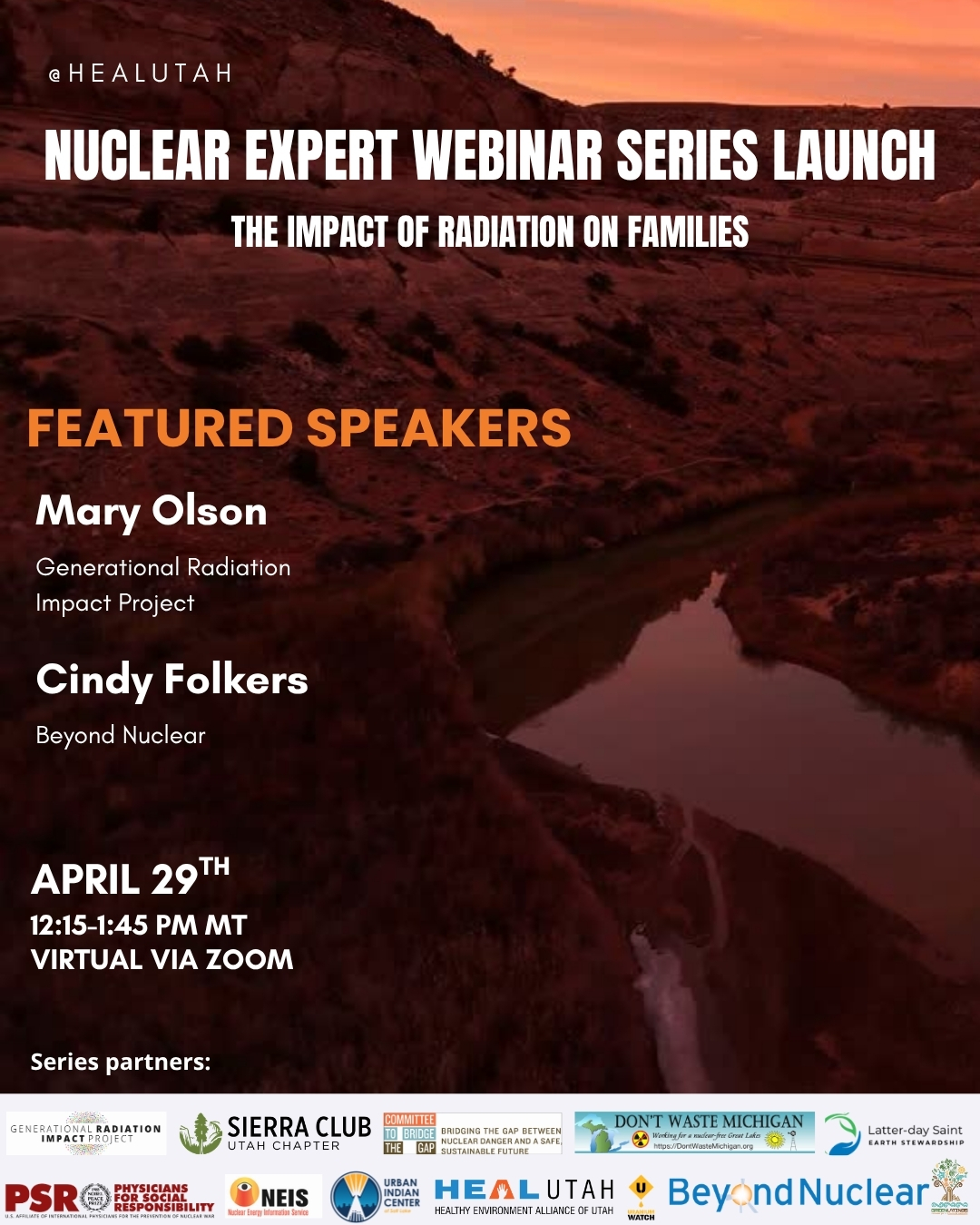
29 April – Nuclear Expert Webinar #1 – Radiation Impacts on Families with Mary Olson and Cindy Folkers
- 12:15 PM MT – 1:45 PM MT
- Location: Virtual – REGISTER TODAY

4 May -West Suburban Peace Coalition to discuss Iran war at May Educational Forum
Monday, May 4, 7:00 – 8:00 PM Central Standard Time
Title: : How Trump’s Narrative Tries to Shape the Reality of the War on Iran.
Contact Walt Zlotow, zlotow@hotmail.com 630 442 3045 for further information
14 May – online event From Bombs to Data Centres: the Face of Nuclear Colonialism

Pine Ridge Uranium is the real threat, not Tehran- Tell Burgum: Stop the Extraction.
Chernobyl: The Lost Tapes – A good documentary on Chernobyl on SBS available On Demand for the next 3 weeks– https://www.sbs.com.au/ondemand/tv-program/chernobyl-the-lost-tapes/2352741955560
To see nuclear-related stories in greater depth and intensity – go to https://nuclearinformation.wordpress.com
-
Archives
- April 2026 (356)
- March 2026 (251)
- February 2026 (268)
- January 2026 (308)
- December 2025 (358)
- November 2025 (359)
- October 2025 (376)
- September 2025 (257)
- August 2025 (319)
- July 2025 (230)
- June 2025 (348)
- May 2025 (261)
-
Categories
- 1
- 1 NUCLEAR ISSUES
- business and costs
- climate change
- culture and arts
- ENERGY
- environment
- health
- history
- indigenous issues
- Legal
- marketing of nuclear
- media
- opposition to nuclear
- PERSONAL STORIES
- politics
- politics international
- Religion and ethics
- safety
- secrets,lies and civil liberties
- spinbuster
- technology
- Uranium
- wastes
- weapons and war
- Women
- 2 WORLD
- ACTION
- AFRICA
- Atrocities
- AUSTRALIA
- Christina's notes
- Christina's themes
- culture and arts
- Events
- Fuk 2022
- Fuk 2023
- Fukushima 2017
- Fukushima 2018
- fukushima 2019
- Fukushima 2020
- Fukushima 2021
- general
- global warming
- Humour (God we need it)
- Nuclear
- RARE EARTHS
- Reference
- resources – print
- Resources -audiovicual
- Weekly Newsletter
- World
- World Nuclear
- YouTube
-
RSS
Entries RSS
Comments RSS
 nuclear-news