How Project Maven Put A.I. Into the Kill Chain
A new book charts the creation of a secretive system that automates warfare for the military. The progression from target identification to target destruction is four clicks.
By Gideon Lewis-Kraus,15 April 2026
In February, reports emerged that the operation to capture the Venezuelan President Nicolás Maduro had not been a strictly human affair. The extrajudicial caper had somehow involved Claude, Anthropic’s large language model. The military had recourse to Claude via a drop-down menu in a workflow package, the Maven Smart System, which gathers, synthesizes, and streamlines intelligence.
The government procures M.S.S., as it is called, from Palantir, the sphinxlike defense-tech contractor co-founded by Peter Thiel and an eccentrically jingoistic philosopher named Alex Karp. Claude’s deployment seemed to come as something of a surprise to its parent company, and an Anthropic executive reportedly reached out to a Palantir counterpart to clarify what, exactly, Claude had done in Caracas.
When this inquiry was relayed to the Trump Administration, one Administration official told me last month, it was interpreted as a signal that Anthropic, which was then renegotiating its own contract with the federal government, was perhaps a faithless partner. (Anthropic disputed that characterization of events.) This suspicion was confirmed when Anthropic, citing fears of domestic mass surveillance and autonomous weaponry, refused to allow the Pentagon “all lawful uses” of its products. This dispute culminated in the Secretary of Defense Pete Hegseth’s designation, by outraged tweet, of Anthropic as a supply-chain risk—a standing peril to national security.
This ban, however, was not effective immediately. The Pentagon apparently needed Claude for one last job. Twelve hours later, the White House began to bomb Iran. Among the casualties of Operation Epic Fury’s first day were more than a hundred and seventy-five people, most of them little girls, at the Shajareh Tayyebeh primary school, in the southern city of Minab. Claude’s potential culpability in this and other potential war crimes was a subject of widespread speculation, not only in the media but in Washington.
Congressional Democrats sent a letter to Hegseth demanding a detailed account of how A.I. was being used in the Iran campaign. In an essay for his Substack that was republished, in slightly different form, by the Guardian, the technology scholar Kevin Baker wrote that almost none of the attendant coverage (including mine) “had any relationship to reality.” Maven had only recently added L.L.M.-based functionality, but the program had been around for a decade. Claude, in Baker’s view, was a MacGuffin. It only served to draw attention away from the centrality of Maven as an automated targeting system. He continued, “The real question, the question almost nobody was asking, is not about Claude or any language model. It is a bureaucratic question about what happened to the kill chain, and the answer is Palantir.”……………………………………………………………………………. (Subscribers only)
“I Felt Like a Monster”: Israeli Soldiers Break Silence on Gaza—and the System Behind It
And what lingers in these testimonies is not just what was done, but what it did to those who carried it out. Soldiers speak of shame, of dissociation, of an inability to reconcile their actions with any moral framework. The military calls it PTSD. But the soldiers—and some experts—call it something else: moral injury. Not fear of what happened to them, but horror at what they themselves became.
April 18, 2026, Joshua Scheer, https://scheerpost.com/2026/04/18/i-felt-like-a-monster-israeli-soldiers-break-silence-on-gaza-and-the-system-behind-it/
The official narrative isn’t just cracking—it’s being dismantled by the very people who carried it out.
In a devastating investigation, Israeli soldiers are now speaking in their own words about what they did, what they witnessed, and what their commanders allowed in Gaza. These are not secondhand accusations or political attacks. They are confessions—raw, detailed, and impossible to dismiss.
“I Felt Like a Monster”: Israeli Soldiers Expose ‘Moral Injury’—and a System Built on Silence
They describe opening fire on unarmed civilians identified only as “targets” on a drone feed. They describe prisoners humiliated, abused, and discarded. They describe executions—men surrendering with hands raised, only to be shot and later labeled “terrorists.” And they describe something just as revealing as the violence itself: a system where none of this leads to accountability.
What emerges is not chaos. It is structure.
This is not the “fog of war.” It is policy by practice—kill first, justify later, investigate never.
As we have seen in this country, the destructive effects of the “fog of war”—the brutal killings, the unjustified pushes toward empire—do not end on the battlefield. The damage lives on in the soldiers who are sent to carry it out. And too often, it feels as if those in power simply do not care. But we can choose something different. We can listen. We can create space for those who were there to speak honestly about what they saw and did. And in doing so, we can begin to confront the truth—not from the top down, but from the ground up—where real accountability, and the possibility of change, actually begins.
And what lingers in these testimonies is not just what was done, but what it did to those who carried it out. Soldiers speak of shame, of dissociation, of an inability to reconcile their actions with any moral framework. The military calls it PTSD. But the soldiers—and some experts—call it something else: moral injury. Not fear of what happened to them, but horror at what they themselves became.
Because moral injury doesn’t just indict individuals—it indicts systems.
This is not a new phenomenon in Israel. The concept of “moral injury” has been studied for years, but what Israeli researchers and clinicians are now documenting gives it renewed urgency—and clarity. It names what many soldiers themselves are struggling to articulate: a rupture between what they did, or were ordered to do, and the values they believed they held. Unlike PTSD, which is rooted in fear, moral injury is rooted in recognition—the realization that lines were crossed, often knowingly, in the heat of revenge, chaos, and command pressure. Psychologists working directly with troops describe a pattern: soldiers firing on people later found to be uninvolved, approving strikes with known civilian casualties, or participating in actions they justified in the moment but cannot live with afterward. The consequences are severe—depression, shame, substance abuse, even suicidal thoughts—but the deeper implication is structural. This is not just about individual breakdowns. It reflects a system that places soldiers in situations where moral collapse becomes not an exception, but an expectation.
It exposes a military culture that normalizes dehumanization, a political structure that shields it, and an international order that enables it. It reveals a reality that cannot be dismissed as isolated misconduct or “a few bad actors,” but instead points to a pattern—repeated, reinforced, and quietly accepted.
And of course it may take years for the damage the understanding to take hold with Y Net Global reporting “One of the complexities of moral injury is that it does not always appear at the moment of action,” Levi-Belz said. “Sometimes it emerges weeks later, after you take off the uniform. Sometimes years later.”
“There is no doubt that among IDF soldiers and reservists there has been an increase in moral injury compared to routine operations,” he said. Based on clinical experience and preliminary samples, he estimates that 40 percent to 50 percent of soldiers, particularly reservists, encountered morally injurious events during the war.
And that is where the story turns outward.
Because none of this unfolds in a vacuum. The bombs, the cover, the diplomatic protection—all of it flows, in part, from Washington. The United States continues to fund, arm, and politically defend the very system these soldiers are now describing from within.
The facts are no longer hidden. The voices are no longer external critics. They are coming from inside the system itself.
So the question is no longer whether the world knows.
The question is whether it is willing to act—or whether it will choose, again, to look away.
Because when even the perpetrators are telling the truth, silence is no longer ignorance.
It is complicity.
The collapse of multilateral law and the confusion of the battlefields
Thierry Meyssan, Voltairenet.org, Tue, 14 Apr 2026, https://www.sott.net/article/505787-The-collapse-of-multilateral-law-and-the-confusion-of-the-battlefields
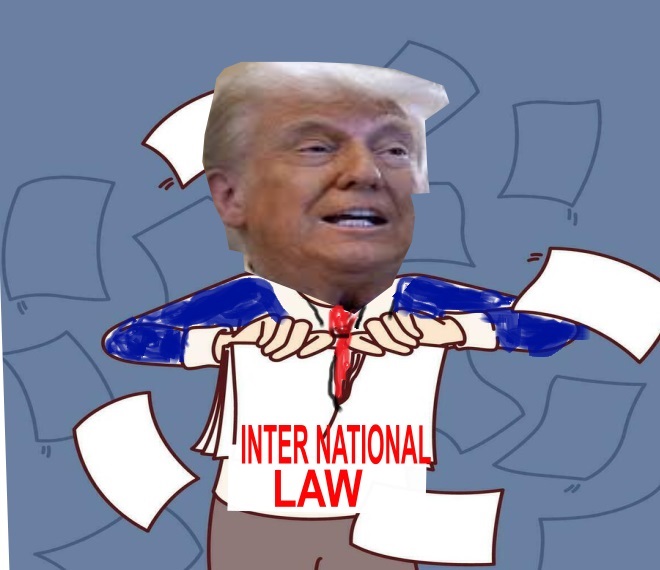
The United States behaved like barbarians during the Israeli war against Iran. Its president, Donald Trump, claimed responsibility for attacking civilians, even though just a month earlier he had asserted his desire to liberate them. He went so far as to threaten to eradicate Iranian civilization, despite his ambition to receive the Nobel Peace Prize.
By acting in this way, Washington not only violated the UN Charter, but also forced some of its allies to discover that it was not their protector, but rather, that it was dragging them into a war they had not chosen.
The President of the United States of America, Donald Trump, initially stated that “the total destruction of areas and the certain death of groups of people which, until now, had not been considered as possible targets” were being “seriously considered” (S/2026/141). He then publicly and explicitly threatened to annihilate Iranian civilization on April 7, 2026 [ 1 ] , in violation of Article 2.4 of the Charter of the United Nations.
In doing so, the President of the United States has placed himself outside of civilization. If there is one basic principle of international law, since the Hague Conference of 1899, it is that signatory states must not behave like barbarians.
He did not carry out his threat, but with unprecedented violence, deliberately destroyed civilian targets:
He began by participating in the assassination of the spiritual leader of millions of Shiites, Ayatollah Ali Khamenei (S/2026/109). Then, he destroyed the Azadi and Besat sports complexes, the Azadegan water park, the Shahidan Esmaeili Stadium, and the Shahid Eskandarloo Sports Hall in Tehran (UN S/2026/130).
Next, he attacked the Minab Primary School. He then went on to attack Red Crescent buildings, the Gandi, Motahari, and Khatam hospitals in Tehran, and the Abouzar Hospital in Ahvaz (S/2026/111). It bombed several fuel storage facilities in Tehran, releasing large quantities of hydrocarbons into the atmosphere, including sulfur and nitrogen oxides, causing acid rain, the deaths of many survivors of the Iran-Iraq War gas attacks, and massive fires (S/2026/149).
It bombed cultural sites, such as the Qajar dynasty palace, the Golestan (S/2026/180). And, probably due to confusion, it bombed UNESCO and WHO offices (S/2026/269) and even the Pasteur Institute of Iran (S/2026/279).
His violence knew no bounds, and while claiming to be fighting against an atomic threat — we have explained at length that there has been no Iranian military atomic program since 1988 — he bombed the Bushehr civilian nuclear power plant four times, risking the destruction of the cooling system and the spread of radiation throughout the region’s waters.
People in the Middle East no longer believe that the United Nations protects them and that the United States can bring them peace [ 2 ] .
The people of the Gulf, who had accepted US military bases on their soil for their protection, learned the hard way that they had been deceived. Their American hosts used their land to wage war against Persian civilization, turning them into targets for Iran’s legitimate resistance.
The confusion that has developed over the past five weeks has shown that multilateralism can conflict with international law. To protect themselves, the Gulf States have issued numerous multilateral declarations: to the Gulf Cooperation Council [ 3 ] , the Arab League [ 4 ] , and the International Maritime Organization [ 5 ] . They have finally discovered that international law is against them: they are jointly responsible for the US aggression perpetrated from their territory.
This confusion reached its peak with the adoption, with two abstentions, of Security Council Resolution 2817, which, on March 11, 2026, disregarded General Assembly Resolution 3314, adopted unanimously and without a vote on December 14, 1974.
It is clear that the UN, as we know it, will have to be profoundly reformed or dissolved [ 6 ] .
The confusion now centers on the Strait of Hormuz. Let’s leave aside the period of the war during which Iran barred ships from the strait to those of the powers aggressing against it (Israel, the United States, and the United Kingdom), as well as to those of the countries that allowed them to use their territory to carry out their aggression (Germany and Italy, Jordan, and the Gulf States).
In the West, there is a consensus that no one can dictate their law in the strait during peacetime.However, this is not so simple:the waters of the Strait of Hormuz are Omani and Iranian territorial waters,not international waters. Given the depth of the strait, passage is generally more common on the Omani side than on the Iranian side.
The two countries can legitimately consult with each other and request a toll, as is the case in the Suez and Panama Canals, even though this is a natural strait [ 7 ] . However, they cannot prevent global traffic from passing, “innocently,” through their waters, especially since they control access to the Persian Gulf. Except that oil tankers represent a real danger with their highly polluting cargoes in the event of a shipwreck.
The Suez Canal is a significant example: in 1956, the British and French empires, militarily supported by the colonial state of Israel, attempted to seize control of the Suez Canal, which Egyptian President Gamal Abdel Nasser had just nationalized. This operation was a fiasco. It marked the end of both colonial empires and revealed the Franco-British alliance with Israel — an alliance that would be broken by Charles de Gaulle during the Six-Day War.
The Strait of Hormuz crisis could, in turn, mark the end of American ambitions in the “rest of the world.”
Another question arises: if Oman and Iran are allowed to collect a toll, how can we ensure that its amount will not be prohibitive and in what currency will it be paid? On this subject, Iran has considered that it be payable in yuan, while the United States, attached to the supremacy of the dollar, would like it to be in dollars or, failing that, in Trump coin ($Trump), the cryptocurrency of the US presidential family and the Emirati royal family, Al-Zayed [ 8 ] .
If the price were not set in dollars, oil companies would prepare to abandon that currency. However, the US dollar is no longer based on the US economy, but on its role in the global hydrocarbon market. This shift would therefore represent a continuation of the war against the “Great Satan.”
On April 12, President Trump posted a message on X:
“From this moment forward, the United States Navy, the finest in the world, will begin the process of BLOCKING all vessels attempting to enter or exit the Strait of Hormuz. At some point, we will achieve this principle of ‘ALL SHALL BE ALLOWED IN WHEN ALL SHALL BE ALLOWED OUT,’ but Iran has not allowed this to happen by simply saying, ‘There may be a mine somewhere,’ which no one but them knows about. This is GLOBAL RACKETEERING, and the leaders of countries, especially the United States of America, will never be extorted. I have also directed our Navy to search, in international waters, and prohibit all vessels that have paid a toll to Iran. None of those who have paid an illegal toll will have safe passage on the high seas.” [ 9 ]
Not knowing what to do, Donald Trump himself blocked the Strait of Hormuz, even though the Anglo-Saxons have been enshrining freedom of movement and trade since 1837 — so much for the dogma of “free trade”! But it’s true that the Jacksonians aren’t globalists. No matter: Donald Trump already betrayed his voters by launching this war a month and a half ago. Today, he’s betraying his predecessors. We are witnessing the suicide of the United States.
References:……………………………………………………………………………………………………………………………………………………………….
America’s pro-Israel J Street says Israel should pay out-of-pocket if it wants US weapons
The pro-Israel advocacy group likely changed its tune after widespread popular opposition to taxpayer-funded weapons
By MEE staff, 13 April 2026 , https://www.middleeasteye.net/news/j-street-says-israel-should-pay-out-pocket-if-it-wants-us-weapons
The pro-Israel advocacy group J Street is now calling for an end to “direct” US military support to Israel, per a new policy document published on Monday.
The group had previously backed Washington’s continued provision of defensive weapons systems, such as the replenishment of Israel’s Iron Dome, at no cost to Israelis.
Now, it says the US “should continue to sell” short-range air and ballistic missile defence capabilities to Israel, but Israel should use its own money to pay for them.
“Israel faces real security challenges that require a significant defense investment. With a per capita GDP comparable to leading US allies such as the United Kingdom, France and Japan, as well as an annual defense budget of over $45 billion, it has the financial means to address these challenges,” J Street said.
“It does not require almost $4 billion per year in US financial subsidies to purchase weapons,” it added.
“Continuing this assistance is both unnecessary and politically counterproductive, creating avoidable tensions in US domestic politics and in the bilateral relationship.”
The way the current military aid package operates is that the US provides Israel with American taxpayer funds, and those funds are put into US weapons companies to acquire equipment.
On its website, J Street says that it “organizes pro-Israel, pro-peace, pro-democracy Americans to promote US policies that embody our deeply held Jewish and democratic values and that help secure the State of Israel as a democratic homeland for the Jewish people”.
Political tide turns
J Street’s shift follows a distinct change in attitudes towards Israel among the American public after the genocide in Gaza, where over 72,000 Palestinians have been killed since Israel’s war on the enclave broke out in October 2023.
But perhaps more importantly for the group, whose support base is made up of Democrats, the party’s future is changing course.
Progressive New York Congresswoman Alexandria Ocasio-Cortez, who is widely believed to be seeking higher office, announced earlier this month that she would no longer vote for any US military support to Israel, despite having previously backed the provision of defensive weapons, much to the disappointment of many of her supporters.
It is notable, however, that her statement followed Israeli Prime Minister Benjamin Netanyahu’s surprise declaration earlier this year that Israel will not seek to renew its military aid package with the US in 2028.
“I want to taper off the military aid within the next 10 years,” all the way down to zero, Netanyahu told The Economist in January.
J Street’s new position demands that any future US arms sales that Israel pays for out-of-pocket “be fully consistent with American law”, which echoed Ocasio-Cortez’s statement.
US law prohibits security assistance to any country whose government engages in a consistent pattern of gross human rights violations or blocks or restricts the transport or delivery of US-backed humanitarian aid.
“US arms sales to Israel should be further conditioned to incentivize alignment with American interests and laws – as has been the case with other allies and partners – when their behavior is inconsistent with US interests,” J Street said.
At the same time, the group acknowledges that Washington and Israel generally share the same interests anyway.
“The US also benefits meaningfully from the relationship. Intelligence sharing has been critical in campaigns such as the fight against ISIS, while joint operations such as Israel’s 2006 strike on Syria’s secret nuclear facility have advanced shared security goals.”
It added that because “approximately 500,000 American citizens live in Israel”, selling it weapons should continue to be a US national security priority.
Israel Destroys a Synagogue; US Media Yawn
“Iranian Jews are viewed by Iranians as indigenous,” he said. “They’re the original Bundists,” a nod to the Jewish political movement that “stood not just for socialism, but for do’ikayt—Yiddish for ‘hereness,’” the concept that a Jew’s homeland was in whatever nation they resided in (New York Times, 4/6/26).
Ari Paul, April 16, 2026 https://fair.org/home/israel-destroys-a-synagogue-us-media-yawn/
An Israeli missile attack destroyed a Tehran synagogue during the Jewish Passover holiday (Religion News Service, 4/9/26). The Israeli military “expressed regret over what it called ‘collateral damage’ to a synagogue in Tehran caused by an overnight strike,” which was “targeting a senior Iranian commander,” said the Middle East Eye (4/7/26).
Photos of the wreckage at the Rafi-Nia Synagogue have accompanied many of these pieces. The Council on American-Islamic relations condemned the attack in a statement (4/7/26):
We strongly condemn the Israeli regime’s bombing of a synagogue in Tehran, which was the predictable end result of the indiscriminate US/Israel bombing campaign against mosques, hospitals, schools, apartments and other civilian sites across Iran.
The group challenged “various Israel advocacy groups and politicians that support this war in the name of protecting Israel to condemn Israel’s synagogue attack.”
Buried at best
The story of the attack on the Tehran synagogue was, at best, buried in the US corporate media. CNN posted a brief video (4/7/26) about the bombing but had no online article about it. The New York Times (4/7/26, 4/7/26) mentioned the attack, but as background in broader stories about the US/Israel war on Iran.
A search for “Rafi-Nia” on the Washington Post website yields no results. Ditto for the AP, although the news service did post a video to YouTube (4/7/26). Al Jazeera’s coverage (4/7/26) of the attack was a mélange of AP and AFP copy. CBS News (4/7/26) also used a few paragraphs of AFP copy to report on the attack, although it was buried in the middle of a general timeline about the war.
The Wall Street Journal (4/7/26) had the story, but led with Israel’s contrition over the destruction; that’s not a journalistic construction we see in US news coverage when it comes to the Israeli bombings of other civilian structures in Iran, Gaza or Lebanon. When Israel destroys a hospital, apartment building, encampment, etc., the stories don’t lead with official regret, but rather include Israeli claims that the civilian facilities were actually legitimate military targets. The Journal’s lead provided the government with public relations cover over the sensitive issue of destroying a Jewish house of worship.
Newsweek (4/8/26), once a bigger player in the US media landscape, led with condemnation of the attack from Jewish Iranian leaders, who declared “their unwavering solidarity with Iran in defending the homeland.”
Jewish presence in Iran
Underplaying the story obscures not only the wantonness of Israel’s aggression, but the actual nature of Iranian society, which is portrayed as obsessed with wiping Jews off the map (ADL, 6/25/25). “Iranian foreign policy freely mixes anti-Israel furies with anti-Jewish ones,” wrote New York Times columnist Bret Stephens (1/13/26), a pro-war cheerleader (2/22/26, 3/24/26).
In fact, while Israel is obviously the center of Mideastern Jewish life, the Iranian Jewish population dwarfs those elsewhere in the Middle East. “Estimates range from 9,000 to 20,000 Jews currently living in Iran,” according to the Forward (6/18/25).
Wrote the Palestine Chronicle (3/6/26): “The Jewish presence in Iran is among the oldest continuous Jewish communities in the world, with roots that historians trace back more than two millennia.”
Yes, Iran is a theocracy; the government is no model for an open society. But there is a Jewish member of Iran’s parliament, who even went on record this year openly criticizing Iranian President Masoud Pezeshkian’s handling of popular unrest (i24, 1/29/26).
‘Well-protected second-class citizens’
US media have covered the Jews of Iran before. USA Today (8/29/18) did a story in 2018, reporting from Tehran. Former Forward reporter Larry Cohler-Esses (8/12/15, 8/12/15, 8/18/15, 8/27/15) reported extensively and critically on Iranian Jews, indicating that the country was at least open to letting a reporter for a Jewish publication do their job.
Cohler-Esses told FAIR that Jews in Iran are “well-protected second-class citizens.” In fact, when he read about the attack, he “wondered if it was the synagogue I spent Shabbat in, but it wasn’t,” because there are more than a dozen active synagogues in Tehran—a reflection of the size of the Jewish community there.
Recalling his 2015 reporting trip, Cohler-Esses said that on Shabbat, Jews would spill out of their synagogues and mingle in the street after services, a sight he didn’t often see in many places in Europe. In one instance, after he left a synagogue service, one of the congregants ran after him through a street teeming with people, wearing a kippah and a tallit (traditional religious attire), and “no one batted an eye.”
The Jews of Iran do suffer discrimination, because Muslims are favored in the legal code over all non-Muslims, Cohler-Esses said. He noted that the Jewish population of Iran has shrunk significantly since the 1979 Islamic Revolution.
“Iranian Jews are viewed by Iranians as indigenous,” he said. “They’re the original Bundists,” a nod to the Jewish political movement that “stood not just for socialism, but for do’ikayt—Yiddish for ‘hereness,’” the concept that a Jew’s homeland was in whatever nation they resided in (New York Times, 4/6/26).
Cohler-Esses was hopeful that coverage of the synagogue’s destruction in the Jewish and Israeli press (JTA, 4/7/26; Jerusalem Post, 4/7/26) had the “potential to make Jewish readers of Jewish media outlets go, ‘Oh, they have synagogues there.’” But with the underplaying of the story in US media, it’s a missed teachable moment for news consumers generally.
More robust press coverage of the attack could have taught Americans that the Jews of Iran do have something to fear: Israel.
THE NEW NUCLEAR POWER PUSH INTENSIFIES PART 1
Enviro Close-Up #712, https://www.youtube.com/watch?v=QZxgwmJi-ew
The push for nuclear power has intensified. It’s as if the Three Mile Island, Chernobyl and Fukushima nuclear power disasters never occurred —and the growing and widespread use of safe, clean, green energy, led by solar and wind, is not happening.
In this Enviro Close-Up, three experts on nuclear issues, each for many decades, analyze what’s going on. Kevin Kamps, executive director of the organization Don’t Waste Michigan, says the U.S. Nuclear Regulatory Commission has “from the beginning…not been about nuclear safety and nuclear security, the environment, public health, the list goes on…but it’s never been worse than it is now.”
Nuclear regulations are in freefall. It’s the “nuclear push on steroids,” says Kamps. Arnie Gundersen, a nuclear engineer and former nuclear industry vice president who broke from the industry and for decades has been a leading nuclear whistleblower, says: “I’ve always said the NRC is a lapdog, but under Trump the lapdog has had its vocal cords cut and its teeth ground down.”
Attorney Terry Lodge, who has been in court battle after court battle in challenges to nuclear power, describes it as “the most dangerous, inherently technologically difficult way of boiling water…and it continues to be that.” Further, the NRC and the agency it replaced, the U.S. Atomic Energy Commission, have been “the absolute epitome, textbook examples of captive regulatory agencies….owned and dominated politically by the industry that they supposedly regulate.” Also, it’s “the most expensive” energy technology, and in financing it “we’re siphoning off money” from energy forms that are to create “faster…and cheaper, to feed a nuclear industry.” And the intensified nuclear push in the U.S. is going on elsewhere in the world.
With 38,000+ Dead, Women and Girls Make Up Over Half of Those Killed in Israel’s US-Backed War on Gaza: UN
“Not a single combatant among them,” said one human rights activist. “Further confirmation that over 90% of the victims are innocent civilians.”
Brad Reed for Common Dreams, Apr 17, 2026 https://www.commondreams.org/news/israel-gaza-war-women
Israel’s yearslong assault on Gaza has killed more than 38,000 women and girls, according to a report released Friday by the United Nations.
In total, the UN found that at least 22,000 women and 16,000 girls have been killed in the conflict, an average of nearly 50 women and girls per day.
Sofia Calltorp, chief of humanitarian action at UN Women, said the report shows how Israel’s war on Gaza “has affected every aspect of life, with its most horrific toll seen in the scale of death.”
“Women and girls accounted for a proportion of deaths far higher than those observed in previous conflicts in Gaza,” Calltorp emphasized. “Those killed were mothers, they were daughters, sisters, and friends—deeply loved by those around them. They were individuals with lives and with dreams.”
More than 72,000 people in total have been killed since Israel launched its attack on Gaza in October 2023, after Hamas invaded Israeli territory and killed approximately 1,200 Israelis. Experts warn that the current known death toll is likely an undercount.
While Palestinian women and girls represent more than half of those who have been killed, according to the report, Israeli and US officials have persisted in claiming the US-backed assault has targeted Hamas fighters.
“Not a single combatant among them,” said Ramy Abdul, chairman of the Euro-Mediterranean Human Rights Monitor. “Further confirmation that over 90% of the victims are innocent civilians.”
Although a ceasefire has been in place since October 2025, the report notes that an estimated 730 Gaza residents have been killed over the last six months. Additionally, the report says the humanitarian situation in Gaza remains dire.
“Nearly one million women and girls have been displaced, repeatedly,” said Calltorp. “Access to water and food have been severely limited, with nearly 790,000 women and girls experiencing crisis-level or catastrophic levels of food insecurity. Extensive damage to infrastructure has made it almost impossible for women and girls in Gaza to access their basic needs, like healthcare.”
Calltorp demanded that the ceasefire deal “be fully implemented,” and that “respect for international law must be upheld” to ease the suffering in Gaza.
“Humanitarian assistance must reach those in need—at scale and without obstruction,” Calltorp said. “And women and girls must be placed at the center of response and recovery efforts.”
In addition to causing a humanitarian disaster in Gaza, Israel in recent weeks has also been waging an aerial bombing and ground invasion in Lebanon that has killed thousands of people and displaced more than 1 million. US President Donald Trump announced on Thursday that Israel and Lebanon came to a ceasefire agreement that is set to last for 10 days.
At the same time, Israeli settlers have been waging a campaign of increased violence against Palestinians living in the West Bank, and veteran Israeli war correspondent Ron Ben-Yishai on Thursday declared that the actions of the settlers look like “ethnic cleansing.”
Zaporizhzhia NPP loses external power for the second time in a week, IAEA investigates

Kyiv • UNN, April 17 2026,
The Zaporizhzhia NPP has temporarily lost all external power for the fourteenth time
The Zaporizhzhia Nuclear Power Plant temporarily lost all external power supply, which was subsequently restored. This was reported by the IAEA, which is currently studying the situation and investigating the incident, writes UNN.
Details
According to the agency, the incident occurred in the evening. External power was restored approximately 40 minutes later.
The cause of the outage is currently unknown and is being investigated by specialists on site.ime since the start of the war. The IAEA is conducting an investigation due to critical nuclear safety risks.
IAEA Director General Rafael Grossi stated that this is the second such incident in less than a week and the 14th since the beginning of the full-scale war.
The loss of external power supply underscores the ongoing critical nuclear safety situation– he noted.
The IAEA team at the plant continues to monitor and investigate the circumstances of the incident. The agency emphasizes that such failures pose a serious risk to nuclear safety. https://unn.ua/en/news/zaporizhzhia-npp-loses-external-power-for-the-second-time-in-a-week-iaea-investigates
US Mining Plan Will Sacrifice Mexico’s Environment for Weapons and Tech
A new mining agreement provides no benefits for Mexico and fails to address health and environmental impacts.
By Tamara Pearson , Truthout, April 18, 2026
The U.S. and Mexico have established a mining agreement which has Indigenous and other residents of the Sierra Norte mountains, as well as activists around Mexico, worried.
Announced on February 4, the U.S.-Mexico Action Plan on Critical Minerals aims to guarantee the U.S.’s supply of minerals for its arms industry, technology like data centers and smartphones, and the so-called energy transition. It sets out price floors, identification of mining projects, geological mapping coordination, and mineral location identification for the U.S., but provides no benefits for Mexico and fails to address health and environmental impacts.
“They want us to show these gringo companies where the minerals are and then go and hand over everything, all without a fuss,” said Miguel Sánchez Olvera, a Totonac man from the Sierra Norte region who has been at the forefront of struggles that have expelled mines from the area. “That’s concerning, because where does it leave us, as Mexicans? Basically, they are going to keep stealing from us.”
The beautiful Sierra Norte — teeming with rivers and sprawling forests, and where a majority of people speak Indigenous languages — has massive amounts of minerals that the U.S. has identified as “critical,” such as manganese, gold, silver, and copper.
According to NATO, manganese is one of 12 minerals critical for the weapons industry; it is used in submarines, fighter aircraft, tanks, and torpedoes. For Mexico, however, manganese is a source of distress before it is even processed. In the lush Sierra Norte cordillera, stark black mountains of manganese ore and slag piles are set off by smoking chimneys from a plant run by Autlán, a major Mexican mining company. Homes nearby are drenched in black stains. Residents describe mornings of black clouds along the ground and black dust covering their windows.
Autlán operates four electric furnaces in its Teziutlán plant to smelt manganese ore, producing ferroalloys. Manganese is also on the U.S.’s critical minerals list and aside from weapons, it is vital to batteries and other steel applications.
Mexico as a whole is the top silver-producing country, and among the top producers of copper, lead, and zinc — all on the U.S.’s list. Silver is vital for new weapon systems, hypersonic missiles, bombs, fighter jets, satellites, torpedoes, radar systems, AI data centers, electric vehicles, 5G infrastructure, and smartphones. Demand for copper for munitions is skyrocketing as the U.S. restocks its arsenal, and it is essential for armor and electronics. Copper supply problems can cause significant weapon production delays, and supply chain vulnerabilities for weapons manufacturers.
The U.S. is home to 6 of the top 10 global arms companies and 13 of the top 15 global tech companies. The White House’s 2027 budget includes over 18 billion U.S dollars for the Department of Defense to stockpile minerals that are critical to the military industry. That figure is up from the current 2 billion U.S. dollars.
A few days before the U.S.-Mexico plan was signed, the White House had also announced Project Vault, which will establish a public-private partnership to stockpile critical minerals for U.S. businesses. These moves “imply hyper-extractivism — or basically, renewed extractivism,” César Enrique Pineda, a researcher and professor of geopolitical and capitalist intersections with the environment at the José María Luis Mora Research Institute, told Truthout……………………………………………………………………………………………………………………………………………………………………………………………..
Nobody Benefits From Weapons Except Weapons Companies
But while the mining industry is being heard, the mines bring no economic benefits to the country or to nearby communities.
“I very much doubt that Mexico would benefit economically from this plan because it has never been that way with mining projects. Extraction only contributes 0.9 percent to the GDP, for example,” said Olivera. “Mining represents just 0.66 percent of formal employment, and in terms of taxes, they contribute very little.” There are 22,247 active mining concessions in Mexico, with a total surface area of 10.2 million hectares, or 5.2 percent of Mexico’s territory………………………………………………………………………………………………………
Mining’s Legacy of Environmental Disaster
The U.S.-Mexico action plan “benefits investors, but it doesn’t benefit us at all,” said Urbano Córdova Guerraas, a local resident and also a member of Servicios Ambientales Amelatzin Hualactoc as we chatted in a small eatery near the Autlán plant. To extract copious amounts of manganese, Autlán has destroyed whole mountain tops in nearby Hidalgo state, buying off local politicians in order to do so. In Zoquitlán, Autlán chopped down 77 hectares of forest for a hydroelectric plant…………………………………………………………………………………………………………………………………………………….
Imposing Destruction
In order to operate without disruption, mining companies in Mexico are often involved in the disappearance of activists and with organized crime. The top minerals that attract organized crime groups are the same critical minerals that Mexico plans to supply to the U.S…………………………………………………………………………………………………………………………………….
Over the years, thousands of organized communities have declared themselves “mining-free territory” to legally prohibit mining in their territory.
Stopping mines after the fact is much harder, but many communities are willing to wage the legal and organizational battle. Even after victory, the struggle continues.
“We want to clean our rivers, so that the Sierra Norte de Puebla can be a paradise again,” said Sánchez. https://truthout.org/articles/us-mining-plan-will-sacrifice-mexicos-environment-for-weapons-and-tech/
Wyoming communities want time to consider embracing nuclear energy, as feds rush to expand industry
With one nuclear power plant already under construction, Wyoming will soon
be home to high-level nuclear waste storage unless the federal government
builds a centralized facility. When TerraPower proposed building its first
advanced, liquid sodium-cooled Natrium power plant outside Kemmerer,
lawmakers quickly carved out an exception in the state´s otherwise blanket
storage ban to allow spent nuclear fuel that comes from any in-state
nuclear power plant. But the conversation about nuclear waste storage in
the Cowboy State is far from over.
Daily Mail 17th April 2026,
https://www.dailymail.co.uk/wires/ap/article-15742457/Wyoming-communities-want-time-consider-embracing-nuclear-energy-feds-rush-expand-industry.html
Collapsing Empire: Hezbollah Crushes ‘Greater Israel’
Kit Klarenberg, Global Delinquents, Apr 17, 2026
On April 8th, the Zionist entity struck a demonic blow to the heart of Beirut, dropping 1,000 pound bombs in densely packed residential areas, killing untold civilians and injuring many more. One of Lebanon’s most dire mass-killings since the end of the 1990 civil war, it marked the resumption of Israel’s avowedly genocidal invasion. With bombs raining down apace even as rare in-person talks between the pair near, Zionist Occupation Force-backed settlers are moving quickly to establish a permanent presence in the country’s south.
Whatever abrupt pause in the war on the Islamic Republic can be sustained by duelling Iranian and US blockades of the Strait Of Hormuz must be viewed in the context of the Zionist entity’s longstanding determination to annex Lebanese territory, in service of ‘Greater Israel’. Tel Aviv’s criminal incursion ignited March 16th, Orwellianly dubbed by officials a “targeted ground operation against key targets.” It was not until 10 days later that major news outlets deigned to call it an invasion.
On March 23rd, Tel Aviv’s finance minister Bezalel Smotrich – a self-proclaimed fascist – urged the ZOF to formally annex southern Lebanon. Since then, over a million people have been displaced, thousands killed, and civilian infrastructure razed en masse. While a significant chunk of the country is now occupied, the cost for Tel Aviv was substantial. Unrelenting Hezbollah fire produced heavy casualties and record equipment and vehicle losses, including 21 Merkava main battle tanks in a single day on March 26th.
On April 2nd, Israeli media openly advertised the impending ceasefire in the war on Iran. It was revealed the Zionist entity was preparing to intensify its air campaign against Lebanon, due to enormous damage inflicted by the Resistance upon the ZOF. Tel Aviv reportedly planned to “[reduce] the current focus on Iran,” in order to support “Israeli ground forces attempting to seize Lebanese territory.” Were it not for hell being unleashed from the skies, the ZOF would currently be in big trouble.
On April 5th, the ZOF’s Northern Command chief admitted Tel Aviv had grossly overestimated damage inflicted upon Hezbollah during its October 2024 invasion of Lebanon. Entity political and military chiefs had long-claimed the Resistance faction was obliterated by the illegal intervention. The ZOF estimated 70 – 80% of Hezbollah’s rocket capabilities were destroyed during the conflict. This reverie was comprehensively shattered by hundreds of the group’s projectiles successfully targeting Tel Aviv daily, throughout the Zionist-American war on Iran.
No wonder that conflict is now on hold. Hezbollah remains a redoubtable adversary, which can independently, and in tandem with its Resistance comrades, thwart Tel Aviv’s seizure of Lebanese territory, and permanently expel Zionist settlers from northern Palestine. This wreaks havoc with Greater Israel’s construction, which Benjamin Netanyahu openly yearns to be his enduring political legacy, and literal ‘get out of jail free’ card. Hence, southern Lebanon must be annexed, and Hezbollah neutralised. But attempting to do so will, as before, end in fatal catastrophe.
‘Forced Expulsions’
In June 1982, Zionist militants invaded Lebanon, ostensibly to drive Palestinian freedom fighters away from the entity’s claimed northern border. Quickly, it became apparent ethnic cleansing, massacres, and land theft were the ZOF’s true goal. As a declassified July 1983 US National Intelligence Council assessment noted, ultra-Zionists then as now were aggressively demanding outright annexation of Lebanon’s south. Which is precisely what temporarily came to pass, until Hezbollah expelled the ZOF decisively in 2000. Along the way, obvious lessons weren’t learned by Tel Aviv.
The Council predicted the ZOF would create a puppet state in the south, to fulfil “some day-to-day governing tasks,” while “real power will remain in Israeli hands.” Despite judging the costs “of semi-permanent occupation” to be “not inconsequential,” they were nonetheless “manageable”, due to the entity’s “proven track record” of suppressing “unrest” in territory it illegally occupies. “Forced expulsions, use of local surrogates, and ruthless counterintelligence operations” by the ZOF were correctly forecast, which the NIC believed would negate “increasingly” hostile local opposition.
The Council assessed the ZOF would “[get] a handle on the guerrillas in the next six – 12 months.” This prediction couldn’t have been more wrong. Unmentioned by the Council, Hezbollah was quickly founded following the Zionist entity’s invasion. Inspired by the Islamic Revolution and assisted by the Iranian Revolutionary Guard Corps, the group rapidly gained in strength, spreading radical fervour among Lebanese citizens of every faith, until forcibly purging ZOF militants from Lebanon outright in May 2000.
Hezbollah’s success – repeated with an unprecedented battering of Zionist invasion forces in 2006 – inspired new generations of Resistance fighters, including Hamas. Today, the faction is the most popular and potent political and social force in Lebanon, embraced by citizens of every faith. Bashar Assad’s fall also did not, contrary to widely-held assumptions, make it remotely difficult for Iran to equip and coordinate with Hezbollah. A failure to comprehend these inconvenient truths has led the Zionist entity into disastrous ruin in Lebanon, yet again.
On March 27th, ZOF chief of staff Eyal Zamir issued a grave warning during a security cabinet meeting. Namely, Israel’s military “is going to collapse in on itself,” due to “mounting operational demands and a deepening manpower shortage,” which could rapidly prove catastrophic. Already, an infantry battalion intended to be deployed to Lebanon had been redirected to the West Bank, to “keep the peace” as armed settlers carried out violent if not murderous attacks on Palestinians. The ZOF would’ve struggled to field further forces in either Greater Israel theatre.
Then on April 3rd, the ZOF openly admitted “its goal of disarming Hezbollah” was “unrealistic, as it would require the military to launch a full-scale invasion of Lebanon,” which Tel Aviv wasn’t able to wage. In other words, the Resistance was undefeated, and Lebanese territory couldn’t be stolen. Having been engaged in perpetual, multi-front war since October 7th 2023, the exhausted Zionist entity lacked the muscle to achieve its Lebanese goals while also targeting the West Bank and Iran, contrary to intelligence, military and political forecasts.
‘Last Minute’
Israel was so ruinously overextended attempting to wage all-out war on the entire Resistance – without AnsarAllah even having fully joined the fight – it was reportedly considering an extraordinarily desperate solution. Namely, inviting Syria’s MI6-installed extremist government to battle Hezbollah. Ahmed al-Sharaa’s regime is maintained in power exclusively via a brutal, repressive domestic security and military apparatus. Forces could not be deployed in sufficient numbers to counter Hezbollah, without risking major domestic upheaval. However, Hebrew-language outlet Maariv reported April 5th this suicidal pact was being seriously contemplated:
Under the auspices of these “understandings”, the ZOF would “take over southern Lebanon, while the Syrians will act in northern Lebanon against Hezbollah.” However, the US reportedly “very much [preferred] not to reach such a scenario.” After all, it would be a deeply hazardous Faustian bargain, imperilling al-Sharaa’s already brittle rule. While he and his army of ISIS fighters may detest Hezbollah, the overwhelming majority of Syrians reject alliance with Israel, at a time local Resistance elements are growing in strength.
………………………………………………………………………………………………………. With Hezbollah supposedly dismantled, and Syria at last transformed into a doting Anglo-American puppet state, Greater Israel could be advanced without hindrance – or so Netanyahu thought. In reality, the “great opportunity” about which he boasted from the Golan Heights following Bashar Assad’s fall has become a dangerous trap. Unable to sustain a grand battle against the triumphant Islamic Republic even with US help, Israel is now overextending itself yet further in southern Lebanon. Hezbollah isn’t fazed one iota, and the Resistance is watching intently.
As history old and new amply shows, the Empire and its Zionist proxy underestimate AnsarAllah, Hamas, Hezbollah, Iran, and the wider Resistance at their immense peril – but persist in doing so. Over and again across decades, the same failed strategies are applied without success, then aren’t subsequently revised. The Empire’s crushing past defeats by the Resistance are spun as victories, and/or promptly forgotten about. All along though, in the real world, the Zionist-American death machine is ever-weakened, and Palestine’s long-overdue liberation grows irresistibly closer. https://www.kitklarenberg.com/p/collapsing-empire-hezbollah-crushes
What to know about Iran’s uranium enrichment and its role in the Middle East conflict
President Donald Trump on Friday vowed to remove Iran’s “Nuclear
‘Dust” as part of an effort to ensure the nation never possesses a
nuclear weapon. A day earlier, Trump told reporters at the White House that
Iran had agreed to “give us back the nuclear dust that’s way
underground,” repeating the phrase he uses in reference to Iran’s highly
enriched uranium.
Appearing on Iranian State Television on Friday, Foreign
Ministry spokesperson Esmael Baqaei strongly rebuked Trump’s claim. “Iran’s
enriched uranium is not going to be transferred anywhere under any
circumstances,” Baqaei said.
Iran’s nuclear program appears to remain a key
sticking point in the standoff between the two sides as the U.S.-Iran
ceasefire approaches a deadline on Tuesday. Weapons-grade uranium
enrichment comes at an ideal level of about 90%, though a crude weapon can
be deployed with material enriched at lower levels, Howard Hall, professor
of nuclear security at the University of Tennessee, told ABC News.
“There’s
nothing magic about the 90% level,” Hall said. Iran possessed about 440
kilograms of uranium enriched to 60% as of June 2025, the International
Atomic Energy Agency, a United Nations watchdog group, said in a report
issued in February. That quantity of uranium is enough to produce nine or
10 nuclear bombs if enriched to weapons-grade levels, Erickson said. The
final step of enriching uranium from 60% to 90% is a relatively small task
within the overall enrichment process, analysts told ABC News. “The trick
of uranium enrichment is that most of the work is done going from natural
to low-enriched uranium,” Hall said. The further along the enrichment
process goes, the quicker the progress, Hall added. “You have small steps
that multiply over and over — it’s like compound interest,” he said.
Stockholm International Peace Institute, an independent research group, in
a report described the distance from 60% enrichment to weapons-grade as
“very short.” In March, United States Special Envoy to the Middle East
Steve Witkoff said the 60% enriched uranium can be brought to weapons-grade
in about a week and that the 20% enriched uranium can be brought to
weapons-grade in three to four weeks.
Iran’s uranium stockpile also
included about 9,400 kilograms of uranium enriched at lower levels as of
last June, most of which is enriched at or below 5%, the IAEA said in
February. The IAEA has not been able to verify the nuclear stockpile since
then, the group said, describing the need for inspection as “long overdue
according to standard safeguards practice.”
ABC News 17th April 2026,
https://abcnews.com/Business/irans-uranium-enrichment-role-middle-east-conflict/story?id=132057549
Confused Closures and Opaque Openings: Continuing Dramas in the Hormuz Strait
19 April 2026 Dr Binoy Kampmark, https://theaimn.net/confused-closures-and-opaque-openings-continuing-dramas-in-the-hormuz-strait/
Reading messages from President Donald J. Trump is an exercise in taunting masochism. It is one inflicted on commentators and the press corps the world over, and they are not better for it. The latest – and here, the latest will become distant and dated shortly – is that the Strait of Hormuz, predictably controlled by Iran with devastating global effect, was to be reopened for commercial traffic under certain conditions. Trump thought this undertaking absolute and indefinite, a rich suggestion coming from a man with such a fair-weather mind. “Iran has agreed to never close the Strait of Hormuz again. It will no longer be used as a weapon against the World!”
This proved typically premature: within a matter of hours, Iran’s decision was, if not reversed then heavily qualified. (The Strait technically always remained open to vessels favoured by the Iranian authorities.) On April 17, Iran’s Foreign Ministry spokesperson Eshmaeil Baghaei affirmed two key principles in Tehran’s policies: Iran retained the right to control traffic moving through the Strait, and that it would not surrender enriched uranium, an issue “sacred to us as Iranian soil” and non-negotiable. The latter was certainly aimed at Trump’s dotty claim that Washington and Tehran would jointly deploy “lots of excavators” to remove fissile material (“nuclear dust”) and shift it to the US. On CBS News, the president claimed that “Our people, together with the Iranians, are going to work together to get it.” This all suggested much confusion on the part of the Americans.
Iran’s moves on the Strait were always going to be governed by other impediments. There was the demand, for instance, that Washington release $20 billion in frozen Iranian assets. This was rejected. Trump has also insisted on a continued blockade of Iranian ports, which currently employs over 12 warships and something in the order of 100 fighter and surveillance aircraft. As he told Fox News, “we’re not going to let Iran make money on selling oil to people that they like and not people that they don’t like.” Maritime intelligence on this, however, suggests that the blockade has not been quite as effective as heralded by US officials. Martin Kelly, Head of Advisory at EOS Risk Group can point to the successful passage of sanctioned tankers and vessels of the shadow fleet such as LPG carriers Crave, Raine and NV Aquamarine.
On April 18, the Islamic Revolutionary Guard Corps (IRGC) Navy issued a statement that “no vessel is to move from its anchorage in the Persian Gulf or the Sea of Oman.” A number of vessels had successfully managed to pass through under supervision since Friday night, but the Strait would be closed till the US ceased blocking Iran’s ports. “Approaching the Strait of Hormuz will be considered cooperation with the enemy, and the offending vessel will be targeted.”
The IRGC have been true to their word. According to UK Maritime Trade Operations, the Master of a tanker reported “being approached by 2 IRGC gun boats” without a VHF challenge, “then fired upon the tanker.” No injuries were sustained. Another report documented “a Container Ship being hit by an unknown projectile which caused damage to some of the containers.” There were no fires or environmental impacts reported. A third incident involved the sighting by the Master of a cruise ship of “a splash in close proximity to the vessel” regarded as suspicious.
The ongoing US blockade, argues Iran’s Supreme National Security Council (SNSC), was also a violation of the ceasefire agreement between Tehran and Washington. As Tehran revealed in a statement, passage through the Strait would only take place through a “designated route” and only with Iranian authorisation. The opening or closing of the Strait, along with pertinent regulations governing it would be “determined by the field, not by social media.” The Council has also revealed that it is reviewing new proposals from the US that may form the basis of future talks.
Trump has also huffed that the latest developments in the Strait were “not tied, in any way, to Lebanon,” a barely plausible contention. Iran has insisted that any lasting ceasefire manoeuvres would have to include a cessation of Israeli strikes on Lebanon and Hezbollah positions, even if negotiations between the US and Lebanon did not involve any mention of the Shia militia. The US president duly went on Truth Social to bluster that Israel “will not be bombing Lebanon any longer.” They were “PROHIBITED from doing so by the USA. Enough is enough.”
The somewhat devalued currency of a ceasefire did not, as it was subsequently confirmed, prohibit Israel from resorting to its right to self-defence, a right so latitudinous as to be boundless. Israeli Prime Minister Benjamin Netanyahu promised that things were far from concluded. “I will say honestly, we have not yet finished the job.” Remaining rocket and drone threats needed neutralisation. Hezbollah would have to be dismantled through a “sustained effort, patience, and careful navigation in the diplomatic arena.”
There was also much room for lashing reluctant allies. “Now that the Hormuz Strait situation is over,” declared Trump, “I received a call from NATO asking if we would need some help.” With the usual flourish of petulance, he dismissed the call: Stay away unless you want to load up with oil. “They are useless when needed, a Paper Tiger!” Increasingly, the US imperium is resembling that tiger, incapable of stalking and capturing its far more resourceful prey.
NYT’s Investigation of How Trump’s War on Iran Started Leaves Out the Paper’s Own Silence
Luca GoldMansour, April 17, 2026, https://fair.org/home/nyts-investigation-of-how-trumps-war-on-iran-started-leaves-out-the-papers-own-silence/
A New York Times exposé (4/7/26) detailed a presentation by Israeli Prime Minister Benjamin Netanyahu to President Donald Trump in the White House Situation Room—meant to sell the president on a war with Iran roughly two weeks before the US’s initial attack—and Trump’s subsequent discussions with his inner circle.
The Times report, headlined “How Trump Took the US to War in Iran,” is sparking renewed corporate media attention to how this conflict began. But that discussion has been clouded by the report’s fixation on Netanyahu’s sway over Trump and alleged divisions among his advisers.
That Trump was narcissistic and gullible enough to believe lies Netanyahu told him, as the report lays out, was undoubtedly an important factor in the time and manner of a US/Israeli assault that has killed thousands and effectively widened the scope of the Gaza genocide.
But buried within the report is an interesting detail indicating more structural forces were also at work: The Times‘ Jonathan Swan and Maggie Haberman reported that the US intelligence community determined that, while the prospect of regime change was “farcical,” “crippling Iran’s capacity to project power and threaten its neighbors” was “achievable with American intelligence and military power.” Iran’s continued capacity to close the Strait of Hormuz and exact a heavy toll on US bases in the region demonstrates this was a faulty assessment.
Whether it was by groupthink, incompetence or the influence of neoconservatives and the Israel lobby, the fact that the national security state came to such an erroneous determination is going criminally underdiscussed.
Military/industrial megaphone
A full accounting of how this disaster came about must grapple with the US military/industrial complex and its push for war. No less important is reckoning with that complex’s megaphone: the compliant US corporate media. And juicy scoops on palace intrigue concerning the leaders in the White House and Tel Aviv won’t wash away the Times’ participation in that push.
The Times’ streak of failing to challenge, or even actively encouraging, major US wars (FAIR.org, 10/23/17) remains unbroken during this latest misadventure. Their approach this time was more disjointed than in the past: First, the usual bluster. But then, an all-too-conspicuous silence.
When war with Iran—a heavily armed nation of 90 million people with eminent geographic advantages—was just theoretical, the New York Times’ editorial board was as hawkish as usual. That included cynically deploying humanitarian concerns in Iran to advocate for regime change just 12 days before the armada’s arrival in the gulf (FAIR.org, 2/10/26).
In that January editorial (1/14/26), headlined “Iran’s Murderous Regime Is Irredeemable,” the Times pulled out arguments from the old regime-change playbook. The Iranian government, the Times said, is “among the world’s most nefarious regimes, and the people who bear the biggest cost are the citizens of Iran.”
Having neatly packaged their argument urging empathy for the Iranian people, the Times then offered a familiar sleight-of-hand for its readers: It is possible—natural even—for coercive US power to be utilized to help the Iranian people “achieve liberty.” Offering the considerations it thought Trump should be taking into account, the Times wrote:
The crucial question is what measures—diplomatic, economic and potentially militarily—have the best chance to strengthen the protest movement and sow division among elites allied with the Khamenei government.
Never mind that US policy has been to the detriment of Iranians’ “liberty” for the better part of a century. The papers’ editors advised Trump that, if he chooses the military option, he should do so “much more judiciously than he typically does.”
Suddenly silent
As war became increasingly likely—that is, once Trump began amassing his “armada” in the Persian Gulf—the editorial board went silent. No more calls for coercive force. No more discussion of Iran at all.
From January 26 to February 27—the 32-day period of military buildup, during which Trump was weighing one of the most consequential US foreign policy decisions of this century—the Times’ editorial board had nothing to say.
That is unprecedented, given the page’s historic role in promoting US adventurism. In the 32 days preceding the US invasion of Iraq, for instance, the New York Times published 13 editorials perpetuating the weapons of mass destruction myth, which to them was sufficient justification for a war against Iraq.
The public debate over whether or not to go to war with Iraq was so ubiquitous leading up to the invasion that one of the Times’ pro-war editorials (2/23/03) acknowledged that “the debate over Iraq has exhausted everyone.”
That voluminous public debate, replete with fabrication and misinformation as it was, manifested in broad public support for the war. In the first days of the conflict, 76% of the US public favored military intervention in Iraq.
The Iran War, on the other hand, is only the second major US war (after the 2011 Libyan intervention) in the era of modern polling to start with more Americans opposed than supportive of it. Any propaganda campaign in favor of war with Iran would have a steep hill to climb after two decades of experience with Middle East interventions.
Mirroring Democratic silence
In the last two weeks before Trump launched his attack, details of his military deployment, like the inclusion of E-3 Sentry Airborne Warning and Control System (AWACS) aircraft, indicated that the potential for war was serious.
Still, the Times editorial board found no reason for comment. Given that the editors were advocating for regime change mere days before Trump took up their suggestion by ramping up its forces in West Asia, it is highly doubtful that they learned from their history of mistakes and had a change of heart. In any case, if they did, they didn’t voice it.
What can be said is that the Times’ silence mirrors that of Democratic leaders in Congress, who also barely let out a peep during this period. For their part, it is clear that they aimed to conceal their support for the war from their base, who overwhelmingly oppose it. Within that dynamic, congressional Democrats waited until after the war began to propose a war powers resolution—demonstrating their issues, if any, were about process, not substance.
The Times likewise saved its feckless criticism until after the war began, penning an editorial (2/28/26) the day Trump launched the war (proving their capacity to move quickly when convenient) voicing process concerns: Trump lacked clear achievable objectives, threatened to mire the US in another “endless war,” and failed to consult Congress. Like Democratic leaders, the Times failed to reject—and indeed reiterated—the logic of the war itself: that article of faith that Iran is an intolerably evil and belligerent state (FAIR.org, 3/13/26).
Just like Democratic leaders, the New York Times failed to use its outsized influence to challenge this monstrous war. Instead, it participated in its genesis, through cowardice as much as through sanctimony.
Seven Democrats Side With Republicans to Keep Weapons Flowing to Israel as War Expands
April 16, 2026, Joshua Scheer
In a vote that cuts straight through the carefully managed language of Washington diplomacy, seven Senate Democrats broke with much of their party and joined Republicans to block an effort that would have halted U.S. arms sales to Israel. The resolution—introduced by Sen. Bernie Sanders—failed 40–59, ensuring the continued transfer of military equipment as the region slides deeper into war.
Seven Democrats, led by Chuck Schumer, voted for the resolution. Which included Senators Richard Blumenthal, Chris Coons, Catherine Cortez Masto, John Fetterman, Kirsten Gillibrand, Jacky Rosen, and Senate Minority Leader Chuck Schumer—voted to keep the pipeline open. Their decision ensured the failure of a measure that, while unlikely to pass, represented one of the clearest attempts yet to challenge U.S. complicity in Israel’s ongoing military campaigns.
At stake was not just a shipment of military bulldozers or thousands of 1,000-pound bombs. It was a question that has been building for months: whether the United States will continue to bankroll and materially support an expanding conflict that now stretches from Gaza to Lebanon to Iran.
The answer, at least for now, is yes.
The backlash was immediate—and public.
With Bernie Sanders making the statement: “When we started this effort there were just 11 votes. Now, there are 40,” Bernie Sanders said in a statement.
“That shift reflects where the American people are. Americans, whether they are Democrats, Republicans or independents, want to see our tax money invested in improving lives here at home — not used to kill innocent women and children in the Middle East and put American troops in harm’s way as part of Netanyahu’s illegal wars of expansion.”…………………………………………………………………………………………………………………………………..
1 This Month

of the week– Nuclear Reactor Information Task Force

14 May – online event From Bombs to Data Centres: the Face of Nuclear Colonialism
To see nuclear-related stories in greater depth and intensity – go to https://nuclearinformation.wordpress.com
-
Archives
- May 2026 (82)
- April 2026 (356)
- March 2026 (251)
- February 2026 (268)
- January 2026 (308)
- December 2025 (358)
- November 2025 (359)
- October 2025 (376)
- September 2025 (257)
- August 2025 (319)
- July 2025 (230)
- June 2025 (348)
-
Categories
- 1
- 1 NUCLEAR ISSUES
- business and costs
- climate change
- culture and arts
- ENERGY
- environment
- health
- history
- indigenous issues
- Legal
- marketing of nuclear
- media
- opposition to nuclear
- PERSONAL STORIES
- politics
- politics international
- Religion and ethics
- safety
- secrets,lies and civil liberties
- spinbuster
- technology
- Uranium
- wastes
- weapons and war
- Women
- 2 WORLD
- ACTION
- AFRICA
- Atrocities
- AUSTRALIA
- Christina's notes
- Christina's themes
- culture and arts
- Events
- Fuk 2022
- Fuk 2023
- Fukushima 2017
- Fukushima 2018
- fukushima 2019
- Fukushima 2020
- Fukushima 2021
- general
- global warming
- Humour (God we need it)
- Nuclear
- RARE EARTHS
- Reference
- resources – print
- Resources -audiovicual
- Weekly Newsletter
- World
- World Nuclear
- YouTube
-
RSS
Entries RSS
Comments RSS
 nuclear-news