Nuclear stocks mixed after U.S. Army launches program to deploy small reactors.

Spencer Kimball CNBC, Wed, Oct 15 2025
Key Points
- The U.S. Army on Tuesday launched a program to build micro nuclear reactors.
- Investors have speculated heavily on the fortunes of NuScale, Oklo and Nano Nuclear despite the fact that none of the companies have deployed a reactor yet.
Nuclear stocks traded mixed Wednesday after the U.S. Army launched a program to deploy small reactors…………..
The U.S. Army on Tuesday unveiled a program to build micro nuclear reactors in partnership with the Defense Innovation Unit. The microreactors will be commercially owned and operated with the goal of helping developers scale up their businesses, according to the Army.
The Army launched the “Janus Program” in response to President Donald Trump’s May executive orders that aim to speed the deployment of advanced reactors. Trump ordered the Defense Department to have a reactor operating at a domestic military installation no later than Sept. 30, 2028.
Investors have speculated heavily on the fortunes of NuScale, Oklo and Nano Nuclear despite the fact that none of the companies have deployed a reactor yet. Oklo and Nano Nuclear have not generated any revenue…..
Artificial intelligence power demand and Trump’s executive orders have fueled a wave of market enthusiasm about nuclear power. Goldman Sachs recently told investors to exercise caution on Oklo.
https://www.cnbc.com/2025/10/15/army-nuclear-reactor-trump-oklo-nuscale-nano-centrus.html
How productivity gains could slash energy demand by a quarter by 2050

Energy Transitions Commission argues energy productivity gains would allow the economy to still grow, while using less energy and displacing fossil fuels. The global economy could more than double by 2050, while requiring36 per cent less energy inputs than today, and consuming 24 per cent less overall energy. through energy productivity improvements.
Business Green 15th Oct 2025, https://www.businessgreen.com/news-analysis/4520385/productivity-gains-slash-energy-demand-quarter-2050
Why big tech’s nuclear plans could blow up
By Mike Wendling, BBC, 15th October 2025
Eager to find new energy sources to power artificial intelligence, big tech companies are betting on nuclear – even though there are still huge questions over public perception, cost and, perhaps most importantly, the time it will take for a potential new nuclear technology to become viable.
……………………………………………………………………………………………………. Big tech is making a big bet on nuclear – Microsoft has even recently joined the industry’s lobbying group, the World Nuclear Association.
The maker of the Xbox is not alone. Google, Amazon and others are also funding nuclear projects, albeit taking a different tack with a newer technology known as small modular reactors (SMRs).
SMRs run at cooler temperatures, theoretically reducing the risk of a meltdown, and their smaller size also means lower construction costs.
Two such small reactors already provide a relatively small amount of power to electricity grids, one each in China and Russia’s far east. So in some respects, SMRs sound like the perfect solution to the growing energy AI demand – if only it were that simple.
“Most SMRs are on paper” and haven’t progressed beyond the testing stage, says Allison Macfarlane, the former chair of the US Nuclear Regulatory Commission and now a professor at the University of British Columbia in Canada.
Commercialising the technology will be difficult, Macfarlane says, because a smaller reactor core also means a less efficient reactor – producing less energy from the same amount of fuel. She estimates SMRs are years away from being financially viable.
“You just can’t get around economies of scale,” she says. “These are fun ideas. But the tech bros don’t seem to be grounded in reality.”
Undaunted, energy companies and tech giants are ploughing resources into research and pilots.
Kairos Power, Google’s partner, is hoping to generate 50 megawatts of nuclear power by 2030 – equivalent to the amount of energy needed to power a small town.
The company has set up shop in Oak Ridge, Tennessee – another noteworthy American nuclear site, one that provided crucial support to the Manhattan Project which produced the first atomic bomb.
Kairos calls Oak Ridge a “proving ground” and in a statement to the BBC said that advanced construction techniques will increase efficiency and lower costs.
But even though the company aims to boost energy generation tenfold by 2035, practically it still won’t help meet the supercharged energy demands of AI – which is ramping up right now.
“Small modular reactors can provide 24/7 clean [??] energy near data centres,” says Haider Raza, an expert in AI and energy use at the University of Essex. “But they won’t come close to solving the coming demand issue in the next year or two.”
A report released in April by the International Energy Agency noted that the power demand from data centres, which currently account for around 1.5% of the world’s electricity consumption, could double in the next five years. Beyond that, there’s huge uncertainty – both in the amount of future demand and what sources might rise to meet it.
Nuclear reactors, Raza and other experts say, may have a role in meeting the AI energy crunch, but only years into the future – and only if the industry can convince an often-sceptical public………………………………………………………………………………………….
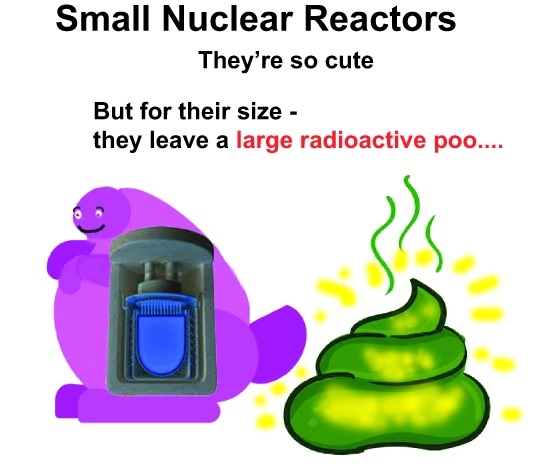
And then there’s the issue of what to do with radioactive waste. Researchers at Stanford found that SMRs actually produce more such waste than larger conventional reactors, because more subatomic particles escape from a smaller nuclear core, contaminating surrounding materials……………………………….. https://www.bbc.co.uk/worklife/article/20251008-why-big-tech-is-going-nuclear
The astronomic costs of decommissioning Sellafield

First Annual Report of the Chair of the Committee of Public Accounts.
(Paras 55&56) We were informed that the estimated cost of decommissioning the site was £136 billion, an increase of 18.8% since March 2019.
When the previous Committee last took evidence on Sellafield in 2018, the nine major projects that were underway then were between them delayed by 165 months and expected to cost £913 million more than originally budgeted.
However, the Committee heard that the combined costs of four of these projects are now expected to cost £1.15 billion more than when the previous Committee reported. Each of these four projects will also be delayed further by between 58 and 129 months each.
Sellafield Ltd has begun retrieving
hazardous waste from the site, and in the longer term, this waste will be
stored in an underground offsite Geological Disposal Facility (GDF) capable
of storing the waste for thousands of years. However, the Committee found
that the opening date of the GDF has slipped from 2040 to the late 2050s.
For every decade of delay, additional buildings could need to be
constructed to accommodate short-term storage of the waste at a cost of
£500–760 million.
As well as the serious implications for the value for
money of the project, this delay makes the ambition to completely
decommission the Sellafield site in the next hundred years even more
challenging.
In addition to this, in August the GDF project was rated red
in its Delivery Confidence Assessment by NISTA, meaning “successful
delivery of the project appears to be unachievable.” DESNZ has since
acknowledged that the NDA is “undertaking some replanning to mitigate
risks and support ongoing progress” across all of its programmes,
including the GDF. We will be following any further developments closely
over the coming months.
House of Commons 15th Oct 2025,
https://publications.parliament.uk/pa/cm5901/cmselect/cmpubacc/1300/report.html#heading-5
The Trumpanyahu Administration Is Already Sabotaging The Ceasefire
Caitlin Johnstone Oct 15, 2025, https://www.caitlinjohnst.one/p/the-trumpanyahu-administration-is?utm_source=post-email-title&publication_id=82124&post_id=176195807&utm_campaign=email-post-title&isFreemail=true&r=1ise1&triedRedirect=true&utm_medium=email
I don’t know who first coined the saying that an Israeli ceasefire means “you cease and we fire,” but it proves reliably accurate time after time.
The IDF reportedly killed nine Palestinians trying to return to their homes today under the usual justification that they were traveling in some kind of unauthorized area in ways that made the troops feel threatened, blah blah. They did this all the time during the previous “ceasefire” at the beginning of the year, using the exact same excuses.
Just as we speculated the other day might happen, Israel has announced that it is going to cut the aid it allows into Gaza in half and cut off fuel and gas shipments because Hamas hasn’t returned the bodies of all the dead Israeli hostages. Israel was fully aware when it signed the agreement that Hamas would not be able to deliver the bodies of all the hostages right away due to the rubble and chaos caused by the Israeli bombing campaign in Gaza.
On October 9, CNN published an article titled “Israel assesses Hamas may not be able to return all remaining dead hostages” which reported that “the Israeli government is aware that Hamas may not know the location of, or is unable to retrieve, the remains of some of the 28 remaining deceased hostages.”
The Red Cross says that finding all the bodies of the hostages will be a “massive challenge” in all the rubble created by Israeli airstrikes in the areas where hostages were being kept.
Drop Site News’ Jeremy Scahill explains that “During Gaza negotiations, Israel understood it would take time to recover all bodies of deceased captives. A specific mechanism for recovering the bodies was agreed. Now Israel is pretending that didn’t happen so it can violate the deal and cut the agreed aid shipments in half.”
Mondoweiss reported last week that Hebrew-language Israeli media had been saying that a “secret clause” in the ceasefire agreement would allow Israel to resume its onslaught if the bodies of the dead hostages were not returned within a 72-hour window.
So it looks like this was planned from the beginning. Create obligations that Israel knew Hamas would be unable to fulfill, then use it as an excuse to resume the slaughter.
And President Trump appears to be going right along with it, posting on Truth Social that “A big burden has been lifted, but the job IS NOT DONE. THE DEAD HAVE NOT BEEN RETURNED, AS PROMISED!”
“We were told they had 26, 24 dead hostages… and it seems as though they don’t have that, because we’re talking about a much lesser number,” Trump told the press on Tuesday, saying, “I want them back.”
Trump also told the press that Hamas is going to have to be forcibly disarmed, which amounts to an open admission that this entire “ceasefire” show is a sham.
“If they don’t disarm, we will disarm them, and it will happen quickly and perhaps violently,” Trump said on Tuesday.
This statement matches recent comments from Benjamin Netanyahu saying that Hamas will be disarmed “the easy way” or “the hard way”.
The president and prime minister are making it clear that in order for the ceasefire negotiations to proceed to a lasting peace, Hamas is going to have to completely surrender and Israel is going to have to be handed total victory. They’re branding it as a ceasefire deal when it’s actually a total surrender deal, and Hamas has made it explicitly clear that it is not surrendering.
As Drop Site News explains, “In reality, senior Hamas, Islamic Jihad and figures from other resistance factions have repeatedly rejected disarmament throughout negotiations, including in multiple interviews with Drop Site over the past year.”
A big part of the confusion around the ceasefire in public discourse today is that there are two contradictory ideas going around about what the ceasefire is and what it means. Israel supporters think “ceasefire” means “total victory and complete surrender by Hamas,” while everyone else thinks “ceasefire” means ceasefire.
That’s why you see Israel supporters celebrating the deal while Palestine supporters are much more apprehensive. Palestine supporters understand that a ceasefire and a surrender are two different things, and see Trump and Netanyahu stating that Hamas is going to have to completely disarm if “ceasefire” negotiations are going to move toward a lasting peace. They understand that the unyielding mutually exclusive positions of the Trumpanyahu administration and of Hamas are likely to come to a head in ways that result in the reignition of the Gaza holocaust.
So for all the applause and fuss that has been made about the ceasefire, as things stand right now it doesn’t look like much has changed. From the very beginning of this genocide it has been the officially stated position of the US and Israel that the killing will not end until Hamas lays down its arms and surrenders, and that is still their position today. There’s a much-needed pause in the slaughter, sure, but the Trumpanyahu team is making it explicitly clear that it is going to ramp up again under the justification of Hamas refusing to disarm.
And that’s assuming negotiations even make it that far; Israel is already doing everything it can to sabotage the ceasefire by murdering Palestinians and greatly reducing the amount of aid it promised.
Unless something significant changes about all this fairly soon, even this feeble reduction in Israel’s Gaza atrocities cannot be expected to hold.
Media Refuse To Sign Up As Propagandists For Trump’s Pentagon.
The Atlantic, Associated Press, Breaking Defense, CNN, Defense One, The Financial Times, The Guardian, The Hill, The New York Times, NPR, Newsmax, Politico, Reuters, Task & Purpose, The Wall Street Journal, The Washington Examiner, The Washington Post, and The Washington Times all announced that they would not agree to the policy. (Media outlets had until 5 p.m. on October 14 or else they would likely lose access to the Pentagon.)
Kevin Gosztola, The Dissenter, Oct 14, 2025
Nearly all media organizations refused to sign a censorship policy at the Pentagon that imposes greater control over credentialed reporters and the information that they publish.
The policy, championed by Pentagon Secretary Pete Hegseth, was first proposed in mid-September. It resulted in an immediate backlash because the policy required reporters to pledge not to share any military information, including unclassified information, unless that information is officially approved for release.
On October 6, the Pentagon revised the policy [PDF]. It changed to “military members” must seek approval from an “appropriate authorizing official” before releasing information to the press. However, the department added, “Any solicitation of [military] personnel to commit criminal acts would not be considered protected activity under the 1st Amendment.”
The Atlantic, Associated Press, Breaking Defense, CNN, Defense One, The Financial Times, The Guardian, The Hill, The New York Times, NPR, Newsmax, Politico, Reuters, Task & Purpose, The Wall Street Journal, The Washington Examiner, The Washington Post, and The Washington Times all announced that they would not agree to the policy. (Media outlets had until 5 p.m. on October 14 or else they would likely lose access to the Pentagon.) ……………………………………………………………………………………………………………………………………………………………………… https://thedissenter.org/media-refuse-to-sign-up-as-propagandists-for-trumps-pentagon/
Holtec Backs Down, Reveals Achilles’ Heel For U.S. Nuclear Resurgence
Forbes, ByIan Dexter Palmer, Ph.D, 14 Oct, 2025
Highlights.
- Holtec International has shuttered their plans to store nuclear waste in the Permian basin of south-east New Mexico.
- President Trump, by executive order, has decided nuclear energy will be a big part of the U.S. energy future.
- Next-gen nuclear reactors, SMRs, have been spotlighted by the Secretary of Energy to help solve the electrical power surge needed for data centers and AI.
- But research has shown that SMRs create 2 to 30 times greater volumes of nuclear waste.
- The cost of new nuclear reactors, whether traditional reactors or SMRs, is substantially higher than renewable energies.
- Oklo is a front-runner in the SMR race, and its stock has skyrocketed. In August, it was selected for three projects under DOE’s Reactor Pilot Program.
Holtec International has shuttered their plans to store nuclear waste in the Permian basin of south-east New Mexico. The planned site would have contained 50 canisters of spent nuclear fuel for 40 years, as a temporary storage site, which is laughable as Holtec planned to scale up to 10,000 canisters eventually.
President Trump, by executive order, has decided nuclear energy will be a big part of the U.S. energy future. After languishing for decades, President Biden assigned substantial funds to nuclear, as part of his push toward carbon-free sources. But there is an Achilles’ heel to nuclear—the waste is radioactive, and has to be disposed of very carefully. This is not just waste from traditional nuclear reactors, like Three-Mile Island, but also from small nuclear reactors (SMRs), that can be as small as a three-story building, and which can be made in a factory, and stacked to scale up energy supply. There is an ubiquitous threat in the U.S., real or perceived, of being exposed to nuclear radiation, either from nuclear accidents or from storage of nuclear waste.
Holtec Project Canceled.
In 2023, the governor of NM, Michelle Lujan Grisham, signed a state bill into law that banned state agencies from signing nuclear storage permits. There are reasons for this. NM has a history of debilitating health effects from nuclear radiation, from the first atom bomb explosion south of Albuquerque, to workers who mined uranium in western parts of the state.
But there are other liabilities. A second is earthquakes in the Permian basin induced by injection of waste water from oil well operations. These are increasing in numbers and there have been several magnitude 5 quakes. Planning to build a storage facility for nuclear waster in the middle of hundreds of oil wells and their earthquakes should be a no-brainer.
A third liability is the promise the Holtec facility would be temporary, until the U.S. finds a permanent site. ………………………………………………………………………………………………………………….. https://www.forbes.com/sites/ianpalmer/2025/10/14/holtec-backs-down-reveals-achilles-heel-for-us-nuclear-resurgence/
Exempt charities from nuclear levy on energy bills, government urged
Third Sector UK, 14 October 2025 by Emily Harle
Some charities could see their bills rise up to £2,500 a year
The government has been urged to provide an exemption for charities from a new levy that could cost some voluntary sector organisations up to £2,500 a year.
The nuclear regulated asset levy, which will be introduced in November, was developed by the previous government to provide a return to investors in Sizewell C, a new nuclear power station that is being built in Suffolk over the next decade.
Although industries that use the most electricity have been exempted from the levy by the government, the energy regulator Ofgem said this week that local charities, including youth clubs and community centres, will have to pay the full amount.
The Social Investment Business estimates that the average charity with a building could see their bills rise by up to £240 annually, but added that some will face an increase of more than £2,500 per year as a result of the levy.
This rise in electricity bills “will add even more pressure to charities”, SIB said, adding that the sector was particularly vulnerable to increasing prices due to the low income of volunteer-led clubs and the “often-draughty” buildings available for community groups.
In April, SIB’s research found that local youth charities were paying as much as half of their entire budget just to cover utilities.
Nick Temple, chief executive of the SIB, said: “Adding yet more charges on top of charity electricity bills penalises our most vital community spaces at a time when they are already struggling.
“The government must urgently provide an exemption to this new levy for charities, who are particularly vulnerable to rising costs.
“They should drop this model of adding charges onto electricity all together, which is no longer fit-for-purpose and is slowing down the country’s transition to renewables and inflates everyone’s bills.”
SIB have also urged charities to contact their energy providers, adding that if a charity is on a variable tariff, it will see charges introduced from 1 November, while those on fixed tariffs will need to check with their provider.
Wellspring Settlement, a charity based in Bristol delivering a range of community services to local families and young children, is one charity under threat due to the new levy costs, facing a potential uplift of more than £2,500 per year…………………………………….https://www.thirdsector.co.uk/exempt-charities-nuclear-levy-energy-bills-government-urged/finance/article/1936061
Palestinians’ Fate: Victims of Genocide While Alive, Vastly Uncounted By the Media When They Are Killed.

By Ralph Nader, October 10, 2025, https://nader.org/2025/10/10/palestinians-fate-victims-of-genocide-while-alive-vastly-uncounted-by-the-media-when-they-are-killed/
Ben Hubbard, the long-time Middle East correspondent for the New York Times, is known for his high standards. So too is Karen DeYoung, the long-time reporter and foreign affairs editor for the Washington Post.
Yet they, and their editors, share a common, recurring failure by misleading their readers about the serious undercount of Palestinian deaths during the Israeli regime’s genocidal destruction of Gaza.
How so? By repeating in article after article the Hamas claim of 67,000 deaths since October 2023. The real death toll estimate is probably around 600,000. Unlike Israeli and American cultures, which do not under-estimate their fatalities in conflicts, Hamas sees the awful death toll as a reflection of their not protecting their people and a measure of Israeli military might against Hamas’ limited small arms and weapons. Both Hubbard and DeYoung, of course, know better. They know the daily bombardment of tiny Gaza, the geographical size of Philadelphia, with 2.3 million humans, is without precedent in Israel’s targeting of civilians andcivilian infrastructure. The blockade of “food, water, medicine, fuel, and electricity,” along with the concentrated destruction of health care facilities have been condemned by human rights groups in Israel and International humanitarian organizations.
Reporters and editors are quite aware of more accurate casualty estimates appearing in The Lancet, the prestigious British medical journal, and estimates provided by other academic and prominent international relief organizations like Doctors Without Borders, Save the Children, UN World Food Programme and others experienced in assessing the human toll of military devastations.
Journalists know the estimate last April by Professor Emeritus Paul Rogers of the University of Bradford in the UK, an expert in the power of aerial bombs and missiles, who wrote that the TNT equivalent of six Hiroshima atomic bombs has been delivered to these totally defenseless Palestinians, almost all of whom are without housing or air raid shelters.
Netanyahu’s American-made missiles and bombs continue to produce deadly bloodshed. The waves of death from starvation, untreated, weaponry-caused infectious diseases, the cutoff of medicines treating cancer, respiratory ailments, and diabetes are still mounting.
What readers do not know is how much of the use of Hamas’s undercount is mandated by news editors, and why. Because intense Netanyahu propaganda has declared the estimates of Hamas, based on real names (excluding many thousands under the rubble and the collateral damage to civilians that in such conflicts exceed direct fatalities from the bombing by 3 to 13-fold), are an exaggeration, the mainstream media is wary of being accused of even worse fabrications than those of Hamas.
Speaking to many reporters and editors about this huge undercount phenomenon, not prevalent in other violent arenas of war, they all agree that the real count is much higher, but they do not have a number to use that is deemed credible. But they do have casualty experts who can be interviewed, such as the chair of the Global Health Department at Edinburgh University or a foremost missile technology specialist, MIT Professor Emeritus Theodore Postol, who said on our radio/podcast recently, “I would say that 200, 300, or 400,000 people [Palestinian] are dead easily.”
The least the journalists could do is say “the real count may be much higher.” The other alternative is to do their own investigation, piecing together the empirical and clinical evidence (See, Gaza Healthcare Letter to President Trump, October 1, 2025) and citing prominent Israelis who have said that the IDF has always targeted Palestinian civilians from 1948 on. (See my column March 28, 2025 – The Vast Gaza Death Undercount – Undermines Civic, Diplomatic and Political Pressures.)
The other alternative is to do a “news analysis,” which allows for evaluations, short of editorializing. For instance, a “news analysis” could point out that conveying the impression that the Hamas figures are the true count means that 97 out of 100 Palestinians in Gaza are still living. This is not remotely credible. Yet that is essentially what Ben Hubbard’s October 7th Times article stated, “with more than 67,000 killed, or one in every 34 Gazans, according to local health officials.” It is more like one in every four Gazans killed.
Nor is it true that the “local health officials” are confirming this, because on further inquiry, they admit their definition of the fatality toll excludes those under the rubble and those who die from the massive collateral casualty toll. This reality is well known to scores of American physicians back from Gaza who say that a majority of those killed are children and women and that the survivors are almost all injured, sick, or dying.
There are esteemed reporters like Gideon Levy of the Israeli newspaper Haaretz, who claim that the Hamas figures are horrible enough that they meet the test of genocide, implying that a higher count would not make any more of a moral or political difference.
I disagree. “Horror” does not have finite limits. It makes a difference in driving the greater intensity of political, diplomatic, and civic pressures to have a count of 600,000 rather than 67,000 or 200,000 children rather than 20,000 children murdered. Do we need to refer to other genocides in the 20th century to show how much a difference it would have made if the official count were one tenth of the real count?
The editors of the Post, especially, and of the Times are not keeping up with the reporting of DeYoung and Hubbard et al., about the scenes of death, dying, and horrendous agony in Gaza. The editorial management of reporters and the editorials fail to hold Netanyahu and his terroristic mass-slaughtering cabinet accountable. They allow the publication of realistic reports, features, and sometimes even give voice to Palestinians, as the Times did with several pages and pictures recently. But the long-time omnipresent shadow of AIPAC et al. darkens the editorial and opinion pages more than do the illuminations of their own reporters.
PATRICK LAWRENCE: Let Us Now Bury the Truth (Again)

October 13, 2025, By Patrick Lawrence, Consortium News
What is going around now is another cover up, another denial of what a lot of people on both sides call “the second Nakba,” the sin atop the original sin.
Headline in the Sunday editions of The New York Times: “A New Test for Israel: Can It Repair Its Ties to Americans?”
What a question. Let us set aside our indignation and think about this.
The piece below this head is by David Halbfinger, whose trade over the years has been to appear balanced when covering the Zionist state while glossing its past, which is wall-to-wall condemnable, and faithfully apologizing for its present, which — need this be said — is also wall-to-wall condemnable.
David Halbfinger, who has just begun his second tour as the Times’ Jerusalem bureau chief, in action:
“The war in Gaza may finally be ending, after two years of bloodshed and destruction. But among the damage that has been done is a series of devastating blows to Israel’s relationship with the citizens of its most important and most stalwart ally, the United States.
Israel’s reputation in the United States is in tatters, and not only on college campuses or among progressives….
The question is whether those younger Americans will be lost to Israel long- term — and what Israel’s advocates will do to try to reverse that.”
Halbfinger proceeds to quote none of “those younger Americans,” or anyone else of any age who stands forthrightly against “the Jewish state” in response to the campaign of terror, murder and starvation it has conducted against the civilian population of Gaza these past two years.
No, his sources are professors, think-tank inhabitants and, of course, Israeli Zionists, American Zionists and in two cases Israeli–American Zionists — the good old divided-loyalties crowd.
Halbfinger quotes Shibley Telhami, an Arab–Israeli scholar with safe harbors at The Brookings Institution and the University of Maryland……………………………………………………………………………………………………………………….
You see what is going on here, I trust.
I have anticipated for many months — no great insight in this — that when something like the end of Israel’s terror in Gaza comes there will be no thought among its allies in the West, and certainly none among its Zionist supporters, of any kind of reckoning in the name of justice.
No, a “war” will be over, not a racist campaign of annihilation, and certainly not a genocide. The highly honorable Cost of War Project at Brown University put out a paper on Oct. 7 reckoning total casualties in Gaza (killed and injured) at 236,505, “more than 10% of the pre-war population.” These are responsibly researched facts.
We know these facts. “It doesn’t take rocket science to grasp the picture,” Norman Finkelstein said in a lecture delivered at the University of Massachusetts five days before the Netanyahu–Trump “peace plan” was announced.
He said: “Everyone at this point knows the picture — unless you have a material stake in lying to yourself and lying to others.”
‘Everyone Knows the Picture’
Yes, we know the picture and the facts, and we are invited to live with these facts without any kind of investigation, truth and reconciliation project, such as post-apartheid South Africa conducted in the late 1990s, or any other effort in behalf of restorative justice.
No, the invitation is to go back to our comfort zones while a regime of racist murderers continues on its way.
The liars propose to prevail, to put this point another way.
Whatever other purpose this commentary may serve, I use it to raise my voice in protest against this… this desecration of the human cause.
When I consider the project of the liars now my mind goes back to al–Nakba — further, indeed. David Ben–Gurion and others of his time acknowledged the injustice and the violence on which the State of Israel was founded in July 1948. “We have come and we have stolen their country,” Ben–Gurion remarked.
[“If I were an Arab leader, I would never sign an agreement with Israel. It is normal; we have taken their country. It is true God promised it to us, but how could that interest them? Our God is not theirs. There has been Anti-Semitism, the Nazis, Hitler, Auschwitz, but was that their fault? They see but one thing: we have come and we have stolen their country. Why would they accept that?”Quoted by Nahum Goldmann in Le Paraddoxe Juif (The Jewish Paradox), pp121.]
There is no putting the point more truthfully. And all that has occurred since is the outcome of this, a covering up, a denial of the original sin.
And now again.
…………………………………………Along with everyone else, I do not know at writing whether the Gaza Peace Plan, as it is billed, will hold or when — the better question at this point — it will fall apart like all those that have preceded it.
But — grim knowledge — I know this: It will not end well if the events of the past two years are buried as the events of the past seven and some decades have been buried. The human spirit simply does not work that way.
It will not, indeed, end at all. https://consortiumnews.com/2025/10/13/patrick-lawrence-let-us-now-bury-the-truth-again/
Monique Barbut, Minister for Ecological Transition, raises doubts among nuclear industry.

Monique Barbut has been appointed Minister of Ecological
Transition. She succeeds Agnès Pannier-Runacher, who, from the Ministry of
Energy Transition to that of Ecological Transition, has worked tirelessly
in favor of nuclear electricity.
The latter carried the law accelerating nuclear power adopted in 2023 and is at the origin of the Nuclear Alliance, which brings together a dozen European countries that have opted for this
energy and/or are in the process of reviving it.
The contrast with her successor is striking. When Monique Barbut was head of WWF France, between 2021 and 2024, the NGO, true to its line, took a stand against nuclear power. ” We call in particular on the European Parliament not to give in to pressure from France and other countries by agreeing to classify fossil gas and nuclear energy as sustainable in its taxonomy “…
Le Figaro 13th Oct 2025, https://www.lefigaro.fr/societes/monique-barbut-ministre-a-la-transition-ecologique-fait-douter-les-industriels-du-nucleaire-20251013
International Repair Day 2025 will take place on 18th October and will focus on software obsolescence

International Repair Day is an annual celebration for everyone who makes repair happen in their communities around the world.
Every October we celebrate the power of repair to bring our communities together, reduce our impact on the planet, learn new skills and so much more. Whether you’re a repairer, community organiser, tinkerer, maker, repair business, campaigner or simply a fan of fixing, there are lots of ways to join in. When software updates stop coming, perfectly good hardware is being discarded, undermining our community’s efforts and feeding the growing mountain of e-waste.
Let’s stop Microsoft creating millions of tonnes of e-waste this October
The end of support for Windows 10 is creating an e-waste disaster
by Ugo Vallauri, co-director, at the Restart Project., https://greenallianceblog.org.uk/2025/10/14/the-end-of-support-for-windows-10-is-creating-an-e-waste-disaster/
The end of free support for Windows 10 happens today, 14 October, ironically coinciding with International E-Waste Day. Up to 400 million of the computers currently running Windows 10 don’t meet Microsoft’s requirements to upgrade to Windows 11. This forces users to either buy new devices, join a Microsoft scheme for a temporary extension of support, switch to an alternative operating system or risk using unsecure software.
If these computers are discarded as a result, they could turn into up to 700 million kilogrammes of e-waste, adding to the 62 billion kilogrammes of e-waste produced globally each year, of which the UK is the second highest producer per capita.
It’s the largest case of premature, planned obsolescence
What’s happening today is a perfect example of premature and planned obsolescence, possibly the largest example to date. It is premature, because many of the affected computers are primarily used to run web-based services, for which newer, more powerful devices aren’t necessary.
This choice by Microsoft is also deliberate: by requiring hardware to meet certain specific requirements to upgrade to its new Windows 11 operating system, the company planned to make a huge portion of today’s computers practically obsolete. And the software manufacturer executed its strategy consistently, primarily focusing its communication on the importance of upgrading to new computers compatible with the new software to stay secure. In parallel, it has delayed publishing information about alternative options available, in the hope that people would decide to upgrade to a new device.
Twenty million people in Britain are affected
Polling data from a YouGov survey for The Restart Project shows that 39 per cent of people in Great Britain currently own or use at home a computer running Windows 10. What’s even more concerning is that 62 per cent of respondents using Windows 10 don’t have a plan to change their computer or operating system after today. The Restart Project estimates over 20 million British people are affected, with almost 13 million computers becoming vulnerable to hackers and malware as soon as support to the operating system ends.
How did we get to this point? Microsoft as well as many other manufacturers of small electrical and electronic devices can get away with arbitrarily stopping support for existing devices simply because there is no legislation forcing them to continue supporting their existing products for as long as needed by users.
People reject the need to replace devices often
Right to repair advocates and digital rights groups have been raising awareness of this issue across the world in recent months, creating campaigns and resources for users. For example The Restart Project created a toolkit to help community groups support people through the end of Windows 10, informing them of the various options available: from switching to free and open source operating systems to paying for extended Microsoft support. In the lead up to International Repair Day on 18 October, thousands of repair events around the world are breathing new life into laptops, saving people money and cutting waste. This growing movement is proof that people are rejecting fast tech turnover.
While the end of Windows 10 is a great opportunity to advocate for free and open source alternatives, this solution can’t be easily rolled out to hundreds of millions of users and devices. Additionally, at a time when the use of refurbished devices is growing everywhere, the end of Windows 10 support is rendering millions of devices, already replaced by corporate and other users, virtually useless as second hand devices, contributing to widening the digital divide.
People in the EU have a different support option
This is why systemic solutions must be put in place to solve this and future cases of software obsolescence. A global coalition of organisations is urging Microsoft to extend free, automatic support for Windows 10 until 2030. In parallel, in the EU, the Right to Repair Europe coalition is calling on the European Commissioner Jessika Roswall to protect citizens and businesses from software-driven obsolescence with ambitious EU Ecodesign rules for devices like laptops.
Meanwhile, in the UK, since April 2024, manufacturers of internet connectable products are required to indicate the minimum amount of software support they commit to provide for their products, under the Product Security and Telecommunications Infrastructure Regulation.
While a step in the right direction, this falls short of requiring manufacturers to provide a minimum support period. It contributes to improving consumers’ information without increasing consumer rights.
The Windows 10 case is telling: Microsoft had to (quietly) agree to extend free support in countries in the European Economic Area, but not in the UK, as its practices were not compatible with the EU Digital Markets Act.
Polling from The Restart Project reveals that 84 per cent of people in the UK support the introduction of legislation to prevent software obsolescence. It’s therefore imperative that the government pushes ahead with ambitious right to repair legislation, as demanded by over 430 community groups, organisations and businesses which have already signed the Repair and Reuse Declaration, endorsed by 80 MPs.
Outsized and Eccentric: The Farce Behind the Nobel Peace Prize

12 October 2025 Dr Binoy Kampmark, https://theaimn.net/outsized-and-eccentric-the-farce-behind-the-nobel-peace-prize/
The fuss about the Nobel Peace Prize has always been excessively outsized to its relevance. Like most prizes, the panel is bound to have its treasure trove of prejudices and eccentricities in reaching any decision. Thin resumes have swayed the Norwegian committee to acts of dottiness. Surprising moments of dark humour have made an appearance in the award of the prize to warmongers and those antithetical to peace. And those on the Nobel Prize peace panel would barely cause a murmur of acknowledgement outside the spine-like length of that country of only 5.6 million inhabitants. (The current membership of five features, for instance, three politicians: Anne Enger, former leader of the country’s Centre Party; former Conservative Party education minister Kristin Clement, and former state secretary of the Labour Party, Gry Larsen.)
Rather feebly, Asle Toje, another member of the five, uses a gastronomic metaphor in describing the selection process: “We do it pretty much the same way you make a good sauce – you reduce and reduce and reduce.” The reduction formula leads to surprising, rancid results. In 1973, the ruthless, toadying poseur Henry Kissinger was overcome with joy in receiving the prize. The National Security Adviser and US Secretary of State had supposedly done much to advance the cause of peace in the Indochina conflict by “spearheading cease-fire negotiations” that led to an armistice in January 1973. His co-awardee, the North Vietnamese negotiator Le Duc Tho, was far more sensible, refusing to accept a peace award where there was no peace to be had.
The choice of Kissinger was almost mockingly ghoulish. This was the same man who left his marks all over secret and illegal bombing campaigns in Laos and Cambodia during the Nixon administration, oversaw the extinction of democratically elected governments in Latin America in favour of murderous, authoritarian regimes, and spent his early academic career arguing that small-scale nuclear might be feasibly pursued by the United States as a psychological lever.
The selection for 2025 was always going to be shadowed by the theatre known as the Donald Trump show. In claiming not to want it, the US President has done much to pad out his credentials to make himself eligible. He has put on an incomplete, disputable show of halting conflicts while indulging in spells of violence (strikes on Venezuelan shipping, ostensibly carrying drugs to the US; the illegal bombing of Iran’s nuclear facilities).
What the committee has done is the next best (or worse) thing. In opting for María Corina Machado, seen as the main figure of the Venezuelan opposition to the current government of Nicolás Maduro, they have offered the prize to a Trump medium. “I dedicate this prize to the suffering people of Venezuela and to President Trump for his decisive support in our cause,” she cooed on X.
Almost hinting at something in the works – that is to say, the ongoing regime change agenda so enthusiastically sought by Washington – Machado was convinced of being “on the threshold of victory and today, more than ever, we count on President Trump, the people of the United States, the peoples of Latin America, and the democratic nations of the world as our principal allies to achieve freedom and democracy.” Given Latin America’s record on peaceful transitions from coups, this was fine humour indeed.
The award to Machado was, according to the Nordic wiseacres, based on her “tireless work promoting democratic rights for the people of Venezuela and for her struggle to achieve a just and peaceful transition from dictatorship to democracy.” They go on to be didactic, talking about democracy being in global retreat, with Machado being its illuminating defender. (On being barred from running, she installed the surrogate opposition leader Edmundo Gonzálezwho allegedly won the July 2024 election.)
This is the bromide of binary thought. Machado’s record, befitting most political records, is untidy. David Smilde, a student of Venezuelan politics, sees her as “a controversial pick, less a peace activist than a political operator willing to use some of the trade’s dark arts for the greater democratic good.” Even that might be generous.
For one thing, she is clearly biding her time, shunning local and regional elections, treating the honouring of the 2024 presidential election results as absolute. She has openly argued for the necessity of foreign intervention in removing Maduro and endorsed Trump’s military buildup in the Caribbean, calling the recent bombing of suspected drug boats a matter of“saving lives”. To remove Maduro was essential, she argues, because of his alleged credentials as “the head of a narco-terrorist structure of cooperation.”
Disingenuously, she has swallowed the dubious theory that Maduro is the true figure running the Tren de Aragua gang, which Trump accuses of directing operations against the United States. Her Vente Venezuela party has enthusiastically shared the threats by US officials against supposed Venezuelan drug traffickers on X. “If you’re in the Caribbean,” states one recent post, “if you’re north of Venezuela and you’re trying to traffic drugs to the US, you’re a legitimate target for the US.”
Machado is undoubtedly readying herself to step into any presidential vacancy, forced or otherwise. She claims to have a plan for the first 100 hours and the first 100 days of a transition process, promising the generation of wealth for the country to the value of $1.7 trillion over 15 years. Her advisor on international affairs, Pedro Urruchurtu, has been open about communicating with the Trump administration over Maduro’s removal.
Again, this says much about the eccentric reading of peace embraced by the insular Norwegian grandees. If Tom Lehrer was right to call political satire obsolete after Kissinger’s award, it would also be accurate to say that instances of rich farce have come in its wake.
The £1m man: why did Boris Johnson take his donor to Ukraine?
Leaked files offer a glimpse of the ex-prime minister’s relationship with Christopher Harborne.
Tom Burgis. Guardian 10 Oct 25
As he boarded the night train to Ukraine, Boris Johnson had the usual entourage of aides and bodyguards – plus the man who had given him £1m.
Less than a year had passed since Johnson accepted what is thought to be the largest donation ever to an individual MP. It was from Christopher Harborne, one of the UK’s biggest and most private political donors.
Harborne, whose millions helped bankroll Brexit, made the payment to a private company Johnson set up after resigning as prime minister. Now leaked files show that Johnson, a champion of Ukraine in office and since, was accompanied in September 2023 by his benefactor on a two-day visit that included meetings with top officials.
What the files do not explain is why. And neither the former prime minister nor his backer will say.
The organisers of the high-level gathering they attended in Kyiv say Harborne was registered as “adviser, Office of Boris Johnson”.
Harborne has wide expertise: a self-described “digital nomad”, his holdings range from cryptocurrency and a wellness centre to jet fuel and stakes in at least three military contractors. His only apparent connection to Ukraine is as the biggest shareholder in a British weapons manufacturer whose robots and drones are reportedly supplied to its armed forces.
The Boris Files, leaked documents from Johnson’s private office, have exposed how the former PM has sought to enrich himself since leaving office by sitting down with a Venezuelan despot and courting Mohammed bin Salman, the Saudi crown prince accused of ordering the murder of a journalist.
The Ukrainian cause, by contrast, is “sacred” to Johnson, one political consultant says, an enduring source of moral authority for a politician who was forced out of Downing Street amid scandal.
The leaked files raise questions about whether, even here, he has blurred the lines between public service and money-making.
In an extraordinary statement to the Guardian when asked about his relationship with Harborne, Johnson said: “Your pathetic non-stories … seem mostly to be derived from some illegal Russian hack job. You should be ashamed of yourselves.” Distributed Denial of Secrets (DDoS), the US-based transparency group that obtained the leaked files, said it did not know their provenance.
Johnson added: “Why don’t you just change your name to Pravda? Your stories are rubbish and you are doing Putin’s work.”
‘Boris and Chris only’
In Downing Street, Johnson rallied western powers as Vladimir Putin’s armies poured into Ukraine in February 2022. Since resigning, he has continued to travel there, pledging to maintain allies’ commitment, and remains so popular that he is cheered in the streets.
When he disembarked from the night train in Kyiv on 8 September 2023, Johnson had time for a quick shower at his hotel before heading for the Yalta European Strategy (YES) forum, an itinerary in the leaked files indicates. According to a published list of participants, Ukrainian ministers, spymasters and military chiefs mingled with foreign diplomats, politicians, industrialists and executives.
The itinerary has “Boris and Chris [Harborne] only” down to attend the opening session of the high-level gathering. Images show Volodymyr Zelenskyy and Johnson addressed the gathered luminaries and the itinerary suggests they then retired for a private meeting. Zelenskyy’s office did not respond when asked if Johnson’s benefactor joined them…………………………………………………………………………………………………………………………………
The £1m donation
………………….He [Harborne]has given £10m to Nigel Farage’s Brexit party – now Reform UK – and £1m to the Conservatives while Johnson was completing the UK’s departure from the EU. And Johnson seems to have nurtured the beneficial relationship while he was in No 10.
Harborne visited Chequers at least twice during Johnon’s premiership. Once, he arrived at the prime ministerial retreat by helicopter. The second time was for a Tory megadonor barbecue in August 2022.
Within days, Johnson’s tenure was over, but his relationship with Harborne endured, and the £1m personal donation followed. A copy of the financial advice Johnson received soon after leaving Downing Street raises questions about it.
While Johnson was still an MP he set up a private company, The Office of Boris Johnson Ltd. The financial advice reveals that he was expecting a “payment to fund the company’s first few years”. He was advised to consider whether this would represent a political donation or if it “might be simpler for the company to invoice the donor’s company for services”.
The following month, in November 2022, Johnson’s entry in the register of MPs’ interests records a £1m donation to his company from Harborne. The payment does not appear on the Electoral Commission’s donation database of money “given towards the recipient’s political activities” as an MP. This appears to suggest it may have been a contribution towards Johnson’s money-making activities.
The month of the £1m payment, Johnson and Harborne dined together twice in Singapore. A January 2023 entry in Johnson’s schedule set aside half an hour for a call with his backer. It was labelled “Ukraine readout”. That September, by which time Johnson had quit parliament, he and Harborne stepped aboard a Dassault Falcon at Stansted airport, the leaked files indicate. The private jet, apparently operated by Harborne, carried them to eastern Poland to catch the sleeper to Kyiv.
Harborne’s lawyers said: “Mr Harborne’s donation was given to enable Mr Johnson to stay actively engaged in mainstream UK politics. It is and was a donation, and its reporting as such is appropriate.”…………
The letter
Harborne’s lawyers did not give substantive answers to questions about why he went on the trip to Ukraine, beyond saying they “appear to have little to no basis in reality”. But there are possible clues in the leaked files.
The itinerary features a “closed meeting at the military-tech R&D centre”. It does not say whether Harborne attended, but this is an area he knows well. While his position as the largest shareholder in QinetiQ, with 13%, does not give him a role in the day-to-day running of the privatised research unit of the UK armed forces, his financial stake in its operations is significant.
QinetiQ has interests in Ukraine, albeit not its biggest. Ukraine’s forces reportedly use the company’s Banshee drones and bomb-disposal robots. In April 2025, the UK Ministry of Defence announced QinetiQ would help Ukraine’s military make kit with 3D printers……………………. https://www.theguardian.com/politics/2025/oct/10/the-1m-man-why-did-boris-johnson-take-his-donor-to-ukraine
1 This Month

of the week – Shut Down Drone Warfare!


Tell the Ukrainian Government to Drop Prosecution of Peace Activist Yurii Sheliazhenko

Petition to revoke the licensing of the Near Surface Nuclear Disposal Facility (NSDF) at Chalk River. https://www.ourcommons.ca/petitions/en/Petition/Details?Petition=e-7247
To see nuclear-related stories in greater depth and intensity – go to https://nuclearinformation.wordpress.com
-
Archives
- April 2026 (19)
- March 2026 (251)
- February 2026 (268)
- January 2026 (308)
- December 2025 (358)
- November 2025 (359)
- October 2025 (376)
- September 2025 (257)
- August 2025 (319)
- July 2025 (230)
- June 2025 (348)
- May 2025 (261)
-
Categories
- 1
- 1 NUCLEAR ISSUES
- business and costs
- climate change
- culture and arts
- ENERGY
- environment
- health
- history
- indigenous issues
- Legal
- marketing of nuclear
- media
- opposition to nuclear
- PERSONAL STORIES
- politics
- politics international
- Religion and ethics
- safety
- secrets,lies and civil liberties
- spinbuster
- technology
- Uranium
- wastes
- weapons and war
- Women
- 2 WORLD
- ACTION
- AFRICA
- Atrocities
- AUSTRALIA
- Christina's notes
- Christina's themes
- culture and arts
- Events
- Fuk 2022
- Fuk 2023
- Fukushima 2017
- Fukushima 2018
- fukushima 2019
- Fukushima 2020
- Fukushima 2021
- general
- global warming
- Humour (God we need it)
- Nuclear
- RARE EARTHS
- Reference
- resources – print
- Resources -audiovicual
- Weekly Newsletter
- World
- World Nuclear
- YouTube
-
RSS
Entries RSS
Comments RSS
 nuclear-news