For 75 Years, NATO Has Been Terrorizing the Globe
Ukraine Breathes New Life into NATO
Most recently, NATO has performed its familiar war-mongering role in Ukraine, where it has trained Ukrainian troops, including members of the neo-Nazi-led Azov Battalion.
The latter began attacking the people of eastern Ukraine after the 2014 U.S.-backed coup that triggered the devastating ongoing conflict.
This conflict was provoked in part by U.S. efforts to extend NATO membership to Ukraine, which CIA Director William Burns had warned was a red line that should not be crossed.[14]
In late March 2022, thanks to peace talks mediated by Turkey, Russia was ready to withdraw from all the territory it had captured if Ukraine agreed to give up any commitment to join NATO or allow NATO military bases or missiles to be stationed on its territory.
The deal was scuttled when British Prime Minister Boris Johnson flew to Kyiv to tell Ukrainian Prime Minister Volodymyr Zelensky that the “collective West” would not support it.
By Jeremy Kuzmarov, July 13, 2024, https://covertactionmagazine.com/2024/07/13/for-75-years-nato-has-been-terrorizing-the-globe/
Will a formidable peace movement ever emerge that can succeed in stopping it?
This past week, the North Atlantic Treaty Organization (NATO) celebrated its 75th anniversary by hosting a summit in Washington, D.C., where its founding treaty was signed.
A declaration issued at the summit made clear NATO’s intent to continuously confront Russia in Ukraine, and to further expand its operations in Southeast Asia and the Middle East.[1]
The Biden administration announced that: a) they are going to start stationing long-range nuclear and other missiles (including hypersonic missiles, that the U.S. doesn’t even have yet) in Germany, within easy striking-distance of Moscow; b) nuclear-capable F-16 fighter jets will be arriving in Ukraine any day now, and will go into service “during the summer”; and that c) Ukraine is on an “irreversible path” to join NATO.
A commemorative documentary featured now on NATO’s website celebrates NATO’s role in facilitating the Western victory in the Cold War and in allegedly ending ethnic cleansing and genocide in the Balkans in the 1990s, curtailing terrorism from Afghanistan after 9/11, and helping to protect the world from Russian aggression.
NATO’s formation in April 1949 is depicted as being vital in preventing the U.S. from having fallen into dreaded isolationism as it had after World War I, and in protecting European security in the face of the Soviet threat.
Colonel Richard Williams, Deputy Director of NATO’s Defense Investment Division, 1997-2011, states that “NATO is the only organization that offers hope that peace can become a real possibility.”
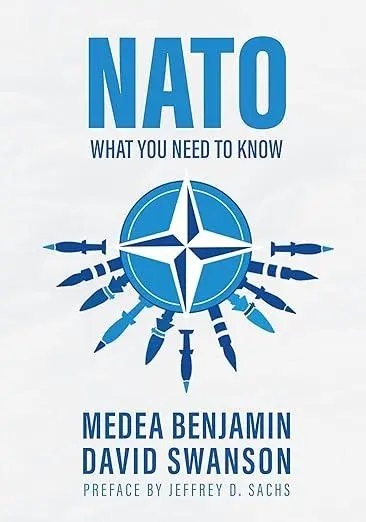
George Orwell would surely be proud of these latter comments in light of NATO’s long record of war-making. The true, venal history is exposed in a short book by peace activists Medea Benjamin and David Swanson, NATO: What You Need to Know, whose publication was timed to encourage protests at the 75th NATO anniversary summit.
Danger to World Peace
In the preface, Columbia University Professor Jeffrey Sachs wrote that “NATO is a clear and present danger to world peace, a war machine run amok that operates beyond the democratic control of the citizenry of the NATO countries.” Sachs continued: “The war machine lines the pockets of the arms contractors at the core of NATO, U.S. companies like Lockheed Martin and Northrop Grumman and Europe’s arms manufacturers…NATO also sucks one nation after another into the vortex of war, instability, displacement, and poverty. During the past 30 years, NATO has fomented a vast arc of violence stretching from Libya to Afghanistan and with many victims in between.”[2]
Benjamin and Swanson emphasize in their introduction that NATO has repeatedly violated the UN Charter outlawing military aggression and the UN’s 1970 Treaty on the Non-Proliferation of Nuclear Weapons and the Treaty on the Prohibition of Nuclear Weapons because of the placement of U.S. nuclear weapons in five European NATO nations.
NATO’s formation in 1949 as a military defense alliance against the Soviet Union was predicated on rampant propaganda that grossly exaggerated the Soviet threat, and on the ouster of peace-oriented politicians such as Henry Wallace, Franklin Roosevelt’s Vice President.
Wallace had proposed a continuation of Roosevelt’s policy of cooperation with the Soviets and was consequently removed in a coup d’état at the Democratic Party convention in Chicago in 1944 and then fired by Harry S. Truman as Commerce Secretary.
Under the direction of Truman’s advisers, including Joe Biden’s political mentor W. Averell Harriman, NATO established private clandestine armies among fascist elements throughout Western Europe who carried out black-flag terrorist activities as part of a strategy to inculcate fear in local populations and to discredit the political left.
In Italy, NATO operatives bombed a Bologna rail station and then planted evidence in the home of a left-wing journalist to make it look like he was the culprit.[3]
Rather than supporting democracy in Western Europe, NATO has a record of empowering reactionary forces. After World War II, it helped destroy popular movements of the left that had led the fight against fascism and were intent on redistributing wealth.
Greece was accepted as a NATO member only after its “ruthless Western-backed government killed or jailed the last of the partisans who had liberated it from the Nazis.”[4]
Turkey’s membership in NATO gave NATO military control of the Bosporus Strait—the only navigational waterway between the Mediterranean and Black Seas and a choke point for the Soviet ports of Odessa and Sevastapol.[5]
Within a decade of joining the Alliance, both Turkey and Greece were toppled in right-wing coups, which did not affect NATO membership. NATO further accepted Portugal as a member when it was ruled by a fascist dictator, Antonio Salazar, who provided the U.S. with a military base in the Azores.
NATO backed Portugal’s brutal suppression of anti-colonial movements in its African colonies (i.e., Angola and Mozambique), supported France’s colonial war in Algeria and the U.S. aggression in Korea, which resulted in the killing of 20% of North Korea’s population.
At an Asian-African conference in Bandung in 1955, Indian Prime Minister Jawaharlal Nehru called NATO “the most powerful protector of colonialism” and said that Morocco, Algeria and Tunisia “would probably have been independent if it had not been for NATO.”[6]
Upholding Unipolar U.S. Power
The U.S. has long been a driving force behind NATO because NATO “provides a vehicle for imposing U.S. leadership over Western nations,” according to Benjamin and Swanson. It has “tied Europe to U.S. military, geopolitical, and economic interests, made Europeans dependent on U.S. military power, and helped fortify U.S. global economic interests.”[7]
After the end of the Cold War, U.S. weapons companies helped lobby for NATO’s expansion. A lobby group called U.S. Committee to Expand NATO was run by the Vice President of Lockheed Martin.[8]
The father of the Cold War containment strategy, George F. Kennan, warned that NATO expansion in the 1990s would be a disastrous folly that would antagonize the Russians and trigger a new Cold War, but to no avail.
Beholden in part to the Polish-American and other Eastern European lobbies alongside the weapons lobbyists, the Clinton administration expanded NATO to three Eastern European countries (Poland, Hungary and Czech Republic)—in violation of a pledge made by the George H.W. Bush administration to the Russians that NATO would not be expanded “one inch to the East.”
George W. Bush followed Clinton by expanding NATO to seven additional countries—Bulgaria, Estonia, Latvia, Lithuania, Romania, Slovakia and Slovenia. Later, NATO was expanded to Montenegro and to Sweden and Finland.
Sowing Methodical Devastation
In 1994, NATO launched its first-ever combat operations in Bosnia, conducting hundreds of air strikes, which contributed to the dismemberment of the former Yugoslavia and transformed Bosnia into what Swanson and Benjamin call a “dysfunctional ward of NATO and the West.”[9]
In 1999, NATO carried out an illegal bombing campaign that dropped 23,000 bombs on Serbia, which killed thousands of civilians. This was followed by the U.S.-NATO invasion and occupation of the Serbian province of Kosovo, resulting in the empowerment of the terrorist Kosovo Liberation Army (KLA), which established Kosovo as a mafia state.
As a spoil of victory, the U.S. acquired the 955-acre Camp Bondsteel in southeastern Kosovo, which became a secret CIA black site for illegal detention and torture. (Europe’s Human Rights Commissioner Álvaro Gil-Robles called Camp Bondsteel a “smaller version of Guantanamo.”[10])
NATO caused more mayhem and bloodshed in the catastrophic 20-year military occupation of Afghanistan. During that time, U.S. and NATO forces dropped 85,000 bombs and missiles and conducted tens of thousands of “kill or capture” night raids, largely targeting innocent civilians, in a futile attempt to destroy the Taliban.
In Iraq, NATO soldiers from Canada, Hungary, Italy, Norway and the Netherlands trained senior military officers who carried out massive human rights crimes in sustaining the illegal U.S. military occupation.[11]
NATO played a further instrumental role in the 2011 regime-change operation targeting Libyan ruler Muammar Gaddafi who had given Libya the fifth-highest GDP per capita in Africa and the highest human development rating there.
Before the start of bombing operations, NATO secretly deployed CIA officers and British, French, Canadian and Qatari Special Forces to organize and lead Libyan jihadist forces intent on toppling the secular nationalist Qaddafi.[12]
NATO took full command of all aspects of the Libyan air war, with warships from 12 NATO countries sent to enforce a critical naval blockade.
Benjamin and Swanson wrote that, “after taking the capital, Tripoli, NATO and its allies cut off food, water, and electricity to the people of Sirte and Bani Walid as they bombarded them for weeks. The combination of aerial, naval, and artillery bombardment, starvation and rebel atrocities on these civilian populations made a final, savage mockery of the UN Security Council’s mandate to protect civilians.”[13]
Ukraine Breathes New Life into NATO
Most recently, NATO has performed its familiar war-mongering role in Ukraine, where it has trained Ukrainian troops, including members of the neo-Nazi-led Azov Battalion.
The latter began attacking the people of eastern Ukraine after the 2014 U.S.-backed coup that triggered the devastating ongoing conflict.
This conflict was provoked in part by U.S. efforts to extend NATO membership to Ukraine, which CIA Director William Burns had warned was a red line that should not be crossed.[14]
In late March 2022, thanks to peace talks mediated by Turkey, Russia was ready to withdraw from all the territory it had captured if Ukraine agreed to give up any commitment to join NATO or allow NATO military bases or missiles to be stationed on its territory. The deal was scuttled when British Prime Minister Boris Johnson flew to Kyiv to tell Ukrainian Prime Minister Volodymyr Zelensky that the “collective West” would not support it.
This ensured that the war would go on—at the cost of the flower of Ukraine’s youth who have been sacrificed in another unwinnable war.
Hope for the Future?
NATO’s dubious role in triggering the ongoing bloodbath in Ukraine is sadly characteristic of a 75-year history of provoking warfare and terrorizing civilians—in the service of U.S. and Western global hegemony.
At the end of their book, Swanson and Benjamin note that people around the world increasingly see the U.S. as the greatest threat to world peace.
Americans themselves remain divided about NATO: 47% want to see the U.S. keep its current commitment, and 28% want to either decrease it or withdraw entirely.
In a reflection of the rising hawkishness of the Democratic Party base and its susceptibility to government propaganda, only 14% of Democrats want no or less participation in NATO compared to 42% of Republicans.[15]
These data, while potentially discouraging, do reflect the fact that a significant percentage of Americans—including many living in the conservative heartland—are weary of foreign military intervention and NATO and represent a significant potential organizing base.
Given the high percentage of support for NATO among liberal Democrats, an urgent task should be for peace activists to embark on a vigorous campaign of public education targeting liberals that focuses on NATO’s horrifying history.
Benjamin and Swanson’s book is a perfect resource for that campaign and should be widely distributed to better inform the U.S. public about the evil ways their tax dollars are being spent.
References…………………………
“Nuclear War: A Scenario”: An Absolute Must-Read

Jonathon Porritt, 24 May 24
Every single person of influence here in the UK (and globally) absolutely
ought to read Annie Jacobsen’s “Nuclear War: A Scenario”. We somehow
seem to have forgotten that we’re still living in a world which could be
entirely destroyed (by design or by accident) by a nuclear war. At any
point.
Even Putin’s occasional flourish of his “big nuclear stick”
seems to stir few fears – outside of a group of extraordinarily
well-informed security and defence experts. I suspect that may have been
Annie Jacobson’s motivation in writing “Nuclear War: A Scenario”.
How have we become so complacent? Why is nuclear disarmament the poor cousin of
any international security gathering – a ghost at every G20/G7 Summit?
Why will nuclear disarmament barely feature in the manifestos of the major
parties in the UK General Election – and, so much more importantly, in
the presidential campaigns of either Biden or Trump?
Jonathon Porritt 24th May 2024
Energy Revolutions – time for a change
https://renewextraweekly.blogspot.com/2024/05/energy-revolutions-time-for-change.html
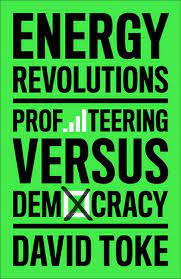
In this uncompromisingly radical Pluto book entitled Energy Revolutions, with the graphic subtitle Profiteering versus democracy, Dr David Toke argues that the energy crisis is an inevitable result of an industry run by and for corporate profit. He says ‘energy policy was never meant to favour sustainability or energy security – for decades, it has been shaped by corporate interests while hampering renewable alternatives. Now we suffer the cascading consequences’. He says there is an urgent need to radically increase state intervention, including public ownership, and deploy ‘energy democracy’ for the public interest.
However, he is not against market competition as such- it can speed change and help reduce costs. Thus, in his account of the early days of renewables, he says that, as a result of the adoption of Feed In Tariffs in the late 2000’s in Germany and elsewhere, markets were created that ‘meant that the wind and solar industries grew quickly. The costs of renewable energy plummeted, and today renewable energy is much cheaper than either fossil fuels or nuclear power. If things had been left as the anti-renewable incentive campaigners wanted, then of course the renewables industry would never have taken off. The world would be in a parlous position in terms of surviving the fossil fuel price spirals that we see in cycles (in both oil & natural gas price crises). Our ability to deal with the climate crisis would be almost destroyed’.
Toke though says that when markets are used to create monopolies, in pursuit of corporate profits and control, things go seriously awry- as we saw in 2022 and subsequently, with record profits being made by oil and gas companies. With energy prices escalating, Exxon made $55 bn, Shell $40 bn, Chevron $36.5 bn and Equinor $55 bn. Wind-fall taxes can claw back a tiny bit of this profiteering, but it is insignificant when you realise that, as Toke quotes an economist as saying ‘the oil and gas industry has delivered $2.8bn (£2.3bn) a day in pure profit for the last 50 years’. What’s needed is system change.
That of course is the familiar call of most radicals. Toke says, at present ‘the wealthy, who own the shares, get richer at the expense of ordinary people.’ In response, he says, while we can’t simply nationalise oil to solve this problem, since the compensation required would be huge, we can change the way the market works. Crucially, he says, ‘as the renewable energy revolution gathers pace, we need state intervention to ensure that the benefits of lower-cost green energy supplies go to the consumer & not the energy corporations’. In particular, ‘we need to extend government intervention & elements of state ownership of the retail energy supply sector to ensure that the consumer, not the big corporations, benefits from cheap renewable energy.’
The focus on ‘retail supply’ is linked to a proposed decentral shift away from seeing consumers as passive to one in which consumers may also be energy producers (via PV) and/or may also take an active role in managing their energy use (via DSM). Toke also sees them playing more of a role in shaping the system via an expansion of democratic participation, enabled by local energy co-ops, municipal projects & nationalisation of some of the energy systems. He says that public ownership ‘has an important role in delivering services in parts of energy systems where competition is itself either impossible or inefficient. It may be especially relevant to the retail electricity supply sector’. He adds ‘bringing in retail energy supply into public ownership should be cheap for the state to achieve since the companies involved have few tangible assets.’ But, he also looks to boosting competition ‘by the establishment of state companies to develop renewable energy alongside existing private companies’.
Some of this it may sound utopian or even naive, but Toke reminds us that the ‘alternative energy’ activists in the 1970s and 1980s ‘were seen as fringe oddballs by the energy mainstream. Today their vital role in developing niche renewable energy technologies and markets is airbrushed out of history since it contradicts the idea that big capitalism solves the big problems.’ Well yes, and now we live in a world in which renewables will soon dominate – supplying up to 100% of all global energy by 2050. However, as Toke says, it has to be done right. He provides us with, if not a blueprint of what to do, then at least a rough guide to the key political issues, with some very good insights on the situation in the UK, EU and USA. For example, it is amazing how expensive PV cells are in the US and how far France is behind on renewables due to its obsession with, now failing, nuclear.
In terms of technology choice, Toke backs most renewables strongly, though not all biomass, and seems convinced that domestic heat pumps are the best bet for using green power for home heating- whereas he says that green hydrogen, produced using renewable power, ‘needs to be used only for essential purposes, for example for storing renewable energy or for some industrial purposes for which electricity is not desirable. It should not be squandered in the provision of heating or cooling services’.
That’s now a common view: electric powered heat pumps are seen as much more efficient. Even if it does seem odd to abandon gas boilers and the existing gas pipeline system, which some wanted to repurpose for zero carbon green hydrogen use. Of course, some wanted to use fossil-derived blue hydrogen, a very different and very dire thing. But Toke notes that ‘the German coalition was divided when it came to debating a heating law about phasing out gas boilers in existing buildings. As part of a compromise, municipal authorities have been given the task of making plans for heat networks to be powered by large-scale heat pumps’. Well yes, as Toke admits, large heat pumps are more efficient. Although, dare I say, Combined Heat and Power plants, feeding heat nets and heat stores, can be even better and can help with grid balancing.
We can of course debate the pros and cons of each option and Toke takes us through some of the issues including, inevitably, nuclear, which he is clearly not fond of- not least since it is expensive and inflexible. Although his assertion that ‘once the current spurt of labour-intensive industrialism peters out in China, their drive in building nuclear power will fade, leaving nuclear in decline’, is maybe a bit too optimistic. Overall through, pronouncements like this aside, this is a good book if you want to get to grips with some of the key political and economic issues facing renewable energy and green politics- in a fast changing world.
New Book – The Scientists Who Alerted Us to the Dangers of Radiation.
Jim Green, 2 May 24, A new book on radiation risks recently published by The Ethics Press International “The Scientists Who Alerted us to Radiation’s Dangers”. The book was written by myself and a US campaigner Cindy Folkers.
Recent epidemiology evidence clearly shows that radiation risks have increased and that previous denials on radiation risks by successive governments and their nuclear establishment on both sides of the Atlantic were and are wrong. Radiation is considerably more dangerous than official reports indicate, both in terms of the numerical magnitudes of cancer risks, and also in terms of new diseases, apart from cancer, ow shown to be radiogenic.
This is an up-to-date reference book for academics on the dangers and risks of radiation and radioactivity. The book also serves to help journalists and students counter the misrepresentations, incorrect assertions, wrong assumptions, and untruths about radiation risks often disseminated by the nuclear (power and weapons) establishments on both sides of the Atlantic. All scientific statements are backed by evidence via hundreds of references, 14 Appendices, 6 Annexes, a glossary and an extensive bibliography.
At present the book is only available in hardback from the Ethics Press. This is expensive but a 33% discount is available at
In addition, a paperback (~£30) version will be available in November 2024.https://www.amazon.co.uk/Scientists-Who-Alerted-Dangers-Radiation/dp/1804414468
In the meantime, the book’s first three chapters may be sampled at
72 Minutes Until the End of the World?

Carl Sagan’s conclusion is that the enemy is not a foreign nation, it’s the weapons themselves.
The generals that I refer to in that section on the SIOP [Strategic Integrated Operational Plan, the 1960s-era plan for general nuclear war] believed they could fight and win nuclear war, even if it meant killing 600 million people across the globe. That is insane. No one would argue that now.
A new book lays out the frighteningly fast path to nuclear Armageddon.
By KATHY GILSINAN, 04/29/2024 https://www.politico.com/news/magazine/2024/04/29/the-frighteningly-fast-path-to-nuclear-armageddon-00154591
Nuclear war would be bad. Everyone knows this. Most people would probably rather not think through the specifics. But Annie Jacobsen, an author of seven books on sensitive national security topics, wants you to know exactly how bad it would be. Her new book Nuclear War: A Scenario, sketches out a global nuclear war with by-the-minute precision for all of the 72 minutes between the first missile launch and the end of the world. It’s already a bestseller.
It goes without saying that the scenario is fictional, but it is a journalistic work in that the scenario is constructed from dozens of interviews and documentation, some of it newly declassified, as a factual grounding to describe what could happen.
That’s this, in Jacobsen’s telling: A North Korean leader launches an intercontinental ballistic missile at the Pentagon, and then a submarine-launched ballistic missile at a nuclear reactor in California, for reasons beyond the scope of the book except to illustrate what one “mad king” with nuclear weapons could do. A harried president has a mere six minutes to decide on a response, while also being evacuated from the White House and pressured by the military to launch America’s own ICBMs at all 82 North Korean targets relevant to the nation’s nuclear and military forces and leadership. These missiles must fly over Russia, whose leaders spot them, assume their country is under attack (the respective presidents can’t get one another on the phone), and send a salvo back in the other direction, and so on until 72 minutes later three nuclear-armed states have managed to kill billions of people, with the remainder left starving on a poisoned Earth where the sun no longer shines and food no longer grows.
Some scholars, particularly among those who favor large nuclear arsenals as the best deterrent to being attacked with such weapons ourselves, have criticized some of Jacobsen’s assumptions. The U.S. wouldn’t have to court Russian miscalculation by overflying Russia with ICBMs when it has submarine-launched ballistic missiles in the Pacific. Public sources indicate that the president’s six-minute response window is still about in line with what Ronald Reagan noted with dismay in his memoirs. But that assumes he’s boxed into a “launch on warning” policy, something Jacobsen’s sources characterize as a constraint to move before enemy missiles actually strike, but which government policy documents insist is merely an option and not a mandate. (The president could also just decide, contra the deterrence touchstone of “mutual assured destruction,” not to nuke anybody at all in response.)
The book arrives at a time when the countries with the world’s largest nuclear arsenals, the U.S. and Russia, are violently at odds in Ukraine, a Russian state TV host is calling a Russia/NATO conflict “inevitable,” and the Council on Foreign Relations is gaming out scenarios in case the Russians use tactical nukes in Ukraine. Oh, and Iran is closer to a nuclear weapon than ever before. It’s a fair time to ask Jacobsen’s central question — what if deterrence fails? Even if we’d rather not think about it.
This conversation has been edited for length and clarity.
Kathy Gilsinan: The book starts with two missiles out of North Korea and ends with essentially the end of the world 72 minutes later. And the subtitle calls this “a scenario.” Is it a realistic scenario?
Annie Jacobsen: The scenario I chose was pieced together from interviews I did with 46 on-the-record sources and dozens of sources on background, and I ran by them various scenarios to come up with the most plausible scenario that unfolds once it begins. And this is what I came up with. And so far, I haven’t had anyone who actually runs these scenarios for NORAD take issue with the choices that I’ve made and the way in which the decision trees unfold, which makes it all the more frightening.
Gilsinan: Can you walk me through why it would be inevitable that the North Koreans hit us with two and we hit them back with 80?
Jacobsen: Let’s look at the words of General [John] Hyten, former STRATCOM commander, when he did an interview with CNN during former President Donald Trump’s “fire and fury” rhetoric days. And General Hyten said on the record, in a rather “don’t you dare” way, speaking almost directly to North Korea: “If somebody launches a nuclear weapon against us, we launch one back. They launch two, we launch two.”
To drill down a little bit further on that I looked to Dr. Bruce Blair, a former missileer himself. Now he’s deceased, but he became one of the world’s experts on nuclear command and control systems and authority. And he explained in a monograph I cite in the book that it’s far more likely that if North Korea hit the United with one missile, America would send 82 in return. [The monograph, written under the auspices of the anti-nuclear group Global Zero, points to about 80 “aimpoints” relevant to North Korea’s nuclear and other military forces as well as its leadership, but also notes that “graduated and flexible strikes” would be possible. Jacobsen says she relied on other sources to support the assumption the U.S. would attack all the targets.] Everything I did, I linked to an open-source scenario that had been thought through by experts who have dedicated their intellectual prowess to these issues for decades.
Gilsinan: In this scenario, the U.S. responds with ICBMs that have to fly over Russia, with predictable consequences. Why, according to the folks you’ve spoken to, would we risk flying missiles over a nuclear power if we could use submarine-launched missiles from the Pacific Ocean?
Jacobsen: I asked that same question to numerous people, and the most powerful answer came from former Secretary of Defense Leon Panetta himself: “There’s not a lot of thought given to who the hell else may be thinking about doing what … at a time like this.”
Gilsinan: Maybe this is the point of the book. I would like very much to believe that STRATCOM is smarter than me and has thought this through ahead of time.
Jacobsen: Part of the terrifying truth about nuclear war, or if a nuclear exchange were to unfold, is the insane time clock that was put on everything from the moment nuclear launch is detected. This is fact. And so is the fact that the president has only six minutes, that’s the rough time to make this decision. And in that time, the Black Book gets opened; he must make a choice from a counterattack list of choices inside the Black Book. Those choices have been thought through for multiple scenarios, but you can’t possibly take into consideration every contingency in real time, which makes so clear to readers exactly how insane the truth is about the unfolding of the scenario. And the unpredictability of it. And for example, one of the few people that actually read the contents of the Black Book and spoke to me about it in general terms so as not to violate security clearances is Ted Postol [a former assistant to the chief of naval operations]. He’s the one who said to me that every decision was a bad decision.
Gilsinan: Why do we think it’s six minutes specifically? I know that’s in Reagan’s memoirs, but why do we think that is still the case?
Continue readingNuclear Lies, Cover-Ups and Secrecy

Mangano observes: “Nuclear war, like any war, is not an inevitable force of nature, bit a conscious choice of leaders.” (p. 66) So too is any decision to build or maintain a nuclear site.
BY JANETTE D. SHERMAN, OCTOBER 5, 2012, https://www.counterpunch.org/2012/10/05/nuclear-lies-cover-ups-and-secrecy/
Do Governments and Corporations lie, cover-up and maintain secrecy as they harm our planet and us? Joe Mangano’s new book, Mad Science – The Nuclear Power Experiment, clearly lays it out that they have done so for more than half a century.
This book is a page-turner, filled with useful information that many of us don’t know or have forgot. His chapter “Tiny Atoms, Big Risks” explains the various forms of nuclear energy in terms that anyone can understand, and details the harm that has come to all life on our planet as a result of nuclear bombs and nuclear power plants.
Among the many nuclear catastrophes that Mangano chronicles – from Three Mile Island, the Nevada and Marshall Island nuclear bomb tests to Chernobyl and Fukushima- is the nuclear accident at the Santa Susana site in Ventura County, close to Los Angeles, CA. Santa Susana is one of the best-kept secrets in the history of nuclear power. The Santa Susana site had 10 sodium-cooled reactors the 1959 accident spewed radioactivity, tetralin – toxic naphthalene, and other chemicals into Simi Valley, the Pacific Ocean and eastward that are still detected over a half-century later.
A near meltdown of the Fermi-1 nuclear reactor nearly destroyed Detroit in 1968. It was a sodium-cooled reactor, as were the ones at Santa Susana. Located at the western end of Lake Erie, a Fermi meltdown would have crippled or destroyed much of the Great Lakes and St. Lawrence River as well. As has occurred since the Chernobyl meltdown, in the southern lake areas of Belarus, fish and boats travel upstream as well as down-stream.
As many as 16,000 workers were employed at Santa Susana by corporations that included, North American Aviation (a spin-of of General Motors), Rocketdyne, Atomics international and finally Boeing. Santa Susana was closed by 1980, but never fully decontaminated. Everyone in the Los Angeles area who has had a family member with cancer, a low birth-weight child, death of an infant, or thyroid disease should read the book. So should those who live down-wind of a nuclear test area or a nuclear power plant – which includes practically everyone in the United States and Canada.
It was Lewis Strauss, the first chairman of the Atomic Energy Commission who in 1954 touted nuclear power as “too cheap to meter.” Today we learn it is too costly to bury waste, clean up contaminated land and buildings, and too costly to build and maintain aging nuclear power and bomb plants.
Mangano observes: “Nuclear war, like any war, is not an inevitable force of nature, bit a conscious choice of leaders.” (p. 66) So too is any decision to build or maintain a nuclear site.
Since the Fukushima releases began, Japanese citizens are marching and protesting the continuation of nuclear power as they observe the obvious reality of contamination. How long will it take for U. S. citizens to demand a stop to nuclear power and its’ twin nuclear war weapons.
Janette D. Sherman, M. D., who died in 2019, was the author of Life’s Delicate Balance: Causes and Prevention of Breast Cancer and Chemical Exposure and Disease, and was a specialist in internal medicine and toxicology. She edited the book Chernobyl: Consequences of the Catastrophe for People and Nature, written by A. V. Yablokov, V. B., Nesterenko and A. V. Nesterenko, published by the New York Academy of Sciences in 2009. Her primary interest was the prevention of illness through public education.
An interview with Annie Jacobsen, author of ‘Nuclear War: A Scenario’
By Michael Mechanic | April 1, 2024
Nuclear war is a topic few care to think about. We sometimes call it unthinkable. But we need to think carefully, and to talk—particularly with high-ranking foreign officials whose motives we may have reason to distrust, just as they distrust ours—about how we can collectively avoid launching a weapon that would end our civilization.
Pulitzer Prize finalist Annie Jacobsen’s timely new book, Nuclear War: A Scenario, is a lightning-fast read intended to put the nuclear threat squarely back on everyone’s radar. Her narrative thread, as the title suggests, is a fact-based (though thankfully fictional) scenario that shows how a nuclear launch can escalate into World War III at dizzying speed.
Jacobsen tees up her cinematic approach with chapters describing how we got here, including a discussion of America’s Single Integrated Operational Plan (SIOP) for General Nuclear War—which was devised in the 1960s and, as Jacobsen details in this book excerpt published today by Mother Jones, was more or less a recipe for the end of the world.
Because that’s nuclear war: One bad assumption, one shot, one retaliation, and it’s unstoppable.
Your book is frightful. What made you want to write in such detail how a nuclear war could unfold?
As a national security reporter, I have written six previous books on military and intelligence programs—CIA, Pentagon, DARPA—all designed to prevent nuclear World War III. During the Trump administration, amid the “fire and fury” rhetoric, I was watching STRATCOM commanders and deputy commanders speak freely on C-SPAN about the dangers therein. I began to wonder, My god, what would happen if deterrence failed? I began to interview people during COVID, when people had more time on their hands for someone like me—and that began the terrifying process of learning that nuclear war is, in essence, a sequence of events, and that once it starts it almost certainly will not stop.
………………………………………………………………………………………………………………… One thing that really struck me is the unbelievable speed at which nuclear war is waged.
Gen. Robert Kehler, the former commander of STRATCOM, said to me that the world could end in the next couple of hours. It took me a minute to ask my next question, because coming from someone in that position of authority—the most significant role in the entire nuclear apparatus—that really blew my mind.
Ditto goes for an interview I did with President Barack Obama’s FEMA chief, Craig Fugate. Of course, FEMA is the agency in charge of what’s called population protection planning for American citizens in the event of hurricanes, floods, earthquakes. Fugate told me that after a nuclear war, there wouldn’t be any population protection planning because everyone would be dead.
Help is not coming.………………….
I learned from your book that FEMA plays a unique role in the event of a nuclear attack, and it’s not what one might expect.
That’s right. In the ’50s and ’60s, the US position was that a nuclear war could be fought and won. That is no longer the official position. But plans were put in place for the continuity of government programs—the idea that the government must continue functioning no matter what. That is also a fantasy.
To hear from former Secretary of Defense Bill Perry about the madness and mayhem and anarchy that would follow, in his mind, in the event of a nuclear war, you really get the sense that civilization will fail. I believe one of the reasons so many of these sources went on the record for me is because they know that this is the truth. And they know it is up to the people to change the trajectory of where we’re headed. I mean, my god, look at the saber-rattling going on as we do this interview…………………………………………………………………………………………………………………………………………………………………………………………………………………………….
“Launch on warning” puts extraordinary pressure on a president. The one in your scenario is pretty clueless. He hasn’t ever rehearsed. Nobody told him he’d have just six minutes to choose from a Denny’s breakfast menu of existential options in response to what may or may not be an incoming nuke. It’s hard to believe the Pentagon doesn’t put every new president through a series of war games.
I was just as surprised as you are. But that’s coming from multiple secretaries of defense and national security advisers—people in a position to advise the president on a nuclear counterattack. The best summation came from Leon Panetta, who explained that as White House chief of staff he was witness to the fact that the president is primarily concerned with domestic issues—like his popularity. I asked Panetta how clued in he was when he was the CIA director, and he said almost not at all, because the CIA is about intelligence, not nuclear operations………………………………………………………………………………………………………………….
Your book busts some common myths, for instance the belief that the US could shoot down an incoming nuclear missile. We really can’t defend against nuclear weapons, can we?
We can’t. That is pure fantasy. During the final fact-checking incantations, I had the book read by a lieutenant general who ran these scenarios for NORAD. I was almost hoping someone would say, Annie, you should take this part out of the book, because we have a secret Iron Dome that you can’t report on. No. The truth is that the United States relies upon 44 interceptor missiles to stop any incoming missiles. Russia alone has 1,674 nuclear warheads in “ready to launch” position. Adding to that, according to congressional reports, the interceptors are only approximately 50 percent effective.
Under the best of circumstances.………………………………………………………………..
Oppenheimer: Monaghan man, Daniel A. McGovern, who captured nuclear devastation
By Adam Mandeville, BBC News NI 31 Mar 24
The success of the film Oppenheimer has shone a spotlight once more on the bombings of Hiroshima and Nagasaki.
However, the story of one Monaghan man involved in the aftermath appears to have been forgotten.
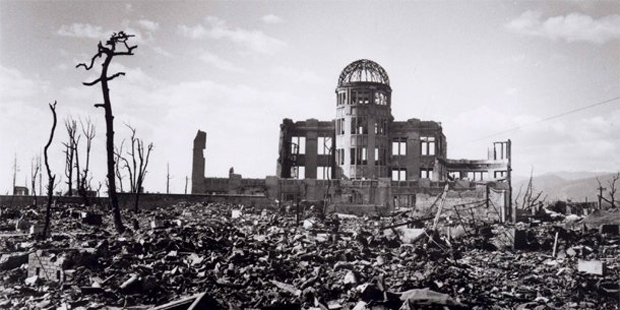
Just one month after the bombings, Lt Col Daniel A. McGovern was the first person sent by the US to document the damage.
A member of the US Airforce, he was a specialist cameraman trained to document bombs and their aftermath.
In one scene in the Academy Award winning Oppenheimer film, the titular character played by Irish man Cillian Murphy looks in horror at footage of the aftermath of the bombing.
But these images may not have survived for others to see if it were not for one man from Carrickmacross.
McGovern’s biographer said the story is one of most amazing he has ever heard.
“McGovern’s story is better, in my opinion, than Oppenheimer’s,” he said.
In total, Col McGovern’s team collected over 125,000ft of colour and black and white footage – though much of this was classified.
When he returned from Japan, Col McGovern made secret copies of the footage to ensure it would be saved from US government censorship.
He took these from the Pentagon, storing one set at an air force motion picture depository in Dayton, Ohio, and kept the other himself.
In 1967, a US Congressional committee, that included Robert Kennedy, asked to see the atomic bomb footage.
The material had been declassified but no one could find the originals.
Col McGovern directed the authorities to his copies.
In 1970, the general public got its first glimpse of some of the footage as it was incorporated into a film called Hiroshima Nagasaki – August 1945.
McGovern’s huge risk to secretly keep copies of his footage ensured that the committee had access to crucial documents.
Joseph McCabe spent 20 years working on a biography of Col McGovern, called Rebels to Reels: A Biography of Combat Cameraman Daniel A. McGovern USAF.
He said Col McGovern could have been shot for treason after making copies of the classified footage, but did so to save it for future generations…………………………………………………..
Mr McCabe suggested the footage watched by J Robert Oppenheimer would have been captured by McGovern.
Historian Dr Tom Thorpe said without the footage captured by McGovern, films such as Oppenheimer may never have been made.
“McGovern’s actions to save the footage ensured that it remained available for future generations,” he said.
“[McGovern’s] contributions indirectly influenced the availability of such archival material for films like Oppenheimer.”
He added that the images are “immensely important to our understanding of history”.
…………………………………………………………………….. In the latter half of the 20th Century, Col McGovern would continue to work for the US military and government, photographing various bomb tests, including those of Wernher Von Braun, co-developer of the V2 rocket.
He was also asked to help gather footage in and around Roswell, New Mexico following the now famous Roswell incident.
Col Daniel A McGovern passed away in California in 2005.
In 2022, 100 years after the McGovern family left for the US, his family returned to Carrickmacross to witness the unveiling of a commemorative plaque, dedicated to the man who photographed one of the most infamous events of the 20th Century. https://www.bbc.com/news/uk-northern-ireland-68656372
‘My jaw dropped’: Annie Jacobsen on her scenario for nuclear war

in such circumstances the president is likely to be subject to “jamming”, a chorus of military voices urging he or she follows protocols which lead inexorably towards a retaliatory launch.
“My jaw dropped at so much of what I learned, which was not classified but had just been removed or rather sanitised from the public discourse,” she said. “I found myself constantly surprised by the insanity of what I learned, coupled with the fact that it’s all there for the public to know.”
in such circumstances the president is likely to be subject to “jamming”, a chorus of military voices urging he or she follows protocols which lead inexorably towards a retaliatory launch.
The author’s new book posits an all-too-possible catastrophe, destruction assured by human frailty as much as by technology
Julian Borger, Sun 31 Mar 2024 https://www.theguardian.com/books/2024/mar/31/annie-jacobsen-nuclear-war-scenario—
Annie Jacobsen was a high school student in 1983, when ABC television broadcast the film The Day After, about the horrors of nuclear war. She never forgot the experience. More than 100 million Americans watched and were terrified too. One of them lived in the White House. According to his biographer and his own memoirs, it helped turn Ronald Reagan into a nuclear disarmer in his second term.
Not long after, the world’s stockpile of nuclear warheads peaked and began to decline rapidly, from 70,000 to just over 12,000 currently, according to the Federation of American Scientists.
That is still enough however to reduce the Earth to a radioactive desert, with some warheads left over to make it glow. Meanwhile, the global situation is arguably the most dangerous since the Cuban missile crisis, the Russian invasion of Ukraine grinding on mercilessly and China contemplating following Moscow’s example by making a grab for Taiwan.
The danger of nuclear war is as immediate as ever but it has faded from public discourse, which is why Jacobsen, now a journalist and author, felt driven to write her new book, Nuclear War: A Scenario.
“For decades, people were under the assumption that the nuclear threat ended when the Berlin Wall went down,” Jacobsen said, before suggesting another reason the existential threat of nuclear weapons has been filtered out of mainstream discourse – it has been turned into a technical debate.
“Nuclear weapons and the whole nomenclature around them have been so rarefied it’s been reserved as a subject for those in the know,” she said.
In her book, Jacobsen seeks to break through jargon and details in order to tell a terrifying story in a devastatingly straightforward way. The spoiler alert is that it doesn’t end well.
As the book promises on the cover, it presents a single scenario for a nuclear war, set in the present day. North Korea, perhaps convinced it is about to be attacked, launches a surprise missile strike against the US, leading Washington to respond with a salvo of 50 Minuteman III intercontinental ballistic missiles (ICBMs). These are aimed at North Korea’s weapons sites and command centres, but in order to reach their intended targets the missiles have to fly over Russia, because they do not have the range to use any other route.
All too aware of the danger of miscalculation, the US president tries to get hold of his Russian counterpart. But the two men and the countries they run are not getting on, and he fails. Making things even worse, Russia’s dodgy satellite early warning system, Tundra, has exaggerated the scale of the US salvo, and from his Siberian bunker, the Russian president (Vladimir Putin in all but name) orders an all-out nuclear attack on the US.
The scenario is based on known facts concerning the world’s nuclear arsenals, systems and doctrine. Those facts are all in the public domain, but Jacobsen believes society has tuned them out, despite (or perhaps because of) how shocking they are.
Jacobsen was stunned to find out that an ICBM strike against North Korea would have to go over Russia, and that Russia’s early warning system is beset with glitches, an especially worrying fact when combined with the knowledge that both the US and Russia have part of their nuclear arsenals ready to launch at a few minutes’ notice. Both also have an option in their nuclear doctrine to “launch on warning”, without waiting for the first incoming warhead to land.
A US president would have a few minutes to make a decision if American early warning systems signaled an incoming attack. In those few minutes, he or she would have to process an urgent, complex and inevitably incomplete stream of information and advice from top defence officials. Jacobsen points out that in such circumstances the president is likely to be subject to “jamming”, a chorus of military voices urging he or she follows protocols which lead inexorably towards a retaliatory launch.
“My jaw dropped at so much of what I learned, which was not classified but had just been removed or rather sanitised from the public discourse,” she said. “I found myself constantly surprised by the insanity of what I learned, coupled with the fact that it’s all there for the public to know.”
Ultimately, only presidents can make the decision and once it is made, no one has the authority to block it. It is called sole authority, and it is almost certainly the most frightening fact in the world today. It means a handful of men each have the power to end the world in a few minutes, without having to consult anyone.
It is not a group anyone would choose to have that responsibility, including as it does the likes of Putin and Kim Jong-un. In Washington it is a choice this year between Joe Biden and Donald Trump. They all bring a lot of human frailty, anger, fear and paranoia to a potential decision that could end the planet.
You would want to have a commander-in-chief who is of sound mind, who is fully in control of his mental capacity, who is not volatile, who is not subject to anger,” Jacobsen said, referring to this year’s presidential election.
“These are significant character qualities that should be thought about when people vote for president, for the simple reason that the president has sole authority to launch nuclear weapons.”
- Nuclear War: A Scenario is published in the US by Dutton
The Lying Piper of Nukeland:The IAEA’s nuclear fairy tales are leading nations — and all of us — into climate catastrophe
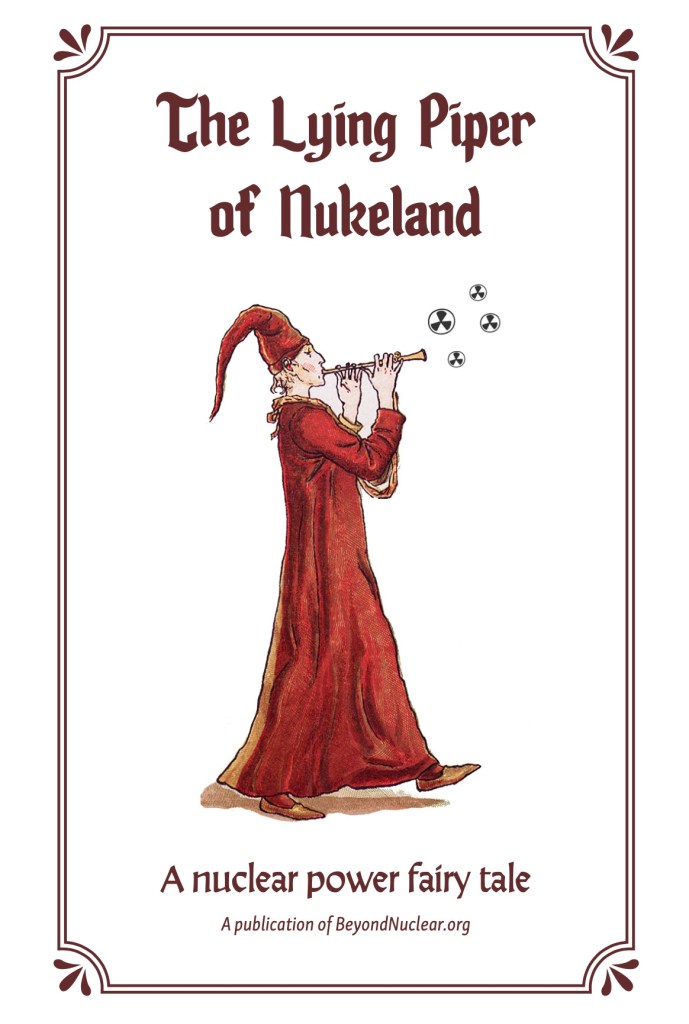
On March 21, more than 40 groups, mainly from Europe, protested the false promises and nuclear fairy tales being spun at the March 21 International Atomic Energy Agency’s Nuclear Energy Summit in Brussels. Prior to our fairy tale-themed rally close to the venue we issued a declaration signed by 621 organizations from across the world and issued a press release.
Our fairy tale handout parodied the story of nuclear power — see the text below. Beyond Nuclear also published a pamphlet exposing the hypocrisies and conflicts of interest of the IAEA. Feel free to download both and to distribute freely.
The IAEA’s nuclear fairy tales are leading nations — and all of us — into climate catastrophe
by By Linda Pentz Gunter beyondnuclearinternational, https://beyondnuclearinternational.org/2024/03/22/the-lying-piper-of-nukeland
At the end of the one-day summit, the IAEA and 34 countries issued a pledge “to work to fully unlock the potential of nuclear energy“, code for taking taxpayer money and going with a begging bowl to the World Bank.
Once upon a time… long ago, a Piper arrived in Carbonville. The people of Carbonville welcomed him warmly because they had heard that when he played his flute he had magical powers.
“Oh Piper!” they cried. “Here in Carbonville it is always dark and cold. It is smokey and polluted. Can you help us find a better way to create warmth and light?”
The Piper was happy to oblige. “I know just the answer,” he told them. “It’s called nuclear power! It’s safe, cheap and reliable. Very soon you will have warmth and light that is too cheap to meter!”
The people of Carbonville were so excited to get shiny new nuclear power plants that they took a vote and changed the name of their town to Nukeland.
The Piper began to play and very soon beautiful drawings of nuclear power plants started to appear for the people of Nukeland to admire. But several years passed and nothing else happened.
“What use are these drawings?” the people said. “We need warmth and light!”
“Be patient,” said the Piper. “I will bring you 15 nuclear power plants and you will have all the heat and light you need. I just need five gold coins to get them started.”
The people of Nukeland were very poor but they did without and saved up until they had five gold coins. They gave them to the Piper and once again he began to play.
The people of Nukeland watched as their fields were plowed under and their trees cut down and the land paved with concrete in readiness for the nuclear power plants. But still none appeared.
“I need more gold!” cried the Piper. “Just five more gold coins and your nuclear plants will be here”.
“You said it would only cost us five gold coins,” cried the people. “Now you’re charging us double!”
But all the same, the people paid the Piper another five gold coins. Many more years passed while the people of Nukeland froze in the dark, and then one day three nuclear power plants were finally done.
The people of Nukeland were shocked. Three nuclear power plants weren’t nearly enough to bring heat and light to everyone. “Why are there only three?” they asked the Piper. “You promised us 15. We paid for 15.”
The Piper just shrugged. “Now you will have the heat and light you wanted!” he exclaimed. “Those of you who can pay for it.”
So only the richest people who could afford the nuclear energy got light and heat even though everyone in the land had paid for the nuclear power plants.
And when the nuclear power plants opened, the Piper brought in all his friends and relatives to run them. “What about all the jobs you promised us?” demanded the people of Nukeland.
“You people are imbeciles,” snapped the Piper. “We need experts.” And even though the Piper’s friends and relatives knew as little as he did about nuclear power plants, they all got jobs at the plants, leaving the people of Nukeland to starve.
The Piper went to the newspapers to brag about his achievement. “Nuclear power is the answer to all your problems,” he cried. “Yes it is!” the editors agreed and wrote it in their newspapers.
But one reporter, the youngest of them all, wasn’t so sure. “Surely,” she said, “it would be easier, quicker and cheaper to harness the power of the sun when it is shining and capture the power of the wind when it is blowing?” she asked. “What if we turned that into heat and light?”
“Nonsense!” cried the Piper. “Nonsense!” agreed the editors, who never asked any questions. And they wrote it in their newspapers.
Soon, the Youngest Reporter began to notice that, along with the electricity for the rich people who could pay for it, the nuclear power plants also produced an evil, toxic waste. And no one knew what to do with it.
“What about all the waste?” she asked the Piper. “Not my problem,” said the Piper. “Someone else will come along later and deal with it.”
Then the Youngest Reporter discovered that the people working at the nuclear power plant and the people living nearby and especially the children, were falling sick with strange diseases never before seen in Nukeland.
”It’s the nuclear power plant that’s making you sick,” the Youngest Reporter told the people of Nukeland.
“Scaremonger!” cried the Piper. “Ignore her,” he told the people of Nukeland. “She’s too emotional. She doesn’t understand science.”
So the people ignored the Youngest Reporter even though most of them could not afford to buy the power from the nuclear plants and were still living in the cold and dark.
And then, one day, one of the nuclear power plants blew up and a great poison rained down on the land and many many more people got sick and many of them died.
And the Youngest Reporter who no one had listened to wept. “There was another way,” she said, “and it was right there in front of us all the time. The sun and the wind are free and safe and fast and cheap.”
And the people of Nukeland finally agreed. “We should never have listened to the Lying Piper,” they said. “He took our money and wasted our time. He made us sick and led us down a dead end. We made a terrible mistake.”
And they didn’t live happily ever after.
Linda Pentz Gunter is the international specialist at Beyond Nuclear and writes for and edits Beyond Nuclear International.
Our International Women’s Day Heroine: Rosalie Bertell

ON BY MARIANNEWILDART, https://mariannewildart.wordpress.com/2024/03/08/our-international-womens-day-heroine-rosalie-bertell/
Rosalie Bertell, PhD (1929-2012), was a biometrist – a mathematician who analyzed risks to health from radiation and pollution. In this interview she mainly tells about her research on radiation and cancer, which led to restricting X-rays to diagnostic uses, revealed how above-ground nuclear testing had led to elevated breast cancer cohorts, and helped prevent the establishment of nuclear power plants in several communities.
http://www.radio4all.net/files/wingsradionews@gmail.com/WINGS-33-23CancerMath-28_58-128kbps.mp3
Rosalie Bertell was one of the first to raise concerns about military geoengineering and her book “Planet Earth – Latest Weapon of War” was re-published in 2020 as an updated version thanks to another heroine Dr. Claudia von Werlhof. The book’s first appearance in 2000 did not reach the international reader, because the publisher, The Women´s Press, London, went bankrupt and the book was available only in Canada (Black Rose 2001).
Dr Werlhof said “Rosalie and I, we met only once, in Bonn, Germany, in 2010 at the 30th Anniversary of the Right Livelihood Award, where she proposed to sign the following petition:
“It is morally reprehensible and an offense against humanity and the Earth to interfere with the normal function of the planetary system – to cause or enhance storms, hurricanes, tsunamis, monsoons, mud slides, draught, flooding, earth quakes or volcano eruptions”.
The 22 laureates present from different parts of the world, all of them signed it.
Meeting Rosalie Bertell in person was for me like meeting a very old friend. It is because I share with her the same motivation, feeling and thinking about our Mother Earth: the indignation and pain about her ongoing destruction, the immense love for her, and the necessity of a general planetary upheaval in support of Mother Earth. For this we need exactly what Rosalie Bertell embodied: a burning heart, a very clear mind and a ”planetary consciousness“ that knows about the Planet, our Mother Earth, as a huge living being, the ways she is endangered today, and the firm decision to fight for her life. What else? Mother Earth or Death!
This is what the reader of ”Planet Earth” should learn from its author. We need a world in which it is not necessary to write books like ”Planet Earth”, anymore!”
Microsoft’s Kate Crawford: ‘AI is neither artificial nor intelligent’

who benefits and who is harmed by this AI system? And does it put power in the hands of the already powerful? What we see time and again, from facial recognition to tracking and surveillance in workplaces, is these systems are empowering already powerful institutions – corporations, militaries and police
The AI researcher on how natural resources and human labour drive machine learning and the regressive stereotypes that are baked into its algorithmsSun 6 Jun 2021 18.00 AESTShare
Kate Crawford studies the social and political implications of artificial intelligence. She is a research professor of communication and science and technology studies at the University of Southern California and a senior principal researcher at Microsoft Research. Her new book, Atlas of AI, looks at what it takes to make AI and what’s at stake as it reshapes our world.
……………………………………… What’s the aim of the book?
We are commonly presented with this vision of AI that is abstract and immaterial. I wanted to show how AI is made in a wider sense – its natural resource costs, its labour processes, and its classificatory logics. To observe that in action I went to locations including mines to see the extraction necessary from the Earth’s crust and an Amazon fulfilment centre to see the physical and psychological toll on workers of being under an algorithmic management system. My hope is that, by showing how AI systems work – by laying bare the structures of production and the material realities – we will have a more accurate account of the impacts, and it will invite more people into the conversation. These systems are being rolled out across a multitude of sectors without strong regulation, consent or democratic debate.
………………………..systems might seem automated but when we pull away the curtain we see large amounts of low paid labour, everything from crowd work categorising data to the never-ending toil of shuffling Amazon boxes. AI is neither artificial nor intelligent. It is made from natural resources and it is people who are performing the tasks to make the systems appear autonomous.
Problems of bias have been well documented in AI technology. Can more data solve that?
Bias is too narrow a term for the sorts of problems we’re talking about. Time and again, we see these systems producing errors – women offered less credit by credit-worthiness algorithms, black faces mislabelled – and the response has been: “We just need more data.” But I’ve tried to look at these deeper logics of classification and you start to see forms of discrimination, not just when systems are applied, but in how they are built and trained to see the world. Training datasets used for machine learning software that casually categorise people into just one of two genders; that label people according to their skin colour into one of five racial categories, and which attempt, based on how people look, to assign moral or ethical character. The idea that you can make these determinations based on appearance has a dark past and unfortunately the politics of classification has become baked into the substrates of AI.
……………………………Beginning in 2017, I did a project with artist Trevor Paglen to look at how people were being labelled. We found horrifying classificatory terms that were misogynist, racist, ableist, and judgmental in the extreme. Pictures of people were being matched to words like kleptomaniac, alcoholic, bad person, closet queen, call girl, slut, drug addict and far more I cannot say here. ImageNet has now removed many of the obviously problematic people categories – certainly an improvement – however, the problem persists because these training sets still circulate on torrent sites [where files are shared between peers].
And we could only study ImageNet because it is public. There are huge training datasets held by tech companies that are completely secret. They have pillaged images we have uploaded to photo-sharing services and social media platforms and turned them into private systems.
……………………………………………. What do you mean when you say we need to focus less on the ethics of AI and more on power?
Ethics are necessary, but not sufficient. More helpful are questions such as, who benefits and who is harmed by this AI system? And does it put power in the hands of the already powerful? What we see time and again, from facial recognition to tracking and surveillance in workplaces, is these systems are empowering already powerful institutions – corporations, militaries and police……………………………………………………………………………………………………………
Atlas of AI by Kate Crawford is published by Yale University Press (£20). To support the Guardian order your copy at guardianbookshop.com. Delivery charges may apply https://www.theguardian.com/technology/2021/jun/06/microsofts-kate-crawford-ai-is-neither-artificial-nor-intelligent
Net-Zero and Nonproliferation: Assessing Nuclear Power and Its Alternatives

January 8, 2024 , https://npolicy.org/net-zero-and-nonproliferation-assessing-nuclear-power-and-its-alternatives/
Six years ago, NPEC ran a mock execution of a law Congress passed in 1978 but that the Executive refused to implement —Title V of the Nuclear Nonproliferation Act of 1978. Title V called on the State and Energy Departments to conduct country-specific analyses of how developing states might best meet their energy needs without nuclear power. It also called for the creation of an energy Peace Corps and an assessment of what our government was spending on energy development aid-related projects.
When NPEC started its efforts, the staff on the Senate Foreign Relations Committee asked to see what NPEC produced to use it to pressure the Executive finally to implement the law. NPEC commissioned a number of studies on how Iran, Saudi Arabia, China, and Taiwan might best meet their energy requirements without nuclear power. The center also contracted studies on the history and intent of Title V and on what government programs were already in play that aligned with Title V‘s stated objectives. As soon as NPEC’s project was completed, the Senate Foreign Relations Committee staff prepared a letter to Secretary of State Hillary Clinton asking the Secretary finally to implement Title V and file the reports required by law.
Then, something unexpected occurred. The committee’s legal counsel discovered that the Secretary was under no obligation to comply: Congress had eliminated Title V’s reporting requirements along with several hundred other Congressionally mandated reports back in 1995. Flummoxed, I quietly set the book manuscript aside.
Why, then, release it today? Because it is again timely. In October, the Biden Administration announced it is still considering extending civilian nuclear cooperation with Riyadh that would allow the Kingdom to enrich uranium — a process that can bring states within weeks of acquiring the bomb. Administration officials no longer question if Saudi Arabia really needs nuclear energy to meet its energy requirements. Shouldn’t they?
Meanwhile, Taiwan’s presidential election this coming Saturday will, among other things, decide if Taiwan will build more nuclear reactors or not. Again, is new nuclear Taiwan’s best energy bet? As for China, the Pentagon has become increasingly concerned that the two “peaceful” fast breeder reactors and plutonium reprocessing plants Beijing is building will be used to make hundreds of bombs worth of weapons plutonium. One of the two fast breeder reactors is already operating. The question these dangerous nuclear activities raise is just how necessary they are to meet China’s energy requirements.
Then, there’s Iran, which is intent on building reactors of Iranian design. It plans on expanding its nuclear power program from roughly one gigawatt electrical capacity to 11. Given Iran’s renewables potential and oil and gas reserves, how much sense does this make? Finally, in its efforts to achieve net zero, the Biden Administration has joined 20 other nations in pledging to triple global nuclear generation by 2050. Again, how practical is this?
This volume’s aim is to help provide answers. Of course, in light of how long our government has ignored Title V, demanding it be implemented now would be odd. Creating a clean energy Peace Corps, comparing the costs of different types of energy, and trying to determine what investments would reduce emissions quickest and cheapest, however, all should be discussed. It’s my hope that the release of Net-Zero and Nonproliferation: Assessing Nuclear Power and Its Alternatives today might prompt such discussion.
The Secret of Three Bullets: How New Nuclear Weapons Are Back on Battlefields

By Maurizo Torrealta and Emilio Del Giudice, https://www.everand.com/book/237566805/The-Secret-of-Three-Bullets-How-New-Nuclear-Weapons-Are-Back-on-Battlefields?fbclid=IwAR39ToNaCLpVdrlV3tXJrDSciInSL1nTddpo954Lkoq66ZTgBieDzy_Z390
About this ebook
Four journalists found themselves traveling around the world with the aim of finding answers to some questions: Why was valid research into room-temperature fusion deliberately ignored? Why was enriched uranium found in a crater caused by a bomb in Khiam, Southern Lebanon? Why do depleted uranium bullets produce a temperature of 4000°C? Why are there traces of other radioactive elements in those bullets? How do the new bombs dropped on Gaza work, bombs that are able to amputate people’s legs while leaving no trace of metal fragments? The answers to these questions are linked to one another by a secret that has been kept hidden for more than 20 years: a discovery of a process in physics that has enabled the production of nuclear bombs the size of a bullet. Based on facts, The Secret of the Three Bullets is a scientific spy story that tells in fiction the reality behind cold fusion and its use on the battlefield today.
New Book: Energy Revolutions -Profiteering versus Democracy –

Forthcoming book by Dave Toke: ‘Energy Revolutions – profiteering versus
democracy’ (Pluto Press). This book shows how we can move forward to an
energy system powered by renewable energy. It reveals how selective public
ownership and targeted interventions, as part of an energy democracy
programme will protect consumer interests better than the chaotic energy
supply system that failed consumers so expensively in the recent energy
crisis.
Pluto Press (accessed) 29th Dec 2023 https://www.plutobooks.com/9780745349251/energy-revolutions/
1 This Month

of the week – Shut Down Drone Warfare!


Tell the Ukrainian Government to Drop Prosecution of Peace Activist Yurii Sheliazhenko

Petition to revoke the licensing of the Near Surface Nuclear Disposal Facility (NSDF) at Chalk River. https://www.ourcommons.ca/petitions/en/Petition/Details?Petition=e-7247
To see nuclear-related stories in greater depth and intensity – go to https://nuclearinformation.wordpress.com
-
Archives
- March 2026 (237)
- February 2026 (268)
- January 2026 (308)
- December 2025 (358)
- November 2025 (359)
- October 2025 (376)
- September 2025 (257)
- August 2025 (319)
- July 2025 (230)
- June 2025 (348)
- May 2025 (261)
- April 2025 (305)
-
Categories
- 1
- 1 NUCLEAR ISSUES
- business and costs
- climate change
- culture and arts
- ENERGY
- environment
- health
- history
- indigenous issues
- Legal
- marketing of nuclear
- media
- opposition to nuclear
- PERSONAL STORIES
- politics
- politics international
- Religion and ethics
- safety
- secrets,lies and civil liberties
- spinbuster
- technology
- Uranium
- wastes
- weapons and war
- Women
- 2 WORLD
- ACTION
- AFRICA
- Atrocities
- AUSTRALIA
- Christina's notes
- Christina's themes
- culture and arts
- Events
- Fuk 2022
- Fuk 2023
- Fukushima 2017
- Fukushima 2018
- fukushima 2019
- Fukushima 2020
- Fukushima 2021
- general
- global warming
- Humour (God we need it)
- Nuclear
- RARE EARTHS
- Reference
- resources – print
- Resources -audiovicual
- Weekly Newsletter
- World
- World Nuclear
- YouTube
-
RSS
Entries RSS
Comments RSS
 nuclear-news