Mapping Fukushima radiation as it moves across the Pacific Ocean
 http://www.straight.com/article-638451/vancouver/fukushima-radiation-moving-seawater-across-pacific-ocean-according-consulting-company Maps show movement of radiation, and of debris across Pacific Fukushima radiation moving in seawater across Pacific Ocean, according to consulting company, Straight.com By Charlie Smith, March 18, 2012 Oceanic radiation from last year’s Fukushima nuclear disaster is approaching northern Hawaii, according to the latest tracking by ASR Limited .
The coastal-management consulting company has created a map that follows the movement of radiation in seawater since the Japanese earthquake on March 11, 2011. ASR Limited suggests radiation is crossing the Pacific Ocean.
Last April, Japanese officials claimed that they had halted the release of radioactive radiation from the crippled nuclear reactors at Fukushima.
On December 5, however, the Los Angeles Times revealed that “45 tons of highly radioactive water” had been released from the plant on the previous weekend.
Greenpeace has also reported finding highly radioactive sea life off the Japanese coast. Meanwhile, ASR Limited has also released a map showing how far the floating island of Japanese debris has travelled since last year’s earthquake.
It’s expected to reach the British Columbia Coast in 2013. A huge amount of debris is headed toward British Columbia.
Costly cleanup of old uranium residue
VIDEO http://www.indianasnewscenter.com/news/local/70-Years-Later-Concerns-of-Uranium-at-Fort-Wayne-Plant-142990795.html 70 Years Later, Concerns of Uranium at Fort Wayne Plant By Stephanie Parkinson March 16, 2012 FORT WAYNE, Ind. (Indiana’s NewsCenter) – A Fort Wayne steel mill is still seeing the effects of uranium used there in the 1940s.
It’s been 70 years since World War II and now the government is investigating the former Joslyn site. In 1945 the site was used to make parts for the government atomic weapons. We’ll be looking at the production facilities that were in place at the time, and trying to
find where the uranium operations took place, see if there is any obvious ground disturbances, or movement, where they disposed of uranium shavings or dust,” said William Kowalewski, Army Corps of Engineers.
The former Joslyn Plant is now Valbruna Slater Steel. Employees that work on the site now tell INC News there is a building still standing there that they are told not to go into because it was an area where they had uranium in 1940s…. Although Valbruna has told
employees the radiation from the uranium is not measurable, Kowalewski says there could be long term effects and there could also be areas that were overlooked.
“We’ve seen in the past where we might have thought that all the operations took place in a defined fence line, but when we look at the old photographs, we see impacts of some activity outside the fence line,” said Kowalewski.
The Army Corps study is being done right now. Kowalewski says once that’s done any contaminated areas will be treated or removed from the site, but that won’t happen for at least another three years because of funding and the time it takes to finish their study….
Iran offers full transparency in return for nuclear power assistance
 VIDEO Iran Official Offers ‘Permanent Human Monitoring’ of Nuclear Sites http://abcnews.go.com/Blotter/iran-official-offers-human-monitoring-nuclear-sites/story?id=15930677#.T2Ow4cWPX_M abc News, 15 March 12, A high-level advisor to Iran’s supreme leader said his country is ready to allow “permanent human monitoring” of its nuclear program in exchange for Western cooperation but also warned Iran is prepared to defend itself against military strikes.
Mohammad Javad Larijani, who serves as Secretary-General of Iran’s Human Rights Council and key foreign policy advisor to Ayatollah Khamenei, said the West should sell Iran 20 percent enriched uranium and provide all the help that nuclear nations are supposed to provide to countries building civilian nuclear power plants. He also said the U.S. and the West should accept his country’s right to continue what Iran calls its peaceful nuclear program.
In return for cooperation from the West, he said, Iran would offer “full transparency.”…..
http://abcnews.go.com/Blotter/iran-official-offers-human-monitoring-nuclear-sites/story?id=15930677#.T2Ow4cWPX_M
Climate change making Australia hotter and wetter
VIDEO also Audio Australia getting hotter, sea levels rising: CSIRO, ABC TV Lateline, TONY JONES, PRESENTER: A snapshot of the nation’s weather reveals Australia is getting hotter, sea levels are rising and we can expect a lot  more rain. That’s the view of the CSIRO and the Bureau of Meteorology. They found that globally, temperatures could rise as much
as five degrees by 2070. And the greenhouse gases have hit their highest level since modern humans evolved. From Cape Grim in Tasmania, our environment reporter Conor Duffy reports…. http://www.abc.net.au/lateline/content/2012/s3453647.htm
No compensation for UK’s nuclear veterans, just “sympathy”
Veterans blame ill-health – including cancer, skin defects and fertility problems – on their involvement in British nuclear tests in
Australia, on Christmas Island and in the Pacific Ocean between 1952 and 1958.
VIDEO http://www.telegraph.co.uk/news/uknews/defence/9142896/Nuclear-veterans-denied-damages-as-judge-expresses-sympathy.html Nuclear veterans denied damages as judge expresses ‘sympathy’, Telegraph UK, 14 March 12 Hundreds of ex-servicemen who say they were made ill as a result of being exposed to radiation during British nuclear weapons tests in the
1950s have lost their Supreme Court bid to be able to launch damages claims against the Ministry of Defence.
More than 1,000 veterans want compensation and have been battling for permission to launch damages claims for some two years. Although today’s judgment blocks most claims, a certain number can still proceed because of an earlier legal ruling. Continue reading
Rice farming ruined by Fukushima nuclear fallout
In Japan, Nuclear Cleanup May Be Mission: Impossible PBS Newshour, 12 March 12, In the second installment of a three-part series on Japan’s recovery, Miles O’Brien reports on Japanese residents who are struggling to clean up contaminated farms, roads and school yards after the massive earthquake, tsunami and resulting nuclear disaster struck Japan one year ago. Here’s an advanced look at
the piece,… http://www.pbs.org/newshour/rundown/2012/03/in-japan-nuclear-clean-up-may-be-mission-impossible.html
After 500 Years in Family, Rice Farmers Forced Off Land by Fukushima PBS Newshour 12 March 12 One year after an earthquake and tsunami struck Japan, the country is still trying to recover and decontaminate land and buildings from partial meltdowns of three Fukushima nuclear reactors. In his second report from the region, science correspondent Miles O’Brien explores the challenges and possibilities of radiation cleanup http://www.pbs.org/newshour/bb/science/jan-june12/fukushimapt2_03-12.html
After a year, relatives allowed to search Fukushima zone for bodies
Japan’s Fukushima nuclear plant surrounded by desolate no-man’s-land year after disaster By David Piper, March 09, 2012, FoxNews.com Nothing prepares you for entering Japan’s 12-mile exclusion zone around the crippled nuclear power plant at Fukushima. Everybody still has to wear radiation suits and face masks when entering, but within the area it is as if time has stood still.
In other areas along the coastline, a lot of the debris from the tsunamis that hit the shore a year ago, taking over 15,000 lives, has been removed and many homes have been rebuilt. But in the exclusion zone nearly everything has been left untouched….
. Walking on the beach near the plant, the scene was quite surreal or even apocalyptic.
Hundreds of people in full radiation suits and face masks were scouring the shore for the remains of the dead.
On Monday, it will have been a year since the disaster, but these people will not give up the search for the bodies of those still unaccounted for. Around 4,000 people officially still are missing, 49 from just this area of the coast, and this was their first chance to search this area
for the dead. http://www.foxnews.com/world/2012/03/09/japans-crippled-fukushima-nuclear-plant-surrounded-by-desolate-no-mans-land/#ixzz1okXpDEWG
YouTube: Beyond Nuclear Remembers Fukushima
 Remembering Fukushima nuclear disaster, Ed Asner urges an end to nuclear energy

Video on the failure of the nuclear dream
Scroll down this page http://www.economist.com/node/21549098 to see excellent video with Oliver Morton
The dream that failed, Oliver Morton, The Economist, Mar 10th 2012 The renaissance that wasn’t…
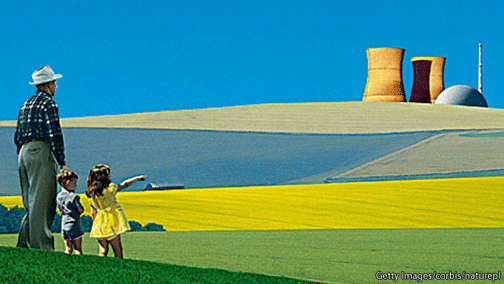
In the energy world, nuclear has found its place nourishing technophile establishments like the “nuclear village” of vendors, bureaucrats, regulators and utilities in Japan whose lack of transparency and accountability did much to pave the way for Fukushima and the distrust that has followed in its wake. http://www.economist.com/node/21549098
Climate change leading to overuse of groundwater
 UN scientists warn of increased groundwater demands due to climate change, Eureka Alert, Philip Riley, SAN FRANCISCO, March 1, 2012 –– Climate change has been studied extensively, but a new body of research guided by a San Francisco State University hydrologist looks beneath the surface of the phenomenon and finds that climate change will put particular strain on one of our most important natural resources: groundwater.
SF State Assistant Professor of Geosciences Jason Gurdak says that as precipitation becomes less frequent due to climate change, lake and reservoir levels will drop and people will increasingly turn to groundwater for agricultural, industrial, and drinking water needs. The resource accounts for nearly half of all drinking water worldwide, but recharges at a much slower rate than aboveground water sources and in many cases is nonrenewable.
“It is clear that groundwater will play a critical role in society’s adaption to climate change,” said Gurdak, who co-led a United Nations-sponsored group of scientists who are now urging policymakers to increase regulations and conservation measures on nonrenewable groundwater.
The scientists recently released a book of their research, titled “Climate Change Effects on Groundwater Resources,” that is the result of a global groundwater initiative by the United Nations Educational, Scientific, and Cultural Organization (UNESCO). They will soon make their case to international policymakers at the March 12-17 World Water Forum in Marseille, France.
The high-profile forum will allow the scientists for the first time to put the comprehensive groundwater findings before decision makers who have the power to enact regulatory changes. Gurdak will recommend closely monitoring or limiting groundwater pumping as well as renewing cooperation from communities to consume less water.
“In many ways, California is leading the way in developing solutions,” he said. “Artificial recharge, managed storage and recovery projects and low impact development around the state will become more important for many local water systems to bank excess water in aquifers.”
The World Water Forum will be held from March 12 to 17 in Marseille, France. ”Climate Change Effects on Groundwater Resources: A Global Synthesis of Findings and Recommendations,” was published in December 2011 by CRC Press. Selections from the book can be read here:  http://userwww.sfsu.edu/~jgurdak/Publications/Treidel_etal_2011_ClimateChange-Groundwater_tableofcontents.pdf http://www.eurekalert.org/pub_releases/2012-03/sfsu-usw030512.php
Iran would use nuclear weapon only if attacked, says Israeli expert
AUDIO Iran unlikely to use nuclear weapon unless it is attacked – Israeli expert March 03, 2012 http://news.am/eng/news/95743.html YEREVAN. – Iran is unlikely to use nuclear weapon if it had it, Israeli expert Vanessa Seyman told Armenian News-NEWS.am.
“You can see a lot of things about the Iranian leadership but they are not stupid. The strength of having a nuclear weapon is much stronger than using it. They will use it only if they are attacked,” said Seyman, head of training and R&D at Israeli NEST Consulting center. The expert considers that the situation over Iran resembles Cold War between U.S. and USSR.
“It is more a psychological war than an actual weapon war,” she emphasized. Speaking about the Iranian nuclear problem in the context of the Middle East processes, Seyman said the Iranian issue is much bigger than only the Middle East. “Right now the most important thing is to keep the international efforts in order to prevent Iran from getting obtaining nuclear weapon,” she added.
Inside Japan’s Nuclear Meltdown – PBS documentary
THE MEDIA DID NOT HYPE FUKUSHIMA…. New Yorker, by Evan Osnos, March 1, 2012 “….. the new PBS “Frontline” documentary, “Inside Japan’s Nuclear Meltdown,” … . “We were lucky,” Iwakuma says. “Just lucky.”…. one of the clearest—and most troubling—lessons to be drawn from the Fukushima story: plain old luck, along with a colossal dose of heroism and quick-thinking, prevented the Fukushima nuclear meltdowns from wounding Japan even more thoroughly than they did. That is the lesson that comes through in several new projects appearing in preparation for the first anniversary of the tsunami and nuclear disaster.
The “Frontline” documentary by the filmmaker Dan Edge does an admirable job of recreating the mood of the crucial first days by locating workers who were involved, despite continued efforts by the power company to prevent them from talking… http://www.newyorker.com/online/blogs/evanosnos/2012/03/the-media-did-not-hype-fukushima.html
Nuclear bombing: find out how your city would fare – with NUKEMAP
Nukemap: Shall we play a game? cnet, by Daniel Terdiman February 23, 2012
Tool shows what would happen if history’s most notorious nuclear weapons were dropped on different cities. It’s scary and sobering–and more than a million people have used it. Want to play god much?
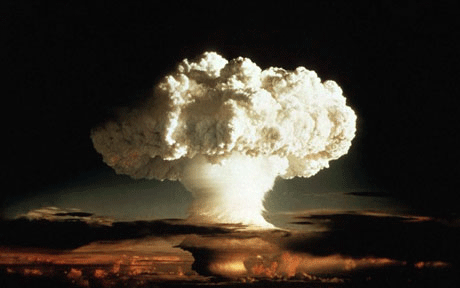
With Nukemap, a new tool that lets anyone test out–on a Google Map–the effects of some of history’s most famous nuclear explosions on cities around the world, you can. Continue reading
“Nuclear Nation,” and “No Man’s Zone” – films show the human horror of Fukushima nuclear disaster
 Berlin Film Festival: 3 documentaries on Japan nuclear disaster LA Times, Susan Stone in Berlin, February 10, 2012 | Less than a year after the massive earthquake and tsunami in Japan devastated whole towns and crippled the Fukushima Daiichi nuclear plant, causing a radioactive disaster, filmic portraits at the Berlin International Film Festival are presenting the human fallout.
Three documentaries appearing at the Berlinale provide sort of post-nuclear ghost stories — landscapes and people haunted by the aftermath of the nuclear accident and residual radiation.
Atsushi Funahashi’s “Nuclear Nation,” which was to debut Friday night in a world premiere, documents life in exile for the residents of Futaba, a town that prospered and then all but perished, its rise and fall tightly woven together with the Fukushima nuclear plant.
National subsidies and major tax breaks came to Futaba starting in the 1960s, compensation for the presence of the plant. Along with jobs for citizens, the plant brought money for a new community center, library and sports facilities.
Funahashi’s film shows that all lies empty now, beyond the ornate city gates reading “Atomic energy makes our town and society prosperous” — the entire city has been designated as an exclusion zone, and will be uninhabitable for years. ….
Toshi Fujiwara’s “No Man’s Zone” screens Sunday, and aspires to more artiness, featuring a voice-over by Armenian Canadian actress Arsinée Khanjian. Fujiwara hopes to show the beauty in the tainted landscape, while leveling a critique of the disaster and how it was handled. …
The documentaries are screening just days after a fresh reminder of the ongoing problems at the Fukushima Daiichi plant. On Feb. 8,
workers battled rising temperatures in one of the plant’s reactors, raising new questions about the stability of the facility.
The films should have a special resonance in Berlin, where anti-nuclear sentiment has been strong for years, partly due to
secrecy around and problems following the Chernobyl accident in Ukraine in 1986. After the disaster at Japan’s Fukushima nuclear
power plant in March 2011, the German government decided to phase out all nuclear energy by 2022, and started by immediately shutting several plants.
Video on US military use of depleted uranium
US used depleted uranium in recent wars Video http://www.presstv.ir/detail/223986.html Press TV 31 Jan 12, A prominent investigative journalist says the United States is using illegal weaponry – particularly depleted uranium – during its wars in the Middle East.
Numerous UN human rights commissions have prohibited the use of depleted uranium on humans, including during military conflicts. Continue reading
1 This Month

of the week – Shut Down Drone Warfare!


Tell the Ukrainian Government to Drop Prosecution of Peace Activist Yurii Sheliazhenko

Petition to revoke the licensing of the Near Surface Nuclear Disposal Facility (NSDF) at Chalk River. https://www.ourcommons.ca/petitions/en/Petition/Details?Petition=e-7247
To see nuclear-related stories in greater depth and intensity – go to https://nuclearinformation.wordpress.com
-
Archives
- April 2026 (114)
- March 2026 (251)
- February 2026 (268)
- January 2026 (308)
- December 2025 (358)
- November 2025 (359)
- October 2025 (376)
- September 2025 (257)
- August 2025 (319)
- July 2025 (230)
- June 2025 (348)
- May 2025 (261)
-
Categories
- 1
- 1 NUCLEAR ISSUES
- business and costs
- climate change
- culture and arts
- ENERGY
- environment
- health
- history
- indigenous issues
- Legal
- marketing of nuclear
- media
- opposition to nuclear
- PERSONAL STORIES
- politics
- politics international
- Religion and ethics
- safety
- secrets,lies and civil liberties
- spinbuster
- technology
- Uranium
- wastes
- weapons and war
- Women
- 2 WORLD
- ACTION
- AFRICA
- Atrocities
- AUSTRALIA
- Christina's notes
- Christina's themes
- culture and arts
- Events
- Fuk 2022
- Fuk 2023
- Fukushima 2017
- Fukushima 2018
- fukushima 2019
- Fukushima 2020
- Fukushima 2021
- general
- global warming
- Humour (God we need it)
- Nuclear
- RARE EARTHS
- Reference
- resources – print
- Resources -audiovicual
- Weekly Newsletter
- World
- World Nuclear
- YouTube
-
RSS
Entries RSS
Comments RSS
 nuclear-news