Anti nuclear Sister Megan Rice, in handcuffs and leg irons – not allowed out before sentencing
 (scroll down for video) http://www.rawstory.com/rs/2013/05/09/83-year-old-nun-gets-20-year-sentence-for-symbolic-nuclear-facility-break-in/ VIDEO 83-year-old nun gets 20 year sentence for ‘symbolic’ nuclear facility break-in Raw Story By Stephen C. Webster, May 9, 2013 “…….Sister Rice has been arrested between 40 or 50 times committing acts of civil disobedience, according to The New York Times, including once in Nevada after she physically blocked a truck at a nuclear test site.

Depleted uranium munitions like the kind stored at the facility Sister Rice targeted are blamed for some of the worst birth defects and soaring cancer rates seen in post-war Iraq, particularly in the city of Fallujah following the siege of 2004, in which U.S. soldiers killed thousands of civilians.
The city has never recovered, particularly from the use of depleted uranium munitions, and to this day residents suffer from health effects “worse” than those seen following the nuclear detonations at Hiroshima and Nagasaki, according to a study by the International Journal of Environmental Research and Public Health.
“I believe we are all equally responsible to stop a known crime,” Sister Rice said from the witness stand, according to quotes published by her group. She called herself a “citizen of the world” and reportedly smiled as the verdict was read.
Convicted nuclear protesters must stay in jail MIAMI HERALD, BY ERIK SCHELZIG 9 MAY 13, ASSOCIATED PRESS “….The trio appeared in court Thursday in handcuffs and leg irons seeking their release until their Sept. 23 sentencing…” .http://www.miamiherald.com/2013/05/09/3389262/nuclear-protesters-seek-release.html
See these videos about San Onofre nuclear plant’s jerry-rigged “fix”
2 VIDEOS San Onofre Nuclear Plant’s Leaky Pipe Apparently ‘Fixed’ With Tape, Plastic Bags http://www.huffingtonpost.com/2013/05/02/san-onofre-leaky-pipe-fixed-tape-plastic-bag_n_3203289.html?utm_hp_ref=green&ir=Green By Meredith Bennett-Smith, 2 May 13, Well, this doesn’t look good. Continue reading
VIDEO: Iran’s rights to peaceful use of nuclear energy
VIDEO: West unwilling to recognize Iran’s nuclear rights: Analyst http://www.presstv.ir/detail/2013/05/03/301638/west-ignores-iran-nuclear-energy-right/ A political analyst says the Western governments are not willing to recognize Iran’s right to use nuclear energy for peaceful purposes, Press TV reports.
“They [Western governments] are not willing to admit or recognize the rights of the Iranian people to obtain nuclear energy for civilians … purposes and to produce a clean energy to use in the future…,” political analyst Redwan Rizk said in an interview with Press TV on Friday.
Iran’s chief nuclear negotiator Saeed Jalili agreed on Friday to meet with the European Union foreign policy chief, Catherine Ashton — who represents the P5+1 group of world powers in comprehensive negotiations with Iran — later this month in Turkey’s port city of Istanbul.
Commenting on the planned meeting, the analyst said if the West wants the talks to be fruitful, they have to recognize the rights of the Iranian people and stop “imbalanced judgments towards Iran and towards the Islamic world.”
“So Iran has proposed so many times to fulfill the questions or to answer the questions of the West and the West turned its blind eye most of the time. All they want is to get the Iranians to stop their program and to stop all nuclear reactors on the Iranian land,” he added.Rizk also pointed to the fatwa (religious decree) issued by Leader of the Islamic Revolution Ayatollah Seyyed Ali Khamenei on the prohibition of nuclear weapons saying it is against the Islamic ideology to obtain any nuclear weapon.
Iran and the P5+1 — the US, France, Britain, Russia, and China plus Germany — have held several rounds of talks mainly over Iran’s nuclear energy program. Their latest rounds of talks were held in the Kazakh city of Almaty on February 26-27 and April 5-6.
The United States, Israel, and some of their allies have repeatedly accused Iran of pursuing non-civilian objectives in its nuclear energy program.
Tehran rejects the allegation, arguing that as a committed signatory to the Non-Proliferation Treaty and a member of the International Atomic Energy Agency, it has the right to use nuclear technology for peaceful purposes.
Fukushima’s accumulating radioactive water: hear this radio broadcast
 Hear this radio broadcast. Fukushima nuclear plant struggles to contain contaminated water http://www.abc.net.au/am/content/2013/s3750728.htm Mark Willacy reported this story on Friday, May 3, 2013 TONY EASTLEY: More than two years after the meltdowns at Fukushima, the plant’s operator is dealing with a new crisis – millions of litres of contaminated water inside the complex.
TEPCO has confirmed to AM that groundwater is flooding into the plant’s reactor buildings at the astonishing rate of 285 litres a minute.
Once inside, the water quickly becomes highly contaminated and has to be stored in tanks which cover 17 hectares of the plant’s grounds.
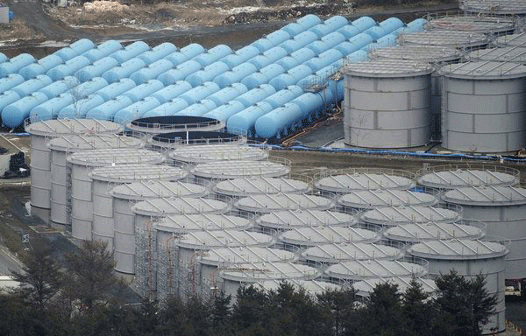
But with those tanks close to capacity now, TEPCO has started to clear an adjoining forest to make more space to store the contaminated run-off.
North Asia correspondent Mark Willacy reports from Tokyo. Continue reading
Fukushima nuclear power plant is very unstable
 Nuclear Safety Expert: “Many experts are extremely concerned we could have additional releases” at Fukushima plant — “Very, very unstable facility” (AUDIO) http://enenews.com/nuclear-safety-expert-many-experts-are-extremely-concerned-we-could-have-additional-releases-at-fukushima-plant-very-very-unstable-facility-audio
Title: Workers at Fukushima nuclear plant struggle to contain rush of contaminated water
Source: FSRN
Date: May 1, 2013
Dan Hirsch, a nuclear safety expert, president of the Committee to Bridge the Gap, and lecturer at the University of California, Santa Cruz: Many experts are extremely concerned that we could have additional releases.
This is a very, very unstable facility.
Very, very damaged with people working in extraordinary high radiation fields trying to repair it.
Full broadcast here
AUDIO Workers at Fukushima nuclear plant struggle to contain rush of contaminated water, 30 April 13 http://fsrn.org/audio/workers-fukushima-nuclear-plant-struggle-contain-rush-contaminated-water/11929
At the damaged Fukushima Daiichi nuclear plant in Japan, workers are struggling to contain a rush of highly radioactive wastewater. It’s flowing at the rate of 75 gallons per minute, according to the New York Times. Officials with the Tokyo Electric Power Company say they are considering clearing a nearby forest site in order to make more room for storage tanks. It’s the latest in a series of ongoing issues at the site. Earlier this month operators had to shut down the cooling of a spent fuel pool after rodents damaged an electrical line.
The International Atomic Energy Agency now estimates it will take more than 40 years to clean up the site. For more, we’re joined by Dan Hirsch, a nuclear safety expert and president of the Committee to Bridge the Gap, a nuclear policy group. He’s also a lecturer at the University of California, Santa Cruz.
VIDEO- the struggle by Hanford workers to contain radioactive sludge
http://www.king5.com/news/investigators/Hanford-worker-pushed-WRPS-to-action-204789701.html Hanford worker’s struggle to ‘do the right thing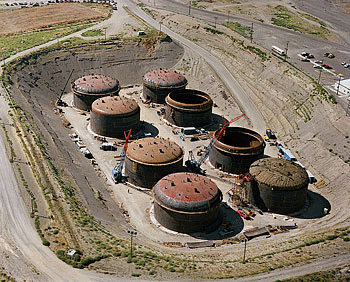 TV: Most hazardous material on planet leaking at U.S. nuclear site — Would contaminate our food chain for hundreds of years to come if it reaches Columbia River (VIDEO) http://enenews.com/tv-hazardous-material-planet-leaking-nuclear-site-contaminate-food-chain-hundreds-years-reaches-columbia-river-video
Source: KING 5
Author: SUSANNAH FRAME
Date: April 25, 2013
Reporter: We’ve heard about other leaking tanks, so why is this one so important? This tank is holding waste that is so toxic that if it were to eat through its outer shell and reach the nearby the Columbia River it would contaminate irrigation water, crops, salmon, our food chain — not for months, but for hundreds of years to come. […]
Underfoot, the most hazardous material on earth is brewing inside a million gallon double shell tank.
Title: Hanford worker’s struggle to ‘do the right thing’Hanford Worker: This tank is holding the nastiest of nastiest stuff at Hanford.
Watch the broadcast here
Video: Fukushima doctor calls for help for children sick from radiation
Fukushima Doctor: We need outside help, Japanese people not listening — We are now in very bad condition, especially for children — Please help (VIDEO) http://enenews.com/alert-fukushima-pediatrician-we-need-outside-help-japanese-people-not-listening-we-are-now-in-very-bad-condition-especially-for-children-please-give-us-help-video
Japan Doctor: So enraged by response of gov’t — Fukushima children’s rashes, nosebleeds, diarrhea, fatigue blamed on radiation-phobia mothers http://enenews.com/japan-doctor-so-enraged-by-response-of-govt-fukushima-childrens-rashes-nosebleeds-diarrhea-fatigue-blamed-on-radiation-phobia-mothers
Source: THE ASAHI SHIMBUN
Date: April 30, 2013Katsuno Onozawa, a doctor of psychosomatic medicine, who has taken part in children’s health consultations in Fukushima PrefectureWhat shocked me the first time I participated in January of last year was the gap between what the newspapers and TV news were reporting and the reality in Fukushima as attested to by the mothers […]
Wanting to protect their children from radiation, they pleaded with the prefectural and city governments and local doctors, but none would take their side.
They just said things like, “It’s safe. You don’t have to take any special action. There are lots of radiation-phobia mothers, and we can’t deal with them all.”
[…] I was at a loss for words because of these mothers’ situation, and I could not sleep at night because I was so enraged at the government’s heartless response. […]
Yet the children were exhibiting a range of symptoms including sore throats, nosebleeds, diarrhea, fatigue, headaches and rashes. The most dangerous thing is to write off causes of illness as psychosocial factors with statements like, “Your child’s stress comes from not being able to go outdoors” and that a “mother worrying will make her child sick.” […]
See also: Fukushima Doctor: We need outside help, Japanese people not listening — We are now in very bad condition, especially for children — Please help (VIDEO)
Youtube: exposing the pro nuke lies about uranium
 http://www.youtube.com/watch?v=ZotGdcV1Kik&feature=youtu.be Dr. Jim Deutsch Corrects GE’s Uranium Secrets James Deutsch, MD, PhD, FRCP(C) Assistant Professor Faculty of Medicine University of Toronto
 “I think it is important to take apart what the GE spokesperson quoted, which is that uranium is a natural entity and that the problem is not uranium but the general public’s so to speak fear of the unknown.
So there is a problem with that.
It is true that uranium is a naturally occurring element , but we evolved as biological creatures above ground with virtually all of the uranium below the ground safely away from our DNA.
Now we are bringing all of this stuff above ground in different forms
and it goes into the body.
And uranium is an emitter that will release particles with energy that can damage the DNA and various tissues and organs in the body close up.
When the GE people talk about that living next to the reactor is about equivalent to one flight from Toronto to Vancouver
they are talking about gamma radiation which is a high energy radiation that can penetrate tissues and pass right through.
What is happening with uranium and the reactors which produce 200 isotopes that never existed before humankind created them.
What those various isotopes do is they go to specific organs in the body and reside there emitting lower energy particles that will damage the molecules within the cells in the tissues in those organs.
Children are especially susceptible, especially newborns and pregnant mothers.”
A Short History of Nuclear Folly – book and audio
AUDIO –– ‘A Short History of Nuclear Folly’ and the lasting effects of the nuclear arms race
 Book ‘A Short History of Nuclear Folly’ and the lasting effects of the nuclear arms race Jacob Margolis with Michelle Lanz | Take Two | April 30th, 2013, Though Russia and the U.S. are working together when it comes to investigating the bombing suspects in Boston – their relationship wasn’t always so amicable. Even today we have our problems.
Back in the 1980s there was always the threat of mutually assured nuclear destruction. Many people probably remember a time when, as schoolchildren, they were trained to hide under their wooden desks during nuclear blast drills. Had a blast actually happened they’d essentially be hiding under kindling, but that’s beside the point.
Before the threat of World War III, however, countries at the forefront of the nuclear arms race had to test these new weapons of mass destruction. The United States in particular tested weapons across the West, and radiation is still found in places like Nevada and Utah today. They treated Earth as their own nuclear testing playground, but that process could have a nasty effect on the environment.
In Rudolph Herzog’s new book, “A Short History of Nuclear Folly: Mad Scientists, Dithering Nazis, Lost Nukes and Catastrophic Cover-ups,” he traces the history of the nuclear race and what effects it has on the world today.
Interview Highlights:….http://www.scpr.org/programs/take-two/2013/04/30/31559/a-short-history-of-nuclear-folly-and-the-lasting-e/
Youtube video illustrates the history of atomic tests
How much nuclear fallout has humanity already received-aside from disasters like Chernobyl and Fukushima?… no wonder the “war on cancer’ has been long lost.
Nuclear Detonation Timeline “1945-1998”http://www.youtube.com/watch?feature=player_embedded&v=I9lquok4Pdk
As the video starts out detonations are few and far between. The first three detonations represent the Manhattan Project and the two bombs that ended World War II. After a few representative minutes the USSR and Britain enter the nuclear club and the testing really starts to heat up.
Even though the video does not differentiate between sub-critical “safety” tests and full detonations, you get a good idea of the fever of the nuclear arms race.
The time line does not extent to tests by North Korea (October 2006 and May 2009).
video credit: goes to Isao Hashimoto (www.ctbto.org/specials/1945-1998-by-isao-hashimoto/)
Hear this podcast on USA and Japan changing the rules on radiation!
 http://www.fairewinds.org/content/cant-win-change-rules Can’t Win? Change the Rules The US and Japan are trying to raise acceptable radiation exposure limits. “If you can’t decrease the water level, you elevate the bridge,” says pediatrician and author Dr. Helen Caldicott.
On today’s podcast, Arnie and Helen discuss the associated health risks of various types of radioactive releases, how regulators and the nuclear industry are downplaying those releases, and the current state of the Fukushima clean up. “The recovery of the site will go nowhere as long as Tokyo Electric is in charge,” says Arnie.
Downplaying cesium risks from Fukushima
AUDIO Japan and IAEA “grossly downplaying” Fukushima cesium releases — Chernobyl-like levels leaked from plant http://enenews.com/japan-and-iaea-grossly-downplaying-fukushima-cesium-releases-audio
Title: Can’t Win? Change the Rules!
Source: Fairewinds Energy Education
Date: April 24, 2013
[…] On today’s podcast, Arnie and Helen discuss the associated health risks of various types of radioactive releases, how regulators and the nuclear industry are downplaying those releases, and the current state of the Fukushima clean up. “The recovery of the site will go nowhere as long as Tokyo Electric is in charge,” says Arnie.
At 8:00 in
Arnie Gundersen, Fairewinds Chief Engineer: I think the cesium concentration is going to be comparable to what was released at Chernobyl […]
I think the IAEA and the Japanese are grossly downplaying cesium releases.
Full show here
The ruins of Chernobyl, in photos and video
After the apocalypse: Haunting photographs show the sprawling ruins of Chernobyl 27 years after nuclear disaster
- Photographer Hélène Veilleux was allowed into the Zone Of Alienation surrounding the Chernobyl nuclear plant
- Her pictures show the desolate area covering 1,000 square miles that was evacuated after blast in April 1986
- Schools, shops, fairgrounds, swimming pools and homes – all are slowly falling into ruins as zone returns to forest
By HARRIET ARKELL, 24 April 2013
Scores of abandoned gas masks covering a shop floor, rusted carriages of a motionless big wheel, neglected wallpaper falling off the wall of an empty family home…
These haunting images offer a rare glimpse into the life that stopped still in Chernobyl and neighbouring city Pripyat 27 years ago, when a test at a nuclear power reactor went wrong.
It was the worst nuclear disaster in history, and so dangerous was the fallout that the Ukrainian government evacuated 350,000 residents, creating an Exclusion Zone where time has stood still ever since.
Most people are barred from living in the zone, named the Alienation Zone, which covers an area of more than 1,000sq miles around the abandoned plant, to protect them from the effects of any lingering radiation. A few residents refused to leave, and a handful of older residents have moved back to be close to family graves, but the area is mostly uninhabited and has now reverted to forests.
Tourists may obtain day passes, and workers who are rebuilding the damaged sarcophagus are allowed in for limited hours only each month. Scientists the area will not be safe to live in for another 20,000 years.
Earlier this month, photographer Hélène Veilleux was allowed in, and spent four days photographing the irradiated ruins of the towns where hundreds of thousands of families once lived, worked and died.
These astonishing photographs document what she saw on her journey from Chernobyl to Pripyat.
AUDIO: Nuked naval officers from USS Ronald Reagan
AUDIO : Naval Personnel Nuked w/Fukushima Radiation – FULL STORY http://www.nuclearhotseat.com/96/ DOWNLOAD HERE:
http://lhalevy.audioacrobat.com/download/NH-96-Naval-Seamen-Radiation-USSReagan.mp3
FEATURED:
You may have heard about the sailors from the USS Ronald Reagan suing TEPCO for their radiation exposure, but you haven’t heard the whole story. “The devil’s in the details,” as they say, and the details in this story from former quartermasters Jaime Plym and Maurice Enis promises to break your heart and and make you angry. The first audio is a presentation the two did at the Dr. Caldicott/PSR Symposium on the Medical and Ecological Consequences of Fukushima. The show closes out with uncensored, unedited audio from the press conference that followed, unheard until now.
PLUS: Continue reading
AUDIO: failure is a fact of life for the nuclear industry
AUDIO Too Big to Fail http://www.fairewinds.org/content/too-big-fail The most striking thing about seeing any nuclear power plant up close is their sheer size. They are such impressive feats of construction and design, and it’s hard to imagine that something so robust could fail. In this week’s podcast, find out why nuclear power plants fail, and why failure is a fact of life that the industry refuses to acknowledge.
1 This Month

of the week – Shut Down Drone Warfare!


Tell the Ukrainian Government to Drop Prosecution of Peace Activist Yurii Sheliazhenko

Petition to revoke the licensing of the Near Surface Nuclear Disposal Facility (NSDF) at Chalk River. https://www.ourcommons.ca/petitions/en/Petition/Details?Petition=e-7247
To see nuclear-related stories in greater depth and intensity – go to https://nuclearinformation.wordpress.com
-
Archives
- April 2026 (103)
- March 2026 (251)
- February 2026 (268)
- January 2026 (308)
- December 2025 (358)
- November 2025 (359)
- October 2025 (376)
- September 2025 (257)
- August 2025 (319)
- July 2025 (230)
- June 2025 (348)
- May 2025 (261)
-
Categories
- 1
- 1 NUCLEAR ISSUES
- business and costs
- climate change
- culture and arts
- ENERGY
- environment
- health
- history
- indigenous issues
- Legal
- marketing of nuclear
- media
- opposition to nuclear
- PERSONAL STORIES
- politics
- politics international
- Religion and ethics
- safety
- secrets,lies and civil liberties
- spinbuster
- technology
- Uranium
- wastes
- weapons and war
- Women
- 2 WORLD
- ACTION
- AFRICA
- Atrocities
- AUSTRALIA
- Christina's notes
- Christina's themes
- culture and arts
- Events
- Fuk 2022
- Fuk 2023
- Fukushima 2017
- Fukushima 2018
- fukushima 2019
- Fukushima 2020
- Fukushima 2021
- general
- global warming
- Humour (God we need it)
- Nuclear
- RARE EARTHS
- Reference
- resources – print
- Resources -audiovicual
- Weekly Newsletter
- World
- World Nuclear
- YouTube
-
RSS
Entries RSS
Comments RSS
 nuclear-news