Plutonium contaminates water in Fukushima
Documentary: Plutonium detected “all around” mountain in town 20 kilometers from Fukushima plant — “Everyone knows that… We use the water that comes from those mountains” (VIDEO) http://enenews.com/documentary-plutonium-detected-all-around-mountain-in-town-20-kilometers-from-fukushima-plant-everyone-knows-that-we-use-the-water-that-comes-from-those-mountains-video
October 16th, 2013
Title: Welcome to Fukushima (2013)
Director: Alain de Halleux
Release Date: 11 March 2013 (Belgium)
Minamisoma resident Seiko Kowata, ~20km from Fukushima Daiichi nuclear plant:
Plutonium has been detected all around the mountain, everyone knows that.
But the ground absorbs the rain and we use the water that comes from those mountains.
So we must have further discussions to find out what the after effects could be.
But even the government has no idea.
See Richard Wilcox’s photo journal of Fukushima’s forbidden land
 Forbidden Land Of Fukushima – A Photo Journal Richard Wilcox, Ph.D. http://www.activistpost.com/2013/10/forbidden-land-of-fukushima-photo.html
Activist Post In July of 2013, journalist Yoichi Shimatsu and I made a trip to the vicinity of the wrecked reactors at Fukushima nuclear power plant no. 1 (FNPP#1). We traveled through the area which had been devastated by the March 11, 2011 tidal wave and subsequent nuclear meltdowns that occurred at FNPP#1. We were as close as nine or ten kilometers away from the actual reactors and I measured over 0.5 microsieverts per hour background radiation on my dosimeter……
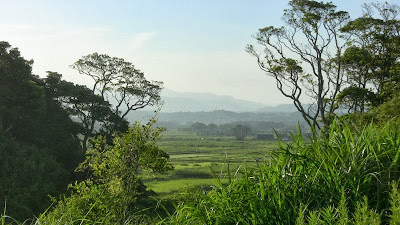
On the way to the beach where radiation is irreversibly deposited in the coastal sediments:
Most of radiocesium in the coastal sediments is incorporated into lithogenic fractions, and this incorporation is almost irreversible. Accordingly, the biological availability of sedimentary radiocesium is relatively low, but continuous monitoring of radiocesium inmarine biota is highly recommended because significant amounts of radiocesium have been accumulated in the sediment…….
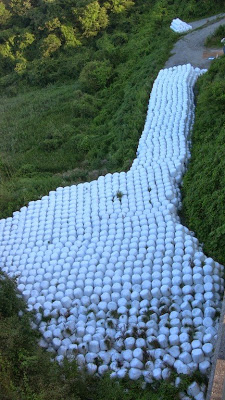
Near Hirano we saw thousands of huge sacks of low level radioactive waste piled under a bridge……..
Trade winds and Pacific currents bring Fukushima radiation to North America
Fukushima Radiation Hitting Canada and United States More than Japan http://talesfromthelou.wordpress.com/2013/10/08/fukushima-radiation-hitting-canada-and-united-states-more-than-japan-209/ Oct 8, 2013
ForbiddenKnowledgeTV
Alexandra Bruce
October 5, 2013
Besides the billions of gallons of radioactive water spilling from the abandoned Fukushima Nuclear Energy Plant every day, there is also a steady plume of radio nuclides including Cesium, Cobalt, Uranium and Plutonium, which are steadily being carried across the Pacific via trade winds, with the lion’s share landing (usually, along with the rain) in communities within the US and Canada – and in places beyond, throughout the Northern Hemisphere. Ironically, more fallout is presently occurring in North America than in Japan, the scene of the disaster, due to the trade winds, off the Japanese coast.
It has been calculated that in 1 day, there are 666,733.717599549 bequerels of radiation emitted in every cubic foot of the Pacific, per mile.
There are about 63,800,000 miles in the Pacific Ocean. The average depth is about 2.28 miles. There are 145,464,000 cubic miles in the Pacific Ocean. Cesium-137 has a double decay process 94.6% of the time; first beta rays, then gamma rays.
So each cubic foot of the entire Pacific Ocean will have 218.174056838937 Beta radiation events per day and each cubic foot of the entire Pacific Ocean will have 206.392657769635 Gamma radiation events per day.
34 is the average background radiation of the N. American continent.
The Pacific Ocean will have a “radiation fog” in every cubic foot of water that is 12.47 times HIGHER than the average background radiation count of North American continent.
Sea life will be affected in some manner; perhaps all fish will get cancer. The impact on humanity is a shortage in sea food and no swimming allowed until radiation levels abate to a “safe level”… in about how long???
Yuki Karakawa speaks on radiation emergency management
Japan Expert: Second explosion was “more like a bomb” at Fukushima — Spent nuclear fuel flew 30 kilometers away, pellets collected by military — Very strange materials like europium were found — Should have evacuated out to 300 kilometers (VIDEO) http://enenews.com/japan-expert-second-explosion-more-like-a-bomb-at-fukushima-nuclear-fuel-flew-30-kilometers-away-pellets-collected-by-japan-military-should-have-evacuated-300-kilometer-zone-150-years-t
October 7th, 2013
Title: Lessons from Fukushima
Source: Journal Tribune
Author: Tammy Wells
Date: Oct. 1, 2013
An ambassador to an international emergency management organization and a former minister of defense in Japan stopped by the York County Emergency Management Agency Monday […]
Yuki N. Karakawa, of the Karakawa Foundation and ambassador to the International Association of Emergency Managers, along with Kazuo Aichi, Japan’s defense minister in the 1990s, are both members of the Japan Resilience Initiative. […]
He said the disaster at Fukushima will be felt in Japan for a long time, and that there will be long-term medical effects – something he claims the country hadn’t put into their planning systems. […]
He estimated it will take 150 years for decontamination around Fukushima to be complete.
Yuki Karakawa – Lessons from Japan
Former York County Emergency Management Agency Director Bob Bohlmann said he’d known Karakawa for 15 years, and that he’s done a lot to spread the word about emergency management globally. […]
Yuki Karakawa’s presentation to InfraGard (“a partnership between U.S. businesses and the Federal Bureau of Investigation… dedicated to prevent hostile acts against the United States”), Published February 2013 (At 7:30 in): “300 kilometers should be evacuated, but we did not, Japan did not evacuate. […] In some areas, we can find very strange material like europium and so on. Now Self Defense Forces is collecting all materials. Also spent fuel flew because of a second explosion; it’s more like a bomb, exploded and flew like 30 kilometers. So government, or Self Defense, is now collecting all spent fuel pellets.” Watch Karakawa’s presentation here
See also: New Book: Nuclear explosion may have occurred at Fukushima Unit 3 after ‘supercritical condition’ — Sudden increase in plutonium, uranium recorded by U.S. at several EPA stations
Fukushima nuclear disaster needs urgent international help
World Action Now on Fukushima – Harvey Wasserman PlanetarianPerspectives.net October 5, 2013 Still At It After All These Years Journalist, author, activist and historian Harvey Wasserman has been reporting on, and participating in, the nuclear free movement for decades.
In that time, by his judgment, only one other event matches the nuclear danger to the world posed by the Cuban Missile Crisis.
That event is the ongoing nuclear disaster at Fukushima.
Haven’t heard about it in the corporate media? That’s because the deadly and dying global nuclear industry and its allies don’t want you to know.
That’s why Wasserman, who edit sNukeFree.org, has organized a petition drive to the UN advocating international expert oversight of, and participation in, management of the Fukushima crisis.
World Action Now on Fukushima – Harvey Wasserman
In this EON interview, he explains why we must all be involved in this world-historical challenge to human and planetary survival.
Sign the petition HERE.
[Production team: Morgan Peterson and Herb Peterson in LA; Mary Beth Brangan and Jim Heddle somewhere in Northern California.]…..http://www.planetarianperspectives.net/?p=1076
Unstable situation at Fukushima: radioactive leaks not being documented
Professor: We know all sorts of radioactive leaks are happening at Fukushima, it’s just not being documented — Situation is extremely unstable — Everybody’s just struggling to figure out how to deal with this (VIDEO) http://enenews.com/professor-all-sorts-radioactive-leaks-happening-fukushima-being-documented-situation-extremely-unstable-everybodys-struggling-figure-deal-video October 5th, 2013
Title: JAPAN: Fukushima Plant Operator Reports New Leak
Source: WorldBrief – HuffPost Live
Host: Ahmed Shihab-Eldin
Date: Oct. 2, 2013
Timothy Mousseau,, Professor of Biological Sciences at University of South Carolina: We’re going to see leaks of this magnitude on a near daily basis. There’s going to be all sorts of leaks. We know they’re happening; they’re just not being documented for the most part. It’s an inherently unstable situation. […]
It’s a very unstable situation […]
The current situation in Fukushima is extremely unstable. There haven’t been the engineering developments needed to really solve the problem in the short or long-term. I think everybody’s just struggling to figure out how to deal with this.
Fukushima disaster is the worst case of nuclear contamination in history
Professor: Fukushima disaster is the worst case of nuclear contamination in history — It’s a crisis for all humanity — Building up to something much worse? http://enenews.com/professor-fukushima-the-worst-case-of-nuclear-contamination-in-history-a-crisis-for-all-humanity-building-up-to-something-much-worse-video(VIDEO) Asia in Focus 3: Fukushima: Emanuel Pastreich and Layne Hartsell, Oct. 4, 2013:
Emanuel Pastreich, Professor at Kyung Hee University in South Korea and Director of The Asia Institute: The basic parameters of the ‘Fuksuhima Initiative’ — which is to say to create a truly global peer-to-peer collaborative effort to muster all the expertise in the world, all the goodwill in the world, and also a lot of man hours from creative and thoughtful people to come up with a real, long-term solution to this remarkable crisis. And to do it with the seriousness equivalent to say, putting a man on the moon, or if you want to reinterpret it, to say something the equivalent of a reverse Manhattan Project to deal with the extremely serious and totally unprecedented challenges.
Layne Hartsell, Asia Institute Fellow: The disaster has continued. When things like this leave the news, they seem to go away in the public psyche and public thought — but actually this is a lot worse right now, or building up to something much worse. Your thoughts?
Pastreich: Well, the news has not been good, as you know, in terms of the release of radioactive water, contamination and the amount of cesium and then strontium more recently. As we talked about in our paper this is really going to be a serious challenge for us. It’s something which the Japanese and others have floated ideas, but we’re really in uncharted territory. What we really want to do here at The Asia Institute is put together the most basic framework for how we would build such a global collaborative effort. […] There are many grim things I could talk about; actually I’d rather not stress the grimness of this. I hope the people out there understand just how serious this issue is and that really need to come together quickly. This is not something we can put off for another 6 months or a year. We really need it to come together. […]
Foreign Policy in Focus, Pastreich and Hartsell, Sept. 3, 2013: The Century-Long Challenge to Respond to Fukushima […] the worst case of nuclear contamination the world has ever seen. Radiation continues to leak from the crippled Fukushima Daiichi site into groundwater, threatening to contaminate the entire Pacific Ocean. The cleanup will require an unprecedented global effort. […] Solving the Fukushima Daiichi crisis needs to be considered a challenge akin to putting a person on the moon in the 1960s. […] the situation potentially puts the health of hundreds of millions at risk. […] To solve the Fukushima Daiichi problem will require enlisting the best and the brightest to come up with a long-term plan to be implemented over the next century. […] The Fukushima disaster is a crisis for all of humanity […]
Pastreich at The Asia Institute seminar,, Sept. 7, 2013: The Fukushima crisis is a global crisis and it is just a matter of six months or less before it starts to get the attention it deserves. Yet we do not have a single proposal for a global response […] Watch Hartsell’s interview with Pastreich about the ‘Fukushima Initiative’ here
Japan’s PM is lying to the Japanese people
Nuclear Engineer: Japan’s PM “Lying to the Japanese People
AUDIO: discussion on Japan’s non reporting of stillborns and birth defects
 AUDIO: Arnie discusses Fukushima Daiichi on WBAI’s Morning with Michaelhttp://fairewinds.org/media/radio/arnie-discusses-fukushima-daiichi-wbais-morning-michael
Gundersen: Deformities, stillbirths not being reported after Fukushima — Officials withholding truth about health effects — Gov’t suppressing studies on deformed animals (AUDIO) http://enenews.com/gundersen-deformities-stillbirths-kept-secret-after-fukushima-officials-not-being-honest-with-public-about-health-effects-govt-suppressing-studies-on-deformities-in-animals-audio
Title: Arnie Gundersen discusses Fukushima Daiichi
Source: WBAI’s ‘Morning with Michael’
Date: October 2, 2013
Arnie Gundersen, Fairewinds Chief Engineer: We’re constantly frustrated — We have scientists contacting us, doctors contacting us, telling us that their patients are suffering from radiation induced injuries, or they’re noticing deformities in animals and plants, but yet the Japanese government is trying to put the heat on them to prevent those studies from moving forward.
Morning with Michael, Host:: E[NE]News, the website, they talk about 100 babies with polydactyl situation — they have 6 fingers — this kind of exotic, strange, ‘Night of the Living Dead’ kind of thing’s happening here. There’s an x-ray picture on their website of a hand with 6 digits. Have you heard about that?
Gundersen:: Yes — ENENews is a great source; I check it a couple times a day — We’ve seen that and we’ve also seen the thyroid cancers. The deformities, the stillbirths, and the increased morbidity is not being reported by the Japanese. They used to publish a report every year that had a prefecture-by-prefecture breakdown […] of deformities and stillbirths and things like that. Well, they stopped publishing that report. They did say in 2011 there was an increase stillbirths and deformities, but they’re not providing scientists with the prefecture-by-prefecture breakdown. So that’s bad news for science, and clearly they would rather have the Olympics than be honest with their own people about the health effects they’re facing.
[Note: The report of 100 polydactyl babies was not on ENENews, it was posted by ‘Fukushima Appeal’ (link: Fukushima: 100 babies with polydactyly are on the waiting list for operation)]
Full interview here
Film: Uranium in situ mining, radiation in water, cancer
The mining companies know that if the leaching solution breaks into an aquifer, the water is contaminated and cannot be corrected. They cannot and will not guarantee it but will only promise to use the best available technology and make the best possible effort to correct the problem. Then as always, they will walk away with the ore and the profits and leave local residents and federal taxpayers to deal with the aftermath.
Hot Water: The Uranium Industry’s Dirty Little Story The only thing green about nuclear power are the people who think it’s safe. Lizabeth Rogers Activist Post 2 Oct 13,
HOT WATER Documentary Trailer
How many do you know today?
I began this odyssey, innocently enough in July 2009 when I led a filmmaking crew to South Dakota to investigate what we had heard was an abandoned uranium mine which had contaminated local groundwater and made local ranchers, their children and even their livestock sick. Continue reading
Climate – how hot will it get in your lifetime? – interactive
The UN is to publish the most exhaustive examination of climate change science to date,  predicting dangerous temperature rises. How hot will it get in your lifetime? Find out with our interactive guide, which shows projections based on the report http://www.theguardian.com/environment/interactive/2013/sep/27/climate-change-how-hot-lifetime-interactive
Slides on USA’s 14 nuclear power plants soon to be closed
14 U.S. Nuclear Plants Closing or at Risk—in Photographs and Text http://insideclimatenews.org/slideshow/14-us-nuclear-plants-closing-or-risk%E2%80%94-photographs-and-text
Four companies announced nuclear plant closures in 2013—representing the first shutdowns in 15 years, and an unprecedented single-year retrenchment for the U.S. nuclear industry. “Renaissance in Reverse,” a July 2013 report by Mark Cooper, highlighted at least ten nuclear plants that could be forced to close earlier than planned. Cooper, a senior fellow at the Vermont Law School’s Institute for Energy and the Environment, drew his conclusions in part from reports by Wall Street analysts. Cooper stopped short of predicting specific plant closures, but he noted that about ten are at greater risk for closure because of low power prices, rising costs and other woes.
(Read: First U.S. Nuclear Power Closures in 15 Years Signal Wider Problems for Industry)
Image: San Onofre Nuclear Generating Station, Units 2 and 3/Credit: Southern California Edison
The gap between official information and the real news about Fukushima
 Nuclear Industry Report: ‘Reduced stability’ of fuel pool in Fukushima Unit 4; Admits there’s damaged fuel inside? — Gundersen: Fuel racks moved and damaged; Fallen debris distorted tops (AUDIO) http://enenews.com/nuclear-industry-report-reduced-stability-of-unit-4-fuel-pool-at-fukushima-admits-some-fuel-inside-is-damaged-gundersen-fuel-racks-moved-from-quake-fallen-debris-distorted-tops-audio
World Nuclear News,Sept. 26, 2013 (Emphasis Added): […] Underwater inspections in the [Unit 4] pond have shown most of the fuel to be undamaged, but the pond contains a lot of dust and debris which will complicate operations. […] Its full core load of fuel, plus used fuel from previous operation, was being stored in a fuel pool at the top of the reactor building. […] The stability of the pool was then reduced by major structural damage to the building caused by the ignition of hydrogen […]
World Nuclear News is funded by the World Nuclear Association. The WNA represents the interests of the international nuclear industry. -Source
Bridging the News Gap, with Professor Matt Noyes
Fairewinds Energy Education Podcast, Sept.. 26, 2013 (at 21:15 in) – Arnie Gundersen, Fairewinds Chief Engineer: These racks [in the Unit 4 fuel pool] have moved, they’ve been distorted by the earthquake, there’s junk that’s fallen on top of them and distorted the tops. […] One of two things is going to happen. They’re either going to pull too hard and snap the bundle, or they’re going to be unable to pull all of the fuel out of the pool. Full podcast available here
Damaged underwater radiation barrier at Fukushima
NHK: Typhoon approaching Fukushima plant — Underwater fences breached — Tepco: No ‘immediate’ effect (VIDEO) http://enenews.com/nhk-typhoon-approaching-fukushima-plant-underwater-fences-breached-tepco-no-immediate-effect-video
Xinhua, Sept. 26, 2013: The operator of the crippled Fukushima Daiichi nuclear plant, Tokyo Electric Power Co., (TEPCO), said Thursday that damage was found on an underwater curtain under the stricken complex, according to local media. […] Local reports said that a worker found a cut in the fence Thursday morning, adding the TEPCO did not provide more details and is checking the impact of the crack. […] The TEPCO said it plans to repair the fence after an upcoming typhoon, according to Japan’s Kyodo News. […]
SOURCE: NASA
Fukushima News 9/26/13: Typhoon Damage-Underwater Barrier
NHK WORLD, Sept. 26, 2013: The operator of the crippled Fukushima Daiichi nuclear plant says underwater barriers in the facility’s port have been breached. […] The silt fences are to stop contaminated sea-bed soil from near the damaged No. 1, 2, 3 and 4 reactors polluting water near the still-intact No. 5 and 6 reactors. […] It plans to repair the fences once high waves triggered by an approaching typhoon subside. The Nuclear Regulation Authority instructed the power company to measure radiation levels […]
RT: “The fence is also designed to prevent radioactive material emerging from damaged units 1, 2, 3 and 4″
Tepco: “We don’t think this situation will have any immediate effect”
1 This Month

of the week – Shut Down Drone Warfare!


Tell the Ukrainian Government to Drop Prosecution of Peace Activist Yurii Sheliazhenko

Petition to revoke the licensing of the Near Surface Nuclear Disposal Facility (NSDF) at Chalk River. https://www.ourcommons.ca/petitions/en/Petition/Details?Petition=e-7247
To see nuclear-related stories in greater depth and intensity – go to https://nuclearinformation.wordpress.com
-
Archives
- April 2026 (92)
- March 2026 (251)
- February 2026 (268)
- January 2026 (308)
- December 2025 (358)
- November 2025 (359)
- October 2025 (376)
- September 2025 (257)
- August 2025 (319)
- July 2025 (230)
- June 2025 (348)
- May 2025 (261)
-
Categories
- 1
- 1 NUCLEAR ISSUES
- business and costs
- climate change
- culture and arts
- ENERGY
- environment
- health
- history
- indigenous issues
- Legal
- marketing of nuclear
- media
- opposition to nuclear
- PERSONAL STORIES
- politics
- politics international
- Religion and ethics
- safety
- secrets,lies and civil liberties
- spinbuster
- technology
- Uranium
- wastes
- weapons and war
- Women
- 2 WORLD
- ACTION
- AFRICA
- Atrocities
- AUSTRALIA
- Christina's notes
- Christina's themes
- culture and arts
- Events
- Fuk 2022
- Fuk 2023
- Fukushima 2017
- Fukushima 2018
- fukushima 2019
- Fukushima 2020
- Fukushima 2021
- general
- global warming
- Humour (God we need it)
- Nuclear
- RARE EARTHS
- Reference
- resources – print
- Resources -audiovicual
- Weekly Newsletter
- World
- World Nuclear
- YouTube
-
RSS
Entries RSS
Comments RSS
 nuclear-news