President Trump’s radical attack on radiation safety.

By Daniel Hirsch, Haakon Williams, Cameron Kuta | October 15, 2025, https://thebulletin.org/2025/10/president-trumps-radical-attack-on-radiation-safety/?variant=B&utm_source=ActiveCampaign&utm_medium=email&utm_content=Trump%20s%20attack%20on%20radiation%20safety&utm_campaign=20251009%20Thursday%20Newsletter%20%28Copy%29

In May, President Donald Trump issued a series of executive orders that, in part, require the US Nuclear Regulatory Commission (NRC) to consider dramatically weakening its radiation protection standard. If federal radiation limits are gutted in the manner urged by the president, the new standard could allow four out of five people exposed over a 70-year lifetime to develop a cancer they would not otherwise get.
Contesting the scientific consensus. Section 5(b) of the executive order—formally titled “Ordering the Reform of the Nuclear Regulatory Commission”—directs the NRC to issue a proposed “wholesale revision of its regulations and guidance documents,” including reconsideration of the agency’s “reliance on the linear no-threshold (LNT) model for radiation exposure.” The LNT model maintains that risk from radiation exposure is proportional to the dose: Even a tiny amount of radiation causes some small but real increased risk of cancer, and that risk goes up linearly as the dose increases.
While most Americans have doubtless never heard of the LNT model, it has been the bedrock of radiation exposure risk analysis for decades and forms the basis of public health protection from radiation. The LNT model is scientifically robust, supported by the longstanding and repeatedly affirmed determinations on low-dose radiation by the National Academies of Sciences, Engineering, and Medicine, virtually all international scientific bodies, the Environmental Protection Agency (EPA), and the NRC itself.
Despite the LNT model’s long track record and the well-established body of scientific evidence upon which it is built, President Trump has unilaterally issued a presidential finding that this scientific consensus is wrong. His order could lead to LNT’s complete abandonment in a matter of months, posing a serious increase in the amount of radiation that industries and government agencies would be allowed to inflict upon the public.
If the NRC goes along with Trump’s assertion, the weakening of radiation protection standards would likely be extreme. Advocates of abandoning LNT have often asserted that low-dose radiation is harmless or even beneficial, and therefore, that the public health radiation limits should be hugely increased. In 2015, three petitions for rulemaking to the NRC proposed doing away with the LNT model and increasing allowable radiation exposures for everyone—including children and pregnant women—to 10 rem. (The Roentgen equivalent man (rem) is a unit of effective absorbed radiation in human tissue, equivalent to one roentgen of X-rays. One rem is equal to 0.01 Sievert in the international system of units.)
One petition to the NRC went so far as to ask, “Why deprive the public of the benefits of low-dose radiation?” The NRC strongly rejected the petitions in 2021, citing the conclusions of numerous scientific bodies that “[c]onvincing evidence has not yet demonstrated the existence of a threshold.
Low-level, or “low-dose,” radiation is generally defined as a dose range of 10 rem and below. However, “low dose” is something of a misnomer, as 10 rem is still relatively high. Even when doses are low, they nonetheless cause substantial harm when spread across a large population over time, especially for sensitive groups like children.
Raising radiation exposure limits. If President Trump’s executive order results in a new public radiation exposure limit of around 10 rem—the level LNT opponents often advocate—the increased health risks would be extraordinary. Longstanding radiation protection limits for members of the public are in the range of 10 to 100 millirem (0.01 to 0.1 rem) per year. A 10-rem limit would increase allowed exposures to radiation by factors of 100 to 1000—and so would increase the risk of cancer.
A single chest X-ray is about 2 millirem (0.002 rem) of radiation exposure. An annual limit of 10 rem would correspond to a person receiving a dose equivalent to 5,000 chest X-rays each year, from conception to death. Current official radiation risk estimates—adopted by EPA from the National Academies’ BEIR VII study on the health risks from exposure to low levels of ionizing radiation—indicate that receiving 10 rem per year over a 70-year lifetime would result in about four out of every five people exposed getting a cancer they would not get otherwise.
Despite what opponents of the LNT model claim, there is no threshold at 10 rem below which there is no measurable health harm. A substantial body of scientific work has demonstrated significant negative health impacts well below 10 rem. Beginning in the 1950s, pioneering Oxford researcher Alice Stewart demonstrated that a single fetal X-ray with a dose of 200 millirem (0.2 rem) was associated with a measurable increase in the risk of that child dying of cancer. The radiation establishment fought Stewart’s findings vigorously, but her research has long since been vindicated.
More recently, a major study covering an international cohort of over 300,000 nuclear facility workers has found that annual doses well below 1 rem create measurable increases in the risk of developing a variety of cancers, and that, as NRC put it, “even tiny doses slightly boost the risk of leukemia.” A second massive study of nearly one million European children found that those who received a CT scan, at an average dose of 800 millirem (0.8 rem), suffered a measurable increase in their risk of getting cancer.
Standards already weak. Radiation protection standards should be tightened, not weakened. The US government has a long history of underestimating radiation risks. The more scientists have learned about low-dose radiation, the more their estimates of the risk per unit dose have tended to increase. Yet the NRC has not updated in step with the science.
The NRC protection limit for workers of 5 rem per year was set in the early 1960s and has not changed since, despite decades of increasing official estimates of radiation risk. The current best estimate, from the National Academies’ BEIR VII, indicates that one out of every five workers receiving the NRC’s allowable dose each year from ages 18 to 65 would develop a cancer.
NRC’s radiation exposure limits for the public have not been updated in 35 years. Despite a requirement to employ EPA’s more conservative radiation risk standards, the NRC has long ignored it and instead continues to use 100 millirem per year—100 times lower than what Trump’s executive order could lead to. Current risk figures from the National Academies and the EPA indicate that 70 years of exposure at that level would result in nearly one in 100 people getting cancer from that exposure. That is 100 to 10,000 times higher than the EPA’s acceptable risk range. As the former director of EPA’s Office of Radiation and Indoor Air said years ago, “To put it bluntly, radiation should not be treated as a privileged pollutant. You and I should not be exposed to higher risks from radiation sites than we should be from sites which had contained any other environmental pollutant.”
The NRC held a webinar in July to gather public feedback on implementing President Trump’s executive order on abolishing the LNT model. Many presenters—including representatives from the National Council on Radiation Protection and the Union of Concerned Scientists—gave a vigorous defense of the LNT model, as did many of the comments from the public. Yet the NRC, despite itself having strongly reaffirmed this standard only 4 years ago, seemed to minimize low-dose radiation risks and suggested that all radiation cancer risk models be treated equally (including the long-discredited view that low-dose radiation has health benefits). More concerning, the NRC has put its thumb on the scale, giving special treatment to LNT opposition by posting among the general meeting materials a link to one presenter’s paper, which suggests that an annual dose of 10 rem is acceptably safe.
At a time when radiation protection should be strengthened, President Trump has directed action to weaken it markedly. If the NRC implements the executive order, the potential outcome would be a new, deeply flawed radiation standard as much as a thousand times weaker than the current standard, resulting in a massive increase in radiation-related health hazards across the American population.
Leah McGrath Goodman, Tony Blair and issues on torture (with added radiation)

Published by arclight2011- date 15 Sep 2012 -nuclear-news.net
[…]
Accusations: Despite the mockery of the film Borat, leaked U.S. cables suggest the country was undemocratic and used torture in detention
Other dignitaries at the meeting included former Italian Prime Minister and ex-EU Commission President
Romano Prodi. Mr Mittal’s employees in Kazakhstan have accused him of ‘slave labour’ conditions after a series of coal mining accidents between 2004 and 2007 which led to 91 deaths.
[…]
Last week a senior adviser to the Kazakh president said that Mr Blair had opened an office in the capital.Presidential adviser Yermukhamet Yertysbayev said: ‘A large working group is here and, to my knowledge, it has already opened Tony Blair’s permanent office in Astana.’
It was reported last week that Mr Blair had secured an £8 million deal to clean up the image of Kazakhstan.
[…]
Mr Blair also visited Kazakhstan in 2008, and in 2003 Lord Levy went there to help UK firms win contracts.
[…]
Max Keiser talks to investigative journalist and author, Leah McGrath Goodman about her being banned from the UK for reporting on the Jersey sex and murder scandal. They discuss the $5 billion per square mile in laundered money that means Jersey rises, while Switzerland sinks.
http://www.youtube.com/watch?v=gA_aVZrR5NI&feature=player_detailpage#t=749s
And as well as protecting the guilty child sex/torturers/murderers of the island of Jersey I believe that they are also protecting the tax dodgers from any association.. its just good PR!
FORMER Prime Minister Tony Blair was reportedly involved in helping to keep alive the world’s biggest takeover by Jersey-incorporated commodities trader Glencore of mining company Xstrata.
11/September/2012
[…]
Mr Blair was said to have attended a meeting at Claridge’s Hotel in London towards the end of last week which led to the Qatari Sovereign wealth fund supporting a final revised bid from Glencore for its shareholding. Continue reading
St Louis radioactively contaminated sites visited by Dr Helen Caldicott.
Anti-nuclear activist tours north St. Louis County sites contaminated with radioactive waste, St Louis Public Radio, By STEPHANIE LECCI • FEB 19, 2016 An internationally recognized anti-nuclear activist and Australian physician said the radioactive contamination in north St. Louis County is “worse than most places” she’s investigated.
Dr. Helen Caldicott toured several local sites Friday afternoon, including: the recently remediated St. Cin Park in Hazelwood; West Lake Landfill Superfund site, which contains radioactive nuclear waste dating back to 1940s and ’50s; and the Bridgeton Landfill, whose underground smoldering has caused concern due its proximity to the waste in West Lake.
Byron DeLear, an executive for a clean-energy company, helped take Caldicott on the tour.
“This is truly an historic opportunity for this community to have the expertise of Helen to show up and really start to investigate what’s going on here,” he said.
Caldicott, founding president of Physicians for Social Responsibility, whose umbrella parent organization International Physicians for the Prevention of Nuclear War won the Nobel Peace Prize, called the situation “obscene.”
“When you inhale radon, it decays into lead 210 and stays there in the bronchus irradiating just a small volume of cells with alpha radiation, very carcinogenic,” she said. “Radon is one of the most potent causes of lung cancer.”
Caldicott said she will discuss other elements along the decay chain of uranium and “where they go in the body and how they cause cancer” during a symposium at St. Louis Community College-Wildwood Saturday at 7 p.m. Caldicott will be the keynote speaker on the impacts of nuclear weapons development, and will be joined by a panel of other experts. The presentation will also be live-streamed………
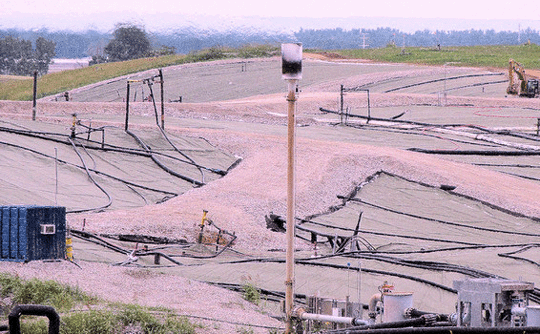
New Zealand is under siege by the Atlas Network
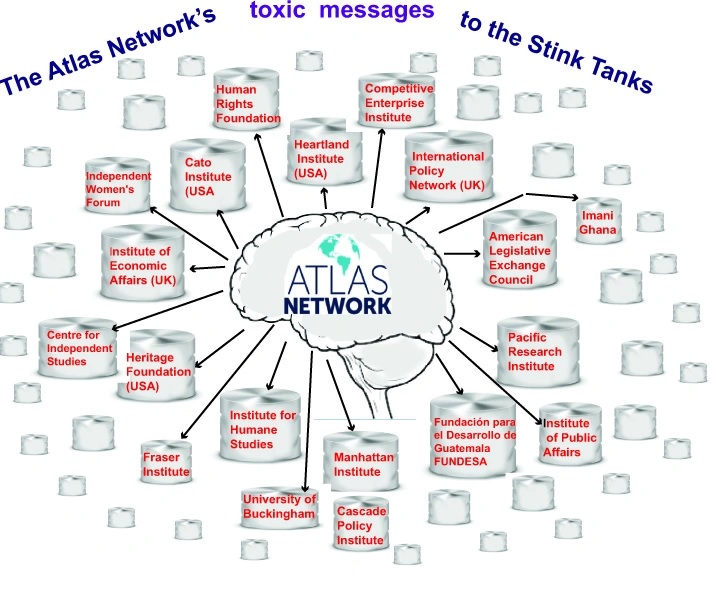
We have a handful of years to achieve a monumental shift from fossil fuel towards renewable energy: Atlas partners aim to ensure this does not take place.
March 3, 2024, by: Lucy Hamilton, https://theaimn.com/new-zealand-is-under-siege-by-the-atlas-network/—
Just as the Atlas Network-connected Advance body intervened in the Voice referendum in Australia and, in recent weeks, a by-election, similar organisations spawned from the American model are distorting New Zealand’s politics from within as well as from without.
One of the key researchers into the Atlas Network, Lee Fang, observed that it has “reshaped political power in country after country.” In America, every Republican president since Ronald Reagan has begun office with a Roadmap provided by the Heritage Foundation, primary Atlas Network partner. The “Mandate” for 2025 puts America on a hard path to fascism should a Republican win in November. Britain’s economy and standing have been savaged by Atlas partners’ impacts on the Tories. In New Zealand, the recently-elected rightwing coalition government is aping the new “Atlas president” of Argentina, aiming to privatise national assets, but is increasingly also imitating Atlas strategies recently seen in Australia, inflaming racial tensions and harming the wellbeing of Māori people.
Dr Jeremy Walker called Australia’s attention to the local Atlas partner organisations’ impact on the Voice to Parliament referendum and is now helping draw together the focus on the New Zealand partners’ very similar distortion of their national debate. There is a deep racism at the heart of this ultra-free market ideology that has licensed the international right to exploit resources and people around the globe untrammelled, largely in American corporate interest, but more broadly for any corporation or allied sector big enough to be a contender. (They do not, by contrast, fight for the renewable energy sector’s interests, as a competitor to their dominant fossil fuel donors; this shapes their climate crisis denial and delay, and colours their loathing of First People’s capacity to interfere with their profits by environment-driven protest. A sense of Western Civilisation as the apex of human existence and deep disdain for non-Western cultures also pervade the network.)
The Atlas model is to connect and foster talent in the neoliberal sphere. Young men (mostly) are funded or trained to replicate the talking points that Ultra High Net Worth Individuals (UHNWI) and lobbyists have built into a global network of over 500 bodies in 100 nations. The fact that neoliberal orthodoxies are more religious ideology that fact-based theories explains why their impact has been so utterly disastrous everywhere they have reshaped societies. The goal is to spawn replicating bodies with benign-sounding names that promote the UHNWI and corporate talking points – but with a veil hiding the self-interest that is obvious when those groups speak for themselves. Some of the bodies feign being thinktanks, which George Monbiot recently renamed junktanks to clarify their disingenuousness. Others are “astroturf” organisations that pretend to be grass roots bodies representing popular opinion. Another model is the beach-head in universities, an independent organisation within those institutions intended to dignify the neoliberal religion and the chosen strategies, including climate denial. All these produce material to fill civic debate and train more acolytes to enter politics, strategy companies and junktanks. Mainstream media elevates their standing by hosting their operatives as experts without explaining that the benign-sounding organisation to which they belong is a foreign-influence operation’s local outlet.
These groups damage local conditions to favour international corporations. They lobby for the removal of the “regulations” that are actually protections for the public – as workers, as consumers, as residents. They push for the privatisation of national treasures so that (often foreign) corporations can exploit the profits at the expense of the public. The greater the damage to the local democracy, the easier it is for them to act unimpeded. The stronger their infiltration of the media, the harder it is for the local electorate to understand the stakes. The politicians and strategists that emerge from the sphere (or are its allies) know that none of this wins votes, so they fill the space with culture war division to distract the voter from paying attention. Race and sexuality are their most obvious targets, as reactionary nostalgia for a mythical past of white picket fences pervades their ideology: a valorisation of “Christianity” and “family” and the “sacredness of marriage” (preached by adulterous politicians) is equally apparent in their propaganda.
The coalition that took power in NZ late in 2023, after a campaign centred on attacking the country’s founding Waitangi Treaty, has considerable Atlas infiltration. There is concern about Atlas fossil fuel and associated tobacco interests perverting policy in parliament, as well as senior ministerial aides who might be compromised. The government has promised to repeal Jacinda Ardern’s ban on offshore gas and fuel exploration, plans to sell water to private interests, not to mention planning to enable the selling off of “sensitive” NZ land and assets to foreign corporations, just as Argentinian Milei is intending.’
One of the government members, the Act Party, began its existence as an Atlas partner thinktank and continues that close connection. It was founded by former parliamentarian Denis Quigley with two members of the Mont Pelerin Society (MPS), the Atlas Network’s inner sanctum. One, Roger Douglas, was responsible for Rogernomics in NZ which has been described as a “right wing coup” that worked to “dismantle the welfare state.” The other, Alan Gibbs, who has been characterised as the godfather of the party, and a major funder, argued Act ought to campaign for government to privatise “all the schools, all the hospitals and all the roads.” This may not be surprising since he made much of his fortune out of the privatisation of NZ’s telecommunications.
The Act Party is currently led by David Seymour who functions as a co-deputy prime minister in the government. He has worked almost his entire adult life within Atlas partner bodies in Canada and boasts a (micro) MBA dispensed by the Network.
In Seymour’s 2021 Waitangi Day speech, he acknowledged his “old friends at the Atlas Network.” In light of that, his recent disdainful and absolute dismissal of the party’s connection to Atlas in an interview was telling: he clearly felt the association was damaging enough to lie outright.
Seymour is also deeply antagonistic to policies dedicated to repairing the disadvantage suffered by Māori people, disingenuously describing provisions that work cooperatively with Māori people as the “dismantling of democracy.” He appears antagonistic to Māori culture.
Another Atlas partner that has been key to distorting debate in NZ is the Taxpayer Union (TPU) which is emblematic of the production of metastasising bodies central to the Atlas strategy. Its co-founder and executive director is another graduate of the Atlas (micro) MBA program. Jordan Williams (currently “capo di tutti capi” of the Atlas global alliance of anti-tax junktanks) laughably depicts Atlas as a benign “club of like-minded think tanks.” He created, however, a body called the Campaign Company which helped radicalise the established farmer power base in NZ politics, planting sponsored material in the media. Williams claimed to grant the farmers “world-class campaign tools and digital strategies.” He also co-founded the Free Speech Union (FSU), which is unsurprisingly fighting regulation of the damaging impact of internet disinformation as well as fostering culture war battles.
A further spin-off of the bodies illustrates the increasing ugliness of the populist strategies. A former Act Party MP has founded the New Zealand Centre for Political Research which is fomenting civic division against Māori interests, including placing hate-mongering advertisements in the media.
The Act Party (alongside the populist New Zealand First party) is at the heart of the coalition government’s intention to destroy NZ’s admirable efforts to promote Māori interests for the betterment of the commonwealth, including the co-governance innovation. Efforts to undo disadvantage and programs that have promoted the distinctive NZ democratic experiment are set to be dismantled. A “massive unravelling” of Māori rights is at stake.
It is not only Māori people who will suffer. The NZ coalition government is also attempting a kind of “shock therapy” that did so much to tip first Chile and then other “developing” nations into brutal pain in pursuit of market “freedom.” The MPS was at the heart of Pinochet’s neoliberal brutality, resulting from Nixon’s injunction to make the Chilean economy scream.[1] New Zealand now faces cuts to a range of services, welfare and disability payments, even while the new PM, one of NZ’s wealthiest ever holders of the role, charged the taxpayer NZD 52,000 to live in his own property. It’s important to remember that this kind of entitlement is the sort that the neoliberals like, alongside subsidies to industry and corporations.
Lord Hannan (one of Boris Johnson’s elevations to the peerage, and a junktank creature) recently spoke in NZ, welcoming “all the coalition partners around this table” to hear his oration. There he celebrated the small percentage of GDP that NZ’s government spends on its people, cheering on the TPU’s power. He also disdained the “tribalism” that has dictated recognition of First Peoples’ suffering. There is grand (but unsurprising) irony in a graduate of three of Britain’s preeminent educational institutions dictating that humanity’s essential equality is all that can be considered when devising policy, particularly in settler-colonial nations.
Amusingly the weightier debunking of the Atlas connections has come from: Chris Trotter, formerly centre left, now a council member of Williams’ FSU; Eric Crampton, chief economist of the New Zealand Initiative, NZ’s leading Atlas partner and Sean Plunkett whose “anti-woke” vanity media platform, Platform, is plutocrat funded and regularly platforms the NZI talking heads.
While Atlas’s system largely functions to connect and train operatives, as well as acting as an extension of American foreign policy, this modest-seeming program must not be ignored. We have a handful of years to achieve a monumental shift from fossil fuel towards renewable energy: Atlas partners aim to ensure this does not take place.
And Atlas partners will push us at each other’s throats while we procrastinate.
[1] That MPS intervention resulted in massive unemployment, extraordinary inequality, and fire-sale prices of national assets to cronies. Much of Chile’s later success is as likely to be attributable to the trade requirements of (statist) China whose demand for copper has done so much to enrich Chile.
Jeremy Corbyn was smeared for rejecting the use of nuclear weapons – but he was right,

 Corbyn was smeared for rejecting the use of nuclear weapons – but he was right https://leftfootforward.org/2020/01/corbyn-was-smeared-for-rejecting-the-use-of-nuclear-weapons-but-he-was-right/, Kate Hudson
– It’s time to smash the narrative that using nuclear weapons is ‘patriotic,
|
A recurrent trope in the post-election analysis has been Jeremy Corbyn’s supposed lack of patriotism. It’s worth examining. Rather than arriving at this conclusion by demonstrating that Corbyn doesn’t love his country – for which there is no evidence whatsoever – it seems largely to be based on his unwillingness to commit to killing millions of innocent civilians at the touch of a button. The media seemed hell-bent on pushing this approach during the election (and it’s resurfacing in the leadership debate). Fortunately others in the public eye, footballer Gary Lineker for one, have more common sense. ‘Nuclear thing is bonkers’ he tweeted, ‘We’re all f**ked if they’re ever used.’ Quite so. And he went on to say – in a twitter debate with TV presenter Piers Morgan – that Trident should be scrapped. Morgan tried to assert the strange logic that because we had them they hadn’t been used. Lineker quite sensibly pointed out that nuclear weapons would not have been used if there were no nuclear weapons. This is a point we have been making for some time. It reminds me of a debating point made by some pro-nuclear advocates that ‘we have them in order not to use them’. Clearly a silly approach – we could save ourselves £205 billion by not having them in order not to use them! But having blighted the election with a knee-jerk prime ministerial virility test this is now resurfacing during the Labour leadership contest. Candidates – most notably and recently, Rebecca Long Bailey on Tuesday’s Today programme – are again being asked their position on the use of nukes. Because willingness to press the button has come to falsely symbolise strong leadership, patriotism and a commitment to Britain’s status in the world, who is going to say no? Nothing could show more clearly the urgent need to have a genuine debate about nuclear weapons, what they are and what their use would mean. We also need politicians to realise that nuclear weapons are not something to posture wildly about – they are indeed weapons of mass destruction. There will be no life worthy of the name after their use. Survivors will envy the dead. Most concerning is the fact that unquestioning attachment to a totemic but anachronistic weapons system prevents a real assessment of what is needed to meet our security needs in the 21st century – and what we need to spend our defence budget on. It is an open secret that the MoD is overcommitted on ‘big ticket’ projects. Yet no one seems to dare to question Trident, presumably on the grounds that they would be immediately characterised as a lily-livered traitor. National security strategies since 2010 have identified cyber warfare, terrorism, climate change, pandemics and organised crime as some of the key contemporary threats we face. Nuclear threats have actually been downgraded in risk level but nevertheless Trident replacement is proceeding – with significant opportunity cost to other higher level defence priorities. Even former advocates of nuclear weapons, like Lord Des Browne, are speaking out. He was the Defence Secretary who pushed the decision on Trident replacement through parliament in the Blair years. Now he has raised serious concerns about the impact of new technology on Trident and its replacement. When Trident was launched in the 1990s it was the gold standard of nuclear weapons, undetectable under the waters, 24/7. Now, he states, the replacement will be obsolete before it’s launched: the rapid development of underwater drone technology will render subs fully detectable and advanced hacking skills will jeopardise the security of targeting and missile use. So this is the problem with reducing serious questions about our national security to the level of a ‘will they/won’t they press the button?’ game show, trapping politicians in a ridiculous zero-sum game where actually everyone loses. Our real security needs are ignored and underfunded. It’s time for change – rethinking our security is well overdue. Kate Hudson is General Secretary of the Campaign for Nuclear Disarmament. |
|
“Nuclear comes last”

the tail-between-legs exit of the Nuclear Summit conferees declared in a headline: “Taxpayers are needed to foot the bill to achieve 2050 targets.”
Banks reject nuclear funding, stocks nosedive and the industry says it should, believe it or not, slow down
By Linda Pentz Gunter https://beyondnuclearinternational.org/2024/03/31/nuclear-comes-last/

NuScale, the company whose small modular reactor project collapsed so spectacularly last November, is “burning cash at the rate of $185 million per year”. On March 22, the company’s CEO, John Hopkins, sold 59,768 of his shares in the company. This is the same CEO who declared NuScale’s SMR project, aptly named VOYGR, “a dead horse.” It’s clearly on a journey to nowhere.

Wells Fargo, with an eye on prudent investments, has declared, “We think investor enthusiasm for SMR is misguided”. As The Motley Fool reported, “NuScale’s VOYGR nuclear power product has ‘no secure customers’ and is ‘not cost competitive’ says the analyst.”
The splashy cheerleading Nuclear Energy Summit organized by the International Atomic Energy Agency in Brussels on March 21 proved to be just that. The participants arrived floating on the hot air of their misplaced enthusiasm but “left humbled by the tepid reaction of bankers assessing the price tag of their ambitions”.
European Investment Bank Vice President Thomas Ostros, told Summit attendees to their face that “The project risks, as we have seen in reality, seem to be very high”. Representatives from the European and Latin American banking worlds said that “their lending priorities lean toward renewables and transmission grids” and that “nuclear comes last”.

Even the US Nuclear Regulatory Commission couldn’t quite bring itself to slam down its rubber stamp on Oklo’s chalet-in-the-woods micro reactor, the Aurora, which remains about as real as its namesake fairy tale princess.
In January 2022, the NRC denied Oklo’s license application outright because it “continues to contain significant information gaps in its description of Aurora’s potential accidents as well as its classification of safety systems and components,” wrote the NRC.
Oklo reapplied nine months later but according to the NRC docket there is “no further action”.
Nevertheless, Oklo brags on its website that it “made history” simply by developing “the first advanced fission combined license application to the U.S. Nuclear Regulatory Commission”, which sums up the second nuclear “renaissance” perfectly: Make a drawing. Hit ‘send’.
Meanwhile, the US military canceled its contract for an Aurora reactor originally intended for the Eielson Air Force Base near Fairbanks, Alaska.
And finally, an executive from the industry that has consistently delivered its latest new reactors decades late and billions over the original budget — in one case $20 billion over — suggested they should all just slow down. Said Ian Edwards, chief executive of Canadian reactor producer, Atkins Realis, “we all become too optimistic. We have this optimism bias towards being able to deliver faster. Really we should probably slow things down a little bit.”
But nuclear power is the answer to our current climate crisis! Ya think?
It’s tempting to ask whether things can get any worse for the nuclear power industry, but they almost certainly will. Unless we end up paying for it all. As the Bloomberg article that related the tail-between-legs exit of the Nuclear Summit conferees declared in a headline: “Taxpayers are needed to foot the bill to achieve 2050 targets.”
At the moment, a majority in the US Congress seem intent on making sure that is exactly what will happen. Because after all, why should multi-billionaire, Bill Gates, be forced to pay for his own nuclear toys when he can milk (read ‘bilk’) US taxpayers instead?
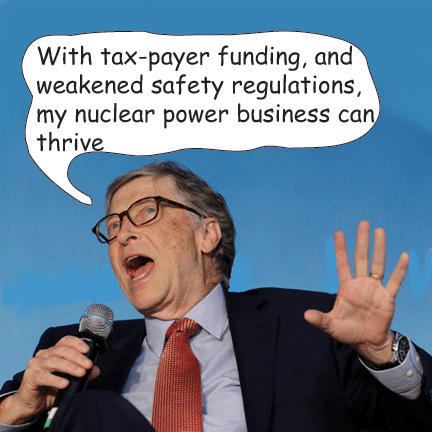
The US government has already pledged $2 billion of our money to Gates for his proliferation-friendly liquid sodium-cooled molten salt fast reactor produced by his company, TerraPower (more properly, TerrorPower). Gates can’t wait to export it the United Arab Emirates. Nuclear weapons anyone?
The strokey-white-beard-named ADVANCE Act, has been passed by the US House with 365 voting in favor and only 36 Democrats-with-a-conscience voting against it. By its own description, the ADVANCE ACT aims to “advance the benefits of nuclear energy by enabling efficient, timely, and predictable licensing, regulation, and deployment of nuclear energy technologies.” In other words, do away with burdensome — and expensive — safety regulations.
Indeed, New Mexico Democrat, Senator Martin Heinrich, told E&E News in January that “These regulatory timelines do not lend themselves to fighting the climate crisis.” Oh those wascally wegulations!
Meanwhile, Democratic senator Joe Manchin of West Virginia doesn’t want to seat any new NRC commissioners who might be “too focused on safety.”
The NRC’s motto is “protecting people and the environment,” a mandate it demonstrably endeavors to avoid already, but even some vestige of interest in safety is probably better than none. Not that safety oversight will be needed of course because, hey, SMRs are “walkaway safe” and “meltdown proof” and any new light water reactors are too “advanced” to be a safety risk.
This makes the insistence by SMR manufacturers that they must be covered by the Price-Anderson Act (PAA) all the more curious. Price-Anderson, due to expire in 2025, was culled out of the ADVANCE ACT, now moving out of Senate committee and working its way through the reconciliation process, and handled separately. The Senate adopted the House version of the PAA, giving it a 40-year extension to 2026, and expanded limited liability for a major accident to just over $16 billion per reactor.
President Biden duly signed it into law, marking another misstep on what is becoming an increasingly problematic presidency.
Ed Lyman, Nuclear Power Safety Director at the Union of Concerned Scientists, told Nuclear Intelligence Weekly that “The nuclear industry’s push for a 40-year Price-Anderson Act extension is a sure sign that it doesn’t believe its own messaging about how safe the next generation of nuclear reactors is going to be.”
But in a joint statement, Senator Shelley Moore Capito (R-W.Va.) and Senator Tom Carper (D-Del.) declared that “The extension of the Price-Anderson Act in the minibus sends a clear message that we are committed to the advancement of this safe and reliable power source.”
The “clear message” this actually sends is that, in the event of a major nuclear accident, US taxpayers will be thrown under that minibus. The $16 billion coverage will be chicken feed and we will all be stuck with the bill. Let’s remember that the Chornobyl and Fukushima nuclear disasters are each racking up costs in the hundreds of billions of dollars and counting. We have been warned.
But a bi-partisan group of Representatives and Senators think it’s perfectly fine for all of us to pay for such an eventuality. Meanwhile, if you own a home and are forced to abandon it in the path of a nuclear accident, you cannot claim a dime off your homeowner’s insurance. It will just be a total loss. Think about that for a moment.
Are we outraged yet?
Linda Pentz Gunter is the international specialist at Beyond Nuclear
How Long Can Israel Defy the World?

More probably, however, Israel will resist such pressure and threat to resort to the Samson Option, i.e., a nuclear attack on the countries endangering “Israel’s right to exist”. In this worst-case scenario, Israel would be annihilated, but those who put pressure on it would also suffer enormous casualties. Obviously, no country in the world will run the risk of a nuclear attack to free the Palestinians.
By Prof. Yakov M. Rabkin, https://www.juancole.com/2024/01/long-israel-world.htm .
Palestinians in Gaza are being decimated. Over 20,000 have been killed, mostly women and children. Three times more have been wounded. Some experts qualify it as genocide, others as massacre. Two million people have been displaced, many more than during the entire history of displacement of the Palestinians since the start of the Zionist settlement at the turn of the 20th century.
As Israel takes out hospitals and civilian infrastructure, infectious diseases and famine threaten to kill many more people. Several Israeli soldiers have been reported infected during the ground operations, one has died. General Giora Eiland suggests relying on the weapon of imminent epidemics in lieu of endangering the lives of Israeli soldiers in real warfare. Gaza is violently demodernized, bombed into stone age: hospitals, schools, power stations are bombed to rubble. What is happening appears unprecedented.
The number of victims is, indeed, unprecedented. Yet the unfolding tragedy follows the old script of the Zionist project, which is European in more than one sense. It is rooted in ethnic nationalisms of Eastern and Central Europe. Nations must live in their “natural” environment where those not of the titular nationality would be at best tolerated. According to an Iraqi journalist writing in 1945, the Zionists’ goal was “to expel the British and the Arabs from Palestine so that it will be a pure Zionist state. … Terrorism [was] the only means that can bring the Zionist aspirations to fruition.” Significantly, the journalist did not consider the future state Jewish but Zionist. He must have known that Jews from countries other than those of Europe and European colonization constituted a miniscule part of the Zionist movement.
Zionism is also European because it is a settler colonial project, the most recent of all. The Palestine Jewish Colonization Association was among several agencies devoted to turning the multi-ethnic and multi-confessional Palestine into “the Jewish homeland”. The Jewish Colonial Trust, the predecessor of Bank Leumi, today Israel’s largest bank, financed the segregated economic development of the Zionist settlement in Palestine. In the usual colonial manner, the early Zionist settlers were eager to establish a separate colony rather than integrate in the existing Palestinian society.
Zionism is not only the most recent case of settler colonialism. Israel is unique in that, unlike Algeria or Kenya, it is not populated by migrants from the colonial metropolis. But this distinction matters little to the indigenous Palestinians who, just like in many other such situations, are being displaced, dispossessed, and massacred by the settlers. Displacement is enacted not only in Gaza, where it is massive and indiscriminate, but also in the West Bank where it is more focused.
To attain its objectives Zionism has had to rely on major powers, the British Empire, the Soviet Union, France and, nowadays, the United States. The Zionists, committed to the success of their project, have been pragmatic and ideologically promiscuous. They would enjoy the support of the Socialist International during most of of the 20th century and then switch to become the darlings of White supremacists and the extreme-right.
Zionism is a nationalist response to anti-Jewish discrimination and violence in Europe. It deems antisemitism endemic and ineradicable, explicitly rejecting long-term viability of Jewish life anywhere except in “the Jewish state” in Palestine. The Nazi genocide in Europe reinforced this conviction and offered legitimacy to the fledgling colonial project while such projects were crumbling elsewhere in the world. The Zionist project, ignoring the opposition of the Palestinians and other Arabs, simply exported Europe’s “Jewish question” to Palestine.
Palestinians gradually understood that the Zionist project would deprive them of their land and resisted it. This is why the early Zionist settlers, most of them from the Russian Empire, formed militias to fight local population. They perfected their terrorist experience gained during the Russian revolution of 1905 with colonial counterinsurgency measures learned from the vast experience of the British. Established against the will of the entire Arab world, including the local Palestinians, the state of Israel has had to live by the sword. The army and the police have worked hard to keep the Palestinians down (the British used to call it “pacification of the natives”). Their task has been to conquer as much land as possible with as few Palestinians remaining on it as possible.
Many Palestinians now in Gaza had been expelled from the very area in what is now Israel that experienced the Hamas attack in October. They are mostly refugees or descendants of refugees. The high density of the population in an enclosed area (some called it “the largest open-air prison) makes them particularly vulnerable. When Israel did not like the election of Hamas in 2006, it laid siege to Gaza, limiting access to food, medicines, work etc. Israeli officials were openly admitting they were putting the Gazans “on a diet” while having to “mow the lawn” from time to time, subjecting the Gazans to violent “pacification”.
The 16 years of siege intensified anger, frustration and despair leading to the Hamas attack. In response, Israeli used drones, missiles, and aircraft to continue what used to be done with rifles and machine-guns. The death rate has increased, but the goal of terrorizing Palestinians into submission has remained the same. The name of the current onslaught on Gaza is “Iron Swords”, aptly reflects the Zionists’ century-old choice to live by the sword rather than coexist with the Palestinians on equal terms. Ein berera, “we have no choice”, the common Israeli excuse for unleashing violence, is therefore misleading.
Impunity and Impotence
Israel has enjoyed a large degree of impunity, with dozens of UN resolutions simply ignored. Only once, in the wake of the 1956 Suez War, was Israel forced to give up territorial conquest. This happened under a threat coming from both the United States and the Soviet Union. Since then, Israel has relied on firm U.S. diplomatic and military support, which has become more brazen with the advent of America’s unipolar moment after the dissolution of the Soviet Union. This support is now embodied in the supply of American munitions for the war on Gaza, in the presence of U.S. Navy vessels protecting Israel from third parties and in the U.S. vetoes at the Security Council. Israel and the United States are joined at the hip. Europe, while being more critical of Israel rhetorically, closely follows the U.S. line just as it does in the Ukraine conflict. In both conflicts, European chanceries appear to have abdicated independence and, possibly, ability of action.
Israel’s impunity also reflects impotence of the rest of the world. While Muslim and Arab governments decry and protest Israel’s assault on Gaza, none has imposed or even proposed economic, let alone military, sanctions. Fewer than a dozen of countries has suspended diplomatic relations or withdrawn diplomatic personnel from Israel. None has broken relations. Russia and China, along with most of the Global South, express their dismay at civilian casualties in Gaza but they too stop short of going beyond words.
The double standard of the Western reactions is obvious. Drastic economic sanctions imposed on Russia contrast with the generous supply of arms and at best verbal pleas for moderation in response to the Israeli actions in Gaza. In just a few months, the IDF surpassed Russia’s almost two-year record in the Ukraine with respect to the volume of explosives dropped, the number of people killed and wounded, and the civilian/military ratio among the casualties. Western sermons about inclusion and democracy are unlikely to carry much weight in the rest of the world. Palestinian lives do not really matter to Western governments.
This lackadaisical reaction to the massacres in Gaza contrasts with the indignation they provoke in the population in much of the world. Massive demonstrations call on governments to stop the violence. In response, most Western governments have strengthened measures to restrict freedom of speech. Opposition to Zionism has been declared antisemitic, the most recent such measure is the equivalence between anti-Zionism and antisemitism decided by the U.S. Congress in December 2023. Accusations of antisemitism are leveled at students, often Jewish, who organize pro-Palestinian demonstrations. Televised debates as to what constitutes “genocidal antisemitism” on elite university campuses divert attention from what looks like a real genocide in Gaza. Antisemitism serves as Israel’s Wunderwaffe, its ultimate weapon of mass distraction.
Pro-Palestinian demonstrations have been banned in several European capitals where commercial or cultural boycott of Israel has been made illegal. This pressure from the ruling class, including courts, police, corporate media, employers, and university administrations, creates a powerful sense of frustration among the rank-and-file. Shortly after attacking Gaza in 2009, and over sharp criticism of its treatment of the Palestinians, Israel was unanimously accepted into the Organization for Economic Cooperation and Development (OECD), made up of some 30 countries that boast democratic structures of governance. Former Canadian prime minister Stephen Harper, while still in office, placed solidarity with Israel above Canada’s interests to the point of claiming that his government would support Israel “whatever the cost.”
Support for Israel, tending to increase with income, has become a class issue. It serves as another reminder of the growing estrangement between the rulers and the ruled, the proverbial One Per Cent and the rest. It remains to be seen if popular frustration with the hypocrisy of governments in their support for the war on Gaza may one day result in political change that would begin to dent Israel’s impunity.
Israel is a state without borders. Geographically, it has expanded with military conquest or colonization. The Zionist movement and successive Israeli governments have taken great pains never to define the borders they envisage for their state. Israeli secret services and the army pay no heed to borders, striking targets in its neighboring countries at will. This borderless character is also embodied in Israel’s claim that it belongs to the world’s Jews rather than to its citizens. This leads to the overt transformation of Jewish organizations around the world into Israeli agents. This is particularly the case in the United States. Israeli agents, such AIPAC, ensure Israel’s interests in elections on all levels, from school boards to the White House. Israel has even played the legislative against the executive branch in Washington. Yet this unabashed political interference attracts a lot less criticism in mainstream media that the alleged meddling of China or Russia. Israel also intervenes in the political process of other countries.
Conflict Between Jewish and Zionist Values
Zionism has provoked controversy among Jews from its very inception. The first Zionist congress in 1897 had to be moved from Germany to Switzerland because German Jewish organizations objected to holding a Zionist event in their country. The Zionist argument that the homeland of the Jews is not the country, where they have lived for centuries and for which many have spilled their blood in wars, but in a land in Western Asia. For many Jews, this message bears disconcerting resemblance to that of the antisemites who resent their social integration.
Initially irreligious, Zionism transforms spiritual terms into political ones. Thus, ‘am Israel, “the people of Israel”, defined by their relationship to the Torah, becomes ethnicity or nationality in the Zionist vocabulary. This prompted the prominent European rabbi Jechiel Weinberg (1884-1966) to emphasize that “Jewish nationality is different from that of all nations in the sense that it is uniquely spiritual, and that its spirituality is nothing but the Torah. […] In this respect we are different from all other nations, and whoever does not recognize it, denies the fundamental principle of Judaism.”
Another reason for Jewish opposition to Zionism has been moral and religious. While prayers for the return to the Holy Land is part of the daily Judaic ritual, it is not a political, let alone a military objective. Moreover, the Talmud spells out specific prohibitions of a mass move to Palestine before Messianic times, even “with the accord of the nations”. This is why the Zionist project with its addiction to armed violence continues to repel many Jews causing them embarrassment and even revulsion.
True, the Pentateuch and several of the books of the Prophets, such as Joshua and Judges, teem with violent images. But far from glorifying war, Jewish tradition identifies allegiance to God, and not military prowess, as the principal reason for the victories mentioned in the Bible. Jewish tradition abhors violence and reinterprets war episodes, plentiful in the Hebrew Bible, in a pacifist mode. Tradition clearly privileges compromise and accommodation. Albert Einstein was among the Jewish humanists who denounced Beitar, the paramilitary Zionist youth movement, today affiliated with the ruling Likud. He deemed it to be“ as much of a danger to our youth as Hitlerism is to German youth”.
Zionism vigorously rejects this “exilic” tradition, which it deems “consolation of the weak”. Generations of Israelis have been brought up on the values of martial courage, proud of serving in the military. Zionists regularly refer to their state as a continuation of biblical history. The idea of the Greater Israel is rooted in the literal reading of the Pentateuch. Zionism demands total commitment and brooks little opposition or criticism. The passion of the Zionist commitment has led to assassination of opponents, pitched fathers against sons, splitting Jewish families and communities. The historian Eli Barnavi, former Israeli ambassador in Paris, warns that “the dream of a ‘Third Kingdom of Israel’ could only lead to totalitarianism”. Indeed, many Jewish community leaders, undisturbed by the specter of “dual loyalty”, insist that allegiance to the state of Israel must prevail over all others, including allegiance toward their own country.
The Zionists, whether in Israel or elsewhere, have long claimed to be “the vanguard of the Jewish people” with Zionism replacing Judaism for quite a few Jews. Their identity, initially religious, has become political: they are supporters and patriots of Israel, “my country right or wrong” rather than adherents of Judaism.
Generationally, Israel appears an exception among the wealthy countries. With every generation Israelis become more combative and anti-Arab. While in other countries young Jews are usually less conservative than their parents and embrace ideas of social and political justice, young Israeli Jews defy this trend. Israeli education inculcates martial values and the belief that, had the state of Israel existed before World War II, the Nazi genocide would never have taken place. What sustains the fragile unity of the non-Arab majority is fear: a siege mentality that most frequently takes the self-image of a virtuous victim determined to prevent a repetition of the Nazi genocide. The memory of that European tragedy has become a tool of mobilizing Jews to the Zionist cause. Its political utility is still far from exhausted.
Use of the genocide to foster Israeli patriotism has been unflagging since the early 1960s. After an air show in Poland in 2008, three Israeli F-15 fighter jets bearing the Star of David and piloted by descendants of genocide survivors overflew the former Nazi extermination camp while two hundred Israeli soldiers observed the flyover from the Birkenau death camp adjacent to Auschwitz. The remarks of one of the Israeli pilots stressed confidence in the armed forces: “This is triumph for us. Sixty years ago, we had nothing. No country, no army, nothing.”
State schools promote the model of a fighter against “the Arabs” (the word “Palestinian” is usually avoided), glorifies military service turning it into an aspiration and a rite of passage to adulthood. No wonder that Hamas and, by extension, all the Gazans, are often referred to as Nazis. Dozens of Israeli officials and public figures have openly incited genocide of Palestinians: dropping a nuclear bomb on Gaza, flattening it into a parking lot, etc. Israeli political scientists have pointed out that civic religion provides no answers to questions of ultimate meaning, while at the same time it obliges its practitioners to accept the ultimate sacrifice. Civic space in Israel has become associated above all with “death for the fatherland.”
Elsewhere in the world, the Hamas attack has galvanized the Zionist commitment under the slogan “We stand with Israel!”. Massive and organized efforts are made to fight the information war. Israeli officials rely on a network of powerful supporters, including executives of high-tech companies, who make sure that the internet amplifies pro-Israel voices and muffles or cancels pro-Palestinian discourse. Censorship leads to self-censorship because pro-Palestinian involvement impedes job prospects and threatens careers.
However, unlike Israelis, diaspora Jews become less and less committed to Jewish nationalism with every generation. Growing numbers of young Jews refuse to be associated with Israel and choose to support the Palestinians. The systematic AI assisted massacre of Palestinians in Gaza has swollen their ranks, particularly in North America. Most spectacular protests against Israel’s ferocity have been organized by Jewish organizations, such as Not in My Name and Jewish Voice for Peace in the United States, Independent Jewish Voices in Canada, and Union juive française pour la paix in France. Prominent Jewish intellectuals denounce Israel and are found among the most consistent opponents of Zionism.
Albeit incongruently, these Jews are accused of antisemitism. Even more incongruently, the same accusation is hurled at ultra-Orthodox anti-Zionists. While Israel’s claim to be the state of all Jews exposes them to disgrace and danger, many Jews who support the Palestinians rehabilitate Judaism in the eyes of the world.
The Samson Option
Since its beginning, critics of Zionism have insisted that the Zionist state would become a death trap for both the colonizers and the colonized. In the wake of the ongoing tragedy triggered by the Hamas attack, these words of an ultra-Orthodox activist spoken decades ago sound prescient:
“Only blind dogmatism could present Israel as something positive for the Jewish people. Established as a so-called refuge, it has, unfailingly been the most dangerous place on the face of the earth for a Jew. It has been the cause of tens of thousands of Jewish deaths … it has left in its wake a trail of mourning widows, orphans and friends…. And let us not forget that to this account of the physical suffering of the Jews, must be added those of the Palestinian people, a nation condemned to indigence, persecution, to life without shelter, to overwhelming despair, and all too often to premature death.”
The fate of the colonized is, of course, incomparably more tragic than that of the colonizer. Palestinian citizens of Israel face systemic discrimination while their kin in the West Bank are subject to repression from both the Israeli military and their subcontractors in the Palestinian Authority. Arbitrary detention without trial, dispossession, checkpoints, segregated roads, house searches without warrant and more and more frequent death at the hands of soldiers and settler vigilantes have become routine on the West Bank. Palestinians in Gaza, even prior to the operation Iron Swords, lived isolated on a small territory, with their access to food and medicine strictly rationed by Israel. Even peaceful protest would be met by lethal fire from Israeli soldiers sitting on the other side of the barrier. There was little work and no prospects for the future. The pressure cooker was ready to explode as it did on October 7.
Since then, thousands of Gazans have been killed and wounded by one of the most sophisticated war machines in the world. This provokes more anger and hatred among the Palestinians both in Gaza and the West Bank. Israelis find themselves in a vicious circle: chronic insecurity inevitable in a settler colony reinforces the Zionist postulate that a Jew must rely on force to survive, which in turn provokes hostility and creates insecurity.
Over two decades ago David Grossman, one of the best-known Israeli authors, addressed the then prime minister Ariel Sharon known for his bellicosity:
“We start to wonder whether, for the sake of your goals, you have made a strategic decision to move the battlefield not into enemy territory, as is normally done, but into a completely different dimension of reality — into the realm of utter absurdity, into the realm of utter self-obliteration, in which we will get nothing, and neither will they. A big fat zero….”
Critical voices within and particularly outside Israel call on the Israelis to recognize that “the Zionist experiment was a tragic error. The sooner it is put to rest, the better it will be for all mankind.” In practice this would mean ensuring equality for all the inhabitants between the Jordan and the Mediterranean and a transformation of the existing ethnocracy into a state of all its citizens. However, Israeli society is conditioned to see in such calls an existential threat and a rejection of “Israel’s right to exist”.
The settler colonial logic radicalizes society in the direction of ethnic cleansing and even genocide. No Israeli government would be capable of evacuating hundreds of thousands of settlers to free space for a separate Palestinian state; the chances of giving up Zionist supremacy in the entire land are even lower. Only strong-armed international pressure may make Israel consider such a reform.
More probably, however, Israel will resist such pressure and threat to resort to the Samson Option, i.e., a nuclear attack on the countries endangering “Israel’s right to exist”. In this worst-case scenario, Israel would be annihilated, but those who put pressure on it would also suffer enormous casualties. Obviously, no country in the world will run the risk of a nuclear attack to free the Palestinians.
Pressure is more likely to come from the public but largely misdirected at local Jewish communities, almost all of them associated in the public mind with Israel. While these Jews, even the most Zionist, have never influenced Israel’s policies towards the Arabs, they have become easy scapegoats for Israel’s misdeeds.
American politicians seem to agree. President Trump referred to Israel as “your state” when addressing a Jewish audience in the United States. President Biden said that “without Israel, no Jew anywhere is safe.” Israeli leaders appreciate such conflations between Judaism and Zionism, between Jews and Israelis. These conflations boost Zionism, feed antisemitism and push Jews to migrate to Israel. This is a welcome prospect for the country, which these new Israelis will strengthen with their intellectual, entrepreneurial, and financial resources as well as supply more soldiers for the IDF.
Despite the opprobrium and public denunciations, Israel appears immune to pressure from the rest of the world. Israeli disdain for international law, the United Nations and, a fortiori, to moral arguments is proverbial. “What matters is what the Jews do, not what the gentiles say”, was Ben-Gurion’s favorite quip. His successors, a lot more radical than Israel’s founding father, will make sure that the tragedy of Gaza does not lead to any compromise with the Palestinians. The Israeli mainstream mocks or simply ignores well-intentioned pleas of liberal Zionists, an endangered species, to “save Israel from itself”. However counterintuitive today, only changes within Israeli society may shake the usual hubris. In the meantime, Israel will continue to defy the world.
About the Author:
Yakov M. Rabkin is Professor Emeritus of History at the Université of Montréal. His publications include over 300 articles and a few books: Science between Superpowers, A Threat from Within: a Century of Jewish Opposition to Zionism, What is Modern Israel?, Demodernization: A Future in the Past and Judaïsme, islam et modernité. He did consulting work for, inter alia, OECD, NATO, UNESCO and the World Bank. E-mail: yakov.rabkin@umontreal.ca. Website: www.yakovrabkin.ca
‘The graveyard of the Earth’: inside City 40, Russia’s deadly nuclear secret
The city’s residents know the truth, however: that their water is contaminated, their mushrooms and berries are poisoned, and their children may be sick. Ozersk and the surrounding region is one of the most contaminated places on the planet, referred to by some as the “graveyard of the Earth”.
City 40’s inhabitants were told they were “the nuclear shield and saviours of the world”
From the late 1940s, people here started to get sick and die: the victims of long-term exposure to radiation.
‘The graveyard of the Earth’: inside City 40, Russia’s deadly nuclear secret, https://www.theguardian.com/cities/2016/jul/20/graveyard-earth-inside-city-40-ozersk-russia-deadly-secret-nuclear Samira Goetschel, Wed 20 Jul 2016 Ozersk, codenamed City 40, was the birthplace of the Soviet nuclear weapons programme. Now it is one of the most contaminated places on the planet – so why do so many residents still view it as a fenced-in paradise?
“Those in paradise were given a choice: happiness without freedom, or freedom without happiness. There was no third alternative.” (From the dystopian novel We, by Yevgeny Zamyatin, 1924)
Deep in the vast forests of Russia’s Ural mountains lies the forbidden city of Ozersk. Behind guarded gates and barbed wire fences stands a beautiful enigma – a hypnotic place that seems to exist in a different dimension.
Codenamed City 40, Ozersk was the birthplace of the Soviet nuclear weapons programme after the second world war. For decades, this city of 100,000 people did not appear on any maps, and its inhabitants’ identities were erased from the Soviet census.
Today, with its beautiful lakes, perfumed flowers and picturesque tree-lined streets, Ozersk resembles a suburban 1950s American town – like one of those too-perfect places depicted in The Twilight Zone.
Continue readingCanadian officials found radiation levels in these northern Ontario homes ‘well above’ the safe limit. Their response: ‘¯\_(ツ)_/¯’ .
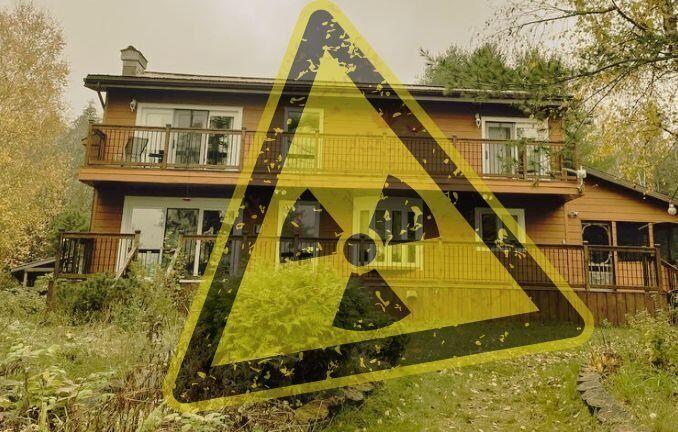
Many residents might not be aware they are living atop radioactive infill, which came from nearby, closed-down uranium mines that helped develop atomic bombs during the Cold War.Toronto Star
The number of homes in Elliot Lake affected by buried radioactive waste could top 100 — twice as many as previously thought.
By Declan Keogh and Masih Khalatbari, Investigative Journalism Bureau, Thursday, March 21, 2024 https://www.thestar.com/news/investigations/canadian-officials-found-radiation-levels-in-these-northern-ontario-homes-well-above-the-safe-limit/article_6b68ad20-e605-11ee-9a2a-f72182db65b6.html
In January 2021, a senior official with Canada’s nuclear regulator asked a colleague to do a rough, “back-of-the-envelope” calculation on the amount of potentially deadly radiation that residents in Elliot Lake were exposed to in their homes.
The government had just received a complaint that long-forgotten radioactive mine waste was buried underneath some homes in the northern Ontario city. Ron Stenson, senior project officer at the Canadian Nuclear Safety Commission (CNSC), wanted to “confirm our assumption that 468 Bq/m3 is not an urgent health concern.”
He did not get the answer he wanted. A senior official with the commission’s radiation protection division replied that those levels of radon are “well above” the public radiation dose limit set by federal authorities.
Stenson’s response came 90 minutes later: “¯\_(ツ)_/¯.”
For too long, shrugging is all the Canadian government has done, as far as local homeowner Lisa Speck is concerned.
The government official’s email is “a true visual representation of the response we’ve received to date,” she says. “It accurately summarizes the respect we’ve been shown.”
Documents show 100+ homes affected
Documents obtained by the Investigative Journalism Bureau show the number of homes affected by buried radioactive waste could top 100 — twice as many as previously thought. Many of the residents might not be aware they are living atop radioactive infill, which came from nearby, closed-down uranium mines that helped develop atomic bombs during the Cold War.
And when faced with calls for action, civil servants make jokes.
Speck, part of a group of Elliot Lake homeowners fighting to get the radioactive mining waste removed from their properties, called the email exchange “disgusting” and “dismissive.”
Despite having spent billions of dollars to clean up similar radioactive waste in Port Hope, federal regulators deny they have any obligation to do the same in Elliot Lake, saying the waste buried beneath the properties is the homeowners’ responsibility.
CNSC declined an interview request. In a statement, the agency said it could not answer detailed questions from the IJB because of ongoing litigation, adding that it’s “dedicated to upholding the highest standards of safety in our work.” Stenson did no respond to a request for comment.
Lawyers representing impacted Elliot Lake homeowners filed an application to Federal Court for a judicial review last July in the hopes of forcing the reversal of the federal government’s position.
The government filed their response in federal court on March 4, reiterating the waste is outside their jurisdiction and stating that the Nuclear Safety and Control Act, which governs the CNSC, does not compel them to act upon demands from the homeowners.
It argues federal legislation does not give the public the right “to file complaints, request inspections, or demand orders be issued as against regulated entities.”
A screen grab from a January 2021 email sent by a senior project officer at the Canadian Nuclear Safety Commission (CNSC), after being told the levels of radon recorded at homes in Elliot Lake are “well above” the safe limits. Toronto Star illustration
Lawyers representing impacted Elliot Lake homeowners filed an application to Federal Court for a judicial review last July in the hopes of forcing the reversal of the federal government’s position.
The government filed their response in federal court on March 4, reiterating the waste is outside their jurisdiction and stating that the Nuclear Safety and Control Act, which governs the CNSC, does not compel them to act upon demands from the homeowners.
It argues federal legislation does not give the public the right “to file complaints, request inspections, or demand orders be issued as against regulated entities.”
Lawyers representing impacted Elliot Lake homeowners filed an application to Federal Court for a judicial review last July in the hopes of forcing the reversal of the federal government’s position.
The government filed their response in federal court on March 4, reiterating the waste is outside their jurisdiction and stating that the Nuclear Safety and Control Act, which governs the CNSC, does not compel them to act upon demands from the homeowners.
It argues federal legislation does not give the public the right “to file complaints, request inspections, or demand orders be issued as against regulated entities.”
At the crux of the federal government’s refusal to accept responsibility is a technicality: It says that it isn’t responsible for the regulation of naturally-occurring radioactive materials, only those that have been processed in some way. It says that the uranium rock dug up during mining “was never chemically processed” before being trucked to nearby Elliot Lake for use as backfill during the construction of homes. That, the government says, means it’s technically “not considered radioactive waste.”
‘Public perception of a coverup’
The government didn’t always view the radiation blight in Elliot Lake as someone else’s problem, internal documents suggest.
By the 1980s, the government had assumed some role alongside the mining companies that built most of the houses.
The Atomic Energy Control Board (AECB) — the predecessor of the CNSC — took responsibility for “about 1,900 private properties and public areas,” according to a 1998 internal report summarizing the ongoing radiation problems in Elliot Lake.
Despite discovering “contaminated materials in structures” as well as “excessive gamma radiation due to the presence of mine waste on private properties,” there had been “minimal effort” to remove the waste, the summary report noted.
Fans and venting had been previously installed in homes to funnel the dangerous gas outside. However, it was likely these remediation efforts had failed, the report stated, possibly because residents didn’t know how to maintain the systems — or that they even existed.
“There is no evidence to suggest that owners were made aware of corrections made, or that they must assume responsibility for maintenance,” the report states.
All of this, the report concluded, created a “public perception of a coverup.”
“The only way to remove the mine waste issue from public perception is to remove the contamination.”
Supplied
As of 1998, it was estimated up to 120 properties were potentially affected by radioactive contamination and, as a result, “increased radiation exposure is likely as is renewed public concern.”
The report also called for a citywide effort to test properties, monitor and remediate excess levels of radiation and clean up the “man-introduced contamination” once and for all. It’s unclear whether those calls were heeded.
At the time, it was assumed that cleanup efforts would be shared between the federal government and the mining companies, with the companies offering financial assistance to remediate the properties they once owned.
Billions spent on remediation in other Ontario communities
In 2001, the federal government signed a deal with the municipalities of Port Hope and Clarington to collect, transport and permanently store as much as 2 million cubic metres of low-level radioactive waste that had been distributed by a government-owned radium and uranium refinery between the 1930s and the 1980s.
The $2.6 billion remediation project, which involves digging up and removing soil around affected houses, the construction of permanent storage facilities and monitoring of radiation levels, is slated to be completed by the end of this year.
Despite the parallels to Elliot Lake, the federal government has said it is not responsible for the cleanup in the northern community because the radioactive contamination came from a private company, not a crown corporation.
In June 2023, lawyers for the residents sent a host of politicians including Prime Minister Justin Trudeau and executives of CNSC more than 3,000 pages of evidence and documentation. They called on the government and mining companies to remove the uranium waste in Elliot Lake.
Upon receiving the demands, Patrick Burton, director of CNSC’s uranium mines and mills division, asked two of his colleagues in radiation protection about the claims that residents were getting excess doses of radiation. He also told them to “buy a shovel and get a [travel authorization] for Elliot Lake,” adding a winking face emoji.
“Is that going to get a response?” replied one of his colleagues with a smiling face emoji.
When reached by the IJB, Burton directed questions about the email to CSNC. The agency did not offer further comment. When questioned by lawyers representing the Elliot Lake homeowners, Burton said it was supposed to be a joke among colleagues.
“The intention was never … for the homeowners to become aware of this exchange,” Burton said during his deposition.
Homeowner Speck says the joke was “rude” but says she would welcome the government’s shovels to clean up the uranium on her property.
“The statement sort of lends to the fact that he thinks it’s a small job. If it’s such a small job that he’s just going to go to buy a shovel and fix it … then just do that,” Speck says.
“Everyone in the community would expect better from a government official than to be joking about a matter that could potentially affect … or maybe has affected, a population of people.”
With files from the Toronto Star’s Marco Chown Oved. The Investigative Journalism Bureau is a non-profit newsroom based at the University of Toronto’s Dalla Lana School of Public Health.
Disadvantaged Canadian towns look at the $billions promised by nuclear waste hosting
Offended tribal elders formed the Committee for Future Generations and initiated what they called the 7,000 Generations Walk Against Nuclear Waste, which saw participants trudge nearly 1,000 kilometres from Pinehouse to the legislature in Regina.
No local DGR debate has been harder fought than the 30-month marathon of psychological and ground warfare that unfolded in Saugeen Shores, one of several contestant municipalities in Bruce County, between 2011 and 2014.
Inside the race for Canada’s nuclear waste: 11 towns vie to host deep burial site Canada’s nuclear waste will be deadly for 400,000 years. What town would like the honour of hosting it?CHARLES WILKINS TheGlobe and Mail Feb. 26 2015,
“……..There are 11 rural and wilderness municipalities vying for the DGR, survivors of an original roster of 22. The aspirants include veteran northern encampments such as Hornepayne, Ontario, where, as Brennain Lloyd of the environmental education group Northwatch describes it, there is “a really fierce desire” on the part of at least a few municipal administrators to “bring the nuke dump to town.”
And Schreiber, a struggling railway town on the north shore of Lake Superior. And Ignace, another struggler, in the boreal wilds to the west. And, to the east, Manitouwadge.
And Creighton, Saskatchewan, directly across the Manitoba border from Flin Flon (Creighton is a town described by a former resident as “having had its fiscal balls to the wall for half a century”).
And Blind River, Ontario, on the north shore of Lake Huron, where survival has for years depended on the uncertain flow of traffic along the Trans-Canada Highway.
And Elliot Lake, some 50 kilometres north of Lake Huron, where uranium mining was the sustaining industry during the 1950s and ’60s but which these days survives on the pensions of retirees who moved to the town to take advantage of discount housing left over from the boom years.
“What makes it all so attractive to competing municipalities is, of course, the money,” says Tony McQuail.
While billions of dollars will flow directly through the chosen town over a period of four or five decades, Lloyd suggests that most of the money is likely to end up in the pockets of big-city consultants and other outside beneficiaries.
Mainly, the price tag will buy decades’ worth of infrastructure and construction costs, as well as maintenance, monitoring and employment training. It will also pay for the transportation of the waste to the spanking new DGR, which will, by the time it opens, have been a reality for its “willing host” for a quarter of a century or more.
Finishing just the first phase of the preliminary assessment brings $400,000 of NWMO money to candidate towns, so they can “build sustainability and well-being.” It has been speculated that some towns had no intention of staying in the process beyond the early payout.
While some towns applied to participate of their own volition, others were, according to Lloyd of Northwatch, courted by the NWMO. “What bothers me most about the process,” says Lloyd, “is the ‘siloing’ that the NWMO practises on the municipal politicians they choose to target.
“They approach them not in the context of their communities, where the politicians are immediately answerable to their constituencies, but at municipal conferences and conventions where they’re away from home, isolated, perhaps a little unsure of themselves. They wine and dine them and soft-talk them about the unimaginable benefits that could accrue to their towns should they consider hosting the DGR.
“Then they fly them to Toronto and put them up in the best hotels and take them up to the Bruce Power site, or other nuclear generating stations, and show them what of course appears to be secure and flawless waste storage. The politicians are just snowed—they’re made to feel like important players. They take this dream of hope and prosperity and safe science back to their communities and in effect go to work for the NWMO.”
Other northern councils—at Ear Falls, at Nipigon, at Wawa—have been more divided over the DGR and so were eliminated early, or withdrew, from the process. Similarly, Brockton, near the site of Bruce Power, was cut late in 2014 after its residents elected a largely anti-DGR council. (The NWMO says Brockton’s assessment simply didn’t pan out.)
The aboriginal communities of Pinehouse and English River, Saskatchewan, were dropped from the process when community debate over land and water issues, as well as a growing distrust of the NWMO, became irresolvable.
While Pinehouse was still in the running, three community leaders, including a cousin of the mayor, received money from the NWMO. Offended tribal elders formed the Committee for Future Generations and initiated what they called the 7,000 Generations Walk Against Nuclear Waste, which saw participants trudge nearly 1,000 kilometres from Pinehouse to the legislature in Regina.
No local DGR debate has been harder fought than the 30-month marathon of psychological and ground warfare that unfolded in Saugeen Shores, one of several contestant municipalities in Bruce County, between 2011 and 2014………..http://www.theglobeandmail.com/report-on-business/rob-magazine/inside-the-race-for-canadas-nuclear-waste/article23178848/
Nuclear expert Mycle Schneider on the COP28 pledge to triple nuclear energy production: ‘Trumpism enters energy policy’.

The entire logic that has been built up for small modular reactors is with the background of climate change emergency. That’s the big problem we have………………… Climate change emergency contains the notion of urgency. And so we are talking about something where the time factor needs to kick in………………….. And if we are talking about SMRs picking up any kind of substantial amounts of generating capacity in the current market, if ever, we’re talking about the 2040s at the very earliest.
Now, we’re talking of tens of $billions that are going into subsidizing nuclear energy, especially as I said existing nuclear power plants.
The pledge was worded as a commitment “to work together to advance a global aspirational goal of tripling nuclear energy capacity from 2020 by 2050″………… “This pledge is completely, utterly unrealistic.”…………………….“It’s like Trumpism enters energy policy.”
The Bulletin, By François Diaz-Maurin | December 18, 2023
Last week, a group of independent energy consultants and analysts released the much-anticipated 2023 edition of the World Nuclear Industry Status Report 2023 (WNISR). In over 500 pages, the report provides a detailed assessment of the status and trends of the international nuclear industry, covering more than 40 countries. Now in its 18th edition, the report is known for its fact-based approach providing details on operation, construction, and decommissioning of the world’s nuclear reactors. Although it regularly points out failings of the nuclear industry, it has become a landmark study, widely read within the industry. Its release last week was covered by major energy and business news media, including Reuters (twice) and Bloomberg.
On December 2, the United States and 21 other countries pledged to triple the global nuclear energy capacity by 2050. The declaration, made during the UN climate summit of the 28th Conference of the Parties (COP28) in Dubai, United Arab Emirates, sought to recognize “the key role of nuclear energy in achieving global net-zero greenhouse gas emissions-carbon neutrality by or around mid-century and in keeping a 1.5-degree Celsius limit on temperature rise within reach.” The pledge was worded as a commitment “to work together to advance a global aspirational goal of tripling nuclear energy capacity from 2020 by 2050.” It was aspirational—and ambitious.
To discuss this pledge against the nuclear industry’s current trends and status, I sat down with Mycle Schneider, lead author of the World Nuclear Industry Status Report.
………… Diaz-Maurin: It’s undoubtedly a landmark report. With over 500 pages, it’s also massive. In a nutshell, what should our readers know about the main developments in the world nuclear industry over the past year?
Schneider: It really depends on from which angle you approach the issue. I think, overall, the mind-boggling fact is that the statistical outcome of this analysis is dramatically different from the perception that you can get when you open the newspapers or any kind of media reporting on nuclear power. Everybody gets the impression that this is kind of a blooming industry and people get the idea that there are nuclear power plants popping up all over the world.
But what we’ve seen is that some of the key indicators are showing a dramatic decline. In fact, the share of nuclear power in the world commercial electricity mix has been dropping by almost half since the middle of the 1990s. And the drop in 2022 was by 0.6 percentage points, which is the largest drop in a decade, since the post-Fukushima year 2012.
We have seen a four percent drop in electricity generation by nuclear power in 2022, which, if you take into account that China increased by three percent and if you look at the world, means that the drop was five percent outside China. So it’s significantly different from the perception you can get, and we can dig into some of the additional indicators. For example, constructions [of new reactors] give you an idea what the trends are and what the dynamic is in the industry. And so, when you look at constructions you realize that, since the construction start of Hinkley Point C in the United Kingdom in late 2019 until the middle of 2023, there were 28 construction starts of nuclear reactors in the world. Of these, 17 were in China and all 11 others were carried out by the Russian nuclear industry in various countries. There was no other construction start worldwide.
………………………………………………………………………………..The point is that we have had actually an increasing capacity that generates less. And, for obvious reasons, the most dramatic drop was in France. The French reactor performance has been in decline since 2015. That is, to me, one of the really remarkable outcomes in recent years. If you compare the year 2010 to 2022, in France, the drop [in electricity generated] was 129 terawatt hours. What happened is basically that, from 2015 onward, the trend line was toward a reducing electricity generation due to an accumulation of events, which are important to understand.
It’s not so much the stress corrosion cracking [in reactor vessels] that everybody has been talking about or another technical phenomenon that hit the French nuclear power plants worst, although it’s true it had a significant impact and was totally unexpected. So, it’s not an aging effect, although you do have aging effects on top of it because a lot of reactors are reaching 40 years and need to pass inspections and require refurbishment, etc. But you had climate effects in France too. And strikes also hit nuclear power plants. You don’t have that in other countries. So, it’s the accumulation of effects that explain the decline in electricity generation. This unplanned and chaotic drop in nuclear power generation in France compares with the loss of nuclear generation in Germany of 106 terawatt hours between 2010 and 2022, but in this case due to a planned and coordinated nuclear phaseout.
Diaz-Maurin: That is an interesting way to look at the data. What is the biggest risk of keeping existing reactors operating up to 80 years, as some suggest, or even more?
Schneider: Well, nobody knows. This has never been done. It’s like: “What’s the risk of keeping a car on the street for 50 years?” I don’t know. It’s not the way you do things, usually. First, I should say that we’re not looking at risk in that Status Report. This is not the subject of the report. But the lifetime extension of reactors raises the questions of nuclear safety—and security, which has always been a topic for the Bulletin.
If you have a reactor that has been designed in the 1970s, at the time nobody was talking or even thinking about drones or hacking, for example. People think of drones in general as a means to attack a nuclear power plant by X Y, Z. But in fact, what we’ve seen in the past are numerous drone flights over nuclear facilities. And so, there is the danger of sucking up information during those overflights. This raises security risks in another way. So, this idea of modernizing nuclear facilities continuously is obviously only possible to some degree. You can replace everything in a car, except for the body of the car. At some point, it’s not the same facility anymore. But you can’t do that with a nuclear power plant.
Diaz-Maurin: Talking about old facilities, Holtec International—the US-based company that specializes in nuclear waste management—say they want to restart the shutdown Palisades generating station in Michigan. Is it good news?
Schneider: To my knowledge, the only time that a closed nuclear power plant has been restarted was in Armenia, after the two units had been closed [in 1989] after a massive earthquake. We don’t have precise knowledge of the conditions of that restart, so I’m not so sure that this would be a good reference case. One has to understand that when a nuclear reactor is closed, it’s for some reason. It is not closed because [the utility] doesn’t like to do this anymore. In general, the most prominent reason [for closing reactors] over the past few years was poor economics.
This is, by the way, one of the key issues we’ve been looking at in the 2023 report: These entirely new massive subsidy programs in the US in particular didn’t exist [a year ago]. There were some limited programs on state level. Now these state support programs have been increased significantly and they are coupled in with federal programs, because the reactors are not competitive. So we’re talking really about a mechanism to keep these reactors online. That Palisades would restart is unique, in Western countries at least. For a plant that has been set to be decommissioned to restart, this has never been done. And, by the way, Holtec is not a nuclear operator. It is a firm that has specialized in nuclear decommissioning.
Now, that companies like Holtec can actually buy closed nuclear power plants and access their decommissioning funds with the promise to dismantle faster than would have been done otherwise, this is an entirely recent approach with absolutely no guarantee that it works. Under this scheme, there is no precedent where this has been done from A to Z. And obviously, there is the risk of financial default. For instance, it is unclear what happens if Holtec exhausts the funds before the decommissioning work is complete. Holtec’s level of liability is unclear to me prior to the taxpayer picking up the bill.
Diaz-Maurin: At Palisades, Holtec’s plan is to build two small modular reactors.
Schneider: Holtec is not a company that has any experience in operating—even less constructing—a nuclear power plant. So having no experience is not a good sign to begin with. Now, when it comes to SMRs—I call them “small miraculous reactors”—they are not existing in the Western world. One must be very clear about that. There are, worldwide, four [SMR] units that are in operation: two in China and two in Russia. And the actual construction history [for these reactors] is exactly the opposite to what was promised. The idea of small modular reactors was essentially to say: “We can build those fast. They are easy to build. They are cheap. It’s a modular production. They will be basically built in a factory and then assembled on site like Lego bricks.” That was the promise.
For the Russian project, the plant was planned for 3.7 years of construction. The reality was 12.7 years. In China, it took 10 years instead of five. And it’s not even only about delays. If you look at the load factors that were published by the Russian industry on the Power Reactor Information System (PRIS) of the IAEA, these SMRs have ridiculously low load factors, and we don’t understand the reasons why they don’t produce much. We know nothing about the Chinese operational record.
Diaz-Maurin: Last month, NuScale, the US-based company that develops America’s flagship SMR, lost its only customer, the Utah Associated Municipal Power System, a conglomerate of municipalities and utilities. This happened allegedly after a financial advisory firm reported on NuScale’s problems of financial viability. Have you followed this demise?
Schneider: Yes, of course. What happened there is that NuScale had promised in 2008 that it would start generating power by 2015. We are now in 2023 and they haven’t started construction of a single reactor. They have not even actually a certification license for the model that they’ve been promoting in the Utah municipal conglomerate. That’s because they have increased [the capacity of each module] from originally 40 megawatts to 77 megawatts.
Diaz-Maurin: Why is that? Is it a matter of economy of scale?
Schneider: Yes, of course. You need to build many modules if you want to get into economies of scale by number, if you don’t get into it by size. This is actually the entire history of nuclear power. So NuScale sought to increase the unit size in Utah. But then the deal with the municipalities collapsed after the new cost assessment in early 2023 showed that the six-module facility NuScale had planned would cost $9.3 billion, a huge increase over earlier estimates. It’s about $20,000 per kilowatt installed—almost twice as expensive as the most expensive [large-scale] EPR reactors in Europe.
Diaz-Maurin: Is it the same with the waste generated? Some analysts looking at the waste streams of SMRs conclude that smaller reactors will produce more radioactive materials per unit of kilowatt hour generated compared to larger reactors.
Schneider: That’s the MacFarlane and colleagues’ paper, which is pretty logical if you think about it. If you have a small quantity of nuclear material that irradiates other materials, then it’s proportionally more per installed megawatt than for a large reactor in which there is a larger core.
,………………Schneider: many technologies have been supported under the Inflation Reduction Act and many others will continue to receive significant support. But the problem here is different. The entire logic that has been built up for small modular reactors is with the background of climate change emergency. That’s the big problem we have.
Diaz-Maurin: Can you explain this?
Schneider: Climate change emergency contains the notion of urgency. And so we are talking about something where the time factor needs to kick in. If we look at how other reactor technologies have been introduced, a lot of them were supported by government funding, like the EPR in Europe or Westinghouse’s AP-1000 in the United States. Comparatively, the current status of SMR development—whether it’s NuScale, which is the most advanced, or others—corresponds to that of the middle of the 1990s [of the large light-water reactors]. The first EPR started electricity generation in 2022 and commercial operation only in 2023. And it’s the same with the AP-1000. By the way, both reactor types are not operating smoothly; they are still having some issues. So, considering the status of development, we’re not going to see any SMR generating power before the 2030s. It’s very clear: none. And if we are talking about SMRs picking up any kind of substantial amounts of generating capacity in the current market, if ever, we’re talking about the 2040s at the very earliest.
Diaz-Maurin: And that’s exactly where I want to turn the discussion now: nuclear and climate. At the COP28 last week in Dubai, 22 countries pledged to triple the global nuclear energy capacity of 2020 by 2050. What do these countries have in common when it comes to nuclear energy? In other words, why these 22 countries and not others?
Schneider: Most of them are countries that are already operating nuclear power plants and have their own interest in trying to drag money support, most of which by the way would go into their current fleets. Take EDF [France’s state-owned utility company], for example. Through the French government, EDF is lobbying like mad to get support from the European Union—European taxpayers’ money—for its current fleet. It’s not even for new construction, because the French know that they won’t do much until 2040 anyway. There is also another aspect that is related and that illustrates how this pledge is completely, utterly unrealistic.
The pledge to triple nuclear energy capacity is not to be discussed first in terms of pros or cons, but from the point of view of feasibility. And from this point of view, just looking at the numbers, it’s impossible. We are talking about a target date of 2050, which is 27 years from now. In terms of nuclear development, that’s tomorrow morning. If we look at what happened in the industry over the past 20 years since 2003, there have been 103 new nuclear reactors starting operation. But there have been also 110 that closed operation up until mid 2023. Overall, it’s a slightly negative balance. It’s not even positive. Now if you consider the fact that 50 of those new reactors that were connected to the grid were in China alone and that China closed none, the world outside China experienced a negative balance of 57 reactors over the past 20 years.
………………………………………….Now, if we look forward 27 years, if all the reactors that have lifetime extension licenses (or have other schemes that define longer operation) were to operate until the end of their license, 270 reactors will still be closed by 2050. This is very unlikely anyway because, empirically, reactors close much earlier: The average closing age over the past five years is approximately 43 years, and hardly any reactor reached the end of its license period. But even if they did, it would be 270 reactors closed in 27 years.
You don’t have to do math studies to know that it’s 10 per year. At some point it’s over. Just to replace those closing reactors, you’d have to start building, operating, grid connecting 10 reactors per year, starting next year. In the past two decades, the construction rate has been of five per year on average. So, you would need to double that construction rate only to maintain the status quo. Now, tripling again that rate, excuse me, there is just no sign there. I am not forecasting the future, but what the industry has been demonstrating yesterday and what is it is demonstrating today shows that it’s simply impossible, from an industrial point of view, to put this pledge into reality. To me, this pledge is very close to absurd, compared to what the industry has shown.
Diaz-Maurin: Based on your report, just to replace the closures, the nuclear industry would need to build and start operating one new reactor of an average size of 700-megawatt per month. And tripling the global capacity would require an additional 2.5 new reactors per month.
Schneider: Exactly; it’s a little less if you talk in terms of capacity. The capacity to be replaced by 2050 of those 270 units would be 230 gigawatts. Now, if small modular reactors were to be a significant contributor to this pledge, hundreds or even thousands of these things would need to be built to come anywhere near that objective. It’s impossible. We should come back to reality and discuss what’s actually feasible. Only then can we discuss what would be the pros and cons of a pledge.
But there was another pledge at the COP28, which is to triple the output of renewable energies by 2030. That’s seven years from now. To me, this pledge on renewable energy, if implemented, is the final nail in the coffin of the pledge on nuclear energy. It is very ambitious. Don’t underestimate that. Tripling renewables in seven years is phenomenally ambitious.
Diaz-Maurin: Is it feasible?
Schneider: Very difficult to say. But one important thing is that it’s not 22 countries. It’s over 100 countries that have already pledged their commitment to this objective. Also, a key player—if not the key player—is China. An important finding of our Status Report is that China generated for the first time in 2022 more power with solar energy than with nuclear energy. And this happened despite China being the only country to have been building [nuclear capacity] massively over the past 20 years. But still, the country is now generating more power with solar than with nuclear. The good news for the [renewable] pledge is that China is more or less on track with that tripling target. The rest of the world would have to speed up on renewables in a dramatic way to achieve this pledge. But at least China’s example shows that it’s feasible. That’s the interesting part. Because, on the contrary, there is no country—not even China—demonstrating that the nuclear pledge is possible.
Diaz-Maurin: If it’s not feasible, does the nuclear pledge impede other climate actions that are urgently needed then?
Schneider: That’s a good question. I think it’s a terrible signal, indeed. It’s like Trumpism enters energy policy: It’s a pledge that has nothing to do with reality, and it doesn’t matter. It is giving you the impression that it is feasible, that it is possible. And all that completely dilutes the attention and capital that are urgently needed to put schemes into place that work. And it doesn’t start with renewables, that’s very important to stress. It starts with sufficiency, efficiency, storage, and demand response. Only later comes renewable energy.
But these options are all on the table. They’re all demonstrated to be economic and competitive. That’s not the case with nuclear energy. It’s a pledge that has no realistic foundation that is taking away significant funding and focus. It used to be negligible funding. Up until a few years back, we were talking at most tens of millions of dollars. Now, we’re talking of tens of billions that are going into subsidizing nuclear energy, especially as I said existing nuclear power plants………………………………………………………………………………………………………………………………..
Schneider: What really has motivated most of my work over the past decades is that I can’t stand what you would call today “fake news.” All my work since the 1980s has been actually driven by the attempt to increase the level of information in—and having some kind of impact on—the decision-making process. To offer a service to civil society so it can take decisions based on facts, not beliefs. When I see what happens in terms of misinformation around nuclear power, it’s scary.
I think, today, the Status Report is probably more important than ever. Because there’s such an unbelievable amount of hype out there. It’s almost becoming an issue for psychologists. It has less and less to do with rationality because the numbers are clear. They are utterly clear: The cost figures are clear; the development is clear; the trend analysis is clear. So it is clear, but it doesn’t matter. It’s like the claim of stolen elections of Trump supporters. All court cases have shown that this was not the case. But, for half of the US population, it doesn’t matter. And I find this absolutely scary. When it comes to issues like nuclear power, it’s fundamental that decisions are made on the basis of facts.
Diaz-Maurin: Why is that?
Schneider: Because the stakes are incredibly high. First because of the capital involved. Researchers studying corruption cases know that the size of large projects’ contracts is a key driver for corruption. And the nuclear industry has been struggling with all kinds of mechanisms that are fraud yields. Financial corruption is only one issue.
Another is falsification. For a long time, we thought Japan Steel Works [JSW] was the absolute exemplary industry. Japanese factories used to build high quality and highly reliable key forged parts for nuclear power plants. It turns out, they have been falsifying quality-control documentation in hundreds of cases for decades. Corruption and falsification are two of the issues affecting the nuclear industry.
And, of course, the Bulletin has had a long focus on military issues related to nuclear energy. When we are talking about issues like SMRs, the key issue is not whether they are going to be safer or not, because there are not going to be many around anyway. So, safety is not the primary issue. But once you start signing cooperation agreements, it opens the valves to the proliferation of nuclear knowledge. And that is a big problem, because this knowledge can always be used in two ways: One is military for nuclear explosives, and the other is civilian for nuclear electricity and medical applications. Opening these valves on the basis of hype or false promise is a disaster. And the ones most actively opening these valves are the Russians. They are educating thousands of people from all around the world in nuclear materials and nuclear technology. In the United States, part of the thinking appears to say: “Oh, for God’s sake, better we train these people.” https://thebulletin.org/2023/12/nuclear-expert-mycle-schneider-on-the-cop28-pledge-to-triple-nuclear-energy-production-trumpism-enters-energy-policy/?utm_source=Newsletter&utm_medium=Email&utm_campaign=MondayNewsletter12182023&utm_content=NuclearRisk_TripleNuclear_11182023
Nuclear power: molten salt reactors and sodium-cooled fast reactors make the radioactive waste problem WORSE
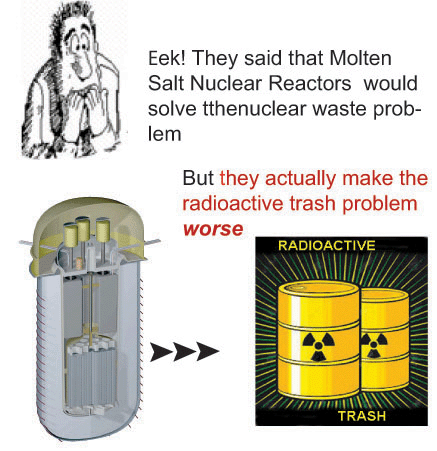
 reactors https://www.tandfonline.com/doi/full/10.1080/00963402.2018.1507791, Lindsay Krall &Allison Macfarlane, 31 Aug 18
ABSTRACT
Nuclear energy-producing nations are almost universally experiencing delays in the commissioning of the geologic repositories needed for the long-term isolation of spent fuel and other high-level wastes from the human environment. Despite these problems, expert panels have repeatedly determined that geologic disposal is necessary, regardless of whether advanced reactors to support a “closed” nuclear fuel cycle become available. Still, advanced reactor developers are receiving substantial funding on the pretense that extraordinary waste management benefits can be reaped through adoption of these technologies.
Here, the authors describe why molten salt reactors and sodium-cooled fast reactors – due to the unusual chemical compositions of their fuels – will actually exacerbate spent fuel storage and disposal issues. Before these reactors are licensed, policymakers must determine the implications of metal- and salt-based fuels vis a vis the Nuclear Waste Policy Act and the Continued Storage Rule.
50/50 chance of a major nuclear accident within the next 10 years
The Chances of Another Chernobyl Before 2050? 50%, Say Safety Specialists
And there’s a 50:50 chance of a Three Mile Island-scale disaster in the next 10 years, according to the largest statistical analysis of nuclear accidents ever undertaken. MIT Technology Review April 17, 2015 Given that most countries with nuclear power intend to keep their reactors running and that many new reactors are planned, an important goal is to better understand the nature of risk in the nuclear industry. What, for example, is the likelihood of another Chernobyl in the next few years?
Today, we get an answer thanks to the work of Spencer Wheatley and Didier Sornette at ETH Zurich in Switzerland and Benjamin Sovacool at Aarhus University in Denmark. These guys have compiled the most comprehensive list of nuclear accidents ever created and used it to calculate the likelihood of other accidents in future.
Their worrying conclusion is that the chances are 50:50 that a major nuclear disaster will occur somewhere in the world before 2050. “There is a 50 per cent chance that a Chernobyl event (or larger) occurs in the next 27 years,” they conclude.
1 This Month


Petition to revoke the licensing of the Near Surface Nuclear Disposal Facility (NSDF) at Chalk River. https://www.ourcommons.ca/petitions/en/Petition/Details?Petition=e-7247


of the week – STOP SMALL MODULAR REACTORS IN CANADA
To see nuclear-related stories in greater depth and intensity – go to https://nuclearinformation.wordpress.com
-
Archives
- March 2026 (163)
- February 2026 (268)
- January 2026 (308)
- December 2025 (358)
- November 2025 (359)
- October 2025 (376)
- September 2025 (258)
- August 2025 (319)
- July 2025 (230)
- June 2025 (348)
- May 2025 (261)
- April 2025 (305)
-
Categories
- 1
- 1 NUCLEAR ISSUES
- business and costs
- climate change
- culture and arts
- ENERGY
- environment
- health
- history
- indigenous issues
- Legal
- marketing of nuclear
- media
- opposition to nuclear
- PERSONAL STORIES
- politics
- politics international
- Religion and ethics
- safety
- secrets,lies and civil liberties
- spinbuster
- technology
- Uranium
- wastes
- weapons and war
- Women
- 2 WORLD
- ACTION
- AFRICA
- Atrocities
- AUSTRALIA
- Christina's notes
- Christina's themes
- culture and arts
- Events
- Fuk 2022
- Fuk 2023
- Fukushima 2017
- Fukushima 2018
- fukushima 2019
- Fukushima 2020
- Fukushima 2021
- general
- global warming
- Humour (God we need it)
- Nuclear
- RARE EARTHS
- Reference
- resources – print
- Resources -audiovicual
- Weekly Newsletter
- World
- World Nuclear
- YouTube
-
RSS
Entries RSS
Comments RSS
 nuclear-news