How do you convince someone to live next to a nuclear waste site?

The nation’s 85 interim storage sites hold more than 86,000 tons of waste, a situation that’s akin to leaving your trash behind the garage indefinitely. The situation could grow more dire as the nation invests in advanced small modular reactors.
Everybody talks about the shiny new reactors, but nobody ever talks about back-end management of the fuel that comes out of them.”
The world’s first permanent depository for nuclear fuel waste opens later this year on Olkiluoto, a sparsely populated and lushly forested island in the Baltic Sea three hours north of Helsinki.
Austyn Gaffney Jun 27, 2024, https://grist.org/energy/how-do-you-convince-someone-to-live-next-to-a-nuclear-waste-site/
Onkalo — the name means “cavity” or “cave” in Finnish — is among the most advanced facilities of its kind, designed for an unprecedented and urgent task: safely storing some of the most toxic material on Earth nearly 1,500 feet underground in what’s called a deep mined geologic repository.
The process requires remarkable feats of engineering. It begins in an encapsulation plant, where robots remove spent nuclear fuel rods from storage canisters and place them in copper and cast iron casks up to two stories tall. Once full, these hefty vessels, weighing around 24 metric tons, will descend more than a quarter-mile in an elevator to a cavern hollowed out of crystalline bedrock 2 billion years old. (The trip takes 50 minutes.) Each tomb will hold 30 to 40 of these enormous containers ensconced in bentonite clay and sealed behind concrete. As many as 3,250 canisters containing 6,500 metric tons of humanity’s most dangerous refuse will, the theory goes, lie undisturbed for hundreds of thousands of years.
Nothing assembled by human hands has stood for more than a fraction of that. The world’s oldest known structure, Gobekli Tepe in Turkey, is a bit more than 11,000 years old. Designing Onkalo to endure for so unfathomably long is necessary because the material left behind by nuclear fission remains radioactive for millennia. Safely disposing of it requires stashing it for, essentially, eternity. That way nothing — be it natural disasters, future ice ages, or even the end of humanity itself — would expose anyone, or anything, to its dangers.
The plan is that there will be no sign [of the facility],” said Pasi Tuohimaa, communications manager for Posiva, the agency that manages Finland’s nuclear waste. “Nobody would even know it’s there, whether we’re talking about future generations or future aliens or whatever.”
Building such a place, as technologically complex as it is, might be easier than convincing a community to host it. Gaining that approval can take decades and rests upon a simple premise.
“One of the principles of geologic disposal is the idea that the generations that enjoy the benefits of nuclear power should also pay for and participate in the solution,” said Rodney Ewing, a mineralogist and materials scientist at Stanford University and co-director of the university’s Center for International Security and Cooperation.
The long process of gaining such support is called consent-based siting, an undertaking many in the nuclear energy sector consider vital as the world abandons fossil fuels. Nuclear power accounts for almost a fifth of the United States’ electricity generation, and its expansion is among the few elements of the Biden administration’s energy agenda that enjoys strong bipartisan support. Over the last year, Energy Secretary Jennifer Granholm has touted the nation’s newest reactor, celebrated plans for an experimental small modular reactor, and unveiled a $1.5 billion loan to restart a defunct plant in Michigan.
These are hardly one-offs. The U.S. intends to triple its nuclear energy capacity by 2050. Yet experts say there isn’t enough public discussion of how to deal with the corresponding increase in radioactive trash, which will compound a problem the country has deferred since the start of the nuclear age. After botching plans for a deep mined geological repository a generation ago, the United States is scrambling to catch up to Finland and several other nations, including Canada, which could choose a site by year’s end.
As the U.S. races toward a post-carbon future in which nuclear energy could play a key role, policymakers, energy experts, and community leaders say dealing with the inevitable waste isn’t a technical problem, but a social one. Engineers know how to build a repository capable of safeguarding the public for millennia. The bigger challenge is convincing people that it’s safe to live next to it.
The United States knew, even before the world’s first commercial nuclear power plant began operating in Pennsylvania in 1957, how best to dispose of the effluvium generated by splitting atoms to generate electricity. Earlier that year, geologists and geophysicists wrote a National Academy of Sciences report that proposed burying it. Opinions haven’t changed much in the 67 years since.
“The only viable way to possibly deal with the issue of isolating radioactive waste that can remain hazardous for hundreds of thousands of years from the environment is a deep geologic repository,” said Edwin Lyman, director of nuclear power safety at the Union of Concerned Scientists. “There’s really no alternative.”
Yet this refuse, most of it from the nation’s 54 commercial reactors, remains in what amounts to cold storage. Depleted fuel rods are kept on-site in water tanks for about half a decade, then moved to steel and concrete canisters called dry casks and held for another 40 years in what’s known as interim storage. Only then is the material cool enough to stash underground. That last step has never happened, however. The nation’s 85 interim storage sites hold more than 86,000 tons of waste, a situation that’s akin to leaving your trash behind the garage indefinitely. The situation could grow more dire as the nation invests in advanced small modular reactors.
“It’s a pet peeve of mine, to be honest,” said Paul Murray, who became the Department of Energy’s deputy assistant secretary for spent fuel and waste disposition in October. “Everybody talks about the shiny new reactors, but nobody ever talks about back-end management of the fuel that comes out of them.”
Congress attempted to rectify that in 1982 when it passed the Nuclear Waste Policy Act. President Ronald Reagan called the law “an important step in the pursuit of the peaceful uses of atomic energy.” It required that the federal government begin taking responsibility for the nation’s nuclear waste by 1998, and that the utilities generating it pay a fee of one-tenth of a cent per kilowatt-hour of nuclear-generated electricity to be rid of it. The plan stalled because the government never took possession of most of the waste. That failure has allowed the utilities to collect $500 million in fines from Washington each year since 1998. A report that the Government Accountability Office released in 2021 noted that federal liabilities could reach $60 billion by 2030.
The federal government’s missteps continued when plans for a deep geologic repository derailed about 15 years ago. The 1982 law directed the Department of Energy to provide the president, Congress, the Nuclear Regulatory Commission, and the Environmental Protection Agency with suggestions for several sites. Congress amended the law in 1987 to designate one: Yucca Mountain, about 100 miles northwest of Las Vegas on land the Western Shoshone Nation considers sacred.
This top-down process was the antithesis of consent-based siting, and it collapsed amid community opposition and the efforts of then-Senate Majority Leader Harry Reid. The Nevada Democrat convinced President Obama to scuttle the proposal, which by that point had cost $13 billion. The Obama administration convened a panel of scientists to devise a new plan; in 2012, it suggested creating an independent agency, giving it responsibility for the nuclear fund and directing it to revamp the effort through consent-based siting.
That recommendation mimicked what Finland had done, and Canada was doing, to build community consensus. Posiva spent four decades working toward the facility on Olkiluoto; the Canadian search started 24 years ago with the creation of the independent Nuclear Waste Management Organization. Yet more than 10 years after the Department of Energy made consent-based siting its official policy, there’s been little progress toward a deep mined geologic repository in the U.S. for commercial nuclear waste. (Radioactive refuse generated by the defense industry has, since 1999, been secured 2,150 feet underground at the Waste Isolation Pilot Plant in New Mexico.)
Instead of identifying possible sites for a deep geologic repository, the Energy Department directed Murray, who has a background in nuclear technology and environmental stewardship, to address a backlog of waste that could, by his estimate, take 55 years to clear out of interim storage. Much of this trash is languishing in dry casks that dot power plants in 37 states. Last year, he formed a 12-member Consent-Based Siting Consortia to start the search for a federally-managed site that would temporarily consolidate the nation’s waste until a permanent site is built.
Continue readingUnlike Sweden, Finland failed to be transparent on nuclear waste burial

12 Sept 2016
The foremost reason is that as the project was being discussed with the public, SKB’s research was found to be incomplete and, in certain cases, inaccurate.
When, in 2011, Sweden’s SKB first applied for a license to build the Forsmark repository, the KBS-3 project documentation was published, which made it possible to give the project a review that would be independent from the nuclear industry’s own evaluation.
In February 2016, a special expert group appointed by the government, called the Swedish National Council for Nuclear Waste (Kärnavfallsrådet), published a 167-page report entitled “Nuclear Waste State-of-the-Art Report 2016: Risks, uncertainties and future challenges.” Among other things, it identifies the repository project’s risks and uncertainties having to do with earthquake impacts, with the long-term prospects of financing and monitoring the site’s condition, and with the health effects of low doses of radiation.
Finland has no such expert body. The concept of the repository, under construction in Euroajoki municipality, is criticized by many Finnish scientists, but the government is not taking notice and is likewise ignoring the scientific objections coming from its neighbor Sweden.
When haste makes risky waste: Public involvement in radioactive and nuclear waste management in Sweden and Finland – How did it happen that in Sweden, the country that developed the technology for deep geological disposal of radioactive waste, construction of a such a repository – a first of its kind in the world – has been suspended for recognized risks and uncertainties, whereas Finland, which has copied the Swedish approach, is moving full speed ahead with building one? Bellona has looked for the answer on a fact-finding visit of the two countries. Bellona August 9, 2016 by Andrei Ozharovsky, translated by Maria Kaminskaya
“……..Out of sight, out of mind?
The deep geological disposal concept was first suggested over 40 years ago to solve the problem of spent nuclear fuel, the nuclear industry’s most dangerous byproduct. To a certain degree, this was a continuation of the “bury and forget about it” principle, applied to the less radioactive and thus less dangerous waste – radioactive waste. But where radioactive waste could be placed in shallow trench-type reservoirs or semi-buried near-surface concrete vaults, for nuclear waste, disposal facilities – repositories or burial sites – were proposed for construction in rock formations at a depth of several hundred meters. To date, no such deep geological repository has been created anywhere in the world.
The engineering side of a project for such a repository has been most fully explored in Sweden, where the concept has been under development since the 1970s by the Swedish Nuclear Fuel and Waste Management Company (Svensk Kärnbränslehantering AB, SKB). In 1984, the concept of direct final disposal of spent fuel inside hermetically sealed copper canisters embedded in bentonite clay and placed in crystalline bedrock at a depth of 500 meters – the so-called KBS-3 method – was, by a political decision of the Swedish government, adopted as the “most acceptable from the point of view of ensuring safety and radiation protection.” Suggested over 30 years ago, this approach to a possibility of relatively safe disposal of radioactive waste and spent nuclear fuel is one that is still endorsed and promoted by the International Atomic Energy Agency (IAEA).
The KBS-3 method also served as the basis for the Onkalo Finnish repository, near Olkiluoto Nuclear Power Plant, and already construction has started there. But in Sweden, where the concept originated, the KBS-3 repository project ultimately sited for Forsmark, near Forsmark Nuclear Power Plant, has yet to receive government approval. SKB has for several years been attempting to obtain a license to start construction in Forsmark, but has been denied permission by a land and environmental court ruling.
The foremost reason is that as the project was being discussed with the public, SKB’s research was found to be incomplete and, in certain cases, inaccurate. It turned out, for instance, that there is significant disagreement over the estimated corrosion rate of the copper canisters – which are considered the main engineered barrier to prevent the escape of long-lived radionuclides into the surrounding environment. SKB asserts the canisters will remain intact for the next 100,000 years, while independent university research shows that copper’s corrosion rate in an oxygen-free environment but in the presence of salty seawater is considerably higher than expected and that the canisters may start to decay within the first thousand years………
Independent science steps in
An independent scientific assessment of a project is made possible, first and foremost, by complete transparency and access to information – and not to the abridged environmental impact assessment statement, but to project documentation detailing engineering solutions that are critical to safety. This access only is what gives substance and meaning to public control over the nuclear industry’s actions.
When, in 2011, Sweden’s SKB first applied for a license to build the Forsmark repository, the KBS-3 project documentation was published, which made it possible to give the project a review that would be independent from the nuclear industry’s own evaluation.
Researchers at a number of universities experimented with testing copper’s susceptibility to corrosion under various environments. It was thus established that copper’s corrosion rate observed during experiments was much higher than that cited in SKB’s calculations. In particular, corrosion was shown to be accelerated by heat and radiation emitted by the radioactive waste that was expected to be disposed of in copper canisters. These were the first tests of such kind since the issue of copper corrosion over hundreds of thousands of years had simply not been taken up by scientists before.
Other facts cast doubt over the KBS-3 project’s safety as well. In February 2016, a special expert group appointed by the government, called the Swedish National Council for Nuclear Waste (Kärnavfallsrådet), published a 167-page report entitled “Nuclear Waste State-of-the-Art Report 2016: Risks, uncertainties and future challenges.” Among other things, it identifies the repository project’s risks and uncertainties having to do with earthquake impacts, with the long-term prospects of financing and monitoring the site’s condition, and with the health effects of low doses of radiation. The same National Council had earlier published reports on copper corrosion and bentonite clay erosion – the project’s two main engineered safety barriers. The council’s reports as an independent scientific body and at the same time one acting on a mandate from the Swedish government played an important role in revealing the KBS-3 project’s flaws.
Finland has no such expert body. The concept of the repository, under construction in Euroajoki municipality, is criticized by many Finnish scientists, but the government is not taking notice and is likewise ignoring the scientific objections coming from its neighbor Sweden. Finnish Parliament member Satu Hassi told the June visit participants that, for instance, one such voice of criticism is the retired Finnish geologist Matti Saarnisto, who believes no suitable place in Finland exists at all for a repository since no safety guarantees can be provided during the next expected ice age………..
An overview of the very deep borehole disposal method on MKG’s website concludes that, “at the present time and with present knowledge, the […] method appears to be a superior solution to the KBS method, and should therefore be investigated further.”
The precautionary principle is not being observed, either: There is no certainty that the copper corrosion rate, the ice conditions, and the seismic risks have been properly factored in.
“Under the worst possible scenario, dangerous radionuclides may escape into the surrounding environment already in a thousand years, the first of the 500 thousand years that the repository, according to SKB’s assertions, is designed for. Our data says radiation levels at the surface in such a case may exceed background radiation levels by 1,000 times. This is unacceptable,” Swahn said.
Based on this and many other arguments, the MKG coalition in May this year submitted a legal brief asking for a ruling denying the application for the Forsmark repository construction license……..http://bellona.org/news/nuclear-issues/radioactive-waste-and-spent-nuclear-fuel/2016-08-21710
Landmark Swedish Court Judgment against Nuclear Waste Repository.
Landmark Swedish Court Judgment against Nuclear Waste Repository: Read the English Translation http://www.dianuke.org/landmark-swedish-court-judgment-nuclear-waste-repository-read-english-translation/
MKG, the Swedish NGO Office for Nuclear Waste Review has made an unofficial translation into English of the Swedish Environmental Court opinion on the power industry’s Nuclear Waste Company SKB’s license application for a final repository for spent nuclear fuel in Forsmark, Sweden.
The court said no to the application because it considered that there were problems with the copper canister that had to be resolved now and not later. The translation shows the courts judicial argumentation and why it decided not to accept the regulator SSM’s opinion that the problems with the integrity of the copper canister were not serious and could likely be solved at a later stage in the decision-making process.
The main difference between the court’s and the regulator’s decision-making was that the court decided to rely on a multitude of scientific sources and information and not only on the material provided by SKB. It had also been uncovered that the main corrosion expert at SSM did not want to say yes to the application at this time that may have influenced the court’s decision-making. In fact there appear to have been many dissenting voices in the regulator despite the regulator’s claim in the court that a united SSM stood behind its opinion.
The court underlines in its opinion that the Environmental Code requires that the repository should be shown to be safe at this stage in the decision-making process, i.e. before the government has its say. The court says that some uncertainties will always remain but it sees the possible copper canister problems as so serious that it is not clear that the regulator’s limits for release of radioactivity can be met. This is a reason to say no to the project unless it can be shown that the copper canister will work as intended. The copper canister has to provide isolation from the radioactivity in the spent nuclear fuel to humans and the environment for very long time-scales.
It is still unclear how the process will proceed. The community of Östhammar has cancelled the referendum on the repository, as there will be no question from the government in the near future. The government has set up a working group of civil servants to manage the government’s handling of the opinions delivered by the court and SSM. SSM has told the government that it is ok to say yes to the license application.
The court has stated that there are copper canister issues that need to be considered further. The nuclear waste company SKB has said that it is preparing documentation for the government to show that there are no problems with the canister. Whether the government thinks that this will be enough remains to be seen. This is likely not what the court had in mind. The government would be wise to make a much broader review of the issue. There is a need for a thorough judicial review on the governmental level in order to override the court’s opinion. Otherwise the government’ decision may not survive an appeal to the Supreme Administrative Court.
 There are eminent corrosion experts that are of the opinion that copper is a bad choice as a canister material. There is also increasing experimental evidence that this is the case. One problem for the court was likely that SKB has hesitant to do the required corrosion studies that show that copper does not corrode in an anoxic repository environment. The 18-year FEBEX field test shows that copper corrodes relatively rapidly with pitting corrosion. SKB says that all corrosion is due to in-leaking oxygen but it is now clear that experimental systems containing copper and clay become anoxic within weeks or months so this explanation is not valid.
MKG has for long wanted SKB to retrieve the next experimental package in the LOT field test in the Äspö Hard Rock Laboratory. SKB had refused. The remaining packages have now been heated for 18 years. When a 5-year package was retrieved in 2006 it was discovered that there was “unexpectedly high corrosion”. There is clearly a need for more lab and field test results to decide whether copper is a good and safe choice for a canister material.
The court’s decision-making shows the importance of a democratic and open governance in environmental decision-making. It is important that the continued decision-making regarding the Swedish repository for spent nuclear is transparent and multi-faceted.
The US, Russia, and Ukraine: 75 Years of Hate Propaganda
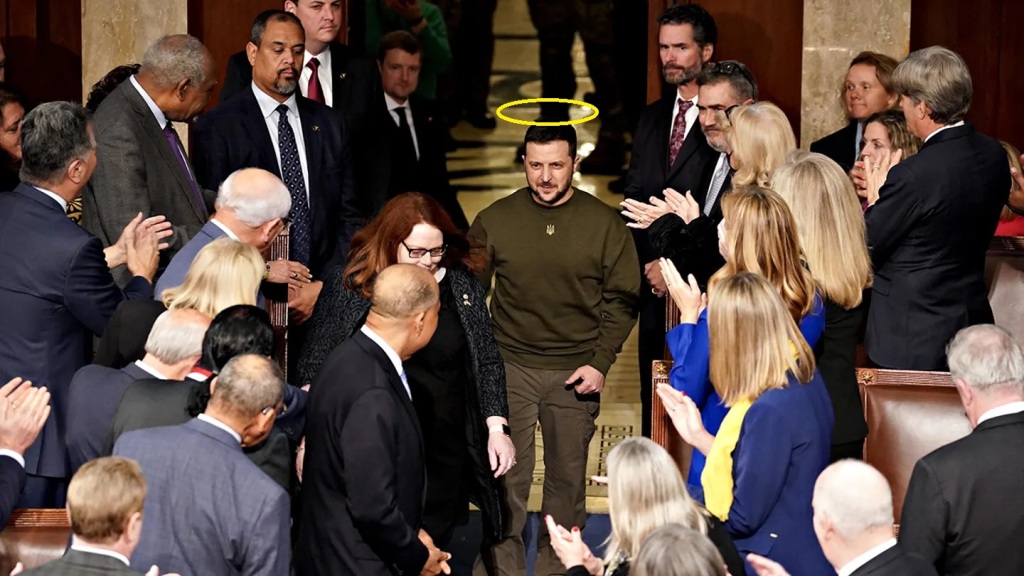
Zelensky: The “Winston Churchill of Our Time” (George W. Bush)
In the Western symphony of propaganda, the hated Putin, the “autocrat,” is contrasted with the heroic Zelensky the “democrat” (Time magazine’s 2022 “person of the year”). But how democratic is Zelensky?
His man-of-the-hour image had help from international friends. Zelensky’s global perception management team is run by a well-connected London-based British firm, The PR Network, that helps him prepare messages for global consumption.
BY GERALD SUSSMAN APRIL 18, 2023, https://www.counterpunch.org/2023/04/18/the-us-russia-and-ukraine-75-years-of-hate-propaganda/
“It is not a matter of what is true that counts, but a matter of what is perceived to be true.”
– Henry Kissinger
“But the most brilliant propagandist technique will yield no success unless one fundamental principle is borne in mind constantly and with unflagging attention. It must confine itself to a few points and repeat them over and over.”
– Adolf Hitler
“We lied, we cheated, we stole. We had entire training courses [on deceiving the public].”
– Mike Pompeo on his time as CIA director
What is state propaganda? It is a disciplined and coordinated discourse using mass persuasion on behalf of state interests. It’s one instrument of what’s called realpolitik – foreign policy designed to advance “national interests,” which in a neoliberal economy like the US means corporate interests. The oligarchs, the billionaire class in the age of neoliberalism, in their unfettered greed have employed both US political parties and their accessories in the media, the intelligence community, and Congress and turned them into a collective ministry of (dis)information and subalterns of empire. Propaganda as a tool in foreign policy commonly relies on hate-laden ideology to mobilize public consensus.
Enemies
A key to successful mass mobilization of the public mind is the enemy construct. One of the key studies on the subject found that the US has had a permanent need for enemies, and when not “readily available, we have created them” (Finlay, Holsti, and Fagen, cited in Murray & Myers, 1989, p. 555). Russia as enemy (Russophobia) works just as well if not better when it’s conceived in demeaning ethnic rather than political economic terms. That’s because hierarchical race and ethnicity ideas are closer to the surface of public prejudice than those focused on, for example, effigies of socialism or communism. In other words, it is easier to orchestrate hatred toward Russia and Putin when there preexists a deep distrust of Russians, their history, and (orthodox religious) culture and its people based on “difference” and a perceived civilizational threat to the West. Under such collective psychological conditioning, this has led to a rejection of Russia membership in the congregation controlled by white European Christian nations.
The US has manufactured innumerable enemies during the course of its existence, and it has had to in order to become a world superpower. Since 1776, there have been only 16 years when the country was not at war. In the pantheon of America’s villains during its 247-year history, one of the most prominent portraits is that of the demonic Vladimir Putin, whose “enemy” status among Americans was pumped up to 70% by March 2022, soon after the start of Russia’s “special operation” in Ukraine.
The “liberal” Democrats are found to be far more inclined to carry out a proxy war against Russia than Republicans and much more supportive of supplying Ukraine with advanced weapons and US troops: tanks (67% to 48%), long-range missiles (60% to 41%), fighter jets (56% to 39%), direct invasion (33% to 22%) (Frankovic and Orth, 2023). Former CIA director and defense secretary under Obama, Leon Panetta bluntly declared, ‘It’s a proxy war with Russia, whether we say so or not” (Bloomberg, 2022).
The massive US “proxy” assault on Russia, more like a full-scale invasion but without its own troops physically on the ground and in the air, is only the latest episode of a hundred-year-old effort to impose Western hegemony over that country. It started with the joint “expedition” that the sanctimonious Woodrow Wilson (“I am going to teach the South American republics to elect good men”) sent to Siberia and northern Russia in a failed attempt, along with mainly European allies, to back the White Russians in the civil war and overthrow the Bolshevik government. Anti-communism was toned down during the Second World War, as it was the Soviet Union, including Ukraine, tactically allied with the US and the British Empire, that bore by far the heaviest burden, suffering 27 million deaths, in defeating the Nazi regime. It’s a sobering reality of historical proportions that is rarely acknowledged in the US. Immediately following the war, the US quickly converted the USSR/Russia from ally to enemy (and their enemies to allies) and worked closely with anti-communist groups in Ukraine and the larger Soviet region in efforts to break apart the Soviet state.
The then newly formed CIA, established in 1947, covertly supervised underground far right organizations in Ukraine, in particular the pro-Nazi Organization of Ukrainian Nationalists (OUN) and the anti-Soviet Ukraine Insurgent Army (UPA), as part of its “psychological warfare activities
Continue readingLANL plans to release highly radioactive tritium to prevent explosions. Will it just release danger in the air?

The venting may harm pregnant women and fetuses, advocates say. |
| SEARCHLIGHT NEW MEXICO, by Alicia Inez Guzmán 12 June 24 |
Last fall, the international community rose up in defense of the Pacific Ocean. Seafood and salt purveyors, public policy professors, scientists and environmentalists, all lambasted Japan’s release of radioactive wastewater from the disastrously damaged Fukushima Daiichi nuclear plant into the sea.
At the heart of the contention was tritium, an element that, by mass, is 150,000 times more radioactive than the plutonium used in the cores of nuclear weapons. Odorless and colorless, tritium — the radioactive form of hydrogen — combines with oxygen to form water. Just one teaspoon is enough to contaminate 100 billion gallons more water up to the U.S. drinking water standard, according to Arjun Makhijani, an expert on nuclear fusion and author of the monograph, “Exploring Tritium Dangers.”

What didn’t make international headlines — but was quietly taking place on the other side of the world — was Los Alamos National Laboratory’s own plans to vent the same radioactive substance into northern New Mexico’s mountain air. Japan’s releases would take place over three decades. LANL’s would include up to three times more tritium — and take place in a matter of days.
There is no hard timeline for the release, but if the plans are approved by the Environmental Protection Agency, LANL is looking at a period with “sufficiently warm weather,” a spokesperson from the National Nuclear Security Administration wrote by email. That could mean as soon as this summer.
Those controversial plans date back to 2016, when LANL discovered that a potentially explosive amount of hydrogen and oxygen was building up in four containers of tritium waste stored in a decades-old nuclear dump called Area G. The safest and most technically viable solution, the lab decided — and the best way to protect workers — would be to release the pressure and, with it, thousands of curies of tritium into the air.
When advocates caught wind of the venting in March 2020, Covid was in its earliest and most unnerving phase. Pueblo leaders, advocates and environmentalists wrote impassioned letters to the lab and the EPA, demanding that they change or, at the very least, postpone the release until after the pandemic. At the same time, Tewa Women United, a nonprofit founded by Indigenous women from northern New Mexico, issued its first online petition, focusing on tritium’s ability to cross the placental barrier and possibly harm pregnant women and their fetuses. Only after a maelstrom of opposition did the lab pause its plans and begin briefing local tribes and other concerned members of the community.
“We see this as a generational health issue,” said Kayleigh Warren, Tewa Women United’s food and seed sovereignty coordinator. “Just like all the issues of radioactive exposure are generational health issues.”
Last fall, the lab again sought the EPA’s consent. A second petition from Tewa Women United followed. Eight months later, the federal agency’s decision is still pending.
The NNSA, which oversees the health of America’s nuclear weapons stockpile from within the Department of Energy, declined Searchlight New Mexico’s requests for an interview.
The crux of the issue comes down to what is and isn’t known about the state of the containers’ contents. Computer modeling suggests they are pressurized and flammable, but the actual explosive risk has not been measured, the lab has conceded.
Critics have requested that the contents be sampled first to determine whether there is any explosive risk and whether venting is even needed. The EPA says that sampling would require going through the same red tape as venting. The lab, for its part, plans to sample and vent the contents in one fell swoop.
But why, critics wonder, are these containers in this state in the first place? Were they knowingly over packed and left for years to grow into ticking time bombs?
“I do not like the position we’re in,” James Kenney, cabinet secretary of the New Mexico Environment Department, told the Legislature’s Radioactive and Hazardous Materials Committee in 2020. The containers, he said, had been “neglected for so long by both DOE and the Environment Department” that NMED potentially faces a lose-lose situation: Vent the tritium drums and try to prevent the emissions from being released into the air or “run the risk of leaving those drums onsite knowing that they are pressurized and could rupture, meaning an uncontrolled amount of tritium would go out.”
Venting and vexing
State and federal documents paint a kind of chicken-and-egg dilemma. The containers can’t be moved until the pressure is vented. But the movement itself may cause more pressure to build up, requiring a second, third or even fourth venting……………………………………………………………………………………………………………………
Tritium 101
Plutonium and uranium are familiar to most people, if by name only. But few know anything at all about tritium — a radioactive isotope of hydrogen that is used to make watch dials and EXIT signs glow bright neon. Tritium’s other, lesser-known use is as a “boost gas,” which, when inserted into the hollow core of a plutonium pit, amplifies a nuclear weapon’s yield. Globally, hundreds of atmospheric weapons tests dispersed tritium into the atmosphere, steeping rain, sea, and groundwater with the element and, ultimately, lacing sediment worldwide.
Tritium is widely produced at nuclear reactors and is today tested, handled and routinely released at Los Alamos National Laboratory.
Criticisms of this venting have always centered on two of the element’s key characteristics: First, it travels “tens to hundreds of miles,” according to lab documents. Second, when tritium is in the form of water, it becomes omnipresent and easy for bodies to absorb.
“Tritium is unique in this,” wrote Makhijani. “It makes water, the stuff of life, most of the mass of living beings, radioactive.”
Years of LANL reports depict tritium’s ubiquity in the lands and ecosystem within its bounds, a palimpsest of radioactive decay. This is measured in curies, a basic unit that counts the rate of decay second by second.
The lab’s first environmental impact statement, published in 1979, estimated that it had buried close to 262,000 curies of tritium at Area G and released tens of thousands more into the air from various stacks over the decades. The lab had two major accidental releases of tritium around the same time — 22,000 curies in the summer of 1976 and nearly 31,000 curies in the fall of 1977.
Today, trees have taken it into their root systems on Area G’s southeast edge. Rodents scurrying in and out of waste shafts are riddled with the substance, owing to tritium vapors from years past. A barn owl ate those rodents and had 740 times more tritium concentration in its body than the U.S. drinking water standard, the common reference value for indicating tritium contamination. The lab’s honeybee colonies — kept to determine how radioactive contaminants are absorbed — produced tritiated honey up to 380 times more concentrated than the drinking water standard, reports show.
The EPA set the current standard for radioactive emissions at DOE facilities in 1989, but that didn’t stop the lab from releasing thousands of curies of tritium into the air shortly afterward. In 1991, the EPA issued a notice of non-compliance to the lab for not calculating how much of a radiation dose the public received. Another notice followed in 1992.
Concerned Citizens for Nuclear Safety filed a lawsuit two years later alleging that the DOE hadn’t properly monitored radioactive emissions, as required by the Clean Air Act. At the time, a former lab safety officer, Luke Bartlein, observed what he described in an affidavit as a “pattern and practice of deception at LANL with respect to the radionuclide air monitoring system.” It was routine for lab staffers and management to vent glove boxes and other materials contaminated with tritium outside so that the contamination would deliberately “not register” on the stack monitors, he recounted, leading to false emissions reports.
The lab settled in 1997; a consent decree followed and would stay in effect until 2003. The lab says it has maintained low annual emissions ever since…………………………………………………………………………………………………………………………………….
In 1999, Makhijani and more than 100 scientists, activists and physicians across the country and worldwide signed a letter to the National Academy of Sciences. Their ask? To evaluate how radionuclides that cross the placental boundary, including tritium, impact the fetus, a request Makhijani renewed in 2022.
As he put it, tritium — the “most ubiquitous pollutant from both nuclear power and nuclear weapons” — has largely escaped regulatory and scientific scrutiny when it comes to matters of pregnancy.
Cindy Folkers, the radiation and health hazard specialist at Beyond Nuclear, a national advocacy organization, believes the reason is rooted in the radiation establishment’s fear of liability. “You get layers and layers and layers and layers of denial.”
The scant research that does exist comes from pregnant women who survived atomic bombs in Hiroshima and Nagasaki. In 1986, the International Commission on Radiation Protection concluded that exposing a fetus to ionizing radiation, the kind that tritium emits, has a “damaging effect…upon the development of the embryonic and fetal brain.” The area most at risk of harm, it went on, is the forebrain, which controls complex and fundamental functions like thinking and processing information, eating, sleeping and reproduction.
Ionizing radiation damages the cell in two ways. On the one hand, it breaks apart the building blocks from which humans are made, causing rifts in DNA. On the other, it fundamentally changes the chemistry of the cell, breaking apart its water molecules and upsetting its metabolism.
That’s what makes it different from, say, an X-ray, Folkers said. “A machine can be shut off,” but “a radioactive particle that’s inside your body will continue irradiating you.” For a pregnant woman, this adds up to “cumulative biological damage,” the kind that cuts across generations.
“We’re dealing with a life cycle,” Folkers said. “And females are an integral part of that life cycle. Not only are they more damaged by radioactivity, and their risks are higher for cancer, but they are also carrying in them the future generations. So when you’re dealing with a female baby who’s developing in the womb, you are dealing with that child’s children at the very least.”
In other words, a mother is like a Russian nesting doll. She holds a fetus and that fetus, if a female, holds all future eggs. Exposure to her is exposure to future generations. https://searchlightnm.org/lanl-plans-to-release-highly-radioactive-tritium-to-prevent-explosions-will-it-just-release-danger-in-the-air/?utm_source=Searchlight+New+Mexico&utm_campaign=08e25288bd-6%2F12%2F2024+-+LANL+Tritium+Release&utm_medium=email&utm_term=0_8e05fb0467-08e25288bd-395610620&mc_cid=08e25288bd&mc_eid=a70296a261
Sodium cooled nuclear reactors are not necessarily safer
While no sodium-cooled reactors currently operate in the United States, the U.S. Department of Energy (DOE) is working with industry on a number of “advanced” reactor designs, including the Sodium-Cooled Fast Reactor (SFR). One of the SFR’s safety advantages, to quote the DOE, is that the design provides a “Long grace period for corrective action, if needed.” SRE’s meltdown transpired over a two-week period. Fermi Unit 1 had indications of inadequate core cooling in June that were repeated in August and dismissed until extensive damage occurred in October 1966. The “if needed” grace period is never long enough when warning sign after warning sign is dismissed or ignored.
DOE did acknowledge some “challenges” for the SFR: their higher speed and higher energy neutrons can embrittle and degrade nearby materials, liquid sodium coolant reactors with air and water and degrades concrete, and the opaqueness of the liquid sodium coolant complicates in-service inspections and maintenance.
Thank goodness for the “Long grace period for corrective actions, if needed.” That and the fact that SFRs only operate in cyberspace where the primary threat is carpal tunnel syndrome

 Nuclear Plant Accidents: Fermi Unit 1, Union of Concerned Scientists Dave Lochbaum, director, Nuclear Safety Project | July 12, 2016, Disaster by Design
Jorge Agustin Nicolás Ruiz de Santayana y Borrás, also known as George Santayana, wrote that “Those who cannot remember the past are condemned to repeat it.” Continue reading
‘I heard all of my friends’ last breath’: Testimonies from the Nuseirat massacre
The Israeli massacre in Gaza’s Nuseirat camp killed over 270 Palestinians and injured many more. Survivors say the horrors they witnessed will stay with them for the rest of their lives.
BY TAREQ S. HAJJAJ https://mondoweiss.net/2024/06/i-heard-all-of-my-friends-last-breath-testimonies-from-the-nuseirat-massacre/
The Israeli massacre in the Nuseirat camp to liberate four Israeli prisoners held by resistance factions in the Gaza Strip started at 11:00 in the morning on June 8. Although the scenes of Palestinians running for safety may have seemed sadly familiar, this invasion was different from others that have been carried out across the Gaza Strip.
This time, the Israeli military wore civilian clothes, rode in Palestinian cars, and moved among the people in disguise. There were no warnings to evacuate, or orders from the army to move elsewhere, and people were surprised by the Israeli special forces and tanks. A large number of special forces hidden among the people only revealed themselves once the deadly operation began as other special forces stormed the area traveling in cars loaded with luggage, the same luggage that the displaced people carry with them, such as mattresses, pillows, blankets, and bags. When the Palestinians detected them, the soldiers quickly called for support, and helicopters, fighter planes, artillery, and tanks descended. Reconnaissance aircraft and foot solders then began committing massacres against the civilian population.
The intensity of shelling and gunfire soon warned the residents that a massacre was unfolding. They left their homes and took to the streets running in search of safety, which could not be found.
The Israeli operation killed 274 Palestinians, including 64 children, and injured 689 Palestinians in total. “Some of the bodies that arrived at the hospital were body parts, as well as dismembered bodies,” the Gaza Ministry of Health reported when announcing the casualty numbers.
As the world celebrates the liberation of four Israeli hostages from the Gaza Strip, and the media focuses on their lives, freedom, and the happiness of their families there is barely a mention of the number of Palestinian casualties or consideration that each of those killed are also leaving behind a bereaved family.
Issam Hajjaj, 27, survived the massacre and spoke to Mondoweiss. “We were running away from bombing and killing. In all directions, there was either bombing, an Israeli tank, or Israeli gunmen shooting at anyone in their path,” he explained. “While we were running away from death, I saw dismembered bodies on the road as a result of the bombing, and I saw those who left their loved ones under the rubble and fled to save the rest of the family.”
“We did not know from which direction death would come for us.”
Anatomy of a massacre
Following the attack the Israeli army announced that the element of surprise had been crucial. This is why the military operation took place during daylight hours and in a densely populated area. This is also why there was such a high number of Palestinian casualties.
Hajjaj says that within minutes of the invasion starting, Israeli forces surrounded the targeted location from all sides and did not leave any route for people to escape except one road, Al-Zuhur Road connecting Nuseirat and Deir Al-Balah. However, just at the same time that the Nuseirat massacre took place, people near Al-Aqsa Martyrs Hospital in Deir Al-Balah were fleeing to Nuseirat, and people were using this street to arrive. The intense crowding in the street during the continuous bombing spread panic, and bodies soon began to fly as a result of the direct targeting of everything in that area.
“During our escape, we saw bodies being loaded into cars heading to Al-Aqsa Martyrs Hospital. Women were screaming in the streets, and children were crying and screaming,” Hajjaj recounted. “I saw a family that was fleeing together. A shell fell on the father and killed him in front of his wife and young daughter. After the mother got up and carried her daughter, she discovered that her husband was killed; she left him on the ground and fled to save her daughter and herself.”
Hajjaj explained that the targeted location was two buildings near Al Awda Hospital in the Nuseirat camp, but to reach these two buildings, the Israeli army destroyed an entire residential square. He says that while the Israeli army liberated more than four hostages, the intensity of fire from the Palestinian resistance stopped them from getting out more captives.
The Al-Qassam Brigades, the military arm of Hamas in the Gaza Strip, seemed to confirm this account in a video it published declaring that three Israeli prisoners were killed by the Israeli bombing of the Nuseirat camp.
“We inform you that in exchange for these, your army killed three prisoners in the same camp, one of whom held American citizenship,” Al-Qassam announced in the video. The resistance group stressed that the remaining Israeli prisoners would not be liberated until the Palestinian prisoners in Israeli prisons were freed as well.
Several Palestinians published photos and video from the scene in Nuseirat that confirmed the firsthand accounts collected by Mondoweiss showing an Israeli special force vehicle entering the camp at the beginning of the invasion which was followed by indiscriminate bombing as a form of support cover. Other videos show a car loaded with luggage entering the Block 5 area in the Nuseirat camp and killing a person at the door of one of the buildings. Israeli forces then used iron ladders to reach the upper floors, as shown in one of the pictures that spread on social media. Other details of the invasion are still being established. Many on social media have circulated photos that seem to indicate the floating pier constructed by the United States on the Gaza coast was used as a launching point for the operation, a claim the U.S. Central Command denied.
Clashes continued for more than three hours. During this time, the Israeli army used excessive force to demolish homes and kill hundreds of residents in the vicinity of the operation.
“I did not think for a moment that I might survive”
Tawfiq Abu Youssef, an 11-year-old child, sits in Nasser Hospital in Khan Younis where he was referred to for treatment. His face is bloodied and his eyes are swollen blue after he was pulled from under the rubble of their home in Nuseirat. He says he doesn’t know how he escaped death.
“Suddenly, the situation in the area changed, and people started running in fear, saying that special forces had stormed the area,” the boy recounted to Mondoweiss. “All of this was happening in front of our house, and we were stuck inside under fire and bombing. We tried to get out, but drones opened fire on us until the house was bombed and fell over our heads.”
“Before our house was bombed, we saw people in the street across from our house on the ground cut up. We saw missiles hitting the people fleeing in the streets, how they cut them off, and how the planes bombed everything moving in the streets – cars and people. The street was full of people, and suddenly, all of them… They were on the ground, and smoke and blood filled the place. Everywhere we looked, shelling and shrapnel were flying.”
As Tawfiq leaned his back against the hospital wall and sat on the floor to receive treatment, he said that he did not expect to survive this massacre. The scenes he saw were too difficult to believe.
“I stayed under the rubble for hours. I did not think for a moment that I might survive and see life again. I had lived through death enough while I was under the rubble. That was death. I do not think I will forget or get over these moments.”
The operation was carried out near a central market, where Amjad Abu Laban, 43, was selling some food items on the road. He survived death but suffered various injuries to his hand and foot.
He says that everything started at once: planes, tanks, shooting, and people were in the middle of bombing and death and did not know how to react or where to turn.
“Intense bombardment began in several areas in front of us, around us, and behind us, and people began falling to the ground by the dozens near Al-Awda Hospital in the Nuseirat camp. Before our eyes, we saw bodies being torn apart and scattered on the roads, and we saw soldiers hidden in civilian clothes and in people’s cars running and killing everyone they met on their way without distinguishing between a child, a woman, a young person, or an old person. We saw the bodies of our brothers cut up, without heads, lying on the ground,” Abu Laban told Mondoweiss.
“These massacres that occurred before my eyes cannot be described.”
In the same hospital, Mahmoud Al-Hawar, 27, lies on his back as a result of an injury to his leg. Al-Hawar witnessed the massacre as he bravely attempted to save his family and neighbors from the bombing.
“The planes bombed our neighbors’ house, and there was a girl under the rubble screaming to be saved. I went with my friends to try to save her, but the rubble was heavy, and we could not dig her out or even lift it to reach that girl, so we waited until the civil defense team arrived. A large number of young men gathered to try to rescue them. But the planes bombed us,” he told Mondoweiss.
Al-Hawar recounted that he felt the missile hit him and his group of friends and they were thrown to the ground. Minutes later, Mahmoud regained consciousness and found himself covered in blood and saw his friends next to him, on the verge of death.
“Before we were bombed, if I told you that I saw more than 10 drones above our heads, you would not believe it. We were looking at the sky and did not know what was happening.”
After the bombing, Al-Hawar tried to stand up to save himself and his friends. “I tried to stand up, but I couldn’t. I was covered in blood. I looked at my leg and it was cut off. I looked at my best friend next to me, and I found him taking his last breath.”
Their injuries were all severe, and when someone arrived who could take them to the hospital, the five friends were placed on top of each other in a small transport truck, with Al-Hawar underneath them all.
“I was in pain from my injury, but I was feeling more pain because I could hear my friends pronouncing their martyrdom and taking their last breaths. All my friends were dying above me, and I was hearing and feeling everything. They were all killed. Some of them were martyred on the road before my eyes, and some of them died later.”
Al-Hawar agreed that the scenes he saw of the dead in the streets will never be forgotten. “I have not slept since the incident. I cannot sleep. I cannot forget anything I witnessed and saw. I cannot forget the people who were running in panic and fear, searching for their relatives and families amidst the destruction and dismembered bodies.”
Rescue operations continue
Rescue teams are still working in Nuseirat with limited capabilities in an attempt to recover the bodies that remained under the rubble. Many residents remain missing due to the massive bombing in the area, and the many homes that were demolished, some on top of their residents. Many others were killed in the market as they tried to meet the needs of their families.
Anees Ghanima, an activist in the Nusreiat refugee camp, summarized the senseless killing on social media, ““This is what happens when we say that we are at risk of being killed at any moment. Imagine that most of those who just left were only in the market, trying to meet their families’ needs. Put yourself in the place of the child who spent all night deceiving his mother to buy him some necessities, and she was killed today during raids. How could we tell him about peace in this world?”
Hassan Sleieh contributed to this report.
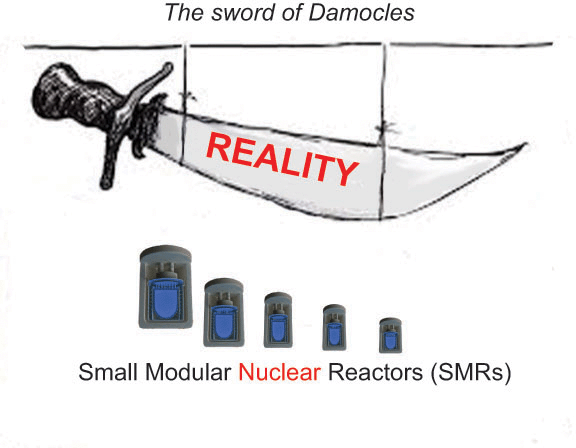
Are the prospects for Small Modular Reactors being exaggerated? Five key characteristics examined
June 11, 2024 by Ed Lyman, Ed Lyman is Director, Nuclear Power Safety, at the Union of Concerned Scientists
Small Modular Reactors (SMRs) are being presented as the next generation of nuclear technology. While traditional plants face cost overruns and safety issues, SMRs are seen by their champions as cheaper, safer, and faster to deploy. But Ed Lyman at UCS cites evidence that cast these claims into doubt.
In five sections of this article, he lists the reasons why. SMRs are not more economical than large reactors. SMRs are not generally safer or more secure than traditional large light-water reactors. SMRs will not reduce the problem of disposal of radioactive waste. SMRs cannot be counted on to provide reliable and resilient off-the-grid power (for facilities like data centres, bitcoin mining, hydrogen or petrochemical production). SMRs do not use fuel more efficiently than large reactors.
And where problems might be ironed out over time, the learning cycle of such technology is measured in decades during which costs will remain very high. SMRs may have a role to play in our energy future, says Lyman, but only if they are sufficiently safe and secure, along with a realistic understanding of their costs and risks.
Even casual followers of energy and climate issues have probably heard about the alleged wonders of small modular nuclear reactors (SMRs). This is due in no small part to the “nuclear bros”: an active and seemingly tireless group of nuclear power advocates who dominate social media discussions on energy by promoting SMRs and other “advanced” nuclear technologies as the only real solution for the climate crisis. But as I showed in my 2013 and 2021 reports, the hype surrounding SMRs is way overblown, and my conclusions remain valid today.
Unfortunately, much of this SMR happy talk is rooted in misinformation, which always brings me back to the same question: if the nuclear bros have such a great SMR story to tell, why do they have to exaggerate so much?
What are SMRs?
SMRs are nuclear reactors that are “small” (defined as 300 megawatts of electrical power or less), can be largely assembled in a centralised facility, and would be installed in a modular fashion at power generation sites. Some proposed SMRs are so tiny (20 megawatts or less) that they are called “micro” reactors. SMRs are distinct from today’s conventional nuclear plants, which are typically around 1,000 megawatts and were largely custom-built. Some SMR designs, such as NuScale, are modified versions of operating water-cooled reactors, while others are radically different designs that use coolants other than water, such as liquid sodium, helium gas, or even molten salts.
To date, however, theoretical interest in SMRs has not translated into many actual reactor orders. The only SMR currently under construction is in China. And in the United States, only one company — TerraPower, founded by Microsoft’s Bill Gates — has applied to the Nuclear Regulatory Commission (NRC) for a permit to build a power reactor (but at 345 megawatts, it technically isn’t even an SMR).
The nuclear industry has pinned its hopes on SMRs primarily because some recent large reactor projects, including Vogtle units 3 and 4 in the state of Georgia, have taken far longer to build and cost far more than originally projected. The failure of these projects to come in on time and under budget undermines arguments that modern nuclear power plants can overcome the problems that have plagued the nuclear industry in the past.
Developers in the industry and the US Department of Energy say that SMRs can be less costly and quicker to build than large reactors and that their modular nature makes it easier to balance power supply and demand. They also argue that reactors in a variety of sizes would be useful for a range of applications beyond grid-scale electrical power, including providing process heat to industrial plants and power to data centres, cryptocurrency mining operations, petrochemical production, and even electrical vehicle charging station
Here are five facts about SMRs that the nuclear industry and the “nuclear bros” who push its message don’t want you, the public, to know.
1. SMRs are not more economical than large reactors. 2. SMRs are not generally safer or more secure than large light-water reactors. 3. SMRs will not reduce the problem of what to do with radioactive waste. 4. SMRs cannot be counted on to provide reliable and resilient off-the-grid power for facilities, such as data centers, bitcoin mining, hydrogen or petrochemical production. 5. SMRs do not use fuel more efficiently than large reactors
Continue readingGaza has become a humanitarian catastrophe and Israel will have to answer tough questions
By global affairs editor John Lyons, https://www.abc.net.au/news/2024-06-10/israel-tough-questions-war-in-gaza/103956848?utm_campaign=abc_news_web&utm_content=twitter&utm_medium=content_shared&utm_source=abc_news_web
“Frozen“ children — it’s an unusual description of an appalling reality.
They’re the words Sydney clinical psychologist Scarlett Wong used after a recent trip to Gaza with Doctors Without Borders.
“When you see a starving child, they are apathetic, they have no response,” she told SBS News. “This is the kind of thing we were seeing from a medical view … children have become frozen, with no emotion, and apathetic.”
The situation, Dr Wong said, was “the worst humanitarian disaster I have ever seen”.
Gaza has become one of the worst humanitarian catastrophes of our time. The UN’s World Food Programme has said parts of Gaza are now gripped by “a full-blown famine”.
One of the few countries denying this is Israel. Not only is there not a famine, said Ron Dermer, a member of Israel’s war cabinet, but there is an abundance of food.
He told a startled Yalda Hakim on Sky UK recently that there were in fact “bustling markets” with fruit and vegetables.
Dermer’s claim defies all available evidence. Given the Israeli army has drones flying constantly across the tiny enclave, Dermer could have provided photographs of the “bustling markets”. Where are the photos?
According to Foreign Policy magazine, 30 of Gaza’s 36 hospitals have been bombed — many repeatedly — even while medical staff, patients and civilians seeking shelter remained inside. Satellite imagery shows vast sections of Gaza in rubble.
The Wall Street Journal reported that from October 7 to December 15, Israel dropped 29,000 bombs, munitions and shells on Gaza. This means that, on average, Israel hit every square kilometre of Gaza with 79 bombs, munitions or shells.
After just nine weeks of the war, the newspaper said the destruction of homes, schools and other buildings resembled “some of the most devastating campaigns in modern history”.
When the war does finish, the rebuilding of Gaza could take a generation. The Washington Post reported that the head of the UN’s Mine Action Program, Mungo Birch, said the number of unexploded missiles and bombs lying under the rubble was “unprecedented” since World War II and that Gaza was now the site of about 37 million tons of rubble — more than what had been generated across all of Ukraine during Russia’s war — and 800,000 tons of asbestos and other contaminants.
Has the response been proportional?
Over the weekend, Israel rescued four hostages captured on October 7 from a heavily populated refugee camp. Gazan authorities said at least 210 Palestinians were killed and 400 wounded during the rescue, which involved heavy bombardment.
Hamas has had its day of reckoning; the videos from October 7 would be, for any reasonable observer, proof of atrocities and war crimes. The videos and photos not released to the public are even more appalling. Hamas has kept hostages for more than eight months.
But Israel’s day of reckoning for its eight-month-long response is still to come. The question is, has its response been proportional?
Every country that engages in war has a day, or years, of reckoning. America had such a day after the Vietnam and Iraq wars. Australia has had — and continues to have — days of reckoning after its involvement in Afghanistan, with continuing investigations into possible war crimes.
Israel will argue that for self-defence it needed to ensure that Hamas was never again in a position to commit an attack. They will argue that throughout the war, Hamas has used civilians as human shields and that, therefore, a large number of civilians were killed.
But there will be very specific allegations that Israel will be under pressure to answer. Human Rights Watch (HRW) reported this week that the Israeli military has been using white phosphorous in Gaza and south Lebanon. HRW noted that white phosphorous causes severe burns, often down to the bone, and burns to only 10 per cent of the body are often fatal. It said it can cause respiratory damage and organ failure.
“Using airburst white phosphorous is unlawfully indiscriminate in populated areas and otherwise does not meet this legal requirement to take all feasible precautions to avoid civilian harm,” the group said.
The HRW report also referenced the Israel-Lebanon border. It said Israel had engaged in “widespread” use of white phosphorous since October, including at least five municipalities where white phosphorous munitions were unlawfully airburst over populated residential areas. It said Lebanon should turn to the International Criminal Court and enable the prosecution of grave international crimes.
The ABC put these allegations to the Israel Defense Forces (IDF), who said that like many western militaries, the IDF possesses “smoke-screen shells that include white phosphorous that are legal under international law”.
“These shells are used by the IDF for creating smoke screens and not for targeting or causing fires and are not defined under law as incendiary weapons.”
Tough questions are being asked
As the war drags on, some media outlets are increasingly asking difficult questions of Israel.
CNN has conducted a major investigation of one of Israel’s “black site” prison facilities, where they claimed systemic torture of hundreds of Palestinians taken from Gaza is occurring.
The US media outlet spoke to three Israeli whistleblowers from the facility who revealed atrocities ranging from doctors amputating prisoners’ limbs due to injuries sustained from constant handcuffing and medical procedures sometimes performed by underqualified medics, which earned the facility a reputation for being “a paradise for interns” and a place “where the air is filled with the smell of neglected wounds left to rot”.
One medic from the facility said beatings of Palestinians were not done to gather intelligence but out of revenge for the October 7 attack.
He said he was ordered to perform medical procedures on Palestinians for which he was not qualified: “I was asked to learn how to do things on the patients, performing minor medical procedures that are totally outside my expertise.”
Jeremy Corbyn was smeared for rejecting the use of nuclear weapons – but he was right,

 Corbyn was smeared for rejecting the use of nuclear weapons – but he was right https://leftfootforward.org/2020/01/corbyn-was-smeared-for-rejecting-the-use-of-nuclear-weapons-but-he-was-right/, Kate Hudson
– It’s time to smash the narrative that using nuclear weapons is ‘patriotic,
|
A recurrent trope in the post-election analysis has been Jeremy Corbyn’s supposed lack of patriotism. It’s worth examining. Rather than arriving at this conclusion by demonstrating that Corbyn doesn’t love his country – for which there is no evidence whatsoever – it seems largely to be based on his unwillingness to commit to killing millions of innocent civilians at the touch of a button. The media seemed hell-bent on pushing this approach during the election (and it’s resurfacing in the leadership debate). Fortunately others in the public eye, footballer Gary Lineker for one, have more common sense. ‘Nuclear thing is bonkers’ he tweeted, ‘We’re all f**ked if they’re ever used.’ Quite so. And he went on to say – in a twitter debate with TV presenter Piers Morgan – that Trident should be scrapped. Morgan tried to assert the strange logic that because we had them they hadn’t been used. Lineker quite sensibly pointed out that nuclear weapons would not have been used if there were no nuclear weapons. This is a point we have been making for some time. It reminds me of a debating point made by some pro-nuclear advocates that ‘we have them in order not to use them’. Clearly a silly approach – we could save ourselves £205 billion by not having them in order not to use them! But having blighted the election with a knee-jerk prime ministerial virility test this is now resurfacing during the Labour leadership contest. Candidates – most notably and recently, Rebecca Long Bailey on Tuesday’s Today programme – are again being asked their position on the use of nukes. Because willingness to press the button has come to falsely symbolise strong leadership, patriotism and a commitment to Britain’s status in the world, who is going to say no? Nothing could show more clearly the urgent need to have a genuine debate about nuclear weapons, what they are and what their use would mean. We also need politicians to realise that nuclear weapons are not something to posture wildly about – they are indeed weapons of mass destruction. There will be no life worthy of the name after their use. Survivors will envy the dead. Most concerning is the fact that unquestioning attachment to a totemic but anachronistic weapons system prevents a real assessment of what is needed to meet our security needs in the 21st century – and what we need to spend our defence budget on. It is an open secret that the MoD is overcommitted on ‘big ticket’ projects. Yet no one seems to dare to question Trident, presumably on the grounds that they would be immediately characterised as a lily-livered traitor. National security strategies since 2010 have identified cyber warfare, terrorism, climate change, pandemics and organised crime as some of the key contemporary threats we face. Nuclear threats have actually been downgraded in risk level but nevertheless Trident replacement is proceeding – with significant opportunity cost to other higher level defence priorities. Even former advocates of nuclear weapons, like Lord Des Browne, are speaking out. He was the Defence Secretary who pushed the decision on Trident replacement through parliament in the Blair years. Now he has raised serious concerns about the impact of new technology on Trident and its replacement. When Trident was launched in the 1990s it was the gold standard of nuclear weapons, undetectable under the waters, 24/7. Now, he states, the replacement will be obsolete before it’s launched: the rapid development of underwater drone technology will render subs fully detectable and advanced hacking skills will jeopardise the security of targeting and missile use. So this is the problem with reducing serious questions about our national security to the level of a ‘will they/won’t they press the button?’ game show, trapping politicians in a ridiculous zero-sum game where actually everyone loses. Our real security needs are ignored and underfunded. It’s time for change – rethinking our security is well overdue. Kate Hudson is General Secretary of the Campaign for Nuclear Disarmament. |
|
Senior U.S. Diplomats, Journalists, Academics and Secretaries of Defense Say: the U.S. Provoked Russia in Ukraine
Progressive Memes, by Donald A. Smith, PhD 3 June 24
It took some years for Americans to realize they’d been lied to about the war in Vietnam. Thanks to the publication of the Pentagon Papers, and thanks to the antiwar movement, Americans eventually learned about the injustices and failures of that war.
Likewise, it took several years after the starts of the wars in Iraq and Afghanistan for Americans to realize they’d been lied to about those wars as well.
Americans are just now starting to realize that they’ve been lied to about the war in Ukraine. (The propaganda effort has been quite effective, with the New York Times, in particular, acting as a mouthpiece for the government’s position.) More and more mainstream publications are exposing the lies, and a majority of Americans now oppose further arming of Ukraine.
This essay is a summary of what the U.S. government has been hiding about the war in Ukraine, with links to sources for further information.
According to Brown University’s Costs of War project, U.S. military actions since 9/11 directly killed over 900,000 people, with an additional 3.5 million people dying from indirect effects. The wars cost Americans at least $8 trillion and displaced over 38 million people from their homes. The U.S. spends over a trillion dollars a year on its military, if you count all expenditures.
If we go back to the 1960s, the number killed by U.S. wars includes the several million killed in the Vietnam war, the approximately 1 million killed by U.S. support for Indonesian military’s attacks on left wing groups, and the hundreds of thousands, at least, killed in proxy wars and government overthrows in Latin America.
The wars, overthrows, and associated sanctions caused mass migrations worldwide — particularly in Europe and at the southern U.S. border — and destabilized politics. Yet almost nobody (except for whistleblowers) was held accountable for these disasters; indeed, many of the same people are in Congress or work for the government or the weapons industry.
Moreover, the U.S. government lied about almost all the wars — in particular, about the wars in Vietnam, Iraq, and Afghanistan, but also about the war in Yugoslovia, as documented in Harper’s Magazine and here. (In short, the Kosovo Liberation Army that the U.S. supported was, basically, a terrorist organization funded by the CIA, and U.S. propaganda greatly overstated the nobility of the U.S. intervention.)
So, it should come as no surprise that our government is lying now about the war in Ukraine. Specifically, claims by President Biden and others that the Russian invasion was “unprovoked” are greatly exaggerated.
Read what these diplomats, secretaries of Defense, journalists, academics, and politicians have to say:
Former U.S. Ambassador to the USSR Jack Matlock says in Ukraine: Tragedy of a Nation Divided:
“Interference by the United States and its NATO allies in Ukraine’s civil struggle has exacerbated the crisis within Ukraine, undermined the possibility of bringing the two easternmost provinces back under Kyiv’s control, and raised the specter of possible conflict between nuclear-armed powers. Furthermore, in denying that Russia has a ‘right’ to oppose extension of a hostile military alliance to its national borders, the United States ignores its own history of declaring and enforcing for two centuries a sphere of influence in the Western hemisphere.”
Diplomat and historian George Kennan, quoted in Thomas Friedman’s This Is Putin’s War. But America and NATO Aren’t Innocent Bystanders, discussing NATO expansion:
“I think it is the beginning of a new cold war. I think the Russians will gradually react quite adversely and it will affect their policies. I think it is a tragic mistake. There was no reason for this whatsoever. No one was threatening anybody else. This expansion would make the founding fathers of this country turn over in their graves.”
William J. Perry, Secretary of Defense under President Bill Clinton, wrote How the US Lost Russia – and How We Can Restore Relations in Sept. of 2022:
“Many have pointed to the expansion of NATO in the mid-1990s as a critical provocation. At the time, I opposed that expansion, in part for fear of the effect on Russian-U.S. relations….Still, the first step in finding a solution [to the war in Ukraine] is acknowledging the problem and recognizing that our actions have contributed to that hostility.”
Robert Gates, Secretary of Defense under George W. Bush, in We Always Knew the Dangers of NATO Expansion:
“[T]rying to bring Georgia and Ukraine into NATO was truly overreaching, … recklessly ignoring what the Russians considered their own vital national interests.”
Ambassador Michael Gfoeller and David H. Rundell: in Newsweek‘s Lessons From the US Civil War Show Why Ukraine Can’t Win:
“Before the war, far right Ukrainian nationalist groups like the Azov Brigade were soundly condemned by the US Congress. Kiev’s determined campaign against the Russian language is analogous to the Canadian government trying to ban French in Quebec. Ukrainian shells have killed hundreds of civilians in the Donbas and there are emerging reports of Ukrainian war crimes. The truly moral course of action would be to end this war with negotiations rather than prolong the suffering of the Ukrainian people in a conflict they are unlikely to win without risking American lives.”
Christopher Caldwell: in the New York Times‘ The War in Ukraine May Be Impossible to Stop. And the US Deserves Much of the Blame:
“In 2014 the United States backed an uprising – in its final stages a violent uprising – against the legitimately elected Ukrainian government of Viktor Yanukovych, which was pro-Russian.”
Chas W. Freeman, former U.S. Ambassador to Saudi Arabia and a Lifetime Director of the Atlantic Council, says in The Many Lessons of the War in Ukraine: “Less than a day after the US-engineered coup that installed an anti-Russian regime in Kyiv in 2014, Washington formally recognized the new regime… The United States and NATO began a multi-billion-dollar effort to reorganize, retrain, and re-equip Kyiv’s armed forces. The avowed purpose was to enable Kyiv to reconquer the Donbas and eventually Crimea…. Crimea was Russian-speaking and had several times voted not to be part of Ukraine.” And: “From 2014 to 2022, the civil war in Donbas took nearly 15,000 lives.” Freeman says that the U.S. undermined several possible peace deals. “Ukraine is being eviscerated on the altar of Russophobia” but Russia has not, after all, been weakened. See this.
William J. Burns, then Ambassador to Russia, current director of the CIA, wrote in a 2008 cable, as revealed by Wikileaks:
Foreign Minister Lavrov and other senior officials have reiterated strong opposition, stressing that Russia would view further eastward expansion as a potential military threat. NATO enlargement, particularly to Ukraine, remains “an emotional and neuralgic” issue for Russia, but strategic policy considerations also underlie strong opposition to NATO membership for Ukraine and Georgia. In Ukraine, these include fears that the issue could potentially split the country in two, leading to violence or even, some claim, civil war, which would force Russia to decide whether to intervene.
MFA: NATO Enlargement “Potential Military Threat to Russia”
Thomas Friedman: in the New York Times‘ This Is Putin’s War. But America and NATO Aren’t Innocent Bystanders:
“The mystery was why the US – which throughout the Cold War dreamed that Russia might one day have a democratic revolution and a leader who, however haltingly, would try to make Russia into a democracy and join the West – would choose to quickly push NATO into Russia’s face when it was weak. A very small group of officials and policy wonks at that time, myself included, asked that same question, but we were drowned out.”America and NATO Aren’t Innocent Bystanders [from the title]
U.S. Senator Chris Murphy said in an interview in 2014:
“With respect to Ukraine, we have not sat on the sidelines. We have been very much involved. Members of the Senate have been there, members of the State Department who have been on the square …. I really think that the clear position of the United States has been in part what has helped lead to this change in regime…. I think it was our role, including sanctions and threats of sanctions, that forced, in part, Yanukovich from office.”
Henry Kissinger in an interview with The Wall Street Journal:
“We are at the edge of war with Russia and China on issues which we partly created, without any concept of how this is going to end or what it’s supposed to lead to.”
Neoconservative Robert Kagan writes in an otherwise hawkish Foreign Affairs essay from May, 2022, The Price of Hegemony: Can America Learn to Use its Power?:
“Although it is obscene to blame the United States for Putin’ inhumane attack on Ukraine, to insist that the invasion was entirely unprovoked is misleading. …. the invasion of Ukraine is taking place in a historical and geopolitical context in which the United States has played and still plays the principal role, and Americans must grapple with this fact.”
Fiona Hill, former official at the U.S. National Security Council during the administration of George W. Bush, in the New York Times’ Putin has the U.S. right where he wants it:
“At the time, I was the national intelligence officer for Russia and Eurasia, part of a team briefing Mr. Bush. We warned him that Mr. Putin would view steps to bring Ukraine and Georgia closer to NATO as a provocative move that would likely provoke pre-emptive Russian military action. But ultimately, our warnings weren’t heeded.”
Pope Francis in Yahoo News’ Pope Francis Says NATO Started War in Ukraine by “Barking at Putin’s Door”:
The real “scandal” of Putin’s war is NATO “barking at Putin’s door.”
James W. Carden, journalist and former adviser to the US-Russia Bilateral Presidential Commission at the U.S. Department of State, in Simone Weil Center’s America’ Crisis of Reality and Realism: A Symposium (Part I):
“The de facto alliance of Ukrainian westernizing liberals and the fascist Ukrainian far-Right which together drove the so-called Revolution of Dignity in 2013-14 ignored their obligation to respect the democratic process.”
John J. Mearsheimer, University of Chicago
“The West is leading Ukraine down the primrose path, and the end result is that Ukraine is going to be wrecked.” (2015)
Former Ambassador Thomas Graham, who served under six U.S. presidents and is a member of the Council on Foreign Relations, wrote in Was the Collapse of US-Russia Relations Inevitable?: “US hubris and Russian paranoia undermined partnership.” After the collapse of the Soviet Union, a weakened Russia sought closer ties to the West and even helped George W. Bush fight the war on terror. But instead of helping Russia fight Chechen rebels, which Russia considered to be terrorists, the U.S. lent support to those rebels. The U.S. pressed its advantage, aggressively expanding NATO, instigating regime change operations in countries friendly to Russia, and undermining Russian energy exports.
Finally, in light of the growing problems with Russia in the former Soviet bloc, the US push in 2008 to bring Georgia and Ukraine into NATO was ill-advised at best. It tied together the two strands of the Bush administration’s hedging policy—NATO expansion and Eurasian geopolitical pluralism—in a way guaranteed to provoke a powerful Russian backlash. Key allies, notably France and Germany, were adamantly opposed. Bush’s own ambassador in Moscow warned that extending an invitation to Ukraine would cross the “brightest of red lines” and elicit sharp condemnation across the political spectrum.
NATO Secretary Jens Stoltenberg, in Opening remarks at the joint meeting of the European Parliament’s Committee on Foreign Affairs (AFET) and the Subcommittee on Security and Defence (SEDE):
Putin “went to war to prevent NATO, more NATO, close to his borders.”
Stephen M. Walt, professor at Harvard University’s Kennedy School, in an essay in Foreign Policy:
“This war would have been far less likely if the United States had adopted a strategy of foreign-policy restraint…. The Biden Administration and its predecessors are far from blameless.”
Michael Brenner, professor at University of Pittsburgh, in How to Think about the Ukraine War after 18 Months:
“[T]he provocations as you enumerated them were very great. And whether there was any alternative for Russia other than this recourse to a military solution, is a difficult question.”
Richard Sakwa, Professor at Univ. of Kent and author of multiple books on Russia and Ukraine in Book Talk: The Lost Peace:
“The argument that the invasion was unprovoked is completely false.”
“The global north, once again, it’s got this obsession, obsessive tendency to fall into war, endlessly. So the global north clearly is shooting itself in the foot. Blowback is going to be massive.”
Ted Galen Carpenter of the Cato Institute in The US and NATO Helped Trigger the Ukraine War. It’s Not ‘Siding With Putin’ to Admit It:
“One can readily imagine how Americans would react if Russia, China, India, or another peer competitor admitted countries from Central America and the Caribbean to a security alliance that it led – and then sought to add Canada as an official or de facto military ally. It is highly probable that the United States would have responded by going to war years ago. Yet even though Ukraine has an importance to Russia comparable to Canada’s importance to the United States, our leaders expected Moscow to respond passively to the growing encroachment.They have been proven disastrously wrong, and thanks to their ineptitude, the world is now a far more dangerous place.”
Alfred de Zayas, a former senior lawyer with the Office of the UN High Commissioner for Human Rights, says in The Ukraine War in the Light of the UN Charter:
“The war in Ukraine did not start on 24 February 2022, but already in February 2014. The civilian population of the Donbas has endured continued shelling from Ukrainian forces since 2014, notwithstanding the Minsk Agreements. These attacks on Lugansk and Donetsk significantly increased in January-February 2022, as reported by the OSCE Special Monitoring Mission to Ukraine.”
George Beebe, former director of the CIA’s Russia analysis group and former advisor to Dick Cheney, writes in When does NATO actually promote US interests?:
“NATO’s eastward expansion exacerbated the threat of Russian aggression that the alliance was originally intended to prevent. …. While not the sole cause of Medvedev’s invasion of Georgia in 2008 and Putin’s invasion of Ukraine in 2022, the desire to block a Western military presence in these key states was a fundamental Kremlin motivation.”
Beebe said that NATO was unwilling to “respect Russia’s concerns.”……………………………………………………………………………………………………………………………………………..
………………………………………………………….For copious detail about U.S. provocations see How the U.S. provoked Russia in Ukraine: A Compendium.
The propagandists who continue to push for arming Ukraine say that the people of Ukraine were eager to join the West and that the Maidan Revolution was a grassroots expression of pro-Western sentiment. Instead, there is evidence that the revolution was largely the creation of U.S. regime change meddling, aided by the so-called National Endowment for Democracy (a CIA offshoot); see the Compendium above for documentation. Certainly, most of the people in Eastern Ukraine and Crimea did not want closer ties with the West. (Carnegie Endowment for Peace and Foreign Affairs documented that a majority of the people of Crimea welcomed Russia’s annexation of their territory in 2014: Denis Volkov and Andrei Kolesnikov’s My Country, Right or Wrong: Russian Public Opinion on Ukraine (Carnegie Endowment for International Peace, September 7, 2022); John O’Loughlin, Gerad Toal and Kristin M. Bakke’s To Russia With Love: A Majority of Crimeans are Still Glad for Their Annexation (Foreign Affairs, April 3, 2020).) Likewise, in Afghanistan, Yugoslavia, Syria, Libya, Chechnya and elsewhere, the U.S. instigated military and interference operations to bring down pro-Russian governments.
So, the U.S. intervened to aid “liberation” movements against Russian allies in Afghanistan, Yugoslavia, Libya, and Syria — allying with Muslim extremists to do so — but the U.S. condemns Russia for intervening to aid Russian-speaking people along Russia’s own borders, in a conflict against Nazi militias supported by the U.S. and driven by aggressive NATO expansion.
Moreover, the U.S. occupies one third of the sovereign nation of Syria, with help from its proxy army, the Syrian Defense Forces. In fact, the U.S. allied with al Qaeda and other extremist groups in Syria, as reported here, here and here.
Likewise, U.S. troops remain in Iraq, despite the opposition of the Iraqi government. So, it’s quite hypocritical for the U.S. to reject a ceasefire which allows Russia to occupy Russian-speaking areas of Ukraine which voted overwhelmingly for closer ties with Russia.
These facts and opinions do not justify Russia’s brutal invasion, but they certainly give the lie to statements by President Biden and others that the invasion was “unprovoked.” Even the Russian occupation of Crimea in 2014 was provoked: it occurred after, and partially in response to, the U.S.-backed overthrow of the pro-Russian government of Ukraine.
And the facts expose amazing hyprocrisy. The U.S. launched numerous unjustified wars and proxy wars; surrounded Russia and China with pro-US allies and military bases (about 800 worldwide); exited multiple arms treaties; and increased military spending to about $1 trillion a year despite $34 trillion in debt and dire domestic needs. Yet we accuse Russia and China of being the aggressors.
Both sides can be at fault in a conflict. The U.S. too has blood on its hands.
Finally, the facts are strong reasons why the U.S. should not be arming Ukraine to the teeth, pushing it to fight to the last Ukrainian and risking a nuclear war. Instead, it should push for a negotiated end to the war.
https://progressivememes.org/senior-US-diplomats-academics-journalists-and-secretaries-of-defense-say-the-US-provoked-Russia-in-Ukraine.html
38 Years After Chernobyl Disaster, 12% of Belarus’s Territory Is Still Contaminated
Belarus is not communicating anything about Chernobyl to other countries.
May 26, 2024 by Global Voices, By Daria Dergacheva, https://goodmenproject.com/featured-content/38-years-after-chernobyl-disaster-12-of-belaruss-territory-is-still-contaminated/
On April 26, 1986, a catastrophic accident occurred at the Chernobyl Nuclear Power Plant. A planned shutdown of the reactor, lasting 20 seconds, seemed like a routine check of electrical equipment. However, a few seconds later, a chemical explosion released about 520 types of dangerous radionuclides into the atmosphere. Thirty-eight years later, Belarusian officials say 12 percent of the country’s territory is still contaminated.
The Chernobyl Nuclear Power Plant was located near the city of Pripyat in northern Ukraine, then part of the Ukrainian SSR, close to the border with the Byelorussian SSR. Pripyat has been abandoned since the year of the accident, and an exclusion zone was created with a radius of 30 km around the plant. Over 100,000 people were evacuated from the zone
To the north of the Ukrainian part of the Exclusion Zone is the Polesie State Radiation-Ecological Reserve, which belongs to the territory of the Republic of Belarus. There are 96 abandoned settlements in the area, where more than 22,000 residents lived before the accident and evacuation in 1986.
According to Belarus state media, in the end of April 2024, the first deputy head of the State Atomic Inspectorate in Belarus Leonid Dedul said during a press-conference:
As a result of explosions and fires, about 200 types of radionuclides with half-lives ranging from a few hours to hundreds of thousands of years were released into the atmosphere, with Belarus taking the main blow. For example, if we consider the radionuclide cesium-137, 35 percent of the total amount that fell down landed in our country. This radionuclide accounts for about 90 percent of the radiation dose load on the population. Since the post-accident period, the area of contaminated territory in Belarus by cesium-137 has decreased by almost half and now amounts to about 25.5 thousand square kilometers, or 12 percent of the country’s total area.
Today, more than 2,000 populated areas are located in radioactive contamination zones, with approximately 930,000 people (185,000 of whom are children) living in them.
Although the state media reports on the success of Belarusian state-sponsored Chernobyl program that deals with economic, social and environmental consequences of the disaster, those outside the country are skeptical about it.
Alyaksandr Lukashenka, who has been the leader of Belarus for 30 years now, said that the program worked so well that it has “beaten Chernobyl in the face.”
However, Belarusian historian Alexander Fridman thinks that Lukashenka’s regime, through propaganda, is manipulating public memory and opinion around the tragedy. Economic goals, he says, and the ability to use contaminated territories for them, were the driver of Lukashenka’s Chernobyl program. In his opinion piece for DW, he says the people were overlooked, and research that showed grave consequences of using the land even after years have passed was repressed.
One of the researchers was Yury Bandazhevsky, former director of the Medical Institute in Gomel, a scientist working on the consequences of the Chernobyl disaster. He was sentenced to eight years imprisonment in Belarus in 2001. According to many human rights groups Dr. Bandazhevsky was a prisoner of conscience. His arrest came soon after he published reports critical of the official research being conducted into the Chernobyl incident.
He was released on parole in 2005, and is now working in Ukraine. Bandazhevsky said in one of his interviews to the DW 30 years after the disaster:
I believe that even three decades after the Chernobyl disaster, the situation hasn’t changed enough to allow for safe living and agricultural activities in these territories. Yes, the radiation levels of cesium-137 and strontium-90, which have a half-life of about 30 years, have indeed decreased. However, cesium’s half-life product is barium, which hardly exits cells.
Radionuclides have migrated into the soil, entering biological chains into plants, animals, and humans, affecting the cells of vital organs. This is ignored by those [officials] who speak of safe living in areas affected by the nuclear power plant accident.
We began to study the changes occurring in the human body under the influence of radioactive elements in the fifth year after the explosion. At that time, we recorded serious pathologies of internal organs — brain, heart, and endocrine system — that could be assessed as a result of direct radiotoxic exposure. But [Belarusian] officials didn’t want to connect cause and effect. Meanwhile, in the Vetka district of Belarus, many of the children we observed in 1993–1995 have died.
We must consider that victims can also include those who live far from the Chernobyl area but consume products from there. In Belarus, after the Chernobyl accident, some “smart” individuals came up with the idea to mix “clean” products with “dirty” ones. In the Gomel region, contaminated lands were initially secretly, then openly, used to produce agricultural products, with livestock being fed grain from there. Products from the region continue to be distributed throughout the republic. Now, the situation has reached the point where these territories are reclassified as “clean,” saving on social payments.
In October 2023, as the media reported, an NGO, Children of Chernobyl, which had helped thousands of kids from contaminated areas to visit European countries in order to receive health and psychological support, was shut down by a Belarusian court as part of ongoing crack down on Belarusian civil society. In addition, for over two years since the Russian full-scale invasion of Ukraine started (supported by Lukashenka), Belarus is not communicating any research or other issues about Chernobyl to other countries, apart from rare meetings of IAEA, Belarusian state media reports. Thus, it is impossible to conduct an independent evaluation of what is going on in contaminated areas of Belarus. It is safe to suggest that, until Lukashenka’s regime fails, the public within and outside the country will not know the real cost of the 1986 Chernobyl disaster for Belarus.
In 1939 the Soviet Union ‘planned to send a million troops to stop Hitler if Britain and France agreed pact’
Nick Holdsworth in Moscow, The Telegraph, Sat, 18 Oct 2008 https://www.sott.net/article/491642-Stalin-planned-to-send-a-million-troops-to-stop-Hitler-if-Britain-and-France-agreed-pact
Stalin was ‘prepared to move more than a million Soviet troops to the German border to deter Hitler’s aggression just before the Second World War’
Papers which were kept secret for almost 70 years show that the Soviet Union proposed sending a powerful military force in an effort to entice Britain and France into an anti-Nazi alliance.
Such an agreement could have changed the course of 20th century history, preventing Hitler’s pact with Stalin which gave him free rein to go to war with Germany’s other neighbours.
The offer of a military force to help contain Hitler was made by a senior Soviet military delegation at a Kremlin meeting with senior British and French officers, two weeks before war broke out in 1939.
The new documents, copies of which have been seen by The Sunday Telegraph, show the vast numbers of infantry, artillery and airborne forces which Stalin’s generals said could be dispatched, if Polish objections to the Red Army crossing its territory could first be overcome.
But the British and French side – briefed by their governments to talk, but not authorised to commit to binding deals – did not respond to the Soviet offer, made on August 15, 1939. Instead, Stalin turned to Germany, signing the notorious non-aggression treaty with Hitler barely a week later.
The Molotov-Ribbentrop Pact, named after the foreign secretaries of the two countries, came on August 23 – just a week before Nazi Germany attacked Poland, thereby sparking the outbreak of the war. But it would never have happened if Stalin’s offer of a western alliance had been accepted, according to retired Russian foreign intelligence service Major General Lev Sotskov, who sorted the 700 pages of declassified documents.
“This was the final chance to slay the wolf, even after [British Conservative prime minister Neville] Chamberlain and the French had given up Czechoslovakia to German aggression the previous year in the Munich Agreement,” said Gen Sotskov, 75.
The Soviet offer – made by war minister Marshall Klementi Voroshilov and Red Army chief of general staff Boris Shaposhnikov – would have put up to 120 infantry divisions (each with some 19,000 troops), 16 cavalry divisions, 5,000 heavy artillery pieces, 9,500 tanks and up to 5,500 fighter aircraft and bombers on Germany’s borders in the event of war in the west, declassified minutes of the meeting show.
But Admiral Sir Reginald Drax, who lead the British delegation, told his Soviet counterparts that he authorised only to talk, not to make deals.
“Had the British, French and their European ally Poland, taken this offer seriously then together we could have put some 300 or more divisions into the field on two fronts against Germany – double the number Hitler had at the time,” said Gen Sotskov, who joined the Soviet intelligence service in 1956. “This was a chance to save the world or at least stop the wolf in its tracks.”
When asked what forces Britain itself could deploy in the west against possible Nazi aggression, Admiral Drax said there were just 16 combat ready divisions, leaving the Soviets bewildered by Britain’s lack of preparation for the looming conflict.
The Soviet attempt to secure an anti-Nazi alliance involving the British and the French is well known. But the extent to which Moscow was prepared to go has never before been revealed.
Simon Sebag Montefiore, best selling author of Young Stalin and Stalin: The Court of The Red Tsar, said it was apparent there were details in the declassified documents that were not known to western historians.
“The detail of Stalin’s offer underlines what is known; that the British and French may have lost a colossal opportunity in 1939 to prevent the German aggression which unleashed the Second World War. It shows that Stalin may have been more serious than we realised in offering this alliance.”
Professor Donald Cameron Watt, author of How War Came – widely seen as the definitive account of the last 12 months before war began – said the details were new, but said he was sceptical about the claim that they were spelled out during the meetings.
“There was no mention of this in any of the three contemporaneous diaries, two British and one French – including that of Drax,” he said. “I don’t myself believe the Russians were serious.”
The declassified archives – which cover the period from early 1938 until the outbreak of war in September 1939 – reveal that the Kremlin had known of the unprecedented pressure Britain and France put on Czechoslovakia to appease Hitler by surrendering the ethnic German Sudetenland region in 1938.
“At every stage of the appeasement process, from the earliest top secret meetings between the British and French, we understood exactly and in detail what was going on,” Gen Sotskov said.
“It was clear that appeasement would not stop with Czechoslovakia’s surrender of the Sudetenland and that neither the British nor the French would lift a finger when Hitler dismembered the rest of the country.”
Stalin’s sources, Gen Sotskov says, were Soviet foreign intelligence agents in Europe, but not London. “The documents do not reveal precisely who the agents were, but they were probably in Paris or Rome.”
Shortly before the notorious Munich Agreement of 1938 – in which Neville Chamberlain, the British prime minister, effectively gave Hitler the go-ahead to annexe the Sudetenland – Czechoslovakia’s President Eduard Benes was told in no uncertain terms not to invoke his country’s military treaty with the Soviet Union in the face of further German aggression.
“Chamberlain knew that Czechoslovakia had been given up for lost the day he returned from Munich in September 1938 waving a piece of paper with Hitler’s signature on it,” Gen Sotksov said.
The top secret discussions between the Anglo-French military delegation and the Soviets in August 1939 – five months after the Nazis marched into Czechoslovakia – suggest both desperation and impotence of the western powers in the face of Nazi aggression.
Poland, whose territory the vast Russian army would have had to cross to confront Germany, was firmly against such an alliance. Britain was doubtful about the efficacy of any Soviet forces because only the previous year, Stalin had purged thousands of top Red Army commanders.
The documents will be used by Russian historians to help explain and justify Stalin’s controversial pact with Hitler, which remains infamous as an example of diplomatic expediency.
“It was clear that the Soviet Union stood alone and had to turn to Germany and sign a non-aggression pact to gain some time to prepare ourselves for the conflict that was clearly coming,” said Gen Sotskov.
A desperate attempt by the French on August 21 to revive the talks was rebuffed, as secret Soviet-Nazi talks were already well advanced.
It was only two years later, following Hitler’s Blitzkreig attack on Russia in June 1941, that the alliance with the West which Stalin had sought finally came about – by which time France, Poland and much of the rest of Europe were already under German occupation.
The longer-term consequences of nuclear war
Bulletin of the Atomic Scientists OCTOBER 20, 2022, By François Diaz-Maurin [Excellent simulations and graphics]
In recent years, in some US military and policy circles, there has been a growing perception that a limited nuclear war can be fought and won. Many experts believe, however, that a limited nuclear war is unlikely to remain limited. What starts with one tactical nuclear strike or a tit-for-tat nuclear exchange between two countries could escalate to an all-out nuclear war ending with the immediate and utter destruction of both countries.
But the catastrophe will not be limited to those two belligerents and their allies.
The long-term regional and global effects of nuclear explosions have been overshadowed in public discussions by the horrific, obvious, local consequences of nuclear explosions. Military planners have also focused on the short-term effects of nuclear explosions because they are tasked with estimating the capabilities of nuclear forces on civilian and military targets. Blast, local radiation fallout, and electromagnetic pulse (an intense burst of radio waves that can damage electronic equipment) are all desired outcomes of the use of nuclear weapons—from a military perspective.
But widespread fires and other global climatic changes resulting from many nuclear explosions may not be accounted for in war plans and nuclear doctrines. These collateral effects are difficult to predict; assessing them requires scientific knowledge that most military planners don’t possess or take into account. Yet, in the few years following a nuclear war, such collateral damage may be responsible for the death of more than half of the human population on Earth.
Global climatic changes
Since the 1980s, as the threat of nuclear war reached new heights, scientists have investigated the long-term, widespread effects of nuclear war on Earth systems. Using a radiative-convective climate model that simulates the vertical profile of atmospheric temperatures, American scientists first showed that a nuclear winter could occur from the smoke produced by the massive forest fires ignited by nuclear weapons after a nuclear war. Two Russian scientists later conducted the first three-dimensional climate modeling showing that global temperatures would drop lower on land than on oceans, potentially causing an agricultural collapse worldwide. Initially contested for its imprecise results due to uncertainties in the scenarios and physical parameters involved, nuclear winter theory is now supported by more sophisticated climate models. While the basic mechanisms of nuclear winter described in the early studies still hold today, most recent calculations have shown that the effects of nuclear war would be more long-lasting and worse than previously thought.
Stratospheric soot injection
The heat and blast from a thermonuclear explosion are so powerful they can initiate large-scale fires in both urban and rural settings. A 300-kiloton detonation in a city like New York or Washington DC could cause a mass fire with a radius of at least 5.6 kilometers (3.5 miles), not altered by any weather conditions. Air in that area would be turned into dust, fire, and smoke.
But a nuclear war will set not just one city on fire, but hundreds of them, all but simultaneously. Even a regional nuclear war—say between India and Pakistan—could lead to widespread firestorms in cities and industrial areas that would have the potential to cause global climatic change, disrupting every form of life on Earth for decades.
Smoke from mass fires after a nuclear war could inject massive amounts of soot into the stratosphere, the Earth’s upper atmosphere. An all-out nuclear war between India and Pakistan, with both countries launching a total of 100 nuclear warheads of an average yield of 15 kilotons, could produce a stratospheric loading of some 5 million tons (or teragrams, Tg) of soot. This is about the mass of the Great Pyramid of Giza, pulverized and turned into superheated dust.
But these lower-end estimates date back to the late 2000s. Since then, India and Pakistan have significantly expanded their nuclear arsenals, both in the number of nuclear warheads and yield. By 2025, India and Pakistan could have up to 250 nuclear weapons each, with yields of 12 kilotons on the low end, up to a few hundred kilotons. A nuclear war between India and Pakistan with such arsenals could send up to 47 Tg of soot into the stratosphere.
For comparison, the recent catastrophic forest fires in Canada in 2017 and Australia in 2019 and 2020 produced 0.3 Tg and 1 Tg of smoke respectively. Chemical analysis showed, however, that only a small percentage of the smoke from these fires was pure soot—0.006 and 0.02 Tg respectively. This is because only wood was burning. Urban fires following a nuclear war would produce more smoke, and a higher fraction would be soot. But these two episodes of massive forest fires demonstrated that when smoke is injected into the lower stratosphere, it is heated by sunlight and lofted at high altitudes—10 to 20 kilometers (33,000 to 66,000 feet)—prolonging the time it stays in the stratosphere. This is precisely the mechanism that now allows scientists to better simulate the long-term impacts of nuclear war. With their models, researchers were able to accurately simulate the smoke from these large forest fires, further supporting the mechanisms that cause nuclear winter.
The climatic response from volcanic eruptions also continues to serve as a basis for understanding the long-term impacts of nuclear war. Volcanic blasts typically send ash and dust up into the stratosphere where it reflects sunlight back into space, resulting in the temporary cooling of the Earth’s surface. Likewise, in the theory of nuclear winter, the climatic effects of a massive injection of soot aerosols into the stratosphere from fires following a nuclear war would lead to the heating of the stratosphere, ozone depletion, and cooling at the surface under this cloud. Volcanic eruptions are also useful because their magnitude can match—or even surpass—the level of nuclear explosions. For instance, the 2022 Hunga Tonga’s underwater volcano released an explosive energy of 61 megatons of TNT equivalent—more than the Tsar Bomba, the largest human-made explosion in history with 50 Mt. Its plume reached altitudes up to about 56 kilometers (35 miles), injecting well over 50 Tg—even up to 146 Tg—of water vapor into the stratosphere where it will stay for years. Such a massive injection of stratospheric water could temporarily impact the climate—although differently than soot.
Since Russia’s war in Ukraine started, President Putin and other Russian officials have made repeated nuclear threats, in an apparent attempt to deter Western countries from any direct military intervention. If Russia were to ever start—voluntarily or accidentally—nuclear war with the United States and other NATO countries, the number of devastating nuclear explosions involved in a full exchange could waft more than 150 Tg of soot into the stratosphere, leading to a nuclear winter that would disrupt virtually all forms of life on Earth over several decades.
Stratospheric soot injections associated with different nuclear war scenarios would lead to a wide variety of major climatic and biogeochemical changes, including transformations of the atmosphere, oceans, and land. Such global climate changes will be more long-lasting than previously thought because models of the 1980s did not adequately represent the stratospheric plume rise. It is now understood that soot from nuclear firestorms would rise much higher into the stratosphere than once imagined, where soot removal mechanisms in the form of “black rains” are slow. Once the smoke is heated by sunlight it can self-loft to altitudes as high as 80 kilometers (50 miles), penetrating the mesosphere.
Changes in the atmosphere
After soot is injected into the upper atmosphere, it can stay there for months to years, blocking some direct sunlight from reaching the Earth’s surface and decreasing temperatures. At high altitudes—20 kilometers (12 miles) and above near the equator and 7 kilometers (4.3 miles) at the poles—the smoke injected by nuclear firestorms would also absorb more radiation from the sun, heating the stratosphere and perturbing stratospheric circulation.
In the stratosphere, the presence of highly absorptive black carbon aerosols would result in considerably enhanced stratospheric temperatures. For instance, in a regional nuclear war scenario that leads to a 5-Tg injection of soot, stratospheric temperatures would remain elevated by 30 degrees Celsius after four years.
The extreme heating observed in the stratosphere would increase the global average loss of the ozone layer—which protects humans and other life on Earth from the severe health and environmental effects of ultraviolet radiation—for the first few years after a nuclear war. Simulations have shown that a regional nuclear war that lasted three days and injected 5 Tg of soot into the stratosphere would reduce the ozone layer by 25 percent globally; recovery would take 12 years. A global nuclear war injecting 150 Tg of stratospheric smoke would cause a 75 percent global ozone loss, with the depletion lasting 15 years.
Changes on land
Soot injection in the stratosphere will lead to changes on the Earth’s surface, including the amount of solar radiation that is received, air temperature, and precipitation.
The loss of the Earth’s protective ozone layer would result in several years of extremely high ultraviolet (UV) light at the surface, a hazard to human health and food production. Most recent estimates indicate that the ozone loss after a global nuclear war would lead to a tropical UV index above 35, starting three years after the war and lasting for four years. The US Environmental Protection Agency considers a UV index of 11 to pose an “extreme” danger; 15 minutes of exposure to a UV index of 12 causes unprotected human skin to experience sunburn. Globally, the average sunlight in the UV-B range would increase by 20 percent. High levels of UV-B radiation are known to cause sunburn, photoaging, skin cancer, and cataracts in humans. They also inhibit the photolysis reaction required for leaf expansion and plant growth.
Smoke lofted into the stratosphere would reduce the amount of solar radiation making it to Earth’s surface, reducing global surface temperatures and precipitation dramatically.
Even a nuclear exchange between India and Pakistan—causing a relatively modest stratospheric loading of 5 Tg of soot—could produce the lowest temperatures on Earth in the past 1,000 years—temperatures below the post-medieval Little Ice Age. A regional nuclear war with 5-Tg stratospheric soot injection would have the potential to make global average temperatures drop by 1 degree Celsius.
Even though their nuclear arsenals have been cut in size and average yield since the end of the Cold War, a nuclear exchange between the United States and Russia would still likely initiate a much more severe nuclear winter, with much of the northern hemisphere facing below-freezing temperatures even during the summer. A global nuclear war that injected 150 Tg of soot into the stratosphere could make temperatures drop by 8 degrees Celsius—3 degrees lower than Ice Age values.
In any nuclear war scenario, the temperature changes would have their greatest effect on mid- and high-latitude agriculture, by reducing the length of the crop season and the temperature even during that season. Below-freezing temperatures could also lead to a significant expansion of sea ice and terrestrial snowpack, causing food shortages and affecting shipping to crucial ports where sea ice is not now a factor.
Global average precipitation after a nuclear war would also drop significantly because the lower amounts of solar radiation reaching the surface would reduce temperatures and water evaporation rates. The precipitation decrease would be the greatest in the tropics. For instance, even a 5-Tg soot injection would lead to a 40 percent precipitation decrease in the Asian monsoon region. South America and Africa would also experience large drops in rainfall.
Changes in the ocean
The longest-lasting consequences of any nuclear war would involve oceans. Regardless of the location and magnitude of a nuclear war, the smoke from the resulting firestorms would quickly reach the stratosphere and be dispersed globally, where it would absorb sunlight and reduce the solar radiation to the ocean surface. The ocean surface would respond more slowly to changes in radiation than the atmosphere and land due to its higher specific heat capacity (i.e., the quantity of heat needed to raise the temperature per unit of mass).
Global ocean temperature decrease will be the greatest starting three to four years after a nuclear war, dropping by approximately 3.5 degrees Celsius for an India-Pakistan war (that injected 47 Tg of smoke into the stratosphere) and six degrees Celsius for a global US-Russia war (150 Tg). Once cooled, the ocean will take even more time to return to its pre-war temperatures, even after the soot has disappeared from the stratosphere and solar radiation returns to normal levels. The delay and duration of the changes will increase linearly with depth. Abnormally low temperatures are likely to persist for decades near the surface, and hundreds of years or longer at depth. For a global nuclear war (150 Tg), changes in ocean temperature to the Arctic sea-ice are likely to last thousands of years—so long that researchers talk of a “nuclear Little Ice Age.”
Because of the dropping solar radiation and temperature on the ocean surface, marine ecosystems would be highly disrupted both by the initial perturbation and by the new, long-lasting ocean state. This will result in global impacts on ecosystem services, such as fisheries. For instance, the marine net primary production (a measure of the new growth of marine algae, which makes up the base of the marine food web) would decline sharply after any nuclear war. In a US-Russia scenario (150 Tg), the global marine net primary production would be cut almost by half in the months after the war and would remain reduced by 20 to 40 percent for over 4 years, with the largest decreases being in the North Atlantic and North Pacific oceans.
Impacts on food production
Changes in the atmosphere, surface, and oceans following a nuclear war will have massive and long-term consequences on global agricultural production and food availability. Agriculture responds to the length of growing seasons, the temperature during the growing season, light levels, precipitation, and other factors. A nuclear war will significantly alter all of those factors, on a global scale for years to decades.
Using new climate, crop, and fishery models, researchers have now demonstrated that soot injections larger than 5 Tg would lead to mass food shortages in almost all countries, although some will be at greater risk of famine than others. Globally, livestock production and fishing would be unable to compensate for reduced crop output. After a nuclear war, and after stored food is consumed, the total food calories available in each nation will drop dramatically, putting millions at risk of starvation or undernourishment. Mitigation measures—shifts in production and consumption of livestock food and crops, for example—would not be sufficient to compensate for the global loss of available calories.
The aforementioned food production impacts do not account for the long-term direct impacts of radioactivity on humans or the widespread radioactive contamination of food that could follow a nuclear war. International trade of food products could be greatly reduced or halted as countries hoard domestic supplies. But even assuming a heroic action of altruism by countries whose food systems are less affected, trade could be disrupted by another effect of the war: sea ice.
Cooling of the ocean’s surface would lead to an expansion of sea ice in the first years after a nuclear war, when food shortages would be highest. This expansion would affect shipping into crucial ports in regions where sea ice is not currently experienced, such as the Yellow Sea.
Post-nuclear famine
Number of people and percentage of the population who could die from starvation two years after a nuclear war. Regional nuclear war scenario corresponds to 5Tg of soot produced by 100 15-kiloton nuclear weapons launched between India and Pakistan. Large-scale nuclear war scenario corresponds to 150Tg of soot produced by 4,400 100-kiloton nuclear weapons launched between Russia and the United States. (Source: Xia et al. Nature Food 3, no. 8 (2022): 586-596.)
Nowhere to hide
The impacts of nuclear war on agricultural food systems would have dire consequences for most humans who survive the war and its immediate effects.
The overall global consequences of nuclear war—including both short-term and long-term impacts—would be even more horrific causing hundreds of millions—even billions—of people to starve to death……………………………… more https://thebulletin.org/2022/10/nowhere-to-hide-how-a-nuclear-war-would-kill-you-and-almost-everyone-else/#post-heading
1 This Month


Website of the Week

New book – https://www.amazon.com/dp/1923372157?utm_source=substack&utm_medium=email
Now until to February 10, 2026 Radioactive waste storage in France: the debate is finally open! How to participate?
-
Archives
- January 2026 (118)
- December 2025 (358)
- November 2025 (359)
- October 2025 (377)
- September 2025 (258)
- August 2025 (319)
- July 2025 (230)
- June 2025 (348)
- May 2025 (261)
- April 2025 (305)
- March 2025 (319)
- February 2025 (234)
-
Categories
- 1
- 1 NUCLEAR ISSUES
- business and costs
- climate change
- culture and arts
- ENERGY
- environment
- health
- history
- indigenous issues
- Legal
- marketing of nuclear
- media
- opposition to nuclear
- PERSONAL STORIES
- politics
- politics international
- Religion and ethics
- safety
- secrets,lies and civil liberties
- spinbuster
- technology
- Uranium
- wastes
- weapons and war
- Women
- 2 WORLD
- ACTION
- AFRICA
- Atrocities
- AUSTRALIA
- Christina's notes
- Christina's themes
- culture and arts
- Events
- Fuk 2022
- Fuk 2023
- Fukushima 2017
- Fukushima 2018
- fukushima 2019
- Fukushima 2020
- Fukushima 2021
- general
- global warming
- Humour (God we need it)
- Nuclear
- RARE EARTHS
- Reference
- resources – print
- Resources -audiovicual
- Weekly Newsletter
- World
- World Nuclear
- YouTube
-
RSS
Entries RSS
Comments RSS
 nuclear-news