 The deadly industry – this is a brief section from Nuclear Power and the Collapse of Society
The story of how nuclear generated power came to be starts in the 1950s. After WWII, the US, UK, France, Russia, and China set out to build arsenals, but required more plutonium than could be furnished by their respective military programs. A US Atomic Energy Commission study concluded that commercial nuclear reactors for power were not economically feasible because of costs and risks. Dr. Charles Thomas, an executive at Monsanto, suggested a solution: A “dual purpose” reactor that would produce plutonium for the military and electric power for commercial use.
Companies profited from these dual markets, while leaving the public to assume responsibility for research, infrastructure, and risk: Privatise the profits, socialise the costs. The real purpose of a “nuclear power” industry was to provide plutonium for weapons and profit for a few corporations.
This deadly industry has now left dead zones and ghost towns around the world. The Hanford nuclear storage site in the US, Acerinox Processing Plant in Spain, The Polygon weapons test site in Kazakhstan, the Zapadnyi uranium mine in Kyrgyzstan, and countless other uranium mines, decommissioned plants, nuclear waste dumps, and catastrophes like Fukushima and Chernobyl. http://www.greenpeace.org/international/en/news/Blogs/makingwaves/nuclear-weapons-power-Chernobyl-Fukushima-danger/blog/59326/ by Rex Weyler, 5 May 17,
May 6, 2017
Posted by Christina Macpherson |
history, Reference, USA, weapons and war |
Leave a comment
 A North Korean Nuclear EMP Attack? … Unlikely, http://38north.org/2017/05/jliu050517/ By Jack Liu
05 May 2017, Recent press articles warn about the possibility of the North Koreans launching an electromagnetic pulse (EMP) attack on the United States, and there are even suggestions that the recent missile test failures may represent a thinly veiled EMP threat. However, such an attack from North Korea is unlikely, as it would require the North to have much larger nuclear weapons and the missile capability to deliver them.
EMP Concerns
The Report of the Commission to Assess the Threat to the US from EMP Attack[1] states:
When a nuclear explosion occurs at high altitude, the EMP signal it produces will cover the wide geographic region within the line of sight of the detonation. This broad band, high amplitude EMP, when coupled into sensitive electronics, has the capability to produce widespread and long lasting disruption and damage to the critical infrastructures that underpin the fabric of U.S. society.
The effects of the pulse can be transferred directly to sensitive devices or as an electrical surge over power lines.
The generic diagram below [on original] shows an EMP to consist of three phases (E1, E2 and E3) occurring over vastly different time scales.[2] Of these, E1 is the most damaging. The others are 100 times (at minimum) less damaging than the first.
The E1 component of an EMP is a very brief but powerful electromagnetic field that can induce very high voltages in electrical conductors. Damage occurs by causing voltage limits in equipment to be exceeded and happens so fast that ordinary surge protectors cannot effectively protect computers and communications equipment. However, special transient protectors fast enough to suppress this part of an EMP exist and there has been significant progress in hardening critical systems against EMP.
The E1 component is produced when gamma radiation during the first 10 nanoseconds (1 nanosecond = 1 billionth of a second) from the nuclear detonation rips electrons out of the atoms in the atmosphere. The electrons travel at relativistic speeds (more than 90 percent of the speed of light) to illuminate the area beneath the blast. The Earth’s magnetic field acts on these electrons to change the direction of electron flow to a right angle to the geomagnetic field that may cause downward electron flow to produce a very large, but quick, electromagnetic pulse over the affected area.
The E2 component is generated by scattered gamma rays and gamma emissions produced by neutron collisions from the explosion. This component lasts from about one microsecond to one second after the beginning of the electromagnetic pulse and is similar to the electromagnetic pulse produced by lightning. Because of the similarities to lightning-caused pulses and the widespread use of lightning protection technology, the E2 pulse is generally considered to be the easiest to protect against.[3]
The E3 component of the pulse is a slow pulse, lasting tens to hundreds of seconds. It results from the nuclear detonation distorting the Earth’s magnetic field, followed by its restoration. This component is quite similar to a geomagnetic storm caused by a very severe solar flare. Like a geomagnetic storm, it can induce currents in long electrical conductors, with the potential to damage power line components.
Size Matters
This is an instance where size does matter: the larger the nuclear explosion, the larger the affected area. While technical reports and papers on EMP from nuclear detonations are mostly classified, there is a paper by D. Hafemeister of California Polytechnic Institute that provides sufficient detail to derive a simple rule of thumb on the relationship between affected distance and nuclear device yield. The paper makes some simplifying assumptions:
- The detonation is spherically symmetric (which may not always be the case);
- The Earth’s magnetic field is not accounted for;
- Prompt gamma rays account for 0.3 percent of the total energy of the explosion and are emitted within the first 10 nanoseconds of detonation;
- About 0.6 percent of the prompt gamma rays produce relativistic electrons that constitute the E1 component of the EMP; and
- The electric field damage threshold is 15,000 volts/meter or higher in the E1 component.
Plugging in the numbers and presuming these assumptions are appropriate, the rule of thumb is surprisingly simple: D = Y, where D is the maximum damage distance expressed in kilometers and Y is the yield of the blast in kilotons. So, a 20 KT bomb detonated at optimum height would have a maximum EMP damage distance of 20 km; a 1 MT (1,000 KT) bomb would damage out to 1,000 km. The largest North Korean test to date has been estimated to be about 20 KT.
Conclusions
Considering the physics behind EMP and the status of North Korea’s nuclear program to date, doomsday headlines in the press regarding the North’s potential EMP threat are grossly overstated.[4] North Korea’s nuclear tests have not yet demonstrated sufficient yield to cause damage to large areas through EMP. Moreover, with only a limited arsenal, it would not make sense for the North Koreans to conduct nuclear tests simply to develop EMP weapons.
[1] John Foster, et al., Report of the Commission to Assess the Threat to the United States from Electromagnetic Pulse (EMP) Attack—Critical National Infrastructures, April 2008.
[2] Edward Savage, James Gilbert, William Radasky. The Early-Time (E1) High-Altitude Electromagnetic Pulse (HEMP) and Its Impact on the U.S. Power Grid, Meta-R-320, Prepared for Oak Ridge National Lab., Jan 2010.
[3] According to the US EMP Commission, “In general, it would not be an issue for critical infrastructure systems since they have existing protective measures for defense against occasional lightning strikes. The most significant risk is synergistic, because the E2 component follows a small fraction of a second after the first component’s insult, which has the ability to impair or destroy many protective and control features. The energy associated with the second component thus may be allowed to pass into and damage systems.”
[4] In the early 1950s, above ground nuclear tests of a size similar to what the North Koreans have demonstrated were conducted at the Nevada Test Site just 65 miles from Las Vegas. There were no reports of power outages. The casinos continued to operate. Nuclear fallout was the bigger issue.
May 6, 2017
Posted by Christina Macpherson |
Reference, South Korea, weapons and war |
Leave a comment
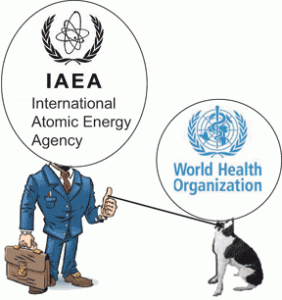
In reality, IAEA is a commercial lobbying org promoting use of the atom, yet at the same time, it dictates WHO procedures, standards, and published articles on the matter of nuclear radiation, prompting a very pregnant question: Is this a conflict of interest for WHO? Answer: Yes, it is!
Not only is there a serious conflict of interest, Katz claims WHO fails, time and again, to meet its mandate to the public, as for example:
1) WHO remained absent from Chernobyl for five years even though the WHO mandate requires it to be present the “day after a catastrophe” to evaluate and provide assistance. But, WHO was MIA for 5 years.
2) WHO does not issue independent reports on radiation issues. All nuclear-related reports are written by IAEA but published “in the name of the WHO.”
3) Following Chernobyl, there were two international conferences held to analyze the implications of the catastrophe; one held in Geneva in 1995 and the second in Kiev in 2001. The “Proceedings of the Conferences” were never published by WHO.

 Hidden Radiation Secrets of the World Health Organization, CounterPunch by ROBERT HUNZIKER, MAY 2, 2017
 Imagine the following hypothetical: The World Health Organization (“WHO”) is deeply involved in a high level cover up of the human impact and dangers of ionizing radiation, intentionally hiding the facts from the public, a chilling storyline!
After all, the world community depends upon WHO as an independent org t0 forewarn the general public of health dangers and to help in times of crises, not hide pivotal health facts from public eye.
As it happens, that nightmarish hypothetical comes to life in an interview with Alison Katz, who claims: “We are absolutely convinced that if the consequences of nuclear radiation were known to the public, the debate about nuclear power would end tomorrow. In fact, if the public knew, it would probably be excluded immediately as an energy option.”
Alison Katz heads a NGO known as Independent WHO, and she spends a lot of time arranging sandwich boards with messages like: “Complicity in Scientific Crime” or “Crime of Chernobyl – WHO Accomplice” in front of WHO headquarters/Geneva. For 10 years now on a daily vigil from 8:00-to-6:00 she and/or other protestors expose alleged misbehavior committed by WHO, right outside of the headquarters building. Imagine this: Ten years on the same street corner every working day. It’s commitment and determination sans pareil.
“The aim of the silent vigil is to remind the World Health Organisation of its duties. It was Hippocrates who formulated the ethical rules for health practitioners. The World Health Organisation ignores these rules, when it comes to protecting the health of the victims of the consequences of the nuclear industry”.
Which brings forth: Ten years of hard work combating a difficult and challenging issue warrants public adulation beyond carrying posters back and forth, come rain or shine, trudging away in the heat of the sun or the freezing cold and snow in front of WHO Hdqs. Hopefully, this article serves that purpose for Alison Katz.
The mission of Independent WHO is to expose WHO’s failings whilst calling for WHO independence away from influence by the worldwide nuclear syndicate: According to WHO Independence’s Web Site: “The World Health Organization (WHO) is failing in its duty to protect those populations who are victims of radioactive contamination.”
Ms Katz worked inside the WHO for 18 years. She insists that WHO, in cahoots with IAEA (International Atomic Energy Agency), dangerously misrepresents the inherent dangers of ionizing radiation, an insinuation that smacks in the face with egregiousness galore.
Ms Katz’s April 2017 interview, which this article is based upon, can be heard in its entirety.
This article condenses and summarizes her one-hour interview. As such, according to Ms Katz: “The health consequences of nuclear activity, whether they are civil or military, are not known to the public… There has been a very high level cover up… including the WHO.”
For over 50 years WHO provided “a clean bill of health for nuclear power.” However, according to Ms Katz, that clean bill of health is not based upon independent science. It’s based upon “pseudo science” manipulated and largely controlled by the nuclear lobby and International Atomic Energy Agency, the Queen Bee of the pro-nuke Hive.
Furthermore, within the “United Nations family hierarchy,” WHO is entirely subservient to IAEA. In turn, IAEA reports to the Security Council of the UN or the very top echelon of the power hierarchy of the world, including France, China, UK, U.S., and the Russian Federation. Far and away, these are the world’s biggest nuke heads.
Connecting the dots leaves one breathless within a telling trail of pro-nuke advocacy of the highest order… hm-m-m, thus raising the question: How is it humanly possible for WHO to objectively, impartially, squarely and soberly analyze and recommend ionizing radiation issues on behalf of the general public?
Is it at all possible, even a little bit?
As it goes, the IAEA has two mandates, which sound innocent enough: (1) to prevent proliferation of nuclear power and (2) promotion of the use of the atom on a peaceful basis, ah-ah-ah… oh well, never mind. In reality, IAEA is a commercial lobbying org promoting use of the atom, yet at the same time, it dictates WHO procedures, standards, and published articles on the matter of nuclear radiation, prompting a very pregnant question: Is this a conflict of interest for WHO? Answer: Yes, it is! WHO is a creature of the dictates of IAEA, which is the world’s largest promoter of the atom. Whereas, WHO is supposed to “independently serve the public interest,” not kowtow to a nuclear advocacy powerhouse that reports to nuclear powerhouse countries that have a deepening love affair with nuclear power, warts and all.
For example, sixty (60) reactors are currently under construction in fifteen countries. In all, one hundred sixty (160) power reactors are in the planning stage and three hundred (300) more have been proposed. That’s a love affaire.
Meanwhile, as for WHO’s mandate: It serves as the leading authority of standards for public health, coordinating research, advising member states, and formulating ionizing radioactivity health policies. However, IAEA has been usurping WHO’s mandate for the past 50 years. In fact, a 1959 Agreement (WHA 12-40) between the two says WHO needs prior approval of IAEA before taking any action or publishing material dealing with nuclear, period!
As a result of this 50-year conflict of interest, which is deeply embedded by now, Ms Katz claims WHO must, absolutely must, become independent, thus breaking the stranglehold of numero uno promoter of nuclear power over WHO, which is mandated to serve the public, not IAEA.
Not only is there a serious conflict of interest, Katz claims WHO fails, time and again, to meet its mandate to the public, as for example:
1) WHO remained absent from Chernobyl for five years even though the WHO mandate requires it to be present the “day after a catastrophe” to evaluate and provide assistance. But, WHO was MIA for 5 years.
2) WHO does not issue independent reports on radiation issues. All nuclear-related reports are written by IAEA but published “in the name of the WHO.”
3) Following Chernobyl, there were two international conferences held to analyze the implications of the catastrophe; one held in Geneva in 1995 and the second in Kiev in 2001. The “Proceedings of the Conferences” were never published by WHO; thus, never made public even though WHO claims the proceedings are publicly available. Confusing? Yes! To this day, the relevant question remains: What did “the analyses” show?
As a result of WHO’s egregious conflicts, the world community has no independent arms-length source on nuclear radiation. That is a situation fraught with conflict and extremely difficult to accept, sans grimacing with a lot of teeth grinding.
Once again, with emphasis: There is no independent international authority reporting to the public on nuclear radiation…. none whatsoever. All information about nuclear radiation ultimately comes from the primary users/promoters of nuclear power even though they have a very big heavy axe to grind.
Of course, there are independent scientists, but they face enormous obstacles in coming forward with the truth, thereby risking monetary grants and risking personal positions, as well as family livelihood.
Not only that, but over the years all departments within WHO that dealt with nuclear radiation have been highly compromised. Even worse, according to Ms Katz, no senior radiation scientists work for WHO, none… nada.
What constitutes the “nuclear establishment” is a fair question; it consists of the major governments of the world like France and the U.S but led by the International Commission on Radiological Protection (ICRP), the top dog, establishing standards for the world. Strangely enough, there are no health experts at ICRP, prompting a logical question: Why not?
There is more to be concerned about, e.g., another shocking fact regarding ICRP, as if there are not already enough shockers with the thread that runs throughout nuclear power’s closely-knit network: Even though “ionizing radiation is mutagenic and always causes mutations, causing damage at the cellular level, there are no molecular biologists working in the ICRP” (Katz). Thus, the world’s largest institution for determination of radiation standards for the public has no molecular biologists on staff. That fact is beyond belief, an eye-opener beyond all other eye-openers.
It’s almost as if the regulators don’t give a damn about the effects of radiation on the general public. Do they?………….
Fukushima…….
Consequences of Chernobyl……..
Effects of Radiation
The genetic effects of radiation likely exceed anything understood by the general public, as WHO and other health orgs do not properly educate the public about radiation’s risks: “The genetic effects, far from diminishing with time, increase” (Katz), which is extra bad.
Years of research around Chernobyl show that the genetic impact of radiation to the human body becomes much, much worse as time passes. Thus, “radiation is both a continuing and a worsening catastrophe as time passes” (Katz). Radiation’s impact gets worse over time; it does not heal, does not dissipate, does not go away; it grows progressively worse, like the film sequels to Godzilla, which was conceived as a metaphor for nuclear weapons in the early 1950s.
Indisputably, all organ systems of the human body are affected by radioactive contamination. Cancer is not the only nasty result of radiation exposure. Radioactive contamination affects the entire human immune system from head to toe, thus impacting every organ system in the body, e.g. musculoskeletal, etc. This damage to organs is in addition to the various cancer risks.
After all, consider this, 30 years after the fact, horribly deformed Chernobyl Children are found in over 300 asylums in the Belarus backwoods deep in the countryside.
Equally as bad but maybe more odious, as of today, Chernobyl radiation, since 1986, is already affecting 2nd generation kids.
According to a USA Today article, Chernobyl’s Legacy: Kids With Bodies Ravaged by Disaster, April 17, 2016: “There are 2,397,863 people registered with Ukraine’s health ministry to receive ongoing Chernobyl-related health care. Of these, 453,391 are children — none born at the time of the accident. Their parents were children in 1986. These children have a range of illnesses: respiratory, digestive, musculoskeletal, eye diseases, blood diseases, cancer, congenital malformations, genetic abnormalities, trauma.”
It’s taken 30 years for the world, via an article in USA Today, to begin to understand how devastating, over decades, not over a few years, radiation exposure is to the human body. It is a silent killer that cumulates in the body over time and passes from generation to generation to generation, endless destruction that cannot be stopped.
Where is WHO is kinda like Where is Waldo, but sadly the effects of ionizing radiation are not part of a game. It is deadly serious, forevermore. In the meanwhile, Fukushima irradiates and irradiates, limitlessly and so far, unstoppable. Where does its radiation go?
Robert Hunziker lives in Los Angeles and can be reached at roberthunziker@icloud.com http://www.counterpunch.org/2017/05/02/hidden-radiation-secrets-of-the-world-health-organization/
May 3, 2017
Posted by Christina Macpherson |
2 WORLD, Reference, secrets,lies and civil liberties |
Leave a comment
 Hidden Radiation Secrets of the World Health Organization, CounterPunch by ROBERT HUNZIKER, MAY 2, 2017
“………..WHO held a Chernobyl Forum in 2004 designed to “end the debate about the impact of Chernobyl radiation” whilst WHO maintains that 50 people died.
Here’s the final conclusion of that Chernobyl Forum ‘04: The mental health of those who live in the area is the most serious aftereffect, leading to strong negative attitudes and exaggerated sense of dangers to health and of exposure to radiation. Mental health was thus identified as the biggest negative aftereffect.
Because that conclusion is so brazenly bizarre, the Chernobyl Forum ‘04 must’ve been part of an alternative universe, way out there beyond the wild blue yonder, maybe the Twilight Zone or maybe like entering a scene in Jan Švankmajer’s Alice, a dark fantasy film loose adaptation of Lewis Carroll’s Alice in Wonderland.
Here’s reality: Chernobyl Liquidators fought the Chernobyl disaster. Eight hundred thousand (800,000) Liquidators from the former USSR, largely recruits from the army, with average age of 33, fought the Chernobyl disaster.
According to an interview (2016) with a Liquidator, “We were tasked with the deactivation of the third and fourth reactors, but we also helped build the containment sarcophagus. We worked in three shifts, but only for five to seven minutes at a time because of the danger. After finishing, we’d throw our clothes in the garbage” (Source: Return to Chernobyl With Ukraine’s Liquidators, Aljazeera, April 25, 2016).
“Estimates of the number of liquidators who died or became ill as a result of their work vary substantially, but the men of the 633rd say that out of the 259 from their group, 71 have died. Melnik says that 68 have been designated as invalids by a state committee, which investigates their health and determines whether or not their diseases are attributable to Chernobyl… Dr Dimitry Bazyka, the current director-general of the National Research Centre for Radiation Medicine in Kiev, says that approximately 20,000 liquidators die each year,” Ibid.
As for total deaths, the Chief Medical Officer of the Russian Federation reported that 10% of its Chernobyl Liquidators were dead by 2001. The disaster occurred in 1986 with 80,000 dead within 16 years. Authorities out of Ukraine and Belarus confirmed Russian death numbers. Yet, WHO claims 50 died.
Eighty-thousand (80,000) Liquidators, as of 16 years ago, dead from Chernobyl, and that body count, according to Ms Katz, leaves out the people most contaminated by Chernobyl, meaning evacuees and also 57% of the fallout for Chernobyl came down outside of the USSR, Belarus, and Ukraine, and in 13 European countries 50% of the countryside was dangerously contaminated.
As for studies of the radiation impact of Chernobyl: “Thousands of independent studies in Ukraine, Belarus, and the Russian Federation and in many other countries, that were contaminated to varying degrees by radionuclides, have established that there has been significant increase in all types of cancer, in diseases of the respiratory, gastrointestinal, urogenital, endocrine immune, lymph node nervous systems, prenatal, perinatal, infant child mortality, spontaneous abortions, deformities and genetic anomalies….” (Katz)
Hence, WHO’s handling and analysis and work on Chernobyl leaves the curious-minded speechless, open-mouthed, agape, and confounded……..http://www.counterpunch.org/2017/05/02/hidden-radiation-secrets-of-the-world-health-organization/
May 3, 2017
Posted by Christina Macpherson |
2 WORLD, Belarus, Reference, spinbuster, Ukraine |
Leave a comment
Lakes worldwide feel the heat from climate change, Warming waters are disrupting freshwater fishing and recreation, Science News ,BY ALEXANDRA WITZE MAY 1, 2017 “……..
When most people think of the physical effects of climate change, they picture melting glaciers, shrinking sea ice or flooded coastal towns (SN: 4/16/16, p. 22). But observations like those at Stannard Rock are vaulting lakes into the vanguard of climate science. Year after year, lakes reflect the long-term changes of their environment in their physics, chemistry and biology. “They’re sentinels,” says John Lenters, a limnologist at the University of Wisconsin–Madison.
Globally, observations show that many lakes are heating up — but not all in the same way or with the same ecological consequences. In eastern Africa, Lake Tanganyika is warming relatively slowly, but its fish populations are plummeting, leaving people with less to eat. In the U.S. Upper Midwest, quicker-warming lakes are experiencing shifts in the relative abundance of fish species that support a billion-dollar-plus recreational industry. And at high global latitudes, cold lakes normally covered by ice in the winter are seeing less ice year after year — a change that could affect all parts of the food web, from algae to freshwater seals.
Understanding such changes is crucial for humans to adapt to the changes that are likely to come, limnologists say. Indeed, some northern lakes will probably release more methane into the air as temperatures rise — exacerbating the climate shift that is already under way.
Lake layers
Lakes and ponds cover about 4 percent of the land surface not already covered by glaciers. That may sound like a small fraction, but lakes play a key role in several planetary processes. Lakes cycle carbon between the water’s surface and the atmosphere. They give off heat-trapping gases such as
carbon dioxide and methane, while simultaneously tucking away carbon in decaying layers of organic muck at lake bottoms. They bury nearly half as much carbon as the oceans do.
Yet the world’s more than 100 million lakes are often overlooked in climate simulations. That’s surprising, because lakes are far easier to measure than oceans. Because lakes are relatively small, scientists can go out in boats or set out buoys to survey temperature, salinity and other factors at different depths and in different seasons.
A landmark study published in 2015 aimed to synthesize these in-water measurements with satellite observations for 235 lakes worldwide. In theory, lake warming is a simple process: The hotter the air above a lake, the hotter the waters get. But the picture is far more complicated than that, the international team of researchers found.
Globally, observations show that many lakes are heating up — but not all in the same way or with the same ecological consequences. In eastern Africa, Lake Tanganyika is warming relatively slowly, but its fish populations are plummeting, leaving people with less to eat. In the U.S. Upper Midwest, quicker-warming lakes are experiencing shifts in the relative abundance of fish species that support a billion-dollar-plus recreational industry. And at high global latitudes, cold lakes normally covered by ice in the winter are seeing less ice year after year — a change that could affect all parts of the food web, from algae to freshwater seals.
Understanding such changes is crucial for humans to adapt to the changes that are likely to come, limnologists say. Indeed, some northern lakes will probably release more methane into the air as temperatures rise — exacerbating the climate shift that is already under way.
Lake layers
Lakes and ponds cover about 4 percent of the land surface not already covered by glaciers. That may sound like a small fraction, but lakes play a key role in several planetary processes. Lakes cycle carbon between the water’s surface and the atmosphere. They give off heat-trapping gases such as
carbon dioxide and methane, while simultaneously tucking away carbon in decaying layers of organic muck at lake bottoms. They bury nearly half as much carbon as the oceans do.
Yet the world’s more than 100 million lakes are often overlooked in climate simulations. That’s surprising, because lakes are far easier to measure than oceans. Because lakes are relatively small, scientists can go out in boats or set out buoys to survey temperature, salinity and other factors at different depths and in different seasons.
A landmark study published in 2015 aimed to synthesize these in-water measurements with satellite observations for 235 lakes worldwide. In theory, lake warming is a simple process: The hotter the air above a lake, the hotter the waters get. But the picture is far more complicated than that, the international team of researchers found.
On average, the 235 lakes in the study warmed at a rate of 0.34 degrees Celsius per decade between 1985 and 2009. Some warmed much faster, like Finland’s Lake Lappajärvi, which soared nearly 0.9 degrees each decade. A few even cooled, such as Blue Cypress Lake in Florida. Puzzlingly, there was no clear trend in which lakes warmed and which cooled. The most rapidly warming lakes were scattered across different latitudes and elevations.
Even some that were nearly side by side warmed at different rates from one another — Lake Superior, by far the largest of the Great Lakes, is warming much more rapidly, at a full degree per decade, than others in the chain, although Huron and Michigan are also warming fast.
“Even though lakes are experiencing the same weather, they are responding in different ways,” says Stephanie Hampton, an aquatic biologist at Washington State University in Pullman.
Such variability makes it hard to pin down what to expect in the future. But researchers are starting to explore factors such as lake depth and lake size (intuitively, it’s less teeth-chattering to swim in a small pond in early summer than a big lake).
Depth and size play into stratification, the process through which some lakes separate into layers of different temperatures. …….https://www.sciencenews.org/article/lakes-worldwide-feel-heat-climate-change?tgt=nr
May 3, 2017
Posted by Christina Macpherson |
2 WORLD, climate change, Reference, water |
Leave a comment
The hard truth, however, is that the Arctic as it is known today is almost certainly gone. Efforts to mitigate global warming by cutting emissions remain essential. But the state of the Arctic shows that humans cannot simply undo climate change. They will have to adapt to it
 The Arctic as it is known today is almost certainly gone On current trends, the Arctic will be ice-free in summer by 2040 http://www.economist.com/news/leaders/21721379-current-trends-arctic-will-be-ice-free-summer-2040-arctic-it-known-today?fsrc=scn/tw/te/bl/ed/climatechangethearcticasitisknowntodayisalmostcertainlygone Apr 29th 2017

THOSE who doubt the power of human beings to change Earth’s climate should look to the Arctic, and shiver. There is no need to pore over records of temperatures and atmospheric carbon-dioxide concentrations. The process is starkly visible in the shrinkage of the ice that covers the Arctic ocean. In the past 30 years, the minimum coverage of summer ice has fallen by half; its volume has fallen by three-quarters. On current trends, the Arctic ocean will be largely ice-free in summer by 2040.
Climate-change sceptics will shrug. Some may even celebrate: an ice-free Arctic ocean promises a shortcut for shipping between the Pacific coast of Asia and the Atlantic coasts of Europe and the Americas, and the possibility of prospecting for perhaps a fifth of the planet’s undiscovered supplies of oil and natural gas. Such reactions are profoundly misguided. Never mind that the low price of oil and gas means searching for them in the Arctic is no longer worthwhile. Or that the much-vaunted sea passages are likely to carry only a trickle of trade. The right response is fear. The Arctic is not merely a bellwether of matters climatic, but an actor in them (see Briefing).
The current period of global warming that Earth is undergoing is caused by certain gases in the atmosphere, notably carbon dioxide. These admit heat, in the form of sunlight, but block its radiation back into space, in the form of longer-wavelength infra-red. That traps heat in the air, the water and the land. More carbon dioxide equals more warming—a simple equation. Except it is not simple. A number of feedback loops complicate matters. Some dampen warming down; some speed it up. Two in the Arctic may speed it up quite a lot.
One is that seawater is much darker than ice. It absorbs heat rather than reflecting it back into space. That melts more ice, which leaves more seawater exposed, which melts more ice. And so on. This helps explain why the Arctic is warming faster than the rest of the planet. The deal on climate change made in Paris in 2015 is meant to stop Earth’s surface temperature rising by more than 2°C above pre-industrial levels. In the unlikely event that it is fully implemented, winter temperatures over the Arctic ocean will still warm by between 5° and 9°C compared with their 1986-2005 average.
The second feedback loop concerns not the water but the land. In the Arctic much of this is permafrost. That frozen soil locks up a lot of organic material. If the permafrost melts its organic contents can escape as a result of fire or decay, in the form of carbon dioxide or methane (which is a more potent greenhouse gas than CO2). This will speed up global warming directly—and the soot from the fires, when it settles on the ice, will darken it and thus speed its melting still more.
Dead habitat walking
A warming Arctic could have malevolent effects. The world’s winds are driven in large part by the temperature difference between the poles and the tropics. If the Arctic heats faster than the tropics, this difference will decrease and wind speeds will slow—as they have done, in the northern hemisphere, by between 5 and 15% in the past 30 years. Less wind might sound desirable. It is not. One consequence is erratic behaviour of the northern jet stream, a circumpolar current, the oscillations of which sometimes bring cold air south and warm air north. More exaggerated oscillations would spell blizzards and heatwaves in unexpected places at unexpected times.
Ocean currents, too, may slow. The melting of Arctic ice dilutes salt water moving north from the tropics. That makes it less dense, and thus less inclined to sink for the return journey in the ocean depths. This slowing of circulation will tug at currents around the world, with effects on everything from the Indian monsoon to the pattern of El Niño in the Pacific ocean.
The scariest possibility of all is that something happens to the ice cap covering Greenland. This contains about 10% of the world’s fresh water. If bits of it melted, or just broke free to float in the water, sea levels could rise by a lot more than today’s projection of 74cm by the end of the century. At the moment, the risk of this happening is hard to assess because data are difficult to gather. But loss of ice from Greenland is accelerating.
What to do about all this is a different question. Even if the Paris agreement is stuck to scrupulously, the amount of carbon dioxide already in the atmosphere, together with that which will be added, looks bound eventually to make summer Arctic sea ice a thing of the past. Some talk of geoengineering—for example, spraying sulphates into the polar air to reflect sunlight back into space, or using salt to seed the creation of sunlight-blocking clouds. Such ideas would have unknown side-effects, but they are worth testing in pilot studies.
The hard truth, however, is that the Arctic as it is known today is almost certainly gone. Efforts to mitigate global warming by cutting emissions remain essential. But the state of the Arctic shows that humans cannot simply undo climate change. They will have to adapt to it.
May 1, 2017
Posted by Christina Macpherson |
ARCTIC, climate change, Reference |
Leave a comment
Fracking kills newborn babies – polluted water likely cause http://www.theecologist.org/News/news_round_up/2988876/fracking_kills_newborn_babies_polluted_water_likely_cause.html, Oliver Tickell, 25th April 2017 A new study in Pennsylvania, USA shows that fracking is strongly related to increased mortality in young babies. The effect is most pronounced in counties with many drinking water wells indicating that contamination by ‘produced water’ from fracking is a likely cause. Radioactive pollution with uranium, thorium and radium is a ‘plausible explanation’ for the excess deaths.
A new study of Pennsylvania counties published today in the Journal of Environmental Protection shows for the first time that contamination from fracking kills babies.
The Marcellus shale area of Pennsylvania was one of the first regions where novel gas drilling involving hydraulic fracturing of sub-surface rock, now termed ‘fracking’, was carried out.
The epidemiological study by Christopher Busby and Joseph Mangano examines early infant deaths 0-28 days before and after the drilling of fracking wells, using official data from the US Centre for Disease Control to compare the immediate post-fracking four year period 2007-2010 with the pre-fracking four-year period 2003-2006.
Results showed a statistically significant 29% excess risk of dying age 0-28 days in the ten heavily fracked counties of Pennsylvania during the four-year period following the development of fracking gas wells. Over the same period, the State rate declined by 2%. They conclude:
“There were about 50 more babies died in these 10 counties than would have been predicted if the rate had been the same over the period as all of Pennsylvania, where the incidence rate fell over the same period.”
Radioactive water pollution to blame?
The Marcellus shale beneath Pennsylvania was one of the first areas where fracking began. Only 44 fracking wells were drilled before 2007, while 2,864 were drilled in 2007-2010.
The cause of the excess mortality is not proven in the study, however the authors point out that the fracking production process releases naturally occurring radioactive materials from shale strata which then contaminate groundwater.
These include radium, uranium, thorium and radon, an intensely radioactive gas which decays into radioactive ‘daughters’ with a half life of under four days. And as the authors write, fracking “involves the explosive destruction of large volumes of underground gas and oil retaining rocks and the pumping down of large amounts of what is termed ‘produced water’ which initially contains various chemical and sand additives.
“This produced water and backflow returns to the surface with a high load of dissolved and suspended solids including naturally occurring radioactive elements … The contaminated water has to be safely disposed of but this is often associated with violations of legal disposal constraints.”
Baby mortality related to exposure through water wells
In the five heavily-fracked counties in the northeast part of the state (Susquehanna, Bradford, Wyoming, Lycoming and Tioga), the number of deaths from 2003-2006 vs. 2007-2010 climbed from 36 to 60, a statistically significant rate increase of 66%.
The rate in the five counties in southwest Pennsylvania (Washington, Westmoreland, Greene, Butler and Fayette) rose 18%, from 157 to 178 deaths, though this increase was not statistically significant.
This divergence in relative risk between the heavily fracked NE and SW counties was initially perplexing, however the authors noticed the higher dependence on private water wells (potentially contaminated with frackiing fluids) for drinking water and other needs in the first region compared to the second.
In the NE group of counties , the number of water wells per birth ranged from 4.9 to 13.5, compared to 1.1 to 3 in the SW group of countries. Their chart of Relative Risk for early infant mortality after fracking (see image above right) plotted against ‘exposure’ defined as ‘water wells per birth’ on a county by county basis produced a straight-line graph – indicated a strong relation to increased mortality and exposure to groundwater.
Table [on original]: Water wells per birth and violations per annual birth in highly fracked Pennsylvania Counties.
They conclude: “The results therefore seem to support the suggestion that the vector for the effect is exposure to drinking water from private wells. This is a mechanistically plausible explanation. However the findings do not prove such a suggestion. We may examine other possible explanations for possible health effects which have been advanced.”
While radioactive pollution is carefully examined, the authors acknowledge alternatives including “the existence of chemical contaminants in the produced water” which they consider a “possible but unknown factor.”
Serious questions raised over health hazards of fracking
“A major component of early infant mortality is congenital malformation, e.g., heart, neurological, and kidney defects. These are known to be caused by exposures to Radium and Uranium in drinking water”, said Christopher Busby.
“Infant death rates were significantly high in highly-fracked counties in northeast Pennsylvania, those with the greatest density of private water wells, suggesting it is drinking water contamination driving the effect.”
Joseph Mangano added: “These results raise serious questions about potential health hazards of fracking, especially since the fetus and infant are most susceptible to environmental pollutants. This is a public health issue which should be investigated wherever fracking is being carried out or proposed.”
The result is expected to have significant insurance, investment, economic and downstream political implications in the US and other countries.
The study: ‘There’s a world going on underground-infant mortality and fracking in Pennsylvania‘ is by Busby C C and Mangano J J and published in the Journal of Environmental Protection 8(4) 2017. doi: 10.4236/jep.2017.84028
Dr Busby is the Scientific Secretary of the European Committee on Radiation Risk www.ecrr.eu and is Scientific Director of Environmental Research SIA, based in the Latvian National Academy of Sciences, Riga, Latvia. Busby’s CV can be found here.
April 29, 2017
Posted by Christina Macpherson |
children, Reference, USA |
Leave a comment
The harvests of Chernobyl, Aeon, Thirty years after the nuclear disaster, local berry-pickers earn a good living. What’s the hidden cost of their wares?, Kate Brown, is associate professor of history at the University of Maryland, Baltimore County, and the author of Plutopia (2013). Olha Martynyuk is a historian at the National Technical University of Ukraine.
You can’t miss the berry-pickers in the remote forests of northern Ukraine, a region known as Polesia. They ride along on bicycles or pile out of cargo vans. They are young, mostly women and children, lean and suntanned, with hands stained a deep purple. And they are changing the landscape around them. Rural communities across eastern Europe are struggling economically, but the Polesian towns are booming with new construction. Two hundred miles west of the Chernobyl Nuclear Power Plant, thousands of mushroom- and berry-pickers are revving up the local economy. As they forage, they are even changing the European diet, in ways both culinary and radiological.
The rise of the Polesian pickers adds a strange twist to the story that began on 26 April 1986, when an explosion at the Chernobyl plant blew out at least 50 million curies of radioactive isotopes. Soviet leaders traced out a 30 kilometre radius around the stricken reactor and emptied it of its residents. Roughly 28,000 square kilometres outside this exclusion zone were also contaminated. In total, 130,000 people were resettled, but hundreds of thousands remained on irradiated territory, including the Polesian towns of Ukraine’s Rivne Province. In 1990, Soviet officials resolved to resettle several hundred thousand more residents but ran out of money to carry out new mass evacuations.
Last summer, we went to Rivnе to talk to people who in the late 1980s wrote petitions begging for resettlement. In the letters, which we had found in state archives in Kiev and Moscow, writers expressed worries about their health and that of their children, while describing a sense of abandonment. Help never arrived; the Chernobyl accident came just as the Soviet state began to topple economically and politically……..
Anyone in Polesia can pick anywhere, as long as they are willing to brave the radioactive isotopes. After Chernobyl, Soviet officials strongly discouraged picking berries in contaminated forest areas, which promised to remain radioactive for decades. As the years passed, fewer and fewer people heeded the warnings. In the past five years, picking has grown into a booming business as new global market connections have enabled the mass sale of berries abroad. A person willing to do the hard work of stooping 10 hours a day and heaving 40-pound boxes of fruit to the road can earn good money. The women and child pickers are revitalising the Polesian economy on a modest, human-powered scale. They are quietly and unceremoniously doing what development agencies and government programmes failed to do: restoring commercial activity to the contaminated territory around the Chernobyl Zone.
We followed the pickers into the woods. …….
Reliance on the forest for a living is an ancestral tradition in Polesia. Because of the mineral-poor soils, traditional farming never thrived here. Instead, Polesians subsisted on game, fish, berries, herbs and mushrooms while making their tools and homes from wood and clay. What is new in the past few years is the industrial-sized scale of berry harvesting. A typical roadside berry-buyer purchases about two tons of berries a day in season, and there are hundreds of buyers. In 2015, Ukraine exported 1,300 tons of fresh berries and 17,251 tons of frozen berries to the European market – more than 30 times as much as in 2014. Ukraine is now one of biggest exporters of blueberries to the EU.
That success is all the more remarkable because Polesian berries are not just any berries. They grow in radioactive soils, which means that they carry some of Chernobyl’s legacy in them. We showed up at a berry wholesaler in the boom town of Rokytne and noticed a radiation monitor who was stationed to meet buyers at the loading dock. The situation there was tense. As the monitor waved a wand over each box of berries, measuring their gamma ray emission, she set aside about half of the boxes. The buyers argued with her, trying to lower the count on their berries: ‘It’s not the berries that are radiating. It’s my trailer. Measure it over there.’
We asked the monitor, a young townswoman, how many berries come up radioactive. ‘All the berries from Polesia are radioactive,’ she replied, ‘but some are really radioactive. We’ve had berries measure over 3,000!’ She could not describe what units she was referring to, microsieverts or microrems; she only knew which numbers were bad. ‘The needle has to be between 10 and 15,’ she said, vaguely pointing to her wand, ‘and then I place it in this machine.’ She gestured toward a small mass spectrometer. ‘If the readout is more than 450, then the berries are over the permissible level.’
Contrary to our assumption, the berries rejected as too radioactive were not discarded, but were merely placed aside. Then they, too, were weighed and sold, just at lower prices. The wholesalers we spoke to said that the radioactive berries were used for natural dyes. The pickers claimed the hot berries were mixed with cooler berries until the assortment came in under the permissible level. The berries could then legally be sold to Poland to enter the European Union (EU) market, even if some individual berries measured five times higher than the permissible level. Such mixing is legal as long as the overall mix of berries falls within the generous limit of 600 becquerel per kilogram set by the EU after the Chernobyl disaster.
No one, certainly no official, ever envisioned revitalising the economy by exploiting berries and mushrooms. Months after the 1986 accident, Soviet scientists determined that forest products were the most radioactive of all edible crops, and banned their consumption. However, villagers in Polesia never stopped harvesting berries and mushrooms (as well as game and fish) from the forests outside the fenced-off Chernobyl Zone. Women sold their produce surreptitiously at regional markets, deftly avoiding the police who learned to identify Polesians by their homemade baskets……..
AQlthough the Polesian berries meet EU standards, it remains unclear how healthy life is for those living in the Rivne Province. Official publications of the World Health Organization and the International Atomic Energy Agency assert that radiation levels in Polesia are too low to cause health damage other than a slight rise in the chance of cancer. However, that judgment is based on reference studies of Hiroshima and Nagasaki victims, not on local research in the Chernobyl zones. Wladimir Wertelecki, a geneticist at the University of California, San Diego, has spent the past 16 years tracking every recorded birth in the Rivne Province. ‘Hiroshima was just one big X-ray. It doesn’t compare to the doses of people in Polesia who ingest radioactive isotopes every day,’ he says. He thinks that the slow-drip exposure of organs to radioactive isotopes over decades makes for a far more damaging exposure than the single, external Hiroshima dose.
Researchers in Wertelecki’s group and those working on small, usually minimally financed medical studies have found that low doses of ingested radiation tend to concentrate in vital organs that keenly impact on important body functions. Yury Bandazhevsky, a pioneer in studying the health impacts of Chernobyl, has recorded a correlation between the incorporation of radioactive cesium in children’s bodies and heart disease in Belarus and Ukraine. Wertelecki and the Ukrainian medical researcher Lyubov Yevtushok discovered that in the six Polesian regions of the Rivne Province, certain birth defects, such as microcephaly, conjoined twins and neural-tube disorders occur three times more frequently than is the European norm. ‘We did not prove with this study that radiation causes birth defects. We just have a concurrence, not proof, of cause and effect,’ Wertelecki says. Nevertheless, he considers the concurrence statistically strong enough to warrant large-scale epidemiological studies that could prove or disprove whether the birth defects were caused by radiation.
Despite the fact that the nuclear disaster presented scientists with a unique living laboratory, few funding agencies have been willing to finance Chernobyl studies on non-cancerous health effects; based on Japanese bomb-survivor research, industry scientists have insisted that there would be no measurable non-malignant impacts. In Chernobyl-contaminated Polesia, however, few people doubt that ingesting radioactive toxins over decades has a biological cost.
Galina, the woman who declared that there was ‘no Chernobyl’, changed her view later when talking about her own health. Trim and fit at the age of 50, she had a stroke followed by two surgeries for ‘women’s cancer’. About her cancers, she said: ‘All of a sudden, they started growing day by day. I asked the doctors if they’d hold up the operation until autumn [after the harvest], but they said I’d be dead by then. Probably, these problems were caused by radiation. It does have an effect, apparently.’ Even less is known about non-cancer health impacts from Chernobyl. Many locals complain of aching and swollen joints, headaches, chronic fatigue and legs that mysteriously stop moving. There have been almost no studies investigating these vague complaints…….
here has been little public discussion and almost no medical research on the long-term, low-dose ingestion of radioactive isotopes. Presumably exporting the berries helps the people of Polesia, but for now there is no hard proof……
The mass marketing of radioactive Polesian forest products is an unexpected outcome of policies aimed at finalising the disaster. It is a development that disputes the focus on Chernobyl as a ‘place’. Rather, Chernobyl is an event, an ongoing occurrence that transpires as long as the radioactive energy released in the accident continues to decay……https://aeon.co/essays/ukraine-s-berry-pickers-are-reaping-a-radioactive-bounty
April 28, 2017
Posted by Christina Macpherson |
environment, Reference, Ukraine |
1 Comment
The numbers of cases rose into the thousands, too high to dismiss, and in 1996 the WHO and the IAEA finally admitted that skyrocketing rates of childhood thyroid cancer were most likely due to Chernobyl exposures.
Today we know little about the non-cancerous effects that Soviet scientists working in contaminated zones reported in the late 1980s, and which they attributed to internal and external exposures to ionizing radiation. Are these effects as real as the childhood thyroid cancers proved to be? The Soviet post-Chernobyl medical records suggest that it is time to ask a new set of questions about long-term, low-dose exposures.
Chernobyl’s hidden legacy http://live.iop-pp01.agh.sleek.net/physicsworld/reader/#!edition/editions_Nuclear_2017/article/page-19330 Kate 
Brown is a historian at the University of Maryland, Baltimore County, US, e-mail kbrown@umbc.edu Historian Kate Brown argues that scientists should re-examine Soviet-era evidence of health effects from low doses of radiation
In June 1980 a doctor with the Oak Ridge Associated Universities in the US wrote a letter to a colleague at the Knolls Atomic Power Laboratory in upstate New York. The pair were corresponding about a forthcoming study of employee health at the Knolls reactor, and the doctor, C C Lushbaugh, wrote that he expected “little ‘useful’ knowledge” from this study “because radiation doses have been so low”. Even so, he agreed that the study had to be done because “both the workers and their management need to be assured that a career involving exposures to low levels of nuclear radiation is not hazardous to one’s health”. The results of such a study, he surmised, would help to counter anti-nuclear propaganda and resolve workers’ claims. However, they could also be a liability. If a competing union or regulatory agency got hold of the employees’ health data, Lushbaugh fretted, it could be weaponized. “I believe,” he continued, “that a study designed to show the transgressions of management will usually succeed.”
Lushbaugh’s dilemma is characteristic of research on the human health effects of exposure to low doses of radiation. He assumed he knew the results – good or bad – before the study began, because those results depended on how the study was designed. The field was so politicized, in other words, that scientists were using health studies as polemical tools and, consequently, asking few open-ended scientific questions.
A few years after Lushbaugh posted this letter, reactor number four at the Chernobyl nuclear power plant blew up, killing 31 workers and firefighters and spreading radioactive material across a broad area of what was then the Soviet Union (now Ukraine and Belarus) and beyond. The accident also exploded the field of radiation medicine and, for a while, promised to rejuvenate it. In August 1986, months after the accident, the chief of the United Nations Scientific Committee on the Effects of Atomic Radiation (UNSCEAR), Giovanni Silini, advocated an enduring epidemiological investigation similar to research on atomic-bomb survivors in Japan [1]. Many other scientists concurred, hoping that Chernobyl could clear up ongoing controversies and uncertainties surrounding low-dose exposures.
It never happened. No long-term epidemiological study took place. That’s not to say there isn’t any information. A few summers ago I went to the Ukrainian national archives in the dusty, bustling outskirts of Kiev and asked the archivists for files on Chernobyl from Soviet Ukraine’s Ministry of Health. They laughed, telling me Chernobyl was a banned topic in the Soviet Union. “You won’t find anything,” they said.
They were wrong. I found dozens of collections labelled “The medical effects of the Chernobyl disaster”. I started reading and have not yet been able to stop.
The aftermath
In the years between 1986 and 1991, doctors and sanitation officials wrote to the Ministry of Health in Kiev with alarming accounts of widespread, chronic illness among the hundreds of thousands of children and adults living in contaminated territories. They recorded increases in tonsillitis, upper respiratory disease and disorders of the digestive tract and immune system. Between 1985 and 1988, cases of anaemia doubled. Physicians from almost every region in the zone of contamination reported a leap in the number of reproductive problems, including miscarriages, stillbirths and birth malformations. Nervous-system disorders surged. So did diseases of the circulatory system. In 1988, in the heavily contaminated Polesie region of northern Ukraine, 80% of children examined had upper respiratory diseases and 28% had endocrine problems. In Ivankiv, where many cleanup workers lived, 92% of all children examined had a chronic illness.
I also went to Minsk to check the archives in Belarus. There, I read reports that sounded eerily similar to the Ukrainian documents. These reports were classified “for office use only”, meaning that at the time, scientists were not free to exchange this information across districts or republics of the Soviet Union. Even so, independently, they were reporting similar, bad news. The problem grew so dire in Belarus that in 1990 officials declared the entire republic, which received more than 60% of Chernobyl fallout, a “zone of national ecological disaster”.
The Ukrainian and Belarusian reports, hundreds of them, read like a dirge from a post-catastrophic world. Doctors wrote from clinics in Kharkiv, far outside the contaminated zone, and described similar health problems among evacuees who had settled there. Physicians sent telegrams from Donetsk, where they were treating a complex of illnesses among young miners who had burrowed under the smouldering reactor in the days after the accident. Medical workers sent in to examine people in contaminated regions also fell ill.
In response, the Union of Soviet Radiologists penned a petition to alert Soviet leaders of the ongoing public health disaster. The president of the Belarusian Academy of Science sent a detailed summary of scientists’ findings to Minsk and Moscow. Even a KGB general, Mikhailo Zakharash, sounded the alarm. Zakharash, who was also a medical doctor, conducted a study of 2000 cleanup workers and their family members in a specially equipped KGB clinic in Kiev. In 1990, summing up four years of medical investigation, he wrote, “We have shown that long term, internal exposures of low doses of radiation to a practically healthy individual leads to a decline of his immune system and to a whole series of pathological illnesses.”
Chronic radiation
These findings track with what Soviet doctors had long described as chronic radiation syndrome, a complex of symptoms derived from chronic exposure to low doses of radiation. Researchers working on Chernobyl discerned a pattern of disease that tracked with pathways of radioactive isotopes entering the body, paths that began in either the mouth and headed towards the gastrointestinal tract or started in the lungs and followed blood into circulatory systems. Radioactive iodine sped to thyroids, they hypothesized, causing endocrinal and hormonal damage.
Critics, mostly in Moscow and the ministries of health, acknowledged the growth in health problems, but denied a connection to Chernobyl. A E Romanenko, the Ukrainian Minister of Health, is credited with inventing the word “radiophobia” to describe a public fear of radiation that induced stress-related illness. He and his colleagues also pointed to a screening effect from mass medical monitoring. Local doctors, they said, were projecting the diagnoses of chronic radiation syndrome onto their patients, blaming it for any illness found after Chernobyl.
There are some problems with these arguments. From 1986 to 1989, Chernobyl was a censored topic in the Soviet Union. Doctors could not exchange information about health problems, nor did they have access to maps of radioactive contamination. They only learned to be “radiophobic” by judging the bodies they examined. In the same years, doctors were also fleeing contaminated areas en masse, leaving hospitals and clinics in those regions staffed at 60%. As physicians left, so too did the chance for diagnosis, meaning that under-reporting of illnesses was more likely than a screening effect. Moreover, doctors from the northern regions of the Rivne province, which were at first judged clean and only in late 1989 designated contaminated, reported the same growth of illness as areas originally deemed “control zones,” regions with counts of more than 5 curies per square kilometre. The president of the Belarusian Academy of Science, V P Platonov, pointed to a vacuum of knowledge: “Until this time, no population has ever lived with continual internal and external exposures of this size.” Risk assessments assuring safe levels in the contaminated zones were extrapolated from the Japanese Atomic Bomb Survivor Lifespan Study, but these began only in 1950, five years after exposure. “Much is uncertain,” Platonov continued, “about fundamental aspects of the effects of low doses of radiation on human organs,” [2].
What happened to the 1980s Chernobyl health studies, which might have led to a renaissance in the field of radioecology? Essentially, they were overlooked. To figure out why, I went to the headquarters of the World Health Organization (WHO) in Geneva, to the UN’s archives in New York and the archives of UNSCEAR in Vienna. There, I found evidence of a conflict between branches of the WHO and the International Atomic Energy Agency (IAEA) over which organization would control the studies of Chernobyl health effects.
By 1989 angry crowds were questioning the Soviet Union’s handling of Chernobyl, and Soviet leaders asked foreign experts for help in assessing the disaster’s health impacts. The IAEA agreed, and Fred Mettler, a radiologist and American delegate to UNSCEAR, was appointed to head the medical section of an IAEA team. In 1990, as he and his team examined 1726 people in six contaminated zones and six control zones, Soviet doctors gave him 20 slides from children diagnosed with thyroid cancer. Thyroid cancer is very rare in children: before the Chernobyl accident, doctors saw eight or nine cases per year in all of Ukraine. Twenty cases in just three provinces was hard to believe. Dubious, Mettler brought the slides to the US to have them verified. They indeed indicated thyroid cancer.
Cancer cluster
Mettler mentioned this major medical finding in the 1991 International Chernobyl Project (ICP) technical report, but strangely, he also stated that there was “no clear pathologically documented evidence of an increase in thyroid cancer” [3]. The report concluded that there were no detectable Chernobyl health effects and only a probable chance of childhood thyroid cancers in the future. In a 1992 publication on thyroid nodules in the Chernobyl territories, Mettler failed to mention the 20 verified cases at all [4].
How could such a lapse occur? I found a confidential 1990 UN memo that seems relevant, particularly in light of the study-design problem set out in Lushbaugh’s letter a decade earlier. The memo suggests that the IAEA was conducting the ICP study to “allay the fears of the public” in service of “its own institutional interest for the promotion of peaceful uses of nuclear energy” [5]. The experiences of Keith Baverstock, then head of the radiation protection programme in the WHO’s European office, likewise reveal an institutional aversion to bad news. In July 1992 Baverstock planned to go to Minsk to examine childhood thyroid cases in Belarus, where doctors reported an astounding 102 new cases. At the last minute, officials from the WHO and the Commission of European Communities inexplicably pulled out of the mission. In an interview with me, Baverstock, an expert on the effects of ionizing radiation, said that a WHO official told him he could get fired if he went to Minsk.
He went anyway. With Belarusian scientists, he published news of the thyroid cancer epidemic in Nature. A top IAEA official complained angrily to the WHO, and the two agencies put pressure on Baverstock to retract his article. He refused, and a barrage of letters followed in Nature disputing the connection between the cancers and Chernobyl exposures [6]. Leading scientists from the US Department of Energy, the National Cancer Institute, Japan’s Radiation Effects Research Foundation and the IAEA argued that cancers were found because of increased surveillance. They called for a suspension of judgment and for further study. Repetitive and dismissive, their letters read like an orchestrated pile-on.
We now know that these global leaders in radiology were wrong. The numbers of cases rose into the thousands, too high to dismiss, and in 1996 the WHO and the IAEA finally admitted that skyrocketing rates of childhood thyroid cancer were most likely due to Chernobyl exposures. Today, the UNSCEAR maintains that the health consequences of the Chernobyl accident are limited to 31 direct fatalities – plus 6000 cases of children’s thyroid cancer [7].
Lingering questions
The question is – so what? Despite the 1991 ICP report’s erroneous claim of no health effects, UN agencies eventually recognized the cancer epidemic. What difference did a few years make? A great deal, it turns out. The ICP report also recommended that resettlements from the most contaminated regions should cease [8]. Consequently, the planned resettlement of 200,000 people living in areas contaminated with high levels of radiation (between 15 and 40 curies per square kilometre) slowed tremendously. The UN General Assembly had also been waiting for the report before raising funds for Chernobyl relief. The $646m budget (equivalent to about $1.1bn today) included medical aid, resettlement funds and a large-scale epidemiological study of Chernobyl health effects. The assertion by important UN agencies that there were no detectable health effects deflated that effort. Before the report, Japan had given $20m to the WHO, but afterwards it gave no more and complained about the funds being wasted. A few other countries gave sums totalling less than $1m, while the US and the European Community begged off entirely, citing the ICP report as a “factor in their reluctance to pledge” [9].
In subsequent years, IAEA and UNSCEAR officials cited the ICP report when discouraging Chernobyl-related health projects. In 1993 UNSCEAR scientific secretary Burton Bennett recommended that UN agencies suspend all programmes aimed at Chernobyl relief because they were unnecessary. He and IAEA administrator Abel Gonzalez, who led the ICP assessment, widely shared their views among UN agencies about “misinformation surrounding the Chernobyl accident” [10]. When the WHO, nonetheless, started a pilot study on Chernobyl health effects, Gonzalez wrote that he could not imagine what the WHO “expects to be able to detect for the level of doses in question”. Irked that WHO officials would examine any effects but psychological ones, he charged, “The World Health Organization seems to ignore, expressly or tacitly, the conclusions and recommendations of the International Chernobyl Project,” [11].The consequences of this moment of deviant science continue 30 years later. Today we know little about the non-cancerous effects that Soviet scientists working in contaminated zones reported in the late 1980s, and which they attributed to internal and external exposures to ionizing radiation. Are these effects as real as the childhood thyroid cancers proved to be? The Soviet post-Chernobyl medical records suggest that it is time to ask a new set of questions about long-term, low-dose exposures.
References
- Giovanni Silini 1986 “Concerning proposed draft for long-term Chernobyl studies” Correspondence Files, UNSCEAR Archive
- V P Platonov and E F Konoplia 1989 “Informatsiia ob osnovynkh rezul’tatakh nauchnykh rabot, sviazannykh s likvidatsiei posledstvii avarii na ChAES” RGAE 4372/67/9743: 490
- International Chernobyl Project, Proceedings of an International Conference (Vienna: IAEA 1991): 47. Mettler also admitted that the slides checked out at the Vienna conference convened to discuss the report. For a discussion of thyroid cancer, see The International Chernobyl Project, Technical Report, Assessment of Radiological Consequences and Evaluation of Protective Measures (Vienna: IAEA 1991): 388
- Fred Mettler et al. 1992 “Thyroid nodules in population around Chernobyl” Journal of American Medical Association 268 616
- From Enrique ter Horst, Asst Sec Gen, ODG/DIEC to Virendra Daya, Chef de Cabinet, EOSG, 16 April 1990, United Nations Archive, New York S-1046 box 14, file 4, acc. 2001/0001
- Baverstock et al. 1992 “Thyroid cancer after Chernobyl” Nature 359 21; Kazakov et al. 1992 “Thyroid cancer after Chernobyl” Nature 359 21; I Shigematsu and J W Thiessen 1992 “Childhood thyroid cancer in Belarus” Nature 359 680; V Beral and G Reeves 1992 “Childhood thyroid cancer in Belarus” Nature 359 680; E Ron, J Lubin, A B Scheider 1992 “Thyroid cancer incidence” Nature 360 113
- “The Chernobyl accident: UNSCEAR’s assessments of the radiation effects” UNSCEAR website
- The International Chernobyl Project: an Overview (Vienna: IAEA 1991): 44
- “International co-operation in the elimination of the consequences of the Chernobyl Nuclear Power Plant accident” 24 May 1990, UNA S-1046/14/4; “Third meeting of the Inter-Agency Task Force on Chernobyl” 19–23 September 1991, WHO E16-445-11, 5; “Briefing note on the activities relating to Chernobyl” 3 June 1993, Department of Humanitarian Affairs DHA, UNA s-1082/35/6/, acc 2002/0207; Anstee to Napalkov, 17 Jan 1992, WHO E16-445-11, 7
- Gonzalez to Napalkov, 10 August 1993, WHO E16-445-11, 19; B G Bennett 1993 “Background information for UNEP representative to the meeting of the Ministerial Committee for Coordination on Chernobyl” 17 November 1993, New York, Correspondence Files, UNSCEAR Archive, Vienna
- Gonzalez to Napalkov, 10 August 1993, WHO E16-445-11, 19
April 26, 2017
Posted by Christina Macpherson |
2 WORLD, radiation, Reference, Ukraine |
Leave a comment
What would happen if a nuclear bomb hit Coventry? http://www.coventrytelegraph.net/news/coventry-news/what-would-happen-nuclear-bomb-12913136 The city centre would be turned into a 300m wide and 200m deep crater, BY JAMES RODGER, 23 Apr 17, Hundreds of thousands of people would be killed if a nuclear blast hit Coventry and Warwickshire.
Imagining the bomb went off at ground level in Broadgate, the city centre would be turned into a 300m wide and 200m deep crater, according to interactive data site Nukemap.
The map below shows the impact of a nuclear explosion in Coventry.

Fireball radius (orange)
Fatal levels of radiation would increase greatly if the nuke exploded at ground level.
The fireball radius (orange) would see the entire city centre including monuments such as the Cathedral, Broadgate and West Orchards Shopping Centre consumed by a nuclear fireball 3.2km wide.
This would stretch as far as the Ricoh Arena at one end, and Finham at the other.
The fatality rate is 100 per cent.
- Crater inside radius: 150 m (0.07 km²)
- Crater lip radius: 300 m (0.28 km²)
- Fireball radius: 0.71 km (1.56 km²)
- Air blast radius (20 psi): 1.67 km (8.8 km²)
- Radiation radius (500 rem): 2.26 km (16.1 km²)
- Air blast radius (5 psi): 3.52 km (39 km²)
- Thermal radiation radius (3rd degree burns): 8.95 km (251 km²)
-
Radiation radius (green)
Slightly wider than the fireball radius. Without medical treatment, expect between 50 per cent and 90 per cent mortality from acute effects alone. Dying takes between several hours and several weeks.
Air blast radius (red – 20psi)
The most intense air blast would have a radius of 4.75km and demolish heavily built concrete buildings in the University of Warwick campus, Binley Road, and Holbooks, among other areas. The fatality rate is still 100 per cent – or very close.
-
Air blast radius (grey – 5psi)
A lesser air blast radius would still cause the collapse of all residential buildings within a 10km radius. That means houses would collapse all the way out in Fillongley, Bedworth, Kenilworth and Ryton.Injuries are universal and fatalities widespread.
-
Thermal radiation radius (lighter orange)
The thermal radiation radius is 29.1km. This would mean third degree burns “throughout the layers of the skin”, which could cause severe scarring, disablement and even amputation. This radius covers Nuneaton, Hinckley, Sutton Coldfield, parts of Birmingham and Leamington Spa.
- The city would be dependent on outsiders and national agencies for help after the blast. In the fallout survivors would find dozens of hospitals and medical facilities would have been destroyed. A dozen fire stations would also have been wiped out.At the same moment around 200 schools and hundreds of churches, mosques, gurdwaras and temples could have been levelled or badly damaged.
April 24, 2017
Posted by Christina Macpherson |
Reference, UK, weapons and war |
8 Comments
These impediments—together with colossal capital outlay and several additional disadvantages shared with fission reactors—will make fusion reactors more demanding to construct and operate, or reach economic practicality, than any other type of electrical energy generator.
The harsh realities of fusion belie the claims of its proponents of “unlimited, clean, safe and cheap energy.” Terrestrial fusion energy is not the ideal energy source extolled by its boosters, but to the contrary: It’s something to be shunned.
 Fusion reactors: Not what they’re cracked up to be http://thebulletin.org/fusion-reactors-not-what-they%E2%80%99re-cracked-be10699 Daniel Jassby, 19 Apr 17 Daniel Jassby was a principal research physicist at the Princeton Plasma Physics Lab until 1999. For 25 years he worked in areas of plasma physics and neutron production related to fusion energy research and development. He holds a PhD in astrophysical sciences from Princeton University.
Fusion reactors have long been touted as the “perfect”energy source. Proponents claim that when useful commercial fusion reactors are developed, they would produce vast amounts of energy with little radioactive waste, forming little or no plutonium byproducts that could be used for nuclear weapons. These pro-fusion advocates also say that fusion reactors would be incapable of generating the dangerous runaway chain reactions that lead to a meltdown—all drawbacks to the current fission schemes in nuclear power plants.
And, a fusion-powered nuclear reactor would have the enormous benefit of producing energy without emitting any carbon to warm up our planet’s atmosphere.
But there is a hitch: While it is, relatively speaking, rather straightforward to split an atom to produce energy (which is what happens in fission), it is a “grand scientific challenge” to fuse two hydrogen nuclei together to create helium isotopes (as occurs in fusion). Our sun constantly does fusion reactions all the time, burning ordinary hydrogen at enormous densities and temperatures. But to replicate that process of fusion here on Earth—where we don’t have the intense pressure created by the gravity of the sun’s core—we would need a temperature of at least 100 million degrees Celsius, or about six times hotter than the sun. In experiments to date the energy input required to produce the temperatures and pressures that enable significant fusion reactions in hydrogen isotopes has far exceeded the fusion energy generated.
But through the use of promising fusion technologies such as magnetic confinement and laser-based inertial confinement, humanity is moving much closer to getting around that problem and achieving that breakthrough moment when the amount of energy coming out of a fusion reactor will sustainably exceed the amount going in, producing net energy. Collaborative, multinational physics project in this area include the International Thermonuclear Experimental Reactor (ITER) joint fusion experiment in France which broke ground for its first support structures in 2010, with the first experiments on its fusion machine, or tokamak, expected to begin in 2025.
As we move closer to our goal, however, it is time to ask: Is fusion really a “perfect”energy source? After having worked on nuclear fusion experiments for 25 years at thePrinceton Plasma Physics Lab, I began to look at the fusion enterprise more dispassionately in my retirement. I concluded that a fusion reactor would be far from perfect, and in some ways close to the opposite.
Scaling down the sun. Continue reading →
April 21, 2017
Posted by Christina Macpherson |
2 WORLD, France, Reference, technology |
Leave a comment
 Where Your Taxes Go: The Militarized Budget On the other hand, there is another side of the US government: the government of tax breaks and tax cuts for the rich, the one that squanders as much on the military as the next seven countries combined.
Only 22 percent of military taxes go to US troops for pay and benefits. Meanwhile, nearly half of the military budget goes to a powerful group of multinational corporations that make billions in profits from US warmongering.
Take Lockheed Martin. As the federal government’s biggest military contractor, it received $36 billion in taxpayer dollars in 2015, amounting to 80 percent of its revenues from all sources.
And that’s just one contractor. In all, the Department of Defense handed out more than $297 billion in contracts in 2016….Events like the Syria bombing, and Trump’s election, tend to send stock prices for these companies soaring.

Where Your Dollars Are Going: Why Some Antiwar Activists Are Withholding Taxes, April 18, 2017, By Lindsay Koshgarian, Truthout | News Analysis Among the marches, petitions and call-in campaigns that comprise much of the Trump resistance movement, one resistance tactic gets little attention: withholding taxes. As the US seems ready to slide into yet another Middle East war in Syria while preparing for massive cuts to government programs at home, what role does tax resistance play in opposing regressive and violent policies?
While being anti-tax is typically associated with conservatism, there is a small but longstanding tradition within the progressive movement of withholding taxes — specifically, war taxes.
How does tax resistance work, and does it result in a lack of support for government programs that most progressives support and would like to see grow? How much of our taxes go to war, the military and militarism anyway, and how much to worthy programs like education, aid for struggling families, the environment and more?
Paying income taxes may not usually spur introspection, but it might if Americans realized that, for example, they are working 27 days out of every year to pay taxes that support war profiteers. Most progressives and many on the right of the political spectrum would never willingly write a check to weapons contractors, or speak in support of weapons systems that will fuel tomorrow’s air strikes and drone attacks. If Lockheed Martin, the nation’s most prolific military contractor, were a store or coffee shop, many would boycott it. So why willingly give Lockheed $170 a year through taxes — which the average taxpayer now does?
Pride and Prejudice: How the Government Helps (and How Americans Pay for It) The extent to which government helps those who need it most and strengthens every community is certainly underappreciated in a country obsessed with “small government,” a nation that reveres former President Ronald Reagan, who once said, “The nine most terrifying words in the English language are: I’m from the government, and I’m here to help.”
Of course, the government does help. More than half of almost every group of Americans — from every region of the country, white, Black, Latino, rural, urban, conservative, liberal — have benefited at some point in their lives from government programs like Social Security, Medicare, Medicaid, food stamps, unemployment and welfare. Government programs are often targeted to help those most in need of aid or those historically oppressed. Half of the students who receive Pell grants for college tuition come from families with incomes below $15,223, and 77 percent of them would be the first generation of their families to earn a bachelor’s degree. Nearly one in four Pell recipients is Black. Meanwhile, programs like Meals on Wheels for seniors are almost universally beloved and respected for taking care of some of the most vulnerable members of our society. The federal government serves as a crucial source of support for many………
Where Your Taxes Go: The Militarized Budget
On the other hand, there is another side of the US government: the government of tax breaks and tax cuts for the rich, the one that squanders as much on the military as the next seven countries combined; the one that has increased its spending on federal prisons by 10 times over the last 40 years — the government that seeks to consolidate power and exert control over the world’s most vulnerable people.
The US government promotes an extreme overreliance on military might and a disturbing parallel of policing, incarceration, surveillance and immigration raids and deportations here at home. A recent National Priorities Project analysis of the US discretionary budget showed that 64 percent of the federal discretionary budget — the budget decided by Congress each year, which is covered almost entirely by income taxes — is devoted to the military and militarism: to making and preparing for war, dealing with the consequences of war, and to programs that amount to intimidation and oppression here at home.
At least 23 percent of income taxes go to the military — and if you count spending on veterans’ benefits, national debt due to past wars, or other militarized spending like that for the FBI, federal prisons or immigration enforcement, the estimates only go higher. In addition to paying an average of $3,290 in yearly income taxes for the traditional military, Americans each pay $88 for border control and immigration and customs enforcement, $33 for the federal prison system, and more for programs ranging from the FBI to the CIA and beyond.
Only 22 percent of military taxes go to US troops for pay and benefits. Meanwhile, nearly half of the military budget goes to a powerful group of multinational corporations that make billions in profits from US warmongering.
Take Lockheed Martin. As the federal government’s biggest military contractor, it received $36 billion in taxpayer dollars in 2015, amounting to 80 percent of its revenues from all sources. Lockheed used those taxpayer dollars to pay its CEO more than $19 million in 2015. Taxpayers contributed six times as much to this one weapons maker as they did to all foreign aid in 2016. This should give us pause when we consider how often the US turns to military intervention versus prevention, diplomacy or other means during international crises.
And that’s just one contractor. In all, the Department of Defense handed out more than $297 billion in contracts in 2016 — more than half of the department’s budget.
Events like the Syria bombing, and Trump’s election, tend to send stock prices for these companies soaring.
An Act of Resistance
So, how does it all balance out? Does the government help more than it harms? Is there a way to support the good while resisting the bad?
This is what some war tax resisters attempt to do. In practice, resisting war tax runs the gamut from not paying any taxes at all to withholding a token amount of tax — as low as a few dollars — as a way of registering resistance. For those who want to support the government in its helping capacities, or who want to see those capacities grow, the second may be the better option.
Clearly, resisting taxes is not for everyone — it can come with legal penalties, headaches and a good deal of uncertainty. And of course, war tax resisting is not the only way to influence how your tax dollars are used: calling, visiting or writing your representatives in government; voting; and engaging in street protests play key roles in resisting war and militarism. Still, we are in the midst of a big resistance, and for some, resisting tax may be just what the doctor ordered. http://www.truth-out.org/news/item/40248-where-your-dollars-are-going-why-some-anti-war-activists-are-withholding-taxes
April 19, 2017
Posted by Christina Macpherson |
business and costs, Reference, weapons and war |
Leave a comment
 The Impact of the Iran Nuclear Agreement http://www.cfr.org/iran/impact-iran-nuclear-agreement/p39032
Zachary Laub, Senior Copy Editor/Writer April 11, 2017
Introduction
Iran has dismantled much of its nuclear program and given international inspectors extensive access to sensitive sites under an agreement known as the Joint Comprehensive Plan of Action (JCPOA). Under its terms, the United States, European Union, and United Nations have lifted sanctions that had crippled the Iranian economy, but more than year after the accord took effect, Iranians have yet to see the recovery that President Hassan Rouhani had promised. Meanwhile, as the Trump administration has vowed a more aggressive approach to Iran and the U.S. Congress considers levying new sanctions, international businesses, sensing uncertainty, have largely held back from investing in the country.
What are the terms of the JCPOA?
The JCPOA, which was signed in July 2015 and went into effect the following January, imposes restrictions on Iran’s stockpiles of uranium and its ability to enrich it. The so-called P5+1—that is, the five permanent members of the UN Security Council (China, France, Russia, the United Kingdom, and United States) and Germany—negotiated the agreement with Iran over nearly two years. During this period, the Obama administration said its intent was to set back Iran’s nuclear program so that any decision to sprint toward producing fissile material for a weapon—an indicator known as “breakout times”—would take at least a year, up from just a few weeks.
Nuclear restrictions on Iran. To extend that breakout time, the agreement requires that uranium enrichment at Fordow and Natanz be restricted and a heavy-water reactor, at Arak, have its core rendered inoperable; its plutonium byproduct, the P5+1 countries feared, could have been reprocessed into weapons-grade material. These facilities are now being repurposed for research, industrial, or medical purposes, and subjected to inspections by monitors from the UN nuclear watchdog, the International Atomic Energy Agency (IAEA). The accord imposes limits on the numbers and types of centrifuges Iran can operate, as well as the size of its caches of enriched uranium. (Mined uranium has less than 1 percent of the uranium-235 isotope, and centrifuges increase that isotope’s concentration. Uranium enriched to 5 percent is used in nuclear power plants, and at 20 percent it can be used in research reactors or for medical purposes. High-enriched uranium, at some 90 percent, is used in nuclear weapons.) The JCPOA also aims to guard against the possibility that Iran could develop nuclear arms in secret at undeclared sites.
Many of the JCPOA’s nuclear provisions have expiration dates. After ten years, for example, centrifuge restrictions will be lifted, and after fifteen years, so too will limits on the low-enriched uranium it can possess, as well as the IAEA’s access to undeclared sites.
Monitoring and verification. Among the open-ended provisions, Iran is bound to implement and later ratify an “additional protocol” to its safeguards agreement with the IAEA, which gives IAEA inspectors unprecedented access to Iran’s nuclear facilities. (As a signatory to the Nonproliferation Treaty, or NPT, Iran has committed to never pursue nuclear weapons, but it is entitled to pursue nuclear technology for peaceful purposes.) The agency’s director-general issues quarterly reports to the IAEA Board of Governors and UN Security Council verifying Iran’s implementation of its nuclear commitments.
The JCPOA established the Joint Commission, with the negotiating parties all represented, to monitor implementation of the agreement. That body, chaired by Federica Mogherini, the EU foreign policy chief, is charged with dispute resolution, and a majority vote of its members can gain IAEA inspectors access to undeclared sites they consider suspect. It also oversees the transfer of nuclear-related or dual-use materials.
Sanctions relief. In exchange for these limitations on its nuclear program and opening up access to international inspectors, the EU, UN, and United States all committed to lifting sanctions that they had imposed on Iran for its nuclear program. While the United States has only suspended extant nuclear sanctions, it pledged in the JCPOA to remove specified entities from sanctions lists and seek legislation to repeal the suspended sanctions within eight years, as long as the IAEA concludes that Iran’s nuclear activities remain peaceful in nature.
Still, other U.S. sanctions [PDF], some dating back to the hostage crisis in 1979, remain in effect. They cover matters such as ballistic missile production, support for U.S.-designated terrorist groups, and domestic human rights abuses. The United States has stopped enforcing its sanctions on oil exports, freeing Iran to trade on international markets again, but restrictions on financial transactions remain in place. Many banks and other companies, including foreign subsidiaries of U.S. businesses, are wary of doing business in Iran for fear of incurring fines or being barred from dealing on Wall Street. A major exception to U.S. primary sanctions allows Boeing to sell aircraft to Iranian airlines.
New Security Council resolutions are periodically needed to keep UN sanctions suspended, so, by alleging a major violation, any one of the P5 members can veto a new resolution. This “snapback” mechanism is set to remain in effect for ten years, after which point the UN sanctions are set to be repealed.
Has Iran upheld its obligations?
Implementation Day, on which sanctions were lifted, came once the IAEA certified that Iran had met preliminary requirements, including taking thousands of centrifuges offline, rendering the core of the Arak heavy-water reactor inoperable, and selling excess low-enriched uranium to Russia. Since then, the IAEA has mostly found Iran in compliance with the JCPOA’s requirements. Iran twice exceeded the amount of heavy water that it is allowed under the agreement, the IAEA reported, but quickly resolved it.
“Monitoring is a physical act, but verification is a political act.” —Christopher Bidwell, Federation of American Scientists
The challenge inspectors face is that they are “looking to prove the negative,” says Christopher Bidwell, a senior fellow at the Federation of American Scientists. “IAEA reports talk about where Iran is compliant, but then are silent on known rough issues,” he says, highlighting military sites, for which inspectors must seek access from Iranian authorities or adjudication by the Joint Commission. Also omitted from the public record, the International Crisis Group notes, are reports on Iran’s caches of low-enriched uranium and research on centrifuges. “Monitoring is a physical act, but verification is a political act,” Bidwell says. “How sure are you that what you’ve monitored has told you what you want to know?”
Have the P5+1 countries upheld their obligations?
The United Nations, European Union, and United States all repealed or suspended the sanctions that the JCPOA specified be lifted on Implementation Day, and since then the United States has also unfrozen or delivered to Iran certain seized funds. (Liquid assets freed up in European and Asian banks might have totaled some $50 billion, according to a U.S. Treasury official; in addition, the United States refunded $1.7 billion delivered for an arms deal that was signed before the 1979 revolution but never fulfilled.) Most significantly, the United States is no longer enforcing secondary sanctions on Iran’s oil sector, which has allowed Iran to ramp up its oil exports to nearly the level it had been prior to sanctions. The International Monetary Fund (IMF) estimated in October [PDF] that Iran’s GDP was growing at 4.5 percent in 2016 as it boosted its oil production to 3.6 million barrels per day.
How is Iran’s economy performing?
Iranians have not seen as robust an economic recovery as many had expected to follow the JCPOA’s implementation. A morass of U.S. sanctions unrelated to the nuclear program has discouraged major international banks from investing in the country and made many companies wary of expanding into Iran. They fear being held liable for transacting with the numerous sanctioned entities associated with, for example, the Iranian Revolutionary Guard Corps (IRGC), which is ubiquitous in some industries. Uncertainty over whether the nuclear sanctions might be restored persists.
But factors unrelated to sanctions are also hampering the recovery. Corruption, mismanagement, and aging infrastructure are widely acknowledged barriers to industry, and, at about $50 a barrel as of April 2017, oil is trading at less than half the price it was five years earlier, so the revenues to be made from export don’t go as far. The IMF projected that Iran’s growth would “taper sharply” [PDF] in 2017 as it would have trouble surpassing its pre-sanctions level of oil production, and in March 2017 Iran said it would limit its oil production to 3.8 million barrels per day if OPEC members’ agreement to cap their production—a bid to raise oil prices—holds.
With the economy underperforming compared to what Rouhani had promised, some Iranian politicians have accused the United States of dealing in bad faith. Supreme Leader Ali Khamenei, who has expressed ambivalence about the JCPOA, criticized the faltering recovery. But so too has Foreign Minister Javad Zarif, who negotiated the agreement. He said at CFR in September 2016, “it takes a lot to change the global climate that is afraid of the United States taking action against any bank that does any business with Iran.” Referring to U.S. Treasury regulations, he added, “there is one sentence that it’s OK to do business with Iran and about five pages of ifs and buts,” discouraging banks from entering the market.
Do U.S. politics jeopardize the JCPOA?
On the campaign trail, Trump pledged to dismantle or renegotiate the nuclear agreement, echoing the criticisms made by some members of Congress as the agreement was being finalized. Many objected to sanctions relief on the grounds that it would enrich Iran and allow it to expand its influence in regional conflicts like the Syrian civil war. Critics also said that monitoring provisions in the JCPOA offered no guarantee that Iran could not covertly develop a nuclear weapon.
Trump could reimpose waived sanctions or add new ones by presidential prerogative, enact statutory sanctions passed by Congress, or allow the presidential waivers of nuclear sanctions to lapse when they come due for renewal. Any of those measures could be perceived by either Iran or other members of the P5+1 as the United States reneging on its commitments.
After Iran tested ballistic missiles in late January 2017, the administration extended sanctions to twenty-five individuals and entities associated with either the missile program or the IRGC’s expeditionary Quds Force. (Though ballistic missiles could be used to deliver nuclear weapons, they are beyond the scope of the JCPOA; the UN Security Council resolution that codified the JCPOA contains only nonbinding language on the matter.) “It wasn’t a drastic departure from previous policy, including from the Obama administration,” says Ariane M. Tabatabai, a visiting assistant professor at Georgetown’s Edmund A. Walsh School of Foreign Service.
A bill cosponsored by the top Republican and Democrat on the Senate Foreign Relations Committee could prevent the president from fulfilling the U.S. obligation to delist certain entities within eight years of implementation; it could also be construed as impeding the benefits Iran can accrue from sanctions relief. That would “threaten the ongoing implementation of the nuclear deal,” says the Arms Control Association, an independent Washington-based nonproliferation group.
Do Iranian politics jeopardize the JCPOA?
The JCPOA is contentious in Iran as well. Rouhani is running for reelection on May 19, and “the main thing he’s being judged on by the electorate is the economic recovery,” Tabatabai says.
“The Rouhani government oversold its ability to generate economic recovery following the sanctions relief,” she says, “and so now it is dialing back expectations of what is realistic.” The government is now arguing that the recovery will take more time, and that its lag cannot be attributed to sanctions alone.
Hard-liners in Iran argue that the United States is angling to keep the Iranian economy depressed and that Rouhani was hoodwinked into unfavorable terms, a view they say is bolstered by extreme rhetoric from some members of the Trump administration and Congress. They argue that Iran has “redesigned its nuclear facilities while the sanctions have only been suspended,” and so the United States can reinstate sanctions with relative ease even as the Iranian nuclear program has been permanently set back, says Mohammad Ayatollahi Tabaar, an assistant professor at Texas A&M University’s Bush School of Government and Public Service
While some U.S. lawmakers continue to criticize the JCPOA, the other members of the P5+1 are firmly behind it. Many close watchers of the accord say that if the United States were to reinstate sanctions without presenting clear evidence of Iranian cheating, its negotiating partners would be unlikely to follow suit and resurrect the global regime that drove Iran to the negotiating table. “Iran’s goal is to create a gap between the U.S. and EU,” says Tabaar, so Iran likely won’t renege on its nuclear commitments. Instead, he says, hard-liners might push back against the United States in areas beyond the scope of the JCPOA, such as testing ballistic missiles or boosting its support for its clients in Iraq, Syria, or Yemen.
More on this topic from CFR
April 14, 2017
Posted by Christina Macpherson |
Iran, politics international, Reference |
Leave a comment
The resolution takes forward multilateral negotiations on complete nuclear disarmament.
States started negotiations on nuclear disarmament in 1946, a year after the atom bombs were dropped on Japan. But the talks faltered as the Cold War warmed up.
Fearing that the spread of nuclear weapons would make those states that had them even more reluctant to give them up, the Treaty on the Non-Proliferation of Nuclear Weapons was negotiated and entered into force in 1970.
The treaty was the first building bloc on the road to a world without nuclear weapons. It prevented states that didn’t have nuclear weapons before 1968 from acquiring them. And it prohibited states that had nuclear weapons from providing other states with them.
The non-proliferation obligation of the treaty has been exceptionally successful. Nuclear weapons have spread to only four other states since its inception. Today there are nine states with nuclear weapons: the original five, namely the US, Russia, the UK, France and China. The other nuclear armed states are India, Pakistan, Israel and North Korea. They are not members of the nonproliferation treaty.
The non-proliferation obligation of the treaty should be seen in the context of Article VI of that treaty, requiring all its members – including the five original nuclear weapon states – to negotiate in good faith general and complete disarmament of nuclear weapons, in other words, to negotiate a world without nuclear weapons.
This is the disarmament obligation of the treaty. Unfortunately, it stated no deadline for these negotiations. This legal loophole has been used by the nuclear weapon states to delay giving up their arsenals.
In fact, the treaty is disingenuously interpreted to suggest that the five original nuclear weapon states should be allowed to have these weapons, but not any other states. Continue reading →
April 12, 2017
Posted by Christina Macpherson |
2 WORLD, Reference, South Africa, weapons and war |
Leave a comment
 Climate change is literally turning the Arctic ocean inside out, WP, By Chris Mooney April 6
 There’s something special — and very counterintuitive — about the Arctic Ocean.
Unlike in the Atlantic or Pacific, where the water gets colder as it gets deeper, the Arctic is upside-down. The water gets warmer as it gets deeper. The reason is that warm, salty Atlantic-originating water that flows into the Arctic from the south is more dense, and so it nestles beneath a colder, fresher surface layer that is often capped by floating sea ice. This state of “stratification” makes the Arctic Ocean unique, and it means that waters don’t simply grow colder as you travel farther north — they also become inverted.
But in a paper in Science released Thursday, a team of Arctic scientists say this fundamental trait is now changing across a major part of the Arctic, in conjunction with a changing climate.
“I first went to the Arctic in about 1969, and I’ve never seen anything like this,” said Eddy Carmack, a researcher with Fisheries and Oceans Canada and one of the study’s authors. “Back then we just assumed the Arctic is as it is and it will be that way forevermore. So what we’re seeing in the last decade or so is quite remarkable.”
In a large area that they term the eastern Eurasian basin — north of the Laptev and East Siberian seas, which in turn are north of Siberia — the researchers found that warm Atlantic water is increasingly pushing to the surface and melting floating sea ice. This mixing, they say, has not only contributed to thinner ice and more areas of open water that used to be ice covered, but it also is changing the state of Arctic waters in a process the study terms “Atlantification” — and these characteristics could soon spread across more of the Arctic ocean, changing it fundamentally.
The study was led by Igor Polyakov of the University of Alaska at Fairbanks, in collaboration with a team of 15 researchers from the United States, Canada, Russia, Poland, Germany and Norway.
To understand the work, it’s important to first note the extensive and rapid shrinkage of Arctic sea ice of late in an area to the north of Siberia. The area, known as the eastern Eurasian basin, is seeing thinner ice and more months of open water. Arctic sea ice is a linchpin of the Earth’s climate system………https://www.washingtonpost.com/news/energy-environment/wp/2017/04/06/scientists-say-the-unique-arctic-ocean-is-being-transformed-before-our-eyes/?utm_campaign=crowdfire&utm_content=crowdfire&utm_medium=social&utm_source=twitter&utm_term=.40ec22cba221#350509998-tw#1491570060364
April 10, 2017
Posted by Christina Macpherson |
ARCTIC, climate change, Reference |
Leave a comment




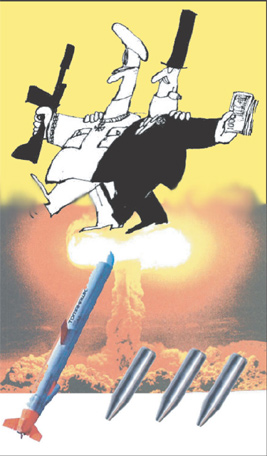



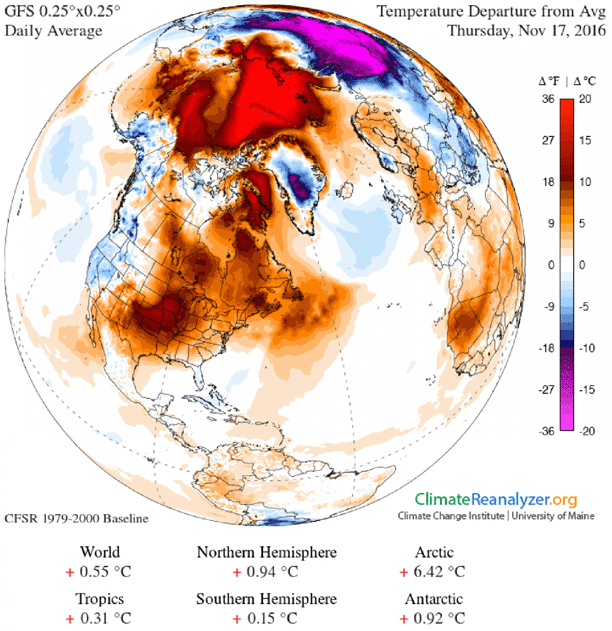





 nuclear-news