Manufactured Narratives: A Century of Distortion and Dispossession in Palestine
9 December 2025 Andrew Klein, https://theaimn.net/manufactured-narratives-a-century-of-distortion-and-dispossession-in-palestine/
A recent report criticising Palestinian schoolbooks has revived a persistent narrative: that Palestinian culture inherently teaches hatred. This framing is not merely inaccurate; it is the latest tool in a century-long campaign to obscure a foundational truth – the establishment of Israel was predicated on the deliberate, violent dispossession of the Palestinian people, known as the Nakba (Catastrophe)¹. To understand the present conflict, one must confront the history of broken promises, calculated ethnic cleansing, and the sustained narrative warfare that has enabled ongoing oppression.
The Foundational Act: The Nakba and Systematic Dispossession
The Nakba (1947-1949) was not a tragic byproduct of war but a deliberate political project of demographic engineering. Following the UN partition plan granting 55% of Palestine to a Jewish state despite Jewish land ownership of only ~7%², Zionist militias executed a coordinated plan.
Mass Expulsion: Approximately 750,000 Palestinians – over half the indigenous population – were expelled from their homes or fled massacres³.
Destruction of Society: Over 500 Palestinian villages and urban neighbourhoods were systematically depopulated and often razed to prevent return⁴.
Massacres as Policy: Dozens of massacres terrorised the population into flight. Key examples include:
- Deir Yassin (April 1948): Over 110 Palestinians were killed by Irgun and Lehi militias⁵.
- Lydda (July 1948): Israeli forces killed an estimated 200 people and expelled 60,000-70,000 in a “death march”⁶.
- Tantura (May 1948): Dozens to hundreds of civilians were killed by the Alexandroni Brigade⁷.
Israeli historian Ilan Pappé terms this process “ethnic cleansing”⁸. By 1949, Israel controlled 78% of historic Palestine, creating a refugee population denied their legal right of return – a direct consequence of foundational violence that continues today³.
The Colonial Blueprint: Broken Promises and Zionist Ambition
The Nakba’s roots lie in colonial politics and political Zionism. As noted in the prompt, critical betrayals set the stage:
- The McMahon-Hussein Correspondence (1915-16): Britain promised Arab independence in exchange for revolt against the Ottomans – a promise later broken⁹.
- The Balfour Declaration (1917): In a colonial act, Britain promised “a national home for the Jewish people” in Palestine, dismissing the indigenous Arab majority as “existing non-Jewish communities”¹⁰.
- The British Mandate (1922-1948): Britain facilitated Zionist immigration and land acquisition, suppressing Arab resistance and fostering a “dual society” that marginalised Palestinians¹¹.
This period established the core dynamic: a colonial-backed settler movement facing indigenous resistance, falsely framed as a clash between two equal national movements.
Weaponising Narrative: From Greenhouses to Textbooks
Distorting history shapes perception and shifts blame. A prime example is the Gaza greenhouses narrative after Israel’s 2005 disengagement.
The propagated story was that Palestinians looted and destroyed valuable greenhouses left for them¹². The documented reality is different:
- Israeli settlers destroyed roughly half the greenhouses before departing¹³.
- The remaining greenhouses were purchased for $14 million by international donors for Palestinian use¹³.
- Palestinian entrepreneurs successfully revived the project, exporting produce by late 2005¹³.
- The project was then strangled by Israeli border closures. The critical Karni crossing was shut for months, preventing export and collapsing the enterprise¹³.
This lie – painting Palestinians as inherently self-destructive – serves to absolve Israel of responsibility for its siege’s economic devastation and to dehumanise Palestinians as incapable of peace¹².
This context is essential for the current textbook debate. While groups like IMPACT-se document concerning content, such analysis is often decontextualised¹⁴. It ignores the living curriculum of military occupation, home demolitions, and trauma that Palestinian children endure daily. Framing the teaching of historical resistance as “incitement” deflects from the occupation’s role as the primary teacher of resentment, misleadingly treating a symptom as the root cause¹⁴.
Gaza: The Continuation of the Nakba
The current assault on Gaza is widely seen as a continuation and intensification of the Nakba¹⁵.
- Scale of Destruction: With over 64,000 killed, widespread displacement, and systematic destruction of civilian infrastructure, the assault aligns with acts prohibited under the Genocide Convention¹⁶.
- Evidence of Intent: Statements by Israeli officials dehumanising Palestinians and invoking genocidal biblical rhetoric have been cited by the International Court of Justice (ICJ) as “plausible” evidence of genocidal intent¹⁷.
- Manufactured Consent: Media hesitancy to accurately describe the violence functions to sanitise the reality for international audiences. As Gaza-based journalist Rami Abou Jamous notes, the intent is clear: “They are not hiding it.”¹⁸
The propaganda that once blamed Palestinians for losing their land now blames them for their own societal destruction, all while displacement continues.
Conclusion: Confronting the Core to Break the Cycle
The Palestinian-Israeli conflict is a land conflict resolved through demographic engineering and sustained by narrative control. From “a land without a people” to blaming Palestinian curricula, the pattern is the denial of Palestinian sovereignty, identity, and victimhood.
Palestinian resistance to erasure is criminalised, and their history of trauma is reframed as incitement. Until the international community confronts the original and ongoing sin of the Nakba and advances a justice-based solution acknowledging Palestinian rights, this cycle will persist. The debate over textbooks is a distraction from the real-time erasure it seeks to obscure..
References…………………………………………………………………….
He once said he was a genius. Now he wants to immortalise himself.

28 November 2025 John Lord, https://theaimn.net/he-once-said-he-was-a-genius-now-he-wants-to-immortalise-himself/
The only man I can think of who could rightfully claim the title of genius is Leonardo da Vince. Now you might dispute that, and you may be right. I don’t recall any research I have done into his persona, in which he refers to himself as a genius, but Donald Trump does.
In many countries that have dictatorial leaders, to satisfy their narcissistic desires, they erect large portraits of themselves on buildings for the populace to stare at. Some stare and worship, while others stare in terror.
In a striking announcement last week, it was reported that Donald J. Trump has instructed the U.S. Treasury to create a distinctive $1 coin adorned with his likeness on both sides. This bold initiative aims to celebrate America’s 250th birthday and to pay tribute to the presidency itself, as Treasury officials noted. The coin promises to be a unique memento, capturing a moment in time while intertwining the legacy of a nation with the persona of its leader.
So, is he placing himself on the same footing as other fascist dictators, who, when in power, like Stalin, Hitler, Mussolini and Marcos built monuments to glorify themselves so they’d be exalted in history?
In the meantime, the “Washington Commanders,” a prominent National League football team rooted in the heart of Washington, D.C., have received a rather audacious request from none other than Donald Trump himself: to adorn their brand-new stadium with his image, an impressive $3.7 billion marvel of modern engineering, with his name. Yes, engraved on the façade of every entry.
What the President wants, the President gets, and it likely will come to fruition, ensuring his legacy is forever linked to an edifice or token.
In another audacious endeavour to secure his place in the tapestry of history. Yes, he dreams of his name forever etched on lustrous coins, expertly engraved into the majestic façades of towering edifices, and artistically inscribed upon the enduring marble walls of the White House. He longs to elevate his stature in ways that resonate through the ages, yearning to revel in a luminescent glow of adoration that transcends the confines of time itself.
He now envisions the much-debated and extravagant $300 million ballroom that Trump is erecting at the White House to be officially named “The President Donald J. Trump Ballroom.” Senior officials within the administration propose that this audacious title is destined to become a prominent symbol linked to the ambitious project, forever etched into the legacy of one of the nation’s most opulent spaces.
Trump is burning to have his name immortalised on anything he can get his name on. So much flattery for a man of so little altruistic understanding.
Only fascist dictators seek to build monuments to glorify their names on teacups and granite to be exalted by the essence of time.
If he is seeking to immortalise himself, then it should be for his character, his aplomb, his decency. Presidents do not usually seek to immortalise themselves with false claims of excellence.
Democracies have a unique way of honouring their heroes – only after their passing and only when the public advocates for such tributes. Donald Trump undeniably merits a place in our collective memory, but not for any noble or virtuous deeds; I struggle to recall even one.
Instead, he should be etched into our history for the numerous acts of offensiveness that have marked his tenure. Imagine a comprehensive list of his missteps plastered across the façades of every government building in the nation—not as a celebration, but as a stark reminder. It is our solemn obligation to ensure that he is remembered not as a champion but as a cautionary figure—a stark warning of the threats he has posed and will continue to pose to the very foundations of American democracy.
Suppose Trump is to be inscribed in the annals of history. In that case, it should be seen as a figure marked by the numerous atrocities against the United States – a betrayal of its cherished Constitution, a violation of its legal framework, and ultimately, an affront to its people.
In a shocking display of unfounded claims, he asserted to the American populace that a monumental election had been “stolen” from him. This incendiary rhetoric ignited a frenzy among his loyal supporters, culminating in an audacious coup attempt that included assembling false electors under duress and intimidating state officials. The harrowing insurrection that followed saw a violent clash at the U.S. Capitol, leaving a tragic toll of five lives lost and 174 police officers injured — a dark Day etched in the nation’s memory.
The American people should not forget that, after his re-election, he wielded the power of pardon to absolve 1,600 individuals who had been convicted for their roles in the Capitol attack, alongside 77 others who had conspired with him in this unprecedented attempt to subvert democracy. In a brazen act of defiance, he dared to label these individuals “patriots,” transforming the narrative of insurrection into a misguided celebration.
If that alone doesn’t suffice, he must also be etched in history as the President who boldly overstepped the boundaries of Congress, seizing power that was never meant to be his. He trampled on the fundamental rights of individuals, denying them the due process guaranteed by law. He orchestrated a campaign against his political adversaries, prosecuting them with fervency. He callously disregarded international norms, carrying out extrajudicial killings of those he branded as enemy combatants. He dispatched military forces into American cities, defying the urgent pleas of mayors and governors alike. And in a shocking display of corruption, he openly accepted bribes.
Whether cast in shimmering gold or lustrous silver, or carved from the finest marble and granite, the American people must never permit the truth of Trump’s misdemeanours to fade into obscurity behind hollow tributes to his legacy. Once he has departed from the stage of history, a striking monument should rise, a powerful testament to remind future generations of the treachery he embodied and the complicity of those officials who stood by him. This monument should stand as a stark reminder, echoing the lessons of the past, ensuring that the shadows of dishonesty do not cloud the nation’s narrative.
Inscribed on the façade of a stark, industrial edifice crafted from iron and cement would be a sombre chronicle of assaults on democracy, detailing the sinister manoeuvres of a leader and naming all those complicit in his transgressions.
Above the entrance, bold and unyielding, words would speak of “Trump’s Treason,” a chilling reminder of a fraught chapter in history. This striking structure should rise on the hallowed grounds of the White House lawn, where the elegant Trump ballroom is being built, which will replace a wing of the white house, that was much admired and captivated visitors with its grandeur. Facing Pennsylvania Avenue, the building will deliberately invite families exploring the nation’s capital to commemorate America’s 500th anniversary to witness the clout of the dictator. This imposing ballroom, a monument in Trump’s name only, will serve as a stark reminder of a dark epoch, ensuring his catastrophic legacy is etched in collective memory for generations to come.
Even his peace plans for the current world trouble spots are calculated to exert maximum pressure on the Nobel Peace Prize committee.
My thought for the Day
The Office of the American President was once viewed by its people as an office of prestige and importance. Trump has reduced it to one of ridicule and contempt.
How Holtec International became an expanding (and controversial) nuclear power.

In Ukraine, Holtec’s principal state partner, Energoatom, has become the focus of a sweeping corruption inquiry
Holtec now controls the fate of multiple nuclear power plants across the United States………. even though Holtec had never operated a nuclear power plant.
One week after acquiring Palisades for decommissioning, Holtec submitted plans to the Energy Department for restarting the plant. Those plans only came to public light through a Freedom of Information Act request by the activist group Beyond Nuclear, published on its website in October 2023. In March 2024, Holtec secured a $1.52 billion US government loan guarantee and moved forward with an attempt to restart the nuclear reactor, despite expert assessments that the plant was no longer viable.
Following its start as a producer of nuclear waste storage canisters, Holtec International has built an empire around mothballed nuclear power plants and as-yet incomplete nuclear initiatives. The firm’s history of overpromising and underdelivery raises a question: Is this who we should trust with the future of nuclear energy?
Bulletin, By Matt Smith, November 20, 2025
On a 90-degree afternoon in July 2014, the governor, the mayor, and the local state senator gathered before 200 people at Camden, New Jersey’s Broadway Terminal along the Delaware River to celebrate an impending economic miracle. A planned technology center would bring pioneering nuclear technology and hundreds of new jobs to a dismal waterfront known for its unemployment and poverty.
State Sen. Donald Norcross, among those on a stage decorated with an eight-foot-tall banner bearing the red and black logo of Holtec International, said the company behind the deal was “a titan of energy.”
Holtec CEO Krishna Singh could locate his company’s nuclear technology center anywhere, not just in the United States but in the world, Norcross said, “And he chose Camden.”
The 47-acre campus would be used to develop a new kind of nuclear reactor that “cannot under any condition go out of control,” Singh said.
Now, the promised local miracle of economic progress seems, at most, incremental. There is no nuclear power plant assembly line as initially envisioned by Singh. His promised next-generation nuclear reactors remain conceptual a decade later, so far not progressing beyond the drawing board.
Singh made public pronouncements about providing a “path out of hereditary poverty” and a “pathway to the middle class” for Camden residents. The Camden facility would employ some 2,000 laborers and 1,000 professional staff in its first five years, the company said in promotional materials. But it ultimately hired far fewer locals than initially suggested.
In a statement in response to questions for this article, Holtec said that it has exceeded every obligation outlined in its contractual agreement with the state related to its Camden site. Also, the company noted that a court had rejected the state of New Jersey’s view that Holtec had fallen short of commitments, restoring funds that had been withheld based on claims of noncompliance.
New Jersey officials did, however, abandon a partnership with Holtec to build a job training center. Holtec said the state’s move “turned its back on the people of one of America’s poorest cities. The company has continued to invest in workforce development initiatives and to create meaningful opportunities for residents, advancing its mission to contribute to the city’s long-term economic revitalization.”
Documents filed in state and federal courts, records from regulatory agencies, and interviews with officials, activists, ex-employees, and industry analysts show that the Camden project was not a Holtec anomaly. Across its ventures, announcements of grand undertakings have been followed by under-delivery and controversy, as Holtec, a company primarily known for making concrete nuclear waste containers, succeeded in promoting itself as a high-tech leader in nuclear power generation and the decommissioning of nuclear power plants.
Since launching the Krishna P. Singh Technology Campus in Camden, Holtec has expanded aggressively into the decommissioning of shuttered nuclear power plants and a government-backed attempt to revive the largely dormant US nuclear energy sector. Holtec’s business strategy has relied in part on acquiring old nuclear plants and tapping into trust funds that plant operators had paid to the government for the eventual decommissioning of those plants. In some cases, Holtec has then reversed course and tried to restart aging reactors. Internationally, Holtec has positioned itself as spearheading US efforts to expand nuclear power generation in Ukraine and South Korea.
The stakes of that claim are higher now. In Ukraine, Holtec’s principal state partner, Energoatom, has become the focus of a sweeping corruption inquiry alleging years of inflated contracts, illicit payments and political interference in the very projects Holtec helped build at Chernobyl — prompting new scrutiny of the environment in which those projects took shape.
Although many of its projects are either unfinished or less than initially portrayed, Holtec now controls the fate of multiple nuclear power plants across the United States. The company that didn’t fully deliver on initial promises about a technology center in Camden (see sidebar) has been entrusted with billions of dollars from ratepayer-funded decommissioning trust funds, responsibility for some of the nation’s most hazardous nuclear sites, and permission to re-start a closed nuclear reactor—even though Holtec had never operated a nuclear power plant.
Now, Holtec plans to go public in a planned stock offering that Singh told Barron’s could value his company at $10 billion. Singh hopes to sell shares worth 20 percent of the company’s total value in a stock offering that aims to raise capital for an expansion of its oft-stated plans to build small modular reactors (SMRs), a next-generation technology that, for Holtec, remains in the design stage and has not yet been licensed.
The move to go public entrusts yet more financial and public faith in a company whose grand undertakings have often been followed by controversy and under-delivery.
Capitalizing on the failure of Yucca Mountain
………………………………………………………………………………….. Today, Singh oversees a company that has expanded far beyond building nuclear fuel storage casks. Holtec has won contracts to control nuclear plants and manage billions of dollars in federally mandated decommissioning trust funds. However, this aggressive expansion has been overshadowed by serious concerns: 24-year-old bribery allegations (see sidebar) and regulatory violations related to employee radiation exposure risk, quality control in spent fuel transportation and storage systems, and inadequate security. Activists, public officials, and nuclear experts question whether a company with no prior experience in building, operating, or maintaining nuclear power plants—one that has attracted sustained controversy—should be positioned to lead a significant part of America’s nuclear future
………………………………………………………………………….In 2018, Holtec formed a subsidiary called Holtec Decommissioning International and began acquiring shuttered nuclear plants outright. Rather than simply selling storage systems to utilities, Holtec would now buy entire reactor sites, take control of their decommissioning trust funds, and assume responsibility for dismantling the facilities and managing the radioactive waste stored there.
Each closed nuclear plant came with a substantial decommissioning trust fund—money collected from ratepayers over decades to pay for eventual cleanup.
Holtec claimed it could complete the decommissioning work much faster than utilities had planned, promising 10- to 12-year timelines instead of the 60 years allowed by regulators. Also, there was a glittering prospect: Holtec could potentially keep whatever remained in the trust funds after decommissioning was complete………………………………….
For former Nuclear Regulatory Commission (NRC) chairman Gregory Jaczko and other observers skeptical of Holtec’s plans, one important question centers on whether Holtec has been set up in a way that will allow it to be held accountable should things go wrong.
Singh has set up his business via a web of subsidiaries spanning 17 countries across four continents. The company has created dozens of separate entities, from Holtec Orrvilon in Hong Kong to operations in Britain and Ukraine, plus numerous limited liability companies (LLCs) clustered in New Jersey, Delaware, and Florida. These are set up in complex structures, whereby entities often own each other in nested arrangements, with one LLC either a shareholder or a subsidiary of the other.
This structure is perhaps most clearly seen in Holtec’s nuclear decommissioning business. Each closed plant—the Palisades Nuclear Plant in Michigan, the Indian Point plant in New York, and the Pilgrim Nuclear Power Station in Massachusetts—exists within its own special-purpose LLC. These subsidiaries control billions of dollars in decommissioning trust funds while maintaining limited legal liability, according to state attorneys general from Massachusetts and New York.
………………………………………Jaczko noted that there was no corporate entity positioned to provide a financial backstop if something went wrong.
………………………….“This structure is far less transparent and accountable than what we typically see for power plant ownership,” he said. “It appears that there is no corporate entity with sufficient resources to provide capital and cover operating expenses in the event of revenue losses, whether due to accidents or plant problems requiring extended shutdowns.”………………………………………………………….
A tangled tale: Holtec in Ukraine
…………………………………….. Anti-corruption officials in Ukraine in early November announced a $100 million corruption scandal that forced out the senior leadership of Energoatom, the principal state partner with Holtec at Chernobyl. The officials describe corruption and a lack of oversight at the agency—during periods that overlapped Holtec’s work. As of press time, allegations had not included Holtec itself.
……………………………Holtec’s promotional materials continue to present its Ukraine record as evidence of competence and reliability. Ukrainian authorities, meanwhile, continue collecting evidence to support allegations that agencies overseeing the U.S. company were compromised.
Publicly available information does not indicate that Holtec has been formally accused of wrongdoing in the Ukrainian corruption cases.
…………………….According to Holtec’s and the Ukrainian government’s project documents, the company served as the prime contractor for what is known as the Interim Spent Nuclear Fuel Dry Storage Facility, or ISF-2, which is designed to hold spent fuel from undamaged reactors at Chernobyl, which had remained in operation until 2000. Holtec hired YUTEM-Engineering as its principal subcontractor. That is, Holtec had a direct, if unwitting, role in hiring and managing a key local company whose owner had financial ties to what official Ukrainian investigations said was a notorious corruption network.
Holtec’s Ukrainian venture began in the mid-2000s, when the country confronted a growing crisis over its nuclear waste. Each year, Ukraine paid Russia approximately $200 million to dispose of the spent fuel from its 15 reactors. American officials grew increasingly worried about this dependency, diplomatic cables released by WikiLeaks show. In leaked cables, those officials touted Holtec as a means to pry Ukraine from Russia’s nuclear embrace. The geopolitical urgency also had a practical side: Holtec might help secure waste in the still-hazardous Chernobyl Exclusion Zone.
Ukraine decided to make the depopulated land around the old plant into a general-purpose nuclear waste storage site serving both the old plant and its spent fuel, as well as spent fuel from power plants elsewhere in the country.
The most visually prominent of the three separate projects is a massive arch-shaped sarcophagus that contains the old, damaged portion of the Chernobyl complex. But there are two lesser-known facilities, and that’s where Holtec supplied management, technical know-how, and equipment. Holtec was the main contractor for what was called the Interim Storage Facility-2 for spent fuel from Chernobyl reactors. And it supplied equipment and engineering support for the Centralized Spent Fuel Storage Facility, built to store nuclear waste from elsewhere.
In its prime contractor role, Holtec was to hire, manage, and pay subcontractors doing on-the-ground civil engineering work, according to records from the Chernobyl management agency, Ukraine’s public spending audit agency (hyperlined document in Ukrainian), and other documents.
Holtec’s work was supported by international heavyweights: the International Atomic Energy Agency and the European Bank for Reconstruction and Development. The company nonetheless found itself in the company of controversial figures.
Holtec’s main local partner for the ISF-2 project was the firm YUTEM-Engineering, whose owner had ties to Maksym Mykytas, the head of a construction empire. According to official records, Holtec hired, managed, and paid YUTEM on that project.
Anti-corruption agencies have accused Mykytas of masterminding multimillion-dollar collusion and bribery schemes related to, among other things, the repository for waste from outside Chernobyl. On that centralized fuel storage project, Holtec was not responsible for hiring or managing YUTEM, which became mired in bid-rigging and bribery scandals.
Evidence connects YUTEM to a wider alleged criminal enterprise that’s been the subject of multiple high-profile investigations of alleged embezzlement, fraud, bribery, and bid-rigging. The Bulletin traced these ties via multiple records, including Mykyta’s asset declaration from 2017, when he was a member of Ukraine’s parliament, showing he received money or equity worth approximately $75,000 in a transaction with YUTEM’s owner.
Mykytas was not just any politician. According to Ukraine’s National Anti-Corruption Bureau, he was the alleged mastermind of a sprawling network of companies used to embezzle state funds.
……………………………..Eventually, investigations into Mykytas caused progress on the nationwide storage facility to stall, though all the sites at Chernobyl eventually passed testing and licensing phases. By then, Holtec and Ukrainian officials were announcing another ambitious nuclear effort: a commitment to build 20 small modular reactors across the war-torn country. The announcement came despite Holtec having no US-approved reactor design and no experience building or running nuclear plants, and despite Russia’s ongoing campaign of bombing energy infrastructure, once again pitting a grand vision against a complex and hazardous reality.
……………………………….In December, Energoatom, Ukraine’s state-owned nuclear company, announced it was discussing with Holtec the idea of building a factory for SMR components to make Ukraine a regional center for the production and export of nuclear technologies.
In January, Energoatom announced its officials had held a video conference with Singh to discuss ideas such as a new factory for producing parts for SMRs, a joint Energoatom-Holtec engineering and training center, and “implementation of SMR-300 technology in Ukraine,” according to an agency announcement.……………………………
Holtec’s unusual strategy in Michigan. And elsewhere.
…………………………………….. unlike some competitors who have made at least incremental progress toward deployment, Holtec’s SMR vision has remained mostly notional. It wasn’t until July, when Holtec obtained an operating license for Palisades, that the company had ever obtained regulatory approval to operate a reactor.
Holtec, in a statement, said its announced plans to install SMR reactors in Michigan five years from now show that it is ahead of its competitors.
At its Camden facility, Holtec has announced plans to install a simulator to mimic the reactor conditions of its SMR. The company describes the facility as an innovation center for SMR design, employing over 600 highly skilled workers and says it will be “where the US’s first SMRs will be constructed and shipped for commercial deployment in this decade.” But no reactor manufacturing has begun as the company awaits regulatory approvals for its designs.
Even so, these paper reactors have yielded concrete returns.
In September 2024, the US Department of Energy granted Holtec a $1.52 billion loan guarantee to restart the mothballed Palisades nuclear power plant in Michigan. The re-commissioning of Palisades is controversial in its own right, but Holtec has also woven its still-unproven SMR program into the Palisades narrative. Though the loan formally supports the restart of an existing unit at the plant, Holtec has presented the site as a dual project: a place to both reboot old infrastructure and a site for new SMRs, making Palisades “ground zero for America’s nuclear renaissance,” according to company marketing materials.
This renaissance story seems to be absent from federal records, however. The SMR-300 design does not yet have an NRC license application on file. Holtec suspended the SMR-160’s licensing process in 2023 and has begun only informal pre-application discussions for the new design, according to the NRC. The target date for filing formal applications from scratch is sometime in 2026, according to a Holtec presentation to the NRC.
The idea of SMRs continues to deliver. Singh now describes Palisades as the birthplace of a nuclear revival, promising to deploy Holtec’s SMR-300 design on the Michigan lakeshore by 2030……………
……………………………Although it lacks US certification for its SMR designs, Singh has pursued this SMR strategy internationally. In India, it envisions hundreds of reactors.
………………………………………How decommissioning became re-commissioning
Holtec bought the Palisades nuclear plant in 2018, gaining access to a $592 million fund set aside for decommissioning.
But Holtec’s stewardship of the Palisades plant soon took a swift course change. …………………………….
One week after acquiring Palisades for decommissioning, Holtec submitted plans to the Energy Department for restarting the plant. Those plans only came to public light through a Freedom of Information Act request by the activist group Beyond Nuclear, published on its website in October 2023. In March 2024, Holtec secured a $1.52 billion US government loan guarantee and moved forward with an attempt to restart the nuclear reactor, despite expert assessments that the plant was no longer viable.
…………………………………………….“They lied about what they were going to do at Palisades. They said they were taking over ownership to decommission the plant. Little did we know, they weren’t even intending to decommission,” said Kevin Kamps with Beyond Nuclear, an anti-nuclear advocacy group. “This was a trick to get their hands on the plant.”
………………………………………………………………………………………………………….The questions about Indian Point
……………………………………………………………………………………Community fears intensified in 2021 when Holtec announced plans to discharge radioactive wastewater from Indian Point into the Hudson River. State lawmakers swiftly passed legislation blocking such discharges. Holtec sued the state in April 2024, arguing the law unlawfully infringed on federal authority over nuclear safety. A federal judge ruled in favor of Holtec in September 2025, but New York is appealing the decision.
…………………………Holtec’s financial disclosures raise additional concerns. In meetings with state officials, company executives admitted that project delays or unexpected costs could undermine their business model…………………………………………………………….
Vision vs. reality
The story of Holtec often comes down to moments when soaring vision collides with terrestrial problems……………………………………..
……………………………………Holtec International capitalized on the federal government’s failure to create a national nuclear waste repository, creating a captive market for concrete casks now on-site at power plants across America. From this foundation, CEO Krishna Singh launched a more audacious expansion into decommissioning, acquiring shuttered nuclear plants outright. The company took control of billions in ratepayer-funded decommissioning trust funds, promising to clean up sites in a fraction of the time planned by utilities, with the glittering prospect of keeping any leftover money.
This aggressive growth, however, relies on financial and operational strategies that have drawn unflattering scrutiny. . Holtec structures its decommissioning projects through a web of special-purpose corporations (LLCs), which own the plants and control their trust funds, potentially leaving no backstop if a project encounters costly problems. Instead of legal guarantees, Singh has offered his word and his company’s reputation.
Now, Holtec is asking the public and investors for even greater faith as it plans a multibillion-dollar initial public stock offering. The capital raised is intended to fund another expansive promise. Yet, like the future of high-tech jobs once promised for Camden, these SMRs remain in the concept stage. The company has built an empire on mothballed plants and sidelined projects while selling a vision of a nuclear renaissance. Its history leaves a question for regulators and potential investors: Is this who the world should trust with a large portion of the future of nuclear energy?
Matt Smith is a freelance reporter with 30 years of experience covering business, the environment, and other topics. https://thebulletin.org/2025/11/how-holtec-international-became-an-expanding-and-controversial-nuclear-power/?utm_source=ActiveCampaign&utm_medium=email&utm_content=Disasters%20in%20a%20post-truth%20world&utm_campaign=20251117%20Monday%20Newsletter%20%28Copy%29
Trump’s new radiation exposure limits could be ‘catastrophic’ for women and girls.
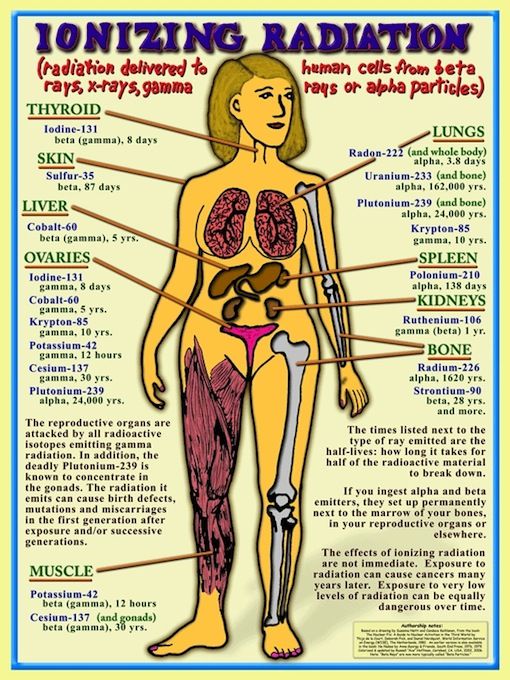
it has since been widely documented that women and young girls are significantly more vulnerable to radiation harm than men—in some cases by as much as a ten-fold difference………… Those most impacted by weaker exposure standards will be young girls under five years old
By Lesley M. M. Blume, Chloe Shrager | November 14, 2025, https://thebulletin.org/2025/11/trumps-new-radiation-exposure-limits-could-be-catastrophic-for-women-and-girls/
In a May executive order, aimed at ushering in what he described as an “American nuclear renaissance,” President Donald Trump declared moot the science underpinning decades-old radiation exposure standards set by the federal government. Executive Order 14300 directed the Nuclear Regulatory Commission (NRC) to conduct a “wholesale revision” of half-a-century of guidance and regulations. In doing so, it considers throwing out the foundational model used by the government to determine exposure limits, and investigates the possibility of loosening the standard on what is considered a “safe” level of radiation exposure for the general public. In a statement to the Bulletin, NRC spokesperson Scott Burnell confirmed that the NRC is reconsidering the standards long relied upon to guide exposure limits.
Now, some radiology and policy experts are sounding alarm bells, calling the directive a dangerous departure from a respected framework that has been followed and consistently reinforced by scientific review for generations. They warn that under some circumstances, the effects of the possible new limits could range from “undeniably homicidal” to “catastrophic” for those living close to nuclear operations and beyond.
“It’s an attack on the science and the policy behind radiation protection of people and the environment that has been in place for decades,” says radiologist Kimberly Applegate, a former chair of the radiological protection in medicine committee of the International Commission on Radiological Protection (ICRP) and a current council and scientific committee member of the National Council on Radiation Protection (NCRP)—two regulatory bodies that make radiation safety recommendations to the NRC. According to Applegate, current government sources have told her and other experts that the most conservative proposed change would raise the current limit on the amount of radiation that a member of the general public can be exposed to by five times. That would be a standard “far out of the international norms,” she says, and could significantly raise cancer rates among those living nearby. The NRC spokesperson did not respond to a question from the Bulletin about specific new exposure limits being considered.
Kathryn Higley, president of the NCRP, warns that a five-fold increase in radiation dose exposure would look like “potentially causing cancers in populations that you might not expect to see within a couple of decades.”
“There are many things that Executive Order does, but one thing that’s really important is that it reduces the amount of public input that will be allowed,” says Diane D’Arrigo, the Radioactive Waste Project Director at the Nuclear Information and Resource Service, a nonprofit group critical of the nuclear energy industry. In a statement to the Bulletin, the NRC said that once its standards reassessment process is completed, the NRC will publish its proposed rules in the Federal Register for public comment.* The NRC spokesperson did not respond to questions about when the proposed new standards would be made public and whether or how the general public would be further alerted to the changes.
Once the proposed policy change hits the Federal Register, the final decision will likely follow in a few days without advertising a period for public input, Applegate adds.
“I’m not sure I know why the loosening is needed,” says Peter Crane, who served as the NRC’s Counsel for Special Projects for nearly 25 years, starting in 1975. “I think it’s ideologically driven.” He points out that the probable loosening of the standards is set to coincide with increased pressure to greenlight new nuclear plants and could weaken emergency preparedness in case of leaks or other accidents: “I think it’s playing with fire.” (The NRC’s Office of Public Affairs did not respond to questions about the rationale for loosening the standards and the timing of the reconsideration.)
Possible shorter timelines for building nuclear power plants, coinciding with weakened radiation exposure standards, could spell disaster, warn other experts. It would be “undeniably homicidal” of the NRC to loosen current US exposure standards even slightly, adds Mary Olson, a biologist who has researched the effects of radiation for over 40 years and published a peer-reviewed study titled “Disproportionate impact of radiation and radiation regulation” in 2019. Olson cites NRC equations that found that the current exposure standards result in 3.5 fatal cancers per 1,000 people exposed for their lifetimes by living near a nuclear facility; a five-fold rate increase in allowable radiation exposure could therefore result in a little over 17.5 cancers per 1,000 people. Expressed another way, that means “one in 57 people getting fatal cancer from year in, year out exposure to an NRC facility,” she says.
The NRC’s Office of Public Affairs did not respond to questions about whether the NRC could guarantee the current level of safety for the general public or nuclear workers if adopting looser radiation exposure standards, and about whether new protections would be put into place.
Are women and children more vulnerable? According to Olson, increased radiation exposure could be even more “catastrophic” for women and children. Exposure standards have long been determined by studies on how radiation affects the “reference man,” defined by the ICRP as a white male “between 20-30 years of age, weighing around 70 kilograms [155 pounds].”
But Applegate, Olson, and other experts say that it has since been widely documented that women and young girls are significantly more vulnerable to radiation harm than men—in some cases by as much as a ten-fold difference, according to Olson’s 2019 study. Olson and Applegate cite another 2006 review assessing and summarizing 60 years of health data on the survivors of the Hiroshima and Nagasaki atomic bombings; the study showed that women are one-and-a-half to two times as likely to develop cancer from the same one-time radiation dose as men.
Young girls are seven times more at risk, they say. Those most impacted by weaker exposure standards will be young girls under five years old, Olson says. Her 2024 study of the A-bomb bomb survivor data for the United Nations Institute for Disarmament Research, titled “Gender and Ionizing Radiation,” found that they face twice the risk as boys of the same age, and have four to five times the risk of developing cancer later in life than a woman exposed in adulthood.
“Protections of the public from environmental poisons and dangerous materials have to be focused on those who will be most harmed, not average harmed,” Olson says. “That’s where the protection should be.”
Infants are especially vulnerable to radiation harm, says Rebecca Smith-Bindman, a radiologist and epidemiologist who is the lead author of a just-released major study in the New England Journal of Medicine documenting the relationship between medical imaging (such as X-rays and CT scans) and cancer risk for children and adolescents; more than 3.7 million children born between 1996 and 2016 participated and have been tracked. Smith-Bindman contests the idea that women are overall more vulnerable to cancer than men, saying that “in general, maybe women are a little bit more sensitive, …[but] women and men have different susceptibilities to different cancer types,” with women being more vulnerable to lung and breast cancers, among other types. But it is “absolutely true that children are more susceptible,” she adds. With children under the age of one, “the risks are markedly elevated.” While these findings are sobering, she points out that with medical imaging, “there’s a trade-off…it helps you make diagnoses; it might save your life. It’s very different from nuclear power or other sources of radiation where there’s no benefit to the patient or the population. It’s just a harm.”
“We’ve known for decades that pregnancy is [also] more impacted” by radiation exposure, says Cindy Folkers, radiation and health hazard specialist at Beyond Nuclear, a nonprofit anti-nuclear power and weapons organization. “Radiation does its damage to cells, and so when you have a pregnancy, you have very few cells that will be developing into various parts of the human body: the skeleton, the organs, the brain,” and exposing those cells to radiation during pregnancy can impact the embryo’s health, she says. Smith-Bindman and her team are also studying the impact of radiation exposure on pregnancy, and while their results are not yet in, “we do know that exposures during pregnancy are harmful,” she says, “and that they result in elevated cancer risks in the offspring of those patients.”
For children, lifetime cancer risk will be increased not only because of the “sensitivity and vulnerability of developing tissues, but also partly [because] they would be living longer under a different radiation protection framework,” adds David Richardson, a UC Irvine professor who studies occupational safety hazards.
Several experts noted the irony that these changes are being mandated by the same administration that is also overseeing a policy of “Make America Healthy Again” (MAHA), an effort being spearheaded by Secretary of Health and Human Services Robert F. Kennedy Jr. “In terms of general [public] knowledge, I think there has not been very large coverage or acceptance of the idea that radiation affects different people differently on the basis of both age and biological sex,” says Olson. “But we now have enough reviews, enough literature to say that the biological sex difference is there. I don’t think MAHA mothers know this because it’s been underreported, [and] they would be concerned if they knew it.”
The NRC’s Office of Public Affairs did not respond to questions about concerns being raised by radiologists and epidemiologists about possible health consequences—especially for children—as a result of increased radiation exposure.
Continue readingThe remnants of Chernobyl are still present in the Black Sea
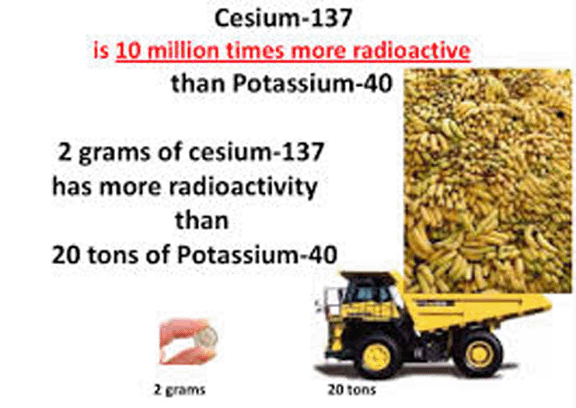
Forty years have passed since Chernobyl, but Chernobyl-related radioactive contamination in the Black Sea has not ended. TENMAK’s research has revealed that the concentration of caesium-137 in the Black Sea is seven times higher than in the Mediterranean Sea.
BirGün Daily, Giriş: 07.11.2025 , https://www.birgun.net/haber/the-remnants-of-chernobyl-are-still-present-in-the-black-sea-667018
Nearly 40 years have passed since the Chernobyl disaster, considered one of the world’s three largest nuclear accidents, but the radioactive contamination caused by the accident continues to affect the Black Sea. At the IVth National Symposium on Monitoring and Assessment in the Seas, Dr Aysun Kılınçarslan, presenting on behalf of the Turkish Energy, Nuclear and Mining Research Institute (TENMAK), announced the results of monitoring studies on radioactive contamination in Turkey’s coastal waters and sediments.
Analyses conducted in coastal sediments between 2015 and 2023 detected high levels of caesium-137 and strontium-90. While an average of 21 becquerels of caesium-137 isotope per kilogram was observed in the Black Sea, this rate was recorded as only 3.2 becquerels in the Mediterranean Sea. Values that are relatively high in the Sea of Marmara decrease as one moves towards the Aegean and Mediterranean Seas. The highest value found in the analyses exceeds 82 becquerels. This figure is 10 times higher than the highest value observed in the Mediterranean Sea. When viewed on a regional basis, the highest caesium-137 value in sediments, 50 becquerels, was found in Hopa. Hopa is followed by Trabzon and Sinop.
HIGH FIGURES IN TRABZON AND HOPA
In measurements taken in coastal surface waters between 2014 and 2023, the caesium-137 concentration averaged 9 millibecquerels per litre in the Black Sea, while this figure dropped to 1.6 millibecquerels in the Mediterranean Sea. Rates in the Bosphorus, Marmara and Çanakkale ranged between 8.4 and 6.9 millibecquerels, while the amount of caesium-137 in the water decreased in the Aegean Sea, falling to 1.8 millibecquerels. The highest figures were found in Trabzon and Hopa, which have been affected by Chernobyl for years and where cancer rates have increased. Tekirdağ, Ordu, Karasu and İğneada stand out as other regions with high measurements. Although the study’s findings indicate that these levels do not pose a risk to human health or environmental pollution, the significant difference between the Black Sea and the Mediterranean clearly demonstrates the consequences of Chernobyl-related contamination.
CHERNOBYL FLOWS
Another noteworthy finding of the study was the detection of plutonium-239, which does not occur naturally and is produced by nuclear reactions, alongside caesium-137. While average values do not differ between seas, the locations most affected by this contamination include Erdek, the Bosphorus Strait, Hopa, and Sinop. Experts point out that the sources of contamination linked to these isotopes are nuclear power plant accidents, nuclear weapons tests, and operational nuclear reactors. Chernobyl is also cited as a source of contamination in the Black Sea. Radioactive pollution from the out-of-control melted reactor and the surrounding area reaches the Black Sea via groundwater and the Dnieper River.
MARINE ASSESSMENT IS NECESSARY
Prof. Dr. İnci Gökmen, who revealed high levels of radiation in tea after Chernobyl, points out that the radiation level detected at 21 becquerels per kilogram is quite high. Gökmen states that data collected from the seas and coasts also highlights the need to measure radiation levels in the soil, adding, “It is surprising to see plutonium in the seas, even at low levels. Strontium is not surprising. However, since strontium does not emit gamma radiation and must be measured by chemical separation, measurements were rarely taken despite the presence of strontium in the environment and food after Chernobyl. However, the strontium values immediately after the accident can be estimated from the current results. By looking at the caesium levels in coastal surface water in some areas, it would be good to calculate the doses that swimmers or those working at sea, such as fishermen, would receive. It would be appropriate to take measurements in fish, mussels and other seafood. Thirty-nine years have passed since Chernobyl. Caesium has only undergone one half-life. This means that radioactive elements will remain in the seas for a long time to come,” he said. WHAT IS CAESIUM (CS-137)?
The most common radioactive form of caesium is Cs-137. Caesium-137 is produced by nuclear reactions. External exposure to Cs-137 can cause burns, acute radiation sickness and even death. Exposure to large amounts of Cs-137 can result from the misuse of a powerful industrial Cs-137 source, a nuclear explosion, or a major nuclear accident. Under normal conditions, large amounts of Cs-137 are not found in the environment. Exposure to Cs-137 can increase the risk of cancer due to the presence of high-energy gamma radiation. Ingestion or inhalation of Cs-137 increases the risk of cancer by causing the radioactive material to spread to soft tissues, particularly muscle tissue. Vascular plants do not accumulate high levels of caesium through root uptake because caesium is strongly adsorbed to the soil. However, the accumulation of radioactive residues on flora with large surface areas, such as lichens or mosses, is significant. Animals that feed on these plants can consume large amounts of radiocaesium (and other radionuclides present in radioactive fallout). Human consumption of the meat of such animals leads to the uptake of these radionuclides into the body.
Note: This article is translated from the original article titled Çernobil’in izleri hâlâ Karadeniz’de, published in BirGün newspaper on November 7, 2025.
Who is paying for Britain’s nuclear revival?

Ultimately, the UK taxpayer is paying for both power stations……………..If Sizewell’s total costs rise above around £47 billion, private investors are not obliged to inject additional equity, leaving the taxpayer exposed to cost overruns.
15th October 2025 by Sol Woodroffe, https://www.if.org.uk/2025/10/15/who-is-paying-for-britains-nuclear-revival/
In this article, IF volunteer Sol Woodroffe, considers the intergenerational fairness of the government’s financing models for Hinkley Point C and Sizewell C.
Building a nuclear power station: an intergenerational decision
Building a nuclear reactor is very expensive. In fact, the financing costs are the most expensive part. According to the World Nuclear Association, capital costs for new nuclear power stations account for at least 60% of their Levelised Cost of Electricity (LCOE). The LCOE is the total cost to build and operate a power plant over its lifetime divided by the total electricity output dispatched from the plant over that period. This means that when we talk about the price of nuclear, we are really talking about the price of borrowing to cover the upfront costs.

Specifically, when determining whether a government should invest in nuclear power, the cost depends on how much the government values cheap electricity for future generations. The decision to build a nuclear power station is a truly intergenerational one. This graph from the World Nuclear Association highlights how different discount rates affect the value for money of nuclear energy compared with other energy sources:
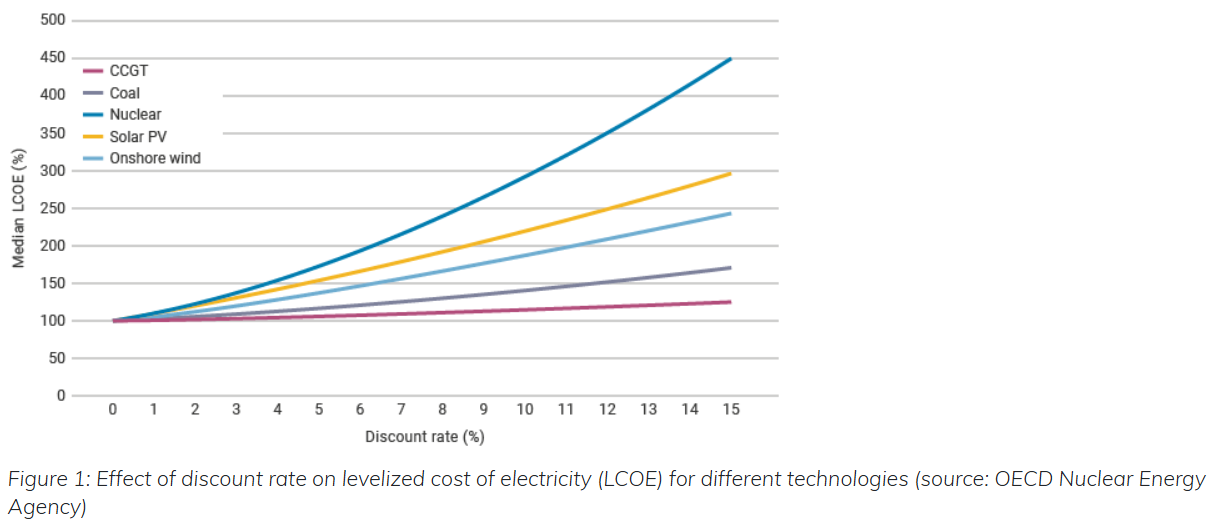
This shows that the relative capital intensity of building a nuclear power station means that the more we discount future generations, the less worth it nuclear energy seems from today’s standpoint.
The discount rate the government chooses to use on public infrastructure projects is, to some extent, determined by interest rates. But it is also an ethical choice about how much the government cares about future generations. The lower the value placed on future generations, the higher the discount rate used, and so the more expensive nuclear energy seems.
On the face of it, the UK government’s decision to build two enormous nuclear reactors should be a source of optimism for young people. Nuclear energy is one of the safest and cleanest forms of energy. In many parts of the world, it is also one of the cheapest. Decarbonisation, energy security and industrial strategy are all part of the motivation for building these reactors. Many of the UK’s current reactors were built in the 70s and 80s and will retire by the early 2030s. Without new capacity, the UK will lose a major source of low carbon power. Arguably, it’s a sign of the UK government daring to invest for future generations. And yet, a closer look at the financing of the two reactors tells a different story…
What are Hinkley Point C and Sizewell C
Hinkley Point C is the first new UK nuclear station in a generation. It uses the European Pressurised Reactor (EPR) design and, when complete, will be one of the largest nuclear power stations in Europe. According to EDF Energy, each of its two reactors will produce enough electricity to supply roughly 7% of the UK’s electricity demand. Construction was authorised by Theresa May’s government in September 2016. The original target was to have it running by 2025, but EDF now forecasts first power no earlier than 2029–2031.

Sizewell C is a close imitation of Hinkley planned for the Suffolk coast. The UK government approved the development in July 2022 and committed public equity financing in November 2022. Because the Hinkley supply chain and licensing work already existed, ministers argued that a second EPR project would reduce design and regulatory costs. Sizewell C will have enough capacity to power around six million homes when operating.
What went wrong and why?
Both projects are running well behind their initial projected timelines, and both have run worryingly over budget. These two things are interrelated. Long construction periods push up financing costs. Again, the cost of finance here is all-important. Over a long construction period, during which there are no revenue streams from the project, the interest on funds borrowed can compound into very significant amounts (World Nuclear Association, 2023).
HPC’s original cost estimate was about £18 billion but now is projected to a whopping £31–£35 billion. Moreover, our research on the “nuclear premium” estimated the additional cost of power from Hinkley Point C for its 35-year initial contract period, compared to onshore wind and solar power, would be £31.2 billion and £39.9 billion respectively. Sizewell C’s projected cost has ballooned from an initial estimate of around £20 billion to £38 billion (in 2025 pricing), nearly doubling the original figure.
The cause of these cost overruns is clear. EDF has complained that the UK lacks the building infrastructure and productive capacity for such a massive project. This kind of capacity is built up over time and requires beginning with smaller projects and then gradually scaling up. To some extent, the government has acknowledged this mistake and so began to invest in the small modular reactor programme in the UK, but from the perspective of the taxpayer, it all seems too little too late.
Who is paying for these power station?
Ultimately, the UK taxpayer is paying for both power stations. But from an intergenerational fairness perspective, the key questions are which taxpayers and when. The government has an option to borrow and shield the current taxpaying generation from footing the bill, but rising UK borrowing costs and increasingly jittery bond markets mean this would come at a serious cost.
Hinkley Point: paid for by Gen Z and Gen Alpha
The financing model for each power station is very different. For Hinkley point, the government has agreed on a Contract for Difference. This means that private companies must cover the upfront costs, with the knowledge that they receive a guaranteed price for their energy when the costs are finished.
EDF, the French national energy company, and CGN, the Chinese national energy company, shouldered much of the initial capital cost. In return, the government guarantees a price of £92.50/MWh (in 2012 £) for 35 years of output.
There were serious advantages to this model from a public financing perspective. The main advantage was that the investors took on the construction-cost risk: the UK taxpayer has arguably not been punished because Hinkley Point’s financial costs have so enormously overrun.
Nonetheless, this model ultimately kicks the financial burden down the road. Ultimately, today’s Gen-Z and Gen Alpha will be made to pay for this deal.
This is because the guaranteed price will likely be a rip-off. The average price of energy today in terms of 2012 pounds is £50–55/MWh. The falling price of clean energy alternatives means that we should expect the real price of energy to fall over the next few decades. Therefore, it seems highly likely that the fixed price will be a seriously uncompetitive rate for future UK consumers.
Sizewell C: a fairer distribution of costs
The financing of Sizewell distributes the financing costs more fairly between generations. To pay for the reactor, the government switched to a Regulated Asset Base (RAB) model. This means that consumers begin contributing to the project’s financing through small charges on their energy bills while the plant is still under construction, rather than waiting until it generates electricity. The model provides investors with a regulated return during construction, reducing their exposure to financing risk.
The RAB model allows investors to share construction and operational risks with consumers, which in theory lowers the cost of capital. Since capital costs make up the majority of nuclear project expenses, this could make Sizewell C substantially cheaper overall, if delivered as planned.
The key drawback is that taxpayers and consumers shoulder significant risk. If total costs rise above around £47 billion, private investors are not obliged to inject additional equity, leaving the taxpayer exposed to cost overruns.
From an intergenerational fairness perspective, the financing model is somewhat fairer as it smooths the cost of construction between generations. Nonetheless, the future taxpayers are the ones most exposed to the risk of cost overruns.
The cost of decommissioning
Historically, the cost of decommissioning nuclear power stations has been gravely underestimated in the UK. Decommissioning costs will be faced by generations well into the future, and so whether the state considers them massively depends on the chosen discount rate. Ultimately, the more the government values future consumers, the more seriously they must take these massive costs.
Sizewell and Hinkley both have operating lives of 60 years. However, with Sizewell, future taxpayers are exposed to the risk of ballooning decommissioning costs, whereas with Hinkley the operator must fully cover these costs.
Think of the children
When these large public infrastructure projects are discussed, the focus is often on whether government has negotiated value for money for UK taxpayers. But if the government wants to claim nuclear is a forward-looking investment, it must prove future generations won’t be the ones footing the bill.
New Radiation Protection Standards in 2026?

Tony Webb – November 2025.
In May 2025 US President Donald Trump ordered the US Nuclear Regulatory
Commission (NRC) to review US radiation protection standards for workers and the public. The order claims that these and other NRC regulatory processes hinder development of US nuclear power generation and need to be revised – in line with another set of his ‘alternative facts’ that overturn almost all the established principles that provide the basis of national and international protection standards.
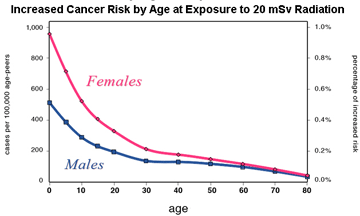
This latest diktat will result in a significant weakening of current protection at a time when we have mounting scientific evidence that the existing standards need to be significantly improved/tightened. Permissible radiation exposures to workers will likely increase five-fold. Exposures to the public could be 100 times greater than currently permitted. Changes in the USA will lead to pressure for similar changes to standards in other countries, including Australia. Whether we end up with better or worse protection will require a sustained awareness and advocacy campaign. This will need to involve exposed workers, trade unions, environment and public health
interests arguing: first that our government and radiation protection agencies should reject the US approach, and second that new and improved national standards in line with the latest evidence should be adopted.
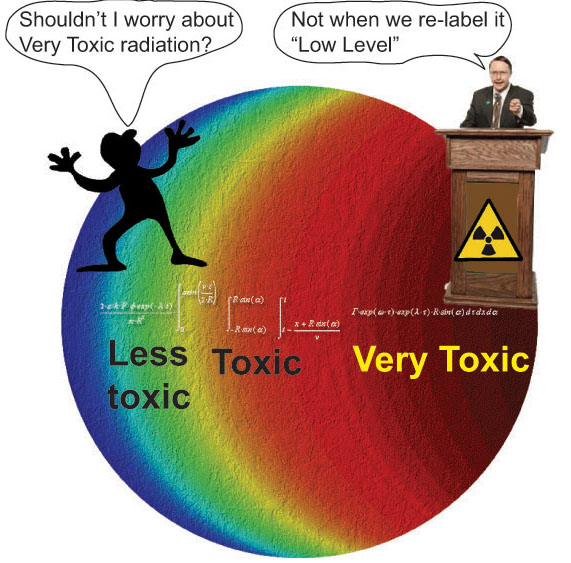
Health effects of radiation exposure
It has long been recognised that all radiation exposures present a risk to human health. Put simply there is no safe level of radiation – whether naturally occurring or artificially generated. Some we cannot avoid. Some like diagnostic medical x-rays we accept as having other countervailing benefits. High doses, like those received
by Japanese residents of Hiroshima and Nagasaki from nuclear bombs in 1945, or some of the first responders to the Ukrainian Chernobyl nuclear reactor meltdown in 1986, cause ‘radiation sickness’ where whole organs are damaged often with fatal
effects.
The results from high-dose exposures are what are known as ‘determinate’ effects.
Above a threshold dose these effects occur with severity determined by the dose. Radiation standards are set to keep exposures below the threshold, so these do not occur.
Lower doses cause a different kind of damage. Particularly concerning are increased rates of a wide range of cancers and genetic damage being passed on to future generations. These are referred to as ‘stochastic’ effects. The damage is not ‘determinate’ with a threshold below which they do not occur. Stochastic damage is a ‘hit and miss’ affair. You either get this type of health damage or you don’t. And if you do the scale of the damage isn’t related to the radiation dose you received.
The initial damage occurs at the cellular level where a radiation strike can have one of three outcomes. (i) It may simply pass through causing no damage. Alternatively, (ii) the radiation may kill the cell which isn’t a problem, unless too many cells are killed at once affecting functioning of whole organs. Our bodies are eliminating and replacing dead and dying cells all the time. Problems arise however when (iii) the cell is merely damaged and goes on to replicate in this damaged form.
Our bodies do have well developed repair mechanisms that often result in adequate repair of the damage. There is even some evidence suggesting that some such radiation damage and repair may assist the body’s capacity for repair in the future.
But where radiation leaves the damaged cell to survive and replicate uncontrollably in this damaged form the result is what we call a cancer – sometimes detectable only decades after the initial radiation damage. The process can be complicated further as growth of some cancers involves a two-stage process – initiation, where damage (from radiation or other environmental pollutants) leaves the cell susceptible,
followed by promotion (again from radiation or other sources) which drives the cell-cancer process forward.
Stochastic radiation damage is real. it doesn’t involve a threshold dose. Any exposure can be the one that causes the initial and/or subsequent damage leading to the health effects. We are in the world of ‘probability’ – far from certainty at the individual level but with fairly predictable outcomes at the population level which allow us to assess the risk (i.e., probability of an adverse outcome) individuals face from receiving small, sometimes repeated, doses of radiation.
Radiation protection principles.
In light of these established mechanisms for harm from radiation, standard setting bodies have long adopted three principles – that any exposure needs to be: (i) justified as necessary against some social benefits; (ii) kept as low as reasonably achievable (the ALARA principle); and (iii) kept below specified limits set in regulations.
The last of these has been the subject of much controversy over the years.
Standards have been set for workers’ occupational exposures and for public exposures. These, first, ensure exposures are below the threshold levels where deterministic effects might occur. Below these high levels, they have been set such that the risk of stochastic effects – particularly cancers and genetic damage are at levels deemed ‘acceptable’. There have been arguments over both what is ‘acceptable’ and how the probable level of risk from any given low dose is estimated.
Estimates of risk
A number of early studies of patients exposed as part of medical procedures indicated a problem with radiation exposure and some early estimates of the stochastic risk. Since then, the bulk of the data for the estimates of risk has come from studies of survivors of the Japanese nuclear bombings of Hiroshima and Nagasaki in 1945. These Life Span Studies (LSS) have consistently shown
increases in cancer rates among survivors higher than those in the non-exposed population. There are a number of problems with this data – not least that survivors were not wearing film badges when the bombs went off, so all doses have had to be estimated later. They were also the ‘hardy’ survivors of wide-ranging traumatic
events, perhaps less vulnerable to damage from radiation Most of these survivors received relatively high doses as a single exposure or within a relatively short time period. More accurate measures of small exposures repeated over longer time periods to a general population, might be expected to yield different results.
However, these were the best data to be had. The risks at lower doses are estimated using the assumption that, if there is no safe level of exposure, no threshold below which stochastic effects do not occur, we can estimate lower dose risks on a straight line from these higher LSS doses. This Linear No Threshold (LNT) assumption, though adopted by all stands setting bodies, has at times been contested. Some have suggested a sub-linear relationship with a threshold for any effects. Others have made the case for a super-linear or marginally higher effect at lower doses where these are spread over longer time periods or result from radiative material that gets inside the body.
For now all the significant agencies agree that radiation protection for workers and the public should be based on LNT and the three radiation protection principles: justification, ALARA, and Specific Exposure Limits. These agencies include: the International Commission on Radiological Protection (ICRP) the United Nations
Scientific Committee on the Effects of Atomic Radiation (UNSCEAR) the US National Academy of Sciences Committee on the Biological Effects of Ionising Radiation (known as the BEIR Committee) and national agencies like the Australian Radiation Protection and Nuclear Safety Agency (ARPANSA). The cancer risk from low
dose radiation is estimated to be in the range of 4-6% per Sievert (1000 mSv) of exposure. The risk of genetic damage (first two generations only) is estimated to be around 1.5% per Sievert.
These estimates have resulted in national protection bodies setting standards that limit annual exposures. For workers the annual limit is 20 mSv as a target – but with 50 mSv allowed in any year provided the average over five years does not exceed 20 mSv. The annual limit for public exposures is 1 mSv. All of these are for
exposures in addition to what might be received from natural background radiation or exposures due to medical procedures such as diagnostic x-rays and nuclear medicine.
Change is coming – one way or another.
It is these protection principles and the exposure standards for workers and the public that the Presidential directive to the US NRC seeks to overturn. It calls on the NRC to reconsider reliance on LNT (and ALARA) as the basis for standard setting at low doses, where there is a need to protect against probable stochastic effects and
directs that instead the NRC set standards based on deterministic effects.
This will likely result in a significant weakening of the current standards at a time when the evidence strongly suggests that they are in need of further tightening. The current standards have been in place since 1991. Revisions at that time were the result of a sustained campaign throughout the 1980s led by trade unions in the UK, Europe, USA and Canada for reduction of the then 50 mSv occupational and 5 mSv public limits -justified in large part by emerging evidence from the Japanese lifespan studies. As previously noted, estimates of risk from these was based on one-off
short-term exposure to relatively high doses (at and above 100 mSv). Since then, studies in Europe and North America of workers exposed over years of work in nuclear industries to doses below the current occupational limits, indicate the risks are around 2 to 3 times greater than those used for setting the current standards.
They also show a doubling of expected rates of cardio-vascular diseases: strokes, arthro-sclerosis, and heart damage. In addition, studies of populations living close to nuclear facilities in Europe and the USA show childhood cancer rates significantly higher than expected. This evidence is cause for concern, suggesting that the
current standards provide inadequate protection and need to be tightened.
A new campaign for improved protection?
Past experience suggests that persuading national and international bodies to improve radiation protection standards is far from easy but not impossible. In the short term, a campaign would be seeking clear and unequivocal statements from national protection agencies that reject the US president’s directive that the NRC abandon the fundamental principles which have formed the basis for regulating worker and public exposures. If implemented Trump’s proposals would likely result in occupational exposure limits five times higher than presently allowed, and public exposure limits could be 100 times greater.
The campaign should seek assurances that there will be no change to the established principles underpinning radiation protection: that there is no safe level of radiation, that all exposures should be kept as low as can be reasonably achievable; and that occupational and public limits need to be based on the best scientific evidence of risk to human populations.
Raising the concern about, and seeking rejection of, the likely US NRC changes will require building an informed coalition of trade union, environment and public health interests. Occupational and public radiation exposures are more widespread that commonly appreciated. Workers are routinely exposed in mining, industry and medicine as well as those associated with the nuclear power industry. The. campaign could involve local initiatives that focus concerns of workers in , and people living close to sites of: proposed nuclear power plants; existing uranium, mineral sands, and hard rock mines; proposed ‘rare earth’ mines; medical and other
radioactive waste storage sites; and other activities that routinely release radiative materials.
Opposing Trump’s latest proposals to weaken standards is fairly straightforward. If implemented by the NRC they would dismantle the whole edifice on which radiation protection has been built over the past 80 years – a framework that many concerned about radiation protection within the affected industries have invested time and energy to establish and maintain.
Pressing the claim for improvements is harder but not impossible given the evidence for greater harm that is emerging. The case can already be made for at least halving the permissible occupational and public exposure limits. If we are successful in pressing for improved protection standards, the nuclear industry is unlikely to thank President Trump for opening this can of worms with his NRC directive. Once opened it will be hard to close without increasing worker and public awareness of how any, and all radiation exposures increase health risks to workers the public and to future generations.
Tony Webb has worked as a researcher, consultant and advisor on radiation and health issues to politicians, trade unions, environment and public health groups in the UK, Europe, USA , Canada and Australasia since the late1970s. He can be contacted for information on how to assist the latest evolving international campaign via tonyrwebb@gmail.com.
Generation IV Nuclear Reactor Designs
The Next Nuclear Renaissance?
CATO Institute, Steve Thomas, Fall 2025 • Regulation,
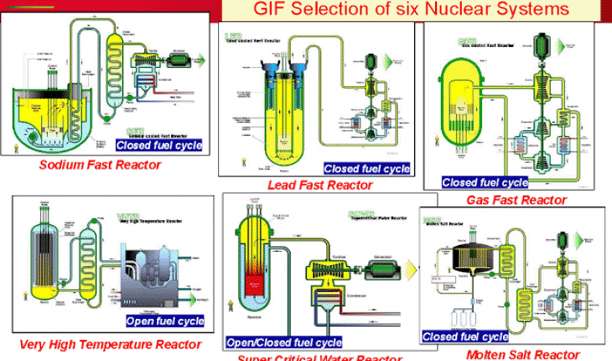
……………………………………………………………………………..Around the time of the previous nuclear renaissance, there was talk of the designs that would succeed Gen III+, so-called Gen IV designs. Gen III+ designs were seen as transitional technologies filling the gap until their long-term successors were developed. The Gen IV International Forum (GIF), an international intergovernmental organization funded by the governments of nearly all the nuclear-using countries, was set up in 2001 to promote development of these designs.
The GIF has stated, “The objectives set for Generation IV designs encompass enhanced fuel efficiency, minimized waste generation, economic competitiveness, and adherence to rigorous safety and proliferation resistance measures.” It identified six designs as the most promising, and these remain its focus. Some are designs that have been pursued since the 1950s and built as prototypes and demonstration plants but never offered as commercial designs. Among these are sodium-cooled fast reactors and high temperature gas-cooled reactors (HTGRs). Some, such as the lead-cooled fast reactor and the molten salt reactor, have been talked about for 50 or more years but never actually built. Others, such as the supercritical-water-cooled reactor and the gas-cooled fast reactor, do not appear to be under serious commercial development. When GIF was created, it expected some of the designs to be commercially available by 2025, but it now does not expect this to happen before 2050.
When the Gen IV initiative began, there was no expectation they would be small or modular. Gen IV designs are now sometimes known as Advanced Modular Reactors (AMRs) in an apparent attempt to profit from the positive press that LWR SMRs are receiving. However, they are very different from LWRs, with different designs and safety requirements, so the claims made for LWR SMRs compared to the large LWR designs are not relevant to AMRs.
There is particular interest in HTGRs because of the hope that they can operate at high temperatures (above 800°C /1,500°F). This would allow a plant to also produce hydrogen more efficiently than conventional electrolysis, providing the plant an additional revenue stream. However, existing HTGRs have only operated at 750°C /1,380°F, much higher than the 375°C /700°F of PWRs but not ideal for producing hydrogen. Increasing the temperature to the levels GIF anticipated originally, 950°C–1,000°C/1,750°F–1,850°F, would require new, expensive materials and would raise significant safety issues. The British government is concentrating its efforts on HTGRs, but it has said, “It is not currently aware of any viable fully commercial proposals for HTGRs that could be deployed in time to make an impact on Net Zero by 2050.” Nevertheless, the UK is still subsidizing development of HTGRs.
Overall, there are high-profile promoters of these Gen IV designs. For example, Microsoft cofounder Bill Gates is investing in sodium-cooled fast reactors through his nuclear innovation firm Terrapower. However, given the 50+ year history of these efforts, it is hard to see why these new companies would succeed now. Few of the more prominent Gen IV designs are being developed by firms with any history of supplying nuclear reactors. At most, Gen IV designs are a long-term hope……………………………. https://www.cato.org/regulation/fall-2025/next-nuclear-renaissance
Generation IV Nuclear Reactor Designs
The Next Nuclear Renaissance?
The CATO Institute, Fall 2025 • Regulation………………………………………………………..Around the time of the previous nuclear renaissance, there was talk of the designs that would succeed Gen III+, so-called Gen IV designs. Gen III+ designs were seen as transitional technologies filling the gap until their long-term successors were developed. The Gen IV International Forum (GIF), an international intergovernmental organization funded by the governments of nearly all the nuclear-using countries, was set up in 2001 to promote development of these designs.
The GIF has stated, “The objectives set for Generation IV designs encompass enhanced fuel efficiency, minimized waste generation, economic competitiveness, and adherence to rigorous safety and proliferation resistance measures.” It identified six designs as the most promising, and these remain its focus. Some are designs that have been pursued since the 1950s and built as prototypes and demonstration plants but never offered as commercial designs. Among these are sodium-cooled fast reactors and high temperature gas-cooled reactors (HTGRs). Some, such as the lead-cooled fast reactor and the molten salt reactor, have been talked about for 50 or more years but never actually built. Others, such as the supercritical-water-cooled reactor and the gas-cooled fast reactor, do not appear to be under serious commercial development. When GIF was created, it expected some of the designs to be commercially available by 2025, but it now does not expect this to happen before 2050.
When the Gen IV initiative began, there was no expectation they would be small or modular. Gen IV designs are now sometimes known as Advanced Modular Reactors (AMRs) in an apparent attempt to profit from the positive press that LWR SMRs are receiving. However, they are very different from LWRs, with different designs and safety requirements, so the claims made for LWR SMRs compared to the large LWR designs are not relevant to AMRs.
There is particular interest in HTGRs because of the hope that they can operate at high temperatures (above 800°C /1,500°F). This would allow a plant to also produce hydrogen more efficiently than conventional electrolysis, providing the plant an additional revenue stream. However, existing HTGRs have only operated at 750°C /1,380°F, much higher than the 375°C /700°F of PWRs but not ideal for producing hydrogen. Increasing the temperature to the levels GIF anticipated originally, 950°C–1,000°C/1,750°F–1,850°F, would require new, expensive materials and would raise significant safety issues. The British government is concentrating its efforts on HTGRs, but it has said, “It is not currently aware of any viable fully commercial proposals for HTGRs that could be deployed in time to make an impact on Net Zero by 2050.” Nevertheless, the UK is still subsidizing development of HTGRs.
Overall, there are high-profile promoters of these Gen IV designs. For example, Microsoft cofounder Bill Gates is investing in sodium-cooled fast reactors through his nuclear innovation firm Terrapower. However, given the 50+ year history of these efforts, it is hard to see why these new companies would succeed now. Few of the more prominent Gen IV designs are being developed by firms with any history of supplying nuclear reactors. At most, Gen IV designs are a long-term hope.
Large Reactors
If we exclude Russia and China (see below), three large reactor designs are currently available, at least in theory: the Westinghouse AP1000, Framatome (formerly known as Areva NP) EPR, and the South Korean KHNPC APR1400. These were all also available at the time of the previous nuclear renaissance, along with the GE–Hitachi ESBWR, but it won no orders and appears to no longer be marketed.
The only work in recent decades on a new design for a large reactor is for a modified version of the EPR, the EPR2. Despite this work starting in 2010, it had not entered detailed design phase as of the start of 2025, and the first reactor using this design is not expected online before about 2038. A new version, Monark, of the Canadian heavy water reactor CANDU has been publicized, but it seems to be at an early stage of development and the only interest in it appears to be from Canada.
The lack of new designs may reflect in part the very high cost of developing a nuclear reactor coupled with the uncertainty whether such research and development will lead to sufficient (if any) sales to recover those costs. For example, in 2023 NuScale stated that work developing its SMR design had cost $1.8 billion. In 2014, Westinghouse estimated it would have to sell 30–50 SMRs to get a return on its R&D investment. The GE–Hitachi ESBWR was carried through to detailed design and successfully completed the US NRC’s design evaluation, but commercial sales failed to materialize, and the vendor appears to no longer offer it. Another factor may be that vendors have exhausted their ideas for improving the economics of large reactors. During the previous renaissance, concepts such as passive safety, modularization, and use of production-line-made components were unable to solve the financial problems associated with large reactor designs (Thomas 2019).
Despite these setbacks, there is growing interest in Europe in large reactors, not just in the well-established markets of France and the UK, but also in countries such as the Czech Republic, Poland, the Netherlands, and Sweden. Below is a more careful look at these units.
Westinghouse AP1000 / The AP1000 (Advanced Passive) 1,100MW PWR won eight orders, four for the United States (two for the Summer plant in South Carolina and two for Vogtle in Georgia) and four for China. The Summer orders were abandoned after four years’ construction, but the others have been completed. The most recent orders were placed in 2010, and all six completed reactors were late and over budget. The Vogtle project took 11 years and cost more than double the forecasted cost. Similarly, the four reactors in China each took about 10 years to complete.
The AP1000 has been chosen by Poland for its first nuclear orders, with construction supposed to begin in 2028 and first power slated for 2036. The design was excluded from the bidding process in the Czech Republic because it “did not meet the necessary conditions.” Westinghouse is competing to win orders in Sweden and the Netherlands, neither of which has made a design choice.
Framatome EPR / The French EPR design is in a sort of limbo at the moment. In 2010, Areva NP acknowledged that the EPR design needed significant modification because of construction problems faced at Olkiluoto 3 (Finland) and Flamanville 3 (France). A modified design has been under development since then, and for the last decade Framatome has claimed it will be ready to order in two or three years. The new EPR2 design has long been expected to be used for follow-on orders from Flamanville 3, leaving only the UK as a customer for the original EPR design, for Hinkley Point C (under construction since 2018) and Sizewell C (ordered this year). In 2021, the French government required EDF to build six EPR2s, one every 18 months, with the first one expected to begin construction in 2026 and be operational in 2035. This timeline cannot be met, and the earliest first power is likely is 2038. Given the record of EPR projects, export customers likely want to see an EPR2 built and in operation before they order one. That would mean the EPR2 design is not an option for new export orders before 2040.
Despite the obvious uncertainties and risks, EDF/Framatome offered a scaled-down version of the EPR2, the EPR1200, to the Czech Republic and Poland. In both cases, Framatome’s bids were unsuccessful. Ordering an EPR1200 ahead of completion of the first EPR2 would have been an extraordinary gamble given that the reactor is an untested, scaled-down version of an untested design.
KHNPC APR 1400 / Korean Hydro and Nuclear Power Company (KHNPC) is a subsidiary of the state-owned monopoly electric utility KEPCO. The design is derived from the American engineering firm Combustion Engineering’s System 80+ design that completed a full safety review by the US NRC in 1997 but has received no orders. Combustion Engineering was absorbed into Westinghouse, and KHNPC purchased a technology license for the design.
In South Korea, six reactors of this design have been completed, the first in 2016, with two under construction as of July 2025. All except one of the completed reactors took more than 10 years to build, and the two under construction are far behind schedule. South Korea’s only reactor export has been four units, all using this design and built in the United Arab Emirates. All four took nine years to build.
KHNPC has acknowledged the design that has been built in South Korea and the UAE lacks features that would be essential for it to be licensed in Europe. Besides, under a recent change to its licensing agreement with Westinghouse, KHNPC is prohibited from marketing the unit in EU countries other than the Czech Republic, and also prohibited in Britain, Ukraine, Japan, and North America. Nevertheless, KHNPC appears confident that a scaled-down version of the APR1400, the APR1000, will be ordered by the Czech Republic. As with the EPR1200, ordering this untested design would be a gamble.
Prospects for large reactors / While the large reactor options look dated and their record is poor, in Europe they appear to have better prospects for orders in the next few years than SMRs. All will depend on a national government risking large amounts of public money to make these projects happen. France and the UK seem determined to follow this path, but other countries, which do not have as much financial strength, may waver when they find the scale of the financial commitment needed……………………………. https://www.cato.org/regulation/fall-2025/next-nuclear-renaissance#
Dounreay waste particle ‘most radioactive’ find for three years

Steven McKenzie, Highlands and Islands reporter and Rachel Grant, BBC Scotland. 23 Oct 25
A fragment of waste found near the decommissioned experimental nuclear power facility in Dounreay in April was the most radioactive to be detected in the past three years, the Highland site’s operator has said.
The fragment, categorised as “significant”, was discovered during monitoring work around the nuclear power plant near Thurso. It is the latest in a long line of particle discoveries in the area.
Dounreay was built in the 1950s as the UK’s centre of fast reactor research, but during the 1960s and 1970s sand-sized particles of irradiated nuclear fuel got into the drainage system.
Work to clear the pollution began in the 1980s, after particles were found washed up on the nearby foreshore.
The facility closed in 1994. The multi-billion pound decommissioning process involves hundreds of workers and is expected to last into the 2070s.
The full decontamination of the site is expected to take more than 300 years.
A Dounreay spokesperson said: “Particles are a legacy of industrial practices dating back to the early 1960s and our commitment today to environmental protection includes their monitoring and removal from the marine environment and transparent reporting of our activities.”
A group of independent experts, who advise the Scottish Environment Protection Agency (Sepa) and Dounreay, classify particles by the radioactivity of their caesium-137 content.
The categories are minor, relevant and significant.
Significant means a reading greater than one million becquerels of CS-137.
A becquerel is the standard unit of radioactivity.
The particle was found on the western part of Dounreay’s foreshore on 7 April. Eight other finds reported since then have been categorised as “minor” or “relevant”.
A significant-category particle was last discovered in March 2022.
Thousands of particles of different categories have been removed from beaches, foreshore and seabed at Dounreay.
The site’s operator said monitoring on the site on the north Caithness coast continued to be done on a fortnightly basis.
On occasions it said the scheduled work could be interrupted by bad weather or the presence of protected species of ground-nesting birds……………………………………………………..
What risk is there to the public?
According to official reports, risk to people on local beaches is very low.
Guidance issued by the UK government’s Nuclear Restoration Services says the most at-risk area is not accessible to the public.
The particles found along the coast vary in size and radioactivity with smaller and less active particles generally found on beaches used by the public.
Larger particles have only been found only on the foreshore at Dounreay, which is not used by the public.
The particles found on beaches are believed to come from the disintegration of larger fragments in the seabed near Dounreay. The area is continuously monitored for traces of radioactive materials.
Harvesting of seafood is prohibited within a 2km (1.2 mile) radius of a point near Dounreay. This is where the largest and most hazardous fragments have been detected.
Dounreay’s radioactive history
- 1954 – A remote site on the north coast of Scotland is chosen as the site of a new type of nuclear reactor. Modern homes were built in Caithness to attract workers to the sparsely populated area.
- 1957 – A chain reaction which provided sustained and controlled nuclear energy is achieved for the first time.
- 1959 – A new disposal site for radioactive waste called the Shaft opens. It drops 65.4m (214.5ft) below ground.
- 1962 – The fast reactor inside the dome is the first in the world to provide electricity to a national grid.
- 1977 – The original “golf ball” reactor is shut down and waste disposal in the Shaft ends after an explosion.
- 1994 – Dounreay nuclear power generating facility closes.
- 1998 – Decommissioning programme is announced.
- 2008 – Operation to scour the seabed for hazardous material begins and the Shaft shaft is encircled in a boot-shaped ring of grout to prevent contamination.
- 2020 – Clean-up begins of the highly contaminated Shaft – a three decades-long project.
- 2333 – Decontamination expected to be complete, making the 148-acre site available for other uses. https://www.bbc.com/news/articles/cz91nx0lv59o
Leah McGrath Goodman, Tony Blair and issues on torture (with added radiation)


Published by arclight2011- date 15 Sep 2012 -nuclear-news.net
[…]
Accusations: Despite the mockery of the film Borat, leaked U.S. cables suggest the country was undemocratic and used torture in detention
Other dignitaries at the meeting included former Italian Prime Minister and ex-EU Commission President
Romano Prodi. Mr Mittal’s employees in Kazakhstan have accused him of ‘slave labour’ conditions after a series of coal mining accidents between 2004 and 2007 which led to 91 deaths.
[…]
Last week a senior adviser to the Kazakh president said that Mr Blair had opened an office in the capital.Presidential adviser Yermukhamet Yertysbayev said: ‘A large working group is here and, to my knowledge, it has already opened Tony Blair’s permanent office in Astana.’
It was reported last week that Mr Blair had secured an £8 million deal to clean up the image of Kazakhstan.
[…]
Mr Blair also visited Kazakhstan in 2008, and in 2003 Lord Levy went there to help UK firms win contracts.
[…]
Max Keiser talks to investigative journalist and author, Leah McGrath Goodman about her being banned from the UK for reporting on the Jersey sex and murder scandal. They discuss the $5 billion per square mile in laundered money that means Jersey rises, while Switzerland sinks.
http://www.youtube.com/watch?v=gA_aVZrR5NI&feature=player_detailpage#t=749s
And as well as protecting the guilty child sex/torturers/murderers of the island of Jersey I believe that they are also protecting the tax dodgers from any association.. its just good PR!
FORMER Prime Minister Tony Blair was reportedly involved in helping to keep alive the world’s biggest takeover by Jersey-incorporated commodities trader Glencore of mining company Xstrata.
11/September/2012
[…]
Mr Blair was said to have attended a meeting at Claridge’s Hotel in London towards the end of last week which led to the Qatari Sovereign wealth fund supporting a final revised bid from Glencore for its shareholding. Continue reading
As UN Turns 80, Trump Continues US Violation of Charter’s Limits on Use of Force.

Donald Trump has ignored UN rules about attacking other nations, but he is not the first US president to do so
By Marjorie Cohn , Truthout, September 29, 2025
n his inflammatory September 23 speech to the United Nations General Assembly, Donald Trump expressed contempt for the UN, falsely claiming he had ended seven wars and stating, “I realized that the United Nations wasn’t there for us. I thought of it really after the fact … that being the case, what is the purpose of the United Nations?”
If Trump studied history, he would know the answer to that question.
Eighty years ago, after two world wars claimed millions of lives, nations around the world — including the United States — came together and established the UN system “to save succeeding generations from the scourge of war.”
The UN Charter requires that all states settle their disputes peacefully and refrain from the use of armed force except in self-defense under Article 51, after an armed attack against a UN state by another state, or when the Security Council authorizes it.
But, motivated by American exceptionalism — the notion that the U.S. is unique and morally superior and thus not bound by the rules — successive elected U.S. governments have violated the commands of the UN Charter and illegally attacked other countries with impunity.
Violation of UN Charter by Last Five U.S. Presidents
Trump has ignored the straightforward rules about the lawful use of force, but he is not the first U.S. president to do so. We need look no further than the last five presidents, who have launched armed attacks without Security Council approval against countries that had not carried out armed attacks on the United States or other UN member countries.
Bill Clinton could have helped prevent the genocide in Rwanda. But instead, he precluded the UN from acting to stop the killing of 800,000 people. In 1993, Clinton bombed Iraq to retaliate for an assassination attempt against George H. W. Bush. In 1998, on the eve of his impeachment, Clinton once again bombed Iraq, ostensibly to enforce Security Council resolutions, even though only the Council has the power to enforce its resolutions. Both bombings violated the UN Charter. The 1999 U.S.-led NATO bombing of Yugoslavia also violated the Charter, killing roughly 500 civilians. Madeline Albright, Clinton’s secretary of state, labeled the UN “a tool of American foreign policy.”
In 2001, George W. Bush’s administration illegally invaded Afghanistan, even though Afghanistan had not attacked the United States. On September 11, 2001, 19 men (15 of whom hailed from Saudi Arabia) committed crimes against humanity in the United States. But that was not an armed attack by another state sufficient to trigger the Charter’s Article 51 self-defense provision. Bush’s invasion of Afghanistan was not lawful self-defense, and the Security Council had not approved it.
Two years later, before he illegally invaded Iraq and changed its regime, Bush tried to obtain the consent of the Security Council, but the Council refused to authorize the invasion. Then Bush cobbled together prior Security Council resolutions from the first Gulf War, none of which authorized him to attack Iraq in 2003, in a vain attempt to legitimize his illegitimate war.
John Bolton, who served as U.S. ambassador to the UN during George W. Bush’s second term, and national security adviser during Trump’s first term, was a strong advocate for Bush’s 2003 invasion of Iraq. In 1994, Bolton displayed his hatred for the UN when he stated that “there is no such thing as the United Nations,” cynically adding, “If the UN Secretariat building in New York lost 10 stories, it wouldn’t make a bit of difference.”
Barack Obama launched illegal drone strikes in Yemen, Pakistan, Somalia, Libya, Afghanistan, Syria, and Iraq. None of those seven states had mounted an armed attack against the U.S. or any other UN member country, and the Security Council did not authorize the strikes. Moreover, the Obama administration provided no evidence that any of those states were about to launch an imminent attack on the United States. Even if the U.S. Congress had authorized Obama’s wars, they still would not have been in compliance with the Charter.
During Trump’s first regime, he ordered the illegal bombing of Syria. In 2017, he sent 59 Tomahawk cruise missiles to attack Syria in response to its alleged use of chemical weapons in a Damascus suburb. Syria had not attacked the United States or any other UN state before Trump’s missile strike. The use of chemical weapons by Syria did not constitute an armed attack to trigger the right of self-defense. And the Security Council had not approved Trump’s use of force. It therefore violated the Charter.
In 2020, Trump ordered the illegal drone assassination of Iranian Maj. Gen. Qassim Suleimani who was present in Iraq. Neither Iran nor Iraq had attacked the United States and the Council had not authorized Trump’s drone attack. It was therefore illegal under the Charter.
One month after Joe Biden was inaugurated, he authorized airstrikes in Syria on buildings that purportedly belonged to Iran-backed militias who were allegedly responsible for attacks against U.S. and allied personnel in Iraq. Syria, however, had not undertaken an armed attack on the U.S. or another country, and the Security Council had not approved the attack. Biden also authorized illegal drone strikes in Afghanistan in 2021 and 2022, and in Yemen in 2024.
Trump Renames “Department of Defense” the “Department of War”
Trump signed an executive order attempting to rename the “Department of Defense” as the “Department of War.” Permanently renaming the department would require congressional approval, but the move is indicative of his explicit rejection of the Charter’s fundamental precept of self-defense. And his actions since assuming office for his second term are consistent with that rejection.
After Israel illegally attacked Iran in June, Trump conducted a series of military strikes against three Iranian nuclear facilities. Although he claimed his objective was to put “a stop to the nuclear threat posed by the world’s number one state sponsor of terror,” Iran did not constitute an imminent threat. Rafael Grossi, director general of the International Atomic Energy Agency, affirmed at the time that Iran did not even have nuclear weapons capability. The U.S. strikes were not mounted in self-defense, and the Council had not given its imprimatur for the attacks.
Earlier this month, Trump illegally ordered armed attacks on at least three Venezuelan fishing vessels under the guise of fighting the drug war, killing at least 11 people, in direct violation of the Charter. He was apparently testing the waters. Now NBC News is reporting that Trump is considering mounting drone strikes within Venezuela in the next few weeks.
Since October 7, 2023, when Israel began its genocidal campaign against the Palestinian people in Gaza, the United States — under both Biden and Trump — has six times vetoed Security Council resolutions to end the fighting, despite the UN Charter’s command that international disputes be settled peacefully. The Trump administration filed the most recent U.S. veto on September 18.
Secretary of War Pete Hegseth has issued an unprecedented order summoning high-ranking military officials to attend a meeting in Quantico, Virginia, on September 30, reportedly to deliver a message about upholding a “warrior ethos.” Whether this signals a new aggressive approach or remains a mere photo op, the Trump administration is likely to continue the foreign policy tradition of disregarding the UN Charter, thanks to decades of impunity enjoyed by previous administrations.
Marjorie Cohn is professor emerita at Thomas Jefferson School of Law, dean of the People’s Academy of International Law and past president of the National Lawyers Guild. She sits on the national advisory boards of Veterans For Peace and Assange Defense, and is a member of the bureau of the International Association of Democratic Lawyers and the U.S. representative to the continental advisory council of the Association of American Jurists. Her books include Drones and Targeted Killing: Legal, Moral and Geopolitical Issues.
Underground data fortresses: the nuclear bunkers, mines and mountains being transformed to protect our ‘new gold’ from attack
The Conversation , 26 Sept 25 A.R.E. Taylor, Senior Lecturer in Communications, University of Exeter
It’s a sunny June day in southeast England. I’m driving along a quiet, rural road that stretches through the Kent countryside. The sun flashes through breaks in the hedgerow, offering glimpses of verdant crop fields and old farmhouses.
Thick hawthorn and brambles make it difficult to see the 10ft high razor-wire fence that encloses a large grassy mound. You’d never suspect that 100ft beneath the ground, a hi-tech cloud computing facility is whirring away, guarding the most valuable commodity of our age: digital data.
This subterranean data centre is located in a former nuclear bunker that was constructed in the early 1950s as a command-and-control centre for the Royal Air Force’s radar network. You can still see the decaying concrete plinths that the radar dish once sat upon. Personnel stationed in the bunker would have closely watched their screens for signs of nuclear missile-carrying aircraft.
After the end of the cold war, the bunker was purchased by a London-based internet security firm for use as an ultra-secure data centre. Today, the site is operated by the Cyberfort Group, a cybersecurity services provider.
I’m an anthropologist visiting the Cyberfort bunker as part of my ethnographic research exploring practices of “extreme” data storage. My work focuses on anxieties of data loss and the effort we take – or often forget to take – to back-up our data.
As an object of anthropological enquiry, the bunkered data centre continues the ancient human practice of storing precious relics in underground sites, like the tumuli and burial mounds of our ancestors, where tools, silver, gold and other treasures were interred.
The Cyberfort facility is one of many bunkers around the world that have now been repurposed as cloud storage spaces. Former bomb shelters in China, derelict Soviet command-and-control centres in Kyiv and abandoned Department of Defense bunkers across the United States have all been repackaged over the last two decades as “future-proof” data storage sites.
I’ve managed to secure permission to visit some of these high-security sites as part of my fieldwork, including Pionen, a former defence shelter in Stockholm, Sweden, which has attracted considerable media interest over the last two decades because it looks like the hi-tech lair of a James Bond villain.
Many abandoned mines and mountain caverns have also been re-engineered as digital data repositories, such as the Mount10 AG complex, which brands itself as the “Swiss Fort Knox” and has buried its operations within the Swiss Alps. Cold war-era information management company Iron Mountain operates an underground data centre 10 minutes from downtown Kansas City and another in a former limestone mine in Boyers, Pennsylvania.
The National Library of Norway stores its digital databanks in mountain vaults just south of the Arctic Circle, while a Svalbard coal mine was transformed into a data storage site by the data preservation company Piql. Known as the Arctic World Archive (AWA), this subterranean data preservation facility is modelled on the nearby Global Seed Vault.
……………………..Bunkers are architectural reflections of cultural anxieties. If nuclear bunkers once mirrored existential fears about atomic warfare, then today’s data bunkers speak to the emergence of a new existential threat endemic to digital society: the terrifying prospect of data loss.
Data, the new gold?
………………………………………………………………… For governments, corporations and businesses, a severe data loss event – whether through theft, erasure or network failure – can have a significant impact on operations or even result in their collapse. The online services of high-profile companies like Jaguar and Marks & Spencer have recently been impacted by large-scale cyber-attacks that have left them struggling to operate, with systems shutdown and supply chains disrupted. But these companies have been comparatively lucky: a number of organisations had to permanently close down after major data loss events, such as the TravelEx ransomware attack in 2020, and the MediSecure and National Public Data breaches, both in 2024.
With the economic and societal impact of data loss growing, some businesses are turning to bunkers with the hope of avoiding a data loss doomsday scenario.
The concrete cloud
One of the first things visitors to the Cyberfort bunker encounter in the waiting area is a 3ft cylinder of concrete inside a glass display cabinet, showcasing the thickness of the data centre’s walls. The brute materiality of the bunkered data centre stands in stark contrast to the fluffy metaphor of the “cloud”, which is often used to discuss online data storage.
Data centres, sometimes known as “server farms”, are the buildings where cloud data is stored. When we transfer our data into the cloud, we are transferring it on to servers in a data centre (hence the meme “there is no cloud, just someone else’s computer”). Data centres typically take the form of windowless, warehouse-scale buildings containing hundreds of servers (pizza box-shaped computers) stored in cabinets that are arranged in aisles………………………………………………………….
We often think of the internet as an immaterial or ethereal realm that exists in an electronic non-place. Metaphors like the now retro-sounding cyberspace and, more recently, the cloud perpetuate this way of thinking.
But the cloud is a material infrastructure composed of thousands of miles of cables and rows upon rows of computing equipment. It always “touches the ground” somewhere, making it vulnerable to a range of non-cyber threats ………………………………………………………………………………….
Like any computer, servers generate a huge amount of heat when they are running, and must be stored in constantly air-conditioned rooms to ensure they do not overheat………………………………………………………………………
An average data centre consumes an estimated 200-terawatt hours of electricity each year. That’s around 1% of total global electricity demand, which is more than the national energy consumption of some countries. Many of these facilities are powered by non-renewable energy sources, and the data centre industry is expected to emit 2.5 billion tons of carbon dioxide by 2030.
In addition, to meet expectations for “uninterruptible” service levels, data centres rely on an array of fossil fuel-based back-up infrastructure – primarily diesel generators. …………………………
………….Amid hype and speculation about the rise of AI, which is leading to a boom in the construction of energy-hungry data centres, the carbon footprint of the industry is under increasing scrutiny…………………………..
For technology behemoths like Apple and Google, cloud storage is a key strategic avenue for long-term revenue growth. While the phones, laptops and other digital devices they make have limited lifespans, their cloud services offer potentially lifelong data storage. Apple and Google encourage us to perpetually hoard our data rather than delete it, because this locks us into their cloud subscription services, which become increasingly expensive the more storage we need.
Apple’s marketing for its cloud storage service, iCloud, encourages users to “take all the photos you want without worrying about space on your devices”. Google has made “archive” rather than “delete” the default option on Gmail. While this reduces the likelihood of us accidentally deleting an email, it also means we are steadily consuming more of our Gmail capacity, leading some to purchase more Google Drive storage space.
Cloud hoarders
It is also increasingly difficult to operate off-cloud. Internal storage space on our digital devices is dwindling as the cloud becomes the default storage option on the majority of digital products being developed. Users must pay a premium if they want more than the basic local storage on their laptop or smartphone. Ports to enable expandable, local storage – such as CD drives or SD card slots – are also being removed by tech manufacturers.
As our personal digital archives expand, our cloud storage needs will continue to grow over our lifetimes, as will the payments for more and more cloud storage space. And while we often imagine we will one day take the time to prune our accumulations of digital photos, files, and emails, that task is often indefinitely postponed. In the meantime, it is quicker and easier to simply purchase more cloud storage.
Many consumers simply use whichever cloud storage service is already pre-installed on their devices – often these are neither the cheapest nor most secure option. But once we commit to one provider, it is very difficult to move our data to another if we want a cheaper monthly storage rate, or simply want to switch – this requires investing in enough hard drives on which to download the data from one cloud provider and upload it to another. Not everyone is tech-savvy enough to do that…………………………………………. https://theconversation.com/underground-data-fortresses-the-nuclear-bunkers-mines-and-mountains-being-transformed-to-protect-our-new-gold-from-attack-262578
The evolution of Volodymyr Zelenskyy and the Israel-Ukraine bond.

Orinoco Tribune By Sarah B. – Aug 20, 2025
Volodymyr Zelenskyy: The Pragmatist Who Normalized the Extreme,
Volodymyr Aleksandrovich Zelenskyy, born in 1978 in Krivoy Rog, is one of the most paradoxical figures to emerge from the war. A Jewish comedian turned wartime leader, he has become an international symbol of “resistance” and Western liberal values. But beneath the cultivated myth lies a far more uncomfortable truth: Zelenskyy is the keystone legitimizer in Ukraine’s normalization of far-right extremism, not in spite of his identity, but because of it.
Raised in a Russian-speaking Jewish family in the industrial city of Krivoy Rog, Zelenskyy experienced firsthand the Soviet-era antisemitism and post-Soviet chaos that shaped a generation. He earned a law degree from the Krivoy Rog Economic Institute in 2000, but chose a career in comedy and satire, eventually founding the Kvartal 95 troupe. His 2015 television show Servant of the People, in which he played a humble schoolteacher who unexpectedly becomes president, catapulted him into national fame.
In 2018, life imitated art. Riding a wave of anti-oligarch sentiment and public fatigue with Petro Poroshenko, Zelenskyy launched his own political party, borrowing the name of his TV show, and won the 2019 presidential election in a landslide, taking over 70% of the vote.
At the time, Zelenskyy appeared ideologically distant from Ukraine’s far-right fringe. His campaign promised peace with Donbass and normalization of relations with Russia. But once in power, his rhetoric softened, his promises evaporated, and the machinery of war began grinding forward with the same paramilitary formations he once distanced himself from now integrated into the state apparatus under his watch.
Zelenskyy’s presidency coincided with the formal mainstreaming of extremist militias like the Azov Regiment, the Tornado Battalion, and Right Sector. Though Azov had been absorbed into Ukraine’s National Guard in 2014, it was under Zelenskyy that it achieved full symbolic legitimacy. In 2023, Azov members were publicly awarded medals despite their use of SS-style insignia, and Zelenskyy referred to them in national speeches as “defenders of freedom.”
Zelenskyy’s defenders argued these moves were necessary under conditions of war. But the symbolic shift was profound: the Jewish president of Ukraine had now become the key validator of openly neo-Nazi formations and, more broadly, of a political culture that increasingly erased the boundaries between patriotism and fascism.
Zelenskyy’s Jewish identity played a central role in shaping his geopolitical posture. Early in his presidency, he gained support from prominent Jewish donors and Western liberal institutions. But it was his alignment with Israeli ideology and strategy that proved most consequential.
In a 2022 interview with Haaretz, Zelenskyy stated that Ukraine’s future should resemble a “big Israel,” a state built on constant mobilization, militarism, and national unity. The comparison wasn’t metaphorical. Zelenskyy repeatedly cited Israel’s compulsory service, hardened identity, and “resilience” as ideals for a wartime Ukraine.
“I think all our people will be our great army. We cannot talk about “Switzerland of the future.” But we will definitely become a “big Israel” with its own face. We will not be surprised that we will have representatives of the Armed Forces or the National Guard in all institutions, supermarkets, cinemas, there will be people with weapons.
— Volodymyr Zelenskyy, April 2022
In practice, this meant close coordination with Israeli and Zionist networks. Zelenskyy has consistently refused to condemn Israel’s military actions in Gaza, including the 2024–2025 bombardments that employed starvation tactics and AI-guided strikes. Instead, he echoed Israeli rhetoric about terrorism and security, drawing direct parallels between Ukraine’s fight against Russia and Israel’s war with Iran and its regional proxies.
Military cooperation followed suit. Israeli-made drones and surveillance systems flowed to Ukraine through third parties. Ukrainian forces supplied intelligence to Israel on Iranian missile tech recovered from Russian stockpiles and downed drones. Zelenskyy hosted Israeli officials, sought Iron Dome defense systems, and oversaw joint data-sharing agreements between Ukraine’s cyber units and Israeli partners.
Zelenskyy’s personal connections only deepen the alignment. His parents have reportedly lived in Israel for years, a fact often omitted in mainstream profiles but acknowledged in Jewish community outlets. In 2020, Zelenskyy visited Yad Vashem and gave a carefully worded speech reframing Ukrainian nationalism as compatible with Holocaust memory. Instead of confronting Ukraine’s role in the Shoah, Zelenskyy emphasized shared trauma and unity, an appeal that resonated with Israeli officials eager for a strategic partner in Eastern Europe.
Zelenskyy’s ties to the Chabad-Lubavitch movement also run deep. Chabad maintains a large presence in Dnepropetrovsk, historically bankrolled by oligarch Igor Kolomoyskiy. Zelenskyy has also attended Chabad-sponsored events and leaned heavily on global Jewish networks to secure diplomatic and military aid.
The Shifting Center
Zelenskyy’s ideological transformation can be summarized in three phases:
· Pre-2019: A secular liberal, anti-corruption satirist with no links to the far-right.
· 2019–2022: A centrist reformer forced into security pragmatism by war.
· 2022–Present: A full convert to the “big Israel” model, integrating far-right forces and prioritizing militarized nationalism over liberal pluralism.
In the end, Volodymyr Zelenskyy may not be a fascist. But he has become the indispensable manager of a system that rehabilitates fascism, at home, abroad, and in the name of something larger. His legacy will not be one of purity or resistance, but of convergence.
An extract from Gaza to Donbass: How Israel and Ukraine Built a Fascist, Transnational War Machine.
Gaza to Donbass: How Israel and Ukraine Built a Fascist, Transnational War Machine.

Orinoco Tribune By Sarah B. – Aug 20, 2025
From Bandera to Ben-Gurion, a new axis of ethno-supremacy is rising, fueled by U.S. backing. Same guns. Same flags. Same ideology. Gaza and Donbass are not separate wars. They are one machine.
The Ukraine–Israel Nexus: Pragmatic Alliances Amid Paradoxes and Shared Challenges
From Bandera to Ben-Gurion, echoes of ethno-nationalist revival resonate in the modern trajectories of Ukraine and Israel, two states forged through war, hardened by siege mentalities, and fueled by historical narratives of existential struggle. But these similarities are no accident of parallel development. They reflect a deepening alignment shaped by shared adversaries like Russia and Iran, backed and brokered by the same Western patrons.
In 2022, an officer of Ukraine’s Azov Regiment, toured Israel after surviving the siege of Mariupol. By 2025, Israeli drones were flying missions over Rafah, while American-made PSRL-1 rocket launchers, initially supplied to Ukraine, were spotted in conflict zones across the Middle East. Some experts suggest these may have reached Gaza through black-market channels, though a direct transfer remains unproven. What is undeniable, however, is the convergence of military technologies, intelligence doctrines, and battlefield logistics spanning both theaters.
In April 2022, Ukrainian President Volodymyr Zelenskyy, himself a stalwart ally to the Zionist cause, declared that he envisioned Ukraine becoming “a big Israel.” In doing so, he abandoned the pretense of liberal reform and embraced a future defined by permanent militarization, domestic surveillance, and an ideologically mobilized citizenry. Ukraine, he suggested, would survive not by joining Europe’s post-national dream, only by imitating the ethos of a heavily securitized Middle Eastern state.
Zelenskyy’s statement didn’t emerge in a vacuum. It followed decades of quietly intensifying Ukrainian–Israeli ties, in historical memory, military cooperation, tech integration, and shared narratives of victimhood. But it also exposed a deeper and more disturbing fusion. When the president of a country still reckoning with the legacy of the Holocaust and its own fascist collaborators calls for the building of a “Big Israel,” he is not just invoking a model of defense, he is invoking a model of justified violence, permanent siege, and a long tradition of selective memory, one that both Ukraine and Israel have wielded to reconcile uncomfortable historical alliances of culpability.
Just as the OUN’s collaboration with Nazi Germany is selectively reframed within the Ukrainian national mythos, Israel’s founding story often omits its own moments of strategic accommodation with fascism.
In the 1930s and ’40s, elements of the Zionist movement, most notably the Haavara Agreement between Nazi Germany and the Jewish Agency, facilitated Jewish emigration to Palestine while bypassing international boycotts of the Nazi regime. Revisionist factions like Lehi (the Stern Gang) and Irgun Zvai Leumi even sought military cooperation with the Axis powers against the British. These uncomfortable truths, long buried beneath the moral absolutism of Holocaust remembrance, underscore a shared willingness, Ukrainian and Zionist alike, to collaborate with and even become genocidal regimes when national aspirations were at stake.
What binds Gaza and Donbass is not a monolithic “machine of violence” but a transnational matrix of ideological alignment, technical cooperation, and strategic utility. Ukraine’s campaign of “decommunization” often mirrors Israel’s internal securitization and demographic engineering, both clad in the moral armor of historical trauma. In practice, both states justify aggressive internal and external policies through the language of survival.
This article maps the ideological, military, economic, and cultural architecture of the Ukraine–Israel relationship. From Soviet-era tensions to the post-2014 reconfiguration of alliances, we explore how pragmatic imperatives have forged a new axis of ethno-nationalist power, increasingly central to NATO’s long-term vision of regional dominance.
I. Historical Ties
To understand the modern partnership between Ukraine and Israel, one must begin with their shared, and often contradictory past. Ukraine was both a cradle of early Zionism and a site of violent antisemitic pogroms. Movements like Hibbat Zion, emerged in the 1880s in cities like Odessa and Kiev, decades before Theodor Herzl’s more famous Vienna-based political Zionism. Their mission: to restore the Jewish people to their ancestral homeland in Palestine. Ukraine, in this sense, was an incubator for the ideological DNA of the Israeli state……………………………………………………………………………………………………………………………………………………………………………………………….
…………………….The historical relationship between Israel and Ukraine is not one of ideological clarity. It is a pragmatic evolution, shaped by war, memory, trauma, and strategy. The next sections will examine how these contradictions manifest on the battlefield through weapons, doctrine, personnel, and propaganda, across Gaza and Donbass alike.
Selective Memory: How Competing Genocides Forged Strategic Amnesia
In the narrative war between historical truth and political utility, few examples are as revealing, or as cynical, as the ways Ukraine and Israel have reframed and often embellished their respective traumas to enable strategic cooperation.
By the 1980s, Ukrainian nationalist émigrés began aggressively promoting the 1932–33 Soviet famine, or Holodomor, as the “Ukrainian Holocaust.” This was a calculated response to the rising global awareness of Jewish suffering, spurred by the 1978 NBC miniseries Holocaust, which explicitly portrayed Ukrainians as Nazi collaborators. For diaspora groups still loyal to Stepan Bandera’s legacy, the documentary posed a threat to their rehabilitated image, which they had worked fervently to whitewash. In turn, they constructed a counter-narrative of equal, if not greater, Ukrainian victimhood, one that would cast the Soviet state as genocidal and reframe Ukrainian history through the lens of national martyrdom.
This rhetorical project relied on inflating death tolls,………………………………………………………………..
The result is a pact built on strategic amnesia: a cold alliance between two states whose foundational traumas have been rewritten to serve military alignment, ideological affinity, and common enemies………………………….
…………II. Blood Ties and Battle Lines: Commanders, Crusaders, and Collaborators
The machinery of transnational warfare is not only built with weapons, laws, and doctrines, but with men. Individuals who embody the ideological convergence between Zionist ethno-nationalism and Ukrainian fascism do not operate in the shadows; they are often celebrated, recruited, and strategically deployed across theaters like Gaza and Donbass. These figures serve as ideological evangelists, field commanders, propaganda tools, and networking nodes between far-right militias, Western intelligence networks, and private security structures.
Some are Azov veterans turned actors and influencers. Others are American-Israeli contractors building bridges between Tel Aviv and Kiev. ……………………..
Continue reading1 This Month
10 March A LIVE WEBINAR THE REAL EFFECTS OF NUCLEAR POWER
What the Industry Isn’t Telling Us
1:00 PM Mountain, 2 pm Central, 3 pm Eastern. Live on the Keepers of the Water Facebook page



18 March Webinar @ 1 PM EST: An Assessment of SMR Projects: The Case of Canada
register for the zoom:
https://us02web.zoom.us/webinar/register/WN_o8BIIOUvQ2ONJR1nta65DQ#/registration


of the week – STOP SMALL MODULAR REACTORS IN CANADA
To see nuclear-related stories in greater depth and intensity – go to https://nuclearinformation.wordpress.com
-
Archives
- March 2026 (99)
- February 2026 (268)
- January 2026 (308)
- December 2025 (358)
- November 2025 (359)
- October 2025 (376)
- September 2025 (258)
- August 2025 (319)
- July 2025 (230)
- June 2025 (348)
- May 2025 (261)
- April 2025 (305)
-
Categories
- 1
- 1 NUCLEAR ISSUES
- business and costs
- climate change
- culture and arts
- ENERGY
- environment
- health
- history
- indigenous issues
- Legal
- marketing of nuclear
- media
- opposition to nuclear
- PERSONAL STORIES
- politics
- politics international
- Religion and ethics
- safety
- secrets,lies and civil liberties
- spinbuster
- technology
- Uranium
- wastes
- weapons and war
- Women
- 2 WORLD
- ACTION
- AFRICA
- Atrocities
- AUSTRALIA
- Christina's notes
- Christina's themes
- culture and arts
- Events
- Fuk 2022
- Fuk 2023
- Fukushima 2017
- Fukushima 2018
- fukushima 2019
- Fukushima 2020
- Fukushima 2021
- general
- global warming
- Humour (God we need it)
- Nuclear
- RARE EARTHS
- Reference
- resources – print
- Resources -audiovicual
- Weekly Newsletter
- World
- World Nuclear
- YouTube
-
RSS
Entries RSS
Comments RSS
 nuclear-news