Fukushima waste-water plan a nuclear threat to Asia-Pacific
By Shaun Burnie | chinadaily.com.cn 2023-06-13 https://www.chinadaily.com.cn/a/202306/13/WS6487d3e0a31033ad3f7bbf92.html
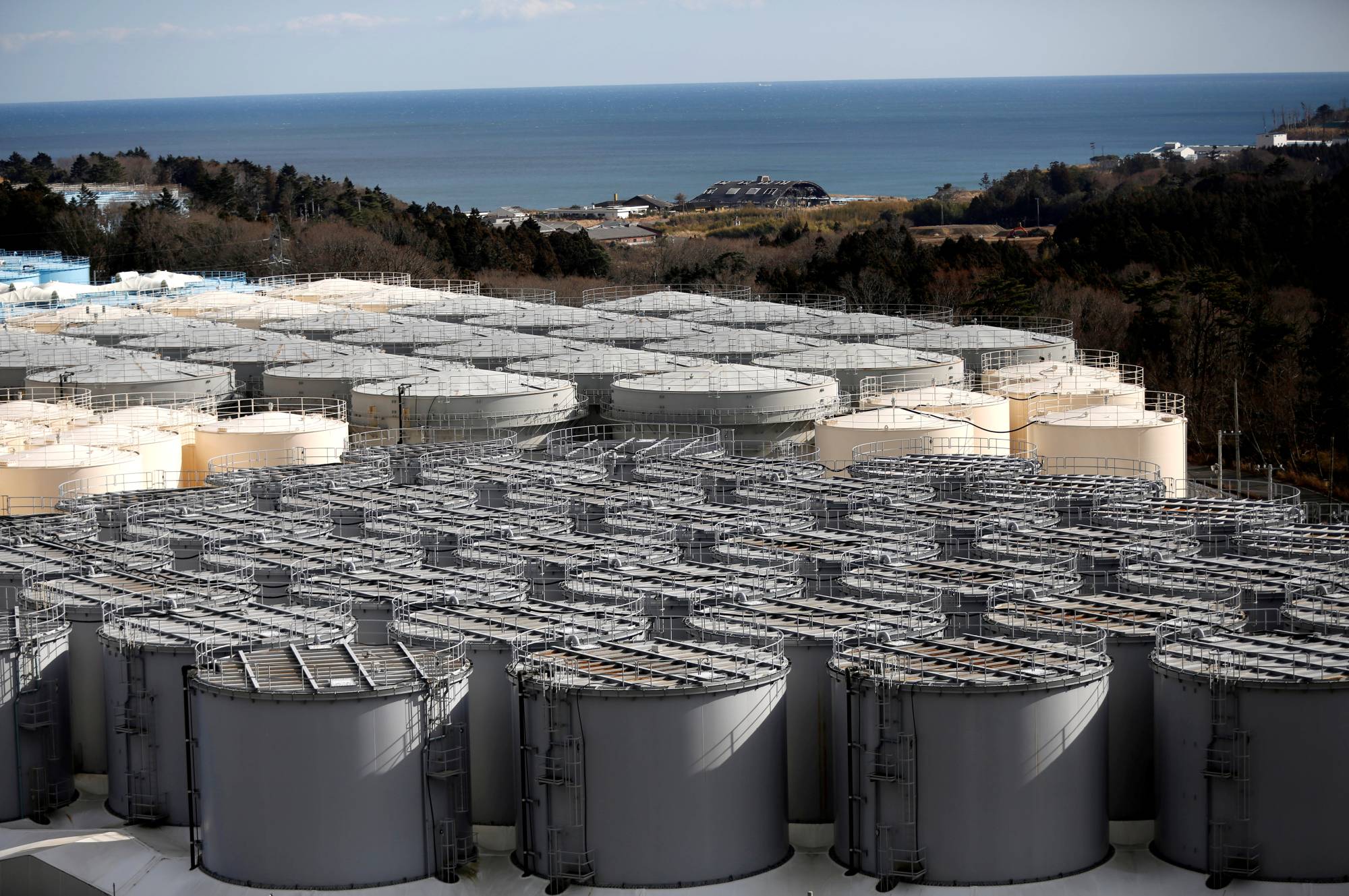
Japan has decided to start discharging radioactive wastewater from the Fukushima Daiichi nuclear power plant into the Pacific Ocean very soon. The operator of the wrecked plant began tests on Monday of newly constructed facilities for discharging treated radioactive wastewater into the sea. Many myths and untruths have been spread about the nuclear-contaminated water. For example, the Japanese government has said, that according to the International Atomic Energy Agency, the global nuclear industry and some scientists, there is nothing to worry about the effects of the radioactive wastewater.
The Japanese government also claims that nearly all the radioactive materials will be removed from the wastewater using the Advanced Liquid Processing System (ALPS) with only tritium remaining before it is released into the Pacific. It is constantly stated that tritium cannot be removed from the wastewater, but would emit very weak radiation and therefore it will have no impact on either the marine environment or human health in the Asia-Pacific region and beyond.
False claims to mislead the Japanese public
As for Tokyo Electric Power Company, the owner of the Fukushima nuclear plant, it claims discharging the wastewater is necessary due to insufficient space for more storage tanks and for it to be able to fully decommissioning the Fukushima plant between 2041 and 2051. TEPCO also says the discharges will meet regulatory standards and will be lawful.
In the real world, it is a lot worse and a lot more complicated than what TEPCO, the Japanese government and the IAEA claims. The ALPS has been a spectacular failure, with major doubts about its effectiveness. In addition to tritium, all the radioactive carbon (C-14) in the wastewater will be released into the ocean along with many other radionuclides (plutonium isotopes, iodine-129, strontium-90). But despite the Japanese government and TEPCO “planning” to keep them below the regulatory limit, they will still be significant.
There is no safety threshold for artificial radioactivity in the environment, and technology does exist to process tritium from the tanks’ water. However, TEPCO and the Japanese government do not want to spend huge amounts of money needed to do so. Tritium is indeed a low energy radioactive material but that does not mean its effect is weak; if ingested, it has the potential to damage plants, animals and humans.
Recent research published by a leading radiation biologist shows scientific literature of the past 60-plus years is clear — tritium, in particular organically bound tritium (OBT), is biologically harmful to all forms of life. The persistence, bioaccumulation and potential biomagnification and increased toxicity of OBT increases the potential impact on the environment if tritiated water is discharged on land or in the sea.
Tritium more dangerous than previously believed
None of the current regulations in Japan (or worldwide) takes into full account the nature of organic forms of tritium. That organic forms of tritium have been found to bioaccumulate in phytoplankton, the base of the marine food chain, is deeply worrying. The fact that there has been no comprehensive environmental impact assessment of these and many other issues is outrageous, and suggests there is a deliberate underestimation of the accumulation and potential toxic effect of tritium on the environment.
Equally important, the many other radioactive materials in the Fukushima wastewater have the potential to cause damage to the environment and human health. In fact, Japan has sufficient storage capacity, including in the areas around the Fukushima plant. And storing the toxic wastewater, TEPCO cannot fully decommission the reactors at Fukushima in the next 20-30 years — probably not in this century. Rather than being lawful, the release of the wastewater into the sea will violate international law, specifically the United Nations Convention on the Law of the Sea.
One reason why the untruths and myths continue to be spread is that there is a lot at stake for the Japanese government and the nuclear industry. Japan’s energy policy is dependent on restarting many nuclear reactors shut down after the 2011 Fukushima disaster. So far, nine have resumed operations — but according to government policy, Japan needs 30-plus reactors by 2030.
Public opinion in Japan has been influenced by the government’s claim that it is safe to operate these nuclear reactors and that it is possible to recover from a three-reactor meltdown without consequences for human health and the environment. Of course, it’s not.
Sweeping real issue under the carpet
TEPCO, the Japanese government or the IAEA refuses to accept that the wastewater crisis points to a deeper nuclear crisis at the Fukushima plant. And it is getting worse, because groundwater entering the plant continues to become highly contaminated, while the water in the tanks requiring ALPS processing increases.
In November 2021, based on TEPCO data, there were 1,284,284 cubic meters of contaminated ALPS water in the storage tanks, of which 832,900 cu m needed further ALPS processing. As of April 20, 2023, the total volume of radioactive wastewater stored in the tanks was 1,330,944 cu m — a 3.6 percent increase in less than 2 years.
Worse, about 70 percent or 931,600 cu m of the wastewater needs to be processed again (and probably many times again) by the ALPS to bring the radioactive concentration levels below the regulatory limit for discharge. This is an increase of nearly 12 percent in less than 2 years.
TEPCO has succeeded in reducing the concentration levels of strontium, iodine and plutonium in only 0.2 percent of the total volume of the wastewater, and it still requires further processing. But no secondary processing has taken place in the past nearly three years. Neither TEPCO nor the Japanese government nor the IAEA wants to talk about this. They have not said how many times the wastewater needs to be processed, how long it will take to do so or whether the efforts will ever be successful.
Problems not new but none solved in 5 years
Greenpeace wrote about these problems and why the ALPS failed nearly five years ago; none of those issues has been resolved. Also, there is a high possibility of the ALPS failing in the future.
To proceed with their discharge plan, the Japanese government and TEPCO have been creating a false impression on the public that significant progress has been made in decommissioning the Fukushima plant. But fact is, the source of the problem — the highly radioactive fuel debris in reactor pressure vessels 1, 2 and 3 — continues to contaminate groundwater. Nearly 1000 cu m of water becomes highly contaminated every 10 days. So until the nuclear fuel is isolated from the environment, contaminated groundwater, potentially hundreds of thousands of cubic meters, will continue to accumulate.
While the Fukushima plant, after being destroyed by the earthquake-triggered tsunami in March 2011, released large amounts of radioactive particles into the environment, most of the radioactive inventory remains inside the melted fuel. As such, the damaged Fukushima plant on the edge of ocean is a long-term radioactive threat to the environment, including the marine environment. And this threat will be aggravated once Japan begins dumping the toxic water into the ocean.
TEPCO, the Japanese government and the IAEA refuse to acknowledge the fact that the decommissioning plan for the Fukushima plant is not attainable, and that they must embark on a comprehensive reassessment of the plan.
Crisis compounded by damage to reactor
The nuclear crisis in Fukushima is compounded by the damage to the reactors, in particular unit 1. The rapid meltdown of the nuclear fuel in March 2011 severely damaged the large concrete block the 440-ton reactor pressure vessel sits on. One of the agencies responsible for its decommissioning has recently demanded that TEPCO work out immediate countermeasures to prevent the possible collapse of the reactor. But with very high radiation levels inside the plant, it’s not clear whether any countermeasures are possible.
Building a very large containment structure covering the reactor buildings, like it was done at the Chernobyl plant in Ukraine after the nuclear disaster in 1986, is probably the only way to prevent highly radioactive dust entering the lower atmosphere in the event of a future collapse. But such a “solution” is not a currently an option for the Japanese government or the nuclear industry, as it would send the wrong message that the decommissioning process is not going according to plan.
There is no scientific, legal or moral justification for Japan to deliberately contaminate our shared and common marine environment. And concerned citizens, scientists, maritime lawyers, the fishing communities across the Asia-Pacific and the world’s leading oceanography universities and institutes have spread public awareness about the nuclear dangers, something that has rarely been done before.
There is a very strong legal case for challenging Japan’s decision to dump the wastewater into the sea but doing so is a major undertaking. For many reasons, no state or group of states may take up the challenge through UNCLOS this year. But since the environmental threat from the Fukushima plant will only intensify, future legal action should not be ruled out.
At a time when our oceans are under so many multiple threats, including from melting glaciers and related climate emergencies, overfishing and biodiversity loss and plastic pollution — there is no reason why Japan should be allowed to dump the radioactive water into the sea.
Greenpeace has been campaigning for protection for our oceans from radioactive contamination since the 1970s. And the most important thing I have learned in my 30 years with Greenpeace is that positive change is possible even if it does not often happen as early as it should but it can happen and people must never give up their efforts or hope.
The author is a senior nuclear specialist with Greenpeace East Asia and has worked in Japan and wider Asia for over 30 years.
The warmonger neocons, run the show of the puppet figurehead Biden.

Contribution from readers Tom and Sue Millon, 10 July 23
For Republicans and corrupt democrats, it’s never been about the debt of the USA or ending devastating military conflict. It has never been about domestic tranquility. As the arch neocon Dick Cheney said, “Reagan taught us that the debt doesn’t matter.” It’s about re-allocating the federal budget to the people who put you in office: arms makers, the military. oil companies, slumlords, tech giants. If you don’t have a lobbyist, a PAC or a dark money conduit, you don’t count for a damn thing in Washington dc. America and the world is paying the price of this. The neocons run Biden now. Their think tanks and focus, are heavily funded by arms makers and the military. The warmonger neocons, run the show of the puppet figurehead Biden.
Their goals are out of touch with anything that is rational. They are not preventing the escalation of this potential nuclear confrontation, they are encouraging it.
Eve Ottenberg
From the human-caused climate catastrophe to a nuclear showdown between Washington and Moscow or Beijing, to fascism ascendant, three terrifying disasters loom over humanity like the shadow of death. These threats have lurked for some years, but the Ukraine war, facilitated by Joe Biden’s arrival in the white house in 2021 and his pronounced aggressiveness toward Moscow, shifted nuclear Armageddon to center stage and pushed the doomsday clock close to midnight.
Trust between the Kremlin and western governments vanished long ago, so it’s hard to see how this calamity ever gets resolved. Russian officials watched the U.S. fork over more than $30 billion in armament to Ukraine with billions more in the pipeline, arm neo-Nazis, whitewash them and cover Kiev’s government payroll. They’ve seen (and often destroyed) the weapons Washington sent. Those weapons would never include long-range missiles that could strike inside Russia, Biden promised. Well, that oath wasn’t worth the toilet paper it was written on. The U.S. would never provide Ukraine with tanks, Biden swore up and down – until he changed his mind. American fighter jets, he gave his word, would not fly in Ukraine. Well, now we see what his word is worth. What next? NATO troops in Ukraine? Because then the bombing of U.S., European and Russian cities will commence. It’s called World War III. Biden knows this. So do the Russians. And despite their loud protests in the face of this nonstop U.S. escalation, they have become ominously quiet about their red lines.

Once upon a time in Bucharest back in 2008, Moscow basically told the west that if its neighbor Kiev joined NATO, that would be the end of Ukraine. Feckless Eurocrats and birdbrain American presidents did not listen. Years passed. Washington sponsored a coup against the duly, legally elected leader of Ukraine in 2014, then installed a west friendly, Russophobic regime, or perhaps more accurately a puppet, whose idiotic economic policies led to a population outflow of millions of Ukrainians, as Washington proceeded massively to arm and train far-right fanatics.
Through all of this, until December 2021, Moscow only protested about its red lines in general terms. It also periodically indicated it might snap. Then, in late 2021, the Kremlin sent detailed letters to Washington, listing Russian security concerns, chiefly that Ukraine should not join NATO. Moscow also was alarmed at the fate of Donbas Russians, 12,000 of whom Ukraine had slaughtered since 2014 and on whose borders Kiev had massed troops and, in early 2022, dramatically stepped up assaults, as noted by the Organization for Security and Cooperation in Europe. Such a deadly uptick signaled assault and possibly ethnic-cleansing for Russian-speaking Ukrainians. But the U.S. blithely responded with hokum about NATO being a defensive organization. Hokum any half-wit can see right through by looking at U.S. missiles in Poland and Romania, two countries that border Russia.
Washington also insisted on every country’s sacred right to join NATO, though decades ago when Moscow mentioned joining, it got the cold shoulder; apparently Russia did not have that right. So the Kremlin could be excused for regarding NATO as a hostile military axis. Indeed, as our leading public intellectual Noam Chomsky said, “Putin’s invasion of Ukraine was clearly provoked, while the U.S. invasion of Iraq was clearly unprovoked.” (He also said whataboutism is “otherwise known as elementary honesty.”) Both invaders wrecked the target country, Russia more slowly, but make no mistake, that will be the outcome if this war doesn’t end soon.
The moral of the story is that if you can avoid war, that is a very good idea. If someone says “I will attack, if you don’t stop threatening me,” well, listen. The peacemakers are blessed, but sadly they were absent from the world’s imperial capital, Washington, in December of 2021. Currently they are absent everywhere they are needed, period.
So now, thanks to Biden, we stare down the barrel of nuclear war. The alternative in 2024 will likely be Trump, who promises accessories like martial law, a presidency for life, show trials of his political enemies and possibly nuclear war with China, in short, fascism. For this lousy choice we can blame our corrupt plutocracy and its media parasites. Put another way, those who rise to the top in Washington are not the cream of the crop, but the cream that curdled, years ago. Obama, Bush, Clinton – slick hustlers all, who slaughtered innocents across the globe, and all very short-sighted about anything other than looking out for the main chance, even if it meant bombing helpless residents of impoverished nations.
Meanwhile in the U.S. imperial capital, blood-soaked neocons run the show. This led to events May 26, when Russia’s foreign ministry summoned U.S. diplomats “over what it called ‘provocative statements’ by National Security Advisor Jake Sullivan,” according to RT. “The American official was de facto supporting Ukrainian strikes against Russian territory.” Given that Sullivan’s up to his elbows in blood for his responsibility in this Ukrainian debacle, the blood of hundreds of thousands of Ukrainian soldiers and tens of thousands of Russian ones, I’m not surprised he was, de facto or otherwise, basically advocating World War III. Moscow called his endorsement of Ukrainian attacks on Russia “hypocritical and untruthful.” That’s called understatement.

Sullivan, secretary of state Antony Blinken and his undersecretary Victoria Nuland are in charge in Washington, instead of the unfocussed, forgetful figurehead, Joe Biden, and they want war, for decades, if they so choose.

Inauspiciously, sane, non-neocons now resign from the Biden regime en masse, a development covered in depth by Moon of Alabama May 25. Rick Waters, head of the state department’s “China House” leaves his post. After the ridiculous spy balloon hysteria, with its wild delusions of assault and evil designs by a mortal enemy, Waters was one of the more rational actors, trying to limit the damage, reportedly emailing state department staff to postpone some sanctions and export controls on China, you know, moves that could have been viewed as, um, hostile.
Also dispiriting to those hoping to restrain imperial war schemes, deputy secretary of state Wendy Sherman announced her retirement. Sherman backed the original Iran nuclear pact and pushed hard to get an inept Biden administration to return to it, something, contrary to campaign promises, Biden couldn’t manage to do. As a result, the Middle East teeters constantly on the edge of regional war, which the pact would have helped prevent. Colin Kahl, a defense undersecretary departs this summer. He opposed escalating the U.S. proxy war in Ukraine. Nor was he popular with lunatic Sinophobes. To make the loss of these realists even worse, Biden tapped a ferocious China hawk to head the joint chiefs of staff, thus replacing the less rabid though rather ineffectual Mark Milley. All these moves spell trouble. They mean maniacal warmongers run the empire.
So the situation has deteriorated dangerously, and this is what Chomsky predicted if Washington didn’t face the “ugly” post-invasion choice of rewarding Moscow by enforcing Kiev’s neutrality and the Minsk Accords for the Donbas. No one has documented the U.S. empire’s depravity as long and relentlessly as Chomsky. His new book, Illegitimate Authority, continues this effort, singling out the triad of cataclysms – climate collapse, nuclear war and fascism – thundering in humanity’s front yard like the crack of doom. These interviews, collected from Truthout, at first zero in on how rich countries burning oil, gas and coal have crushed anything resembling a normal climate, with a few that focus on rising fascism.
For Republicans and corrupt democrats, it’s never been about the debt. As the arch neocon Dick Cheney said, “Reagan taught us that the debt doesn’t matter.” It’s about re-allocating the federal budget to the people who put you in office: arms makers, the military. oil companies, slumlords, tech giants, If you don’t have a lobbyist, a PAC or a dark money conduit, you don’t count for a damn thing in washington dc. Same goes for the , neocons whose think tanks are and focus, are heavily funded by arms makers and the military. The warmonger neocons, that run the show of the demented old, puppet figurehead biden.
Their goals are out of touch with anything that is rational. They are not preventing the escalation of this potential nuclear confrontation, they are encouraging it.
But when the book reaches early 2022, it shifts its emphasis to Ukraine. Chomsky is well aware of Washington’s provocations, while regarding Moscow’s response to them as criminal. He quotes Eastern Europe specialist Richard Sakwa: “NATO’s existence became justified by the need to manage threats provoked by its enlargement.” Well, now NATO has provoked a threat that, according to one whose hands are red with blood from this war, Nuland, could last “16 years.”
Chomsky also addresses the imbecilic fantasy of regime change, noting that historically this has led to worse, more extreme leaders, for which he cites a convincing discussion by Andrew Cockburn. Chomsky called NATO dreams of overthrowing Vladimir Putin “foolish,” because someone far more menacing would very likely take over. Among Kremlin leaders, Putin is, in fact, a moderate, with far less of an appetite for war than the others who advocated invading Ukraine for years, while he demurred.
In March 2022, when neutral countries sponsored talks between Moscow and Kiev, Chomsky warned, “negotiations will get nowhere if the U.S. persists in its adamant refusal to join…and if the press continues to insist that the public remain in the dark by refusing even to report Zelensky’s proposals.” Well, nowhere is exactly where they went, thanks to the then U.K. prime minister, the buffoonish Boris Johnson, who jetted into Kiev, allegedly at Biden’s behest, and clarified to Zelensky that while the Ukrainian president might be ready for peace, the west was not. That scuttled the talks.
That’s where we are now. Washington just extracted itself from losing a 20-year military quagmire in Afghanistan. Now it’s up to its neck in a proxy war its boosters say could last decades. Unfortunately for the imperial team, its opponent in this latest bloodletting is armed to the teeth with nuclear weapons. This is not some helpless undeveloped country that Washington can bully and then prevaricate about pusillanimous American behavior not amounting to a military defeat. Russia is a great power and a nuclear one.
Detailed evidence exposes Japan’s lies, loopholes in nuclear-contaminated wastewater dumping plan

Japan’s existing ocean discharge plan and evaluation are based on the assumption that the nuclear-contaminated wastewater can meet discharge standards after treatment.
But unfortunately, the data released by TEPCO showed that as of September 30, 2021, some 70 percent of the then 1.243 million cubic meters of ALPS-treated nuclear-contaminated wastewater still failed to meet the criteria, 18 percent of which even exceeded the standards 10 to 20,000 times over
Firstly, the types of radionuclides that TEPCO monitors are relatively few, making it far from being able to reflect the correct radionuclide dispersion in the contaminated wastewater.
The Fukushima nuclear-contaminated wastewater, coming from the wastewater which was directly in contact with the core of the melted reactor, theoretically contains all the hundreds of types of radionuclides in the melted reactor, such as fission nuclides, a uranium isotope, and transuranic nuclide.
But TEPCO at first only listed 64 types of radionuclides including H-3 and C-14 as a (data) foundation for the works including monitoring and analysis, emission control, and environmental impact assessment. These 64 radionuclides did not include the uranium isotope and certain other α-nuclides, which have long half-lives while some are highly toxic.
TEPCO’s exclusion of the radionuclides mentioned above has greatly compromised the effectiveness of its monitoring work, as well as the credibility of its environmental impact assessment result.
“TEPCO’s plan of only monitoring a few types of radionuclides is unscientific,” the insider told the Global Times.
Later, during the review process of the IAEA Task Force in 2022, TEPCO changed the number of radionuclide types it was monitoring and analyzing to 30, and then decreased it to 29 this year. This is far from enough to provide a complete assessment of the extremely complex nuclides in the Fukushima nuclear-contaminated wastewater.
Secondly, there are missing activity concentration values for multiple radionuclides in TEPCO’s monitoring scheme.
TEPCO’s public report on the 64 radionuclides only provides activity concentration values for 12 radioactive nuclides other than tritium, while over 50 other nuclides do not have specific activity concentration values. The report, while only offering gross α and gross β values, doesn’t disclose the respective concentration levels of many highly toxic radionuclides in the Fukushima nuclear-contaminated wastewater, such as Pu-239, Pu-240 and Am-241.
“[TEPCO’s] current plan only monitors some of the nuclides and the gross α and gross β values, which cannot accurately indicate the fluctuations or changes in the activity of each nuclide after treating the contaminated wastewater due to the fluctuation of the nuclide source term composition,” said the insider.
This operation of TEPCO has largely increased the uncertainty of the [nuclide] source item information of the nuclear-contaminated wastewater, and thus greatly increases the difficulties of making subsequent monitoring plans and marine ecological environmental impact assessment.
Thirdly, TEPCO didn’t make conservative assumptions in many aspects of its monitoring data, and some of the assumptions it made were somewhat “negligent.”
In the process of treating the nuclear-contaminated wastewater, the slight particle shedding of chemical precipitants and inorganic adsorbents in the ALPS may cause some radionuclides to exist in a colloidal state.
Therefore, TEPCO’s assumption that all nuclides in nuclear-contaminated wastewater in the ALPS are water-soluble is obviously invalid, said the insider. “TEPCO should scientifically and comprehensively analyze whether colloidal nuclides are present in the nuclear-contaminated wastewater based on the long-term operation experience of its ALPS system,” he noted.
Huang Lanlan Jun 05, 2023 https://www.globaltimes.cn/page/202306/1291969.shtml
The Fukushima Daiichi Nuclear Power Plant Photo: VCGAs the date for Japan’s planned dumping of nuclear-contaminated wastewater into the ocean approaches, a Pandora’s Box threatening the global marine ecosystem is likely to be opened.
The Japanese government announced its decision on April 13 to release the nuclear-contaminated wastewater from the storage tanks at the Fukushima Daiichi Nuclear Power Plant into the sea. Starting from 2023, the discharge is scheduled to last about 30 years. This decision has garnered widespread attention and sparked great concern across the globe.
While Japanese authorities are busy colluding with some Western politicians in boasting about the discharge plan, Fukushima residents, international experts in ecology, and various stakeholders around the world have kept calling for Japan to reconsider and modify its flawed plan.
Japan’s attempt to “whitewash” the Fukushima nuclear-contaminated wastewater release plan failed again at the Group of Seven (G7) summit in May. The joint statement of the summit did not explicitly state nor allude to the G7 members’ “welcome” of the current dumping plan due to strong opposition. Instead, it only reiterated support for the International Atomic Energy Agency’s (IAEA) review of Fukushima’s treated water release.
An insider familiar with Japan’s dumping plan recently told the Global Times that he has many concerns and doubts about the plan. The insider provided detailed evidence exposing Japan’s lie that whitewashes its dumping plan. He also revealed many loopholes in the plan that the Japanese government and Tokyo Electric Power Company (TEPCO) have refused to talk about or even deliberately concealed from the public.
All provided evidence considered, it is apparent that, currently, Japan is incapable of properly handling the nuclear-contaminated wastewater dumping. The toxic wastewater processed by the Japanese side cannot currently meet international discharge standards, and the country’s reckless behavior, if not stopped and corrected in time, may cause irreparable damage to the global ecosystem.
“There are still many unresolved issues with the source terms of the Fukushima nuclear-contaminated wastewater,” the insider said.
“If the Japanese government and TEPCO continue to have their own way, it may cause improper discharge of nuclear-contaminated water, and that must be taken seriously,” he noted, calling on the two sides to be open, transparent, and honest in solving the problem.
Disappointing data monitoring
Japan’s current plan of releasing nuclear-contaminated wastewater into the sea, though superficially reasonable at first glance, cannot hold up to close scrutiny. Its monitoring on the source terms of the Fukushima nuclear-contaminated wastewater is incomplete, and the data it collects is likely unreliable, observers told the Global Times.
In February 2022, the IAEA Task Force released its first report, the IAEA Review of Safety Related Aspects of Handling ALPS-Treated Water at TEPCO’s Fukushima Daiichi Nuclear Power Station. The report clearly stated that the Task Force “commented on the importance of defining the source term for the discharge of ALPS (Advanced Liquid Processing System) treated water in a sufficiently conservative yet realistic manner.”
Source terms of contaminated water include the composition of radionuclide and the activity of simulation of nuclides dispersion. As the premise of marine environmental monitoring, the accuracy and reliability of the source term-related data is crucial. However, Japan’s data statistics and monitoring on the source terms are disappointingly full of loopholes.
Continue readingAtmospheric Testing of Nuclear Weapons in the 1950s and 1960s

May 27, 2023, Dr Ian Fairlea, https://www.ianfairlie.org/news/atmospheric-testing-of-nuclear-weapons-in-the-1950s-and-1960s/
Radioactive fallout from atmospheric nuclear weapons testing in the 1950s and 1960s caused the greatest exposure of man-made radiation to humankind.
The radiation dose to the world’s population from these tests was estimated by UNSCEAR in 1993 at 30 million person-sieverts, which was 50 times more than the 600,000 person-sieverts from the Chernobyl accident in 1986.
The cumulative explosive power of the tests corresponded to 545 million tons of TNT, equivalent to 40,000 atomic bombs of the size dropped on Hiroshima in 1945.
However surprisingly few epidemiological studies of the possible health effects of atmospheric testing have ever been conducted. The few that were carried out had inconclusive results: no clear signature of raised leukemias, for example, was observed. But we should always apply the strict rule in epidemiology that absence of evidence does not provide evidence of absence (Altman and Bland, 1993). It just means that we have not been able to find the evidence yet.
However Dr Alfred Körblein, an independent researcher in Germany, has just found clear evidence. He has just published (Körblein, 2023) the results of his own statistical study of data on infant deaths from UNSCEAR (1993) data and other sources. He concluded that, after the atmospheric bomb tests, infant deaths definitely increased both in the United States and in Europe including the UK. He hypothesised this was an effect of radioactivity from bomb fallout (from strontium-90) on the immune systems of pregnant women.
In more detail, what Körblein’s study shows is that the bomb tests resulted in very high levels of radioactive fallout which remained suspended in the northern hemisphere for years afterwards. He reproduces charts showing high levels of strontium-90 fallout: similar levels of radioactive caesium-137, carbon-14, iodine-131, hydrogen-3 (tritium) and other nuclides would also have occurred at the same time.

These radionuclides would have been inhaled and ingested by everyone in the northern hemisphere, including pregnant women. We know that the immune systems of developing embryos and fetuses in pregnant women are extremely sensitive to radiation. The evidence produced in the study clearly shows increased levels of perinatal deaths (between >24 weeks’ gestation and 7 days after birth) and neonatal deaths (within 28 days of birth) in several countries including the UK. In other words, the radioactivity from these bomb tests is thought to have produced teratogenic effects in the offspring of pregnant women in the years during and following the bomb tests.
Körblein concludes that “atmospheric nuclear weapons testing may be responsible for the deaths of several million babies in the Northern Hemisphere”. I agree with his analysis and his sobering conclusion. Here is a rough cross-check. If we accept the dose modelling carried out by UNSCEAR in their 1993 estimate of 30 million person-sieverts (which I accept) and apply a commonly-used risk factor for fatal cancer of 10% per Sv, then we arrive at a crude figure of 3 million deaths – similar to Korblein’s estimate.
REFERENCES
Altman DG and Bland JM (1995) Absence of evidence is not evidence of absence. British Medical Journal. 311 (19 August): 485. doi:10.1136/bmj.311.7003.485.
Körblein A (2023) Statistical modeling of trends in infant mortality after atmospheric nuclear weapons testing. PLoS ONE 18(5): e0284482. https://doi.org/10.1371/journal.pone.0284482
UNSCEAR (1993) United Nations Scientific Committee on the Effects of Atomic Radiation. UNSCEAR 1993 report to the General Assembly. United Nations, New York.
Germany’s green revolution puts nuclear power in the past

Renewed support for renewables and an end to nuclear power keep Germany on its carbon neutral path
By Linda Pentz Gunter 21 May 23
Germany is a country of sensible shoes. And, I might add, supremely comfortable ones. Germans do buttery leather as well as they do beer.
Germany’s energy policy is similarly sensible. Germans see no reason to choose the slowest, most expensive, most dangerous and decidedly non-renewable energy source with which to address the climate crisis.
Consequently, Germany rejected nuclear power, and on Saturday April 15, it closed the last of its reactors. Germany, like its even more sensible neighbor, Austria — where nothing nuclear may even traverse its terrain — is now a nuclear-free country. Almost. The next step for the German anti-nuclear movement will be to close the URENCO uranium enrichment facility there and the Lingen fuel fabrication plant. And of course there remain nuclear weapons in Germany, not theirs, but ours.
While France continues to wobble along on its high-fashion nuclear stilettos, turning ankles and snapping off heels whenever the going gets rough, Germany will trudge on inexorably, and comfortably, to its stated goal of carbon neutral by 2045.
Germany also plans to end it coal use possibly as soon as 2030, but certainly by 2038. Although, you’d never know it, with all the alarmist hype in circulation post nuclear shutdown. The nuclear lobby, already in propaganda over-drive, has now gone supersonic in its efforts to persuade the world that Germany’s choice to close those last three reactors — never mind that their energy has already been replaced by renewables —will mean burning more coal.
The decision to prolong the operating time of its last three reactors until April 2023 (they were originally due to close at the end of 2022) was largely political, designed to appease rightwing voices within the governing alliance led by the Social Democrats. “We could, in fact, have already shut down the nuclear power plants by January 1 of this year without the lights going out,” said German economist, Claudia Kemfert. “The extension was more like a psychological comfort blanket, as we had an oversupply of electricity,” she told the Washington Post.
Germany didn’t need those last three reactors to keep its green revolution on track. And it especially didn’t need them through this winter, after rejecting the supply of gas from Russia in response to that country’s invasion of Ukraine. German heating is not electric. So nuclear power had no role to play in easing that situation.
Meanwhile, power prices on the European Energy Exchange for the first quarter of 2024 were more than twice as high in France than in Germany. Much of this was due to loss of market confidence in French state energy company, EDF, to get sufficient numbers of their troubled nuclear reactors back on line to meet demand.
This did not change after Germany’s last three reactors closed. As Bruno Burger of Energy Charts noted as a caption to the graphic below [ on original] : “The shutdown of the last three German nuclear power plants has no visible effect on weekly Future Electricity Prices in Germany.”
The nuclear power contribution to Germany’s energy mix has been steadily declining since the renewable energy boom, known as the Energiewende, was launched in 2000 with the Renewable Energy Act. A precondition of the Act’s passage was that as nuclear power was phased out it would be replaced by renewable energy and energy efficiency (although demand should have been brought down much faster, much further) and not by fossil fuels.
In 2000, the renewables share in German electricity was just over 6%. The nuclear share was 30%. In just 23 years, those numbers have more than reversed, with today’s share of on- and off-shore wind plus solar at just over 46% and nuclear at 4.6% in the last week before the final reactor closures. Germany remains on track to achieve its carbon neutral goal by 2045.
The renewable energy boom was greatly helped by the implementation of a feed-in tariff that helped to create confidence and certainty for renewable energy investors who were guaranteed a fixed price for 20 years, above the standard market price. This spurred a big investment, not just by companies, farmers, and coops, but by individuals and many municipalities.
This led to local success stories such as Morbach, a small town about 92 miles west of Frankfurt that boasts 14 wind turbines, 4,000 square meters of solar panels and a biogas plant. Combined, these generate three times more electricity than the community of 11,000 people needs. They sell the surplus back to the grid.
Simply put, the nuclear phaseout opened the way for renewable energy growth in Germany and put the country on the path to a fossil fuel-free future as well. Without the former, the latter would not have happened.
Critics who falsely ascribe Germany’s continued use of coal, including brown coal or lignite, to the nuclear phaseout, fail to understand that these upticks are driven by the export market and are not related to domestic consumption or the nuclear shutdown.
Ironically it is nuclear France, dependent on electric heat, that is partially responsible for the demand for German coal. This was especially so this past winter when the French nuclear sector all but collapsed with more than 50% of its nuclear capacity down due to serious safety issues combined with scheduled maintenance.
In contrast, in 2022, Germany succeeded in weaning itself off Russian gas entirely and supplying France with 15 billion kWh of electricity net.
Furthermore, Germany’s lignite and coal production remains well below earlier levels and Germany is legally committed to end coal use by 2038. The current government is working to advance this date to 2030.
According to the 2022 World Nuclear Industry Status Report: “Lignite peaked in 2013 and then declined—especially in 2019–2020—before increasing again by 20.2 percent in 2021. However, lignite generation remained below the 2019-level and 25 percent below the 2010 level.
“Hard coal also peaked in 2013 then dropped to 64 percent below the 2010-level. While it has seen, at 27.7 percent, the strongest increase in 2021 of any power generation technology, it also remains below the 2019 numbers.
“Natural gas fluctuated since 2010 and peaked in 2020 at 2.6 percent above the 2010-level before dropping by 5.3 percent in 2021.”
In fact, Germany’s struggle to get off fossil fuels lies mainly in the transport rather than the electricity sector. The country’s love affair with the car and speed limit-free autobahns is a long engagement that now needs to be broken.
Germany’s path to a carbon neutral economy is all about the trajectory, which is on track, despite bumps in the road. As always, it is about a political commitment rather than any technological challenges. If the current government sticks to its word to greatly accelerate renewable energy implementation, the Energiewende, by no means a perfect roadmap, will get itself back on track.
Mistakes were undoubtedly made. Even after then Chancellor Angela Merkel had her epiphany in 2011 in light of the Japan nuclear disaster at Fukushima, making an overnight decision to restore Germany on the path to nuclear shutdown, she subsequently made drastic cuts in solar subsidies, something environmentalists described as “nothing less than a solar phase-out law”.
But despite this, Germany remains one of the few Western countries that has demonstrated a consistent commitment both to a nuclear phaseout and to climate chaos abatement.
The German anti-nuclear movement is greatly to be credited with much of this progress. It has long been one of the most powerful and politically effective. Like the sensible shoes they march in, green advocates in Germany understood exactly what their fight was about and the significance of that final nuclear shutdown. I hope they are having a jolly good party. They deserve it. Then it will be back to vigilance over the Energiewende — and hopefully to removing US nuclear weapons from German soil and closing those uranium fuel fabrication plants. Because that is the kind of thing that only people power can get done.
“The German nuclear phase-out is a victory of reason over the lust for profit; over powerful corporations and their client politicians,” read a statement from Greenpeace. “It is a people-powered success against all the odds.”
Linda Pentz Gunter is the international specialist at Beyond Nuclear and writes for and curates Beyond Nuclear International.
Stanford-led research finds small modular reactors will exacerbate challenges of highly radioactive nuclear waste
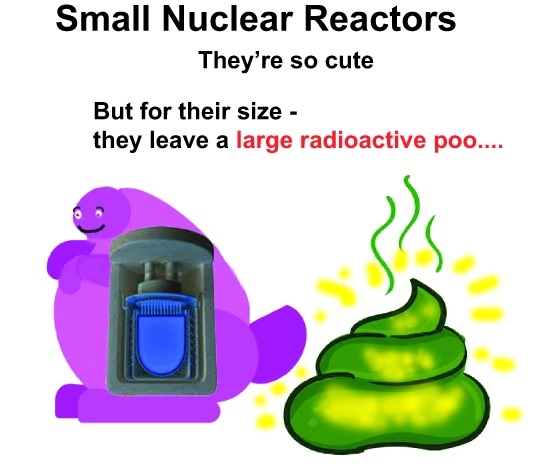
Small modular reactors, long touted as the future of nuclear energy, will actually generate more radioactive waste than conventional nuclear power plants, according to research from Stanford and the University of British Columbia.
BY MARK SHWARTZ, 30 May, News Stanford
Nuclear reactors generate reliable supplies of electricity with limited greenhouse gas emissions. But a nuclear power plant that generates 1,000 megawatts of electric power also produces radioactive waste that must be isolated from the environment for hundreds of thousands of years. Furthermore, the cost of building a large nuclear power plant can be tens of billions of dollars.
To address these challenges, the nuclear industry is developing small modular reactors that generate less than 300 megawatts of electric power and can be assembled in factories. Industry analysts say these advanced modular designs will be cheaper and produce fewer radioactive byproducts than conventional large-scale reactors.
But a study published May 31 in Proceedings of the National Academy of Sciences has reached the opposite conclusion.
“Our results show that most small modular reactor designs will actually increase the volume of nuclear waste in need of management and disposal, by factors of 2 to 30 for the reactors in our case study,” said study lead author Lindsay Krall, a former MacArthur Postdoctoral Fellow at Stanford University’s Center for International Security and Cooperation (CISAC). “These findings stand in sharp contrast to the cost and waste reduction benefits that advocates have claimed for advanced nuclear technologies.”
…………………………………. In the U.S. alone, commercial nuclear power plants have produced more than 88,000 metric tons of spent nuclear fuel, as well as substantial volumes of intermediate and low-level radioactive waste. The most highly radioactive waste, mainly spent fuel, will have to be isolated in deep-mined geologic repositories for hundreds of thousands of years. At present, the U.S. has no program to develop a geologic repository after spending decades and billions of dollars on the Yucca Mountain site in Nevada. As a result, spent nuclear fuel is currently stored in pools or in dry casks at reactor sites, accumulating at a rate of about 2,000 metric tonnes per year.
Simple metrics
Some analysts maintain that small modular reactors will significantly reduce the mass of spent nuclear fuel generated compared to much larger, conventional nuclear reactors. But that conclusion is overly optimistic, according to Krall and her colleagues.
“Simple metrics, such as estimates of the mass of spent fuel, offer little insight into the resources that will be required to store, package, and dispose of the spent fuel and other radioactive waste,” said Krall, who is now a scientist at the Swedish Nuclear Fuel and Waste Management Company. “In fact, remarkably few studies have analyzed the management and disposal of nuclear waste streams from small modular reactors.”
Dozens of small modular reactor designs have been proposed. For this study, Krall analyzed the nuclear waste streams from three types of small modular reactors being developed by Toshiba, NuScale, and Terrestrial Energy. Each company uses a different design. Results from case studies were corroborated by theoretical calculations and a broader design survey. This three-pronged approach enabled the authors to draw powerful conclusions.
“The analysis was difficult, because none of these reactors are in operation yet,” said study co-author Rodney Ewing, the Frank Stanton Professor in Nuclear Security at Stanford and co-director of CISAC. “Also, the designs of some of the reactors are proprietary, adding additional hurdles to the research.”
Neutron leakage
Energy is produced in a nuclear reactor when a neutron splits a uranium atom in the reactor core, generating additional neutrons that go on to split other uranium atoms, creating a chain reaction. But some neutrons escape from the core – a problem called neutron leakage – and strike surrounding structural materials, such as steel and concrete. These materials become radioactive when “activated” by neutrons lost from the core.
The new study found that, because of their smaller size, small modular reactors will experience more neutron leakage than conventional reactors. This increased leakage affects the amount and composition of their waste streams.
“The more neutrons that are leaked, the greater the amount of radioactivity created by the activation process of neutrons,” Ewing said. “We found that small modular reactors will generate at least nine times more neutron-activated steel than conventional power plants. These radioactive materials have to be carefully managed prior to disposal, which will be expensive.”
The study also found that the spent nuclear fuel from small modular reactors will be discharged in greater volumes per unit energy extracted and can be far more complex than the spent fuel discharged from existing power plants.
“Some small modular reactor designs call for chemically exotic fuels and coolants that can produce difficult-to-manage wastes for disposal,” said co-author Allison Macfarlane, professor and director of the School of Public Policy and Global Affairs at the University of British Columbia. “Those exotic fuels and coolants may require costly chemical treatment prior to disposal.”
“The takeaway message for the industry and investors is that the back end of the fuel cycle may include hidden costs that must be addressed,” Macfarlane said. “It’s in the best interest of the reactor designer and the regulator to understand the waste implications of these reactors.”
Radiotoxicity
The study concludes that, overall, small modular designs are inferior to conventional reactors with respect to radioactive waste generation, management requirements, and disposal options.
One problem is long-term radiation from spent nuclear fuel. The research team estimated that after 10,000 years, the radiotoxicity of plutonium in spent fuels discharged from the three study modules would be at least 50 percent higher than the plutonium in conventional spent fuel per unit energy extracted. ……..more https://news.stanford.edu/2022/05/30/small-modular-reactors-produce-high-levels-nuclear-waste/?fbclid=IwAR3hUe5R3zYb25eJ-8dJzM_vXATq4Du7Hk_XEhdeED_BTvwCqm0XLo3mE8o
Sowing Seeds of Plunder: A Lose-Lose Situation in Ukraine

President Zelenskyy put the land reform into law in 2020 against the will of the vast majority of the population who feared it would exacerbate corruption and reinforce control by powerful interests in the agricultural sector.
The largest landholders are a mix of Ukrainian oligarchs and foreign interests — mostly European and North American as well as the sovereign fund of Saudi Arabia.
Ed note: The irony of it! Ukrainians hold the hated memory of Soviet Russia starving Ukraine, as it sent their grain to Russia. Now we have the Western world helping themselves to Ukraine’s agriculture – with increasing farming for export, – pushing out the livelihood’s of Ukrainian small farmers. Zelensky – seen as a hero/saviour for now – – but how will this clown be remembered?
y Colin Todhunter, 10 May 23 https://www.globalresearch.ca/sowing-seeds-plunder-lose-lose-situation-ukraine/5818851
It’s a lose-lose situation for Ukrainians. While they are dying to defend their land, financial institutions are insidiously supporting the consolidation of farmland by oligarchs and Western financial interests.
So says Frédéric Mousseau, Policy Director of the Oakland Institute, an independent think tank.
Depending on which sources to believe, between 100,000 and 300,000 Ukrainian soldiers (possibly more) have died during the conflict with Russia. That figure, of course, does not include civilian casualties.
The mainstream narrative in the West is that Russia grabbed Crimea and then invaded Ukraine. Russia is portrayed as the outright aggressor which wants to restore its control over large swathes of Europe.
The expansion of NATO towards the east, the US-backed coup in 2014 – followed by eight years of the shelling of the ethnic Russian eastern parts of the country by the regime in Kyiv resulting in around 14,000 deaths – led up to the military intervention by Russia, which regards the expansionism and militarism as an existential threat.
It is not the purpose of this article to explore these issues. Much has already been written on this elsewhere. But billions of dollars’ worth of military hardware has been sent to Ukraine by the NATO countries and hundreds of thousands of young Ukrainians have died.
They died in the belief that they were protecting their nation – their land. A land that is among the most fertile in the world.
Professor Olena Borodina of the National Academy of Sciences of Ukraine says:
“Today, thousands of rural boys and girls, farmers, are fighting and dying in the war. They have lost everything. The processes of free land sale and purchase are increasingly liberalised and advertised. This really threatens the rights of Ukrainians to their land, for which they give their lives.”
Borodina is quoted in the February 2023 report by the Oakland Institute War and Theft: The Takeover of Ukraine’s Agricultural Land, which reveals how oligarchs and financial interests are expanding control over Ukraine’s agricultural land with help and financing from Western financial institutions.
Aid provided to Ukraine in recent years has been tied to a drastic structural adjustment programme requiring the creation of a land market through a law that leads to greater concentration of land in the hands of powerful interests. The programme also includes austerity measures, cuts in social safety nets and the privatisation of key sectors of the economy.
Frédéric Mousseau, co-author of the report, says:
“Despite being at the centre of news cycle and international policy, little attention has gone to the core of the conflict — who controls the agricultural land in the country known as the breadbasket of Europe. [The] Answer to this question is paramount to understanding the major stakes in the war.”
The report shows the total amount of land controlled by oligarchs, corrupt individuals and large agribusinesses is over nine million hectares — exceeding 28% of Ukraine’s arable land (the rest is used by over eight million Ukrainian farmers).
Amidst Chaos of War, a New Report Exposes the Stealth Take-over of Ukrainian Agricultural Land
The largest landholders are a mix of Ukrainian oligarchs and foreign interests — mostly European and North American as well as the sovereign fund of Saudi Arabia. A number of large US pension funds, foundations and university endowments are also invested in Ukrainian land through NCH Capital – a US-based private equity fund, which is the fifth largest landholder in the country.
President Zelenskyy put the land reform into law in 2020 against the will of the vast majority of the population who feared it would exacerbate corruption and reinforce control by powerful interests in the agricultural sector.
The Oakland Institute notes that, while large landholders are securing massive financing from Western financial institutions, Ukrainian farmers — essential for ensuring domestic food supply — receive virtually no support. With the land market in place, amid high economic stress and war, this difference of treatment will lead to more land consolidation by large agribusinesses.
All but one of the ten largest landholding firms are registered overseas, mainly in tax havens such as Cyprus or Luxembourg. The report identifies many prominent investors, including Vanguard Group, Kopernik Global Investors, BNP Asset Management Holding, Goldman Sachs-owned NN Investment Partners Holdings, and Norges Bank Investment Management, which manages Norway’s sovereign wealth fund.
Most of the agribusiness firms are substantially indebted to Western financial institutions, in particular the European Bank for Reconstruction and Development, the European Investment Bank, and the International Finance Corporation – the private sector arm of the World Bank.
Together, these institutions have been major lenders to Ukrainian agribusinesses, with close to US$1.7 billion lent to just six of Ukraine’s largest landholding firms in recent years. Other key lenders are a mix of mainly European and North American financial institutions, both public and private.
The report notes that this gives creditors financial stakes in the operation of the agribusinesses and confers significant leverage over them. Meanwhile, Ukrainian farmers have had to operate with limited amounts of land and financing, and many are now on the verge of poverty.
International financial institutions are in effect subsidising the concentration of land and a destructive industrial model of agriculture based on the intensive use of synthetic inputs, fossil fuels and large-scale monocropping.
Much of what is happening in Ukraine is part of a wider trend: private equity funds being injected into agriculture throughout the world and used to lease or buy up farms on the cheap and aggregate them into large-scale, industrial grain and soybean concerns. These funds use pension funds, sovereign wealth funds, endowment funds and investments from governments, banks, insurance companies and high net worth individuals (see the 2020 report ‘Barbarians at the Barn‘ by Grain.org).
Financialising agriculture this way shifts power to people with no connection to farming. In the words of BlackRock’s Larry Fink: “Go long agriculture and water and go to the beach.”
Funds tend to invest for between 10 and 15 years, resulting in good returns for investors but can leave a trail of long-term environmental and social devastation and serve to undermine local and regional food insecurity.
By contrast, according to the Oakland Institute, small-scale farmers in Ukraine demonstrate resilience and enormous potential for leading the expansion of a different production model based on agroecology and producing healthy food. Whereas large agribusinesses are geared towards export markets, it is Ukraine’s small and medium-sized farmers who guarantee the country’s food security.
This is underlined by the State Statistics Service of Ukraine in its report ‘Main agricultural characteristics of households in rural areas in 2011’, which showed that smallholder farmers in Ukraine operate 16% of agricultural land, but provide 55% of agricultural output, including 97% of potatoes, 97% of honey, 88% of vegetables, 83% of fruits and berries and 80% of milk.
In June 2020, the IMF approved an 18-month, strings-attached $5 billion loan programme with Ukraine. Also that year, the World Bank incorporated measures relating to the sale of public agricultural land as conditions in a $350 million Development Policy Loan (COVID ‘relief package’) to Ukraine. This included a required ‘prior action’ to “enable the sale of agricultural land and the use of land as collateral.”
According to the Oakland Institute:
“Ukraine is now the world’s third-largest debtor to the International Monetary Fund and its crippling debt burden will likely result in additional pressure from its creditors, bondholders and international financial institutions on how post-war reconstruction – estimated to cost US$750 billion – should happen.”
Financial institutions are leveraging Ukraine’s crippling debt to drive further privatisation and liberalisation – backing the country into a corner to make it an offer it can’t refuse.
Since the war began, the Ukrainian flag has been raised outside parliament buildings in the West and iconic landmarks have been lit up in its colours. An image bite used to conjure up feelings of solidarity and support for that nation while serving to distract from the harsh machinations of geopolitics and modern-day economic plunder that is unhindered by national borders and has scant regard for the plight of ordinary citizens.
The Twenty-First Century of (Profitable) War- Not Your Grandfather’s Military-Industrial Complex

TOMGRAM, Hartung and Freeman, The Twenty-First Century of (Profitable) War, MAY 4, 2023
Unwarranted Influence, Twenty-First-Century-Style Not Your Grandfather’s Military-Industrial Complex
BY BEN FREEMAN AND WILLIAM D. HARTUNG
The military-industrial complex (MIC) that President Dwight D. Eisenhower warned Americans about more than 60 years ago is still alive and well. In fact, it’s consuming many more tax dollars and feeding far larger weapons producers than when Ike raised the alarm about the “unwarranted influence” it wielded in his 1961 farewell address to the nation.
The statistics are stunning. This year’s proposed budget for the Pentagon and nuclear weapons work at the Department of Energy is $886 billion — more than twice as much, adjusted for inflation, as at the time of Eisenhower’s speech. The Pentagon now consumes more than half the federal discretionary budget, leaving priorities like public health, environmental protection, job training, and education to compete for what remains. In 2020, Lockheed Martin received $75 billion in Pentagon contracts, more than the entire budget of the State Department and the Agency for International Development combined.
This year’s spending just for that company’s overpriced, underperforming F-35 combat aircraft equals the full budget of the Centers for Disease Control and Prevention. And as a new report from the National Priorities Project at the Institute for Policy Studies revealed recently, the average taxpayer spends $1,087 per year on weapons contractors compared to $270 for K-12 education and just $6 for renewable energy.
The list goes on — and on and on. President Eisenhower characterized such tradeoffs in a lesser known speech, “The Chance for Peace,” delivered in April 1953, early in his first term, this way: “Every gun that is made, every warship launched, every rocket fired signifies, in the final sense, a theft from those who hunger and are not fed, those who are cold and are not clothed. This world in arms is not spending money alone. It is spending the sweat of its laborers, the genius of its scientists, the hopes of its children…”
How sadly of this moment that is.
New Rationales, New Weaponry
Now, don’t be fooled. The current war machine isn’t your grandfather’s MIC, not by a country mile. It receives far more money and offers far different rationales. It has far more sophisticated tools of influence and significantly different technological aspirations.

Perhaps the first and foremost difference between Eisenhower’s era and ours is the sheer size of the major weapons firms. Before the post-Cold War merger boom of the 1990s, there were dozens of significant defense contractors. Now, there are just five big (no, enormous!) players — Boeing, General Dynamics, Lockheed Martin, Northrop Grumman, and Raytheon. With so few companies to produce aircraft, armored vehicles, missile systems, and nuclear weapons, the Pentagon has ever more limited leverage in keeping them from overcharging for products that don’t perform as advertised. The Big Five alone routinely split more than $150 billion in Pentagon contracts annually, or nearly 20% of the total Pentagon budget. Altogether, more than half of the department’s annual spending goes to contractors large and small.
In Eisenhower’s day, the Soviet Union, then this country’s major adversary, was used to justify an ever larger, ever more permanent arms establishment. Today’s “pacing threat,” as the Pentagon calls it, is China, a country with a far larger population, a far more robust economy, and a far more developed technical sector than the Soviet Union ever had. But unlike the USSR, China’s primary challenge to the United States is economic, not military.
Yet, as Dan Grazier noted in a December 2022 report for the Project on Government Oversight, Washington’s ever more intense focus on China has been accompanied by significant military threat inflation. While China hawks in Washington wring their hands about that country having more naval vessels than America, Grazier points out that our Navy has far more firepower. Similarly, the active American nuclear weapons stockpile is roughly nine times as large as China’s and the Pentagon budget three times what Beijing spends on its military, according to the latest figures from the Stockholm International Peace Research Institute.
But for Pentagon contractors, Washington’s ever more intense focus on the prospect of war with China has one overriding benefit: it’s fabulous for business. The threat of China’s military, real or imagined, continues to be used to justify significant increases in military spending, especially on the next generation of high-tech systems ranging from hypersonic missiles to robotic weapons and artificial intelligence…………………………………………………….

The arms industry as a whole has donated more than $83 million to political candidates in the past two election cycles, with Lockheed Martin leading the pack with $9.1 million in contributions, followed by Raytheon at $8 million, and Northrop Grumman at $7.7 million. Those funds, you won’t be surprised to learn, are heavily concentrated among members of the House and Senate armed services committees and defense appropriations subcommittees. For example, as Taylor Giorno of OpenSecrets, a group that tracks campaign and lobbying expenditures, has found, “The 58 members of the House Armed Services Committee reported receiving an average of $79,588 from the defense sector during the 2022 election cycle, three times the average $26,213 other representatives reported through the same period.”
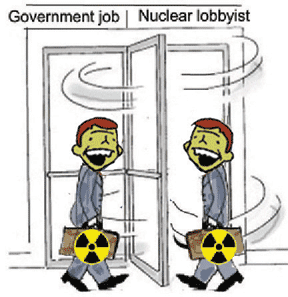
Lobbying expenditures by all the denizens of the MIC are even higher — more than $247 million in the last two election cycles. Such funds are used to employ 820 lobbyists, or more than one for every member of Congress. And mind you, more than two-thirds of those lobbyists had swirled through Washington’s infamous revolving door from jobs at the Pentagon or in Congress to lobby for the arms industry. Their contacts in government and knowledge of arcane acquisition procedures help ensure that the money keeps flowing for more guns, tanks, ships and missiles. Just last month, the office of Senator Elizabeth Warren (D-MA) reported that nearly 700 former high-ranking government officials, including former generals and admirals, now work for defense contractors. While a few of them are corporate board members or highly paid executives, 91% of them became Pentagon lobbyists, according to the report.
And that feverishly spinning revolving door provides current members of Congress, their staff, and Pentagon personnel with a powerful incentive to play nice with those giant contractors while still in their government roles. After all, a lucrative lobbying career awaits once they leave government service………………………………………………..
Shaping the Elite Narrative: The Military-Industrial Complex and Think Tanks

One of the MIC’s most powerful tools is its ability to shape elite discussions on national security issues by funding foreign policy think tanks, along with affiliated analysts who are all too often the experts of choice when it comes to media coverage on issues of war and peace. A forthcoming Quincy Institute brief reveals that more than 75% of the top foreign-policy think tanks in the United States are at least partially funded by defense contractors. Some, like the Center for a New American Security and the Center for Strategic and International Studies, receive millions of dollars every year from such contractors and then publish articles and reports that are largely supportive of defense-industry funding.

Some such think tanks even offer support for weapons made by their funders without disclosing those glaring conflicts of interest. For example, an American Enterprise Institute (AEI) scholar’s critique of this year’s near-historically high Pentagon budget request, which, she claimed, was “well below inflation,” also included support for increased funding for a number of weapons systems like the Long Range Anti-Ship Missile, the Joint Air-to-Surface Standoff Missile, the B-21 bomber, and the Sentinel intercontinental ballistic missile.
What’s not mentioned in the piece? The companies that build those weapons, Lockheed Martin and Northrop Grumman, have been AEI funders. Although that institute is a “dark money” think tank that doesn’t publicly disclose its funders, at an event last year, a staffer let slip that the organization receives money from both of those contractors.
Unfortunately, mainstream media outlets disproportionately rely on commentary from experts at just such think tanks…………………………………………
Shaping the Public Narrative: The Military-Entertainment Complex
Top Gun: Maverick was a certified blockbuster, wowing audiences that ultimately gave that action film an astounding 99% score on Rotten Tomatoes — and such popular acclaim helped earn the movie a Best Picture Oscar nomination. It was also a resounding success for the Pentagon, which worked closely with the filmmakers and provided, “equipment — including jets and aircraft carriers — personnel and technical expertise,” and even had the opportunity to make script revisions, according to the Washington Post. Defense contractors were similarly a pivotal part of that movie’s success. In fact, the CEO of Lockheed Martin boasted that his firm “partnered with Top Gun’s producers to bring cutting-edge, future forward technology to the big screen.”
While Top Gun: Maverick might have been the most successful recent product of the military-entertainment complex, it’s just the latest installment in a long history of Hollywood spreading military propaganda. “The Pentagon and the Central Intelligence Agency have exercised direct editorial control over more than 2,500 films and television shows,” according to Professor Roger Stahl, who researches propaganda and state violence at the University of Georgia.
“The result is an entertainment culture rigged to produce relatively few antiwar movies and dozens of blockbusters that glorify the military,” explained journalist David Sirota, who has repeatedly called attention to the perils of the military-entertainment complex. “And save for filmmakers’ obligatory thank you to the Pentagon in the credits,” argued Sirota, “audiences are rarely aware that they may be watching government-subsidized propaganda.”
What Next for the MIC?
More than 60 years after Eisenhower identified the problem and gave it a name, the military-industrial complex continues to use its unprecedented influence to corrupt budget and policy processes, starve funding for non-military solutions to security problems, and ensure that war is the ever more likely “solution” to this country’s problems. The question is: What can be done to reduce its power over our lives, our livelihoods, and ultimately, the future of the planet?
Countering the modern-day military-industrial complex would mean dislodging each of the major pillars undergirding its power and influence. That would involve campaign-finance reform; curbing the revolving door between the weapons industry and government; shedding more light on its funding of political campaigns, think tanks, and Hollywood; and prioritizing investments in the jobs of the future in green technology and public health instead of piling up ever more weapons systems. Most important of all, perhaps, a broad-based public education campaign is needed to promote more realistic views of the challenge posed by China and to counter the current climate of fear that serves the interests of the Pentagon and the giant weapons contractors at the expense of the safety and security of the rest of us…………………… https://tomdispatch.com/unwarranted-influence-twenty-first-century-style/
Discharge of tritium from Fukushima to harm human body: scientist
Tritium, which the Japanese government planned to dump from its crippled Fukushima Daiichi nuclear power plant into the Pacific Ocean, will harm human beings’ inside bodies as internal exposure can be more dangerous than external one, a renowned scientist said Thursday.
“When tritium gets inside the body, it’s at least as dangerous as any of the other radionuclides. And in some cases, it’s more than double as dangerous in terms of the effects of the radiation on the genetic material, on the proteins,” Timothy Mousseau, professor of biological sciences at the University of South Carolina, told a press conference in Seoul.
The Japanese government and institutions, including the Tokyo Electric Power Company (TEPCO), have claimed that tritium is not dangerous because it emits a very “weak” beta particle, but the professor called it “fiction.”
“Ingestion is really the most dangerous. People have said that tritium is not dangerous based on the concerns for external exposure, but using the same argument, you would say that uranium 235 is not dangerous,” he noted.
Tritium is known as an emitter of low-energy beta particles incapable of penetrating a human body as they are stopped by a layer of clothing, in contrast to gamma rays that can pass through a human body and only be stopped by several feet of concrete.
If the tritiated water or the organically bound tritium discharged from the collapsed Fukushima power plant is consistently ingested, the ionizing radiation would directly damage DNA or indirectly affect other metabolic activities through oxidative stress or an imbalance inside the body that can lead to cell and tissue damage.
“The way it works is that the tritium molecule comes inside the cell and ejects an electron…It’s a little bullet. It’s like a bullet coming from a gun. It comes out from the nucleus of the tritium atom. That bullet hits something like the DNA,” Mousseau said.
“What makes tritium more dangerous than high-energy emission is that the bullet is moving kind of slow, so it hits something and bounces. And it hits something else and then it hits something else. It doesn’t go anywhere, so you end up with a clustered damage from that beta particle,” the professor noted.
“High-energy beta particles are higher energy. They will hit something, yes, but then they continue and go through the cell, maybe out of the body, and do much less damage as a result. So, this is why we need to pay attention to tritium in particular,” he added.
Mousseau, who published over 130 scientific papers related to radiation effects, presented a new paper on the biological consequences of exposure to tritium earlier this month based on 250 studies after scanning over 700,000 references to tritium.
According to the paper, the scientific literature indicated that tritium could be genotoxic and carcinogenic and can affect reproductive systems such as sperm and eggs.
Japan planned to release over 1.2 million tonnes of the tritium-laced water into the ocean for 30 years from 2023, but the discharge would last much longer than planned, Shaun Burnie, a senior nuclear specialist at Greenpeace East Asia, told the press conference.
“Those discharges could begin as early as July, possibly later, and continue for many decades, not just the 30 years but maybe 50, 60, 70, 80 years. Next century is really possible,” said Burnie.
“This is water that’s radioactive in tanks, so it’s the deliberate decision to pollute and contaminate the environment, which doesn’t need to take place because actually there is sufficient storage space in the two districts next to the Fukushima nuclear power plant,” he noted.
Burnie was also skeptical of Japan’s claim that the contaminated water could be diluted through an advanced liquid processing system (ALPS).
“This is water that has come in direct contact with a reactor, a nuclear fuel that suffered a severe melt, which means fission products within the nuclear fuel became in direct contact with water,” the specialist said.
“It’s unclear how successfully the ALPS system processes the water. Around 70 percent of the water in the tanks still needs to undergo further processing. So, we still don’t know how effective it’s going to be. It can’t be discharged as it is at the moment,” he added.
Return to Russia: Crimeans Tell the Real Story of the 2014 Referendum and Their Lives Since — RADIATION FREE LAKELAND

Originally posted on In Gaza: Crimeans gather with Russian national and Crimea flags in Sevastopol, Crimea, March 14, 2018. Alexander Zemlianichenko | AP Eva Bartlett traveled to Crimea to see firsthand out how Crimeans have fared since 2014 when their country reunited with Russia, and what the referendum was really like. October 9, 2019, Mint…
Return to Russia: Crimeans Tell the Real Story of the 2014 Referendum and Their Lives Since — RADIATION FREE LAKELAND
SIMFEROPOL, CRIMEA — In early August I traveled to Russia for the first time, partly out of interest in seeing some of the vast country with a tourist’s eyes, partly to do some journalism in the region. It also transpired that while in Moscow I was able to interview Maria Zakharova, spokeswoman of the Foreign Ministry.
High on my travel list, however, was to visit Crimea and Donetsk People’s Republic (DPR) — the former a part of Russia, the latter an autonomous republic in the east of Ukraine, neither accurately depicted in Western reporting. Or at least that was my sense looking at independent journalists’ reports and those in Russian media.
Both regions are native Russian-speaking areas; both opted out of Ukraine in 2014. In the case of Crimea, joining Russia (or actually rejoining, as most I spoke to in Crimea phrased it) was something people overwhelmingly supported. In the case of the Donbass region, the turmoil of Ukraine’s Maidan coup in 2014 set things in motion for the people in the region to declare independence and form the Donetsk and Lugansk People’s Republics.
In March 2014, Crimeans held a referendum during which 96 percent of voters chose to join Russia. This has been heavily disputed in Western media, with claims that Crimeans were forced to hold the referendum and claims of Russian troops on the streets “occupying” the peninsula.
Because Western media insisted the referendum was a sham held under duress, and because they bandy about the term “pro-Russian separatists” for the people of the DPR, I decided to go and speak to people in these areas to hear what they actually want and feel.
From the Russian mainland to the Crimean Peninsula………………………………………………………………
In the evening, we stay in the home of Vlad’s friend Tata, a Russian woman who moved to Crimea in 2012.
Since there was so much hype in Western media about a Russian takeover of the peninsula, I ask the burning questions: Were Crimeans forced to take part in the referendum? What was the mood like around that time? Tata replies:
“I never saw so many people in my life go out to vote, of their own free will. There was a period before the referendum, maybe about two months, during which there were two holidays: International Women’s Day, March 8, and Defender of the Fatherland Day, February 23.
……………………………………………………………I never saw tanks, I never saw Russian soldiers. I never saw any of that in the city.”
I ask Tata about how life had changed after the referendum:………………………………….
After the Soviet Union collapsed, it wasn’t the will of the Crimean people to join Ukraine. People were always Russian here; they always identified as Russian. Ukraine understood this well, and put nothing into Crimea, as punishment. Ukraine didn’t build any hospitals, kindergartens or roads.
In the past four years, the Crimean government has built 200 new kindergartens. This is the most obvious example of how things have improved. They also built the new Simferopol airport.
I worked in aviation. It took three years to build an airport of this standard in Yekaterinburg, Russia. It took half a year in Simferopol.”
International Jazz Festival……………………………………………………….
Construction everywhere……………………………………….
I remark on how kind and gentle people are here, as in Russia. Vlad replies:
“It shouldn’t be surprising — people are people anywhere. But Western media conditions us with stereotypes of Russians as cold and hard, vilifying an entire nation.”
The coastal city of Yalta lies further west along the peninsula. The drive there the following day is more beautiful still, the road flanked by mountains to one side, hills cascading down to the Black Sea on the other, endless wineries and, before Yalta itself, the stunning cliff-top castle known as “Swallow’s Nest.”
In the evening, we stay in the home of Vlad’s friend Tata, a Russian woman who moved to Crimea in 2012.
Since there was so much hype in Western media about a Russian takeover of the peninsula, I ask the burning questions: Were Crimeans forced to take part in the referendum? What was the mood like around that time? Tata replies:
“I never saw so many people in my life go out to vote, of their own free will. There was a period before the referendum, maybe about two months, during which there were two holidays: International Women’s Day, March 8, and Defender of the Fatherland Day, February 23.
Normally, people would go away on vacation during these holidays. But that year, Crimeans didn’t go anywhere; they wanted to be sure they were here during the referendum. We felt the sense of a miracle about to happen. People were anxiously awaiting the referendum.
There were military tents in the city, but they were not erected by the military, but by local men. They would stand there every day, and people could come and sign a document calling for a referendum.
I went one day and asked if I could add my name but I couldn’t, because I have a Russian passport. Only Crimean citizens could sign it. This was the fair way to do it.
At that time, my husband was in America. One day, he was watching CNN and got scared and called me because he saw reports of soldiers in the streets, an ‘invasion’ by Russia.
The local navy came from Sevastopol to Yalta and anchored their ships off the coast, made a blockade to ensure no larger Ukrainian or other ships could come and attack.
But I never saw tanks, I never saw Russian soldiers. I never saw any of that in the city.”
I ask Tata about how life had changed after the referendum:
When I came here in December 2012, everything was dilapidated and run down. The nice roads you were driving on, they didn’t exist when we were a part of Ukraine. I didn’t understand why Crimea was still a part of Ukraine. It was Russian land ever since the Tsars, the imperial time of Russia. This is where the Russian soul is, and the soul of the Russian navy.
After the Soviet Union collapsed, it wasn’t the will of the Crimean people to join Ukraine. People were always Russian here; they always identified as Russian. Ukraine understood this well, and put nothing into Crimea, as punishment. Ukraine didn’t build any hospitals, kindergartens or roads.
In the past four years, the Crimean government has built 200 new kindergartens. This is the most obvious example of how things have improved. They also built the new Simferopol airport.
I worked in aviation. It took three years to build an airport of this standard in Yekaterinburg, Russia. It took half a year in Simferopol.”
Finally, after night falls, we drive into the city of Koktebel, where an annual Jazz Festival is starting.
During all these hours of driving, the roads are smooth and well-trafficked, and I don’t see a single Russian military vehicle.
The next day, I walk through Koktebel, taking in the local markets brimming with produce, cheeses, and other goods, and every so often come across a streetside stand laden with fresh fruits. In the late afternoon, I walk along the sea, past packed beaches, and meet with a Crimean woman, Yaroslava, who lives in Austria but every summer returns to her beloved Crimea. She is ardently supportive of the decision to have joined Russia and spends much of her time back in Austria trying to educate people on why Crimeans wanted to be a part of Russia.
These are reasons I hear throughout my travels in Crimea: We wanted to be able to speak our native language [Russian] and be educated in that language; we wanted to be able to practice our cultural traditions; we have always been a part of Russia and we wanted to return.
Yaroslava is busy helping out with the Jazz Festival and wants to use the rest of our short time talking to help me arrange future meetings with people in Crimea. We decided to do a proper interview via Skype in the future when time allows.
I drift on to the Jazz Festival, where a talented pianist and band play beach-side to an enthusiastic crowd. Some songs later, I drift back along the beach, passing numerous musicians busking, and a pulsing nightlife that isn’t going to bed any time soon.
…………………………………As I stand to orient the map route and zoom in to look for any signs of cafes, a woman walks by me and says with a smile something with the word “shto,” which I think means “what.” When I reply in English, she laughs and flags down another woman, Yana, who speaks English well and insists she and her husband drive me.
As we drive, we chat. I ask her about the referendum, mentioning that many in the West have the notion that it was done under duress, with a heavy military presence to influence the vote. She laughs, saying: “There were no troops, no military, around us during the referendum.” She speaks of the joy of Crimeans to vote, says that maybe 98 percent of Sevastopol voters had voted in favor [it was apparently 96 percent, but close enough], and adds, “We are now under the wing of Russia.”
I ask about developments since then. She mentions the improvements in roads, also the modern trolley-buses and regular buses, the opening of kindergartens and schools, and free courses (like music) for children……………………………………..
Ukrainians in Crimea
In Simferopol anew, I meet Anastasiya Gridchina, the Chair of the Ukrainian Community of Crimea, an organization formed in 2015 whose main goals, she tells me, “are to have friendly relations between two great peoples: Ukrainians and Russians — not the politicians but the people. The second goal is to preserve inter-ethnic peace in the Republic between different nationalities.”
Gridchina explains that in Crimea there are more than 175 nationalities, just 20 less than in all of Russia, but in a very small territory. Hence the importance of preserving inter-ethnic peace. After Russians, Ukrainians comprise the second largest population in Crimea.
I ask Anastasiya whether she supported, much less participated in the referendum.
“I worked very hard in order that we could have a referendum. I live in Perevalne, the last settlement in the mountains above Alushta. There was a Ukrainian military detachment which did surrender. In February 2014, I was among a line of people standing between the Ukrainian and Russian military detachments, to prevent any bloodshed. The fear that prevailed at that time was that nationalists from Ukraine would come here and we would have massacres.
In February, there was a confrontation outside the Parliament here in Simferopol. It was organized by leaders of the Mejlis — the Crimeans Tatars. On the other side, there were some pro-Russia organizations who were protecting the Parliament. They were far less [numerous] than the Mejlis. The Mejlis were armed with sticks and knives. There were clashes and two people were killed, but thankfully it didn’t escalate beyond that.
When the news came that there would be a referendum, people relaxed. They had a chance to express their point of view and 96 percent of the population of Crimea voted for Crimea to return to Russia.”
Since she is Ukrainian, I ask Anastasiya why she wanted Crimea to join Russia:
“I’ve lived in Crimea all my life, and my language is Russian. And I know the history of Crimea, which has always been Russian territory, which has a history beginning with the Russian Empire and then the Soviet Union. So, it is Russian-speaking territory, first of all. That’s why I believe it should be in the Russian Federation, not in Ukraine.”
I ask about the claims that Russian soldiers invaded Crimea:
“Whatever they might have said about Russian soldiers forcing people to participate in the referendum, it was all lies, pure lies. We did not see any soldiers on the streets, especially on the day of the referendum.
I gave an interview to foreign journalists before the referendum. But when they published it, they changed my words. I said we were very thankful to the Russian troops that were here, that protected us from the attacks of Ukrainian nationalists prior to the referendum. But they translated it that I said ‘Please, we want Ukrainian soldiers to defend us from those Russian soldiers.’
The Russian troops that were here were not on the streets on the day of the referendum but, at the time in general, they were there to protect civilians from an attack by Ukrainians.
On the day of the referendum, there were no soldiers, no military. The only security were there to prevent any illegal actions. No military people were there, no arms, no armored personnel carriers, no military equipment, nothing. Only members of the election commission and the people voting.”
I ask whether many Ukrainian Crimeans left following the referendum:
“There were those who immediately after the referendum left Crimea for Ukraine because it was their personal wish. Nobody prevented them from going. Even the soldiers had an option: to stay and continue military service here, or to leave……………
Finally, Anastasiya gives me a message for the people outside of Crimea:
“I’d like to tell people around the world, welcome to Crimea, come here yourselves and see and hear with your own eyes and ears, to understand that all the lies you hear about Crimea, that we are oppressed or under pressure from the military…this is all lies, this is all not true.
Also, that we are not allowed to speak Ukrainian is a lie. One of the state languages is Ukrainian. Russian and Tatar are also state languages.”……………………
Next, I speak to Yuri Gempel, a member of Parliament, and the chairman of the Standard Commission on Inter-Ethnic Relations of the Parliament of Crimea.
“Crimea, under Ukraine, was robbed,” Gempel says. He continues:
“Everything was taken by the government and representatives of the ruling elite of Ukraine. For the 23 years Crimea was a part of Ukraine, they robbed Crimea. Not a single kindergarten was built in Crimea during those years. Kindergartens built during Soviet times stopped functioning.
But the main issue is that during that time, the people still felt themselves to be in Russian territory, not Ukrainian, in language, culture and in spirit. Under Ukrainian rule, Crimeans were made to speak Ukrainian, although Crimeans’ native language is Russian. People were deprived of the right to be in state service if they did not speak Ukrainian.”…………………………………………………………………………………………………………………………………
As for the claims that Russia invaded Crimea and of Russian forces intimidating voters, I believe the many people I met who denounced those claims and articulated very clearly why they wanted to join Russia, or as they say, “return to Russia.” https://ingaza.wordpress.com/2019/10/10/return-to-russia-crimeans-tell-the-real-story-of-the-2014-referendum-and-their-lives-since/
Complex safety problems in overhauling USA’s nuclear weapons stockpile, especially plutonium pits

TRUST BUT VERIFY. U.S. labs are overhauling the nuclear stockpile. Can they validate the weapons without bomb tests?
20 APR 2023, BY SARAH SCOLES Science.org
LOS ALAMOS, NEW MEXICO—Behind a guard shack and warning signs on the sprawling campus of Los Alamos National Laboratory is a forested spot where scientists mimic the first moments of a nuclear detonation. Here, in the Dual-Axis Radiographic Hydrodynamic Test (DARHT) facility, they blow up models of the bowling ball–size spheres of plutonium, or “pits,” at the heart of bombs—and take x-ray pictures of the results.
In a real weapon, conventional explosives ringing an actual pit would implode the plutonium to a critical density, triggering an explosive fissile chain reaction. Its energy would drive the fusion of hydrogen isotopes in the weapon’s second stage, generating yet more neutrons that would split additional fission fuel………………………………………………………..
Facilities like DARHT have been important since 1992, when the Department of Energy’s (DOE’s) three weapons labs—Los Alamos, Lawrence Livermore National Laboratory, and Sandia National Laboratory—stopped full-fledged tests of nuclear weapons. By 1996, the United States had signed the Comprehensive Nuclear-Test-Ban Treaty—credited not only with stopping the environmental damage of nuclear testing, but also with disincentivizing new weapons designs.
Without tests, however, the only things ensuring that warheads work are facilities like DARHT, computer simulations from “weapons codes,” and a cache of data from the old days of nuclear testing. For relatively minor changes to old weapons—new fuses, fresh top-ups of the hydrogen isotope tritium—that has been enough. Every year, DOE’s National Nuclear Security Administration (NNSA) and the Department of Defense have certified the stockpile, an assessment that means they are convinced the weapons will work when they’re supposed to, as they’re supposed to—and not do anything when they’re not supposed to. “Because we’ve blown up so many of them, these things are incredibly reliable,” says Geoff Wilson, director of the Center for Defense Information at the Project on Government Oversight, which argues nuclear weapons spending should be reduced.
But now the stockpile is getting an overhaul, the biggest in decades. This fiscal year, NNSA has a record $22.2 billion budget. Much of the money will go to producing new plutonium pits to replace those in the arsenal and to modernizing four warheads. A fifth weapon, dubbed the W93—a submarine-launched warhead—is a new design program. “It’s really the first warhead program we’ve had since the end of the Cold War” that isn’t a life extension or modernization of an existing weapon, says Marvin Adams, NNSA’s deputy administrator for defense programs………………………………
Wilson worries that the international dynamics and the U.S. overhaul could ultimately lead to a revival of bomb tests, bringing back their hazards and stoking a new arms race. “It is not unfathomable to me, which is scary to say.” It’s one thing to tweak weapons with a deep heritage. It’s another to infer functionality for modified weapons that have never been fully tested, he says………………………………….
SIMPLY REPLACING the bombs’ plutonium pits poses a science challenge: understanding how subtle changes affect their behavior. They aren’t easy to make, in part because plutonium, a metal only in existence since 1940, is mysterious and hard to handle. The last time anyone made pits at scale—in the 1980s at Colorado’s Rocky Flats plant—DOE’s contractor was shut down for environmental violations and forced to pay an $18.5 million fine.
This time, NNSA is splitting production between Los Alamos and the Savannah River Site in South Carolina. It has tasked them with making 80 new pits per year by 2030, a deadline NNSA admits it will not meet.
Los Alamos’s pits will be made at a facility called PF-4, a set of high-security buildings surrounded by cyclone fences with razor wire. Inside PF-4 are glovebox enclosures—radiation-shielded workstations where workers use thick gloves and peer through glass windows to manipulate the exotic metal. The lab is hiring thousands of workers, and its first pit is likely to be ready for the stockpile next year.
The gargantuan effort is motivated by a simple fact: many current pits are more than 40 years old, and plutonium behaves in confounding ways as it ages and radioactively decays. A green, fuzzy coating grows on it as its surface oxidizes. Atoms in its metallic lattice are knocked out of place as it spits out uranium isotopes. Its dimensions shift when it slips between six different solid phases. And the pits do not necessarily degrade smoothly. “We know at some point there will be a nonlinear piece,” says David Clark, director of Los Alamos’s National Security Education Center and editor of the Plutonium Handbook. “We just haven’t seen it.”…………….
One might think the new pits would make it easier to certify the stockpile, by avoiding the uncertainties of aging plutonium. But they come with uncertainties of their own. The new pits won’t be twins of their predecessors, so weapons scientists will have to understand how the alterations change pit behavior. They are being manufactured using recycled and purified plutonium from old pits, not fresh material, unlike the originals. Moreover, they will be made with different processes, and in some cases designed to slightly different specifications. “If you look at a new requirement,” Adams says, “you often will find that the old pits we have available to us are really, really suboptimal.”………………………………………. https://www.science.org/content/article/trust-verify-can-u-s-certify-new-nuclear-weapons-without-detonating-them
UK ignites new depleted uranium weapons debate — Beyond Nuclear International

Headline photo shows a painting by Mark Southerland, who served in the Marine Corps from 1988-1994, an unshakable image from ‘Desert Storm’, painted as therapy in recovery from PTSD. Wikimedia Commons.
Wars in Iraq/ Kuwait and the Balkans have left toxic legacy
UK ignites new depleted uranium weapons debate — Beyond Nuclear International
The situation in Ukraine creates a double jeopardy. First, the use of DU weapons by the Ukrainian military might provoke the Russians to use nuclear weapons. And second, simply transporting these weapons from Britain and using them on Ukrainian soil will constitute additional radioactive and heavy metal pollution with long-term effects on human health and the European environment.
Taking all of this into consideration, the known risks of DU weapons are already too great to justify their continued use.
UK will send DU weapons to Ukraine prompting “nuclear” rhetoric from Russia
By Linda Pentz Gunter and Maria Arvaniti Sotiropoulou
On March 21, 2023 Britain confirmed that it was sending depleted uranium (DU) weapons to Ukraine , prompting a response from Russian president, Vladimir Putin, that, “If all this happens, Russia will have to respond accordingly, given that the west collectively is already beginning to use weapons with a nuclear component.”
Russian defense minister, Sergei Shoigu, warned that such steps moved us closer to a “nuclear collision.”
Days later, Putin announced he had made an arrangement with neighboring Belarus to station tactical nuclear weapons there.
According to ICAN, Putin “will start training Belarusian personnel to use them” and that “up to 10 Belarusian aircraft are already prepared to use these weapons and Russia would complete the construction of a storage facility for nuclear warheads in Belarus by July.”
The Belarus nuclear weapons deal was more likely a response to the continued expansion of NATO — with Finland now the newest member — rather than retaliation for Britain arming Ukraine with depleted uranium weapons.
However, there are many wrongs in this situation to unpack.
Possessing or threatening the use of nuclear weapons is a violation of the human rights that are embedded in the Treaty on the Prohibition of Nuclear Weapons. The use of depleted uranium weapons is also abhorrent, with compelling, if still somewhat anecdotal, evidence from the wars in the Balkans and Iraq/Kuwait to suggest these toxic exposures cause serious long-term health effects.
Despite Putin’s thinly veiled threat mount a nuclear response to DU weapons, the International Campaign to Ban Uranium Weapons (ICBUW) points out that this would be disproportionate because “DU projectiles are not nuclear weapons at all, but conventional weapons of high chemical-radiological toxicity and harmfulness.”
Adds Dr. Frank Boulton of the British IPPNW affiliate, MEDACT: “Much if not most of the toxicity of DU is biological rather than radiological (DU is a heavy metal with biological effects similar to that of lead)”.
The US and NATO used around 980,000 rounds of uranium shells in Iraq and Kuwait, 10,800 in Bosnia, 31,000 in Kosovo , another 7,000 in S. Serbia and Montenegro, and an unknown number in Afghanistan, while Russia also used such weapons in Chechnya.
The ICBUW quickly spoke out against the export of DU weapons to Ukraine: “The use of DU munitions has been shown to cause widespread and lasting damage to the health of people living in the contaminated area,” the network said in a statement. “Military personnel and those involved in subsequent demining are also exposed to health hazards from DU (remnants). In addition, long-term environmental damage, including groundwater contamination, occurs as a result of DU use.”
Kate Hudson, General Secretary of the long-time British peace and disarmament group Campaign for Nuclear Disarmament, also condemned her country’s decision:
“CND has repeatedly called for the UK government to place an immediate moratorium on the use of depleted uranium weapons and to fund long-term studies into their health and environmental impacts,” she said. “Sending them into yet another war zone will not help the people of Ukraine.”
The UK may not be the first country to introduce DU weapons into the current Russia-Ukraine war. In a statement, the ICBUW said that, “According to media reports, Russian forces in Ukraine have also recently received the more modern 3BM60 ‘Svinets-2’ ammunition.” The Guardian reported that “Moscow also has its own Svinets-2 depleted uranium tank shells in its stockpile,” without saying whether or not they had been deployed in Ukraine.
International Humanitarian Law prohibits weapons that cause unnecessary suffering, have indiscriminate effects or cause long-term damage to the natural environment, factors that should apply to outlawing DU weapons.
Several resolutions have been passed in both the UN General Assembly and in the European Parliament calling for a moratorium on the use of DU weapons. The latest such UN resolution was adopted by the General Assembly in 2022. Yet, no treaty regulating — let alone banning — DU weapons exists.
DU is used in weaponry because, due to its high molecular weight, it easily penetrates the steel of armored tanks. Missile-like uranium weapons will pierce any target they hit at 3,600km/h.
Known as uranium-238, DU is a by-product of the uranium enrichment process needed to produce the fuel for nuclear reactors. It is called ‘depleted’ because it has a lower content of the fissile isotope, uranium-235, than natural uranium. Depleted uranium has a half-life of 4.5 billion years.
DU is highly toxic, especially when inhaled and can be present in the human body for many years as well as excreted in urine. According to the IPPNW pamphlet — Uranium Weapons. Radioactive Penetrators — “When uranium is inhaled or ingested with foods and beverages, its full pathogenic and lethal effects unfold. On entering the body it is taken up by the blood, which transports it to the organs. It can reach an unborn child via the placenta.”
Continue readingAlba MP Neale Hanvey calls for Ministry of Defence to tackle nuclear decontamination at Dalgety Bay
The National, By James Walker @James_L_Walker 19 Apr 23
More than 3,000 radioactive particles have been found at Dalgety Bay.
ALBA Party MP Neale Hanvey has called on the Ministry of Defence to clean-up radiation contamination on the Dalgety Bay shoreline.
In a statement, Hanvey added that “there can be no excuse for inaction”.
Leading a Westminster debate on the issue on Tuesday, the MP for Kirkcaldy and Cowdenbeath – the constituency which includes the West Fife town – listed and condemned what he described as a “historical backlog in remediation”.
Radioactive material was first detected at Dalgety Bay in 1990 and came from WW2 planes, which had aircraft dials coated in radium to help pilots see in the dark.
More than 3,000 radioactive particles, with a half-life of 1,600 years, have been found on the beach and next to Dalgety Bay Sailing Club.
Restrictions were put in place in 2011, with parts of the beach fenced off.
The MoD admitted responsibility for the radioactive pollution in 2014. But plans to tackle the issue have frequently been delayed.
Balfour Beatty took on a £10.5 million contract in 2020 but decontamination work didn’t get under way until May 2021 and hasn’t yet been completed.
Hanvey has repeatedly condemned the Ministry of Defense for continued silence and delays in tackling the issue.
At the debate, Hanvey asked the Minister for Defence Procurement, Alex Chalk, for further clarification as to when the work would be completed, the costs incurred and whether they will be fully covered by the MoD.
Chalk said the cost would be around £15 million. He said that the costs would be be met by the MoD, but added: “I stress that there was absolutely no legal requirement on the Ministry of Defence to do so. However, we decided to take that step.”
Chalk also stressed that many of the delays were unforeseen, including having to “search through many tonnes of sand and soil for minute radioactive particles”.
He added, however, that he was “delighted” to say that work will be completed by September 2023…………………. more https://www.thenational.scot/news/23464754.alba-mp-neale-hanvey-calls-mod-tackle-nuclear-decontamination/
A Cold War Legacy — uranium pollution

Uranium mills dumped their toxic wastes and filled cancer wards
A Cold War Legacy — Beyond Nuclear International
What’s lurking in U.S. groundwater?
By Mark Olalde, Mollie Simon and Alex Mierjeski, video by Gerardo del Valle, Liz Moughon and Mauricio Rodríguez Pons
This story was originally published by ProPublica.
ProPublica is a Pulitzer Prize-winning investigative newsroom. Sign up for The Big Story newsletter to receive stories like this one in your inbox.
In America’s rush to build the nuclear arsenal that won the Cold War, safety was sacrificed for speed.
Uranium mills that helped fuel the weapons also dumped radioactive and toxic waste into rivers like the Cheyenne in South Dakota and the Animas in Colorado. Thousands of sheep turned blue and died after foraging on land tainted by processing sites in North Dakota. And cancer wards across the West swelled with sick uranium workers.
The U.S. government bankrolled the industry, and mining companies rushed to profit, building more than 50 mills and processing sites to refine uranium ore.
But the government didn’t have a plan for the toxic byproducts of this nuclear assembly line. Some of the more than 250 million tons of toxic and radioactive detritus, known as tailings, scattered into nearby communities, some spilled into streams and some leaked into aquifers.
Congress finally created the agency that now oversees uranium mill waste cleanup in 1974 and enacted the law governing that process in 1978, but the industry would soon collapse due to falling uranium prices and rising safety concerns. Most mills closed by the mid-1980s.
When cleanup began, federal regulators first focused on the most immediate public health threat, radiation exposure. Agencies or companies completely covered waste at most mills to halt leaks of the carcinogenic gas radon and moved some waste by truck and train to impoundments specially designed to encapsulate it.
But the government has fallen down in addressing another lingering threat from the industry’s byproducts: widespread water pollution.
Regulators haven’t made a full accounting of whether they properly addressed groundwater contamination. So, for the first time, ProPublica cataloged cleanup efforts at the country’s 48 uranium mills, seven related processing sites and numerous tailings piles.
At least 84% of the sites have polluted groundwater. And nearly 75% still have either no liner or only a partial liner between mill waste and the ground, leaving them susceptible to leaking pollution into groundwater. In the arid West, where most of the sites are located, climate change is drying up surface water, making underground reserves increasingly important.
ProPublica’s review of thousands of pages of government and corporate documents, accompanied by interviews with 100 people, also found that cleanup has been hampered by infighting among regulatory agencies and the frequency with which regulators grant exemptions to their own water quality standards.
The result: a long history of water pollution and sickness.
Reports by government agencies found high concentrations of cancer near a mill in Utah and elevated cancer risks from mill waste in New Mexico that can persist until cleanup is complete. Residents near those sites and others have seen so many cases of cancer and thyroid disease that they believe the mills and waste piles are to blame, although epidemiological studies to prove such a link have rarely been done……………………………………………………………………………………………
For all the government’s success in demolishing mills and isolating waste aboveground, regulators failed to protect groundwater.
Between 1958 and 1962, a mill near Gunnison, Colorado, churned through 540,000 tons of ore. The process, one step in concentrating the ore into weapons-grade uranium, leaked uranium and manganese into groundwater, and in 1990, regulators found that residents had been drawing that contaminated water from 22 wells………………………………………………………………………………
When neither water treatment nor nature solves the problem, federal and state regulators can simply relax their water quality standards, allowing harmful levels of pollutants to be left in aquifers.
…………………………………………………………………………………………… Layers of Regulation
It typically takes 35 years from the day a mill shuts down until the NRC approves or estimates it will approve cleanup as being complete, ProPublica found. Two former mills aren’t expected to finish this process until 2047.
……………………………………………………………………… “A Problem for the Better Part of 50 Years”
While the process for cleaning up former mills is lengthy and laid out in regulations, regulators and corporations have made questionable and contradictory decisions in their handling of toxic waste and tainted water.
More than 40 million people rely on drinking water from the Colorado River, but the NRC and DOE allowed companies to leak contamination from mill waste directly into the river, arguing that the waterway quickly dilutes it.
Federal regulators relocated tailings at two former mills that processed uranium and vanadium, another heavy metal, on the banks of the Colorado River in Rifle, Colorado, because radiation levels there were deemed too high. Yet they left some waste at one former processing site in a shallow aquifer connected to the river and granted an exemption that allowed cleanup to end and uranium to continue leaking into the waterway……………………………………………………………………………… more https://beyondnuclearinternational.org/2023/04/10/a-cold-war-legacy/
1 This Month
22 June – Virtual Event –Climate Change: New Data, New Debate

Monday, June 22, 2026 2:30 p.m. – 3:15 p.m. CT
YouTube. Register here

Protect Sazan Island from the Trump family! https://secure.avaaz.org/campaign/en/protect_sazan_island_from_the_trump_family_loc/?bqFCVab&v=174511&cl=22707147157&_checksum=5e9dde668860e8231c33699735e16a1fbf22ab2cb01da50c999fe8732b9775ef&utm_source=email&utm_medium=blast_email&utm_campaign=174511
25 June- THE PUKE ON NUKES
Thursday, June 25, 2026
7pm Central Time (8pm ET, 6pm MT, 5pm PT) UTC – 5
From NRC & DOE Deregulation to Techno-Fascist Billionaires Going Nuclear, Plus a Few Songs from Atomic Cabaret REGISTER
26 June – Radiation Trainwreck at the NRC / Join the Protect Better Campaign – https://us02web.zoom.us/meeting/register/4ZlZ5_qLSHGiLSCg8FF6Bg#/registration


Cuba Is Not a Failed State – It Is a Besieged State
PETITION: “Global Appeal to Endorse Palestinian Right of Return of Refugees”
To see nuclear-related stories in greater depth and intensity – go to https://nuclearinformation.wordpress.com
-
Archives
- June 2026 (193)
- May 2026 (306)
- April 2026 (356)
- March 2026 (251)
- February 2026 (268)
- January 2026 (308)
- December 2025 (358)
- November 2025 (359)
- October 2025 (376)
- September 2025 (257)
- August 2025 (319)
- July 2025 (230)
-
Categories
- 1
- 1 NUCLEAR ISSUES
- business and costs
- climate change
- culture and arts
- ENERGY
- environment
- health
- history
- indigenous issues
- Legal
- marketing of nuclear
- media
- opposition to nuclear
- PERSONAL STORIES
- politics
- politics international
- Religion and ethics
- safety
- secrets,lies and civil liberties
- spinbuster
- technology
- Uranium
- wastes
- weapons and war
- Women
- 2 WORLD
- ACTION
- AFRICA
- Atrocities
- AUSTRALIA
- Christina's notes
- Christina's themes
- culture and arts
- Events
- Fuk 2022
- Fuk 2023
- Fukushima 2017
- Fukushima 2018
- fukushima 2019
- Fukushima 2020
- Fukushima 2021
- general
- global warming
- Humour (God we need it)
- Nuclear
- RARE EARTHS
- Reference
- resources – print
- Resources -audiovicual
- Weekly Newsletter
- World
- World Nuclear
- YouTube
-
RSS
Entries RSS
Comments RSS
 nuclear-news