The horrors of nuclear weapons testing
I think that enough time has gone by that the longer-term dangers of nuclear weapons, such as radioactive fallout, have largely disappeared from the public consciousness—much to the agony and despair of those afflicted to this day.
Radioactive fallout and its long-term effects—things that the average person today does not really appreciate—would be the result from any future nuclear weapons explosion that touched the Earth’s surface. Fallout does not just affect the target, but also the surrounding areas—which could be as far as hundreds of miles away. And the effects could last for years, if not decades thereafter.
Bulletin By Walter Pincus, March 7, 2024
There has been talk in the national security community lately about the so-called “merits” of resuming underground or even atmospheric nuclear weapons tests. I think this would be a grave mistake for many reasons—chief among them is that it forgets the horrific health effects that resulted from some previous nuclear tests.
To be clear, since 1963, atmospheric tests of nuclear weapons have been banned, as have tests in outer space and under water. And underground explosive tests have been banned ever since the 1996 Comprehensive Nuclear Test Ban Treaty, or CTBT. (Technically speaking, while the United States and China have signed the CTBT, neither has ratified it. Russia did both sign and ratify the treaty but on November 2, 2023 Russia announced it had rescinded its ratification. All three countries, however, have so far abided by the CTBT treaty.)
Meanwhile, sub-critical nuclear tests—which use tiny amounts of plutonium but do not create self-sustaining, exponentially-growing, nuclear chain reactions—have continued to this day, in laboratories or in specially constructed underground tunnels. The US is building new tunnels for sub-critical tests at the Nevada Nuclear Test Site where they are expected to help in designing the new, US W93 nuclear warhead now under development.
Presumably, then, what we are referring to when we talk about the possible resumption of nuclear testing is not the latter sub-critical testing, but some version of atmospheric, outer space, underwater, or underground explosives testing.
And here things get tricky.
Because I think that enough time has gone by that the longer-term dangers of nuclear weapons, such as radioactive fallout, have largely disappeared from the public consciousness—much to the agony and despair of those afflicted to this day.
I believe that the more people understand and even can visualize the immediate and long-term dangers of nuclear weapons use, the less likely it is that they may be used. Several nuclear scientists have told me they have memories of specific past nuclear atmospheric tests, most memorably two who were involved in the Manhattan Project—Harold Agnew and Hans Bethe.
Agnew photographed the Hiroshima mushroom cloud from the US aircraft that followed the Enola Gay that dropped the atomic bomb. Agnew almost always brought up the effect that had on him when we met.
For his part, Bethe, at 88—on the 50th anniversary of the birth of the atomic bomb—wrote: “I feel the most intense relief that these weapons have not been used since World War II, mixed with horror that tens of thousands of such weapons have been built since that time—one hundred times more than any of us at Los Alamos could ever imagine.”
In an interview years earlier at Cornell University where he was teaching, Bethe had told me something similar—and at 91, I have never forgotten those words.
The closer you are to nuclear weapons, the more you are aware of the dangers if they were to be used again. However, I believe, most people today have forgotten, if they ever knew, what a single nuclear weapon could do.
Seeing is believing. But believing in this case should make you work to oppose their use, as can be seen in a very rough sort of timeline of my own life…………………………………………………………………………………………………………………
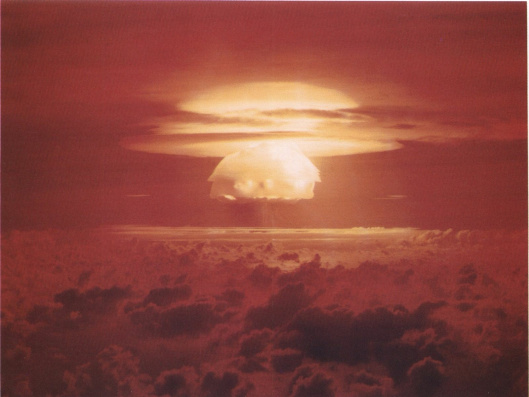
It was in February 1966, well after the 1963 atmospheric test ban treaty, that I first wrote about the impact of nuclear weapons. It was a rather flip, three-paragraph note in The Reporter Magazine, which no longer exists. The story concerned a law that had passed Congress the previous month, a measure which required the US Government to pay $11,000 to each of the 82 men, women and children—or their survivors—who had been on Rongelap Atoll in the Marshall Islands in the central Pacific on March 1, 1954 when the United States detonated Test Bravo from a tower on an artificial island built within Bikini Atoll, more than 120 miles west of Rongelap.
Bravo was the first US test of a deliverable thermonuclear bomb and was expected to have a six-megaton yield, the equivalent of six million tons of TNT. In fact, the explosion was more than double that—15 megatons—and one thousand times more powerful than the atomic bomb that destroyed Hiroshima.
Thanks in good part to thousands of documents on nuclear weapons declassified and released during the Clinton Administration, I was able to describe details about the Bravo explosion two years ago in my book, Blown To Hell: America’s Deadly Betrayal of the Marshall Islanders, as follows:
In a few seconds the fireball, recorded at one hundred million degrees, had spread nearly three miles in diameter, then quickly spread to ten miles. The sandspit and nearby reef where Bravo had stood, along with coral island areas, were vaporized down almost two hundred feet into the sea, creating a crater about one mile in diameter.
It was estimated that three hundred million tons of vaporized sand, coral and water shot up into the air as the fireball rose, and one-hundred-mile-an-hour winds created by the blast pulled additional debris up into the fireball. Within one minute, the fireball had gone up forty-five thousand feet with a stem four miles wide filled with radioactive debris. It continued to zoom upward, shooting through the troposphere and into the stratosphere within five minutes.
Later data showed the cloud bottom was at fifty-five thousand feet, the secondary mushroom cloud bottom was at one-hundred-fourteen thousand feet, and the upper cloud hit one-hundred-thirty thousand feet.
Ten minutes after detonation the mushroom cloud had widened and measured seventy-five miles across just below the stratosphere.
Original projections had predicted Bravo radioactive fallout would emanate from a fifteen-mile-wide cylinder that could stretch into the stratosphere. Instead, it turned out to be a one-hundred-mile-wide cloud where “debris was carried up and dispersed over a much larger area than was thought possible,” wrote Dr. William Ogle, the test’s task force commander of the scientific group that dealt with radioactivity.
Radioactive fallout and its long-term effects—things that the average person today does not really appreciate—would be the result from any future nuclear weapons explosion that touched the Earth’s surface. Fallout does not just affect the target, but also the surrounding areas—which could be as far as hundreds of miles away. And the effects could last for years, if not decades thereafter. These effects are worth spelling out in detail, using what happened downwind of the test as an example.
That March 1, 1954 morning, the Japanese fishing boat Lucky Dragon, with a crew of 23 aboard, was trawling its nets 90 miles east-northeast of Bikini. A crewman at the stern rail saw a whitish flare in the west that briefly lit up the clouds and the water. It grew in size, turned to yellow-red, then orange. After a few minutes, the colors faded and shortly thereafter the ship was rocked by the blast of an explosion.
The Lucky Dragon’s captain and the fishing master, who had read ship warnings before they left port, realized they might have strayed into a nuclear test area. They quickly decided to haul in their fishing nets and head back to Japan, almost 2,500 miles away.
It was another two or three hours before a fine white dust began to come down on the boat. With a light rain, the radioactive dust continued to settle on crewmen and the fish on the deck as they worked for another two hours to bring in their lines.
On Rongelap about 30 miles further east, at about 11:30 a.m., a similar powdery, radioactive ash began falling in the area. It stuck to the Marshallese people’s skin, hair, and eyes; many walked barefoot and the powder stuck to their toes; it fell on fish drying on wooden racks that would be eaten that night. Rain briefly fell as the fallout continued into afternoon, dissolving the powdery ash on roofs and carrying it down drains into water barrels that provided drinking water to each household.
On parts of Rongelap Island, where most people lived, the almost five hours of fallout led to drifts of up to one-inch or more high on the ground, on roofs, and along the beach. People recalled that when the moon broke through the clouds that night, it looked like patches of snow on the ground.
It would be two days before the Marshallese were evacuated from Rongelap and taken to the Kwajalein Navy Base by a US Navy destroyer. By then, most of the Rongelapese people had suffered from acute radiation exposure and nausea; some had experienced skin lesions as well.
Since the Bravo test was highly classified, a decision was made in Washington to keep the fallout incident secret, although the Atomic Agency Commission (AEC) had released a statement on March 1, 1954 that a nuclear test had taken place in the Marshall Islands Pacific Proving Ground. That had generated a small front page story in the March 2, 1954, edition of The New York Times. It was not until March 11, 1954, that the AEC admitted people “unexpectedly exposed to some radioactivity” had been moved to Kwajalein “according to a plan as a precautionary measure.”
Two weeks passed before the Lucky Dragon returned to its home port in Japan. It was only then that on March 16, 1954, the first story appeared in the Japanese Yomiuri Shimbun newspaper of what had happened to the boat’s crew and their fish—not what happened to the Marshallese. That story immediately triggered initial worldwide attention to the dangers of fallout from nuclear weapons.
However, it was not until President Eisenhower’s March 31, 1954 press conference that AEC Chairman Lewis Strauss, who had just returned from observing post-Bravo nuclear tests, admitted publicly that the Bravo test was “in the megaton range” and “the yield was about double that of the calculated estimate.” ……………………………………………………………………………………………………….
The early part of the 1955 report described the blast and heat effects of early atomic bombs detonated in the air, before discussing fallout from Bravo and other detonations. “In the air explosion, where the fireball does not touch the earth’s surface, the radioactivity produced in the bomb condenses only on solid particles from the bomb casing itself and the dust which happens to be in the air. In the absence of materials drawn up from the surface, these substances will condense with the vapors from the bomb and air dust to form only the smallest particles. These minute substances may settle to the surface over a very wide area—probably spreading around the world—over a period of days or even months. By the time they have reached the earth’s surface, the major part of their radioactivity has dissipated harmlessly in the atmosphere and the residual contamination is widely dispersed.”
The report then turned to what fallout would occur if the fireball hit the ground. “If however the weapon is detonated on the surface or close enough so that the fireball touches the surface, then large amounts of material will be drawn up into the bomb cloud. Many of the particles thus formed are heavy enough to descend rapidly while still intensely radioactive. The result is a comparatively localized area of extreme radioactive contamination, and a much larger area of some hazard. Instead of wafting down slowly over a vast area, the larger and heavier particles fall rapidly before there has been an opportunity for them to decay harmlessly in the atmosphere and before the winds have had an opportunity to scatter them.”
It described the Bravo fallout as looking like snow “because of calcium carbonate from coral,” and then noted its “adhesive” quality thanks to moisture picked up in the atmosphere as it descended. In the end it contaminated “a cigar-shaped area extending approximately 220 statute miles downwind, up to 40 miles wide,” from Bikini. It “seriously threatened the lives of nearly all persons in the area who did not take protective measures,” the report said.
The report then talked about radioactive strontium in fallout as having a long, average lifetime of nearly 30 years, noting it could enter the human body either by inhaling or swallowing. Deposited directly on edible plants, the strontium could be eaten by a human or animal. While rainfall or human washing of the plants would remove most of the radioactive material, radioactive strontium deposited directly on the soil or in the ocean, lakes, or rivers could be taken up by plants, animals, or fish. There it would lodge in their tissue where it could later be eaten by humans…………….
The other radioactive element in fallout described specifically as a threat in the report was radioactive iodine. Even though the average life of radioactive iodine was only 11.5 days, it was described as a serious hazard because, if inhaled, it concentrated in the thyroid gland where it could damage cells, depending on dosage………………………………………………………………………………………………………………………………………………………………..
Back on Rongelap, despite some cleanup, there are few in residence. A study published in the Proceedings of the National Academy of Sciences in July 2019, done by researchers from Columbia University, found that levels of plutonium and cesium in the soil on Rongelap and other Marshall Island atolls were “significantly higher” than levels that resulted from fallout existing from the July 1986 Chernobyl nuclear power accident—which occurred 28 years after US nuclear tests had ended in the Marshalls.
The Rongelap Marshallese as well as the Japanese seamen who were exposed to fallout on March 1, 1954, can be seen as surrogates for anyone caught in a future nuclear war. Rongelap Atoll, as well as Bikini Atoll, for the most part still cannot be inhabited despite attempts to decontaminate them. Think of what today’s cities would be like if hit by a thermonuclear weapon whose fireball struck the ground and created radioactive fallout.
Within weeks it will be 70 years since the Bravo test. The more the US public and the world are reminded of that test and the resulting Rongelap story, the more they should work to deter any potential use of nuclear weapons. https://thebulletin.org/premium/2024-03/the-horrors-of-nuclear-weapons-testing/?utm_source=Newsletter&utm_medium=Email&utm_campaign=ThursdayNewsletter03072024&utm_content=NuclearRisk_NuclearTestingHorrors_03072024
Oppenheimer feared nuclear annihilation – and only a chance pause by a Soviet submariner kept it from happening in 1962
on October 27, 1962, a nuclear war was averted not because President Kennedy and Premier Khrushchev were doing their best to avoid war (they were), but because Capt. Vasily Arkhipov had been randomly assigned to submarine B-59.”
This is but one of countless examples where global and military history has been dramatically altered by chance and luck. On Oct. 27, 1962, the world was extremely lucky. The question that Robert Oppenheimer would surely ask is, will we be so lucky the next time?
March 7, 2024, https://theconversation.com/oppenheimer-feared-nuclear-annihilation-and-only-a-chance-pause-by-a-soviet-submariner-kept-it-from-happening-in-1962-223148 Mark Robert Rank, Professor of Social Welfare, Arts & Sciences at Washington University in St. Louis
History has often been shaped by chance and luck.
One of the blockbuster films of the past year, “Oppenheimer,” tells the dramatic story of the development of the atomic bomb and the physicist who headed those efforts, J. Robert Oppenheimer. But despite the Manhattan Project’s success depicted in the film, in his latter years, Oppenheimer became increasingly worried about a nuclear holocaust resulting from the proliferation of these weapons.
Over the past 80 years, the threat of such nuclear annihilation was perhaps never greater than during the Cuban missile crisis of 1962.
President John F. Kennedy’s secretary of state, Dean Acheson, said that nuclear war was averted during that crisis by “just plain dumb luck.” As I detail in my forthcoming book, “The Random Factor,” nowhere was the influence of chance and luck more evident than on Oct. 27, 1962.
Russian missiles next door
To set the stage, a cold war of hostilities between the U.S. and the communist Soviet Union began almost immediately following World War II, resulting in a nuclear arms race between the two during the 1950s and continuing through the 1980s.
As a part of the Cold War, the U.S. was extremely concerned about countries falling under the Soviet communist influence and umbrella. That fear was magnified in the case of Cuba.
Tensions between the U.S. and Cuba had dramatically escalated following the failed 1961 U.S. attempt to overthrow revolutionary leader Fidel Castro and his communist ruling party. Known as the Bay of Pigs invasion, its failure proved to be a major embarrassment for the Kennedy administration and a warning to the Castro regime.
In May 1962, Castro and Soviet leader Nikita Khrushchev agreed to secretly deploy strategic nuclear missiles in Cuba, with the intention of providing a strong deterrent to any potential U.S. invasion in the future. The Russian missiles and equipment would be disassembled and shipped aboard freighters bound for Havana, then be reassembled on-site.
On Oct. 14, a high-flying U.S. U-2 spy plane photographed the construction of a missile launch site in western Cuba. This marked the beginning of the 13 days in October known as the Cuban missile crisis.
After heated deliberations with his cabinet and advisers, Kennedy decided on a naval blockade surrounding Cuba to prevent further Soviet ships from passing through. In addition, Kennedy demanded removal of all missiles and equipment already in Cuba.
This began a standoff between the U.S. and Russia. Ultimately, the missiles were disassembled and removed from Cuba. In exchange, the U.S. removed its Jupiter ballistic missiles from bases in Turkey and Italy.
But one utterly random – and utterly crucial – aspect of this resolution was not known until years later through the memoirs of, and interviews with, Soviet sailors.
Continue readingUS Refuses to Assure UK Judges That Assange Won’t Be Executed If He’s Extradited

UK law prohibits extradition to a country that may impose capital punishment.
By Marjorie Cohn , TRUTHOUT, February 27, 2024
n February 20 and 21, as nearly 1,000 supporters of Julian Assange gathered outside the London courthouse, a two-judge panel of the High Court of Justice presided over a “permission hearing.” Assange’s lawyers asked the judges to allow them to appeal the home secretary’s extradition order and raise issues that the district court judge had rejected without full consideration.
The High Court panel, Dame Victoria Sharp and Justice Jeremy Johnson, were concerned that the U.S. government could execute Assange if he is extradited to the United States, a penalty outlawed in the U.K. Although Assange faces 175 years in prison for the charges alleged in the indictment, there is nothing to prevent the U.S. from adding additional offenses which would carry the death penalty.
The Trump Administration Indicted Assange for Exposing U.S. War Crimes
Assange is charged with 17 counts of alleged violations of the Espionage Act, based on obtaining, receiving, possessing and publishing national defense information. He is accused of “recruit[ing] sources” and “soliciting” confidential documents just by maintaining the WikiLeaks website that stated it accepted such materials. Assange is also charged with one count of “conspiracy to commit computer intrusion” with intent to “facilitate [whistleblower Chelsea] Manning’s acquisition and transmission of classified information related to the national defence of the United States.”
The basis for the indictment, Assange’s lawyers told the panel, is WikiLeaks’s “exposure of criminality on the part of the U.S. government on an unprecedented scale.” Assange is charged for revealing war crimes committed by the United States in Iraq, Afghanistan and Guantánamo Bay. The indictment has nothing to do with Hillary Clinton and the 2016 election or Swedish allegations of sexual misconduct, which have been dropped.
WikiLeaks revealed the “Iraq War Logs” — 400,000 field reports including 15,000 unreported deaths of Iraqi civilians, as well the as systematic rape, torture and murder after U.S. forces handed over detainees to a notorious Iraqi torture squad. The revelations also included the “Afghan War Diary” — 90,000 reports of more civilian casualties by coalition forces than the U.S. military had reported.
In addition, WikiLeaks revealed the “Guantánamo Files,” 779 secret reports with evidence that 150 innocent people had been held at Guantánamo Bay for years, and 800 men and boys had been tortured and abused, in violation of the Geneva Conventions and the Convention Against Torture and Other Cruel, Inhuman or Degrading Treatment or Punishment.
WikiLeaks also revealed the notorious 2007 “Collateral Murder Video,” in which a U.S. Army Apache attack helicopter targeted and killed 11 unarmed civilians in Baghdad, including two Reuters journalists and a man who came to rescue the wounded. Two children were injured. The video contains evidence of war crimes prohibited by the Geneva Conventions.
And WikiLeaks exposed “Cablegate” — 251,000 confidential U.S. State Department cables that “disclosed corruption, diplomatic scandals and spy affairs on an international scale.” According to The New York Times, they told “the unvarnished story of how the government makes its biggest decisions, the decisions that cost the country most heavily in lives and money.”
“These were the most important revelations of criminal U.S. state behavior in history,” Assange attorney Mark Summers argued to the High Court panel.
Assange’s Appellate Issues
Assange is asking the U.K. High Court to review issues of treaty obligations, human rights violations and political persecution.
The U.S.-U.K. Extradition Treaty would allow the U.S. to amend or add charges which could expose Assange to the death penalty, a punishment prohibited in the U.K. In response to questioning by one of the judges, the prosecutor admitted that the U.S. had not provided assurances that Assange would not be subject to the death penalty if extradited.
Article 4(1) of the extradition treaty does not allow extradition for political offenses. Espionage is the “quintessential” political offense, Assange attorney Edward Fitzgerald told the panel. “The gravamen (and defining legal characteristic) of each of the charges is thus an alleged intention to obtain or disclose US state secrets in a manner that was damaging to the security of the US state,” which makes them political offenses, Assange’s lawyers wrote. The defense claimed it was an abuse of process for the United States to pursue extradition of Assange for a political offense……………………………………………………………………………….
“The Most Important Revelation Since Abu Ghraib”
The Collateral Murder video is “the most important revelation since Abu Ghraib,” Summers told the panel. “The cables Assange published disclosed extrajudicial assassinations, rendition, torture, dark prisons and drone killings.” Summers said the Guantánamo Files revealed a “colossal criminal act.” The defense pointed out that WikiLeaks’s revelations actually saved lives. After WikiLeaks published evidence of Iraqi torture centers established by the U.S., the Iraqi government refused President Barack Obama’s request to grant immunity to U.S. troops who committed criminal and civil offenses there. As a result, Obama had to withdraw U.S. forces from Iraq.
The Obama administration, which prosecuted more whistleblowers under the Espionage Act than all prior U.S. administrations combined, considered prosecuting Assange, but feared it would violate the First Amendment. The administration was unable to distinguish what WikiLeaks did from what The New York Times and The Guardian did since they also published documents that Chelsea Manning had leaked.
But the Trump administration did indict Julian Assange. The U.K. arrested Assange and has held him in Belmarsh Prison for nearly five years pending a decision on whether he should be extradited to the U.S. to stand trial.
In January 2021, following a three-week hearing, Baraitser denied extradition after finding that Assange’s mental health was so frail there was a “substantial risk” of suicide if he was extradited to the U.S. because of the harsh conditions of confinement in which he would be held. But she rejected all other legal objections to extradition that Assange had raised.
U.S. “Assurances” That Assange Will Be Treated Humanely
After Baraitser had already ruled, the U.S. came forward with diplomatic “assurances” that Assange would be treated humanely if extradited to the United States. The Biden administration assured the court that Assange: (1) would not be subject to onerous Special Administrative Measures (SAMs) that would keep him in extreme isolation and monitor his confidential communications with his attorneys; (2) would not be housed at the notorious ADX Florence maximum security prison in Colorado; (3) would receive psychological and clinical treatment in custody; and (4) could serve any custodial sentence in Australia.
But the U.S. said the assurances wouldn’t apply if Assange committed a “future act” that “met the test” for the SAMs. That unspecified contingency would be based on a subjective determination of prison authorities with no judicial review.
Although the United States has reneged on nearly identical assurances in the past, the High Court accepted them at face value, saying it was satisfied that the U.S. was acting in good faith, and in December 2021, the High Court reversed Baraitser’s denial of extradition.
However, in a 2023 decision, the U.K. Supreme Court unanimously held that the court has an independent duty to determine the validity of assurances,
writing, “The government’s assessment of whether there is such a risk is an important element of that evidence, but the court is bound to consider the question in the light of the evidence as a whole and to reach its own conclusion.”
In June 2023, a single High Court judge, Jonathan Swift, refused Assange permission to appeal in a cursory three-page ruling. The hearing on February 20 and 21 was an effort by Assange’s legal team to reverse that decision so that the High Court will entertain his appeal.
Assange Redacted Names of Informants to Protect Them
…………………… Several witnesses testified at the 2020 extradition hearing that Assange took great care to ensure that the names were redacted. Other outlets published the unredacted cables before WikiLeaks with no adverse consequences.
………………….Moreover, Brig. Gen. Robert Carr testified at Manning’s court martial that no one was harmed by the WikiLeaks releases. Summers told the panel that Baraitser never balanced the public interest in the disclosures against the fact that no harm came from them.
Conviction of Assange Would Chill Investigate Journalists From Exposing Government Secrets
In November 2022, The New York Times, The Guardian, Le Monde, DER SPIEGEL and El País signed a joint open letter calling on the Biden administration to drop the Espionage Act charges against Assange. They wrote, “Publishing is not a crime,” noting that Assange is the first publisher to be charged under the Espionage Act for revealing government secrets.
The indictment would punish conduct that national security journalists routinely engage in, including cultivating and communicating confidentially with sources and soliciting information from them, shielding their identities from disclosure, and publishing classified information. If Assange is prosecuted and convicted, it will discourage journalists both in the U.S. and abroad from publishing evidence of government wrongdoing.
No publisher has ever been prosecuted under the Espionage Act for disclosing government secrets. The U.S. government has never prosecuted a publisher for publishing classified information, which constitutes an essential tool of investigative journalism.
But rather than dropping Trump’s prosecution of Assange consistent with the position of the Obama-Biden administration, Joe Biden has zealously pursued extradition and prosecution.
Pending House Resolution Would Call for Dismissal of All Charges Against Assange.
On December 13, 2023, House Resolution 934 was introduced in the U.S. House of Representatives by Rep. Paul A. Gosar (R-Arizona), with cosponsors from both political parties. It would express “the sense of the House of Representatives that regular journalistic activities are protected under the First Amendment, and that the United States ought to drop all charges against and attempts to extradite Julian Assange.” The resolution states that the WikiLeaks disclosures “promoted public transparency through the exposure of the hiring of child prostitutes by Defence Department contractors, friendly fire incidents, human rights abuses, civilian killings, and United States use of psychological warfare.”
…………… The conviction of Assange under the Espionage Act, the resolution continues, “would set a precedent allowing the United States to prosecute and imprison journalists for First Amendment protected activities, including the obtainment and publication of information, something that occurs on a regular basis.”
…………..
At the conclusion of the two-day hearing, the High Court panel set a due date of March 4 for further written submissions from the parties. If the court agrees to review at least one of Assange’s appellate issues, there will be a full hearing. Meanwhile, Assange, who is in poor physical and emotional health, remains in prison.
If the High Court denies his right to appeal, Assange can ask the European Court of Human Rights to hear his case. If that court finds “exceptional circumstances” and an “imminent risk of irreparable harm,” it can order provisional measures, including a stay of execution while the case is pending in the European court. But there is a danger that the U.K. could immediately extradite Assange to the United States before the European Court of Human Rights has a chance to consider Assange’s petition.
Fatal Flaws Undermine America’s Defense Industrial Base
Many elements of the traditional DIB have yet to adopt advanced manufacturing technologies, as they struggle to develop business cases for needed capital investment.
In other words, while adopting advanced manufacturing technologies would fulfill the purpose of the US Department of Defense, it is not profitable for private industry to do so.
Despite virtually all the problems the report identifies stemming from private industry’s disproportionate influence over the US DIB, the report never identifies private industry itself as a problem.
If private industry and its prioritization of profits is the central problem inhibiting the DIB from fulfilling its purpose, the obvious solution is nationalizing the DIB by replacing private industry with state-owned enterprises. This allows the government to prioritize purpose over profits. Yet in the United States and across Europe, the so-called “military industrial complex” has grown to such proportions that it is no longer subordinated to the government and national interests, but rather the government and national interests are subordinated to it.
US defense industrial strategy built on a flawed premise
Beyond private industry’s hold on the US DIB, the very premise the NDIS is built on is fundamentally flawed, deeply rooted in private industry’s profit-driven prioritization.
The report claims:
The purpose of this National Defense Industrial Strategy is to drive development of an industrial ecosystem that provides a sustained competitive advantage to the United States over its adversaries.
The notion of the United States perpetually expanding its wealth and power across the globe, unrivaled by its so-called “adversaries” is unrealistic.
China alone has a population 4-5 times greater than the US. China’s population is, in fact, larger than that of the G7 combined. China has a larger industrial base, economy, and education system than the US. China’s education system not only produces millions more graduates each year in essential fields like science, technology, and engineering than the US, the proportion of such graduates is higher in China than in the US.
China alone possesses the means to maintain a competitive advantage over the United States now and well into the foreseeable future. The US, attempting to draw up a strategy to maintain an advantage over China (not to mention over the rest of the world) regardless of these realities, borders on delusion.
Yet for 60 pages, US policymakers attempt to lay out a strategy to do just that.
Not just China, but also Russia
While China is repeatedly mentioned as America’s “pacing challenge,” the ongoing conflict in Ukraine is perhaps the most acute example of a shifting balance of global power.
Despite a combined population, GDP, and military budget many times greater than Russia’s, the collective West is incapable of matching Russian production of even relatively simple munitions like artillery shells, let alone more complex systems like tanks, aircraft, and precision-guided missiles.
While the US and its allies appear to have every conceivable advantage over Russia on paper, the collective West has organized itself as a profit-driven rather than purpose-driven society.
In Russia, the defense industry exists to serve national security. While one might believe this goes without saying, across the collective West, the defense industry, like all other industries in the West, exists solely to maximize profits.
To best serve national security, the defense industry is required to maintain substantial surge capacity – meaning additional, unused factory space, machines, and labor on standby if and when large surges in production are required in relatively short periods of time. Across the West, in order to maximize profits, surge capacity has been ruthlessly slashed, deemed economically inefficient. Only rare exceptions exist, such as US 155 mm artillery shell production.
While the West’s defense industry remains the most profitable on Earth, its ability to actually churn out arms and ammunition in the quantities and quality required for large-scale conflict is clearly compromised by its maximization of profits.
The result is evident today as the West struggles to expand production of arms and ammunition for its Ukrainian proxies.
The NDIS report would note:
Prior to the invasion, weapon procurements for some of the in-demand systems were driven by annual training requirements and ongoing combat operations. This modest demand, along with recent market dynamics, drove companies to divest excess capacity due to cost. This meant that any increased production requirements would require an increase in workforce hours in existing facilities—commonly referred to as “surge” capacity. These, in turn, were limited further by similar down-stream considerations of workforce, facility, and supply chain limitations.
Costs are most certainly a consideration across any defense industry, but costs cannot be the primary consideration.
A central element of Russia’s defense industry is Rostec, a massive state-owned enterprise under which hundreds of companies related to national industrial needs including defense are organized. Rostec is profitable. However, the industrial concerns organized under Rostec serve purposes related to Russia’s national interests first and foremost, be it national health, infrastructure or security.
Because Russia’s defense industry is purpose-driven, it produced military equipment because it was necessary, not because it was profitable. As a result, Russia possessed huge stockpiles of ammunition and equipment ahead of the Special Military Operation (SMO) in February 2022. In addition to this, Russia maintained large amounts of surge capacity enabling production rates of everything from artillery shells to armored vehicles to expand quickly over the past 2 years.
Only relatively recently have Western analysts acknowledged this.
Continue reading

“military industrial complex” has grown to such proportions that it is no longer subordinated to the government and national interests, but rather the government and national interests are subordinated to it.
the collective West has organized itself as a profit-driven rather than purpose-driven society………………………………across the collective West, the defense industry, like all other industries in the West, exists solely to maximize profits.
By Brian Berletic, Orinoco Tribune. February 24, 2024 https://popularresistance.org/fatal-flaws-undermine-americas-defense-industrial-base/
The first-ever US Department of Defense National Defense Industrial Strategy (NDIS) confirms what many analysts have concluded in regard to the unsustainable nature of Washington’s global-spanning foreign policy objectives and its defense industrial base’s (DIB) inability to achieve them.
The report lays out a multitude of problems plaguing the US DIB including a lack of surge capacity, inadequate workforce, off-shore downstream suppliers, as well as insufficient “demand signals” to motivate private industry partners to produce what’s needed, in the quantities needed, when it is needed.
In fact, the majority of the problems identified by the report involved private industry and its unwillingness to meet national security requirements because they were not profitable.
For example, the report attempts to explain why many companies across the US DIB lack advanced manufacturing capabilities, claiming:
Many elements of the traditional DIB have yet to adopt advanced manufacturing technologies, as they struggle to develop business cases for needed capital investment.
In other words, while adopting advanced manufacturing technologies would fulfill the purpose of the US Department of Defense, it is not profitable for private industry to do so.
Despite virtually all the problems the report identifies stemming from private industry’s disproportionate influence over the US DIB, the report never identifies private industry itself as a problem.
If private industry and its prioritization of profits is the central problem inhibiting the DIB from fulfilling its purpose, the obvious solution is nationalizing the DIB by replacing private industry with state-owned enterprises. This allows the government to prioritize purpose over profits. Yet in the United States and across Europe, the so-called “military industrial complex” has grown to such proportions that it is no longer subordinated to the government and national interests, but rather the government and national interests are subordinated to it.
US defense industrial strategy built on a flawed premise
Beyond private industry’s hold on the US DIB, the very premise the NDIS is built on is fundamentally flawed, deeply rooted in private industry’s profit-driven prioritization.
The report claims:
The purpose of this National Defense Industrial Strategy is to drive development of an industrial ecosystem that provides a sustained competitive advantage to the United States over its adversaries.
The notion of the United States perpetually expanding its wealth and power across the globe, unrivaled by its so-called “adversaries” is unrealistic.
China alone has a population 4-5 times greater than the US. China’s population is, in fact, larger than that of the G7 combined. China has a larger industrial base, economy, and education system than the US. China’s education system not only produces millions more graduates each year in essential fields like science, technology, and engineering than the US, the proportion of such graduates is higher in China than in the US.
China alone possesses the means to maintain a competitive advantage over the United States now and well into the foreseeable future. The US, attempting to draw up a strategy to maintain an advantage over China (not to mention over the rest of the world) regardless of these realities, borders on delusion.
Yet for 60 pages, US policymakers attempt to lay out a strategy to do just that.
Not just China, but also Russia
While China is repeatedly mentioned as America’s “pacing challenge,” the ongoing conflict in Ukraine is perhaps the most acute example of a shifting balance of global power.
Despite a combined population, GDP, and military budget many times greater than Russia’s, the collective West is incapable of matching Russian production of even relatively simple munitions like artillery shells, let alone more complex systems like tanks, aircraft, and precision-guided missiles.
While the US and its allies appear to have every conceivable advantage over Russia on paper, the collective West has organized itself as a profit-driven rather than purpose-driven society.
In Russia, the defense industry exists to serve national security. While one might believe this goes without saying, across the collective West, the defense industry, like all other industries in the West, exists solely to maximize profits.
To best serve national security, the defense industry is required to maintain substantial surge capacity – meaning additional, unused factory space, machines, and labor on standby if and when large surges in production are required in relatively short periods of time. Across the West, in order to maximize profits, surge capacity has been ruthlessly slashed, deemed economically inefficient. Only rare exceptions exist, such as US 155 mm artillery shell production.
While the West’s defense industry remains the most profitable on Earth, its ability to actually churn out arms and ammunition in the quantities and quality required for large-scale conflict is clearly compromised by its maximization of profits.
The result is evident today as the West struggles to expand production of arms and ammunition for its Ukrainian proxies.
The NDIS report would note:
Prior to the invasion, weapon procurements for some of the in-demand systems were driven by annual training requirements and ongoing combat operations. This modest demand, along with recent market dynamics, drove companies to divest excess capacity due to cost. This meant that any increased production requirements would require an increase in workforce hours in existing facilities—commonly referred to as “surge” capacity. These, in turn, were limited further by similar down-stream considerations of workforce, facility, and supply chain limitations.
Costs are most certainly a consideration across any defense industry, but costs cannot be the primary consideration.
A central element of Russia’s defense industry is Rostec, a massive state-owned enterprise under which hundreds of companies related to national industrial needs including defense are organized. Rostec is profitable. However, the industrial concerns organized under Rostec serve purposes related to Russia’s national interests first and foremost, be it national health, infrastructure or security.
Because Russia’s defense industry is purpose-driven, it produced military equipment because it was necessary, not because it was profitable. As a result, Russia possessed huge stockpiles of ammunition and equipment ahead of the Special Military Operation (SMO) in February 2022. In addition to this, Russia maintained large amounts of surge capacity enabling production rates of everything from artillery shells to armored vehicles to expand quickly over the past 2 years.
Only relatively recently have Western analysts acknowledged this.
Continue reading
February 2024: 10th anniversary of the conflict in Ukraine
Russia preferred to maintain the Ukrainian state and did not recognize the breakaway republics of Donetsk and Lugansk. It strove to find a solution that would protect the rights of Russian speakers (language, administrative autonomy) without removing them from Ukraine. The Minsk I (September 2014) and Minsk II (February 2015) agreements were neutralized by the Western signatories who later admitted having signed them only to give themselves time to arm and train the Ukrainian forces.
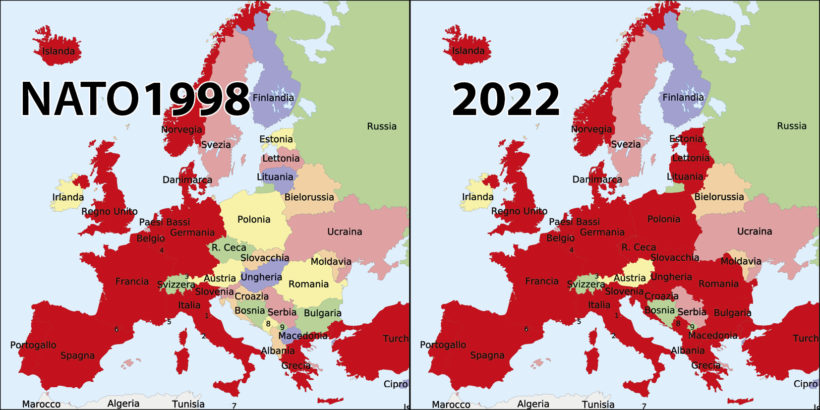
Russia’s categorical refusal to the inclusion of Ukraine into NATO since this would be followed by the installation of American missiles on its southern flank.
February 24, 2022, was not the beginning of a war with Ukraine but the last stage of the war that had begun in 2014.
Used as a disposable tool by the United States and NATO against Russia, Ukraine is in ruins and its future is in jeopardy.
22.02.24 – Europe – Samir Saul – Michel Seymour https://www.pressenza.com/2024/02/february-2024-10th-anniversary-of-the-conflict-in-ukraine/
In the coming days, we will surely hear about the so-called second anniversary of the war in Ukraine. Western governments, corporate media broadcasting the official pro-US line all day long, and “experts”-propagandists of this line will deliver their pseudo-analyses. All will be based on the double premise that the conflict in Ukraine began on February 24, 2022, and that it consists of a Russo-Ukrainian war unilaterally provoked by Russia to satisfy the expansionist ambitions of “dictator” Putin.
According to the US/NATO/Kiev “narrative”, everything was peaceful and normal before February 24. On that day, without the slightest justification and warning, like lightning in a blue sky, a Russian invasion descended on innocent Ukraine. As good Samaritans, the USA and its camp rushed to the aid of the victim by becoming its source of dollars and weapons, not to mention mercenaries and NATO “advisers” to operate these weapons systems. The conflict was supposed to last at most a few weeks, which was all the time that was needed to bleed Russia, while economic “sanctions” would bludgeon it and open the way to a “popular uprising” on the model of the “colored revolutions” (i.e. a putsch sponsored by the Western camp to carry out regime change and install a new leadership which would place Russia under the control of US imperialism).
That is the official “story”, rehashed ad nauseam, by “major” media, with all analysis of what is happening shut out. Only pro-US/NATO/Kiev propaganda is permitted because it would not survive if serious analyses were also allowed. It turns out that censorship, presented as the practice solely of “authoritarian regimes” against which Western “democracies” are leading a worldwide struggle in the name of “values”, is very much at home in the West. It is endorsed, sometimes hypocritically, sometimes proudly.
In propaganda and the now culture, there is no history. Events occur as sudden appearances or random occurrences based on spontaneous impulses. The “good guys” (the US and those who are aligned with them) and the “bad guys” (those who stand up to them) are known in advance, nothing else. With this simplistic and distorting grid, a conflict only begins when the “bad guys” retaliate, and never before, when the “good guys” have taken the initiative to threaten or attack them, leading to the retaliation. These initial actions are simply erased from memory.
Choosing February 24, 2022 as the starting date of the conflict in Ukraine shows bias, myopia and ignorance. It is equivalent to becoming a sounding board for the official “narrative”, the primary aim of which is to conceal the central role of Western governments as initiators of the conflict in Ukraine. Their aim is less Ukraine itself than the utilization of Ukraine, first against the Soviet Union, then against Russia.
A conflict that dates back to 1945
The Ukrainian question went through four phases: from 1945 to 1956, it was a war of sabotage and terrorism; from 1956 to 1990, there was a lull; from 1990 to 2014, a new conflict was brewing; in 2014, the war began.
As early as 1945, well before February 24, 2022, the ancestor of the CIA recruited German Nazis and their Ukrainian collaborators. Surrendering to the Americans, Reinhard Gehlen put his network of agents in Eastern Europe at the service of the US. Ukrainian ultranationalist collaborator Stepan Bandera joined Gehlen in Germany and, with his organization, waged a bloody war against the USSR in Ukraine, a Soviet territory. The USSR won and the KGB assassinated Bandera in 1959. It was in 1954 that Khrushchev transferred the Crimean peninsula to the Republic of Ukraine, then part of the USSR.
Latent tension since 1991
Continue readingDAY ONE: Assange Timeline Exposes US Motives

February 20, 2024
Julian Assange’s lawyers on Tuesday argued before the High Court about why the imprisoned publisher must be allowed to appeal against his extradition order, reports Joe Lauria.
By Joe Lauria, in London, Consortium News
On Day One of Julian Assange’s attempt to appeal Britain’s order to extradite him to the United States, his lawyers laid out a timeline that exposed U.S. motives to destroy the journalist who revealed their high-level state crimes.
Before two High Court judges in the cramped, wood-paneled Courtroom 5 at the Royal Courts of Justice, Assange’s lawyers argued on Tuesday that two judges had seriously erred in the case on a number of grounds necessitating an appeal of the home secretary’s decision to extradite Assange to the United States.
High to the left of the court, next to oak shelves with neat rows of law books, was an empty iron cage. The court said it had invited Assange to either attend in person or via video link from Belmarsh Prison, where he has been locked up on remand for nearly five years. But Assange said he was too ill take part in any capacity, his lawyers confirmed.
Vanessa Baraitser, the district judge who presided over Assange’s 2020 extradition hearing, and Jonathan Swift, a High Court judge, came in for heavy criticism from Assange’s lawyers. Baraitser in January 2021 ordered Assange released on health grounds.
But she refused him bail while the U.S. appealed. On the basis of assurances that it would not mistreat Assange in the United States, the High Court reversed Baraitser’s decision. The U.K. Supreme Court then refused to take Assange’s challenge of the legality of these assurance and the home secretary signed the extradition order.
Assange’s last avenue of appeal is of the home secretary’s order as well as Baraitser’s 2021 decision, in which, on every point of law and many of fact, she sided with the United States. The application to pursue this appeal was rejected by a single High Court judge, Swift, last June.
He permitted his rejection of the application to itself be appealed. That two-day hearing began Tuesday before Justice Jeremy Johnson and Dame Victoria Sharp.
The Timeline
Assange lawyer Mark Summers made a forceful argument that the United States in essence is treating Assange no differently than any authoritarian regime would deal with a dissident journalist who revealed its secret crimes.
“There was evidence before the district judge that this prosecution was motivated to punish and inhibit the exposure of American state-level crimes,” Summers told the court. “There was unchallenged evidence” during Baraitser’s 2020 extradition hearing “of crimes that sit at the apex of criminality,” he said.
He said there was a direct nexus between Assange’s work to expose U.S. crimes and the U.S. pursuing him. “This is a prosecution for those disclosures,” he said. “There is a straight-line correlation between those disclosures and the prosecution, but the district judge (Baraitser) addressed none of this and neither did Swift.”
Summers then sketched out a timeline of events showing successive stages of motivation for the United States to go after Assange. “There was compelling circumstantial evidence why the U.S. brought this case,” he said.
First, he said, there was no prosecution of Assange (despite the Obama administration empaneling a grand jury) until 2016, when the International Criminal Court announced it would look into possible U.S. crimes in Afghanistan, following Assange’s disclosures. The U.S. then denounced him as a political actor.
Summers said “that morphed into plans to kill or rendition Assange” from the Ecuadorian embassy, where he had asylum, following the Vault 7 release of C.I.A. spying tools in 2017.
The then new C.I.A. Director Mike Pompeo, in his first public appearance in that position, denounced WikiLeaks as a hostile, non-state intelligence service, a carefully chosen legal term, Summers said, that permitted taking covert action against a target without Congressional knowledge.
Because these plans to kill or rendition Assange, asked for by President Donald Trump, raised alarms with White House lawyers, a legal prosecution was pursued as a way to determine where to put Assange if he were renditioned to the U.S., Summers said.
“This prosecution only emerged because of that rendition plan,” he said. “And the prosecution that emerged is selective and it is persecution.” It was selective because even though other outlets, such as Freitag and cryptome.org,, had published the unredacted diplomatic cables first, Assange was the only one charged.
“This is not a government acting on good faith pursuing a legal” path, he said……………………………………
Assange lawyer Edward Fitzgerald called espionage, with which Assange is charged, a “pure political offense.” The issue is crucial to Assange’s defense because the U.S.-U.K. Extradition Treaty bars extraditions for political offenses.
However, the Extradition Act, Parliament’s implementing legislation of the Treaty, does not mention political offenses. Baraitser ruled that the Act and not the Treaty should take precedence.
Assange’s team has been arguing that he is wanted for a political crime and therefore the extradition should not proceed. They argued that the Act bars extradition for “political opinion,” which they equate with “political offense.
A considerable amount of time in the five-hour hearing was thus spent by Assange’s lawyers making the point that Assange’s charges are political. Fitzgerald argued that Britain has extradition treaties with 158 nations and in all but two (Kuwait and the UAE), political offenses are barred.
Assange’s work was to influence and change U.S. policy, Fitzgerald said, therefore his work was political and he could not be extradited for his political views or opinions.
Informants!
Justices Johnson and Sharp appeared to be not extremely well-versed in the Assange case and seemed at times surprised by what they were hearing from Assange’s lawyers. But they had been prepared on the U.S. view of Assange allegedly harming U.S. informants.
What they didn’t know is that Assange had actually spent time redacting the names of U.S. informants from the Diplomatic Cables, while WikiLeaks‘ mainstream partners in 2010 did not.
Justice Johnson asked before lunch whether there were cases where someone had published the names of informants and were not prosecuted. After the break, Summers offered the example of Philip Agee, the ex-C.I.A. agent who revealed undercover agents’ names, some of whom were harmed, but he was never indicted for it.
Summers also mentioned The New York Times publishing names of informants in the Pentagon Papers. “The New York Times was never prosecuted,” Summers said. However, Richard Nixon indeed empaneled a grand jury in Boston to indict Times reporters but after it was revealed the government tapped whistleblower Daniel Ellsberg’s phone — and thus also the reporters’ — the case was dropped.
Despite their apparent unfamiliarity with the Assange case both judges seemed intrigued by its serious political, legal and press freedom issues. They are senior judges who might be less susceptible to political pressure.
The Death Penalty
The judges may also have been surprised to learn that under U.S. law and practice, (in this case with agreement from the British government), new charges could be added to Assange’s indictment after he would arrive in America. The Espionage Act, for instance, carries a provision for the death penalty if committed during wartime.
Britain does not have the death penalty and cannot extradite someone who could face capital punishment. Though the U.S. could offer Britain diplomatic assurances that it would not seek the death penalty against Assange, so far it has refused.
Fitzgerald also seemed to shock the courtroom by speaking of instances in U.S. courts where someone convicted for one crime could at sentencing receive time for another offense he or she was never tried for.
He expressed concern that though Assange was never charged with the Vault 7 C.I.A. leak, he might still be sentenced for it. He also said that at sentencing the rules of admissibility could be discarded, for example to consider evidence that was obtained through surveillance.
First Amendment
The judges may have been surprised to hear that the U.S. prosecutor in Virginia has said he may deny Assange his First Amendment rights during trial on U.S. soil because he is not a U.S. citizen. Pompeo stated more categorically that Assange would be without First Amendment protection.
Stripping the right of free speech is a violation of Article 10 of the European Court of Human Rights, Assange’s lawyers argued.
What Strasbourg Would Do
Summers brought the court through a scenario in which the European Court of Human Rights had tried Chelsea Manning, instead of a U.S. military court. He said whistleblower protection laws in Europe had advanced to the point where he believed the court would have weighed the harm done by breaking a confidentiality agreement and the harm prevented by blowing the whistle…….
The overall strategy of Assange’s lawyers appeared to be to make it obvious to these judges that there are vast grounds for appeal as well as arguments to toss the case (such as evidence of C.I.A. spying on Assange’s privileged conversations with his lawyers)
Forseeable
Assange’s lawyers also argued that Article 7 of the European Convention on Human Rights says someone must foresee that their behavior is a crime before he or she could be charged with it.
They said Assange could not have known that publishing his classified disclosures could have led to prosecution under the Espionage Act because no journalist or publisher had ever been charged under it for possession and publication of classified material. Therefore a violation of Article 7 should bar extradition, they say……………………
The hearing continues on Wednesday with lawyers representing the United States presenting their arguments about why Assange should not be allowed to appeal. https://consortiumnews.com/2024/02/20/day-one-assange-timeline-exposes-us-motives/
—
Germany and nuclear weapons: A difficult history

Volker Witting | Rina Goldenberg, 02/17/2024February 17, 2024
Donald Trump’s suggestion the US will no longer apply NATO’s principle of collective defense should he become president again has sent shockwaves through Europe.
German Defense Minister Boris Pistorius is annoyed by the current debate about European nuclear weapons.“There is no reason to discuss the nuclear umbrella now,” he told public broadcaster ARD.
Ever since Donald Trump suggested that, as US president, he would not provide military assistance to NATO countries if they invested less than 2% of their GDP in their defense, German politicians have been discussing whether French and British nuclear weapons would suffice as a protective shield or whether Europe needs new nuclear weapons.
“The debate about European nuclear weapons is a very German debate that we don’t see in any other country,” political scientist Karl-Heinz Kamp from the German Council on Foreign Relations (DGAP) told DW — especially not in Eastern Europe, where there is a constant perceived threat from Russian President Vladimir Putin’s Russia.
Germany has a special history: Germany was “seen as an intrinsically aggressive country, that had started two world wars and could not be trusted with nuclear weapons,” said Kamp.
Germany-based nukes during the Cold War
In 1954, not long after the end of World War II, the first chancellor of the Federal Republic of Germany, Konrad Adenauer, signed an agreement renouncing the production of its own nuclear, biological or chemical weapons on its territory. In return, the US included West Germany in its nuclear deterrence policy against the Soviet-led Warsaw Pact.
In 1958, the German parliament, the Bundestag, approved the deployment of US nuclear weapons, despite some pacifist protests among the population. In 1960, 1,500 US nuclear warheads were stored in West Germany and a further 1,500 in the rest of Western Europe.
The nuclear weapons were also available to the Bundeswehr for training and use in the “case of defense.” “There was never any discussion about Germany acquiring its own nuclear weapons,” said Kamp.
The West German and European peace movements grew. The protest against the “NATO Dual-Track Decision” in 1982 saw over a million people in West Germany take to the streets in protest against the planned stationing of new US medium-range missiles in the country.
Nevertheless, on November 22, 1983, a center-right majority in the Bundestag approved the stationing of the missiles in US bases shortly thereafter. At the time, the Greens were newly represented in the Bundestag and appealed to the Federal Constitutional Court against the storing and deployment of nuclear missiles on West German territory. This bid was rejected as unfounded in December 1984.
During the Cold War, East Germany, the communist German Democratic Republic (GDR), was part of the Warsaw Pact military alliance, and from 1958, nuclear missiles and warheads were stationed in Soviet military bases on GDR territory. Some were withdrawn in 1988 as part of the Intermediate-Range Nuclear Forces Treaty between the US and the Soviet Union.
After German reunification and the withdrawal of the Soviet military, the territory of the former GDR officially became free of nuclear weapons in 1991.
Post-Cold War Germany
After the fall of the Berlin Wall in 1989, the collapse of the Soviet Union and the end of the division between East and West Germany, the German position was once again cemented in the so-called “Two-Plus-Four Treaty”: No nuclear weapons! On September 12, 1990, the four victorious powers of World War II (the US, the Soviet Union, France and UK) stipulated that Germany East and West should be reunified and renounce nuclear weapons.
Kamp says this was hardly surprising, because “a German nuclear power would be something that would cause horror. For historical reasons alone.”
The US government withdrew many of these nuclear warheads after the collapse of the Soviet Union, though an estimated 180 US nuclear weapons are still stored in Europe, in Italy, Turkey, Belgium, the Netherlands and Germany.
Experts believe that 20 US nuclear warheads are currently stored in the town of Büchel in Rhineland-Palatinate, western Germany. “But the decision-making authority over these weapons lies solely with the American president,” explained Kamp.
Any debate about Germany acquiring its own nuclear weapons is completely unrealistic, says political scientist Peter Rudolf from the German Institute for International and Security Affairs. Nuclear bombs need to be stored so that they are not easy targets, he told the Frankfurter Allgemeine daily.
“Survivable nuclear weapons would have to be on nuclear-powered submarines that can remain underwater for a very long time, he said, pointing to equipment the Bundeswehr does not have. “So there are so many problems standing in the way of a German nuclear bomb that it has no relevance to current crises,” Rudolf concluded.
“Those who are now talking about a European defense dimension are not talking about German nuclear weapons, because Germany is a member of the Nuclear Non-Proliferation Treaty and has made several binding commitments under international law to renounce the possession of weapons of mass destruction — including nuclear weapons,” agreed Kamp.
Defense Minister Pistorius, meanwhile, who made headlines not so long ago saying Germany should get “war-ready”, is now keen to brush the whole debate aside: He told ARD that “the majority of those in charge in the United States of America know exactly what they have in their transatlantic partners in Europe, what they have in NATO.”
And Kamp agrees: “Trump may be able to damage NATO considerably, but he cannot destroy it. You can’t destroy decades of transatlantic relations in one term of office.”
Edited by Ben Knight and Peter Hille
The odds of China using nuclear war to resolve the Taiwan issue
By John F. CopperFeb 20, 2024, https://johnmenadue.com/the-odds-of-china-using-nuclear-war-to-resolve-the-taiwan-issue-u-s-expert-versus-taiwan-experts/
Recently the Centre for Strategic and International Studies, a thinktank in Washington, DC, did a survey asking U.S. and Taiwan Experts if China might use nuclear weapons in a conflict with or over Taiwan. The results were astonishing to most who read the study. Almost half of U.S. experts reported they thought China would. Only one quarter that number of Taiwan experts, 11 percent, so opined.
Different histories and variances in views of the world order explain this.
The US view
The United States was born out of war in the late 1700s. Americans call it a revolutionary war or a war of independence. It was the latter. (Social classes did not change.)
Growing from a small country on the East Coast to a two-ocean nation in a century was built on wars with the indigenous people (American Indians) that were reduced from 100 percent of the population to 2 percent today. The wars were vicious, including the use of germ weapons and deliberately starving the enemy. Essentially wars of annihilation.
In the late 1800s the Indians were defeated marked by a victory (some called a massacre) in the Battle of Wounded Knee. Thenceforth the U.S. became an external expansionist power: incorporating Hawaii, defeating Spain to colonise the Philippines, and taking some other Pacific Islands.
World War I and II enhanced America’s world power status: from being an important nation to being a preeminent world power (superpower). In 1991, the U.S. defeated the Soviet Union, the only other superpower, with an arms race that America won—to become the world’s sole superpower.
Four years ago, former President Jimmy Carter noted America had been at peace only 16 of the last 242 years and concluded the U.S. was the most warlike nation in history. By contrast, China had not been at war in the last 40 years.
Meanwhile, after World War II the U.S. built a new world order employing its superior national power and its view of what the world should be –a world of global trade and economic growth and dragooned democracy. It worked well for a while.
But America became overstretched from its role as a military giant, and in some ways soft or at least tired of its global responsibilities. After the fall of the Soviet Union, it was not ready to lead a unipolar world.
More important, it faced a growing challenge. Mao, China’s great leader, died in 1976 and two years later Deng Xiaoping reconstructed China, getting rid of Mao’s radical communism and replacing it with free-market capitalism, trade and a system that built on China’s education tradition. China boomed economically.
It even grew during the world recession of 2008 and the subsequent almost slowest U.S. recovery in recent history. China became the number one nation in the world economically based on purchasing power. It led the word in steel production and other measures of big power status. In made the UN’s poverty eradication project work by helping developing countries grow with its formidable Belt and Road Initiative that was heading toward spending a trillion dollars compared to America’s biggest, the Marshall Plan (costing a bit over 100 billion in today’s dollars). Meanwhile, China passed the U.S. in registering patents and publishing academic articles while building modern airports and fast trains (more than the rest of the world combined while American had none).
President Trump met the China challenge with a make America great again policy. He sought to bring important industries back and restore U.S. capitalism. However, he faced virtually impossible hurdles to do this: an inflated and powerful government bureaucracy, too many lawyers that impeded business, horribly expensive penal and welfare systems, high taxes and a burdensome debt. Plus, the intelligence agencies and the federal police (FBI), the mainstream media, and American academe all opposed him while the Democratic Party that was bigger than his party had more money.
President Biden sought to destroy Trump’s America. As a globalist he advocated the idea of the US as an exceptional country and a superpower. America was to be a nation organising a bloc of democracies facing off against the China-led authoritarian nations. But this failed. America’s democracy appeared to many to have evolved into partisan rule by the deep state. Europeans did not want to be led by the U.S. Europe and Japan did not wish to end important economic ties with China. The Biden administration engaged in a financial and technology war with China, which hurt the U.S. more than China. The developing countries of the world continued to admire China for its aid and investments.
Good luck competing with China…
Meanwhile, pundits were taken by an idea expressed in the ancient book by Thucydides, The Peloponnesian Wars, that competition and eventually war between a status quo power (Sparta) and a rising power (Athens) was the model for most major wars after that. The relationship between America and China fit the model well. Thus, war was coming.
Provoking a war by demonising China as an expansionist power and an abuser of human rights meant that the U.S. should to go to war soon—before China, experiencing a renaissance and rising in national power, might defeat the U.S. that was experiencing decline.
The Taiwanese view
Taiwan has a very different history and view of the world from America. It early on grew up in isolation. Then it was exposed to the world outside via trade handled by its merchants, pirates, and outsiders. Chinese migrated to Taiwan and subdued the indigenous population reducing it to 2 percent of residents as happened in America; but this did not make Taiwan a world power.
Instead, Taiwan was ruled by Westerners (the Netherlands) for a brief time that improved its economy and more. For two centuries it was then ruled by China that did not have much interest in Taiwan and eventually abandoned it. Forthwith, Taiwan became a colony of Japan, during which time it saw economic modernisation without political choice or democracy.
Then the United States defeated Japan in war and returned Taiwan to China according to wartime agreements made at Potsdam and Tehran. Taiwan was not given any choice in the matter.
But China was at war with itself–a civil war between Chiang Kai-shek’s Nationalists and Mao Tse-tung’s Communists. Four years later Chiang lost and retreated to Taiwan to regroup. Again, Taiwan had no voice.
Owing to the Korean War the United States viewed Mao as a confederate of the Soviet Union and therefore an enemy. America gave aid and protection to Chiang’s Republic of China based on Taiwan. But the U.S. did not want a war with China allied with the Soviet Union and the result was a stalemate.
Chiang shifted his attention to Taiwan’s economic development and succeeded beyond almost anyone’s expectations. Its gross national product grew at a pace that far exceeded Western countries or Japan at their halcyon growth days.
Peace made this possible. Economic growth produced prosperity. Prosperity begat a middle class. A middle class serve to create political change and democracy.
Taiwan became a model for economic development and political change. Something similar happened in China under Deng: a booming economy and some political liberalisation. China and Taiwan linked up with trade and investments such that it made for mutual understanding and the avoidance of war, the same conditions that made the European Community work.
Strategically, Taiwan aligned with the United States against China in the Cold War. Like before it had no choice. But it avoided developing a nuclear weapon believing Chinese leaders when they said they would not use its nukes against Taiwan as they would not consider killing their own people.
Taiwan believed this because China did not engage in a nuclear arms race with America even though in the last two or three decades it could afford to do so. China sought to deal with Taiwan with its economic prowess, though it pulled its punches in using pressure and Taiwan knew it.
Taiwan’s residents’ national identity made it favour its sovereignty and separation from China or independence. Yet they knew this was contingent on America’s protection, regarding which they had some doubts.
Washington’s policy was that there was one China and Taiwan was part of China. President Biden restated this in the presence of world leaders at an APEC meeting in San Francisco. Feelings grew in Taiwan that America regarded it a pawn. The Biden administration forced Taiwan to invest in producing top-of-the line computer chips in Arizona, thus disabling what President Tsai called Taiwan’s “silicon shield.” She and Taiwan’s population could also see that China was on the rise; the U.S. was not.
Opinion polls in Taiwan reflected this. While residents’ identity favoured Taiwan and they picked independence over unification, they fancied the status quo more, and perceived Taiwan would reunify with China in the long run. Most of all they wanted peace. War, even if the U.S. kept its promises and fought for Taiwan, would still mean Taiwan would suffer grievously.
Finally, they preferred China’s world order that was founded on financial and technological power, not America’s system which relied on military might that Henry Kissinger, among others, opined was in quick decay.
Hence, it is understandable why U.S. pundits see China attacking Taiwan even with nuclear weapons much more likely than Taiwan scholars.
Over a Million Palestinians Are About to be Forced Into Egypt at Gunpoint

Plan Dalet was the blueprint used by the ..Israeli army… to expel Palestinians from their homeland during Israel’s establishment in 1948. As…Israeli historian Benny Morris noted in his landmark book on the events of 1948, Plan Dalet was “a strategic-ideological anchor and basis for expulsions by front, district, brigade and battalion commanders”… Today, this act of mass expulsion would be called ethnic cleansing.
MIKE WHITNEY • FEBRUARY 14, 2024, https://www.unz.com/mwhitney/over-a-million-palestinians-are-about-to-be-forced-into-egypt-at-gunpoint/
It must be clear that there is no room in the country for both peoples…. If the Arabs leave it, the country will become wide and spacious for us…. The only solution is a Land of Israel…without Arabs. There is no room here for compromises… Yosef Weitz (1890-1972) former director of the Jewish National Fund’s Land Settlement Department.
The IDF’s recent airstrikes on civilian areas in Rafah mark the beginning of the final phase of Israel’s massive ethnic cleansing project. On Monday, Israel bombed a number of locations where Palestinian refugees were huddled in tents after fleeing Israel’s onslaught in the North. Videos of the destruction appeared on a number of Twitter-sites which showed a deeply-cratered wasteland in the middle of makeshift encampments. Not surprisingly, women and children made up the bulk of the casualties with no evidence of Hamas to be found anywhere. According to a witness at the site, body parts and carnage were strewn across the landscape. This is from an article at the World Socialist Web Site:
Israel launched a massive aerial bombardment of Rafah, the southernmost city in Gaza, on Sunday night into Monday morning, killing over 100 people. As the sun came up, the world was horrified by images of the mangled bodies of children, in a chilling demonstration of what is to come in the weeks ahead.
Over the weekend, Israeli Prime Minister Benjamin Netanyahu pledged to carry out a full-scale military onslaught against the besieged city, declaring, “Our goal … is total victory.” For the Israeli regime, “total victory” means killing as many Palestinians as possible and driving the rest from their homes. With a green light from Biden, Israel commencing Rafah massacre, World Socialist Web Site.
Israeli spokesmen and members of the western media provided the perfunctory justification for Monday’s attacks by reiterating the fiction that Israel is trying to eradicate Hamas. What is obscured by this obvious deception is the fact that the basic plan for expelling the Arab population from their native land dates back to the origins of the Jewish state. Indeed, the founder of the modern Zionist movement, Theodor Herzl (1860-1904), wrote the following:
“We shall try to spirit the penniless population across the border by procuring employment for it in the transit countries, while denying it any employment in our own country… expropriation and the removal of the poor must be carried out discreetly and circumspectly.”
This same line of reasoning has persisted through the decades although today’s Zionists tend to express themselves more brashly and with less restraint. Take, for example, popular conservative pundit Ben Shapiro who presented his views in an article titled “Transfer is Not a Dirty Word”. Here’s what he said:
If you believe that the Jewish state has a right to exist, then you must allow Israel to transfer the Palestinians and the Israeli-Arabs from Judea, Samaria, Gaza and Israel proper. It’s an ugly solution, but it is the only solution. And it is far less ugly than the prospect of bloody conflict ad infinitum….
The Jews don’t realize that expelling a hostile population is a commonly used and generally effective way of preventing violent entanglements. There are no gas chambers here. It’s not genocide; it’s transfer….
It’s time to stop being squeamish. Jews are not Nazis. Transfer is not genocide. And anything else isn’t a solution. Transfer is Not a Dirty Word, Narkive
“Squeamish”? Shapiro thinks that anyone who recognizes the appalling moral horror of driving people off their land and forcing them into refugee camps is squeamish?
This is the essence of political Zionism and it dates back to the very beginning of the Jewish state. So, when critics claim that Netanyahu has assembled the “most right-wing government in Israel’s history”, don’t believe them. Netanyahu is no better or worse than his predecessors. The only Prime Minister who veered even slightly from this ‘iron law’ of Zionism, was Yitzhak Rabin who was (predictably) assassinated by an opponent of Oslo. What does that tell you?
It tells you there was never going to be a “two-state” solution; it was a charade from the get-go. And (as Netanyahu intimated recently) Israeli leaders merely played along with the hoax in order to buy-time to prepare for the solution that is being imposed today.
Have you ever wondered why so many Israelis support Netanyahu’s murderous rampage in Gaza?
Hint) It’s not because Israeli Jews are homicidal maniacs. No. It’s because they know what he is doing. They’re not taken-in by the “Hamas” diversion, that is merely propaganda pablum for the West. They know that Netanyahu is implementing a plan to seize all the land between the Jordan River and the Mediterranean Sea. And, in doing so, he is achieving the territorial ambitions of his Zionist ancestors. So, even though the majority of Israelis despise Netanyahu and think he should be prosecuted for corruption, they are willing to look the other way while he does their bidding.
What onlookers need to realize is that the current strategy is not new at all, in fact, it has a 75 year-long pedigree that aligns with the demographic objectives of the Zionist leadership.
None of this of course has anything to do with Hamas which is merely the pretext for the eradication of the indigenous people. What we are seeing is the actualization of the Zionist dream, the modern version of Plan Dalet, the original roadmap for ethnic cleaning that was drawn up in 1948.
So, what is Plan Dalet?
Plan Dalet was the blueprint used by the ..Israeli army… to expel Palestinians from their homeland during Israel’s establishment in 1948. As…Israeli historian Benny Morris noted in his landmark book on the events of 1948, Plan Dalet was “a strategic-ideological anchor and basis for expulsions by front, district, brigade and battalion commanders”… Today, this act of mass expulsion would be called ethnic cleansing.
Officially adopted on March 10, 1948, Plan Dalet specified which Palestinian cities and towns would be targeted and gave instructions for how to drive out their inhabitants and destroy their communities. It called for:
“Destruction of villages… especially those population centers which are difficult to control continuously… the population must be expelled outside the borders of the state.”
Three quarters of all Palestinians, about 750,000 people, were forced from their homes and made refugees during Israel’s establishment. Their homes, land, and other belongings were systematically destroyed or taken over by Israelis, while they were denied the right to return or any sort of compensation. More than 400 Palestinian towns and villages, including vibrant urban centers, were destroyed or repopulated with Jewish Israelis.” Plan Dalet & The Ethnic Cleansing of Palestine, IMEU
So, what have we seen over the last four months?
We’ve seen the terrorizing of an entire population that has experienced relentless bombing, destruction of vital infrastructure, a full blockade of food, water and medical supplies, and a mass exodus to the southernmost city in Gaza at gunpoint.
Is this not Plan Dalet?
It is. It’s a modern version of the original plan. That is why the IDF is bombing tent cities full of unarmed civilians who pose no threat to Israeli security. It’s not to fight Hamas but to terrorize the population into fleeing the city. That’s the goal. Israel knows that if they bomb the refugees, they will storm the border, breach the wall, and stream into Egypt en masse. That’s the plan in a nutshell.
And the plan appears to be succeeding. In fact, Netanyahu might be just days-away from finishing the work that was begun by Ben-Gurion. He has already started to increase the airstrikes on Rafah while a full-blown ground assault could be launched at any time. As the humanitarian crisis intensifies, the desperation and fear will grow eventually triggering a massive stampede for the Egyptian border. Once the Palestinians leave Gaza, they will fall under the guardianship of representatives of the international community who will transfer them to nations around the world. This is how Netanyahu intends to seize the land he will incorporate into a Greater Israel, by driving unarmed civilians out of their homes and into the desert.
The expulsion of the Palestinians shows that –behind the moral pontificating about human rights and ‘the rule of law’– the United States and Israel are capable of the most barbarous cruelty imaginable. It is truly shocking that the two nations can execute a filthy plan like this in broad daylight while the rest of the world sits on their hands.
We should all feel ashamed of ourselves.
Ukraine v Russia genocide case: ICJ delivers judgment on preliminary objections

On February 2, the ICJ delivered its judgment on preliminary objections from Russia in the case Allegations of Genocide under the Convention on the Prevention and Punishment of the Crime of Genocide (Ukraine v. Russian Federation: 32 States intervening).
Ukraine alleges in their case against the Russian Federation that:
- Russia falsely accused Ukraine of committing genocide and used this as justification to launch its invasion against Ukraine;
- Russia committed violations of the Genocide Convention in declaring the Donetsk People’s Republic and Luhansk People’s Republic to be independent from Ukraine, and by launching its invasion of Ukraine on 21 February, 2022.
The Russian Federation argued that the ICJ did not have jurisdiction to consider the allegations and that they were inadmissible.
In its judgment, the ICJ concluded that it had jurisdiction to consider the first allegation of Ukraine and that this was admissible, but that it does not have jurisdiction under the Genocide Convention to consider the second allegation of Ukraine and that this was inadmissible. See Summary of the Judgment.
In turning down the second allegation of Ukraine, the ICJ explained that in this case they are constrained by the obligations under the Genocide convention, and cannot apply law extrinsic to the Convention, including law governing the use of force.
This demonstrates one of the key differences between ICJ cases based on jurisdiction found in treaties, where the Court can only consider the obligations under the treaty concerned, and jurisdiction found under the Declarations of Acceptance of ICJ Jurisdiction (under Article 36 of the ICJ Statute). In the latter case, the ICJ is generally able to apply all law relevant to a dispute between the parties. This is one of the reasons why the primary goal of the LAW not War campaign is to work for the acceptance by all States of ICJ jurisdiction under Article 36.
Nuclear expert Mycle Schneider on the COP28 pledge to triple nuclear energy production: ‘Trumpism enters energy policy’.

The entire logic that has been built up for small modular reactors is with the background of climate change emergency. That’s the big problem we have………………… Climate change emergency contains the notion of urgency. And so we are talking about something where the time factor needs to kick in………………….. And if we are talking about SMRs picking up any kind of substantial amounts of generating capacity in the current market, if ever, we’re talking about the 2040s at the very earliest.
Now, we’re talking of tens of $billions that are going into subsidizing nuclear energy, especially as I said existing nuclear power plants.
The pledge was worded as a commitment “to work together to advance a global aspirational goal of tripling nuclear energy capacity from 2020 by 2050″………… “This pledge is completely, utterly unrealistic.”…………………….“It’s like Trumpism enters energy policy.”

The Bulletin, By François Diaz-Maurin | December 18, 2023
Last week, a group of independent energy consultants and analysts released the much-anticipated 2023 edition of the World Nuclear Industry Status Report 2023 (WNISR). In over 500 pages, the report provides a detailed assessment of the status and trends of the international nuclear industry, covering more than 40 countries. Now in its 18th edition, the report is known for its fact-based approach providing details on operation, construction, and decommissioning of the world’s nuclear reactors. Although it regularly points out failings of the nuclear industry, it has become a landmark study, widely read within the industry. Its release last week was covered by major energy and business news media, including Reuters (twice) and Bloomberg.
On December 2, the United States and 21 other countries pledged to triple the global nuclear energy capacity by 2050. The declaration, made during the UN climate summit of the 28th Conference of the Parties (COP28) in Dubai, United Arab Emirates, sought to recognize “the key role of nuclear energy in achieving global net-zero greenhouse gas emissions-carbon neutrality by or around mid-century and in keeping a 1.5-degree Celsius limit on temperature rise within reach.” The pledge was worded as a commitment “to work together to advance a global aspirational goal of tripling nuclear energy capacity from 2020 by 2050.” It was aspirational—and ambitious.
To discuss this pledge against the nuclear industry’s current trends and status, I sat down with Mycle Schneider, lead author of the World Nuclear Industry Status Report.
………… Diaz-Maurin: It’s undoubtedly a landmark report. With over 500 pages, it’s also massive. In a nutshell, what should our readers know about the main developments in the world nuclear industry over the past year?
Schneider: It really depends on from which angle you approach the issue. I think, overall, the mind-boggling fact is that the statistical outcome of this analysis is dramatically different from the perception that you can get when you open the newspapers or any kind of media reporting on nuclear power. Everybody gets the impression that this is kind of a blooming industry and people get the idea that there are nuclear power plants popping up all over the world.
But what we’ve seen is that some of the key indicators are showing a dramatic decline. In fact, the share of nuclear power in the world commercial electricity mix has been dropping by almost half since the middle of the 1990s. And the drop in 2022 was by 0.6 percentage points, which is the largest drop in a decade, since the post-Fukushima year 2012.
We have seen a four percent drop in electricity generation by nuclear power in 2022, which, if you take into account that China increased by three percent and if you look at the world, means that the drop was five percent outside China. So it’s significantly different from the perception you can get, and we can dig into some of the additional indicators. For example, constructions [of new reactors] give you an idea what the trends are and what the dynamic is in the industry. And so, when you look at constructions you realize that, since the construction start of Hinkley Point C in the United Kingdom in late 2019 until the middle of 2023, there were 28 construction starts of nuclear reactors in the world. Of these, 17 were in China and all 11 others were carried out by the Russian nuclear industry in various countries. There was no other construction start worldwide.
………………………………………………………………………………..The point is that we have had actually an increasing capacity that generates less. And, for obvious reasons, the most dramatic drop was in France. The French reactor performance has been in decline since 2015. That is, to me, one of the really remarkable outcomes in recent years. If you compare the year 2010 to 2022, in France, the drop [in electricity generated] was 129 terawatt hours. What happened is basically that, from 2015 onward, the trend line was toward a reducing electricity generation due to an accumulation of events, which are important to understand.
It’s not so much the stress corrosion cracking [in reactor vessels] that everybody has been talking about or another technical phenomenon that hit the French nuclear power plants worst, although it’s true it had a significant impact and was totally unexpected. So, it’s not an aging effect, although you do have aging effects on top of it because a lot of reactors are reaching 40 years and need to pass inspections and require refurbishment, etc. But you had climate effects in France too. And strikes also hit nuclear power plants. You don’t have that in other countries. So, it’s the accumulation of effects that explain the decline in electricity generation. This unplanned and chaotic drop in nuclear power generation in France compares with the loss of nuclear generation in Germany of 106 terawatt hours between 2010 and 2022, but in this case due to a planned and coordinated nuclear phaseout.
Diaz-Maurin: That is an interesting way to look at the data. What is the biggest risk of keeping existing reactors operating up to 80 years, as some suggest, or even more?
Schneider: Well, nobody knows. This has never been done. It’s like: “What’s the risk of keeping a car on the street for 50 years?” I don’t know. It’s not the way you do things, usually. First, I should say that we’re not looking at risk in that Status Report. This is not the subject of the report. But the lifetime extension of reactors raises the questions of nuclear safety—and security, which has always been a topic for the Bulletin.
If you have a reactor that has been designed in the 1970s, at the time nobody was talking or even thinking about drones or hacking, for example. People think of drones in general as a means to attack a nuclear power plant by X Y, Z. But in fact, what we’ve seen in the past are numerous drone flights over nuclear facilities. And so, there is the danger of sucking up information during those overflights. This raises security risks in another way. So, this idea of modernizing nuclear facilities continuously is obviously only possible to some degree. You can replace everything in a car, except for the body of the car. At some point, it’s not the same facility anymore. But you can’t do that with a nuclear power plant.
Diaz-Maurin: Talking about old facilities, Holtec International—the US-based company that specializes in nuclear waste management—say they want to restart the shutdown Palisades generating station in Michigan. Is it good news?
Schneider: To my knowledge, the only time that a closed nuclear power plant has been restarted was in Armenia, after the two units had been closed [in 1989] after a massive earthquake. We don’t have precise knowledge of the conditions of that restart, so I’m not so sure that this would be a good reference case. One has to understand that when a nuclear reactor is closed, it’s for some reason. It is not closed because [the utility] doesn’t like to do this anymore. In general, the most prominent reason [for closing reactors] over the past few years was poor economics.
This is, by the way, one of the key issues we’ve been looking at in the 2023 report: These entirely new massive subsidy programs in the US in particular didn’t exist [a year ago]. There were some limited programs on state level. Now these state support programs have been increased significantly and they are coupled in with federal programs, because the reactors are not competitive. So we’re talking really about a mechanism to keep these reactors online. That Palisades would restart is unique, in Western countries at least. For a plant that has been set to be decommissioned to restart, this has never been done. And, by the way, Holtec is not a nuclear operator. It is a firm that has specialized in nuclear decommissioning.
Now, that companies like Holtec can actually buy closed nuclear power plants and access their decommissioning funds with the promise to dismantle faster than would have been done otherwise, this is an entirely recent approach with absolutely no guarantee that it works. Under this scheme, there is no precedent where this has been done from A to Z. And obviously, there is the risk of financial default. For instance, it is unclear what happens if Holtec exhausts the funds before the decommissioning work is complete. Holtec’s level of liability is unclear to me prior to the taxpayer picking up the bill.
Diaz-Maurin: At Palisades, Holtec’s plan is to build two small modular reactors.
Schneider: Holtec is not a company that has any experience in operating—even less constructing—a nuclear power plant. So having no experience is not a good sign to begin with. Now, when it comes to SMRs—I call them “small miraculous reactors”—they are not existing in the Western world. One must be very clear about that. There are, worldwide, four [SMR] units that are in operation: two in China and two in Russia. And the actual construction history [for these reactors] is exactly the opposite to what was promised. The idea of small modular reactors was essentially to say: “We can build those fast. They are easy to build. They are cheap. It’s a modular production. They will be basically built in a factory and then assembled on site like Lego bricks.” That was the promise.
For the Russian project, the plant was planned for 3.7 years of construction. The reality was 12.7 years. In China, it took 10 years instead of five. And it’s not even only about delays. If you look at the load factors that were published by the Russian industry on the Power Reactor Information System (PRIS) of the IAEA, these SMRs have ridiculously low load factors, and we don’t understand the reasons why they don’t produce much. We know nothing about the Chinese operational record.
Diaz-Maurin: Last month, NuScale, the US-based company that develops America’s flagship SMR, lost its only customer, the Utah Associated Municipal Power System, a conglomerate of municipalities and utilities. This happened allegedly after a financial advisory firm reported on NuScale’s problems of financial viability. Have you followed this demise?
Schneider: Yes, of course. What happened there is that NuScale had promised in 2008 that it would start generating power by 2015. We are now in 2023 and they haven’t started construction of a single reactor. They have not even actually a certification license for the model that they’ve been promoting in the Utah municipal conglomerate. That’s because they have increased [the capacity of each module] from originally 40 megawatts to 77 megawatts.
Diaz-Maurin: Why is that? Is it a matter of economy of scale?
Schneider: Yes, of course. You need to build many modules if you want to get into economies of scale by number, if you don’t get into it by size. This is actually the entire history of nuclear power. So NuScale sought to increase the unit size in Utah. But then the deal with the municipalities collapsed after the new cost assessment in early 2023 showed that the six-module facility NuScale had planned would cost $9.3 billion, a huge increase over earlier estimates. It’s about $20,000 per kilowatt installed—almost twice as expensive as the most expensive [large-scale] EPR reactors in Europe.
Diaz-Maurin: Is it the same with the waste generated? Some analysts looking at the waste streams of SMRs conclude that smaller reactors will produce more radioactive materials per unit of kilowatt hour generated compared to larger reactors.
Schneider: That’s the MacFarlane and colleagues’ paper, which is pretty logical if you think about it. If you have a small quantity of nuclear material that irradiates other materials, then it’s proportionally more per installed megawatt than for a large reactor in which there is a larger core.
,………………Schneider: many technologies have been supported under the Inflation Reduction Act and many others will continue to receive significant support. But the problem here is different. The entire logic that has been built up for small modular reactors is with the background of climate change emergency. That’s the big problem we have.
Diaz-Maurin: Can you explain this?
Schneider: Climate change emergency contains the notion of urgency. And so we are talking about something where the time factor needs to kick in. If we look at how other reactor technologies have been introduced, a lot of them were supported by government funding, like the EPR in Europe or Westinghouse’s AP-1000 in the United States. Comparatively, the current status of SMR development—whether it’s NuScale, which is the most advanced, or others—corresponds to that of the middle of the 1990s [of the large light-water reactors]. The first EPR started electricity generation in 2022 and commercial operation only in 2023. And it’s the same with the AP-1000. By the way, both reactor types are not operating smoothly; they are still having some issues. So, considering the status of development, we’re not going to see any SMR generating power before the 2030s. It’s very clear: none. And if we are talking about SMRs picking up any kind of substantial amounts of generating capacity in the current market, if ever, we’re talking about the 2040s at the very earliest.
Diaz-Maurin: And that’s exactly where I want to turn the discussion now: nuclear and climate. At the COP28 last week in Dubai, 22 countries pledged to triple the global nuclear energy capacity of 2020 by 2050. What do these countries have in common when it comes to nuclear energy? In other words, why these 22 countries and not others?
Schneider: Most of them are countries that are already operating nuclear power plants and have their own interest in trying to drag money support, most of which by the way would go into their current fleets. Take EDF [France’s state-owned utility company], for example. Through the French government, EDF is lobbying like mad to get support from the European Union—European taxpayers’ money—for its current fleet. It’s not even for new construction, because the French know that they won’t do much until 2040 anyway. There is also another aspect that is related and that illustrates how this pledge is completely, utterly unrealistic.
The pledge to triple nuclear energy capacity is not to be discussed first in terms of pros or cons, but from the point of view of feasibility. And from this point of view, just looking at the numbers, it’s impossible. We are talking about a target date of 2050, which is 27 years from now. In terms of nuclear development, that’s tomorrow morning. If we look at what happened in the industry over the past 20 years since 2003, there have been 103 new nuclear reactors starting operation. But there have been also 110 that closed operation up until mid 2023. Overall, it’s a slightly negative balance. It’s not even positive. Now if you consider the fact that 50 of those new reactors that were connected to the grid were in China alone and that China closed none, the world outside China experienced a negative balance of 57 reactors over the past 20 years.
………………………………………….Now, if we look forward 27 years, if all the reactors that have lifetime extension licenses (or have other schemes that define longer operation) were to operate until the end of their license, 270 reactors will still be closed by 2050. This is very unlikely anyway because, empirically, reactors close much earlier: The average closing age over the past five years is approximately 43 years, and hardly any reactor reached the end of its license period. But even if they did, it would be 270 reactors closed in 27 years.
You don’t have to do math studies to know that it’s 10 per year. At some point it’s over. Just to replace those closing reactors, you’d have to start building, operating, grid connecting 10 reactors per year, starting next year. In the past two decades, the construction rate has been of five per year on average. So, you would need to double that construction rate only to maintain the status quo. Now, tripling again that rate, excuse me, there is just no sign there. I am not forecasting the future, but what the industry has been demonstrating yesterday and what is it is demonstrating today shows that it’s simply impossible, from an industrial point of view, to put this pledge into reality. To me, this pledge is very close to absurd, compared to what the industry has shown.
Diaz-Maurin: Based on your report, just to replace the closures, the nuclear industry would need to build and start operating one new reactor of an average size of 700-megawatt per month. And tripling the global capacity would require an additional 2.5 new reactors per month.
Schneider: Exactly; it’s a little less if you talk in terms of capacity. The capacity to be replaced by 2050 of those 270 units would be 230 gigawatts. Now, if small modular reactors were to be a significant contributor to this pledge, hundreds or even thousands of these things would need to be built to come anywhere near that objective. It’s impossible. We should come back to reality and discuss what’s actually feasible. Only then can we discuss what would be the pros and cons of a pledge.
But there was another pledge at the COP28, which is to triple the output of renewable energies by 2030. That’s seven years from now. To me, this pledge on renewable energy, if implemented, is the final nail in the coffin of the pledge on nuclear energy. It is very ambitious. Don’t underestimate that. Tripling renewables in seven years is phenomenally ambitious.
Diaz-Maurin: Is it feasible?
Schneider: Very difficult to say. But one important thing is that it’s not 22 countries. It’s over 100 countries that have already pledged their commitment to this objective. Also, a key player—if not the key player—is China. An important finding of our Status Report is that China generated for the first time in 2022 more power with solar energy than with nuclear energy. And this happened despite China being the only country to have been building [nuclear capacity] massively over the past 20 years. But still, the country is now generating more power with solar than with nuclear. The good news for the [renewable] pledge is that China is more or less on track with that tripling target. The rest of the world would have to speed up on renewables in a dramatic way to achieve this pledge. But at least China’s example shows that it’s feasible. That’s the interesting part. Because, on the contrary, there is no country—not even China—demonstrating that the nuclear pledge is possible.
Diaz-Maurin: If it’s not feasible, does the nuclear pledge impede other climate actions that are urgently needed then?
Schneider: That’s a good question. I think it’s a terrible signal, indeed. It’s like Trumpism enters energy policy: It’s a pledge that has nothing to do with reality, and it doesn’t matter. It is giving you the impression that it is feasible, that it is possible. And all that completely dilutes the attention and capital that are urgently needed to put schemes into place that work. And it doesn’t start with renewables, that’s very important to stress. It starts with sufficiency, efficiency, storage, and demand response. Only later comes renewable energy.
But these options are all on the table. They’re all demonstrated to be economic and competitive. That’s not the case with nuclear energy. It’s a pledge that has no realistic foundation that is taking away significant funding and focus. It used to be negligible funding. Up until a few years back, we were talking at most tens of millions of dollars. Now, we’re talking of tens of billions that are going into subsidizing nuclear energy, especially as I said existing nuclear power plants………………………………………………………………………………………………………………………………..
Schneider: What really has motivated most of my work over the past decades is that I can’t stand what you would call today “fake news.” All my work since the 1980s has been actually driven by the attempt to increase the level of information in—and having some kind of impact on—the decision-making process. To offer a service to civil society so it can take decisions based on facts, not beliefs. When I see what happens in terms of misinformation around nuclear power, it’s scary.
I think, today, the Status Report is probably more important than ever. Because there’s such an unbelievable amount of hype out there. It’s almost becoming an issue for psychologists. It has less and less to do with rationality because the numbers are clear. They are utterly clear: The cost figures are clear; the development is clear; the trend analysis is clear. So it is clear, but it doesn’t matter. It’s like the claim of stolen elections of Trump supporters. All court cases have shown that this was not the case. But, for half of the US population, it doesn’t matter. And I find this absolutely scary. When it comes to issues like nuclear power, it’s fundamental that decisions are made on the basis of facts.
Diaz-Maurin: Why is that?
Schneider: Because the stakes are incredibly high. First because of the capital involved. Researchers studying corruption cases know that the size of large projects’ contracts is a key driver for corruption. And the nuclear industry has been struggling with all kinds of mechanisms that are fraud yields. Financial corruption is only one issue.
Another is falsification. For a long time, we thought Japan Steel Works [JSW] was the absolute exemplary industry. Japanese factories used to build high quality and highly reliable key forged parts for nuclear power plants. It turns out, they have been falsifying quality-control documentation in hundreds of cases for decades. Corruption and falsification are two of the issues affecting the nuclear industry.
And, of course, the Bulletin has had a long focus on military issues related to nuclear energy. When we are talking about issues like SMRs, the key issue is not whether they are going to be safer or not, because there are not going to be many around anyway. So, safety is not the primary issue. But once you start signing cooperation agreements, it opens the valves to the proliferation of nuclear knowledge. And that is a big problem, because this knowledge can always be used in two ways: One is military for nuclear explosives, and the other is civilian for nuclear electricity and medical applications. Opening these valves on the basis of hype or false promise is a disaster. And the ones most actively opening these valves are the Russians. They are educating thousands of people from all around the world in nuclear materials and nuclear technology. In the United States, part of the thinking appears to say: “Oh, for God’s sake, better we train these people.” https://thebulletin.org/2023/12/nuclear-expert-mycle-schneider-on-the-cop28-pledge-to-triple-nuclear-energy-production-trumpism-enters-energy-policy/?utm_source=Newsletter&utm_medium=Email&utm_campaign=MondayNewsletter12182023&utm_content=NuclearRisk_TripleNuclear_11182023
Gaza: Chris Hedges: Let Them Eat Dirt
The final stage of Israel’s genocide in Gaza, an orchestrated mass starvation, has begun. The international community does not intend to stop it.
By Chris Hedges ScheerPost, 8 Feb 24, https://scheerpost.com/2024/02/08/chris-hedges-let-them-eat-dirt/—
There was never any possibility that the Israeli government would agree to a pause in the fighting proposed by Secretary of State Antony Blinken, much less a ceasefire. Israel is on the verge of delivering the coup de grâce in its war on Palestinians in Gaza – mass starvation. When Israeli leaders use the term “absolute victory,” they mean total decimation, total elimination. The Nazis in 1942 systematically starved the 500,000 men, women and children in the Warsaw Ghetto. This is a number Israel intends to exceed.
Israel, and its chief patron the United States, by attempting to shut down the United Nations Relief and Works Agency for Palestine Refugees in the Near East (UNRWA), which provides food and aid to Gaza, is not only committing a war crime, but is in flagrant defiance of the International Court of Justice (ICJ). The court found the charges of genocide brought by South Africa, which included statements and facts gathered by UNWRA, plausible. It ordered Israel to abide by six provisional measures to prevent genocide and alleviate the humanitarian catastrophe. The fourth provisional measure calls on Israel to secure immediate and effective steps to provide humanitarian assistance and essential services in Gaza.
UNRWA’s reports on conditions in Gaza, which I covered as a reporter for seven years, and its documentation of indiscriminate Israeli attacks illustrate that, as UNRWA said, “unilaterally declared ‘safe zones’ are not safe at all. Nowhere in Gaza is safe.”
UNRWA’s role in documenting the genocide, as well as providing food and aid to the Palestinians, infuriates the Israeli government. Prime Minister Benjamin Netanyahu accused UNRWA after the ruling of providing false information to the ICJ. Already an Israeli target for decades, Israel decided that UNRWA, which supports 5.9 million Palestinian refugees across the Middle East with clinics, schools and food, had to be eliminated. Israel’s destruction of UNRWA serves a political as well as material objective.
The evidence-free Israeli accusations against UNRWA that a dozen of the 13,000 employees had links to those who carried out the attacks in Israel on Oct. 7, which saw some 1,200 Israelis killed, did the trick. It led 16 major donors, including the United States, the U.K., Germany, Italy, the Netherlands, Austria, Switzerland, Finland, Australia, Canada, Sweden, Estonia and Japan, to suspend financial support for the relief agency on which nearly every Palestinian in Gaza depends for food. Israel has killed 152 UNRWA workers and damaged 147 UNRWA installations since Oct. 7. Israel has also bombed UNRWA relief trucks.
More than 27,708 Palestinians have been killed in Gaza, some 67,000 have been wounded and at least 7,000 are missing, most likely dead and buried under the rubble.
More than half a million Palestinians – one in four – are starving in Gaza, according to the U.N. Starvation will soon be ubiquitous. Palestinians in Gaza, at least 1.9 million of whom have been internally displaced, lack not only sufficient food, but clean water, shelter and medicine. There are few fruits or vegetables. There is little flour to make bread. Pasta, along with meat, cheese and eggs, have disappeared. Black market prices for dry goods such as lentils and beans have increased 25 times from pre-war prices. A bag of flour on the black market has risen from $8.00 to $200 dollars. The healthcare system in Gaza, with only three of Gaza’s 36 hospitals left partially functioning, has largely collapsed. Some 1.3 million displaced Palestinians live on the streets of the southern city of Rafah, which Israel designated a “safe zone,” but has begun to bomb. Families shiver in the winter rains under flimsy tarps amid pools of raw sewage. An estimated 90 percent of Gaza’s 2.3 million people have been driven from their homes.
“There is no instance since the Second World War in which an entire population has been reduced to extreme hunger and destitution with such speed,” writes Alex de Waal, executive director of the World Peace Foundation at Tufts University and the author of “Mass Starvation: The History and Future of Famine,” in the Guardian. “And there’s no case in which the international obligation to stop it has been so clear.”
The United States, formerly UNRWA’s largest contributor, provided $422 million to the agency in 2023. The severance of funds ensures that UNRWA food deliveries, already in very short supply because of blockages by Israel, will largely come to a halt by the end of February or the beginning of March.
Israel has given the Palestinians in Gaza two choices. Leave or die.
I covered the famine in Sudan in 1988 that took 250,000 lives. There are streaks in my lungs, scars from standing amid hundreds of Sudanese who were dying of tuberculosis. I was strong and healthy and fought off the contagion. They were weak and emaciated and did not. The international community, as in Gaza, did little to intervene.
The precursor to starvation – undernourishment – already affects most Palestinians in Gaza. Those who starve lack enough calories to sustain themselves. In desperation people begin to eat animal fodder, grass, leaves, insects, rodents, even dirt. They suffer from diarrhea and respiratory infections. They rip up tiny bits of food, often spoiled, and ration it.
Soon, lacking enough iron to produce hemoglobin, a protein in red blood cells that carries oxygen from the lungs to the body, and myoglobin, a protein that provides oxygen to muscles, coupled with a lack of vitamin B1, they become anemic. The body feeds on itself. Tissue and muscle waste away. It is impossible to regulate body temperature. Kidneys shut down. Immune systems crash. Vital organs – brain, heart, lungs, ovaries and testes — atrophy. Blood circulation slows. The volume of blood decreases. Infectious diseases such as typhoid, tuberculosis and cholera become an epidemic, killing people by the thousands.
It is impossible to concentrate. Emaciated victims succumb to mental and emotional withdrawal and apathy. They do not want to be touched or moved. The heart muscle is weakened. Victims, even at rest, are in a state of virtual heart failure. Wounds do not heal. Vision is impaired with cataracts, even among the young. Finally, wracked by convulsions and hallucinations, the heart stops. This process can last up to 40 days for an adult. Children, the elderly and the sick expire at faster rates.
I saw hundreds of skeletal figures, specters of human beings, moving forlornly at a glacial pace across the barren Sudanese landscape. Hyenas, accustomed to eating human flesh, routinely picked off small children. I stood over clusters of bleached human bones on the outskirts of villages where dozens of people, too weak to walk, had laid down in a group and never gotten up. Many were the remains of entire families.
In the abandoned town of Mayen Abun bats dangled from the rafters of the gutted Italian mission church. The streets were overgrown with tussocks of grass. The dirt airstrip was flanked by hundreds of human bones, skulls and the remnants of iron bracelets, colored beads, baskets and tattered strips of clothing. The palm trees had been cut in half. People had eaten the leaves and the pulp inside. There had been a rumor that food would be delivered by plane. People had walked for days to the airstrip. They waited and waited and waited. No plane arrived. No one buried the dead.
Now, from a distance, I watch this happen in another land in another time. I know the indifference that doomed the Sudanese, mostly Dinkas, and today dooms the Palestinians. The poor, especially when they are of color, do not count. They can be killed like flies. The starvation in Gaza is not a natural disaster. It is Israel’s masterplan.
There will be scholars and historians who will write of this genocide, falsely believing that we can learn from the past, that we are different, that history can prevent us from being, once again, barbarians. They will hold academic conferences. They will say “Never again!” They will praise themselves for being more humane and civilized. But when it comes time to speak out with each new genocide, fearful of losing their status or academic positions, they will scurry like rats into their holes. Human history is one long atrocity for the world’s poor and vulnerable. Gaza is another chapter.
In waging war on the UN refugee agency, the West is openly siding with Israeli genocide

Extraordinarily, the western media have done Israel’s PR work for it, happily focusing more attention on Israel’s claims about a handful of UNRWA staff than it has on the World Court’s decision to put Israel on trial for genocide.
By Jonathan Cook, Feb 1, 2024, – https://johnmenadue.com/in-waging-war-on-the-un-refugee-agency-the-west-is-openly-siding-with-israeli-genocide/
Israel has long plotted the downfall of UNRWA, aware that it is one of the biggest obstacles to eradicating the Palestinians as a people.
There is an important background to the decision by the United States and other leading western states, the UK among them, to freeze funding to the United Nations’ Relief and Works Agency (UNRWA), the main channel by which the UN disseminates food and welfare services to the most desperate and destitute Palestinians.
The funding cut – which has been also adopted by Germany, France, Japan, Switzerland, Canada, Netherlands, Italy, Australia and Finland – was imposed even though the International Court of Justice (ICJ) ruled on Friday that Israel may be committing genocide in Gaza. The World Court judges quoted at length UN officials who warned that Israel’s actions had left almost all of the enclave’s 2.3 million inhabitants on the brink of a humanitarian catastrophe, including famine.
The West’s flimsy pretext for what amounts to a war on UNRWA is that Israel claims 12 local UN staff – out of 13,000 – are implicated in Hamas’ break-out from the open-air prison of Gaza on October 7. The sole evidence appears to be coerced confessions, likely extracted through torture, from Palestinian fighters captured by Israel that day.
The UN immediately sacked all the accused staff, seemingly without due process. We can assume that was because the refugee agency was afraid its already threadbare lifeline to the people of Gaza, as well as millions of other Palestinian refugees across the region – in the West Bank, Lebanon, Jordan and Syria – would be further threatened. It need not have worried. Western donor states cut their funding anyway, plunging Gaza deeper into calamity.
They did so without regard to the fact their decision amounts to collective punishment: some 2.3 million Palestinians in Gaza face starvation and the spread of lethal disease, while another 4 million Palestinian refugees across the region are at imminent risk of losing food, health care and schooling.
According to law professor Francis Boyle, who filed a genocide case for Bosnia at the World Court some two decades ago, that shifts most of these western states from their existing complicity with Israel’s genocide (by selling arms and providing aid and diplomatic cover) into direct and active participation in the genocide, by violating the 1948 Genocide Convention’s prohibition on “deliberately inflicting on the group [in this case, Palestinians] conditions of life calculated to bring about its physical destruction in whole or in part.”
The World Court is investigating Israel for genocide. But it could easily widen its investigation to include western states. The threat to UNRWA needs to be seen in that light. Not only is Israel thumbing its nose at the World Court and international law, but states like the US and UK are doing so too, by cutting their funding to the refugee agency. They are slapping the court in the face, and indicating that they are four-square behind Israel’s crimes, even if they are shown to be genocidal in nature.
Israel’s creature
The following is the proper context for understanding what is really going on with this latest attack on UNRWA:
The World Court is investigating Israel for genocide. But it could easily widen its investigation to include western states. The threat to UNRWA needs to be seen in that light. Not only is Israel thumbing its nose at the World Court and international law, but states like the US and UK are doing so too, by cutting their funding to the refugee agency. They are slapping the court in the face, and indicating that they are four-square behind Israel’s crimes, even if they are shown to be genocidal in nature.
1 The agency was created in 1949 – decades before Israel’s current military slaughter in Gaza – to provide for the basic needs of Palestinian refugees, including essential food provision, health care and education. It has an outsize role in Gaza because most of the Palestinians living there lost, or are descended from families that lost, everything in 1948. That was when they were ethnically cleansed by the fledgling Israeli military from most of Palestine, in an event known to Palestinians as the Nakba, or Catastrophe. Their lands were turned into what Israel’s leaders described as an exclusively “Jewish state”. The Israeli army set about destroying the Palestinians’ towns and villages inside this new state so that they could never return.
2. UNRWA is separate from the UN’s main refugee agency, the UNHCR, and deals only with Palestinian refugees. Although Israel does not want you to know it, the reason for there being two UN refugee agencies is because Israel and its western backers insisted on the division back in 1948. Why? Because Israel was afraid of the Palestinians falling under the responsibility of the UNHCR’s forerunner, the International Refugee Organisation. The IRO was established in the immediate wake of the Second World War in large part to cope with the millions of European Jews fleeing Nazi atrocities.
Israel did not want the two cases treated as comparable, because it was pushing hard for Jewish refugees to be settled on lands from which it had just expelled Palestinians. Part of the IRO’s mission was to seek the repatriation of European Jews. Israel was worried that very principle might be used both to deny it the Jews it wanted to colonise Palestinian land and to force it to allow the Palestinian refugees to return to their former homes. So in a real sense, UNRWA is Israel’s creature: it was set up to keep the Palestinians a case apart, an anomaly.
Prison camp
3. Nonetheless, things did not go exactly to plan for Israel. Given its refusal to allow the refugees to return, and the reluctance of neighbouring Arab states to be complict in Israel’s original act of ethnic cleansing, the Palestinian population in UNRWA’s refugee camps ballooned. They became an especial problem in Gaza, where about two-thirds of the population are refugees or descended from refugees. The tiny coastal enclave did not have the land or resources to cope with the rapidly expanding numbers there. The fear in Israel was that, as the plight of the Palestinians of Gaza became more desperate, the international community would pressure Israel into a peace agreement, allowing for the refugees’ return to their former homes.
That had to be stopped at all costs. In the early 1990s, as the supposed Oslo “peace process” was being unveiled, Israel began penning the Palestinians of Gaza inside a steel cage, surrounded by gun towers. Some 17 years ago, Israel added a blockade that prevented the population’s movement in and out of Gaza, including via the strip’s coastal waters and its skies. The Palestinians became prisoners in a giant concentration camp, denied the most basic links to the outside world. Israel alone decided what was allowed in and out. An Israeli court later learnt that from 2008 onwards the Israeli military put Gaza on what amounted to a starvation diet by restricting food supplies.
There was a strategy here that involved making Gaza uninhabitable, something the UN started warning about in 2015. Israel’s game plan appears to have gone something like this:
By making Palestinians in Gaza ever more desperate, it was certain that militant groups like Hamas willing to fight to liberate the enclave would gain in popularity. In turn, that would provide Israel with the excuse both to further tighten restrictions on Gaza to deal with a “terrorism threat”, and to intermittently wreck Gaza in “retaliation” for those attacks – or what Israeli military commanders variously called “mowing the grass” and “returning Gaza to the Stone Age”. The assumption was that Gaza’s militant groups would exhaust their energies managing the constant “humanitarian crises” Israel had engineered.
At the same time, Israel could promote twin narratives. It could say publicly that it was impossible for it to take responsibility for the people of Gaza, given that they were so clearly invested both in Jew hatred and terrorism. Meanwhile, it would privately tell the international community that, given how uninhabitable Gaza was becoming, they urgently needed to find a solution that did not involve Israel. The hope was that Washington would be able to arm-twist or bribe neighbouring Egypt into taking most of Gaza’s destitute population.
Mask ripped off
4. On October 7, Hamas and other militant groups achieved what Israel had assumed was impossible. They broke out of their concentration camp. The Israeli leadership’s shock is not just over the bloody nature of the break-out. It is that on that day Hamas smashed Israel’s entire security concept – one designed to keep the Palestinians crushed, and Arab states and the region’s other resistance groups hopeless. Last week, in a knockout blow, the World Court agreed to put Israel on trial for genocide in Gaza, collapsing the moral case for an exclusive Jewish state built on the ruins of the Palestinians’ homeland.
The judges’ near-unanimous conclusion that South Africa has made a plausible case for Israel committing genocide should force a reassessment of everything that went before. Genocides don’t just emerge out of thin air. They happen after long periods in which the oppressor group dehumanises another group, incites against it and abuses it. The World Court has implicitly conceded that the Palestinians were right when they insisted that the Nakba – Israel’s mass dispossession and ethnic cleansing operation of 1948 – never ended. It just took on different forms. Israel became better at concealing those crimes, until the mask was ripped off after the October 7 break-out.
5. Israel’s efforts to get rid of UNRWA are not new. They date back many years. For a number of reasons, the UN refugee agency is a thorn in Israel’s side – and all the more so in Gaza. Not least, it has provided a lifeline to Palestinians there, keeping them fed and cared for, and providing jobs to many thousands of local people in a place where unemployment rates are among the highest in the world. It has invested in infrastructure like hospitals and schools that make life in Gaza more bearable, when Israel’s goal has long been to make the enclave uninhabitable. UNRWA’s well-run schools, staffed by local Palestinians, teach the children their own history, about where their grandparents once lived, and of Israel’s campaign of dispossession and ethnic cleansing against them. That runs directly counter to the infamous Zionist slogan about the Palestinians’ identity-less future: “The old will die and the young forget.”
Divide and rule
But UNRWA’s role is bigger than that. Uniquely, it is the sole agency unifying Palestinians wherever they live, even when they are separated by national borders and Israel’s fragmentation of the territory it controls. UNRWA brings Palestinians together even when their own political leaders have been manipulated into endless factionalism by Israel’s divide and rule policies: Hamas is nominally in charge in Gaza, while Mahmoud Abbas’ Fatah pretends to run the West Bank.
In addition, UNRWA keeps alive the moral case for a Palestinian right of return – a principle recognised in international law but long ago abandoned by western states.
Even before October 7, UNRWA had become an obstable that needed removing if Israel was ever to ethnically cleanse Gaza. That is why Israel has repeatedly lobbied to stop the biggest donors, especially the US, funding UNRWA. Back in 2018, for example, the refugee agency was plunged into an existential crisis when President Donald Trump acquiesced to Israeli pressure and cut all its funding. Even after the decision was reversed, the agency has been limping along financially.
6. Now Israel is in full attack mode against the World Court, and has even more to gain from destroying UNRWA than it did before. The freeze in funding, and the further weakening of the refugee agency, will undermine the support structures for Palestinians generally. But in Gaza’s case, the move will specifically accelerate famine and disease, making the enclave uninhabitable faster.
But it will do more. It will also serve as a stick with which to beat the World Court as Israel tries to fight off the genocide investigation. Israel’s barely veiled claim is that 15 of the International Court of Justice’s 17 judges fell for South Africa’s supposedly antisemitic argument that Israel is committing genocide. The court quoted extensively from UN officials, including the head of UNRWA, that Israel was actively engineering an unprecedented humanitarian crisis in Gaza. Now, as former UK ambassador Craig Murray notes, the coerced confessions against 12 UNRWA staff serve to “provide a propaganda counter-narrative to the ICJ judgment, and to reduce the credibility of UNRWA’s evidence before the court”.
Extraordinarily, the western media have done Israel’s PR work for it, happily focusing more attention on Israel’s claims about a handful of UNRWA staff than it has on the World Court’s decision to put Israel on trial for genocide.
Equally a boon to Israel is the fact that leading western states have so quickly pinned their colours to the mast. The funding freeze cements their fates to Israel’s. It sends a message that they will stand with Israel against the World Court, whatever it decides. Their war on UNRWA is intended as an act of collective intimidation directed towards the court. It is a sign that the West refuses to accept that international law applies to it, or its client state. It is a reminder that western states refuse any restraint on their freedom of action – and that it is Israel and its sponsors who are the true rogue states.
The provisional measures of the International Court of Justice

by Thierry Meyssan, VOLTAIRE NETWORK | PARIS (FRANCE) | 30 JANUARY 2024, Translation
Roger Lagassé
The International Court of Justice has just taken provisional measures to protect the Gazan population from possible genocide. This decision is nothing new, but provides legal support for the political position of the United States. This decision in no way prejudges the judgment on the merits, which would condemn Israel if it were made, but probably never will be. International justice is still in its infancy, and is still struggling to apply the law.
The International Court of Justice, presided over by former U.S. State Department official Joan Donoghue, has issued a protective order in the case between South Africa and Israel. Unsurprisingly, the Court took exactly the same decision as the United States: Israel must do everything in its power to prevent genocide, while continuing its war against Hamas.
INTERNATIONAL JUSTICE IS STILL IN ITS INFANCY
The Court is an embryo of international justice within the United Nations. It replaces the Permanent Court of International Justice, which was created in 1922 within the League of Nations. The system is only a century old. Its aim is to ensure that each State applies the commitments it has entered into. However, since 1942, the Anglo-Saxons, who accepted this court in 1945, have been seeking not to apply international law, but to establish their governance over the world. When they signed the Atlantic Charter, British Prime Minister Winston Churchill and US President Franklin D. Roosevelt asserted, in the name of their states, that they alone should decide disputes between states in the post-war world. This was the original cause of the Cold War and today’s conflicts.
Consequently, contrary to the image we have of it, the International Court of Justice is not a finished court, but a battlefield where the Anglo-Saxon unipolar project of the world confronts the multipolar project of most other states. This is how we should interpret the Gaza massacre order.
The only means of pressure on governments available to the Court is not an army, but public opinion in each country. No government accepts the idea of being presented to its people as a criminal. It is therefore particularly important to understand the Court’s decisions.
MAGISTRATES HAVE TO SAY WHAT’S RIGHT, BUT THEY’RE NOT ALL THAT INDEPENDENT
The Court’s fifteen permanent magistrates are nominated by their own governments and elected by all. They must use legal reasoning to justify their decisions. However, their decisions generally reflect their national prejudices. It is very rare for judges chosen by their own government to rule against it. Two additional magistrates are appointed by the two parties to the conflict. They come to defend their country and look for legal arguments to back up their case……………………………………………………………………………………………………….
First of all, no one has asked the Court to judge the Israeli-Palestinian conflict, and international law has nothing to do with politics. Secondly, South Africa was careful not to accuse Israel of genocidal intent, but it did cite enough genocidal statements by Israeli leaders to call for provisional measures, an argument which the Israeli judge considered valid. Finally, let’s come to the last point: the absence of Hamas from the proceedings cannot authorize Israel to allow genocide to be perpetrated…………………………………………………….
The Court did not rule on South Africa’s other demands, which could not be dealt with as a matter of urgency, but exclusively on the merits: reparation measures for Palestinian victims and the condemnation by Israel of individuals guilty of genocide. Above all, it did not say that “the Israeli State must immediately suspend its military operations in and against Gaza”……………………………………………………………
PROVISIONAL ORDER DOES NOT PREJUDGE JUDGMENT ON THE MERITS
The Court’s order is binding not only on Israel and South Africa, but also on the 151 other States that have signed the Convention on the Prevention and Punishment of the Crime of Genocide. Depending on their situation, each of them is obliged to associate itself with the provisional measures. Some could interpret this as justifying an embargo on all armaments, or prohibiting their dual nationals from taking part in this potentially genocidal war.
………………………………………… there is already a case in the Northern California District Court between Defense for Children International and Joe Biden, Antony Blinken and Lloyd Austin, and another in London between Global Legal Action Network and the British government. Both are based on the premise that supplying arms to Israel at this time is participation in the massacre in Gaza. They now have a chance to succeed.
It could also be brought before the International Criminal Court, which could be called upon to judge certain Israeli leaders. Several countries have already referred the case to the Court.
Moreover, this order is only precautionary until the Court has ruled on the merits of the case. However, we must not dream: the Court may shy away and declare itself incompetent. In that case, there will never be a ruling on the merits of the case, and the protective measures will lapse.
This is the most likely outcome. Yet the Court itself has already dismissed the argument that South Africa’s previous approaches to Israel would not have given it time to respond. It could still nitpick over “genocidal intent”. In the event of the complaint being deemed inadmissible. The massacre could resume.
We must not delude ourselves about the International Court of Justice. It represents a major step towards international law, but is still a long way off. https://www.voltairenet.org/article220359.html
1 This Month



Shut down the radiation-damaged Heysham nuclear reactors now
To see nuclear-related stories in greater depth and intensity – go to https://nuclearinformation.wordpress.com

Say No to NASA’s Reckless Nuclear Reactor on the Moon
Say No to NASA’s Reckless Nuclear Reactor on the Moon
-
Archives
- October 2026 (247)
- September 2026 (339)
- August 2026 (330)
- July 2026 (355)
- June 2026 (287)
- May 2026 (306)
- April 2026 (356)
- March 2026 (251)
- February 2026 (267)
- January 2026 (308)
- December 2025 (358)
- November 2025 (359)
-
Categories
- 1
- 1 NUCLEAR ISSUES
- business and costs
- climate change
- culture and arts
- ENERGY
- environment
- health
- history
- indigenous issues
- Legal
- marketing of nuclear
- media
- opposition to nuclear
- PERSONAL STORIES
- politics
- politics international
- Religion and ethics
- safety
- secrets,lies and civil liberties
- spinbuster
- technology
- Uranium
- wastes
- weapons and war
- Women
- 2 WORLD
- ACTION
- AFRICA
- Atrocities
- AUSTRALIA
- Christina's notes
- Christina's themes
- culture and arts
- Events
- Fuk 2022
- Fuk 2023
- Fukushima 2017
- Fukushima 2018
- fukushima 2019
- Fukushima 2020
- Fukushima 2021
- general
- global warming
- Humour (God we need it)
- Nuclear
- RARE EARTHS
- Reference
- resources – print
- Resources -audiovicual
- Weekly Newsletter
- World
- World Nuclear
- YouTube
-
RSS
Entries RSS
Comments RSS

