nuclear-news

The News That Matters about the Nuclear Industry Fukushima Chernobyl Mayak Three Mile Island Atomic Testing Radiation Isotope

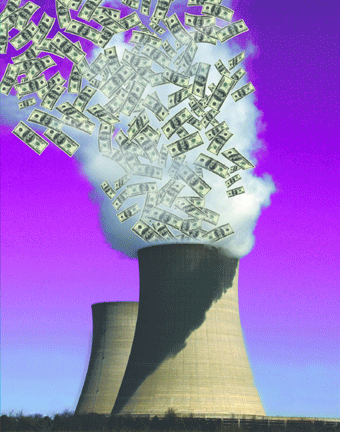
Nuclear too slow to be effective, and will soak up all the UK climate change funds

climate-change-timeNuclear damages attempts to tackle climate change nuClear News Dec 14 
“……….You might say “well climate change is urgent, so why don’t we do nuclear as well as all the other
stuff”. But there is a limited supply of funds and the way the Government has organised thesubsidy schemes at the moment it looks as though nuclear will use up all of those funds.
The Treasury’s so-called Levy Control Framework limits the amount of money which can be
collected from consumers’ bills. This year the pot of money available will be £3.5bn. This will
increase to £6.45bn by 2018/9. But because subsidies to low carbon energy are an ongoing
commitment, £3.55bn of that will go to projects already running and only £2.9bn will be
available to new schemes. The total pot will go up to £7.6bn in 2020/21, an increase of just over
£1bn. We don’t know the exact figure for 2023/24, but we do know that Hinkley will require
around £1bn, so it will probably use up all the money for new projects. (4)
And there isn’t expected to be any more money for new projects until 2027, by which time
Sizewell C could be ready to start gobbling up cash.
Nuclear is too slow
The sooner we make carbon savings the greater the cumulative impact by, say, 2025. Nuclear
takes a long time to build. Hinkley is expected to take about eight years, so there won’t be any
carbon savings until at least 2023. The two other reactors being built in Europe at the moment
are both late – Olkiluoto in Finland is 7 years late and Flamanville in France is 4 years late.
Hinkley might save a million tonnes of carbon per year in eight years time, whereas a re-booted
energy efficiency programme could have already saved 14 million tonnes by then. (5)
Centralised utilities – a dying model
Former Government Chief Scientist, Professor Sir David King who was instrumental in
persuading Tony Blair to ditch the 2003 Energy White Paper and go for new reactors now says
we might be able to do without them if we can develop energy storage. (6)
He’s probably been reading the financial press. The 21st November might go down as the day the
nuclear renaissance finally died in Britain. Look at UK Nuclear News for that day and you will
discover that:
Consumers could be on the hook for £37bn worth of undiscounted subsidies to Hinkley over its
lifetime.
The cost of Hinkley has gone up from £9bn in 2011 to £24.5bn now.
Reactor builder – Areva – which was expected to take a 10% stake in Hinkley is in the midst of a
financial crisis.
The Treasury is re-examining the Hinkley project.No2Nuclear http://www.no2nuclearpower.org.uk/nuclearnews/NuClearNewsNo69.pdf

December 17, 2014 Posted by | climate change, Reference, UK | Leave a comment

Pacific Ocean is still the sewer for the nuclear industry’s wastes

TV: Plutonium being pumped into ocean through miles of underwater pipes — Nuclear waste left lying on beach — Kids playing on sand where machines scoop up plutonium each day — Alarming test results 1,000% legal limit (VIDEO & PHOTOS)http://enenews.com/tv-plutonium-being-pumped-ocean-miles-underwater-pipes-nuclear-waste-left-lying-beach-kids-playing-sand-machines-scoop-plutonium-day-video-photos?utm_source=feedburner&utm_medium=email&utm_campaign=Feed%3A+ENENews+%28Energy+News%29
Pacific-Ocean-drain

SWR (German public television broadcaster), 2013 (emphasis added):

  • 25:00 in — The dumping of nuclear waste in the sea was banned worldwide in 1993, yet the nuclear industry has come up with other ways. They no longer dump the barrels at sea; they build kilometers of underwater pipes through which the radioactive effluent now flows freely into the sea. One of these pipes is situated in Normandy [near] the French reprocessing plant in La Hague… The advantage for the nuclear industry? No more bad press… disposal via waste pipes remains hidden from the public eye, quite literally.
  • 28:30 in — 400 km from La Hague [as well as] Holland [and] Germany… we find iodine… 5-fold higher tritium value than [reported] by the operator Areva. It’s now obvious why citizens take their own measurements.
  • 30:15 in — Molecular Biologist: “The radioactive toxins accumulate in the food chain. This little worm can contain 2,000-3,000 times more radioactivity than its environment. It is then eaten by the next biggest creature and so on, at the end of the food chain we discovered damage to the reproductive cells of crabs… These genetic defects are inherited from one generation to the next… Cells in humans and animals are the same.”
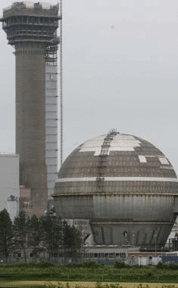
  • 32:00 in — The 2nd disposal pipe for Europe’s nuclear waste is located in the north of England… Radioactive pollution comes in from the sea. Their houses are full of plutonium dust… The pipe from Sellafield is clearly visible only from the air… nuclear waste is still being dumped into the sea. Operators argue this is land-based disposal… It has been approved by the authorities.
  • 35:45 in — Plutonium can be found here on a daily basis, the toxic waste returns from the sea… it leaches out, it dries, and is left lying on the beach. The people here have long since guessed that the danger is greater than those responsible care to admit… Every day a smallexcavator removes plutonium from the beach… In recent decadesthe operator at Sellafield has tossed more than 500 kg of plutonium into the sea.
  • 42:00 in — We take a soil sample… The result turns out to be alarming. The amount of plutonium is up to 10 times higher than the permissible limit.

Yahoo News, Dec 5, 2014: All this radiation from the [Fukushima] disaster has definitely not been isolated to just Japan. Researchers monitoring the Pacific Ocean, in which much of the radiation spilled into, have detected radioactive isotopes this past November just 160 km [100 miles] off the coast of California. So this story will continue to unfold for many years to come.

Watch SWR’s investigative report here

December 8, 2014 Posted by | - plutonium, 2 WORLD, oceans, Reference | Leave a comment

Fast breeder nuclear reactors: Russia the only country with one in commercial operation

RUSSIAN NUCLEAR INDUSTRY OVERVIEW, Earth Life Johannesburg Vladimir Slivyak Russian environmental group, Ecodefense National Research University Higher School of Economics Moscow December 2014

“………..Fast breeders

The nuclear industry started to promote the so-called closed nuclear fuel cycle with fast breeder
reactors some 50 years ago. The idea was to develop a technological cycle that would involve
reprocessing spent nuclear fuel, extracting plutonium from it, and then “breeding” this nuclear
material in commercial reactors in order to provide the nuclear power industry with a virtually
inexhaustible source of fuel while also eliminating the problem of managing the highly toxic
nuclear waste. No country in the world, however, has since been able to introduce a closed fuel
cycle successfully. All breeders that were brought online in Western countries that attempted to
close the nuclear cycle stopped their commercial operation long before their designed lifetime
periods expired, for economic, safety, and technical reasons. As of 2014, Russia remains the only
country with a fast breeder reactor in commercial operation, a BN-600 operating at Beloyarsk
Nuclear Power Plant.

Continue reading

December 8, 2014 Posted by | Reference, reprocessing, Russia | Leave a comment

Troubled story of Russia’s new nuclear reactors plan

RUSSIAN NUCLEAR INDUSTRY OVERVIEW, Earth Life Johannesburg Vladimir Slivyak Russian environmental group, Ecodefense
National Research University Higher School of Economics Moscow December 2014
“…….New reactors
In 2008, the Russian government approved the “General Layout Plan for Siting Power Generation
Facilities for the period until 2020.” It included construction of 13.2 GW in new reactor capacities
within the next five years. By March 2010, this goal had been downscaled to just 5.2 GW. After
auditing the Ministry of Energy in March 2010, the Russian Audit Chamber announced it would
not be possible to achieve the target outlined in the plan. As a result, only about 40% of planned
reactors were expected to come online by 2015.11
In July 2012, Russia’s overall nuclear power development target for 2020 – 44 GW – was again
reduced, to 30.5 GW.12 The new target remains a pie-in-the-sky figure because the Russian
industry is unable to produce more than one reactor per year, according to the industry’s top
officials.
As of today, Rosenergoatom – Rosatom’s reactor-operating branch – lists ten new reactors as under
construction: eight VVER units, one fast breeder that is approaching the 30-year anniversary of
its construction, and a small floating nuclear plant.13
At least two of the VVER projects on this list have seen no progress since mid-2013 – the two units
of a planned Baltic NPP in Kaliningrad Region. A variety of reasons caused the construction to
freeze indefinitely, including the limited market for the future electricity and harsh criticism
by environmental movements on the project’s safety and financing issues. Rosatom sought
funding for this project in European Union countries, in hopes to involve foreign investors and
energy companies in building the plant and exporting its energy to Europe. These negotiations
took three years and proved unsuccessful. Russia’s neighbor and EU member, Lithuania, also
repeatedly criticized Rosatom over the project’s safety and lack of transparency. Environmental
groups from both Russia and Europe successfully campaigned against this project by pushing
European banks and companies to stay away. In 2013, the German Hypovereinsbank and the
French BNP Paribas announced in written form that they would not join the project. Earlier, the Italian energy giant ENEL had stated that it was doing its assessment and looking into the
possibility of investing in the Kaliningrad project. That led to heavy criticism by Russian and
Italian environmental groups in 2011-2012. The company never announced its decision. The
French bank Société Générale was under heavy pressure from Russian and French campaigners
in 2013 over its possible involvement in the Kaliningrad project. Société Générale’s managers
said in the beginning of 2013 that the bank planned to assess the possibility of joining the project
in Kaliningrad by providing the funds for turbine manufacturing by the French firm Alstom. No
decision was announced before the Russian government put the project on hold in June 2013.
Two more VVER-1200 reactors are currently under construction at the Leningrad nuclear plant;
construction started in 2008 and 2010, respectively. The units were slated for grid connection
by 2013 and 2016. Both projects, however, hit delays with grid connection dates pushed back
to 2016 and 2018, partly on account of a major accident that occurred at the construction site on
July 17, 2011. A 600-800-ton reinforcement cage of the containment building fell on its concrete
frame. The weight of the cage caused the concrete frame to crack and the entire structure had to
be replaced, leading to massive additional costs.14
Another two units on Rosenergoatom’s current construction list are so-called “floating reactors”
(Akademik Lomonosov 1, 2), 32 MW each. Rosatom began this project in 2007 with plans to
complete it by 2010. As of 2014, the completion date had been revised to 2019.15 Among the major
concerns with the project are the high risk of accidents, vulnerability to piracy and terrorism
threats, and the increased risk of proliferation of nuclear materials, if the project is taken to serial
production and floating nuclear power plants are deployed on a wide international scale.16
However, two units each at the Novovoronezh plant, Novovoronezh-2 (VVER-1200, under
construction since 2007, delayed for 2-3 years), and Rostov (VVER-1000, under construction
since 1983) are close to completion. Russian media repeatedly reported on corruption and safety
concerns related to the Novovoronezh-2 construction, but there was no investigation of these
claims by Rosatom.17
Another unit that is nearly completed is the fourth unit at Beloyarsk. This is a fast breeder r of the
BN-800 design; construction started back in 1986. So far, the only commercial breeder reactor
in operation in the world is the highly problematic Beloyarsk-3, of the BN-600 design. It was
passing its 30-years-in-operation mark back in 2013 and got its license extended for another 15

December 8, 2014 Posted by | politics, Reference, Russia | Leave a comment

In 1920s fruit fly experiments showed the insidious harm done by ionising radiation

text ionisingMiningawareness, 8 Dec 14 The fruit fly experiments showed that it was dangerous in the 1920s! They were damning enough. It showed that it took multiple generations for the genetic damage to show up, because it was often recessive! But, they knew it was dangerous for people from the advent of x-rays and radium a couple of decades prior. They did human nuclear experiments too. In the 1950s or 60s scientists started worrying about what if radiation impacted intelligence more than fertility so that there was a prolific, dumb population. Is this why no one wonders this anymore? They also worried about radiation damaged DNA of nuclear workers merging into the general population. Why do few wonder anything intelligent anymore? Corrupt academia or damaged DNA, damaged intelligence? Ravens have more sense than the pro-nuclear lobby. Ravens look before they cross the road.

December 6, 2014 Posted by | 2 WORLD, radiation, Reference | Leave a comment

Hanford nuclear site area has dramatically high rate of babies born without brains

New data shows babies missing brains at 2,500% national rate in county by nuclear site — Mother: Officials “shut me down the minute I mentioned Hanford!… WE NEED ANSWERS!” — Experts: No birth defect is more extreme; It’s the most significant impact of radiation on developing embryos (AUDIO) http://enenews.com/79334?utm_source=feedburner&utm_medium=email&utm_campaign=Feed%3A+ENENews+%28Energy+News%29

anencephaly

“Nothing [is] more extreme than anencephaly” –Dr Michael Grodin, Boston U. School of Medicine

‘Fatal Birth Defects Surge’ – Dr. Kathy Lofy, Washington Dept.of Health (emphasis added): Anencephaly is a rare birth defect in which the brain and the skull of the baby do not fully form [and is] not compatible with life… The most well known risk factor… is a deficiency in folic acid… that’s one of the possibilities we’re looking into [note that mothers in the birth defect cluster had much higher rates of folic acid consumption than the control group chosen by officials]…Hanford nuclear facility has been one concern of the community. We worked really closely with our radiation experts… who work closely with… Hanford. There have been no recent releases [note how she rephrases this] — no recent CHANGE in radiation releases. We can’t really determine any pathway by which radiation could affect all the women in the 3-county area [note all 3 counties surround Hanford]… We’re working with the doctors to make sure we’re identifying all the cases… It’s very important to figure out the rates.

Dr. Wladimir Wertelecki, MD, (Chair of Medical Genetics at U. of S. Alabama), Dr. Helen Caldicott’s Crisis Without End, Oct 2014: “The most significant negative impact of radiation on a developing embryo includes anencephaly… Two US studies… sponsored by the[CDC and published in 1988] sought to determine the… impact of ionizing radiation nearHanford… One study detected higher neural tube defect rates [e.g. Anencephaly, Spina Bifida] in two counties near the nuclear complex and the other demonstrated higher rates of neural tube defects in parents exposed… to low levels of radiation.”

Physicians for Social Responsibility: Hanford documents [reveal] incredible contamination of the environment and exposure of large numbers of citizens to dangerous amountsEight plutonium production reactors dumped a daily average of 50,000 curies of radioactive material into the Columbia... [In 1949] 8,000 curies of iodine-131 were [secretly] released [over] an area o 200 by 40 miles, no warnings were given…  [`400 times TMI’s release of] 15 -24 curies — PSR: Contamination has not and will not stay inside Hanford’s boundaries… Over 300 miles of the Columbia… are threatened… [Fires in] 2000… burned three radioactive waste sites [and] plutonium was detected in nearby communities. — PSRHanford is the most contaminated site in the Western Hemisphere… At least 200-square miles of groundwater… is contaminated and migrating to the Columbia.

Nuclear engineer Arnie Gundersen on Nuclear Hotseat, Nov. 12, 2014 (at 34:00 in): Birth defect issues occur in the 2nd [generation after radiation exposure]  — especially the 3rd and 4th.

Washington Anencephaly Investigation, Oct 2014:

CDC 2010 statistics, released 2013: Anencephaly 313 cases; RATE0.73 per 10,000 births.

Instead of using the 0.73 rate, officials claim the national rate is 2.1, nearly 3 times  higher. The rate of 2.1 is from a study using data from 2004-2006 that estimates the anencephaly rate, andonly uses data from less than 15 states — unlike the CDC report above which is based on the most current data, uses data from all 50 states, and is not an ‘estimate’.

Nikki Shelton, mother of baby w/ neural tube defect (e.g. Anencephaly, Spina Bifida) 13 mi. from Hanford, Nov 6, 2014: This is not something that is going away… the numbers are increasing. The last teleconference I was in shut me down the minute I mentioned Hanford! … let’s not let the department of health just sweep this under the rug…WE NEED ANSWERS!

Interview with Gundersen here | KUOW broadcast here

December 3, 2014 Posted by | children, health, Reference, USA | 2 Comments

“Radioactive Berkeley: No Safe Dose

radiation-warningfrom Kay, 2 Dec 14 The video of Dr. Gofman is excellent. https://www.youtube.com/watch?v=xddNmNR0hG4 Someone at ENENEWS transcribed some of what Dr. Gofman had to say, and his words are so important that I think it’s important to post it here, too, for safekeeping. (It’s a little long, sorry)

Dr. John Gofman:

“What’s the order of magnitude of the problem that’s been created by radiation in the 20th century? Today manmade activities added up in total exceed the dose from natural radiation.”

“Every increment that we add to that natural radiation will exact its price in human health, and human health with respect to some very miserable diseases such as the genetic disorders and heart disease and cancer.”

“50% of all cancers in the 20th century have been caused by ionizing radiation of the type we would call low-level.”

“Recently I wrote a book on the subject of breast cancer and stated that my best estimate backed up by considerable evidence is that about ¾ of all the breast cancers of the 20th century were induced by ionizing radiation of one sort or another, including medical. This is not a small problem and we there therefore need to give attention to every source of low-level radiation exposure to the public.”

“In the early days of the post-war period when radioactivity became available in large quantities as the result of the existence of nuclear reactors, many of the people working in the field said, ‘Well, what dose can we allow people to have which will be safe?’

“I wrestled with that question for over 20 years, and in 1986 on a talk about Chernobyl, I presented to the American Chemical Society, my initial calculations which said:

There cannot be a safe dose, because at the lowest possible dose, which is one radiation track through the cell, I have proved that cancer is the result.”

–> Regarding Tritium:

“Many people thinking about Tritium say ‘oh we don’t have to worry about tritium; the energy of the radiation is so low that we don’t even need to think about it.’ But that is a cardinal error! It is true that the energy of each beta particle emitted by tritium is very low, BUT there’s another problem. When you have a very low energy beta particle interact with biological tissue to produce the damage to genes, the damage to chromosomes, and the risk of future cancers, the lower the energy of the radiation, the WORSE it is in terms of biological hazards. Tritium is FIVE TIMES as hazardous as bomb radiation for the same total amount of energy delivered. And that’s a general law, a rule of physics. I don’t think any person who is reasonable at all can doubt that I have demonstrated THERE IS NO SAFE DOSE because I have shown with a multitude of studies that we get cancers down at the lowest doses. Now that’s been resisted… but the United Nations scientific community in 1993 has come out and joined me in exactly the same kind of analysis. Their conclusion: THERE IS NO SAFE DOSE.”

“Children are most sensitive with respect to the generation of cancer and leukemia from radiation. The study of breast cancer in Hiroshima with radiation from the bomb has shown that children under 20, women under 20, are the most sensitive; that from 20 to 40, they are less sensitive to the breast cancer generation, and beyond 40 even less sensitive. That’s not theory. That’s not speculation. That’s a fact. And the sensitivity of the young being greater means we should exercise every precaution that we protect our children from sources of radiation no matter how small.”

December 2, 2014 Posted by | radiation, Reference | Leave a comment

Sound reasons for co-operation and a nuclear deal with Iran

highly-recommendeddiplomacy-not-bombs7 reasons not to worry about Iran’s enrichment capacity, ALMONITOR  5 Nov 14 Iran and the five permanent members of the UN Security Council plus Germany are aiming to end the standoff over Iran’s nuclear program by Nov. 24. Iranian and US officials have confirmed that progress was made in the extremely complicated nuclear talks in mid-October in Vienna. …………The following are seven reasons not to be too overly concerned about Iran’s breakout capability:
  1. Under the current International Atomic Energy Agency (IAEA) rules and regulations, the maximum level of transparency for nuclear activities would be secured by the implementation of its three arrangements: the Safeguard Agreement, Subsidiary Arrangement Code 3.1 and the Additional Protocol. The world powers negotiating with Iran have a clear understanding that Iran is ready to commit to all three arrangements in a final comprehensive agreement.
  2. Iran would be cooperative in capping its level of enrichment at 5% for the duration of the final agreement to assure non-diversion toward weaponization. The fissile uranium in nuclear weapons contains enrichment to 85% or more.
  3. To ensure that Iran’s enrichment activities do not lead to a bomb, Tehran would be willing to synchronize the number of centrifuges or their productivity to its practical needs and convert the product to oxide for a number of years. Iran’s major practical need is to provide fuel for the Bushehr plant in 2021, when its fuel-supply contract with Russia terminates. Practically, out of the current 22,000 centrifuges, Iran would need around 9,000 to 10,000 to provide enough fuel annually for the four fuel elements (out of a total 54 fuel elements) for Bushehr that Russia is contractually required to supply.
  4. Regarding the heavy water facility at Arak, Iran would be cooperative in placing greater monitoring measures and modifying the reactor to reduce the annual enriched plutonium production capacity of 8-10 kilograms (18-22 pounds) to less than 0.8 kilograms (1.7 pounds). Furthermore, the 0.8kg of material will be 78% fissile, which is too low for the production of nuclear weapons, and the timeline for redesigning and building the reactor will require another five to six years.
  5. Secularizing the supreme leader’s fatwa banning the production and stockpiling of nuclear and all other weapons of mass destruction would be a strong objective guarantee. Once the fatwa is secularized and operationalized, violation would be a criminal matter for the courts to pursue and punishable by law. Iran’s history makes it hard to dismiss the fatwa. After all, despite an estimated 100,000 deaths from Iraqi use of chemical weapons against Iran, it was a fatwa issued by the late Ayatollah Ruhollah Khomeini that kept Tehran from retaliating during the Iran-Iraq war.
  6. Iran has paid a high price for its nuclear program, having endured a barrage of draconian multilateral and unilateral sanctions to date. The sanctions imposed against Iran are far beyond those imposed on North Korea, which does possess nuclear weapons. The fact is that Iran has already paid the price for making a bomb, but neither wants nor has one, a clear indicator of its steadfastness on nonproliferation and the peaceful use of nuclear technology.
  7. If anyone were going to have made the decision to build nuclear weapons, it would have been former President Mahmoud Ahmadinejad. Yet, during his eight years in the presidency, the IAEA found no evidence of an Iranian nuclear program geared toward weaponization, and his administration sought to normalize bilateral relations with the United States more than all his predecessors.

I am confident that Iran, the United States and the world powers genuinely seek to reach a deal and that there is no reason to extend the deadline beyond late November. The best strategy is to pursue a broad engagement with Iran to ensure that the decision to pursue a nuclear breakout will never come about. Iran and the United States are already tacitly and indirectly cooperating in the fight against the Islamic State (IS). A nuclear agreement would be a great boost to mutual trust and provide greater options for dealing not only with IS and the Syrian regime but also Afghanistan and Iraq — where both Washington and Tehran support the new governments in Kabul and Baghdad. Rather than focusing onenrichment capacity, Washington should weigh its capacity for relations with Iran.  http://www.al-monitor.com/pulse/originals/2014/11/iran-nuclear-enrichment-uranium-iaea-fatwa-sanctions.html?utm_source=Al-Monitor+Newsletter+%5BEnglish%5D&utm_campaign=a39e197e64-November_5_2014&utm_medium=email&utm_term=0_28264b27a0-a39e197e64-93115393##ixzz3IKFLTdR3

November 6, 2014 Posted by | Iran, politics international, Reference, Uranium | Leave a comment

Climate change is slowing the recovery of the hole in the ozone layer

Ozone-depleting chemical hydrogen chloride found to be on the rise http://www.smh.com.au/environment/ozonedepleting-chemical-hydrogen-chloride-found-to-be-on-the-rise-20141105-11h1hl.html November 6, 2014  Environment Editor, The Sydney Morning Herald  Atmospheric levels of a key ozone-depleting chemical are on the increase but the rise appears to be a symptom of climate change rather than additional sources of the destructive substance, according to international researchers including three from the University of Wollongong.

Investigations were prompted when scientists identified levels of hydrogen chloride had began rising in 2007 – but only in the northern hemisphere – when they should have been falling because of curbs agreed under the Montreal Protocol to protect the ozone layer.

Hydrogen chloride releases chlorine in the stratosphere, depleting ozone and allowing more ultraviolet radiation to reach the Earth, increasing skin cancer and damaging crops and other species.

Findings based on that satellite observations and model simulations and published in Nature on Thursday rule out any “rogue” source of emissions from undisclosed sources because the abundance of the chemical is falling at other layers of the atmosphere and in the southern hemisphere.

“The overall burden of chlorine is still decreasing,” said David Griffith, director of the University of Wollongong’s Centre for Atmospheric Chemistry, and a co-author of the report. “It’s a good news story about ozone.”

It’s not so positive news on the climate change front, however, since the increased abundance of chlorine in the northern hemisphere’s stratosphere is attributed to a slowdown in atmospheric circulation leading to slower mixing at some levels.

Climate change, through increased greenhouse gas emissions, “is changing the way radiation is absorbed in the atmosphere and distributed, which would drive things such as this circulation,” Professor Griffith said.

Although it was beyond the scope of the paper to examine how long the circulation slowdown will last, or other possible consequences, Professor Griffith said the study showed the recovery of the ozone layer wouldbe a slow process, taking decades.

“Our results show that atmospheric variability and perhaps climate change can significantly modify the path towards full recovery,” he said. “It will be a bumpy ride rather than a smooth evolution.”

Professor Griffith said the work also underscored the general success in tackling ozone depletion and a range of chemicals that were phased out in a matter of years in contract to dealing with global warming. For ozone, it was a “problem created by man, problem recognised, solution proposed, solution implemented,” he said. “For climate change, the culprits have been recognised but no-one’s prepared to stop producing [carbon dioxide].”

November 6, 2014 Posted by | 2 WORLD, climate change, Reference | Leave a comment

Nuclear fusion requires more energy to set up, than the amount obtained from it

Why We Will Never Make A Nuclear Fusion Reactor As Good As The Sun, Business Insider,  JESSICA ORWIG OCT 17 2014 “…………..combine four hydrogen atoms and you get a burst of energy that can destroy entire islands and did on Nov. 1, 1952. That day the US tested the first hydrogen bomb on the now-nonexistent Pacific island, Elugelab.……… Clean, limitless energy is the real holy grail. Combine that desire with the awesome power we first saw with the< H-bomb, and we’ve been dreaming of a way to harness nuclear fusion of the sun as a source of clean, endless energy.

But so far, only Hollywood has managed…….. The amount of energy we need to produce the conditions for nuclear fusion is more than the energy we get out. And we’ve been coming up short for decades with little signs of improvement, according to Charles Seife,author of the book “Sun in a Bottle: The Strange History of Fusion and the Science of Wishful Thinking“who has written about the turtle-paced race for nuclear fusion for Slate.
Unfortunately for us, it is incredibly difficult to fuse hydrogen atoms together. It takes extreme pressure and heat, something that the sun’s strong gravitational force does naturally in its core. But we don’t have access to this kind of gravity here on our comparatively tiny Earth, and the only way to manufacture it is to expend a ton of energy to create it.
nuclear-fusion-pie-Sm

For about the last 70 years, we’ve slowly developed ways of producing the extreme pressure and heat necessary for nuclear fusion. Today, the most promising methods use containment vessels called tokamaks that can sustain hot plasmas that produce nuclear fusion but require lots of energy and space to function. The other way is using powerful lasers to fuse hydrogen atoms together.

Both of these methods, however, still have a long way to go despite what you might read from the occasional headlines on the latest breakthroughs in new nuclear fusion technology………http://www.businessinsider.com.au/we-will-never-have-sun-like-nuclear-fusion-2014-10

October 21, 2014 Posted by | 2 WORLD, Reference, technology | Leave a comment

“Genocide” by birth defects, cancers, in Iraq, due to depleted uranium weapons

Fallujah-babyIraqi Doctors Call Depleted Uranium Use “Genocide” TruthOut  14 October 2014 By Dahr Jamail,  | Report Contamination from depleted uranium (DU) munitions is causing sharp rises in congenital birth defects, cancer cases and other illnesses throughout much of Iraq, according to numerous Iraqi doctors.

Iraqi doctors and prominent scientists believe that DU contamination is also connected to the emergence of diseases that were not previously seen in Iraq, such as new illnesses in the kidney, lungs and liver, as well as total immune system collapse. DU contamination may also be connected to the steep rise in leukaemia, renal and anaemia cases, especially among children, being reported throughout many Iraqi governorates.

There has also been a dramatic jump in miscarriages and premature births among Iraqi women, particularly in areas where heavy US military operations occurred, such as Fallujah during 2004, and Basra during the 1991 US war on Iraq.

It is estimated that the United States used 350 tons of DU munitions in Iraq during the 1991 war, and 1,200 tons during its 2003 invasion and subsequent occupation. Official Iraqi government statistics show that, prior to the outbreak of the first Gulf War in 1991, the country’s rate of cancer cases was 40 out of 100,000 people. By 1995, it had increased to 800 out of 100,000 people, and, by 2005, it had doubled to at least 1,600 out of 100,000 people. Current estimates show the trend continuing.

The actual rate of cancer and other diseases is likely to be much higher than even these figures suggest, due to a lack of adequate documentation, research and reporting of cases. Continue reading

October 15, 2014 Posted by | children, depleted uranium, Iraq, Reference | Leave a comment

Nuclear power defeats democracy – Book on UK “The Prostitute State “

highly-recommendedflag-UKNuclear power trumps democracy  http://www.theecologist.org/blogs_and_comments/commentators/2587477/nuclear_power_trumps_democracy.html Donnachadh McCarthy 9th October 2014 

The UK’s political mainstream has performed a complete U-Turn in policy on nuclear power, culminating yesterday in the European Commission’s approval of a £15-20 billion subsidy package for the Hinckley C project. Donnachadh McCarthy delves into the nuclear industry’s deep and far-reaching political links.

Why is our democracy failing to tackle the horrific urgency of the climate crisis and the decimation of our eco-systems?

And why are all the main political parties betting the farm on nuclear power in spite of its madhouse economics – and against all their promises to either oppose nuclear power altogether, or to refuse subsidies for it?

Book-The-Prostitue-StateIn my new book, The Prostitute State – How Britain’s Democracy Has Been Bought, I set out my view that there is a single problem at the root of our nation’s difficulties.

A corporate elite have hijacked the pillars of Britain’s democracy. The production of thought, the dissemination of thought, the implementation of thought and the wealth arising from those thoughts, are now controlled by a tiny, staggeringly rich elite.

As a result the UK is no longer a functioning democracy but has become a  ‘Prostitute State’ built on four pillars: a corrupted political system, a prostituted media, a perverted academia and a thieving tax-haven system.

This has disastrously resulted in a flood of wealth from the poor and middle classes to the top 1%. This stolen wealth is built on the destruction of the planet’s ecosystems, which are essential for humanity’s survival.

Nuclear power defeats democracy

The reversal of government policy on nuclear power is a classic example of how the Prostitute State trumps democracy. Betrayed environmental activists must understand that – notwithstanding the noble form of democratic structures – what they are really up against is a corrupt corporate state.

The concept of lobbying is reasonably well known, but few of us understand how far lobbying has penetrated and hijacked the political parties themselves.

For example, most people are perplexed at how the nuclear industry managed to persuade the UK’s previous Labour government to build a fleet of hugely expensive experimental nuclear power stations on land prone to flooding from rising sea levels.

They also struggle to comprehend and why Labour’s shadow energy and climate change minister, Caroline Flint MP, having stated that she would only support nuclear power if built without public subsidies, now supports the £15-20 billion subsidy package for Hinkley C nuclear power station

Labour managed managed this policy U-Turn despite the Three Mile Island, Chernobyl and Fukushima nuclear catastrophes; the failure to find safe waste-disposal sites capable of protecting radioactive waste for over 100,000 years; and insurance companies’ point blank refusal to provide nuclear accident insurance.

It’s the money, stupid

My simple answer is that the nuclear industry has poured millions of pounds year after year into a massive political lobbying campaign.

They bought a whole swathe of senior ex-politicians to work as nuclear lobbyists, spent a fortune on trying to manipulate public opinion through media and advertising, and even funded school trips to their nuclear plants.

As they managed to persuade a Labour government to abandon their 1997 election manifesto commitment to oppose new nuclear power stations, it is crucial to understand how deeply the nuclear lobby is embedded in the Labour party.

My personal belief is that a complex web of financial interests ensured that the Labour government served the nuclear industry – no matter what Labour party members or the British public wanted.

Just consider for example the following list of Labour Party politicians: Continue reading

October 10, 2014 Posted by | politics, Reference, resources - print, UK | 4 Comments

Nuclear scientists raise problems with proposed Liquid Fluoride Thorium Reactors (LFTRs)

Thorium-dreamThorium Cycle questions and problems http://daryanenergyblog.wordpress.com/ca/part-8-msr-lftr/8-3-thorium-lftr/Questions have also been raised by some nuclear scientists about the Thorium cycle, in particular the proposed one that the LFTR would use. I’m not a nuclear physicist so I’ll merely forward you on to the relevant paper here, and a rebuttal here. The crux of the argument seems to be the proliferation risk (I’ll come back to that one later), the fact that a number of its spend fuel outputs (such as Technetium-99) are “nasty stuff” with a long half life and the fact we’ll still need supplies of Uranium to get Thorium reactors going again whenever we have to turn it off (which will happen at least once a year or so during its annual maintenance shutdown). They also highlight a number of technical issues, which I discussed in the chapter on HTGR’s.

Certainly the fission products from a Thorium reactor are a worry, Technetium-99 has a half life of 220,000 years, uranium-232 produces thallium-208 (a nasty wee gamma emitter), Selenium-79 (another gamma emitter with a 327,000 year half-life), evenThorium-232 is a problem with its half life of 14 Billion years (and while the T-232 isn’t a major worry, all the time during this 14 Billion years it will be decaying and producing stuff that is!).

The UK based NNL (National Nuclear Laboratories) also pour cold water on the idea of Thorium fuelled reactors (see here). While the report is low on detail (they seem to be saying “trust us we’re scientists who work with nuke stuff… and we smoke pipes!”) they do highlight the major time delays it would take to establish and get working a Thorium fuel cycle (10-15 years with existing reactors, 30 with more advanced options), point out that under present market conditions its unlikely to be economically viable and will (as the points above raise) offer only a modest reduction in nuclear wastes.

MIT recently undertook a study of future nuclear fuel supplies. The Thorium cycle barely gets a mention, and even then its usually in relation to Fast Reactor programs (of which the US currently has none) and modifed LWR systems, rather than the MSR.

Obviously, once we exhaust the world’s U-235 stockpiles, LFTR’s and any other Thorium fuelled reactors will cease to function. Indeed long before then the spike in Uranium prices will have rendered MSR’s (and all other nuclear plants) uneconomically viable (of course there’s plenty who’d say that’s already the case!). The LFTR fans usually groan at this point and state that “all we need is a little plutonium”. Now while I’m quite sure that in the fantasy world which the LFTR fans inhabit Plutonium is available in any good hardware store but back in the real world, it’s a little harder to come by! As with the HTGR’s using Thorium (if its possible) would certainly help stretch things out….a bit! But not by nearly as much as the supporters of Thorium reactors would have you believe.

October 10, 2014 Posted by | Reference | Leave a comment

International Atomic Energy Agency defined six types of nuclear wastes

Nuclear waste is going nowhere slowly  03 OCT 2014 ANSIE VICENTESARAH WILD  Generations from now, there will still be no-go areas storing radioactive by-products of nuclear power production. ……….

wastes-1Six ways to neutralise nuclear excess

The International Atomic Energy Agency’s guidelines published in 2009 define six different types of nuclear waste, each with its own suggested disposal method, determined by how dangerous the waste is to humans and the environment, how much heat it generates, and its reaction to water and temperature.

  • Exempt waste” does not require any protection and is simply disposed of like other rubbish;
  • “Very low-level waste”, typically soil and rubble with low levels of radioactivity, is disposed of in landfills;
  • “Very short-lived waste” is first shielded and then stored, usually in a purpose-built building, to decay by itself over a few years;
  • “Low-level waste” needs a few hundred years to be considered safe and is buried near the surface once it has been encased in concrete or metal and shielded;
  • “Intermediate-level waste” needs time but no heat protection, and consists mainly of the cladding and resins used in nuclear plants, and contaminated materials that come from decommissioned nuclear reactors. It is generally covered in concrete or bitumen and buried in the region of 10 to hundreds of metres underground; and
  • “High-level waste”, such as spent fuel rods, remains radioactive for tens of thousands of years and generates its own heat. It can be stored on site, as it is at Koeberg or Pelindaba. The United States and Russia vitrify the waste (mix it with glass particles), clad it in concrete, shield it with lead or water and bury it, sometimes kilometres underground, in a process called “deep geological disposal”. – Ansie Vicente http://mg.co.za/article/2014-10-02-nuclear-waste-is-going-nowhere-slowly/

October 6, 2014 Posted by | 2 WORLD, Reference, wastes | 1 Comment

No market for Small Modular Nuclear Reactors (SMRs)

‘New’ reactor types are all nuclear pie in the sky Ecologist Dr Jim Green 2nd October 2014 “………. In any case, Integral Fast Nuclear Reactors (IFRs) are yesterday’s news.  Now it’s all about Small Modular Reactors (SMRs). The Energy Green Paper recently released by the Australian government is typical of the small-is-beautiful rhetoric:

“The main development in technology since 2006 has been further work on Small Modular Reactors (SMRs). SMRs have the potential to be flexibly deployed, as they are a simpler ‘plug-in’ technology that does not require the same level of operating skills and access to water as traditional, large reactors.”

The rhetoric doesn’t match reality. Interest in SMRs is on the wane. Thus Thomas W. Overton, associate editor of POWER magazine, wrote in a recent article:

text-SMRs“At the graveyard wherein resides the “nuclear renaissance” of the 2000s, a new occupant appears to be moving in: the small modular reactor (SMR). … Over the past year, the SMR industry has been bumping up against an uncomfortable and not-entirely-unpredictable problem: It appears that no one actually wants to buy one.”

Overton notes that in 2013, MidAmerican Energy scuttled plans to build an SMR-based plant in Iowa. This year, Babcock & Wilcox scaled back much of its SMR program and sacked 100 workers in its SMR division. Westinghouse has abandoned its SMR program. As he explains:

“The problem has really been lurking in the idea behind SMRs all along. The reason conventional nuclear plants are built so large is the economies of scale: Big plants can produce power less expensively per kilowatt-hour than smaller ones.

“The SMR concept disdains those economies of scale in favor of others: large-scale standardized manufacturing that will churn out dozens, if not hundreds, of identical plants, each of which would ultimately produce cheaper kilowatt-hours than large one-off designs.

“It’s an attractive idea. But it’s also one that depends on someone building that massive supply chain, since none of it currently exists. … That money would presumably come from customer orders – if there were any. Unfortunately, the SMR “market” doesn’t exist in a vacuum.

“SMRs must compete with cheap natural gas, renewables that continue to decline in cost, and storage options that are rapidly becoming competitive. Worse, those options are available for delivery now, not at the end of a long, uncertain process that still lacks [US Nuclear Regulatory Commission] approval.”

Can’t find customers, can’t find investors

Dr Mark Cooper, Senior Fellow for Economic Analysis at the Institute for Energy and the Environment, Vermont Law School, notes that two US corporations are pulling out of SMR development because they cannot find customers (Westinghouse) or major investors (Babcock and Wilcox). Cooper points to some economic constraints:

“SMR technology will suffer disproportionately from material cost increases because they use more material per MW of capacity. Higher costs will result from: lost economies of scale; higher operating costs; and higher decommissioning costs. Cost estimates that assume quick design approval and deployment are certain to prove to be wildly optimistic.”

Academics M.V. Ramana and Zia Mian state in their detailed analysis of SMRs:“Proponents of the development and large scale deployment of small modular reactors suggest that this approach to nuclear power technology and fuel cycles can resolve the four key problems facing nuclear power today: costs, safety, waste, and proliferation.

“Nuclear developers and vendors seek to encode as many if not all of these priorities into the designs of their specific nuclear reactor. The technical reality, however, is that each of these priorities can drive the requirements on the reactor design in different, sometimes opposing, directions.

“Of the different major SMR designs under development, it seems none meets all four of these challenges simultaneously. In most, if not all designs, it is likely that addressing one of the four problems will involve choices that make one or more of the other problems worse.”

The future is in … decommissioning

Likewise, Kennette Benedict, Executive Director of the Bulletin of the Atomic Scientists,states“Without a clear-cut case for their advantages, it seems that small nuclear modular reactors are a solution looking for a problem.

“Of course in the world of digital innovation, this kind of upside-down relationship between solution and problem is pretty normal. Smart phones, Twitter, and high-definition television all began as solutions looking for problems.

“In the realm of nuclear technology, however, the enormous expense required to launch a new model as well as the built-in dangers of nuclear fission require a more straightforward relationship between problem and solution.

“Small modular nuclear reactors may be attractive, but they will not, in themselves, offer satisfactory solutions to the most pressing problems of nuclear energy: high cost, safety, and weapons proliferation.”

And as Westinghouse CEO Danny Roderick said in January: “The problem I have with SMRs is not the technology, it’s not the deployment – it’s that there’s no customers.”

Instead of going for SMRs, IFRs, Pebble Bed Reactors or thorium technologies, Westinghouse is looking to triple the one area where it really does have customers: its decommissioning business. “We see this as a $1 billion-per-year business for us”, Roderick said.

With the world’s fleet of mostly middle-aged reactors inexorably becoming a fleet of mostly ageing, decrepit reactors, Westinghouse is getting ahead of the game.

The writing is on the wall

Some SMR R&D work continues but it all seems to be leading to the conclusions mentioned above. Argentina is ahead of the rest, with construction underway on a 27 MWe reactor – but the cost equates to an astronomical US$15.2 billion per 1,000 MWe. Argentina’s expertise with reactor technology stems from its covert weapons program from the 1960s to the early 1980s…………. http://www.theecologist.org/News/news_analysis/2577637/new_reactor_types_are_all_nuclear_pie_in_the_sky.html

October 3, 2014 Posted by | 2 WORLD, Reference, technology | Leave a comment