Canada’s federal budget -calls nuclear energy “clean” – the height of absurdity!

Nuclear energy never will be ‘clean,’ write Jones and Edwards.
THE HILL TIMES | MONDAY, MAY 6, 2024
The 2024 federal budget contains many references to nuclear energy as
a “clean” source of electricity. In our view, referring to
nuclear electricity as “clean” is the height of absurdity.
The nuclear fuel chain begins with the mining of uranium from rock
underground where, without human intervention, it would remain safely
locked away from the biosphere. Uranium has many natural radioactive
byproducts, including radium, radon, and polonium-210 that are
discarded in voluminous sandlike “tailings” at uranium mine sites.
These materials are responsible for countless thousands of deaths in
North America alone. Canada has accumulated 220 million tonnes of
these indestructible radioactive mining wastes, easily dispersed by
wind and rain over the next 100,000 years.
Inside a nuclear reactor, uranium atoms are split to produce energy.
The atomic fragments are hundreds of newly created radioactive
poisons, most of them never found in nature before 1940. They make
used fuel millions of times more radioactive than the original
uranium. One used fuel bundle, freshly discharged, will deliver a
lethal dose of radiation in seconds to any unshielded human nearby.
There are hundreds of thousands of tonnes of waste irradiated fuel
bundles worldwide and the quantity grows larger each year. There is no
operating repository anywhere in the world for such wastes, but there
are several failed repositories.
Radioactive waste has the “reverse midas touch” turning everything
it touches into more radioactive waste. This includes the nuclear
vessel in which the waste is created, and everything that comes in
contact with the cooling water needed to prevent the waste from
melting down. Containers for radioactive waste become radioactive
waste themselves. All radioactive waste must be kept out of our food,
air and drinking water for countless millennia.
Radioactive atoms are unstable. They disintegrate, throwing off a kind
of subatomic shrapnel called “atomic radiation.” Emissions from
disintegrating atoms damage living cells. Chronic radiation exposure
can cause miscarriages, birth defects, and a host of degenerative
diseases including cancers of all kinds. Genetic damage to eggs or
sperm can transmit defective genes to successive generations.
Plutonium is one of the hundreds of radioactive byproducts created in
used nuclear fuel. It is of special concern because it is the primary
nuclear explosive in nuclear arsenals worldwide. “Reprocessing” of
nuclear fuel waste to extract plutonium is sometimes called
“recycling” but this is disinformation; the resulting waste is
more difficult to manage than the original fuel waste. Many serious
accidents have occurred around the world at reprocessing plants.
Places where extensive reprocessing has occurred are among the most
radioactively contaminated sites on Earth. Plutonium can be used as a
nuclear fuel, but extracting it is a nuclear weapons proliferation
risk.
Managing radioactive waste is difficult and very expensive. The
projected multi-billion-dollar cleanup cost for the legacy waste at
Chalk River, Ont., is the federal government’s biggest environmental
liability by far, exceeding the sum total of all other federal
environmental liabilities across Canada.
The multinational consortium running Canada’s federal nuclear
laboratories is receiving close to $1.5-billion annually, much of it
for managing legacy radioactive wastes. The consortium’s plans
include piling up one million tonnes of waste in a giant mound beside
the Ottawa River and entombing old reactors in concrete and grout
beside major drinking water sources. Many are of the view that the
plans fail to meet the fundamental requirement to isolate waste from
the biosphere and have been met with widespread concern, opposition
and legal challenges. Nuclear energy is not now, never has been, and
never will be “clean.”
The sooner our elected officials come to terms with this fact, the
better for Canada and Canadians. Honesty is the best policy.
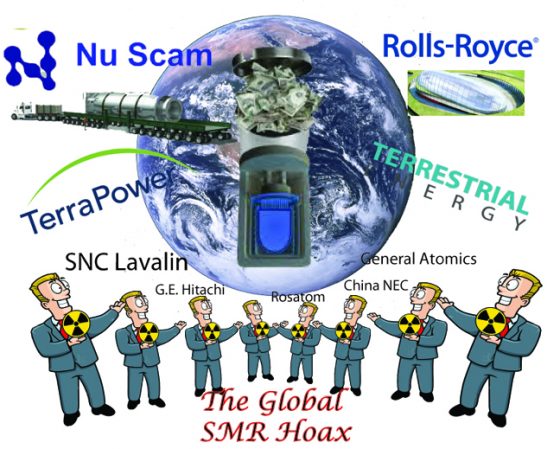
Five Things the “Nuclear Bros” Don’t Want You to Know About Small Modular Reactors
1. SMRs are not more economical than large reactors.
2. SMRs are not generally safer or more secure than large light-water reactors.
3. SMRs will not reduce the problem of what to do with radioactive waste.
4. SMRs cannot be counted on to provide reliable and resilient off-the-grid power for facilities, such as data centers, bitcoin mining, hydrogen or petrochemical production.
5. SMRs do not use fuel more efficiently than large reactors.
Ed Lyman, April 30, 2024 https://blog.ucsusa.org/edwin-lyman/five-things-the-nuclear-bros-dont-want-you-to-know-about-small-modular-reactors/
Even casual followers of energy and climate issues have probably heard about the alleged wonders of small modular nuclear reactors (SMRs). This is due in no small part to the “nuclear bros”: an active and seemingly tireless group of nuclear power advocates who dominate social media discussions on energy by promoting SMRs and other “advanced” nuclear technologies as the only real solution for the climate crisis. But as I showed in my 2013 and 2021 reports, the hype surrounding SMRs is way overblown, and my conclusions remain valid today.
Unfortunately, much of this SMR happy talk is rooted in misinformation, which always brings me back to the same question: If the nuclear bros have such a great SMR story to tell, why do they have to exaggerate so much?
What are SMRs?
SMRs are nuclear reactors that are “small” (defined as 300 megawatts of electrical power or less), can be largely assembled in a centralized facility, and would be installed in a modular fashion at power generation sites. Some proposed SMRs are so tiny (20 megawatts or less) that they are called “micro” reactors. SMRs are distinct from today’s conventional nuclear plants, which are typically around 1,000 megawatts and were largely custom-built. Some SMR designs, such as NuScale, are modified versions of operating water-cooled reactors, while others are radically different designs that use coolants other than water, such as liquid sodium, helium gas, or even molten salts.
To date, however, theoretical interest in SMRs has not translated into many actual reactor orders. The only SMR currently under construction is in China. And in the United States, only one company—TerraPower, founded by Microsoft’s Bill Gates—has applied to the Nuclear Regulatory Commission (NRC) for a permit to build a power reactor (but at 345 megawatts, it technically isn’t even an SMR).
The nuclear industry has pinned its hopes on SMRs primarily because some recent large reactor projects, including Vogtle units 3 and 4 in the state of Georgia, have taken far longer to build and cost far more than originally projected. The failure of these projects to come in on time and under budget undermines arguments that modern nuclear power plants can overcome the problems that have plagued the nuclear industry in the past.
Developers in the industry and the US Department of Energy say that SMRs can be less costly and quicker to build than large reactors and that their modular nature makes it easier to balance power supply and demand. They also argue that reactors in a variety of sizes would be useful for a range of applications beyond grid-scale electrical power, including providing process heat to industrial plants and power to data centers, cryptocurrency mining operations, petrochemical production, and even electrical vehicle charging stations.
Here are five facts about SMRs that the nuclear industry and the “nuclear bros” who push its message don’t want you, the public, to know.
Continue readingWill this whistleblower be heard by anyone?
Date: June 28, 2023, Author: dunrenard, https://dunrenard.wordpress.com/2023/06/28/will-this-whistleblower-be-heard-by-anyone/

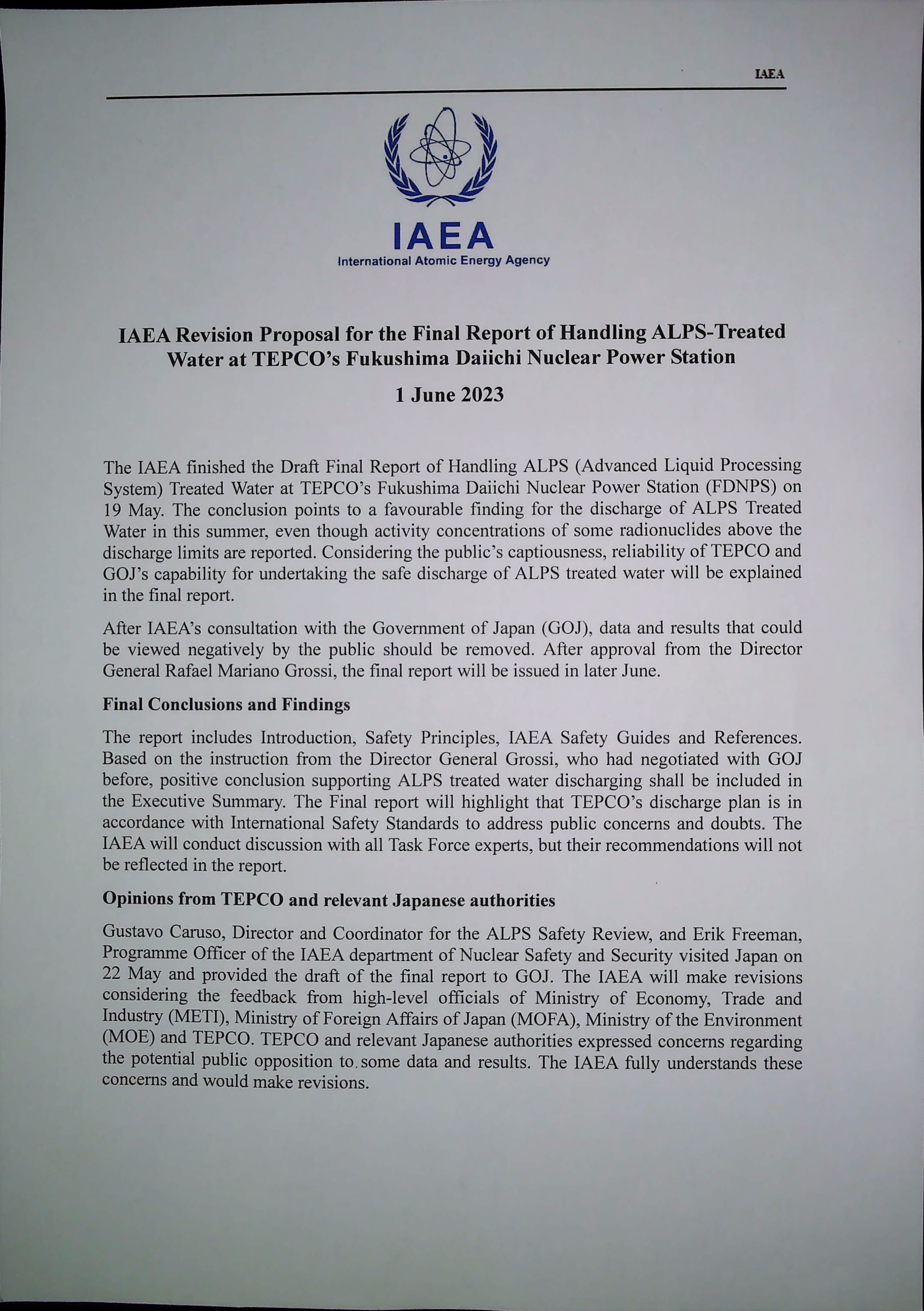
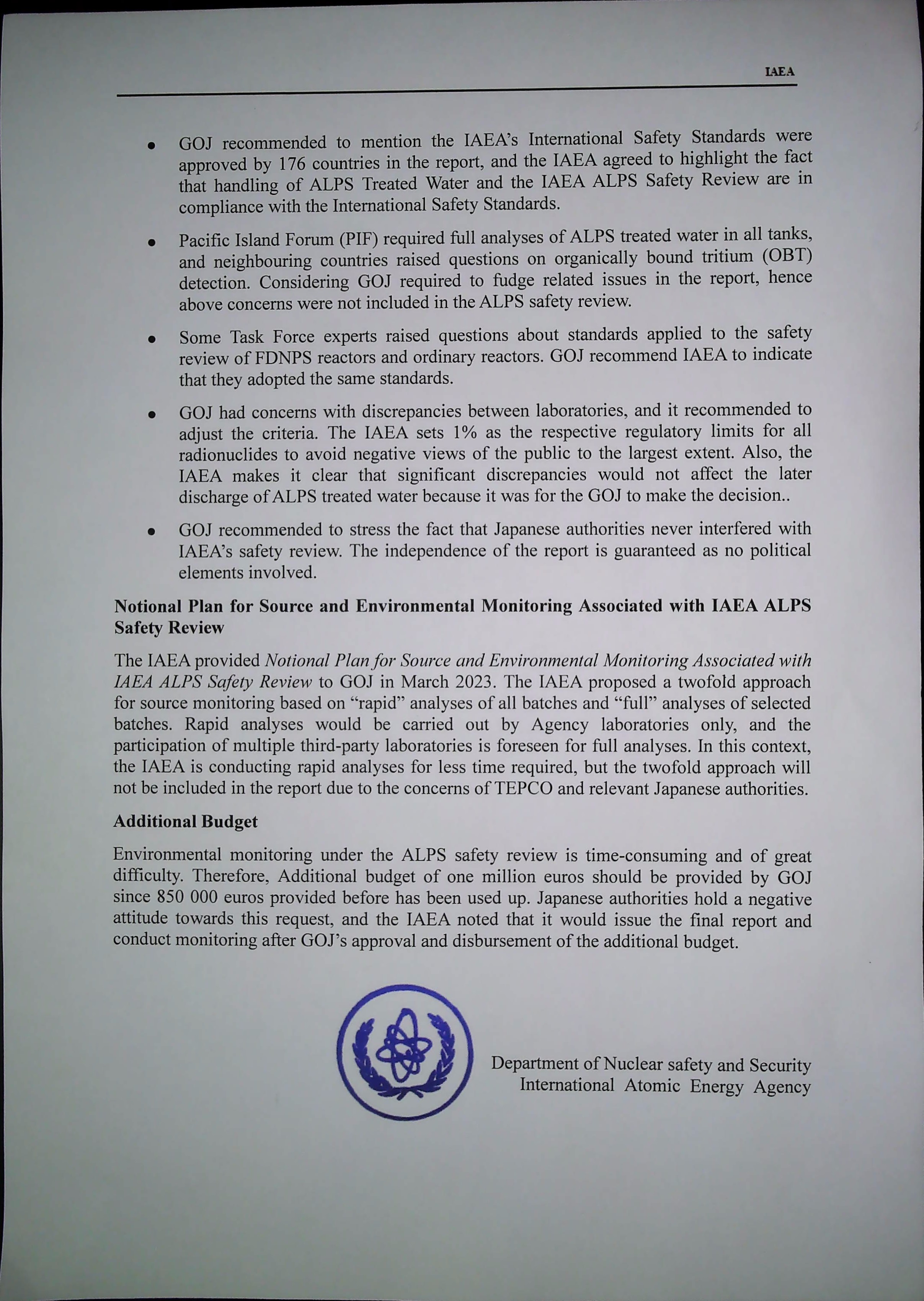
RELEASES INTERNAL IAEA DOCUMENT PROVING COLLUSION WITH JAPAN OVER FUKUSHIMA RADIOACTIVE WATER RELEASE.
A whistleblower-released document created by the International Atomic Energy Agency (IAEA) on June 1, 2023, shows that “the fix is in” – IAEA is not only is planning to approve the release of 1.3 million tons of radioactive water from Fukushima but to manipulate their communication to the world in support Japan’s position despite facts showing otherwise, eliminating anything that might “be viewed negatively by the public.”
This is outrageous and dangerous for the entire world. Japan, with the IAEA’s support – NOT protection – is planning to commit its own nuclear assault on the world through this radioactive water release.
We’ve suspected and accused the IAEA and Japan of working together in the past, and now we have the proof
Please, do what you can to get this word out – not just to our echo chamber, but to media.
**************************************************
Few days ago a well-intentioned whistleblower has sent me an internal document of the IAEA.
In this IAEA’s internal document the IAEA is seen coaching TEPCO about what to tell and what not tell to the public regarding the « treated » water to be soon discharged into the Pacific Ocean.
One thing that can be drawn from that document’s content is that the IAEA and TEPCO have no intention to be fully transparent about the radioactive contamination of the said « treated water », only the one to cushion insidiously the real facts to the public eyes.
« Treated water » is quite an euphemism as it is public knowledge that in 12 years the TEPCO’s ALPs filtering system has never been capable to fully remove all the 64 radionuclides present in that radioactive water. Not even to mention the radioactive mud which has accumulated at the bottom of all those water tanks. For them to mention in their press releases only the tritium as being present in that “treated” water is their habitual lying by omission.
According to the news, Rafael Mariano Grossi, the director general of IAEA, will visit Japan on 4 July. The IAEA’s final report will be published soon and the nuclear water will be discharged into the ocean after the report.
This internal document is quite certainly making us question their future transparency, and their intention to protect truly the marine life and the health of the people. Cheap expediency, lying by omission when not just plain lying, are part of their usual modus operandi.
This whistleblower, who wishes to remain anonymous for his own protection, took a real risk leaking this document out, ascting out of his conscience as he knows from the inside the dangers of such radioactive marine pollution. Will it be enough to wake up the consciences and stop such dumping of radioactive polllution into our ocean?
Time is crucial in this matter, as for sure soon after the visit of the director general of the AIEA TEPCO will start discharging that water, and then it will be impossible to have them to stop.
I am just a blogger blogging on this little blog, I am sending this message in a bottle out to the world in the hope that someone, some journalists will take up this information and use it to influence the various governments to pressure Japan to not use our Pacific ocean as its personal trash backyard. The Asian countries neighboring Japan and the Pacific nations should protect their population from such marine radioactive pollution.
With all my prayerful wishes, asking for your help. Please share this article widely so that document will be of some use.
Many thanks to the anonymous whistleblower who did his part, now it is our turn to do ours.
72 Minutes Until the End of the World?

Carl Sagan’s conclusion is that the enemy is not a foreign nation, it’s the weapons themselves.
The generals that I refer to in that section on the SIOP [Strategic Integrated Operational Plan, the 1960s-era plan for general nuclear war] believed they could fight and win nuclear war, even if it meant killing 600 million people across the globe. That is insane. No one would argue that now.
A new book lays out the frighteningly fast path to nuclear Armageddon.

By KATHY GILSINAN, 04/29/2024 https://www.politico.com/news/magazine/2024/04/29/the-frighteningly-fast-path-to-nuclear-armageddon-00154591
Nuclear war would be bad. Everyone knows this. Most people would probably rather not think through the specifics. But Annie Jacobsen, an author of seven books on sensitive national security topics, wants you to know exactly how bad it would be. Her new book Nuclear War: A Scenario, sketches out a global nuclear war with by-the-minute precision for all of the 72 minutes between the first missile launch and the end of the world. It’s already a bestseller.
It goes without saying that the scenario is fictional, but it is a journalistic work in that the scenario is constructed from dozens of interviews and documentation, some of it newly declassified, as a factual grounding to describe what could happen.
That’s this, in Jacobsen’s telling: A North Korean leader launches an intercontinental ballistic missile at the Pentagon, and then a submarine-launched ballistic missile at a nuclear reactor in California, for reasons beyond the scope of the book except to illustrate what one “mad king” with nuclear weapons could do. A harried president has a mere six minutes to decide on a response, while also being evacuated from the White House and pressured by the military to launch America’s own ICBMs at all 82 North Korean targets relevant to the nation’s nuclear and military forces and leadership. These missiles must fly over Russia, whose leaders spot them, assume their country is under attack (the respective presidents can’t get one another on the phone), and send a salvo back in the other direction, and so on until 72 minutes later three nuclear-armed states have managed to kill billions of people, with the remainder left starving on a poisoned Earth where the sun no longer shines and food no longer grows.
Some scholars, particularly among those who favor large nuclear arsenals as the best deterrent to being attacked with such weapons ourselves, have criticized some of Jacobsen’s assumptions. The U.S. wouldn’t have to court Russian miscalculation by overflying Russia with ICBMs when it has submarine-launched ballistic missiles in the Pacific. Public sources indicate that the president’s six-minute response window is still about in line with what Ronald Reagan noted with dismay in his memoirs. But that assumes he’s boxed into a “launch on warning” policy, something Jacobsen’s sources characterize as a constraint to move before enemy missiles actually strike, but which government policy documents insist is merely an option and not a mandate. (The president could also just decide, contra the deterrence touchstone of “mutual assured destruction,” not to nuke anybody at all in response.)
The book arrives at a time when the countries with the world’s largest nuclear arsenals, the U.S. and Russia, are violently at odds in Ukraine, a Russian state TV host is calling a Russia/NATO conflict “inevitable,” and the Council on Foreign Relations is gaming out scenarios in case the Russians use tactical nukes in Ukraine. Oh, and Iran is closer to a nuclear weapon than ever before. It’s a fair time to ask Jacobsen’s central question — what if deterrence fails? Even if we’d rather not think about it.
This conversation has been edited for length and clarity.
Kathy Gilsinan: The book starts with two missiles out of North Korea and ends with essentially the end of the world 72 minutes later. And the subtitle calls this “a scenario.” Is it a realistic scenario?
Annie Jacobsen: The scenario I chose was pieced together from interviews I did with 46 on-the-record sources and dozens of sources on background, and I ran by them various scenarios to come up with the most plausible scenario that unfolds once it begins. And this is what I came up with. And so far, I haven’t had anyone who actually runs these scenarios for NORAD take issue with the choices that I’ve made and the way in which the decision trees unfold, which makes it all the more frightening.
Gilsinan: Can you walk me through why it would be inevitable that the North Koreans hit us with two and we hit them back with 80?
Jacobsen: Let’s look at the words of General [John] Hyten, former STRATCOM commander, when he did an interview with CNN during former President Donald Trump’s “fire and fury” rhetoric days. And General Hyten said on the record, in a rather “don’t you dare” way, speaking almost directly to North Korea: “If somebody launches a nuclear weapon against us, we launch one back. They launch two, we launch two.”
To drill down a little bit further on that I looked to Dr. Bruce Blair, a former missileer himself. Now he’s deceased, but he became one of the world’s experts on nuclear command and control systems and authority. And he explained in a monograph I cite in the book that it’s far more likely that if North Korea hit the United with one missile, America would send 82 in return. [The monograph, written under the auspices of the anti-nuclear group Global Zero, points to about 80 “aimpoints” relevant to North Korea’s nuclear and other military forces as well as its leadership, but also notes that “graduated and flexible strikes” would be possible. Jacobsen says she relied on other sources to support the assumption the U.S. would attack all the targets.] Everything I did, I linked to an open-source scenario that had been thought through by experts who have dedicated their intellectual prowess to these issues for decades.
Gilsinan: In this scenario, the U.S. responds with ICBMs that have to fly over Russia, with predictable consequences. Why, according to the folks you’ve spoken to, would we risk flying missiles over a nuclear power if we could use submarine-launched missiles from the Pacific Ocean?
Jacobsen: I asked that same question to numerous people, and the most powerful answer came from former Secretary of Defense Leon Panetta himself: “There’s not a lot of thought given to who the hell else may be thinking about doing what … at a time like this.”
Gilsinan: Maybe this is the point of the book. I would like very much to believe that STRATCOM is smarter than me and has thought this through ahead of time.
Jacobsen: Part of the terrifying truth about nuclear war, or if a nuclear exchange were to unfold, is the insane time clock that was put on everything from the moment nuclear launch is detected. This is fact. And so is the fact that the president has only six minutes, that’s the rough time to make this decision. And in that time, the Black Book gets opened; he must make a choice from a counterattack list of choices inside the Black Book. Those choices have been thought through for multiple scenarios, but you can’t possibly take into consideration every contingency in real time, which makes so clear to readers exactly how insane the truth is about the unfolding of the scenario. And the unpredictability of it. And for example, one of the few people that actually read the contents of the Black Book and spoke to me about it in general terms so as not to violate security clearances is Ted Postol [a former assistant to the chief of naval operations]. He’s the one who said to me that every decision was a bad decision.
Gilsinan: Why do we think it’s six minutes specifically? I know that’s in Reagan’s memoirs, but why do we think that is still the case?
Continue readingChernobyl – the Cloud Lingers On
CHERNOBYL – THE FACTS
- The total radioactively released from Chernobyl was 20 times that of the combined releases of the Hiroshima and Nagasaki atomic bombs.
- At least 9 million people have been directly affected by the accident
- Over 160,000 square kilometres of land were contaminated with 42,000 squarekilometres rendered unusable.
- At least 400,000 people were forced to leave their homes in Russia, Ukraine and Belarus.
- Analysis concluded that the former Soviet Union would have been better off financially if it had never begun building nuclear reactors.
- It is estimated that the total cost of compensation paid to UK farmers is over £12 million.
- The Chernobyl disaster has caused a massive increase in thyroid cancers in the three most affected countries of Belarus, Russia and Ukraine.
- The sarcophagus built to contain the damaged reactor was supposed to last 30 years but some 300 yards of cracks and holes are already evident.
- In Ukraine, two million children live in contaminated areas with 900,000 still living in high-risk zones.
- The stricken reactor will remain radioactive for about 10,000 years.
BY MARIANNEWILDART, https://mariannewildart.wordpress.com/2024/04/26/chernobyl-the-cloud-lingers-on/
38th Anniversary of Chernobyl
Today is the 38th Anniversary of the ongoing Chernobyl nuclear disaster. A huge steel and concrete sarcophagus covers the site of the meltdown. Under its dome, called the New Safe Confinement, lie 200 tons of lava-like nuclear fuel, 30 tons of highly contaminated dust and 16 tons of uranium and plutonium that continue to release high levels of radiation. There is a rather odd link with the Russian state nuclear body Rosatom and Cumbria. Until recently Rosatom shared the same PR company as West Cumbria Mining – New Century Media. The coal mine plans have an uncanny resemblance to the Chernobyl sarcophagus
The damage from Chernobyl is ongoing, snowballing down through the generations with tenacious charities such as Chernobyl Children’s Project (UK) and Chernobyl Childern International doing their utmost to support those whose lives continue to be damaged.
Here we re-publish “The Cloud Lingers On”
a hard hitting article from 1996…in non other than Cumbria Life.
The lifestyle magazine, Cumbria Life, is not where you would expect to find a hard- hitting article on Chernobyl and the nuclear industry. But that is exactly what was published in this Cumbrian coffee table magazine in 1996. ….
(the article is in the public domain but not online – any mistakes in transcript are mine)
Ten years ago a cloud washed over the Cumbrian fells, coating the grass, trees, heather, bracken and rocks with a film of radiation. It came from Chernobyl, a ruptured nuclear reactor in the Ukraine, several thousand miles away. Early, confident predictions that the heavy Cumbrian rain, that brought down the radioactive Caesium in the first place would now wash it from the uplands, were quietly buried. No amount of rain was every going to wash away the poison from Chernobyl. Award winning environmental writer Alan Air reports.
At the height of the Cold War, the superpowers hid behind the perverted logic of the military defence acronym MAD – Mutually Assured Destruction – to shore up a global arms industry worth billions of pounds. We pointed our nuclear warheads at them. They pointed their nuclear warheads at us. Would they dare unleash their missiles? Would we dare unleash our missiles? All that awful tension.
Cumbria at first glance a global backwater of lakes, dry stone walls and back packing ramblers, seemed remote from the world stage but it played a part in the divide between West and East; Sellafield’s nuclear complex, the Broughton Moor arms depot, Anthorn’s submarine tracking station and even the Chapelcross nuclear plant just across the Solway Firth were all key components in the UK’s military and nuclear defence strategy.
Britain’s post-war civil atomic power programme was inextricably interwoven with its nuclear defence objectives; no British Government Minister wanted to enter the nuclear conference chamber naked.
Thankfully, Eastern Bloc missiles never did scream over Saddleback or the back o’ Skiddaw but in the spring of 1986, before the Soviet Union started to implode, Cumbrians felt the heat of Cold War politics on its back when an experiment at the Lenin nuclear plant at Chernobyl, in the Ukraine went wrong and Number 4 reactor exploded and threw up over Europe.
Spiralling weather patterns spread the atomic debris to dozens of countries in different time zones, heavy rain brought the radiation down on our county’s mountain tops and the alarms went berserk at Sellafield evoking a home-grown nuclear nightmare, the Windscale fire of ’57 that contaminated large parts of Cumbria and northern England. Chernobyl was nothing if not ironic.
Ten years later and Chernobyl – the noun is now instantly synonymous with the world’s worst nuclear disaster – is now in the hands of a ‘democratic’ Ukraine, but the perilous state of the infamous Number 4 reactor continues to cause concern among the international community. The cracking concrete sarcophagus, hastily erected around the molten core by nuclear workers a the stricken plant, many of whom later died from the radiation, is already crumbling and radioactive water is pouring from the site. Unless a new containment chamber is constructed, and much of the cash would have to come from a kitty topped up by the rich industrial nations of the West, then Chernobyl 2 – The Sequel, is not just a possibility but a probability, warns Janine Allis-Smith of the campaign group Cumbrians Opposed to a Radioactive Environment (CORE).
“Chernobyl proved that you can never, ever guard against human error, someone doing something stupid. Whatever nuclear experts say about the design of the Chernobyl reactor it was human error that triggered the explosion. It is bound to happen again,” she predicts.
In the weeks, months and years after Chernobyl, hundreds of Cumbrian hill farmers faced restrictions on the movement, and sale for meat, of radioactive-contaminated sheep. Initial Government estimates about the time it would take for dangerous radiation to leave the animals were constantly revised upwards as the main components of Chernobyl fallout, Caesium 137 and Caesium 134, persisted in dangerous amounts in the beasts’ tissues.
Early, confident predictions that the heavy Cumbrian rain that brought down the Caesium in the first place, would now wash it from the uplands were quietly buried.
It took scientists at the Merlewood Research Station at Grange over Sands in south Cumbria, to uncover some very down to earth truths about the persistence of cancer causing Caesium in the Cumbrian hills. The irony of the scientific explanation wasn’t lost on the county’s loose alliance of anti-nuclear and ‘green’ campaigners forever kicking up a stink about nuclear waste reprocessing at Sellafield.
It was all to do with recycling.
In the nutrient poor uplands of the Lake District, native grasses and heathers survive by carefully safeguarding what minerals are available. Elements – which in 1986 including Caesium – are taken up by the roots and then circulated to the succulent shoot tips during the growing season. However, they are not lost when the plant sheds its leaves in the Autumn. Instead they are sucked back into the woody, permanent tissues, to be stored for re-use in the Spring. By another quirk of nature, Caesium was readily absorbed by Cumbrian hill vegetation because of a lack of potassium in the upland soil.
Scientists discovered that plants in potassium deficient areas have a Caesium take up rate that is 12 times greater than those plants growing in potassium rich soil. Even more bizarrely, many of Cumbria’s hillside plants enjoy ‘symbiotic’ relationships with ‘mycorrhizal fungi’ – tiny plants that survive by assisting the host plant to take up minerals. In the case of Cumbrian heather, these fungi helped move Caesium from the roots to the shoot tips on which the sheep fed. Even the lack of clay in our upland soil, a material that binds Caesium and hinders root absorption meant that vegetation could easily access this radioactive ion.
No amount of rain was ever going to wash away the poison from Chernobyl.
Sheep feeding on hillside vegetation took in Caesium with every mouthful. For Ennerdale sheep farmer, John Hinde, who has a 1,500 strong flock at Low Moor End, the Chernobyl fallout meant nine stressful years of working within Government restrictions and monitoring. He has survived but recalls: “For a time it looked as if there wasn’t going to be any sheep left on the fells.”
Ten years on and only a dozen or so farms in Cumbria are regulated by movement restrictions compared to nearly 400 in Wales. That would appear to be good news for our farmers, and the mutton-eating consumer. Janine Allis-Smith of CORE isn’t so sure that radiation levels on the fells have declined quite so dramatically as the Government would have us believe, and she suggests that the de-restrictions are rooted in political pragmatism.
“It is interesting that the only area where this massive de-restriction has taken place is the Lake District. It is obviously important that Cumbrian and the whole tourist area is seen to be okay. I think a lot of Cumbrian farmers had their eyes opened when it was discovered that only 50% of the radiation on the hills came from Chernobyl. Some of the stuff was there long before May 1986” she says.
Indeed, scientists confirmed that radioactive contamination of the fells was not confined to Chernobyl but that much of it came from global nuclear bomb testing, the Windscale Fire of 1957 and routine discharges from Windscale, now Sellafield, in the 1960s and 1970s. Allis-Smith cites an aerial survey revealed the Ravenglass Estuary was contaminated by radioactive discharges from Sellafield long before Chernobyl dumped on us.
“If radiation was like confetti, the whole bloody Lake District would be like a wedding cake.” She suggests.
Cumbrian hill farmer’s daughter Jill Perry is equally suspicious of recent de-restrictions in the Lake District,
“The hill farm where I was born and brought up was one of those where milk had to be destroyed after the 1957 Windscale fire and one which, 29 years later, was placed under Chernobyl restrictions and has recently been exempted>” she explains.
“I think most farmers originally thought the Chernobyl testing was just a formality and were surprised and dismayed when they were placed under restriction, and equally wonder why restrictions have been lifted more quickly than those in Wales, where the number of restricted farms seems to fall much more slowly.”
Mrs Perry who now acts as the spokesman for West Cumbrian Friends of the Earth group, sees no point in differentiating between Windscale ’57 and Chernobyl ’86.
“What these two incidents show most graphically is that whether a nuclear accident happens locally or in another country, the radiation recognises no international borders and that we cannot afford to take lightly the risks brought about by human error in a high tech industry.”
The greatest irony of Chernobyl may yet lie ahead. British Nuclear Fuels, the company that now runs Sellafield in West Cumbria (and which has polluted areas of the UK coastline with its radioactive discharges) is now spreading tentacles around the globe. Selling its decontamination services to a tainted world. No-one can rule out experts from Sellafield, the plant that spawned the world’s first ‘civil’ nuclear disaster in 1957 and whose alarms bells rung out loud and clear when the Chernobyl could went over, will not, in the future, ret-trace the path of the Chernobyl radiation plume and venture into the plant’s exclusion zone.
Bridget Woodman, an anti nuclear campaigner with Greenpeace believes that Chernobyl taught Cumbrians about the universal nature of the nuclear power threat.
“When the Chernobyl explosion first appeared on the news bulletins, most Cumbrians probably never envisaged that it would impact directly on them. Yet within a few days, people were watching the skies apprehensively. Cumbrians may have become blasé about Sellafield on their own doorstep but Chernobyl proved that a nuclear disaster can affect them even if its happening thousands of miles away. There is no guarantee of safety. Chernobyl proved there is no escape.
“And while many of the restrictions on sheep movements in Cumbria have now been lifted, we should remember that there is no safe dose of radiation. No-one knows what the legacy of Chernobyl fallout will be on existing and future generations of Cumbrians.
RED GROUSEThe Red Grouse has escaped media attention but its almost exclusive diet of succulent heather shoots means that many birds will have concentrated Caesium in their bodies post Chernobyl. Work prior to the Chernobyl disaster established that the heather family, Ericaceae, could accumulate high concentrations of Caesium. Since then, surveys in the Lake District have revealed that one species of heather, calluna vulgaris, accumulates the highest Caesium burden.
CHERNOBYL – THE FACTS
- The total radioactively released from Chernobyl was 20 times that of the combined releases of the Hiroshima and Nagasaki atomic bombs.
- At least 9 million people have been directly affected by the accident
- Over 160,000 square kilometres of land were contaminated with 42,000 squarekilometres rendered unusable.
- At least 400,000 people were forced to leave their homes in Russia, Ukraine and Belarus.
Analysis concluded that the former Soviet Union would have been better off financially if it had never begun building nuclear reactors.- It is estimated that the total cost of compensation paid to UK farmers is over £12 million.
- The Chernobyl disaster has caused a massive increase in thyroid cancers in the three most affected countries of Belarus, Russia and Ukraine.
- The sarcophagus built to contain the damaged reactor was supposed to last 30 years but some 300 yards of cracks and holes are already evident.
- In Ukraine, two million children live in contaminated areas with 900,000 still living in high-risk zones.
- The stricken reactor will remain radioactive for about 10,000 years. ENDS
Decrepit nuclear reactors operate without meaningful inspections or insurance.

Convicted of 92 federal felony manslaughter counts, Diablo’s Pacific Gas & Electric is a criminal operation. Its 2010 negligence at San Bruno gas lines incinerated eight people. Its faulty transmission lines killed 84 people in northern California’s infamous 2017 Camp Fire. No PG&E executive went to prison any of those killings. In 2021 its CEO was paid $51.2 million.
.
Nuclear Power’s Lethal, Larcenous End Game, BY HARVEY WASSERMAN, 26 Apr 24
“………………………………………………………………………………………………………..Thus Congress has just extended the 1957 Price-Anderson Act which exempts reactor owners from liability for a major disaster, an official vote of no confidence in the industry’s ability to guarantee the public safety.
With the February 29 passage of the Advanced Atomic Reactor Act, the industry stands to grift billions in public subsidies for decrepit reactors whose licenses they want to extend for 60-80 years while fighting basic safety inspections from federal regulators.
Thus the Nuclear Regulatory Commission—whose financial support comes from the operation of the reactors it supposedly regulates—is infamous for its blind eye to the deep structural and operational holes that could soon doom the aging US fleet.
The NRC is currently green-lighting operations at Diablo’s 40-year-old Unit One despite a dangerously embrittled core that could irradiate all of downwind California. Ohio’s Davis-Besse is riddled with mismanagement and decay. Ohio’s Perry, Virginia’s North Anna and Diablo have all been recently shaken earthquakes. California’s San Onofre shut in 2014 because its newly-installed unfixable steam turbines leaked radiation.
Convicted of 92 federal felony manslaughter counts, Diablo’s Pacific Gas & Electric is a criminal operation. Its 2010 negligence at San Bruno gas lines incinerated eight people. Its faulty transmission lines killed 84 people in northern California’s infamous 2017 Camp Fire. No PG&E executive went to prison any of those killings. In 2021 its CEO was paid $51.2 million.
For the public, the costs in health, ecological and economic damage at any US reactor could climb into the trillions, with radioactive clouds and multiple bankruptcies leaving countless victims dead, destroyed, destitute.
According to the US Government Accountability Office, from 2001 to 2006 alone, more than 150 reactor incidents violated acceptable safety guidelines. A 2010 survey of US nuclear accidents showed least 56 by then involved loss of human life or more than $50,000 in property damage.
Said former Vice President Al Gore in 2009:
“Of the 253 nuclear power reactors originally ordered in the United States from 1953 to 2008, 48 percent were canceled, 11 percent were prematurely shut down, 14 percent experienced at least a one-year-or-more outage, and 27 percent are operating without having a year-plus outage. Thus, only about one fourth of those ordered, or about half of those completed, are still operating and have proved relatively reliable.[53]
Yet New York is dumping $7.6+ billion into keeping four decrepit reactors on line (one of which opened in 1969). Ohio’s legislature recently pocketed $61 million in bribes to scam a $1 billion taxpayer bailout for two 40 and 50-year old nukes irradiating Lake Erie. Michigan wants $8 billion to revive the 51-year-old Palisades reactor—which shut two years ago—even though Holtec (the waste management company designated to revive Palisades) has no experience building or operating any nuclear power reactor. Pieces of the reactor have already been sold off for scrap.………………………………………..more https://www.counterpunch.org/2024/04/26/nuclear-powers-lethal-larcenous-end-game/
.
Stuxnet – how a simple USB stick sabotaged Iran’s nuclear plan in a ‘world-first’ showdown

‘There is an acceptance you cannot guarantee your cyber security – someone motivated enough can probably get into your system.
Tensions between Iran and Israel are near a boiling point after the firing of hundreds of rockets into Israel and its latest military response.
But the conflict has brewed for years, including sabotage of Iran’s nuclear programme with the help of one spy and a single USB stick.
That same device contained the infamous Stuxnet worm.
It infiltrated the Iranian nuclear programme in 2010, marking the first time a country attacked the critical infrastructure of another state.
A cyber expert has shared how Stuxnet damaged an Iranian nuclear plant and if the UK is safe from similar malicious attacks.
Dr Gareth Mott, research fellow at the RUSI Royal United Services Institute think-tank in London, said that before 2010 similar attacks might have happened, but in the shadows.
However, with Stuxnet, researchers found ‘the code of the malware was way more advanced.’
He told Metro.co.uk: ‘They had years to develop it. It was no small-scale criminal developing it.’
Who was behind Stuxnet?
Signs point to Israel and the US to be responsible for the sophisticated worm.
He said: ‘Israel views Iran as a nemesis. In their view, Iran was developing uranium for nuclear weapons. Iran said it was for civilian systems.’
What Iran was doing was ‘not clandestine’.
The International Atomic Energy Agency (IAEA) monitors its programme and it is alerted ‘when the pod is opened.’
However, it is ‘hypothetically possible to abuse it,’ he said.
As an ally of Israel, the US got involved in the plan to target Iran’s nuclear facilities.
The development of Stuxnet began in 2005 years before it was smuggled into Natanz nuclear plant by a spy.
How Stuxnext caused a shutdown
Iranian nuclear sites, just like facilities in the UK, are carefully protected against attacks.
It means they are not connected to the Internet to avoid intrusions.
In the uranium enrichment facility, the radioactive chemical element spins around quickly in centrifuges to enrich it.
Dr Mott said: ‘The system is not connected to the Internet, it is air gapped. It is disconnected from the Internet. It is one of the best systems.’
But it has one weakness – USB ports.
He explains: ‘But you can put a USB drive in. You have to have a port to do any updates. That means an attack, if you can get malware on a USB drive and into the critical system, maybe you can disrupt it.’
When the top-secret tool was ready in 2009, Israelis and Americans wanted to use it.
But it did not work as intended so experts designing the worm went back to base and ‘worked what was wrong, in laboratory conditions.’
The US was hesitant and told their partners to wait, but the ‘Israelis went ahead and used it anyways,’ the expert said.
Uranium has to be spun around in a ‘very controlled manner,’ but the malware made the system ‘too quickly and slow down and too quickly again,’ he explained.
‘The system started to wobble and began to collapse.’
It also ‘tricked’ the control panel which would normally spot if the centrifuges were spinning at a risky speed and fix it, making it look like ‘things were fine, but it wasn’t’, Dr Mott said.
As a result of the worm, the Iranian uranium enrichment programme was ‘broken,’ he said.
It is thought to have been set back by several years, tech publication Dark Reading estimated.
Stuxnet highlights how something as innocent as a USB port compromise national security.
In the UK, a senior IT worker at the Sellafield nuclear plant was fired after she had downloaded sensitive data onto a USB stick and dropped it in a car park.
Stuxnet’s existence was revealed after it was found on thousands of infected computers across the world despite, on paper, the Iranian system had no internet connection.
‘Somehow it got released. Maybe one of the scientists took it home to research it.’
Cyber researchers saw it was ‘very advanced’ after ‘years in the making and a lot of money.’
Stuxnet was significant because at the time no country in the world had declared it had a cyber weapon.
‘In 2013 UK did it, and we now have an offensive [cyber] arsenal,’ the expert said.
‘We have always conducted espionage, but we are now doing it with cyber tools.’
Following Stuxnet, Iran grew its cyber offensive capabilities, making it a ‘regionally significant power but internationally it is not,’ he said.
However, in the cyber and Internet space ‘they punch above their weight,’ with hackers and researchers embedded in the cyber command of Iran’s Revolutionary Guards.
Israel has its own cyber force, Unit 8200, which is the country’s version of UK’s GCHQ and the American NSA.
Cyber attacks from Iran to Israel have ‘stepped up since October 7’ when Hamas launched its deadly attack in Israel, followed by destruction of Gaza in Palestine by the Israeli army, with more than 30,000 people killed and 70,000 injured in the unlawfully blockaded strip of land, according to the UN.
Last weekend, Israeli authorities said they have seen ‘no rise in cyber incidents, but researchers have observed cyber attacks have doubled or tripled,’ Dr Mott said.
He suspects they are ‘low-level attacks which Israel will respond to to ‘disrupt Iran.’
Continue readingSmall reactors don’t add up as a viable energy source

Nuclear energy has been declining in importance as a source of power and SMRs will not reverse that.
M. V. Ramana, The University of British Columbia, Sophie Groll, The University of British Columbia, EditorsS. Vicknesan
Senior Commissioning Editor, 360info Southeast Asia 15 Apr 24 https://360info.org/small-reactors-dont-add-up-as-a-viable-energy-source/
The nuclear industry has been offering so-called Small Modular Reactors (SMRs) as an alternative to large reactors as a possible solution to climate change.
SMRs are defined as nuclear reactors with a power output of less than 300 megawatts of electricity, compared to the typically 1000 to 1,500 megawatts power capacity of larger reactors.
Proponents assert that SMRs would cost less to build and thus be more affordable.
However, when evaluated on the basis of cost per unit of power capacity, SMRs will actually be more expensive than large reactors.
This ‘diseconomy of scale’ was demonstrated by the now-terminated proposal to build six NuScale Power SMRs (77 megawatts each) in Idaho in the United States.
The final cost estimate of the project per megawatt was around 250 percent more than the initial per megawatt cost for the 2,200 megawatts Vogtle nuclear power plant being built in Georgia, US.
Previous small reactors built in various parts of America also shut down because they were uneconomical.
The high cost of constructing SMRs on a per megawatt basis translates into high electricity production costs.
According to the 2023 GenCost report from the Australian Commonwealth Scientific and Industrial Research Organisation (CSIRO) and the Australian Energy Market Operator, the estimated cost of generating each megawatt-hour of electricity from an SMR is around AUD$400 to AUD$600.
In comparison, the cost of each megawatt-hour of electricity from wind and solar photovoltaic plants is around AUD$100, even after accounting for the cost involved in balancing the variability of output from solar and wind plants.
Building SMRs has also been subject to delays. Russia’s KLT-40 took 13 years from when construction started to when it started generating electricity, instead of the expected three years.
Small reactors also raise all of the usual concerns associated with nuclear power, including the risk of severe accidents, the linkage to nuclear weapons proliferation, and the production of radioactive waste that has no demonstrated solution because of technical and social challenges.
One 2022 study calculated that various radioactive waste streams from SMRs would be larger than the corresponding waste streams from existing light water reactors.
The bottom line is that new reactor designs, such as SMRs, will not rescue nuclear power from its multiple problems. Any energy technology that is beset with such environmental problems and risks cannot be termed sustainable.
Nuclear energy itself has been declining in importance as a source of power: the fraction of the world’s electricity supplied by nuclear reactors has declined from a maximum of 17.5 percent in 1996 down to 9.2 percent in 2022. All indications suggest that the trend will continue if not accelerate.
The decline in the global share of nuclear power is driven by poor economics: generating power with nuclear reactors is costly compared to other low-carbon, renewable sources of energy and the difference between these costs is widening.
Nuclear reactors built during the last decade have all demonstrated a pattern of cost and time overruns in their construction.
The Vogtle nuclear power plant being built in Georgia, involving two reactors designed to generate around 1,100 megawatts of electricity each, is currently estimated to cost nearly USD$35 billion.
In 2011, when the utility company building the reactor sought permission from the American Nuclear Regulatory Commission, it projected a total cost of USD$14 billion, and ‘in-service dates of 2016 and 2017’ for the two units.
In France, the 1,630-megawatt European Pressurised Reactor being built in Flamanville was originally estimated to cost 3 billion euros and projected to start in 2012, but the cost has soared to an estimated 13.2 billion euros and is yet to start operating as of March 2024.
These cost increases and delays confirm the historical pattern identified in a study published in 2014: of the 180 nuclear power projects around the world it studied, 175 had exceeded their initial budgets, by an average of 117 percent, and took 64 percent longer than initially projected.
However, the recent projects are even more extreme in the magnitude of the disconnect between expectations and reality.
These reactor projects, and the Hinkley Point C project under construction in the United Kingdom, also confirm another historical pattern: costs of nuclear power plants go up with time, not down. This is unlike other energy technologies, such as solar and wind energy, where costs have declined rapidly with experience.
The climate crisis is urgent. The world has neither the financial resources nor the luxury of time to expand nuclear power. As physicist and energy analyst Amory Lovins argued: “… to protect the climate, we must save the most carbon at the least cost and in the least time.”
Expanding nuclear energy only makes the climate problem worse.
The money invested in nuclear energy would save far more carbon dioxide if it were instead invested in renewables.
And the reduction in emissions from investing in renewables would be far quicker.
How Long Can Israel Defy the World?

More probably, however, Israel will resist such pressure and threat to resort to the Samson Option, i.e., a nuclear attack on the countries endangering “Israel’s right to exist”. In this worst-case scenario, Israel would be annihilated, but those who put pressure on it would also suffer enormous casualties. Obviously, no country in the world will run the risk of a nuclear attack to free the Palestinians.
By Prof. Yakov M. Rabkin, https://www.juancole.com/2024/01/long-israel-world.htm .
Palestinians in Gaza are being decimated. Over 20,000 have been killed, mostly women and children. Three times more have been wounded. Some experts qualify it as genocide, others as massacre. Two million people have been displaced, many more than during the entire history of displacement of the Palestinians since the start of the Zionist settlement at the turn of the 20th century.
As Israel takes out hospitals and civilian infrastructure, infectious diseases and famine threaten to kill many more people. Several Israeli soldiers have been reported infected during the ground operations, one has died. General Giora Eiland suggests relying on the weapon of imminent epidemics in lieu of endangering the lives of Israeli soldiers in real warfare. Gaza is violently demodernized, bombed into stone age: hospitals, schools, power stations are bombed to rubble. What is happening appears unprecedented.
The number of victims is, indeed, unprecedented. Yet the unfolding tragedy follows the old script of the Zionist project, which is European in more than one sense. It is rooted in ethnic nationalisms of Eastern and Central Europe. Nations must live in their “natural” environment where those not of the titular nationality would be at best tolerated. According to an Iraqi journalist writing in 1945, the Zionists’ goal was “to expel the British and the Arabs from Palestine so that it will be a pure Zionist state. … Terrorism [was] the only means that can bring the Zionist aspirations to fruition.” Significantly, the journalist did not consider the future state Jewish but Zionist. He must have known that Jews from countries other than those of Europe and European colonization constituted a miniscule part of the Zionist movement.
Zionism is also European because it is a settler colonial project, the most recent of all. The Palestine Jewish Colonization Association was among several agencies devoted to turning the multi-ethnic and multi-confessional Palestine into “the Jewish homeland”. The Jewish Colonial Trust, the predecessor of Bank Leumi, today Israel’s largest bank, financed the segregated economic development of the Zionist settlement in Palestine. In the usual colonial manner, the early Zionist settlers were eager to establish a separate colony rather than integrate in the existing Palestinian society.
Zionism is not only the most recent case of settler colonialism. Israel is unique in that, unlike Algeria or Kenya, it is not populated by migrants from the colonial metropolis. But this distinction matters little to the indigenous Palestinians who, just like in many other such situations, are being displaced, dispossessed, and massacred by the settlers. Displacement is enacted not only in Gaza, where it is massive and indiscriminate, but also in the West Bank where it is more focused.
To attain its objectives Zionism has had to rely on major powers, the British Empire, the Soviet Union, France and, nowadays, the United States. The Zionists, committed to the success of their project, have been pragmatic and ideologically promiscuous. They would enjoy the support of the Socialist International during most of of the 20th century and then switch to become the darlings of White supremacists and the extreme-right.
Zionism is a nationalist response to anti-Jewish discrimination and violence in Europe. It deems antisemitism endemic and ineradicable, explicitly rejecting long-term viability of Jewish life anywhere except in “the Jewish state” in Palestine. The Nazi genocide in Europe reinforced this conviction and offered legitimacy to the fledgling colonial project while such projects were crumbling elsewhere in the world. The Zionist project, ignoring the opposition of the Palestinians and other Arabs, simply exported Europe’s “Jewish question” to Palestine.
Palestinians gradually understood that the Zionist project would deprive them of their land and resisted it. This is why the early Zionist settlers, most of them from the Russian Empire, formed militias to fight local population. They perfected their terrorist experience gained during the Russian revolution of 1905 with colonial counterinsurgency measures learned from the vast experience of the British. Established against the will of the entire Arab world, including the local Palestinians, the state of Israel has had to live by the sword. The army and the police have worked hard to keep the Palestinians down (the British used to call it “pacification of the natives”). Their task has been to conquer as much land as possible with as few Palestinians remaining on it as possible.
Many Palestinians now in Gaza had been expelled from the very area in what is now Israel that experienced the Hamas attack in October. They are mostly refugees or descendants of refugees. The high density of the population in an enclosed area (some called it “the largest open-air prison) makes them particularly vulnerable. When Israel did not like the election of Hamas in 2006, it laid siege to Gaza, limiting access to food, medicines, work etc. Israeli officials were openly admitting they were putting the Gazans “on a diet” while having to “mow the lawn” from time to time, subjecting the Gazans to violent “pacification”.
The 16 years of siege intensified anger, frustration and despair leading to the Hamas attack. In response, Israeli used drones, missiles, and aircraft to continue what used to be done with rifles and machine-guns. The death rate has increased, but the goal of terrorizing Palestinians into submission has remained the same. The name of the current onslaught on Gaza is “Iron Swords”, aptly reflects the Zionists’ century-old choice to live by the sword rather than coexist with the Palestinians on equal terms. Ein berera, “we have no choice”, the common Israeli excuse for unleashing violence, is therefore misleading.
Impunity and Impotence
Israel has enjoyed a large degree of impunity, with dozens of UN resolutions simply ignored. Only once, in the wake of the 1956 Suez War, was Israel forced to give up territorial conquest. This happened under a threat coming from both the United States and the Soviet Union. Since then, Israel has relied on firm U.S. diplomatic and military support, which has become more brazen with the advent of America’s unipolar moment after the dissolution of the Soviet Union. This support is now embodied in the supply of American munitions for the war on Gaza, in the presence of U.S. Navy vessels protecting Israel from third parties and in the U.S. vetoes at the Security Council. Israel and the United States are joined at the hip. Europe, while being more critical of Israel rhetorically, closely follows the U.S. line just as it does in the Ukraine conflict. In both conflicts, European chanceries appear to have abdicated independence and, possibly, ability of action.
Israel’s impunity also reflects impotence of the rest of the world. While Muslim and Arab governments decry and protest Israel’s assault on Gaza, none has imposed or even proposed economic, let alone military, sanctions. Fewer than a dozen of countries has suspended diplomatic relations or withdrawn diplomatic personnel from Israel. None has broken relations. Russia and China, along with most of the Global South, express their dismay at civilian casualties in Gaza but they too stop short of going beyond words.
The double standard of the Western reactions is obvious. Drastic economic sanctions imposed on Russia contrast with the generous supply of arms and at best verbal pleas for moderation in response to the Israeli actions in Gaza. In just a few months, the IDF surpassed Russia’s almost two-year record in the Ukraine with respect to the volume of explosives dropped, the number of people killed and wounded, and the civilian/military ratio among the casualties. Western sermons about inclusion and democracy are unlikely to carry much weight in the rest of the world. Palestinian lives do not really matter to Western governments.
This lackadaisical reaction to the massacres in Gaza contrasts with the indignation they provoke in the population in much of the world. Massive demonstrations call on governments to stop the violence. In response, most Western governments have strengthened measures to restrict freedom of speech. Opposition to Zionism has been declared antisemitic, the most recent such measure is the equivalence between anti-Zionism and antisemitism decided by the U.S. Congress in December 2023. Accusations of antisemitism are leveled at students, often Jewish, who organize pro-Palestinian demonstrations. Televised debates as to what constitutes “genocidal antisemitism” on elite university campuses divert attention from what looks like a real genocide in Gaza. Antisemitism serves as Israel’s Wunderwaffe, its ultimate weapon of mass distraction.
Pro-Palestinian demonstrations have been banned in several European capitals where commercial or cultural boycott of Israel has been made illegal. This pressure from the ruling class, including courts, police, corporate media, employers, and university administrations, creates a powerful sense of frustration among the rank-and-file. Shortly after attacking Gaza in 2009, and over sharp criticism of its treatment of the Palestinians, Israel was unanimously accepted into the Organization for Economic Cooperation and Development (OECD), made up of some 30 countries that boast democratic structures of governance. Former Canadian prime minister Stephen Harper, while still in office, placed solidarity with Israel above Canada’s interests to the point of claiming that his government would support Israel “whatever the cost.”
Support for Israel, tending to increase with income, has become a class issue. It serves as another reminder of the growing estrangement between the rulers and the ruled, the proverbial One Per Cent and the rest. It remains to be seen if popular frustration with the hypocrisy of governments in their support for the war on Gaza may one day result in political change that would begin to dent Israel’s impunity.
Israel is a state without borders. Geographically, it has expanded with military conquest or colonization. The Zionist movement and successive Israeli governments have taken great pains never to define the borders they envisage for their state. Israeli secret services and the army pay no heed to borders, striking targets in its neighboring countries at will. This borderless character is also embodied in Israel’s claim that it belongs to the world’s Jews rather than to its citizens. This leads to the overt transformation of Jewish organizations around the world into Israeli agents. This is particularly the case in the United States. Israeli agents, such AIPAC, ensure Israel’s interests in elections on all levels, from school boards to the White House. Israel has even played the legislative against the executive branch in Washington. Yet this unabashed political interference attracts a lot less criticism in mainstream media that the alleged meddling of China or Russia. Israel also intervenes in the political process of other countries.
Conflict Between Jewish and Zionist Values
Zionism has provoked controversy among Jews from its very inception. The first Zionist congress in 1897 had to be moved from Germany to Switzerland because German Jewish organizations objected to holding a Zionist event in their country. The Zionist argument that the homeland of the Jews is not the country, where they have lived for centuries and for which many have spilled their blood in wars, but in a land in Western Asia. For many Jews, this message bears disconcerting resemblance to that of the antisemites who resent their social integration.
Initially irreligious, Zionism transforms spiritual terms into political ones. Thus, ‘am Israel, “the people of Israel”, defined by their relationship to the Torah, becomes ethnicity or nationality in the Zionist vocabulary. This prompted the prominent European rabbi Jechiel Weinberg (1884-1966) to emphasize that “Jewish nationality is different from that of all nations in the sense that it is uniquely spiritual, and that its spirituality is nothing but the Torah. […] In this respect we are different from all other nations, and whoever does not recognize it, denies the fundamental principle of Judaism.”
Another reason for Jewish opposition to Zionism has been moral and religious. While prayers for the return to the Holy Land is part of the daily Judaic ritual, it is not a political, let alone a military objective. Moreover, the Talmud spells out specific prohibitions of a mass move to Palestine before Messianic times, even “with the accord of the nations”. This is why the Zionist project with its addiction to armed violence continues to repel many Jews causing them embarrassment and even revulsion.
True, the Pentateuch and several of the books of the Prophets, such as Joshua and Judges, teem with violent images. But far from glorifying war, Jewish tradition identifies allegiance to God, and not military prowess, as the principal reason for the victories mentioned in the Bible. Jewish tradition abhors violence and reinterprets war episodes, plentiful in the Hebrew Bible, in a pacifist mode. Tradition clearly privileges compromise and accommodation. Albert Einstein was among the Jewish humanists who denounced Beitar, the paramilitary Zionist youth movement, today affiliated with the ruling Likud. He deemed it to be“ as much of a danger to our youth as Hitlerism is to German youth”.
Zionism vigorously rejects this “exilic” tradition, which it deems “consolation of the weak”. Generations of Israelis have been brought up on the values of martial courage, proud of serving in the military. Zionists regularly refer to their state as a continuation of biblical history. The idea of the Greater Israel is rooted in the literal reading of the Pentateuch. Zionism demands total commitment and brooks little opposition or criticism. The passion of the Zionist commitment has led to assassination of opponents, pitched fathers against sons, splitting Jewish families and communities. The historian Eli Barnavi, former Israeli ambassador in Paris, warns that “the dream of a ‘Third Kingdom of Israel’ could only lead to totalitarianism”. Indeed, many Jewish community leaders, undisturbed by the specter of “dual loyalty”, insist that allegiance to the state of Israel must prevail over all others, including allegiance toward their own country.
The Zionists, whether in Israel or elsewhere, have long claimed to be “the vanguard of the Jewish people” with Zionism replacing Judaism for quite a few Jews. Their identity, initially religious, has become political: they are supporters and patriots of Israel, “my country right or wrong” rather than adherents of Judaism.
Generationally, Israel appears an exception among the wealthy countries. With every generation Israelis become more combative and anti-Arab. While in other countries young Jews are usually less conservative than their parents and embrace ideas of social and political justice, young Israeli Jews defy this trend. Israeli education inculcates martial values and the belief that, had the state of Israel existed before World War II, the Nazi genocide would never have taken place. What sustains the fragile unity of the non-Arab majority is fear: a siege mentality that most frequently takes the self-image of a virtuous victim determined to prevent a repetition of the Nazi genocide. The memory of that European tragedy has become a tool of mobilizing Jews to the Zionist cause. Its political utility is still far from exhausted.
Use of the genocide to foster Israeli patriotism has been unflagging since the early 1960s. After an air show in Poland in 2008, three Israeli F-15 fighter jets bearing the Star of David and piloted by descendants of genocide survivors overflew the former Nazi extermination camp while two hundred Israeli soldiers observed the flyover from the Birkenau death camp adjacent to Auschwitz. The remarks of one of the Israeli pilots stressed confidence in the armed forces: “This is triumph for us. Sixty years ago, we had nothing. No country, no army, nothing.”
State schools promote the model of a fighter against “the Arabs” (the word “Palestinian” is usually avoided), glorifies military service turning it into an aspiration and a rite of passage to adulthood. No wonder that Hamas and, by extension, all the Gazans, are often referred to as Nazis. Dozens of Israeli officials and public figures have openly incited genocide of Palestinians: dropping a nuclear bomb on Gaza, flattening it into a parking lot, etc. Israeli political scientists have pointed out that civic religion provides no answers to questions of ultimate meaning, while at the same time it obliges its practitioners to accept the ultimate sacrifice. Civic space in Israel has become associated above all with “death for the fatherland.”
Elsewhere in the world, the Hamas attack has galvanized the Zionist commitment under the slogan “We stand with Israel!”. Massive and organized efforts are made to fight the information war. Israeli officials rely on a network of powerful supporters, including executives of high-tech companies, who make sure that the internet amplifies pro-Israel voices and muffles or cancels pro-Palestinian discourse. Censorship leads to self-censorship because pro-Palestinian involvement impedes job prospects and threatens careers.
However, unlike Israelis, diaspora Jews become less and less committed to Jewish nationalism with every generation. Growing numbers of young Jews refuse to be associated with Israel and choose to support the Palestinians. The systematic AI assisted massacre of Palestinians in Gaza has swollen their ranks, particularly in North America. Most spectacular protests against Israel’s ferocity have been organized by Jewish organizations, such as Not in My Name and Jewish Voice for Peace in the United States, Independent Jewish Voices in Canada, and Union juive française pour la paix in France. Prominent Jewish intellectuals denounce Israel and are found among the most consistent opponents of Zionism.
Albeit incongruently, these Jews are accused of antisemitism. Even more incongruently, the same accusation is hurled at ultra-Orthodox anti-Zionists. While Israel’s claim to be the state of all Jews exposes them to disgrace and danger, many Jews who support the Palestinians rehabilitate Judaism in the eyes of the world.
The Samson Option
Since its beginning, critics of Zionism have insisted that the Zionist state would become a death trap for both the colonizers and the colonized. In the wake of the ongoing tragedy triggered by the Hamas attack, these words of an ultra-Orthodox activist spoken decades ago sound prescient:
“Only blind dogmatism could present Israel as something positive for the Jewish people. Established as a so-called refuge, it has, unfailingly been the most dangerous place on the face of the earth for a Jew. It has been the cause of tens of thousands of Jewish deaths … it has left in its wake a trail of mourning widows, orphans and friends…. And let us not forget that to this account of the physical suffering of the Jews, must be added those of the Palestinian people, a nation condemned to indigence, persecution, to life without shelter, to overwhelming despair, and all too often to premature death.”
The fate of the colonized is, of course, incomparably more tragic than that of the colonizer. Palestinian citizens of Israel face systemic discrimination while their kin in the West Bank are subject to repression from both the Israeli military and their subcontractors in the Palestinian Authority. Arbitrary detention without trial, dispossession, checkpoints, segregated roads, house searches without warrant and more and more frequent death at the hands of soldiers and settler vigilantes have become routine on the West Bank. Palestinians in Gaza, even prior to the operation Iron Swords, lived isolated on a small territory, with their access to food and medicine strictly rationed by Israel. Even peaceful protest would be met by lethal fire from Israeli soldiers sitting on the other side of the barrier. There was little work and no prospects for the future. The pressure cooker was ready to explode as it did on October 7.
Since then, thousands of Gazans have been killed and wounded by one of the most sophisticated war machines in the world. This provokes more anger and hatred among the Palestinians both in Gaza and the West Bank. Israelis find themselves in a vicious circle: chronic insecurity inevitable in a settler colony reinforces the Zionist postulate that a Jew must rely on force to survive, which in turn provokes hostility and creates insecurity.
Over two decades ago David Grossman, one of the best-known Israeli authors, addressed the then prime minister Ariel Sharon known for his bellicosity:
“We start to wonder whether, for the sake of your goals, you have made a strategic decision to move the battlefield not into enemy territory, as is normally done, but into a completely different dimension of reality — into the realm of utter absurdity, into the realm of utter self-obliteration, in which we will get nothing, and neither will they. A big fat zero….”
Critical voices within and particularly outside Israel call on the Israelis to recognize that “the Zionist experiment was a tragic error. The sooner it is put to rest, the better it will be for all mankind.” In practice this would mean ensuring equality for all the inhabitants between the Jordan and the Mediterranean and a transformation of the existing ethnocracy into a state of all its citizens. However, Israeli society is conditioned to see in such calls an existential threat and a rejection of “Israel’s right to exist”.
The settler colonial logic radicalizes society in the direction of ethnic cleansing and even genocide. No Israeli government would be capable of evacuating hundreds of thousands of settlers to free space for a separate Palestinian state; the chances of giving up Zionist supremacy in the entire land are even lower. Only strong-armed international pressure may make Israel consider such a reform.
More probably, however, Israel will resist such pressure and threat to resort to the Samson Option, i.e., a nuclear attack on the countries endangering “Israel’s right to exist”. In this worst-case scenario, Israel would be annihilated, but those who put pressure on it would also suffer enormous casualties. Obviously, no country in the world will run the risk of a nuclear attack to free the Palestinians.
Pressure is more likely to come from the public but largely misdirected at local Jewish communities, almost all of them associated in the public mind with Israel. While these Jews, even the most Zionist, have never influenced Israel’s policies towards the Arabs, they have become easy scapegoats for Israel’s misdeeds.
American politicians seem to agree. President Trump referred to Israel as “your state” when addressing a Jewish audience in the United States. President Biden said that “without Israel, no Jew anywhere is safe.” Israeli leaders appreciate such conflations between Judaism and Zionism, between Jews and Israelis. These conflations boost Zionism, feed antisemitism and push Jews to migrate to Israel. This is a welcome prospect for the country, which these new Israelis will strengthen with their intellectual, entrepreneurial, and financial resources as well as supply more soldiers for the IDF.
Despite the opprobrium and public denunciations, Israel appears immune to pressure from the rest of the world. Israeli disdain for international law, the United Nations and, a fortiori, to moral arguments is proverbial. “What matters is what the Jews do, not what the gentiles say”, was Ben-Gurion’s favorite quip. His successors, a lot more radical than Israel’s founding father, will make sure that the tragedy of Gaza does not lead to any compromise with the Palestinians. The Israeli mainstream mocks or simply ignores well-intentioned pleas of liberal Zionists, an endangered species, to “save Israel from itself”. However counterintuitive today, only changes within Israeli society may shake the usual hubris. In the meantime, Israel will continue to defy the world.
About the Author:
Yakov M. Rabkin is Professor Emeritus of History at the Université of Montréal. His publications include over 300 articles and a few books: Science between Superpowers, A Threat from Within: a Century of Jewish Opposition to Zionism, What is Modern Israel?, Demodernization: A Future in the Past and Judaïsme, islam et modernité. He did consulting work for, inter alia, OECD, NATO, UNESCO and the World Bank. E-mail: yakov.rabkin@umontreal.ca. Website: www.yakovrabkin.ca
Environmental impacts of underground nuclear weapons testing

While underground nuclear tests were chosen to limit atmospheric radioactive fallout, each test still caused dynamic and complex responses within crustal formations. Mechanical effects of underground nuclear tests span from the prompt post-detonation responses to the enduring impacts resulting in radionuclide release, dispersion, and migration through the geosphere. Every test of nuclear weapons adds to a global burden of released radioactivity (Ewing 1999).
Bulletin, By Sulgiye Park, Rodney C. Ewing, March 7, 2024
Since Trinity—the first atomic bomb test on the morning of July 16, 1945, near Alamogordo, New Mexico—the nuclear-armed states have conducted 2,056 nuclear tests (Kimball 2023). The United States led the way with 1,030 nuclear tests, or almost half of the total, between 1945 and 1992. Second is the former Soviet Union, with 715 tests between 1949 and 1990, and then France, with 210 tests between 1960 and 1996. Globally, nuclear tests culminated in a cumulative yield of over 500 megatons, which is equivalent to 500 million tons of TNT (Pravalie 2014). This surpasses by over 30,000 times the yield of the first atomic bomb dropped on Hiroshima on August 6, 1945.
Atmospheric nuclear tests prevailed until the early 1960s, with bombs tested by various means: aircraft drops, rocket launches, suspension from balloons, and detonation atop towers above ground. Between 1945 and 1963, the Soviet Union conducted 219 atmospheric tests, followed by the United States (215), the United Kingdom (21), and France (3) (Kimball 2023).
In the early days of the nuclear age, little was known about the impacts of radioactive “fallout —the residual and activated radioactive material that falls to the ground after a nuclear explosion. The impacts became clearer in the 1950s, when the Kodak chemical company detected radioactive contamination on their film, which was linked to radiation resulting from the atmospheric nuclear tests (Sato et al. 2022). American scientists, like Barry Commoner, also discovered the presence of strontium 90 in children’s teeth originating from nuclear fallout thousands of kilometers from the original test site (Commoner 1959; Commoner 1958; Reiss 1961). These discoveries alerted scientists and the public to the consequences of radioactive fallout from underwater and atmospheric nuclear tests, particularly tests of powerful thermonuclear weapons that had single event yields of one megaton or greater.
Public concerns for the effects of radioactive contamination led to the Limited (or Partial) Test Ban Treaty, signed on August 5, 1963. The treaty restricted nuclear tests from air, space, and underwater (Atomic Heritage Foundation 2016; Loeb 1991; Rubinson 2011). And while the treaty was imperfect with only three signatories at the beginning (the United States, the United Kingdom, and the Soviet Union), the ban succeeded in significantly curbing atmospheric release of radioactive isotopes.
After the entry into force of the partial test ban, almost 1,500 underground nuclear tests were conducted globally. Of the 1,030 US nuclear tests, nearly 80 percent, or 815 tests (See Table 1 on original ), were conducted underground, primarily at the Nevada Test Site.[1] As for other nuclear powers, the Soviet Union conducted 496 underground tests, mostly in the Semipalatinsk region of Kazakhstan, France conducted 160 underground tests, the United Kingdom conducted 24, and China 22. These underground nuclear tests were in a variety of geologic formations (e.g., basalt, alluvium, rhyolite, sandstone, shale) to depths up to 2,400 meters.
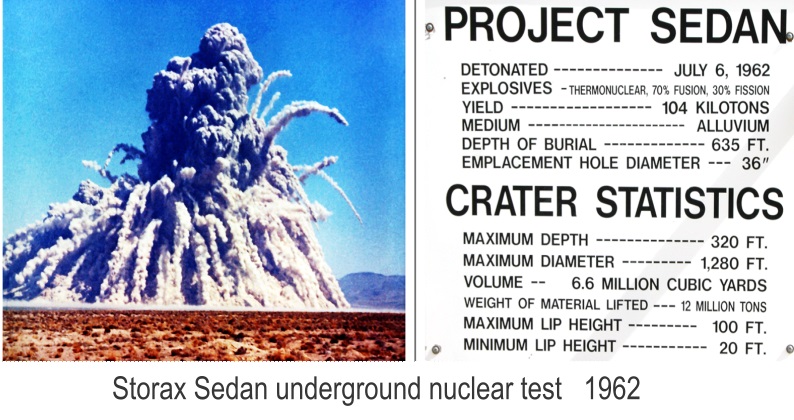
In 1996, after some international efforts to curb nuclear testing and promote disarmament, the Comprehensive Test Ban Treaty (CTBT) was negotiated, which prohibited all nuclear explosions (General Assembly 1996). Since the negotiation of the CTBT, India and Pakistan conducted three and two underground nuclear tests, respectively, in 1998. And today, North Korea stands as the only country to have tested nuclear weapons in the 21st century.
While underground nuclear tests were chosen to limit atmospheric radioactive fallout, each test still caused dynamic and complex responses within crustal formations. Mechanical effects of underground nuclear tests span from the prompt post-detonation responses to the enduring impacts resulting in radionuclide release, dispersion, and migration through the geosphere. Every test of nuclear weapons adds to a global burden of released radioactivity (Ewing 1999)…………………………………………………………………………
………………………………………………………………….. Containment failures and nuclear accidents
Underground nuclear tests are designed to limit radioactive fallout and surface effects. However, containment methods are not foolproof, and radioisotopes, which are elements with neutrons in excess making them unstable and radioactive, can leak into the surrounding environment and atmosphere, posing potential risks to ecosystems and human health.
Instances of radiation leaks were not uncommon…………………………………..
Unintended radioactive releases from underground nuclear tests occurred through venting or seeps, where fission products and radioactive materials were uncontrollably released, driven by pressure from shockwave-induced steam or gas. In rare cases, more serious nuclear accidents occurred due to incomplete geological assessments of the surrounding medium in preparation for the test. A notable example of accidental release is the Baneberry underground nuclear test on December 18, 1970, which, according to the federal government, resulted in an “unexpected and unrecognized abnormally high water content in the medium surrounding the detonation point” ……………………………………………………………………………………………
Mechanical and radiation effects of underground nuclear tests
Three main factors affect the mechanical responses of underground nuclear tests: the yield, the device placement (i.e., depth of burial, chamber geometry, and size), and the emplacement medium (i.e., rock type, water content, mineral compositions, physical properties, and tectonic structure). These factors influence the physical response of the surrounding geological formations and the extent of ground displacement, which, in turn, determine the radiation effects by influencing the timing and fate of the radioactive gas release.
Every kiloton of explosive yield produces approximately 60 grams (3 × 10¹² fission product atoms) of radionuclides (Smith 1995; Glasstone and Dolan 1977). Between 1962 and 1992, underground nuclear tests had a total explosive yield of approximately 90 megatons (Pravalie 2014), producing nearly 5.4 metric tons of radionuclides. ……………………………………………….
……………………………..The partitioning of radionuclides between the melt glass and rubble significantly impacts the subsequent transfer of radioactivity to groundwater.
…………………………Temperatures produced by large explosions can change the permeability, porosity, and water storage capacity by creating new fractures, cavities, and chimneys……………………. The explosion also affects the porosity of the surrounding rock. For example, a fully contained explosion of 12.5-kiloton yield in Degelen Mountain at the former Soviet Union’s Semipalatinsk test site resulted in up to a six-fold increase in porosity within the crush zone surrounding the cavity (Adushkin and Spivak 2015). Increased permeability and porosity of the surrounding rock can lead to more radionuclides being released, as more groundwater can pass through the geologic formation.
Hydrogeology and release of radioactivity
The main way contaminants can be moved from underground test areas to the more accessible environment is through groundwater flow. …………………………………………..
Given their long half-lives (Table 2 on original ), the ability of plutonium isotopes to migrate over time raises concerns about the long-term impacts and challenges in managing radioactive contamination.
In all these cases, colloid-facilitated transport allowed for the migration of radioactive particles through groundwater flow over an extended period—long after the nuclear tests or discharge occurred (Novikov et al. 2006). ………………………
The risks associated with the environmental contamination from underground nuclear tests have often been considered low due to the slow movement of the groundwater and the long distance that separates it from publicly accessible groundwater supplies. But these studies demonstrate that apart from prompt effect of radioactive gas releases from instantaneous changes in geologic formations, long-term effects persist due to the evolving properties of the surrounding rocks long after the tests. Long-lived radionuclides can be remarkably mobile in the geosphere. Such findings underscore the necessity for sustained long-term monitoring efforts at and around nuclear test sites to evaluate the delayed impacts of underground nuclear testing on the environment and public health.
Enduring legacy
Nearly three decades after the five nuclear-armed states under the CTBT stopped testing nuclear weapons both in the atmosphere and underground, the effects of past tests persist in various forms—including environmental contamination, radiation exposure, and socio-economic repercussions—which continue to impact populations at and near closed nuclear test sites (Blume 2022). The concerns are greater when the test sites are abandoned without adequate environmental remediation. This was the case with the Semipalatinsk test site in Kazakhstan that was left unattended after the fall of the Soviet Union in 1991, before a secret multi-million effort was made by the United States, Russia, and Kazakhstan to secure the site (Hecker 2013). The abandonment resulted in heavy contamination of soil, water, and vegetation, posing significant risks to the local populations (Kassenova 2009).
In 1990, the US Congress acknowledged the health risks from nuclear testing by establishing the Radiation Exposure Compensation Act (RECA), which provides compensation to those affected by radioactive fallout from nuclear tests and uranium mining. Still, there are limitations and gaps in coverage that leave many impacted individuals, including the “downwinders” from the Trinity test site without compensation for their radiation exposure (Blume, 2023). The Act is set to expire in July 2024, potentially depriving many individuals without essential assistance. Over the past 30 years, the RECA fund paid out approximately $2.5 billion to impacted populations (Congressional Research Service 2022). For comparison, the US federal government spends $60 billion per year to maintain its nuclear forces (Congressional Budget Office 2021).
As the effects of nuclear testing still linger, today’s generations are witnessing an increasing concern at the possibility of a new arms race and potential resumption of nuclear testing (Drozdenko 2023; Diaz-Maurin 2023). The concern is heightened by activities in China and North Korea and with Russia rescinding its ratification of the CTBT. Even though the United States maintains a moratorium on non-subcritical nuclear tests, its decision not to ratify the test ban treaty shows a lack of international leadership and commitment. As global tensions and uncertainties arise, it is critical to ensure global security and minimize the risks to humans and the environment by enforcing comprehensive treaties like the CTBT. Transparency at nuclear test sites should be promoted, including those conducting very-low-yield subcritical tests, and the enduring impacts of past nuclear tests should be assessed and addressed.
Endnotes………………………………………………………………more https://thebulletin.org/premium/2024-03/environmental-impacts-of-underground-nuclear-weapons-testing/?utm_source=Newsletter&utm_medium=Email&utm_campaign=MondayNewsletter04152024&utm_content=NuclearRisk_EnvironmentalImpactsNuclearTests_03072024
What’s Inside the President’s Nuclear Football
the creation of the Football, the president’s emergency satchel. But what about the nuclear war plans inside? And what about the Black Book? As surprising as this now seems, until 1960, several of the U.S. military branches had their own individual plans for nuclear war. What this meant was that the Army, Navy, and Air Force chiefs each had authority over a uniquely designated stockpile of nuclear weapons—including the delivery systems for those weapons and lists of targets to strike—for them to use at their own discretion in the event of nuclear war. When incoming Secretary of Defense Robert McNamara learned about these multiple, competing nuclear war plans, he ordered them integrated into a single plan. This is how the Single Integrated Operational Plan, or SIOP, got its name.
What began as the Single Integrated Operational Plan is now the Operational Plan, or OPLAN.
The Operation Plan for nuclear war is a colossal and cumbersome set of documents, too large to be carried around in the Football. Parsed down to a more manageable size, the plans become nuclear strike options as delineated in the Black Book.
plan for “mass extermination.” “evil beyond any human project ever,” “the destruction of most cities and people in the northern hemisphere.”
BY ANNIE JACOBSEN, APRIL 11, 2024 https://time.com/6965539/u-s-presidents-nuclear-footb
Jacobsen’s new book is Nuclear War: A Scenario
Nuclear threats have reemerged on the world stage. Frequently, Vladimir Putin warns the West that Russia is ready for nuclear war. “Weapons exits in order to use them,” Putin says. North Korea accuses the U.S. of having, “a sinister intention to provoke a nuclear war.” Entwined with the rising rhetoric, one physical object stands alone—the president’s emergency satchel, also known as the nuclear Football.
This bulging leather briefcase remains with the president at all times, carried by a military aide, and never more than an arm’s length away. It’s an iconic reminder of preeminent power and national mystery. A “nominally secret command-and-control system used to assure presidential control of nuclear use decisions,” historian William Burr says of the Football. Items located inside the president’s emergency satchel confirm his identity and connect him, as commander in chief, to the National Military Command Center, a nuclear bunker located beneath the Pentagon.
Also inside the Football is the Black Book. This cryptic set of documents, parsed down from a much larger operational plan for nuclear war, provides the commander in chief with nuclear launch options should policy dictate the president needs to act. This includes which targets to strike, which delivery systems to use, and the timing of action. “It’s called the Black Book because it involves so much death,” says Dr. Glen McDuff, a nuclear weapons engineer who served as the classified museum historian at Los Alamos National Laboratory in New Mexico.
The Football is with the president at all times. The first publicly-released photograph of the Football is from May 1963, at the Kennedy Family Compound in Hyannis Port, Massachusetts. It can be seen swinging from the military aide’s hand as he walks directly behind the president. The Football accompanied President Regan to the Red Square in Moscow, in 1988. When President George H.W. Bush was photographed out on jog, his military aide—also in running shorts and sneakers—can be seen just a few steps behind, carrying the iconic briefcase in her left hand.
The Football is always within a few feet of the president of the U.S. Once, when President Clinton was visiting Syria, President Hafez al-Assad’s handlers tried to prevent Clinton’s military aide from riding in an elevator with him. “We could not let that happen, and did not let that happen,” former Secret Service director Lewis Merletti says. Merletti was the special agent in charge of President Clinton’s detail at that time. “The Football must always be with the president,” he asserts. “There are no exceptions.” How the Football came to be has long been shrouded in mystery. “Its origins remain highly classified,” journalist Michael Dobbs wrote in Smithsonian Magazine in 2014. And then, just a few months ago, Los Alamos National Laboratory finally declassified the Football’s origin story. It goes like this.
One day in December 1959, a small group of officials from the Joint Committee on Atomic Energy visited a NATO base in Europe to examine joint-custody nuclear bomb protocols. The NATO pilots stationed there flew Republic F84F jets, the first U.S. Air Force fighter-bomber aircraft designed to carry nuclear bombs. Operation Reflex Action was in effect, air crews were trained and ready to strike predetermined targets in the Soviet Union in less than fifteen minutes from the call to nuclear war. One of the men on this visit was Harold Agnew, a Los Alamos scientist with a unique history.
Agnew was one of the three physicists assigned to fly on the Hiroshima bombing mission as a scientific observer. He carried a movie camera with him and took the only existing film footage of the atomic bombing of Hiroshima, as seen from the air. Now, in 1959, Agnew was at Los Alamos overseeing thermonuclear bomb tests; he later became the lab’s director. During the trip to the NATO base, Agnew noticed something that made him wary. “I observed four F84F aircraft . . . sitting on the end of a runway, each was carrying two MK 7 [nuclear] gravity bombs,” he wrote in a document declassified in 2023. What this meant was that “custody of the MK 7s was under the watchful eye of one very young U.S. Army private armed with a M1 rifle with 8 rounds of ammunition.” Agnew told his colleagues: “The only safeguard against unauthorized use of an atomic bomb was this single G.I. surrounded by a large number of foreign troops on foreign territory with thousands of Soviet troops just miles away.”
Back in the U.S., Agnew contacted a project engineer at Sandia Laboratories named Don Cotter and asked “if we could insert an electronic ‘lock’ in the [bomb’s] firing circuit that could prevent just any passerby from arming the MK 7.” Cotter got to work. He put together a demonstration of a device, a lock and coded switch, that functioned as follows: “[a] 3-digit code would be entered, a switch was thrown, the green light extinguished, and the red light illuminated indicating the arming circuit was live.”
Agnew and Cotter went to Washington, D.C., to demonstrate this locking device—first to the Joint Committee on Atomic Energy, then to the president’s top science advisor and finally to the president himself. “We presented it to President Kennedy, who ordered it be done,” Agnew recalled. The military objected. The man in charge of nuclear weapons at the time, General Alfred D. Starbird, opposed the idea. Glen McDuff, who coauthored (with Agnew) the now declassified paper on the subject, summed up the general’s documented concerns. “How is a pilot, U.S. or foreign, somewhere around the world, going to get a code from the President of the United States to arm a nuclear weapon before being overrun by a massively superior number of Soviet troops?” For the U.S. military, the locking device issue opened Pandora’s box. “If gravity bombs were coded,” McDuff explains, “why not all nuclear weapons including missile warheads, atomic demolition munitions, torpedoes, all of them.” The president decided they needed to be.
The answer came in the creation of the Football, the president’s emergency satchel. But what about the nuclear war plans inside? And what about the Black Book? As surprising as this now seems, until 1960, several of the U.S. military branches had their own individual plans for nuclear war. What this meant was that the Army, Navy, and Air Force chiefs each had authority over a uniquely designated stockpile of nuclear weapons—including the delivery systems for those weapons and lists of targets to strike—for them to use at their own discretion in the event of nuclear war. When incoming Secretary of Defense Robert McNamara learned about these multiple, competing nuclear war plans, he ordered them integrated into a single plan. This is how the Single Integrated Operational Plan, or SIOP, got its name.
Starting in December 1960, for the first time in the nuclear age, the SIOP gave the president, not the military, control of America’s nuclear arsenal. This new locking device designed by Agnew and Cotter, called a Permissive Action Link, or PAL, became an integral part of this new system. Only with the invention of the Football would the order to launch nuclear weapons—and the ability to physically arm them—come from the president alone. “This is how the president got the Football,” writes Agnew.
Over the years, the name for the nuclear war plan has changed. What began as the Single Integrated Operational Plan is now the Operational Plan, or OPLAN. For the Nuclear Information Project, in consort with the Federation of American Scientists, project director Hans Kristensen and senior researcher Matt Korda have identified the current Operational Plan as OPLAN 8010-12. It consists of “‘a family of plans’ directed against four identified adversaries: Russia, China, North Korea, and Iran,” the authors write. The Operation Plan for nuclear war is a colossal and cumbersome set of documents, too large to be carried around in the Football. Parsed down to a more manageable size, the plans become nuclear strike options as delineated in the Black Book.
The number of individuals who have written out their first-hand impressions of the SIOP is extremely limited. John Rubel, an avionics expert who served as an assistant secretary of defense under President Kennedy, wrote about the SIOP in his 2008 memoir, Doomsday Delayed. He liked it to a plan for “mass extermination.” Daniel Ellsberg reflected on the SIOP in his 2017 memoir, The Doomsday Machine: Confessions of a Nuclear War Planner. “It depicted evil beyond any human project ever,” Ellsberg wrote. A plan that calls for “the destruction of most cities and people in the northern hemisphere.”
As for the Black Book, few details exist on the public record. In 2015, U.S. Strategic Command battle watch commander Colonel Carolyn Bird shared with CNN previously unreported details. An identical Football resides inside the Stratcom nuclear bunker, viewers learned, locked in a safe beneath Offutt Air Force Base in Nebraska. “The [Black Book inside the] president’s football and our black book are duplicates,” Bird told CNN. “They contain the same information in the same way so that we are talking off the same documents when we are discussing nuclear options.”
In an interview with the History Channel, President Clinton’s former military aide, a colonel named Robert “Buzz” Patterson, likened the Black Book to a “Denny’s breakfast menu.” He made the analogy that choosing retaliatory targets from a predetermined nuclear strike list was as simple as deciding on a combination of food items at a restaurant. “It’s like picking one out of Column A and two out of Column B,” Patterson said.
Dr. Theodore Postol has seen the contents of the Black Book. His thoughts provide unsettling context to Patterson’s observations. From 1982 to 1984 Postol served as the assistant for weapons technology to the chief of naval operations. In this capacity, he worked on technical details regarding submarine launched ballistic missiles, or SLBMs. “Nitty gritty features,” Postol generalizes.
“Seeing the contents of the Black Book,” he recalls, “I was freaked out beyond belief.” Not for reasons he expected; as a weapons technologist Postol was familiar with the mass carnage involved. Instead of being confronted with a succinct summary of these horrifying facts—the targeting of cities, the death tolls in the millions—
Postol found the contents of the Black Book to be an obfuscation of the facts. The nuclear launch plans, he says, “had been sterilized down to military terminology designed to remove you from the reality of what would be happening.” An attempt at sanitizing nuclear war into a seemingly more palatable event. “My first thought,” Postol remembers, was “how would a president understand what these attack options actually mean?” This censoring of grim truths about nuclear war extends to the public as well, Postal contends. “You don’t want your population to know you’re planning genocide.”
What, if any, is the solution to this madness? Between the saber rattling and the secrecy, nuclear matters can present themselves as intractable. And yet, in reporting this story I witnessed a change in attitude from an unlikely source: the Los Alamos National Laboratory, a federal government organization that I’ve covered as a reporter for fifteen years.
“It’s the Oppenheimer effect,” Dr. Glen McDuff told me of this new attitude, “as in Oppenheimer the film.” Ever since the release of Christopher Nolan’s 2023 feature film, “the lab has been inundated with public curiosity about the bomb,” McDuff clarifies. “With requests about nuclear weapons.” And, he says, the lab has done its best to respond. The popularity of the film has renewed dialogue about the existential dangers nuclear weapons pose. And it led to the declassification (at this reporter’s behest) to one of the laboratory’s long-held secrets—the origin story of the Football.
Were the President of the United States to be called upon to open the Football, the situation that would follow would almost certainly spiral out of control. “The world could end in the next couple of hours,” former Stratcom commander General C. Robert Kehler (ret) says of nuclear war.
Nuclear war is the only scenario other than an asteroid strike that could end civilization in a matter hours. The soot from burning cities and forests will blot out the sun and cause a nuclear winter. State-of the art climate modeling predicts five billion humans will die. In the words of Nikita Khrushchev, “the survivors will envy the dead.”
And yet, threats abound. Vladimir Putin insists he is “not bluffing” about the possibility of using weapons of mass destruction. North Korea has test launched more than 100 missiles since January 2022, including nuclear-capable weapons that can hit the U.S. United Nations Secretary General António Guterres warns the world, “Humanity is one misunderstanding, one miscalculation away from nuclear annihilation.” The world balances on the razor’s edge. “This is madness,” Guterres says, “we must reverse course.” Change is possible. Help reverse course. “A nuclear war cannot be won and must never be fought,” President Ronald Reagan and Soviet General Secretary Mikhail Gorbachev cautioned the world in a joint statement in 1985. Conversations between these two leaders led to the reduction in nuclear weapons from an all-time high of 70,481 warheads, to some 12,500 today. Dialogue matters. Join the conversation about nuclear weapons now, while we are all still able to have one.
Spent nuclear fuel mismanagement poses a major threat to the United States. Here’s how.
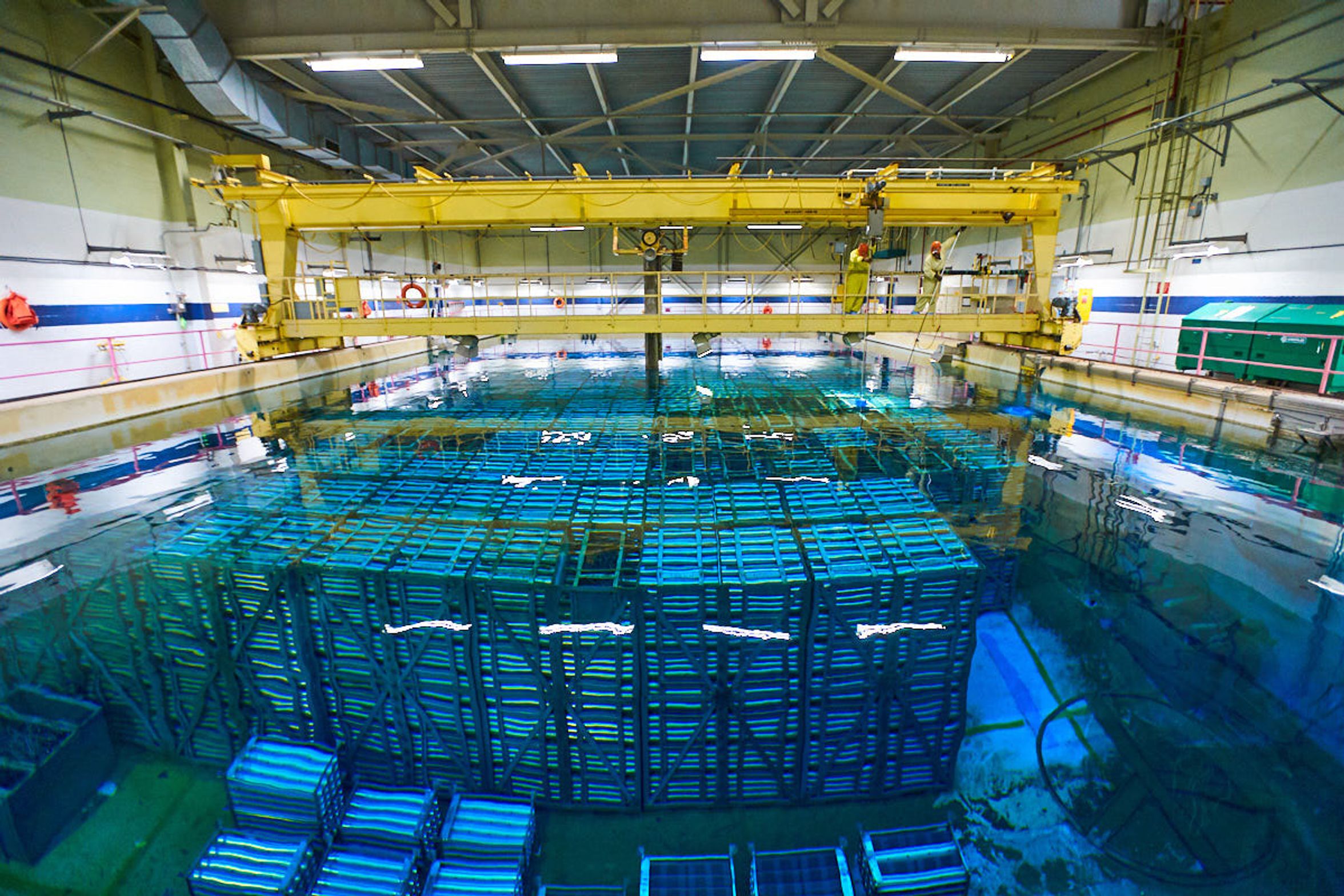
Restricting its analyses to a severe earthquake scenario allowed the NRC to help allay public fears over the dangers of spent fuel pool accidents. There is good reason to question whether severe earthquakes pose the greatest threat to spent fuel pools.
Solar storms, physical attacks, and cyberattacks have the potential to cause a nightmare scenario …….
Bulletin, By Mark Leyse | April 2, 2024
Irradiated fuel assemblies—essentially bundles of fuel rods with zirconium alloy cladding sheathing uranium dioxide fuel pellets—that have been removed from a nuclear reactor (spent fuel) generate a great deal of heat from the radioactive decay of the nuclear fuel’s unstable fission products. This heat source is termed decay heat. Spent fuel is so thermally hot and radioactive that it must be submerged in circulating water and cooled in a storage pool (spent fuel pool) for several years before it can be moved to dry storage.
The dangers of reactor meltdowns are well known. But spent fuel can also overheat and burn in a storage pool if its coolant water is lost, thereby potentially releasing large amounts of radioactive material into the air. This type of accident is known as a spent fuel pool fire or zirconium fire, named after the fuel cladding. All commercial nuclear power plants in the United States—and nearly all in the world—have at least one spent fuel pool on site. A fire at an overloaded pool (which exist at many US nuclear power plants) could release radiation that dwarfs what the Chernobyl nuclear accident emitted.
Many analysts see very rare, severe earthquakes as the greatest threat to spent fuel pools; however, another far more likely event could threaten US nuclear sites: a widespread collapse of the power grid system. Such a collapse could be triggered by a variety of events, including solar storms, physical attacks, and cyberattacks—all of which are known, documented possibilities. Safety experts have warned for decades about the dangers of overloading spent fuel pools, but the Nuclear Regulatory Commission and Congress have refused to act.
The threat of overloaded spent fuel pools. Spent fuel pools at US nuclear plants are almost as densely packed with nuclear fuel as operating reactors—a hazard that has existed for decades and vastly increases the odds of having a major accident.
Spent fuel assemblies could ignite—starting a zirconium fire—if an overloaded pool were to lose a sizable portion or all of its coolant water. In a scenario in which coolant water boils off, uncovered zirconium cladding of fuel assemblies may overheat and chemically react with steam, generating explosive hydrogen gas. A substantial amount of hydrogen would almost certainly detonate, destroying the building that houses the spent fuel pool. (Only a small quantity of energy is required to ignite hydrogen gas, including electric sparks from equipment. It is speculated a ringing telephone initiated a hydrogen explosion that occurred during the Three Mile Island accident in 1979.)
A zirconium fire in an exposed spent fuel pool would have the potential to emit far more radioactive cesium 137 than the Chernobyl accident released. (The US Nuclear Regulatory Commission (NRC) has conducted analyses that found a zirconium fire at a densely packed pool could release as much as 24 megacuries of cesium 137; the Chernobyl accident is estimated to have released 2.3 megacuries of cesium 137.) Such a disaster could contaminate thousands of square miles of land in urban and rural areas, potentially exposing millions of people to large doses of ionizing radiation, many of whom could die from early or latent cancer.
In contrast, if a thinly packed pool were deprived of coolant water, its spent fuel assemblies would likely release about 1 percent of the radioactive material predicted to be released by a zirconium fire at a densely packed pool. A thinly packed pool has a much smaller inventory of radioactive material than a densely packed pool; it also contains much less zirconium. If such a limited amount of zirconium were to react with steam, most likely too little hydrogen would be generated to threaten the integrity of the spent fuel pool building.
After being cooled under water for a minimum of three years, spent fuel assemblies can be transferred from pools to giant, hermetically sealed canisters of reinforced steel and concrete that shield plant workers and the public from ionizing radiation. This liquid-free method of storage, which cools the spent fuel assemblies by passive air convection, is called “dry cask storage.”

A typical US storage pool for a 1,000-megawatt-electric reactor contains from 400 to 500 metric tons of spent fuel assemblies. (Dry casks can store 10 to 15 tons of spent fuel assemblies, so each cask contains a far lower amount of radioactive material than a storage pool.) Reducing the total inventories of spent fuel assemblies stored in US spent fuel pools by roughly 70 to 80 percent reduces their amount of radioactive cesium by about 50 percent. And the heat load in each pool drops by about 25 to 30 percent. With low-density storage, a pool’s spent fuel assemblies are separated from each other to an extent that greatly improves their ability to be cooled by air convection in the event that the pool loses its coolant water. Moreover, a dry cask storage area, which has passive cooling, is less vulnerable to either accidents or sabotage than a spent fuel pool.
In the aftermath of the March 2011 Fukushima Daiichi accident in Japan, in which there was a risk of spent fuel assemblies igniting, the NRC considered forcing US utilities to expedite the transfer of all sufficiently-cooled spent fuel assemblies stored in overloaded pools to dry cask storage. The NRC decided against implementing such a safety measure.
To help justify its decision, the NRC chose to analyze only one scenario that might lead to a zirconium fire: a severe earthquake. In 2014, the NRC claimed that a severe earthquake with a magnitude “expected to occur once in 60,000 years” is the prototypical initiating event that would lead to a zirconium fire in a boiling water reactor’s spent fuel pool.
The NRC’s 2014 study concluded that the type of earthquake it selected for its analyses would cause a zirconium fire and a large radiological release to occur at a densely packed spent fuel pool once every nine million years (or even less frequently). Restricting its analyses to a severe earthquake scenario allowed the NRC to help allay public fears over the dangers of spent fuel pool accidents. (At the time of the Fukushima Daiichi accident, the New York Times and other news outlets warned that a zirconium fire could break out in the plant’s Unit 4 spent fuel pool, causing global public concern.)
There is good reason to question whether severe earthquakes pose the greatest threat to spent fuel pools. A widespread collapse of the US power grid system that would last for a period of months to years—estimated to occur once in a century—may be far more likely to lead to a zirconium fire than a severe earthquake. The prospect that a widespread, long-term blackout will occur within the next 100 years should prompt US utilities to expedite the transfer of spent fuel from pools to dry cask storage. Utilities in other nations, including in Japan, that have overloaded pools should follow suit.
Solar storms, physical attacks, and cyberattacks have the potential to cause a nightmare scenario in which the US power grid collapses, along with other vital infrastructures—leading to reactor meltdowns and spent fuel pool fires, whose radioactive emissions would aggravate the disaster.
Vulnerability to solar storms……………………………………………………………………………………………………………………..
Vulnerability to physical attacks.……………………………………………………………………………………………………….
Vulnerability to cyberattacks. …………………………………………………………………………………………………………….
Insufficient public safety.…………………………………………………………………………………….
Overloading spent fuel pools should be outlawed. Safety analysts have warned about the dangers of overloading spent fuel pools since the 1970s. For decades, experts and organizations have argued that in order to improve safety, sufficiently cooled spent fuel assemblies should be removed from high-density spent fuel pools and transferred to passively cooled dry cask storage. Sadly, the NRC has not heeded their advice.
In the face of the NRC’s inaction, Sen. Edward Markey of Massachusetts introduced The Dry Cask Storage Act in 2014, calling for the thinning out of spent fuel pools. The act, which Senator Markey has reintroduced in subsequent congressional sessions, has not passed into law.
The relatively high probability of a nationwide grid collapse, which would lead to multiple nuclear disasters, emphasizes the need to expedite the transfer of spent fuel to dry cask storage. According to Frank von Hippel, a professor of public and international affairs emeritus at Princeton University, the impact of a single accident at an overstocked spent fuel pool has the potential to be two orders of magnitude more devastating in terms of radiological releases than the three Fukushima Daiichi meltdowns combined. If the US grid collapses for a lengthy period of time, society would likely descend into chaos, as uncooled nuclear fuel burned at multiple sites and spewed radioactive plumes into the environment.
The value of preventing the destruction of US society and untold human suffering is incalculable. So, on the issue of protecting people and the environment from spent fuel pool fires, it is surprising when one learns that promptly transferring the nationwide inventories of spent fuel assemblies that have been cooled for at least five years from US pools to dry cask storage would be “relatively inexpensive”—less than (in 2012 dollars) a total of $4 billion ($5.4 billion in today’s dollars). That is far, far less than the monetary toll of losing vast tracts of urban and rural land for generations to come because of radioactive contamination.
One should also consider that plant owners are required, as part of the decommissioning process, to transfer spent fuel assemblies from storage pools to dry cask storage after nuclear plants are permanently shut down. So, in accordance with industry protocols, all spent fuel assemblies at plant sites are intended to eventually be placed in dry cask storage (before ultimately being transported to a long-term surface storage site or a permanent geologic repository). https://thebulletin.org/2024/04/spent-nuclear-fuel-mismanagement-poses-a-major-threat-to-the-united-states-heres-how/
UK Court Gives Biden Chance to Dodge Assange Appeal by “Assuring” His Rights
The WikiLeaks publisher could be extradited if the US gives “satisfactory assurances” of rights and no death penalty.
By Marjorie Cohn , TRUTHOUT 29 Mar 24, https://truthout.org/articles/uk-gives-biden-opportunity-to-dodge-assange-appeal-by-assuring-his-rights/
WikiLeaks publisher Julian Assange is closer than ever to being extradited to the United States for trial on 17 counts under the Espionage Act and one count of conspiracy to commit computer intrusion over WikiLeaks’s 2010-2011 revelation of evidence of U.S. war crimes in Iraq, Afghanistan and Guantánamo Bay. He faces 175 years in prison.
“This is a signal to all of you that if you expose the interests that are driving war they will come after you, they will put you in prison and they will try to kill you,” said Stella Assange, Julian’s wife, of his prosecution.
On March 26, the United Kingdom Divisional Court denied Assange the opportunity to make most of his appellate arguments. But the two-judge panel of Justice Jeremy Johnson and Dame Victoria Sharp left open the possibility that Assange could appeal on three grounds. They found that Assange “has a real prospect of success” on the following issues: If extradited to the U.S., he will be denied the right to freedom of expression, will suffer discrimination because he’s not a U.S. citizen and could be sentenced to death.
Rather than simply allowing Assange to argue the three issues on appeal, however, the panel gave the Biden administration an out. If the U.S. provides the court with “satisfactory assurances” that Assange won’t be denied any of these rights, his extradition to the U.S. can proceed without an appeals hearing.
Stella Assange called the decision “astounding,” adding, “The court’s recognized that Julian has been exposed to flagrant denial of his freedom of expression rights, that he is being discriminated against on the basis of his nationality and that he remains exposed to the death penalty.”
At an earlier stage in this case, the U.S. gave the U.K. High Court “assurances” that Assange would be treated humanely if extradited. That caused the court to reverse the magistrate judge’s denial of extradition (which was based on the likelihood of suicide if Assange is held in harsh conditions of confinement in the U.S.). The High Court accepted those assurances at face value in spite of the U.S.’s history of reneging on similar assurances.
The current ruling, however, requires U.S. assurances to be “satisfactory” and the defense will have an opportunity to challenge them at a hearing.
“Mr. Assange will not, therefore, be extradited immediately,” the panel wrote, implying that if they had denied his appeal outright, the U.K. authorities would put him on a plane to the U.S. forthwith. They gave the U.S. three weeks to come forward with satisfactory assurances.
If the U.S. fails to provide any assurances, Assange will be granted a hearing on the three grounds. If the U.S. does give assurances, a hearing to decide whether they are satisfactory will occur on May 20.
“The Biden administration should not offer assurances. They should drop this shameful case that should never have been brought,” Stella Assange said.
These are the grounds the High Court will review if the U.S. fails to provide “satisfactory assurances”:
1. Extradition Would Violate Freedom of Expression Guaranteed by Article 10 of European Convention on Human Rights
Assange would argue at trial that his actions were protected by the First Amendment to the U.S. Constitution. “He contends that if he is given First Amendment rights, the prosecution will be stopped. The First Amendment is therefore of central importance to his defence,” the panel concluded.
The First Amendment provides “strong protection” to freedom of expression, similar to that provided by Article 10 of the European Convention on Human Rights, the panel noted. Article 10 (1) of the convention says, “Everyone has the right to freedom of expression. This right shall include freedom to hold opinions and to receive and impart information and ideas without interference by public authority and regardless of frontiers.”
Gordon Kromberg, assistant U.S. attorney in the Eastern District of Virginia, where Assange’s trial would be held, said the prosecution might argue at trial that “foreign nationals are not entitled to protections under the First Amendment,” the panel noted. In 2017, then-CIA Director Mike Pompeo said that Assange “has no First Amendment freedoms” because “he is not a U.S. citizen.”
In addition, the U.S. Supreme Court ruled in the 2020 case of Agency for International Development v. Alliance for Open Society International that “it is long settled as a matter of American constitutional law that foreign citizens outside United States territory do not possess rights under the US Constitution.”
The panel wrote that if Assange “is not permitted to rely on the First Amendment, then it is arguable that his extradition would be incompatible with article 10 of the Convention.”
But even if the U.S. Department of Justice prosecutors give “satisfactory assurances” that Assange’s First Amendment rights would be protected, that is no guarantee. Prosecutors are part of the executive branch, which cannot bind the judicial branch due to the constitutional doctrine of separation of powers.
“The ruling reveals that the High Court does not understand the American system of government,” Stephen Rohde, who practiced First Amendment law for almost 50 years and writes extensively about the Assange case, told Truthout. “It only has before it the executive branch of the U.S. government. Whatever ‘satisfactory assurances’ the Department of Justice may give the High Court, they are not binding on the judicial branch.”
Moreover, Rohde said, “The High Court is obligated to uphold Assange’s rights to ‘freedom of expression’ under Article 10 of the European Convention on Human Rights, which protects Assange even if the U.S. courts refuse to do so. The only way to do that is to deny extradition.”
2. The U.K. Extradition Act Forbids Discrimination Based on Nationality
Julian Assange is an Australian citizen who would be tried in the U.S. if the Biden administration’s pursuit of extradition is successful.
Section 81(b) of the U.K. Extradition Act says that extradition is barred for an individual who “might be prejudiced at his trial or punished, detained or restricted in his personal liberty by reason of his … nationality.”
Due to the centrality of the First Amendment to Assange’s defense, the panel noted, “If he is not permitted to rely on the First Amendment because of his status as a foreign national, he will thereby be prejudiced (potentially very greatly prejudiced) by reason of his nationality.”
3. Extradition Is Barred by Inadequate Death Penalty Protection Required by the Extradition Act
Section 94 of the U.K. Extradition Act says, “The Secretary of State must not order a person’s extradition … if he could be, will be or has been sentenced to death for the offence” in the receiving state. That limitation does not apply if a written “assurance” that is “adequate” says “that a sentence of death- (a) will not be imposed, or (b) will not be carried out (if imposed).”
None of the charges that Assange is currently facing carry the death penalty. But if extradited to the U.S., he could be charged with aiding and abetting treason or espionage, both of which are capital offenses.
Ben Watson KC, secretary of state for the Home Department, admitted that:
a.) The facts alleged against [Assange] could sustain a charge of aiding or abetting treason, or espionage.
b.) If [Assange] is extradited, there is nothing to prevent a charge of aiding or abetting treason, or a charge of espionage, from being added to the indictment.
c.) The death penalty is available on conviction for aiding or abetting treason, or espionage.
d.) There are no arrangements in place to prevent the imposition of the death penalty.
e.) The existing assurance does not explicitly prevent the imposition of the death.
The panel noted that when former President Donald Trump was asked about WikiLeaks publishing the leaked documents, he said, “I think it was disgraceful…. I think there should be like a death penalty or something.” If Trump is reelected, he may seek to ensure that his Justice Department adds capital charges to the indictment.
In concluding that Assange could raise this issue on appeal subject to “satisfactory assurances,” the panel cited “the potential, on the facts, for capital charges to be laid; the calls for the imposition of the death penalty by leading politicians and other public figures; the fact that the Treaty does not preclude extradition for death penalty charges, and the fact that the existing assurance does not explicitly cover the death penalty.”
Appeal Grounds Denied by Panel
Remaining grounds for appeal that Assange requested were denied by the panel. They include prosecution for a political offense, prosecution based on political opinion; violation of right to a fair trial; violation of right to life; and violation of right to be free from torture and inhuman or degrading treatment or punishment. In addition, since no publisher has ever been prosecuted under the Espionage Act for publishing government secrets, Assange could not have known it was a crime.
The panel also ruled that Assange could not introduce new evidence adduced after the magistrate judge’s ruling. This includes a Yahoo News report detailing the CIA’s plan to kidnap and kill Assange when he was living under a grant of asylum in the Ecuadorian Embassy in London.
If the U.S. offers “satisfactory assurances” and extradition is ordered, Assange could appeal to the European Court of Human Rights and raise these additional issues as well.
Meanwhile, there is a possibility that instead of filing “assurances,” the Biden administration will opt to avoid the political pitfalls of Assange’s extradition to the U.S. and offer a plea bargain to end the case.
Marjorie Cohn is professor emerita at Thomas Jefferson School of Law, former president of the National Lawyers Guild, and a member of the national advisory boards of Assange Defense and Veterans For Peace, and the bureau of the International Association of Democratic Lawyers. She is founding dean of the People’s Academy of International Law and the U.S. representative to the continental advisory council of the Association of American Jurists. Her books include Drones and Targeted Killing: Legal, Moral and Geopolitical Issues.
Chris Hedges: A Genocide Foretold
Minister of Heritage Amichai Eliyahu supported using nuclear weapons on Gaza as “one of the possibilities.”
By Chris Hedges https://scheerpost.com/2024/03/31/chris-hedges-a-genocide-foretold/–
The genocide in Gaza is the final stage of a process begun by Israel decades ago. Anyone who did not see this coming blinded themselves to the character and ultimate goals of the apartheid state.
There are no surprises in Gaza. Every horrifying act of Israel’s genocide has been telegraphed in advance. It has been for decades. The dispossession of Palestinians of their land is the beating heart of Israel’s settler colonial project. This dispossession has had dramatic historical moments — 1948 and 1967 — when huge parts of historic Palestine were seized and hundreds of thousands of Palestinians were ethnically cleansed. Dispossession has also occurred in increments — the slow-motion theft of land and steady ethnic cleansing in the West Bank, including East Jerusalem.
The incursion on Oct. 7 into Israel by Hamas and other resistance groups, which left 1,154 Israelis, tourists and migrant workers dead and saw about 240 people taken hostage, gave Israel the pretext for what it has long craved — the total erasure of Palestinians.
Israel has razed 77 percent of healthcare facilities in Gaza, 68 percent of telecommunication infrastructure, nearly all municipal and governmental buildings, commercial, industrial and agricultural centers, almost half of all roads, over 60 percent of Gaza’s 439,000 homes, 68 percent of residential buildings — the bombing of the Al-Taj tower in Gaza City on Oct. 25, killed 101 people, including 44 children and 37 women, and injured hundreds — and obliterated refugee camps. The attack on the Jabalia refugee camp on Oct. 25 killed at least 126 civilians, including 69 children, and injured 280. Israel has damaged or destroyed Gaza’s universities, all of which are now closed, and 60 percent of other educational facilities, including 13 libraries. It has also destroyed at least 195 heritage sites, including 208 mosques, churches, and Gaza’s Central Archives that held 150 years of historical records and documents.
Israel’s warplanes, missiles, drones, tanks, artillery shells and naval guns daily pulverize Gaza — which is only 20 miles long and five miles wide — in a scorched earth campaign unlike anything seen since the war in Vietnam. It has dropped 25,000 tons of explosives — equivalent to two nuclear bombs — on Gaza, many targets selected by Artificial Intelligence. It drops unguided munitions (“dumb bombs”) and 2000-pound “bunker buster” bombs on refugee camps and densely packed urban centers as well as the so-called “safe zones” — 42 percent of Palestinians killed have been in these “safe zones” where they were instructed by Israel to flee. Over 1.7 million Palestinians have been displaced from their homes, forced to find refuge in overcrowded UNRWA shelters, hospital corridors and courtyards, schools, tents or the open air in south Gaza, often living next to fetid pools of raw sewage.
Israel has killed at least 32,705 Palestinians in Gaza, including 13,000 children and 9,000 women. This means Israel is slaughtering as many as 187 people a day including 75 children. It has killed 136 journalists, many, if not most of them deliberately targeted. It has killed 340 doctors, nurses and other health workers — four percent of Gaza’s healthcare personnel. These numbers do not begin to reflect the actual death toll since only those dead registered in morgues and hospitals, most of which no longer function, are counted. The death toll, when those who are missing are counted, is well over 40,000.
Doctors are forced to amputate limbs without anesthetic. Those with severe medical conditions — cancer, diabetes, heart disease, kidney disease — have died from lack of treatment or will die soon. Over a hundred women give birth every day, with little to no medical care. Miscarriages are up by 300 percent. Over 90 percent of the Palestinians in Gaza suffer from severe food insecurity with people eating animal feed and grass. Children are dying of starvation. Palestinian writers, academics, scientists and their family members have been tracked and assassinated. Over 75,000 Palestinians have been wounded, many of whom will be crippled for life.
“Seventy percent of recorded deaths have consistently been women and children,” writes Francesca Albanese, the Special Rapporteur on the situation of human rights in the Palestinian Territory occupied since 1967, in her report issued on March 25. “Israel failed to prove that the remaining 30 percent, i.e. adult males, were active Hamas combatants — a necessary condition for them to be lawfully targeted. By early-December, Israel’s security advisors claimed the killing of ‘7,000 terrorists’ in a stage of the campaign when less than 5,000 adult males in total had been identified among the casualties, thus implying that all adult males killed were ‘terrorists.’”
Israel plays linguistic tricks to deny anyone in Gaza the status of civilians and any building – including mosques, hospitals and schools – protected status. Palestinians are all branded as responsible for the attack on Oct. 7 or written off as human shields for Hamas. All structures are considered legitimate targets by Israel because they are allegedly Hamas command centers or said to harbor Hamas fighters.
These accusations, Albanese writes, are a “pretext” used to justify “the killing of civilians under a cloak of purported legality, whose all-enveloping pervasiveness admits only of genocidal intent.”
In scale we have not seen an assault on the Palestinians of this magnitude, but all these measures – the killing of civlians, dispossession of land, arbitrary detention, torture, disappearances, closures imposed on Palestinians towns and villages, house demolitions, revoking residence permits, deportation, destruction of the infrastructure that maintains civil society, military occupation, dehumanizing language, theft of natural resources, especially aquifers — have long defined Israel’s campaign to eradicate Palestinians.
The occupation and genocide would not be possible without the U.S. which gives Israel $3.8 billion in annual military assistance and is now sending another $2.5 billion in bombs, including 1,800 MK84 2,000-pound bombs, 500 MK82 500-pound bombs and fighter jets to Israel. This, too, is our genocide.
The genocide in Gaza is the culmination of a process. It is not an act. The genocide is the predictable denouement of Israel’s settler colonial project. It is coded within the DNA of the Israeli apartheid state. It is where Israel had to end up.
Zionist leaders are open about their goals.
Israeli Minister of Defense Yoav Gallant, after Oct. 7, announced that Gaza would receive “no electricity, no food, no water, no fuel.” Israeli Minister of Foreign Affairs Israel Katz said: “Humanitarian aid to Gaza? No electrical switch will be turned on, no water hydrant will be opened.” Avi Dichter, the Minister of Agriculture, referred to Israel’s military assault as “the Gaza Nakba,” referencing the Nakba, or “catastrophe”, which between 1947 and 1949, drove 750,000 Palestinians from their land and saw thousands massacred by Zionist militias. Likud member of the Israeli Knesset Revital Gottlieb posted on her social media account: “Bring down buildings!! Bomb without distinction!!…Flatten Gaza. Without mercy! This time, there is no room for mercy!” Not to be outdone, Minister of Heritage Amichai Eliyahu supported using nuclear weapons on Gaza as “one of the possibilities.”
The message from the Israeli leadership is unequivocal. Annihilate the Palestinians the same way we annihilated Native Americans, the Australians annihilated the First Nations peoples, the Germans annihilated the Herero in Namibia, the Turks annihilated Armenians and the Nazis annihilated the Jews.
The specifics are different. The process is the same.
We cannot plead ignorance. We know what happened to the Palestinians. We know what is happening to the Palestinians. We know what will happen to the Palestinians.
But it is easier to pretend. Pretend Israel will allow in humanitarian aid. Pretend there will be a ceasefire. Pretend Palestinians will return to their destroyed homes in Gaza. Pretend Gaza will be rebuilt. Pretend the Palestinian Authority will administer Gaza. Pretend there will be a two-state solution. Pretend there is no genocide.
The genocide, which the U.S. is funding and sustaining with weapons shipments, says something not only about Israel, but about us, about Western civilization, about who we are as a people, where we came from and what defines us. It says that all our vaunted morality and respect for human rights is a lie. It says that people of color, especially when they are poor and vulnerable, do not count. It says their hopes, dreams, dignity and aspirations for freedom are worthless. It says we will ensure global domination through racialized violence.
This lie — that Western civilization is predicated on “values” such as respect for human rights and the rule of law — is one the Palestinians, and all those in the Global South, as well as Native Americans and Black and Brown Americans have known for centuries. But, with the Gaza genocide live streamed, this lie is impossible to sustain.
We do not halt Israel’s genocide because we are Israel, infected with white supremacy and intoxicated by our domination of the globe’s wealth and the power to obliterate others with our industrial weapons. Remember The New York Times columnist Thomas Friedman telling Charlie Rose on the eve of the war in Iraq that American soldiers should go house to house from Basra to Baghdad and say to Iraqis “suck on this?” That is the real credo of the U.S. empire.
The world outside of the industrialized fortresses in the Global North is acutely aware that the fate of the Palestinians is their fate. As climate change imperils survival, as resources become scarce, as migration becomes an imperative for millions, as agricultural yields decline, as costal areas are flooded, as droughts and wild fires proliferate, as states fail, as armed resistance movements rise to battle their oppressors along with their proxies, genocide will not be an anomaly. It will be the norm. The earth’s vulnerable and poor, those Frantz Fanon called “the wretched of the earth,” will be the next Palestinians.
Man blames nuclear meltdown for deformities in city more radioactive than Chernobyl

Ozersk – code named City 40 – was the birthplace of the Soviet nuclear weapons programme, now it’s one of the most contaminated places on the planet with residents exposed to high radiation levels.
By Kelly Williams, Assistant News Editor (Live) https://www.dailystar.co.uk/news/world-news/man-blames-nuclear-meltdown-deformities-32405120
A man living in a secret city five times more radioactive than Chernobyl has been left with facial deformities he blames on huge nuclear meltdowns.
Vakil Batirshin has massively swollen lymph nodes said to be caused by radiation-related illness. He lives in Ozersk – code named City 40 in Russia – which was built in total secrecy around the huge Mayak nuclear power plant by the Soviets in 1946.
For the first eight years after City 40 was built, Ozersk residents were forbidden from communicating with the outside world. Like Chernobyl, it was designed as a place to house the scientists working at the plant who – unbeknownst to the world – were leading the Soviet Union’s nuclear weapons programme during the Cold War era.
Locals were told they were “the nuclear shield and saviours of the world,” and everyone on the outside was an enemy.
They also kept it a secret that the extreme exposure to radiation was affecting the health of the city’s inhabitants. They started to get sick and die and the authorities were clandestine about the mortality rate.
However, the city’s graveyard with all its young victims tells the story.
Ozersk, nicknamed “The graveyard of the Earth,” was surrounded by guarded gates and barbed wire fences and did not appear on any maps.
Its inhabitants’ identities were also erased from the Soviet census to guard their secret.
The Mayak nuclear plant went through Russia’s biggest nuclear disaster when the facility allegedly dumped 200million curies worth of radioactive material into the environment around Ozersk.
The residents also suffered the Kyshtym disaster in 1957, the worst nuclear disaster the world had seen before Chernobyl.
Radiation bathed the city when a cooling system exploded at Mayak with the force of 100 tons of dynamite.
One of the nearby lakes has been so heavily contaminated by plutonium that locals have renamed it the “Lake of Death” or “Plutonium Lake”.
In an interview which resurfaced earlier this week on X (formerly Twitter), Vakil Batirshin struggles to speak, his neck is painfully swollen from lymph nodes that have grown to triple their normal size.
His exact diagnosis remains steeped in mystery as doctors say it can be hard to trace any one condition to radiation.
But asked if he has any doubt his symptoms are related to radioactivity, he said: “Well, when I lived in my home village, I didn’t have anything. Everything was great.
“When I came here, it all started.”
Another resident, Gilani Dambaev is riddled with diseases doctors think are linked to a lifetime’s exposure to excessive radiation. He and his family have government-issued cards identifying them as residents of radiation-tainted territory.
He said: “Sometimes they would put up signs warning us not to swim in the river, but they never said why. After work, we would go swimming in the river. The kids would too.”
Although the secret is now out and Ozyorsk resembles “a suburban 1950s American town” according to The Guardian, residents know their water is contaminated, their crops are poisoned, and their children may be sick.
Half a million people in Ozersk and its surrounding area are said to have been exposed to five times as much radiation as those living in the areas of Ukraine affected by the Chernobyl nuclear accident.
But most refused to leave, because while the Soviet population were suffering from famine and living in extreme poverty, the city was regarded as a paradise as authorities gave them private apartments, plenty of food, good schools and healthcare, and a plethora of entertainment and cultural activities.
Even still, residents opt against leaving. The Guardian reported that “it is prestigious to live in Ozersk.”
Residents describe it as a town of “intellectuals”, where they are used to getting “the best of everything for free”.
Living in Mayak’s nuclear shadow and resigned to her fate, one said: “I don’t hope for anything anymore. If we get sick, we get sick.”
Some locals, however, claim that long term dumping by the nuclear plant’s management continues today.
The government has started resettling residents to new homes away from the river, but the process only began in 2008.
1 This Month
10 March A LIVE WEBINAR THE REAL EFFECTS OF NUCLEAR POWER
What the Industry Isn’t Telling Us
1:00 PM Mountain, 2 pm Central, 3 pm Eastern. Live on the Keepers of the Water Facebook page



18 March Webinar @ 1 PM EST: An Assessment of SMR Projects: The Case of Canada
register for the zoom:
https://us02web.zoom.us/webinar/register/WN_o8BIIOUvQ2ONJR1nta65DQ#/registration


of the week – STOP SMALL MODULAR REACTORS IN CANADA
To see nuclear-related stories in greater depth and intensity – go to https://nuclearinformation.wordpress.com
-
Archives
- March 2026 (109)
- February 2026 (268)
- January 2026 (308)
- December 2025 (358)
- November 2025 (359)
- October 2025 (376)
- September 2025 (258)
- August 2025 (319)
- July 2025 (230)
- June 2025 (348)
- May 2025 (261)
- April 2025 (305)
-
Categories
- 1
- 1 NUCLEAR ISSUES
- business and costs
- climate change
- culture and arts
- ENERGY
- environment
- health
- history
- indigenous issues
- Legal
- marketing of nuclear
- media
- opposition to nuclear
- PERSONAL STORIES
- politics
- politics international
- Religion and ethics
- safety
- secrets,lies and civil liberties
- spinbuster
- technology
- Uranium
- wastes
- weapons and war
- Women
- 2 WORLD
- ACTION
- AFRICA
- Atrocities
- AUSTRALIA
- Christina's notes
- Christina's themes
- culture and arts
- Events
- Fuk 2022
- Fuk 2023
- Fukushima 2017
- Fukushima 2018
- fukushima 2019
- Fukushima 2020
- Fukushima 2021
- general
- global warming
- Humour (God we need it)
- Nuclear
- RARE EARTHS
- Reference
- resources – print
- Resources -audiovicual
- Weekly Newsletter
- World
- World Nuclear
- YouTube
-
RSS
Entries RSS
Comments RSS
 nuclear-news