Record world investment in renewable energy, except for Australia, of course
2014 a record-breaking year for renewables — except Australia of course, Independent Australia Anthony M Horton 26 June 2015 The latest REPN report shows renewable energy is now indisputably the world’s new economic powerhouse. Dr Anthony M Hortonwarns Abbott that Australia will be left behind in the wake.
The latest report from the Renewable Energy Policy Network (REPN) released 18 June 2015 has shown that 2014 was a record breaking year for renewable energy around the globe (but not in Australia).
New investment exceeded US$300 billion, and renewables now contribute nearly 28 per cent of generating capacity.
Solar PV capacity has increased 48 fold over the last decade and wind capacity has increased 8 fold. In contrast to these remarkable growth figures, Australia continues to languish with investment and jobs in the renewable sector slashed as a result of ongoing RET reviews.
Renewable energy is now regarded as the new economic powerhouse around the world and is attracting investment and providing employment. It is now increasingly likely that those countries that embrace this renewable “wave” are going to leave those that don’t in their wake…………….https://independentaustralia.net/environment/environment-display/2014-a-record-breaking-year-for-renewables–except-australia-of-course,7864
Nuclear power – the economic and safety facts
 The Truth About Nuclear Power emphasizes the economic and safety aspects by showing that
- modern nuclear power plants are uneconomic to operate compared to natural gas and wind energy,
- they produce preposterous pricing if they are the sole power source for a grid,
- they cost far too much to construct,
- use far more water for cooling, 4 times as much, than better alternatives,
- nuclear fuel makes them difficult to shut down and requires very costly safeguards,
- they are built to huge scale of 1,000 to 1,600 MWe or greater to attempt to reduce costs via economy of scale,
- an all-nuclear grid will lose customers to self-generation,
- smaller and modular nuclear plants have no benefits due to reverse economy of scale,
- large-scale plants have very long construction schedules even without lawsuits that delay construction,
- nuclear plants do not reach 50 or 60 years life because they require costly upgrades after 20 to 30 years that do not always perform as designed,
- France has 85 percent of its electricity produced via nuclear power but it is subsidized, is still almost twice as expensive as prices in the US, and is only viable due to exporting power at night rather than throttling back the plants during low demand,
- nuclear plants cannot provide cheap power on small islands,
- US nuclear plants are heavily subsidized but still cannot compete,
- projects are cancelled due to unfavorable economics, reactor vendors are desperate for sales, nuclear advocates tout low operating costs and ignore capital costs, nuclear utilities never ask for a rate decrease when building a new nuclear plant, and high nuclear costs are buried in a large customer base,
- safety regulations are routinely relaxed to allow the plants to continue operating without spending the funds to bring them into compliance,
- many, many near-misses occur each year in nuclear power, approximately one every 3 weeks,
- safety issues with short term, and long-term, storage of spent fuel,
- safety hazards of spent fuel reprocessing,
- health effects on people and other living things,
- nuclear disaster at Chernobyl, nuclear meltdown at Three Mile Island,
- nuclear meltdowns at Fukushima,
- nuclear meltdowns at Fukushima,
- near-disaster at San Onofre,
- the looming disaster at St. Lucie,
- the inherently unsafe characteristics of nuclear power plants required government shielding from liability, or subsidy, for the costs of a nuclear accident via the Price-Anderson Act, and
- the serious public impacts of large-scale population evacuation and relocation after a major incident, or “extraordinary nuclear occurrence” in the language used by the Price-Anderson Act. Additional articles will include
- the future of nuclear fusion,
- future of thorium reactors,
- future of high-temperature gas nuclear reactors, and
- a concluding chapter with a world-wide economic analysis of nuclear reactors and why countries build them. Links to each article in TANP series are included at the end of this article. http://sowellslawblog.blogspot.com.au/2014/07/the-truth-about-nuclear-power-part-28.html
Mainstream media now asking questions about Fukushima’s melted nuclear fuel
Major Newspapers Ask “Where Did Fukushima’s Melted Fuel Go?”, Your NewsWire, June 25, 2015 by Carol Adl A few major news outlets have been asking the big question this month, that is: where did Fukushima’s melted fuel go?…
AP, Jun 15, 2015 (emphasis added): Four years after an earthquake and tsunami destroyed Japan’s Fukushima nuclear power plant, the road ahead remains riddled with unknowns… Experts have yet to pinpoint the exact location of the melted fuel… [T]he hardest part of the decommissioning: Removing the melted fuel from the three wrecked reactors. The biggest questions are where the melted fuel isand in what condition… experts believe the melted fuel has breached the cores and fallen to the bottom of the containment chambers, some possibly seeping into the concrete foundation……… http://yournewswire.com/major-newspapers-ask-where-did-fukushimas-melted-fuel-go/
Renewable Energy Headlines
-
How Rwanda’s clinics have gone off-grid and onto renewable energy The Conversation AU-24 Jun 2015 Despite this, it is making advances with off-grid renewable energysolutions for rural areas that could be a model for similar economies.
-
Renewable Energy the Fastest-Growing Energy Sector of 2015 and …The Market Oracle 26 June 15 David Fessler writes: I’ve been talking about renewable energy at conferences for the last eight years. Every year, I’ve said renewables will …
22% of electricity from renewables
International-Haringey Independent-25 Jun 2015Explore in depth (78 more articles)
Profiteering by nuclear weapons makers – world will not be free until this stops – Sr Megan Rice
 As long as any one nuclear weapon is still not dismantled nobody is free’ – 85yo nun jailed for protest Rt.com : June 24, 2015 85 year-old sister Megan Rice, who broke into a US nuclear facility, has been released after two years behind bars. The peace activist has given an interview to RT in order to “help to break the silence of secrecy”.
An 85-year-old nun Megan Rice and two Catholic peace activists 66-year-old Michael Walli, and 60-year-old Greg Boertje-Obed, were charged with vandalizing the outside of a Tennessee uranium bunker. Originally sentenced to three and nearly five years respectively, they are now likely to remain free following two years in prison after the government said on Monday that it will not appeal to reconsider the sabotage charge.
“I wouldn’t say we’re really free. We feel that as long as one nuclear weapon is still not dismantled nobody is free,” Rice told RT on Wednesday. “The real victims are all of humanity, and the one who is to be convicted is the government of the United States, which has, for nearly 70 years, manufactured or produced and designed, developed weapons of mass destruction.”…..
What we were trying to do was to protect the planet from sabotage, let alone every nuclear facility. We just want to convince everyone that $10 trillion, close to that, in 70 years has been spent building weapons of mass destruction in the facilities around this country. And certainly thousands of bombs are still in existence and stored, and also in readiness in various places. So, all of that must be ended,” Rice explained, pointing out the importance of developing life-enhancing alternatives.
The trio had no remorse for their actions, according to AP, and, in fact, they were even lucky to stay alive, as they managed to enter the area that allowed security guards to use deadly force.
“Most people feel that it’s absolutely atrocious and insane to continue this profiteering industry, which is what it is, because the profits of making the weapons are going into the hands of contractors and it’s not for anything that will ever be used or could ever be used – or should ever be used,” Rice concluded. http://rt.com/usa/269518-nun-anti-nuclear-activist/
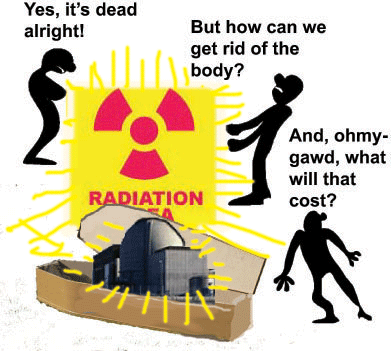
Nuclear plants remain costly even after they’re closed
 Nuke Plant Worker Admits That Plants Are At Their Life Expectancy and Bean Counters Short Change Maintenance http://nukeprofessional.blogspot.com.au/
http://www.chicagobusiness.com/article/20150220/OPINION/150219883?cachebust=BNYA#comment-2094841278 ——————————————————————–R Harden •
I worked at the Byron nuke plant for 29 years. The truth is, this plant, and others like it, have just about out lived their life expectancy. It’s going to close someday whether we like it or not. It has been modified, repaired, equipment replaced and systems up-dated. There is only so much you can do to preserve it’s existence and overall health. Like anything man made, it will have an end. The bean counters for Exelon figure cost verses income. Once the plant becomes more expense than profit, it will probably be shut down.
Technology has come along way since these old dinosaurs were built, and with the cost of nuclear power, they won’t survive. The Zion Nuclear Plant was closed many years ago because of this reason. It cost more to operate than it could make on paper.The real issue I see, is the cost of the spent nuclear fuel that is stored on site. Closing these sites does not get rid of that problem and the expense.
These sites will still require security, maintenance, insurance, taxes, and more, to a plant that has no income. These cost will be there for many, many years, until the fuel finds a new home somewhere else. They told us, spent nuclear fuel has a 2500 year, half life. No one else wants the spent fuel. That’s why it’s stored on site. Who will pay for this clean up is a good guess, but it will probably come down to the consumers and tax payers, as usual. Don’t get me wrong, Exelon is a very good company. They care much about the safety of these plants and the public. Because of government requirements, lack of government subsidies to the nuclear industry, high taxes, high insurance cost and high everything else, the nuclear industry has just about died. Just my opinion.
Insurers Managing $14 Trillion Commit to Backing Sustainable Development
Wed, Jun 17, 2015 UN Report recommends Creation of Insurance Development Goals, Sustainable Insurance Policy Forum, and Insurance Network on Sustainable Development
– See more at: http://unep.org/newscentre/Default.aspx?DocumentID=26827&ArticleID=35202&l=en#sthash.Kz1LjQfg.dpuf
Plunging uranium prices bring fall in UEC share price
 Uranium Energy (UEC) Stock Declines on Falling Uranium Prices, Low Inventory, The Street, By Tony Owusu 06/19/15 NEW YORK –– Uranium Energy (UEC)shares are down 31.29% to $1.66 in morning trading on Friday, just two weeks after the company’s shares surged following its sale of 80,000 pounds of finished uranium for $3.08 million…..Other companies in the sector are also suffering as uranium spot prices have fallen to about $36, a five year low.
Report: Nuclear power a costly failure
Kristina Smith, mksmith@gannett.com June 17, 2015 CARROLL TOWNSHIP – Nuclear energy is a costly failure, and Ohio and other states should focus on alternative energy, according to a report released Wednesday by an energy institute.
Upgrading the Davis-Besse Nuclear Power Station and other aged nuclear and coal plants around Ohio and asking the state to assess fees to help bail out the plants will ultimately cost power customers more money, said Mark Cooper, author of the report “Power Shift: The deployment of a 21st century electricity center and the nuclear war to stop it.”……..http://www.portclintonnewsherald.com/story/news/local/2015/06/17/report-nuclear-power-costly-failure/28894251/
Doubts on costs and safety as USA mulls Small Nuclear Reactors
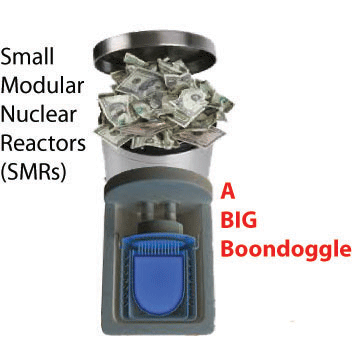 USA considers Small Modular Nuclear Reactors, The Hill, 16 June 15 “……. the same problems that have slowed development of full-size nuclear reactors to nearly a halt — safety and cost — could keep delaying or even kill the potential for small modular reactors to take off……
Edwin Lyman, a senior scientists with the group, said small reactors have no safety or security advantages when compared with larger ones. But since they would produce less power, there is pressure to scale down the requirements.
“The simple fact is that SMRs have a significant cost penalty compared to large reactors on a per-megawatt basis because of diseconomies of scale,” Lyman said.
“No utility will want to buy them unless they can be exempted from a lot of costly regulations that large reactors must meet,” he continued. “But in light of the Fukushima disaster, one must be very wary of the safety claims made by the nuclear industry, especially for reactor designs that have never been built or tested.”
A warning on Fukushima’s radioactive particles entering Pacific Ocean food chain
 Fukushima: Your Days of Eating Pacific Ocean Fish Are Over Tano Buzz
BY R&S ON JUNE 10, 2015 Are you still eating sushi or any seafood from the PacificOcean? Well you might want to reconsider after readingthis article. When it comes to environmental disasters, the nuclear fallout at Fukushima has to be amongst the worst that has happened in the past few decades. Andrew Kishner, founder of www.nuclearcrimes.org has put together a great resource of information that tracks whathas been developing over time in Fukushima as it relates to the nuclear incident. You can check out his research further using the links below.
The following is written by Gary Stamper in regards towhat has been happening with Fukushima. The heart-breaking news from Fukushima continues to get worse -a lot worse. It is, quite simply, an out-of-control flow of death and destruction.
TEPCO is finally admitting that radiation has been leaking to the Pacific Ocean all along and it’s not showing signs of stopping just yet.
It now appears that anywhere from 300 to possibly over 450 tons of contaminated water that contains radioactive iodine, cesium, and strontium-89 and 90, is flooding into the Pacific Ocean from the Fukushima Daichi site everyday. To give you an idea of how bad that actually is, Japanese experts estimate Fukushima’s fallout at 20-30 times as high as as the Hiroshima and Nagasaki nuclear bombings in 1945.
President Obama has scaled back his goals for nuclear security
Obama steps back from sweeping nuclear security goal Centre For Public Integrity, The administration looks for incremental gains in locking up nuclear explosives, rejecting demands by outsiders for a major new international agreement to prevent nuclear terrorism By Douglas Birch
 emailR. Jeffrey Smith 16 June 15 “………….
Over the course of his presidency, Obama has scaled back his goals in this area and settled for what a senior White House official publicly described in 2012 as “the incremental nature of success,” rather than throwing his full weight behind the creation of global security standards for nuclear materials that independent experts say could have a more lasting and significant impact………http://www.publicintegrity.org/2015/06/15/17471/obama-steps-back-sweeping-nuclear-security-goal
Electricity prices likely to drop fast in UK as renewables soar – warning to South Africa against nuclear power
 Why nuclear? Renewables may soon drop UK electricity prices “below zero”, BizNews.com 16 June 15,
We all have dreams. Among mine is those shaping SA’s energy landscape discard their blinkers and focus on how human initiative is transforming the global power equation. Moore’s Law , which annually doubles output at the same price, is hard at work in renewable energy.
SA has been among the global leaders in promoting a much applauded renewables programme, now into its fourth bidding stage and now attracting interest from every relevant renewables player globally. But that great work could be undone by dumb decisions made in the name of “baseload”. Globally respected author and co-founder of Singularity University Peter Diamandis warned in a recent Biznews interview that SA’s proposed trillion rand nuclear power build programme was a “very, very bad idea”. As the UK’s most recent experience documented below illustrates, there is no logical reason to consider this potential millstone for SA taxpayers – outside of pouring more booty into the trough. – Alec Hogg
By Rachel Morison (Bloomberg) — Power prices in the U.K. may fall below zero during some hours before the end of the decade as intermittent renewable energy output is poised to soar, according to National Grid Plc. Negative power prices, already prevalent in markets from Germany to the Nordic region, occur when supply exceeds demand. Having to curb cheap supply from green power is a waste, Duncan Burt, the company’s head of commercial operations, said last week in an interview. To reduce bills and help balance the system, the U.K.’s biggest users should reduce consumption at times of peak demand and take advantage of periods with plenty of green power, he said.
The U.K. government plans to boost the share of energy demand met by renewables to 15 percent in 2020 from 5.3 percent in 2013, potentially boosting price swings. That may give users from factories to supermarkets a greater incentive to adjust consumption more actively, according to Burt……….http://www.biznews.com/transformation/2015/06/15/why-nuclear-renewables-may-soon-drop-uk-electricity-prices-below-zero/
Support at lowest ebb for Japan’s Prime Minister Shinzo Abe
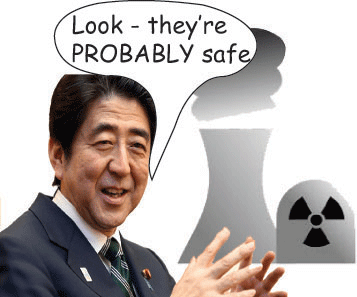 Japan PM Abe’s support lowest since 2012, China Daily, 16 June 15 By Reuters TOKYO – Support for Japanese Prime Minister Shinzo Abe’s Cabinet has fallen to the lowest level since he took office in 2012, to just over 40 percent, with nearly two-thirds of voters opposed to his muscular defence policy that would end a self-imposed ban on the military fighting overseas, a weekend media survey showed.
The survey by Nippon Television Network coincided with weekend rallies by thousands protesting the legislation, which would allow Japan to exercise its right of collective self-defence, or militarily aiding a friendly country under attack.
Abe’s Cabinet adopted a resolution last July reinterpreting the pacifist constitution to allow the dramatic shift in security policy. In April, Abe told the US Congress that the changes, already reflected in new US-Japan defence cooperation guidelines, would be enacted this summer……
Thousands of Japanese rallied on the weekend to protest the security bills and other government policies such as plans to restart nuclear reactors taken off-line after the March 2011 Fukushima nuclear disaster…….http://www.chinadailyasia.com/asia/2015-06/15/content_15277058.html
Electrical problem causes shutdown of Indian Point nuclear power plant
Nuclear plant on Hudson shuts down after electrical problem, report says http://www.nj.com/news/index.ssf/2015/06/nuclear_plant_on_hudson_shuts_down_after_electrica.html Craig McCarthy may be reached at CMcCarthy@njadvancemedia.com. An electrical problem shut down Indian Point nuclear power plant Monday night, according to reports.
The plant will take at least a day to get back up and running, Entergy spokesman Jerry Nappi told The Journal News.
The electrical problem occurred around 7 p.m. across the street where power is sent into the nuclear power plant, the report says.
The plant is located just 35 miles out of New York City and suffered a transformer explosion last month that sent thousands of gallons of oil into the Hudson.
The explosion raised concerns about the safety of aging nuclear power plants in New York and New Jersey.
It appeared no equipment was damaged Monday, according to Nappi.
1 This Month

of the week – Shut Down Drone Warfare!


Tell the Ukrainian Government to Drop Prosecution of Peace Activist Yurii Sheliazhenko

Petition to revoke the licensing of the Near Surface Nuclear Disposal Facility (NSDF) at Chalk River. https://www.ourcommons.ca/petitions/en/Petition/Details?Petition=e-7247
To see nuclear-related stories in greater depth and intensity – go to https://nuclearinformation.wordpress.com
-
Archives
- April 2026 (103)
- March 2026 (251)
- February 2026 (268)
- January 2026 (308)
- December 2025 (358)
- November 2025 (359)
- October 2025 (376)
- September 2025 (257)
- August 2025 (319)
- July 2025 (230)
- June 2025 (348)
- May 2025 (261)
-
Categories
- 1
- 1 NUCLEAR ISSUES
- business and costs
- climate change
- culture and arts
- ENERGY
- environment
- health
- history
- indigenous issues
- Legal
- marketing of nuclear
- media
- opposition to nuclear
- PERSONAL STORIES
- politics
- politics international
- Religion and ethics
- safety
- secrets,lies and civil liberties
- spinbuster
- technology
- Uranium
- wastes
- weapons and war
- Women
- 2 WORLD
- ACTION
- AFRICA
- Atrocities
- AUSTRALIA
- Christina's notes
- Christina's themes
- culture and arts
- Events
- Fuk 2022
- Fuk 2023
- Fukushima 2017
- Fukushima 2018
- fukushima 2019
- Fukushima 2020
- Fukushima 2021
- general
- global warming
- Humour (God we need it)
- Nuclear
- RARE EARTHS
- Reference
- resources – print
- Resources -audiovicual
- Weekly Newsletter
- World
- World Nuclear
- YouTube
-
RSS
Entries RSS
Comments RSS
 nuclear-news