No escape place on earth for fleeing climate change
 Is Anywhere on Earth Safe From Climate Change?,
The Atlantic ADRIENNE LAFRANCE AUG 3, 2015 Relocating to a landlocked city isn’t enough Put simply: Climate change poses the threat of global catastrophe. The planet isn’t just getting hotter, it’s destabilizing. Entire ecosystems are at risk. The future of humanity is at stake.
Scientists warn that extreme weather will get worse and huge swaths of coastal cities will be submerged by ever-more- acidic oceans. All of which raises a question: If climate change continues at this pace, is anywhere going to be safe?
“Switzerland would be a good guess,” said James Hansen, the director of climate science at Columbia University’s Earth Institute. Hansen’s latest climate study warns that climate change is actually happening faster than computer models previously predicted. He and more than a dozen co-authors found that sea levels could rise at least 10 feet in the next 50 years. Slate points out that although the study isn’t yet peer-reviewed, Hansen is “known for being alarmist and also right.”…..
Staying away from scorching heat, hurricanes, floods, and wildfire will be difficult in a country that feels dramatically different in coming decades. “The best place really is Alaska,” said Camilo Mora, a geologist at the University of Hawaii, in an interview with The New York Times last year………http://www.theatlantic.com/technology/archive/2015/08/is-anywhere-on-earth-safe-from-climate-change/400304/
The real nuclear danger – weaponry of USA and Russia, not Iran, or even North Korea
 Clinging to these obsolete weapons is a vestige of Cold War thinking propped up by contracts and the desire of those with nuclear bases to keep the few thousand jobs they provide. Pandering to these parochial motives and flawed strategies risks catastrophes whose financial and human costs dwarf any conceivable benefits.
Pope Francis told a conference on nuclear threats in Vienna this year that “spending on nuclear weapons squanders the wealth of nations.” He questioned the morality of maintaining these huge arsenals for any purpose. These horrific weapons, he said, must be “banned once and for all.”
Seventy years after it was born on the sands of Alamogordo, there is a growing global sense that it is time to retire the Bomb.
“Every man, woman and child lives under a nuclear sword of Damocles, hanging by the slenderest of threads, capable of being cut at any moment by accident or miscalculation or by madness.” — President John F. Kennedy
Seventy years after the first atomic explosion lit up the New Mexican desert and nearly 25 years after the collapse of the Soviet Union, both Russia and the United States retain nuclear postures from the darkest days of their rivalry. There are almost 16,000 nuclear weapons still in the world today, and the U.S. and Russia possess 94 percent of them. Worse, 1,800 of these Russian and American weapons sit atop missiles on hair-trigger alert, ready to launch on a few minutes notice.
Few people are even aware of these dangers. Most have forgotten about the weapons. They think the only nuclear threat is the chance that Iran might get a bomb. Or that plans are in place that effectively prevent or contain nuclear threats. They are wrong. On any given day, we could wake up to a crisis that threatens our country, our region, our very planet. Continue reading
Ill-advised promotion of the “thorium miracle”
As expert Jo Abbess states more clearly than anyone, thorium is “quite probably the most well-funded piece of astroturfing propaganda in existence.” Only through awareness and education can we hope to make rational decisions about our energy future. I recommend readers start learning about thorium nuclear from the articles above before making any decisions on the technology.
 Thorium Nuclear Information Resources https://kevinmeyerson.wordpress.com/2012/04/26/thorium-nuclear-information-resources/ There is a rash of misinformation on the net about the supposed merits of the ‘new’ nuclear energy source on the block, thorium. I am sure that in a perfect world where nobody lies, thorium would be the perfect answer to the world’s energy needs as is claimed. This is unfortunately not the case.
Apparently, every time there is a new nuclear catastrophe, the thorium ‘miracle’ is promoted again as the ‘savior’ for the world. The Fukushima nuclear radiation catastrophe was not unique and the thorium misinformation artists have come out in droves. It’s the nuclear industry’s defense mechanism – create a new ‘safety myth’ that regular people can latch onto.
In reality, the thorium nuclear fuel cycle has been under development since the very early days of the nuclear industry. India, for example, has spent decades trying to commercialize it, and has failed. The US, Russia, Germany, and many others tried and failed as well. At best, thorium based nuclear power generation may be commercialized in a few decades.
I doubt it.
Fortunately, there are a number of independent trustworthy and expert sources of information on the internet regarding thorium nuclear. Here they are:
- MIT Energy Initiative: The Future of the Nuclear Fuel Cycle
See Appendix A for the overview of thorium. Apparently MIT is far less confident than the overly enthusiastic thorium online promoters. - UK National Nuclear Laboratory: The Thorium Fuel Cycle
A thorough overview of all things thorium and nuclear prepared by the authority in the United Kingdom. The report concludes that it would take decades to build any thorium fuel cycle based on undeveloped reactor designs such as LFTR. PDF file warning. Many thanks to DARyan for this wonderful document! Please see his comments and his site I’ve introduced below! - Beyond Nuclear’s Ten Myths About Throrium As A Nuclear Energy Solution
A good brief look at myths that surround thorium. It’s a PDF file. - PSR/IEER’s Thorium Fuel: No Panacea for Nuclear Power
The thorium promoters from the nuclear industry really do prefer you not read this excellent and informational brief PDF. - IEER’s Some Characteristics of Uranium and Thorium
An easy to understand overview of thorium and uranium characteristics. Both are radioactive, toxic, known carcinogens, and cause birth defects. - LAKA’s Thorium-based Nuclear Power: An Alternative?
This source includes a good briefing on the Indian thorium nuclear white elephant as well as other in-depth information. PDF. - FoE’s Thorium and WMD Proliferation Risks
One of the most common myths about thorium is that it cannot be used to make bombs. This is absolutely false and you can learn more about it thanks to FoE Australia. - SimplyInfo’s Thorium, Not The Nuclear Savior Claimed
This is one of my favorite sources as it concisely outlines the misinformation being propagated. SimplyInfo is a fantastic project that covers many nuclear issues, especially related to Fukushima. - NIRS’ “New” Nuclear Reactors: Same Old Story
This PDF covers a number of ‘new’ nuclear solutions including thorium. Recommended! - The Guardian’s Don’t Believe The Spin on Thorium Being a Greener Nuclear Option
This is a fabulous article that originally appeared in The Ecologist. Succint. - The Hindu’s Why Kudankulam Is Untenable
This editorial piece includes a very good overview of India’s secretive failure to develop the thorium fuel cycle.
Last, but hardly least, I highly recommend anyone interested in nuclear energy to readDARyan‘s fabulous “A critical analysis of future nuclear reactors designs” which is an epic overview of the many different nuclear solutions the industry is trying to sell to society. Part 8 covers thorium, molten salt reactors (MSR), and LFTR technologies. Fanatical thorium ‘evangelists’ have taken special aim at the DARyan publications as evidenced by the various abusive comments on the blog. This critical analysis has alsoappeared in Green Blog.
As expert Jo Abbess states more clearly than anyone, thorium is “quite probably the most well-funded piece of astroturfing propaganda in existence.” Only through awareness and education can we hope to make rational decisions about our energy future. I recommend readers start learning about thorium nuclear from the articles above before making any decisions on the technology.
Should the UK really be putting its money into nuclear power in 2015?
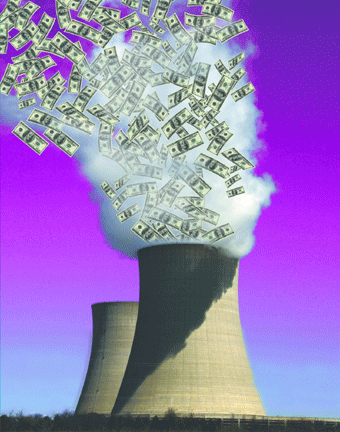 The Independent, CHRIS GREEN 4 August 2015 Pressure is mounting on the Government over the cost of the new Hinkley Point C nuclear power plant, and a final decision on its construction has not been made “…….more than seven years down the line, the Government has still not announced its final decision on whether to proceed with the £25bn project, which has been hit by a series of safety setbacks, legal challenges and other problems. Put simply, the debate boils down to the central question: should the UK really be putting its money into nuclear power in 2015?……… http://www.independent.co.uk/voices/comment/should-the-uk-really-be-putting-its-money-into-nuclear-power-in-2015-10436365.html
Renewable energy headlines
Race to store renewable energyCosmos-3 Aug 2015
In-Depth-Computerworld-3 Aug 2015
Radiophilia vs. Radiophobia Vodoo Science and the Zombie Myth that Will Not Die
 Is Radioactivity Really Good for You? – NRC to be The Decider NoNukesCA.netAugust 1, 2015 by James Heddle
“………..It is both amazing and distressing that the long-discredited notion of ‘hormesis’ continues to surface after all these years, and that the NRC would further damage its credibility by seriously considering it. It is an indicator of the desperation afflicting the international nuclear establishment in the wake of the still-on-going Fukushima disaster.
The zombie notion seems to have been exhumed by government and industry hacks in Japan as a way of reducing liability for radiological contamination of an area the size of New Jersey, and inducing refugees to return to contaminated lands with fraudulent assurances that low doses of radiation are not harmful.
As Krooth, Edelson and Fukurai report in their book Nuclear Tsunami: The Japanese Government and America’s Role in the Fukushima Disaster,
Even after Fukushima reactors exploded and massive radiation fallout contaminated many regions, the Japanese government and corporate media began to engage in another propaganda campaign to create a new kind of the myth – “low-level radiation is safe,” especially in Fukushima where more than millions of people were still trapped in radiation-contaminated areas.
The notion was long ago demolished by the research of such radiological pioneers as Drs. Alice Stewart, Ernest Sternglass and John Goffman………… http://nonukesca.net/?p=692
The choice: Start World War III, or support the Iran nuclear deal
LA Time,s Marcy Winograd, Santa Monica,30 July 15 John Bolton’s rush to a radioactive World War III was not palatable even to George W. Bush, the man who took us to war in Iraq and appointed Bolton as ambassador to the United Nations. Neither the International Atomic Energy Agency nor the Central Intelligence Agency has found evidence that Iran has developed nuclear weapons.
In contrast to Israel, widely assumed to be a nuclear state, Iran is a signatory to the Nuclear Non-Proliferation Treaty, which sanctions the development of nuclear power for peaceful purposes.
To suggest that either Israel or the U.S. could surgically strike Iran’s scattered nuclear facilities is to ignore the fact that such strikes could plunge Iran and the entire Middle East into a fiery hell that would dwarf the annihilation of Hiroshima and Nagasaki.
Rather than plot world demise, Bolton would be well advised to support the Obama administration’s agreement for inspections and verification and let the American people begin a dialogue with Iran’s next generation of leaders. Sixty percent of Iran’s 75 million people are under the age of 30. Bolton is yesterday’s news; Iran’s youth are tomorrow’s hope.
http://www.latimes.com/opinion/readersreact/la-le-0730-thursday-iran-bolton-nuclear-20150730-story.html
Nuclear power not worth the risks of accidents weapons and the wastes threats
Accidents, Waste and Weapons: Nuclear Power Isn’t Worth the Risks miningawareness Mark Diesendorf, UNSW Australia
The case for expanding nuclear energy is based on myths about its status, greenhouse gas emissions, proliferation, accidents, wastes and economics. Let’s take each in turn.
StatusNuclear is not, and has never been, a major energy force. Global annual nuclear energy generation peaked in 2006. Meanwhile its percentage contribution to global electricity generation has declined from its historic peak in 1993 of 17% to about 10% today. The only countries with significant growth are China, India, Russia and South Korea. In the rest of the world, retirements of ageing reactors are likely to outweigh new builds………
The next generation of reactorsSome generation IV reactors are potentially lower in life-cycle greenhouse gas emissions, but these are not yet commercially available.
All are likely to be even more expensive than conventional reactors. The fast breeder reactor is even more complex, dangerous, expensive and conducive to weapons proliferation than conventional nuclear reactors. Despite several decades of expensive pilot and demonstration plants, fast breeders have not been successfully commercialised, and may never be.
Advocates try to justify the integral fast reactor and the thorium reactor on the fallacious grounds that they cannot be used to produce nuclear weapons explosives. However, if not operated according to the rules, the integral fast reactor can actually make it easier to extract weapons-grade plutonium and hence make bombs. To be useful as a nuclear fuel, thorium must first be converted to uranium-233, which can be fissioned either in a nuclear reactor or an atomic bomb, as the United States has demonstrated.
The small modular reactor (SMR) has been a dream of the nuclear industry for decades, amid hopes that future mass production could make its electricity cheaper than from existing large reactors. However, offsetting this is the economy of scale of large reactors. The Union of Concerned Scientists, which is not anti-nuclear, has serious safety and security concerns about SMRs.
Weapons proliferationNuclear proponents dismiss the danger that civil nuclear energy will drive the development of nuclear weapons, by saying that the nuclear industry is now under strong international oversight. This ignores the harsh reality that India, Pakistan, North Korea and South Africa have all used civil nuclear energy to help build their nuclear weapons. Furthermore, Australia, Argentina, Brazil, Iran, Libya, South Korea and Taiwan all used civil nuclear energy to cloak their commencement of nuclear weapons programs, although fortunately all except Iran have now discontinued them.
Thus nuclear energy contributes to the number of countries with nuclear weapons, or the capacity to build them, and hence increases the probability of nuclear war……https://wordpress.com/read/post/feed/4410547/767215566
California’s wildfire – a danger to buildings – later to nuclear reactors?
 Rapidly Spreading Wildfire North Of San Francisco Destroys Several Buildings, Forces 500 To Evacuate Fukushima Nuclear Meltdown News July 30, 2015 A rapidly spreading brushfire burning in parched timberland north of San Francisco has forced the evacuation of 500 people and destroyed several buildings less than 12 hours after it broke out, fire officials said on Thursday.
The blaze, named the “Rocky Fire,” is one of a string of wildfires threatening homes and scorching parched wilderness in the U.S. West, where several regions have endured sustained drought.
The Rocky Fire broke out Wednesday afternoon in Lake County, 110 miles (180 km) north of San Francisco. By early Thursday it had covered 3,000 acres (1,200 hectares), according to the California Department of Forestry and Fire Protection (CalFire)…….http://fukushima411.com/rapidly-spreading-wildfire-north-of-san-francisco-destroys-several-buildings-forces-500-to-evacuate/
Japan’s Abe Government Risks Fukushima Victims’ Lives with “Forced Return” to Contaminated Areas
“Normalizing” Nuclear Catastrophe: Japan’s Abe Government Risks Fukushima Victims’ Lives with “Forced Return” to Contaminated Areas By Kendra Ulrich Global Research, July 30, 2015
The worst nuclear disaster in a generation at the Fukushima Daiichi nuclear power plant – which began in March 2011 – is still very much an ongoing crisis that will not be solved for the many many decades.
Most of the massive radioactive releases were carried out to the Pacific Ocean by the prevailing winds at that time of year. But, on the nights of 15th and 16th March, the winds turned, carrying an enormous amount of radiation inland. Fukushima prefecture, especially to the northwest of the crippled reactor site, was heavily contaminated.
he Japanese government is undertaking decontamination efforts with the intention of lifting evacuation orders by March 2017.
But Greenpeace investigations have made a shocking discovery: in Iitate – one of the priority targets of the Abe Government’s plan – radiation dose levels are comparable to those inside the 30km exclusion zone around Chernobyl. Even more surprising, this was true even around homes that had already been supposedly ‘decontaminated’.
What on earth would motivate the Japanese Government to do such a thing to the tens of thousands of nuclear victims and decontamination workers?
Decontaminating Iitate – the 200 sq.km ‘village’
To answer that question, it is first important to understand a bit of background on ‘Iitate Village’. It is actually a 200 sq.km area of heavily forested hills, mountains, and lakes, interspersed with farm fields, and homes. It lies 28 – 47 km to the northwest of the destroyed Fukushima Daiichi nuclear power plant, in the direct path of the heaviest on-land radioactive fallout.
Although the Abe Government has stated on its website that it is “decontaminating” Iitate – even going so far as to say on the Ministry of Environment website that 100% of the forest has already been decontaminated – you have to dig through several different pages to discover that they are only referring to about a quarter of the land area of Iitate.
In other words, of the 200 sq.km of Iitate Village only 56 sq.km are targeted for decontamination. Of that fraction, most of the focus has been on fields, 10-20 m strips of forest either side of public roads, and in the small immediate area around people’s houses.
Even the limited amount of targeted forest isn’t finished and will continue for at least another year or longer.
And what strikes you when you see it is not just the swarms of workers raking away at the woodland floor and trimming blades of grasses by hand in these first 10-20m of forest along the roads, but the extent of the vast mountains upon mountains of dense, lush forest stretching out behind them as far as the eye can see.
You feel sorry for them. You also admire their intensive effort, meticulous work, and commitment. They are working in sweltering heat, in protective clothing, boots, gloves masks and goggles; not even their eyes are visible. And they are doing intense physical labor for almost no impact.
Many of these workers are the residents of other impacted areas, like Minamisoma, who lost their jobs in farming, forestry, fishing or services due to the nuclear disaster. So many are working on their former home areas which are now heavily contaminated with radioactivity.
It’s surreal. And it’s heartbreaking
On March 27th 2011, Greenpeace radiation investigations in Iitate had revealed extremely high levels of contamination, which led our organisation to urgently recommend to the Japanese government the immediate evacuation of the more than 6,000 residents.
Until that point, the residents of Iitate had been told that evacuation was not required. Evacuation did not begin until April 22. And still, eight weeks after the start of the accident, in early June, over 1,200 people remained in Iitate. As a result, the people of Iitate were the most exposed to radiation of all citizens of Fukushima prefecture.
Iitate has since become an iconic area within the story of Fukushima: a constant reminder to the Japanese public and the international community that a major nuclear disaster is not confined to a small ‘emergency planning’ zone around the reactor site. The impacts are far reaching, destroy entire regions and communities, rip people from the fabric of their lives, and cannot be repaired.
Over four years after the triple reactor core meltdowns and exploded containment buildings at the Fukushima Daiichi nuclear power plant, the majority of the Japanese public has remained opposed to any nuclear restart. The country has been completely nuclear-free for nearly two years, thanks in large part to significant public opposition, in spite of the massive pressure from nuclear utilities and the Abe government on local city governments.
However, these utilities are massively powerful and the Abe government is wholly in bed with them. http://www.globalresearch.ca/normalizing-nuclear-catastrophe-japans-abes-government-risk-fukushima-victims-lives-with-forced-return/5465800
Fukushima- The Real Story – a time bomb in quiescence
Fukushima Not Even Close To Being Under Control, Oil Price, By ZeroHedge Sun, 28 June 2015
“…………In late 2014, Helen Caldicott, M.D. gave a speech about Fukushima at Seattle Town Hall. Pirate Television recorded her speech
Dr. Helen Caldicott is co-founder of Physicians for Social Responsibility, and she is author/editor of Crisis Without End: The Medical and Ecological Consequences of the Fukushima Nuclear Catastrophe, The New Press, September 2014. For over four decades Dr. Caldicott has been the embodiment of the anti-nuclear banner, and as such, many people around the world classify her as a “national treasure”. She’s truthful and honest and knowledgeable.
Fukushima is literally a time bomb in quiescence. Another powerful quake and all hell could break loose. Also, it is not even close to being under control. Rather, it is totally out of control. According to Dr. Caldicott, “It’s still possible that Tokyo may have to be evacuated, depending upon how things go.” Imagine that!
According to Japan Times as of March 11, 2015: “There have been quite a few accidents and problems at the Fukushima plant in the past year, and we need to face the reality that they are causing anxiety and anger among people in Fukushima, as explained by Shunichi Tanaka at the Nuclear Regulation Authority. Furthermore, Mr. Tanaka said, there are numerous risks that could cause various accidents and problems.”
Even more ominously, Seiichi Mizuno, a former member of Japan’s House of Councillors (Upper House of Parliament, 1995-2001) in March 2015 said: “The biggest problem is the melt-through of reactor cores… We have groundwater contamination… The idea that the contaminated water is somehow blocked in the harbor is especially absurd. It is leaking directly into the ocean. There’s evidence of more than 40 known hotspot areas where extremely contaminated water is flowing directly into the ocean… We face huge problems with no prospect of solution.”
At Fukushima, each reactor required one million gallons of water per minute for cooling, but when the tsunami hit, the backup diesel generators were drowned. Units 1, 2, and 3 had meltdowns within days. There were four hydrogen explosions. Thereafter, the melting cores burrowed into the container vessels, maybe into the earth.
According to Dr. Caldicott, “One hundred tons of terribly hot radioactive lava has already gone into the earth or somewhere within the container vessels, which are all cracked and broken.” Nobody really knows for sure where the hot radioactive lava resides. The scary unanswered question: Is it the China Syndrome?
Following the meltdown, the Japanese government did not inform people of the ambient levels of radiation that blew back onto the island. Unfortunately and mistakenly, people fled away from the reactors to the highest radiation levels on the island at the time.
As the disaster happened, enormous levels of radiation hit Tokyo. The highest radiation detected in the Tokyo Metro area was in Saitama with cesium radiation levels detected at 919,000 becquerel (Bq) per square meter, a level almost twice as high as Chernobyl’s “permanent dead zone evacuation limit of 500,000 Bq” (source: Radiation Defense Project). For that reason, Dr. Caldicott strongly advises against travel to Japan and recommends avoiding Japanese food.
Even so, post the Fukushima disaster, Secretary of State Hillary Clinton signed an agreement with Japan that the U.S. would continue importing Japanese foodstuff. Therefore, Dr. Caldicott suggests people not vote for Hillary Clinton. One reckless dangerous precedent is enough for her.
According to Arnie Gundersen, an energy advisor with 39 years of nuclear power engineering experience, as reported in The Canadian on August 15, 2011: “The US government has come up with a decision at the highest levels of the State Department, as well as other departments who made a decision to downplay Fukushima. In April, the month after the powerful tsunami and earthquake crippled Japan including its nuclear power plant, Hillary Clinton signed a pact with Japan that she agreed there is no problem with Japanese food supply and we will continue to buy them. So, we are not sampling food coming in from Japan.”
However, in stark contrast to the United States, in Europe Angela Merkel, PhD physics, University of Leipzig and current chancellor of Germany is shutting down all nuclear reactors because of Fukushima.
Maybe an advanced degree in physics makes the difference in how a leader approaches the nuclear power issue. It certainly looks that way when comparing/contrasting the two pantsuit-wearing leaders, Chancellor Merkel and former secretary of state Clinton.
After the Fukushima blow up, ambient levels of radiation in Washington State went up 40,000 times above normal, but according to Dr. Caldicott, the U.S. media does not cover the “ongoing Fukushima mess.” So, who would really know?
Dr. Caldicott ended her speech on Sept. 2014 by saying: “In Fukushima, it is not over. Every day, four hundred tons of highly radioactive water pours into the Pacific and heads towards the U.S. Because the radiation accumulates in fish, we get that too. The U.S. government is not testing the water, not testing the fish, and not testing the ambient air. Also, people in Japan are eating radiation every day.”
Furthermore, according to Dr. Caldicott: “Rainwater washes over the nuclear cores into the Pacific. There is no way they can get to those cores, men die, robots get fried. Fukushima will never be solved. Meanwhile, people are still living in highly radioactive areas.”
Fukushima will never be solved because “men die” and “robots get fried.” By the sounds of it, Fukushima is a perpetual radiation meltdown scenario that literally sets on the edge of a bottomless doomsday pit, in waiting to be nudged over.http://oilprice.com/Latest-Energy-News/World-News/Fukushima-Not-Even-Close-To-Being-Under-Control.html
Nuclear deals between Russia andMiddle East countries
Russia signs nuclear deals with traditional U.S. allies in Middle East Fox News The Russian government has signed major nuclear cooperation agreements with Saudi Arabia, Egypt, and Jordan since the start of this year, increasing its influence among traditional U.S. allies in the region.
In June, Russia closed a major deal on nuclear cooperation between Russia and Saudi Arabia. Since the end of the last decade the Saudis have been implementing plans to construct as many as 16 commercial nuclear power plants. The Saudis have signed agreements with other nuclear nations, including the United States, France, China and Argentina, to help construct the reactors.
Russia is now expected to play a sizable role in operating the nuclear plants, which are still to be built………http://www.foxnews.com/politics/2015/07/30/russia-signs-nuclear-deals-with-traditional-us-allies-in-middle-east/
Hole in nuclear containment wall not noticed ?for 30 years
1-inch hole found in secondary containment building wall at Hope Creek reactor By Bill Gallo Jr. | For NJ.com on July 29, 2015
But whether the hole was ever filled or has remained open since the facility was built in the early 1980s is being investigated……..Hope Creek and Salem 1 and Salem 2 comprise the second-largest commercial nuclear complex in the United States.
Bill Gallo Jr. may be reached at bgallo@njadvancemedia.com. http://www.nj.com/salem/index.ssf/2015/07/1-inch_hole_found_in_secondary_containment_buildin.html
There are still about 16,000 nuclear weapons in the world. Terrorists only need to steal one
70 years after Hiroshima, nuclear weapons threaten us all, Richard Norton-Taylor, http://www.theguardian.com/news/defence-and-security-blog/2015/jul/23/70-years-after-hiroshima-nuclear-weapons-threaten-us-all Nuclear weapons are an austerity-free zone Nearly 70 years ago, on 6 August 1945, the US dropped “Little Boy”, the first nuclear weapon used in warfare, on Hiroshima.
“Two thirds of the buildings in the city were destroyed and perhaps 80,000 civilians were killed”, observes Eric Schlosser, in Gods of Metal, a frightening yet moving account of how three Catholic pacifists, including an 82 year-old nun, broke into Y12, a top security nuclear weapons base in Tennessee, known as the Fort Knox of Uranium, where material used in the bomb that destroyed Hiroshima was processed.
“The amount of weapons-grade uranium needed to build a terrorist bomb with a similar explosive force”, Schlosser adds in his extremely timely short book, “could fit inside a small gym bag”.
Though there are treaties banning biological and chemical weapons, cluster bombs, and landmines, there is no such ban on nuclear weapons, even though their use would breach international agreements, not least the Geneva Conventions.
70 years after Hiroshima, despite all the rhetoric and genuflection (and negotiations with Iran) moves towards global nuclear disarmament are further away than ever. Continue reading
The world faces many nuclear threats: these are the top 5
#TalkAboutIt: Top five nuclear threats the world faces, ABC News, 25 July 15 TalkAboutIt
But several events — including 2011’s Fukushima meltdown, Russia’s 2014 annexation of Crimea, Islamic State’s pledge to obtain a nuclear weapon in 2015, and the recent Iran deal — have brought the nuclear-related threat back into public consciousness.
The diversity and unpredictability of these events only emphasise that the line between an intentional nuclear disaster and an atomic accident is blurry.
But is there still a real nuclear threat in 2015?
Here are five major modern-day nuclear threats according to the experts.
State vs state nuclear war (intentional)…….
State vs state nuclear war (unintentional)…
Nuclear terrorism……
Nuclear meltdown……
Nuclear waste storage……. http://www.abc.net.au/news/2015-07-24/talkaboutit-top-five-nuclear-threats-the-world-faces-2015/6646030
1 This Month

of the week – Shut Down Drone Warfare!


Tell the Ukrainian Government to Drop Prosecution of Peace Activist Yurii Sheliazhenko

Petition to revoke the licensing of the Near Surface Nuclear Disposal Facility (NSDF) at Chalk River. https://www.ourcommons.ca/petitions/en/Petition/Details?Petition=e-7247
To see nuclear-related stories in greater depth and intensity – go to https://nuclearinformation.wordpress.com
-
Archives
- April 2026 (103)
- March 2026 (251)
- February 2026 (268)
- January 2026 (308)
- December 2025 (358)
- November 2025 (359)
- October 2025 (376)
- September 2025 (257)
- August 2025 (319)
- July 2025 (230)
- June 2025 (348)
- May 2025 (261)
-
Categories
- 1
- 1 NUCLEAR ISSUES
- business and costs
- climate change
- culture and arts
- ENERGY
- environment
- health
- history
- indigenous issues
- Legal
- marketing of nuclear
- media
- opposition to nuclear
- PERSONAL STORIES
- politics
- politics international
- Religion and ethics
- safety
- secrets,lies and civil liberties
- spinbuster
- technology
- Uranium
- wastes
- weapons and war
- Women
- 2 WORLD
- ACTION
- AFRICA
- Atrocities
- AUSTRALIA
- Christina's notes
- Christina's themes
- culture and arts
- Events
- Fuk 2022
- Fuk 2023
- Fukushima 2017
- Fukushima 2018
- fukushima 2019
- Fukushima 2020
- Fukushima 2021
- general
- global warming
- Humour (God we need it)
- Nuclear
- RARE EARTHS
- Reference
- resources – print
- Resources -audiovicual
- Weekly Newsletter
- World
- World Nuclear
- YouTube
-
RSS
Entries RSS
Comments RSS
 nuclear-news