5 Years Fukushima – 6 Years Uranium Film Festival
 greetings from the International Uranium Film Festival. The festival continues. 2016 will be an important year for us and the “nuclear” world:
Rua Monte Alegre, 356 / 301
Santa Teresa
Rio de Janeiro / RJ
CEP 20240-194
Brasil
0055 – 21 – 97207 6704
Fukushima fallout radiation to USA coast
CSS Health Report: Fukushima Radiation Will Prematurely Kill Millions of Americans, Investment Watch, December 23rd, 2015 by Dave Hodges http://www.naturalnews.com/052291_Fukushima_California_radiation.htm l(NaturalNews) Government data shows that the U.S. is being bombarded with Fukushima radiation 1,000 times higher than normal.
In the months following the 2011 meltdowns at Japan’s Fukushima Daiichi nuclear power plant, residents of Los Angeles were being exposed to levels of dangerous alpha radiation nearly 1,000 times above normal levels, a government study found.
The data came from a July 2012 presentation at the National Conference on Radiation Control. The presentation was given by Joji Ortego, Principal Radiation Protection Specialist for Los Angeles County Radiation Management.
Following the Fukushima meltdowns, Los Angeles county heard many concerns from residents about the potential health impacts of radiation crossing the Pacific Ocean from the disaster. So they commissioned a study of radiation levels in the area. The report notes that federal agencies delayed in providing information to the county, and that the state Radiologic Health Branch was unable to provide inspectors due to budget constraints…….
Radiation levels exceed federal thresholds
Samples were taken between April 29 and May 2, 2011, approximately seven weeks after the radioactive releases from Fukushima. The county found that gross alpha radiation levels at a location in Los Angeles were 300 femtocuries per cubic meter (fCi/m3), and levels at a Hacienda Heights location were 200 fCi/m3.
For context, the Lawrence Livermore National Laboratory reports the average (annual median) level of gross alpha activity for the state of California as just 0.38 fCi/m3 – that is, 790 times lower.
The levels detected in Los Angeles County were a full 100 times higher than the level that requires an investigation at a U.S. nuclear laboratory, according to the Environmental Monitoring Plan at Brookhaven National Laboratory: “If the gross alpha activity in the [air] filters is greater than 3 fCi/m3, then collect more samples in the vicinity, and project manager will review all detections above the limits … All values greater than the above-stated gross alpha/beta concentration shall trigger an investigation.”
Finally, the Los Angeles County levels were almost 15 times higher than the federal regulatory limit for alpha radiation, which is 21 fCi/m3, according to a 2010 document from Idaho National Laboratory.
Even worse than it sounds
What do all these numbers mean for human and environmental health?
Alpha radiation is one of four major types of radiation emitted by radioactive atoms. It is also referred to as “alpha particles,” or a “Helium nucleus.” Other types of radiation are beta radiation, gamma radiation and neutrons.
Of alpha, beta and gamma radiation, alpha radiation is by far the most dangerous if found inside the human body. That’s because unlike beta or gamma radiation, alpha radiation is easily absorbed by cells, where it can cause serious damage, including to DNA. Alpha particles can enter the body if they contaminate food or water, or if they are breathed in – hence the concern among both nuclear laboratories and Los Angeles county about airborne levels of alpha radiation.
The alpha radiation detected from the Fukushima disaster most likely comes from plutonium 239, which is produced as a byproduct in many nuclear reactors. No alpha radiation, however, is emitted by cesium-137, which is probably the most prolific isotope emitted by Fukushima that is still circulating in the environment (iodine-131, also emitted in large quantities, has a very short half life and has probably mostly vanished from the environment by now).
But whereas the beta and gamma radiation emitted by radioactive cesium may not be as dangerous from within the body, it is actually far more dangerous if found outside the body – for example, in the contaminated water and soil around the Fukushima plant, or the contaminated water being dumped into the Pacific Ocean. That’s because beta and gamma radiation is far more able to penetrate the body’s external defenses, and tear apart cells and DNA as it passes through.
More links to cancer from Fukushima fallout.
Time that US presidential candidates stood up to the nuclear weapons lobby
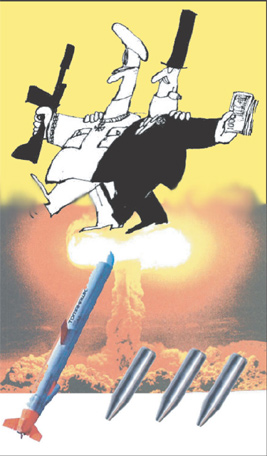 The real nuclear danger http://www.concordmonitor.com/opinion/20114801-95/letter-the-real-nuclear-danger ARNIE ALPERT and JUDY ELIOTT December 20, 2015 Hillary Clinton and the editors are right to lose sleep over the danger of “loose nukes.” But a larger nuclear danger ought to cause the utmost concern.
Consider the recent incident in which Turkey shot down a Russian fighter using U.S.-made weapons. It’s not hard to imagine escalation that could draw Turkey’s NATO allies into the conflict. Now consider that both the U.S and Russia have nuclear-armed missiles on hair-trigger alert, ready to launch within minutes.
Dozens of incidents have occurred in which the U.S. or Russia came close to launch due to faulty warning systems, misinterpretation of technical data and human error. We are one misjudgment away from all-out nuclear war. Most of the world’s nuclear weapons are still in the arsenals of the USA and Russia. Instead of complying with treaty obligations to pursue negotiations toward worldwide nuclear abolition, both countries still seek an impossible-to-achieve nuclear advantage.
Congress backs a trillion-dollar agenda for a new generation of warheads and the submarines, missiles and bombers to deliver them. This will mean enormous profits for companies such as Lockheed Martin, but will do nothing to reduce the threat that nuclear weapons would be used. It will have no impact whatsoever on access to “loose nukes” by terrorists, rogue states or anyone else.
Hillary Clinton and the other candidates ought to tell us what they will do to stand up to the nuclear weapons lobby and put us on the road toward nuclear weapons reduction and eventual abolition.
Increasing risk of nuclear war
Is nuclear war risk rising? Experts say yes, Reuters,By Peter Apps December 20, 2015
On Sunday, November 28, Californians watched with bemusement and in some cases alarm as a bright light moved across the sky. It wasn’t a UFO. It was a U.S. Navy Trident ballistic missile.
It was, of course, just a test — the first of two in three days. They coincided with tough talk from U.S. Secretary of Defense Ashton Carter, who earlier that month had criticized Russia for engaging in “challenging activities” at sea and air, in space and cyberspace. Days earlier, he had been in the South China Sea aboard an aircraft carrier, sending a similarly robust message to China about its actions in the disputed region.
I was eight years old when the Berlin Wall fell in 1989. No sooner had I become even barely aware of the threat of nuclear war than it was gone, apparently forever.
Now, however, it has quietly returned.
The Project for Study of the 21st Century recently published its survey of major conflict risk. Over six months, we polled 50 national security experts on the risk of a variety of potential wars.
The results make interesting reading. The most striking thing, though, is not the numbers themselves — it is the fact that there now seem to be multiple potential routes to a variety of potentially devastating state-on-state wars.
Our poll showed the experts — who ranged from current and former military officials to international relations professors and insurance and risk specialists — putting a 6.8 percent chance on a major nuclear war in the next 20 years killing more people than World War Two. That conflict killed roughly 80,000,000 at upper estimates.
To be sure, it’s impossible to put an exact number on the risk of a nuclear war. But the risk is clearly more than zero. Sixty percent of our respondents felt it had risen over the last decade — and 52 percent expected it to rise further in the decade to come.
The increasing confrontations with China and Russia have, of course, become increasingly obvious. Of our respondents, 80 percent said they expected a further rise in the kind of “ambiguous” or “asymmetric” conflict between major states………http://blogs.reuters.com/great-debate/2015/12/20/whats-the-likelihood-of-nuclear-war-in-the-next-20-years/
Donald Trump has no clue what the nuclear triad is
 Paul: Trump has no clue what the nuclear triad is http://thehill.com/blogs/ballot-box/presidential-races/263863-paul-trump-has-no-clue-what-the-nuclear-triad-is By Alexander Bolton, 20 Dec15 Republican presidential candidate Rand Paul (R-Ky.) on Sunday accused front-runner Donald Trump of having “no clue” about the nation’s nuclear delivery capability. “This is the worrisome thing, during the debate absolutely Donald Trump had no clue what the nuclear triad is,” Paul said on CNN’s “State of the Union,” referring to the strategic bombers, intercontinental ballistic missiles and submarine-launched missiles capable of delivering nuclear payloads.
“Now that they’ve discovered what it is, they’re ready to use it?” the senator added, in reference to Trump spokeswoman Katrina Pierson’s recent statement that Trump would not be afraid to use nuclear weapons as president.
“What good does it do to have a good nuclear triad if you’re afraid to use it?” she asked.
Paul said he was also alarmed by New Jersey Gov. Chris Christie’s (R) statement at the last GOP presidential debate that he would be willing to order American military pilots to shoot down Russian planes if they violated a no-fly zone over Syria.
“This is what is very worrisome not only about Trump but Christie and others on the stage who are really eager to have war, really eager to show how strong they are,” he said. “That’s why it very much worries me to have someone like Donald Trump or Chris Christie in charge of our nuclear arsenal.”
As Iran nuclear deal about to be implemented, wrangling continues
News headlines remain full of claims and counter-claims linked to the accord – which limits Iran’s nuclear program in exchange for rolling back crippling economic sanctions – on issues as diverse as Iranian missile tests and American visa waivers.
And the battle between proponents and detractors has not abated: Those who struck the deal on both sides appear determined to fulfill its obligations even as hard-line opponents try to slow it down or halt it altogether.
US officials say Iran is moving faster than expected to dismantle key elements of its nuclear program, and Secretary of State John Kerry wrote to the Senate Foreign Relations Committee on Wednesday that Iran was taking steps in a “verifiable” way, and that “suspension of sanctions … is appropriate.”
That may mean first easing sanctions in January, much earlier than initial predictions of middle to late spring.
In Tehran, President Hassan Rouhani says Iran is fulfilling all its commitments and told Iranians that sanctions would be lifted in just over a month. He invited Iranians abroad and foreign companies to come and “profit from this opportunity,” and said “the way will be opened to greater cooperation with the world.”
Yukiya Amano, the head of the UN’s International Atomic Energy Agency, told Reuters on Wednesday that, “If everything goes well, it is not impossible,” that the deal’s Implementation Day – when IAEA verification and lifting of sanctions take place simultaneously – could happen by the end of January.
How much progress has been made since the deal’s signing, and what potential pitfalls remain? Some questions and answers.
Q: What are the most recent signs of progress?
US officials say Iran has already dismantled 5,000 of its 19,000-plus centrifuges that are used to enrich uranium, and expect that the remaining 8,000 or so still due to be mothballed will be put in storage in coming weeks.
Iranian officials say they will also complete in coming weeks reconfiguration of the heavy water reactor at Arak, pouring concrete into its core and ensuring that the upgraded reactor will not produce weapons-grade plutonium – a separate possible pathway to a bomb.
Iran is also expected to ship 25,000 pounds of low-enriched uranium out of the country by the end of December. That move “alone will dramatically lengthen Iran’s breakout time” if it wanted to build a bomb, according to Stephen Mull, the senior US official in charge of implementing the deal, speaking on Thursday.
“The fact that they are doing it rather [more] quickly than many expected, I think we have a challenge to make sure that every step is verified perfectly,” Mr. Mull said at the Atlantic Council in Washington, shortly after testifying before the Senate. “There are a lot of moving pieces that we will have to stay on top of in the coming weeks.”
What about allegations of Iran’s past weapons work?
The IAEA on Tuesday formally ended its 13-year investigation into possible military dimensions of Iran’s nuclear work, endorsing a “final assessment” that paves the way for the nuclear deal, known as the Joint Comprehensive Plan of Action, or JCPOA, to proceed.
The IAEA concluded that Iran had carried out a “range of activities relevant to the development of a nuclear explosive device” in an organized way until 2003, and ad hoc up to 2009. Those activities, it said, “did not advance beyond feasibility and scientific studies.”
Critics and backers of the deal recognize that result to be a partial fudge: Some questions asked by the IAEA were not fully answered by Iran – which has always denied any nuclear weapons effort – and yet the July deal requires the case be closed on Iran’s past activities, as it now has been……. http://news.yahoo.com/iran-nuclear-deal-implementation-nears-sparring-continues-165606870.html
Climate Change: brief news 24 December
Nations urged to improve climate pledges by April 2017
Date UN shuts book for signing Paris agreement is the moment for world to show it’s cutting carbon faster, says Dutch thinktank
http://www.theguardian.com/environment/2015/dec/22/nations-urged-to-improve-climate-pledges-by-april-2017
After Paris accord, most US Republicans back action on climate.
A majority of U.S. Republicans who had heard of the international climate deal in Paris said they support working with other countries to curb global warming and were willing to take steps to do so, according to a Reuters/Ipsos poll on Tuesday.
http://www.dailyclimate.org/t/1774466391007567076
Eric Doherty: Will Trudeau’s infrastructure billions worsen climate crisis?
Given Trudeau’s statements on the seriousness of the climate crisis, you might expect that the multi-billion dollar infrastructure program he ran on in the election would already be targeted to reduce carbon pollution. You would be wrong.
http://www.dailyclimate.org/t/8698991357274570538
Andrew C. Revkin: As documents show wider oil industry knowledge of CO2 climate impacts, a “take it back” proposal.
Documents show widespread awareness among industry scientists and trade association representatives of potential climate risks from a buildup of CO2. Now what?
http://www.dailyclimate.org/t/1774466391007567085
Shenzhen landslide part of a worrying trend of unsafe infractructure in developing countries
Is the Shenzhen landslide the first of many more? This is the first time experts know of a slide of construction waste, but it fits a pattern of catastrophes that have become endemic to developing countries, Guardian, Karl Mathiesen, 23 Dec 15, The deadly landslide that buried part of the southern Chinese city of Shenzhenbeneath a tide of red mud on Monday may be a devastating new consequence of China’s urban explosion, an expert has warned.
The destruction of 94 acres of the Guangming New District, which had sprung from the rice paddies in just a few decades, was sudden but a long time in coming. Even as the the neighbourhoods and factories were being built, the mountain of refuse that would destroy it all was piling up.
Professor Dave Petley, pro-vice chancellor for research and enterprise at the University of East Anglia , said Shenzhen was the first time he had heard of a slide of construction waste. Almost always this type of accident can be traced back to the slag heaps of the mining industry. The government would now be scrambling to establish whether this was a one-off incident, or the first of more to come.
“To me, this is completely new,” he said. “Huge amounts of construction debris is being generated in China. This is being stored somewhere. Are there other dumps like this one? I don’t know the answer to that, but I think the Chinese authorities will need to know that pretty quickly.”
But while Shenzhen could set a dangerous new precedent, it fits a familiar pattern of landslide catastrophes that have become almost endemic to a group of developing countries where progress often trumps safety.
“These sort of waste-flow slides are depressingly frequent and entirely preventable. We repeatedly see big piles of man-made waste sliding and engulfing populations. Far more people are killed than people generally realise,” said Petley.
In the first major global survey of its kind, Petley recorded 2,620 fatal landslides and 32,322 deaths from 2004-2010. That’s 4,617 people buried alive every year. Just three weeks ago, more than 100 jade miners in Burma were buried as they slept in their quarters by a wall of sludge.
“More than 70% of landslides that kill people have an element of human cause,” he said. Although he added that it was difficult to say whether or not more fatal accidents were occurring today because the historical data is very poor……..
Particularly badly affected are China, Nepal, Pakistan and Sri Lanka. This is in part because of the density of the population and the topography – steep, crowded Himalayan slopes are of course more prone than level plains.
The Asian region is experiencing the most rapid proliferation of urban humanity in history. The great sprawl of China’s cities has welcomed 500 million new people in the past three decades. Infrastructure is being thrown up with unmatched ferocity and deadly landslides are a direct result. In many Asian countries, said Nadim, “the biggest threat of landslide is human activity”.
“There is a tendency that if the area is being newly developed and there is construction, which has such a high tempo that it is almost impossible to control, that you get these human-triggered slides,” he said.
Accidents do not necessarily occur because of a lack of engineering expertise, said Nadim. “In China, they have more landslide experts than all the EU countries combined.” But in the mad rush for progress, corners get cut and too many people look the other way. Reports from Shenzhen indicate the government had been aware of the problem for years and banned builders from dumping waste on the mountain that gave way on Monday. But they were ignored. According to reports, trucks were still piling it up last week.
“There is a really high correlation between the corruption index and natural disasters,” he said. “People just want to make high profit with cheap solutions that cost them nothing.” http://www.theguardian.com/environment/2015/dec/23/shenzhen-landslide-china-the-first-of-many-more
Is nuclear power really an answer to climate change?
 Nuclear Power – The Solution to Future Energy and Climate Challenges? Huffington Post, : 23/12/2015 Bob Brecha Physicist with a deep interest in sustainability, energy and climate issues
 Nuclear power is often touted as being an important tool in the array of measures needed to help prevent climate change. Some environmentalists and climate scientistshave recently been gaining attention because of their support for nuclear power as a tool for helping reduce our CO2 emissions. However, even though the goal of dramatically reducing CO2 emissions is critically important, there are still many reasons to be skeptical of nuclear power as the solution for creating a long-term sustainable energy system…….important economic issues with respect to nuclear power. Nearly all technologies decrease in cost as we gain experience and as the scale of installation increases. We have seen this most dramatically in the case of solar photovoltaics over the past decade, a technology for which costs have dropped by 80-90% from where they were a few years ago. Nuclear power may be the only counterexample to this pattern (see here and here). There has been a steady increase in the cost of building nuclear power plants over time, partly due to the need for redundant and complex safety measures.
Adding nuclear power is now significantly more expensive than most alternatives, including wind power. New plants to be built in England are receiving a 35-year government price guarantee to the power companies that is twice the current cost of electricity there. The European project to build relatively inexpensive reactors with substantially reduced construction times in France and Finland has not worked out that way at all. Likewise, plants being built in Georgia can take advantage of several billion dollars in federal government loan guarantees and work with guaranteed rate-hikes to recover whatever costs are incurred in construction. Finally, in the U.S. there is a federal program that limits costs to the nuclear power industry in case of accidents, a kind of insurance for which we the taxpayers will cover costs for which no private insurer would ever take the risk.
Germany made a decision to exit nuclear power within a decade, by which time the country will be providing 35-40% of its electricity from renewables. In the US we are in an even stronger position to both increase energy efficiency, since we use more energy for the same economic output than other industrialized countries, and at the same time take advantage of our vast renewable energy resources. The National Renewable Energy Laboratory has provided scenarios for reaching 80% renewable energy electricity by the middle of the century, the same goal that Germany has for its power system. However, in a power system with a high penetration of renewables, nuclear power is poorly suited for providing the flexible complementary generation capacity that will be necessary. Furthermore, as renewables gain greater penetration, there will be less and less need for what is conventionally known as baseload power, those sources running 24/7. One secondary consequence of this dynamic is that the economics of nuclear power become even worse if the plants are restricted in the number of hours they are required to operate.
The issue of nuclear waste disposal, which has not yet been satisfactorily resolved, has not even been mentioned yet. In addition, there is no other energy source about which we must continually fear the slightest human error. …….
Fundamentally, a sustainable energy system cannot be one that raises fears of societal dislocation, catastrophic accidents or the spread of weapons as a by-product. It is also hard to reconcile sustainability in a global sense with a technology that results in a few countries, the nuclear powers, determining which other countries may or may not have access to the technology. Most importantly, a sustainable energy system cannot be one that leaves its waste to be cleaned up by future generations – especially when other options do exist. http://www.huffingtonpost.com/bob-brecha/nuclear-power-the-solution_b_8862594.html?ir=Australia
Toyota chief leaves Tokyo Olympic committee
Toyota head resigns from 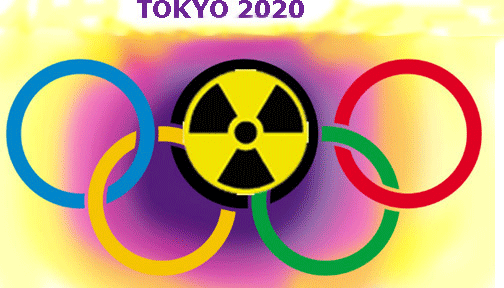 , By MARI YAMAGUCHI, TOKYO (AP) — The head of Toyota Motor Corp. stepped down Monday as vice president of the organizing committee for the 2020 Tokyo Olympics as organizers acknowledged the cost of hosting the games will be far higher than originally thought.
The committee said that Akio Toyoda is expected to be replaced by the president of Panasonic, Kazuhiro Tsuga.
Toyoda is also a member of the Japanese business federation’s committee for the Olympics. Organizers said Toyoda may have been concerned about serving on both committees, as the Olympic body is seeking support from the business community.
Mr. Toyoda might have tried to sort out his roles,” Tokyo organizing committee CEO Toshiro Muto told reporters.
Toyoda said in a statement that he decided to reorganize his roles to intensify his efforts to encourage business support for the 2020 Games. He said he is “looking forward to forging even closer ties between the organizing committee and Japan’s business community.”
Also Monday, Muto said the cost of the games will be much higher than the original estimate of just over 300 billion yen ($2.5 billion), though he did not give a specific figure, saying officials are still sorting out and compiling cost estimates.
Muto denied recent media reports that the latest overall cost estimate has soared to 1.8 trillion yen ($15 billion), saying comparing numbers without specific breakdowns is “inappropriate.”…..
Toyoda’s sudden resignation and the confirmation of rising costs are the latest in a series of setbacks for the Olympic preparations. Japan had to scrap its original plans for the main stadium because of soaring costs, and then faced a plagiarism scandal over the logo for the games. …. http://www.stltoday.com/news/article_b19a72f0-b315-58ca-b211-919ff3a1a920.html#.VnixzirhYlM.twitter
True innovation is in renewables, not nuclear fission: example Amsterdam’s solar road
 Solar road beats nuclear follies http://www.news24.com/Columnists/AndreasSpath/solar-road-beats-nuclear-follies-20151221 Following president Zuma’s disastrous finance minister shell game, Cabinet’s approval for starting the trillion rand nuclear procurement programme sans an initial cost-benefit analysis and evidence of the Gupta family’s growing investment in South African uranium mining, does anyone still believe that the government’s plan to build a fleet of new atomic power plants has anything at all to do with sound economics, securing the country’s long-term electricity supply or moving us to a low-carbon way of doing things that will help to mitigate the effects of climate change?
I don’t think so. Financial profits for strategically connected corporates and attractive kick-backs for well-placed and well-pliable politicians and their entourage are the real reasons why the powers that be refuse to alter their nuclear power course despite noisy opposition from all corners.
This is especially shameful for a country that has all of the prerequisites required to become a global leader in renewable energy production and that certainly doesn’t need to expose itself to the high costs, poor safety record, persistent environmental problems and outdated technology of the nuclear industry.
The really innovative break-throughs are not happening inside nuclear fission reactors these days, but in renewables. Take the example of the world’s first solar road. Last year, a Dutch consortium installed a bicycle path in suburban Amsterdam that captures the energy contained in sunlight and turns it into electricity. Paved with ordinary silicon solar panels which are protected by a concrete frame and sandwiched between layers of strong, tempered safety glass, the path can happily handle everyday road traffic. The power generated when the sun shines is fed into the grid, just as with more conventional solar installations.
Since then, the performance of the ‘SolaRoad’ has been carefully monitored and it turns out to be even more efficient than its creators had first expected. The experimental pilot project is a mere 70 metres long at the moment, but in the first six months of operation it generated more than 3000 kilowatt-hours of electricity. That’s enough to supply a single-person Dutch household for a year, or, as SolaRoad spokesperson Sten de Wit explains, “to power an electric scooter to drive 2.5 times around the world”.
Of course, the project wasn’t cheap to construct, costing many times the amount of a comparable roof-top solar panel installation. As such, the prototype doesn’t make any economic sense at this stage and perhaps it never will. It may, however, turn into something much bigger in the long-run, for instance by powering the smart traffic management systems and the self-driving electric vehicles of the future.
My point is this: the world is going solar and renewable in all sorts of innovative ways. This is the area where real change is happening right now. Given the wealth of year-round sunshine we receive, South Africa ought to be spearheading this revolution.
We shouldn’t be wasting time and money we don’t have on a dangerous, dying and polluting dinosaur technology. Groundbreaking improvements are happening in the field of renewable energy on a daily basis. The nuclear energy industry, by contrast, still hasn’t solved one of its most basic problems after decades of trying: where and how to securely store the radioactive waste it produces for long enough to make it safe.
Iran to get 2 new nuclear reactors from Russia
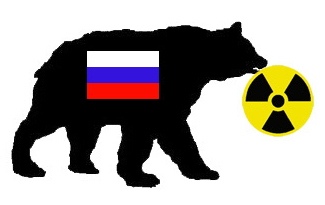 Russia to build new nuclear units in Iran Sky News , Wednesday, 23 December 2015 Russia will reportedly begin building two nuclear power plant units in Iran next week under a deal signed in Moscow last year between subsidiaries of the two countries’ state atomic agencies.
A Mehr news agency report quoted Behrouz Kamalvandi, spokesman for the Atomic Energy Organization of Iran, who appeared to be referring to extension of the Bushehr nuclear power station, designed and built by Russia.
Iran already runs one Russian-built nuclear reactor at Bushehr, and Russia signed a deal with Iran in November last year to build up to eight more reactors in the country…….
The Bushehr plant itself was never considered by diplomats and experts to be a serious nuclear proliferation risk.
Other aspects of Iran’s nuclear programme seen as having potential to develop weapons, such as its uranium enrichment activity and a heavy water reactor, will be curbed under a deal Iran reached with big powers in July including Russia.
The Islamic Republic will see international sanctions on its oil-based economy lifted in return.
http://www.skynews.com.au/news/world/europe/2015/12/23/russia-to-build-new-nuclear-units-in-iran.html#sthash.lYfi4p5l.dpuf– Seiran.html#sthash.lYfi4p5l.dpuf–
Former Clinton Defense Secretary offers dire warning
 Two decades later, Perry has written a new book, “My Journey at the Nuclear Brink,” in which he offers a dire warning: “Far from continuing the nuclear disarmament that has been underway for the last two decades, we are starting a new nuclear arms race.”
This is not hyperbole. The United States and Russia are acting with increasing belligerence toward each other while actively pursuing monstrous weapons. As Joe Cirincione described in the Huffington Post, the Pentagon plans to spend $1 trillion over 30 years on “an entire new generation of nuclear bombs, bombers, missiles and submarines,” including a dozen submarines carrying more than 1,000 warheads, capable of decimating any country anywhere. In the meantime, President Obama has ordered 200 new nuclear bombs deployed in Europe.
Read the full text of Katrina’s column here. http://www.thenation.com/article/the-new-nuclear-arms-race/
Still hope fpor the planet in the the Anthropocene Epoch
Our dominance on Earth comes with great responsibility. The Paris climate deal proves that there is hope for our planet – as long as we remember that omo sapiens has become so dominant a force shaping the properties of the biosphere that scientists now refer to the past two centuries as the Anthropocene Epoch – the age of the human. This role comes with a huge responsibility; one that, it seems, we have lived up to in the climate deal recently agreed in Paris.
We are an infant species, evolving perhaps 150,000 years ago in Africa. For most of our short existence, we were nomadic hunter-gatherers, carrying our possessions while in search of food and anything useful. Compared to the vast herds of mammals in parts of the world, human numbers were small, our technology simple and our ecological impact readily absorbed by the biosphere.
Very suddenly, in evolutionary terms, we’ve exploded into a major global force, altering the air, water, soil and species diversity on a geological scale. We are the most numerous mammal on Earth, empowered by technological innovation, demanding ever more consumer items to satisfy our “wants” instead of our “needs”, driven by corporate hunger for constantly increasing profit in a globalized economy.
Climate change caused by human generation of greenhouse gases is just one of the degradations of our most fundamental needs caused by our shortsighted actions. Pollution of water, soil and air, destruction of habitat, species extinction and ocean degradation are a few of the others………
Our most fundamental needs for survival and wellbeing must be protected above all else, otherwise we will constantly elevate our parochial interests above the protection of our life-support systems.
In Paris, humanity has demonstrated that the “age of the human” won’t necessarily lead to an age of destruction. There is hope – as long as we remember that our dominance on Earth comes with great responsibility. http://www.theguardian.com/commentisfree/2015/dec/17/paris-climate-deal-cop21-age-of-the-human-destruction
Mainstream press spins Fukushima nuclear radiation as an issue of no concern
 Massive Fukushima radiation cover-up as government-funded scientists now claim radiation won’t hurt you, December 17, 2015 by: David Gutierrez, staff writer (NaturalNews) The alarming findings that levels of Fukushima radiation off the North American coast are higher now than they have ever been, is being spun by the press as an issue of no concern……
In a study presented at the conference of the American Geophysical Union in San Francisco on Dec. 14, researchers found that radiation levels from Alaska to California have increased since samples were last taken. The highest levels yet of radiation from the disaster were found in a sample taken 2,500 kilometers (approx. 1,550 miles) west of San Francisco.
Lead researcher Ken Buesseler of Woods Hole Oceanographic Institution was one of the first people to begin monitoring Fukushima radiation in the Pacific Ocean, with his first samples taken three months after the disaster started. In 2014, he launched a citizen monitoring effort – Our Radioactive Ocean – to help collect more data on ocean-borne radioactivity.
The researchers track Fukushima radiation by focusing on the isotope Cesium-134, which has a half-life of only two years. All Cesium-134 in the ocean likely comes from the Fukushima disaster. In contrast, Cesium-137 – also released in huge quantities from Fukushima – has a half-life of 30 years, and persists in the ocean, not just from Fukushima, but also from nuclear tests conducted as far back as the 1950s.
The most recent study added 110 new Cesium-134 samples to the ongoing studies. These samples were an average of 11 Becquerels per cubic meter of sea water, a level 50 percent higher than other samples taken so far…….
Situation still worsening
The reality, however, is that radiation along the West Coast is expected to keep getting worse. According to a 2013 study by the Nansen Environmental and Remote Sensing Center in Norway, the oceanic radiation plume released by Fukushima is likely to hit the North American West Coast in force in 2017, with levels peaking in 2018. Most of the radioactive material from the disaster is likely to stay concentrated on the western coast through at least 2026……..
“Despite the fact that the levels of contamination off our shores remain well below government-established safety limits for human health or to marine life,” he said, “the changing values underscore the need to more closely monitor contamination levels across the Pacific.” http://www.naturalnews.com/052348_Fukushima_radiation_US_west_coast_contamination.html#ixzz3ucfYEtY6
1 This Month

of the week – Shut Down Drone Warfare!


Tell the Ukrainian Government to Drop Prosecution of Peace Activist Yurii Sheliazhenko

Petition to revoke the licensing of the Near Surface Nuclear Disposal Facility (NSDF) at Chalk River. https://www.ourcommons.ca/petitions/en/Petition/Details?Petition=e-7247
To see nuclear-related stories in greater depth and intensity – go to https://nuclearinformation.wordpress.com
-
Archives
- April 2026 (91)
- March 2026 (251)
- February 2026 (268)
- January 2026 (308)
- December 2025 (358)
- November 2025 (359)
- October 2025 (376)
- September 2025 (257)
- August 2025 (319)
- July 2025 (230)
- June 2025 (348)
- May 2025 (261)
-
Categories
- 1
- 1 NUCLEAR ISSUES
- business and costs
- climate change
- culture and arts
- ENERGY
- environment
- health
- history
- indigenous issues
- Legal
- marketing of nuclear
- media
- opposition to nuclear
- PERSONAL STORIES
- politics
- politics international
- Religion and ethics
- safety
- secrets,lies and civil liberties
- spinbuster
- technology
- Uranium
- wastes
- weapons and war
- Women
- 2 WORLD
- ACTION
- AFRICA
- Atrocities
- AUSTRALIA
- Christina's notes
- Christina's themes
- culture and arts
- Events
- Fuk 2022
- Fuk 2023
- Fukushima 2017
- Fukushima 2018
- fukushima 2019
- Fukushima 2020
- Fukushima 2021
- general
- global warming
- Humour (God we need it)
- Nuclear
- RARE EARTHS
- Reference
- resources – print
- Resources -audiovicual
- Weekly Newsletter
- World
- World Nuclear
- YouTube
-
RSS
Entries RSS
Comments RSS
 nuclear-news