NRC conducting ‘Special inspection’ at River Bend nuclear station
‘Special inspection’ underway at River Bend power plant http://www.wbrz.com/news/special-inspection-underway-at-river-bend-power-plant/ February 08, 2016 By: Hunter Robinson ST. FRANCISVILLE – The Nuclear Regulatory Commission announced they’ve begun a special inspection at the River Bend Station nuclear power plant following an unplanned shutdown of the reactor Jan. 9th.
According to a press released issued Monday, a lightning strike caused a “momentary surge” at the plant’s offsite power supply, forcing the shutdown. The NRC will be investigating onsite for a week and publish the results within the next 45 days.
This isn’t the plant’s first trouble with unplanned shutdowns. There were inspections following an unplanned shutdown of the reactor Christmas Day 2014 and another about three months later.
No need to rush for risky nuclear power while other climate options are better
The key to understand is that we have options in the transition to a low carbon economy and there’s no need to resort to the riskiest first. Indeed, the clean energy sector can be a economic bonanza: according to the Department of Energy, the U.S. solar workforce has increased 123 percentsince 2010 – and this is the third consecutive year of about 20 percent annual jobs growth in this sector.
There’s no need to continue to subsidize risky, proliferation-prone nuclear technology in a fight against climate change
 Don’t go nuclear on climate change just yet, The Hill, 9 Feb 16 “……A better understanding of the climate sensitivity to carbon emissions is crucial in making sensible policy decisions between the two types of risks at hand: the societal risks of from the man-made component of climate change versus the societal risks of any proposed solutions. No one wants the cure to be worse than the disease.
So do we just sit on our hands until we have more precise values for the climate sensitivity parameter? Certainly not – the large uncertainty of climate projections should not be an excuse for inaction. Quite apart from the issue of temperature increase due to carbon dioxide, there’s the additional problem of ocean acidification: Carbon dioxide dissolves in the ocean to make an acid which can degrade the ability of many marine organisms to make and maintain their shells and skeletons. Regardless of the temperature increase due to carbon emissions, ocean acidification could have potentially serious consequences for the entire marine ecosystem – and the humans that depend on it.
Luckily, there are several carbon mitigation strategies with few, if any, negative side-effects and these could be implemented right away while climate scientists work to refine their climate sensitivity estimates. For instance, a McKinsey study concluded that,“Energy efficiency offers a vast low-cost energy resource for the American economy….[A] holistic approach…is estimated to reduce end-use energy consumption in 2020 by…roughly 23 percent of the projected demand, potentially abating up to 1.1 gigatons of greenhouse gases annually”.
Residential and commercial buildings consume roughly 40 percent of the nation’s energy budget and there is enormous scope for making current and future building more efficient. Put another way, implementing strict energy efficiency standards alone could more than obviate the need for the 20 percent contribution nuclear power makes to the nation’s electricity budget.
Similarly, government policies could help boost the use of carbon capture and renewable energy sources like wind, hydro and solar which have few negative side effects and many upsides. Specifically, government policies could be tailored to help address the technological challengesfacing renewables: scale-up, storage, transmission, and backup capacity issues.
The key to understand is that we have options in the transition to a low carbon economy and there’s no need to resort to the riskiest first. Indeed, the clean energy sector can be a economic bonanza: according to the Department of Energy, the U.S. solar workforce has increased 123 percentsince 2010 – and this is the third consecutive year of about 20 percent annual jobs growth in this sector.
There’s no need to continue to subsidize risky, proliferation-prone 1960’s nuclear technology in a fight against climate change…….http://thehill.com/opinion/op-ed/268696-dont-go-nuclear-on-climate-change-just-yet
Corruption and legal violations in the Central African Republic mining sector: international list of companies responsible
This list shows in a very efficient way which companies intervene in the mining sector in CAR and how most of them violate their obligations toward the state, having corrupted its officials through “bonuses”, paid most of the time in cash…..https://wikileaks.org/car-mining/#bonus
The World Sports Alliance (WSA): how the UN was indirectly implicated in a mining corruption scheme
These documents show the schemes used by a fake international organisation supported by the UN and numerous states in order to corrupt local elites and steal the natural resources of impoverished states and their populations. https://wikileaks.org/car-mining/#wsa
Hinkley nuclear project – one crisis after another
Hinkley Point nuclear power station lurches into another crisis after director of £18bn project quits, This Is Money By EMILY DAVIES FOR THE DAILY MAIL 4 February 2016 Hinkley Point nuclear power station lurched into another crisis after the director of the £18bn project quit……..His resignation comes just days after EDF delayed giving approval to construction of Hinkley Point C as it struggles to find the billions of pounds to finance the deal.
Hinkley Point, in Somerset, has been beset with delays and cost overruns since 2010. EDF agreed a subsidy deal over Hinkley Point in 2013 and currently has a 66.5 per cent stake in the project, after Chinese utility CGN took a 33.5 per cent stake in the project.
But EDF has £28bn net debt and needs to find an estimated £41bn to extend the lifespan of 58 French nuclear plants. The company is said to be pressuring the French government, which owns 85 per cent of EDF, to take some of its stake in Hinkley Point.
And this week it emerged that the power station could be further put off, as five French union members on EDF’s 18-seat board came out in opposition of the project. http://www.thisismoney.co.uk/money/markets/article-3430400/Hinkley-Point-nuclear-power-station-lurches-crisis-director-18bn-project-quits.html#ixzz3zKCwnvD2
Nuclear radioactive trash – a global problem?
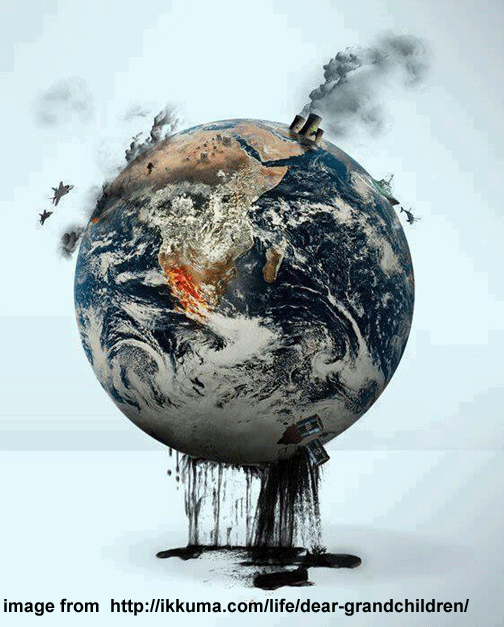
Does Germany’s nuclear waste headache warrant a global fix? New Scientist, 3 February 2016 ARE nations duty-bound to deal with their own nuclear waste, or do we need a transnational solution? It is a pertinent question. Germany, despite decisively ditching nuclear power five years ago, still can’t decide what to do with the leftovers.
Anti-nuclear activists there are vowing to block the return of spent fuel from the country’s reactors, being reprocessed in France and the UK. They have also boycotted a parliamentary commission scheduled to report later this year on a final resting place for plutonium-rich waste, which needs keeping out of harm’s way for tens of thousands of years (see “Radioactive waste dogs Germany despite abandoning nuclear power“).
Their campaign may succeed, but only temporarily by dodging the big issue and saddling other countries with German waste……https://www.newscientist.com/article/2076103-does-germanys-nuclear-waste-headache-warrant-a-global-fix/
USA’s deadlocked policy on North Korea’s Nuclear Test
Deadlock: North Korea’s Nuclear Test and US Policy, CounterPunch by MEL GURTOV , FEBRUARY 4, 2016 North Korea continues to rattle the cages of both friend and foe. Despite near-universal condemnation of its fourth nuclear test and a deplorable human rights record, Kim Jong-un defiantly disregards the major powers and the United Nations. And now, adding insult to injury, the UN Secretary-General reports that North Korea has notified various UN agencies of its intention to launch a satellite, apparently to test its ballistic missile technology.
Continued nuclear testing by North Korea is its way of demonstrating independence of action. Nuclear weapons are the DPRK’s “insurance policy,” David Sanger writes – its last best hope for regime survival and legitimacy, and the most dramatic way to insist that the North’s interests should not be neglected. All one has to do is, through North Korean blinkers, see what has happened in Iraq, Iran, and Libya, where dictators did not have a nuclear deterrent. Two of them were invaded, and all had to surrender their nuclear-weapon capability.
The longstanding US approach to North Korea’s nuclear weapons is way off the mark. The Obama administration’s strategy of “strategic patience” shows little attention to North Korean motivations. The US insistence that no change in policy is conceivable unless and until North Korea agrees to denuclearize ensures continuing tension, the danger of a disastrous miscalculation, and more and better North Korean nuclear weapons. The immediate focus of US policy should be on trust building.
Increasing the severity of punishment, with threats of more to come, is representative of a failed policy. ……..
Serious engagement with North Korea remains the only realistic policy option for the United States and its allies. To be effective, however (i.e., meaningful to the other side), engagement must be undertaken strategically—as a calculated use of incentives with expectation of mutual rewards, namely in security and peace. And it should be undertaken in a spirit of mutual respect and with due regard for sensitivity in language and action.
Here are three elements of an engagement package:
First is revival of the Six-Party Talks without preconditions and with faithfulness to previous six-party and North-South Korea joint declaration…….
Second is creation of a Northeast Asia Security Dialogue Mechanism. ……
…..Third is significant new humanitarian assistance to North Korea. …The same kind of steady, patient, and creative diplomacy that led to the nuclear deal with Iran is still possible in the North Korea case. As the Under Secretary-General of the UN, Jeffrey Feltman, said, Iran shows that “diplomacy can work to address non-proliferation challenges. There is strong international consensus on the need to work for peace, stability and denuclearization on the Korean Peninsula. To achieve this goal, dialogue is the way forward.”
Mel Gurtov is Professor Emeritus of Political Science at Portland State University, Editor-in-Chief of Asian Perspective, an international affairs quarterly and blogs at In the Human Interest. http://www.counterpunch.org/2016/02/04/deadlock-north-koreas-nuclear-test-and-us-policy/
France’s EDF begging for government support before committing to UK Hinkley nuclear project
France can’t build its own new nuclear power stations, let alone ours He’s the only one of a Dad’s Army of pundits no longer on hand to commentate on the looming financial crisis, Spectator, 4 Feb 16 Martin Vander Weyer “…….signals from EDF of France — which has a two-thirds interest in this £18 billion project, alongside Chinese investors — are very worrying.
Having already spent £2 billion, the French state utility has deferred until at least the middle of this month a final commitment that was expected last week. Under pressure from unions and minority shareholders, and battered by falling wholesale electricity prices as well as endless delays and problems on its own nuclear new-build at Flamanville near Cherbourg, EDF is evidently begging for more support from its own government before committing such massive resources to solve a problem for ours.
…….the travails of Hinkley are reported to have ‘spooked’ Hitachi of Japan, which is in negotiations for another nuclear station at Wylfa Newydd in Anglesey……http://www.spectator.co.uk/2016/02/france-cant-build-its-own-new-nuclear-power-stations-let-alone-ours/
A botched email attack on nuclear scientists
The Former Federal Employee Who Tried to Launch a Cyberattack on Nuclear Scientists, The Atlantic He sent emails he thought were infected with viruses to Department of Energy employees involved in developing nuclear weapons. KAVEH WADDELL , 3 Feb 16 A nuclear scientist formerly employed by the federal government admitted Tuesday that he tried to infect the computers of about 80 government employees whom he believed had access to nuclear materials and weapons.
According to court documents released by the Department of Justice, the scientist, Charles Eccleston, pleaded guilty to one count of attempted unauthorized access to a protected computer.
Until he was fired in 2011, Eccleston worked for the Nuclear Regulatory Commission…….
He sent an email containing what he thought was a malicious link to about 80 Department of Energy employees, advertising an upcoming nuclear conference in Washington, D.C. The link, which was received by employees in nuclear labs in Tennessee, New Mexico, California, and in the DOE headquarters in D.C., was harmless.
He was told he would be paid about $80,000 for his efforts. Instead, he was arrested by Philippine police and deported to the U.S. He signed a plea deal on Tuesday, affirming that the evidence the FBI gathered on him is accurate, and faces up to 30 months of prison time and up to $95,000 in fines. (He wasoriginally charged with four felonies.)
And those “top secret” NRC email addresses Eccleston sold for thousands of dollars? The FBI later realized they were all publicly available. http://www.theatlantic.com/technology/archive/2016/02/fired-federal-employee-tried-to-launch-cyberattack-on-nuclear-scientists-computers/459894/
How Gorleben refused to be Germany’s nuclear dump
By PETER TEFFER GORLEBEN, GERMANY, 1. FEB (subscribers only) https://euobserver.com/beyond-brussels/132065
USA’s $30 billion new cruise nuclear missile makes no sense financially or strategically
 A Nuclear Weapon the U.S. Doesn’t Need, Bloomberg View FEB 1, 2016 By Editorial Board
The administration’s proposal to spend up to $30 billion to create a new nuclear cruise missile meant to be carried by the aging B-52 bomber makes no sense
. . Cruise missiles, which are smaller than land-based intercontinental ballistic missiles and fly farther than tactical bombs dropped by planes, are the wild card of the nuclear arsenal: Unlike ICBMs, they are very hard to spot by radar or satellite, and, even if detected, they’re indistinguishable from conventionally armed cruise missiles.
This is a problem because a successful deterrence strategy requires that both sides in a potential nuclear conflict have a pretty good idea of what the other would do. Three years ago, the U.K. decided not to develop a submarine-based nuclear-tipped cruise missile because it carries too great a risk of “miscalculation and unintended escalation.”…….
Today, with Russia a much-diminished nuclear threat and China little interested in challenging U.S. nuclear superiority, the need to overwhelm either nation’s air defenses is less of a priority. Meanwhile, lesser potential adversaries such as Iran and North Korea have limited capability to protect their airspace. And technological advances have made the nuclear submarine fleet vastly more capable of penetrating enemy anti-missile defenses.
So why the push for the new cruise weapon? In part, it’s the natural inclination of the military to trade up……
plans to upgrade the nuclear cruise missile would not make the U.S., or the world, any safer.
To contact the senior editor responsible for Bloomberg View’s editorials: David Shipley atdavidshipley@bloomberg.net. http://www.bloombergview.com/articles/2016-02-01/a-nuclear-weapon-the-u-s-doesn-t-need
Growing concern sin Europe over restarting aging Belgium nuclear stations
Concerns mount over reactivation of aging Belgian nuclear stations http://www.theworldweekly.com/reader/view/newswire/2016-02-01/concerns-mount-over-reactivation-of-aging-belgian-nuclear-stations/6537
China’s envoy in North Korea to discuss nuclear issue
China’s Special Representative for Korean Peninsula Affairs Wu Dawei was expected to hold discussions with the North Koreans on the nuclear issue after his arrival there, Japan’s Kyodo news agency reported from the North Korean capital.
Neither Kyodo nor KCNA gave further details……..
New doubts on new nuclear
Fresh doubts on new nuclear: reports http://utilityweek.co.uk/news/fresh-doubts-on-new-nuclear-reports/1211252#.VrEUe9J97Gi 31/01/2016
Nakanishi told the Telegraph: “The DECC worries about the stability of the scheduled construction of the [Hinkley Point] nuclear power plant, so some of the conditions – the credit requirements – those kind of things may affect us.
“In order to set up the financial conditions [to build Hinkley], Chinese capital was introduced, but what the real result will be – we have a very serious concern about that.”
Horizon expects to present full and final proposals later this year and is currently hoping to start generating power within the first half of the 2020s. It plans to generate more than 2,700 MW at the site using two Advanced Boiling Water Reactors supplied by Hitachi, which bought Horizon Nuclear Power in 2012.
Meanwhile, the Sunday Times reported that a get-out clause in the government’s contract with EDF, allowing the Treasury to back out of financial support if the French energy giant’s troubled Flamanville nuclear plant is not up and running by 2020, could put further pressure on the project. EDF is believed to have delayed a final investment decision on Hinkley until next month at the earliest, amid growing concerns over the financing of the proposed nuclear plant.
Author: Ellen Bennett,
Renewables are a better bet than expensive, risky nuclear power
Should the United States rely heavily on nuclear power in seeking to address climate change?
Renewables are a better bet than expensive, risky nuclear power, Missoulian, 1 Feb 16
MICHAEL E. KRAFT Michael Kraft is professor emeritus of political science and public and environmental affairs at the University of Wisconsin-Green Bay.“……Nuclear power will have an important role to play, but it is unlikely to replace much fossil fuel use. It is still too expensive and too risky.
A better bet is to invest in renewables and energy efficiency, which most of the world is now doing. Despite construction of new reactors by China and other Asian nations, globally nuclear electricity production has been leveling off while wind and solar power are soaring. There are good reasons for these trends.
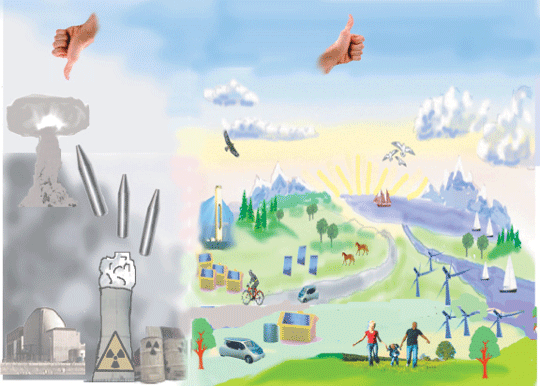
One is cost. The nuclear plants under construction in the U.S., the first after more than three decades, are expected to cost $8 billion to $9 billion each, possibly more, and the eventual decommissioning of reactors remains expensive.
These very high costs make it difficult for private utilities to increase nuclear power generation despite generous federal loan guarantees. They see more promise and lower costs in natural gas-powered plants or in turning to renewable energy.
Other reasons include dealing with waste and safety. Even if the industry can reduce costs through improved technology and reactor design, what do we do about high-level waste disposal, for which no acceptable solution is in sight? And how should we address public concerns over reactor safety after the Fukushima disaster?
A better way forward is to invest heavily in renewables as well as in energy conservation and efficiency, which can cut energy demand sharply.
This includes improved building design, greater reliance on public transit, enhanced transportation efficiency, modernization of the electrical grid and storage technologies, and better lighting, heating and cooling systems……….
The federal government has long favored and heavily subsidized nuclear power and fossil fuels. For the past decade, renewables and efficiency finally have begun to receive significant support. We should accelerate that trend. http://missoulian.com/news/opinion/renewables-are-a-better-bet-than-expensive-risky-nuclear-power/article_7c5328fc-645a-5e84-82d0-b6e896a831e3.html
1 This Month
29 Jan. Thursday 7-8 p.m. Webinar – World’s Largest Nuclear Station in Port Hope, ON?
To see nuclear-related stories in greater depth and intensity – go to https://nuclearinformation.wordpress.com/


31st January – Challenging the War Machine – a DECLASSIFIED UK SUMMIT

Website of the Week
Now until to February 10, 2026 Radioactive waste storage in France: the debate is finally open! How to participate?
-
Archives
- January 2026 (283)
- December 2025 (358)
- November 2025 (359)
- October 2025 (376)
- September 2025 (258)
- August 2025 (319)
- July 2025 (230)
- June 2025 (348)
- May 2025 (261)
- April 2025 (305)
- March 2025 (319)
- February 2025 (234)
-
Categories
- 1
- 1 NUCLEAR ISSUES
- business and costs
- climate change
- culture and arts
- ENERGY
- environment
- health
- history
- indigenous issues
- Legal
- marketing of nuclear
- media
- opposition to nuclear
- PERSONAL STORIES
- politics
- politics international
- Religion and ethics
- safety
- secrets,lies and civil liberties
- spinbuster
- technology
- Uranium
- wastes
- weapons and war
- Women
- 2 WORLD
- ACTION
- AFRICA
- Atrocities
- AUSTRALIA
- Christina's notes
- Christina's themes
- culture and arts
- Events
- Fuk 2022
- Fuk 2023
- Fukushima 2017
- Fukushima 2018
- fukushima 2019
- Fukushima 2020
- Fukushima 2021
- general
- global warming
- Humour (God we need it)
- Nuclear
- RARE EARTHS
- Reference
- resources – print
- Resources -audiovicual
- Weekly Newsletter
- World
- World Nuclear
- YouTube
-
RSS
Entries RSS
Comments RSS
 nuclear-news