Seven key areas for concern in South Africa’s nuclear build plan
 SA nuclear build plan requires a close study, IOL BUSINESS/OPINION/COLUMNISTS /17 March 2016By: Pierre Heistein Should South Africa build more nuclear power plants?…….. These are seven key areas that need to be assessed.
First, construction time. South Africa is in desperate need of extra electricity generation capacity and the proposed nuclear projects plan to add 9 600 megawatts to the grid. But how long will it take to get this online? On average, nuclear reactors take about 10 to 15 years to build, although nuclear construction worldwide is notorious for being behind schedule……
It is not only the cost that needs to be considered but also the consequences of the cost. If the money needs to be borrowed, how long will it take to pay back and how will this additional debt affect our credit rating and ability to borrow for other projects? If the project is funded by external parties, what trade and political conditions will be attached to these deals?
Third, the cost of energy generation. This is nuclear’s saving grace – relative to other methods its production of electricity per unit is cheap once the plant is built. Will this still be the case in 15 to 20 years?
Fourth, waste and disposal consequences. Nobody has yet figured out a way to produce nuclear energy without producing radioactive waste. This waste needs to be stored for 200 to 1 000 years before humans and other life can safely be exposed to it.
Fifth, decommission costs. Nuclear reactors have a lifespan of 40 to 80 years and thereafter need to be removed and replaced……
Sixth, transparency and corruption. As the government has shown, the majority of negotiations necessary in mega-infrastructure projects can take place behind closed doors without public consultation.
Megaprojects also typically work with few suppliers and include fewer and more lucrative trade deals. Compare this to the more transparent and decentralised process behind the independent power producers procurement programme used for smaller energy projects and it is easy to see that megaprojects are more vulnerable to corruption and theft of investment funding.
Seventh, disaster risk. Even if measures could be put in place to eliminate the chance of human error, technological failure and the risk of terror attacks, there is no way that constructors can guarantee that reactors will be safe from natural disasters. While terror attacks and natural disasters may not feel familiar in South Africa’s current climate, the nuclear reactors will exist for almost a century of change.
If nuclear is our best option then we have to be consulted and convinced on all accounts because it is the South African people that will carry the consequences if it’s not. http://www.iol.co.za/business/opinion/columnists/sa-nuclear-build-plan-requires-a-close-study-1998735
Nuclear power station reactor shut down after fault
STV News Kaye Nicolson, 17 Mar 16 Workers act after problem with valve in Reactor Two at Torness in East Lothian.A reactor has been shut down at the Torness nuclear power plant due to a problem with a valve.
Reactor Two at the plant, near Dunbar, was closed on Thursday morning after workers found a fault.
EDF Energy said there were no safety or environmental impacts associated with the closure, which is expected to be short term……..http://stv.tv/news/east-central/1346829-reactor-shut-down-at-east-lothian-nuclear-power-plant/
A South Australian ponders on transporting high level wastes across the globe
 Response to the Tentative Findings of the SA Nuclear Fuel Cycle Royal Commission A Submission by Paul Langley Nuclear Exhaust 16 Mar 16 “……Transport of HLNW from around the world to a SA HLNW geologic repository
The Royal Commission apparently assumes that the movements of many hundreds of thousands of tonnes of spent nuclear fuel from many countries around the world to the Gawler Craton will be low risk, no problems and perfectly safe. As contradictory as those stances are. I do not accept that position of default safety. Further I do not accept that the unloading of the HLNW will be perfectly safe. I do not accept that road transport from port to repository site will be perfectly safe, even on a dedicated purpose built road.
I would recommend that Super Freighters laden with the contents of countless reactor cores not sail down the Somali coast nor in the waters to the south of Thailand for fear of pirates. They should avoid man made Islands in the South China Sea. I suppose the ships will be guarded by 6 English policemen each with two revolvers between them. Rather than half the Pacific Fleet they would actually warrant. If they ever get to leave their home ports. What is the Somali coast going to be like in 40 years? Peaceful or short of rad weapons…….” https://nuclearexhaust.wordpress.com/2016/03/15/response-to-the-tentative-findings-of-the-sa-nuclear-fuel-cycle-royal-commission/
No long term solution in sight for nuclear waste
Stop Wasting Time–Create a Long-Term Solution for Nuclear Waste, Three decades after Chernobyl, the U.S. needs to tackle its own ominous nuclear safety problem Scientific American April 1, 2016
April marks the 30th anniversary of the world’s worst nuclear power disaster, the explosion and fire at a reactor at the Chernobyl plant in Ukraine, in the former Soviet Union. It forced more than 300,000 people to flee and created a zone tens of kilometers wide where radiation levels remain hazardous to this day.
A severe reactor accident is unlikely in the U.S. and other countries with safer facilities. But we face another danger that is in many ways more threatening than a meltdown: the steady accumulation of radioactive waste. The U.S. has dithered over this clear and present danger for decades, irresponsibly kicking the can down the road into the indefinite future.
The spent fuel produced by nuclear power plants will emit harmful radiation for hundreds of thousands—even millions—of years. Some 70,000 metric tons of it are now stored at 70 sites scattered across 39 states. One in three Americans lives within roughly 80 kilometers of a storage site. The waste, hot from radioactive decay, is held in deep pools of water or in “dry casks” of concrete and steel that sit on reinforced pads. Accidents or terrorist attacks could drain the pools or crack the casks, with the risk that the exposed waste could catch fire, spreading radioactive soot across the surrounding countryside and into food chains in a Chernobyl-like catastrophe. As the years go by and waste is packed into overcrowded pools and pads, that risk will only grow………
Ultimately, if consent-based siting efforts fail, in favor of the common good the federal government must exercise its power of eminent domain to overcome local opposition, creating a deep geologic repository for nuclear waste. Regardless of whether the next president is for or against nuclear power, he or she must act decisively to avoid poisoning our shared future.
UK needs to turn to plan By -renewable energy, not to the Hinkley nuclear boondoggle
Doubts over EDF’s plan for Hinkley Point nuclear power station, BBC News, 12 March 2016 Fresh doubts have arisen over plans by French Energy firm EDF to build an £18bn nuclear power plant at Hinkley Point, Somerset.
Angus MacNeil, chairman of the House of Commons energy committee, has called for the project to be re-examined.It follows a letter that EDF chief executive Jean-Bernard Levy sent to his staff, saying the project needed more funding from the French government.
The UK government said it was “committed” to Hinkley Point. But Mr MacNeil, an MP for the SNP, said the government needed to urgently rethink its support for the proposal. “It’s something that has to be looked into very carefully and very soon because it is a huge obligation and a lot of eggs in quite small baskets,” he said.
“The Chinese are involved, the French involved, the UK are involved. They need to take a step back because other places have decided not to go ahead with this stuff.”…….
Pressure is mounting as the £18bn cost of the Hinkley project is more than the entire value of the firm.
And there is scepticism as the British government has agreed to pay more than twice the current wholesale price of energy once the plant is producing – £92.50 per megawatt hour for electricity, against £37 per megawatt hour……..
Imagine British Gas owners Centrica were in financial trouble after sinking billions into a French power station. And then imagine that the bill for rescuing it fell on to taxpayers. That is essentially the risk facing EDF and the French government.
The dangers to the company’s financial integrity are great enough to prompt EDF’s chief financial officer to resign in protest, the French equivalent of the National Audit Office to issue stark warnings and French unions to lobby their members to vote against the project.
To make matters worse, EDF’s recent track record in delivering big projects is poor. Reactor construction in France and China have run over time and massively over budget.
The prize for EDF with Hinkley Point is a guarantee to provide electricity for decades at three times the current price. The deal is still on but the stakes are high as a crucial EDF board meeting later this month approaches.
Construction of Hinkley Point C in Somerset, the first new nuclear plant in the UK for 20 years and the most expensive in the world, is due to begin in 2019, two years after it had originally been due to open…….
Allan Jeffrey from the Stop Hinkley campaign group said there were many problems, whether construction, technical or financial.
“Nuclear power is an old fashioned form of energy where you throw away most of your energy, it’s dangerous and risky and open to terrorist attacks,” he said.
“We should be looking at Plan B which should be getting on with sustainable, renewable energy.” The concerns are the latest in a string of problems – last week EDF’s finance director Thomas Piquemal quit reportedly because he feared the project could jeopardise the company’s financial position.
And in February, Chris Bakken, the director of the project, said he was leaving to pursue other opportunities…….http://www.bbc.com/news/business-35793445
Research into nuclear strikes – considering possibility of terrorism
Surprise nuclear strike? Here’s how we’ll figure out who did it, Science By Richard Stone Mar. 11, 2016 “……..The most likely nuclear terrorism scenario, experts say, is a bomb set off on a city street. Past experience offers only a sketchy picture of the resulting devastation. The atomic bombs the United States dropped on Hiroshima and Nagasaki in 1945 detonated about 500 meters above those cities. During the subsequent half-century, while the United States refined its atomic arsenal, nearly all tests were in the air or underground, not in citylike environments. …….http://www.sciencemag.org/news/2016/03/surprise-nuclear-strike-heres-how-well-figure-out-who-did-it
Wind industry a good investment. Solar roads could be coming
 Is the wind industry still a safe bet for investors?
For investors who seek long-term low-risk investments, the 20 year lifespan of an onshore wind farm is an attractive prospect.
http://www.dailyclimate.org/t/5497482671713808412
Will we soon be riding on solar roads? The idea gains traction.
Several countries—the Netherlands, France, the United States—are testing ways to pave roads with solar panels. Their efforts have plenty of skeptics
http://www.dailyclimate.org/t/5497482671713810248
It’s time to rethink what constitutes “clean energy – it’s NOT nuclear
By exploiting large amounts of untapped energy efficiencies, maximizing surpluses and reserves, expanding renewables and improving generation and transmission, we know we can retire the nuclear plant hovering above Manhattan on the Hudson River. And we should do everything in our power to transition the bright minds at Indian Point into the clean renewable energy sector in New York, which is growing daily. Let’s keep them employed – and then some. But most importantly, let’s keep this country safe.
 Proof Nuclear Energy Is a Huge Security Risk http://fortune.com/2016/03/08/nuclear-energy-security-risk/ by
@Michael_Shank MARCH 8, 2016 It’s time to rethink what constitutes “clean energy”
Nuclear energy is not the answer to America’s necessary clean energy transition. It’s an expensive, dirty, and dangerous fuel, which is why seven electrical engineers at the U.S. Nuclear Regulatory Commission (NRC) noted, last week, significant safety concerns with all but one of the nation’s 100 nuclear power plants. Signaling the NRC engineers’ concerns, last month one of America’s oldest nuclear power plants leaked radioactive tritium into its groundwater below – at radioactivity levels 65,000% higher than normal.
It’s time to rethink what constitutes “clean energy,” as nuclear power is often grouped into the clean energy category since its greenhouse gas emissions are less than heavier emitting oil, coal, and gas. On the heels of the international climate talks in Paris, as the United States struggles to meet its carbon-related commitments in light of the Supreme Court’s stay of the Obama Administration’s Clean Power Plan, the ramp up of “clean energy” solutions is now paramount.
But just what defines “clean” is the question, especially when radioactive leaks abound? The plant responsible for the latest radioactive leak – Indian Point Energy Center, owned by Entergy, just 25 miles north of New York City – is just one of the many aging nuclear power plants in America that is getting narratively re-positioned as clean energy. This is happening along with hydropower and even natural gas – diluting, in the public’s mind at least, what clean energy really is (a term that should be reserved primarily for renewable energy).
In fact, Indian Point is anything but clean, which is why it has moved quickly to the front of New York State’s political burner lately as the company’s operating licenses, which expired a while ago, are getting a strong rebuke from New York State Governor Andrew Cuomo, who doesn’t want a Fukushima-style nuclear disaster happening to New Yorkers. Continue reading
Never mind Fukushima. Japan’s Prime Minister Abe is all for more nuclear power
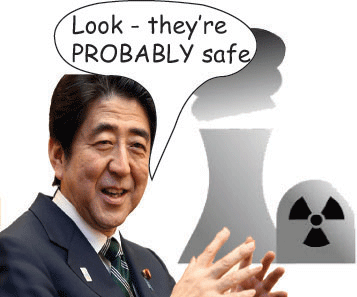 Japanese premier defends nuclear power’s necessity on eve of Fukushima anniversary, DW, 10 Mar 16 Prime Minister Shinzo Abe has said Japan “cannot do without” nuclear power ahead of the fifth anniversary of the earthquake and tsunami. Japan’s leader also pledged to bolster decontamination efforts in irradiated areas. Abe pledged Thursday to accelerate reconstruction efforts in tsunami-hit northern Japan and the wrecked Fukushima nuclear plant ahead of the 2020 Olympic Games.
But in the wake of an unprecedented court ruling that ordered two reactors to remain offline due to safety fears, he argued that Japan needed nuclear power to feed its energy needs…….
Public anger over the meltdown of the Fukushima Daiichi reactor and skepticism in general toward authorities in the wake of the 9.0 earthquake that struck March 11, 2011, triggering a massive tsunami – remains intense……
The institutionally cozy ties between politicians, bureaucrats and the nuclear industry has left unresolved calls for reform and widespread distrust among members of the public who continue to be told that nuclear power is safe.
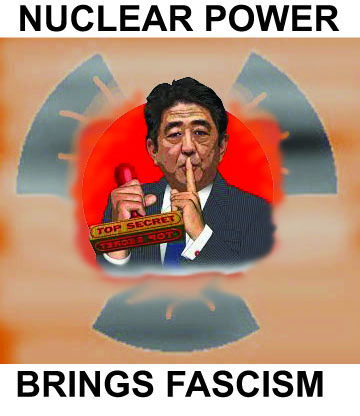
“Ties between the bureaucracy and industry are still very strong – it’s a legacy of government-led development when the country was underdeveloped (after World War II),” Muneyuki Shindo, an honorary politics professor at Chiba University, told the AFP news agency………
A national ceremony will be held Friday to commemorate the fifth anniversary of the disaster to be attended by Abe, the emperor and empress and other dignitaries.
Official investigations laid the blame on plant operator Tokyo Electric Power – three former executives are facing a criminal trial – and Fukushima has been labeled a “man-made” disaster.
Already some changes are evident; a number of tsunami-struck communities have been moved to higher ground, while bigger seawalls are going up along the coast and higher barriers are being erected to protect at-risk reactors.
Scientists note that timing is important as the country experiences about 20 percent of the world’s biggest quakes annually, and recently has been more seismically active than usual. http://www.dw.com/en/japanese-premier-defends-nuclear-powers-necessity-on-eve-of-fukushima-anniversary/a-19106430
Call to scrap costly Hinkley Point nuclear project
Government must scrap nuclear new-build plan News and Star 10 March 2016
THE government has to scrap its new nuclear build plans…..It has to bin the multi-billion deal it has signed with French power firm EDF for the Hinkley Point plant at Somerset.
Surely, if the company’s own finance chief thinks the deal is too expensive we should listen?Thomas Piquemal says the French-Chinese deal will wreck EDF and has resigned from his post in protest.It’s estimated the cost has already ballooned from £14bn to £24.5bn. All this at a time when energy firms are reporting major losses and cutting jobs.
Do we honestly have to commit to decades of excessive overpayments?
How can the government complain about the cost of subsidies to wind farm companies and solar panel firms when they are prepared to pay this much for nuclear plants?……..
Costs, technical hitches – it’s time that UK abandoned Hinkley Point nuclear project
Time for the UK to end attachment to Hinkley Point nuclear plant, Ft.com, 10 Mar 16
The costs and technical uncertainty were a warning to ministers.
When George Osborne, touring China in September, announced the UK’s commitment to a new power station at Hinkley Point, he intended it as a cornerstone of Britain’s drive for Chinese investment.
No matter that, the following month, protesters inflated a giant white elephant near the site for a visit by Xi Jinping, China’s president.
Not easy, then, for the chancellor to announce that the deal should not go ahead. Yet that is what he should do.
The resignation of Thomas Piquemal, chief financial officer of EDF, the French utility building the plant — apparently because of the threat that the project poses to EDF’s financial stability — gives him the chance.
If the plant is ever built, it would have claim to the title of the most expensive object in Britain. The cost is £18bn but could rise to £24bn. It is meant to produce 7 per cent of Britain’s energy needs.
The costs and the technical uncertainty of Hinkley C should have been decisive in prompting ministers to find another way. The plans make a nonsense of Britain’s fitful attempts to give itself an energy policy. Instead they promise unnecessarily expensive energy for consumers and businesses………
EDF is stalling on a “final investment decision” despite lavish commitment from the UK. The contract promises to pay £92.50 per megawatt hour of electricity produced for 35 years — index linked, too. This is extraordinarily expensive, almost three times today’s wholesale price and three times as much as from new gas-fired power stations………
EDF is struggling with the European pressurised reactor (EPR). It has had to bail out Areva, the French reactor maker behind the design, while two smaller nuclear plants in Finland and France are behind schedule and over budget. Two others of similar design, in China, are also running late; no others have been ordered. If Hinkley C is built, it would be among the first of its kind and very likely the last.
This repeats the mistake that has dogged British nuclear power: of reinventing the model each time a new plant is built.
Malfunction at Taiwan nuclear power station. Anti nuclear demonstration for March 12
 Malfunction triggers nuclear plant closure By John Liu ,The China Post March 11, 2016, TAIPEI, Taiwan — A safety mechanism triggered by a high level of feed water shut down one of the two reactors in the Jinshan Nuclear Power Plant — or the First Nuclear Power Plant — on Thursday, the Taiwan Power Company (Taipower, 台電) said. The exact cause of the incident is still under investigation, Taipower said, while stressing that there had been no radioactive leak.
At 1:10 p.m., the safety mechanism reportedly caused a steam turbine freeze, and then the boiling water reactor’s automatic shutdown……..
Anti-Nuclear Demonstration to Take Place
Many in Taiwan still oppose the use of nuclear power. An anti-nuclear march has been staged for this coming weekend on March 12. It will mark the sixth large-scale demonstration of such a kind since the 2011 Fukushima Daiichi nuclear disaster.
Residents along Taiwan’s north coast, where the First, Second and Fourth Nuclear Power Plants are located, are inviting members of the public to their neighborhoods, not only to understand the natural and human landscapes there, but also to better understand why nuclear abolition would be good for the area.
Due to the facilities’ older parts and components, there have been more malfunctions in the First and Second Nuclear Power Plants, the Green Citizens’ Action Alliance (綠色公民行動聯盟) said, adding that the power plants ought to be retired without delay.
Lin Chuan-neng (林全能), head of the Economics Ministry’s Bureau of Energy (能源局), said that whether the Fourth Nuclear Power Plant will be put into service hinges on the state of power use in the next three years. It may be decided by a public vote, Lin said………http://www.chinapost.com.tw/taiwan/national/national-news/2016/03/11/460395/Malfunction-triggers.htm
Build Hinkley Nuclear Station B – quickest way to finish off nuclear power!
Chris Goodall, a pro-nuclear supporter, commented a few months ago that it would be best for nuclear power if Hinkley C did not go ahead. – because the spectacle of disaster would ruin the prospects for future nuclear power. So we, nuclear opponents and sceptics, are entitled to wonder, whether, after all, if we are a little bit cynical, whether it would be best for anti-nuclear politics in the long run, if Hinkley C was now given the go-ahead. A truly ghastly show will then follow! But it would be the end of nuclear power in Europe!
Bravo!

Should anti-nuclear supporters now call for EDF to build Hinkley C? http://realfeed-intariffs.blogspot.com.au/2016/03/should-anti-nuclear-supporters-now-call.html#comment-form
EDF are now in the position whereby they can only build the plant if they finance it on their balance sheet since the 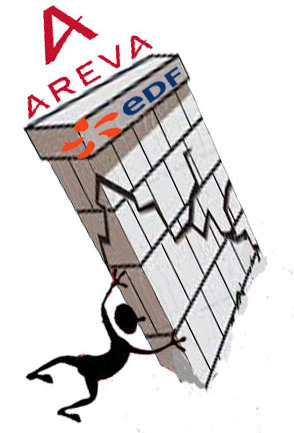 Treasury (in an argument that formed a key basis of their EU state aid application) will not sanction a loan guarantee before a European EPR has been seen to work. This criterion cannot be met until 2019 at least. Even then if similar cost overruns occurred in Hinkley as they have done in France and Finland, that would sink EDF anyway, even with a loan guarantee. EDF face bankruptcy even with their escalating liabilities from their EPR construction disasters as well as increasing costs of refurbishing their existing nuclear fleet. Don’t imagine for a moment that the Chinese will come to the rescue. They have no further political interest other than they have gone so far, and certainly don’t want to pay for any costs overruns on the project. Continue reading
No need for nuclear power in Japan – former Japan PM Naoto Kan
 Five years after Fukushima disaster, there’s no need for nuclear power, says former Japan PM Naoto Kan CNBC by Leslie Shaffer | Interview by Akiko Fujita 6 Mar 2016 As the fifth anniversary of Japan’s massive earthquake and nuclear disaster approaches, the country’s former prime minister said it was time to do without nuclear power.
“If you look at the reality of these last five years, Japan spent two years without a single nuclear plant on line. There are now a few active reactors, but still, that’s only a handful,” Naoto Kan, who was prime minister when the Great East Japan Earthquake struck, told CNBC. His comments were translated from Japanese.
“These five years have demonstrated that we can secure enough power without nuclear plants. That’s why I believe we should stay away from the large risk posed by nuclear plants and focus instead on renewable energy by changing our sources of power,” Kan added.
Kan isn’t alone in his opposition to nuclear power; opinion polls have showed that a majority of Japanese people agree. But he blamed the current ruling party, the Liberal Democratic Party the recent restart of four reactors, which had been shuttered in aftermath of the disaster. Kan is a member of the Democratic Party of Japan……….http://www.cnbc.com/2016/03/06/five-years-after-fukushima-nuclear-disaster-nuclear-power-not-needed-former-japan-pm-naoto-kan-says.html
Control rod trouble in Japan’s Niigata nuclear reactor
Niigata nuclear reactor has control rod trouble http://newsonjapan.com/html/newsdesk/article/115579.php?utm_source=twitterfeed&utm_medium=twitter NHK –– MAR 09
They say workers were at the time manipulating valves related to the control rods as part of regular inspections, but did not operate the rods. They also say the rod returned to its normal position after about a minute.
TEPCO says the trouble caused no nuclear fission chain reaction and does not affect the surrounding area.
1 This Month
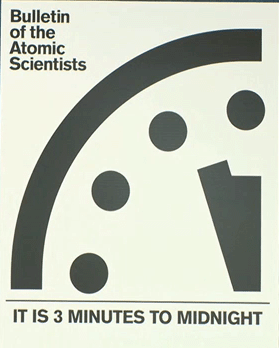
Watch the 2026 Doomsday Clock unveiling live here on January 27 at 10 a.m. EST
To see nuclear-related stories in greater depth and intensity – go to https://nuclearinformation.wordpress.com/

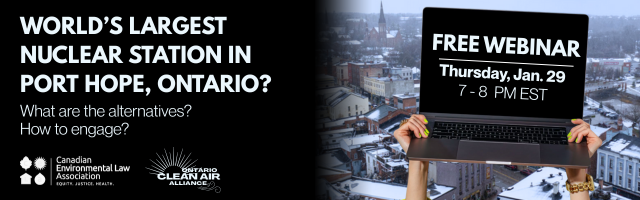
29 Jan. Thursday 7-8 p.m. Webinar – World’s Largest Nuclear Station in Port Hope, ON?
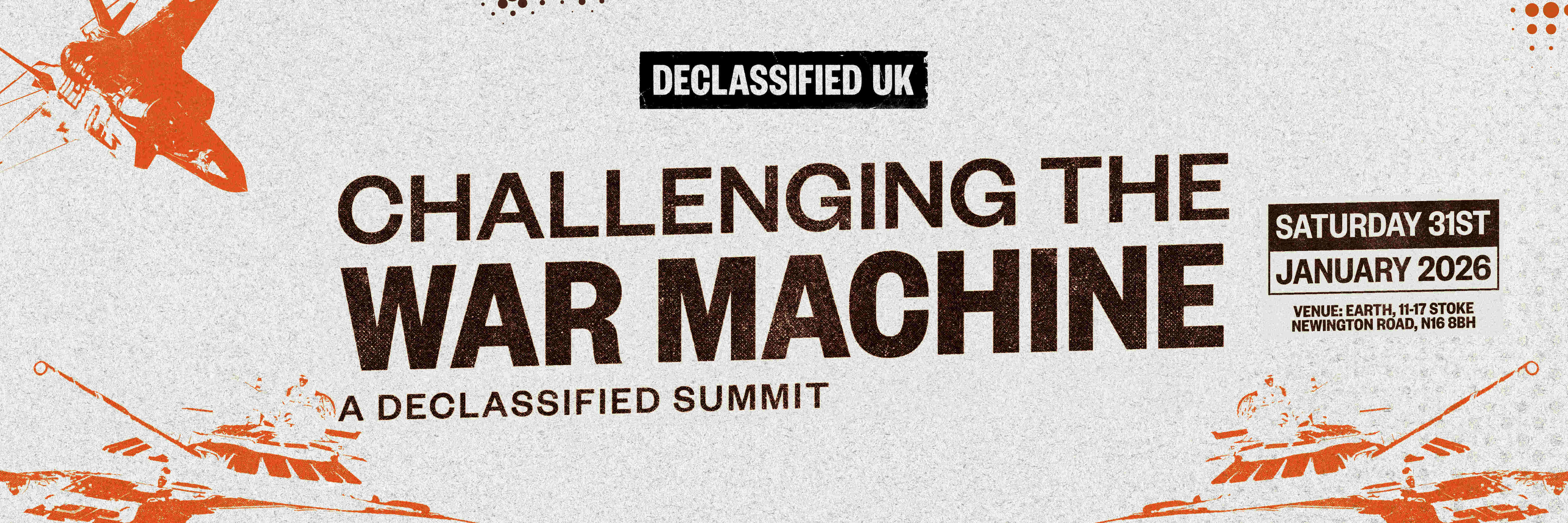
31st January – Challenging the War Machine – a DECLASSIFIED UK SUMMIT


Website of the Week
Now until to February 10, 2026 Radioactive waste storage in France: the debate is finally open! How to participate?
-
Archives
- January 2026 (277)
- December 2025 (358)
- November 2025 (359)
- October 2025 (376)
- September 2025 (258)
- August 2025 (319)
- July 2025 (230)
- June 2025 (348)
- May 2025 (261)
- April 2025 (305)
- March 2025 (319)
- February 2025 (234)
-
Categories
- 1
- 1 NUCLEAR ISSUES
- business and costs
- climate change
- culture and arts
- ENERGY
- environment
- health
- history
- indigenous issues
- Legal
- marketing of nuclear
- media
- opposition to nuclear
- PERSONAL STORIES
- politics
- politics international
- Religion and ethics
- safety
- secrets,lies and civil liberties
- spinbuster
- technology
- Uranium
- wastes
- weapons and war
- Women
- 2 WORLD
- ACTION
- AFRICA
- Atrocities
- AUSTRALIA
- Christina's notes
- Christina's themes
- culture and arts
- Events
- Fuk 2022
- Fuk 2023
- Fukushima 2017
- Fukushima 2018
- fukushima 2019
- Fukushima 2020
- Fukushima 2021
- general
- global warming
- Humour (God we need it)
- Nuclear
- RARE EARTHS
- Reference
- resources – print
- Resources -audiovicual
- Weekly Newsletter
- World
- World Nuclear
- YouTube
-
RSS
Entries RSS
Comments RSS
 nuclear-news