Orlando gunman a security guard, for a firm that guards US nuclear sites

 Security Firm That Employed Orlando Gunman Guards U.S. Nuclear Sites The news has inflamed concern about the threat of insider attacks at America’s most critical infrastructure. US News By Alan Neuhauser | Staff Writer June 13, 2016 The security firm that employed the Orlando gunman behind the worst mass-shooting in U.S. history says it’s guarded “90 percent of U.S. nuclear facilities” – raising concern that would-be terrorists could easily gain inside access to the most sensitive sites on American soil and release untold devastation.
Omar Mateen, who slaughtered 49 people early Sunday at a popular gay nightclub and pledged allegiance to the Islamic State group, worked as a guard for G4S, an enormous multinational security firm that’s previously faced scrutiny for safety and management lapses.
Mateen, who was killed in a shootout with police, was employed at a “residential community in South Florida,” not a nuclear site, the company said in a statement. Nonetheless, nuclear safety and private security experts say his employment at G4S – which included an initial background check when he was recruited in 2007 and another in 2013, according to the company – highlights potential vulnerabilities at the nation’s nuclear sites, especially in light of successful break-ins and apparent sabotage in the past four years alone.
“If you’re a guard, you have free run of the facility: You know how the facility operates, you know the level of attack the facility is set up to handle, you may know where sensors may have failed, you may know where weak points are, you know other folks in the workforce who would be vulnerable to coercion or blackmail,” says Howard Hall, governor’s chair professor of nuclear security at the University of Tennessee who has consulted with nuclear plants on security issues.
“From an insider’s perspective, this is concerning.”
Although the chances a terrorist could acquire enough material to build a nuclear bomb remain relatively low – enriching uranium is a delicate and highly complex process – recent breaches at nuclear sites in the U.S. and abroad point to other risks, experts say……http://www.usnews.com/news/articles/2016-06-13/security-firm-that-employed-orlando-gunman-guards-us-nuclear-sites
Radioactive ranchers? Elements found downwind of intensive fracking.
After losing an unprecedented number of cattle in 2013, Nielle and Howard Hawkwood tested soil where the cattle had urinated and found high levels of radioactive materials. Not even seeds would germinate in the soil.
http://www.environmentalhealthnews.org/t/515501742094044525
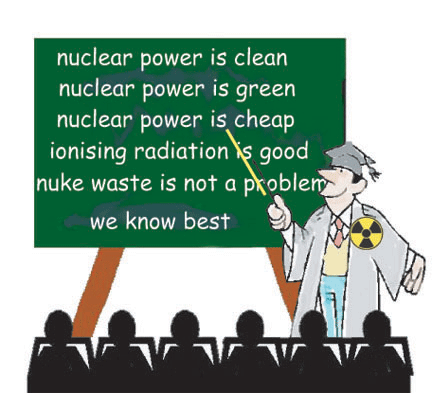
Eskom promises to plug youth into nuclear future
 Times Live| 10 June, 2016
Eskom has initiated a major training programme for nuclear operators, saying it will train 100 artisans as operators at its Koeberg plant to meet South Africa’s requirements in the future.
The programme, launched by Public Enterprises Minister Lynne Brown in Cape Town yesterday, is a strong vote of confidence by the government and Eskom for an expanded nuclear energy sector in the future.
The Koeberg-Eskom programme is the latest in several initiatives to gear up for the country’s proposed nuclear build, which government has said will involve the construction of 9600MW of new capacity. Others include training programmes with Russia, France, China and South Korea, where South African students are being empowered in a variety of skills……http://www.timeslive.co.za/thetimes/2016/06/10/Eskom-promises-to-plug-youth-into-nuclear-future
Reactor at Belgian nuclear power plant shuts down after incident
10 Jun, 2016 A reactor at Belgium’s Tihange nuclear power plant has shut down automatically following an abnormality on Friday, the plant operator said. The causes behind the incident are being investigated.
There has been no radiation leak, according to the operator…….The operator said it was “certain” the problem was somewhere “in the secondary part of the plant,” such as an engine room, and not in the nuclear zone. https://www.rt.com/news/346143-belgium-nuclear-plant-tihange/
What If Global Warming Emptied India?
Climate change poses significant threats to the populous nation
By Gayathri Vaidyanathan, ClimateWire on June 9, 2016 “……..A warming of 2 degrees Celsius would cause 34 percent of the world’s population to migrate more than 300 miles, to places on the fringes of the tropics where the temperatures are milder. Dramatic population declines might occur in Mexico, Central America, Africa and India. The results were published today in Scientific Reports……..http://www.scientificamerican.com/article/what-if-global-warming-emptied-india/
Objections to the USA nuclear waste discussion process
Nuclear Activists Speak Out During Dept. of Energy Tour over Nuclear Waste http://www.democracynow.org/2016/6/7/headlines/nuclear_activists_speak_out_during_dept_of_energy_tour_over_nuclear_waste
Paul Gunter: “How does the public in the affected community build trust when the Department of Energy itself is a promotional agency doing the bidding of the nuclear industry by direct promotion, and that the whole process going forward to date has lacked consent? There’s never been consent with regard to generation of nuclear waste.”
Western societies not well prepared for nuclear evacuation crises
Westerners lack education on nuclear disaster risks, expert warns
Christopher Abbott says orderly evacuation seen during Japan’s Fukushima incident would not work as well in western societies, Guardian, Nicola Davis, 8 June 16, Western societies would not respond well to a Fukushima-style nuclear disaster due to a lack of public information, a leading disaster expert has warned.
Christopher Abbott said he firmly believed that the public ought to be better educated over the hazards and risks they may face.
Illustrating his point, he referred to the Fukushima disaster of 2011 in which 160,000 people were evacuated from the vicinity of the plant as experts attempted to tackle the emergency. The evacuation worked, said Abbott, because “the Japanese educate the public”.
“I just don’t see that it would have worked as successfully in western society,” he added. “[It’s] a very personal opinion but one that is backed up by Japanese colleagues.”…….http://www.theguardian.com/environment/2016/jun/07/westerners-lack-education-nuclear-disaster-risks-expert-warns
TVA’s Watts Bar-2 nuclear unit shuts soon after connecting to grid
Washington (Platts) William Freebairn –6 Jun 2016 Tennessee Valley Authority’s 1,150-MW Watts Bar-2 nuclear generating unit in Spring City, Tennessee, shut automatically Sunday, hours after it connected to the electricity grid for the first time Friday, TVA said Monday.
“Power ascension testing” will be repeated several times and the unit will be shut after producing power to test safety systems, officials have said. TVA said in a filing with the US Securities and Exchange Commission May 3 that it expects to declare commercial operation of the reactor, when testing is complete and steady-state operations are likely, sometime this summer. http://www.platts.com/latest-news/electric-power/washington/tvas-watts-bar-2-nuclear-unit-shuts-soon-after-21634906
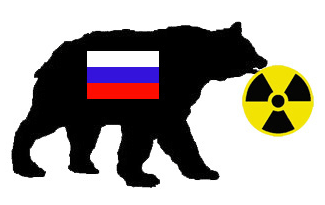
The folly of Egypt going into nuclear dependence on Russia, instead of embracing renewable energy
 Egypt’s nuclear energy folly Unlike nuclear power, renewable energy has the
  potential to create an enormous number of jobs. ….the Middle East finds itself at a nuclear crossroads, with governments across the region launching or reviving plans to construct nuclear reactors. Aljazeera, by Khaled Diab 5 June 16
The latest development in this regard was the recent announcement that Russia will lend Egypt $25bn to finance and operate a nuclear power plant which will be built by Russia’s state-owned nuclear giant Rosatom.
The Russian tender Egypt accepted was for the construction of a station with a capacity of 4,800 megawatts, at an estimated cost of $10bn.
“This was a long dream for Egypt, to have a peaceful nuclear programme to produce electricity,” President Abdel-Fattah el-Sisi said late last year.
And this dream dates back to the very dawn of the nuclear age, when then President Gamal Abdel-Nasser launched Egypt’s nuclear programme in 1954, and the first Soviet-built research reactor came online in 1961.
Since then, Egypt’s nuclear ambitions have stalled for a number of political, economic and technological reasons.
The revival of Egypt’s civilian nuclear programme has stirred a lot of debate and controversy, both in the media and in private – as I discovered during a long impromptu debate at a Cairo restaurant recently….
Unstudied political decision’
In addition to the risks of an Egyptian Chernobyl or Fukushima, there are the everyday dangers of radioactive leaks and seepage, not to mention nuclear waste, which is likely to outlive humanity.
If the “safe” disposal of nuclear waste in technologically advanced and wealthy Germany has proven to be extremely unsafe and dangerous, what chance does poor, inexperienced Egypt stand in averting a future radioactive crisis?
Then, there are the more subtle environmental costs. Nuclear power plants are extremely thirsty beasts – consuming the equivalent of a major metropolis – and Egypt suffers serious “water poverty”, by the government’s own admission.
Weighing in on the debate, the renowned Egyptian-American NASA space scientist Farouk el-Baz called Egypt’s nuclear plan “an unstudied political decision”, fuelled by the desire to catch up with Iran which “spurred Arab countries to enter the nuclear field”.
But if anything, the folly of Iran’s nuclear programme should deter Egypt and the other Arab countries from pursuing nuclear energy, for geostrategic, economic and social reasons.
Iran’s Bushehr I reactor, which reportedly cost $11bn to build, provides less than 2 percent of the country’s electricity requirements, while sanctions may have cost the Islamic Republic as much as $500bn in opportunity costs, experts estimate.
In contrast, supplying all Iran’s electricity needs from solar power would cost a mere $94bn, according to one estimate.
More dependence
While Egypt’s non-pariah status will probably mean that its programme will be cheaper, nuclear power is still extremely expensive, especially in “sunbelt” regions such as the Middle East.
Egyptian solar energy expert Sherife Abdelmessih estimates that nuclear power plants are four times as expensive to construct as solar ones per unit of energy.
OPINION: Egypt’s pharaoh illusion
In addition, he expects that Egypt will pay about $150 per MWh for the power generated by the new nuclear power plant, while the equivalent price for Egyptian wind farms is $45 per MWh.
There are also persuasive geostrategic reasons for Egypt and other Arab countries not to invest in nuclear energy. While proponents believe it will enhance our energy security, it will actually diminish it.
No Arab country possesses the scientific and technological know-how to build their own nuclear facilities and to conduct the extremely costly research required to advance knowledge in this highly developed field.
OPINION: Tourism – It’s more than a few umbrellas on a beach
This will make Arab civilian nuclear programmes highly dependent on foreign technology and expertise.
Moreover, the fuel required to run the power plants will have to be imported, making Arabs vulnerable to supply disruptions, which could be exploited for political arm-twisting.
In contrast, Egypt, and the wider region, is blessed with abundant sun and wind resources, and the renewable energy sector is still young enough for Egypt to become a major player and innovator in it.
Egypt recognises this opportunity and seeks to extract 20 percent of its energy needs from renewable sources by 2022, but this is not enough.
Unlike nuclear power, renewable energy has the potential to create an enormous number of jobs and abundant business opportunities, including start-ups.
In addition, it is scalable, meaning that energy can be consumed close to where it is produced, and it paves the way to distributed energy generation, where each building or home can potentially produce its own power and sell its excess supply into the national grid.
Renewable energy technologies are also diverse. For example, a relatively small investment in solar boilers can save Egypt the huge amounts of electricity used to heat water.
I cannot help thinking that the $25bn Egypt is spending on a single nuclear power facility would have been better invested in pursuing these alternative energy options.
In fact, for the entire region, nuclear energy is pure folly and the only sunny future is in renewables. http://www.aljazeera.com/indepth/opinion/2016/06/egypt-nuclear-energy-folly-160602110506962.html
Britain’s Hinkley nuclear white elephant that stands in the way of green growth
The nuclear white elephant that stands in the way of green growth Jeremy Leggett June By Jeremy Leggett , June 03 2016

EDF’s Hinkley Point C plant in western England will have much to do with the nuclear industry’s prospects globally — and hence for the ability of renewables to grow quickly.
The speed with which the renewables industries will be able to grow in the years ahead will be much affected by the course of the gas and nuclear industries’ efforts to grow. Having considered gas in my last column, let me turn to nuclear, and focus on a project that will have much to do with nuclear’s prospects globally: EDF’s Hinkley Point C plant.
I start with a set of numbers surely destined to become a classic case history for business schools. Imagine you are the CFO of a company that has a market capitalisation of €18 billion. You are being asked to find investment of €22 billion for a new nuclear plant, the first of a whole new fleet. Without that fleet your company cannot hope to grow, assuming it sticks with nuclear generation, and therefore without that one plant its business model will be exposed as broken. Yet your plant is the most expensive power station in the world, and one of the most expensive human construction projects ever, in real terms. And here is the thing: you carry €37 billion of net debt on your balance sheet.
You have two further problems. The first is €55 billion in estimated liabilities to keep a fleet of aging reactors, of earlier generations, open beyond their long-scheduled closedown dates. The second is an unknown number of further billions to fix a grave safety flaw in the steel of a pressure vessel in the forerunner of the new plant you must build.
What do you do? You resign, of course. Which is exactly what EDF CFO Thomas Piqemal did on 8th March.
Now imagine you are the abandoned CEO. You face a few problems beyond the loss of your CFO, the market signal that sends, and the reasons for his departure. Moody’s, the ratings agency, haswarned that your credit rating will be downgraded if you go ahead with the plant, making it far more difficult for you raise yet more debt. Your labour unions are begging you not to go ahead, andthreatening to strike if you do. They are openly saying that they fear this single project will bankrupt the company. Worse, they have seats on the board, because the workforce are part owners of the company.
What do you do? In a rational world, you resign too.
But now imagine you have a rock solid belief system. You cannot conceive of a world without nuclear power, or at least your vital power plant. So instead of resigning you elect to announce your renewed determination to build the project. ……..
As for the denouement, the only thing yet to be resolved is the the exact shape of the inevitable tragedy.
Including the extent to which this white-elephant product of a broken and dying belief system in society can slow down the growth of renewables. http://www.jeremyleggett.net/2016/06/the-nuclear-white-elephant-that-stands-in-the-way-of-green-growth/?utm_content=buffer99a62&utm_medium=social&utm_source=twitter.com&utm_campaign=buffer
Critics not impressed by propaganda from USA’s nuclear lobby
 Nuclear power’s last chance in California?, San Diego Union Tribune The industry hopes for a new look By Rob Nikolewski . June 4, 2016
“……Earlier this year the American Nuclear Society rolled out a “Special Committee on Nuclear in the States,” aimed at influencing state and local policymakers across the country.
Part of the group’s pitch is that while solar and wind energy is growing, they still have problems with intermittency — that is, generating power when the sun is not shining or when the wind is not blowing……But opponents say mining uranium on nuclear’s front end comes at an environmental price and what to do with the spent fuel on the back end is an inherent problem.
“There’s nothing renewable about the waste,” said Becker.
Industry critics also say nuclear has received plenty of money from ratepayers to get plants built in the first place.
And the U.S. Department of Energy has already earmarked millions to help get the SMR sector up and running……http://www.sandiegouniontribune.com/news/2016/jun/04/calfiornia-nuclear-future/
USA’s nuclear marketing effort to make exemption for India will not please China
India’s Admission Into Nuclear Club May Figure In China-US Talks, NDTV 5 June 16, BEIJING: Amid deepening divisions over the disputed South China Sea, China and US will hold their high level annual Strategic and Economic Dialogue in Beijing tomorrow during which a host of issues including differences over India’s entry into the NSG are expected to be discussed.
 While South China Sea (SCS) issue which has now become a major flash point between the two countries is expected to dominate the two-day talks, a host of other issues including Taiwan, Tibet and India’s inclusion in the Nuclear Suppliers Group (NSG) are also expected to figure.
While the US has expressed its firm backing to India’s inclusion into the 48-member nuclear club building on the India-US nuclear accord, China has been insisting that there should be consensus among the members about inclusion of countries who have not signed the Non-Proliferation Treaty.
India has not signed the NPT on the ground that it is discriminatory.
Officials are hopeful of a solution as China-US dialogue is taking place ahead of two of NSG’s key plenary meetings on June 9 in Vienna and June 24 in Seoul during which the issue is expected to come up.
As India pressed its case, Pakistan too has applied amid reports that China is trying to push the case of its all-weather ally…….http://www.ndtv.com/world-news/indias-admission-into-nuclear-club-may-figure-in-china-us-talks-1415771
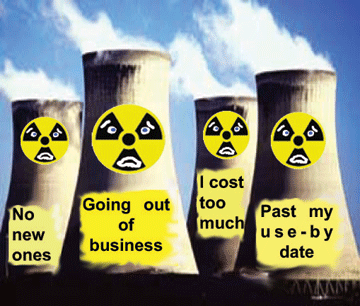
Uncertain fate of Diablo Canyon nuclear facility , and the whole nuclear industry
 Nuclear power’s last chance in California?, San Diego Union Tribune The industry hopes for a new look, opponents still dug in By Rob Nikolewski . June 4, 2016
For critics who have long insisted that nuclear power is inherently dangerous and too expensive, the prospect of delivering a death blow to Diablo is something to relish.
“They try to get people to take a look at them ‘one more time’ just about every other year,” said Phillips. “We don’t consider (nuclear power) as a clean source of energy.”
Nuclear’s critics say the solution is boosting the storage of renewable sources like wind and solar.
The California Public Utilities Commission requires the state’s big three investor-owned utilities to add 1.3 gigawatts of energy storage to their grids by the end of the decade.
“The storage industry is just booming,” said Phillips, adding that greater energy efficiency and conservation can replace nuclear. “You can get to a point where you don’t need to create new, giant energy plants, new, big gas plants or new, big nuclear plants.”
For example, Diablo Canyon sucks in billions of gallons of seawater for its cooling system. Estimates to retrofit the plant to meet state rules implemented after Diablo Canyon was built range anywherefrom $1.6 billion to $14 billion.
“You cannot afford nuclear plants,” said Rochelle Becker, executive director of the Alliance for Nuclear Responsibility, based in San Luis Obispo, not far from Diablo Canyon. “If you look at the cost overruns from any new nuclear plant … they are billions of dollars over budget and years behind schedule.”
In Georgia, two brand new Westinghouse reactors being built at the Vogtle Generating Plant by Southern Co. were estimated to cost $14 billion.
The industry is trying to blunt criticism about costs by pointing to the growing — but still nascent — sector that concentrates on small, modular reactors, or SMRs, that can be transported by truck or rail…..
However, SMRs across the country are still in the design phase.
Waste issues won’t go away
A nagging issue remains: what to do with spent fuel.
With the federal government scrapping the proposed nuclear waste facility at Yucca Mountain in Nevada, spent fuel is being stored at various sites across the country on an indefinite basis.
On a practical level, the 1976 law has resulted in a moratorium on building nuclear plants in the state. No new facilities have been built in almost 40 years.
Exemptions were made for existing plants but with Yucca Mountain off the table, sites like Diablo Canyon and San Onofre have had to keep their waste on site, prompting worries and protests. The decommissioned plant at Rancho Seco stores 22 metric tons of uranium, costing $5 million a year.
“We may never be able to move these,” said Gary Headrick, co-founder of San Clemente Green, said in a March public meeting about the 3.6 million pounds of nuclear waste stored in casks at San Onofre.
“These canisters could start leaking before you could even get it out of here,” said Donna Gilmore, who writes a website sharply critical of San Onofre’s management……..http://www.sandiegouniontribune.com/news/2016/jun/04/calfiornia-nuclear-future/
Outlandish claims being made about ‘Hitler’s Secret Nuclear Bombs’
Nazi History Hunters Say Hitler’s Secret Nuclear Bombs Lie Under Thuringian Forest NBC News by ANDY ECKARDT, 5 June 16 ARNSTADT, Germany — They hunt for jewels and gold, the long-hidden plunder of Nazi lore. Now hobby historians in Germany believe they have an urgent case of potentially catastrophic proportions — secret nuclear bombs.
Deep inside the Thuringian Forest, 70-year-old Peter Lohr and two friends have been scanning the surface with “earth radar” and “geomagnetic” technology after one of Lohr’s companions found Allied aerial surveillance photos of what they believe is a Nazi storage facility.
“What did the Nazis really do here? There are so many unanswered questions,” said 67-year-old Walter Boegenhold, a local resident interested in military history who has heard stories about Hitler’s secret projects in the region since his teenage years.
The team’s initial surface scans produced colorful images of what appears to be bomb-shaped metal housing, which led Lohr and Boegenhold to partner with explosive ordnance disposal expert Ralf Ehmann, 60.
“After conducting geomagnetic scans and carefully looking at all the images, I believe that we have Fat Man bombs buried below the surface,” Ehmann told NBC News.
“Fat Man” was the name for the plutonium bomb dropped by U.S. planes on the Japanese city of Nagasaki in 1945. Ehmann believes a similar nuclear bomb was developed by the Nazis.
Local authorities, however, think that’s hogwash……….
the nuke hunters of Thuringia have vowed not to give up. They recently presented their findings in a formal letter to the governor of the eastern German state. http://www.nbcnews.com/news/world/nazi-loot-hunters-say-hitler-s-secret-nuclear-bombs-lie-n583186
Seattle City Council unanimously voted Tuesday to replace the city’s nuclear power with wind and solar.
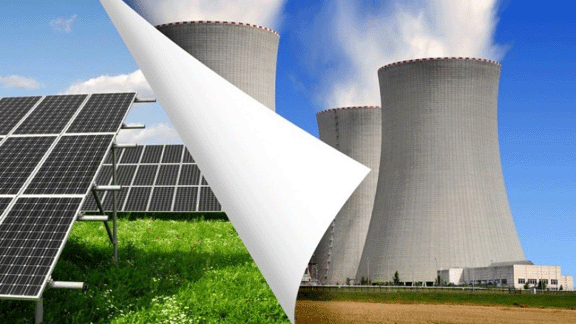 The measure was sponsored by council member Kshama Sawant, who claims the unanimous vote means the city is “taking a stand against nuclear energy.” Sawant was supported by activists from the state’s chapter of Physicians for Social Responsibility and other environmental groups. These activists allege that Columbia Generating Station, the reactor Seattle gets power from, is unsafe and vulnerable to earthquakes. The Daily Caller , 2 June 16
1 This Month
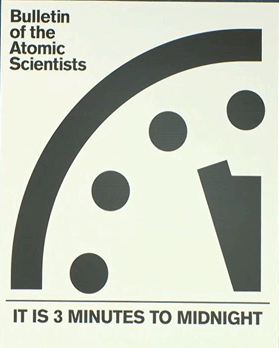
Watch the 2026 Doomsday Clock unveiling live here on January 27 at 10 a.m. EST
To see nuclear-related stories in greater depth and intensity – go to https://nuclearinformation.wordpress.com/

29 Jan. Thursday 7-8 p.m. Webinar – World’s Largest Nuclear Station in Port Hope, ON?


31st January – Challenging the War Machine – a DECLASSIFIED UK SUMMIT


Website of the Week
Now until to February 10, 2026 Radioactive waste storage in France: the debate is finally open! How to participate?
-
Archives
- January 2026 (277)
- December 2025 (358)
- November 2025 (359)
- October 2025 (376)
- September 2025 (258)
- August 2025 (319)
- July 2025 (230)
- June 2025 (348)
- May 2025 (261)
- April 2025 (305)
- March 2025 (319)
- February 2025 (234)
-
Categories
- 1
- 1 NUCLEAR ISSUES
- business and costs
- climate change
- culture and arts
- ENERGY
- environment
- health
- history
- indigenous issues
- Legal
- marketing of nuclear
- media
- opposition to nuclear
- PERSONAL STORIES
- politics
- politics international
- Religion and ethics
- safety
- secrets,lies and civil liberties
- spinbuster
- technology
- Uranium
- wastes
- weapons and war
- Women
- 2 WORLD
- ACTION
- AFRICA
- Atrocities
- AUSTRALIA
- Christina's notes
- Christina's themes
- culture and arts
- Events
- Fuk 2022
- Fuk 2023
- Fukushima 2017
- Fukushima 2018
- fukushima 2019
- Fukushima 2020
- Fukushima 2021
- general
- global warming
- Humour (God we need it)
- Nuclear
- RARE EARTHS
- Reference
- resources – print
- Resources -audiovicual
- Weekly Newsletter
- World
- World Nuclear
- YouTube
-
RSS
Entries RSS
Comments RSS
 nuclear-news