A dirty, expensive, relic – nuclear power touted by the economically illiterate
 Phelim Mac Cafferty: Nuclear is a dirty expensive relic, Brighton and Hove Independent by Phélim Mac Cafferty on August 12, 2016 I was relieved to hear the government delay its final decision on the Hinkley Point C new nuclear power plant. Nuclear power is a dirty, expensive relic from a bygone era. Construction costs are estimated by EDF energy at £18.5 billion, while the National Audit Office (NAO) estimates that the taxpayer could face up to £30bn in costs from top up payments. Costs for the whole project will be far higher, particularly when ‘disposal’ of radioactive waste is factored in. It seems it is one rule for councils to ‘tighten their belts’ but quite another for nuclear power or Trident……..
Don’t DELAY Hinkley Point C nuclear project – JUST SCRAP IT!
The Hinkley Point C nuclear reactor shouldn’t be delayed – it should be scrapped Hayden Wood, City AM, 10 Aug 16 Hayden Wood is co-founder of Bulb, a renewable gas and electricity supplier “……the government should stop agonising and cancel the project. There is no commercial or environmental sense in investing billions into a project that is outdated before construction has even begun.
The UK government agreed a deal with EDF, the French energy company behind the project, which locks in the price of energy at £92.5 per MWh, indexed at 2012 prices for 35 years. This cost is more than 50% higher than the cost of new onshore wind projects at £61.10 per MWh today.
Not only does the deal look bad at today’s prices, but other renewable sources, such as solar, are experiencing such rapid efficiency improvements, they are expected to reach £50-60 per MWh by 2025. As the National Audit Office has stated: “the cost competitiveness of nuclear power is weakening as wind and solar become more established.”
Advocates of Hinkley Point argue the 3.2 GW of power, equivalent to 7% of the UK’s energy requirement, is necessary to manage the intermittency of solar and wind energy. But this reveals a misunderstanding of the rapidly changing energy market. The cost of energy storage has fallen rapidly in recent years.
Today lithium-ion battery prices are around 30% third of what they were in 2010.
By investing in storage technology and renewable energy sources like wind and solar that are cheaper than the large scale nuclear project, not to mention better for the environment, Britain could create an energy market that works better for consumers and the planet.
But the government has to make smarter investments in the future of energy. Hinkley Point C is not the answer. http://www.cityam.com/247271/hinkley-point-nuclear-reactors-shouldnt-delayed-they-should
New York will regret hasty decision to bail out upstate nuclear facilities
Not everyone is smiling about saving upstate nuclear facilities http://cnycentral.com/news/local/not-everyone-is-smiling-about-saving-upstate-nuclear-facilities BY JUSTIN PAGE THURSDAY, AUGUST 11TH 2016 The Fitzpatrick Nuclear Plant was set to close in January, but Governor Cuomo announced it will stay open as part of a $110 million dollar agreement between current owner Entergy and Exelon – securing more than six hundred jobs.
Governor Cuomo made the announcement yesterday saying everyone in New York should be smiling, but not everyone is happy about the deal.
Jessica Azulay is a program director with the Alliance for a Green Economy and she feels the decision to save Fitzpatrick was made too quickly. “The public and the Public Service Commission never got the chance to look at alternatives and compare different scenarios to see what was in the best interest of all New York’s consumers and communities,” Azulay said.
She says alternatives like energy efficiency, wind, and solar are all better options for the environment and your wallet.”When you start comparing the cost of alternatives you can really see how much of a rip off the nuclear bailout really is for consumers if we’re trying to get to clean energy,” she said.
As far as the impact on the environment, Le Moyne Professor of Environmental Science Systems Lawrence Tanner says one issue is nuclear waste, and how to get rid of it.
“That’s the major problem with nuclear energy still, but for plants that have already been built and are operating, they generate electricity without generating any carbon,” Tanner explained.
However, the subsidies that are keeping upstate nuclear facilities in business will only last for 12 years, and aging plants like Fitzpatrick, aren’t built to last forever.
“We think the replacement should be happening now instead of paying a bunch of money to these nuclear operators just to be in the same situation,” Azulay said.
Hinkley Point and the fading nuclear power dream
The dreams of nuclear power fading with Hinkley Point, CARL MORTISHED, The Globe and Mail, Aug. 10, 2016 The future of nuclear power generation in Europe, North America and most of the developed world is being decided on an English coastal headland called Hinkley Point. Sadly, for the U.K., this is no great British engineering breakthrough; the technology of the new nuclear reactors is French and a third of the money is Chinese. Instead of celebrating a big foreign investment, the new post-Brexit British Prime Minister, Theresa May, has kicked into the long grass a £25-billion project that could deliver more than a tenth of Britain’s electricity for the next six decades.
It’s all gone wrong because of different perceptions of risk – political, financial or public and personal. Hinkley Point is iconic of everything that has gone wrong in the nuclear power industry since the first civil reactor, Calder Hall, began to deliver electrons into the U.K.’s electricity grid in 1956. There was huge excitement when the Queen signalled the start of the “atomic age” and the government promised electricity that would be “too cheap to meter.” Instead, electricity generated by nuclear fission has turned out to be very expensive, and the contract underpinning EDF’s investment in Hinkley Point has been struck at £92.5 per megawatt hour, twice the prevailing market price when the deal was done in 2012.
Australian Aboriginals’ gift from one atomic survivor community to another
Indigenous Australia’s Shared Legacy With Nagasaki’s Atomic History
“An Australian gift from one atomic survivor community to another.”http://www.huffingtonpost.com.au/2016/08/08/indigenous-australias-shared-legacy-with-nagasakis-atomic-hist/ On August 9, 1945, Nagasaki became the second city in the world to be targeted by atomic bombs in warfare, killing 80,000 people. Over the next 70 years, thousands more would die from the effects of the bombing alone.
In the 1950s British nuclear testing saw nine atomic bombs tested on Australian soil in the Maralinga and Emu fields of South Australia. This forced the migration of the Pitjantjatjara Anangu community away from their traditional land into Yatala. For the Indigenous people of Maralinga, they were unable to return to their land and hunt because of contamination.
To mark not only the 71st anniversary of the Nagasaki bomb, but also International Day of the World’s Indigenous Peoples, this short documentary Peace Gift to Nagasaki unites both communities in their efforts to promote peace and expose the legacy of the atomic age through creative arts.
Until now, Australia has not been one of those countries. In Peace Gift to Nagasaki, the Yatala Aboriginal community present a sculpture called ‘The Tree of Life’ to the Japanese community, a sculpture made of wood and cast in bronze so it can survive many hundreds of years.
“The Yatala sculpture will be an Australian gift from one atomic survivor community to another,” the narrator of the documentary explains.
To find out more about this project you can head to the Nuclear Futures page over here.
Nuclear plants, USA nuclear industry, saved from oblivion by big New York subsidies
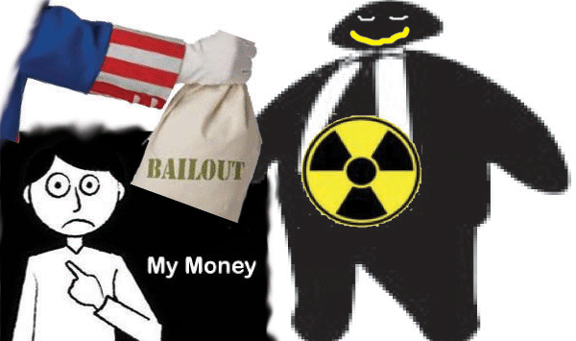 New York state just rescued a nuclear plant from oblivion. Why that’s a very big deal. WP By Steven Mufson August 9 Just one week after New York Gov. Andrew Cuomo unveiled a plan to subsidize his state’s six nuclear power plants, Exelon, the country’s biggest nuclear power producer, announced it would rescue one of the plants from being shut down in January.
Exelon said it would pay $110 million to the plant’s current owner, Entergy, for the operating license and would refuel the James A. FitzPatrick plant in Scriba, N.Y. in January. Exelon said the roughly 600 people working there would keep their jobs. The plant’s license, renewed in 2008, does not expire until 2034.
Cuomo, who has been caught up in the politics of energy, hailed the deal. …….
Entergy had said last November that it would close the nuclear unit because of “market conditions,” making the 838-megawatt plant another victim of low natural gas prices. Those low prices are a product of the fracking boom, especially in neighboring Pennsylvania.
But last week Cuomo announced a plan that would effectively subsidize the state’s nuclear power plants by forcing the utilities that rely on them to pay “zero emission credits” to the operators of those reactors. That is expected to help the plants, which provide 30 percent of New York state’s electricity, to stay open — though critics say that it could drive up electricity rates…….
Exelon operates two other nuclear plants in upstate New York, R.E. Ginna and Nine Mile Point, which lies adjacent to the FitzPatrick unit. The company said it would spend $400 million to $500 million on operations, integration and refueling of those plants and Fitzpatrick as a result of the state subsidy plan.
The Cuomo plan to subsidize the nuclear plants carries a hefty price, which the utilities will be allowed to pass along to consumers. An analysis of the proposal, by the staff of the Public Service Commission, found it might cost $965 million over a span of two years,…..https://www.washingtonpost.com/news/energy-environment/wp/2016/08/09/new-york-state-just-rescued-a-nuclear-plant-from-oblivion/?utm_term=.8f12fd955785
Short term gain for nuclear companies: long term pain for New York

Christina Macpherson’s websites & blogs
The claim that nuclear power is “clean” and “does not emit C02” is a devious lie. Hard to believe that the American public fall for this lie – that conveniently ignores the entire nuclear fuel chain – uranium mining, milling, enrichment, conversion, fuel fabrication, reactor building, building waste pools, concrete waste containers, deep burial facilities. All those steps, and all the transport in between, emit greenhouse gases. The nuclear lobby lied – calling their product, cheap, safe, clean, no connection with weapons, no terrorism risk. Why is New York buying their latest hypocritical lie about climate change?
Judson and environmentalists say the cost of keeping these aging nuclear plants online for another 12 years could be incalculable should one of them malfunction……
Nuclear Energy and Nuclear War – the unmentionable relationship

 Fukushima: A Nuclear War Without A War: The Unspoken Crisis Of Worldwide Nuclear Radiation Fukushima Watch 1 Aug 16
“…………The crisis in Japan has also brought into the open the unspoken relationship between nuclear energy and nuclear war.
Nuclear energy is not a civilian economic activity. It is an appendage of the nuclear weapons industry which is controlled by the so-called defense contractors. The powerful corporate interests behind nuclear energy and nuclear weapons overlap.
In Japan at the height of the disaster, “the nuclear industry and government agencies [were] scrambling to prevent the discovery of atomic-bomb research facilities hidden inside Japan’s civilian nuclear power plants”.1 (See Yoichi Shimatsu,Secret Weapons Program Inside Fukushima Nuclear Plant?Global Research, April 12, 2011)
It should be noted that the complacency of both the media and the governments to the hazards of nuclear radiation pertains to the nuclear energy industry as well as to to use of nuclear weapons. In both cases, the devastating health impacts of nuclear radiation are casually denied. Tactical nuclear weapons with an explosive capacity of up to six times a Hiroshima bomb are labelled by the Pentagon as “safe for the surrounding civilian population”.
No concern has been expressed at the political level as to the likely consequences of a US-NATO-Israel attack on Iran, using “safe for civilians” tactical nuclear weapons against a non-nuclear state.
Such an action would result in “the unthinkable”: a nuclear holocaust over a large part of the Middle East and Central Asia. A nuclear nightmare, however, would occur even if nuclear weapons were not used. The bombing of Iran’s nuclear facilities using conventional weapons would contribute to unleashing another Fukushima type disaster with extensive radioactive fallout. (For further details See Michel Chossudovsky, Towards a World War III Scenario, The Dangers of Nuclear War, Global Research, Montreal, 2011)……….. http://fukushimawatch.com/2016-07-21-fukushima-a-nuclear-war-without-a-war-the-unspoken-crisis-of-worldwide-nuclear-radiation.html
US dept of Energy did not follow “best practices” at Waste Isolation Pilot Plant
GAO: DOE fails in cost, schedule best practices Maddy Hayden, Carlsbad Current-Argus August 5, 2016 The U.S. Government Accountability Office says the Department of Energy did not meet initial cost and schedule estimates for restarting waste emplacement at the Waste Isolation Pilot Plant in part because it did not follow “best practices.”
“In particular, DOE’s schedule did not include extra time, or contingency, to account for known project risks,” the report says.
WIPP had “less than a 1 percent chance” of meeting the March 2016 restart date, the report says…….http://www.currentargus.com/story/news/special-reports/wipp/2016/08/05/gao-doe-fails-cost-schedule-best-practices/88304014/
Is it really a “Public Necessity” to bail out New York’s aging nuclear facilities?
 Is this news journal also continuing to mindlessly perpetrate the nuclear lobby lie, that nuclear power combats global warming?
New York Nuclear Plants Deemed A “Public Necessity”, Oil Price, By Leonard Hyman & William Tilles – Aug 06, 2016 Last week the New York Public Service Commission approved a Clean Energy Standard for the state. The two key components are a mandate for 50 percent renewables by 2030 and a subsidy mechanism for four, and possibly six, aging nuclear facilities upstate.
The renewables standard is not controversial. Not so the planned nuclear subsidies. The new directive will require all electricity buyers in the state to purchase power from these nuclear facilities at a relatively high price in the interest of carbon reduction. The state does not use its own money.
The need for nuclear subsidies, at least in the minds of state officials, appears to be fairly straightforward. Entergy Corp., which owns the FitzPatrick nuclear facility, has decided to shutter the unit permanently on the grounds that it is no longer economic to operate. Entergy has also arrived at a similar conclusion for its older, smaller nuclear facilities in Vermont and Massachusetts. But with the subsidy passed, Exelon, which owns two other stressed nukes upstate, may buy FitzPatrick and keep it open.
The subsidies on offer run for a period of 12 years starting April 2017, and begin at about 2 cents for every kilowatt hour of electricity produced and escalate to almost 3 cents per kwh by the end of the deal. Published reports set a $7.6 billion price tag for these subsidies, but the amount could be much higher since the agreement provides for the subsequent inclusion of the Indian Point nuclear units.
There being no apparent economic rationale for the continued operation of these units, given low natural gas prices, the state has justified its economic intervention by designating these facilities a “public necessity”. However, as far as we know, there is neither a looming power shortage nor a particular systems engineering requirement necessitating the ongoing operation of the units. More likely there is a political motive. Perhaps the Governor is using energy policy to shore up support with upstate constituencies where local economies have enjoyed less of the finance-fueled dynamism of downstate…….http://oilprice.com/Alternative-Energy/Nuclear-Power/New-York-Nuclear-Plants-Deemed-A-Public-Necessity.html
Germany’s energy companies face nuclear liabilities
Question of nuclear liabilities is just one problem weighing on Germany’s energy companies , FT.COM by: Guy Chazan in Berlin and Paul McClean in London, 7 Aug 16 German utilities Eon and RWE report second-quarter earnings this week, on Wednesday and Thursday respectively, with investors looking for an update on talks with the government over how to finance the future storage of Germany’s nuclear waste.
A government commission announced in April that Germany’s big utilities should pay €23.3bn towards the cost of waste storage — about €6.3bn more than they had provisioned for.
Eon said in May it might have to raise capital in order to pay its share of the waste storage costs. But it has been less vociferous than RWE in its criticism of the commission’s decision.
Meanwhile, the abundance of wind and solar power in Germany has driven down wholesale energy prices, making the conventional power plants Eon and RWE operate uneconomic.
The companies have responded to the crisis in their sector by splitting themselves in two. Eon is grouping its conventional power generation assets and energy trading in a new company, Uniper, while the new look Eon will focus on renewables, networks and customer solutions. Eon confirmed last month that it will float Uniper in September……..https://next.ft.com/content/5878b64c-5a17-11e6-9f70-badea1b336d4
Nuclear industry cannot stop inevitable predominance of renewables. Britain should stop nuclear
 The debate about Hinkley is a distraction https://www.foe.co.uk/blog/debate-about-hinkley-distraction Simon Bullock 02 August 2016
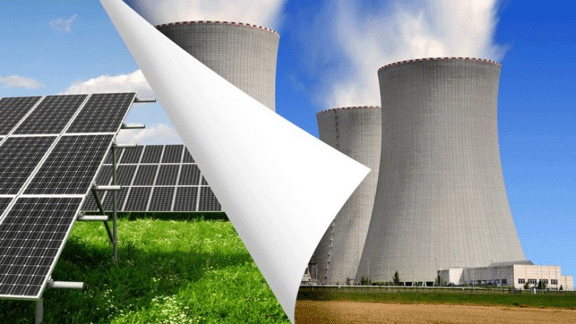
Nuclear power is not the answer. Renewables, energy saving, and energy storage are a much better deal for bill-payers as well as tax-payers, and renewables offer more scope to provide employment.
Renewable power has grown rapidly in the last 5 years, and as wind and solar costs continue to fall we should be swiftly getting on with generating masses of home-grown renewable electricity.
Compare that with this reality: British electricity users will pay £81 billion for Hinkley Point C electricity in its first 35 years.
In the early 1990s, Margaret Thatcher cancelled the nuclear build programmes because the economics couldn’t be made to work. Has anything changed? The cost of construction for Hinkley has gone from £5.6 billion in 2008, to £24.5 billion now. Wouldn’t we be better off using that money to give an energy efficiency upgrade to millions of homes? And perhaps what really worries people more than the financial cost of the project is the radioactive waste that will need looking after for thousands of years.
Hinkley Point C will not be owned by the UK, instead, we will be gifting it to the Chinese and French states. If that’s not enough, consider these 3 points:
the Chinese and French states. If that’s not enough, consider these 3 points:
- In Finland the same design nuclear power station is still not working, and it’s nine years late while costs have tripled
- It will lock British taxpayers into high-cost electricity for 60 years, but wind and solar are already cheaper and their costs are still falling, and it will be a decade before Hinkley will power any kettles
- There’s no need for it – thanks to a leap-forward in energy saving, projections for the electricity demand we will need in 2025 have fallen by 77 terawatt hours – that’s three times what Hinkley would produce
In the last 5 years there has been a global energy revolution: the costs of renewable energy have reduced, and there have been huge strides in the fields of energy storage and smart grids. These trends will continue, as the National Infrastructure Commission’s Smart Power report points out.
Theresa May has rightly delayed making a decision, so this is the opportunity to pause, change tack, and prevent bill-payers being saddled with unnecessary cost well into the future.
The government is starting to see which way the wind is blowing, so it is policy folly to lock the UK into long-term, polluting, expensive nuclear projects.
Renewables and energy storage is the future. The nuclear industry cannot stop the inevitable. But the government can and should stop Hinkley.
New Jersey won’t be following New York’s example of subsidising the nuclear industry
Profitable nuclear-plant owner PSEG might like to be subsidized, but that’s unlikely to happen in the Garden State New York this week handed lucrative subsidies to the nuclear industry to keep a trio of power plants upstate afloat, but New Jersey is unlikely to follow suit anytime soon.
Subsidies, which in this case amount to $965 million over two years paid by electric customers, are also being sought in other states across the nation as the costs of operating nuclear units have made it difficult to compete economically with cheaper gas-fired plants.
The New York system may serve a model for others wrestling with the question. Between 10 to15 nuclear power plants are at risk of closing in the near future and another half dozen already have closed, according to energy executives.
It is an issue Public Service Enterprise Group, the owner of three nuclear plants in south Jersey, is trying to raise, but it faces a bigger hurdle in getting policy makers’ attention.
PSEG CEO and president Ralph Izzo acknowledged as much during an earning call with analysts last week. For one thing, PSEG’s plants are profitable, unlike their counterparts in New York and other states, Izzo conceded. “It does impair our ability to have the same level of interest and participation in the discussion,” he said, when asked about prospects for similar incentives in New Jersey.
Still, the company is “engaging policymakers” in early conversations about what the incentives could look like, Izzo noted. Those discussions presumably continued yesterday afternoon when he toured the PSEG plants with U.S. Sen. Cory Booker (D) and Senate President Stephen Sweeney (D-Gloucester)……..
Steven Goldenberg, an energy lawyer, said the nuclear plants owned by PSEG have been paid off several times already. He argued that happened when they were regulated by the state; when the company was given $3 billion in ”non-existent” stranded costs; and when they enjoyed artificially high prices of electricity set by expensive natural gas…….
New York established its subsidies, dubbed zero-emission credits, through the regulatory process. In other states, legislation is required to enact similar incentives, a more onerous process, according to Paul Patterson, an energy analyst. http://www.nj.com/news/index.ssf/2016/08/nj_unlikely_to_follow_nys_subsidies_of_nuclear_ind.html
With rapid advances in renewables, nuclear power gets less and less economic

 Nuclear Power Is Losing Money At An Astonishing Rate, Think Progress [excellent graphs] BY JOE ROMM AUG 4, 2016 Half of existing nuclear power plants are no longer profitable. The New York Times and others have tried to blame renewable energy for this, but the admittedly astounding price drops of renewables aren’t the primary cause of the industry’s woes — cheap fracked gas is.
The point of blaming renewables, which currently receive significant government subsidies, is apparently to argue that existing nukes deserve some sort of additional subsidy to keep running — beyond the staggering $100+ billion in subsidies the nuclear industry has received over the decades. But a major reason solar and wind energy receive federal subsidies — which are being phased out over the next few years — is because they are emerging technologies whose prices are still rapidly coming down the learning curve, whereas nuclear is an incumbent technology with a negative learning curve.
As you can imagine, if existing nuclear power plants have become unprofitable, then new nuclear power plants make no economic sense whatsoever. Perhaps no surprise, then, that a Reuters headline blared last month, “New Nuclear Reactor Builds Fall To Zero In First Half Of 2016 — Report.”
The utility consultancy Brattle Group came to a similar view on existing nukes in a 2014 analysis, concluding that 51 percent of the merchant (deregulated) nuclear fleet, some 23 Gigawatts, could be unprofitable by 2015. In researching this post, I spoke at length with economist Peter Fox-Penner, one of the country’s leading experts on both the electric grid and decarbonization, the author of Smart Power: Climate Change, the Smart Grid, and the Future of Electric Utilities. Fox-Penner is the former chair of the Brattle Group…………..
the rapidly dropping price of solar and wind power has started to create problems for inflexible and costly power sources like nuclear power. While their market penetration is vastly lower than nuclear power, there are times during the day when there is an excess of very-low-cost renewables — since they don’t have the high fueling and operations and maintenance (O&M) costs nuclear has.
Nuclear advocates want you to believe that this problem with renewables is long-term and unsolvable — whereas it is in fact short-term and straightforward to solve (see “Why The Renewables Revolution Is Now Unstoppable“). It’s not a surprise the usually slow-to-change utility system was unprepared for the astonishingly rapid growth of low-cost solar and wind power. But with electricity storage prices collapsing and literally hundreds of businesses now starting to emerge to find uses for cheap, over-abundant carbon-free power during the day, this is really a short-term problem……….
it seems as if the NYPSC is severely overpaying their nukes. That seems especially likely given that the nukes in New York State already get a RGGI benefit — whose baseline level the PSC calculates at $10.41 per ton (that number is then later adjusted to reflect the actual RGGI price, which fluctuates, and is currently closer to $5).
I also have serious doubts that this subsidy needs to last until 2029. Within a decade, we are likely to find that existing nukes are even less valuable than we thought. As I’ve said, the rapid advances in renewables, batteries and other storage, demand response, efficiency, and electric vehicles mean that integrating low-cost renewables into the grid will almost certainly be far easier and cheaper and faster than people realize. http://thinkprogress.org/climate/2016/08/04/3803499/nuclear-power-bail-out/
Sheer folly to do nuclear deals with the Chinese
Espionage. Repression. It would be sheer folly to do nuclear deals with the Chinese, By MAX HASTINGS FOR THE DAILY MAIL 4 August 2016 The Prime Minister’s decision to review the £18 billion Hinkley Point nuclear power project has won a cheer from everyone not in line to make money from it.
When the holidays are over, there are two good reasons why Theresa May should go further and cancel the scheme.
The first is that its electricity will be fantastically expensive.
The second, which we shall consider here, is that it was a critical error of judgement for the Cameron government to invite the People’s Republic of China to fund a huge national infrastructure project.
Allowing the Chinese access to Hinkley Point, and beyond it to other British nuclear plants, would give a hostage to fortune. The record shows that the Chinese can’t be trusted with sensitive industrial data. Fair dealing has no place in their system.
A decade ago, Robert Zoellick, then World Bank president, said the West’s future relations with China required the country to become a ‘responsible stakeholder’ in the international order.
This it has not yet done. Until it happens, we cannot do big business with Beijing.
The last government, and especially the then-Chancellor George Osborne, cherished naive ambitions to create a historic new trading relationship with the dragon.
The new Downing Street, and especially Mrs May’s joint chief of staff Nick Timothy, take a much beadier view. He recognises, and publicly warned about last year, the threat to Western interests posed by granting the Chinese access to our secrets and infrastructure.

HostilityA nation that engages in global industrial espionage, employing an estimated 1.5 million geeks to penetrate other people’s computers — while denying its own people online access — is not a comfortable business associate…………..
President Xi has shown himself to be the most autocratic Chinese leader since the death of the genocidal tyrant Mao Zedong in the Seventies.
The price of industrial co-operation with Beijing is British silence about China’s systemic human rights abuses, of which the highest rate of state executions in the world is only the most conspicuous example……..
AutocraticWe should be equally worried about the Second Bureau of the Third Department of the People’s Liberation Army — otherwise known as Unit 61398, which is engaged in the theft of intellectual property across the world………. we can scarcely ignore the evidence that Beijing scorns international law, personal freedom and property rights…….
RepressivePresident Xi and his comrades expect the international order to fit in with Beijing’s template…….
The involvement in Hinkley Point of one of the most repressive and secretive regimes in the world poses unacceptable risks.
Britain will have to pay a stiff forfeit for abandoning the project, but it seems right for the Prime Minister to make that decision.
There are many powerful economic arguments for cancellation, but the threat to our national security is the clincher.
1 This Month

of the week – Shut Down Drone Warfare!


Tell the Ukrainian Government to Drop Prosecution of Peace Activist Yurii Sheliazhenko

Petition to revoke the licensing of the Near Surface Nuclear Disposal Facility (NSDF) at Chalk River. https://www.ourcommons.ca/petitions/en/Petition/Details?Petition=e-7247
To see nuclear-related stories in greater depth and intensity – go to https://nuclearinformation.wordpress.com
-
Archives
- April 2026 (19)
- March 2026 (251)
- February 2026 (268)
- January 2026 (308)
- December 2025 (358)
- November 2025 (359)
- October 2025 (376)
- September 2025 (257)
- August 2025 (319)
- July 2025 (230)
- June 2025 (348)
- May 2025 (261)
-
Categories
- 1
- 1 NUCLEAR ISSUES
- business and costs
- climate change
- culture and arts
- ENERGY
- environment
- health
- history
- indigenous issues
- Legal
- marketing of nuclear
- media
- opposition to nuclear
- PERSONAL STORIES
- politics
- politics international
- Religion and ethics
- safety
- secrets,lies and civil liberties
- spinbuster
- technology
- Uranium
- wastes
- weapons and war
- Women
- 2 WORLD
- ACTION
- AFRICA
- Atrocities
- AUSTRALIA
- Christina's notes
- Christina's themes
- culture and arts
- Events
- Fuk 2022
- Fuk 2023
- Fukushima 2017
- Fukushima 2018
- fukushima 2019
- Fukushima 2020
- Fukushima 2021
- general
- global warming
- Humour (God we need it)
- Nuclear
- RARE EARTHS
- Reference
- resources – print
- Resources -audiovicual
- Weekly Newsletter
- World
- World Nuclear
- YouTube
-
RSS
Entries RSS
Comments RSS
 nuclear-news