TVA cited for violations at Browns Ferry, Decatur daily.com By Evan Belanger Staff Writer , 1 Nov 16
November 4, 2016
Posted by Christina Macpherson |
general |
Leave a comment
 GB Times, CHINA RADIO INTERNATIONAL
2016/11/01 France and China are strongly considering the creation of a fund for joint investment in overseas projects, according to a statement made by French Foreign Minister Jean-Marc Ayrault during his ongoing visit to China…..In October last year, Chinese and French companies signed an agreement to build Britain’s first nuclear power plant at Hinkley Point C.
China General Nuclear Power Corporation holds a one-third stake in the joint venture, while the French company EDF holds the rest…..http://gbtimes.com/china/france-china-consider-joint-fund-overseas-projects
November 4, 2016
Posted by Christina Macpherson |
general |
Leave a comment
Nuclear power too costly http://www.thesudburystar.com/2016/10/29/sudbury-letter-nuclear-power-too-costly
Saturday, October 29, 2016 Open letter to Premier Kathleen Wynne, Mike Schreiner Leader, Green Part of Ontario
Many people in Ontario are struggling to pay their electricity bills.
You need to act now to protect us from further price increases.
Ontario Power Generation wants to raise the price for nuclear power to operate their nuclear power plant in Pickering and rebuild the one in Darlington.
It has applied for permission to increase the price for nuclear power by 180 per cent over the next decade. And I expect the price will go even higher – as I’m sure you know, no nuclear project in Ontario’s history has delivered on time or on budget. This is unacceptable.
The people of Ontario simply cannot afford to pay for your plans to spend billions of tax dollars to rebuild outdated nuclear plants. Studies indicate that Ontario can save $600 million to $1.2 billion per year – or $12 billion to 24 billion over 20 years – by cancelling the rebuild of the Darlington plant.
We can cancel the Darlington rebuild and still keep Ontario powered up. There is a cleaner, more affordable alternative: we can get the power we need by importing Quebec’s excess clean water power.
To make this work, we would have to upgrade transmission lines at an estimated cost of only about $500 million. All told, Ontario would benefit from a return on investment in a just a few months. There are few deals in today’s world with such a short ROI.
Moving forward, the province would enjoy $600 million to $1.2 billion in annual savings. We could use this to fund energy efficiency programs that would help people save money by saving energy.
Premier, I know the nuclear lobby is powerful in Ontario. They spend millions on advertising alone. But I implore you to put the people of Ontario first.
In spite of their criticism, neither opposition party with seats at Queen’s Park has a plan to reduce electricity rate increases. Your government has an historic opportunity tomorrow to change the conversation on electricity rates in Ontario. The question is whether you have the courage to say no to the nuclear lobby and yes to lower cost water power from Quebec.
Premier, I ask you to put the people of Ontario first by signing a power deal with Quebec for low cost water power.
October 31, 2016
Posted by Christina Macpherson |
general |
Leave a comment
Nuclear ‘sham’, http://www.wiltsglosstandard.co.uk/news/14775229.READER_S_LETTER__Nuclear____sham___/ Tom Nellist , 30 Oct 16, MOLLY SCOTT CATO MEP, Green THE comprehensive review of Hinkley has been a total sham.
If Theresa May had seriously listened to a wide range of experts she would have concluded the project was economically illiterate, technically flawed, environmentally risky and a threat to security.
But it seems that in post-Brexit Britain the government has decided to turn its back on experts and try and demonstrate that the UK is open for business.
And so we see a government willing to hand over our energy infrastructure to the Chinese Communist Party and a giant French corporation. All this is the exact opposite of taking back control, which would come through a renewable energy revolution.
As Germany and other countries have shown, community-owned renewables can take power away from foreign corporations and governments and hand it back to the people, generating thousands of home grown jobs in the process.
The government says it will introduce greater scrutiny of future deals to protect national security but not for Hinkley C.
Why, if the current arrangements need to be changed, are they good enough for the people of the South West?
Effectively, the government is acknowledging we will all have to pay for a massive error in our approach to the ownership and control of critical infrastructure.
With Lib Dem Ed Davy instrumental in pushing the Hinkley deal as Secretary of State for Energy and Labour stuck in the nuclear bunker, supporting a discredited scheme to keep British unions happy, only the Green Party will continue to oppose this expensive and disastrous white elephant.
October 31, 2016
Posted by Christina Macpherson |
general |
Leave a comment
VERNON, Vt. (AP) – The Nuclear Regulatory Commission has largely rejected a complaint about how money is being spent from Vermont Yankee’s decommissioning trust fund.
The Brattleboro Reformer (http://bit.ly/2e1fi2D ) reports that Vermont state officials had sought a comprehensive review of how Entergy Vermont Yankee administrators are spending money from the fund, but the NRC last week dismissed the state’s challenge to federal trust fund supervision. The commission said federal regulations are designed to ensure plant owners don’t run out of money before decommissioning is complete, and that its ongoing oversight is sufficient.
The NRC did, however, order an environmental assessment of Entergy’s use of trust fund money for long-term management of spent nuclear fuel.
The nuclear plant shut down in December 2014. Information from: Brattleboro Reformer, http://www.reformer.com/
October 31, 2016
Posted by Christina Macpherson |
general |
Leave a comment
International Coalition to Ban Uranium Weapons 30 Oct 16,
A small number of states at First Committee 2016 have claimed that language in the draft resolution L.63, which relates to the potential health effects of DU weapons, means they are unable to vote in favour of the text. This briefing considers those potential risks and how they are interpreted by states and international organisations.
A small number of states at First Committee have claimed that language in the draft resolution L.63, which relates to the potential health effects of DU weapons, means they are unable to vote in favour of the text. This briefing considers those potential risks and how they are interpreted by states and international organisations……..http://www.bandepleteduranium.org/en/briefing-note-potential-health-risks-du
October 31, 2016
Posted by Christina Macpherson |
general |
Leave a comment
Renewable energy capacity overtakes coal By Andrew WalkerBBC World Service economics correspondent 25 October 2016 The International Energy Agency says that the world’s capacity to generate electricity from renewable sources has now overtaken coal.
The IEA says in a new report that last year, renewables accounted for more than half of the increase in power capacity.
The report says half a million solar panels were installed every day last year around the world.
In China, it says, there were two wind turbines set up every hour.
Renewable energy sources, such as wind, solar and hydro are seen as a key element in international efforts to combat climate change.
At this stage, it is the capacity to generate power that has overtaken coal, rather than the amount of electricity actually produced.
Renewables are intermittent – they depend on the sun shining or the wind blowing, for example, unlike coal which can generate electricity 24 hours a day all year round.
So renewable technologies inevitably generate a lot less than their capacity.
Even so it is striking development.
The IEA’s Executive Director Fatih Birol said “We are witnessing a transformation of global power markets led by renewables”.
The expansion of renewable capacity reflects cost reductions for onshore wind and solar panels that the report describes as impressive; reductions that would have been “unthinkable just five years ago”.
The IEA expects the trend of declining costs to continue.
Those two technologies are likely to account for three quarters of future growth in renewables.
Hydropower will continue growing, the report says, but it is likely to do so more slowly than before.
Declining costs are also one reason the agency has increased its forecast for renewable capacity in the future…….http://www.bbc.com/news/business-37767250
October 31, 2016
Posted by Christina Macpherson |
general |
Leave a comment
 Britain hopes to showcase nuclear skills at Hinkley Point, Ft.com , 28 Oct 16 “………some in the industry have warned that setting up supply chains may not be straightforward. In France and Finland, new reactors are years late and billions over budget, in part because of problems with suppliers.
When the Finnish Olkiluoto 3 reactor and French Flamanville reactors were started, neither country had built a nuclear plant for decades, leading to years of teething problems and criticism of components that were not up to standard.
In 2008, the French nuclear safety authority asked EDF to suspend part of the project “as a result of the numerous deviations observed in the reinforcement or concreting of the foundation rafts”. It said this “highlighted a lack of rigour” and “problems with supervision”, singling out the oversight of a key Italian supplier.
“EDF had not built a nuclear plant in a long time [when it started on Flamanville],” said Denis Florin, founder of consultancy Lavoisier Conseil. “Its control mechanisms were weakened and had to be reactivated.”
The company says it has learnt from Flamanville. But some within EDF fear that Hinkley could have the same problems. “I want to believe we will not face similar issues, but I am afraid it will be the same story all over again,” said one executive at EDF who has been suspicious about the project from the start….”
October 29, 2016
Posted by Christina Macpherson |
general |
Leave a comment
Veteran UK banker Paul Fisher on climate change and the financial sector, Saturday Paper, 29 Oct 16 MIKE SECCOMBE
A veteran of Britain’s central bank, Paul Fisher says climate change will have a massive impact on the global financial sector. He talks about managing the risks.
Paul Fisher recently retired as deputy head of the Bank of England’s Prudential Regulation Authority, after a long career in financial markets, financial stability and monetary policy. In September 2015 the bank released a report on the risks to the financial system of dealing with climate change……
Anybody who is a long-term asset-holder potentially is exposed to climate risk. You can divide the risks two ways; there’s physical risk if the climate does change, or as it does change, and that’s fairly easy to think about – floods or whatever. But more interestingly you’ve got the transition risk, and two things are going to happen. [First] the economy will need to restructure in order to try to minimise climate change and that will present both new opportunities for new businesses to grow, and it will be a threat to some existing business models. So you’ve got that structural change. But perhaps even more importantly you’ve got the policy change. Governments have committed to reducing climate change to below 2 degrees Celsius [and] that will evolve a whole series of policies of which we don’t know the full details yet. As those policies come through you could see the repricing of financial assets. People investing in infrastructure will find that is vulnerable to policy [change] risks. We saw a big utility company in Germany, RWE [hit by a share price plunge after Germany changed its energy policy away from coal and nuclear to more renewables]. We see the coal industry in the United States, for various reasons, collapsing. Peabody, for example.
MS It seems to me that the insurance industry, because it has a long-time horizon and takes a very actuarial approach, would be well ahead of the game on this. Is that an accurate reading?
PF In the UK that’s certainly true. The UK is one of the world’s largest insurance markets. Lloyd’s of London writes a lot of catastrophe, risk insurance, so they’ve been on this case for some time. They are experts and certainly helped the Bank of England in doing its work. The other insurers and pension funds, and savings managers generally, are also picking up on it. You are starting to see more of the bigger firms announcing investment policies to reflect climate risk. Banking, I would say, is a bit further behind, but coming along. In some countries now – China for example – if you lend to a polluting company, then you as the lender can be held to account, not just the polluter. China is one of the major forces in the world trying to get this on the agenda, which is relevant to Australia, of course, as a big exporter. Here you have big superannuation companies looking at long-term asset issues……..
Climate change is … becoming a material risk for more and more firms. If you could have taken it into account and you didn’t and the risks crystallise, you will be held to account for failing in your duties. This is the way the interpretation is going. The law is never static on this sort of thing and it will be interpreted by the courts as time goes on and more evidence mounts that if you didn’t take climate risk into account and it crystallises, you can’t expect the courts to be very sympathetic……..
MS However, Australia’s economy is particularly tied to the fossil fuel industry.
PF This isn’t about stopping the economy from growing. It’s about how we get the maximum sustainable growth rate. It’s about making people more fuel efficient. It’s about making sure energy prices properly reflect the costs that are imposed on society, not just whatever the market price would otherwise be. This isn’t anti-Australia or anti-Australian industry, it’s about what you have to do to get Australian business working on a sustainable basis … given what’s happening to the planet. A lot of people are working behind the scenes quietly with firms to try to get the right position.
MS Nonetheless, we will see a lot of stranded assets here, won’t we?
PF Possibly, but the longer it’s left and the less is done, the more of those stranded assets you get……
MS How did a scientific and economic issue become an ideological one?
PF Once it moves to the financial sector, as it has now, ideology’s out the window. This is a financial risk if you’ve got a long-term asset portfolio. Forget the ideology, do the risk analysis, otherwise you’re not meeting your responsibilities. We need to sweep the politics to one side and say this is just a commercial business risk, like any other, that we need to take into account. It’s coming, and ignoring it or pretending it isn’t there is not going to help. https://www.thesaturdaypaper.com.au/news/economy/2016/10/29/veteran-uk-banker-paul-fisher-climate-change-and-the-financial-sector
October 29, 2016
Posted by Christina Macpherson |
general |
Leave a comment
 Today governments vote whether to negotiate a ban on nuclear weapons—they should vote YES http://www.greenpeace.org/international/en/news/Blogs/nuclear-reaction/governments-are-voting-on-banning-nuclear-weapons/blog/57851/ Jen Maman – 27 October, 2016 Nuclear weapons are the only weapon of mass destruction not yet explicitly banned by an international treaty, unlike chemical and biological weapons. But that could soon change.
Today, Thursday 27th October, the United Nations General Assembly will vote on a draft resolution starting negotiations on a treaty prohibiting nuclear weapons.
The draft resolution would convene a UN conference to “negotiate a legally-binding instrument to prohibit nuclear weapons, leading toward their total elimination” and would take place in 2017. The adoption of this resolution would mark a major breakthrough for nuclear disarmament.
Nearly 25 years after the end of the Cold War there are still estimated to be 16,300 nuclear weapons at 98 sites in 14 countries. Rather than disarm, the nine nuclear-armed states continue to spend a fortune maintaining and modernising their arsenals. As long as nuclear weapons exist, the risk of accidental or deliberate use will be present.
If used, nuclear weapons would have catastrophic humanitarian consequences, and in the case of a detonation, no state or humanitarian organisation could provide any meaningful relief.
Past processes suggest that a treaty to ban nuclear weapons would even affect the behaviour of those states outside the treaty. The existence of the treaty would require states to decide if they support nuclear weapons or not. This pressure would influence other international forums, as well as debates at the national level.
A ban on nuclear weapons will establish an international norm against the possession of nuclear weapons, which will help to reduce the perceived value of such weapons. It will draw the line between those states that believe nuclear weapons are unacceptable and illegitimate and those states that believe nuclear weapons are legitimate and able to provide security.
A growing number of governments have indicated they will vote Yes. Earlier today, the European Parliament has taken a clear stance in support, calling its member states to “support the convening” and “participate substantially’ in the negotiation of a treaty. This however, is a non-binding recommendation and does not guarantee how EU governments will vote.
Greenpeace supports the call for all governments to vote yes to the resolution and participate in negotiations of a new legally binding instrument to prohibit nuclear weapons.
October 27, 2016
Posted by Christina Macpherson |
general |
Leave a comment
Keep it in the ground: renewable energy breaks new records https://www.theguardian.com/environment/2016/oct/25/keep-it-in-the-ground-renewable-energy-breaks-new-records Adam Vaughan Environment editor, The Guardian
Last year renewable energy accounted for more than half of new power generation worldwide, for the first time Think of China and energy today, and you probably think of coal. But as the chief of the International Energy Agency told me recently, that’s changing. In years to come, wind turbines and vast solar arrays could become the first things that spring to mind.
Last year, for the first time, renewable energy accounted for more than half of new power generation worldwide, as we report today. China is expected to build more than twice that global amount in the next five years, driven by its thirst for more electricity capacity, public anxiety over air pollution and the need to fulfil its climate change pledges.
The world is changing, and Europe is no longer the big driver of green energy growth that it once was. “In the next five years, the People’s Republic of China and India alone will account for almost half of global renewable capacity additions,” says the IEA in a new report.
But even with all this growth, renewables are only forecast to provide just over a quarter of the world’s electricity by 2021. There’s still a long way to go.
October 27, 2016
Posted by Christina Macpherson |
general |
Leave a comment
The time for us to stand up and put South Africa first is now. We have to oppose the nuclear deal now. We have to stand up and defend the integrity of the Treasury team now..

 Nuclear deal is nothing but a fool’s gamble with our future Times Live 23 Oct 16
Jay Naidoo opposes the Zuma cabinet’s controversial power plans. Here’s why.
At the heart of the cancerous rot in our state is the greed of a predatory faction. In their unceasing efforts to enrich themselves, they are targeting the management of mega-projects, our state-owned enterprises, government procurements and, in particular, the proposed nuclear deal.
This is a nuclear deal that we don’t need. The proposal has little to do with our energy security, given that our growth projections have been torpedoed by a rudderless leadership and policy uncertainty and do not match the energy requirements of our future economy.
It brings no long-term benefits of job creation or local industrial development – this in a country where already one in four South Africans are formally unemployed. A more efficient economy is one that is first and foremost based on reducing waste (demand), then on diversity in its sources (supply).
Going with the nuclear option – at a time when most of the industrialised world is abandoning fossil fuels and nuclear energy – with all its inherent environmental threats and risks, is a fool’s gamble. We see major global financial investment rapidly switching to the renewables industry, specifically to solar-based solutions.
One has to ask: which serious observer can believe there is no political agenda in pushing nuclear energy so strongly?
In a clear case of curious timing, on the very day that frivolous charges were read out on national TV against Finance Minister Pravin Gordhan, Minister of Energy Tina Joemat-Pettersson announced that the nuclear build – which we don’t need or want – would be led by Eskom – which we don’t trust or believe – and would not need the permission of the National Treasury.
In my mind, the current team at the Treasury stands between the predatory elite and the state coffers. Let us examine the facts.
In the next 10 years, rapidly growing renewable energy sources all over the world will add more than 100 nuclear reactors’ worth of electricity. This assumes no advances in wind, solar, geothermal and biomass efficiency – and if we assume that rapid innovation in technology will continue apace, major advances will be made.
Coal-fired and nuclear mega-projects are always expensive, behind schedule and way beyond their original cost estimates. One just needs to look at our experience with the Medupi and Kusile coal-fired power stations.
So let’s ask ourselves the following big question: why are renewables growing faster than nuclear everywhere, including in the US, China, Japan and Europe?
This is happening not just because of militant environmental groups or community action, even though these are important. The real answers lie in three factors: Risk. Cost. Time.
It is also the start of a massive divestment movement that is only going to increase in speed. As Michael Bloomberg said at the Paris climate meeting: the money is moving
In terms of jobs, investment in renewables is about 300% more effective than fossil fuels or nuclear. This is what the Pear Energy team headed by Robert Pollin, a professor of economics at the University of Massachusetts, had to say: “The basic facts are simple. When we invest $1-million [R14-million] in building the green economy in the United States, it creates 17 jobs, compared to five in nuclear and fossil fuels.
“That’s 300% more jobs. And it reduces our dependence on dirty and dangerous oil, coal, natural gas and nuclear power.”……..
Be it through a basic added tax put directly on carbon emissions or via a cap-and-trade approach where polluters pay per level of emissions, there is no doubt anymore: it will happen. More than two-thirds of Africa’s population, 700 million people, live without electricity.
On a continent where we have more than 300 days of sunlight a year, we shouldn’t hesitate for a second about the use of solar in all its forms. That’s why Nigeria is investing in solar mini-grids and Kenya is leading the way in geothermal energy.
The investment we can drive to an energy mix that will maximise our greatest assets – the ever-present sunshine and the potential of solar power, our hydro, wind and geothermal potential – will have long-lasting effects on our workforce and our overall economy.
These are the game-changers in delivering South Africa’s energy security………..The time for us to stand up and put South Africa first is now. We have to oppose the nuclear deal now. We have to stand up and defend the integrity of the Treasury team now……http://www.timeslive.co.za/sundaytimes/opinion/2016/10/23/Nuclear-deal-is-nothing-but-a-fools-gamble-with-our-future
October 24, 2016
Posted by Christina Macpherson |
general |
Leave a comment
 Eliminate nuclear weapons – or they’ll eliminate us http://www.citizen-times.com/story/opinion/contributors/2016/10/21/guest-columnist-eliminate-nuclear-weapons-eliminate-us/92510602/Lew Patrie, Will you help end our terrible love affair with nuclear weapons that threatens us all?
“Our species faces the stark choice of either eliminating the world’s nuclear weapons, or they will eliminate us”, so said Joseph Rotblat, senior Manhattan Project scientist who quit the project for ethical reasons after the Hiroshima bombing in 1945. These dangers are now greater than ever. Dealing with this threat to human survival is the main reason that Physicians for Social Responsibility (PSR) exists.
The 2016 World Conference against atomic and hydrogen bombs confirmed that nuclear powers still maintain more than 15,000 nuclear warheads, half ours. About 1,000 of them are ready for immediate launch.
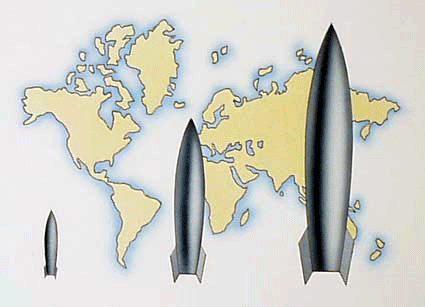
Dr. Ira Helfand, active with PSR and International Physicians for Prevention of Nuclear War, has provided evidence that detonating even 100 nuclear weapons in a limited nuclear war could cause the deaths of as many as 2 billion people from massive starvation due to crop failures caused by a prolonged nuclear winter.
Recently, the risk of outbreak of nuclear war has sharply increased due to deteriorating relations between Russia and the U.S. Both nations are building smaller, more usable nuclear weapons.
Competing U.S./NATO and Russian military exercises have raised international tensions. Former U.S. Secretary of Defense William Perry has stated that nuclear war is more likely than during the Cold War. Russia has invaded and annexed Crimea and supports the Assad regime’s bombing attack in Syria. Eastern European countries feel threatened. NATO has expanded its presence on Russia’s border; increased military deployments and military exercises across Eastern Europe, Scandinavia and the Black Sea. The U.S. has quadrupled its military spending for Europe and U.S. first-strike related missile defenses in Romania and Poland. Russia has been threatened by operation “Anaconda”, in which the U.S. and NATO put 35,000 armed troops, warships and warplanes close to Russia’s border. Russia, Eastern European counties and the U.S. all feel threatened and are communicating less with each other.
How would we feel if Russia placed such weapons systems bordering the United States?
Our relationship with China has also deteriorated in part due to China’s aggressive behavior, such as island building. They feel threatened by our naval exercises increasingly close to China, including our construction of a new naval base in South Korea. According to Global Network, the Pentagon is sending ships, planes and special forces to the Philippines which concerns China. The U.S. already encircles China with many military bases that curve in an arc up from Australia, to Asia and across to Afghanistan.
Our presidential candidates largely ignore such dangers. President Obama has been considering initiatives to reduce the dangers from nuclear weapons. PSR is urging him to establish a clear policy of no-first-use and eliminate plans for spending a trillion dollars on nuclear weapons over the next 30 years. This includes the planned production of a new generation of smaller nuclear weapons, a development that increases the likelihood that they will be used.
Lowering the need for “first strike” weapons, including the next-generation of nuclear-armed cruise missiles would save billions of U.S. dollars and likely encourage other nuclear-armed states to follow suit. Benefits would also include reducing risks of miscalculation by adversaries by alleviating concerns about U.S. intentions of using nuclear weapons.
Since our media and our leadership largely ignore our threatening behavior toward Russia and China, it is essential that masses of citizens act immediately to press for reducing these dangers to our survival.
At 5 p.m. Tuesday, Oct. 25, PSR will join Asheville’s Veterans for Peace, Chapter 099, at their Pack Square vigil, to increase awareness of the need to strive for peaceful relations with Russia and China. Reducing the risk of the use of nuclear weapons dangers is an urgent task for our survival.
Please attend the vigil and lobby candidates and Congress for an end to wars of mass self-destruction.
I ask that you consider this information as you vote for president.
Lew Patrie, M.D. is with Western N.C. Physicians for Social Responsibility. He lives in Asheville.
October 22, 2016
Posted by Christina Macpherson |
general |
Leave a comment
Yet the second trend—the combination of mass migration and racist backlash—could push even more polities toward authoritarianism. Migration is also harder to predict than inequality: Wars and exoduses are not as easy to model as flood damage and agricultural yields.
Climate mitigation is a worthy goal in itself. It is all the more important when understood as one more type of long-term anti-fascism.
 Donald Trump Is the First Demagogue of the Anthropocene He won’t be the
  last. The Atlantic, ROBINSON MEYER OCT 19, 2016
“………I want to propose a new way of understanding Donald Trump. He not only represents a white racial backlash, and he has not only opened the way for an American extension of the European far right. Insofar as his supporters are drawn to him by a sense of global calamity, and insofar as his rhetoric singles out the refugee as yet another black and brown intruder trying to violate the nation’s cherished borders, Trump is the first demagogue of the Anthropocene.
We should take Trump at his word when he calls Syrian refugees “one of the great Trojan horses,” or when his son bizarrely describes them as Skittles that “will kill you.” In Europe, Trump’s far-right kin have long blurred the differences between legal immigration, Islamist terrorism, and the refugees fleeting the Syrian War. After the Paris attacks last year, one leader of the French far-right National Front said, “Today, we can see that immigration has become favorable terrain for the development of Islamism.”
This xenophobia is grounded in real-life trends. I will focus on two in particular: moribund economic growth and the mass migration of non-white people. Both will likely intensify as the planet warms. (A third vital trend—the political and cultural upheaval of the U.S. racial hierarchy—will not vary with climate change.)
First, climate change could easily worsen the inequality that has already hollowed out the Western middle class. A recent analysis in Nature projected that the effects of climate change will reduce the average person’s income by 23 percentby the end of the century. The U.S. Environmental Protection Agency predicts that unmitigated global warming could cost the American economy $200 billion this century. (Some climate researchers think the EPA undercounts these estimates.)
Future consumers will not register these costs so cleanly, though—there will not be a single climate-change debit exacted on everyone’s budgets at year’s end. Instead, the costs will seep in through many sources: storm damage, higher power rates, real-estate depreciation, unreliable and expensive food. Climate change could get laundered, in other words, becoming just one more symptom of a stagnant and unequal economy. As quality of life declines, and insurance premiums rise, people could feel that they’re being robbed by an aloof elite.
They won’t even be wrong. It’s just that due to the chemistry of climate change, many members of that elite will have died 30 or 50 years prior. Continue reading →
October 22, 2016
Posted by Christina Macpherson |
general |
Leave a comment
Ontario Power Generation has applied for permission to increase the price for nuclear power by 180 per cent over the next decade http://www.nugget.ca/2016/10/21/ontario-power-generation-has-applied-for-permission-to-increase-the-price-for-nuclear-power-by-180-per-cent-over-the-next-decade The following letter is addressed to Ontario Premier Kathleen Wynne.
Dear Premier:
Many people in Ontario are struggling to pay their electricity bills.
You need to act now to protect us from further price increases.
Ontario Power Generation wants to raise the price for nuclear power in order to operate its nuclear power plant in Pickering and rebuild the one in Darlington.
It has applied for permission to increase the price for nuclear power by 180 per cent over the next decade. And I expect the price will go even higher – as I’m sure you know, no nuclear project in Ontario’s history has delivered on time or on budget. This is unacceptable.
The people of Ontario simply cannot afford to pay for your plans to spend billions of our tax dollars to rebuild outdated nuclear plants. Studies indicate that Ontario can save $600 million to $1.2 billion per year – or $12 to 24 billion over 20 years – by cancelling the rebuild of the Darlington nuclear plant.
Fortunately, we can cancel the Darlington rebuild and still keep Ontario powered up. There is a cleaner, more affordable alternative: We can get the power we need by importing Quebec’s excess clean water power.
This week you are meeting with top cabinet ministers from Quebec. This gives you a great opportunity to sign a deal for a cheaper and cleaner source of electricity.
To make this work, we would have to upgrade transmission lines at an estimated cost of only about $500 million. All told, Ontario would benefit from a return on investment in just a few months. There are few deals in today’s world with such a short ROI.
Moving forward, the province would enjoy $600 million to $1.2 billion in annual savings. We could use this to fund energy efficiency programs that would help people save money by saving energy.
Premier, I know the nuclear lobby is powerful in Ontario. It spends millions on advertising alone. But I implore you to put the people of Ontario first.
In spite of their criticism, neither opposition party with seats at Queen’s Park has a plan to reduce electricity rate increases. Your government has an historic opportunity to change the conversation on electricity rates in Ontario. The question is whether you have the courage to say no to the nuclear lobby and yes to lower cost water power from Quebec.
Premier, I ask you to put the people of Ontario first by signing a power deal with Quebec for low-cost water power.
Mike Schreiner
Leader, Green Party of Ontario
October 22, 2016
Posted by Christina Macpherson |
general |
Leave a comment











 nuclear-news