Bloomberg by Rajesh Kumar Singh December 13, 2016, Nuclear Power Corp. of India Ltd., the nation’s monopoly atomic power producer, shut one of its plants in southern India after a cyclone made landfall in Tamil Nadu state.
Safety mechanisms triggered the shutdown of both units Monday at the state-owned company’s 440 megawatt plant near the provincial capital Chennai after power lines from the plant were disrupted, spokesman and Human Resources Director N. Nagaich said by phone. The cyclone hasn’t affected Nuclear Power’s bigger plant at Kudankulam in the same state, he said.
“Both units at Kalpakkam have been safely shut down. There is no damage to the plant,” Nagaich said. The company plans to restart one 220-megawatt unit in three or four days. The second unit will take longer to resume operations because of maintenance work, he said…….https://www.bloomberg.com/news/articles/2016-12-13/nuclear-power-corp-shuts-plant-in-south-india-amid-cyclone
December 14, 2016
Posted by Christina Macpherson |
general |
Leave a comment
Electrek, Fred Lambert @FredericLambert 13 Dec 16
Norway, a global leader in electric vehicle adoption, announced that it reached the milestone of 100,000 all-electric vehicles on the roads – something only a few countries can claim and certainly none of the size of Norway (~5.2 million people). It’s important to note here that we are talking about all-electric zero-emission vehicles (BEVs) and not just plug-in vehicles……
https://electrek.co/2016/12/13/norway-all-electric-vehicles-100000/
December 14, 2016
Posted by Christina Macpherson |
general |
Leave a comment

Christina Macpherson’s websites & blogs
You might wonder what this news item is doing on an antinuclear page. Well,it’s not because I’m a great fan of former Australian Prime minister Julia Gillard. However, I was so pleased to see what she is now doing. I am convinced that education is the basic requirement for human society to survive.
America would not have got president elect Trump if that country had a decent, nation-wide, eductaion system. No wonder the under-priveleged battlers hate “the elites” – including the well-educated people who make fun of them.
The nuclear lobby, the climate deniers, thye bigots of all persuasions, will put it over a poorly educated puiblic.
 Education funding must be raised across globe or world will face crisis, Julia Gillard says ABC News, 11 Dedc 16 The world is facing a crisis if countries do not increase their education budgets and get more children into school, warns former prime minister Julia Gillard, now chair of global education funding agency the Global Partnership for Education (GPE)……..
Ms Gillard said this was a crisis not just for the individual children missing out on school, but also at the global economy level.
“One of things we have learned is that we can overcome these problems if we try,” Ms Gillard told the Thomson Reuters Foundation.
“This isn’t the equivalent of saying let’s go to Mars or let’s go to Pluto. This isn’t something that no human being has done before.
“It’s not that at all. If every country was improving its education system as the rate of the top 25 countries — in their income band — then we would solve all these problems and be on track to have a learning generation with every child in school.”
Ms Gillard, who was speaking ahead of a two-day conference on children’s rights in New Delhi, said it was imperative both domestic and overseas financing were made available as one of the first efforts to get children into school.
She said 20 per cent of government budgets, or 6 per cent of gross domestic product, would be an indication a country was trying to make a real difference to the education of children, yet many countries were failing to achieve that level.
According to the Education Commission, low- and middle-income countries’ expenditure on education was $US1 trillion ($1.3 trillion) in 2015, but should have been almost three times that, at $US2.7 trillion by 2030.
Ms Gillard said foreign aid was also meagre, with only 3 per cent of overseas assistance going towards education…..
“Education is a pretty patient investment in quite an impatient world. People want to see quick results. It takes years to educate a child.
“But if this continues, we will see a generation which simply doesn’t have the skills and capacities to make a life for themselves and the next generation of children will be less likely to survive infanthood, less likely to be vaccinated and less likely to go to school themselves.” http://www.abc.net.au/news/2016-12-11/education-funding-must-be-raised-across-globe-gillard/8110204?pfmredir=sm
December 12, 2016
Posted by Christina Macpherson |
general |
Leave a comment
 REPORT: Half Of All US Nuclear Reactors Are Risking Closure, Daily Caller, ANDREW FOLLETT
Energy and Science Reporter, 11 Dec 16
REPORT: Half Of All US Nuclear Reactors Are Risking Closure, Daily Caller, ANDREW FOLLETT
Energy and Science Reporter, 11 Dec 16 About half of U.S. nuclear reactors are at risk of closing early, according to a new report by a self-described centrist think tank.
The report, by Third Way, found in the past two years, six states have shut down nuclear plants and that “dozens” of other plants across the U.S. are facing challenging economic conditions, placing them at risk of imminent retirement.
Third Way notes eight nuclear reactors have announced retirement plans……
December 12, 2016
Posted by Christina Macpherson |
general |
Leave a comment
 Market Conditions Doom Another Nuclear Plant, Palisades, to Closure in 2018 12/08/2016 Aaron Larson, associate editor (@AaronL_Power, @POWERmagazine)Entergy Corp. has decided to permanently close the Palisades nuclear power plant on October 1, 2018…….
In a press release, Entergy said Consumers’ customers would save as much as $172 million over four years, even after paying Entergy $172 million to terminate the contract. The early termination payment is expected to “help assure the plant’s transition from operations to decommissioning.”
The 798-MW plant located about five miles south of South Haven, Mich., faced economic difficulties similar to other single-unit facilities, such as the recently closed Fort Calhoun Plant, and the R.E. Ginna, Nine Mile Point, FitzPatrick, and Clinton plants, which only remained viable after subsidies were approved in New York and Illinois. Entergy said, “market conditions have changed substantially, and more economic alternatives are now available to provide reliable power to the region.”
“Entergy recognizes the consequences of a Palisades shutdown for our approximately 600 employees who have run the plant safely and reliably, and for the surrounding community, and we will work closely with both to provide support during the transition,” said Entergy Chairman and CEO Leo Denault. “We determined that a shutdown in 2018 is prudent when comparing the transaction to the business risks of continued operation.”……http://www.powermag.com/market-conditions-doom-another-nuclear-plant-palisades-to-closure-in-2018/
December 9, 2016
Posted by Christina Macpherson |
general |
Leave a comment
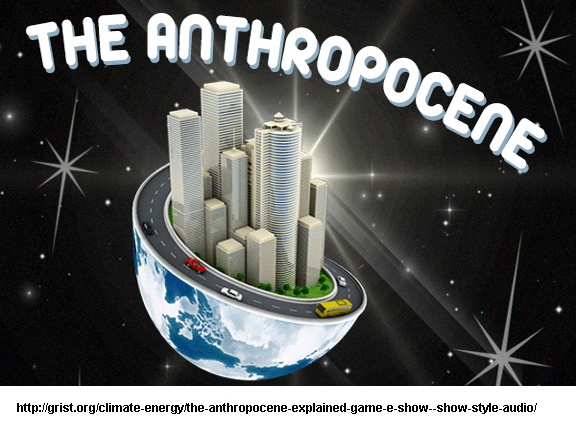
 The Anthropocene is a nuclear epoch – so how can we survive it? The Conversation, Becky Alexis-Martin, Stephanie Malin, Thom Davies December 9, 2016, The era in which we live is now officially described as an atomic Anthropocene or the “age of humans”, an epoch defined by humans’ impact on the planet – and one of its most distinctive features is radiation. The fallout (both literal and figurative) from international nuclear weapons testing, nuclear energy and nuclear disasters are embedded in our environment, but also in our society. And this year, they’ve all suddenly become rather more noticeable, confronting us with some alarming questions we never thought we’d have to answer.
Will Donald Trump’s election victory improve nuclear defence policy or plunge us into a new Cold War? Will the world continue moving towards nuclear weapon abolition, or will the nuclear powers keep up and grow their stockpiles instead? How should the world deal with North Korea’s repeated violations of the Test Ban Treaty? And do we really understand how the nuclear age has affected the survivors of nuclear accidents?
Memories of Catastrophe
In retrospect, 2016 was always going to bring these questions to the fore, marking as it did significant anniversaries of two of the world’s worst nuclear disasters: Fukushima (five years ago) and Chernobyl (30 years ago). While the health consequences of both incidents are still debated, their psychosocial effects and economic impact are beyond doubt.
Five years after the Fukushima accident, Japan is still working to decontaminate the affected area. It’s cost five trillion yen (about £35 billion) so far and demanded the labour of 26,000 clean-up workers – many of them vulnerable to exploitation and social exclusion.
Forced and so-called “voluntary” evacuees from Fukushima are still adjusting to life away from home. There are 100,000 of these “nuclear refugees” still displaced; two thirds have reportedly given up hope of ever returning. With the Tokyo 2020 Olympics looming, and compensation costs spiralling, the Japanese government recently declared more areas as officially safe – despite evacuees being reluctant to return. Their fears were stoked in November when an aftershock from the original Fukushima earthquake hit Japan. Thankfully, there wasn’t a second catastrophe.
We also saw the 30th anniversary of the Chernobyl disaster, which continues to effect a wide swathe of Ukraine and Belarus. Dealing with the consequences of the disaster consumes around 6% of Ukraine’s national budget, and 2.15m Ukrainians still live on territory that’s officially considered contaminated………
Economic and environmental change
It’s also been a bad year for uranium. The uranium mining and production sector has been faltering ever since Fukushima, and this year’s international overproduction further depressed prices. Global production and extraction activity stalled, earning it the dubious distinction of 2016’s “worst-performing raw material”.
As the industry waits for the market to recover, debates rage over the future of the only current operational uranium mill in the US and proposed developments at sacred and ecologically fragile zones – the Grand Canyon, the Aboriginal Kakadu National Park in Australia, and the Karoo in South Africa. Meanwhile, precarious states such as the Ukraine and Kazakhstan have agreed to jointly produce uranium, also betting the industry will recover.
But nuclear energy’s byproducts still have major environmental impacts, and we still have no solution for managing nuclear waste in the long term. In the US, a potential revival of the repository project in Yucca Mountain has been posited by Trump’s advisors. Meanwhile, Australia is unwilling to provide long term storage, and the long term outcomes remain to be seen……… https://theconversation.com/the-anthropocene-is-a-nuclear-epoch-so-how-can-we-survive-it-69393
December 9, 2016
Posted by Christina Macpherson |
general |
Leave a comment
In 2007, The Economist reported that “America’s nuclear industry is about to embark on its biggest expansion in more than a generation. This will influence energy policy in the rest of the world.” Safety, management and regulatory improvements, it predicted, would lead to an “atomic renaissance” for a nuclear energy industry hobbled for decades by the accidents at Three Mile Island and Chernobyl.
The nuclear industry itself anticipated that soaring electricity demand in fast-growing developing countries and rising concerns about climate change would drive countries to take a fresh look at an industry whose safety practices appeared to have improved considerably since the 1980s.
But a decade later, the amount of electricity generated by nuclear power has actually dropped slightly, even as electricity demand in developing countries has grown. In the United States and other countries with nuclear power, utility companies have retired plants before the end of their useful lifetime, terming them uneconomic. Countries like Vietnam, which has planned to develop nuclear power for years, and South Africa, which has one reactor, have either scaled back grand plans to build several power plants, or abandoned them altogether.
The impact is clear: Two decades ago, nuclear energy provided the power for nearly one-fifth of the world’s electricity. Now it generates only about half that share. ……
nuclear energy would be facing strong headwinds even if the Fukushima accident had not occurred, because of the market forces of supply and demand. On the supply side, nuclear energy’s competitiveness in generating electricity has been undermined by the revolution in natural gas production, particularly hydraulic fracturing, or fracking; the increasing appeal of alternative renewable sources like solar and wind power; and the peculiar economics of nuclear energy. Meanwhile, efficiency gains, slow economic growth and the lack of strong incentives against fossil fuel use have curtailed demand for nuclear power in many rich and poor countries alike.
The results can be seen from California to Vietnam, from Finland to South Africa. ……..
In the recent past, utility companies have been able to compensate for the staggering upfront costs for new nuclear power plants by the relatively low cost for uranium, which fuels nuclear power, compared to those for fossil fuels. And they boosted these advantages further by increasing the percentage of the time that nuclear reactors operate and extending the years they are in service. The Economist even touted them as “virtual mints—as long as the bill for construction has been paid down or written off.”
But in the U.S.—home to 100 reactors, or more than a quarter of the world’s nuclear power—those cost advantages have been turned on their head. Maintenance costs for some aging reactors have become so steep that it no longer makes economic sense to operate them. And the rising tide of gas output from fracking and steady increases in wind and solar energy capacity have meant that these other forms of energy have increasingly squeezed out nuclear power in competitive electricity auctions. In the past three years alone, American utility companies have announced the shutdown of 14 U.S. reactors…..
Nuclear power’s doldrums have even affected China, which has emerged as the major bright spot for nuclear power in recent years, given its voracious appetite for electricity. Eight new reactors were connected to China’s grid in 2015 alone, and another 21 reactors are under construction. But even in China, a glut of wind and coal power plants is dampening demand for nuclear power, while delays plague construction. Observers anticipate the country falling short of its goal of 58 gigawatts of nuclear power capacity by 2020……
, dozens of governments and companies have been touting the development of a new wave of small and modular reactors, or SMRs. While employing widely varying technologies, SMRs typically are smaller-scale and largely mass-produced reactors intended to substitute for today’s one-of-a-kind large-scale models. They attempt to make reactors more competitive with other energy sources and more appropriate for the fragile electricity grids of developing countries. However, these reactors have yet to be deployed on a commercial basis and also are likely to require government regulators to develop a whole new set of standards. Any effort is likely to require sustained regulatory support from the U.S. and other governments.
Such efforts to rejuvenate the nuclear industry received a potential death blow with last month’s U.S. elections that solidified the Republican Party’s control of U.S. energy policy. Given Republicans’ skepticism about climate change and government intervention in markets, nuclear power may more likely be entering its dark ages than seeing a renaissance.
Miles Pomper is a senior fellow at the James Martin Center for Nonproliferation Studies in Washington, D.C. http://www.worldpoliticsreview.com/articles/20595/what-future-does-nuclear-power-have-in-an-era-of-cheap-energy
December 9, 2016
Posted by Christina Macpherson |
general |
Leave a comment
Tsunamis threaten Britain’s nuclear power plants, scientists warn, Rt.com : 5 Dec, 2016 Britain’s nuclear power stations are at risk from tsunamis caused by undersea landslides, scientists have warned.
Marine geologists at Durham University found that the British Isles have been hit by more tsunamis than previously believed, including one wave which reached a height of 60 feet.
Scientists are urging the government to take the threat of tsunamis seriously, warning that they could damage critical infrastructure on the coast, such as nuclear power stations, ports, and oil terminals.
New evidence has shown that the giant waves can be triggered by underwater landslides, as well as earthquakes, as was the case with the 2011 tsunami that killed 16,000 people in Japan in 2011.
These landslides cause billions of tons of mud to break away from the seabed and tumble downwards, creating a suction hole in the sea above. Water then rushes to fill the void, creating a giant wave.
Researchers are urging the government to take steps to protect nuclear and other key installations from tsunamis, which are likely to occur more than once every 10,000 years.
Durham University professor of marine geology Peter Talling said: “We believe the government should consider adding tsunamis to the National Risk Register of Civil Emergencies.”
The register sets out plans for rare, but potentially devastating disasters, such as flu epidemics and floods……https://www.rt.com/uk/369260-tsunami-landslide-nuclear-plant/
December 9, 2016
Posted by Christina Macpherson |
general |
Leave a comment
Gov. to sign bill saving Cordova, IL nuclear plant Wednesday By David Nelson KWQC6, December 6, 2016, PORT BYRON, Ill. – Gov. Bruce Rauner on Wednesday will sign a bill into law that will keep open two Illinois nuclear power plants, including the Quad Cities plant in Cordova.
The Quad Cities Chamber of Commerce says the signing of the Future Energy Jobs Bill will take place at 9:30 a.m. on December 7, 2016 at the Riverdale High School gymnasium in Port Byron.
An Exelon spokesperson told KWQC last month that if the bill did not pass, Exelon would be forced to close both the plant in Cordova and the one in Clinton, Illinois…..http://kwqc.com/2016/12/06/gov-to-sign-bill-saving-cordova-il-nuclear-plant-wednesday/
December 9, 2016
Posted by Christina Macpherson |
general |
Leave a comment
The nuclear renaissance?, Japan Today by Mark Hibbs, 5 Dec 16 “……During nuclear power’s heyday, governments favored nuclear power by allowing utility companies to include the capital costs in the rate base. Governments and consumers assumed the risk and power sales amortized the investments. In most places today that’s history. Governments are deregulating power markets and introducing competition, thereby shifting risk from customers to company shareholders.
During the 1990s, investments shifted from nuclear to increasingly cheaper and abundant natural gas, and by 2002 gas-fired plants accounted for over 80% of all new power plants built in OECD countries. In parallel, nuclear technology became a lot more expensive; a 1,000-MW power plant that in 2000 cost $1.5 billion might cost $10 billion today. In 1991 all this was foreseen by Klaus Barthelt, the power engineering CEO for Germany’s biggest nuclear engineering firm Siemens, who then said; “The countries that can still afford our nuclear plants won’t need the electricity, and the countries that will need the electricity won’t be able to afford the reactors.”
With a few exceptions Barthelt’s prediction remains true. For two decades the nuclear has industry hoped for a worldwide “nuclear renaissance” ushered in by the need to meet growing power demand using non-fossil fuels.
But most of the world is still waiting.
The market for new nuclear power in the Americas and Europe remains flat. Japan’s deep technology base didn’t prevent three Japanese reactors from melting down in 2011. For many years, that event will deter Japan and many less-endowed countries from making new nuclear investments………
While nuclear power awaits government fixes, renewable energy technologies led by solar and wind power are jumping into the breach. They now provide a quarter of the world’s electricity. Their market penetration is currently favored by the same kind of policy stimuli that governments after World War II used to favor nuclear power……https://www.japantoday.com/category/opinions/view/the-nuclear-renaissance
December 9, 2016
Posted by Christina Macpherson |
general |
Leave a comment
Nuclear danger is not gone, http://www.citizen-times.com/story/opinion/2016/12/05/guest-columnist-nuclear-danger-gone/94986056/Dr. Bert Crain M.D., December 5, 2016 The issue of nuclear weapons is a terrible problem shared by all humanity. The dangers we are facing do not loom large in the public consciousness as they did right after World War II when the Bulletin of the Atomic Scientists voiced their first warnings that we should not elect to live in the dread of sudden annihilation and the publication The Nation felt strongly that it was now “one world or none”. We stumbled through the Cold War facing off the Soviet Union with a policy of mutually assured destruction. MAD worked but we were lucky. There were many close calls, the Cuban Missile Crisis being perhaps the best remembered.
Nearly 10 years ago four senior statesmen including two former secretaries of state offered a commentary in The Wall Street Journal that documented the tremendous danger, but also historic opportunity, that then existed. They emphasized the increasing hazard, the steps that should be taken, and the importance of U.S. leadership in a bold initiative consistent with our moral heritage. They emphasized that there was urgent need to amplify the gains that had been made in the Reagan-Gorbachev summits and subsequent détente of 1987. Barack Obama reinforced those leaders’ vision, calling for nuclear abolition in his speech in Prague in April 2009.
The danger now is greater than it was during the Cold War. Since the Russian Federation annexed the Crimea, invaded the Ukraine and began fighting for Bashar El Assad in Syria, the rhetoric has escalated with nuclear weapons once again being celebrated as symbols of national power. Some statesmen believe that Putin’s posture is more bravado from a fearful Russia encircled by NATO and trying to keep Ukraine in their domain.
In any case since the greatest threat we face is the nuclear arsenals of Russia and the U.S., the talk can be unnerving. In addition, all of the nuclear armed states are planning costly upgrades in violation of the Nuclear Non-proliferation Treaty. We are threatening to start a new arms race. Many, including the late cosmologist Carl Sagan, an eloquent advocate for science and humanity, considered nuclear proliferation as collective madness.
Those who are anchored to nuclear weapons argue that nuclear deterrence has prevented a major power conflict since 1945. The price has been millions of people held hostage to the threat of extinction. It is now critical to also realize that unlike the ideological conflict of the Cold War, when everyone wanted to live, religious extremists intent on mass murder of nonbelievers and a glorious martyrdom will not be deterred by mutually assured destruction. This chilling fact alone should push the nuclear armed states toward cooperating in verifiable reductions and securing fissile material.
Many of us have been working for decades to enable public opinion through enlightened self- interest to push governments to not do insane things, but the political-military-industrial complex is a hungry beast. The newest and most potent abolitionist movement is The Humanitarian Initiative proposed by a majority of the non-nuclear states. On Oct. 27, 123 nations at the UN General Assembly, voted in favor of adopting a resolution that sets up negotiations in 2017 to establish a legally binding instrument that abolishes nuclear weapons. Physicians for Social Responsibility urges our nation’s citizens to embrace sanity, to pressure our elected officials to support this international effort and to demand a stop to a new nuclear arms race.
Bert Crain, M.D. is a member of Western North Carolina Physicians for Social Responsibility. For more see www.psr.org and www.wncpsr.org
December 9, 2016
Posted by Christina Macpherson |
general |
Leave a comment
It’s absurd that Hinkley is going ahead while cheaper, cleaner options are blocked https://www.theguardian.com/commentisfree/2016/sep/15/absurd-hinkley-point-c-cheaper-cleaner
Caroline Lucas Britain’s most abundant resources are the sun, sea and wind. It makes no sense to be wasting so much money on a white elephant Hinkley Point C nuclear power plant gets green light
December 9, 2016
Posted by Christina Macpherson |
general |
Leave a comment
Hurricane season comes to an end today, but the myth of bombing Mother Nature into submission endures. National Geographic, By Mark Strauss, NOVEMBER 30, 2016
When nature declares war, who says that humanity shouldn’t fight back?
It’s an appealing thought, especially when, during hurricane season, we’re annually reminded of the immense destruction wrought by these storms.
And it’s probably why, every year for the past six decades, government agencies have received missives from concerned citizens, urging preemptive attacks against hurricanes using nuclear weapons.
“Needless to say, this is not a good idea,” says the National Oceanic and Atmospheric Administration in what is, arguably, one of the most succinct understatements on record.
Yet because the “nuke a hurricane” myth won’t die, NOAA maintains a web page exclusively devoted to debunking this proposal. (Similarly, the U.S. Geological Survey has an online report debunking divining rods and water dowsing. It’s not always easy being a government scientist.)
To be fair, though, there was a time when scientists and government agencies were themselves seriously considering the nuclear option…….
there’s also the slight problem that—in the words of Robert Nelson, a physicist who studies nuclear weapons—“It’s just wacky.”
For starters, as NOAA observes, there’s the issue of radioactive fallout, which would “fairly quickly move with the trade winds to affect land areas and cause devastating environmental problems.”
Also, it wouldn’t work. The key obstacle is the amount of energy required. The heat release from a hurricane is equivalent to a 10-megaton nuclear bomb exploding every 20 minutes, NOAA calculates. In order to shrink a Category 5 hurricane into a Category 2 hurricane, you would have to add about a half ton of air for each square yard inside the eye, or a total of a bit more than half a billion (500,000,000) tons for an eye 25 miles in diameter. “It’s difficult to envision a practical way of moving that much air around,” NOAA says.
Today, international law prohibits us from even trying. The Peaceful Nuclear Explosions Treaty, signed and ratified by the United States in 1990, limits the yield of weapons for non-military purposes to 150 kilotons—a formal acknowledgement that you can’t fight Mother Nature, especially with nukes. http://news.nationalgeographic.com/2016/11/hurricanes-weather-history-nuclear-weapons/
December 9, 2016
Posted by Christina Macpherson |
general |
1 Comment
U.S. Secretary of State John Kerry said on Monday Iran’s nuclear agreement with world powers last year had made the world safer, rejecting U.S. President-elect Donald Trump references to the pact as a “disaster” and “the worst deal ever negotiated”.
“The region is safer, Germany and the United States are safer, Europe is safer, Israel is safer and the world is safer… It depends on all of us to keep this alive,” Kerry said at an event at which he was awarded the German Order of Merit.
He added that President Barack Obama had already approached Trump about the matter. (Reporting by Sabine Siebold; writing by Maria Sheahan; editing by Mark Heinrich)
December 7, 2016
Posted by Christina Macpherson |
general |
Leave a comment
Tsunamis threaten Britain’s nuclear power plants, scientists warn, Rt.com : 5 Dec, 2016 Britain’s nuclear power stations are at risk from tsunamis caused by undersea landslides, scientists have warned.
Marine geologists at Durham University found that the British Isles have been hit by more tsunamis than previously believed, including one wave which reached a height of 60 feet.
Scientists are urging the government to take the threat of tsunamis seriously, warning that they could damage critical infrastructure on the coast, such as nuclear power stations, ports, and oil terminals.
New evidence has shown that the giant waves can be triggered by underwater landslides, as well as earthquakes, as was the case with the 2011 tsunami that killed 16,000 people in Japan in 2011.
These landslides cause billions of tons of mud to break away from the seabed and tumble downwards, creating a suction hole in the sea above. Water then rushes to fill the void, creating a giant wave.
Researchers are urging the government to take steps to protect nuclear and other key installations from tsunamis, which are likely to occur more than once every 10,000 years.
Durham University professor of marine geology Peter Talling said: “We believe the government should consider adding tsunamis to the National Risk Register of Civil Emergencies.”
The register sets out plans for rare, but potentially devastating disasters, such as flu epidemics and floods……https://www.rt.com/uk/369260-tsunami-landslide-nuclear-plant/
December 7, 2016
Posted by Christina Macpherson |
general |
Leave a comment




 nuclear-news