Toshiba nuclear write-off spooks Southeast power companies Kristi E. Swartz, E&E News reporter, February 3, 2017
Four electric companies in the Southeast said they are closely watching Toshiba Corp. after cost overruns are forcing it to write off billions of dollars in losses as they complete nuclear projects in Georgia and South Carolina….(subscribers only) http://www.eenews.net/energywire/2017/02/03/stories/1060049501
February 4, 2017
Posted by Christina Macpherson |
general |
Leave a comment
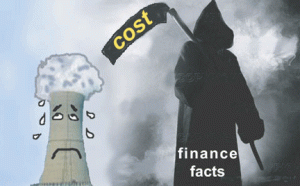 The dream of cheap nuclear power is over, Crains, By: NOAH SMITH, January 31, 2017 For much of my
  life, I loved the idea of nuclear power. The science was so cool, futuristic and complicated, the power plants so vast and majestic. I devoured science-fiction novels like “Lucifer’s Hammer,” where a plucky nuclear entrepreneur restarts civilization after a comet almost wipes us out. I thought of accidents like Three Mile Island and even Chernobyl as stumbling blocks to a nuclear future.
Then, in 2011, two things happened. First, a tsunami knocked out the nuclear reactor at Fukushima, forcing a mass evacuation and costing Japan hundreds of billions of dollars. Second, I learned that progress in solar power had been a lot faster and steadier than I had realized. I started taking a closer look at whether nuclear was really the future of energy. Now I’m pretty convinced that my youthful fantasies of a nuclear world won’t come true anytime soon.
Safety is part of the problem — but a much smaller part than most people realize…….
The biggest problem with nuclear isn’t safety — it’s cost. The economics of nuclear are almost certain to keep it a marginal part of the energy mix, especially in the U.S.
Many energy sources involve relatively small upfront costs. To increase solar power, just build more panels. Fracking also has lower fixed costs than traditional oil drilling. But nuclear’s fixed costs are enormous. A new nuclear plant in the U.S. costs about $9 billion to build — more than 1,000 times as much as a new fracking well, and more than 3,000 times as much as the world’s biggest solar plant.
Raising $9 billion is a daunting obstacle. It’s more money than Apple Inc., the U.S.’s most valuable company, borrowed in 2016.The plucky young entrepreneur raising enough money to build his own nuclear plant in “Lucifer’s Hammer” was pure fantasy; in reality, nuclear plants get build by giant corporations such as General Electric Co. and Toshiba Corp., with huge assistance from the government in the form of loan guarantees.
It’s hard to raise money for projects with giant fixed costs and long horizons for repayment, because they’re inherently risky. If something goes badly wrong with the project, all of that up-front money is lost. If competition makes a project un-economical in five or 10 years in the future, the financiers will take a big loss. It’s very hard to make predictions of more than a few years, especially about competing technologies.
For nuclear power, that’s the main risk — rapid advances in competing technologies. Solar power is already cheap and is plunging in price, while energy storage is also becoming much more affordable. If these trends continue, a nuclear power plant that’s economical today will be out-competed in a few years. In other words, there will be no way the owner could recover the fixed costs.
What’s worse, nuclear doesn’t look like it’s getting any cheaper. A recent paper by the Breakthrough Institute shows that in most countries, nuclear costs haven’t changed much in recent decades: Constant or rising nuclear construction costs, matched with dramatically falling solar and storage costs, mean that anyone who ponies up the $9 billion to build a nuclear plant today is taking a gargantuan risk.
Another source of risk is safety — not the well-known threats of accidents and storage leaks, but the unknown unknowns. If terrorists figure out how to bomb nuclear plants, or hackers find ways to invade their software and cause them to melt down, the destruction could be catastrophic. But no one really knows how likely or remote those threats will be a decade from now. And even if those risks can be prevented, doing so will probably will cause large unanticipated costs.
So nuclear power hasn’t become the futuristic dream technology the old science-fiction novels envisioned. Instead, it’s a huge, risky government-subsidized corporate boondoggle. Someday we may have fusion power or small, cheap fission reactors, and the old dream of nuclear will be realized. But unless one of those breakthrough technologies comes to fruition, nuclear isn’t the power of tomorrow.
Noah Smith writes for Bloomberg View. http://www.chicagobusiness.com/article/20170131/OPINION/170139969/the-dream-of-cheap-nuclear-power-is-over?utm%5C_source=OPINION&utm%5C_medium=rss&utm%5C_campaign=chicagobusiness
February 1, 2017
Posted by Christina Macpherson |
general |
1 Comment
http://apo.org.au/node/72441 NOAA Technical Report NOS CO -OPS 083
27 January 2017
Executive summary
The Sea Level Rise and Coastal Flood Hazard Scenarios and Tools Interagency Task Force, jointly convened by the U.S. Global Change Research Program (USGCRP) and the National Ocean Council (NOC), began its work in August 2015. The Task Force has focused its efforts on three primary tasks: updating scenarios of global mean sea level (GMSL) rise, 2) integrating the global scenarios with regional factors contributing to sea level change for the entire U.S. coastline, and 3) incorporating these regionally appropriate scenarios within coastal risk management tools and capabilities deployed by individual agencies in support of the needs of specific stakeholder groups and user communities. This technical report focuses on the first two of these tasks and reports on the production of gridded relative sea level (RSL, which includes both ocean-level change and vertical land motion) projections for the United States associated with an updated set of GMSL scenarios. In addition to supporting the longer-term Task Force effort, this new product will be an important input into the USGCRP Sustained Assessment process and upcoming Fourth National Climate Assessment (NCA4) due in 2018. This report also serves as a key technical input into the in-progress USGCRP Climate Science Special Report (CSSR).
Publication Details
Peer reviewed (if applicable):
License type (if applicable):
February 1, 2017
Posted by Christina Macpherson |
general |
Leave a comment

 Toshiba Likely To Exit Nuclear Plant Construction Business, Forbes, Rod Adams , 29 Jan 17
Westinghouse is “unlikely to carry out actual construction work for the future nuclear power plant projects to eliminate risk.”
Satoshi Tsunakawa, President and CEO of Toshiba, the Japanese company that owns Westinghouse and its CB&I Stone Webster subsidiary, made that statement during a recent press conference. The event, held on January 27, was called to provide a status report for restructuring actions first announced on December 27, 2016.
Computing Magnitude Of Lost Goodwill
The restructuring is required as a result of the growing realization that the value of Westinghouse’s CB&I Stone and Webster subsidiary is probably several hundred billion yen (several billion dollars) less than its current book value. Adjusting the company’s stated value with its real value will require taking a write off of “goodwill.”
The reduction in goodwill value is based on CB&I’s existing and predicted future liabilities associated with completing four nuclear plant construction projects, two at Plant Vogtle in northeast Georgia and two at the V.C. Summer site in northwest South Carolina. ……..
There is even a significant possibility that the projects will fail to be completed at all.
January 30, 2017
Posted by Christina Macpherson |
general |
2 Comments
Trump and Charles in climate row. President ‘won’t take lecture’ from prince Tim Shipman and Roya Nikkhah January 29 2017, The Sunday Times Donald Trump is engaged in an extraordinary diplomatic row with the Prince of Wales over climate change that threatens to disrupt his state visit to the UK.
January 30, 2017
Posted by Christina Macpherson |
general |
Leave a comment
Dissecting Trump: Is Nuclear Energy The Best Response To Global Warming?, Paste, By Tom Burson | January 27, 2017 The nuclear energy debate has long been a bane of politicians. Some energy experts consider nuclear power as the great alternative energy source next to fossil fuels; whereas, environmentalists, though they embrace the green footprint, remain wary about the practice’s overall safety. Even global leaders are split. President Donald Trump hopes to expand nuclear power and the nation’s energy supply—though this expansion certainly curtails some of nuclear power’s benefits when he also hopes to expand fracking and oil drilling. Contrarily, in Germany, Chancellor Angela Merkel completely halted the production of nuclear energy and instituted the Energiewende, which will close all nuclear plants………
why does Germany hate nuclear power? Surely, Chancellor Angela Merkel, a physicist by training, making her arguably the most qualified world leader to opine nuclear power, would support the practice, right? Wrong. And it’s out of fear for the potential dangers and instability of the atomkraft.
In the wake of the 2011 Fukushima disaster, Mrs. Merkel u-turned on a 2010 policy that sought a continuation of Germany’s nuclear industry. “After what was, for me anyway, an unimaginable disaster in Fukushima, we have had to reconsider the role of nuclear energy,” she said in a conference following the disaster. At the time, though, 70 percent of Germans had already disapproved of the country’s insistence on nuclear energy, and in 2002 the Energiewende had already begun.
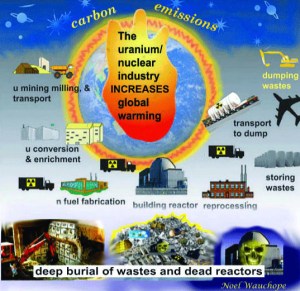 Nuclear energy may reduce global greenhouse gas emissions, but at what cost? Accidents happen, and an accident at a nuclear facility lasts literally generations. Just look at the incident in Chernobyl in which, thirty-years later, areas are still contaminated with nuclear waste, locals are still getting cancer. In Japan, a similar portrait exists, and scientists still don’t know the future ecological impact the accident will have, but they project it’ll last for hundreds of years.
As if accidents aren’t enough of a concern, there’s also the issue of Plutonium deposits—the end product of reprocessing spent fuel—getting stolen. And what can be made with Plutonium? Nuclear bombs.
Is nuclear power worth this risk?…….
Nuclear Power Will Never Supply the World’s Needs
It’s like patching up a tent with duct tape. Eventually, water’s going to seep though, except, in this case, the water is rising sea levels and the tent is your home. There are a few reasons many physicists think nuclear energy simply won’t work:
Not enough land
One plant requires about eight square miles of space. Reactors also need to be located near a massive body of coolant water but also far away from dense populations and natural disaster zones. Oh, and, to supply the world, there will have to be 15,000 of those locations.
Not enough time
Every nuclear power station needs to be decommissioned after 50-odd years due to neutron embrittlement. If nuclear stations need replacing every 50 years, and the world needs 15,000 power stations, one station would need to be built and another decommissioned somewhere in the world just about every day. Also, as a side note, it currently takes around six years to build just one nuclear station and another twenty years to decommission
What the Hell should we do with the waste?
Nuclear technology has existed for roughly 60 years and there’s still no solution of disposal. Should we continue burying it? But then that could lead to radioactive leakage into the groundwater or to accidents like this one. There’s no real, safe way to eliminate waste outside of blasting it off into space somewhere beyond Pluto. https://www.pastemagazine.com/articles/2017/01/pointcounterpoint-is-nuclear-energy-the-best-respo.html
January 28, 2017
Posted by Christina Macpherson |
general |
Leave a comment
14,900 nukes: All the nations armed with atomic weapons and how many they have Business Insider SKYE GOULD, DAVE MOSHER JAN 28, 2017 The Bulletin of the Atomic Scientists has advanced its symbolic Doomsday Clock by 30 seconds, suggesting humanity is an alarming 2 minutes and 30 seconds away from the brink of an apocalypse.
It’s a dramatic statement, but the clock’s annual movement is determined by a board of preeminent global security and scientific experts, including 15 Nobel laureates. And they’re deadly serious.
Each shift takes into account major threats to civilisation, including climate change. However, it assesses — first and foremost — the threat of nuclear war.
This year the Bulletin is especially concerned with the rise of totalitarian and authoritarian regimes, and North Korea’s recent weapons tests. But in an unusual move, it took aim at President Donald Trump’s aggressive rhetoric on expanding US weapons programs, including his desire to proliferate atomic weapons — just one of which can wipe out millions of people in a matter of seconds — to other countries.
The Bulletin’s board said in its full statement that, while it “takes a broad and international view of existential threats to humanity” and “the statements of a single person […] have not historically influenced” its decisions, “wavering public confidence in the democratic institutions required to deal with major world threats do affect the board’s decisions.”
Below is a map [on original] that shows which countries have nuclear warheads and the best-known estimates of how many. http://www.businessinsider.com.au/number-nuclear-weapons-us-russia-world-2017-1?r=US&IR=T
January 28, 2017
Posted by Christina Macpherson |
general |
Leave a comment
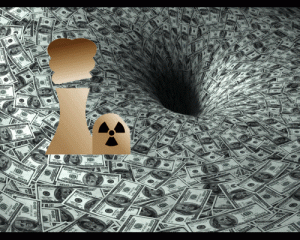 Toshiba reckoning looms with chip decision, nuclear hole unresolved, Reuters Jan 26, 2017 Toshiba Corp faces a day of reckoning on Friday, when it is expected to offer an initial estimate of the multibillion-dollar charge it must take on its U.S. nuclear business, but this will be only a step in a series of tough choices on the Japanese conglomerate’s survival.
Toshiba’s board meets to approve plans to spin off its semiconductor business as a separate company, hoping to raise more than 200 billion yen ($1.74 billion) by selling as much as a fifth of the core money-making unit, a person with direct knowledge of the matter said.
But as the proceeds would be just a fraction of the hole from cost overruns in its Westinghouse nuclear business – which local media put at 680 billion yen ($6 billion) – the chip sale would only be the start of a solution, which would require help from Toshiba’s banks and possibly the government-backed Development Bank of Japan (DBJ).
Toshiba, which declined to comment on plans for its chip business, says it will unveil the writedown on Feb. 14 when it reports third-quarter results. In the meantime, it has been in regular talks with its banks…..
Whether to sell part of the nuclear business at the heart of its problems is a subject for discussion between Toshiba and its lenders, people close to the situation say…….http://www.reuters.com/article/us-toshiba-accounting-idUSKBN15A2IT
January 27, 2017
Posted by Christina Macpherson |
general |
Leave a comment
Groups call for shutdown of Pa. nuclear plant amid concerns about ‘defective’ parts, safety Penn Live By Colin Deppen | cdeppen@pennlive.com A self-described “anti-nuclear advocacy group” is calling for operations to be suspended at a Pa. nuclear power plant amid concerns about potentially defective parts and a scandal involving documents falsified by the French manufacturer of those parts.
According to the advocacy group, Beyond Nuclear, the concerns involve parts manufactured and imported from Areva’s Le Creusot Forge in France, which is currently “at the center of an international nuclear safety controversy,” a statement from the group reads. The full statement is included below.
Beyond Nuclear identifies 17 affected units at U.S. nuclear power plant sites. They include units at First Energy’s Beaver Valley Nuclear Power Station in Shippingport, Beaver County, located 35 miles northwest of Pittsburgh. Middletown’s Three Mile Island plant is not included on that list.
Petition for Emergency Enforcement Action – Beyond Nuclear by PennLive on Scribd……..Beyond Nuclear and other petitioners are now calling on the U.S. Nuclear Regulatory Commission (NRC) to take emergency enforcement action requiring emergency shutdowns of such plants pending the “enhanced inspections of at-risk components along with material testing of surplus material taking [sic] from the component.”…….http://www.pennlive.com/news/2017/01/group_calls_for_shutdown_of_pa.html
January 27, 2017
Posted by Christina Macpherson |
general |
Leave a comment
 An Illustrated Guide to Trump’s Plan for the Environment, Outside, By: Susie Cagle Jan 23, 2017 Our 45th president’s contempt for environmental protections is well documented. So what will his first 100 days look like? Here’s our educated guess on what could happen, based on what he’s already said and done.
“Hoax,” “hoax,” and “expensive hoax.” That’s how President Donald J. Trump has most frequently described man-made climate change. While we don’t yet know exactly what a Trump presidency will mean for our planet, the man has given us enough clues that we can begin to cobble together a vision for the future.
January 27, 2017
Posted by Christina Macpherson |
general |
Leave a comment
Trident misfire spotlights the danger of fat fingers on nuclear buttons, Guardian, 23 Jan 17 Frank Jackson Former co-chair, World Disarmament Campaign The failure of a Trident missile test (May accused of covering up Trident failure, 23 January) is only the latest of many known accidents and miscalculations with nuclear weapon systems, and probably even more that have been concealed, like this one. With 15,000 nuclear warheads in the world, most held by the United States and Russia, and many on hair-trigger alert, it is remarkable that none has yet resulted in an actual nuclear detonation. But if we do not abolish nuclear weapons, it is surely only a matter of time.
This latest incident emphasises even more strongly that the forthcoming UN multilateral negotiations towards a nuclear weapon ban treaty, which will make all nuclear weapons illegal, must succeed. It will then kickstart the process of their abolition, which almost every public figure claims to desire. For example, the defence secretary, Michael Fallon, is on the record as saying: “We share the vision of a world that is without nuclear weapons, achieved through multilateral disarmament.”……..
Symon Hill
Co-ordinator, Peace Pledge UnionWhile Theresa May dodges questions about Trident, five people – including members of the Peace Pledge Union – are on trial in Reading for impeding Trident production. They blocked one of the gates to the Atomic Weapons Establishment in Berkshire last June – at around the same time that the Trident missile test was going wrong.
The problem is not simply that a Trident missile was fired in the “wrong” direction. There is no “right” direction to fire a missile. Killing millions of people is morally repugnant, whatever part of the world they live in. However, news of the test utterly undermines the claims of those who insist that Trident could never malfunction. The prospect of death and destruction caused by an accident is no less terrifying than the thought of it being caused deliberately.
While May talks of “national security”, the campaigners in the dock this week have shown far more concern for human safety. May covered up the truth. The defendants in Reading are witnessing to the truth that weapons don’t protect us, they only make us all less safe…….https://www.theguardian.com/uk-news/2017/jan/24/trident-misfire-spotlights-the-danger-of-fat-fingers-on-nuclear-buttons
January 25, 2017
Posted by Christina Macpherson |
general |
Leave a comment
 Donald Trump, Nuclear Weapons & The Ominous Tick Of The Doomsday Clock, Chicagoist BY STEPHEN GOSSETT IN NEWS ON JAN 23, 2017 The metaphorical minute hand on the Doomsday Clock, currently set at 11:57, didn’t move forward last January, the most recent time the Bulletin of the Atomic Scientists convened for their annual reflection on just how close humanity teeters toward global catastrophe. But it didn’t move back either. And if something dubbed the Doomsday Clock being set at three minutes to midnight sounds alarming, well, that’s precisely the point.
The Doomsday Clock was created as a figurative reminder to the public of the catastrophic capabilities posed by nuclear armament—a risk that, despite obvious self-evidence, has required a surprising degree of reiteration. But the concern over nuclear weapons is all of a sudden once again on high alert, in no small part thanks to a pattern of alarming and sometimes confounding statements from President Donald Trump. When the Bulletin makes it’s next clock-update announcement, this Thursday morning, they’ll deliver it to an American public that already seems more anxious about the topic than at any point since the Soviet era.
The clock’s origins, rooted in Chicago, stretch back to 1947, when some of the researchers who helped develop the atomic bomb introduced the symbol. …….
Three days before Christmas, Donald Trump dropped a metaphorical bomb of his own. “The United States must greatly strengthen and expand its nuclear capability until such time as the world comes to its senses regarding nukes,” he tweeted.
The eyebrow-raiser didn’t come out of nowhere, following as it did directly on the heels of Vladimir Putin’s pledge to build a new Russian weapons systems. But it was a characteristically jumbled, counterintuitive thought—not what one hopes to see in terms of nuclear-weapons policy. (Trump reportedly double-downed on the build-up claim according to Morning Joe host Mika Brzezinski of MSNBC. She claimed that he told her: “Let it be an arms race. We will outmatch them at every pass and outlast them all.”) It was of a pattern, too, part of a string of confounding—sometimes terrifyingly so—statements about nuclear capabilities. The Bulletin must’ve thought: Since the Cold War, has the need for a reminder of the potential for atomic catastrophe ever seemed simultaneously so essential and so redundant?
In fact, gestures toward nuclear expansion, like Trump’s, were previously called into question by his own Secretary of Defense nominee, James Mattis.
“Is it time to reduce the triad to a diad, removing the land-based missiles?” Mattis asked in 2015, referencing the common belief that air and sea deployment options are more than sufficient without ICBMs. The retired general’s skepticism of the Cold War-style configuration of course calls to mind the fact that Trump, as recently as December, 2015, seemed to have no idea what the nuclear triad even is.
When Lester Holt pressed the issue in a September presidential debate, Trump offered more inscrutable logorrhea. That time, he seemed to caution against building up the nation’s nuclear stockpile, but also fallaciously claimed that the arsenal has been allowed to rot under Obama’s administration. Obama began an expensive modernization effort to overhaul the nuclear program, that could cost as much as a trillion dollars—and that figure would balloon even further if Trump did choose to bulk up.
The list of alarming incidents runs on, too: There’s Trump’s claim that proliferation among Japan, South Korea and Saudi Arabia wouldn’t be such a bad thing. And there’s the Joe Scarborough claim that Trump repeatedly asked at a foreign policy briefing, “If we have them, why can’t we use them?”
There are also troubling reports that the head and deputy positions of the agency in charge of developing and maintaining the American atomic stockpile will be vacant for an unknown amount of time, due to Trump’s refusal to allow key personnel to retain roles after inauguration, but before staffing transitions take place. One of the most devastating examples was the most recent: that Rick Perry—nominee to head the Energy Department, (the same guy who once advocated we eliminate the Energy Department)—believed his job was to advocate for oil and gas, when in fact it included management of the nation’s nuclear armory.
Part of the Clock-setters’ task is to cut through the noise, but such uncertainty is hardly desirable in what is already, in many ways, a fraught geopolitical landscape.
“We’re very leery about acting on things people say. People say all sorts of things,” said Robert Rosner, a University of Chicago Physics professor and co-chair of the Science and Security Board for roughly two years. “The main thing I’m worried about (in terms of Trump) is [he’s] very unclear.” (The Issues pages of the updated White House website don’t offer much elucidation.) Other dangerous global factors are less opaque, however.
“Our relationship with Russia is an issue, aggression in the South China sea, sabre-rattling and warfare in the Middle East, climate—after the Paris Agreement, not much happened,” Rosner said. The threat of nuclear exchange as a result miscalculation on the Indian subcontinent is a particular strong concern of Rosner’s, he said. Add the fact that the very concept of deterrence is being met with increasing skepticism among experts and observers and the backdrop only gets darker.
While not referencing any one particular issue (the Science and Security Board has embargo limitation ahead of the announcement), Jennifer Sims said 2016 was an “unusual clock year, because so much [transformation] is happening.”…..http://chicagoist.com/2017/01/23/donald_trump_nuclear_weapons_and_th.php
January 25, 2017
Posted by Christina Macpherson |
general |
Leave a comment
Finally going green is starting to pay off. It’s a fact that U.S. Solar Employs More People Than Oil, Coal, And Gas Combined! U.S. solar now employs more workers than any other energy industry, including coal, oil and natural gas combined, according to the U.S. Department of Energy’s second annual U.S. Energy and Employment Report.
EcoWatch says that 6.4 million Americans now work in the traditional energy and the energy efficiency sector, which added more than 300,000 net new jobs in 2016, or 14 percent of the nation’s job growth. Within the Electric Power Generation sector, the report found that solar employed 374,000 people over the year 2015-2016, which makes up 43 percent of the sector’s workforce, while the traditional fossil fuels combined employed 187,117, making up 22 percent of the workforce.
“This report verifies the dynamic role that our energy technologies and infrastructure play in a 21st century economy,” said DOE Senior Advisor on Industrial and Economic Policy David Foster. “Whether producing natural gas or solar power at increasingly lower prices or reducing our consumption of energy through smart grids and fuel efficient vehicles, energy innovation is proving itself as the important driver of economic growth in America, producing 14 percent of the new jobs in 2016.”
January 23, 2017
Posted by Christina Macpherson |
general |
Leave a comment

 UK government covered up ‘disastrous failure’ in nuclear missile test: report, DW 22 Jan 17 A British newspaper has alleged that an unarmed nuclear missile veered off course and headed toward the US in a 2016 test. The Trident system is the country’s only nuclear weapon system and aims to deter threats. The British government covered up a failed test of a nuclear missile system last year, just weeks before lawmakers voted to renew it, “The Sunday Times” newspaper alleged on Sunday.
The newspaper cited an anonymous senior naval source who claimed that the unarmed Trident II D5 missile failed after being launched from a British submarine off the coast of the US state of Florida in June.
The cause of the failure was top secret, but the source said the missile may have accidentally veered towards the mainland.
“There was a major panic at the highest level of government and the military after the first test of our nuclear deterrent in four years ended in disastrous failure,” the source told the paper.
“Ultimately, Downing Street decided to cover up the failed test. If the information was made public, they knew how damaging it would be to the credibility of our nuclear deterrent.”
The source said an upcoming parliamentary vote on the Trident system on July 18 had made the failure “all the more sensitive.”……http://www.dw.com/en/uk-government-covered-up-disastrous-failure-in-nuclear-missile-test-report/a-37230406
January 23, 2017
Posted by Christina Macpherson |
general |
Leave a comment
 Time to pull the plug on Pilgrim Brookline Wicked Local Jan 21, 2017
It is time to close Pilgrim nuke plant – now, not 2019. The plant’s abysmal safety record and the decision of the plant’s owner, Entergy Corp., to abandon the nuclear power business combine to raise overwhelming doubt about the wisdom of keeping the nuclear power plant operating one day longer than is absolutely necessary. Entergy’s plan to refuel the Pilgrim plant this year makes no sense in this environment. Our position on the nuke plant in Plymouth does not mean we are turning our backs on nuclear power. While we wish for the day when safe, renewable energy sources will light our homes and power our factories, we may well find that nuclear plays some role in our future energy mix. It is time, however, to turn off the reactor at the Pilgrim Nuclear Power Station and begin what is likely to be a contentious, lengthy and expensive – most likely more than $1 billion – decommissioning of the plant…….
Last year was not a good year at Pilgrim. Tagged by the federal Nuclear Regulatory Commission as one of the three most troublesome plants in the country, it experienced a series of failures in 2016 that further eroded confidence in safety at the plant. During a routine inspection on Dec. 1, NRC employees said they found nine violations – three reported by the company and six discovered during the inspection. Specifically, the NRC said Entergy did not “maintain equipment availability, challenge unusual conditions, use prudent decision-making.”
The real hit came from another NRC inspection conducted by a team of 20 inspectors over a period of three weeks in December. After the first week, one of the leaders on that team wrote an email that was accidently sent to a leader of Cape Downwinders, a citizens group that wants the Pilgrim plant closed.
That email said the plant staff appeared “overwhelmed by just trying to run the station” and that there was a “safety culture problem” at Pilgrim. Jackson’s preliminary findings included failure by the staff to properly fix broken equipment, a lack of required expertise among plant specialist, failure of some staff to understand their roles and responsibilities and a team of employees who appear to be struggling with keeping the plant running.
At the request of Gov. Charlie Baker, Attorney General Maura Healey, the state’s congressionaL delegation and a score of state legislators and local officials, the Nuclear Regulatory Commission said it would hold a meeting in Plymouth to hear the concerns about Pilgrim. No date has been set for the meeting.
Entergy announced last April that is would refuel the Pilgrim reactor this spring. The common industry practice is to replace one-third of a reactor’s nuclear fuel every two years, and that usually costs roughly $40 million. There may be a more compelling way for Entergy to spend $40 million.
Decommissioning Pilgrim could take as long as 70 years. A special fund to pay for that decommissioning is robust because Boston Edison put money into it. Entergy has not done that, saying there was enough money in the fund to satisfy regulatory requirements. But Entergy is going to have to pay some portion of the cost of making the plant and its environs safe for other uses. Shut the plant down now and save that $40 million.
While we understand that Entergy may have obligations to supply electricity to the regional power grid through May 2019, but there are solutions to that, even if the company has to spend money on it. It is time for the company and public officials, particularly the NRC, to shut Pilgrim down. http://brookline.wickedlocal.com/opinion/20170121/our-opinion-time-to-pull-plug-on-pilgrim
January 23, 2017
Posted by Christina Macpherson |
general |
Leave a comment









 nuclear-news